Brooklyn ’14

So that explains it. New York ComicCon was at the Javits Center in Manhattan from October 9-12. Normally this would concern me not at all, but when riding the subway in Manhattan last week, sometimes I noticed youth in costumes, some elaborate, that seemed to evoke comic book characters, though none I recognized. Being too early for Halloween, despite marketers’ best efforts to pull that event forward, I figured it was something else.

But the oddest thing I saw in the subway was a normally dressed young woman waiting for a train going Uptown. She looked a little bored. Then I noticed the unloaded crossbow that she was holding, pointing down. Where does one practice crossbow on this teeming, crowded island? There must be an indoor range somewhere. Still, it was something you don’t see every day, not even in New York.

I left for New York on October 9 and returned on the 17th. I had business to attend to, but also made an effort to see things I hadn’t before. No matter how many times you visit – and I’ve lost count now – there’s always more, since New York is just that kind of place. I spent time in Manhattan, of course, but the focus this time around was Brooklyn. Over the years, my visits to the borough have been only sporadic, and now they say it’s the place to be in New York. My nephew and his flatmates in Bed-Stuy, who are passing their young manhood there, were good enough to put me up.

So I walked the streets and rode the trains, and a few buses. I ate barbecue, supposedly Texas style, Southern-style chicken (though not quite spiced in any Southern style I know), a Turkish gyro, a Cuban sandwich, slices of pizza standing up, some pretzels, food at diners – surprisingly common in the city – and visited a few tiny grocery stores, the kind large boxes have killed in most places, because Ye Shall Know Them by Their Grocery Stores. Almost everything is overpriced, but what isn’t in that part of the country? I marvel that the non-wealthy can live there at all.

In Manhattan, I made it to the High Line, a truly remarkable new public space, and the September 11 Memorial and Museum, besides a few moments at familiar old places, such as Grand Central and the streets of Midtown. In Brooklyn, I wandered around parts of Bed-Stuy, Downtown, Brooklyn Heights, and Dumbo. Every now and then, I would see a development, usually an apartment building, that I’d written about at one time or other.

Brooklyn Bridge Park, besides being up close under that highly aesthetic feat of bridge engineering, is also a truly remarkable new public space. One morning I got up early and made my way to the bucolic and vast Green-Wood Cemetery, south of Prospect Park. One afternoon I spent a few footsore hours in the Brooklyn Museum, an institution overshadowed by the big-box museums on Manhattan, but a palace of art in its own right.

Years ago, I took a Circle Line tour, which involves taking a boat all the way around Manhattan while a guide makes bad jokes on the intercom. Or at least it did then. This time, I opted for the much cheaper East River Ferry, for a view of the city by night, and no narration. Also, I took a walk on Roosevelt Island, taking the aerial tram to get there, in the company of other tourists, but also a fair contingent of Hasidim on an afternoon excursion.

On the whole, the place made me tired. It’s crowded, noisy, dirty and expensive. Who would have it any other way? I’m glad I was able to make it this year.
Al Stewart ’14

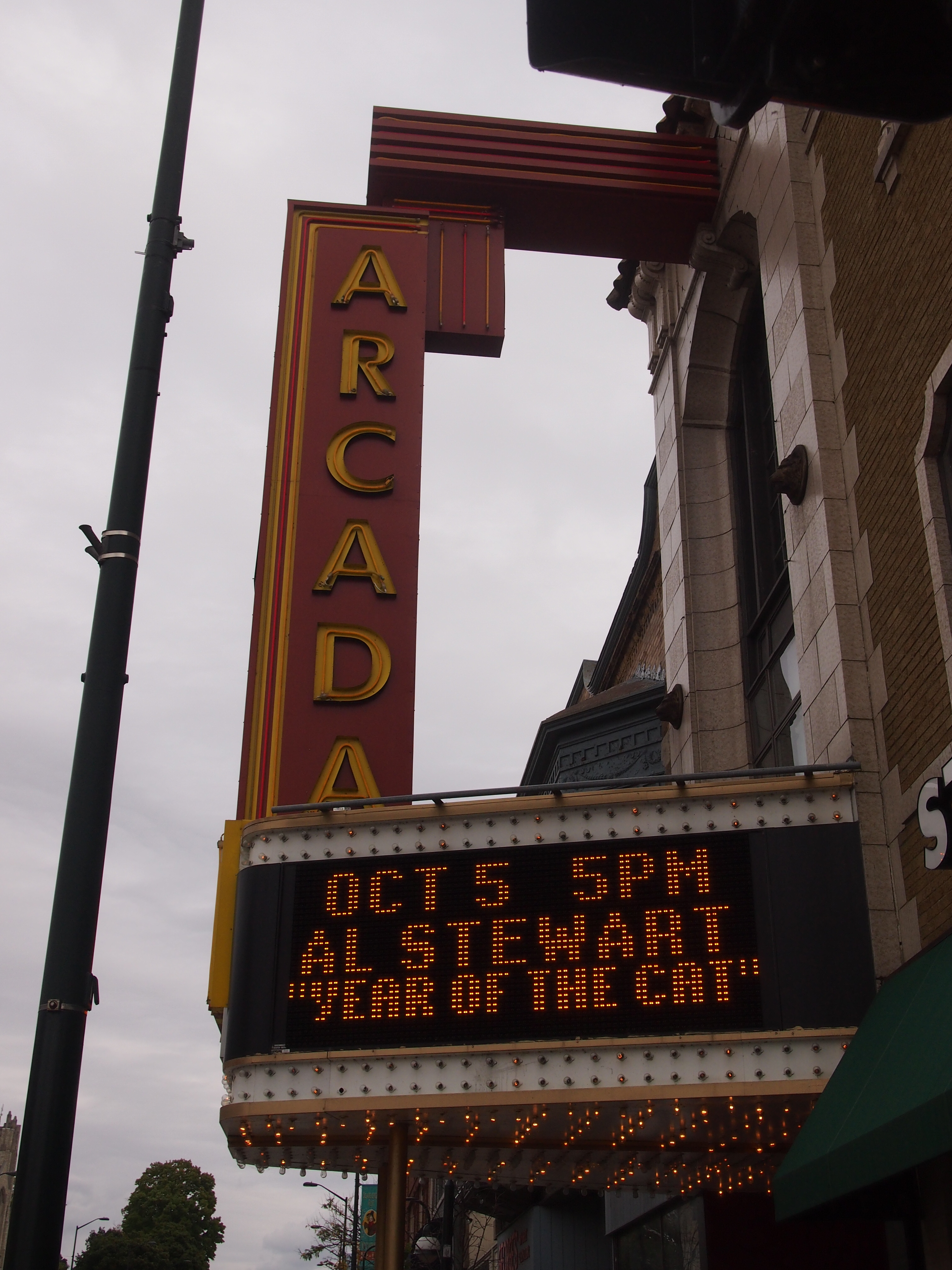
I went to St. Charles on Sunday to see live music at the Arcada Theater, which is on Main St.

Arcada Theater Oct 5, 2014Al Stewart again, with right-hand man Dave Nachmanoff. I hope Al has more years as a touring musician, but he’s 69, so there’s no guarantee. I won’t drive to, say, Saskatoon to see him, but if he plays nearby, I’ll make the effort. No one else in the house was interested, so I went by myself.

The Arcada Theater is a mid-sized venue, seating about 900 and dating from the 1920s when it was built as a movie house and vaudeville stage. Lester Norris – that’s the husband of Dellora Norris – developed the place. According to Wiki at least (I’m not going to chase down another source), the act at the grand opening in 1926 was Fibber McGee and Molly, which would have been when they were known locally in Chicago as radio players.

These days, a fellow named Ron Onesti, president of the Onesti Entertainment Corp., owns the theater. He’s a hands-on kind of impresario, to judge by his talkative, enthusiastic introduction of the act, and the give-away of tickets by random drawing during the intermission that he presided over, asking the audience questions such as who came here from the furthest? (Someone claimed to be from England.)

He’s got a niche: shows for people roughly my age (10 years either side, I’d say). Note some of the upcoming acts: Asia, Gary Wright, the Fifth Dimension, Tommy James and the Shondells, Kansas, BJ Thomas, America, Little River Band. Onesti was also out in the lobby after the show, talking to patrons. “Good show,” I told him.

I talked for a moment to Dave Nachmanoff, for that matter, before the show. He was standing next to a table of his CDs, and another table of Al Stewart merchandise. I told him I’d seen him a number of times, and enjoyed the shows. He seemed to appreciate the sentiment.

Al Stewart was in fine form, expertly playing his guitar and singing with pretty much the same voice as 40 years ago. I doubt that I’ll have half that much energy, should I survive to his age. The set list was mostly mid-period Al, with numbers from Past, Present and Future, Modern Times, Year of the Cat and Time Passages, but also some later songs, such as the especially good “Night Train to Munich” and “House of Clocks.” Not much this time from his early records, if anything, and nothing from Last Days of the Century.

No “Roads to Moscow” either, which is one I’ve yet to hear him play live, and would like to. Of course, it clocks in at more than eight minutes, so maybe he doesn’t play it often. Truth is, the man has a large opus. He could stitch together three or four entirely different set lists and they’d be just as good.

Essential to his show is the patter between the songs, and he didn’t disappoint, either telling stories about swinging ’60s London or the historical context of a particular song or something autobiographical.

For instance: “I decided when I was 11 or 12 that I wanted to play guitar and write songs. But I realized something when I left school at 17. Although I loved rock ’n’ roll, Little Richard and Elvis Presley and the Everly Brothers and Jerry Lee Lewis and Eddie Cochran – I loved Eddie Cochran – I realized when I started trying to do it, I couldn’t do it. I can’t explain how terrible that was. The only thing I loved in the world, and I couldn’t do it. It was a tricky period. Then Bob Dylan came along. He couldn’t play or sing either. [enormous laughter] But he sounded like he’d swallowed a dictionary. [more laughs] That was it. That was my ticket, right there.”

Introducing his song “Warren Harding”: “Pretty much everything went wrong while he was in office, and he followed the cleverest president, Woodrow Wilson, who was fiercely intellectual, and the most idealist president – he believed in world peace, and that he alone could sort out all the troubles in the world after World War I, and it killed him. None of the things he wanted actually happened. Warren Harding: Hey, let’s party! He stayed up drinking with the press corps and playing cards. He was the anti-Wilson. Who was best? Actually, neither of them.”

Al mentioned at point that he was sorry the Bears lost that day. “He follows American football,” Dave said.

“I do, actually,” Al answered.

“He doesn’t care a whit for soccer.”

“I can’t support any game played for 90 minutes, where the score is nothing-nothing. [laughter, applause] That’s not sport, that’s torture.”

Main Street, St. Charles

St. Charles, Illinois, is on the Fox River southwest of where I live, about a 30 minute drive, partly on the two-lane roads near the river. Though quite a ways from Chicago, I suppose it counts as an outer mid-sized suburb, with about 33,000 inhabitants.

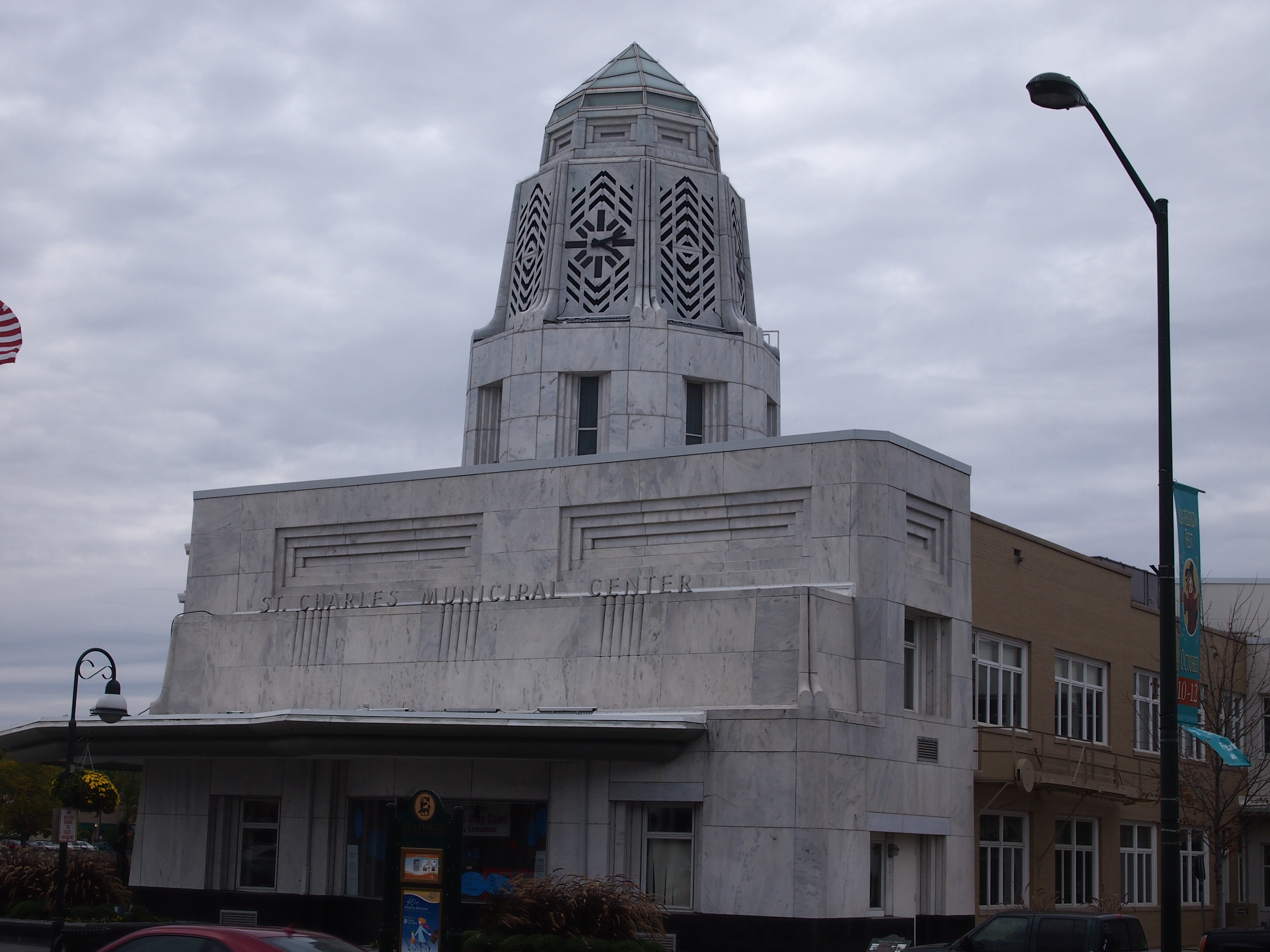
It’s got an interesting municipal building on Main Street, overlooking the Fox. Not too many Art Moderne municipal buildings around, at least in metro Chicago.

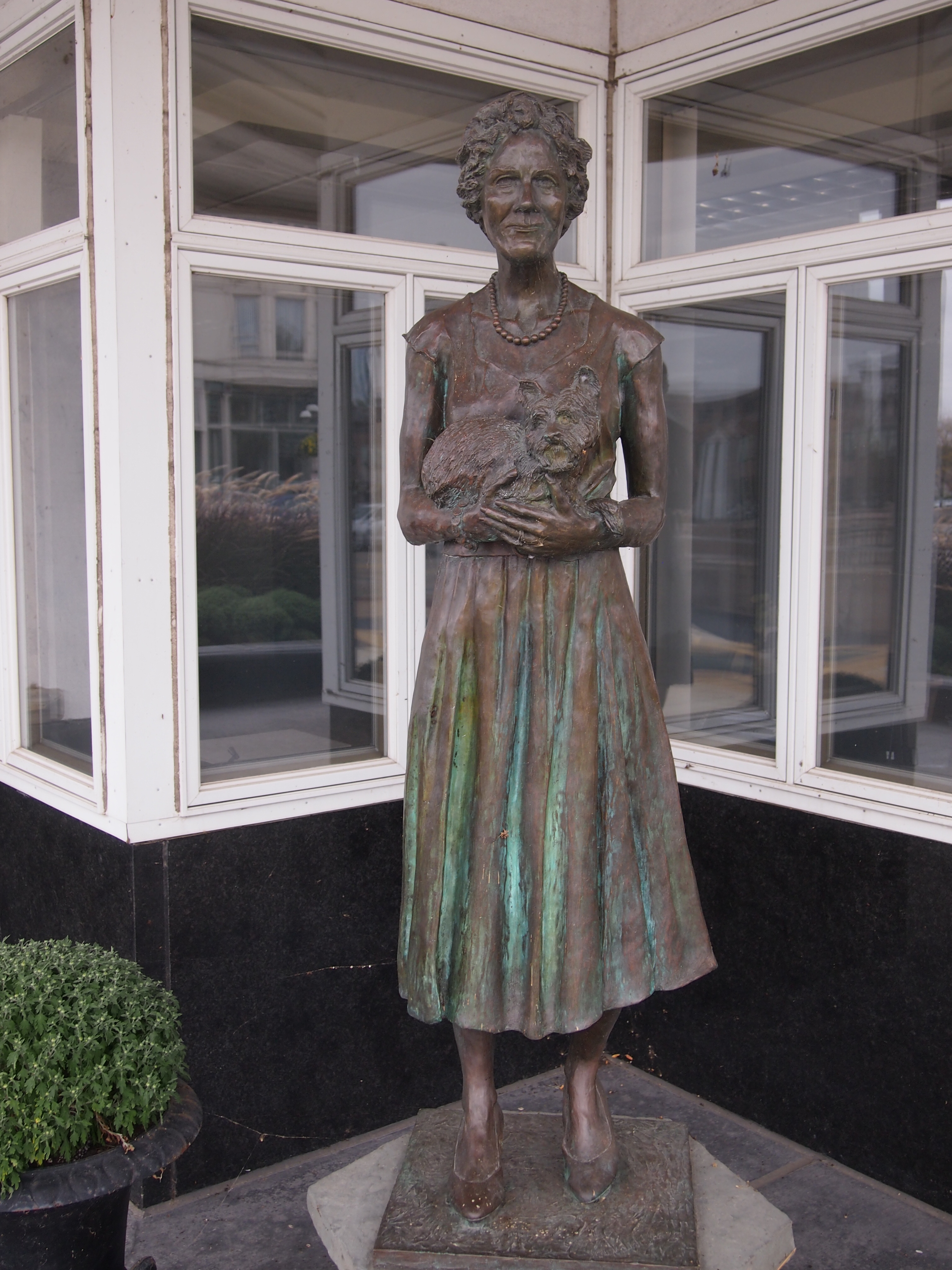
St Charles, Ill. Oct 5, 2014Vintage 1940, and it sure looks like it. Designed by R. Harold Zook, early 20th century architect noted for his work in the area, and for a fun name, at least by me. Get a little closer, and you’ll find Dellora standing in from of the edifice.

St Chas, Ill. Oct 5, 2014And her dog Toto? Her plaque doesn’t say. It does tell us that this is a representation of Dellora Angell Norris (1902-1979): “Her vision and generosity shaped our community for generations to come.” Not to quibble, but shouldn’t that be will shape? Ah, well. It’s in bronze, no editing now. Dedicated June 8, 2006. The sculptor is Ray Kobald.

Mr. Kobald is local to St. Charles. Think globally, sculpt locally.

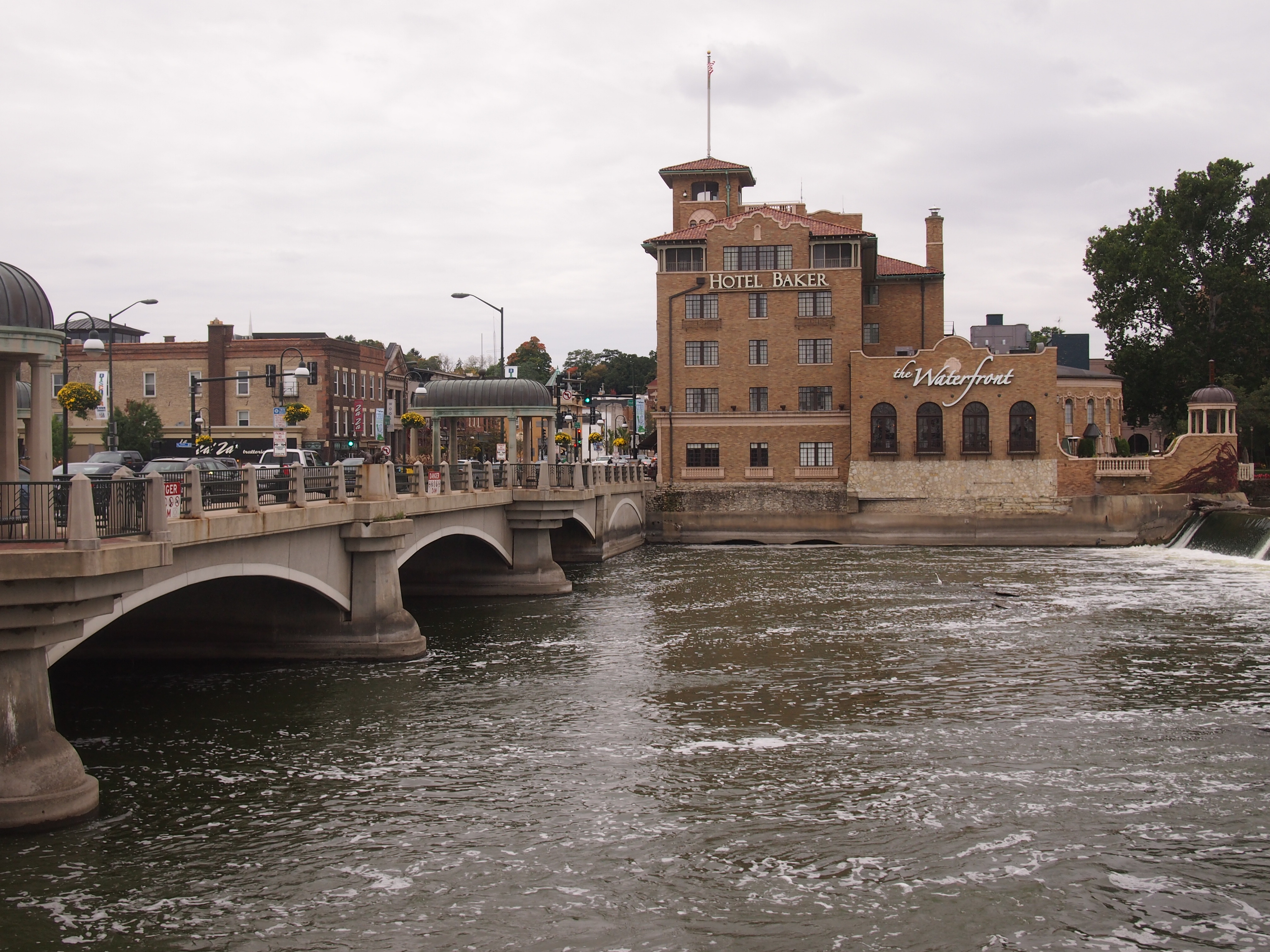
On the west side of the Main Street bridge in St. Charles is the Hotel Baker.

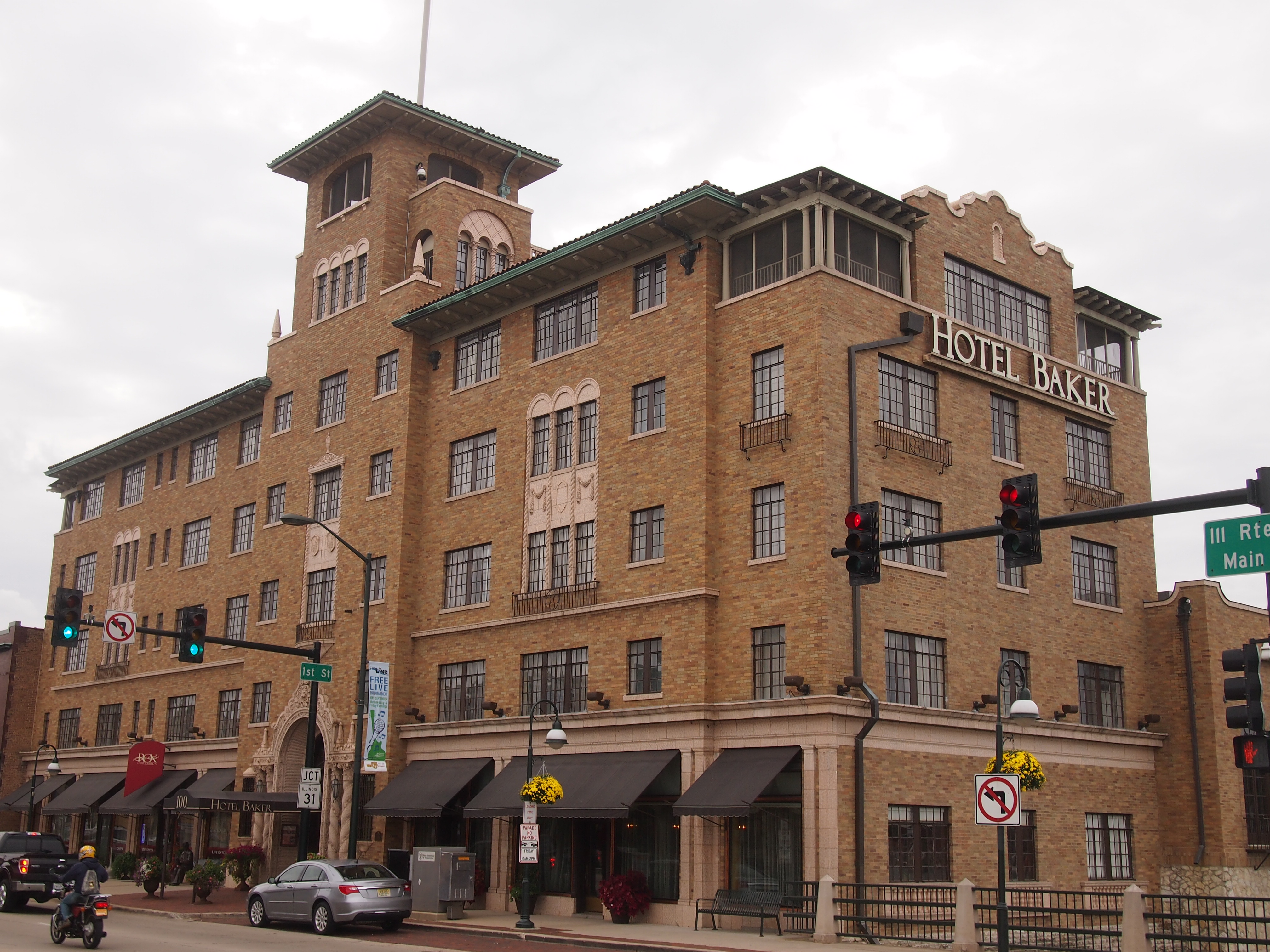
Hotel Baker, St Charles, Ill. Oct 2014A closer view.

Hotel Baker, Oct 2014Local millionaire Edward J. Baker, one of the heirs to John “Bet-a-Million” Gates barbed wire and oil fortune, developed the property in 1927 (Dellora Norris was another heir). Over the years it was a hotel, then a retirement home, now a hotel again. Actually, he was Col. Baker — a Kentucky colonel, somehow or other. More about him here.

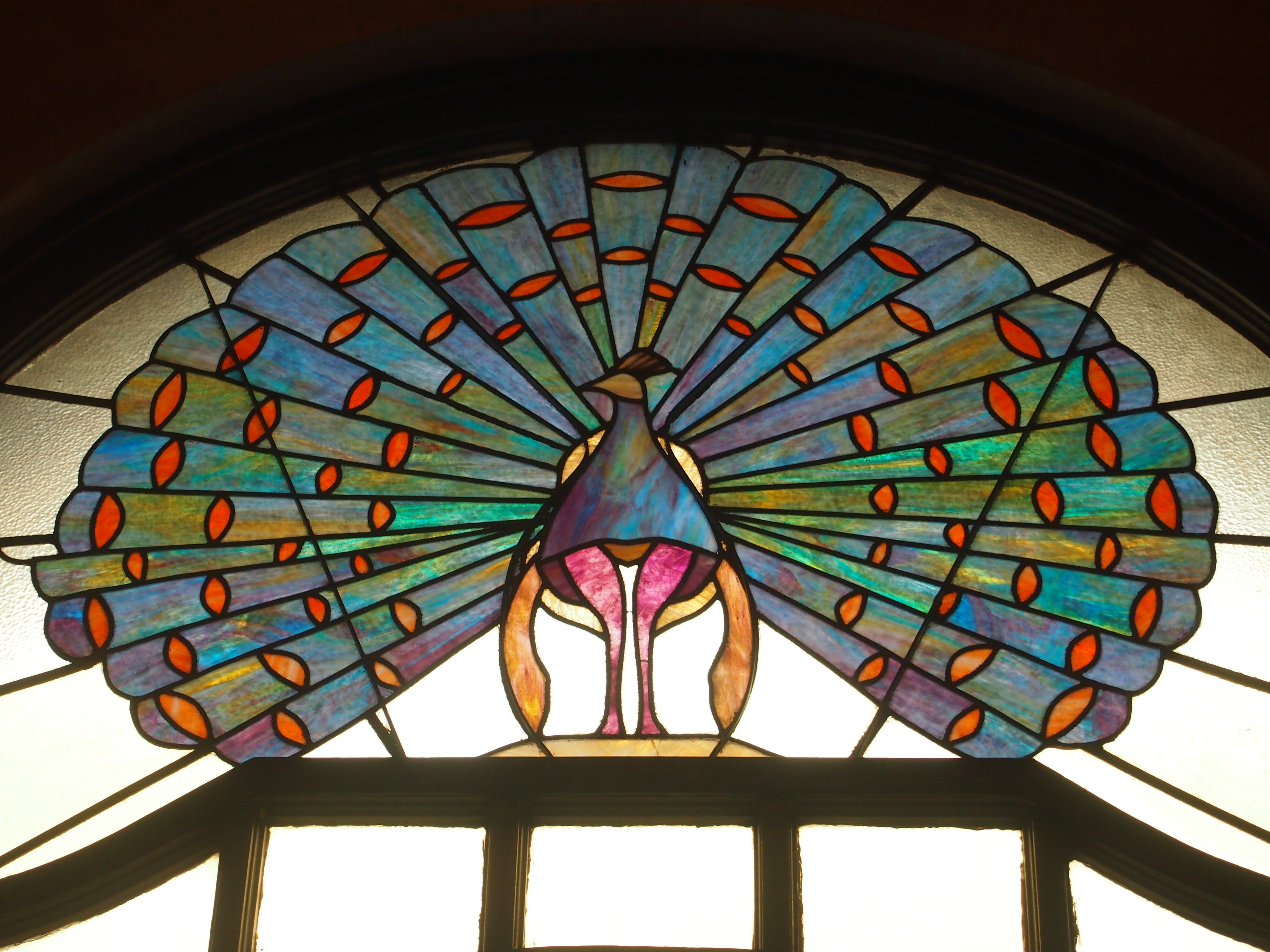
I ducked inside for a moment, fond as I am of spiffy hotel lobbies. Over the entrance, facing inward, is this nice piece of work.

Hotel Baker, Oct 2014The Baker Peacock, you could call it.

Telephone Incident 1992

In my apartment in Osaka, I had a black rotary phone connected to the wall by a sturdy black cord. There was no way to disconnect it without damaging the cord. Even in the early 1990s, that setup was a throwback. I don’t remember my phone number any more, but maybe it was 609 3443 or 3449. The problem described below didn’t go on for long, fortunately.

October 11, 1992

Recently some business somewhere has been assigned a phone number very similar to mine. At least it doesn’t seem to be a place, like a pizza joint maybe, that gets calls every minute. Even so, someone’s got 609 3446, one misstroke on a push-button phone from connecting with me. I received about a half-dozen call for this business in the afternoon.

At first I answered the phone each time, telling the caller than he had a wrong number, after which he would invariably call back. One dim bulb called three times, even after I’d told him (in reasonably good Japanese) that he’d misdialed the last digit.

I was annoyed until I had the inspiration of holding the receiver close to my tape deck, which I’d turn up a little for the occasion. Then I started having fun with it. No one ever called back after hearing a little music. The jolt must have made them more careful of the next dialing.

Everywhere a Sign

A question to ponder: How can Crème Caramel Chicago’s product be so good? Ingredients: milk, eggs, sugar, cream, caramel, vanilla. That’s it. Yet in the words of Shakespeare, it’s a wow.

It’s also a product of EU Foods, though it has nothing to do with that supranational entity, I think, since it was made in Bensenville, Illinois.

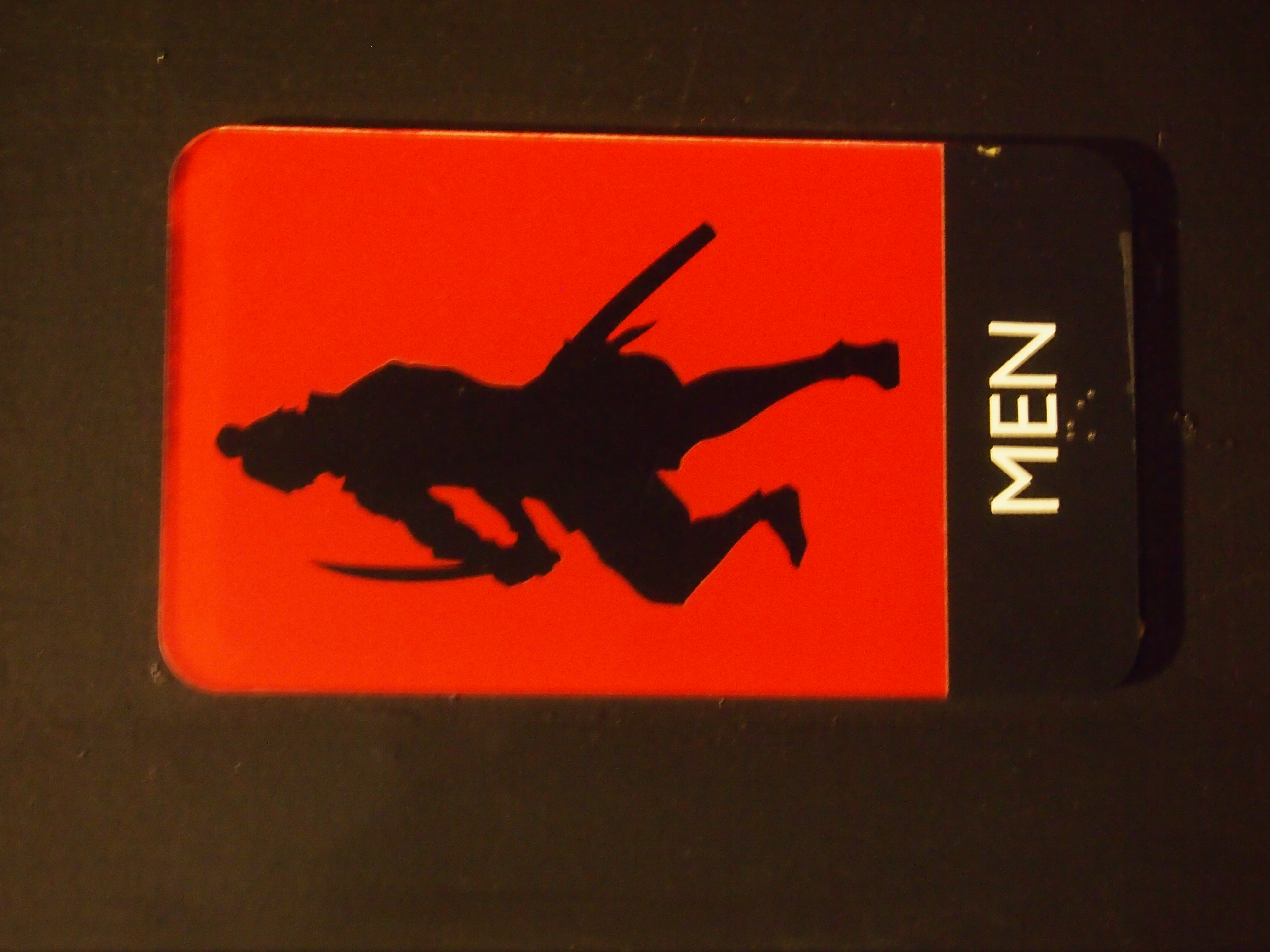
Another thing to ponder: a thematic men’s room sign.

Samurai bathroom attendantI saw it about a year ago in Dallas at the Ann & Gabriel Barbier-Mueller Museum. As I write this, the wires – quaint, that term – are burning up with news of the first U.S. Ebola case, and the honor goes to Dallas. Well, why not? Texas excels at so much else.

I doubt that we’ll get an epidemic, though. What we will get is excessive news coverage. Just another reason to avoid cable news, out in that vast wasteland. Vaster now than when I was born; a regular Sahara.

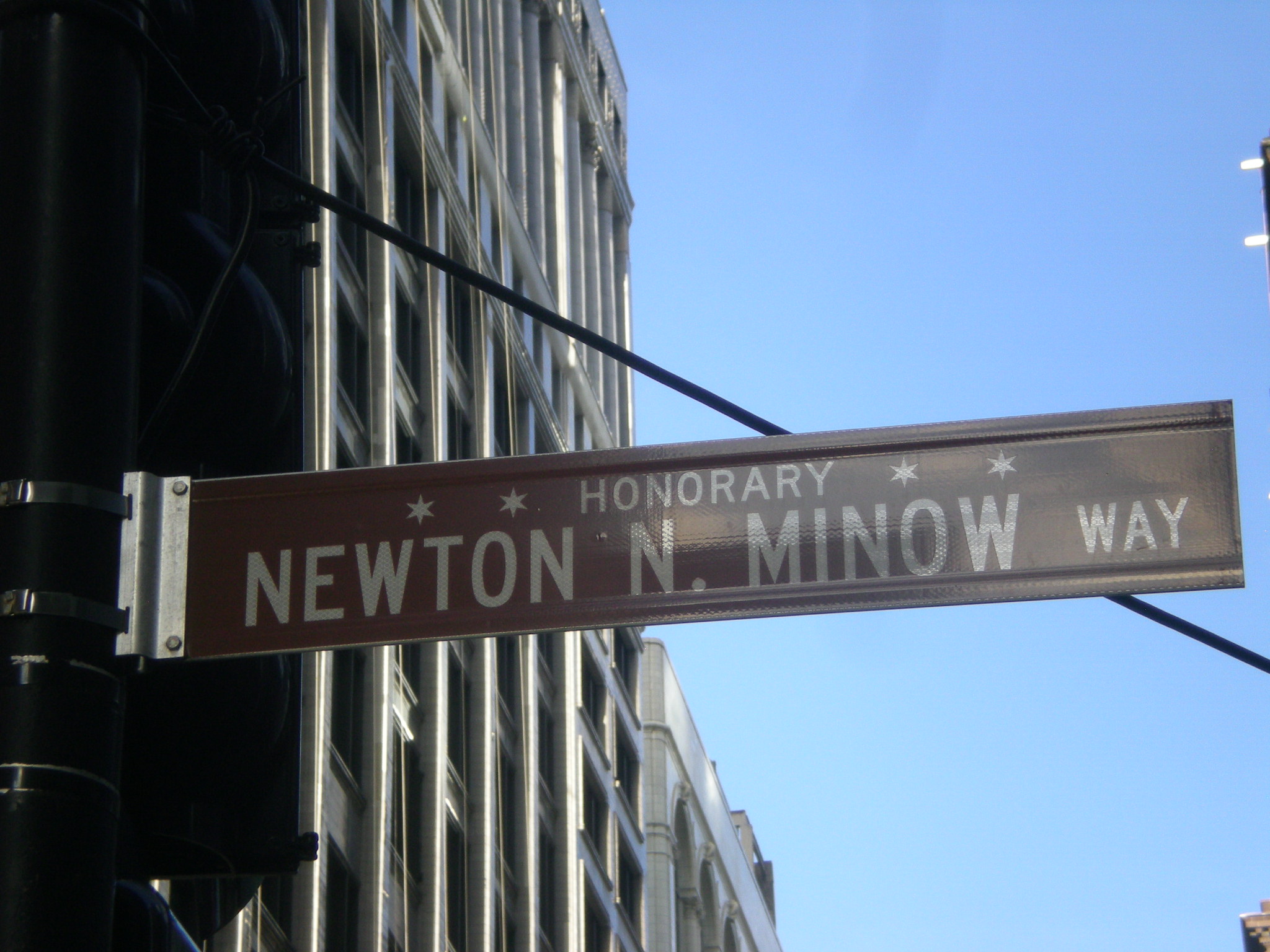
Newton MinowI didn’t know that Newton Minow had an honorary street sign in Chicago, but I saw it downtown last month. I’m happy to report that at 88, Mr. Minow is still alive and kicking.

A Handful of Pilsen Murals

Distinctly cool today. Call it fall. I’ve read the British consider that usage quaint, or maybe bumpkinish, since “fall” passed out of common usage for them in the 19th century, replaced by “autumn.” Here in North America, we kept the more Anglo-Saxon, and evocative term, though it’s roughly on par in usage with Latinate autumn.

Makes you wonder (me, anyway) why a Latinate equivalent for spring didn’t catch on – “vernam” maybe. Or “aestam” for summer and “hiemiam” for winter (I can see why that didn’t catch on. An alternative would be “brumam” for winter). That’s the kind of thing that occurs me when I see a few leaves floating by.

I need to spend a little more time in Pilsen, where St. Procopius is located. Some years ago I visited National Museum of Mexican Art, back when it was known as the Mexican Fine Arts Center Museum, which is in the neighborhood. The museum had a really good collection of Día de los Muertos-related art on exhibit, which it does every October.

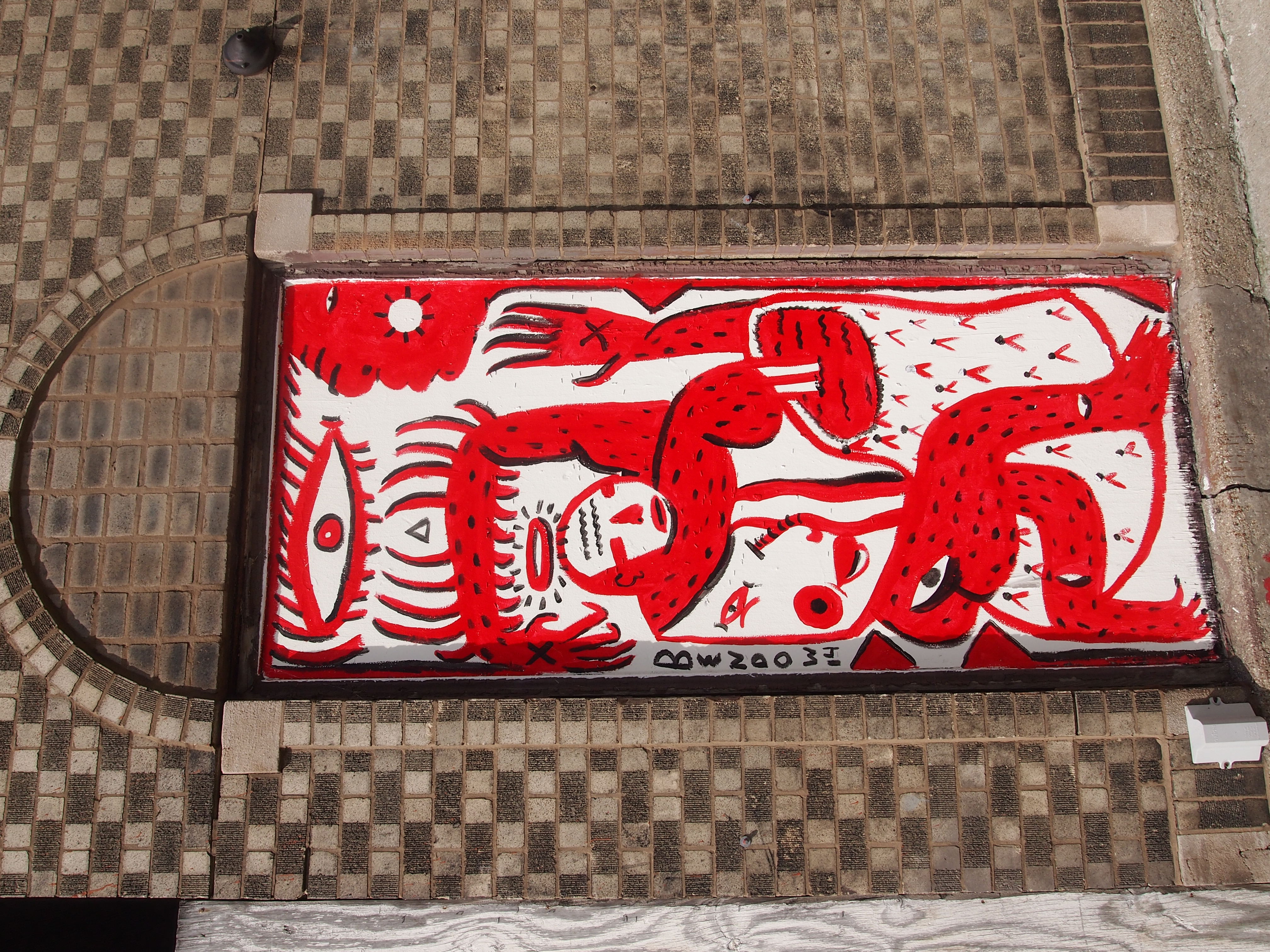
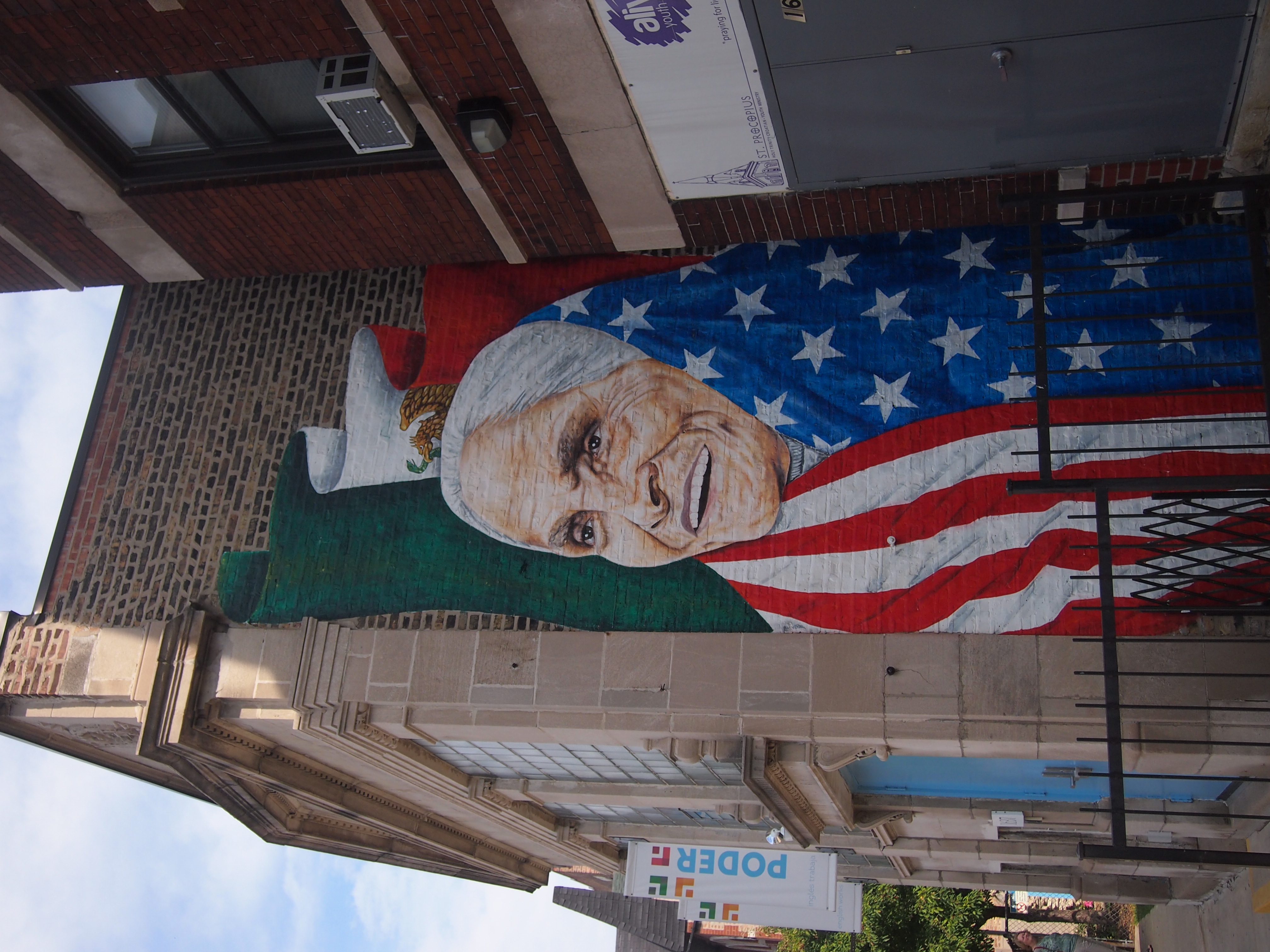
Pilsen’s also got good Mexican food and outdoor murals to look it. We didn’t have a lot of time to wander around and look at them during the bus tour, but I managed to run across a few. Such as this door-sized one, dated this year.
Pilsen mural, Sept 2014A larger one.

Pilsen muralAnd a more horizontal one.

Pilsen mural, Sept 2014I saw a few more from the window riding by. There are many more.

Greater Furano 1993

As a destination, Hokkaido has a lot to recommend it. Seafood and walks in the hilly town of Hakodate; mountains in the central part of the island for skiing, for people who like that, as well as biking and hiking trails; fall foliage on par with New England or East Tennessee; dairy products on par with Wisconsin; scenic Lake Akan; a wine-making region, including a wine “castle”; and Sapporo, the only place on the island as crowded as a Honshu city, but with its charms, such as the Sapporo Beer Garden.

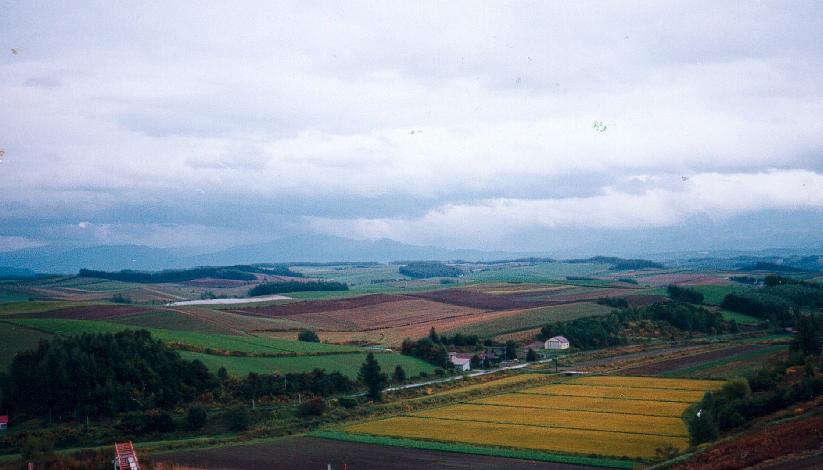
The foliage up in the central mountains offered vivid yellows and reds when we visited in late September and early October 1993, but green still predominated in the agricultural areas near Furano, a small city also in central Hokkaido. The terrain isn’t mountainous, but not flat either.

Near Furano, Hokkaido, 1993The region is known for its carrots and onions and corn and lavender, as well as milk and ice cream, none of which the outside world associates with Japan. The Meiji government saw its chance to remake Hokkaido into an agricultural province in the late 19th century – they might have been a little worried that the Tsar wanted it, along with Sakhalin – and naturally hired foreign experts to get things rolling. In this case, the agriculturist William Clark of Massachusetts, who established Sapporo Agricultural College (now Hokkaido University) in the 1870s. We saw his statue at the school.

We walked on one of the roads outside of town. As I said, still mostly green.

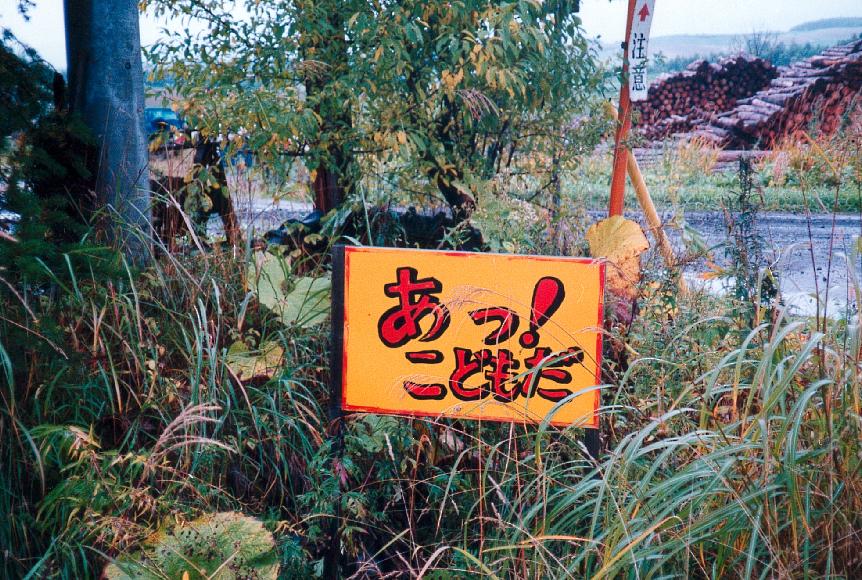
Near Furano, fall 1993This sign was simple enough for me to read. Watch out! Children. Essentially, a Children At Play sign.

Children at Play Sign, Hokkaido, fall 1993I liked this.

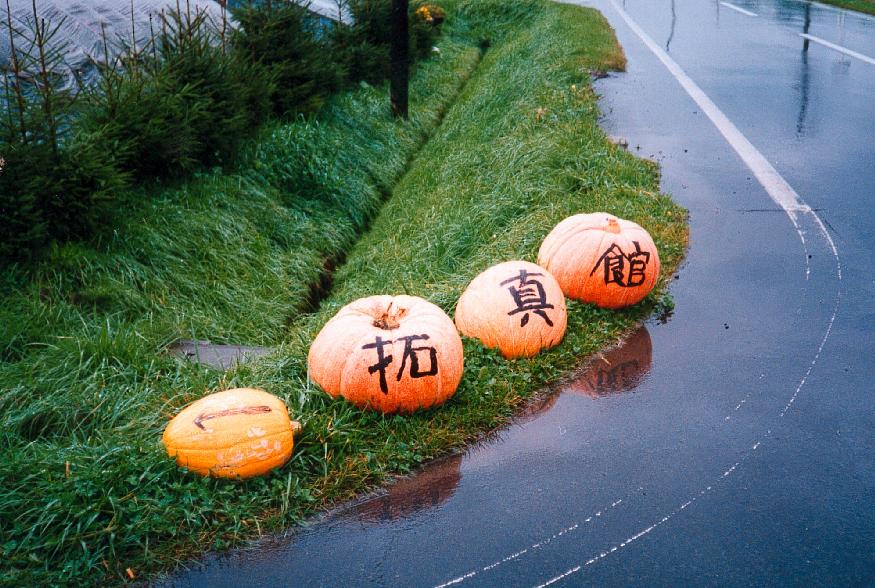
Hokkaido pumpkins, fall 1993Hokkaido farmers also seem to grow pumpkins, used here to advertise a museum. Taku’s Photography Museum, Yuriko tells me. But we didn’t take Taku up on visiting his museum.

First Baptist Congregational Church

By the time we got to the last church on the tour, we were feeling the overload. At least I was. It’s the kind of feeling that drives you back to your room for an evening of television – a bad movie in another language is just the thing — after spending the day looking at grand churches or magnificent museums or arresting ruins or even just intense, one-thing-after-another cities, or some combo of all these.

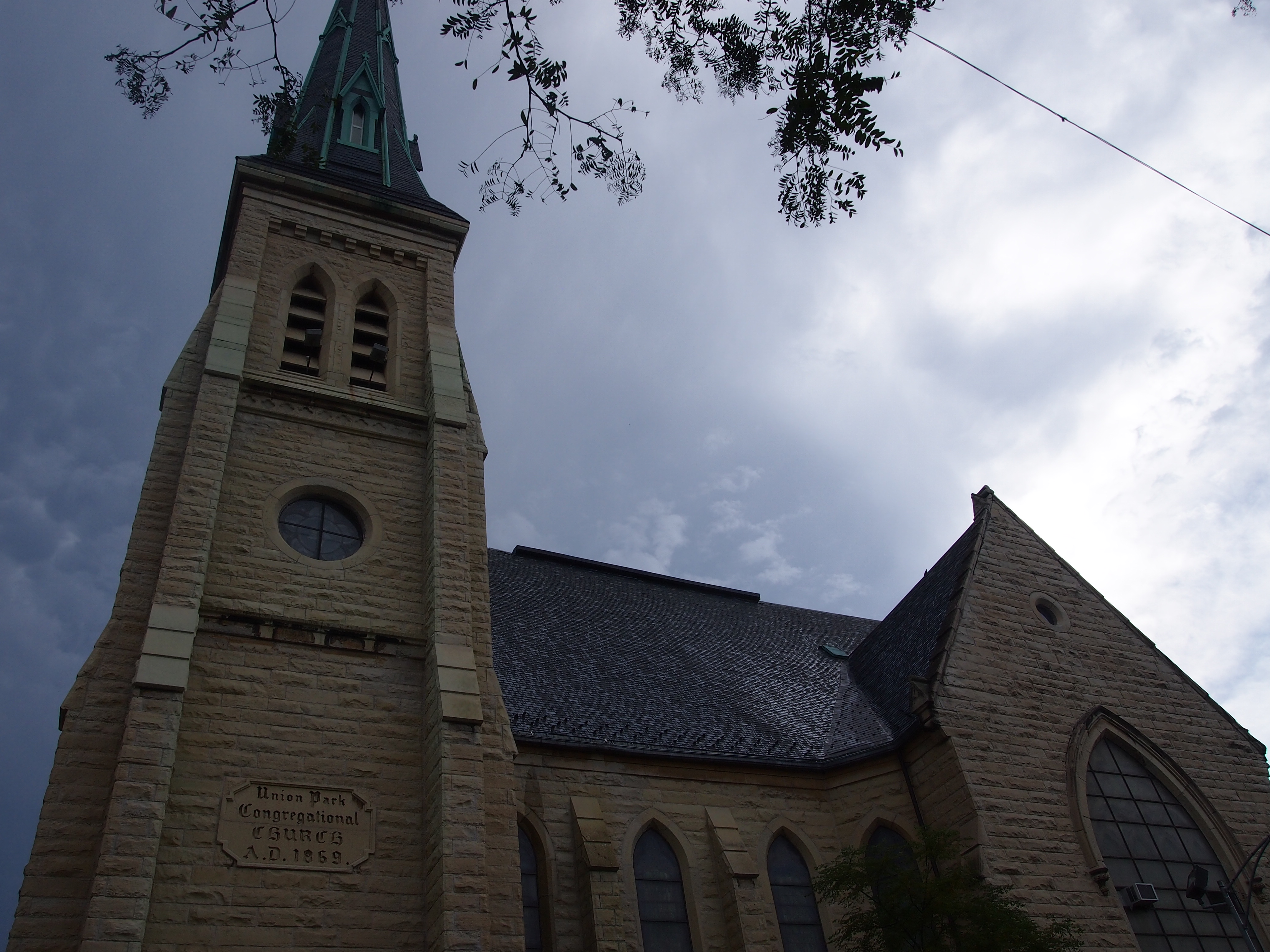
First Baptist Congregational Church Well, one more. We can handle that. The last one for bus #4 was the curiously named First Baptist Congregational Church at 60 N. Ashland Ave. Its Gothic Revival outside hinted that it was going to be another big, spectacular church inside. That’s a good thing, of course. But the effect wears off a little after four others.

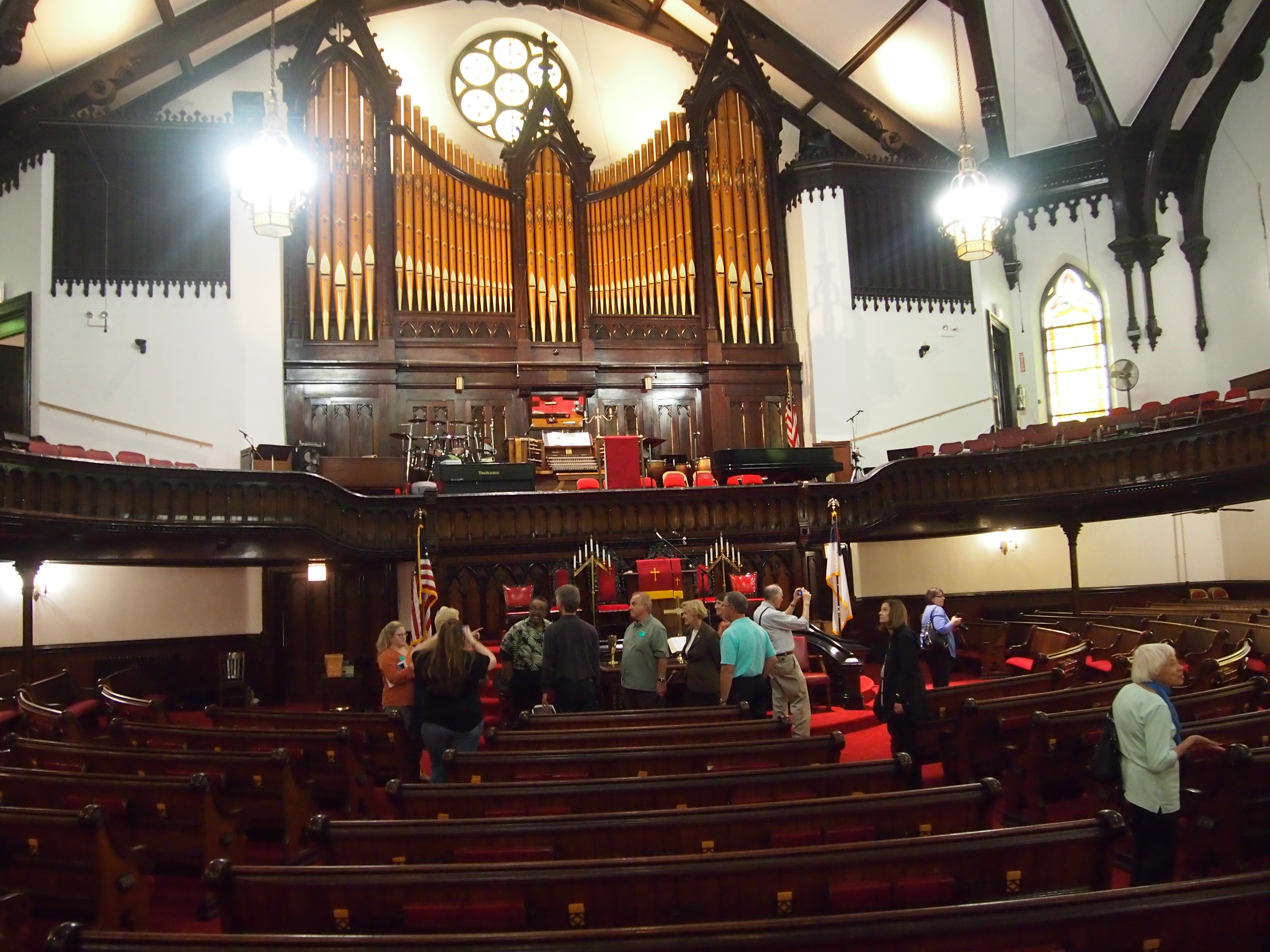
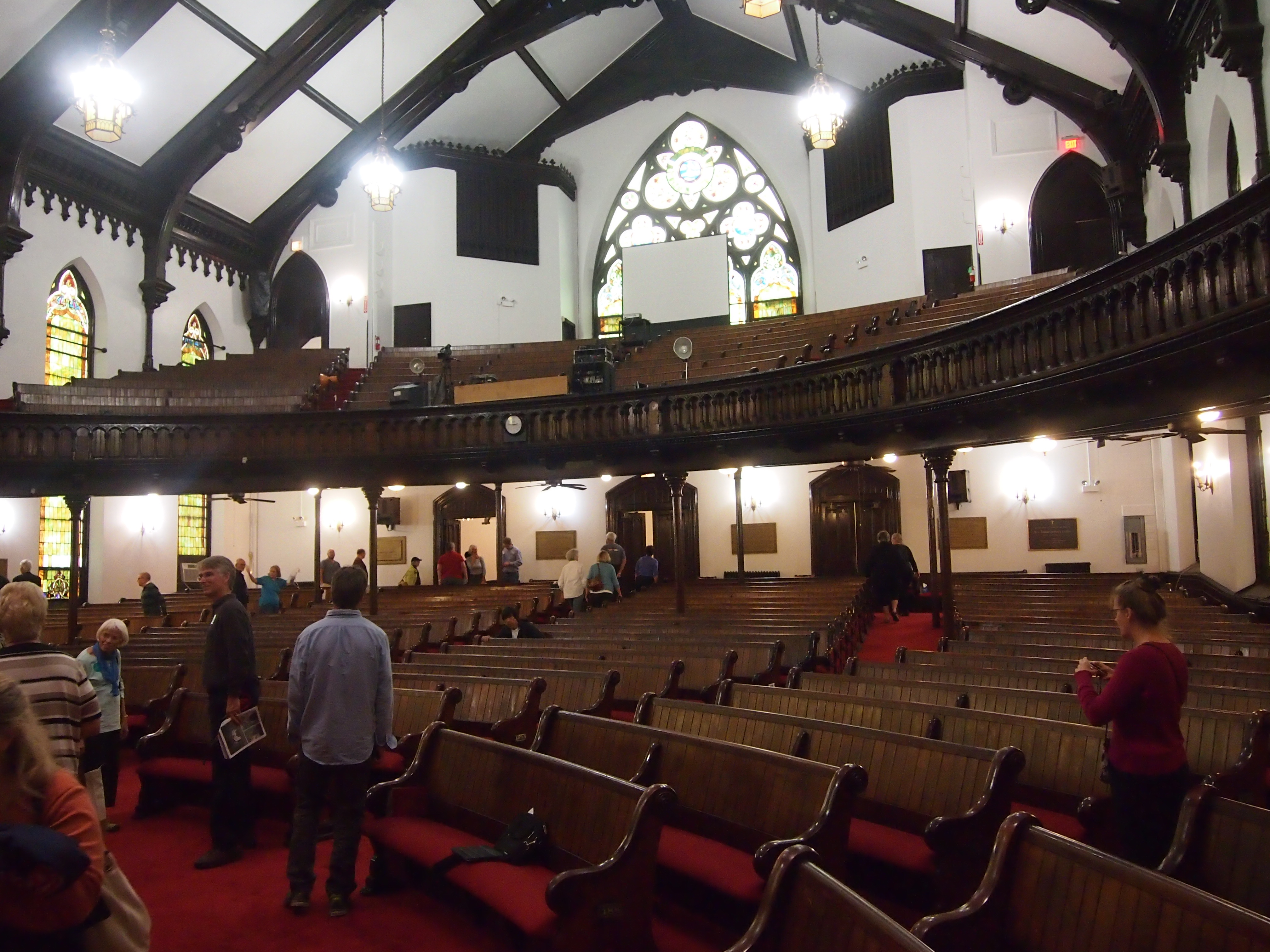
It was spectacular inside. But not in the way I expected. It perked me right up and made me want to look around. It wasn’t like any of the other churches. For one thing, First Baptist Congregational is an auditorium church, trimmed in dark woods, a very inviting design.

The view toward the front, facing the powerful organ, among other things.

First Baptist Congregational Church, ChicagoToward the back.

First Baptist Congregational Church, ChicagoIt’s also the oldest of the churches we saw that day, built as the Union Park Congregational in 1869, long enough ago that the congregation who built it had been abolitionist before the war, and active in resisting the enforcement of the Fugitive Slave Act. After the war, the congregation counted Mary Todd Lincoln as a member for a time.

They hired one Gurdon P. Randall to design their church. He was active in Chicago both before and after the war, but apparently a number of his structures were lost in the Chicago Fire. Union Park Congregational survived, since the fire didn’t reach this far west. Through a number of shifts in congregation whose details I’ll skip, the modern congregation is affiliated with both the United Church of Christ and the National Baptist Convention.

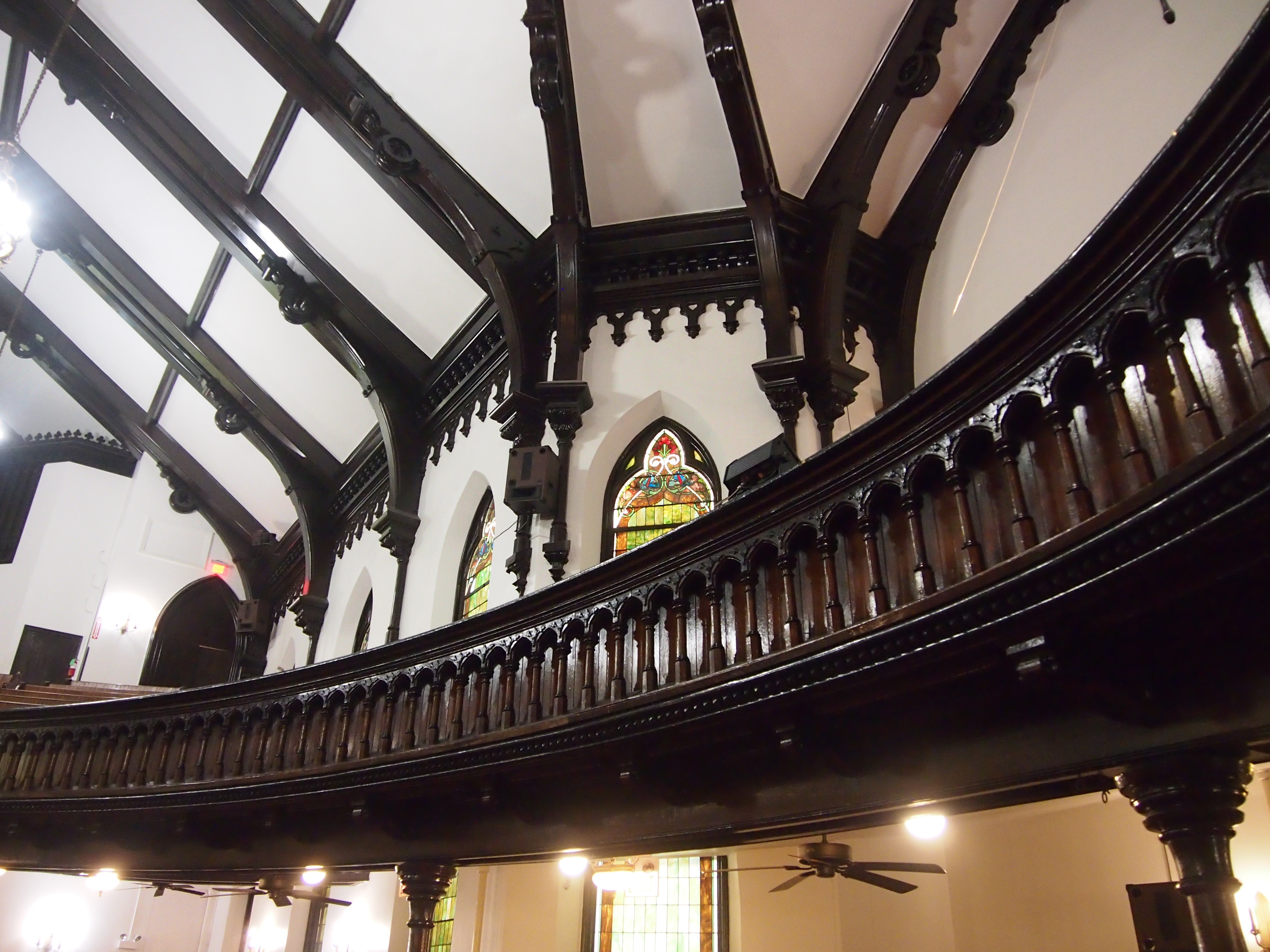
It isn’t lavish in an in-your-face way, but the detail is remarkable.

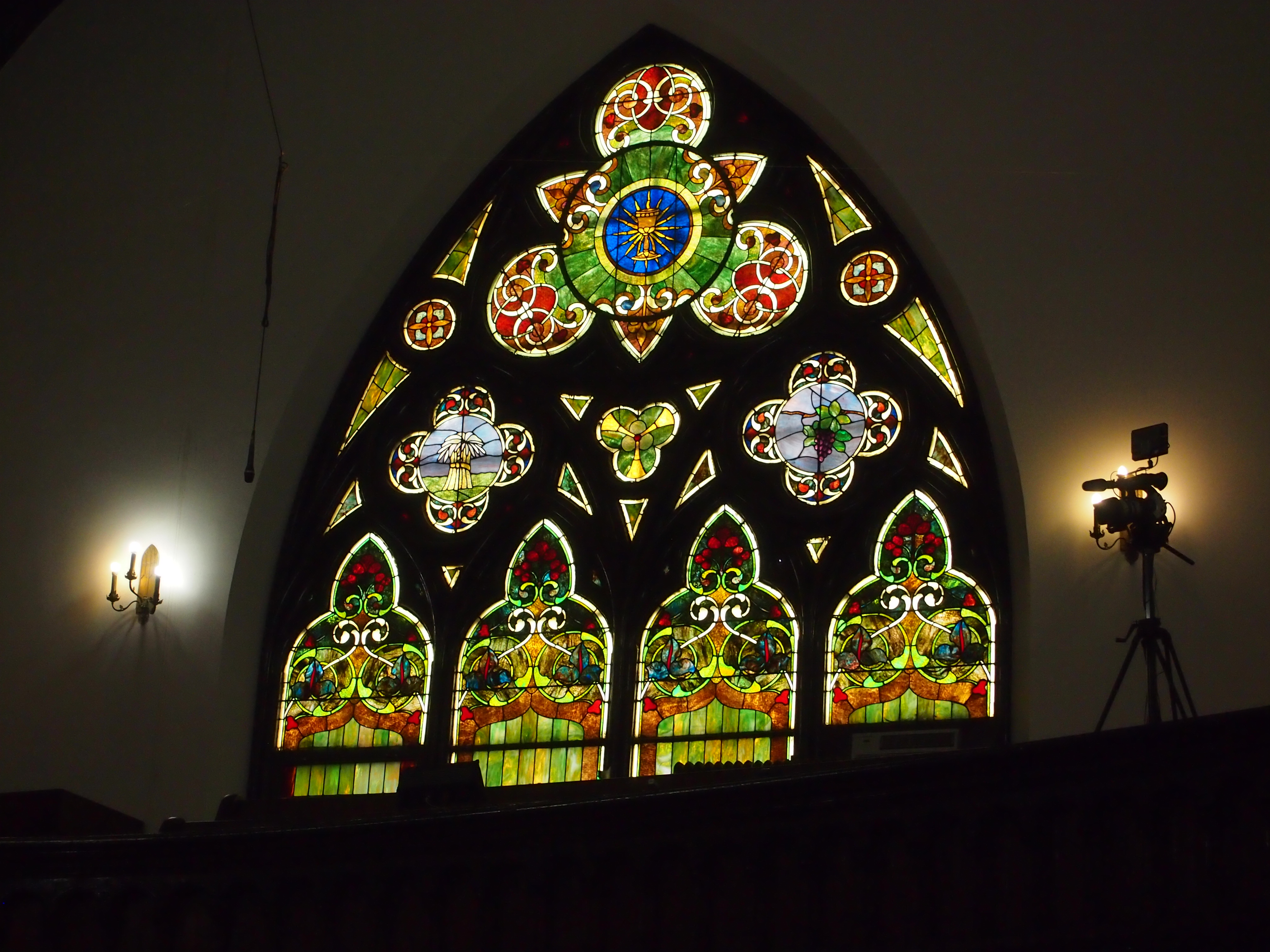
First Baptist Congregational Church, Chicago, Sept 20, 2014Got pretty stained glass, too.

First Baptist Congregational Church, Chicago, Sept 20, 2014About three years ago, a snowstorm sent one of the smaller spires crashing through the roof and the false roof over the nave (if that’s the right term for an auditorium church). That was bad enough, but apparently the wind then carried soot that had accumulated between the two roofs over the years inside the church, covering everything. The restoration was only recently completed.

St. Paul’s Catholic Church

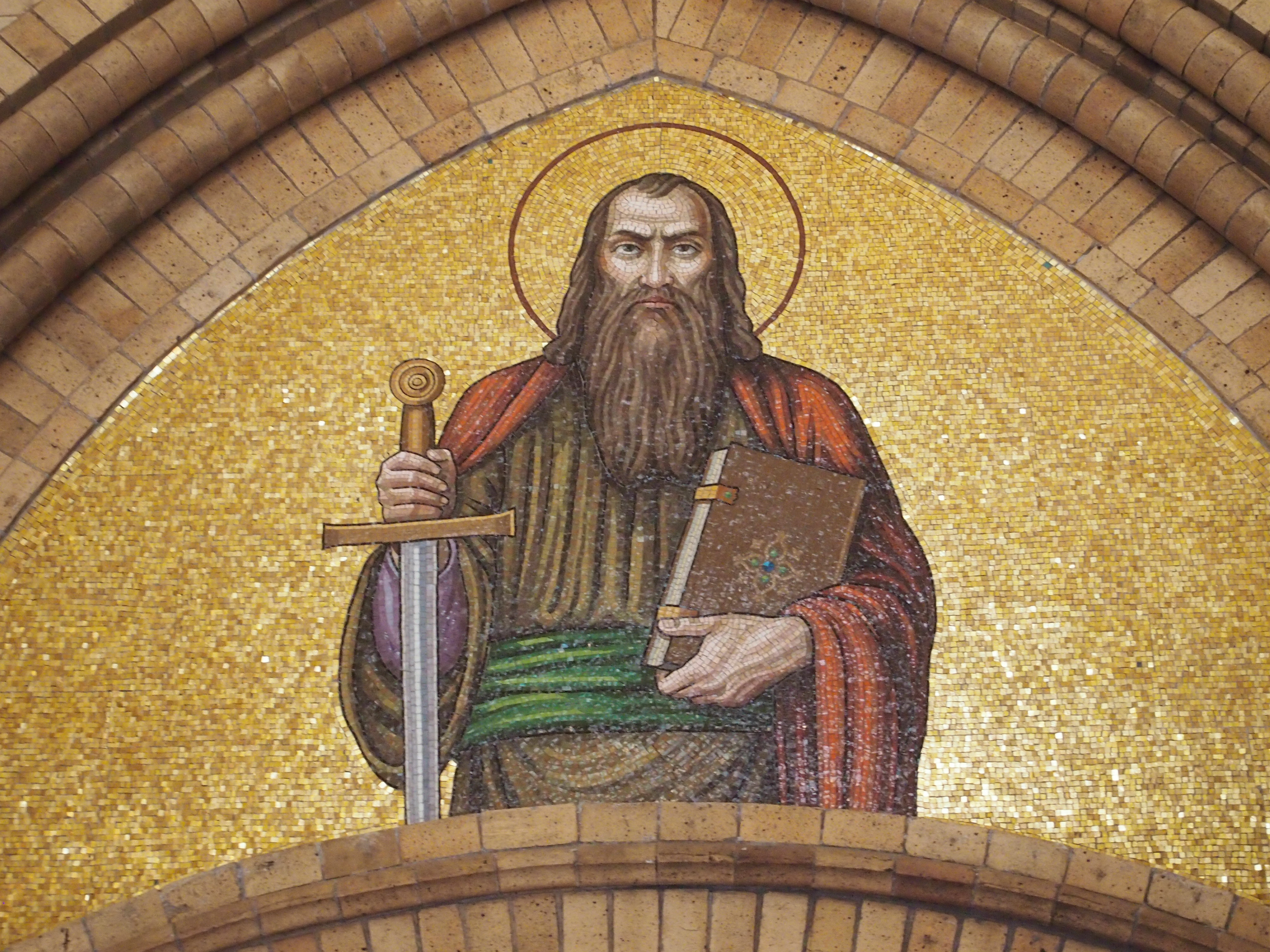
At St. Paul’s Catholic Church at 2234 S. Hoyne in Chicago, Paul is there to greet you.

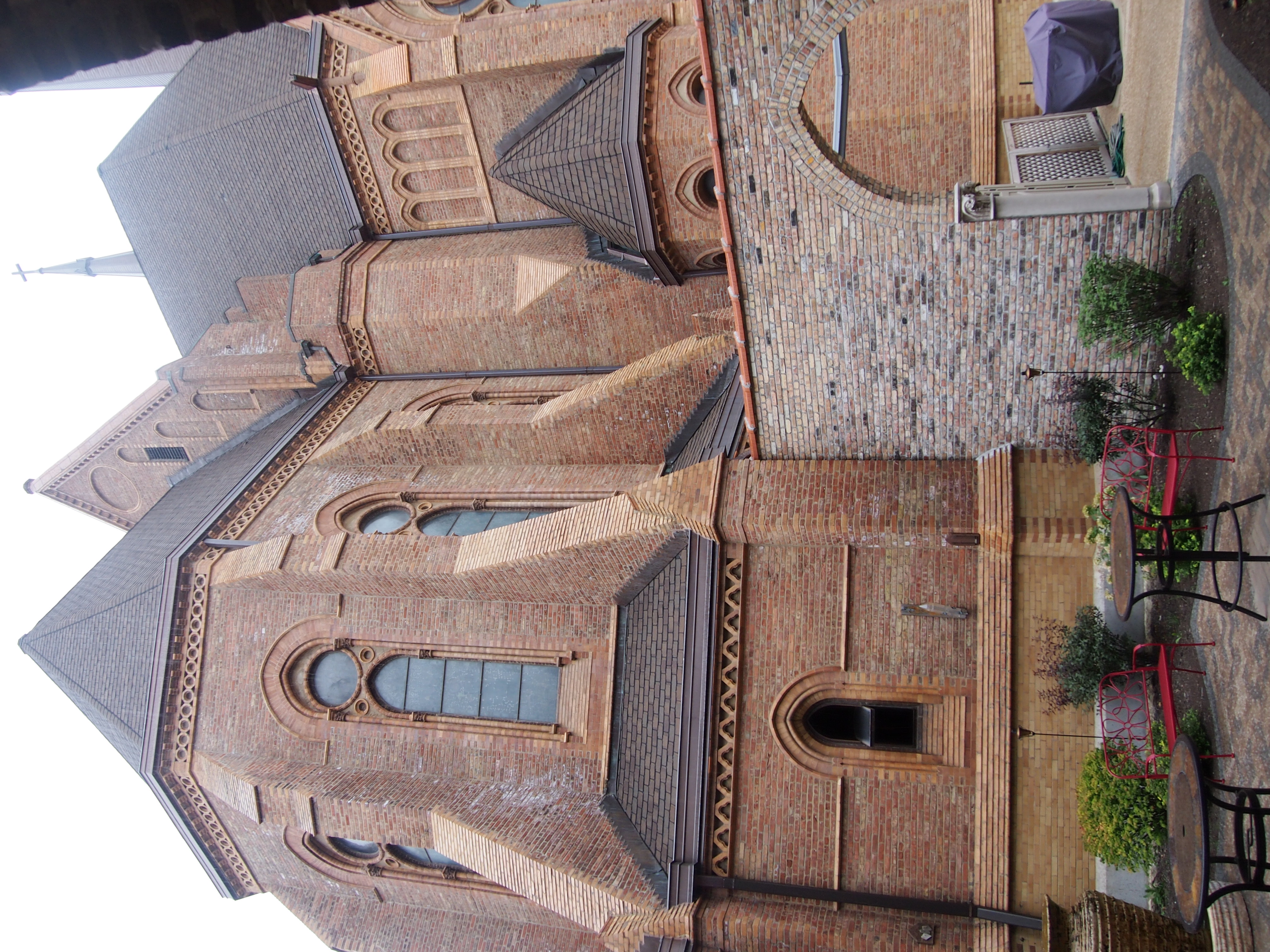
St Paul's, Chicago, Sept 2014Or at least a mosaic St. Paul does, looking absolutely certain of his mission to the Gentiles. He’s above the front entrance, and while the church has many brilliant mosaics – and who doesn’t like a brilliant mosaic? – note the bricks around the Paul mosaic. The entire church is an enormous, artful mass of those bricks. As this view from the rear makes clear.

OLYMPUS DIGITAL CAMERA“St. Paul’s Church was established by a small German community in 1876, with its cornerstone laid in 1897,” the CAF says. “Designed by Henry J. Schlacks, the church was built entirely by its own parishioners — many of whom were professional bricklayers. Singled out in Ripley’s Believe It Or Not as ‘the church built without nails,’ the structure underwent a long-term restoration project completed in 2013. The gothic-style building is visible from all sides of Pilsen due to its exceptionally tall spires and dark brick.”

Schlacks, of course, is the fellow who did St. Adalbert (see yesterday). But St. Paul was an astonishingly early work in his career, since he was only 28 at the time. “Schlacks himself took on the role of general contractor and hired men of the parish…” the CAF says. “He wrote, ‘We could find no builder in Chicago acquainted with the proposed method of construction, or who could give even an approximate estimate of the cost from my plans….’ ”

True to the tradition of its building, parishioners did most of the recent renovation, as this article in Crain’s Chicago Business (of all places) notes. And a fine job of it they did.

St Paul's, Chicago Spet 2014

It’s all brick, even the white areas on the ceiling, which were plastered over at some point. The mosaics, we were told, were completed in the early 1930s – ordered in pieces from Germany, I believe. Especially striking are Jesus and the Apostles, though they look a little like they’re at a board meeting of some kind (the nonprofit Salvation Co).

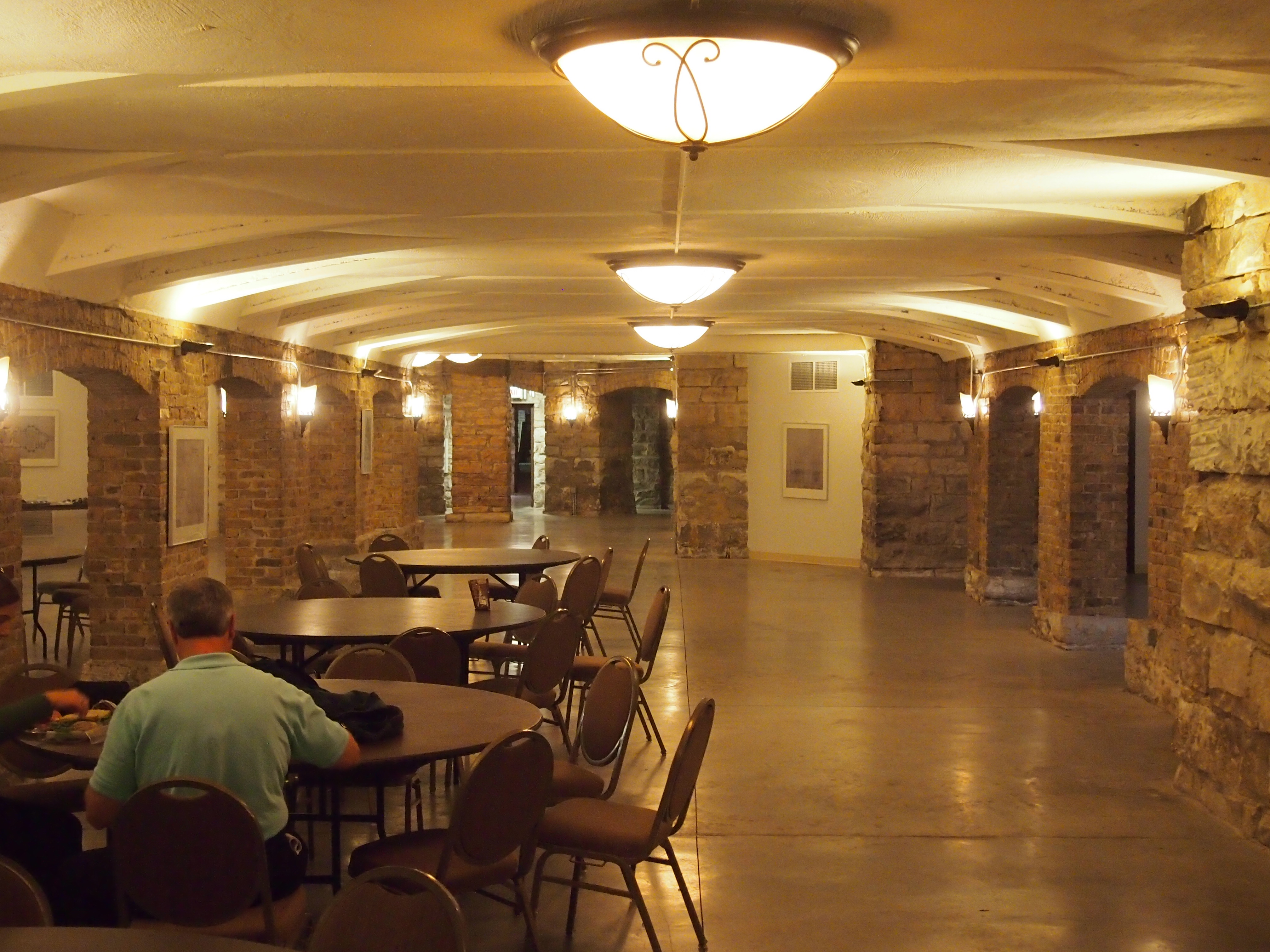
St Paul's Chicago, Sept 2013By the time we got to St. Paul’s, we were eating our sack lunches in the bus. The tour took us downstairs for more refreshments. The lower level, now an event and meeting space, was a major part of the recent renovation, and striking in its own way.

St Paul's, Chicago, Sept 2014When I saw it, I thought, Rathskeller. Perfect place to hoist a brew and sing drinking songs in bad German. In the case of the tour, however, the only drinks on offer were water, soda and coffee.

St. Adalbert Catholic Church

The third church on the CAF bus tour last Saturday was St. Adalbert Catholic Church, named for another saint I knew little about. That only goes to show I’m not up on my hagiography, since he seems to be a fairly big-wheel saint of the 10th century. He’s the patron of Bohemia, Poland, Hungary and Prussia, and a martyr. The story is that pagans up around the Baltic Sea – whom he was trying to Christianize — offed him for cutting down their sacred oak.

According to Wiki, at least, he’s well remembered, even in our time: “April 1997 was the thousandth anniversary of Saint Adalbert’s martyrdom. It was commemorated in the Czech Republic, Poland, Germany, Russia and other countries. Representatives of Catholic, Greek Orthodox, and Evangelical churches pilgrimaged to Gniezno, to the saint’s tomb. John Paul II visited Gniezno and held a ceremonial divine service in which heads of seven European states and about a million believers took part.”

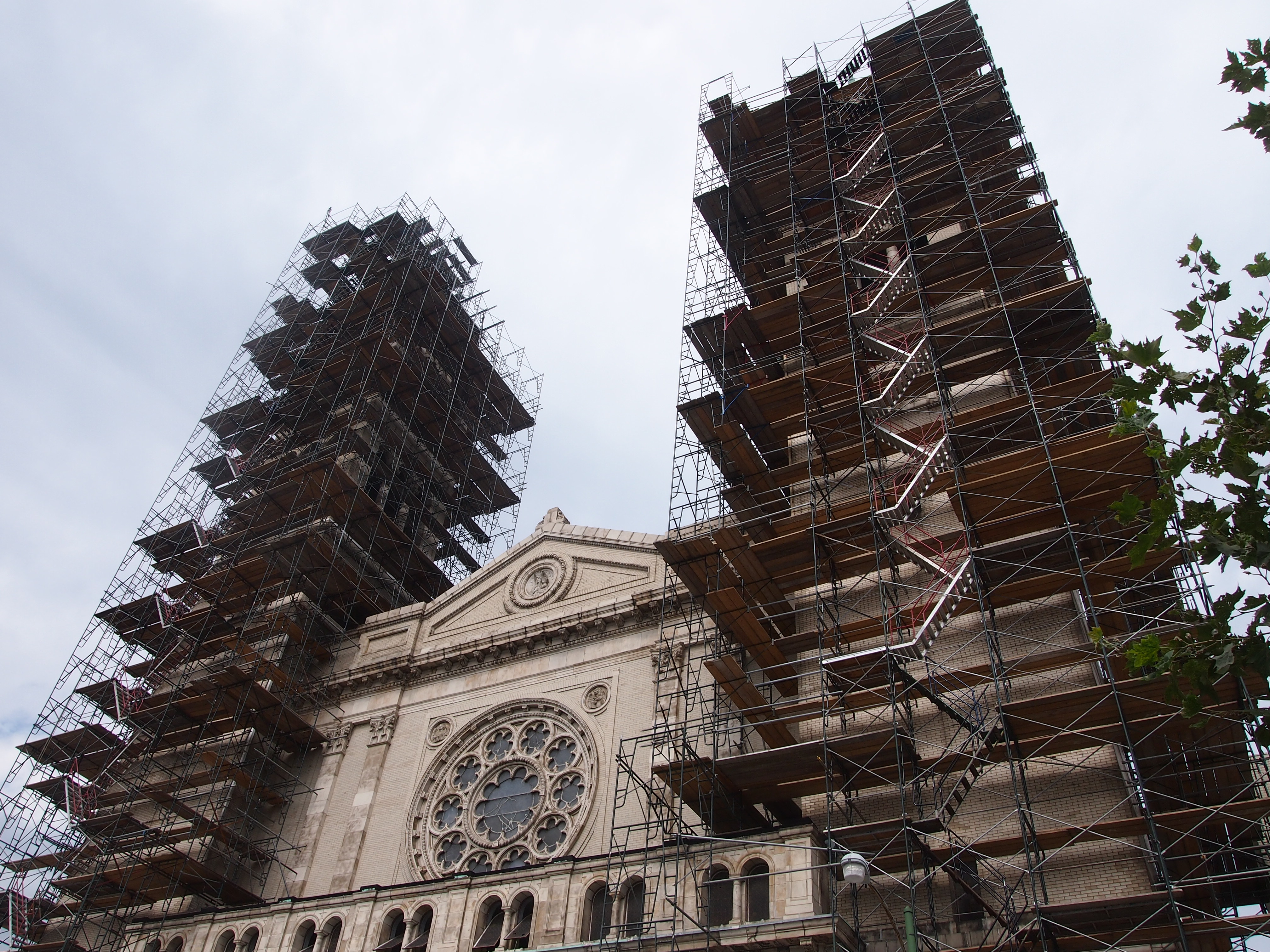
In Chicago, St. Adalbert is at 1650 W. 17th St., and currently has some structural issues.

St. Adalbert Catholic Church, Chicago, Sept 2014That’s some of the largest scaffolding I’ve ever seen. Apparently the church’s twin towers are losing their will to resist gravity, and need renovation. Naturally, there isn’t enough money for that, and a cheaper option is to shorten them. That seems like a damn shame. I looked around for a box to drop a dollar in for the cause of saving the towers, but I didn’t see one.

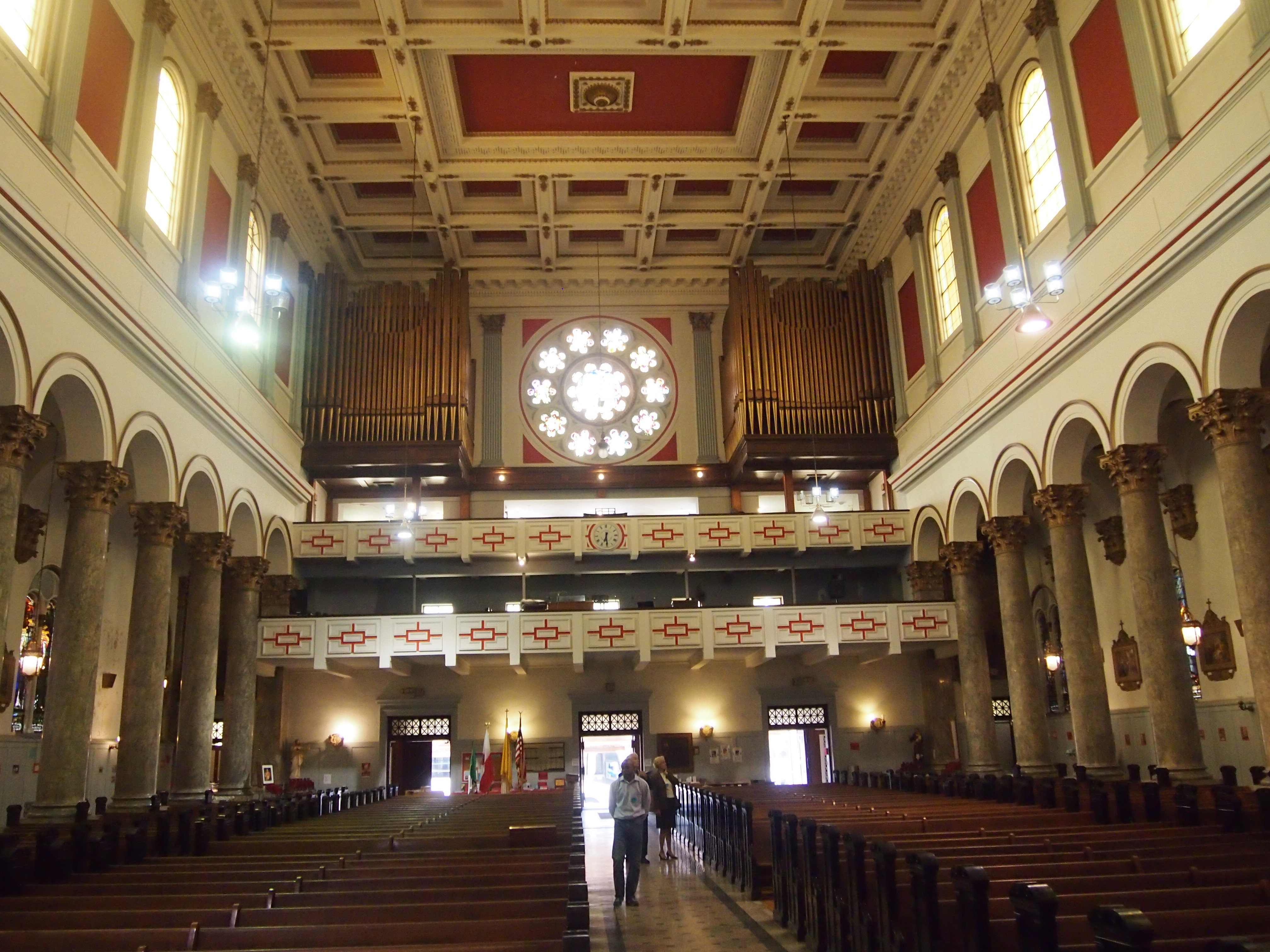
St. Adalbert is the newest of the churches we saw, completed in 1914. Chicago Poles hired Henry Schlacks, who was renowned for his church work in Chicago, to design the structure. It’s done in Italian Renaissance style, and it reminded me of some of the churches I saw in Italy, though I couldn’t say quite which (it’s been more than 30 years, after all).

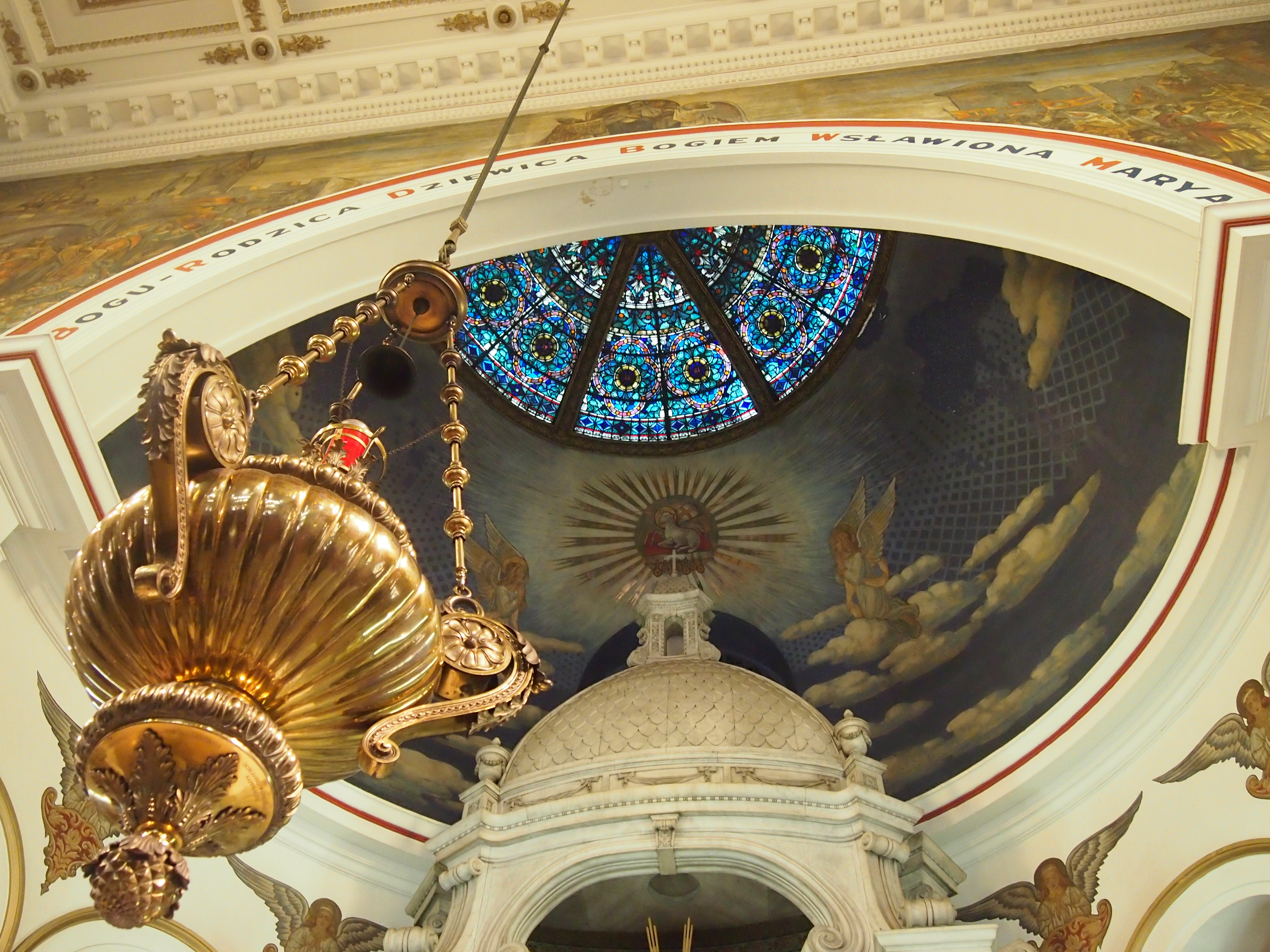
St Adalbert's ChicagoSt. Adalbert Catholic Church, Chicago, Sept 2014In its early days, the church was Polish through-and-through. Above the altar is a mural depicting events in the saga of Poland, such as the wedding of Queen Jadwiga of Poland and Prince Jagiello of Lithuania, and (I think) the frustration by Charles X of Sweden’s designs on Poland, for which Our Lady of Czestochowa seems to get some credit. Also, the Polish in the arch over the altar is the opening words of “Hymn of the Motherland.” In more recent times, shrines to Our Lady of Guadalupe and Our Lady of San Juan de los Lagos have been added, a reflection of more recent demographics.

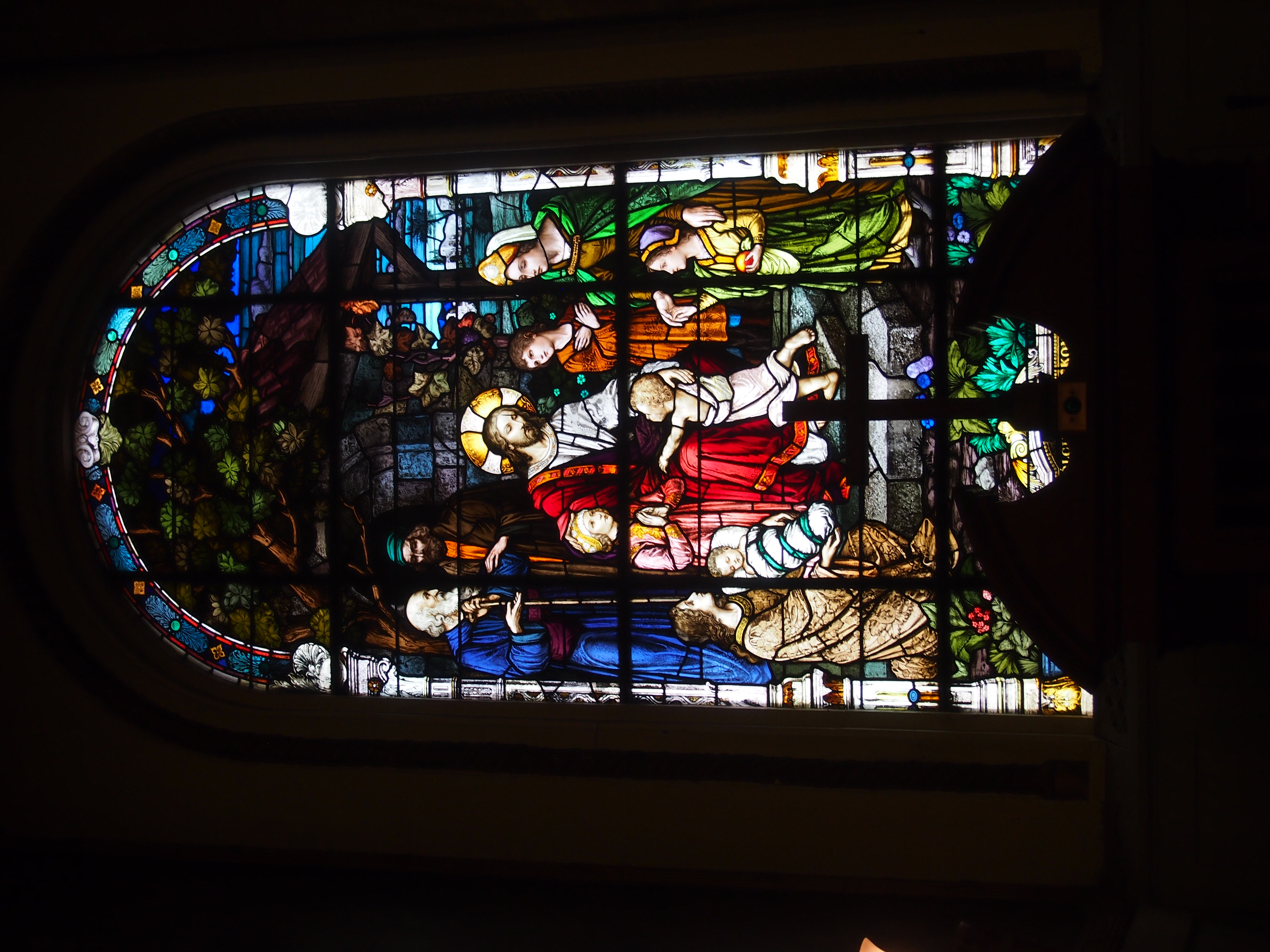
The church features an excellent collection of stained glass, some of which tell the story of Adalbert and his efforts to convert the heathen up near the Baltic Sea. Others are episodes from the New Testament.

St. Adalbert Catholic Church, Chicago, Sept 2014There’s even a large Tiffany dome far above the altar.

St. Adalbert Catholic Church, Chicago, Sept 2014It’s almost hidden away from casual inspection, peeking out like a moon in the clouds.