View From the Brackenridge Eagle

Last time we were in San Antonio, we rode the Brackenridge Eagle miniature train, which makes a circuit through the park of the same name. The Sunken Gardens is near the main depot and the ride isn’t that expensive, so on impulse we went again. Ann insisted on borrowing my camera and documenting the ride. She took some good pictures.

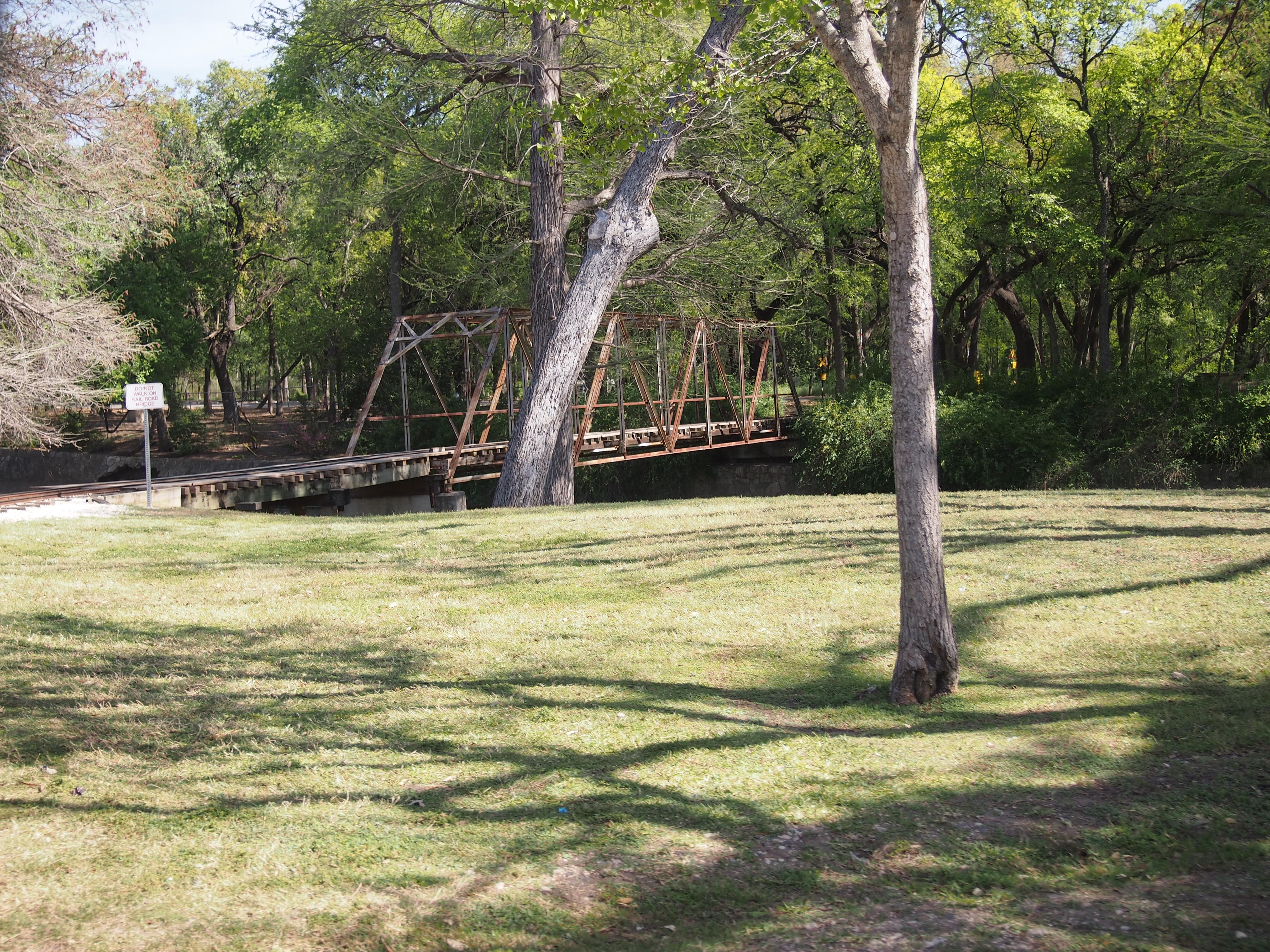
This a (miniature) RR bridge across the San Antonio River.

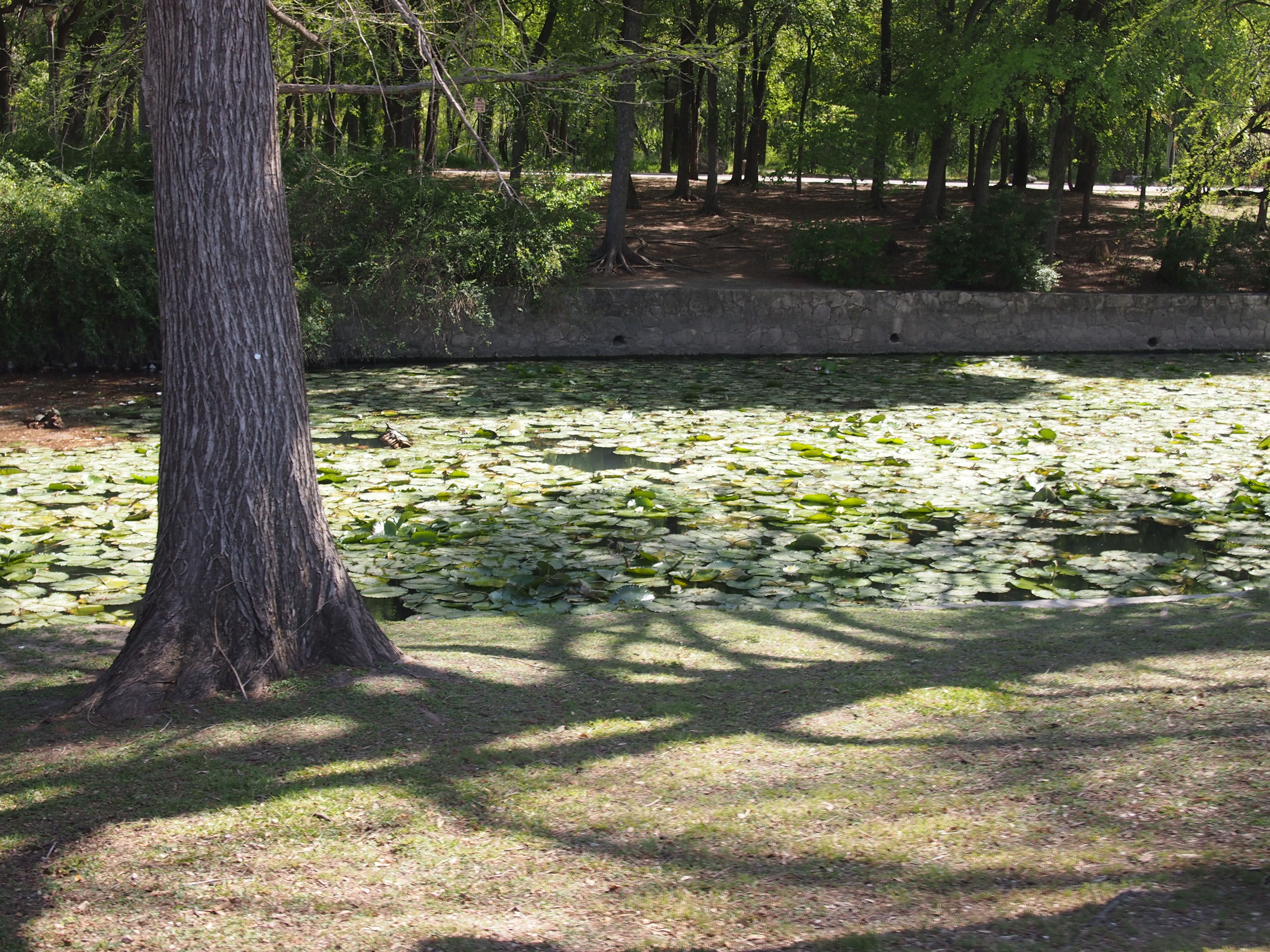
And the river itself, in its lily pad glory. This point isn’t very far at all from the headwaters of the river, which accounts for its small size.

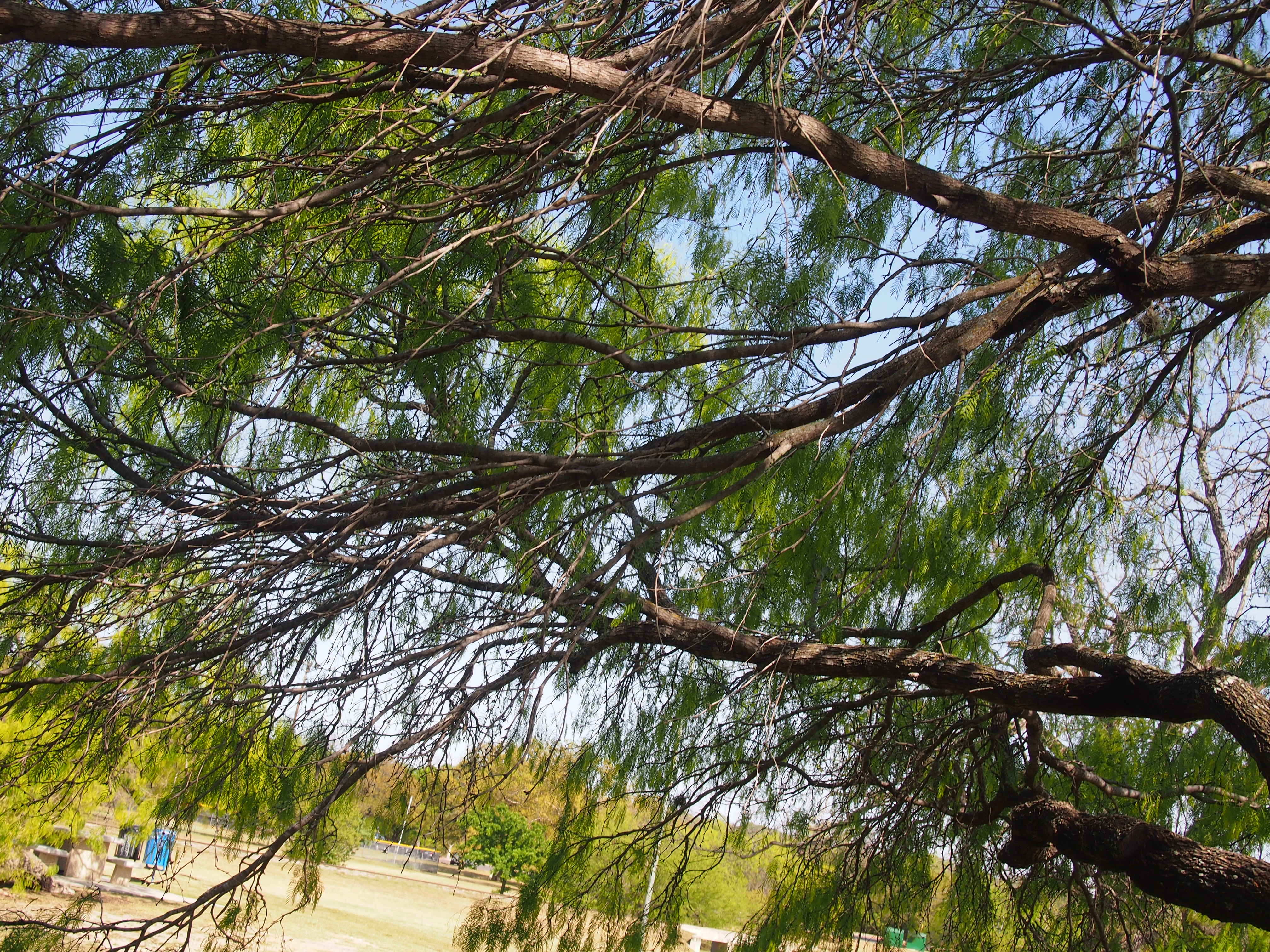
The unmistakeable branches of a mesquite tree near the tracks. The line brushes up against vegetation fairly close in some spots, and the requirement is to keep your hands (and head) inside the train. It’s a good idea.

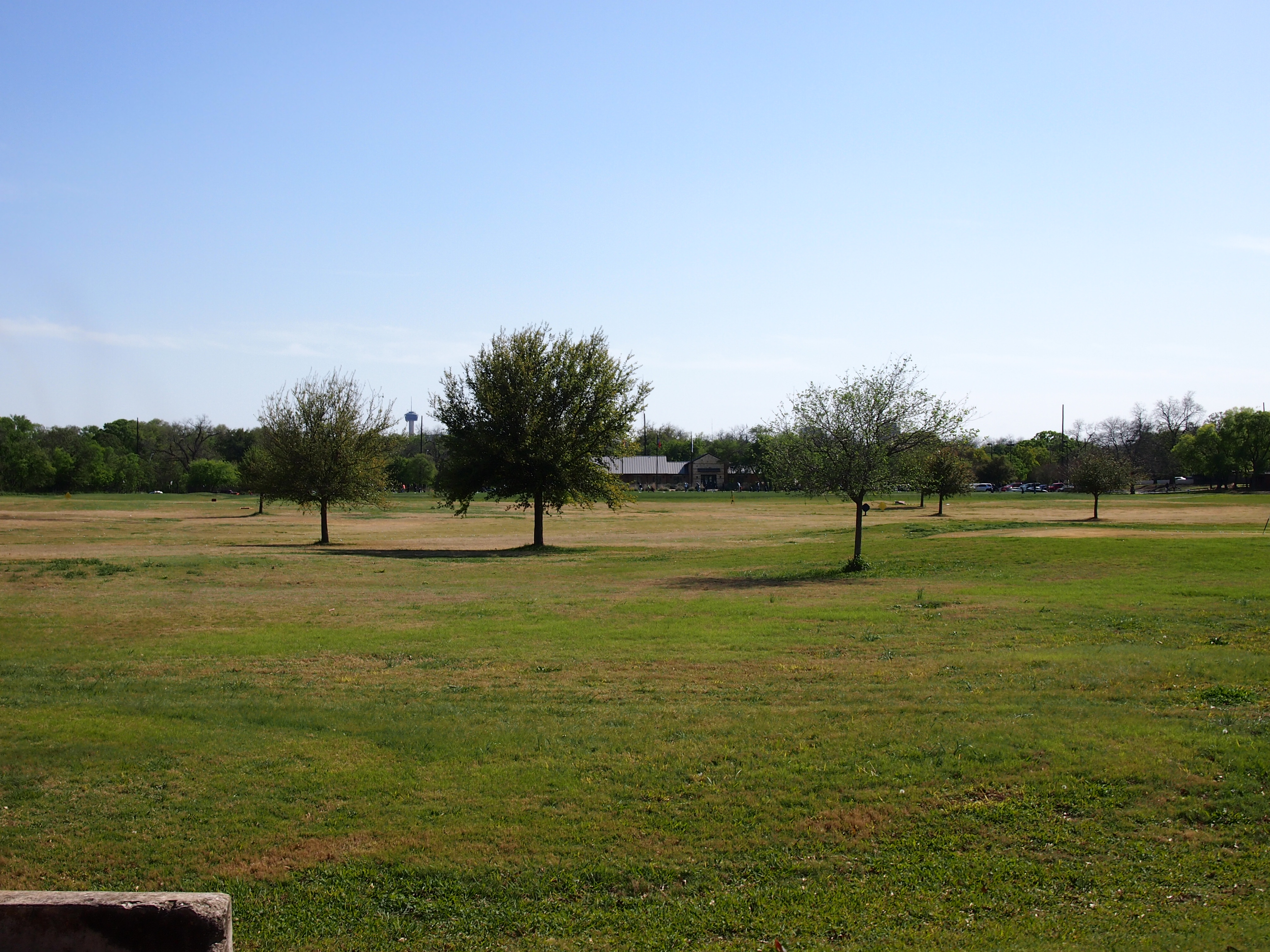
Not the most picturesque landscape, but note the Tower of the Americas in the background.

This train’s too good just for kids.

The Sunken Gardens

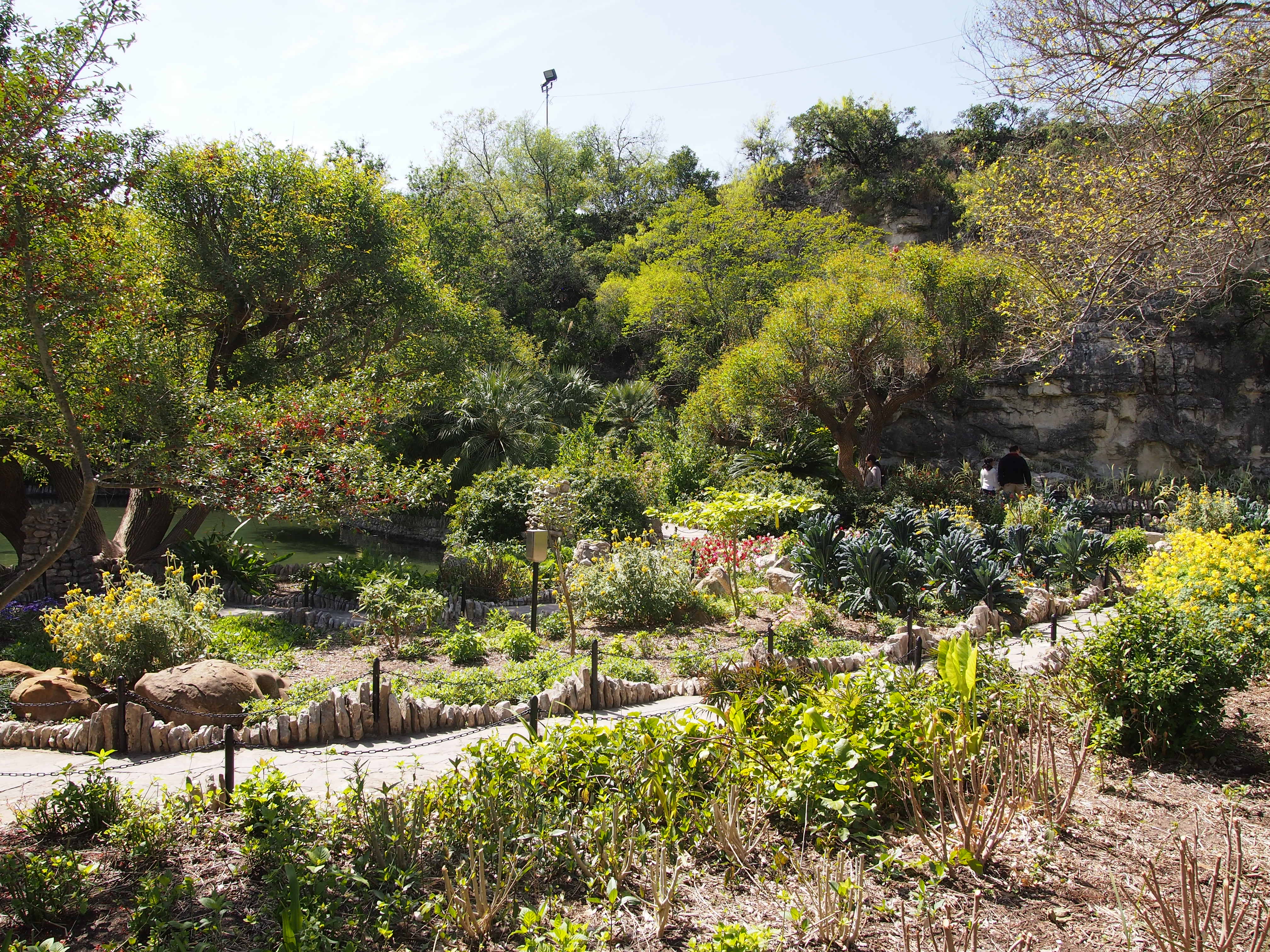
I went with my brother and children to the Sunken Gardens in San Antonio last week. It isn’t officially called that, but rather the Japanese Tea Gardens. More about that in a moment, but under any name it’s a lovely place, and a fine example of land re-use, since long ago it was a quarry.

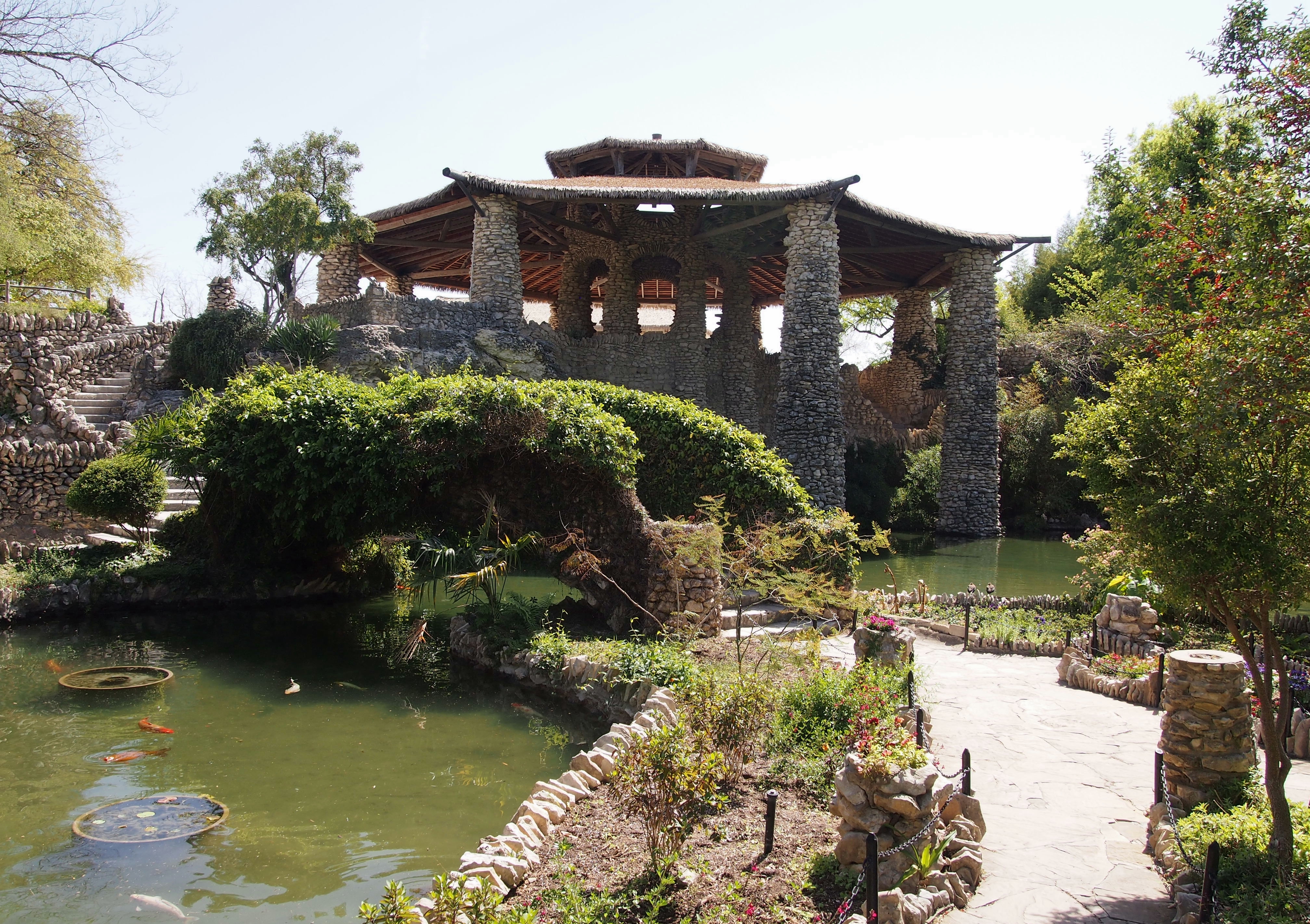
A view from the “sunken” portion of the gardens, looking up at the pavilion, whose columns are remarkable stacks of stone, a bit like manmade hoodoos.

Coming from the pre-spring landscapes of the North, we appreciated the spring lushness of the place. Of all of San Antonio, actually.

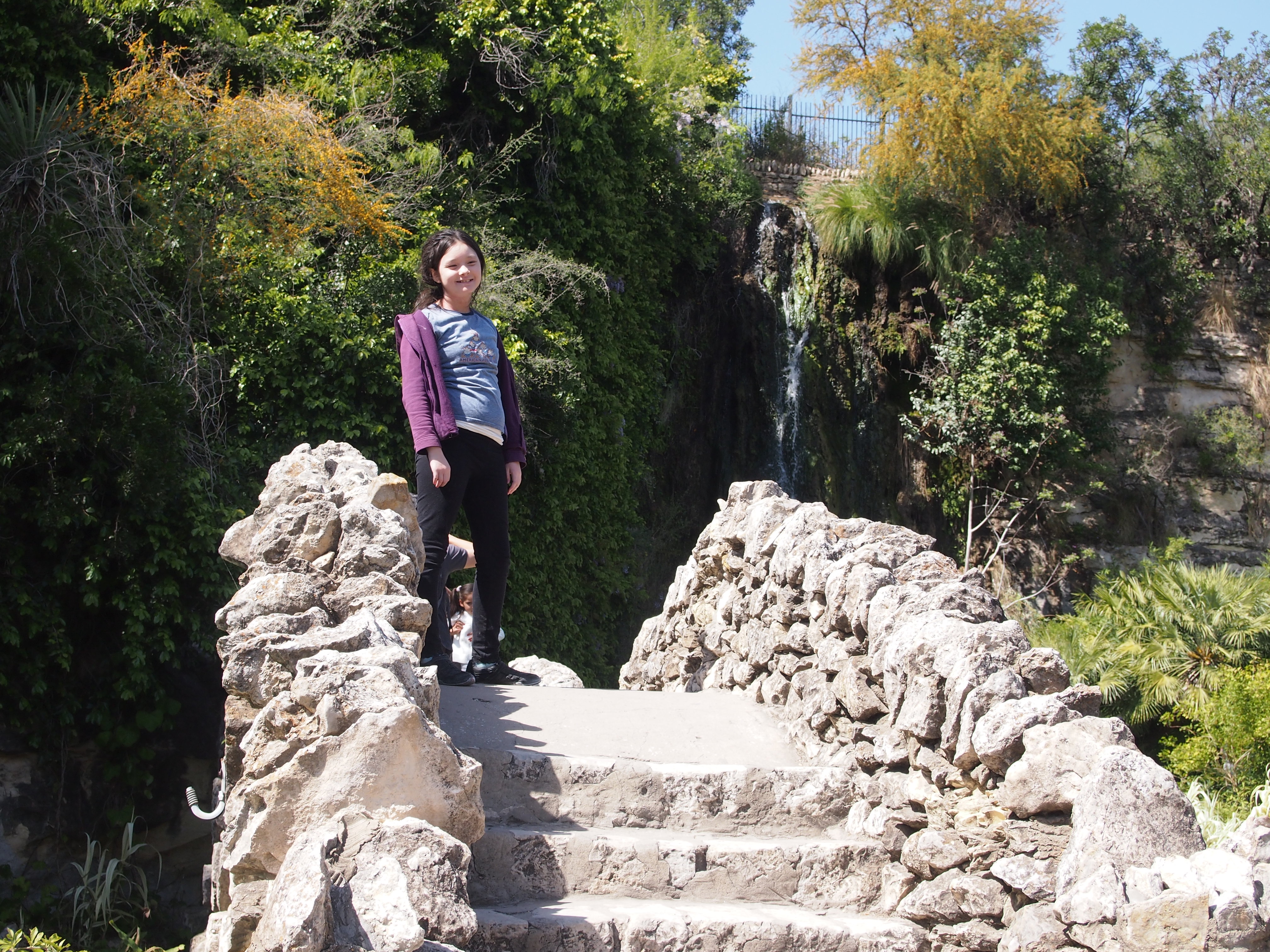
At its web site, the city of San Antonio briefly tells the story of the Sunken Gardens, which is part of the larger story of Brackenridge Park, crown jewel of San Antonio municipal parks. “The restored garden features a lush year-round garden and a floral display with shaded walkways, stone bridges, a 60-foot waterfall and ponds filled with koi,” the site accurately says.

I call it the Sunken Gardens because that’s what everyone called when I was growing up, and maybe people still call it that, despite the official renaming. There’s nothing wrong with the official name, since it honors the pre-WWII history of the garden, but I see no reason to change.

This woman took a better selection of pictures of the garden than I had the patience to make.

San Antonio Missions National Historical Park

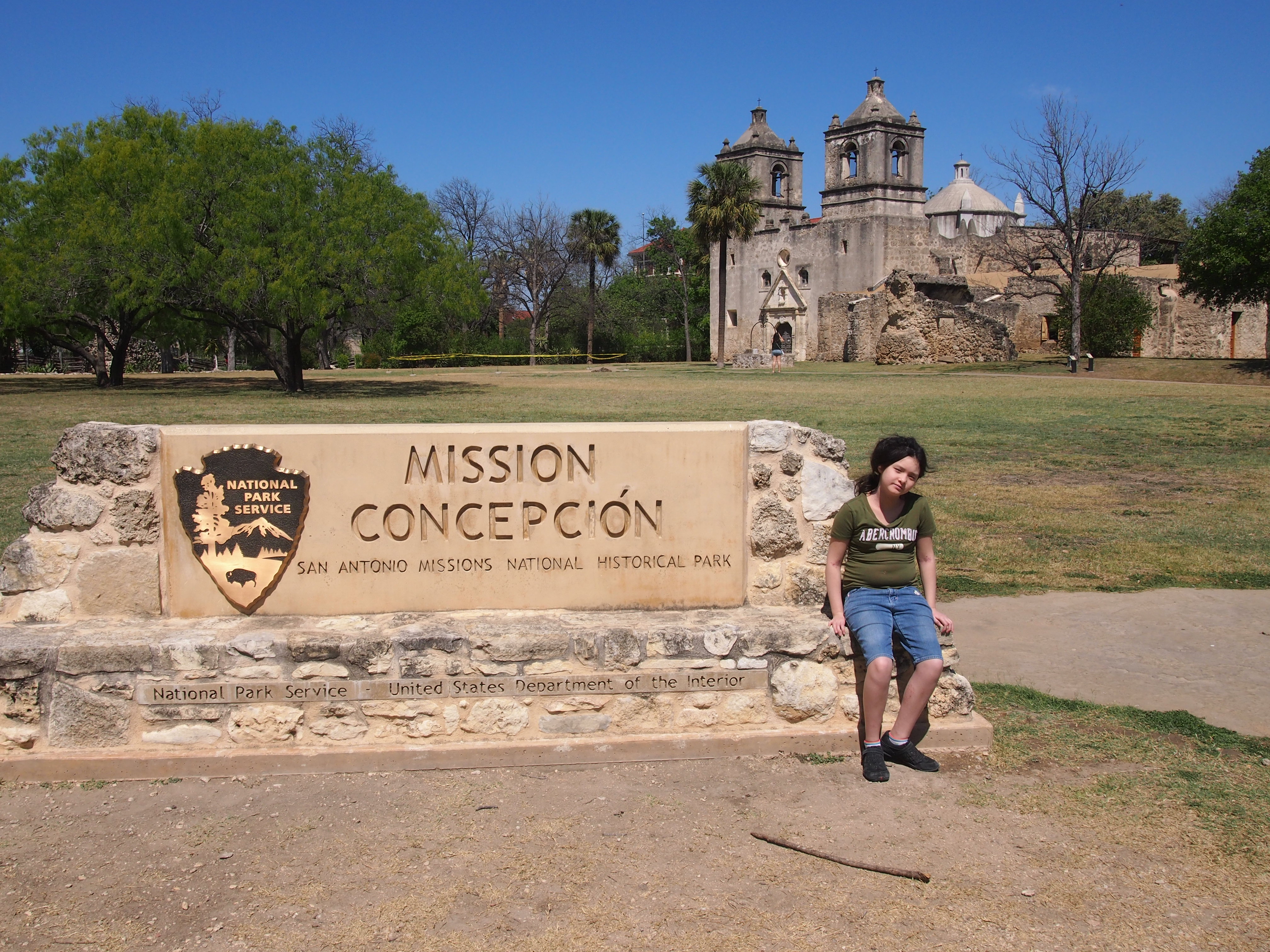
People remember the Alamo. Mission Concepcion, not so much.

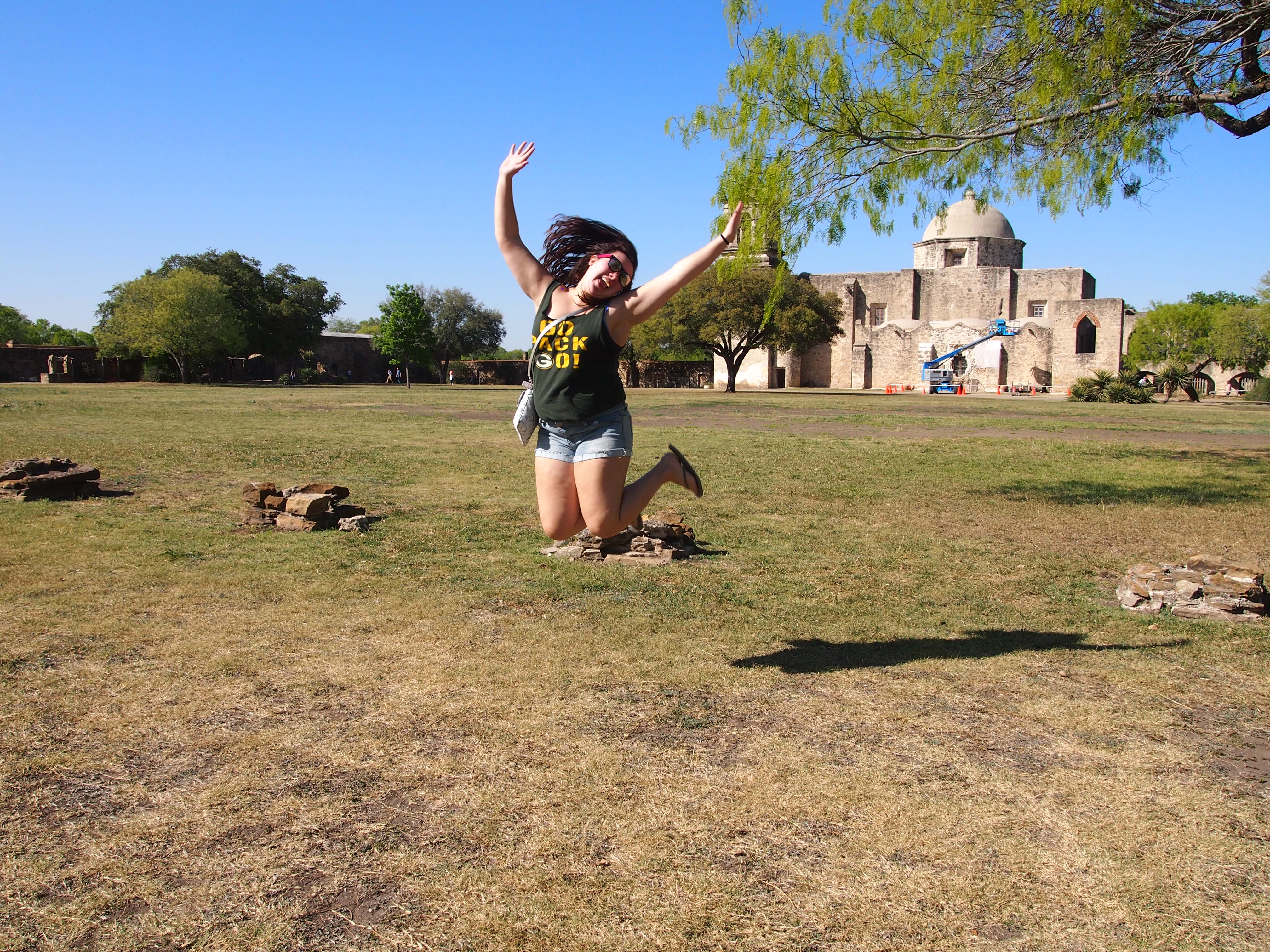
I hadn’t visited any of the San Antonio missions — formally San Antonio Missions National Historical Park, est. 1978 — in about 20 years, when I took Yuriko to see them. During our spring break, it was time to take my children.

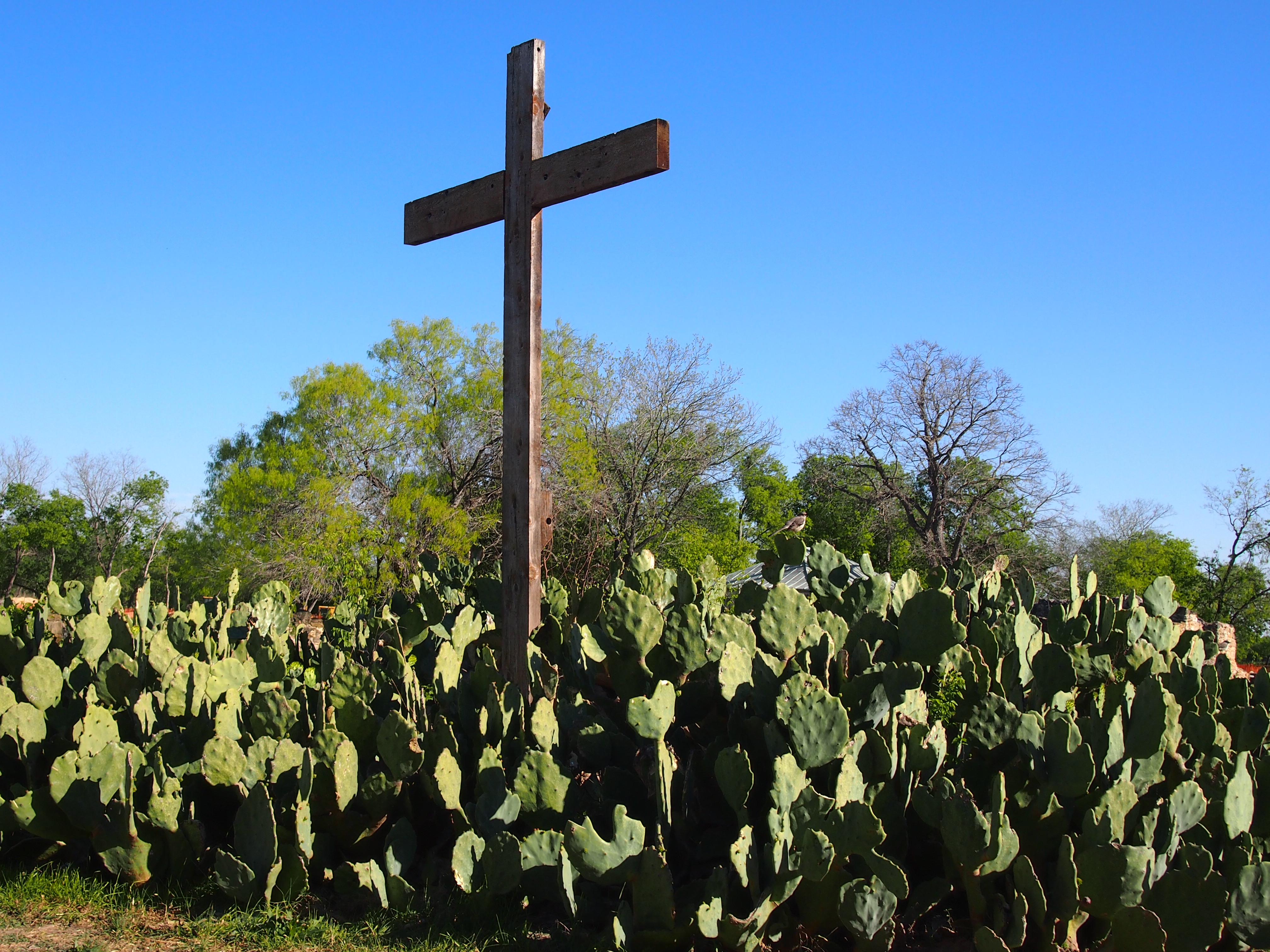
Lilly seemed positively excited about Mission San Jose. Well, maybe. We also made it to Mission San Juan, which was an interesting enough structure, but not as interesting as the crucifix in the cactus patch.

On the other side of the cross, we noticed straps for arms and a place to rest one’s feet built into it. We figured that in a few days — we were visiting not long before Good Friday — someone would be on the cross.

San Antonio ’13

We, that is Lilly, Ann and I, went to San Antonio last week to visit my mother, both brothers, a nephew, an aunt, and a cousin — from my point of view. For Lilly and Ann, they got to visit their grandmother, two uncles, a cousin, their great aunt, and another cousin.

We also saw a few places. Not much new for me, though including some spots I hadn’t seen in years, but new places for them. For them, San Antonio will always be, I hope, that interesting city where their dad grew up.

More about all that later. For now, though, prayers for my mother, their grandmother, who is recovering from a fall last Friday — a few hours after we left — that broke her hip. She had surgery over the weekend, and is still in the hospital.

R.I.P., Eleanore Triplett, whom we learned had passed away in Dallas while we were in San Antonio. She was my late sister-in-law Deb’s mother, Jay’s mother-in-law, and my nephews’ grandmother.

Cronkite’s Last Broadcast

Memory is unreliable, so keep a diary. Or so I read once in an article about planning and executing a months-long trip. Memory is unreliable, of course, but written accounts aren’t always much help either.

On March 6, 1981, I was in Durham, NC, on spring break and wrote: “We all went to a North Carolina Mexican restaurant, which wasn’t bad. Better than El Sol in Logan [Logan, Utah, where I’d been the year before, and which featured cinnamon in its enchiladas, if I remember right]. The place was divided into the Cosmopolitan Room and the Fiesta Room, or something like that, and one was mainly a bar, though you can eat there, which we did. It had a television on the wall.

“Since we were there from roughly 6:15 to 7:15, Walter Cronkite’s last news program was on. During his final words, the whole place was watching, maybe a dozen people. I’ve never watched his broadcasts that much, but I think he wrapped it up with style.”

I don’t remember a thing about that nameless Mexican restaurant, what I ate, or what my friends – Neal and Stewart – and I might have talked about. So much for the efficacy of diaries as a memory aid, at least in this case. I vaguely remember the quiet of the place, with everyone watching a communal television event that would never happen now (who cares about network news anymore?). But if I had to cite any of Cronkite’s words, I couldn’t, except for “that’s the way it is,” because he always said that.

It was a fluke that I saw it. I didn’t have a TV in my dorm room, didn’t know anyone who did, and probably won’t have ventured down to the common room — which had a TV — to watch it there, had I been on campus that day. We were staying with Neal’s parents during that trip, and I don’t remember watching much TV there, either (though I did read most of Helter Skelter there).

Naturally, in the age of YouTube, you can see it again if you want. I agree with my original assessment of the sign off.

I thought of Cronkite’s last sign off on Saturday when I spotted a small error in the pilot episode of The Americans, which I started watching because I saw it described as “a period piece about Russian spies in America.” The period turned out not to be the height of the Cold War, but the late Cold War setting of 1981. No, I thought, it can’t be a period piece if I remember the period as more or less an adult. But I guess that isn’t true anymore.

Anyway, it’s a pretty good spy yarn, more interesting because the spies in question are sleeper Soviet agents who pass as middle-class Americans (with convenient orders to converse only in English, even among themselves). The small error was in passing. The scene showed a television, and Walter Cronkite was delivering the news. The show is clearly set in the spring of 1981, April at least and probably May. Cronkite was gone after March 6.
Hinamatsui 2004

Sequester Day came and went on Friday without much fuss here in the heart of North America, though we may come to rue it eventually. Texas Independence Day was Saturday (177 years now). According to our school calendar, March 2 is also Read Across America Day. Someone might have noted that day at our township library, but I didn’t go there this weekend, and every day can be that as far as I’m concerned.

All the while, about a foot of snow covered the ground. It hasn’t been warm enough to melt most of it. That’s a little unusual for early March, which typically sees the beginning of mud season.

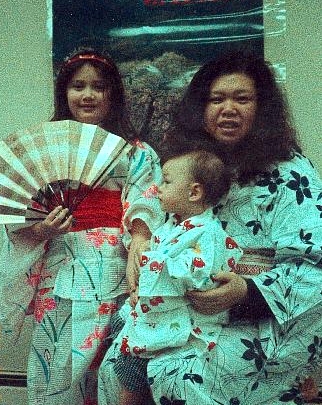
Today is Hinamatsui, or Girls’ Day. We’ve been hit-or-miss over the years in marking the day, which is a Japanese festival, more about which here. This year, Yuriko brought out those few dolls we have appropriate to the day. Back in 2004, we went to some kind of event for the occasion. I don’t remember what we did, exactly, or where it was, but I did take a picture. It isn’t that great as a picture, but I like the subject matter.

Deputy Marshall Ronald Reagan

Portillo’s is a (mostly) local chain specializing in hot dogs, Italian beef, burgers and the like, and across its various locations, thematic decorations from the ’20s to the ’60s. The food is good and the decorations interesting, so every few months we go to one of the locations, two of which are fairly close.

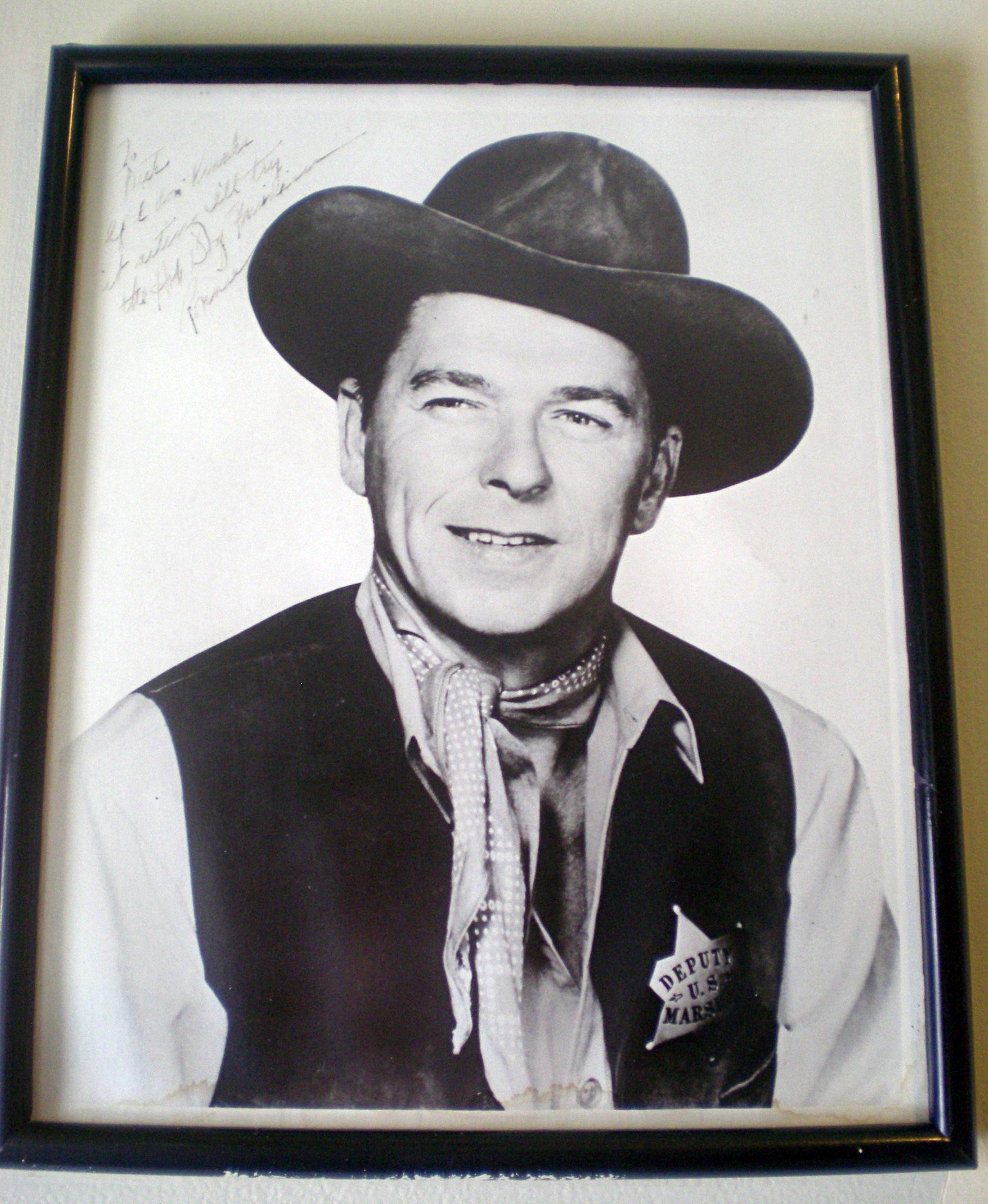
Last weekend Lilly and I visited the one on Illinois 83 in Elmhurst, a bit out of our usual orbit. Before ordering, I was waiting while Lilly was in the restroom, and taking a look at some of the items on the walls in that part of the restaurant. Off in one corner is a framed picture of Ronald Reagan in a western outfit, wearing a badge that says Deputy U.S. Marshall. My guess would be it’s a publicity shot from Law and Order (1953).

On closer inspection, I noticed that it’s autographed. I’m not familiar with Reagan’s handwriting, but I’ve no reason to think it isn’t his. “Dick” must be Dick Portillo, who founded and still owns the chain.

To Dick –

If I don’t make it acting, I’ll try the hot dog business.

Ron

The Chicago Time Zone Plaque

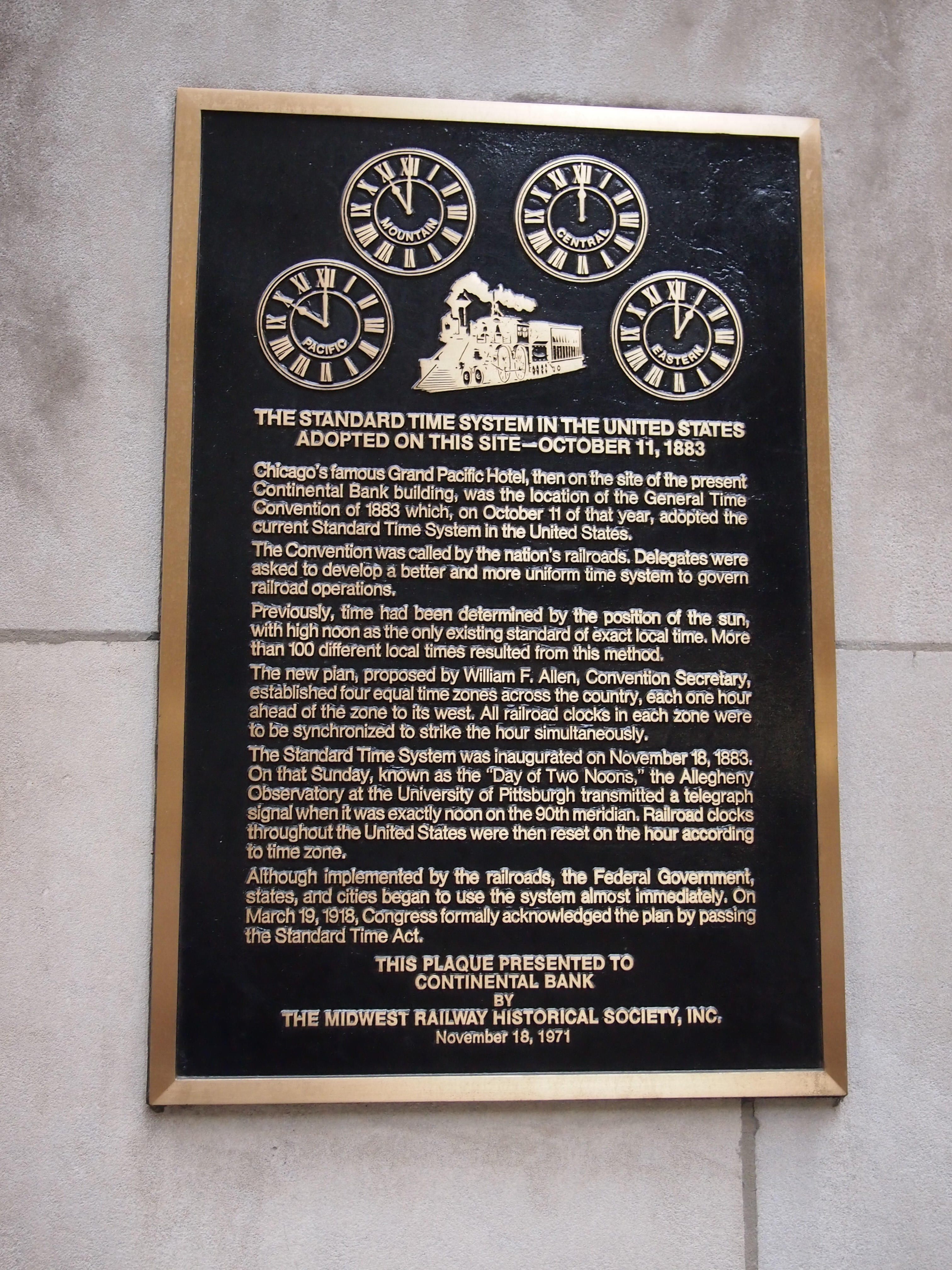
One more item from downtown Chicago, at least until the next time I go there. This plaque, near the junction of LaSalle and Jackson for over 40 years now, memorializes something few people give much thought — few people give it the time of day, you might say. Time zones.THE STANDARD TIME SYSTEM IN THE UNITED STATES ADOPTED ON THIS SITE — OCTOBER 11, 1883.

Chicago’s famous Grand Pacific Hotel, then on the site of the present Continental Bank building, was the location of the General Time Convention of 1883 which, on October 11 of that year, adopted the current Standard Time System in the United States.

The Convention was called by the nation’s railroads. Delegates were asked to develop a better and more uniform time system to govern railroad operations.

Previously, time had been determined by the position of the sun, with high noon as the only existing standard of exact local time. More than 100 different local times resulted from this method.

The new plan, proposed by William F. Allen, Convention Secretary, established four equal times zones across the country, each one hour ahead of the zone to its west. All railroad clocks in each zone were to be synchronized to strike the hour simultaneously.

The Standard Time System was inaugurated on November 18, 1883. On that Sunday, known as the “Day of Two Noons,” the Allegheny Observatory at the University of Pittsburgh transmitted a telegraph signal when it was exactly noon on the 90th meridian. Railroad clocks throughout the United States were then reset on the hour according to the time zone.

Although implemented by the railroad, the Federal Government, states, and cities began to use the system almost immediately. On March 19, 1918, Congress formally acknowledged the plan by passing the Standard Time Act.

CBOT Allegories

More snow this afternoon. In fact, more than any other storm this winter so far, and it’s still falling. This can mean only one thing: shoveling soon.

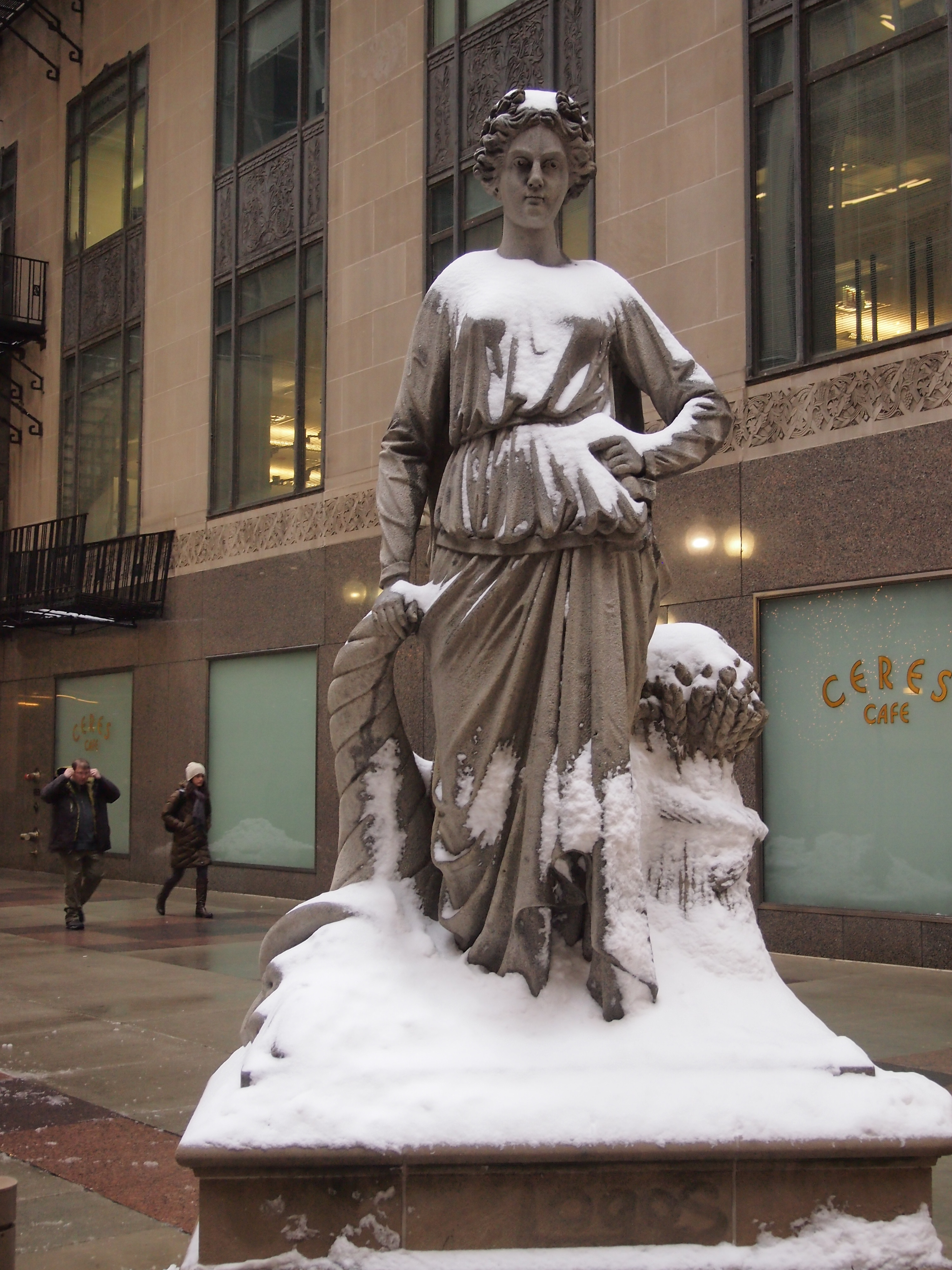
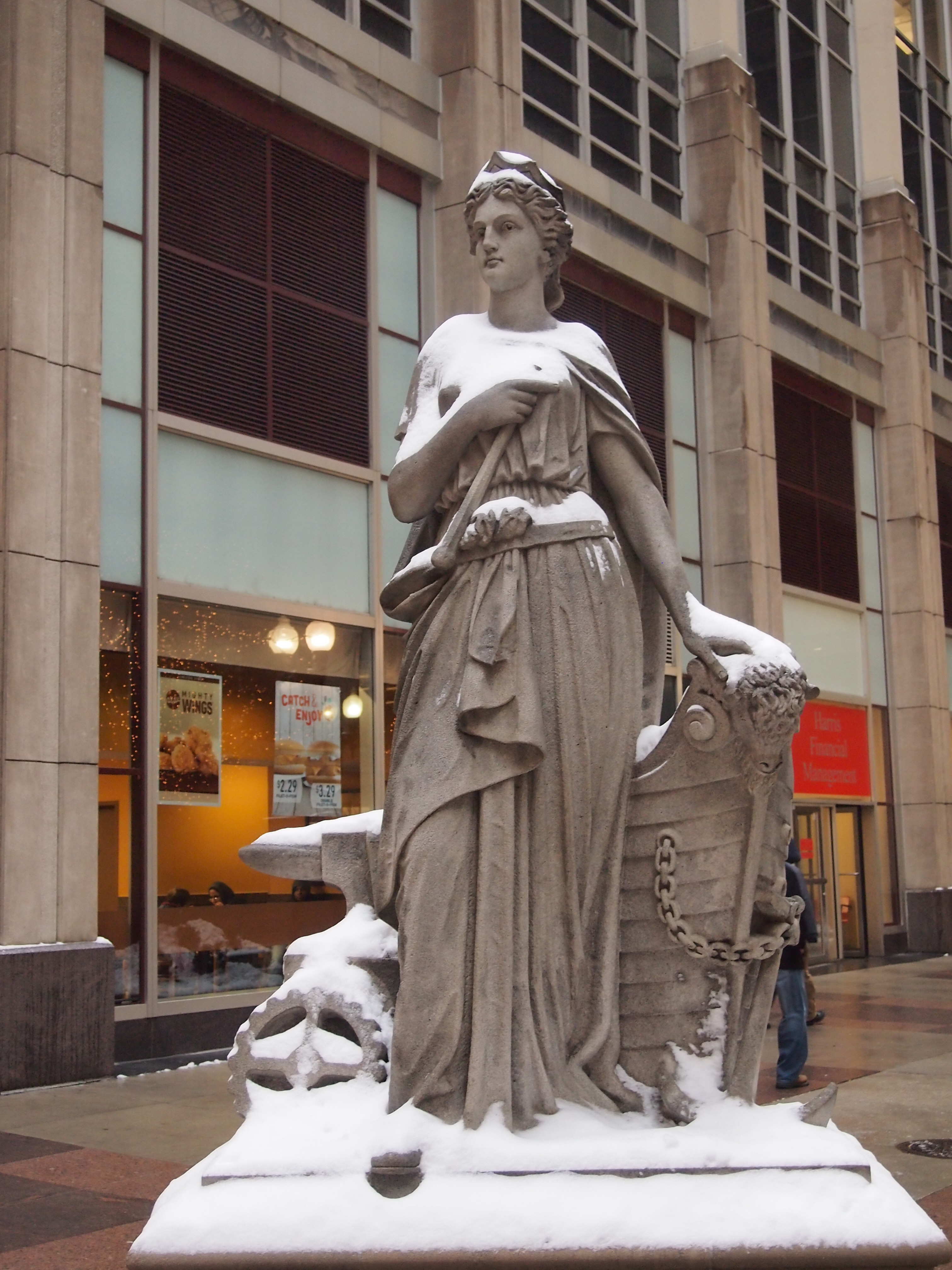
Last week I took a look at these downtown ladies – 12-foot granite ladies who weigh a remarkable 5.5 tons each, festooned with last week’s snow. They can be found in the plaza outside the Chicago Board of Trade.

First, Agriculture. Note Ceres Cafe in the background.

Next, Industry.

Allegorical statues, that’s what this country needs more of. A nearby plaque explains: “These two statues, one symbolizing agriculture and the other industry, once stood at the main entrance of the Board of Trade Building, built in 1885. The statues greeted commodity traders and the public for 45 years. Thought lost forever when the buildings were demolished in 1929 to make way for the exchange’s current Art Deco structure, in 2005, the statues were graciously returned to their origins through the generosity and goodwill of DuPage County Forest Preserve District.”

A 2004 Tribune article says: “The statues turned up in 1978, lying on their sides in grass, when the DuPage Forest Preserve District bought the former estate of Arthur Cutten, a wealthy CBOT grain trader in the early 1900s. For about the past decade, they’ve stood watch over the parking lot to the Danada Forest Preserve District in Wheaton.”

Jewelers Row, Chicago

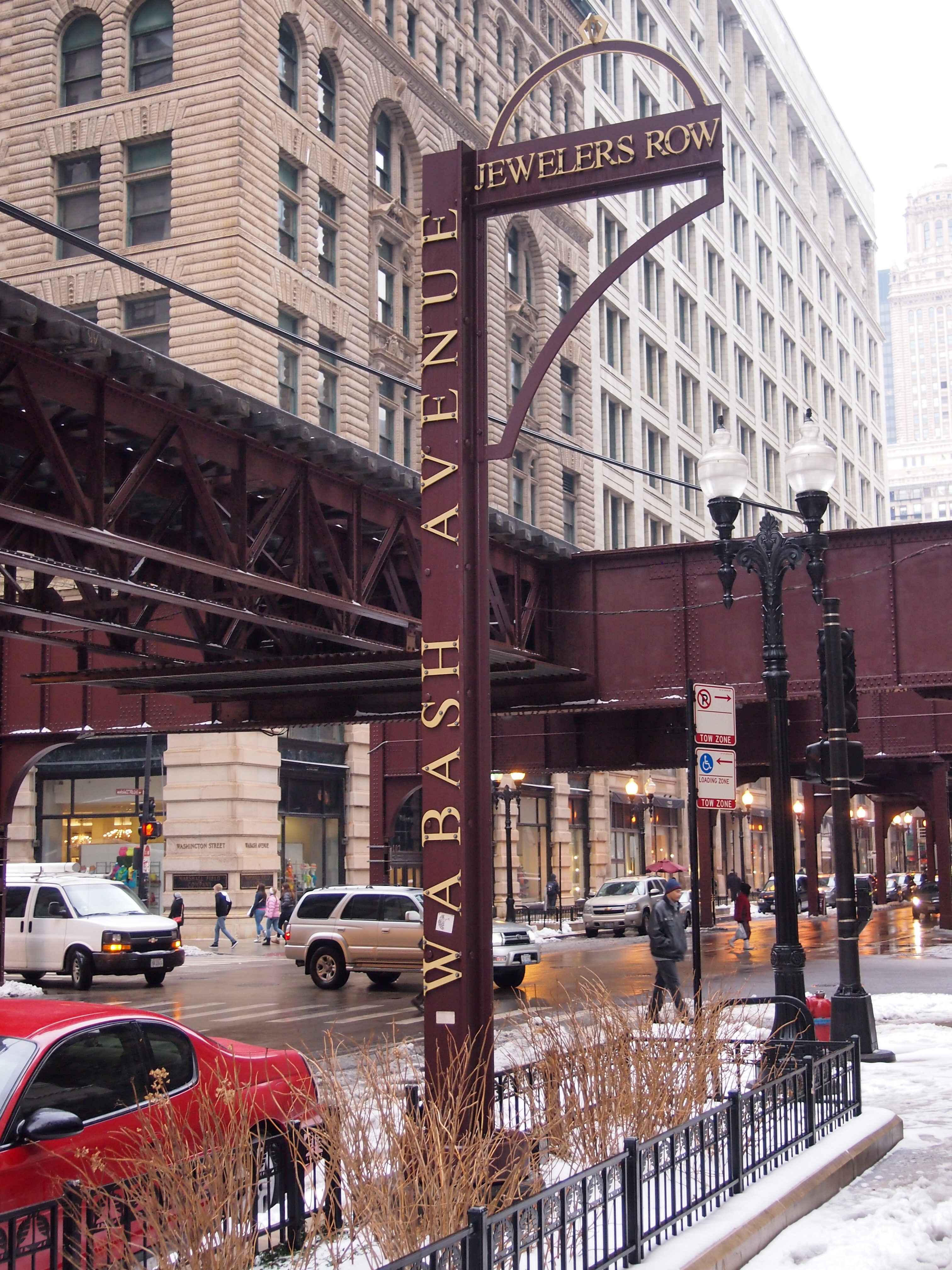
Since I don’t go downtown regularly anymore, I miss new things that appear there. I’m not sure when these signs went up on Wabash Ave., but I don’t remember seeing them before. It could have been several years ago for all I know. I’m going to think of them as new anyway.

There are more than one of these gamma-like signs, with some on each side of the street, though I didn’t make an exact count. It’s more than just an historical marker, since there’s still a concentration of jewelry stores along that stretch of Wabash from Washington to Monroe. Jewelry makers and sellers, silver specialists, and watch makers have clustered in the area for about 100 years.

It’s an historical district for its buildings. According to the City of Chicago: “Comprised of a distinguished group of buildings important in the development of Chicago commercial architecture, the district includes important building types such as post-Chicago Fire loft manufacturing buildings, Chicago School loft manufacturing, mercantile, and office buildings, early twentieth-century skyscrapers, and Art Deco-style mercantile buildings. These buildings were designed in a variety of architectural styles, including Italianate, Chicago School, and Art Deco, by significant Chicago architects, including John Mills Van Osdel, Hill & Woltersdorf, Adler & Sullivan, D. H. Burnham & Co., Holabird & Roche, Alfred Alschuler, Christian Eckstorm, and Graham, Anderson, Probst & White.”

Note that the sign is brown, to match the paint on the elevated tracks nearby. I think that paint job is new, too, since I seem to remember the El tracks being faded yellow covered with the grim of decades, but maybe I’m just imagining that.