Tidbinbilla

Christmas Eve 1991

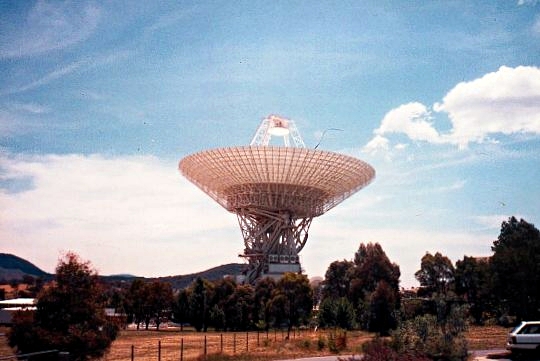
A summer’s day. I bought sun block today. Along with Pete, his brother, and his brother’s enormously pregnant wife, we went to the Tidbinbilla Deep Space Tracking Station southwest of Canberra to take a look at the big dishes and the small museum, which emphasizes Australian, Japanese and European efforts to explore space.

Had a “Jupiter Dog” at the Moon Rock Café. You’d think there would be a Great Red Spot on it somehow, but it mainly featured onions and diced tomatoes (maybe one of those tomatoes counts as the spot). Returned to town the way we had come, winding through hilly bush and flatter farmland. Sometimes emu and kangaroos bounded across the road ahead of us.

Postscript 2012: The formal name of the place is the Canberra Deep Space Communication Complex, and it still functions as one of three stations operated by NASA to keep track of far, far away spacecraft, with the other two in California and Spain. “This strategic placement permits constant observation of spacecraft as the Earth rotates, and helps make the Deep Space Network the largest and most sensitive scientific telecommunications system in the world,” notes NASA.

South Loop Lights

I went to a real estate event in the South Loop yesterday, at a mixed-use property started in 2007 but delayed, as so many were — and still are — by the Panic of 2008. But there’s been some recovery since then. These days, the property’s in reasonably good shape, with its apartments leased and retail tenants committing for space.

It has a U-shaped layout, with the residential floors on either side of a drive that runs the length of property, and an upscale movie theater at the end of the U, which is open for business.

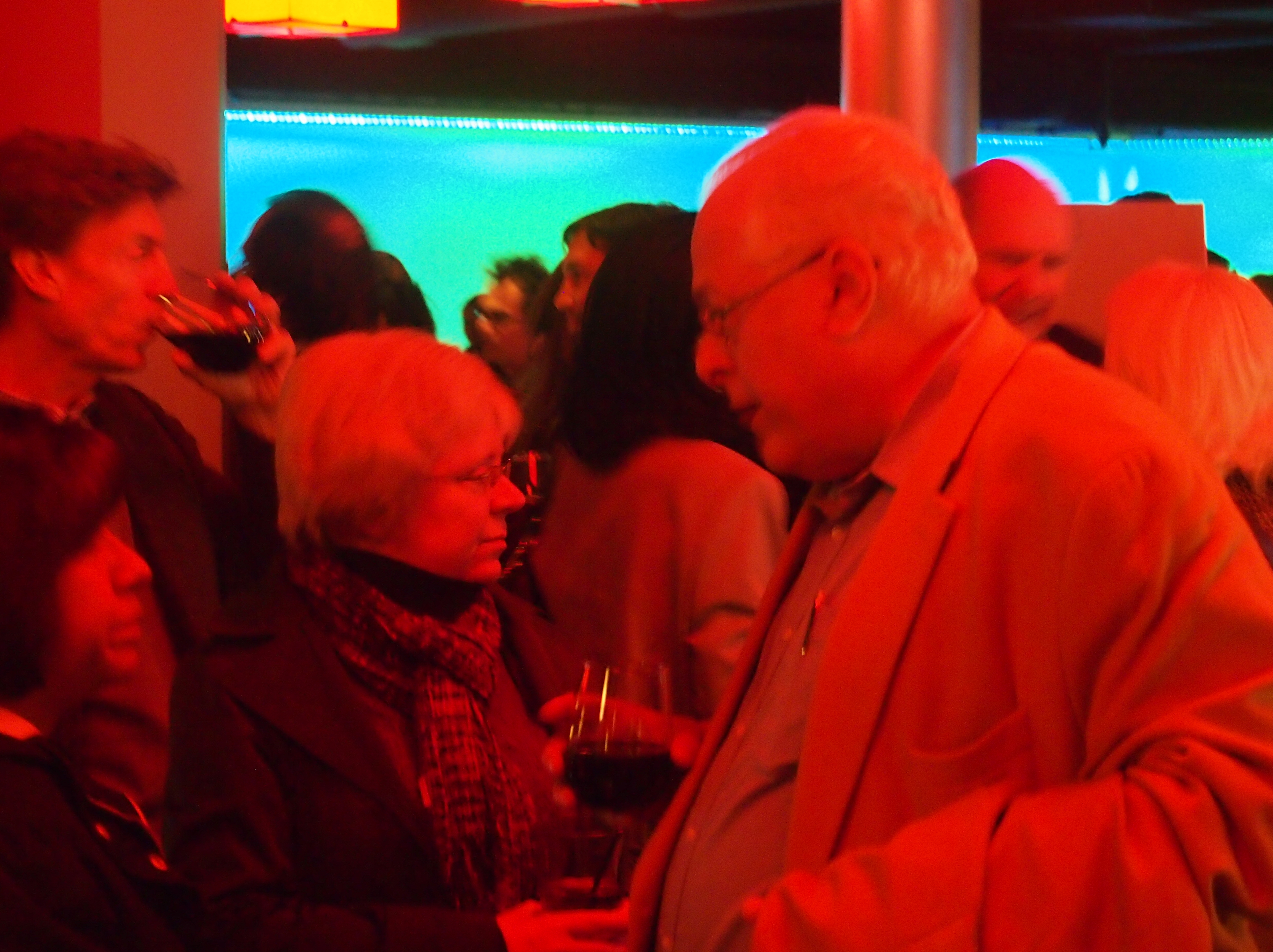
It’s one of those places that has a fancy bar upstairs from the lobby of the theater, which is where the event was held. I didn’t drink there, but the bar food was pretty good. Fine views of the city from that vantage. The room had interesting lighting, too, which allowed me to take pictures like this one of the small crowd.

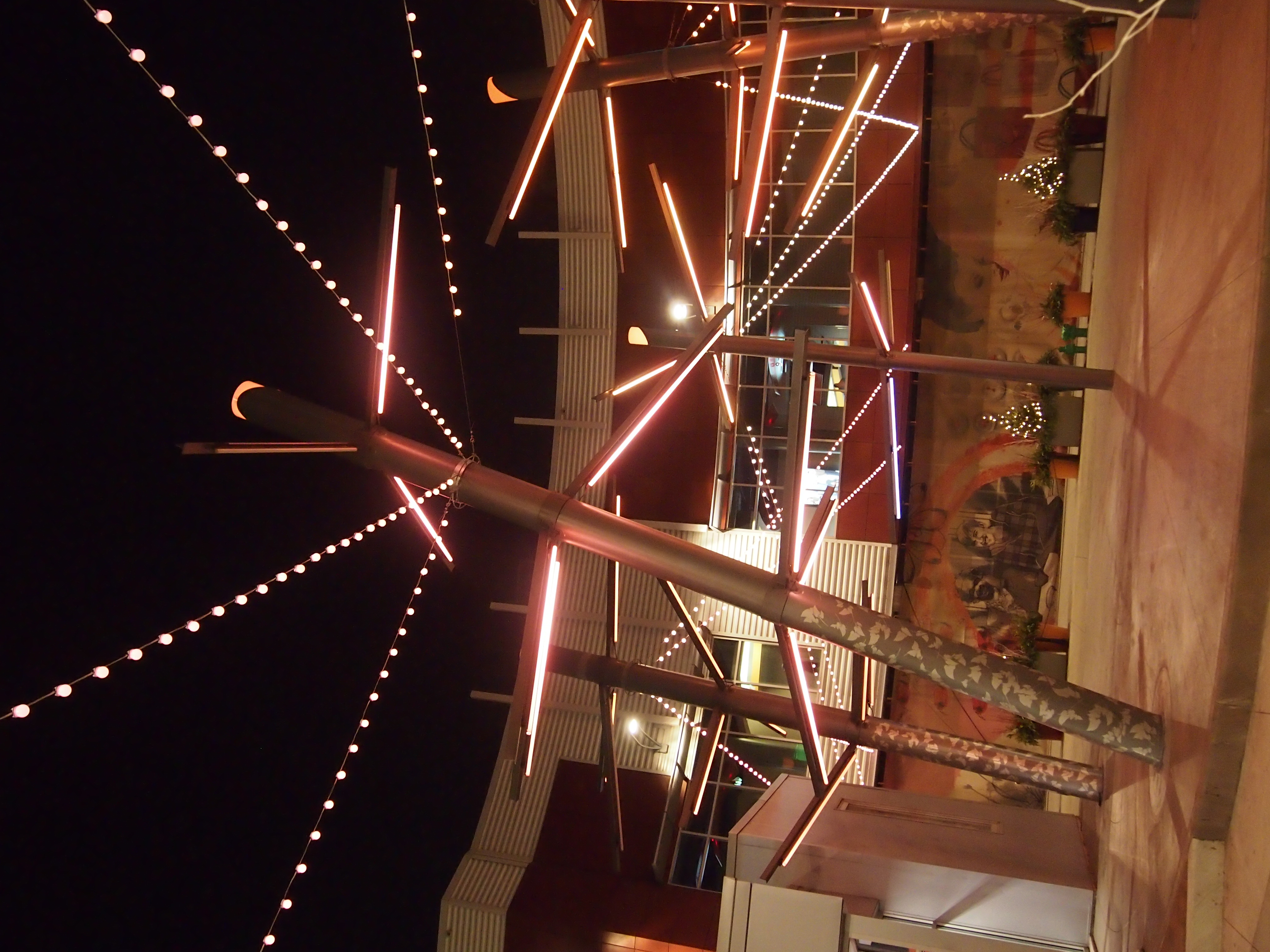
Outside the theater, not far from the Seward Johnson statue, shines this array of lights.

Nice to see a spot that isn’t all decked out for Christmas yet. Unless this is Christmas décor that’s trying to smash the prevailing red-green-gold-silver paradigm.

“Caution, Man Contemplating Work”

“Can you see what’s wrong with it?”

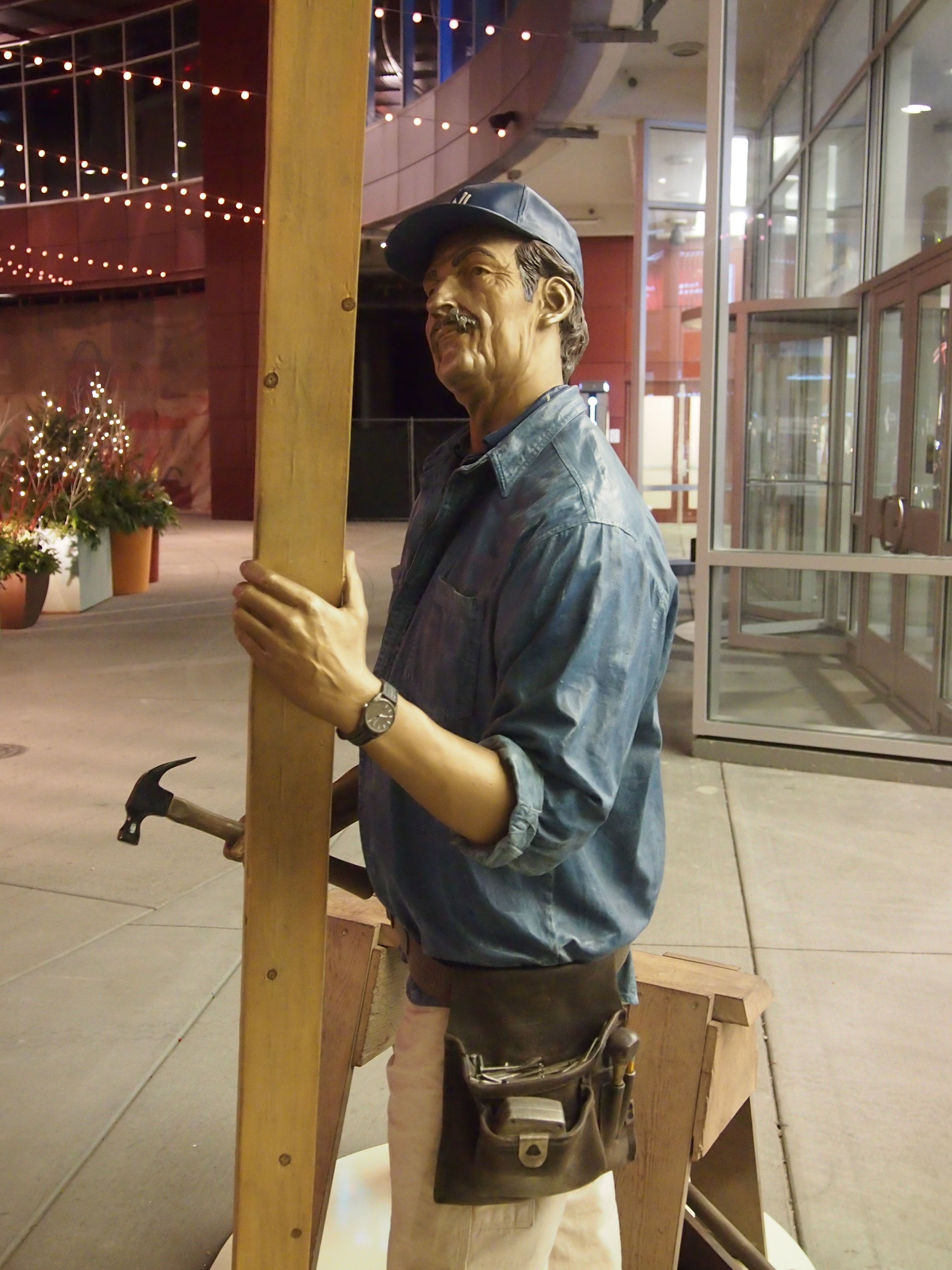
A security guard asked me that today. I was looking at this statue, “Caution, Man Contemplating Work” by Seward Johnson, which is in a new mixed-use development in the South Loop of Chicago.

I started looking more closely. Two left feet? A tool held in an unrealistic way?

“It isn’t something hard to see,” the guard said. “It’ll jump out at you.”

I looked a little more and there it was — on his head is a New York Yankees cap. I pointed that out.

“Yeah, it was supposed to be the Cubs,” he said.


Mariano’s Fresh Market

This year’s Thanksgiving meat: beef ribs. We discussed other choices, with the more standard fare rejected, though I wouldn’t have minded brining a turkey again. Obtaining the last of the items for the meal on Wednesday night meant visiting the new Mariano’s Fresh Market at Golf and Barrington roads, which has been open about a month. It’s the latest Chicago-area store by the chain, which is owned by Milwaukee-based Roundy’s Supermarkets.

I hadn’t been there before, but I’ll be back. It can’t quite replace Ultra Foods, since Mariano’s isn’t a discounter, but it’s a good combination of an ordinary grocery (around here, that means Jewel and Dominick’s) and an upmarket chain like Whole Foods, without Whole Foods prices. Or so I thought on first inspection. We’ll see if that holds up. Also, there are plenty of interesting brands I’ve never seen before, so the place merits further exploration.

Best purchase: a coconut cream pie for Thanksgiving dessert. Pretty much like the pies you can get at Bakers Square, but without the ordering in advance for a holiday, and at roughly the same cost. Best product that we didn’t buy: canned Spotted Dick, in the section selling British products. Enough to make me laugh, since I was once a 14-year-old boy, and he hasn’t completely gone away.

Hub-UK.com tells us that “Spotted Dick is a steamed suet pudding usually made with dried currants, hence the ‘spotted’ part of the name, which is traditionally served with custard. Why it is called ‘Spotted Dick’ is not exactly clear. There is a similar pudding called Spotted Dog which is made using plums rather than currants but it would seem unlikely that Dick is a corruption of dog.”

I wonder how I never saw Spotted Dick at the grocery store we used to patronize in Ealing years ago, where I did see Mr. Brain’s Pork Faggots.

Branson Leftovers

Back again on Sunday, as the long Thanksgiving weekend peters out. We will be home for the occasion, since just the thought of going anywhere is tiring.

Branson is full of shows, but Joseph beat everything else I saw for sheer spectacle. Joseph is a South & Sight Theatres production, whose specialty is elaborate stagings of Bible stories, but “elaborate” hardly does it justice. The theater’s enormous, seating about 2,000, with a large stage that accommodates massive sets, large troupes of actors (including live animals, such as goats and camels), and impressive lighting and effects. The sets alone for Joseph—fittingly evoking ancient Egypt much of the time—would be worth seeing all by themselves, but fortunately not all of the effort went into sets and effects. The script tells the story of Joseph well, both in song and dialogue.

Christopher James, emcee on the Branson Belle showboat, told the trip’s best joke. I forget the exact wording, but it was a line about knowing better than to shine a bright light on stage, since too many of the audience would respond by getting up and heading toward it.

Indeed, at some of the shows I was a youngster compared to most of the audience. Such shows were heavily spiked with ’40s and especially ’50s nostalgia. But the showmen of Branson are preparing for the future. At one point, we had to wait for a few minutes outside a theater as the audience emerged from a John Denver tribute show. That is, a show spiked with ’70s nostalgia. The audience looked much younger than at most of the other shows—roughly my age.

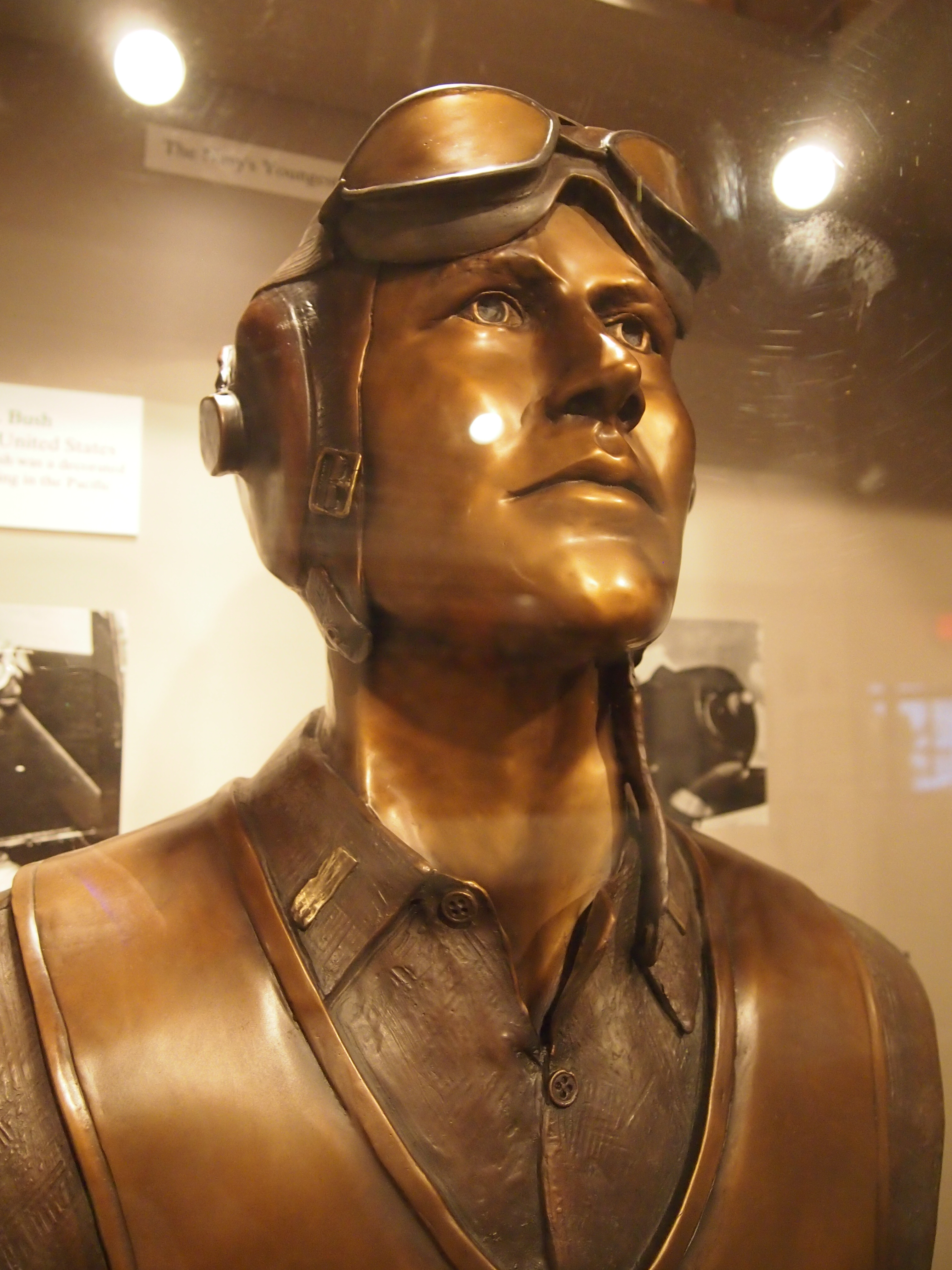
No presidents were from Branson or are buried nearby, unless you count Harry Truman up in Independence, Mo. But I did see one presidential item: a bronze of the elder George Bush, as a young naval aviator, at the Veterans Memorial Museum.

We also visited the College of the Ozarks, which is a few miles from Branson. It’s a private Christian school whose students pay no tuition, but rather work for the school 15 hours a week. The fruits of all that work are many: among other things, we saw the greenhouses that grow orchids, a crafts building, the small hotel that the school runs, and the school’s restaurant, where we had Sunday brunch, done as a large buffet. The food was really good. Much of it is raised by students on the college’s farm.

Speaking of food, I had breakfast at a number of other places during my visit, and none of them—not even at the College of the Ozarks—offered grits. I was puzzled. I thought Branson would be south of the Grits Line, but maybe I’m wrong about that. Biscuits and gravy were widely served, but not grits. Odd.

Veterans Memorial Museum, Branson

On Sunday, November 4, I had the Veterans Memorial Museum in Branson practically to myself, though I knew that only a week later, on Veterans Day, the place would be full. Or for that matter, more crowded during much of “Branson’s Veterans Homecoming Week,” which was from November 5 to 11 this year. The 18,000-square-foot museum opened in 2000 on Missouri 76, one of the town’s main streets, and is essentially the work of a Nebraska sculptor and “museum entrepreneur” named Fred Hoppe. Glowing information about him is at the museum’s web site; a less flattering story is at the Branson Tri-Lake News.

Be that as it may, the Veterans Memorial Museum is a fine little museum, traditional in design and subject matter. That is, most of the displays are static, relying mainly on artifacts, with a fair amount of expository text. The place runs counter to the line of modern museum thinking – which might be accurate, for all I know – that exhibits should be interactive two-and-a-half ring circuses to keep museumgoers happy. But I’m OK with static, text-heavy displays, especially if I’m by myself and have some leisure to look and read.

The subject and layout reminded me a little of the Imperial War Museum in London, as well as the Musée du Débarquement in Normandy, at least as those places appeared in the early 1990s, though both are larger and much more comprehensive about their subjects. The Veterans Memorial Museum is composed of ten rooms covering U.S. wars of the 20th century, beginning with a small room containing a large model of the U.S.S. Missouri, a newsreel about the Japanese surrender aboard that vessel on continuous loop, and a few other artifacts. After that, the exhibits began with World War I and proceeded chronologically. Because of my own inclinations, I spent more time with World War I than in any other room.

There was a lot to see just in that room: photos, paintings, uniforms, weapons and other gear, objets d’ art, and more, and not just representing the U.S. or even the Allies, though they were the main focus. I’m pretty sure I’d never seen an actual Blue Max before, nor a WWI German artillery helmet. Artillery helmets of that time, it seems, didn’t have the famed spike on top, but a ball-shaped peak. The room also sported a nice collection of trench art, especially decorated shell casings, including some remarkably elaborate carvings. One way to pass the tedium of trench life, I suppose.

Among the photographs was, I thought, a particularly poignant one. It depicted graves, a common enough sight, but with a caption explaining that they belonged to men of the 324th Infantry, all of whom “died in the last three hours of the war.”

One long wall of the World War I room looks, at first, blank. Then you notice that it’s covered, floor to ceiling, with sepia-tinted doughboys’ faces, each about the size of a dime. The faces are repetitive, since the effect is created by putting together long strips seemingly copied from the same panoramic regimental photo. No matter. The point of the wall is to impress you with a vast number of faces, and it does. One face, a sign says, stands for every two Americans who died in the Great War, which was about 117,000 men all together.  A wall of doomed youth, looking out at you from behind glass and nearly a 100 years.

The other rooms include a sizable number of interesting artifacts, both American and from other nations, including in what I can only call the Axis Room. (As the History Channel knows, Nazis are always interesting.) Besides Nazi and imperial Japanese paraphernalia, one can also find an Enigma encryption machine in that room, the likes of which I’ve seen at the Museum of Science and Industry and (I think) the Science Museum in London. I should have taken a moment to mock the machine: Ha! We decoded your ass! But I didn’t think of it.

The centerpiece of the museum is in a World War II room – there’s more than one room devoted to that war – that includes 50 bronze life-sized soldiers charging in two lines. A work of sculptor Fred Hoppe, “Each figure in the WWII centerpiece is modeled after an actual combat soldier, one from each of the fifty states,” notes the museum web site. “Leading the charge up the beach is Fred’s father, the late Fred Hoppe Sr.”

The room is long and narrow, as you’d expect, and the names of each American serviceman to die in the war, about 416,800 in all, are written all along its walls. An effective reminder of the war’s cost to the United States, certainly, but I have to say the doughboy faces on the WWI wall were more moving, even though that was only pictorial representation, and not a detailed accounting of individuals.
Janice Martin, Aerial Violinist

A favorite fact about the showboat Branson Belle, which plies the waters of Table Rock Lake, Missouri: when the ship was launched in 1995, she slid into the water on a ramp greased with 4,000 pounds of bananas. The yellow fruit was a eco-friendly alternative to standard lubricants, and perhaps even cheaper, though I’m not up on the economics of boat launching.

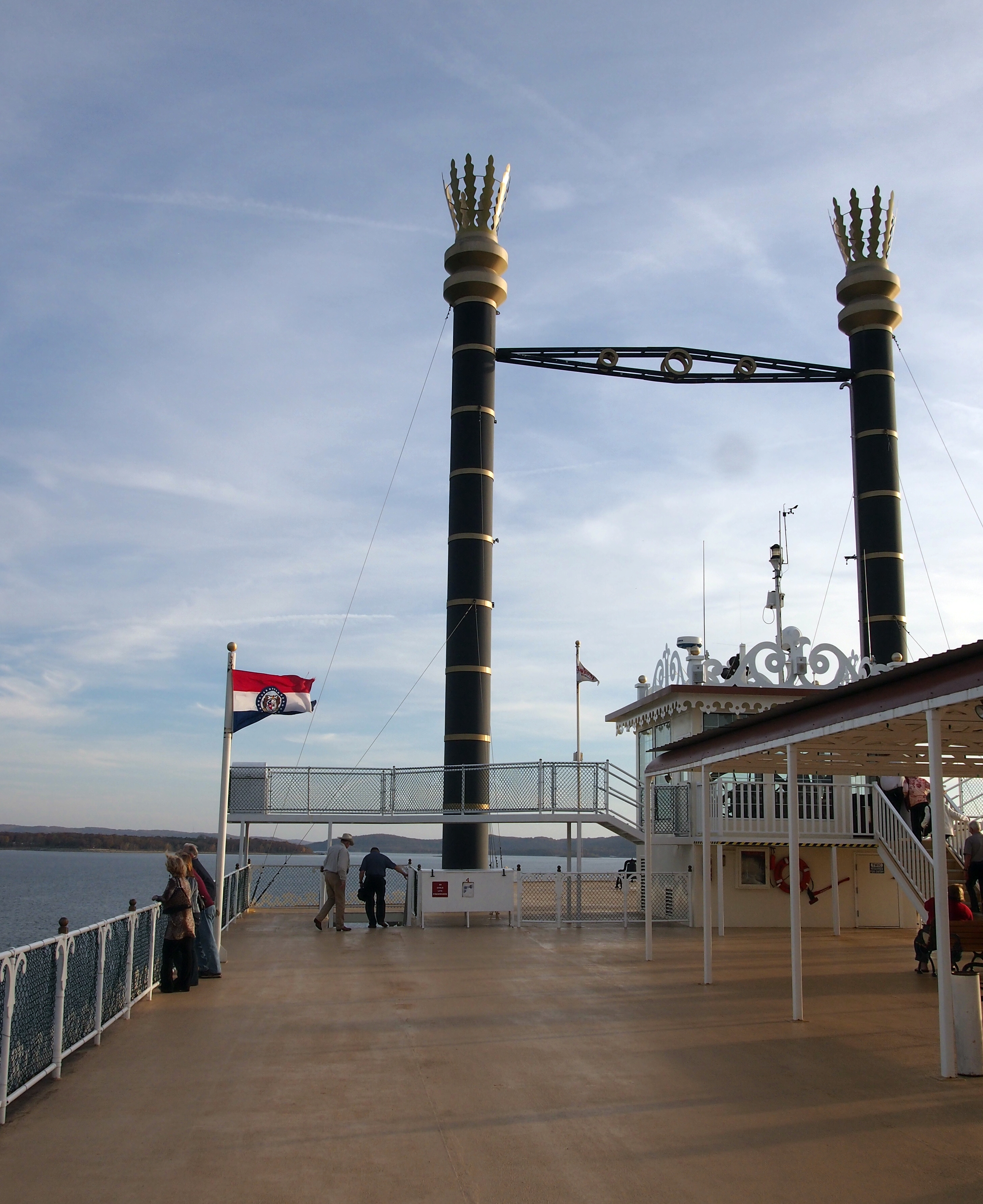
Branson Belle is the property of Herschend Family Entertainment Corp., the company that also owns Silver Dollar City and a lot of other properties.– including Dollywood, but that’s part of another tourist-magnet area. The showboat’s a paddle-wheeler – two twin wheels, 24 feet in diameter each, and it’s a smooth ride, because while sitting in the theater I didn’t notice the ship getting underway. Later I wandered around taking pictures, making it as far as the topmost deck.

The 4 pm show included dinner plus entertainment: magician-comedian emcee Christopher James, who told the best jokes among the various shows I saw, a number of musicians, and “the world’s only aerial violinist,” Janice Martin. That alone was worth getting on the showboat for.

Janice Martin also happens to be a fine singer and pianist, which was part of the act, but I think everyone was waiting to see just what an aerial violinist would do. Climb up a couple of silk lines and do the kind of act you might see in a circus, to begin with. But strapped over one of her shoulders somehow was a special violin built for the purpose, which she played skillfully while dangling from the silks in one way or another. Flat-out amazing.

How did the remarkable combination come about? From the little she said, she’s been a musician always, including training at the Julliard. As for the aerialist skills, she said she first learned rope climbing during her stint in the U.S. Army as a musician. At what point did a light bulb go off? – hey, I can do both of these at the same time. Couldn’t say, but it did, and I hope the Branson Belle is making it well worth her while.

Table Rock Lake Sunset

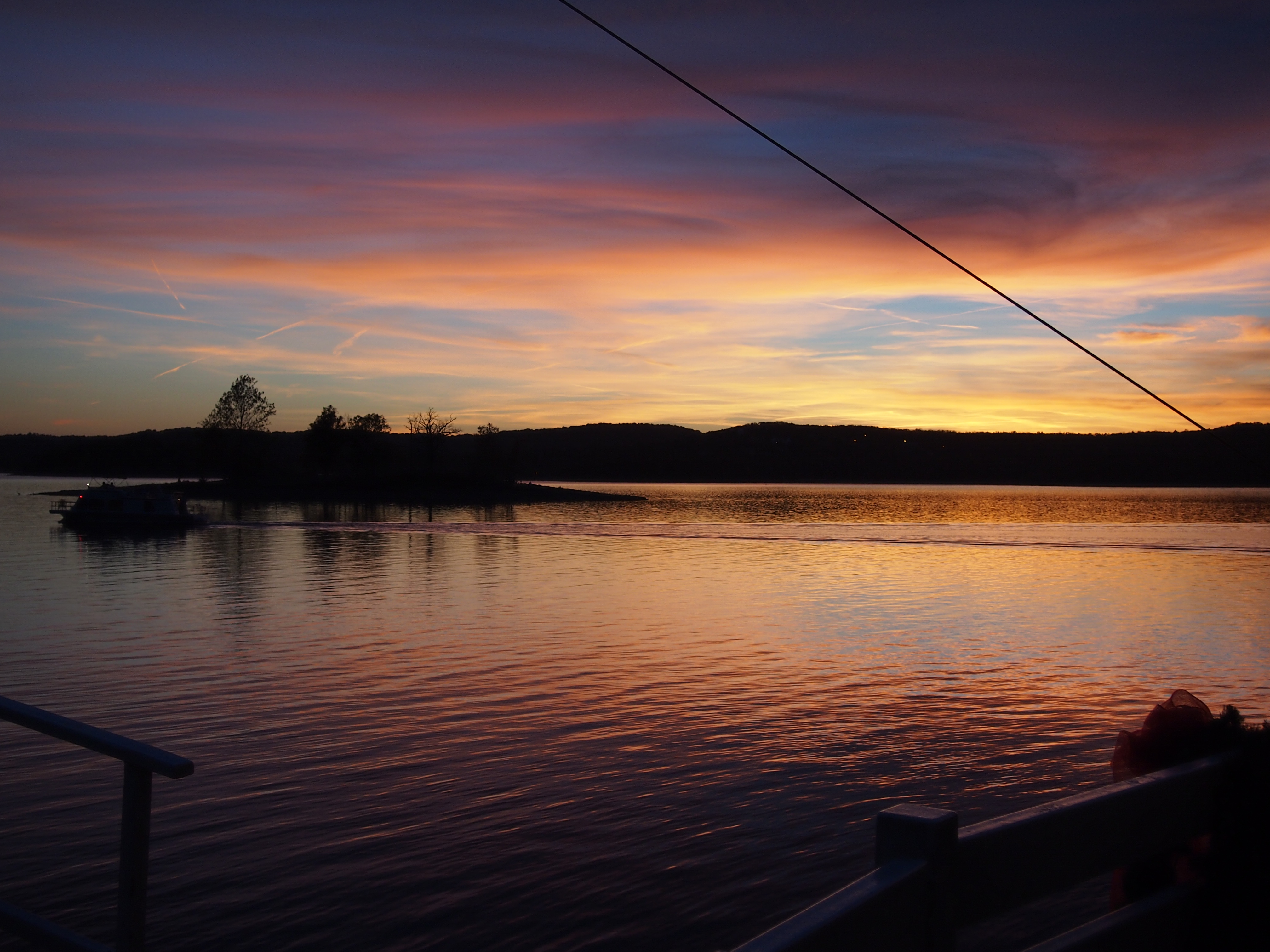
Those formerly eager dam-builders, the U.S. Army Corps of Engineers, built Table Rock Lake near Branson in the 1950s to control flooding by the White River. Since then the lake has also done its part to attract visitors to Branson. It’s a fine lake.

We spent the afternoon of November 2 on the lake, aboard the showboat Branson Belle, which wrapped up its 4 pm cruise just as the light was disappearing in the west.

The Titanic Museum Attraction

When you buy a ticket for the Titanic Museum Attraction in Branson—that’s its slightly odd name—you get a “boarding pass.” On the front the pass says “permission to come aboard” and gives the sailing dates of the doomed steamer, which sailed from Southampton to Cherbourg to Queenstown to Unwanted Immortality.

On the back is a short bio of one of the passengers or crew, but not his or her fate on Titanic. That’s the hook. To find out what happened, you have to consult a wall in the museum that lists all those who lived and all those who died, and wall is designed to be the last thing you see (besides the gift shop) in a normal tour of the museum. Of course, not quite every “boarding pass” has that kind of suspense. Another fellow on our press trip got Capt. Smith, and I’m afraid we all know what happened to him.

I got William Sloper, First Class Passenger from New Britain, Conn., who was a young stockbroker and son of a banker who’d just finished spending three months in Europe. A wealthy swell, in other words. I won’t maintain the suspense: he survived. Lived on until 1955, in fact, according to the Encyclopedia Titanica.

“When the Titanic struck the iceberg, Sloper was playing bridge with some friends,” the Encyclopedia notes. “Sloper was rescued in lifeboat 7. The lifeboat was one of the early boats sent away and First Officer William Murdoch was freely allowing men into the starboard side lifeboats when there were no women around. According to Sloper, he owed his life to Dorothy Gibson, an actress and one of his bridge companions, who got into the lifeboat and insisted that he join her.”

Luck was with him, in other words. Even first-class passengers needed some. But the experience haunted Sloper in an unusual way: “A New York Herald reporter identified Sloper… as having dressed in women’s clothing to escape the ship,” the Encyclopedia continues. “On the advice of his father, other family members and trusted friends, Sloper did not sue the Herald nor the reporter. He decided that the fuss would eventually pass [but] spent the rest of his life refuting the charge.”

On the outside, the Titanic Museum Attraction is built to look something like the ship, only smaller. I knew little about the place going in, and was prepared for a Disneyfied version of the disaster or worse. So I was astonished to find a first-rate museum inside, a fine blend of standard displays and written information with various kinds of interactivity. Besides actual artifacts from the bottom of the Atlantic, it features a wealth of photographs and other images, models, maps, period clothing and items and accoutrements, and a full-scale replica of the ship’s grand staircase, which is a functioning staircase between the museum’s two floors.

Since Titanic amounted to a floating city, it’s a large subject, yet the museum does a good job of illuminating the larger story of the disaster, which is hardly obscure, but also dozens of smaller stories. One story in particular caught my attention: the photographs of Father Frank Browne, a Jesuit who sailed from Southampton to Queenstown, and then disembarked with a large cache of pictures he made on the ship.

For some reason, I’d never heard about him, though I think I’ve seen some of his pictures. The better part of a room in the museum is given over to the story of the priest and his camera, and I’m glad I spent some time finding out about him. That’s all I ask from a museum: to come away knowing something new.

Underground Branson

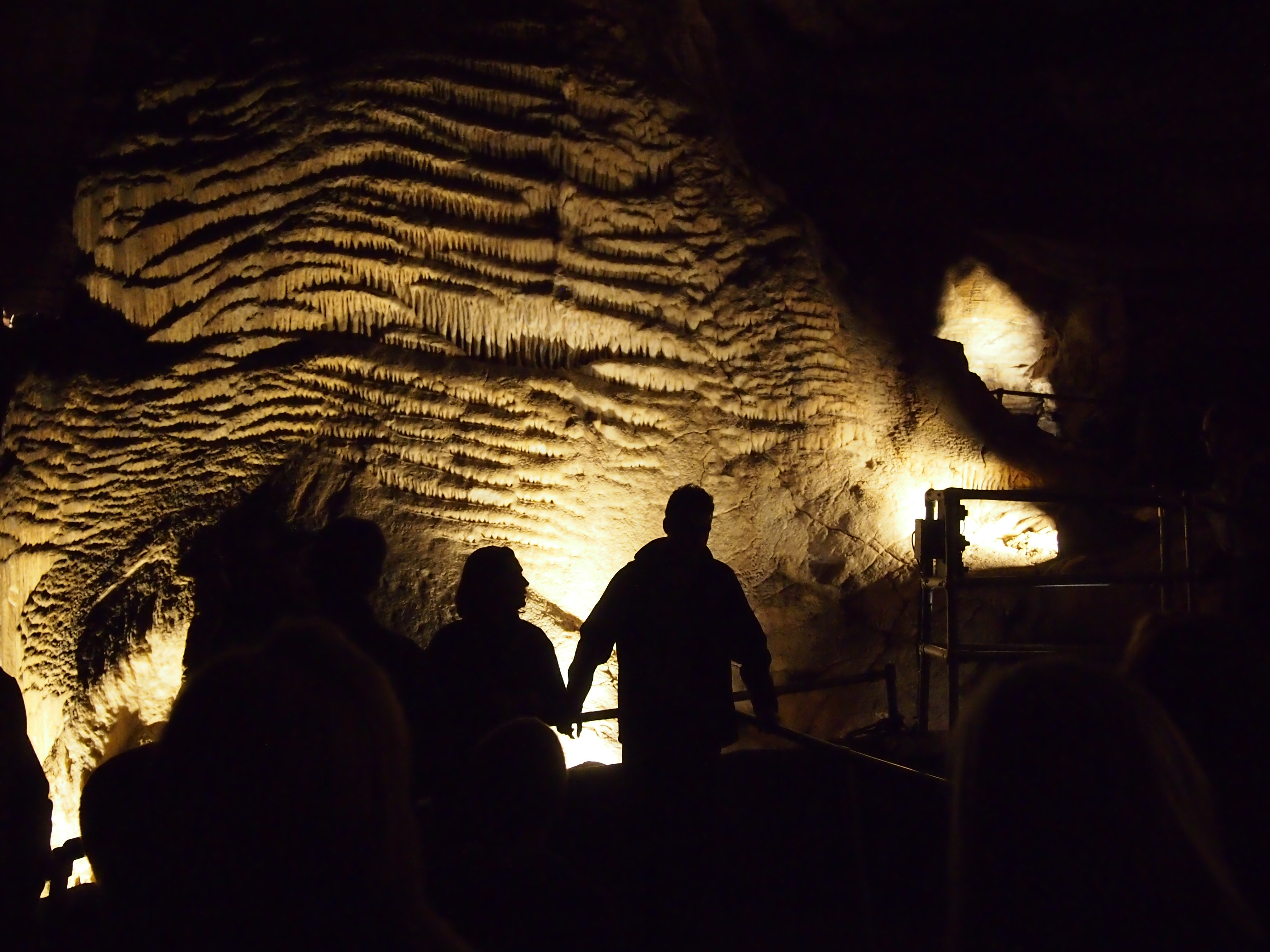
I’ve finally learned to take passable snapshots in caves. While visiting Branson, I took the tour of Marvel Cave, which begins with a long walk down steel stairs and then passage along a trail to the bottom of the enormous Cathedral Room, where I caught an image of a man and woman holding hands in front of a formation called The Sentinel.

The guide was happy to regale us with certain size comparisons, such as that the fact that the Statue of Liberty, not counting the pedestal, would fit easily in the Cathedral Room. I had to check that later, and sure enough, the Cathedral Room is 204 feet high, while the statue is 151 feet high. The room is large enough to accommodate hot air balloons in flight, and in 1963 balloonist Don Piccard set the “underground altitude record” in the room. The guide also said that someone stood on top of a hot air balloon once and touched the ceiling of the room, probably the only person ever to touch it.

Marvel Cave is the original Branson-area tourist attraction. Tours began in the 1890s, after the commercial uses of the cave, namely the extraction of bat guano, had played out. That’s older than the area’s many theaters, museums, and other attractions, older than massive local lake built by the U.S. Army Corps of Engineers, older even than The Shepherd of the Hills, the 1907 book that inadvertently encouraged travelers to come to the Ozarks. Silver Dollar City, which is on the surface directly above the cave, owes its existence to the fact that people were coming there anyway—a theme park ought to work on the site, and it has. It opened in 1960, during the immediate post-Disneyland boom time for theme parks.

The cave’s bats must be hibernating already, since we didn’t see or hear any. White nose syndrome hasn’t reached Missouri yet, and we were warned not to enter the cave wearing any clothes worn in caves with infected bats, since the fungus that apparently causes the disease is thought to travel that way.

Marvel Cave offered up one of the more difficult walks I’ve ever taken in a cave, or maybe I’m just getting old. The paths are slippery in places, and not all the stairs are even. The ceiling comes down to meet your head in a lot of spots, especially one called Tall Man’s Headache. The walk down was easy enough, but the climb up involved a lot of stairs, though the last part of the tour involves being taken out of the cave by a short cable railroad.

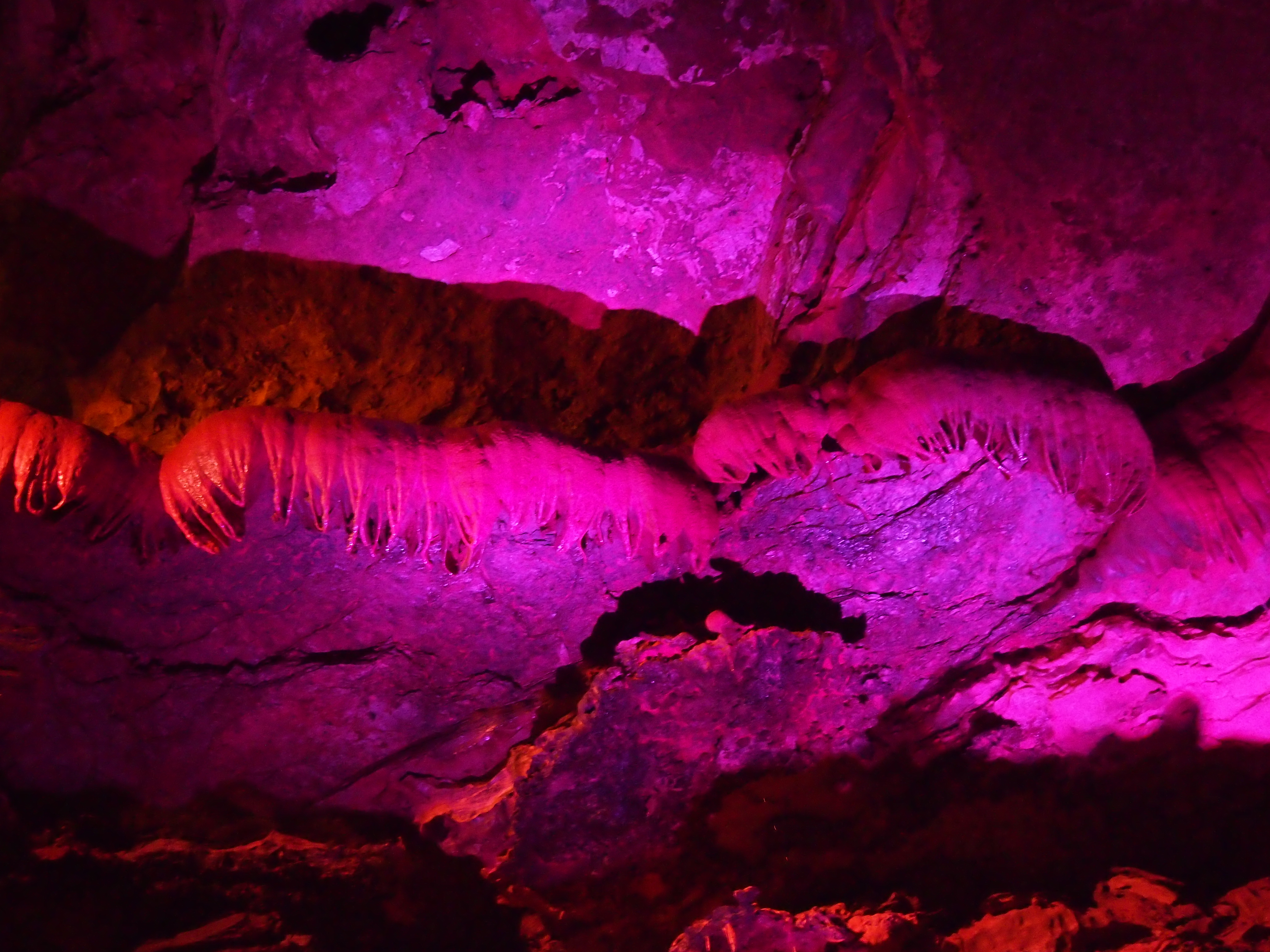
But it was worth the exertion. It isn’t the largest or the most feature-packed commercial cave I’ve ever toured, but it’s an impressive one with a range of pretty features, only a few of which include the use of colored lights.