The Hot Sardines

Usually one visit to the city per weekend is enough. On Saturday, the trip to see The Merchant of Venice involved a drive to a part of town where parking is easy and an El stop is nearby, so we could ride the rest of the way to a neighborhood with far more difficult parking.

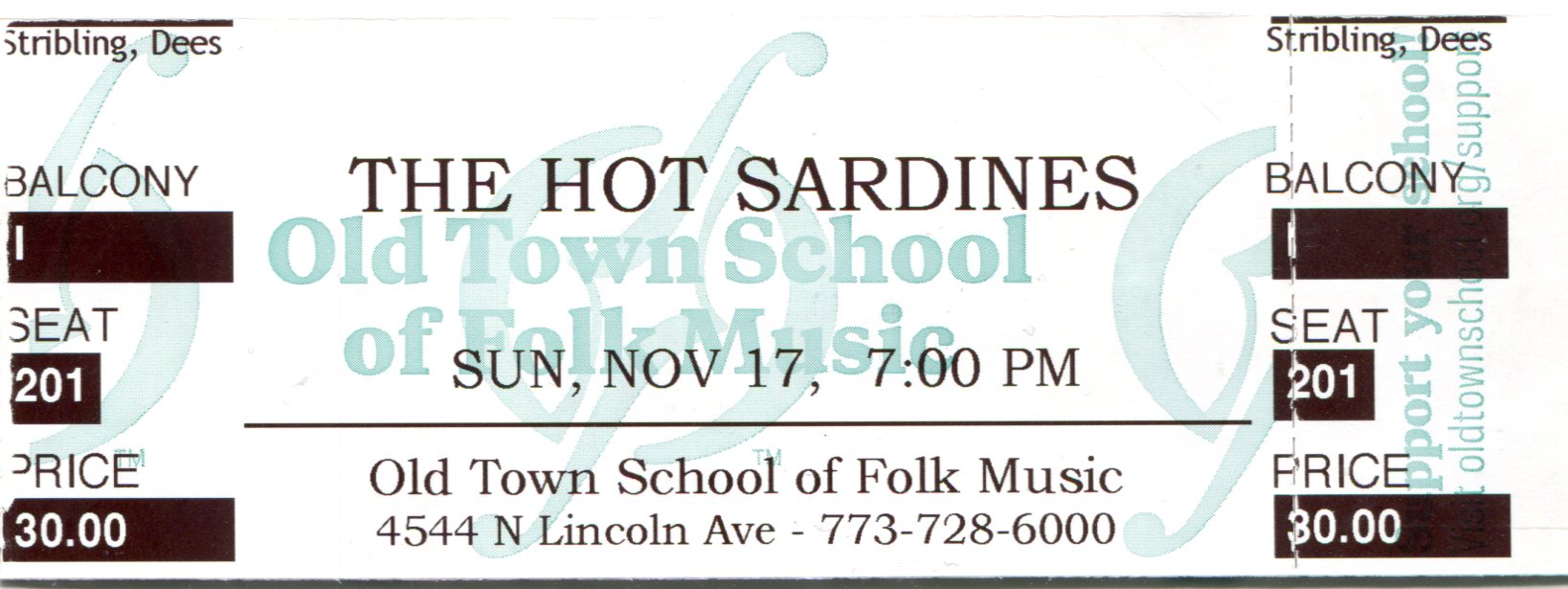
Not long ago, I found out that the Hot Sardines were going to be in town the same weekend — but on Sunday — so I decided that I wanted to see them, too. At least driving all the way was an option, since the band was playing at the Old Town School of Folk Music in Lincoln Square. We parked a half a block away.

The only reason I know about the Hot Sardines is YouTube. To be more exact, YouTube algorithms that suggest one thing and another. When it comes to music, that’s almost always very little outside a narrow range, but occasionally something unusual gets through. Probably listening to electroswing a few years ago made the bots suggest the Hot Sardines’ to-the-ceiling-lively version of “Bei Mir Bist Du Schoen.”

They’re just as lively in person. Hot is fitting. Hot jazz and lots of it, in a roughly two-hour show with no intermission and two encores, with frontwoman Elizabeth Bougerol and bandleader Evan Palazzo each hopping their jive — peppy vocals and animated piano, respectively. Other band members jammed on trombone, trumpet, bass, tenor saxophone, clarinet and drums, sometimes including conga. Often enough each of them had solos in which to shine, and shine they did, every jack jazzman of them.

There was also a fellow on stage with no instruments. Sitting in a chair in his fancy duds and fine hat. (Of course, they all wore fancy duds — Bougerol in gold lame and Palazzo in powder blue.) As soon as the first number started, his feet started tapping, and you noticed the taps on his shoes. He was the band tap dancer. Did he ever move, sometimes just sitting down, but often on his feet, moving all over the stage, tap-tap-tap-tap-tap with arms and legs moving every which way, adding his distinctive rhythm to the band. Who thought of adding him? (A.C. Lincoln by name.) What an inspiration.

Some tunes were more familiar, some less, all good. Among others, the Hot Sardines played “Some of These Days,” a Sophie Tucker number, “Bill Bailey Won’t You Please Come Home,” “Lulu’s Back in Town” and “Caravan” (take note of A.C. Lincoln doing his thing in that last video). “Bei Mir Bist Du Schoen” was the first encore.

As we entered the theater, I noticed a few small signs here and there explaining that the show was partly sponsored by the European Union. Odd, I thought, then forgot about it.

About mid-way through, Bougerol, who had a pretty good between-song patter, mentioned it. “Seems like one of our sponsors is the European Union,” she said, making a gesture that told us, How strange.

“Must be because I’m a French national,” she said.

Listening to her speak or sing in perfectly idiomatic and unaccented English, you’d have no clue. Apparently she was born in Neuilly-sur-Seine near Paris, but spent time in Ivory Coast and Canada while growing up — as well she might, since her grandfather was a Canadian jazzman named Bobby Gimby, who wrote a song I might have sung as a six-year-old had I lived in Ontario instead of Texas.

Bougerol did four or five of songs in French — just as jazzy as anything in English — but the only one whose title I know was “I Wanna Be Like You,” or whatever the French equivalent is. She said she knew it from watching the French version of Disney’s Jungle Book as a child.

The band lineup is a little different in this video, but the tune and lyrics are the same.

She also told the amusing story of how the band formed. Namely, the beginning of the musical collaboration between her and Palazzo, who met by answering the same Craigslist ad for a jazz jam. They discovered they both knew a relatively obscure Fats Waller song, “Feet’s Too Big,” and played it at the jam.

Then they played it for us in the audience.

Now that’s a fun song. Fats Waller’s recording of it is here.

The Merchant of Venice

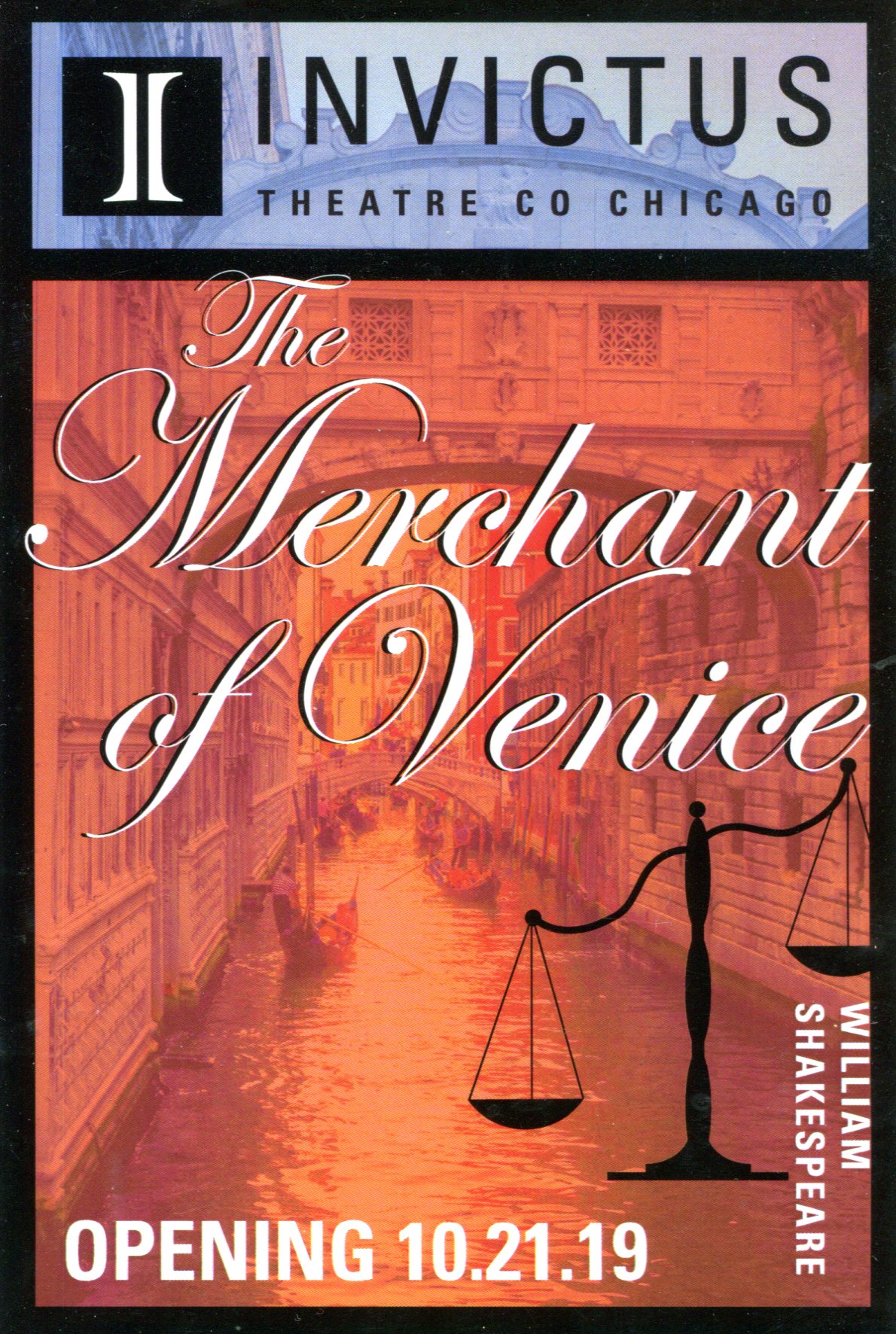
On Saturday Ann and I went to the North Side of Chicago to the Pride Arts Center to see The Merchant of Venice as performed on a small stage by Invictus Theatre Co., which did a first-rate job.

Besides enjoying the steady stream Shakespearean turns of phrase — as with any of his works — by seeing that play, we were also dipping our toes into the unending argument about how to interpret the play and especially Shylock.

The modern urge is to want Shylock to be sympathetic, and he is sometimes, such as in his righteous anger. Yet sometimes he’s not, as when he bemoans not his lost daughter, but the money she took with her. I doubt that Elizabethan audiences concerned themselves much with understanding Shylock, however nuanced Shakespeare made him. They just were looking to be entertained, and probably booing and hissing at Shylock was fully part of that.

But we bring centuries of further history with us when we see the play. Invictus referenced this explicitly by setting the action in Fascist Italy, with costumes specific to that period — including the stylish dresses of upper-class women of the time, but also blackshirts. The setting added an extra layer of menace to the situation Shylock found himself in, making him easier to sympathize with.

Also emphasized: Shylock as an outsider. Joseph Beal, who did a fine turn with the part, played it with a Yiddish accent, which might not have meant anything to Venetians of 1600 or even 1938, but which marks him apart from the rest of the cast to our ears.

There are comic elements in the play, of course, some of which actually were funny, especially when Portia’s suitors mulled which box to pick to win her hand. A young actor named Jack Morsovillo briefly stole the show as the comic Arragon in that scene. Though it wasn’t all that funny, the play also featured the comic conceit of two men unable to recognize their wives simply because they were pretending to be men.

In this production, a silent addition marked the end of the play. Jessica, the daughter who abandoned Shylock, emerges on one side of the stage, looking miserably torn about the decision she’s made. Shylock emerges on the other side of the stage, looking at her. Are they going to reconcile? Quarrel? Before anything is said, two blackshirts come from behind Shylock, grab him and take him away.

Quite an ending, even if appended for a modern audience, for a play that’s technically a comedy. So the production was squarely in this new(ish) tradition — since the 19th century, I believe — of making Shylock more victim than monster, but hardly all victim. Well done, Invictus.

Once Upon a Time in Quentin Tarantino’s Childhood

We went to see Once Upon a Time in Hollywood not long ago. Been a while since I’d seen a new movie, or a Quentin Tarantino movie, for that matter. Come to think of it, I don’t think I’d ever seen one of his movies in the theater — everything’s been on tape or DVD or demand, to list formats chronologically.

I left Once Upon a Time wondering how old Tarantino is. I knew next to nothing about him, except for his fondness for putting ultraviolence in his movies. From the way he depicted the period of the movie, 1969, I got the sense that he remembered it, but not as an adult. Like me.

Sure enough, he was born in 1963. That makes us contemporaries. Later he must have filled in some of the gaps his own memory might not have retained, as one does. I can’t imagine, for instance, that a six-year-old would have paid much attention to Sharon Tate or any of the movies she was in, least of all a bomb like The Wrecking Crew. (Matt Helm movies are best forgotten.) On the other hand, Tarantino probably saw old TV westerns on reruns or shows like the FBI or Mannix in the early ’70s, just as I did.

Yuriko came away baffled by many of the references. She’d come to see Brad Pitt, whom she enjoyed seeing — he had a good part — but it isn’t a past she shares. Neither of our daughters went, but come to think of it, most of the references probably would have been strange to them as well.

Despite including the Manson family and some other unsavory aspects of the period, the movie was an exercise in nostalgia — of a kid who watched American movies and TV beginning in the late 1960s. For a time when Americans watched roughly the same TV shows and movies, because options were much more limited than they are now.

What will be the basis of pop-culture nostalgia for the 2010s in 50 years, if there’s any? I’d think it would be as fractured as entertainment is now. Well, so what? Can’t say that I care. Not my circus, not my monkeys.

Pitt, as stuntman Cliff Booth, had my favorite line in the movie. In a flashback, Booth was on the set of The Green Hornet with Bruce Lee, who is characterized as a preening, vain fellow, and they’re rehearsing a fight scene.

Bruce Lee: My hands are registered as lethal weapons. We get into a fight, I accidentally kill you? I go to jail.

Cliff Booth: Anybody accidentally kills anybody in a fight, they go to jail. It’s called manslaughter.

Hush, Here Comes A Whiz Bang

Been a while since I visited Archive.org, which I remember from the early days of the Internet. Or at least my early days on the Internet, back in 199-something. According to the site, the archive now holds 330 billion web pages, 20 million books and other texts, 4.5 million audio recordings, 4 million videos, 3 million images and 200,000 software programs.

Maybe not the Library of Babel, or even the Library of Alexandria — or the existing Library of Congress, with its 168 million items — but impressive all the same. A fine place to wander around. When I did so the other day, I came across digitized versions of Captain Billy’s Whiz Bang, the juvenile humor mag whose heyday was nearly 100 years ago.

I downloaded a cover. It’s public domain now. The explosion of pedigreed bunk belongs to all humanity.

Naturally I spent some time reading some of the jokes. They were anachronistically mentioned by Prof. Harold Hill, after all: “Is there a nicotine stain on his index finger? A dime novel hidden in the corncrib? Is he starting to memorize jokes from Captain Billy’s Whiz Bang?”

This is what I have to say about it: juvenile humor has a short shelf life. Also worth noting: 25 cents wasn’t exactly cheap in the 1920s for a kid. A quarter in 1922 had the purchasing power of about $3.80 now.

Speaking of juvenile humor, I ran across this article the other day. Interesting that the writer, or maybe the editor, expects readers to get the visual reference to Alfred E. Neuman. So, apparently, do the editors of Der Spiegel, at least their English-speaking audience.

Full Moon Bluegrass, 1986

Found this tucked away in an envelope the other day, a relic of my Nashville days — post-college days, that is.

I went to one. I think it was the August 19 party, but I’m not sure. They were held on land not far from town that included a barn. I don’t know who organized them or how I knew about it, though I did go with some of my Nashville friends.

People showed up and sang and played their fiddles and mandolins and banjos and whatnot. Being Nashville, the music was good. No admission, but I think hats were passed around; someone had to pay for the schedule cards and the July 4 fireworks. It was a hoedown. Or a shindig. Or my own favorite of these words, a hootenanny.

That’s more a folk music term, but never mind. I like the word so much I’m going to use it: As a young man in Nashville, I went to a hootenanny. Recommended.

RIP, Donald Ault

The other day I learned that Donald Ault died in April at 76. Sad to hear it. Among my college professors, he was one of the more interesting.

Besides being a William Blake scholar of renowned, Ault also had an early academic interest in comics, especially the work of the talented Carl Barks. Most of the rest of the VU English Department didn’t think much of that — comics (and balloons) is for kiddie-winkies, after all — and a few years after I took his class, Donald Ault was off to the University of Florida. That was a better fit for him than Vanderbilt, where he had come to from Berkeley.

Ault said so himself in a short memoir republished by the International Journal of Comic Art blog. An appreciation for Ault by another former VU student is here, better than anything I can write about him.

Ault taught the last English class I took at Vanderbilt, in the spring of 1983, whose formal title I don’t remember. But I do remember an assignment for that class that had me write an interpretation of a Carl Barks’ Donald Duck story. Out of a number of ideologies to choose from in doing the paper, I picked a Marxist interpretation. I don’t remember what I wrote, but I do remember having fun with it.

We also watched some videos — items in those pre-Internet days that were hard to find. One in particular was J-Men Forever, an insane romp of a thing put together by a couple of members of Firesign Theatre. As it happened, I’d heard of Firesign because a couple of their records were floating around my freshman dorm hall, but I’d never heard of J-Men Forever.

RIP, Dr. Ault.

The Comedy of Errors

Went to Aurora, Illinois, on Saturday evening for a performance of The Comedy of Errors, the only one in the suburbs this year by Chicago Shakespeare in the Parks.
The play’s the trope-namer, though I expect the idea is much older even than Plautus, and in fact Errors owes a lot to Plautus. It’s a trope big enough to include comic high points like Fawlty Towers (also a comedy of manners) as well as such excrescences as Three’s Company.

Free Shakespeare in the 21st century packs ’em, I’m glad to report.
The Chicago Shakespeare Company, full of talented young actors, handled the material well, including lots of slapstick and wordplay. I suspect some of the more obscure jokes were removed and other points smoothed out, though I’m not an expert on the play. No matter. It was funny.

The show began when the sun was still hot, so Shakespeare-shaped hand fans were available. By the time Errors ended, it was dusk and pretty comfortable there at RiverEdge Park.

Acrobatics and juggling punctuated the play, which I figure is true to the spirit of the earliest performances. And to the staging by the Flying Karamazov Brothers, for that matter. The goal was (is) to entertain, after all. So it does, in competent hands, 400+ years later.

The biggest laughs came when one of the Dromios described being pursued by the other Dromio’s girlfriend, a kitchen wench.

Dromio: Marry, sir, she’s the kitchen wench, and all grease, and I know not what use to put her to but to make a lamp of her and run from her by her own light. If she lives till doomsday, she’ll burn a week longer than the whole world.

Antipholus: What complexion is she of?

Dromio: Swart like my shoe, but her face nothing like so clean kept. For why? She sweats. A man may go overshoes in the grime of it.

Antipholus: That’s a fault that water will mend.

Dromio: No, sir, ’tis in grain; Noah’s flood could not do it.

Antipholus: What’s her name?

Dromio: Nell, sir, but her name and three quarters — that’s an ell and three quarters — will not measure her from hip to hip.

Antipholus: Then she bears some breadth?

Dromio: No longer from head to foot than from hip to hip. She is spherical, like a globe. I could find out countries in her.

The Joliet Area Historical Museum

RIP, Debbie DeWolf. One Monday morning in 1988, when I was working at the Law Bulletin Publishing Co. in Chicago, the company receptionist — whose name I forget — reportedly called the company long distance from Kansas or Nebraska or the like and said she wasn’t coming to work that day. Or ever again.

Shortly thereafter, a young woman named Debbie DeWolf took her place. She was one of the more effervescent people I’d ever met and she ultimately make a career at the LBPC well beyond answering phones. I hadn’t spoken with her for many years before her death, but it was sad news.

On Sunday, Ann and I spent some time in Joliet. We noticed that the Blues Brothers pop up in odd places around town, such as on the wall of an auto parts business and at the main entrance to the Joliet Area Historical Museum.

The Joliet Area Historical Museum

That’s pretty remarkable traction for not only fictional characters, but for characters created more than 40 years ago. Then again, Jake’s nickname was “Joliet,” and he was seen being released from the Joliet Correctional Center when The Blue Brothers opened (and come to think of it, he was back in the jug at the end of the movie), so I guess Joliet can claim him.

Better than the city being associated forever with the prison. The museum doesn’t particularly downplay the long history of the prison, but it isn’t exactly celebrated either. In any case, it will probably be a few more decades before “prison” stops being the first answer in a word association game with “Joliet.”

It’s a longstanding tie. In 1972, Chicago songwriter Steve Goodman recorded a song called “The Lincoln Park Pirates,” about an aggressive Chicago-based towing service that regularly ransomed cars. It included the following lines:

All my drivers are friendly and courteous
Their good manners you always will get
‘Cause they all are recent graduates
Of the charm school in Joliet

The Joliet Area Historical Museum is a well-organized example of a mid-sized local history museum, with thematically grouped artifacts and reading material. In its main exhibition hall, the centerpiece re-creates a section of the Illinois and Michigan Canal, which passed through Joliet. The view from the first floor.
The Joliet Area Historical MuseumThe view from the second floor, with stained glass from a demolished local church in the background.
The Joliet Area Historical MuseumAnother transportation-related artifact: a Lincoln Highway signpost.
The Joliet Area Historical MuseumAs it happens, the Lincoln Highway still runs through Joliet, half a block south of the museum, as U.S. 30. There’s also a sign in downtown Joliet marking the intersection of the Lincoln Highway and a branch of the former U.S. 66.

The museum does acknowledge the prison. In fact, there’s an entire gallery devoted to artwork made from material and debris and found objects from the former pen, or paintings inspired by it.

Even here, there’s no getting away from Jake Blues.
The Joliet Area Historical Museum“Fight Girl,” “Caught” and “Jake” by Dante DiBartolo. Interestingly, the images are painted on metal shelving scavenged from the prison.

Part of the former prison burned in 2013 — arson — and some of the burned items were later used for art as well. Such as a scorched TV set for “Ren-ais-sance Man” by Terry M. Eastham.
Joliet Area Historical MuseumI didn’t see a title for this one.
Joliet Area Historical MuseumRemarkably, the work is by a 7th grader named Sophia Benedick. The words on the work are, “It’s Never Too Late to Mend.”

There is also a room in the museum devoted to John Houbolt. He was the NASA aerospace engineer who pushed successfully for lunar orbit rendezvous for Apollo, a concept that made the landing possible by 1969. I’d read about him before (and seen him depicted in the superb miniseries From the Earth to the Moon), but missed the detail that he went to high school in Joliet.

Besides the museum, we spent a short time in downtown Joliet. One of these days, I want to attend a show at the Rialto Square Theatre. Supposed to be pretty nice on the inside. The outside’s not too bad either.
Rialto Square Theater JolietOn the grounds of the Joliet Public Library downtown is Louis Joliet himself.
Louis Joliet statue Joliet Public LibraryUnlike Jebediah Springfield, he didn’t purportedly found the town or anything. Joliet just passed this way.

Woodstock Walkabout

At noon on Saturday, the sun was high and mighty and toasting northern Illinois well into the 90s F. Later in the afternoon, an unexpected storm blew through. Unexpected because I hadn’t looked at any weather reports. By late afternoon, the storm was over and temps were in the pleasant 70s.

A good time to take a short walk in Woodstock, Illinois, which might be one of the state’s most pleasant towns. A good place to start was Woodstock Square. At the very center of the square is a GAR memorial to Union soldiers and sailors from Woodstock, which was founded in 1852.
What’s a town square without a gazebo?
Woodstock Square IllinoisStrolling south from Woodstock Square, I passed by the Blue Lotus Buddhist Temple. I noticed it on a previous visit to Woodstock.

Blue Lotus Temple Woodstock Illinois

I don’t believe these statues were there the last time. It’s been seven or so years, after all. Plenty of time to add a few depictions of Buddha.
Blue Lotus Temple Woodstock IllinoisBlue Lotus Temple Woodstock IllinoisThe temple isn’t the only religious site in the vicinity. Cater-cornered across the street is Woodstock’s First Church of Christ, Scientist. Not far away are the First United Methodist Church and the Unity Spiritual Center of Woodstock.

I’d come to Woodstock to see Greg Brown at the handsome Woodstock Opera House. He’s a vastly underappreciated singer-songwriter-story teller from Iowa.

It was dark after the show, but I didn’t want to hurry away from Woodstock. Besides, I’d read that there was a new(ish) mural just north of Woodstock Square. So it is, in an alley — which the town calls a “pedway” — off Main Street next to Classic Cinemas Woodstock Theatre.

The mural honors the likes of Groundhog Day, filmed locally and remembered elsewhere in town.

Woodstock Illinois Movie and Stage Mural

Orson Welles, who spent part of his youth in Woodstock.

Woodstock Illinois Movie and Stage MuralThe town also remembers Chester Gould, though the Dick Tracy Museum in Woodstock closed a number of years ago.
Woodstock Illinois Movie and Stage MuralThe alley features two statues as well. One is a wood carving of Woodstock Willie, presumably the town’s answer to Punxsutawney Phil, created by carver Michael Bihlmaier.
Woodstock WillieOddly enough, also near the mural is a small bronze of Welles by a local artist, Bobby Joe Scribner.
Woodstock Orson Welles statueAccording to the information sign near the work, it’s the only statue of Welles on public display in the United States. Interesting that it depicts an older Welles. His Paul Masson period, you might say.

High Summer Hiatus

Saw a few fireflies the other day, a certain sign of that nebulous period, high summer. The days might be getting shorter, but you don’t notice that yet — like the long moment at the top of ballistic trajectory. Back to posting around July 7.

Usually I rely on rain to wash my car or, if absolutely necessary, a hosing down on a warm day. But after our recent summertime jaunt to central Illinois-Indiana, enough bugs had met their insectoid maker against the leading edge of my car that I ponied up for an automated car wash. Half price ($5), though, since I had a coupon.

I find the journey through the car wash, at less than two minutes, visually and sonically interesting. I get that for my money, besides the removal of bug splatter.

So I held my camera as steady as possible during the splashing and blooping and hissing and flapping, along with elements of a minor light show.

The dog spent some time this morning trading insults with a resident squirrel. At least that’s how I want to think of it. The dog spotted a squirrel in the major back yard tree around 9 and immediately started looking up and whining at it, as she often does. Soon the squirrel was making its own noise, something like a duck with laryngitis.

Age has slowed her (the dog) down a little, but not yet when it comes to guarding the back yard against other creatures. Earlier this year, she spent time trying to scratch through the deck to reach what I suspect was a brood of possums. They seem to be gone now, since that dog behavior has stopped for now.

Chanced on a site called Yarn the other day that purports to offer a search “by word or phrase for TV, movies, and music clips.” So I decided to test it.

Why that phrase? Just popped into my head like the Stay-Puft Marshmallow Man.