The Producers

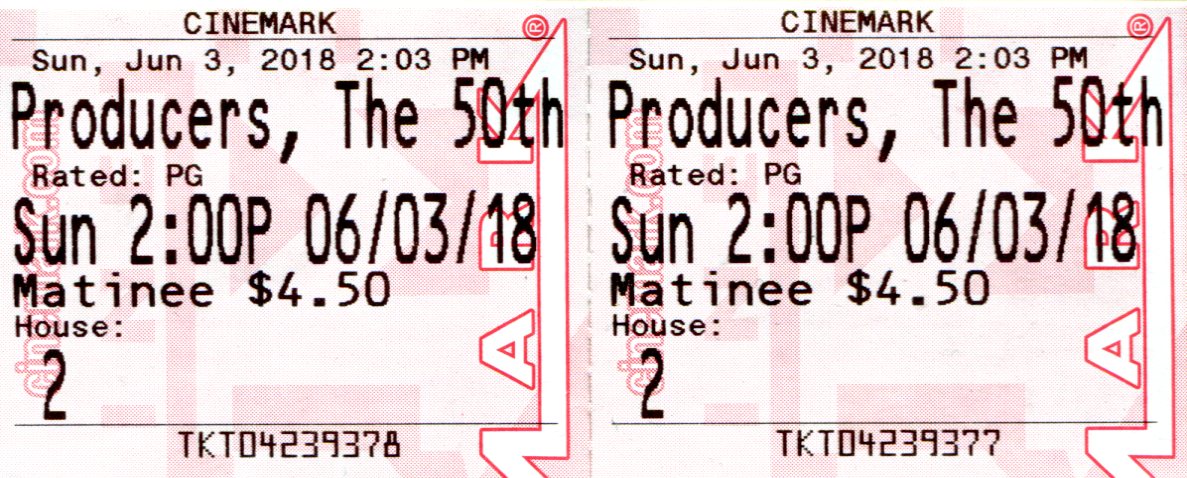
Remarkably, Ann wanted to see The Producers, so we went this afternoon. Another movie released in 1968, but about as different as can be from 2001. She seemed amused by it.

I had given her the gist of the story — the producers schemed to pick a play that would certainly fail, so they could keep the over-subscribed investment, and then it doesn’t fail. I think she had wanted some context for “Springtime for Hitler,” which she must have seen on YouTube (probably the 2005 version, though).

I don’t think I spoiled anything by telling her that. The joy of The Producers is in the execution. In the good many years since I saw it last, I’d forgotten how much fun the movie is. And how much is slapstick. It in the hands of lesser actors and a lesser director, it would have just been low comedy. With Mel Brooks and Zero Mostel and Gene Wilder and Kenneth Mars, what you have is inspired low comedy. For his part, Mars’ loopy German might be the best ever put on film.

As funny as the leads were, I have to say I laughed the hardest at Lorenzo St. DuBois (L.S.D.)’s audition song, as performed by Dick Shawn. Known, according to Wiki, for “small but iconic roles in madcap comedies, usually portraying caricatures of counter culture personalities.” He certainly nailed the dimwitted hippie in The Producers.

Somehow I’d forgotten that he was wearing a can of Campbell’s Soup around his neck during the audition. Nice detail. Ann didn’t ask me about it, and maybe she just considered it a passing oddity. But it was pretty clear to me that Mel Brooks, already entering middle age in 1968, didn’t think much of hippies, Pop Art, Timothy Leary, etc. The rest of the audience — mostly my age or older — got the joke, and laughed a lot at L.S.D’s antics, too.

Something I didn’t know until I did a little reading: Estelle Winwood, who played one of the old women Zero Mostel dallies with to get money for his plays — the one with the most lines — had a long career, acting well into her 90s, and living to be 101. She also was associated with the Algonquin Round Table.

Speaking of longevity, since it was a TCM showing, the movie was proceeded by a recent short interview with Mel Brooks. He’s a hale fellow for 91.

2001 at the Music Box

Just before the screening of 2001: A Space Odyssey at the Music Box Theatre in Chicago at noon on Saturday, one of the theater’s managers spent a few minutes telling us what to expect. Not in terms of content — it was a safe assumption that most (but not all) of the audience had seen the movie sometime in the last 50 years — but that there would be a few minutes of introductory music to a dark screen, and an intermission.

She also mentioned that the Music Box was one of a relatively small number of movie theaters nationwide equipped to screen the new 70 mm print of 2001. Interesting that a neighborhood jewel box of a theater from the 1920s has the latest movie screening tech.

I’d read about the new print. It was made recently from the original negatives, the goal of which wasn’t to clean up the images or digitally goose the movie, but to re-create as closely as possible what an audience would have seen in 1968. When I read about that, I knew I wanted to see it, even though I’ve seen the movie n times over the years.

For one thing, it had been a long time since I’d seen 2001 in a movie theater. I know I did at some point in the early ’70s, when I was old enough to be dropped off at a movie theater, the Broadway Theater in Alamo Heights, but not old enough to drive there myself. I saw it again at some mall theater during high school, after which I read Arthur C. Clarke’s book. In college, I saw it a few more times, at the Vanderbilt student cinema, and I think at an early multiplex in San Antonio during an early ’80s summertime revival.

Since then, I’ve seen it on VHS, DVD and on demand, but not in a theater. I was miffed that TCM didn’t pick it for its big screen series this year for the 50th anniversary, while choosing to show entertaining but lesser moves like Big and Grease. But maybe that’s because the 70 mm version was in the offing elsewhere (including Cannes, where it was first shown not long ago).

More than wanting to see 2001 in a theater, I was intrigued by the idea that it would look like it did 50 years ago. I wasn’t old enough to see it then. I’ll never have the experience of seeing it when it was just a strange new movie — no one ever will again — before it worked its way into the common culture, inspiring volumes of interpretation and giving us an unshakable image of a killer sentient computer with an unctuous voice. Still, this would be as close as I’d get to an original showing.

Ann went with me. Yuriko did not want to go and Lilly had a conflict. The Music Box wasn’t full for the showing, but there was a fair crowd, and not everyone was my age or older. The 70 mm “unrestored” print didn’t disappoint. It also showed, if there was ever any doubt, that 2001‘s special effects were special indeed, from the closest foreground to the furthest background.

Odd how those model spaceships, on actual celluloid, look more real than any GCI spaceships I’ve seen in a digital medium. That observation might be conditioning left over from my youth, or valid for most people, or meaningless all together. I don’t care. That’s what I see.

I noticed a few imperfections in the print: a scratch or two, minor pops of light, that kind of thing. That took me back. Do I remember right that probably as late as the 1980s, movies displayed those kinds of visual ticks?

Speaking of visuals, one new thing that occurred to me during this viewing, and there’s always something new each time, was the visual debt that some of the backgrounds owed to Chesley Bonestell and Luděk Pešek. For instance, a long shot showing the vertical landing of the ship that took Dr. Floyd to the Moon, with unrelated astronauts in spacesuits in the foreground, instantly brought Bonestell to mind — this time. You’d think I’d have noticed that before.

The soundtrack was loud. Except when it wasn’t. At first I thought that was a function of the more advanced sound systems of our time compared with 1968, and so not quite like an original audience would have experienced it. Now I’m not so sure.

“The team also went back to the original six-track soundtrack and faithfully transferred it to the new prints,” the Variety article notes. “ ‘The film is mixed in a very extreme way,’ [director Christopher] Nolan says with awe. ‘There are incredible sonic peaks that are beyond anything anyone would do today.’ ”

Sonic peaks from the get-go, I’d say, as the heavens align to the “Also sprach Zarathustra” fanfare. But for me the most startling sonic peak comes when HAL decides to murder the hibernating astronauts. The cut is from the quiet of the spaceship while Bowman is out retrieving Poole’s body to a sudden, full-screen, flashing COMPUTER MALFUNCTION accompanied by a loud beeping. Louder, I believe, than in other versions of the film. I heard at least one audience member gasp when the scene started.

As well she should have. In my earliest viewings of the movie, that scene disturbed me the most. Sure, you can say HAL went just a little funny in the head because of contradictory programming. Or maybe he was just an evil bastard willing to murder people in their sleep. You know, like some people are. I’m hardly alone in noting that HAL was pretty much the most human member of the crew, for better and definitely worse.

Then again, the sound wasn’t always loud, or even quite intelligible. The more-or-less idle chitchat on the space station at the very beginning of the spoken dialog was a little hard to hear. Everything is intentional in a Kubrick movie, so I suppose that fits with the movie’s well-known lack of exposition.

That was one of the few things I told Ann before the movie. I didn’t want to over-prepare her, but I did say that obtrusive exposition wasn’t one of the movie’s characteristics. Had there been voice-over narration — the original script apparently called for that — I believe that would count as obtrusive, and the movie wouldn’t be regarded as highly. I never did quite like the brief narration at the beginning of Dr. Strangelove, though I can see why it’s there.

Here’s something I never noticed in the soundtrack. Again, during the idle chitchat at the beginning, there’s a background PA voice announcing the following. Twice.

A blue lady’s cashmere sweater has been found in the restaurant. It can be claimed at the manager’s desk.

How did I never hear that before? It popped out at me this time. Maybe that’s a function of the new print. Or maybe it’s just one of those things tucked inside a densely layered work of art that isn’t noticeable early on.

Later, the PA says: Will Mr. Travers please contact the met office.

Whatever that is. Interesting detail, those PA announcements. As if to show that by the end of the 20th century, space travel will have some of the ordinariness of air travel in 1968. Many of the space station details — the customs screening, the restaurant, the phone call — point to that.

Guess that counts as 1968 optimism about the future of space travel. It’s easy to deride that in hindsight, but it wouldn’t have been completely unreasonable at the time. We were well on the way to the Moon, for one thing.

After that would come large space stations, Moon bases, voyages to Mars and rocket engines and spaceships large enough to mount an expedition to Jupiter in 18 months. The idea that extensive space travel would be part of the near future had jumped out of speculative fiction into the realm of serious expectation. Turned out no one wanted to pay for those things, but that was still in the future.

The movie is not, on the other hand, optimistic about future of politics, as you’d expect from Kubrick. That’s another thing that occurred to me for the first time. It’s only hinted at, but the hints are pretty clear. Mainly, the movie assumes that political bureaucracies will be the same prevaricating, susicious entities they’ve long been.

Dr. Floyd is either an important official of the U.S. government, or in a quasi-governmental body, but in any case the lid is slammed down on the discovery of the monolith on the Moon. He offers the official, and secret, reason.

Floyd: I accept the need for absolute secrecy in this and I hope you will too. Now, I’m sure you’re all aware of the extremely grave potential for cultural shock and social disorientation contained in this present situation if the facts were prematurely and suddenly made public without adequate preparation and conditioning. Anyway, this is the view of the council.

Eighteen months later, the monolith is still a secret, even from the astronauts going to investigate where the radio beam pointed. Talk about paranoid secrecy. It’s almost Soviet in its reach.

Floyd expresses the idea, which isn’t unusual in science fiction, that the discovery of extraterrestrials would somehow cause “cultural shock and social disorientation.” Not just science fiction. I seem to remember discussion along those lines — a “fundamental change” in our thinking or some such, if not shock or disorientation — as far back as when the Vikings were digging unsuccessfully for microbes on Mars.

I’m skeptical that any such thing would happen. Say we discovered an alien artifact tomorrow. Something indisputable, except that there would be a group of fools that disputes it anyway. But let’s say most people accepted it for good reasons.

Then what? Assuming the artifact isn’t attacking us or producing pathogens, nothing too dramatic. The reaction would be, how about that. Someone is out there. How interesting. Maybe over the course of decades or centuries, the discovery would change the way we think, but for most people in the here and now, it would be a curiosity. Our lives would go on. Besides, we’ve already been conditioning ourselves, in books and movies and TV and more, to the possibility of aliens for years.

Overall, I’d say 2001 is optimistic, assuming a certain common interpretation of the movie. After much travail — it is an odyssey, after all — mankind does reach for the next level of development, just as the ape-men did.

One more thing I thought about for the first time this time around: Why no redundancy for HAL? The astronauts talk about shutting down HAL and resuming the mission using Earth-based computers, which would certainly be a clunky way to go about it at that distance. And mission control mentions “twin” 9000 series computers at its disposal. So why weren’t at least two HAL-class computers built into the Discovery? In case, you know, one fails in some way, such as trying to go all HAL on the crew.

A nit to pick. After it was over, Ann seemed impressed, and had some questions and observations. She did sleep through some of the movie, though. Especially those long scenes outside the spacecraft.

She may or may not grow to like 2001 as much as I do. It’s an acquired taste, and not for everyone. But I’m glad she went.
Trans-Pecos & Llano Estacado 3,600+ Mile Drive Tidbits

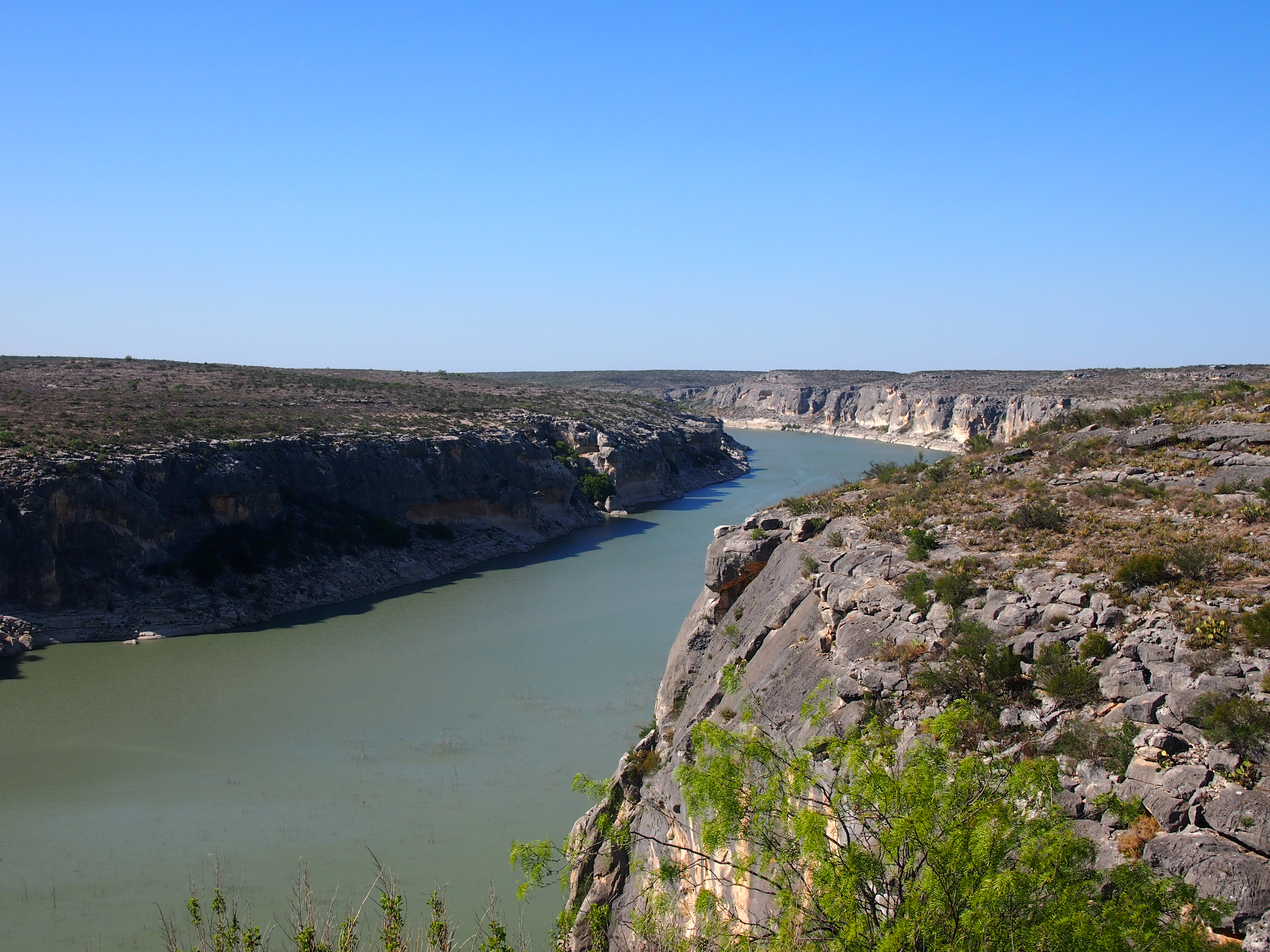
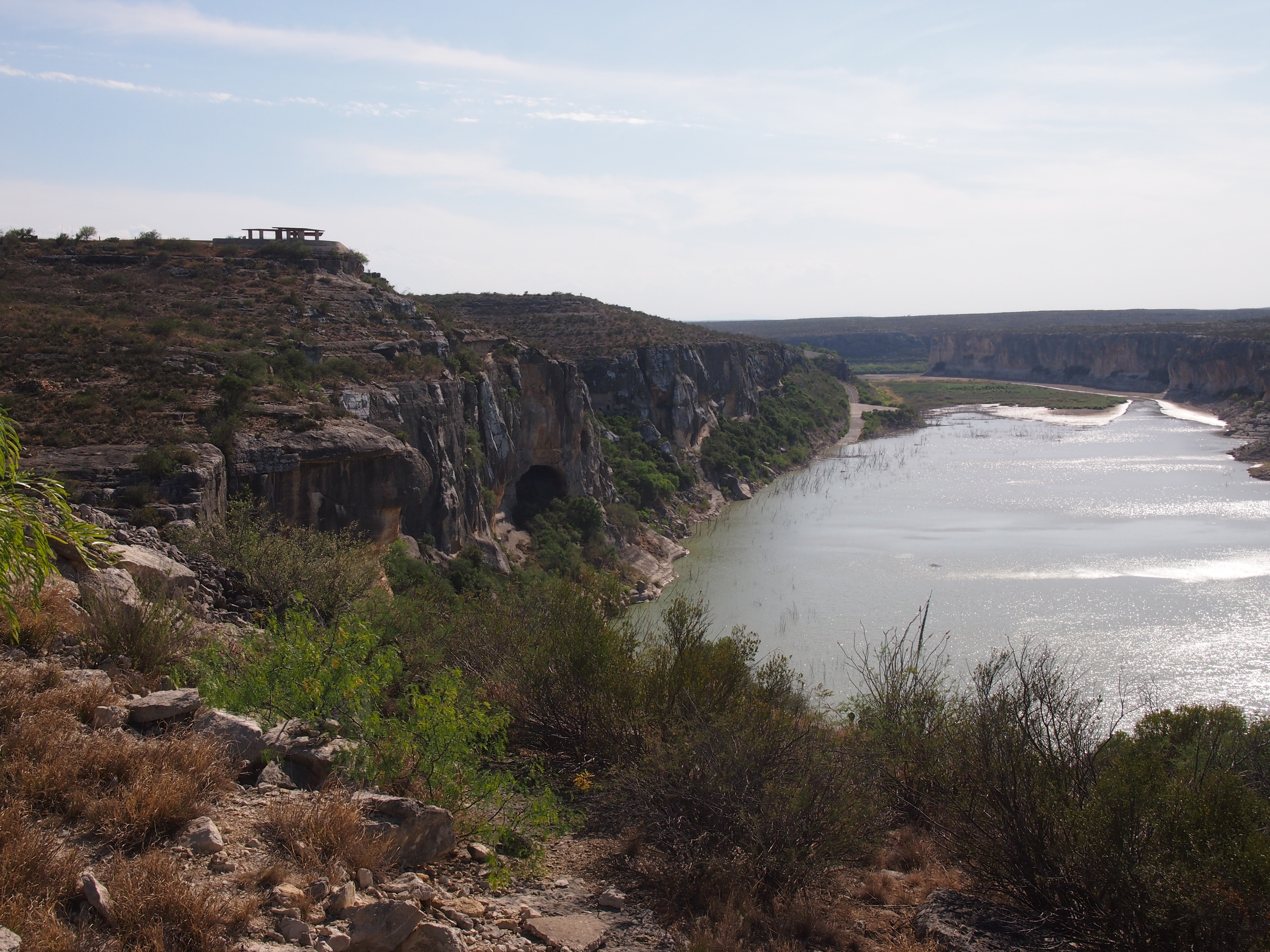
Along U.S. 90, not far west of the town of Comstock, Texas, the road crosses the Pecos River. The east end of the bridge has a place to stop and take in the view. This is looking upriver.

Downriver, toward the Pecos’ meeting with the Rio Grande.

Hard to believe there’s that much water in West Texas. Anyway, the river (of course) marks the beginning of the Trans-Pecos.

One of the grand hospitality properties of the Trans-Pecos is the Gage Hotel in Marathon, originally developed in 1927 by West Texas cattle baron Alfred Gage (born in Vermont), and designed by El Paso architect Henry Trost. Fifty years later, Houston businessman J.P. Bryan bought the rundown property and made it into a modern boutique hotel.

I didn’t stay at the Gage, though I had a good meal there and used its wifi. Instead, I stayed at the Marathon Motel & RV Park down the road. It has all the charms of a tourist court — separate cabin-like buildings of two or four units, even a bottle opener fixed to the wall — at a more modest price than the Gage.

There is an astronomy enthusiast at the Marathon Motel in the evenings, Bob, who sets up a couple of sophisticated telescopes a short walk outside the property and shows guests the night sky, which is pretty dark out in Marathon. I spent about an hour talking with Bob and looking his scopes the first night I was there.

Trouble was, the Moon was waxing gibbous, which made the sky a lot less dark. But we looked at some easy-to-find brighter objects, such as Jupiter and some of the Galilean moons, as well as Mizar and Alcor, and tried to spot the Orion Nebula. Orion was trending toward the horizon, about to bid adieu for the warm months.

Bob said the sky would be dark again a few hours before dawn, but I didn’t get up at that time until the last morning I was at the motel. At about 5 that morning, I woke (for the usual reason), but also got dressed and wandered outside for a few minutes. Bob was right. The Moon was gone, and there was what I wanted to see, no telescope necessary — the wispy, luminous edge of the Milky Way, billions and billions of stars at a glance. It was like seeing an old friend.

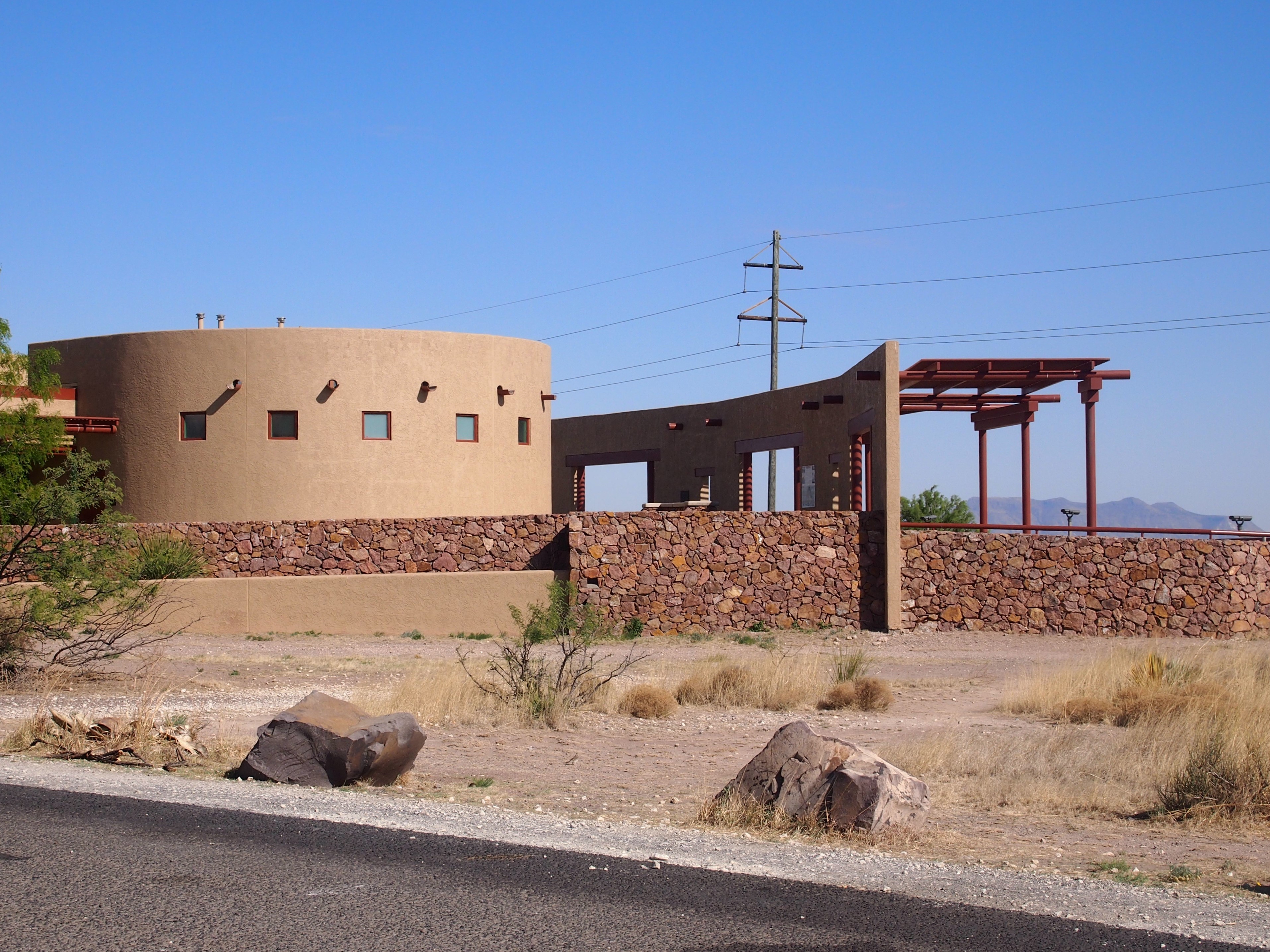
Speaking of nighttime spectres, not long after I left Marfa, I stopped along U.S. 67/90 at the Marfa Mystery Lights Viewing Center, which is essentially a rest stop with extra windows in the wall.

I wasn’t about to come that way at night and wait around for a glimpse of a desert will-o’-the-wisp, so I had to be satisfied with a daytime view of the direction of the Marfa lights. Eh.

While driving along I-20 in metro Midland-Odessa, I saw an official highway sign for the Midland International Air & Space Port. What? Space port? Seems a little optimistic on the part of the local airport authority.

Indeed, in 2014 the FAA approved the airport’s application to become first primary commercial service airport to be certified as a spaceport. XCOR Aerospace was due to start flying its Lynx spaceplane from Midland, but the company went bankrupt in 2017 before that ever happened. Oops. Maybe Fireball XL5 will start using Midland International soon. (That theme song has more traction than I realized. Even Neil Gaiman did a cover; once, anyway.)

In Amarillo, I saw another kind of sign. Fake street signs. I was driving along I forget which street, and saw a diamond-shaped sign, off to the side of the road but actually on private property, that said WE CALLED HIM COUNT DRACULA. It was a non-standard color, too: black with red letters.

Huh? But I had driving to do, and other cars not to hit, so the thought passed. Sometime later, I saw another sign — different color, similarly located — that said MINE BY RIGHT OF CONQUEST.

This got me to wondering, and I actually remembered to look into these odd signs. Doesn’t take long to find image collections of the signs, which are all over Amarillo, apparently.

According to Roadtrippers Chronicles — “The Raddest Stories From The Road” — “the strange signs are part of an art installation called The Dynamite Museum. Partially funded by oil heir and patron of offbeat art Stanley Marsh 3 (most famous for his work with Ant Farm on Cadillac Ranch), there are even a few in the nearby town of Adrian (it’s said that Marsh liked the idea of putting the signs in towns that started with the letter A).

“There was no rhyme or reason to the messages on the signs; the people behind the project would come up with ideas, or vote on suggestions sent in, and then install their favorites all over town.”

If I’d known that before I went to Amarillo, I would have looked for more.

The morning I left Amarillo, I had the radio to keep me company on the open road to Oklahoma City (I-40 in our time), and for a while I got a strong signal from Turkey, Texas, to the south. That day was Bob Wills Day in Turkey, and it sounded like a big to-do. The biggest shindig of the year for the town, probably. After all, Bob Wills is still the king.

I didn’t know until I looked it up that the King of Western Swing spent some of his youth on a farm near Turkey. The town of Turkey clearly remembers him. Sounded like fun, but it was too far out of the way. Just another thing missed because of scheduling.

Two Entertainers Who Died in Unfortunate Air Crashes

I asked Ann about both Buddy Holly and Will Rogers not long ago. She was unfamiliar with them. That only goes to show a generational difference. As far as I’m concerned, both are visible threads in the American cultural fabric, people I always remember hearing about. But the tapestry is very large and changing, so every generation sees different threads.

While driving from Marathon, Texas, to Amarillo, I passed through Lubbock, a city I’d had scant experience with before. Maybe none, I’m not sure. So I took a short look around. If I’d had more time, I might have strolled around the campus of Texas Tech or visited the American Wind Power Museum or the Prairie Dog Town at Mackenzie Park.

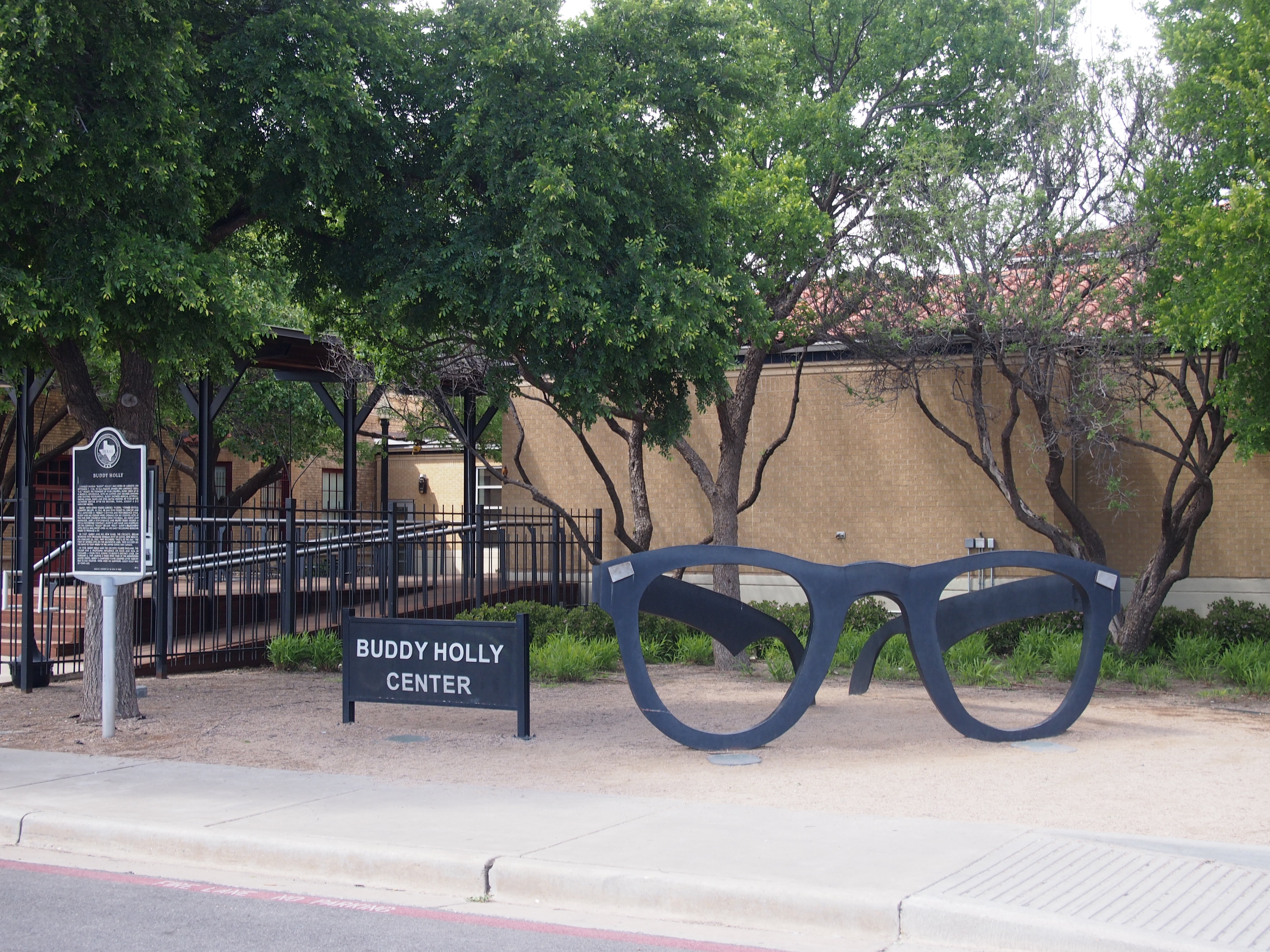
But I only wanted to spend a few hours in town, so I made my way to the Buddy Holly Center.

The center, which is at 1801 Crickets Ave., and a block from Buddy Holly Ave., is a performing and visual arts venue that also includes a small museum dedicated to the rock ‘n’ roll pioneer from Lubbock whose surname was actually spelled Holley. The museum takes up two rooms. Really one and a half, since one room is more about other famous musicians and entertainers visiting the center, such as Sir Paul McCartney, who played a concert there in 2014 (and who, last I heard, owns the rights to Holly’s songs).

Still, I will say that the main exhibit room, which is guitar-shaped, was packed with items and full of things to read. Buddy Holly might have died at 22, and only worked for a few years as an up-and-coming professional musician, but he was busy. He wrote songs, made records, toured constantly, appeared a few times on TV, and somehow found time to get married. Clearly he’d found something he was good at — this new music genre — and went after it with great energy, creating a remarkable output in a short time.

On display are photographs, letters, post cards, tour itineraries, including one for the Winter Dance Party, recording equipment, a microphone, business cards, contracts, performing outfits, furniture, Buddy’s childhood record collection (all 45s), and his Fender Stratocaster, which is the last one he ever played. There’s a lengthy timeline posted on the wall detailing Holly’s life and career, and other one about the evolution of rock ‘n’ roll.

Also on display, oddly enough, are the horn-rimmed glasses he was wearing when he died. Apparently they were in an evidence locker in Cerro Gordo County, Iowa, until 1980. The 750-pound giant glasses outside the center were fashioned in 2002 by a local artist, Steve Teeters, who died a few years ago.

No photography allowed in the museum. The clerk who sold me my ticket, and signs in the display room, were clear on that point. Something about copyright. No doubt the RIAA would release flying monkeys to snatch the camera away from anyone foolish enough to take pictures, and bill him $10,000 per image besides.

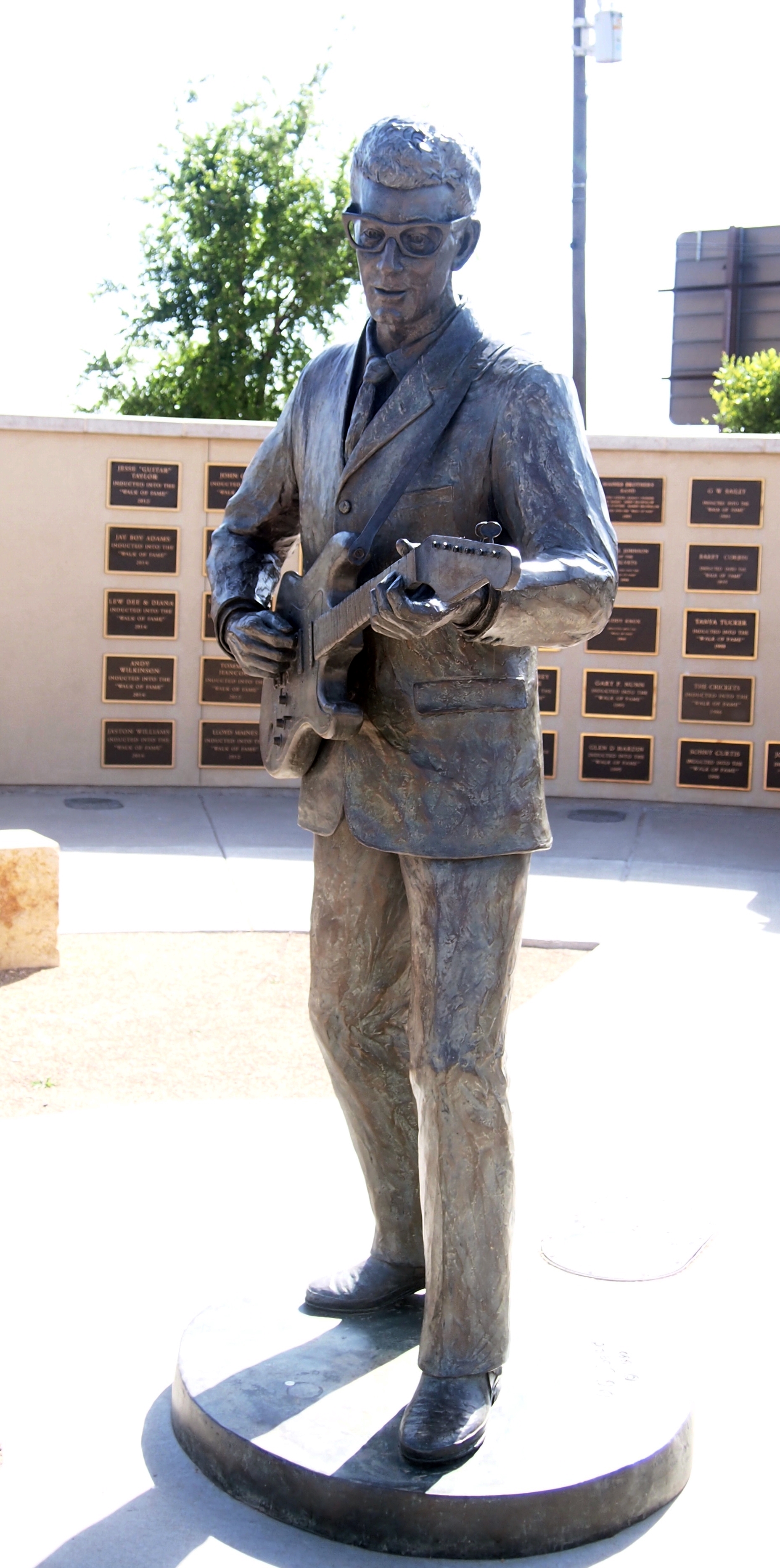
You can, however, take all the exterior shots you want, including across the street at an eight-and-a-half foot bronze of Buddy and his Fender Stratocaster, created in 1980 by San Angelo-born sculptor Grant Speed, well before the Buddy Holly Center opened in 1999.  The statue was moved from elsewhere in Lubbock only a few years ago, and now fronts a wall with various plaques honoring 30 years of inductees on the West Texas Walk of Fame.

I recognized only a handful of names on the wall besides Holly, such as Waylon Jennings, Mac Davis, Tanya Tucker, Roy Orbison (who lived in Wink when he was young) and Dan Blocker, whose alma mater, Sul Ross State University, I drove by in Alpine.

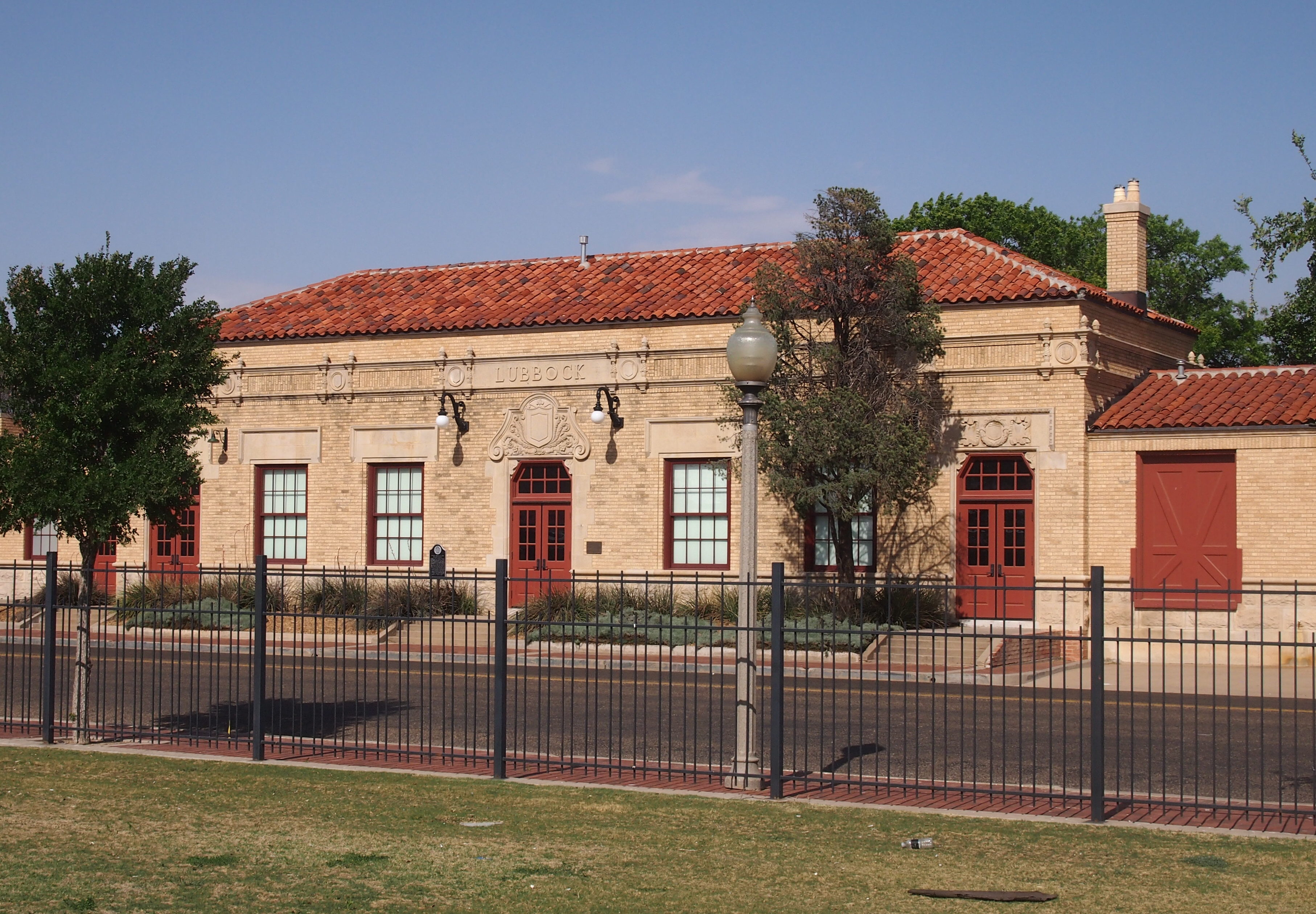
The Buddy Holly Center is an adaptive reuse. Long ago, the building was a handsome depot for the Fort Worth and Denver South Plains Railway Co., dating from the 1920s.
En route from Amarillo to Lebanon, Missouri, I made a stopover in Claremont, Oklahoma, not far from Tulsa, to visit the Will Rogers Memorial Museum. Strictly speaking, I’d been there before sometime as a child. But I had no memory of it.

Will Rogers, on the other hand, I’ve always seem to have known about. That’s remarkable for an entertainer who wasn’t actually of my parents’ time — my mother wasn’t quite 10 when he died — but rather of my grandparents’ time. I knew enough about him to go see James Whitmore do his fine impression of Rogers live, including a rope trick or two, on one of the Vanderbilt stages in the summer of 1984 .

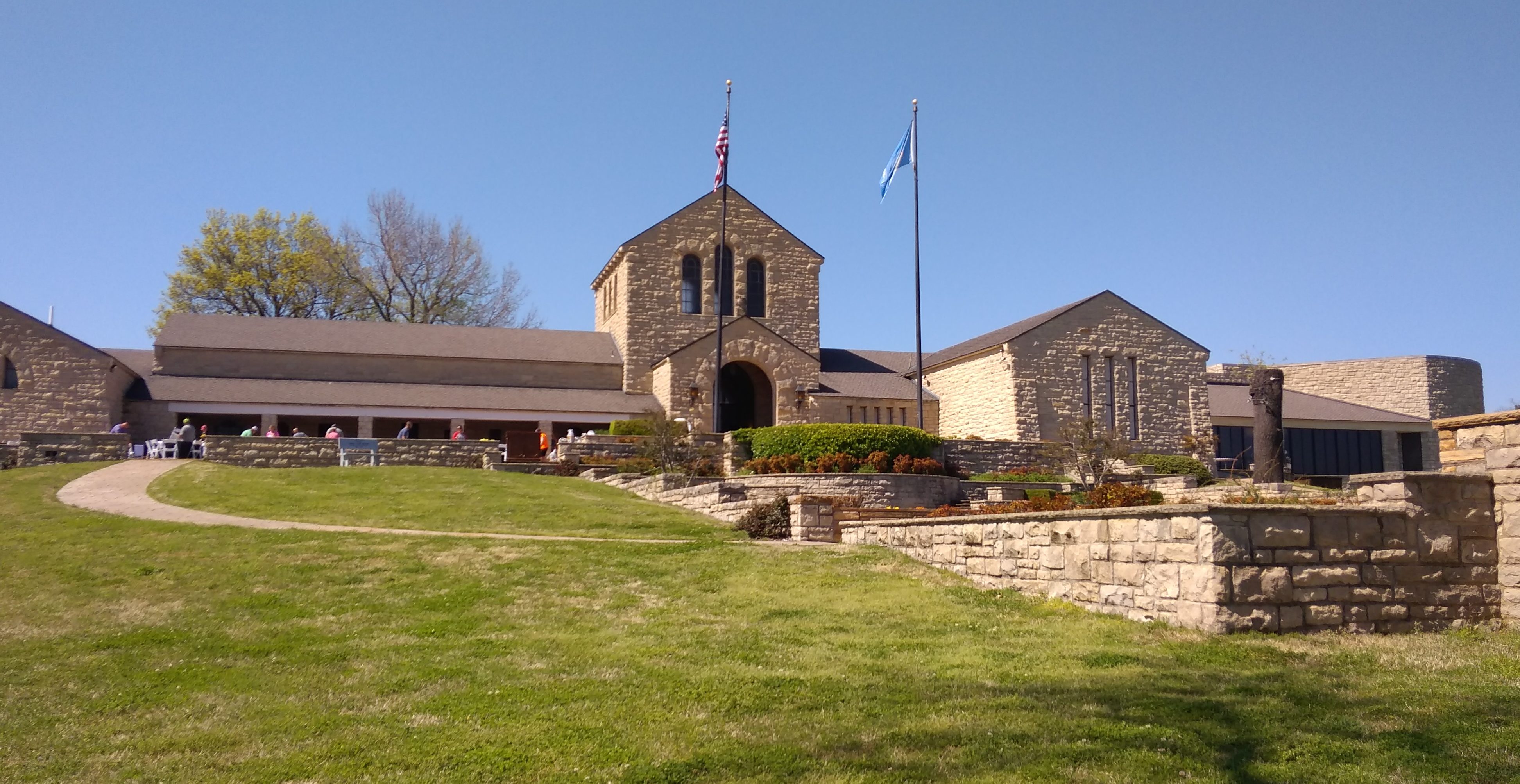
Here’s the view of the museum from the back. John Duncan Forsyth designed the original 15,000-square-foot limestone building, though there was an addition in the 1980s.

Will Rogers has a good many more exhibits than Buddy Holly, as you’d expect, considering that Rogers’ career in entertainment lasted quite a bit longer, beginning with wild west shows when that was still a thing, and moving on to all the media available in the first decades of the 20th century: vaudeville, movies, radio, and newspapers. No doubt if Rogers had lived on into the 1950s — he was only 55 when he died — we’d remember an early TV program called The Will Rogers Show.

Before I went to the museum, I had only the vaguest notion of Rogers’ early life in the Oklahoma Territory. I imagined that his origins were quite modest. Probably he was happy to have people think that, but in fact his father, Clem Rogers, was quite prosperous. The museum hints that Clem considered his son something of a ne’er-do-well, slumming as a cowboy and lassoist.

The last laugh was on Clem, who died before his son got into movies or on the radio. Ultimately, Will Rogers built himself a 31-room ranch house in California, which (per Wiki) “includes 11 baths and seven fireplaces, is surrounded by a stable, corrals, riding ring, roping arena, golf course, polo field — and riding and hiking trails that give visitors views of the ranch and the surrounding countryside — 186 acres.”

When the nation loves you, you can afford such digs. Here’s what President Roosevelt said over the radio in 1938 to dedicate the memorial in Claremore: “This afternoon we pay grateful homage to the memory of a man who helped the nation to smile. And after all, I doubt if there is among us a more useful citizen than the one who holds the secret of banishing gloom, of making tears give way to laughter, of supplanting desolation and despair with hope and courage. For hope and courage always go with a light heart.

“There was something infectious about his humor. His appeal went straight to the heart of the nation. Above all things, in a time grown too solemn and somber he brought his countrymen back to a sense of proportion.”

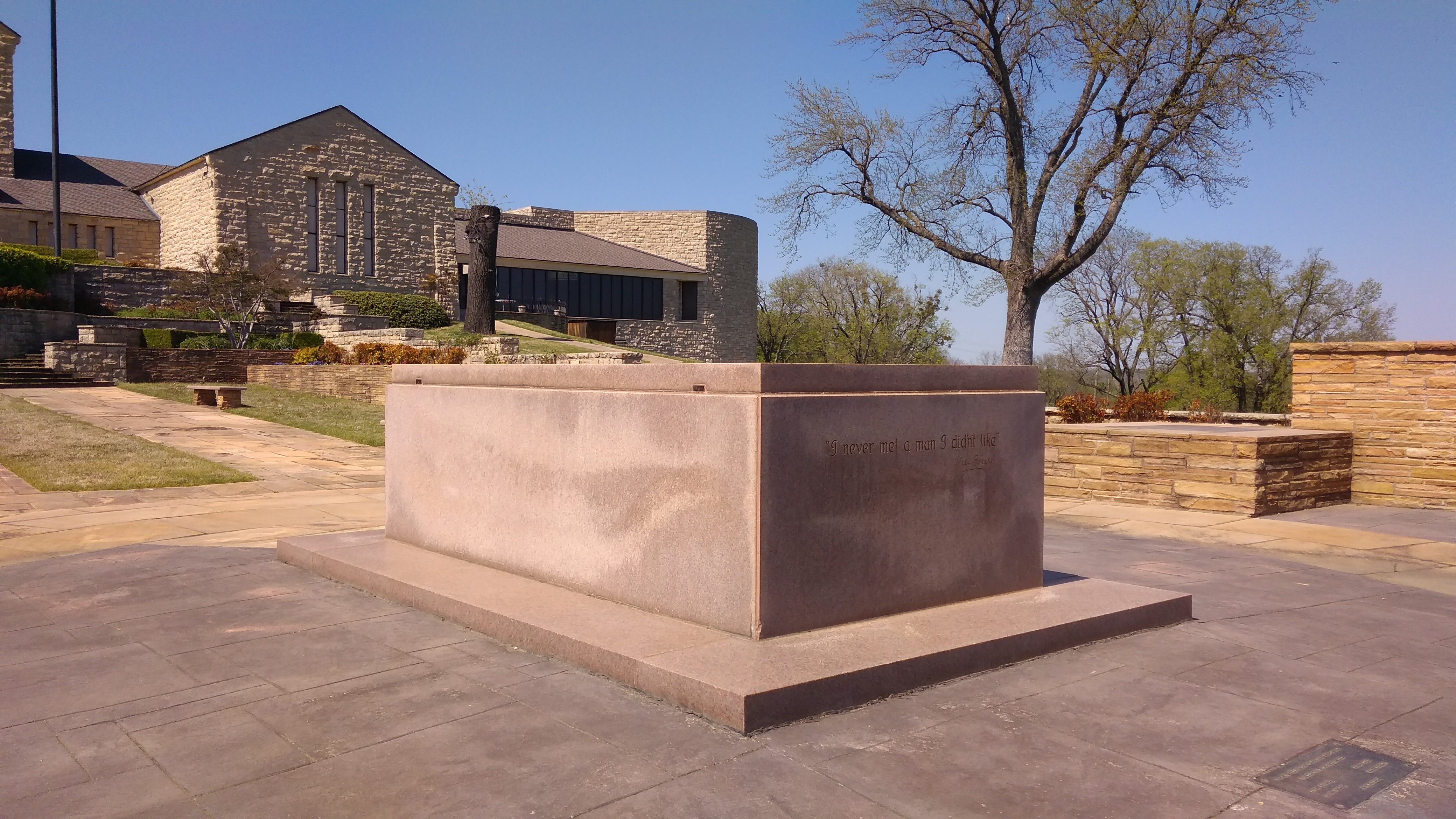
Rogers, his wife, three of his children and one of his grandchildren are interred on the grounds.

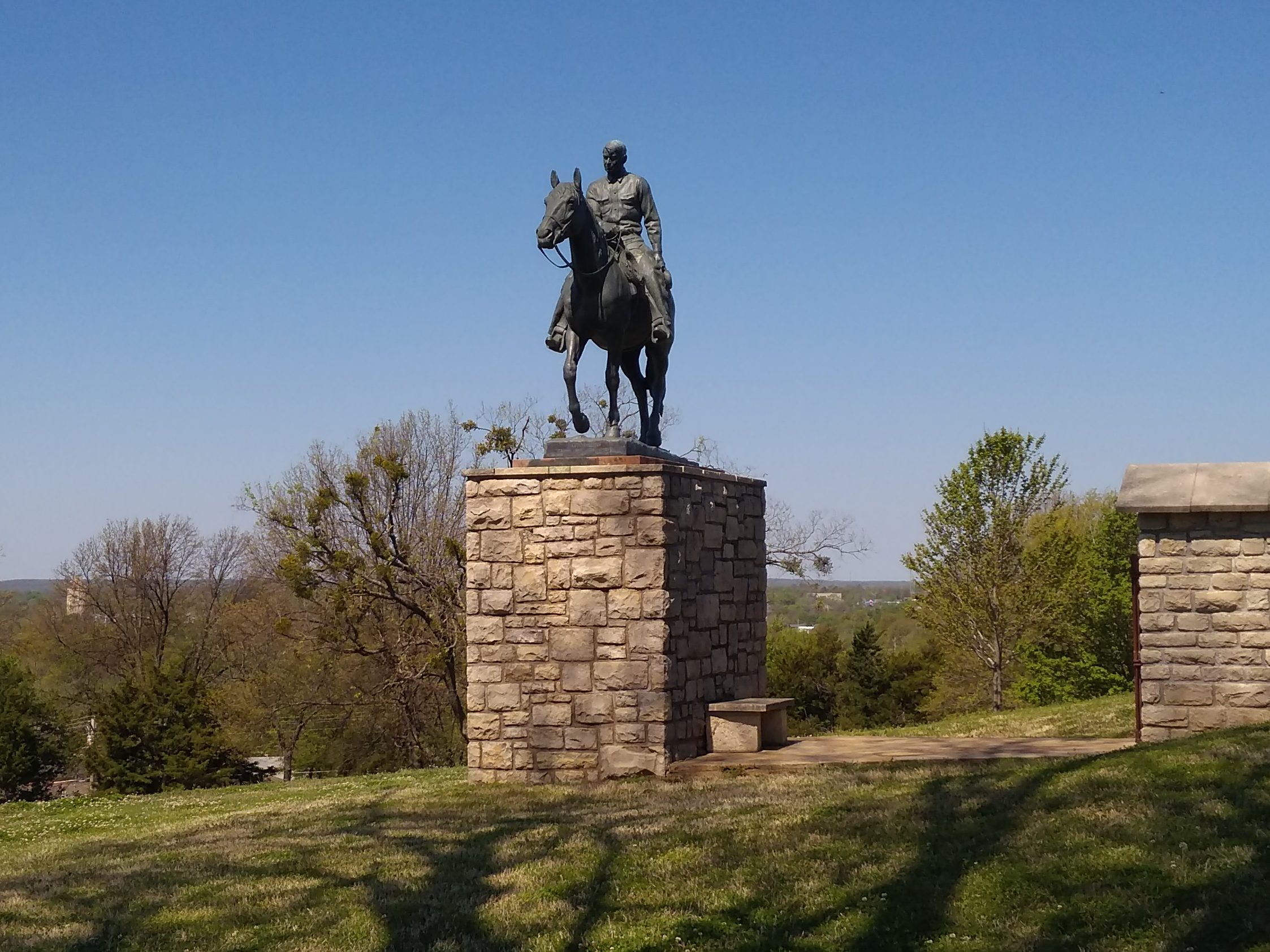
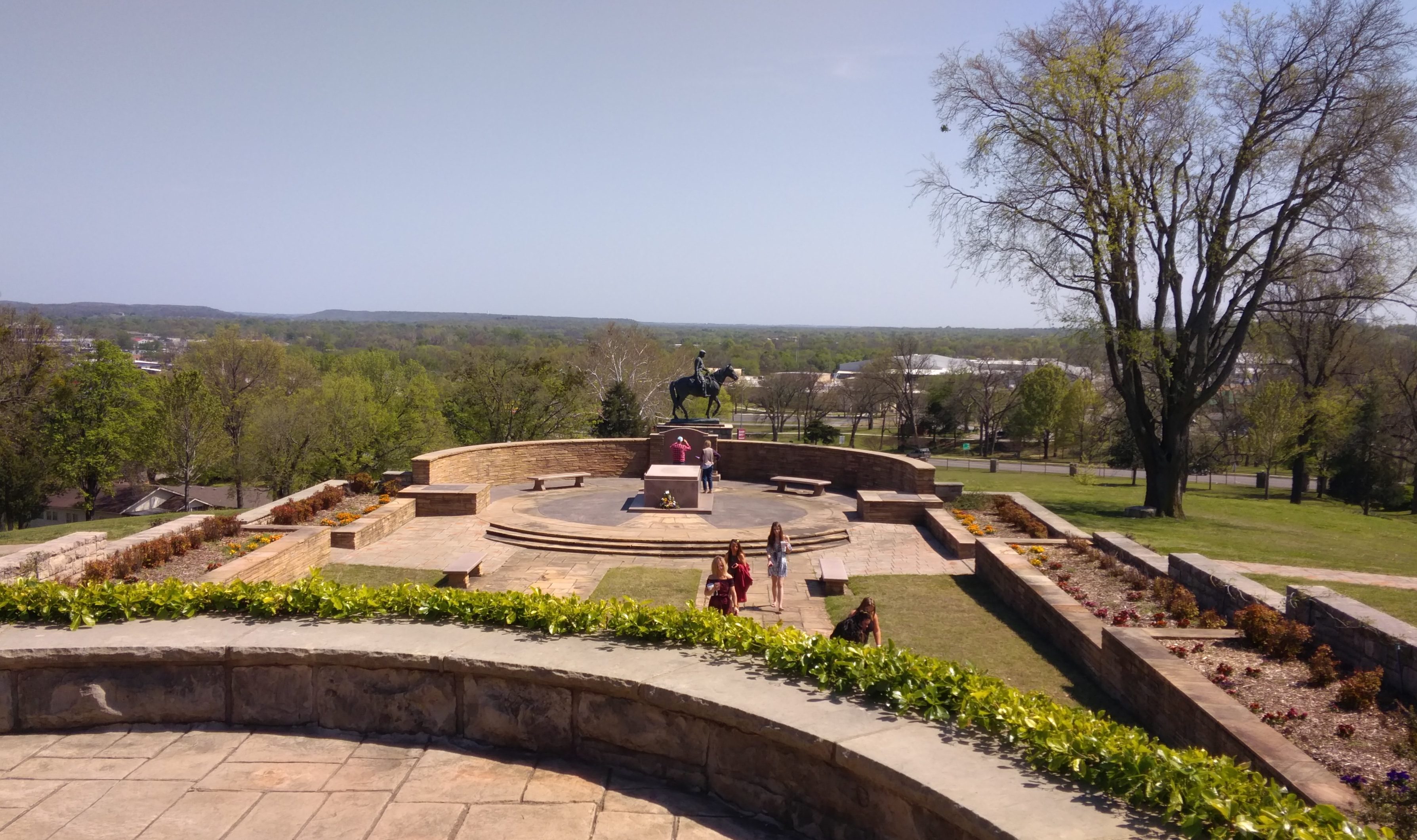
Naturally, there’s an equestrian statue of Rogers on the grounds.

It’s now near the tomb. To judge from the ca. 1970 picture I posted a few years ago, the statue has been moved from wherever it was then. The view from the back of the museum:

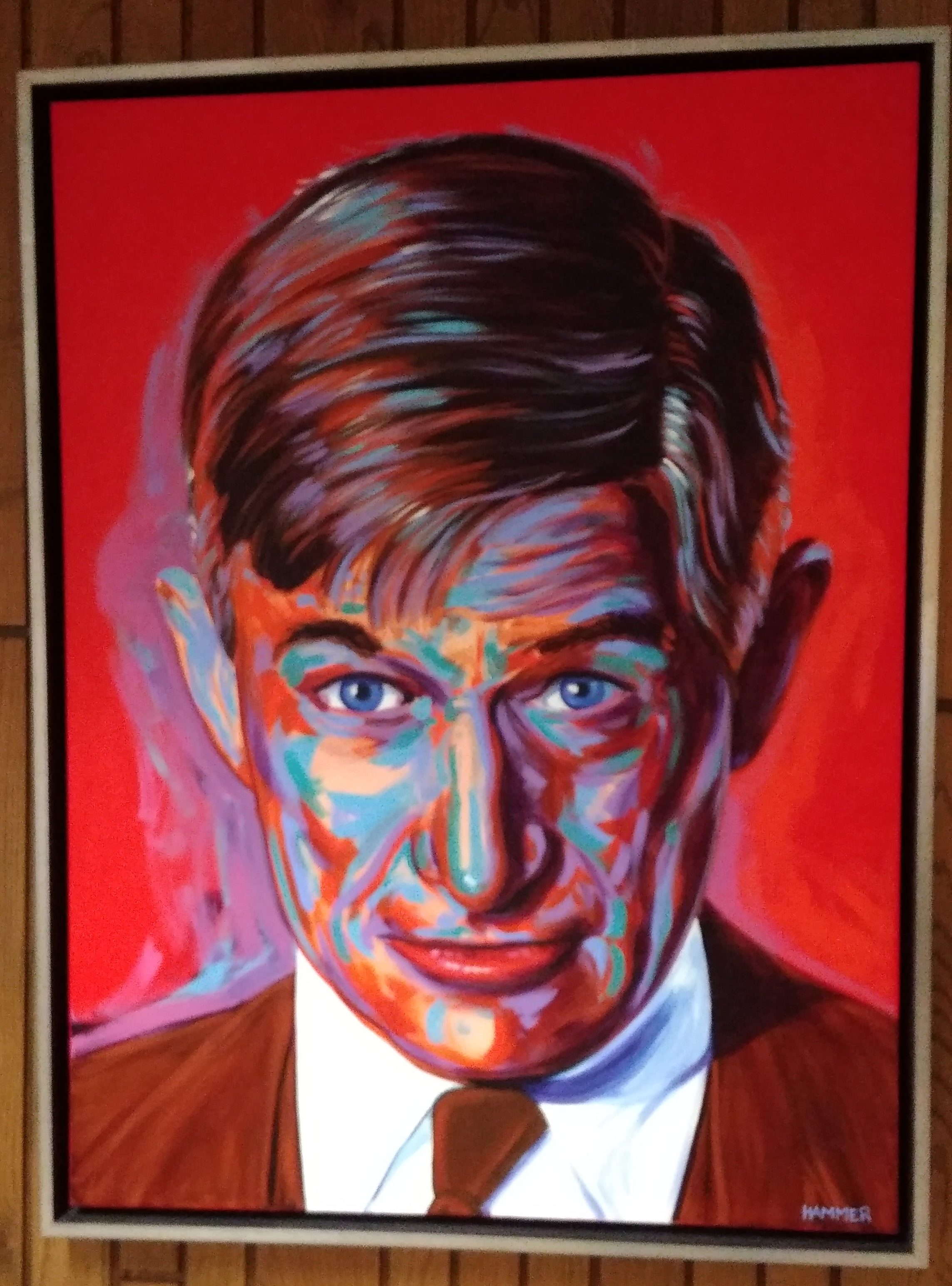
I didn’t take too many pictures inside the museum, but I make an image of a painting I liked.
It’s by an artist named John Hammer, who lives in Claremore. (More about him here.) I knew his style at once, since about a year ago I saw an edition of Travel Buddy — a coupon book you get at rest stops — that had a painting of his on the cover, a portrait of another Okie of renown, Woody Guthrie.

I picked it up because it was so different that anything you might see on a publication like that. I kept it because I really liked it.

One More Spring Break

The Quasi-Spring Break I had in March lived up to its name, as winter-lite conditions persisted both in metro Chicago and greater New York. Essentially, wherever I was. Even through April until yesterday, we joined much of the nation in complaining about the cold (though I read that Phoenix had its first 100-degree F. day of the year not long ago).

So time again for another Spring Break. Maybe a warmer one. Back posting around April 29.

Till then, some entertaining music videos to watch. Such as the delightful animated video for Caro Emerald’s “That Man,” released in 2010. A fine homage to Saul Bass, and that mid-century style.

For something with a different vibe, “Ghost of Stephen Foster,” a song by the Squirrel Nut Zippers (2000), and another work of homage. This time to the cartoons of Fleischer Studios.

Finally, a charming video for Joni Mitchell’s cover of “Twisted,” which she released in 1974.

I’ve long enjoyed her version, and in fact it’s the first I heard. Listen for the Cheech and Chong vocal cameo.

Quasi-Spring Break

The vernal equinox might have just passed, but every time I go outside, winter reminds me that it’s decided to linger. Have one for the road. Take another turn around the block.

Then again, we’ve seen a few robins. The croci are emerging. In the evening, Onion is way off to the southwest. All the usual signs of spring are here. So time for a kind of spring break. Back to posting Easter Monday, which is April 2 this year.

Till then, a few items.

Without looking for it — the only way to find many things — I came across this picture the other day.

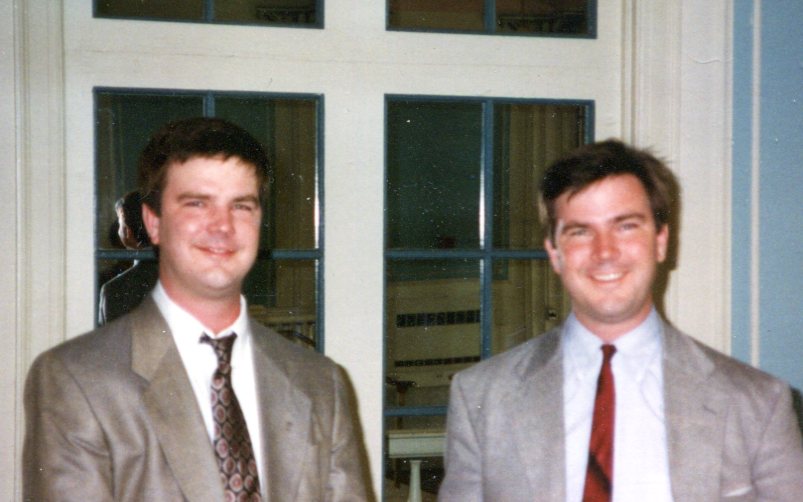
That’s Mike and Steve Johnson, in a picture I took at a wedding of a mutual friend of ours on July 6, 1996. Mike died in 2016. I’m sorry to report that his twin brother Steve died earlier this year.

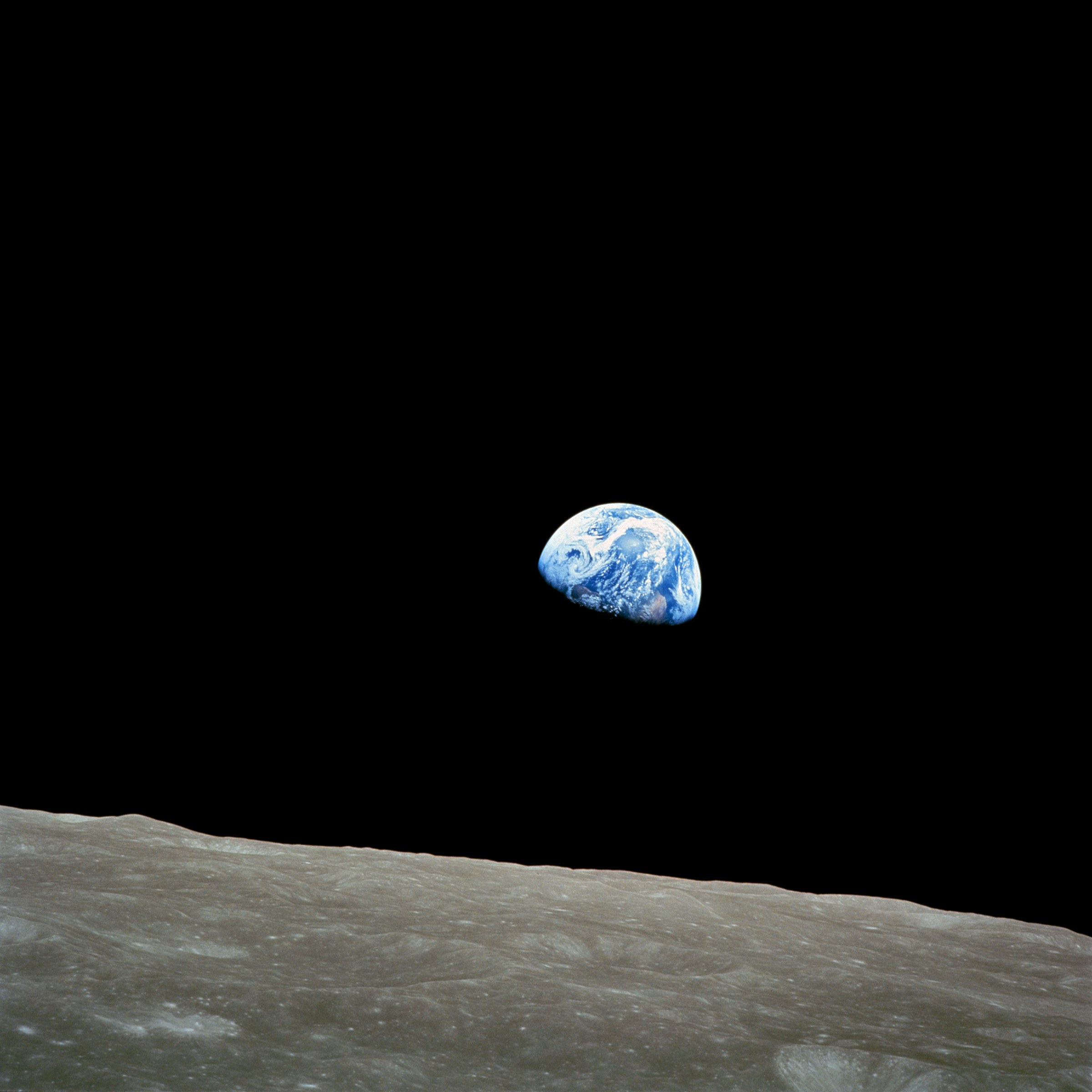
Recently I finished Apollo 8, subtitled “The Thrilling Story of the First Mission to the Moon,” by Jeffrey Kluger (2017). Thrilling indeed. Covers much of the same ground — rather, space — as the Apollo 8 chapter of A Man on the Moon: The Voyages of the Apollo Astronauts, though naturally in more detail.

The author characterizes the mission as the most “audacious” decision NASA ever made, and I’ll go along with that. Reading about any of the Apollo voyages, but especially this one, gives you (or should give you) a sense of just how dangerous it all was. Worth the risk, of course, but I’m surprised none of the Apollo astronauts bought it on the Moon, or in space, as opposed to the awful fate of the Apollo 1 crew.

A footnote: all of the Apollo 8 crew are still alive. Frank Borman just turned 90, James Lovell will turn 90 next Sunday, and Bill Anders is the youngest at 84. None of the other full Apollo crews are alive, though for now there’s at least one left from each mission except Apollo 14.

About 20 years ago, I saw Lovell speak at a real estate conference. I don’t remember much about what he said, other than to praise the movie Apollo 13, but it was a kick to see him anyway.

Recently we saw Vertigo at the theater. Been a long time since I last saw it, more than 30 years. These days, it gets high critical praise. Perhaps, I thought, I’d admire it more with a few more decades behind me, since I remember not being overly impressed by it as a young man.

It’s certainly a remarkable movie, interesting in a lot of ways. But it didn’t speak to me any more now than it did before. Maybe the story’s serious implausibilities got in the way. Not sure I can quite put my finger on it. A good movie, maybe a great one, but best? Naah.

Patience

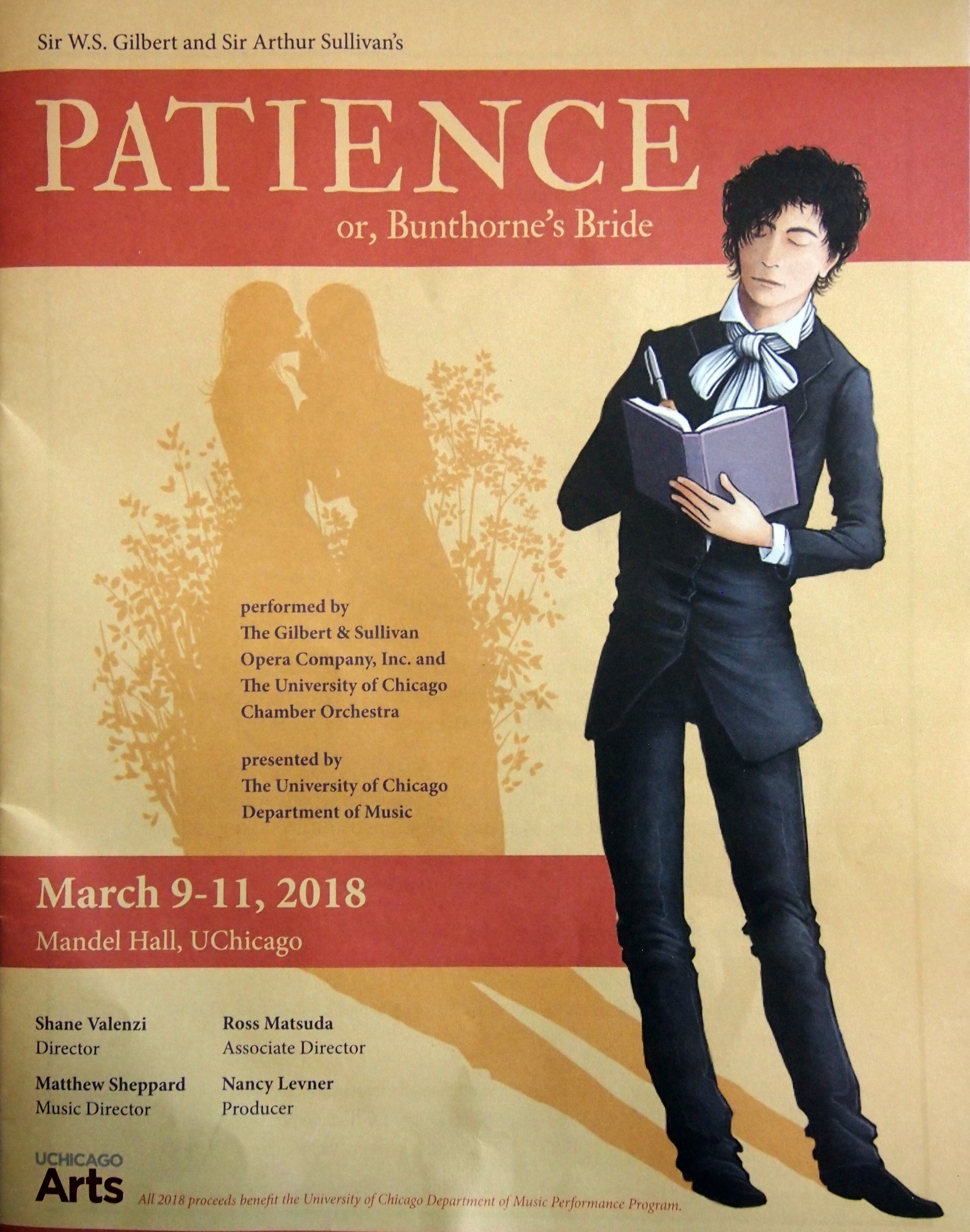
The Gilbert & Sullivan Opera Company’s performance of Patience drew a sizable crowd to Mandell Hall at the University of Chicago on Sunday (including us), as did previous Gilbert & Sullivan productions that we saw, Yeomen of the Guard and Iolanthe.

For good reason. The company, directed by Shane Valenzi, did a fine job of it, their talent augmented by the skillful University of Chicago Chamber Orchestra, a 40-member ensemble.

Remarkable how something funny almost 140 years ago can still be funny. Not only that, spot-on satirical. Then again, while the aesthetic poetry movement might be a thing of the increasingly distant past, fads — and more particularly, the fickle adulation of male sex symbols — are still immediately recognizable.

All of the leads, including Jeffrey Luksik as Bunthorne and Olivia Doig as Patience, brought considerable talent to their parts, but I was especially amused by Brandon Sokol’s take on Grosvenor. As the program notes put it, “Grosvenor is Fabio, a pure sex symbol without anything resembling artistic sensibilities,” and Sokol played it up delightfully.

Also amusing was Grosvenor’s transformation into “appearance and costume absolutely commonplace.” He came out with his golden hair shortened and wearing sports apparel, namely a Cubs cap and a Bears t-shirt. That was part of the costuming of the entire production, overseen by costume designer Rachel Sypniewski. The costumes were decidedly not Victorian, but that design decision worked.

“We’ve attempted to draw that comparison [between Victorian and modern faddishness] more or less overtly,” the program says, “modernizing the dress of the women and the poets to reflect a Poe-ish aesthetic evocative of the vampire-esque gothic movement that evolved from aestheticism and [which] enjoyed a revival during the popularity of the Twilight saga… The men [Dragoons] are Canadian Mounties who, despite their fearsome competence and justifiable pride, and nonetheless often the subject of light ridicule in American popular culture.”

(Such as Dudley Do-Right. Something I didn’t know about the Mounties, per Wiki: “Although the RCMP is a civilian police force, in 1921, following the service of many of its members during the First World War, King George V awarded the force the status of a regiment of dragoons, entitling it to display the battle honours it had been awarded.”)

Three of the Dragoons, usually dressed as Mounties, got the biggest laugh of the night when they tried to be aesthetics, dressed in tights. Actually, the very biggest laugh came when one of their members, the Duke of Dunstable, played by an enormous, hairy actor named Dennis Kulap, came out in pink tights.

One more thing about Patience, which I discovered just today: Oscar Brand and Joni Mitchell singing “Prithee Pretty Maiden.”

Big Bad Voodoo Daddy

WGN said this morning: “Periods of rain and thundery downpours are to persist into Tuesday evening, maintaining a flood threat across the entire metro area.” Just what we need.

“Chicago lies on the warm side of a front extending from the southern Plains, to lower Michigan. Unseasonable, moisture-rich Gulf air is being focused along this boundary which separates polar air from unusual warmth, more typical of late April. The ground is frozen and where it has melted, soils are saturated.” Yep.

Regrets, I’ve had a few. Here’s one: I could have seen Cab Calloway live. He was still performing in the 1980s, with more vigor than anyone over 80 can expect to have.
But I didn’t seek him out. I’ve got no excuse.

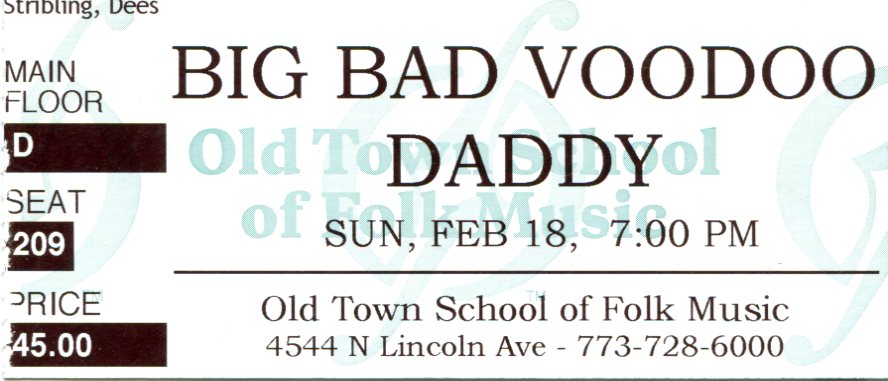
Sometimes, you do the next best thing. I thought of that on Sunday evening when Ann and I went to see Big Bad Voodoo Daddy at the Old Town School of Folk Music in the city. At one point, frontman Scotty Morris and his hoppin’ band did a cover of “Minnie the Moocher.” It wasn’t Cab, it couldn’t be, but it was a gas.

The whole show was a gas: rousing swing revival tunes by enormously talented musicians who’ve been playing together for decades. Loud but not too loud, brassy but leavened by strings, as much of a righteous riff as I’m ever likely to reap. It might be the 21st century, but they’re the cats shall hep ya, even so.

Morris, in his suit and tie and what must be his trademark fedora, sang and alternately picked guitar and banjo, and did a little patter for the audience. Not too much, but he included the fact that the band has been together for 25 years this year.

“Twenty-five years ago, the most famous band in the world was Nirvana,” he said. “I think they had four hit songs that year. So I figured that was the perfect time to start a swing band.”

According to the band’s web site, it “was named Big Bad Voodoo Daddy after Scotty met Texas blues guitar legend Albert Collins at one of the latter’s concerts. ‘He signed my poster “To Scotty, the big bad voodoo daddy.” I thought it was the greatest name I had ever heard on one of the greatest musical nights of my life.’ ”

Morris and eight other men took to the stage and made the music come alive via trumpet, all manor of sax, clarinet, trombone, double bass, keyboard, drums and more, playing and jumping and swinging, while their instruments reflected the variable colored spotlights of the venue. Smoke and the clink of glasses would have added to the ambiance, but we don’t get those in the 21st century (or even earlier: the difference between Preservation Hall in 1981 and 1989 was smoke).

BBVD did an energetic mix of swing standards — “Minnie” with all the call-response Hi-De-Ho you could shake a stick at, but also “Diga Diga Doo,” “Mambo Swing,” “The Jumpin’ Jive,” and “I Wan’na Be like You” — along with tunes of their own. Neo-swing, you might call those, or the commonly used term, electroswing.

Such as “Why Me?”

The video is fun, and I like the recorded version, but it isn’t as much fun as the live version. I suspect it’s their biggest hit, if you can call it that, because they did it during the encore.

Though BBVD has always been a touring band, I think they were also promoting their latest record on this tour, Louie, Louie, Louie. Record indeed, since vinyl copies were for sale in the lobby.

Named, according to Morris, after the three Louies: Armstrong, Jordan and Prima. “We stole a lot from them,” he said. Well, sure. They stole from the best and made it their own.

The Philadelphia Story

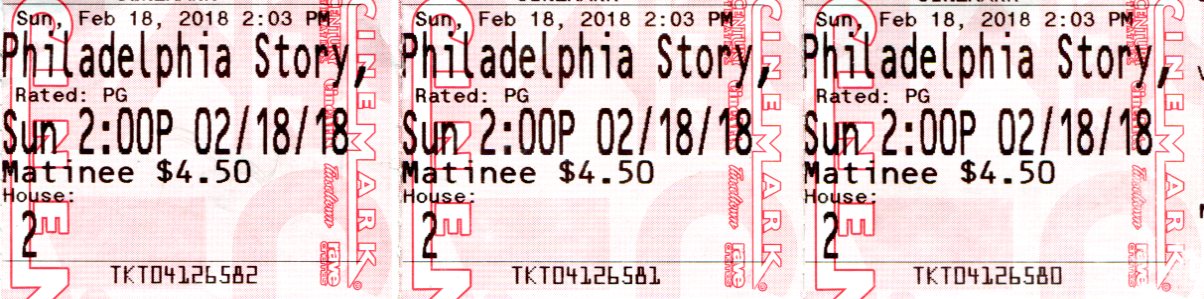
We all went to see The Philadelphia Story on Sunday at the movie theater of a nearby mall — a special showing, just like Treasure of the Sierra Madre and Casablanca recently. Oddly enough, Ann suggested we see it. And she wants to see next month’s showing, Vertigo.

That, I told her, is a very different movie from The Philadelphia Story. Truth is, I’ve forgotten most of the details of Vertigo. I’ve only seen it once, in the summer of ’81, and I wasn’t entirely taken with it. I might think differently now. Or not. Guess I’ll find out.

As for The Philadelphia Story, it was as charming as ever. Think this was my third viewing. After it was over — and after Ann discussed the structure of the movie, with some astuteness beyond her years — it occurred to me that “love triangle” isn’t an apt term for the story.

Better would be a love triskelion, with Tracy Lord (Katharine Hepburn) as the focus, and the three men, Dexter Haven (Cary Grant), Mike Connor (Jimmy Stewart) and the stiff and put-upon George Kittredge (John Howard), all connected to her for different reasons.

When I got home, I looked up Virginia Weidler, who memorably played the bubbly younger sister, Dinah Lord. I figured she might be the only named member of the cast to still be alive. But no, she died in 1968 at only 41. Seems that Ruth Hussey survived the longest, dying in her 90s in 2005.

Of course there’s a lot of witty banter in the movie. My favorite line — which I didn’t remember from previous viewings, though I don’t know why not — was by Uncle Willie (Roland Young). Dexter had suggested going off for some of the hair of the dog that bit them. Uncle Willie thinks that’s a fine idea:

“C’malong, Dexter, I know a formula that’s said to pop the pennies off the eyelids of dead Irishmen.”

Stinkin’ Badges

All of us went to a screening of The Treasure of the Sierra Madre on Sunday, one of the old movies that TCM shows in movie theaters periodically, in this case for the 70th anniversary of its release. I can take or leave Ben Mankiewicz doing the introduction, as he might on television, but for someone who hasn’t seen the movie, I guess they’re informative.

No one else in the family had seen it. I had, on tape about 25 years ago. Good to see it again, and on the big screen. Like for Casablanca, the movie didn’t fill the house, but there was enough of an audience for an audible chuckle when the subject of badges came up, as most of us knew it would.

Remarkably, “Stinking Badges” has its own Wikipedia page.

This is the kind of thing I wonder about when I’m watching a movie again: just how far would a peso go at the time when the movie is set (1925, despite the appearance of some later-model cars)? Maybe that came to mind because I was handling pesos recently.

Early in the movie, Fred C. Dobbs (Bogart) panhandles three times from the same well-dressed American in Tampico — played by director John Huston — eventually claiming not to realize it was the same man, who tells him off. The well-dressed American clearly gives Dobbs a Mexican peso of immediate post-Revolution vintage: one of these, I could see.

A very common coin at the time: from 1920 to 1945, about 458.6 million of them were minted. It’s a nice coin, composed of .7199 silver and weighing 16.66 g (12 g silver) though not as weighty as a U.S. Peace dollar of the time, .9000 silver and weighing 26.73 g. So what was Dobbs receiving when he got one?

According to the movie at least, which I realize had no obligation to be accurate, enough to buy a meal or a few drinks or a haircut with change left over. The haircut scene was interesting for another reason: Bogart was bald by this time, but after the pretend haircut and oiling of his hair, he didn’t look like it. Probably the work of hair stylist Betty Delmont, if IMDb is accurate.

Also, McCormick (Barton MacLane) promised Dobbs and Curtin U.S. $8 a day for working on his oil rig. That’s about U.S. $114 in current money, but what did it mean in pesos in 1925, when the cost of living was surely a lot less in Mexico?

Curious about the exchange rate, I did some looking around and found this interesting table posted by the St. Louis Fed: average annual exchange rates to the U.S. dollar in the 1920s. That would be the Coolidge dollar that Cole Porter sang about being the top. To answer the question about pesos, it seems that ca. 1925, the rate was about two pesos to the dollar. So if Bogart could get 16 pesos a day, when he could feed himself for two or three, that’s not bad.

Of course, Dobbs and Curtin didn’t get any of that until they beat it out of McCormick. You’d think that if McCormick had made a habit of swindling oil-rig workers, and still walked around openly in Tampico, he’d at least have carried a pistol.

Another thing I noted while looking at the table. In 1922, a French franc was worth about 8.2 U.S. cents. By 1926, the rate was 3.2 U.S. cents to the franc. No wonder Hemingway could afford to drink himself silly in Paris, and Liebling could afford to eat himself fat. Further examination of the table traces the course of the great inflation not only in Germany, but also in Poland and Hungary.

One more thing: when looking into the value of the 1920s peso, I happened across an interesting essay about the economics of The Treasure of the Sierra Madre by a Wake Forest economist named Robert Whaples.

Toward the end of the essay, Whaples offers this observation: “In these scenes and others, the film examines altruism; bargaining and negotiation; barriers to entry; creation of capital; capital constraints; compensating wage differentials; contract enforcement; corruption; cost-benefit analysis; credence goods; debt payment; deferred compensation; economies of scale; efficiency wages; entrepreneurship; exchange rates; externalities; fairness; the nature and organization of the firm; framing effects; game theory; gift exchange; incentives; formal and informal institutions; investment strategies; job search; the value of knowledge; labor market signaling; selecting the optimal location; marginal benefits and costs; the marginal product of labor; natural resource extraction; opportunity costs; partnerships; price and wage determination; property rights and their enforcement; public goods; reputation; risk; scarcity; secrecy; sunk costs; supply and demand analysis; team work; technology and technological change; the theory of value; trade; trust; unemployment; and the creation and recognition of value and wealth.

Can any other movie offer more?”