Navy Pier 2016

One of the new things this season at Chicago’s Navy Pier is the Ferris wheel.
Navy Pier Ferris Wheel 2016“The new attraction, dubbed the Centennial Wheel in honor of the Lake Michigan landmark’s 100th anniversary this July, offers a higher and longer but also higher-speed hoop ride than the one provided by its predecessor,” noted the Chicago Tribune in May. The ride is also significantly more expensive.”

But of course. Can’t let any opportunity pass to grab more of that tourist dollar.

“At 196 feet tall, 48 feet taller than the structure it replaces, the Centennial Wheel is present on the pier but not dominant, occupying roughly the same footprint as the old one, which began offering rides in 1995 and gave its last one here in September.

“The old wheel — expected to start offering rides from its new home on Branson, Mo.’s Highway 76 next month — served up about 760,000 rides in 2014, just under 10 percent of all Navy Pier visitors (both figures were down from pier peaks). That was at $8 for an adult ticket.” The new basic price is $15, with (naturally) other options that cost more, to make those buying the base ticket feel like cheapskates.

Good to know that the old wheel, like so many aging entertainers, is finding a new audience in Branson. I remember that the cars were red and sported the Golden Arches, denoting its sponsor. I only rode the old one once, ca. 2002, on a company outing one summer day. Worth $8 (probably less then) for the views of the city and the lake.

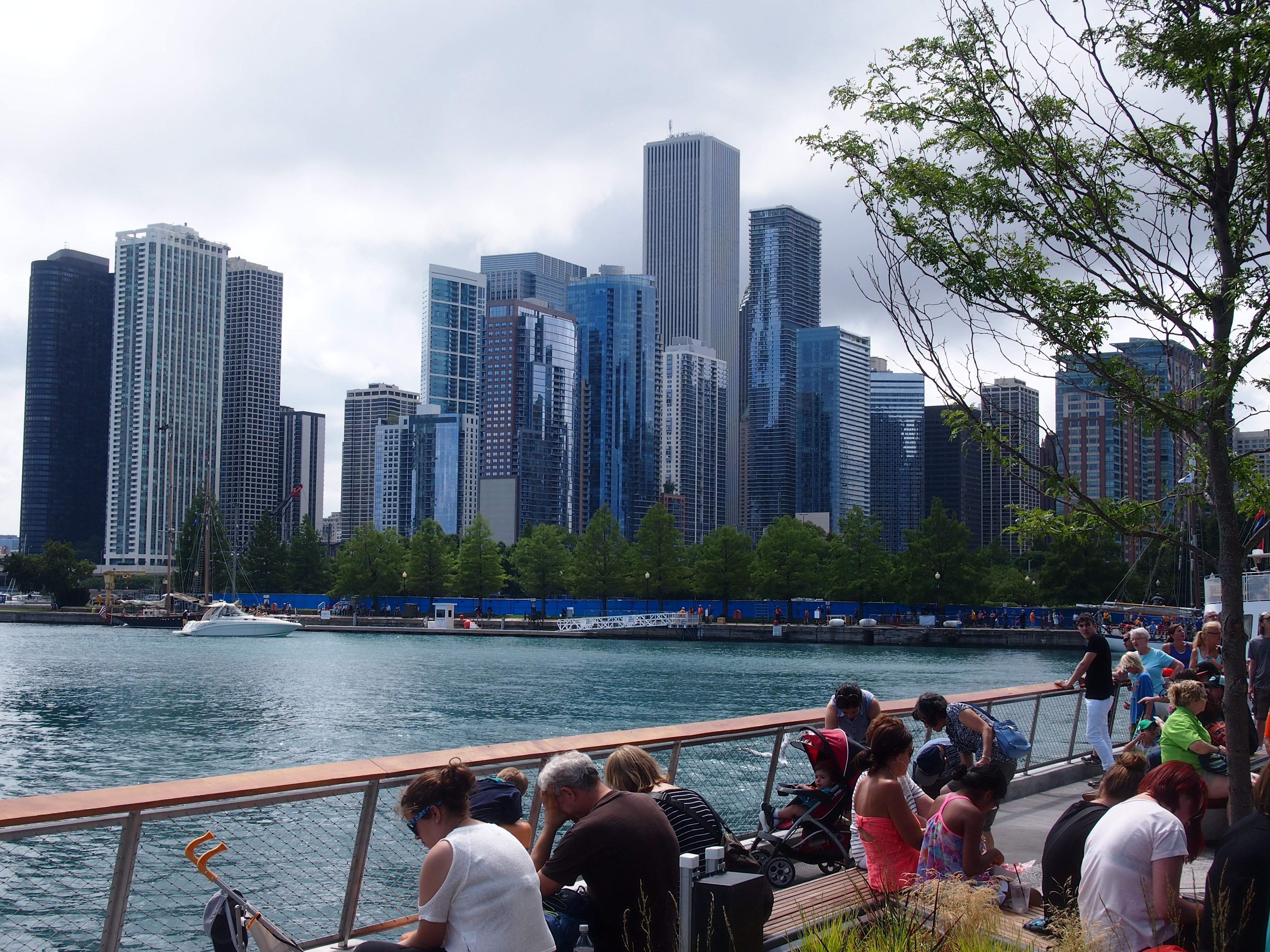
Even so, there are plenty of views from Navy Pier, from the pier itself. Such as of the East Loop.
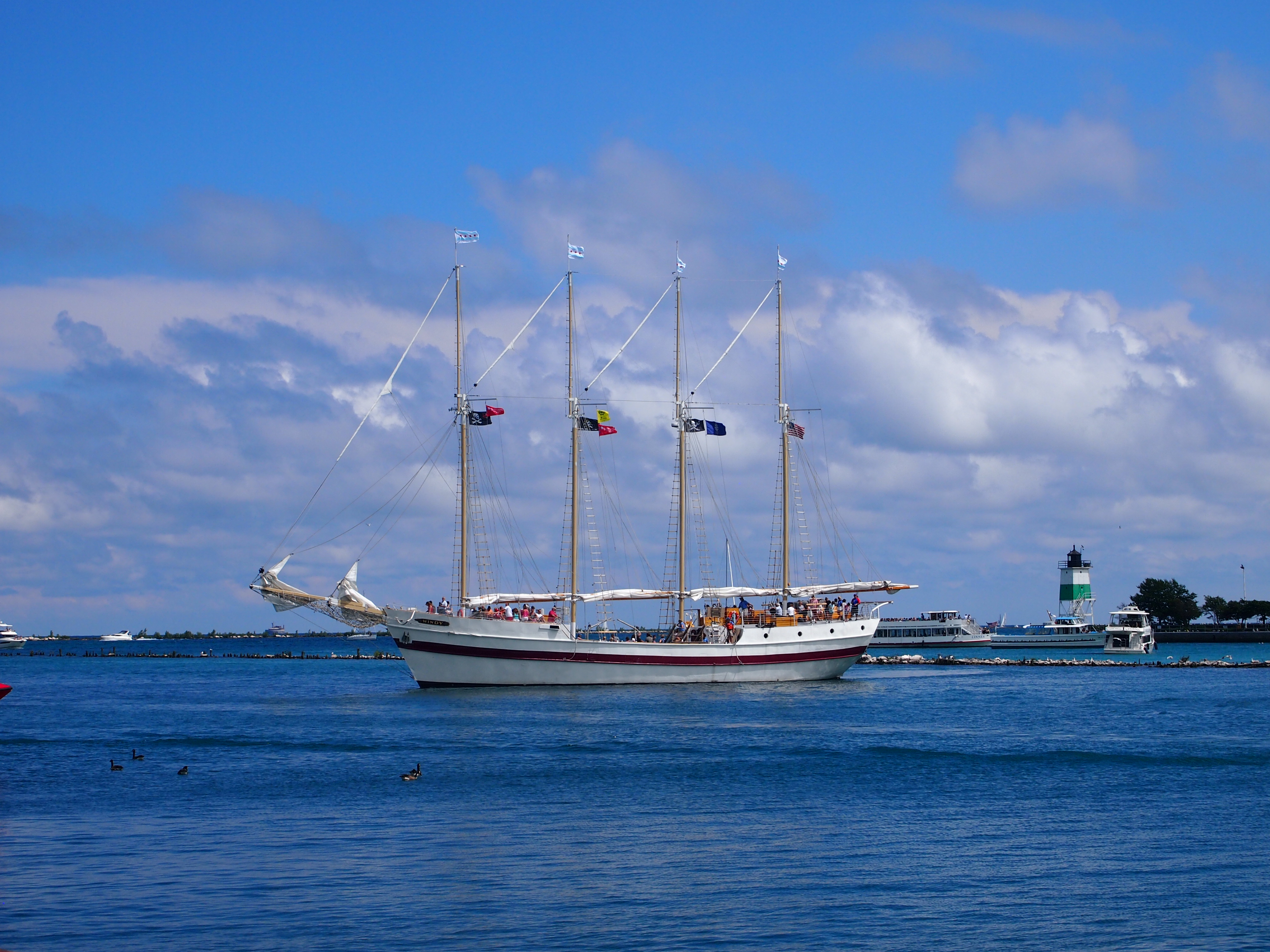
Navy Pier 2016And sailing craft on Lake Michigan.
Lake Michigan from Navy Pier 2016Lake Michigan from Navy Pier 2016It had been a while since we’d been to Navy Pier. Not sure how long. A few years. Saturday was a good day for it, especially since temps weren’t expected to be in the 90s, as they had been the weekend before. While crowded, the expanse of the space — about 50 acres — holds a crowd pretty well, except for the food court.

As mentioned, Navy Pier is now 100 years old, built as Municipal Pier. “Navy” was an honorary title given in the 1920s, as the “Soldier” in Soldier Field, though in fact the U.S. Navy did use the pier for a while during WWII. By the time I got to know it in the late ’80s, the structure was in a state of picturesque decay.

As I wrote years ago: “For those unfamiliar with the pier, it juts into Lake Michigan from downtown Chicago a good quarter-mile or so. In the mid-90s, the City of Chicago fostered a redevelopment of the pier that transformed it from a seldom-visited, decaying relic, to the top tourist draw in the entire state of Illinois, featuring a large array of mostly family-friendly diversions, part outdoors, a good many indoors. Also, it has a relatively small amount of convention space (a gnat’s worth, compared to the elephantine McCormick Place).

“Occasionally, I miss the decaying relic, since it had some charm. I recall going there only twice in the late ’80s, once to see a live broadcast of a live radio show WBEZ no longer produces, at the ballroom at the tip of the pier; and another time to see parts of the AIDS Quilt on display under the pier’s enormous empty shed.”

As a summertime destination this year, Navy Pier wasn’t a random choice. We’d come to see the tall ships, more about which tomorrow.

Boomers 7, Miners 5

Not long ago I realized that we hadn’t been to a minor league baseball game in a while. I wasn’t sure how long, so I checked: more than eight years. Time to go again. Same stadium, different team, since the old Flyers went under in 2011 — something about a cool million in unpaid back rent to the stadium owners, who happen to be the Village of Schaumburg and the Schaumburg Park District.

Since 2012, the Schuamburg Boomers have been the home team at the stadium, which isn’t all that far from where we live. Besides proximity, there are other advantages to attending baseball games locally, mainly cost. I’m happy to note that the price of reserved seating this year was exactly the same as it was in 2008: $11.

I can’t say the same about the Cubs. It’s a little hard to tell, since the club seems to have changed the ticket pricing scheme since eight years ago, the better maybe to put a fig leaf on their naked avarice, but I think that a ticket at a “middle distance behind home plate” — which was $66 then — no longer exists, though some far-off seats are still in the $60s. Seems that nothing behind home plate is less than $99. My opinion of MLB as a pack of gougers remains unchanged, then.

On Friday the Schaumburg Boomers of the Frontier League — whose mascot is a Prairie Chicken — played the South Illinois Miners, first of a three-game weekend series. Another thing to like about minor-league ball is that the players commit whopping blunders sometimes, and that happened almost right away, with the Miners getting two runs in the 1st inning because of a wildly misthrown ball to first base (or rather, in the direction of first base). But during the bottom of the same inning, the Boomers then got three runs because of poor play by the Miners.

After that, the quality of the fielding — but not always the hitting — improved somewhat. Both teams managed some well-executed double plays, and most of the outfielders caught the pop flies they needed to, with only one more run until the eighth inning, which began 4-2, with the Boomers leading. Around the 6th inning, it began to drizzle.

The weather had been a worry all evening, since heavy rains had fallen that day, only clearing up about two hours before the first pitch, when it was still cloudy. I didn’t want the game to be called because of rain, not because missing a few innings would have been that bad. Mainly I didn’t want to miss the fireworks after the game.

The prospect of rain might have depressed attendance that evening. I don’t know how many seats usually sell at a Friday Boomers game, but last Friday the stands were less than full, with large swatches of seats empty. As the drizzle fell, more people left. We stuck it out. We being Yuriko and I, along with Lilly and three of her friends (Ann declined to go).

I don’t remember whether the announcer was such a minimalist last time around. All this announcer could be bothered to do was tell us the name of the batter up and natter sometimes about some promotion or other at the ballpark. I don’t mind that, but I would like to hear occasional clarifications of what was going on.

At one point, with two men on base — first and second — something happened, an umpire or two suddenly went into motion, there was noise from members of the crowd who might have understood what was going on, and then the two men advanced to second and third. It took me a while to figure out that a balk must have been called on pitcher. Maybe that’s me being dense about baseball, but I got the sense that a lot of other people were mystified as well. A short sentence from the announcer would have helped. Could be interpreting the game’s above his pay grade.

By the top of the 8th, when the drizzle petered out, all the Boomers had to do was keep the Miners at bay for two more innings. No such luck. In short order, bang, bang, the Miners got two runs to tie the game, 4-4. Actually, it wasn’t that short an inning. One batter in particular had a fondness for foul balls, and he hit one again and again and again and again.

I wasn’t looking forward to extra innings. Nine’s enough, especially when it might rain. Luckily, in the bottom of the 8th, the Boomers did pretty much the same thing as in the bottom of the 1st, bouncing back with well-placed hits, and scoring three runs. The Miners got a run in the top of the 9th, but couldn’t catch up, and that was that, 7-5. I don’t care one way or the other much about the Boomers, but oddly enough I was glad to see them win. That’s crowd psychology for you.

The postgame fireworks were dessert. Not the most spectacular ever, but a nice show, everything you want in hanabi (literally fire flowers in Japanese; always have liked that word). Even better, the show was close enough that you could faintly smell the gunpowder, adding an extra layer of enjoyment — and memory. I thought of the fireworks at Tivoli all those years ago, close enough so that the ash rained down on us (and while I didn’t mention it, you could smell the fireworks too).
Nonstop-Kino, Last Day of July 1983

Why do I still have a movie ticket stub after a third of century? Don’t ask. I don’t save all of them, or even very many. This one, yes. On July 31, 1983, I went to the Nonstop-Kino in Innsbruck, Austria.

Nonstop-Kino Innsbruck 1983Rich and I took in a screening of Manhattan that afternoon. All together only four people — including the two of us — were at the show. Even so, in an example of doing what the Romans do, or in this case the Austrians, we actually sat in Row 6, Seats 7 and 8.

I’ve seen movies in London (Return of the Jedi and Babette’s Feast and Duck Soup) and Rome (I forget what) and of course many in Japan and some in other Asian countries, but the cinemas in the German-speaking world are the only ones I’ve encountered that sold seats like a live theater.

Manhattan was dubbed in German. I’d seen movie before, so that didn’t matter, but I didn’t think the voice actor doing Woody Allen was a good fit. In the age of the Internet, it’s easy enough to find out that the voice actor who’s done Allen for years — the Synchronsprecher, love that word — is one Wolfgang Draeger (who also was Sir Robin in Monty Python und Die Ritter der Kokosnuß). Apparently Draeger’s highly esteemed, especially for doing Allen. Still, I didn’t care for the match. His voice wasn’t nebbish enough.

RTX 2016

Morbid curiosity inspired me to turn on the TV early yesterday afternoon to see a little live coverage from Cleveland. By complete chance I saw all of Scott Baio’s little speech. Later, I explained to Lilly who that was: “You know the concept of A-list celebrities, right? He’s a D-list celebrity.” Guess the Fonz isn’t in the Trump camp. He never did suffer bullies gladly.

I’m not the person to describe RTX 2016 in any coherent way. That’s because of my willful ignorance, something I disapprove of in many situations, but not when it comes to pop culture. The only sane reaction to pop culture is willful ignorance: pay attention to whatever interests you, roundly ignore the rest, which is most everything.

RTX stands for Rooster Teeth Expo. According to Rooster Teeth itself, “Rooster Teeth Productions is recognized as one of the world’s leading innovators in the field of entertainment production. Over the past 11 years, we have built a global community of highly engaged and dedicated viewers. From podcasts and gameplay videos to one of the fastest growing consumer shows in the U.S., Rooster Teeth continues to become a main hub for community, gaming & entertainment.”

Fine. Good for them. I’d still be wholly ignorant of them except that Ann is a viewer — how “engaged and dedicated,” I couldn’t say, but enough to tell me earlier this year that she wanted to go to RTX, which was in Austin (the company’s hometown) July 1-3. I probably surprised her when I told her attending the show could be part of a longer trip to Texas, and we’d time things to be in Austin on one of those days.

So on July 2, we found ourselves at the Austin Convention Center, site of RTX. I saw crowd scenes.

RTX 2016RTX 2016The exhibit hall was remarkably like that of any other convention I’ve been to — rows and rows of booths featuring companies promoting themselves and their products. The difference being that almost all the products, including media productions and games and whatnot, were completely unfamiliar to me, and none of the attendees were wearing ties. But Ann knew a lot about the products, including many of the characters. All of these, for instance.

RTX 2016RTX 2016RTX 2016She told me who the girl in bird feathers was supposed to be, but I’ve forgotten. I will give the various cosplayers I saw points for effort. Some of the costumes looked like a lot of work.

Toward mid-day, we watched a panel discussion featuring the top guy at Rooster Teeth and some of his top creatives. They filled a ballroom with a few thousand people. At the beginning, they screened a brand-new episode, if that’s the right word, of an online show called “A Million Dollars, But…” The conceit of the show is that you can have a million dollars, but you have to put up with some onerous, and frankly magical, condition (and not, say, paying high taxes on it).

Let’s call it juvenile entertainment. A few of the bits in the episode were funny, but hearing about how it’s put together strained my patience. I’m not the intended audience anyway. But I have to note that not all of the audience were kids — not in the chronological sense. I’d put most of the attendees in their early to mid-20s.

We also attended a performance by a couple of singers, a man and a woman. They were reasonably talented and did songs from various shows, mostly Internet-based (I think). Ann seemed to know most of the tunes. I knew none of them. Time flies, new things happen. Toward the end, the man said, “We always close with a song I’m sure virtually all of you know.”

Then they launched into a song I didn’t know. Turned out to be the theme from Pokemon. Of course I’ve heard of that cartoon. It would take more than willful ignorance to keep from hearing of it, even before Pokemon Go became the goldfish swallowing of the summer of ’16. But the theme? Somehow I never bothered with hearing it, certainly not enough to know it. Ann expressed some astonishment at this.

The last event we attended was a cosplay costume contest. Participants strolled from the back to the front of one of the meeting rooms, showing themselves off as they went up the center aisle. The moderators announced who they were, and who their costumes represented. I actually had heard of a few of them, such as one of the iterations of Batman and Luigi, the brother of Mario, though as far as I’m concerned, Mario Bros. is just an arcade game I never played much.

I was struck by the fact that the participants mostly weren’t interested in playing characters from Star Trek or Star Wars or other such longstanding and well-worn tales. They wanted newer characters. That’s probably a good thing.

If I remember right, this fellow was best in show. I don’t know who he’s supposed to be, but it’s an impressive outfit all the same. Mostly Styrofoam, from the looks of it.

RTX 2016Purity of Essence t-shirtI wore my Gen. Jack D. Ripper PURITY OF ESSENCE t-shirt to the event. I figured he, too, is a fictional character of some import, even if only to earlier generations. As I suspected, I got no reaction to it, not even many quizzical looks, until just before we left the event. We were walking down the main corridor of the convention center, when suddenly a young man walking the other way said, Wow! right at me.

I was startled, but he quickly explained: “Where did you get that shirt? I spent the last two years of high school quoting Dr. Strangelove all the time.” Good to know that that movie isn’t completely lost on youth. I told him I didn’t remember the exact name of the web site where I bought it, but that the shirt should be easy enough to Google. As indeed it is.

Finally, there was this performer, BE INCREDIBLE.
SoCo street busker July 2, 2016Actually, he had nothing to do with RTX. We took a bus to and from the event, and when we returned, the bus let us off on South Congress a few blocks north of the Austin Motel — and there he was, busking.
SoCo street busker July 2, 2016Maybe not incredible, but he had some good moves. I put a dollar coin in his bucket.

The Noah Bell on My Nightstand

Ted Striker: Mayday! Mayday!

Steve McCroskey: What the hell is that?

Johnny: Why, that’s the Russian New Year. We can have a parade and serve hot hors d’oeuvres…

April ended with heavy rains and chilly air. May Day passed under gray skies, with equally chilly air. Yet the grass is long, buds are everywhere, and birds are noisy in their pursuit of making baby birds.

Sometime in the spring of 1986 (probably), I bought a noah bell at a Wicca gift shop in Austin. Strictly speaking, I don’t think Wicca had anything to do with the store, which was stocked with crystals and incense and other esoteric-flavored knickknacks, but that’s how I referred to it later. Maybe that’s gross insensitivity to Wicca, but even my enlightened Austin friends got a chuckle out of the description. Things were different in the ’80s, I guess.

In our time, naturally, one doesn’t even have to go out to find Wicca supplies.

Thirty years later, this is my noah bell.

noah bellThis is what it sounds like, struck with a stainless steel spoon: Noah bell rung three times.

Interestingly enough, it sounds about the same when struck with a plastic pen. Note that there’s no clapper. There used to be one, which was made of wood, but it disappeared sometime over the last three decades. It wasn’t made of copper, so I know it wasn’t stolen.

My bell is about 4¾ inches (12.5 cm) tall, not counting the ring on top, and 3 to 3½ inches (up to 9 cm) in diameter, since it’s more oval than circular. A smaller noah bell with a clapper sounds like this.

I still have the large tag that came with my noah bell, because of course I do.

Noah Bell FrontSo it’s not just a noah bell, but a Maharani brand noah bell. A maharani is the wife of a maharajah, so I suppose that’s like naming your brand Queen or Empress.

Noah Bell BackOLD INDIAN BELIEF needs to be all caps? That’s told of other bells as well, and I have to wonder what kind of lily-livered devil or evil spirit would be scared off by the sound of a bell. Don’t they cover that in evil spirit training? Then again, I ring it around here sometimes, and we’re not bothered by evil spirits that I know of.

The company that imports these bells from India is called Maharani Imports. According to its web site, “Maharani Imports specializes in whimsically themed wind chimes and mobiles made with recycled iron, handmade fused glass beads, and Noah Bells all assembled together in Mumbai. We also have many costume and semi-precious necklaces, earrings, and bracelets…

“We are based outside of Dallas in a small rural town called Bartonville. The company has been in that location since 1980 and we are located on a 30 acre ranch property with many rescued animals. Namely we have about 6 donkeys and 9 llamas, which we welcome you to come visit by appointment if you are nearby!”

Bartonville’s just south of Denton, and I’m not so sure that it’s particularly rural any more. But I can see how the good folks at Maharani Imports might have discovered Austin early as a solid market for their products. My own noah bell now spends most of its time on the nightstand near my bed, along with a lamp, a stack of books, a small statue of Lincoln, and some other bibelots.

Ravinia Circular ’16

The annual circular advertising this summer’s shows at Ravinia Festival arrived in the mail recently. Wonder how long printed circulars of this kind will be mailed at all, but for now they are.

It’s been a while since I’ve been to the venue, but I’ve enjoyed all of my visits, such as the long-ago August night in 1989 when a lunar eclipse was visible high over the concert. Or our attendance of a children’s concert in July 2002.

Ravinia 2002Ravinia, in Highland Park, Ill., on the North Shore, is the Midwest’s Wolf Trap. Or rather, since Ravinia’s a lot older than Wolf Trap, with outdoor music performances held there for more than 100 years — Wolf Trap is the Ravinia of the East Coast, open only since 1970.

In any case, Ravinia gets some A-list acts, and charges accordingly. Prices are for seats in the pavilion or for lawn seating, and they’re printed on the circular. Some of the concerts, especially lawn seating for some classical musicians, charge a reasonable $10, and I’d seriously consider paying $25 to hear the CSO play the entirety of The Planets while I relax on the lawn. (And ponder whether that should be “The Planets” or The Planets.)

On the other hand, I was curious to see who commands the highest pavilion seating ticket prices. Is it Bob Dylan? No. Paul Simon? No. Don Henley? Dolly Parton? Diana Ross? Nope. Those are all close, but Duran Duran tops the list at $160 a pavilion seat, and a steep $55 for a lawn ticket. Moreover, they’re playing two nights in a row, which is fairly rare at Ravinia.

Am I missing something? I remember Duran Duran as a tolerable early ’80s band that had a handful of hits. Must be their fan base is larger than I realize. Even so, here’s something I’m sure I’m missing: Duran Duran at Ravinia for $160 a pop.

The Force Awakens

We went to see Star Wars: The Force Awakens recently, since I’m not the sort who rushes out to see the newest thing in the theaters, though that did happen with the first movie of the series those long summers ago (more than a dozen of us went together; it was an event). On the whole, the most recent yarn had everything it needed to: sympathetic characters, old and new, lots of action, lots of spaceships and exotic sets, lots of improbabilities and coincidences, lots of homages — many homages to the original movies, some simply visual, others in bits of dialogue — and so on. My favorite homage was the discussion of throwing a captured First Order minion into a trash chute, though you don’t actually see the heroes do it.

All in all, worth second-run prices. Some quibbles: Interestingly, Finn said that his bad-guy job was in sanitation, which set up the homage to the trash chute. Certainly a necessary function, but if so, why was he part of the death squad detail at the beginning of the movie? Do all of the storm troopers rotate into death squads now and then, just to keep them murderous? If so, why are they such lousy shots?

Why is the armed force defending the presumably re-established Republic called the Resistance? Sure, resistance has a noble undertone, but it implies trying to overthrow tyranny, not protect a government. Shouldn’t it have been the Galactic Force or the Republic Defenders or the like? (Or the Force Force?) Guess the Republican Guard wouldn’t work, the Iranians having taken that one.

And how is it that the Jedi were so thin on the ground that the retirement of just one of them, namely Luke Skywalker, shut down the whole enterprise? Weren’t there others? You know, a second string? Maybe these things are explained in the expanded universe, but I’m grown man. I refuse to have anything to do with that.

Also, I wonder just how much dough Mark Hamill got paid, along with top billing, to stand there for a few seconds and look old? Maybe that sum is a balm for his, shall we say, not-as-stellar-as-Harrison Ford’s career. By contrast Ford had a meaty-ish part in the latest movie, but then again he clearly signed up only for this one, unless there’s some movie resurrection magic ahead for Han Solo.

The supreme bad guy was malformed and ugly, or at least his hologram/projection/whatever of him was. But of course. Ugly = Evil. As I wrote a good many years ago, when I was busy ignoring one of the prequels, I pictured the unseen evil emperor in the first movie as “a handsome yet ruthless tyrant, a spellbinding demagogue, a despot who made the hyperdrive trains run on time, and who had an intensely loyal following in parts of the galaxy that got public works contracts. But no. He turned out to be a drooling, hissing, ugly fellow who ruled by channeling the Dark Side, rather than bread and circuses (and maybe a gulag).

“Better still would have been a despotic Emperor with some virtues, someone who offered peace to a Republic torn by civil war, someone along the lines of Augustus. In that case, the rebel alliance might still be fighting for freedom, but with less purity of motive — and willing to blow up a planet or two itself…”

Christopher Orr in the Atlantic did a reasonably good review of the movie, except for this line toward the end: “The original Star Wars was in almost every way an original, a movie that forever changed filmmaking for both good and ill.” Maybe original if you were 10, as he was.

But it was fully known and commented upon at the time that, aside from the remarkable special effects, very little about the first movie was original, and not just in the sense that all Hero With a Thousand Faces on a Journey of a Thousand Leagues stories tap into archetypes. Still, that didn’t make the first movie any less enjoyable or important in the history of summer blockbusters. Obviously the thing struck a chord. I remember reports of people going to see the first one many, many times. Then again, people also went to see The Rocky Horror Picture Show many, many times. That struck a somewhat different chord, I figure.

Pappy Lee O’Daniel

The day after I visited LBJ’s boyhood home, I discovered this tucked away at my mother’s house.

Pappy Lee O'DanielIt’s a campaign card for W. Lee O’Daniel. It’s clear that it dates from his first run for governor of Texas, which was in 1938. Why my mother kept this, I couldn’t say. I don’t remember her ever saying anything about “Pappy” Lee O’Daniel, and in any case she herself never voted for him, since she wasn’t old enough.

On the back are the lyrics to three stanzas of “Beautiful Texas,” a song pretty much lost to time, but written by W. Lee O’Daniel, the singing, flour-making governor of Texas from 1938 (he won the election and re-election two years later) to 1941, when he became a U.S. Senator by being the only person to best LBJ in an election (not counting 1960 primaries). All in all, one of Texas’ more interesting governors.

Beautiful Texas by Pappy Lee O'DanielIf he sounds familiar, it’s because the Coen brothers borrowed the name, an association with flour, and hillbilly music for the governor of Mississippi character played memorably by Charles Durning in O Brother Where Art Thou?

Why? Because they’re the Coen brothers. Presumably they were amused by the idea of a flour-merchant governor with hillbilly music on his side. For a couple of gentlemen from Minnesota, that shows a remarkably granular interest in Texas history, even if they put the fictional Pappy in an alt-universe, Coen brothers-flavored Mississippi.

“Moral fiber? I invented moral fiber! Pappy O’Daniel was displaying rectitude and high-mindedness when that egghead you work for was still messing his drawers!” — the fictional Pappy O’Daniel.

Arlo Guthrie ’86

Here’s one thing about Arlo Guthrie, at least as he was 30 years ago: his distinctive, sometimes squeaky voice was exactly the same in person as on his recordings, as you might hear on “Alice’s Restaurant.” Other than that, I don’t remember a lot about the concert, not even whether he sang-spoke that particular song. He probably did. It’s also likely he did “City of New Orleans” and some of his father’s songs.

Guthrie86He also went on a short tirade about the metric system after telling a possibly true story about encountering a Canadian who didn’t understand the line in “The Garden Song” that goes, “Inch by inch, row by row, I’m going to make this garden grow.” Remarkably, there’s an ’80s clip of him in Austin singing that song, and sure enough, he tells the story about the Canadian (a border guard). In the show I saw, I remember him proclaiming, “There’s no poetry to the metric system!”

I’ll go along with that, but he needn’t have worried too much; the customary system still abides in the U.S. some 30 years later. Americans aren’t sophisticated about some things, but we are sophisticated enough to use and understand two systems of measurement at the same time.

How I Learned to Stop Worrying and Watch the Movie

“Presidents Day” is around the corner. The holiday is still officially for Washington’s Birthday, and yet because it’s the third Monday of February by law, it can’t ever actually be on his New Style birthday, the 22nd. This year, it’s exactly a week before.

Still, time to dwell on the immortal deeds of William Henry Harrison, Millard Fillmore, Rutherford B. Hayes, et al. You know, the greats. Back to posting on Tuesday, February 16.

On the last night I was in Seattle last summer, I attended a dinner party in Fremont with my old college friend Bill and his wife. Bill was wearing a Dr. Strangelove t-shirt, one featuring the menacing, cigar-sporting face of Gen. Jack D. Ripper, complete with the caption PURITY OF ESSENCE. It looked a lot like this.

Strangelove teeI thought so highly of the shirt that Bill told me the web site where I could buy my own, which I did when I got home. It’s pictured above. In October I wore the shirt to the State Fair of Texas, where it got a few looks and exactly one comment in passing, “Love that shirt!”

A few weeks ago, I watched Dr. Strangelove for the nth time. Late one night in the late ’70s, I happened across the last 20 minutes or so of the movie, perhaps on one of San Antonio’s UHF channels, which was the first time I saw any of it. I couldn’t make heads or tails of it, and only when I saw it in college did I realize what I’d seen. Oddly enough, I also caught the last few minutes of Lolita on the same channel, and only realized it when it was shown in film class some years later; maybe that UHF program director had a thing for Kubrick.

Dr. Strangelove is many things, especially dark Cold War satire with endless allusions to sex, as has been pointed out many times. I had another idea about it this time around, one that makes some sense as an interpretation: the movie’s also about various aspects of the masculine psyche.

In popular lore, especially in idiotic bits like “Manslator,” men are simple creatures, but no human being is simple, much less either of the genders imagined as a whole. The following are notes about the six main characters in that light. Not that I believe that anyone thought about the masculine psyche when the movie was being created, just that it’s an idea worth kicking around these 50-odd years later.

Gen RipperGen. Jack D. Ripper, the Psycho Killer. A fine example of an unsubtle name for a fictional character, but it does get to the point: Ripper wants to kill. Mind you, he isn’t a mindless killer. He’s a high-functioning, detail-oriented, completely delusional killer who fully believes he’s doing the right thing. This makes him exceptionally dangerous to everyone else.

Ripper feels under attack: an invisible, poisonous attack by a loathsome enemy aimed at his very manhood or, as he so famously put it, his “precious bodily fluids.” So for Ripper, it’s self-defense. For everyone else who isn’t a psychopath, it’s murder. Like it or not, the psycho killer’s definitely part of the masculine psyche, though fortunately not the controlling part for most men most of the time.

Group Capt. MandrakeGroup Captain Lionel Mandrake, the Rational Man. Mandrake is as rational as Ripper is delusional. He understands what’s happening, even asking Ripper why he launched the attack, to get to the bottom of things. Note his bitter laugh as he realizes just how nuts Ripper is and, at the end of the clip, how he rationally dives for cover when shots break the windows, while Ripper stands up. He also understands how horrible the situation is, and he’s fully committed to stopping the madness.

Rationality too is part of the masculine psyche, stronger in some men than others. Yet, like reason is in so many situations, Mandrake’s powerless in the face of determined madness, at least until the madness self-destructs. Even then, he doesn’t quite succeed, because of a string of impossible-to-predict incidents that defy reason: the bomber not being able to receive the recall order, the unexpected change in target, the dogged persistence of Major Kong.

President MuffleyPresident Merkin Muffley, the Nurturing Man. To say President Muffley represents the feminine side of a man’s psyche is to risk trading on stereotypes about women, so perhaps “nurturing” is better, even though Muffley’s name more than hints at womanhood: muff and merkin, which is a pubic wig theoretically for either gender, but more often associated with women.

Not only is the president eager to prevent a nuclear exchange, he’s aghast at the prospect of it, since it represents mass murder, the complete opposite of protecting and nurturing. Moreover, he has moral authority, and acts decisively. He calls out Gen. Turgidson more than once (like a mother bawling out her teenage son), he demands an audience with Gen. Ripper, tries to be calming with Premier Kissov, and wonders whether the survivors in Dr. Strangelove’s mine shafts would be too distraught to carry on. Like Mandrake, his best efforts fail. This is, of course, a pessimistic movie.

Buck TurgidsonGen. Buck Turgidson, the Adolescent. Like all of the names in Dr. Strangelove, “Turgidson” is absurd yet also speaks volumes. Adolescent boys are well known, and rightly so, for their turgidity. But as important as nooky is to an adolescent — it’s pointed out quite often that the only female character in the movie happens to be Buck’s mistress, and she happens to be in a bikini the whole time — adolescence is also marked by impulsive behavior, never mind what happens next. Gen. Ripper launched his wing? Damn, we’d better attack right now, hit ’em with everything we’ve got!

Adolescence also involves, in boys at least, an urge to fight, literally or figuratively, and enthusiasm for the cause. Turgidson tussles with the Soviet ambassador — literally — downplays 10-20 million deaths as mussed hair, and is quite excited in describing how a talented B-52 pilot can get through to his target, only realizing right at the end what it means, namely the end of the world. Adolescents are, after all, still learning that actions have consequences. One nice touch: Turgidson’s chewing gum most of the time.

Major KongMajor T.J. “King” Kong, the Engineer. People who happen to be engineers are many things, like anyone else, but Major Kong is the engineer whose focus, whose overriding concern, is to solve problems and get things done. Beyond that, he’s out of his competence. He can’t quite imagine the consequences of the thermonuclear war he’s participating in — at one point, he predicts promotions and medals, as if it were a conventional war; and there’s the hilarious line about “nookuler combat toe-to-toe with the Rooskies.” But he knows he has to do his part, and by gar, he’s going to do it.

So he puts his considerable talents toward that end, overcoming a hostile attack, damage to his aircraft and a stubborn bomb bay door. All that cleverness, all that technical prowess, all that problem-solving, all that persistence: even so the result is doom. The name Kong suggests brute force, which certainly is fitting for nuclear weapons, but Kong and his plane are a little more than that: a force that, once turned loose, is impossible to control again.

Dr. Strangelove, aka MerkwürdigliebeFinally, Dr. Strangelove, the Amoral Power Seeker. Nazis are hardly the only amoral power seekers in history, but they are a prime example of men seeking absolute power over other men. Strangelove is a barely reformed Nazi whose job is weapons research. How, in other words, to better project your power over other people. He isn’t a killer per se, but if people die as a result of his machinations, that doesn’t matter. With lust for dominance as his driving force — one of a number of kinds of lust in the movie — Strangelove nevertheless isn’t quite in control of himself, which give Peter Sellers a chance to be very funny indeed with the doctor’s Nazi-saluting, neck-grabbing hand, his true impulses beneath a veneer of sophistication.

Strangelove’s also coldly calculating, and considers the American people he’s supposedly working to protect as little more than animals. It’s telling that he says that a “nucleus of human specimens” might be “preserved,” and that men in the mine shafts will need to do “prodigious service” to “breed.” If most people are really like animals, it’s up to the strongest men — it’s practically their duty — to run things, by Strangelove’s calculations.

If I thought about the movie more, I might dream up interpretations for those amusing minor characters, Ambassador Alexei de Sadeski (“Our source was the New York Times“) and Col. Bat Guano (“You’re going to have to answer to the Coca-Cola Company”). But I think I’ve thought about it enough for now.