Time for Three

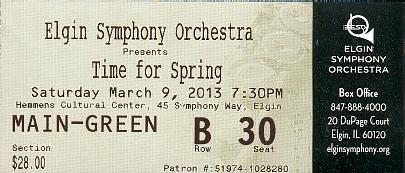
Lilly and I went to see the Elgin Symphony Orchestra play Tchaikovsky recently — Symphony No. 5 in E minor, part of the program called “Time for Spring” — and they did a fine job of it. But the astonishingly good part of the concert was the half-hour or so Time for Three was on stage. The trio, two violins and a double bass, set up in front of the orchestra and went to town, accompanying the orchestra on Concerto 4-3 by Jennifer Higdon, who apparently wrote the piece about five years ago with Time for Three in mind.

The trio – Zach De Pue, violin; Nick Kendall, violin; and Ranaan Meyer, double bass – were more than just energetic, technically adept young men, though they were certainly that. They went well beyond good musicianship, exuding their joy in working together, which wasn’t lost on the audience, who applauded frequently and stood for the three at the end (until they came out for an encore).

More about Time for Three is at the PBS Newshour web site, and while this YouTube video doesn’t really do them sonic justice – I’m not sure anything but seeing them live could – it still shows their range, and how they approached working together, and how enthusiastic the audience was. And of course it was filmed in the same hall as we saw them. In fact, it’s from roughly the same vantage point, except we were to their left, rather than their right, on the second row (which are the cheap seats at the ESO, but acoustically just fine).

Moonlight Saving Time

Today’s the first day of DST, and the nation is vexed by tired workers and dangerous motorists. To hear the opponents of the change tell it (and they’re never are quite as vocal in the fall). Maybe there’s something to their charges, but I’ve lived in a temperate-zone country where the time does not change, namely Japan. At the height of summer, the morning sun would wake me up at around 4 a.m. and my non-air conditioned apartment would be hot already by the time I had to get up for work.

It’s then, when you’re lying in bed feeling the sweat rising at 5 a.m., that you think: maybe taking this useless hour of daylight and dropping it into the evening is good idea. That is to say, I’m not persuaded that getting rid of DST would cure much of what ails us.

On the other hand, early March to early November isn’t quite right either. Better the way it was before Congress tinkered with it in 2005 – first Sunday in April to the last one in October, or even the way it was from 1967 to 1986, when it was the last Sunday in April to the last Sunday in October.

I looked at this map today because of the change, but also because it’s always a good day to look at a map. I wondered, what’s up with that corner of British Columbia that doesn’t change their clocks? Wiki says: “Part of the Peace River Regional District of BC (including the communities of Chetwynd, Dawson Creek, Hudson’s Hope, Fort St. John, Taylor and Tumbler Ridge) is on Mountain Time and does not observe DST. This means that the region would be on the same time as Mountain Standard Time (MST) in the winter, and Pacific Daylight Time (PDT) in the summer.” Hm.

One more thing: the change brings to mind this charming song, which is mostly lost to time.

I like the video that bsgs98 made. Where do you get so many pictures of people and paper moons? Google images, of course. But I also wondered, how exactly did the custom of sitting for a photo with a paper moon start, how long did it last, and why did it die out? A simple search doesn’t tell me, and I’m too lazy to dig around more (for now).

A quick check does reveal that there were many covers of the “Moonlight Saving Time,” but among those I’ve heard, I prefer Guy Lombardo’s version. The song was written by Irving Kahal and Harry Richman in the early ’30s, and it’s amazing the things you can find with a little creative Googling.

The Milwaukee Sentinel, in a squib published on June 17, 1934, said: “It was in the spring, three years ago, on the night that New York went on daylight saving time that he [Richman] thought up the title. There was a beautiful moon and the idea occurred to Harry that ‘Moonlight Saving Time’ would be a good title. Next day, he and Irving Kahal wrote the song.”

Cronkite’s Last Broadcast

Memory is unreliable, so keep a diary. Or so I read once in an article about planning and executing a months-long trip. Memory is unreliable, of course, but written accounts aren’t always much help either.

On March 6, 1981, I was in Durham, NC, on spring break and wrote: “We all went to a North Carolina Mexican restaurant, which wasn’t bad. Better than El Sol in Logan [Logan, Utah, where I’d been the year before, and which featured cinnamon in its enchiladas, if I remember right]. The place was divided into the Cosmopolitan Room and the Fiesta Room, or something like that, and one was mainly a bar, though you can eat there, which we did. It had a television on the wall.

“Since we were there from roughly 6:15 to 7:15, Walter Cronkite’s last news program was on. During his final words, the whole place was watching, maybe a dozen people. I’ve never watched his broadcasts that much, but I think he wrapped it up with style.”

I don’t remember a thing about that nameless Mexican restaurant, what I ate, or what my friends – Neal and Stewart – and I might have talked about. So much for the efficacy of diaries as a memory aid, at least in this case. I vaguely remember the quiet of the place, with everyone watching a communal television event that would never happen now (who cares about network news anymore?). But if I had to cite any of Cronkite’s words, I couldn’t, except for “that’s the way it is,” because he always said that.

It was a fluke that I saw it. I didn’t have a TV in my dorm room, didn’t know anyone who did, and probably won’t have ventured down to the common room — which had a TV — to watch it there, had I been on campus that day. We were staying with Neal’s parents during that trip, and I don’t remember watching much TV there, either (though I did read most of Helter Skelter there).

Naturally, in the age of YouTube, you can see it again if you want. I agree with my original assessment of the sign off.

I thought of Cronkite’s last sign off on Saturday when I spotted a small error in the pilot episode of The Americans, which I started watching because I saw it described as “a period piece about Russian spies in America.” The period turned out not to be the height of the Cold War, but the late Cold War setting of 1981. No, I thought, it can’t be a period piece if I remember the period as more or less an adult. But I guess that isn’t true anymore.

Anyway, it’s a pretty good spy yarn, more interesting because the spies in question are sleeper Soviet agents who pass as middle-class Americans (with convenient orders to converse only in English, even among themselves). The small error was in passing. The scene showed a television, and Walter Cronkite was delivering the news. The show is clearly set in the spring of 1981, April at least and probably May. Cronkite was gone after March 6.

A Weekend With the Doctor

Spent a chunk of the weekend watching old Doctor Who. Very old, as in a story from 1964 and one from 1967, survivors of the shockingly routine practice of destroying old TV shows that the BBC and other organizations used to follow. You’d think that the BBC, of any media concern, would have had some sense of history, but apparently not. Separately, I’ve read that the company was about to wipe the tapes of Monty Python’s Flying Circus when PBS showed an interest in them, and thus a crime against comedy was averted.

Anyway, I discovered that 50th anniversary Doctor Who specials are now in production, the earliest parts of which are available to us. Ann and I spent some time on Friday and Saturday watching them. Hearing about the earliest shows through the standard format of interviews-and-clips was fairly interesting, but even better, each special (so far) has included a full story featuring the particular Doctor under discussion. My interest in the series has been intermittent down the years, so I’d never seen any Doctors earlier than Tom Baker. Probably a lot of Americans and maybe even younger Brits can say that.

The two stories were “The Aztecs” and “The Tomb of the Cybermen.” First Doctor and Second Doctor, respectively. I can’t recommend watching them at one go, since they were created as serials. After a while the story arc gets tiresome – what, another complication preventing the heroes from getting back to the Tardis? Get on with it already. Spacing it out a bit would work better. But Ann insisted on watching all the way through.

Still, I found the shows entertaining. Doctor Who’s famed low-budget production values were on full display, especially when – as happened a few times during “The Aztecs,” – a character was called on to move a heavy stone door, and it’s clear that nothing more heavy than styrofoam or the like was involved. The story involved the Doctor and his companions showing up in pre-Columbian Tenochtitlan (presumably) and mixing it up high-caste Aztecs, all of whom look and sound precisely like British actors in costumes that could have done service in The Robot Vs. the Aztec Mummy. I had a hard time explaining to Ann exactly why I thought that funny.

As a story, “The Tomb of the Cybermen” seemed more cohesive and – put in context as children’s entertainment pre-Internet, pre-CGI – was probably pretty scary to many of its original audience. It involves the Doctor and his companions showing up on some desolate planet and unwisely helping to unearth a pod of Cybermen, who of course are long-running menaces bent on destroying humanity or conquering the Earth or whatever. Ann, of a more sophisticated (jaded?) generation, told me that one reason she liked the story was because the effects weren’t particularly good, thus making it less scary than the more recent iterations of Cybermen on the show.

My favorite bit was a supporting character who was supposed to be a spaceship captain. It was implied that he was an American, but he sounded like no American I’ve ever heard. I had to look this up: the actor was George Roubicek, born in Austria and saying lines written by British writers who seem to have had no ear at all for American idioms. Surprising, since even 50 years ago, weren’t a lot of American movies shown in the UK?

According to Wiki at least, Roubicek’s made much of his career doing dubbing work, and I say good for him (and he’s still alive) . He also had a small part in Star Wars. Like everyone else involved, he probably had no idea it would become the phenomenon it did. Probably the same could be said for Doctor Who.

Deputy Marshall Ronald Reagan

Portillo’s is a (mostly) local chain specializing in hot dogs, Italian beef, burgers and the like, and across its various locations, thematic decorations from the ’20s to the ’60s. The food is good and the decorations interesting, so every few months we go to one of the locations, two of which are fairly close.

Last weekend Lilly and I visited the one on Illinois 83 in Elmhurst, a bit out of our usual orbit. Before ordering, I was waiting while Lilly was in the restroom, and taking a look at some of the items on the walls in that part of the restaurant. Off in one corner is a framed picture of Ronald Reagan in a western outfit, wearing a badge that says Deputy U.S. Marshall. My guess would be it’s a publicity shot from Law and Order (1953).

On closer inspection, I noticed that it’s autographed. I’m not familiar with Reagan’s handwriting, but I’ve no reason to think it isn’t his. “Dick” must be Dick Portillo, who founded and still owns the chain.

To Dick –

If I don’t make it acting, I’ll try the hot dog business.

Ron

Ten Years Later

Big snow predicted for tomorrow. Not a blizzard, mind you, but six inches maybe. The weathermen try to act impressed by that, but it isn’t impressive. I haven’t checked to see if the Weather Channel is trying to stick a name on it. Last time it was a noted cartoon fish (or submariner). Maybe it’ll be Winter Storm Magilla.

Oddly enough, and apropos of nothing, I never watched The Magilla Gorilla Show, though I can’t say that about other awful output of the Hanna-Barbera cartoon factory. Or at least I have no memory of it. Not sure why. I was squarely in its demographic, at least by the end of the show’s run in 1967. But there must have been something else on at the same time that I, and probably more importantly, that my brothers wanted to watch. I never even heard of the show until much later, when I listened to the theme song on a TeeVee Toons collection.

Just out of curiosity, I counted up the number of posts between the day I first posted back at Blogger, February 21, 2003, and today. It’s only a milestone because we use base 10, but base 10 it is. The total is 2,435, or almost exactly two times every three days. Not so much across the span of 10 years. I couldn’t say how many words that is, but at 300 per entry — a seat-of-the-pants estimate — that puts it around 730,000.

Two hundred words a day. Eh, any fool can do that. Even if you count the for-pay words I’ve done in the last 10 years, that might only be 800 to 1,000 words a day. That doesn’t take one into the league of Asimovian compulsive writers.

But quantity isn’t everything. I’ve enjoyed blogging in particular about those few places I’ve been over the last decade. With any luck — because life is impermanent — I’ll record impressions of a few more places here over the next decade (or in a successor blog, because blogs are impermanent, too.)

“Stand when I speak to you, earthman.”

There’s all kinds of interesting things at this blog, which I chanced across the other day, but which also seems to have been discontinued. I think I understand why. It looks like a lot of work: all the scanning, caption writing, linking and publishing.

I’ve only skimmed it, but I like the tone of the site. Not: look at all this junk from the past we can feel superior to, for moral or aesthetic reasons. And not: look at all this cool stuff that reminds me of my childhood, when the world was a better place. But rather, look at all this! The world’s got an inexhaustible supply of interesting things, for endless reasons. Enjoy!

I found it because I was trying to learn more about the cartoonist Charles Rodrigues. I have the paperback book Spitting on the Sheriff and Other Diversions (1966). I picked it up at my mother’s house at some point, where it had been kicking around for years. “the in crowd” has scanned a number of them here, some of the better ones in fact. One of my favorites is, “Stand when I speak to you, earthman.”

The Presidents Day Blackout

At 5:10 p.m. the electricity flickered, went out, returned for a few seconds, then went out for about 50 more minutes.

Time to be dramatic: Blackout! NW Suburbs Without Power! Family of four plunged into uncertainty of powerless, dimly lit Monday evening! Forced to eat dinner and play a board game by candlelight!

But it wasn’t dramatic. It wasn’t that cold today, so the house didn’t even lose that much heat. There was no obvious reason for it — no windstorm or ice buildup on power lines. Just one of those things.

Only three of us were here, since Lilly was visiting a friend at the time. I checked the block and everyone else’s power was gone as well, though the lights outside the school behind our back yard were still glowing. Lilly reported later that Twitter had informed her that some undetermined local area was dark — her friends were tweeting about it, I guess, but it couldn’t have been too large an area, since her friend (about a half mile from us) didn’t lose power.

Our TV and Internet were gone, but how can that be a bad thing for a few minutes, especially that fine silence where the TV used to drone? We discovered that our camping lantern, which contains four D batteries, has actually been a container for dead batteries for a while now. But we have about a half-dozen candles, and so ate our Japanese curry-rice by their light. Good thing the rice had cooked by the time the juice went off, though we could have boiled pasta and had curry-pasta.

Ann wanted to play a game: Sorry! As we prepared the table to set it up, the power came on again. I told her we could still play, and she still wanted to play by candlelight, so we did, though her mother was watching TV in the same room, so it wasn’t quite the throwback experience it might have been. Her yellow men edged our a victory over my green ones, four home to three home.

The No Name Storm

Heavy snow this evening, but it didn’t rise to the level of blizzard. For one thing, there was practically no wind. First rain, than big snow flakes fell almost straight down. Nothing like the promised blizzard in the Northeast, which the Weather Channel is trying to name after a fictional submarine captain or a spunky animated clown fish.

Name winter storms? No, if it’s a real corker, the likes of the “Great Blizzard of 1888” or the “Armistice Day Blizzard,” or the “Blizzard of 1978” will do. Trying to name a winter storm like a hurricane is just the Weather Channel drifting a little more toward infotainment. I’m with the National Weather Service on that score: no names for winter storms.

And speaking of which: no to the new cat Monopoly token. There’s a dog token, of course, but dogs are loyal creatures who will follow you around the board. Cats will lounge around Free Parking all day, waiting to be fed. I’m old enough to remember to man-on-horseback and cannon tokens, which shouldn’t have been retired either. When it comes to weather nomenclature and Monopoly, I’m a mossbacked reactionary.

More Bullwinkle

Sometime in 1987, I bought a Bullwinkle clock at a clock shop in Water Tower Place. It’s one of only a few things I ever remember buying at that mall on Michigan Ave. It was an impulse purchase. When I saw it, I knew I had to have it.

Note that the numbers are in reverse order. The hands moved counterclockwise, and the clock kept good time, only backwards. I hung it in my apartment in Chicago from ’87 to ’90, and more than one person commented on how confusing the clock was.

Near Bullwinkle is a copyright mark, “1987 P.A.T. Ward,” so I hope the $20 or so I spend provided a bit of income to Jay Ward (d. 1989), who deserved to profit mightily from Bullwinkle. On the back is “H.I. Enterprises, Milwaukee.” Not Frostbite Falls, but not too far away.

At some point (I think), a battery leaked and damaged the movement, so it doesn’t run any more. But years ago I hung it on the wall in my office over the large bookcase all the same. Recently I took it down for dusting, and had Ann pose with it.