Fireflies, Cicadas, Crickets and Bops

Late July is that rare moment here when the fireflies haven’t quite gone away, and the cicadas and the crickets have both started their noisemaking. The crickets are just beginning and not so loud, but the cicadas are reaching for peak loudness, which tends to be in August.

Got a lot to do. Time for a high summer break. Back to posting around August 7.

I was really glad to find this again the other day. It hasn’t been on YouTube in a long time, but it’s on Vimeo.

The Three Little Pigs – Three Little Bops from Rudolf Second Channel on Vimeo.

A cartoon of great charm that I don’t remember ever seeing as a kid. Maybe afternoon TV program directors thought the jazz off-putting for kids, or maybe there was some copyright issue. Anyway, enjoy it while it’s available.

Listening to the Fourth of July

Back to work. Got an email today, a steamy hot July day, that started: “Are you working on any National Ice Cream Day (July 17) stories? If so, please consider…” Not my beat, unfortunately.

We didn’t troop out to any public space to see a professional fireworks on July 4 this year. Rather, we listened to the numerous private explosions — at least I did — from the comfort of the backyard deck. Temps were just right, the wind had died down, and the small amount of rain we’d had a few hours before dark had most dried up.

Such pyrotechnics are banned under Illinois law. Or at least all the fun stuff is outlawed. It’s a law that goes unenforced after dark on Independence Day, or much before dark that day, unless (I suppose), you decided (for example) to shoot off bottle rockets in front of a cop. Or at a cop. Assuming you survived such an act, that would probably earn a fine at least.

I’ve heard private July 4 fireworks every year that I’ve lived in Illinois and been here for the holiday, but my impression is that the unsanctioned explosions ramped up in quantity and quality beginning in 2020. That year, we arrived home from Prairie du Chien on the Fourth, and soon watched from the front yard as the block lit up with more fireworks than ever before. I don’t know about last year — we went to Westmont for the show — but the trend seems to have carried on this year.

Then again, location probably matters. Fifteen years ago (was it that long ago?), we were treated to a lot of fine explosions in one of the rural parts of Grundy County, Illinois. This year, I didn’t bother with Grundy or even my front yard. I parked myself on my deck and decided to listen.

Peak illegal fireworks, between about 9 p.m. and 10 p.m., was a richly layered aural experience: rumbling every few seconds off in the far distance, pops and whizzing in the mid-distance almost as often, and BANGS nearby pretty often, all mixed together in a mildly noisy stew, except for those close-by BANGS, which weren’t mild at all. The distant rumbles sounded almost the same as distant thunder, but not quite, if you listened closely. Sometimes you could see fireworks out in the mid-distance, pops of gold and green and blue and red, but this year sound was the thing.

At roughly the same time as ambient explosions peaked, the legal fireworks display at the ballpark about a mile away was, as usual, just visible over a line of trees. I also think I barely heard, and barely saw, the legal fireworks display in Elgin as well, some miles distant to the west. At about 9:30, I heard a massive number of small explosions, as you usually do for the finale of such a show — but faintly — in roughly the right direction as Elgin. I could also see a pale but expanding glow simultaneously with the noise.

By about 10, most of the noise was gone, though of course there were scattered booms and pops until nearly midnight, when nature decided to make some noise of its own. A large thunderstorm barreled through the area, dropping a few inches of rain and conclusively putting an end to this year’s Independence Day explosions.

Antiques of Naperville

Back on July 5, since of course the stretch from Canada Day to Independence Day at the very least ought to be a row of holidays.

At a shop called Antiques of Naperville, which is tucked away on a side street in that suburb’s downtown, there is a sign that says:

Take All The Photos You Want
Please
Tag Us @Antiques of Naperville
#shopdoggibson #brownbarnantiques

Sure thing. This doesn’t count as a tag, but it is a mention. I took the place up on its offer of no-limits photography, because there was so much stuff around. Interesting stuff. That’s all I ask of an antique store. Not every shop allows pictures, but is that not a mistake in this age of social media?

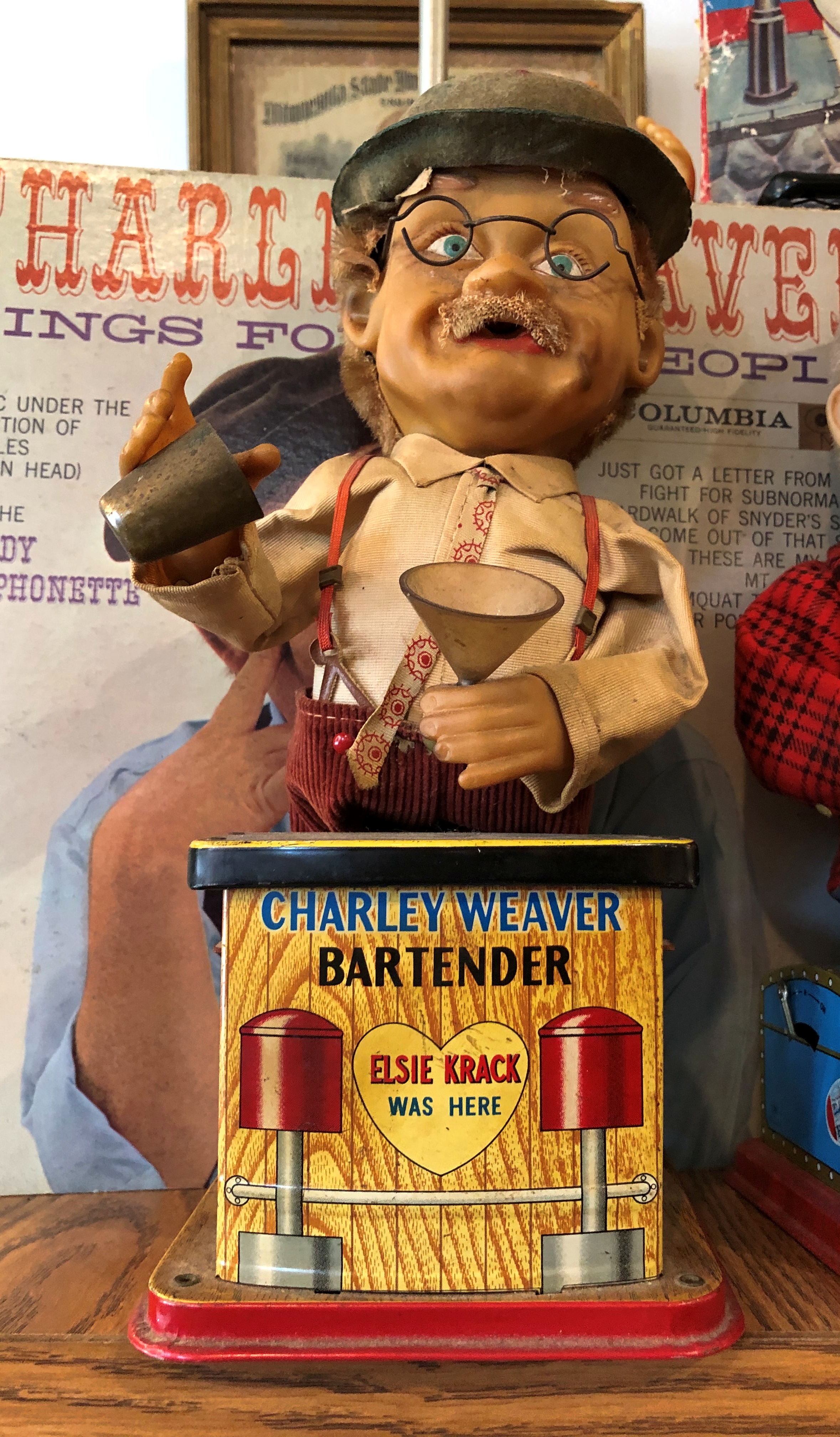
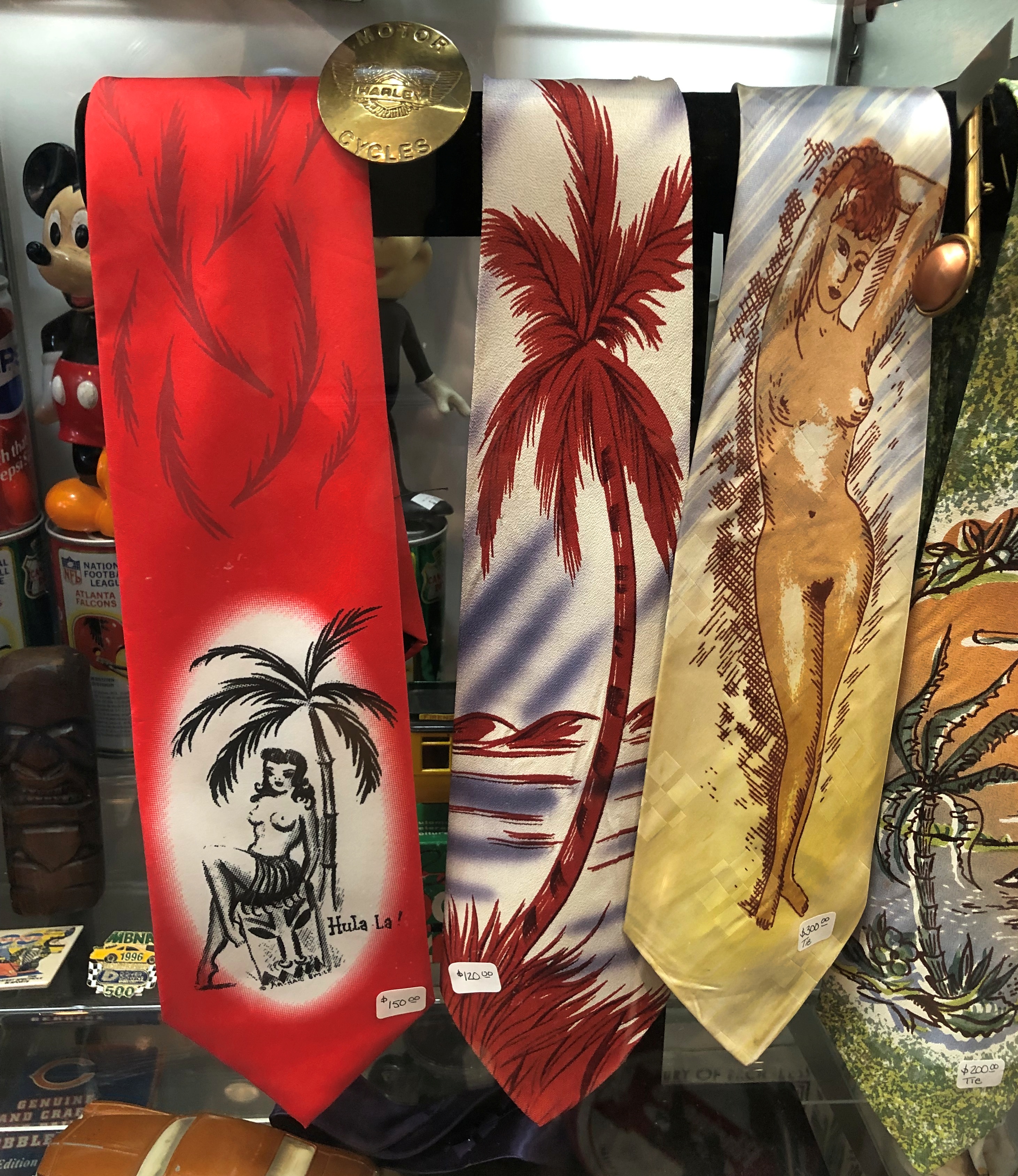
This was the place I found the Charley Weaver bartender doll, previously posted. Nearby him were these ties — and somehow they’re in the same bric-a-brac milieu as ol’ Charley.Antiques of Naperville

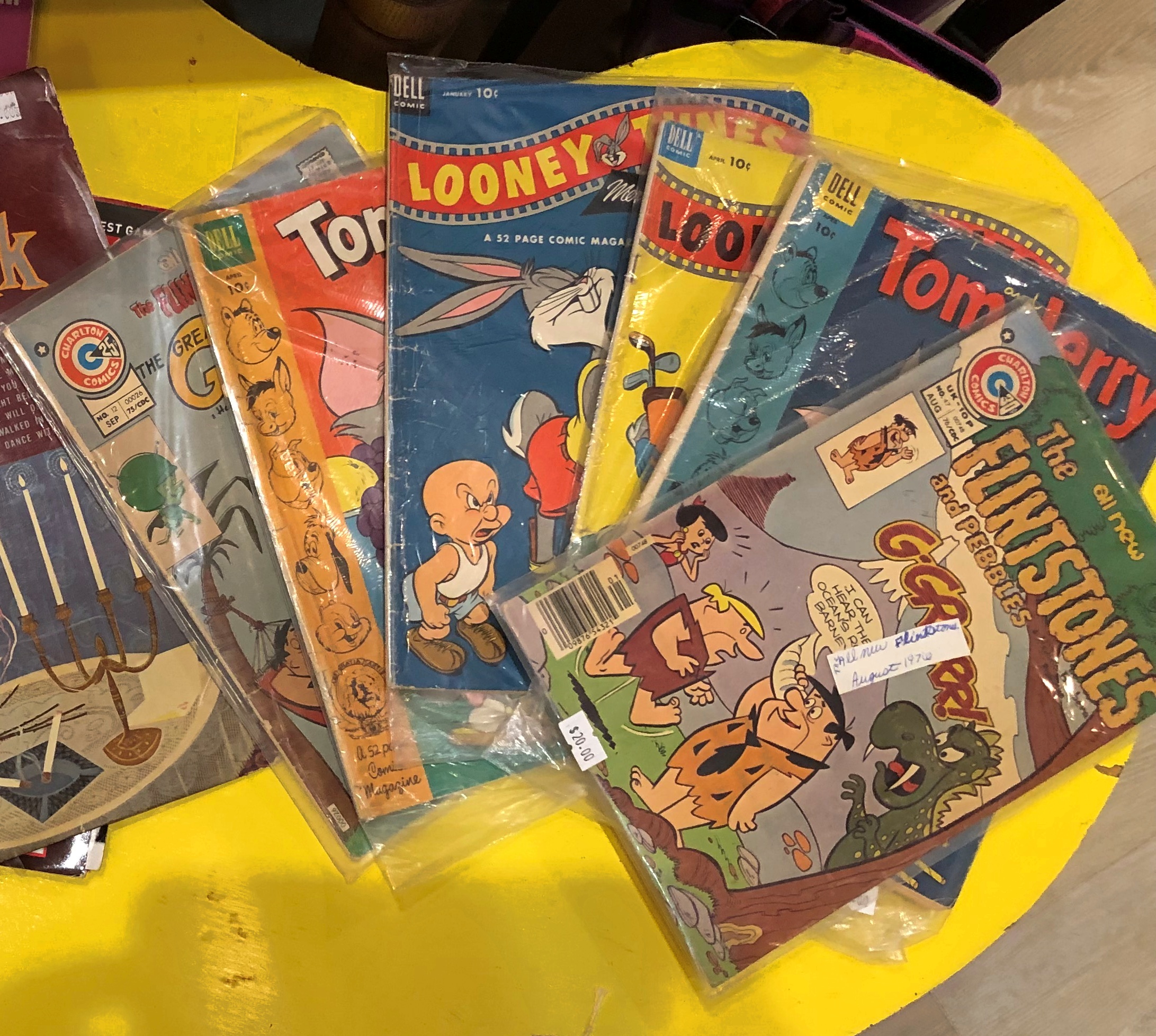
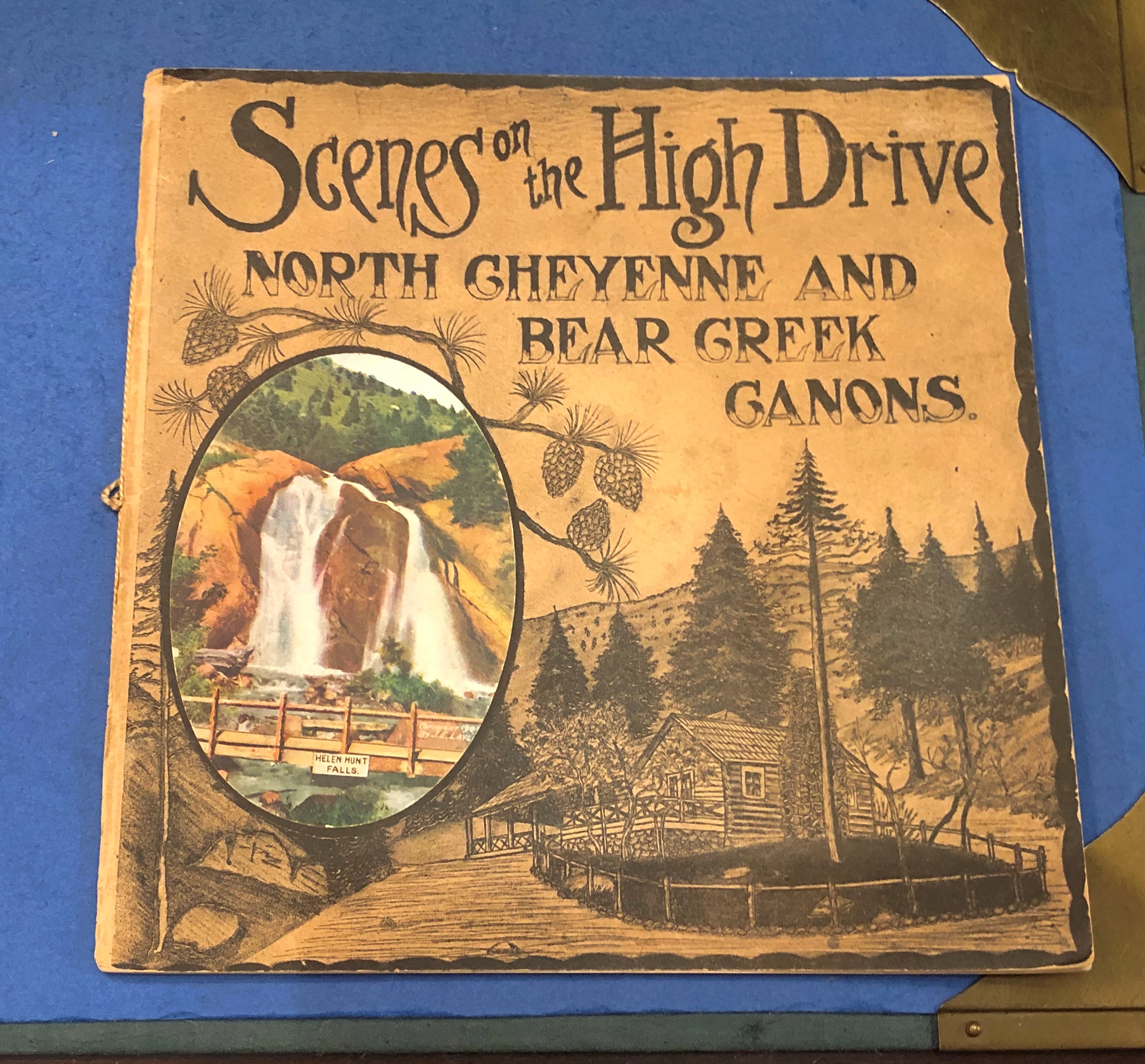
Divers reading material.Antiques of Naperville Antiques of Naperville

Dell. We always had many more Gold Key comics than Dell, but there were a few around the house.

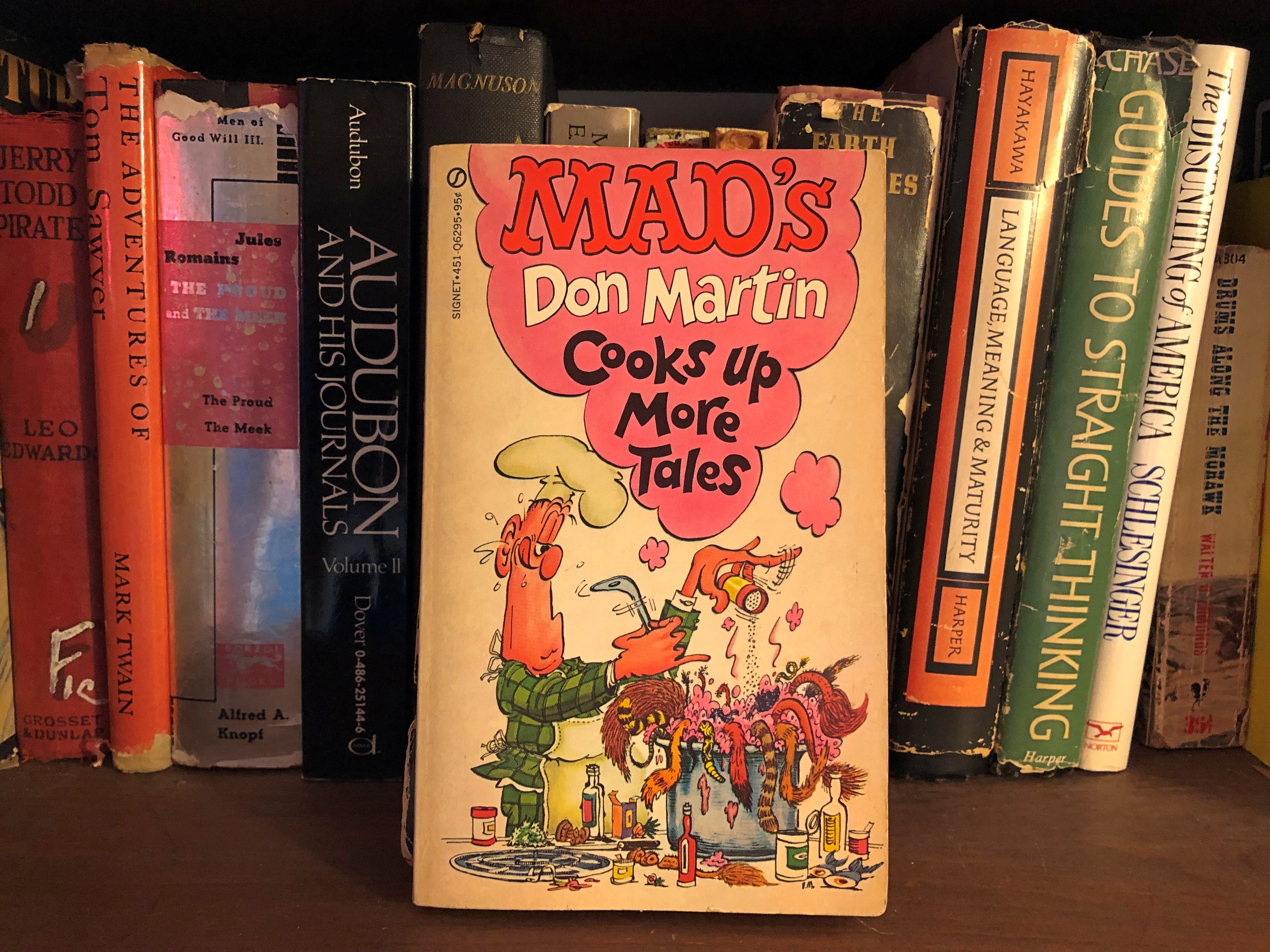
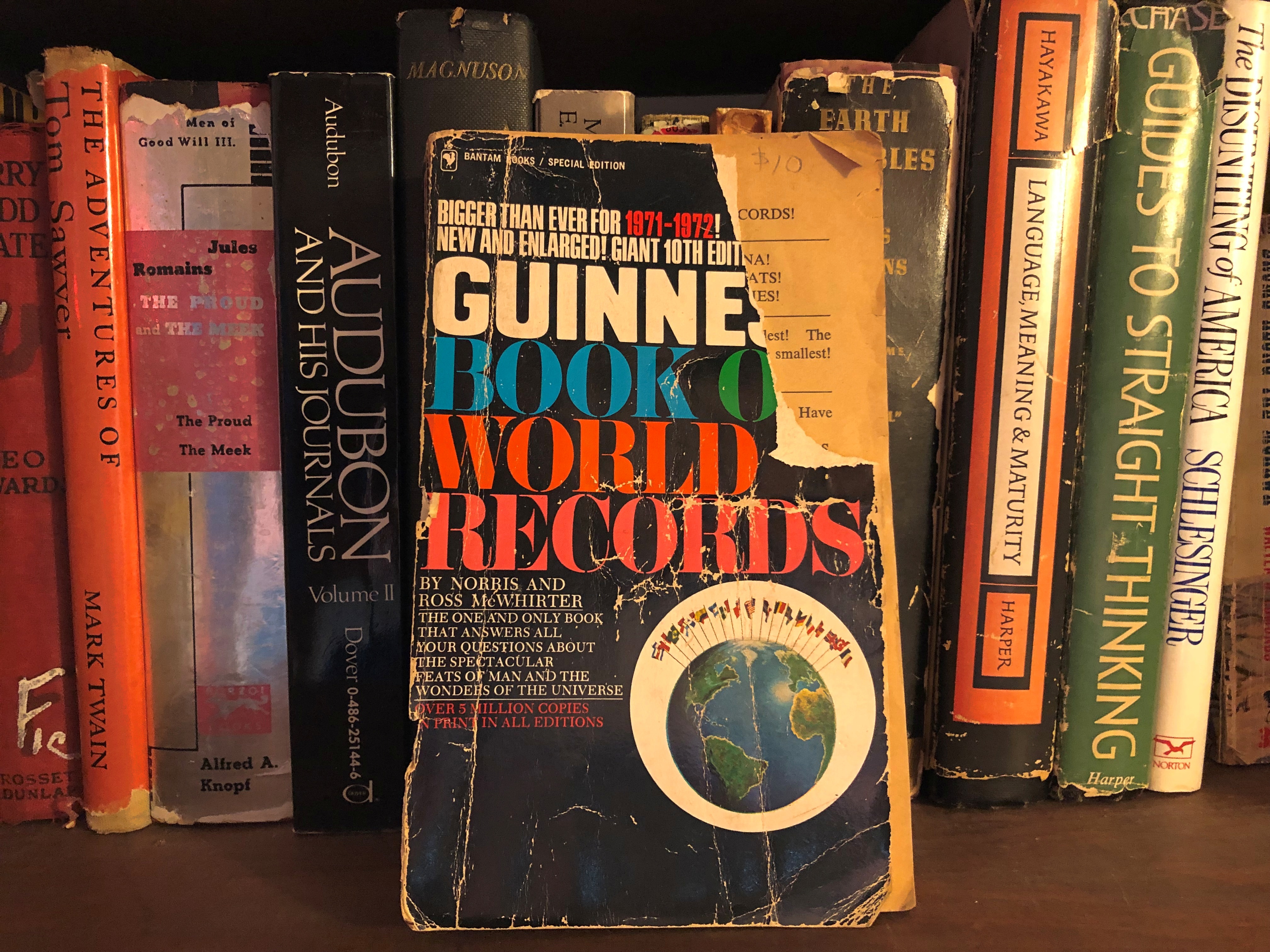
Paperbacks. Not that old. We had this book when I was young and I read it. And the next one.Antiques of Naperville

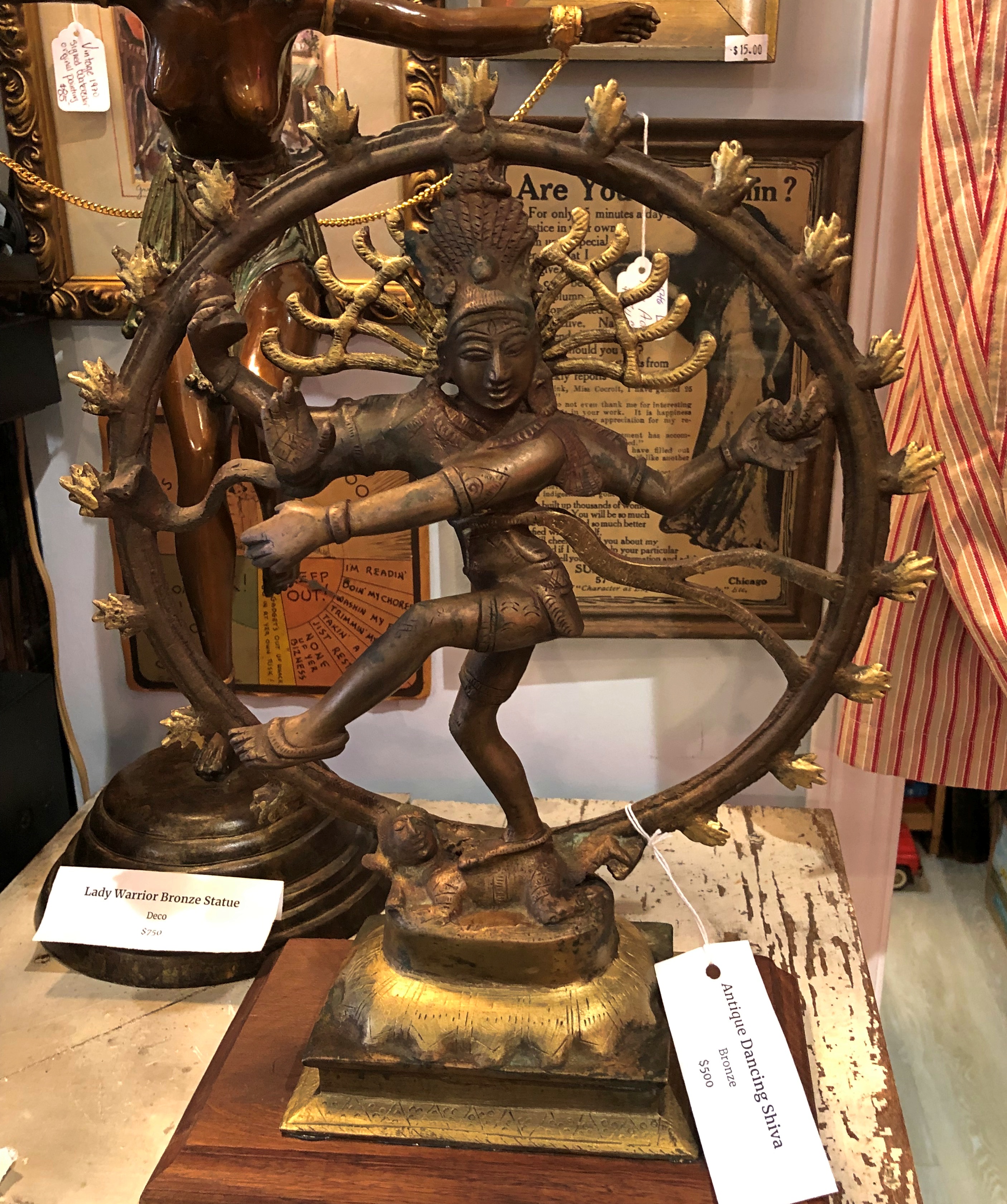
Something we didn’t have: Shiva.Antiques of Naperville

Shiva is the Destroyer, and it occurs to me that destruction doesn’t have to be dramatic and fast, does it? Sometimes — often? — usually? — destruction is gradual, happening off in a quiet corner or nook, but inexorable all the same. Such as for the objects in an antique shop, for instance.

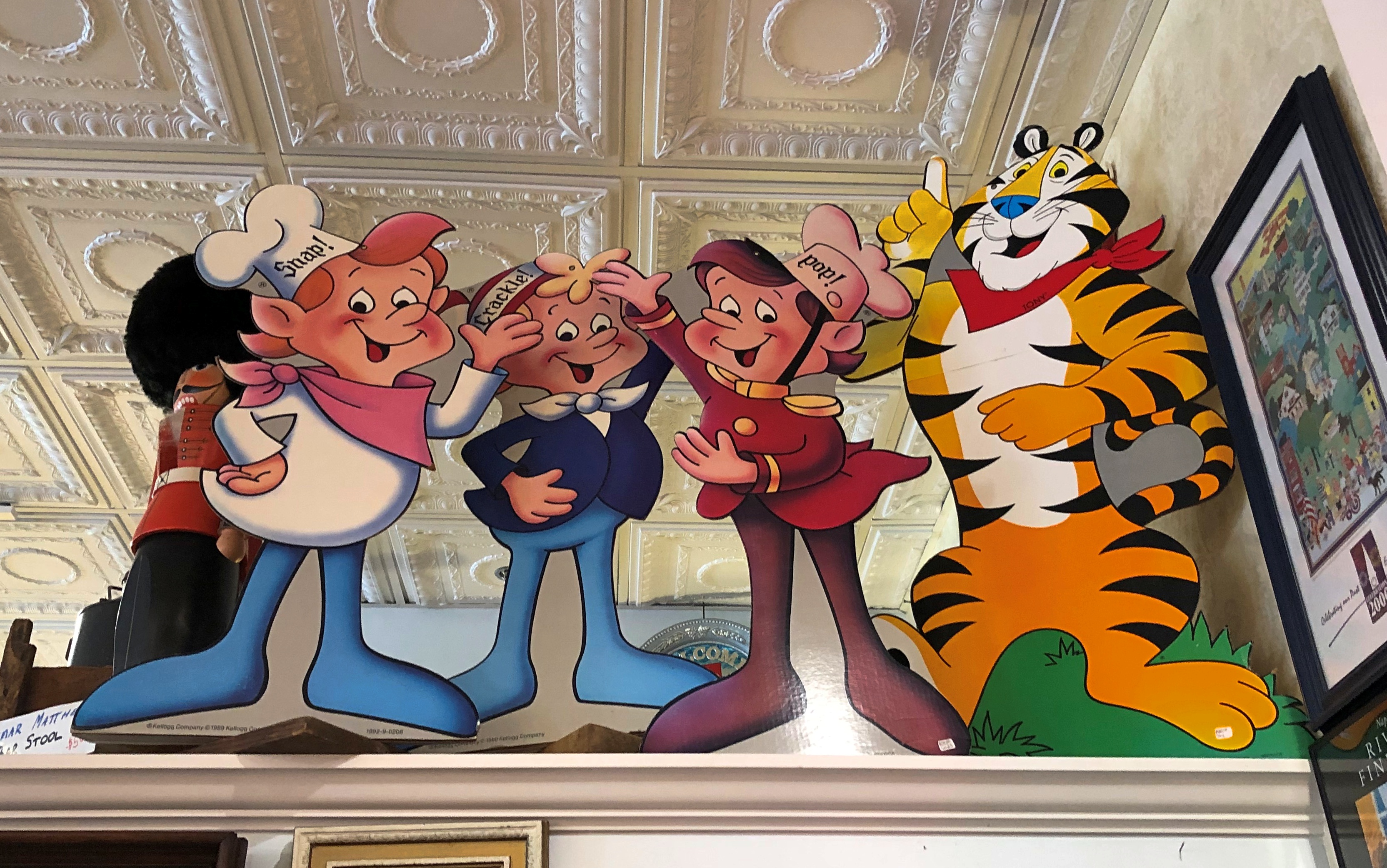
Characters more friendly than Shiva.Antiques of Naperville
Antiques of Naperville

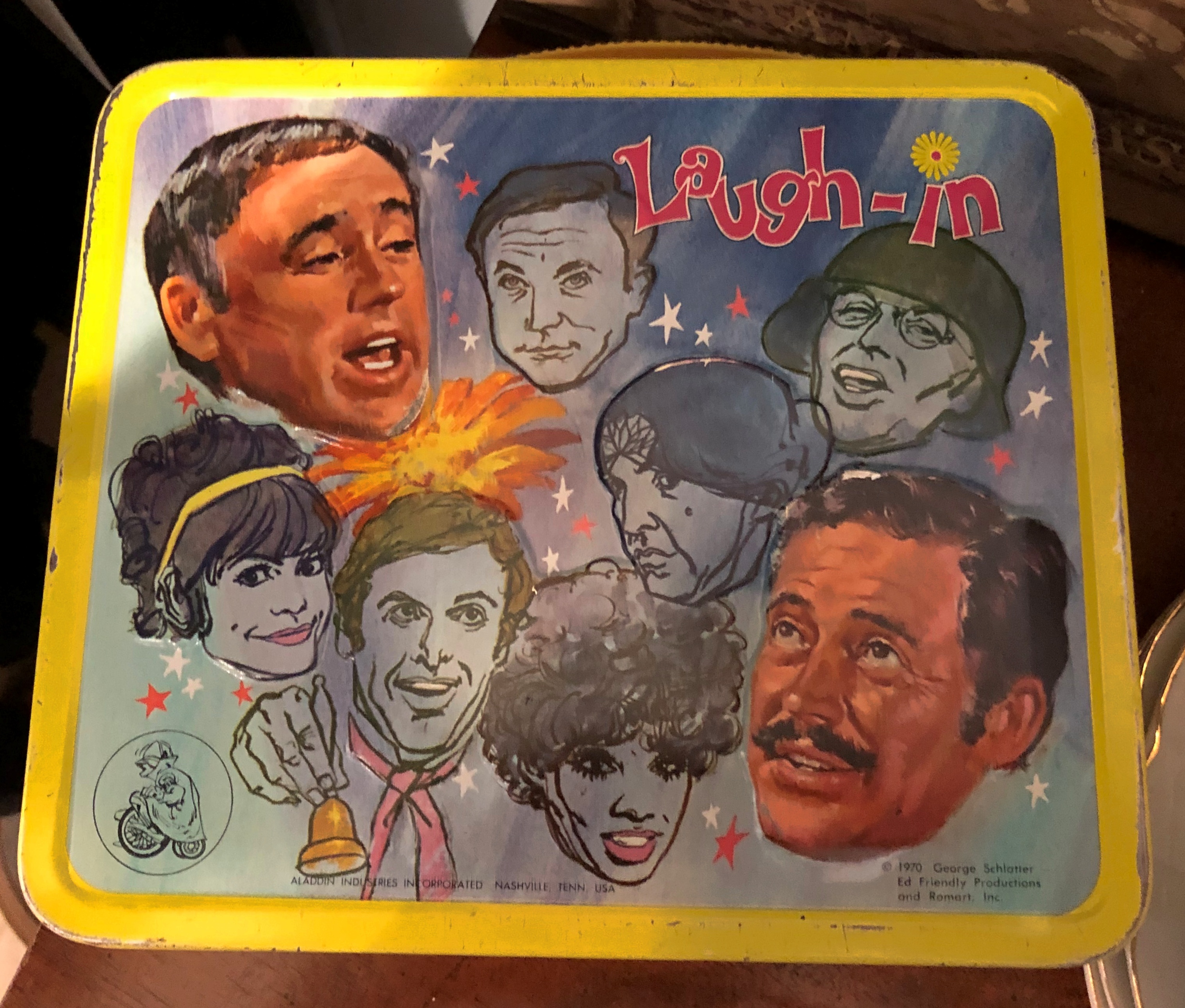
I have to say it: Very interesting, but stoopid. You bet your sweet bippy.

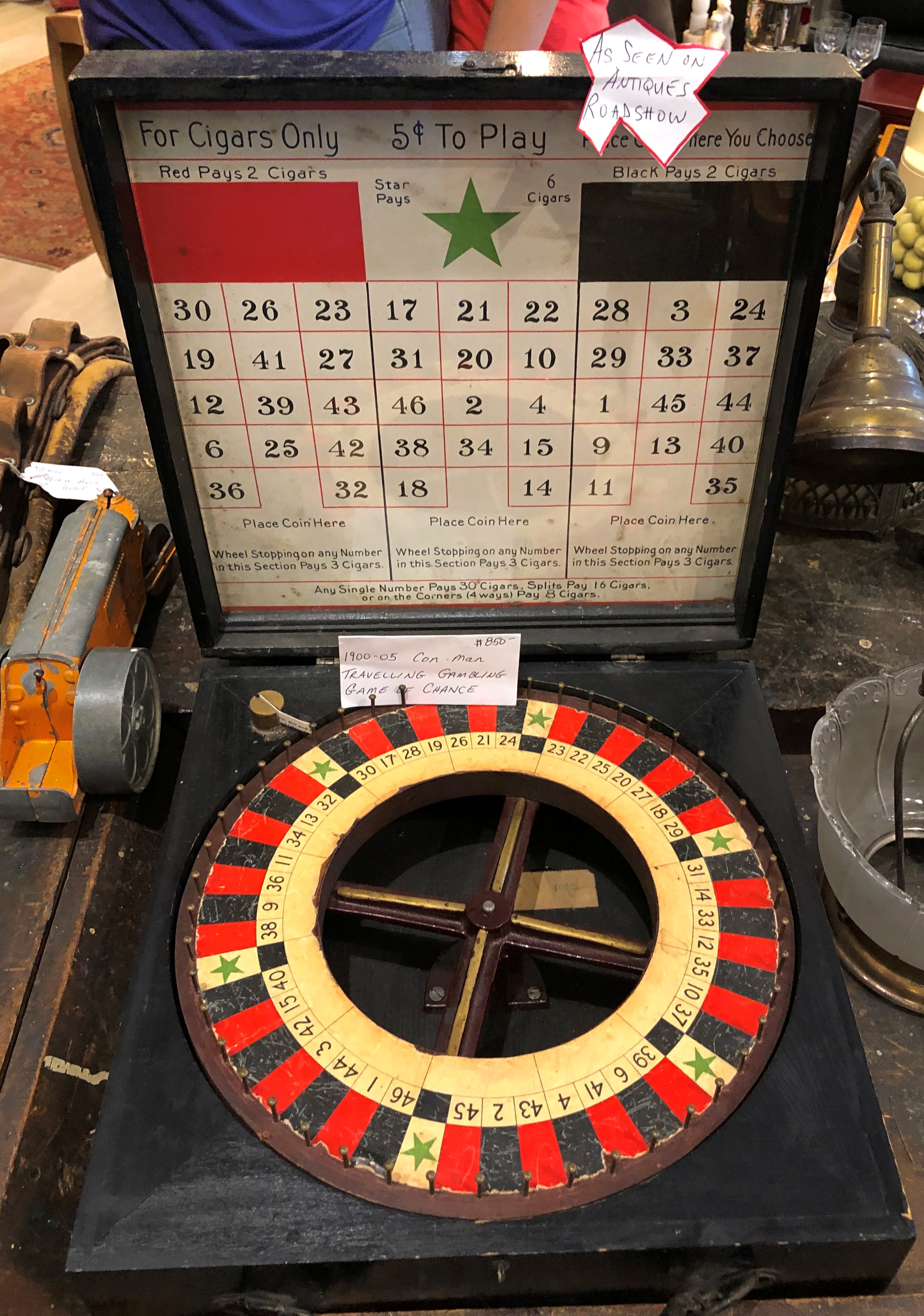
“As seen on Antiques Roadshow.” This very thing, or just one like it?
Antiques of Naperville

A traveling game of chance, its sign said, used by con men. No doubt.

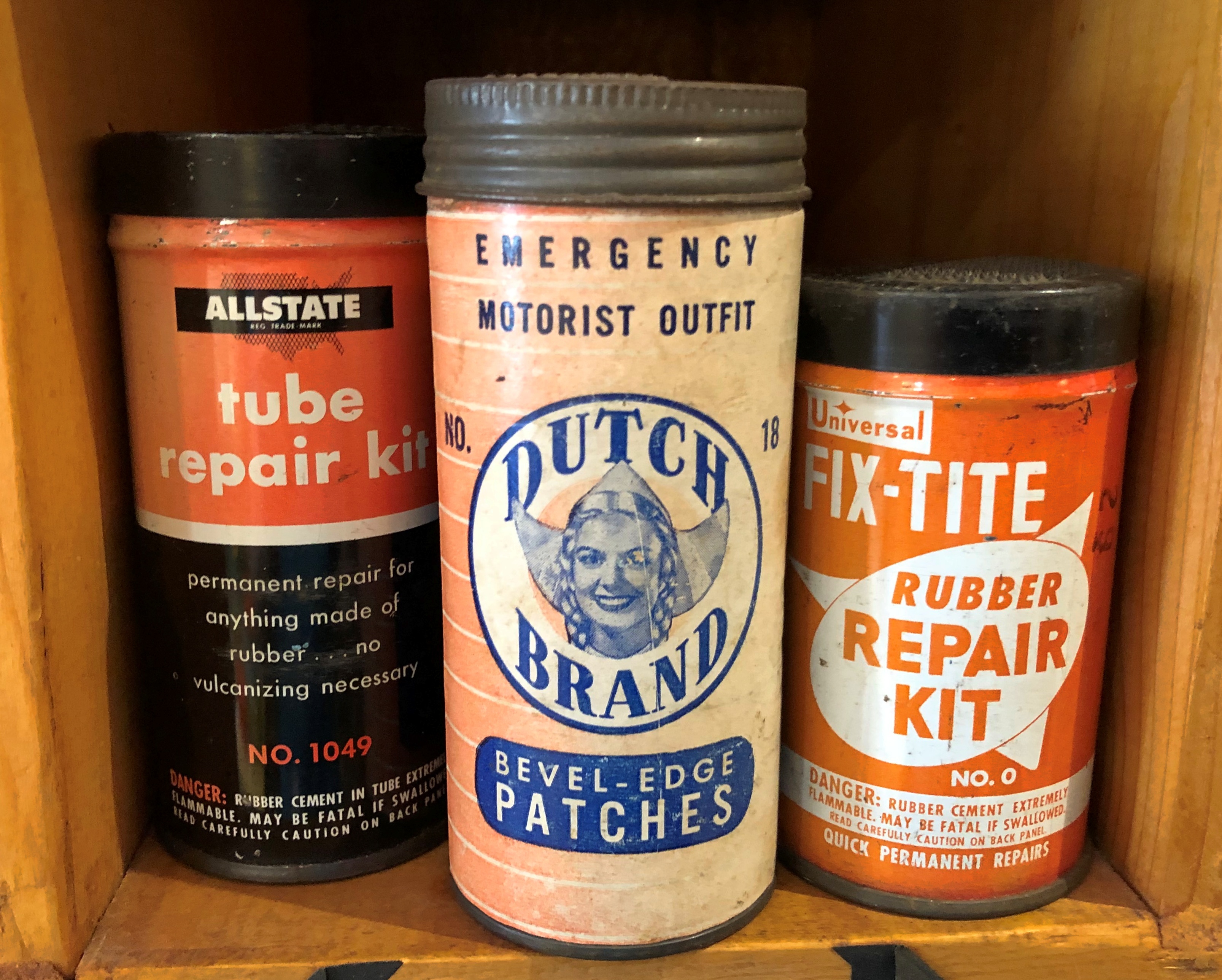
Items no longer needed by drivers, fortunately.Antiques of Naperville

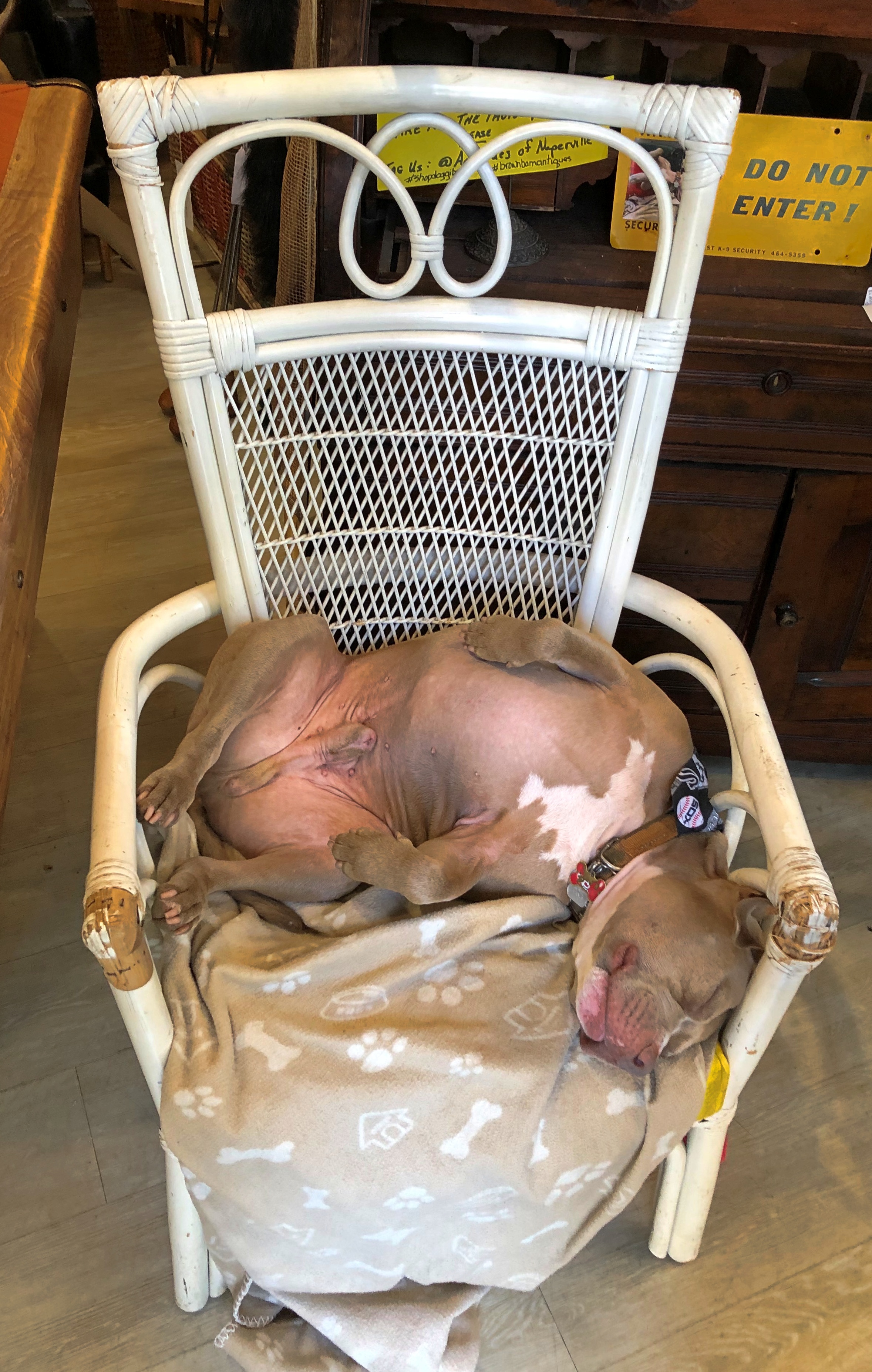
Yuriko pointed out the inhabitant of a chair in the shop.You bet your sweet bippy

For a moment I thought it was a doll or cushion of some kind, but then one of the dog’s paws twitched. It was a living dog. Probably the most inert dog I’ve ever seen, and a lot of dogs are inert a lot of the time. This dog paid no attention to any of the people shuffling through the shop, and barely acknowledged it when Yuriko petted him.

Along the West Branch of the DuPage River

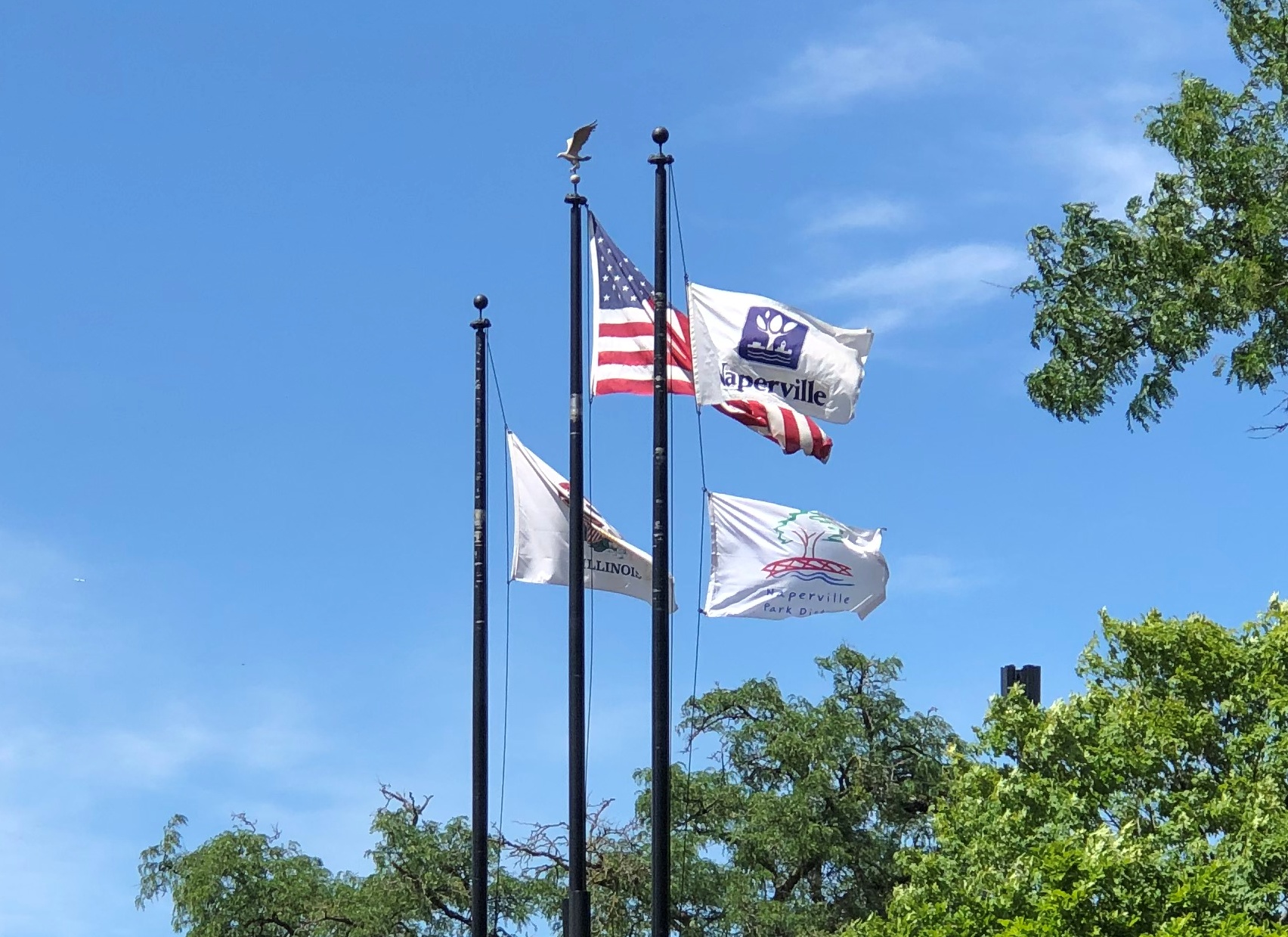
Naperville, the second-largest Chicago suburb by population at nearly 148,000, has much to recommend a casual visitor, either in warm months or colder ones. (Way-far west Aurora, surprisingly, is number one at nearly 200,000 souls.)Naperville flag

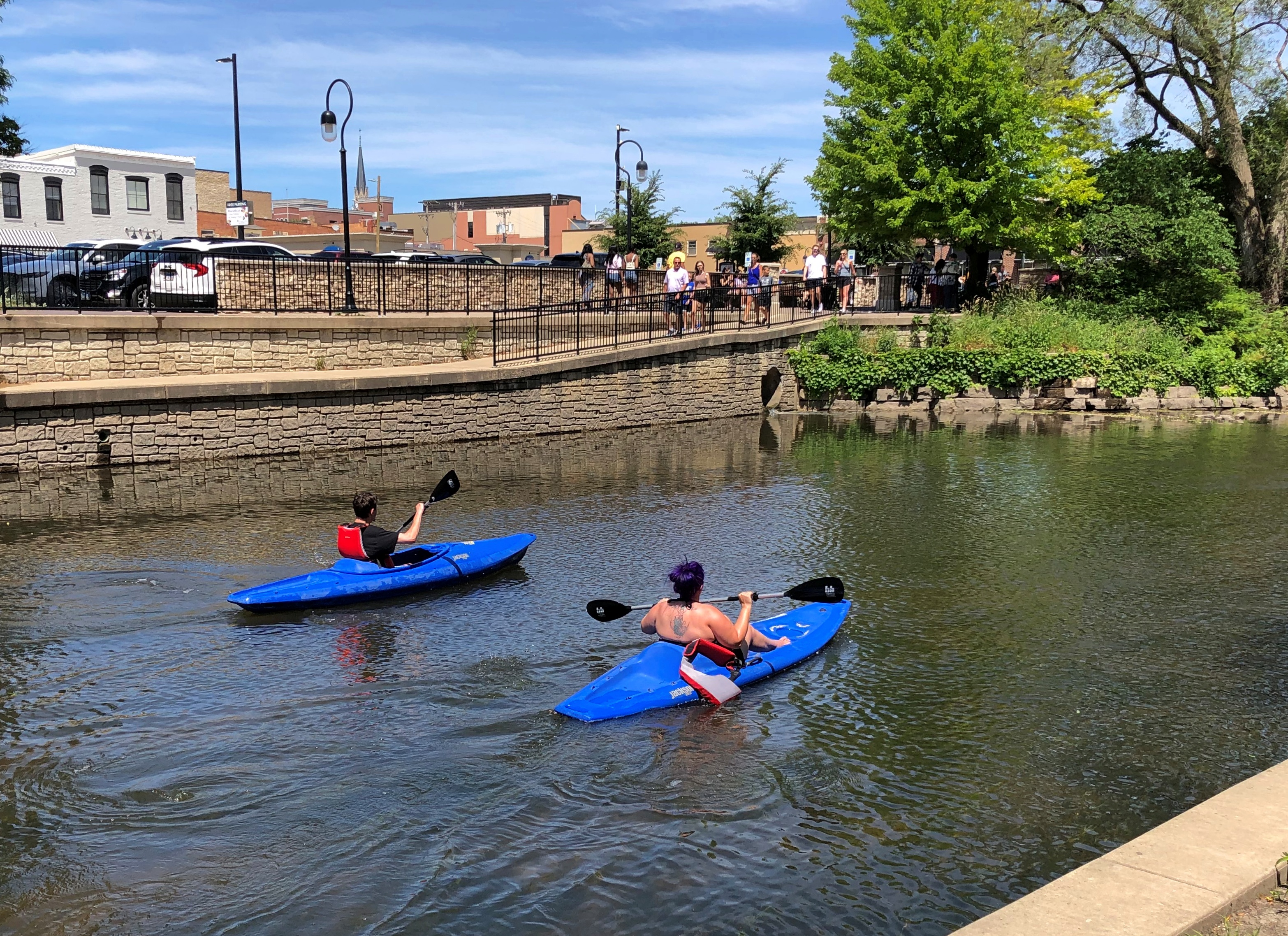
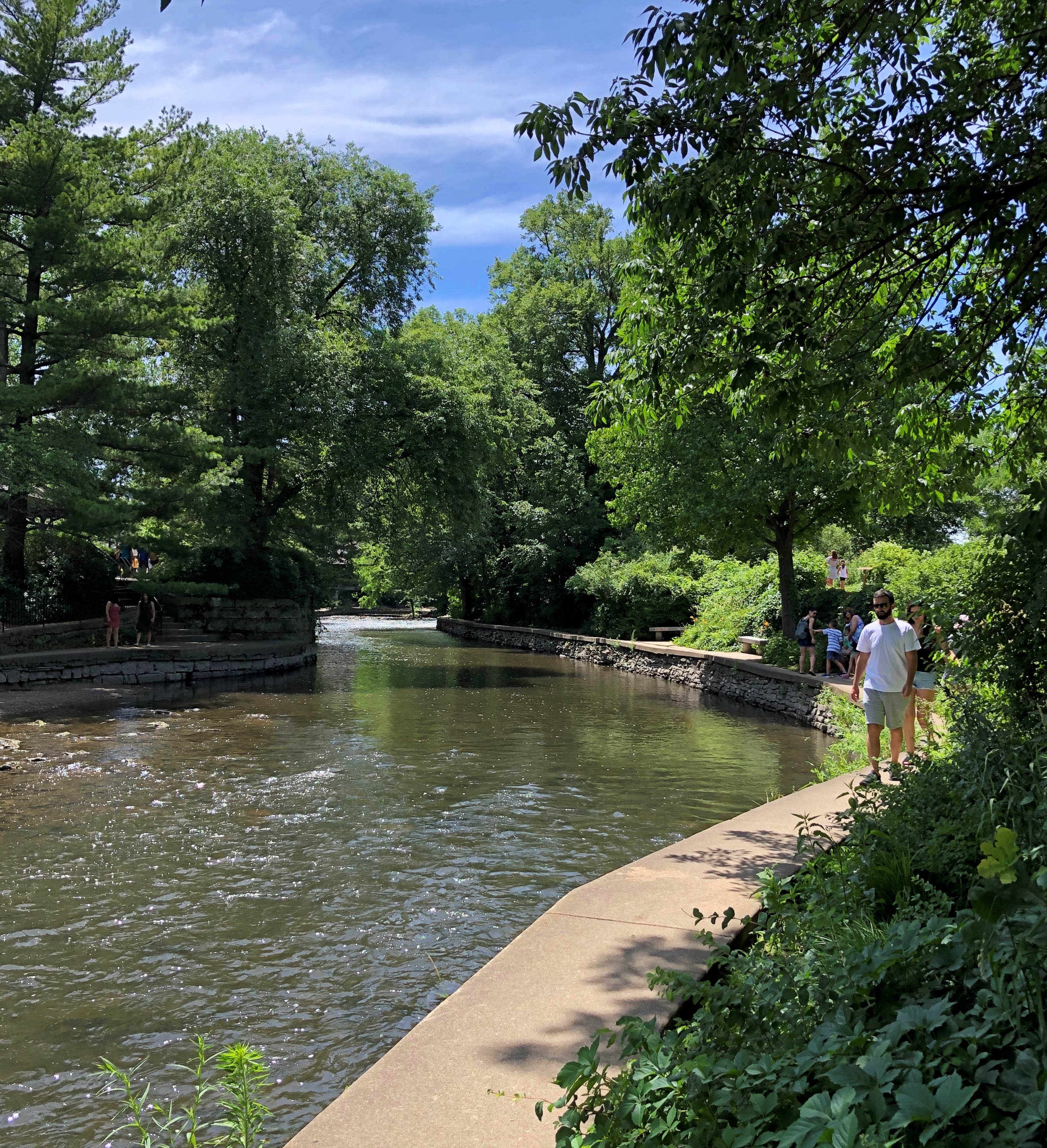
Sunday was warm, but not hot enough to keep us from a stroll along West Branch of the DuPage River, which passes through downtown Naperville, and is in fact one of the village’s main amenities. The river is broad at that point.
West Branch, DuPage River, Naperville

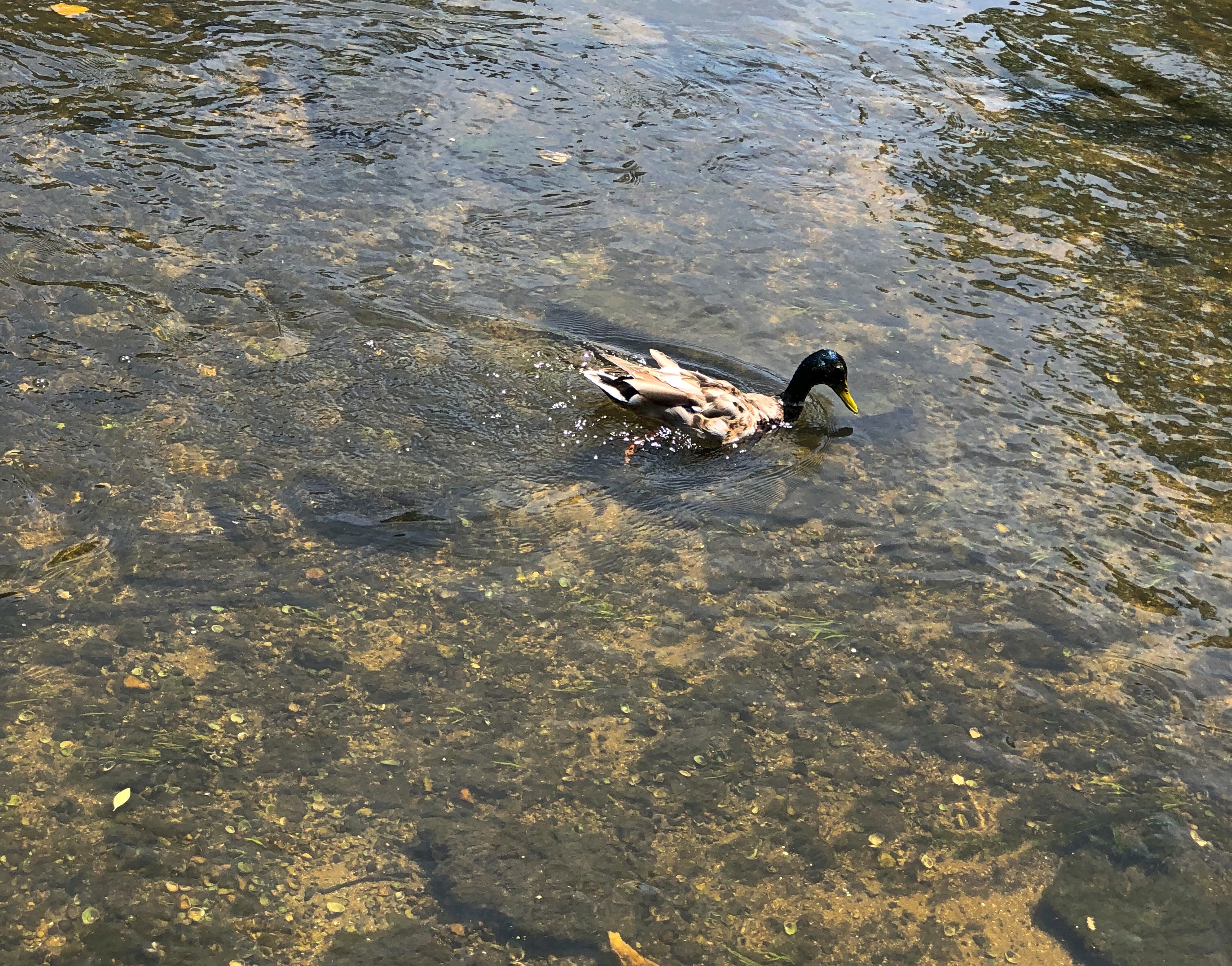
But not that deep. A foot or two at most, yet deep enough for ducks and kayaks.West Branch, DuPage River, Naperville West Branch, DuPage River, Naperville

The walkways along the river are fairly narrow.
West Branch, DuPage River, Naperville

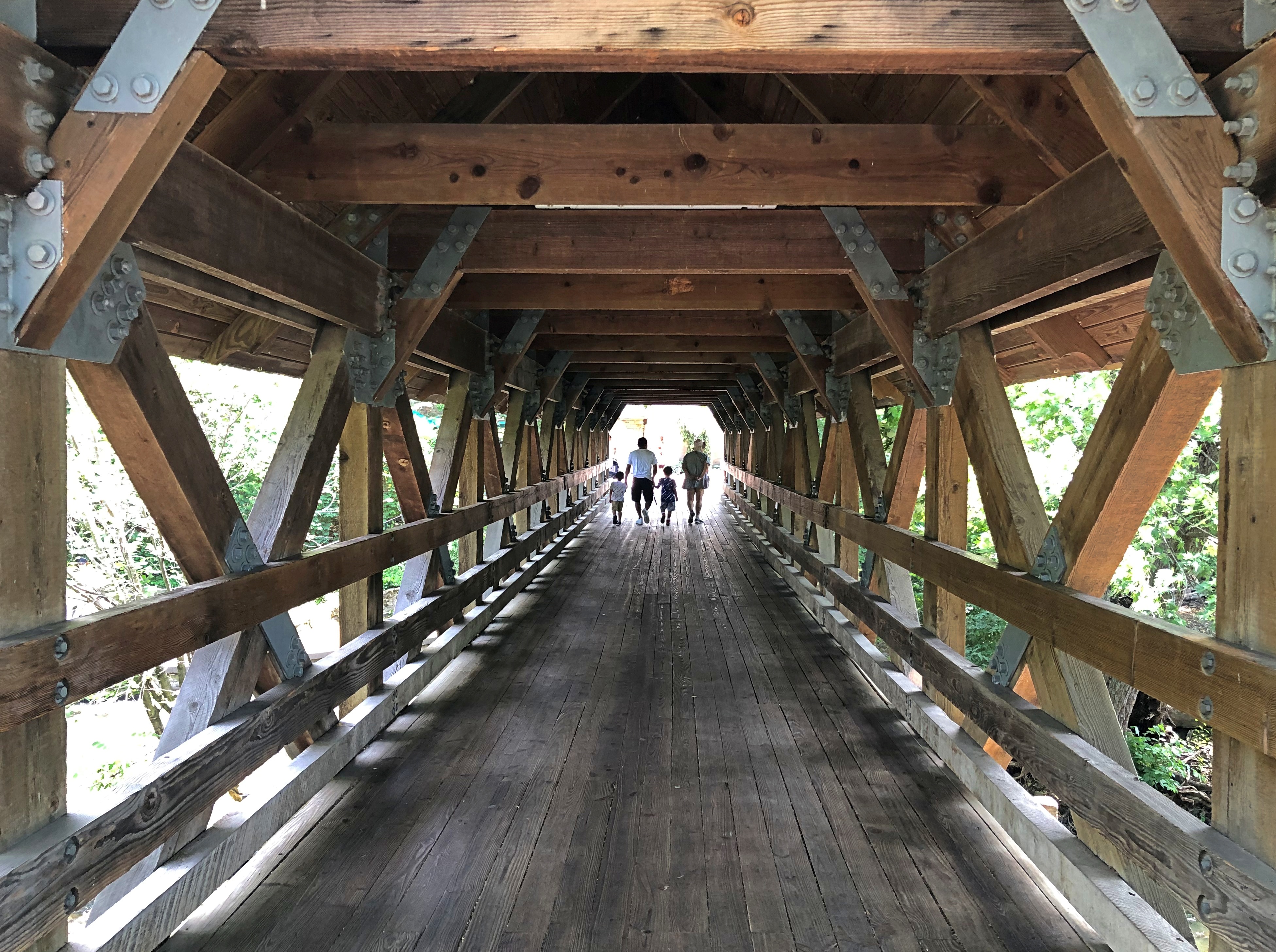
Both banks are connected by wooden foot bridges.West Branch, DuPage River, Naperville

With small parks and other features on either side.
West Branch, DuPage River, Naperville

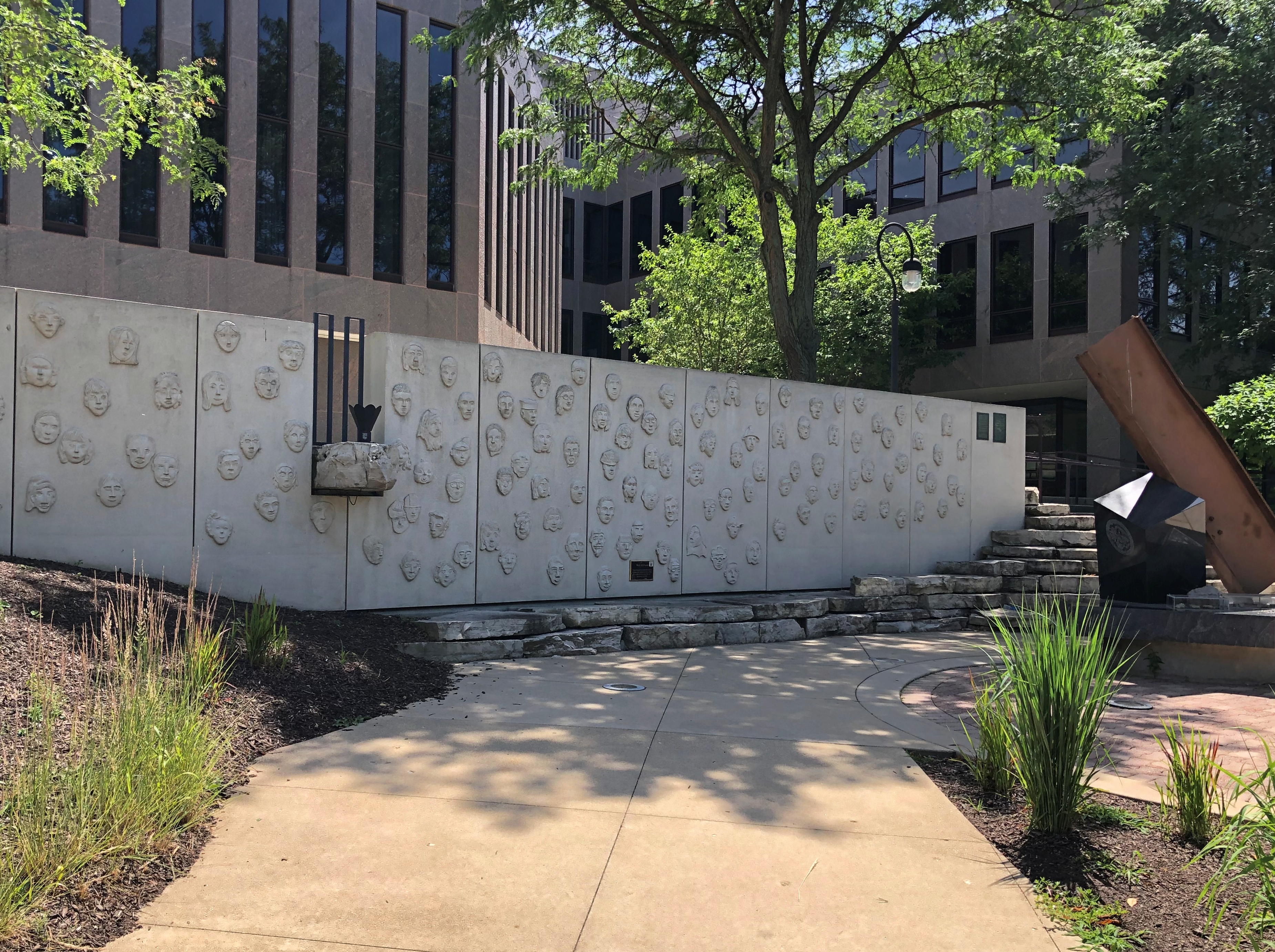
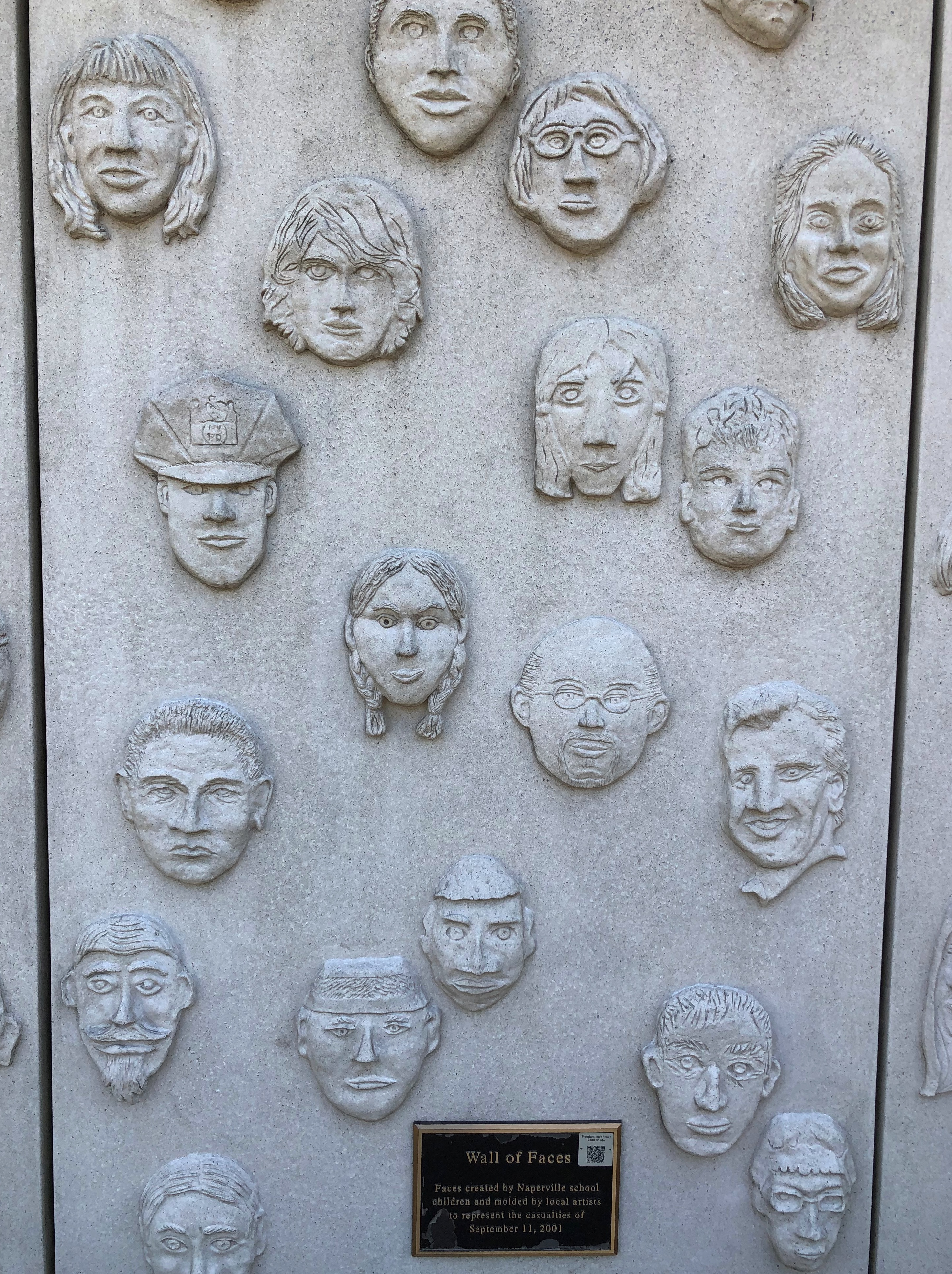
Including some artwork. Such as “Wall of Faces,” whose plaque says that it was “created by Naperville school children and molded by local artists to represent the casualties of September 11, 2001.” West Branch, DuPage River, Naperville
West Branch, DuPage River, Naperville

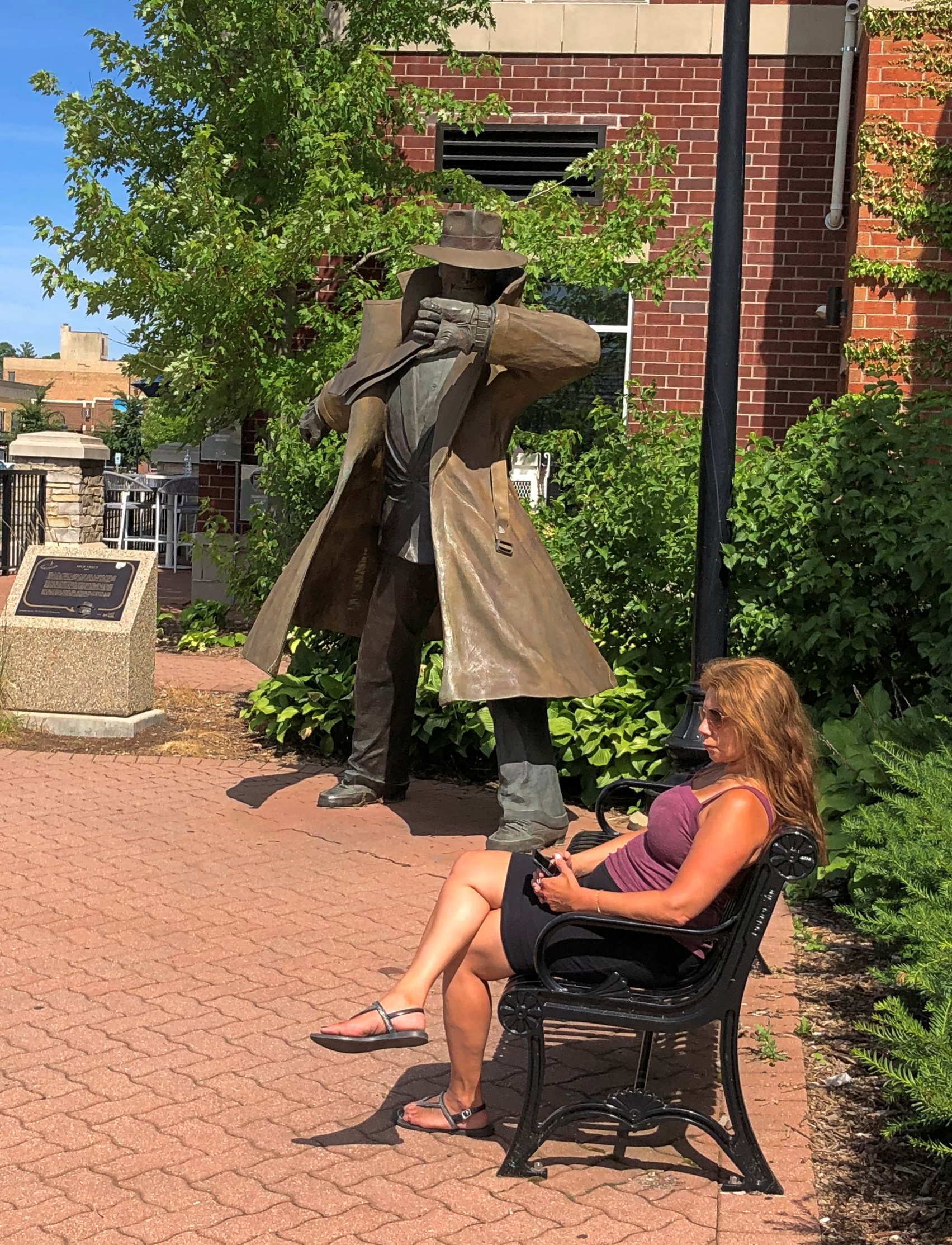
And a bronze Dick Tracy. I don’t think I’d noticed that before.
West Branch, DuPage River, Naperville - Dick Tracy bronze

It’s been there since 2010, so I just wasn’t paying attention. But why Naperville? I associate the comic policeman with Woodstock, Illinois, home of creator Chester Gould. The plaque explained that Dick Locher (1929-2017), who was one of Gould’s successors in writing and drawing the comic, lived in Naperville. In fact he was a multi-talented fellow, creating this statue as well.

Household Hazardous Waste Run ’22

There are five permanent places in the state that will take household hazardous waste off your hands, no charge beyond your taxes, according to this Illinois EPA site, plus collections that move from place to place.

One of the permanent facilities, the closest one to where we live (I think), is in Naperville, open on Saturdays and Sundays 9 am to 2 pm. That’s what took us to Naperville on Sunday. Mid-morning, I loaded the back of the car with a variety of chemicals previously found in our garage: cans and bottles and other vessels tucked away in open cardboard boxes so they wouldn’t clatter around too much.

The village of Naperville says that acceptable items include aerosol cans, automotive fluids (including oil, gasoline and anti-freeze), car batteries, fire extinguishers, mercury, paints and stains (oil-based only), peanut oil, pesticides, propane tanks, solvents, thermostats and “unknown hazardous substances.” That last one, I have to say, is pretty bold of the village.

Unacceptable: ammo, compressed gas (except propane), explosives, helium tanks, latex paint, paper or glass or wood — those three generally aren’t hazardous, unless some falls on you, or fuels an out-of-control fire — radioactive materials, sharps, tires, trash or alkaline batteries.

I had none of those. Of the acceptable ones, I had everything but car batteries, fire extinguishers, mercury, thermostats and peanut oil. Peanut oil? Apparently it gums up pipes in high concentrations. Also, I had no unknown hazardous substances, such as boxes one finds floating in the bay.

Since offloading your household waste down in Naperville is first come, first serve, I imagined waiting in a long line in my car, each car belching out auto emissions as they snaked slowly toward the pickup point, where masked state employees appeared and disappeared according to some schedule opaque to me. Hours might be lost to the process.

When we got there, exactly no other cars were ahead of us, and only one came in behind us. A man wearing a white clean suit — are there any other colors? — but not a helmet, asked were we were from, and I told him.

Then he and a partner, also be-clean suited, quickly examined everything in the back and removed everything but a single can, which in their opinion was empty, and could be put in regular trash. That was it. Took all of about two minutes, once the driving was done. Sometimes things work as they are supposed to, even when dealing with the state. Seldom is that written about or mentioned. So I’m doing that now.

Naperville is nearly a half-hour drive from where we live, meaning we weren’t about to turn around and go home right away, burning the gas just for that. So we spent the rest of the morning and most of the afternoon there. I’m glad we did, because otherwise I wouldn’t have made the acquaintance of an homunculus Charley Weaver.

More on that later. Enough to say now that someone my age just caught the tail end of Charley Weaver.

Cement Mixer

Over 95 F. degrees here yesterday, on the occasion of the summer solstice — a near-record in metro Chicago for this day, the weather record-keepers say. That didn’t keep men hired by the village from further work on the street, including the appearance of a cement mixer. I didn’t take a picture, but I did think of the song of that name. Who wouldn’t?

I didn’t realize there were quite so many recordings until I looked into it. The always wonderful Slim Gaillard, of course, was first.

Then there’s the big band stylings — and perhaps more mainstream version — of Alvino Rey.

I’d heard those. But there’s also one by Liberace, of all people, who naturally had fun with it, and a hip early ’60s version by the Orlons. And more. (Mel Tormé? Well, I might listen to that sometime.)

Uncle Walt’s Band, 1982

Nearly two years ago, media distribution company Orchard Enterprises provided 21 songs to YouTube, cuts on a collection called Uncle Walt’s Band Anthology. Subtitled — and it really captures the essence of that band — “Those Boys From Carolina, They Sure Enough Could Sing…”

Sure enough. The three-man band, Walter Hyatt, Champ Hood and David Ball, all originally from Spartanburg, SC, existed for a few years in the early 1970s and again in the late ’70s and early ’80s. They produced four original albums, did solo work, and played with a good number of other musicians in Austin and Nashville over the years. Those few reviews one can find about Uncle Walt’s Band tend to characterize them as Americana, and I supposed they were — a mix of American styles by South Carolina musicians who honed their skills in Nashville and Austin both.

Though fondly remembered by a few, especially other musicians, wider fame eluded Uncle Walt’s Band. I already knew that, but the point is hammered home by looking at the view count for some of their wonderful songs on Anthology — such as the fun “Seat of Logic” (only 533 views after two years, not 533,000 as by rights it ought to be); the winsome “Ruby” (only 569 views); and the sweetly melancholic “High Hill” (only 344 views); and on and on.

Forty years ago this evening I had the exceptionally good fortune of seeing Uncle Walt’s Band live in Nashville. “Crystalline sound,” I wrote in the diary I kept at the time, along with other unhelpful scraps when it comes to remembering it now. Still, the show was some of the best live music I saw in college, or ever really. A less fanciful way to characterize the gentlemen who played for us that evening would be near-perfect three-voice close harmony, with guitar, fiddle and bass.

I had taken a month-long trip not long before that evening, returning to Nashville less than a week earlier, with plans to attend summer school, but not take it all that seriously. That is exactly what I did and I don’t regret a moment of it. While I was away, my friend Dan had obtained the records Uncle Walt’s Band (a renaming and reissue of the 1974 Blame It On The Bossanova) and An American in Texas (1980, the same year the band appeared on Austin City Limits).

To put it in music biz terms, those records were in heavy rotation around the house where Dan and Rich lived, and where Mike, Steve and I were constant visitors that summer. As soon as I returned to Nashville, I heard it too. Then we got wind of the fact that Uncle Walt’s Band was playing live on Saturday the 12th at a place called The Sutler. We couldn’t believe our luck, and we weren’t about to miss that.

At time I called The Sutler “a tavern next to a bowling alley, a bakery and a restaurant,” which it was, though I didn’t record its address on 8th Ave. South in the Melrose neighborhood. That was further than we usually went, though (I know now), not that far from campus. Dive might not quite have been the word for the place, but it certainly wasn’t posh, and while I’m pretty sure I went there a few times in later years, I only remember seeing UWB there, and the joint’s last iteration closed only this year. It was standing room only for a while, but eventually we got a table. We stayed for the whole show. My mind’s eye can visualize it even now, and my mind’s ear can hear a crystalline echo of their sound.

UWB broke up for the last time the year after we saw them, but their musical presence that summer made an impression on me. Enough that in the late ’80s, when I was visiting Austin, I noticed a small poster somewhere advertising a show by Walter Hyatt at the famed Waterloo Ice House on on Congress Ave. We have to go to that, I told Tom Jones, whom I was visiting, and so we did.

During one of the breaks in that show, I asked Hyatt where I could buy copies of the two records that I remembered so fondly from the summer of ’82 — I think I even mentioned the show at The Sutler — since finding obscure music was more of a chore in those days. He gave me an address to send a check to, and soon after I did, I received an audio cassette of Uncle Walt’s Band and An American in Texas, which I listened to periodically over the years and own to this day.

Forty years is a long time, and time has taken its toll. Walter Hyatt died in the ValuJet Flight 592 crash in 1996 and Champ Hood died of cancer in 2001. David Ball has had a successful career as a country musician and is now pushing 70.

One more thing: I didn’t realize until the other day that the subtitle, “Those Boys From Carolina…” was no random pick. Lyle Lovett, Texan of distinct hair and winning ways with song, mentioned UWB in a song he recorded long after the band was gone, but before Walter Hyatt died, the amusing “That’s Right, You’re Not From Texas.”

Those boys from Carolina,
They sure enough could sing.
But when they came on down to Texas,
We all showed them how to swing.

Monument Valley Navajo Tribal Park

Back to posting on the last day of May. Memorial Day and Decoration Day coincide this year, which won’t happen again until 2033.

“Throughout the 19th century, white settlers considered the Monument Valley region — like the desert terrain of the Southwest in general — to be hostile and ugly,” notes Smithsonian magazine. “The first U.S. soldiers to explore the area called ‘as desolate and repulsive looking a country as can be imagined,’ as Capt. John G. Walker put it in 1849, the year after the area was annexed from Mexico in the Mexican-American War. ‘As far as the eye can reach… is a mass of sand stone hills without any covering or vegetation except a scanty growth of cedar.’ ”

Tastes change. I imagine Capt. Walker’s reaction was entirely reasonable for his time, considering he and his men came by horse and mule, carrying everything they needed, living meagerly and fully aware that their surroundings could kill them all too easily, or at least make for days of uncomfortable misery, whatever season it was. Monument Valley was a vivid ordeal for them, not a notion fostered by cinematic entertainment.

We have it a good deal easier here in the 21st century, and am I glad. All it took for us to reach Monument Valley Navajo Tribal Park on May 18 was a roughly two-hour drive from Page, Arizona, by Toyota horseless carriage along paved two-lane roads through the Navajo Nation.

My main concern that morning — and we got up fairly early — was that I didn’t know for sure we’d get in. The park’s policy for visitors is, first come, first served, and there’s a limit to the number of people who can enter each day. Even on a weekday, I imagined joining a long line of cars waiting, only to be turned away.

Nothing of the kind happened. We got to the entrance booth with no one ahead, paid $8 a head, and got in to the place known as Tse’Bii’Ndzisgaii in Navajo. First stop, a fully modern visitor center.Monument Valley Navajo Tribal Park
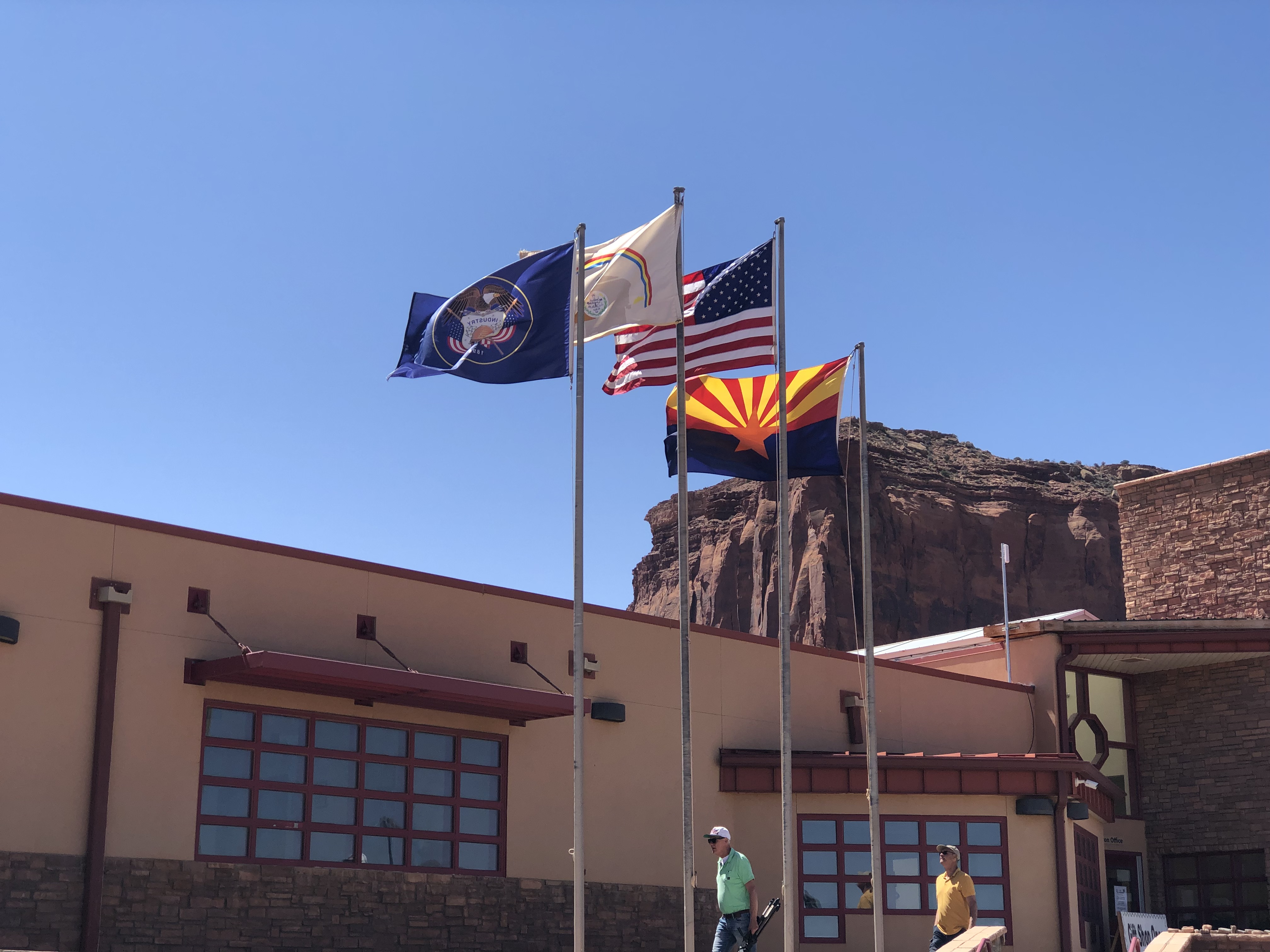
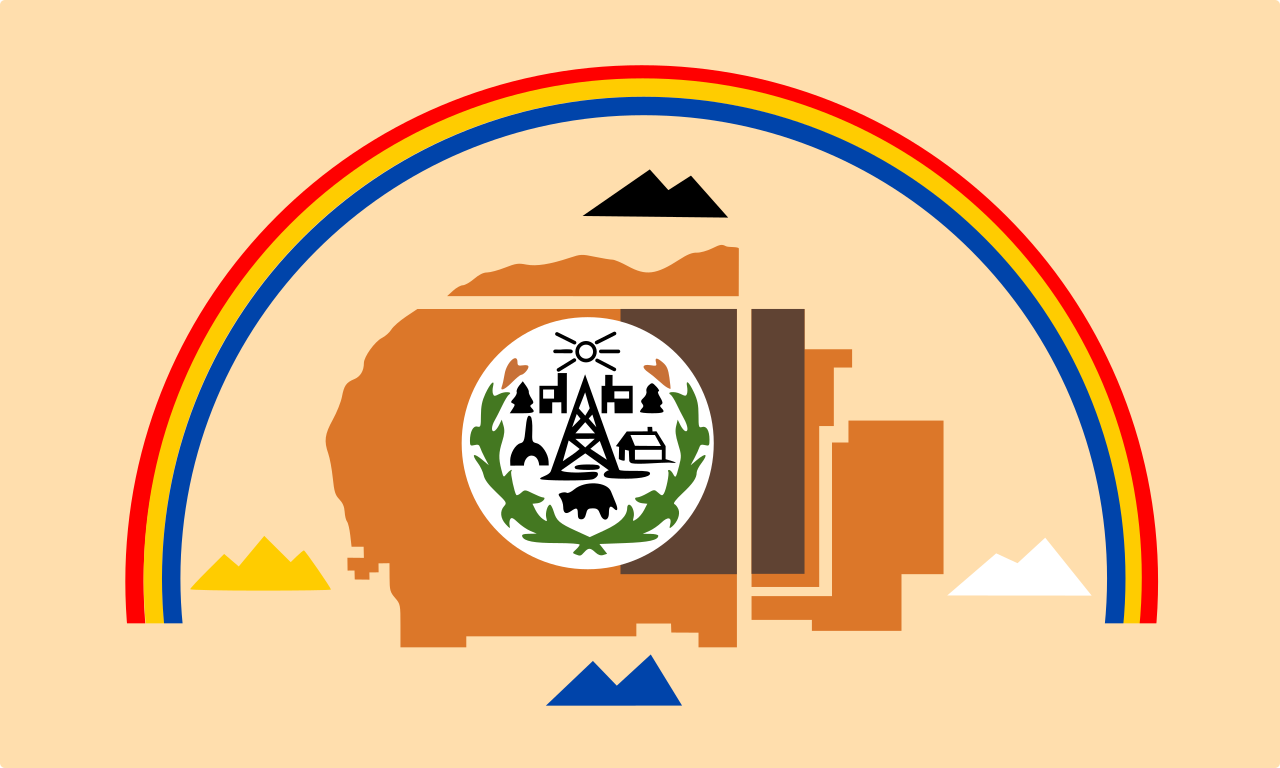
The wind whipped the four flags in full motion: Utah, the Navajo Nation, the United States and Arizona. I wasn’t familiar with the Navajo flag, but I am now.
Something I didn’t know until we entered the park and saw a number of private roads leading off to residences in the distance: people live in Monument Valley, unlike in a national park or monument. I expect ranching and running tours are their main occupations, along with selling the products of Navajo craftsmanship to visitors.

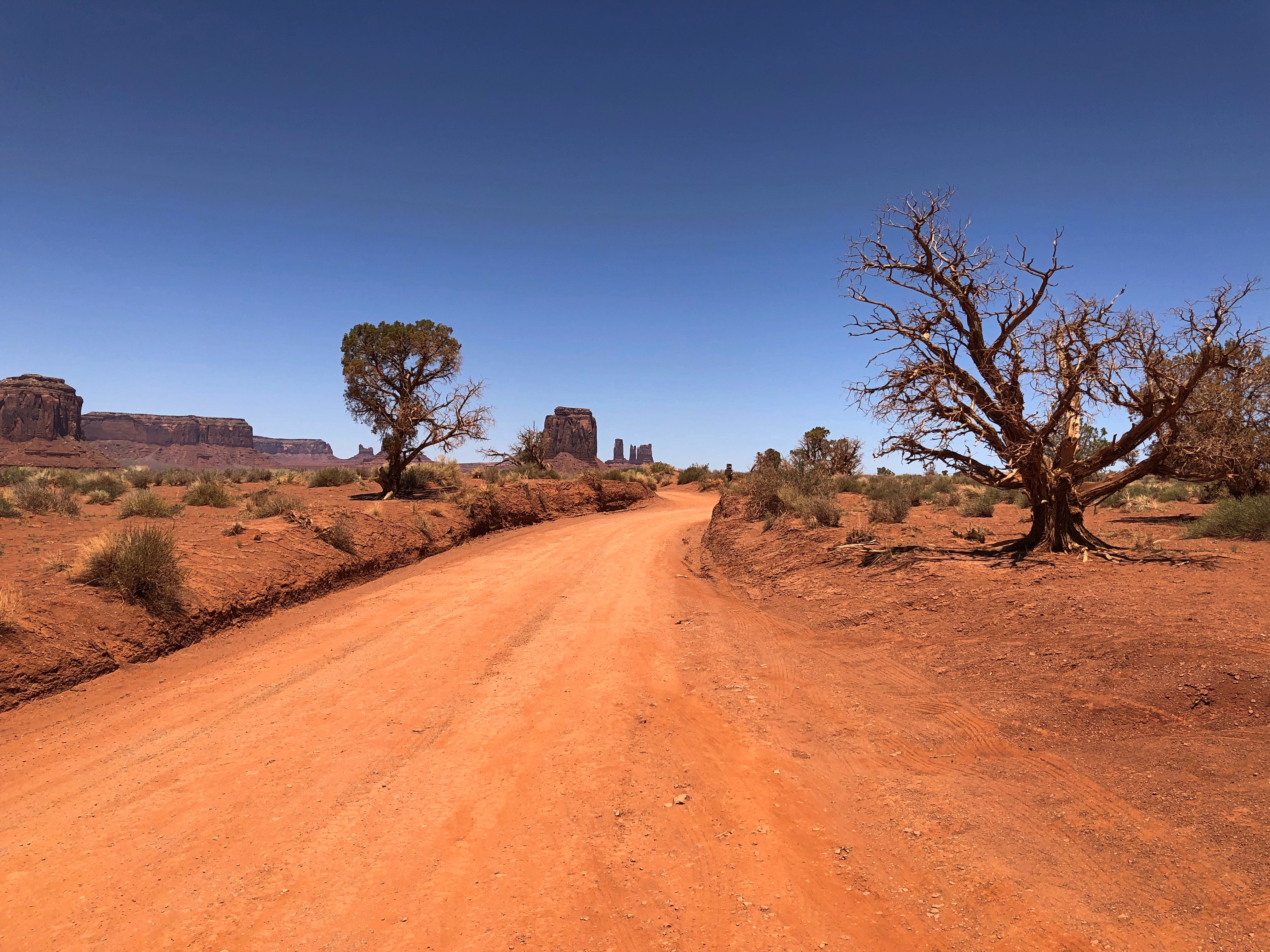
For $8 a head — an absolute bargain, if you asked me — you get to drive around a 17-mile unpaved loop road in the park, dusty and red as Mars, but only occasionally bumpy. The road doesn’t venture that deep into the park, which measures nearly 91,700 acres. Longer treks by foot or horse or jeep are possible, available only with Navajo guides, and no doubt offer rich rewards to those undertake them.

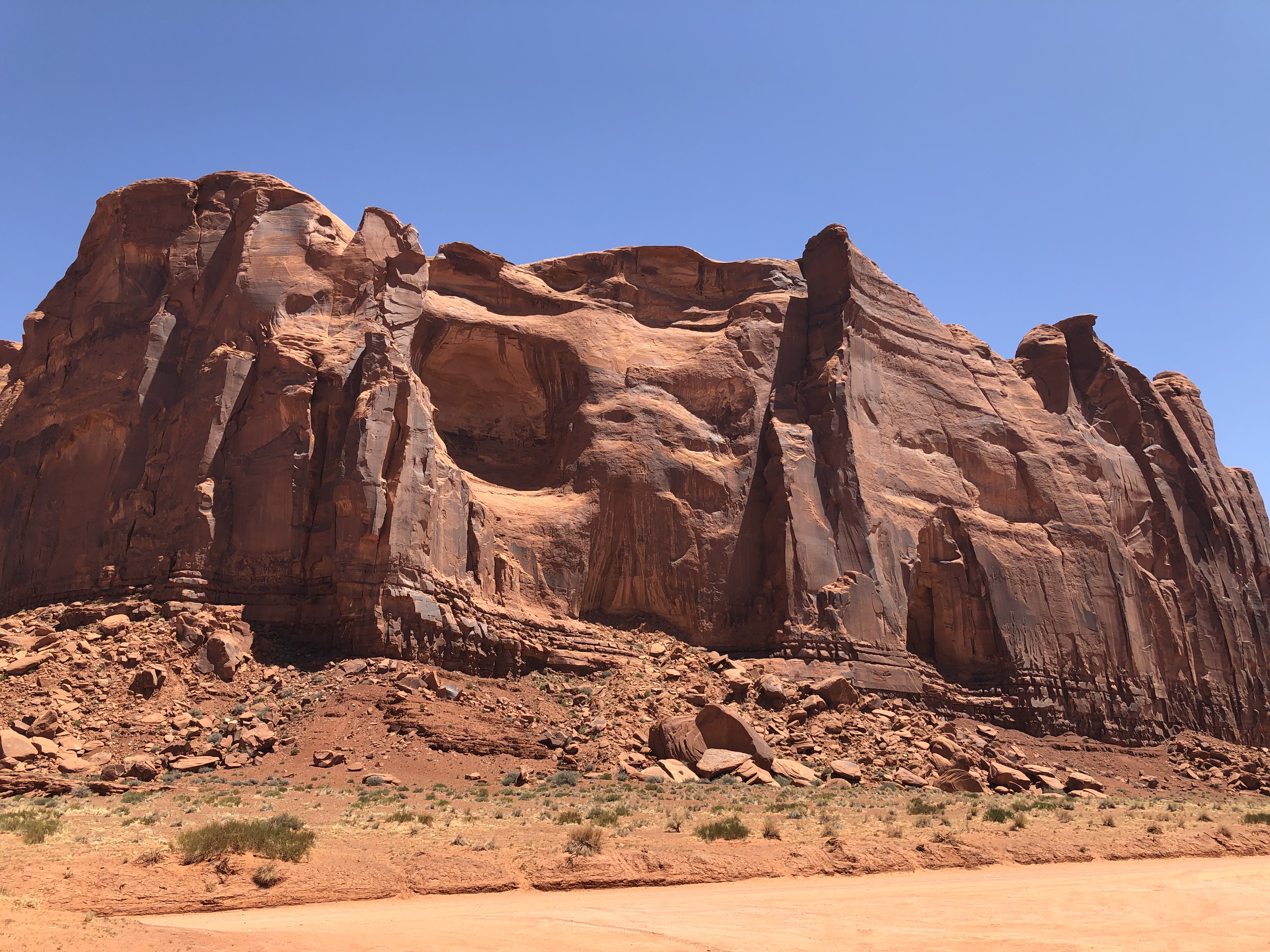
Even so, the drive is incredible, passing formations of astounding size and shape and contour and color. It’s easy to see what enamored John Ford about the place.
Speaking of the director, the park honors him with a spot called John Ford Point.

As well it should, since he put Monument Valley on the map, as far as the more receptive imagination of the 20th century was concerned, though naturally he wasn’t the first outsider of that period to visit — the likes of Zane Grey and (of course) Theodore Roosevelt came earlier. Harsh terrain, still, but the material progress of later years allowed later visitors the leisure to appreciate the place in a way that Capt. Walker could not.

Ford must have known he had a cinematic treasure in view when he had the cameras first deployed here for Stagecoach. The world clearly agreed.

Of Ford’s many forays into the valley, Smithsonian has this to say: “The shoots were usually festive, with hundreds of Navajo gathering in tents… singing, watching stuntmen perform tricks and playing cards late into the night. Ford, often called ‘One Eye’ because of his patch, was accepted by the Navajo, and he returned the favor: after heavy snows cut off many families in the valley in 1949, he arranged for food and supplies to be parachuted to them.”

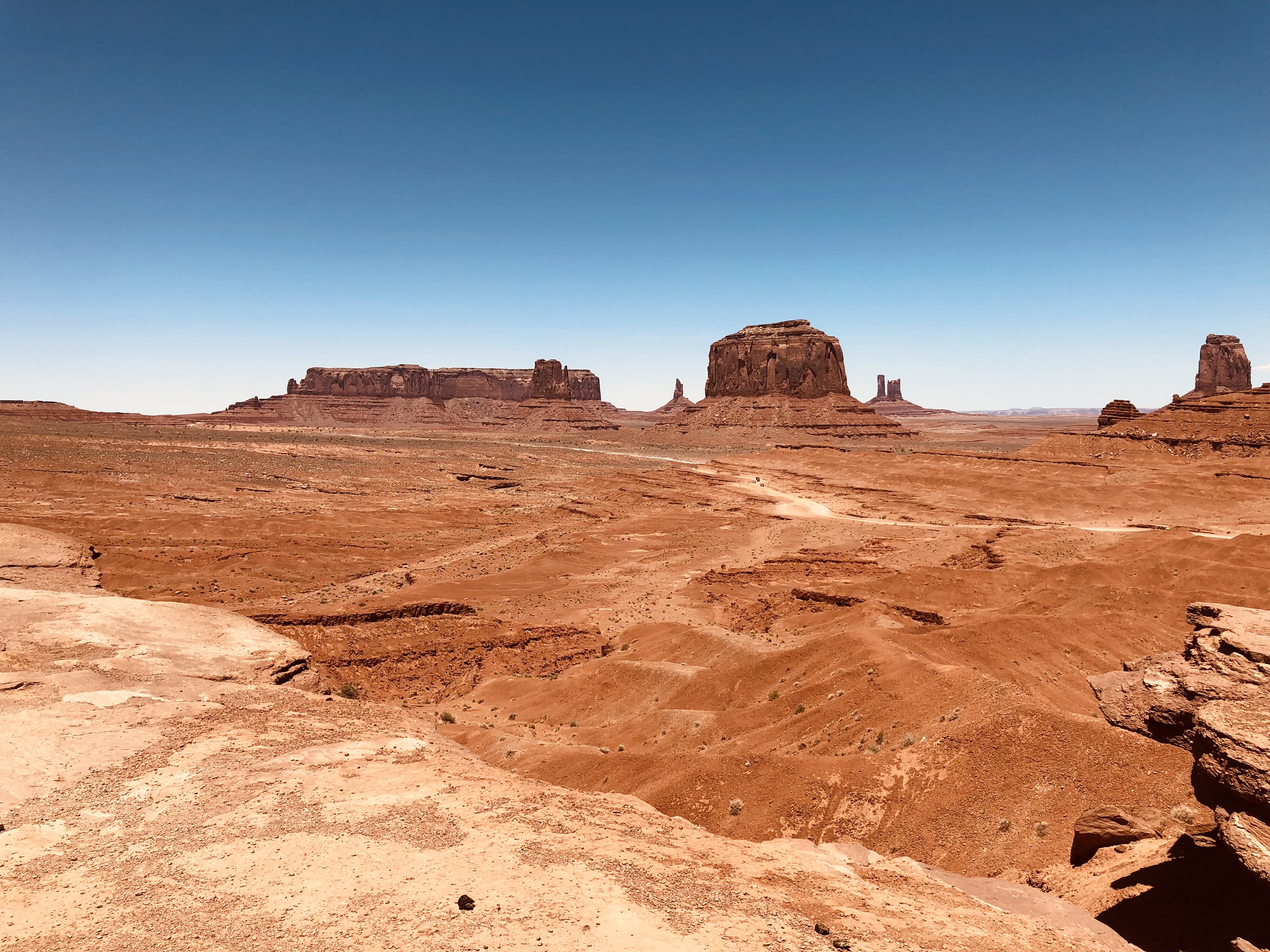
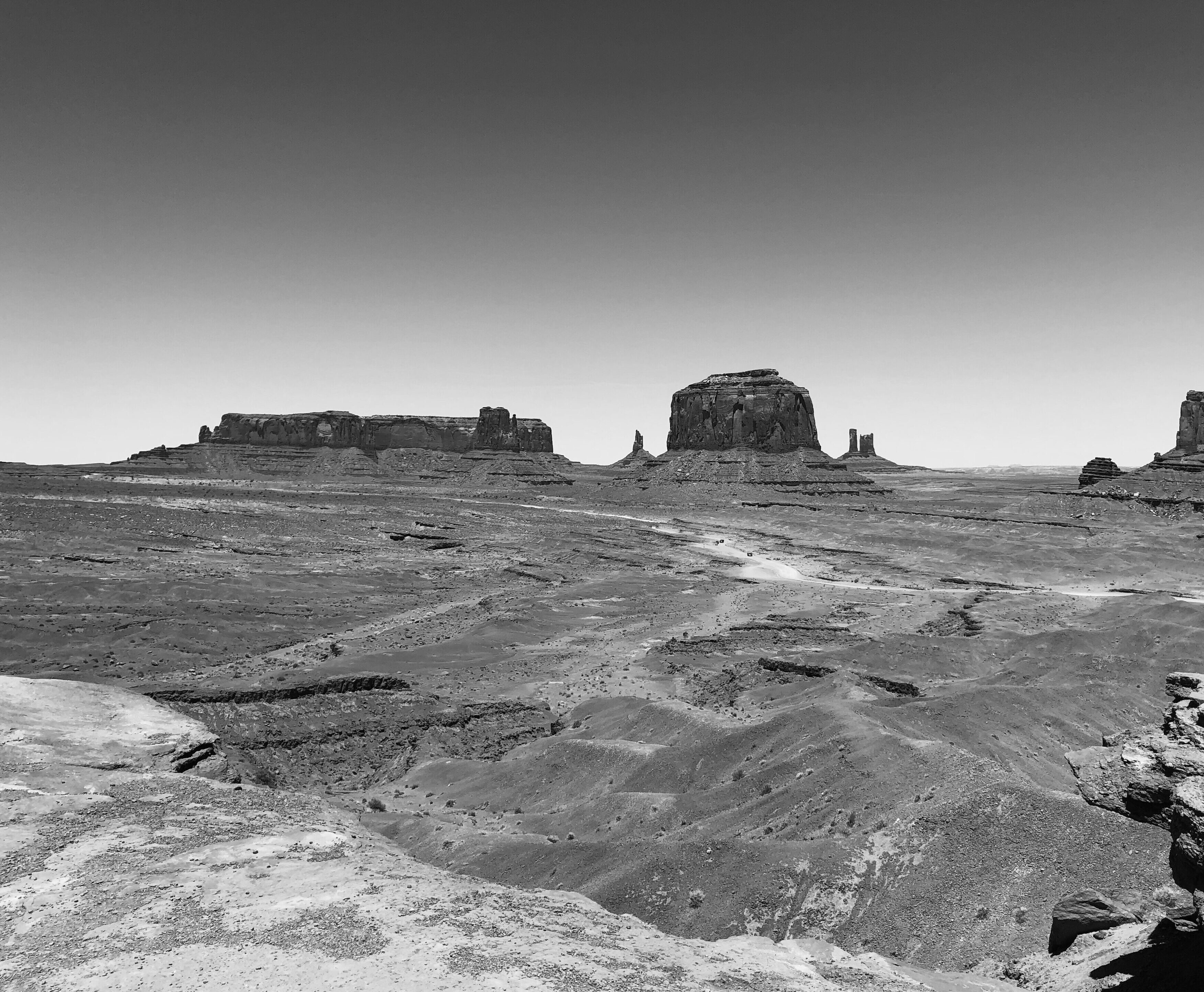
Though it wasn’t the first place we visited on the drive — in fact, it was nearly the last — the instantly recognizable view from John Ford Point is going to go first here.Monument Valley Navajo Tribal Park Monument Valley Navajo Tribal Park Monument Valley Navajo Tribal Park
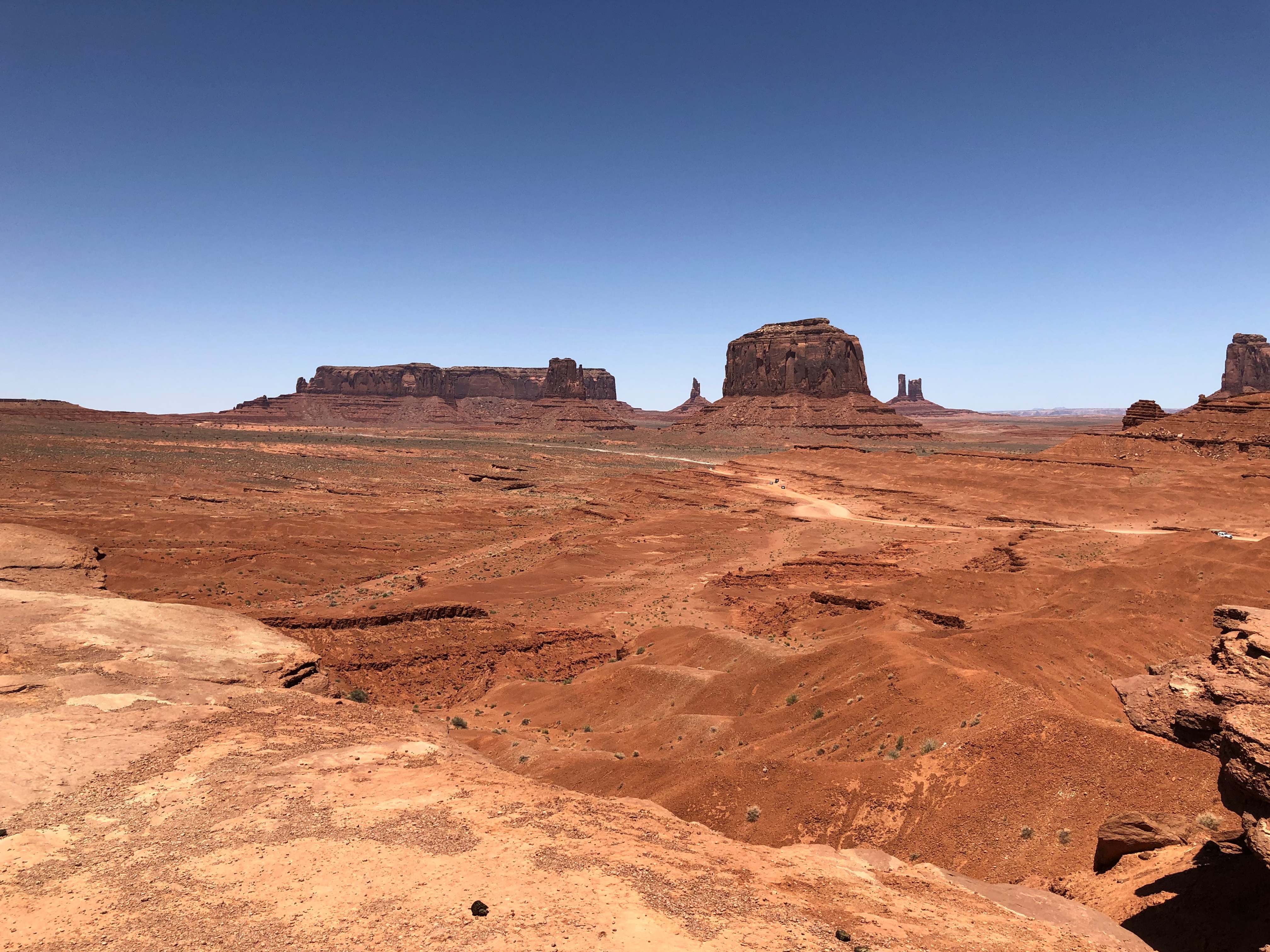
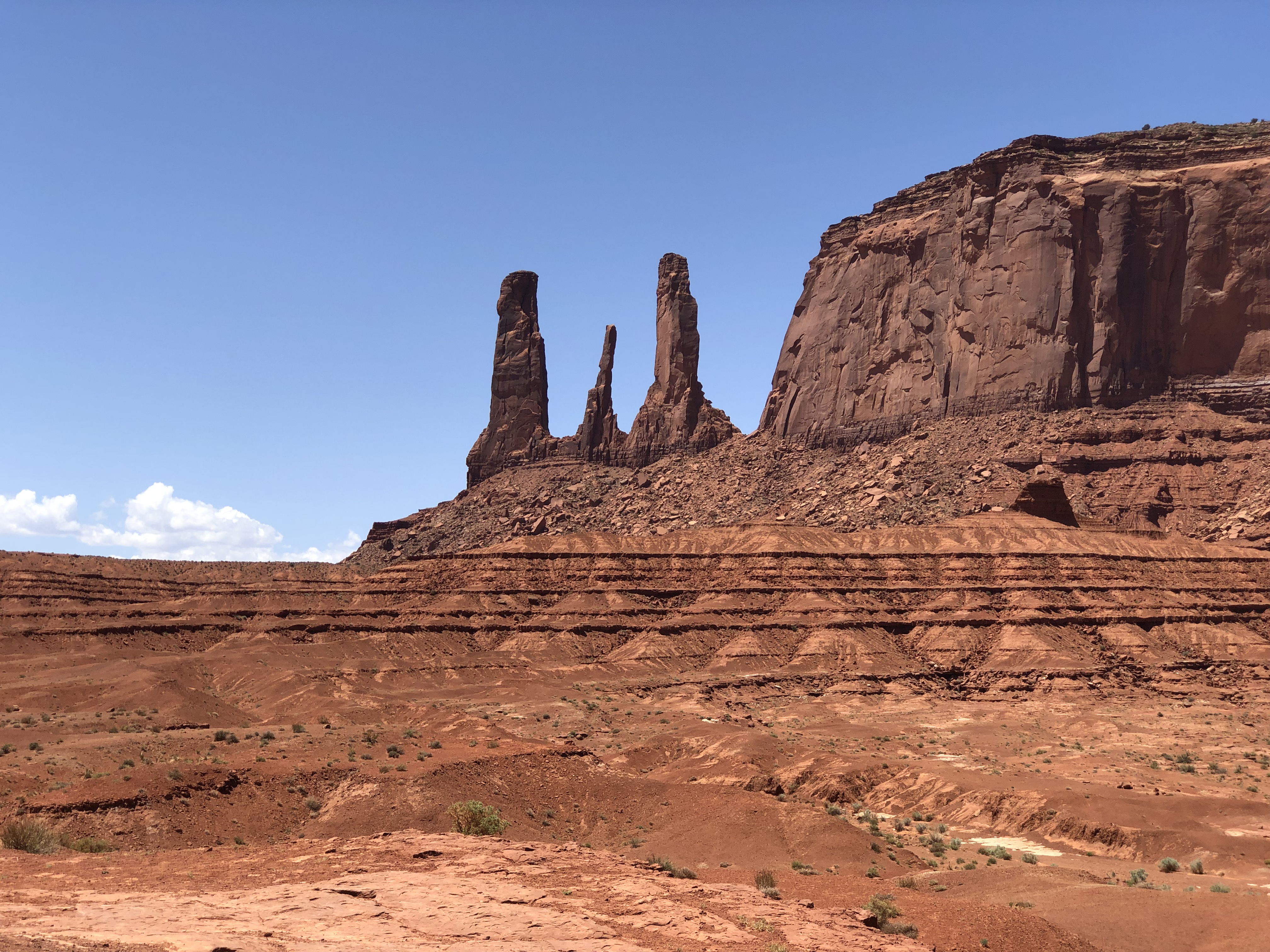
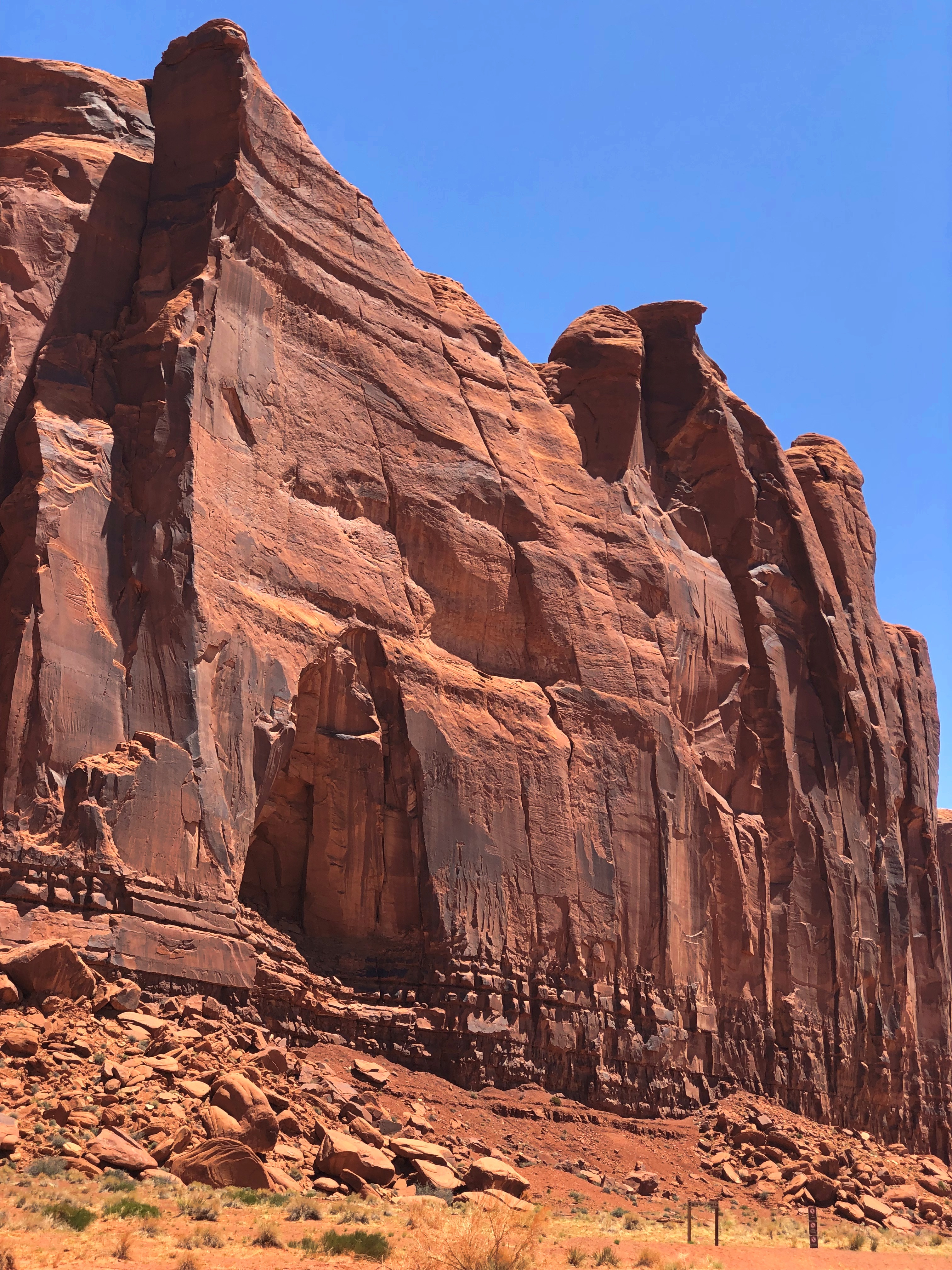
Because later movies and commercials returned to this particular view so often, the other marvels on the road aren’t as famed or recognizable. But they’re equally worth a good look. Just a sampling below; there was something remarkable just about everywhere you look.Monument Valley Navajo Tribal Park
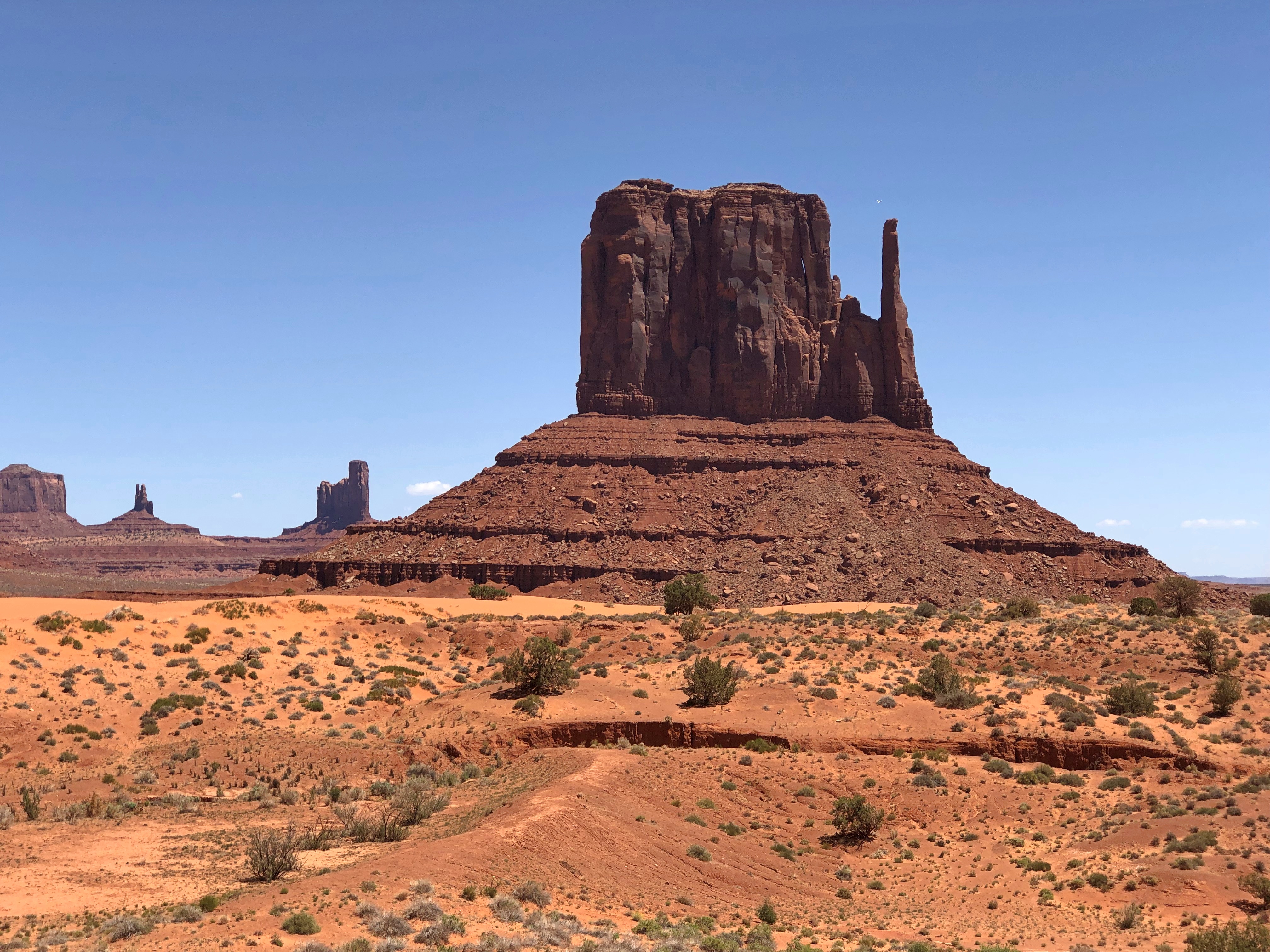
Monument Valley Navajo Tribal Park Monument Valley Navajo Tribal Park Monument Valley Navajo Tribal Park

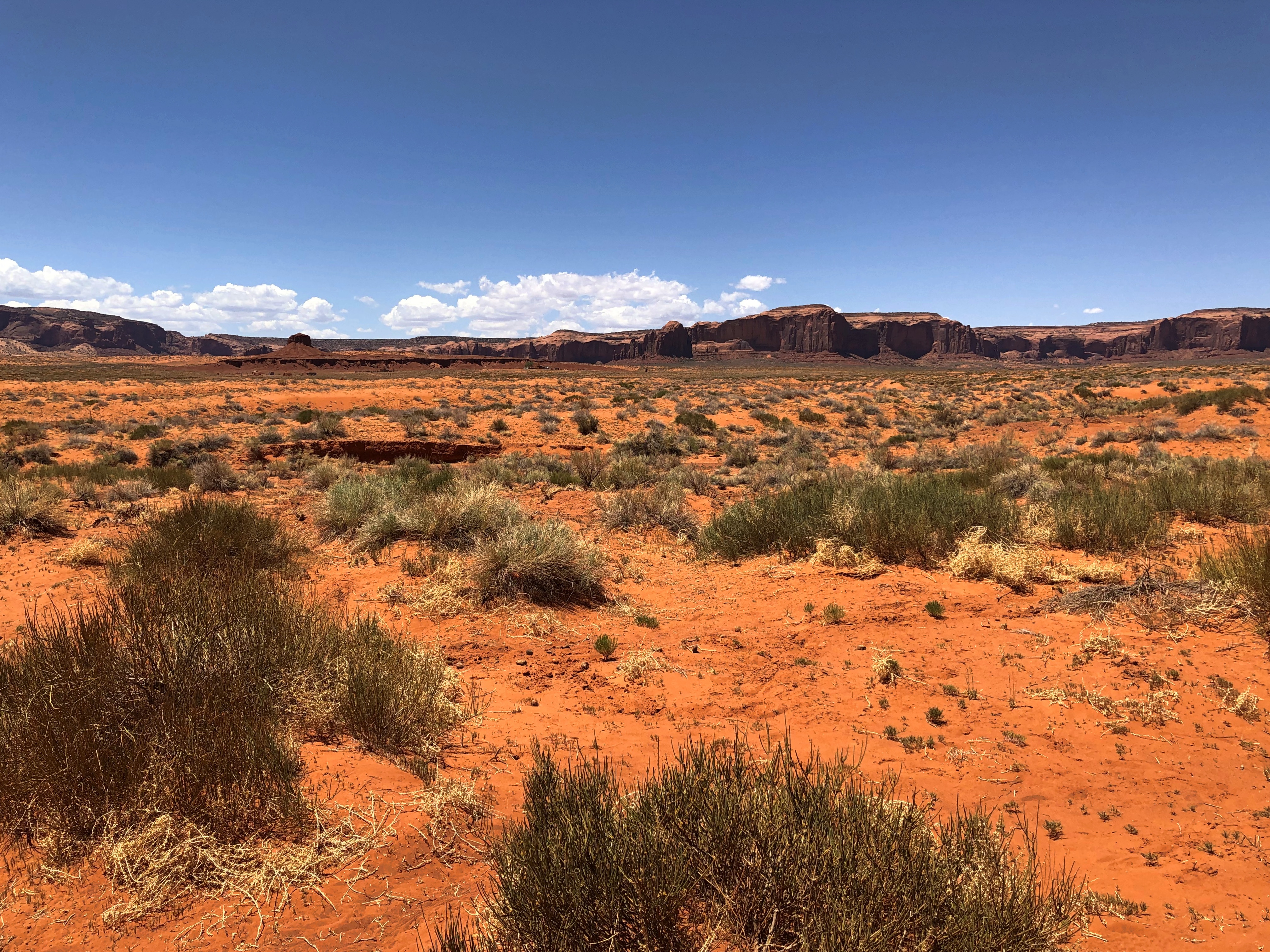
Aside from the rock giants, the terrain itself fascinates, its colors so unusual to those of us from greener places.Monument Valley Navajo Tribal Park Monument Valley Navajo Tribal Park
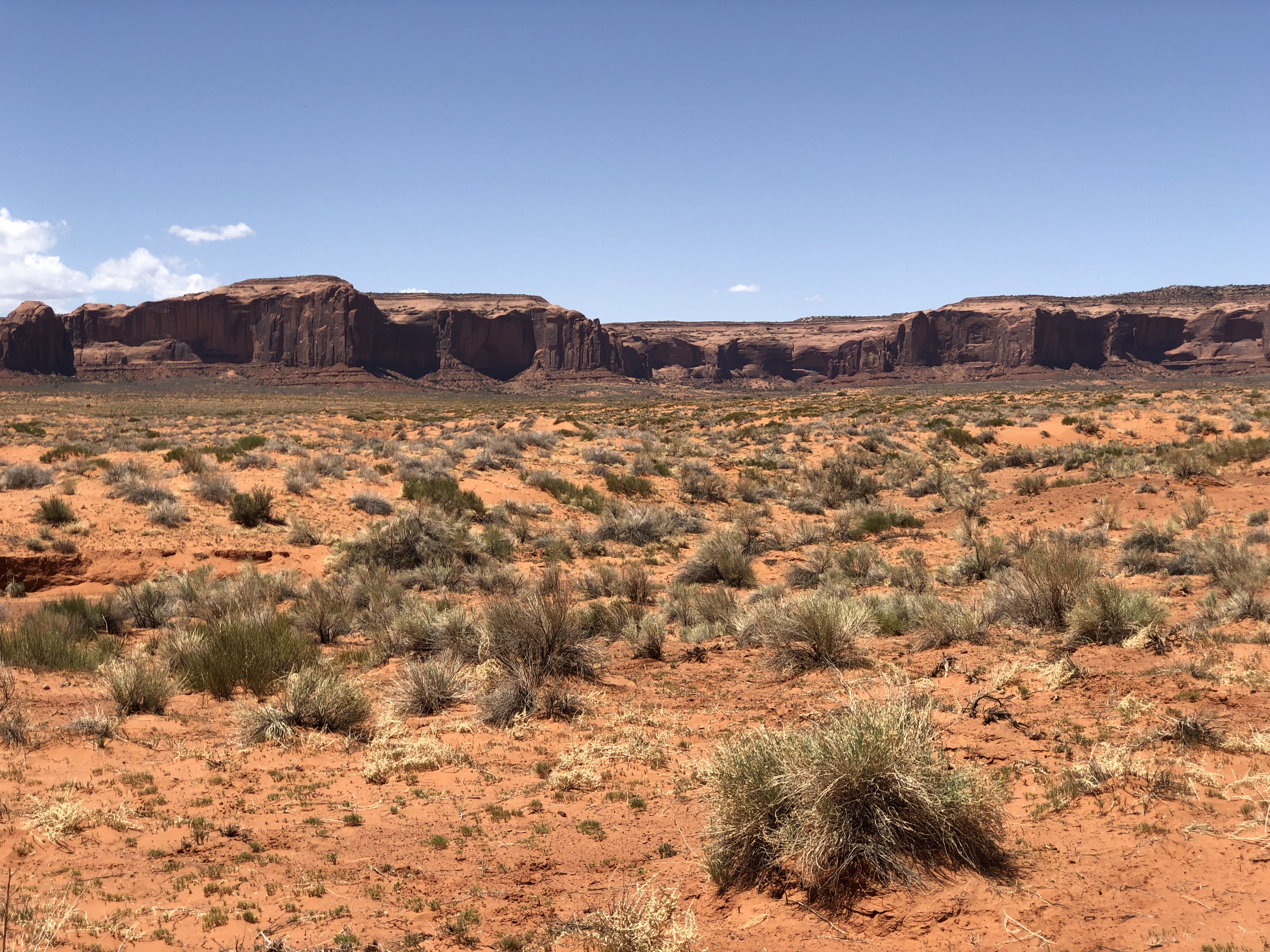
Color that the road itself shares.Monument Valley Navajo Tribal Park

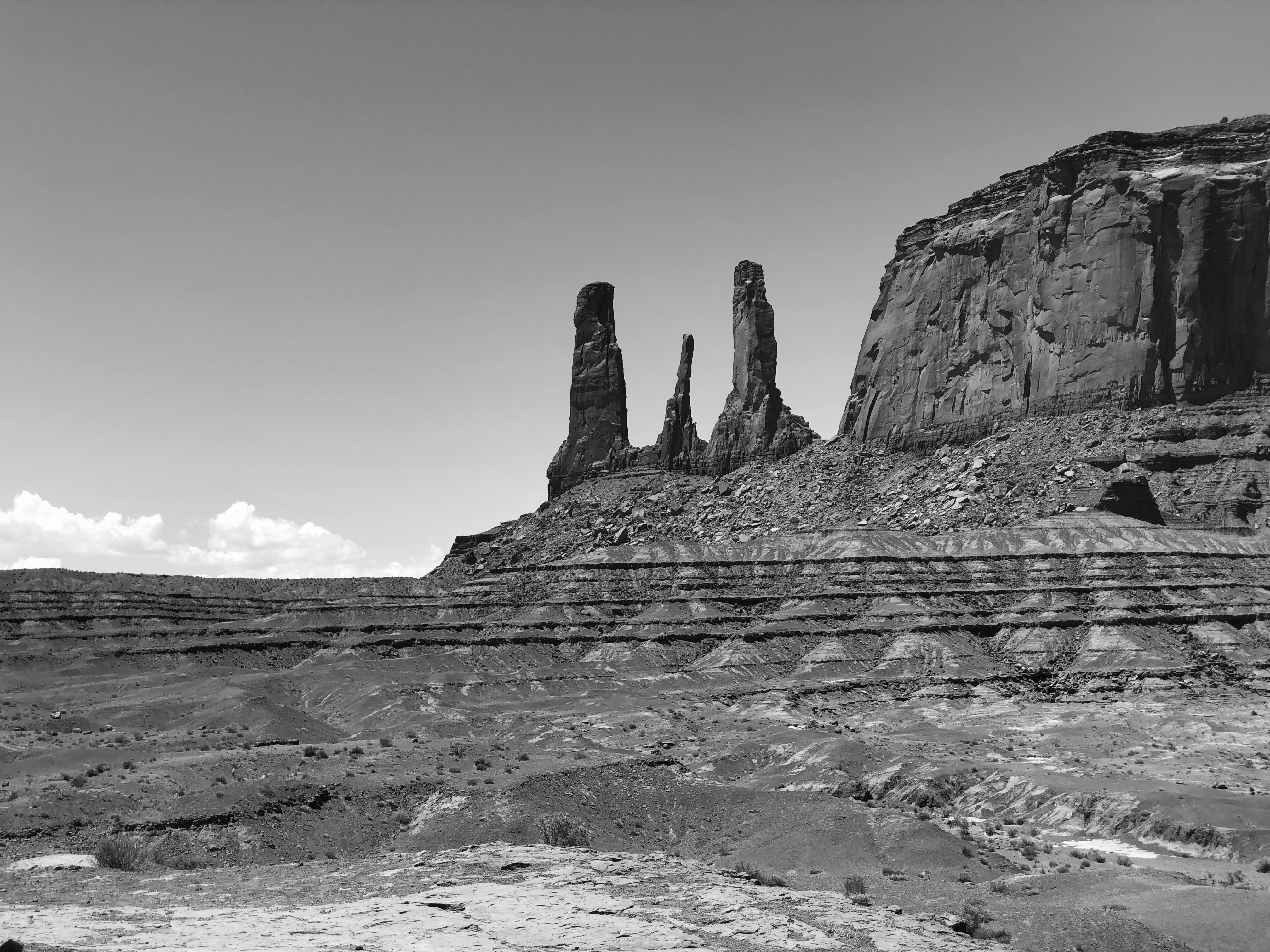
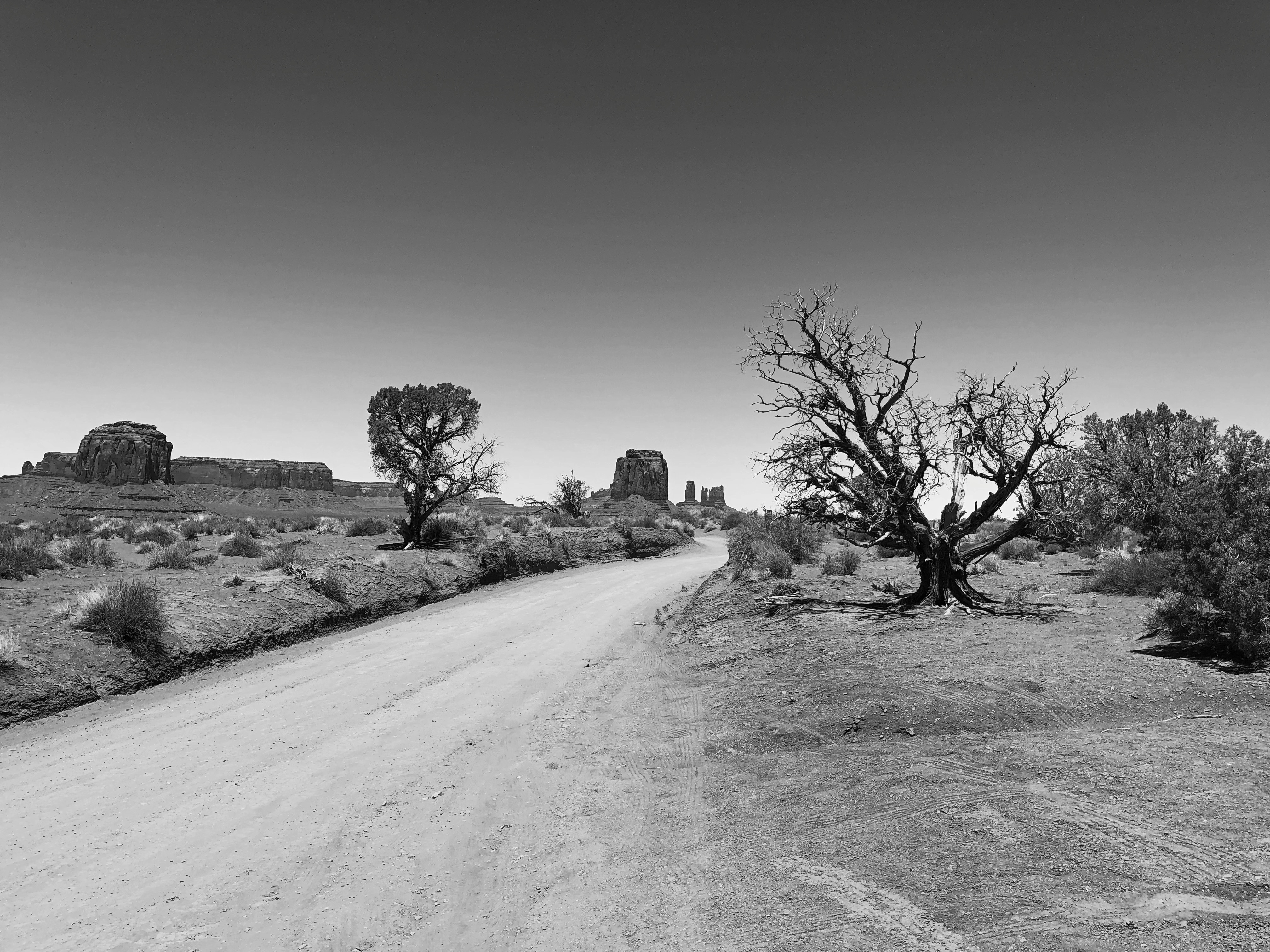
Without color, the contours emerge vividly; Ford must have appreciated that, too.Monument Valley Navajo Tribal Park
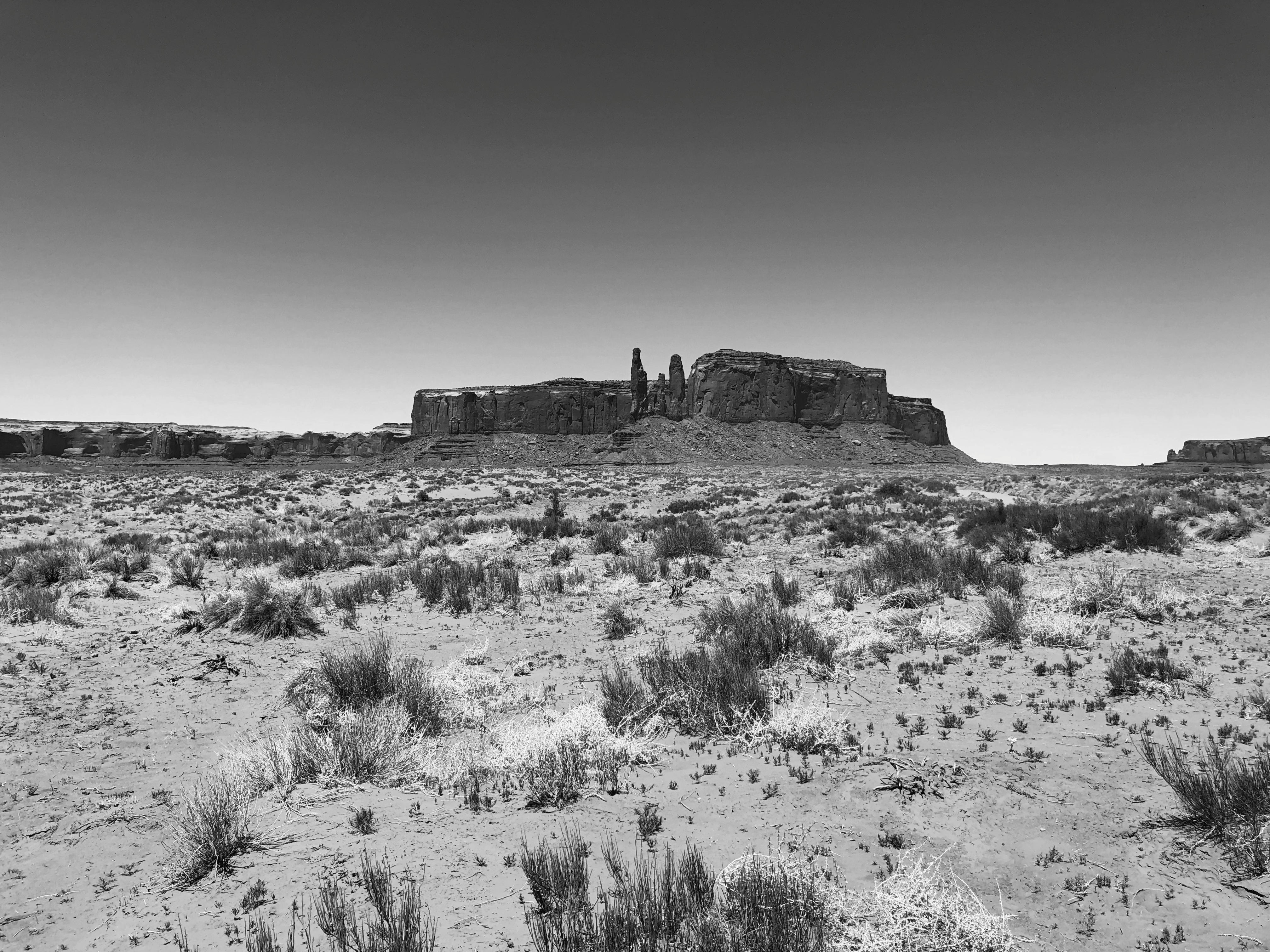
Monument Valley Navajo Tribal Park

We left the park that afternoon, but even as you drive north from Monument Valley on U.S. 163, it has one more gift to give, if you’re paying attention. I almost wasn’t. As we drove along, we noticed people ahead, standing in the road, taking pictures. They got out of the way before we reached them, but I wondered, what are they doing there?

Then it hit me, and we stopped at the next pullout in the road, maybe a fifth of a mile away, and looked back. A view almost as famed as that at John Ford Point, and certainly as arresting.Monument Valley Navajo Tribal Park
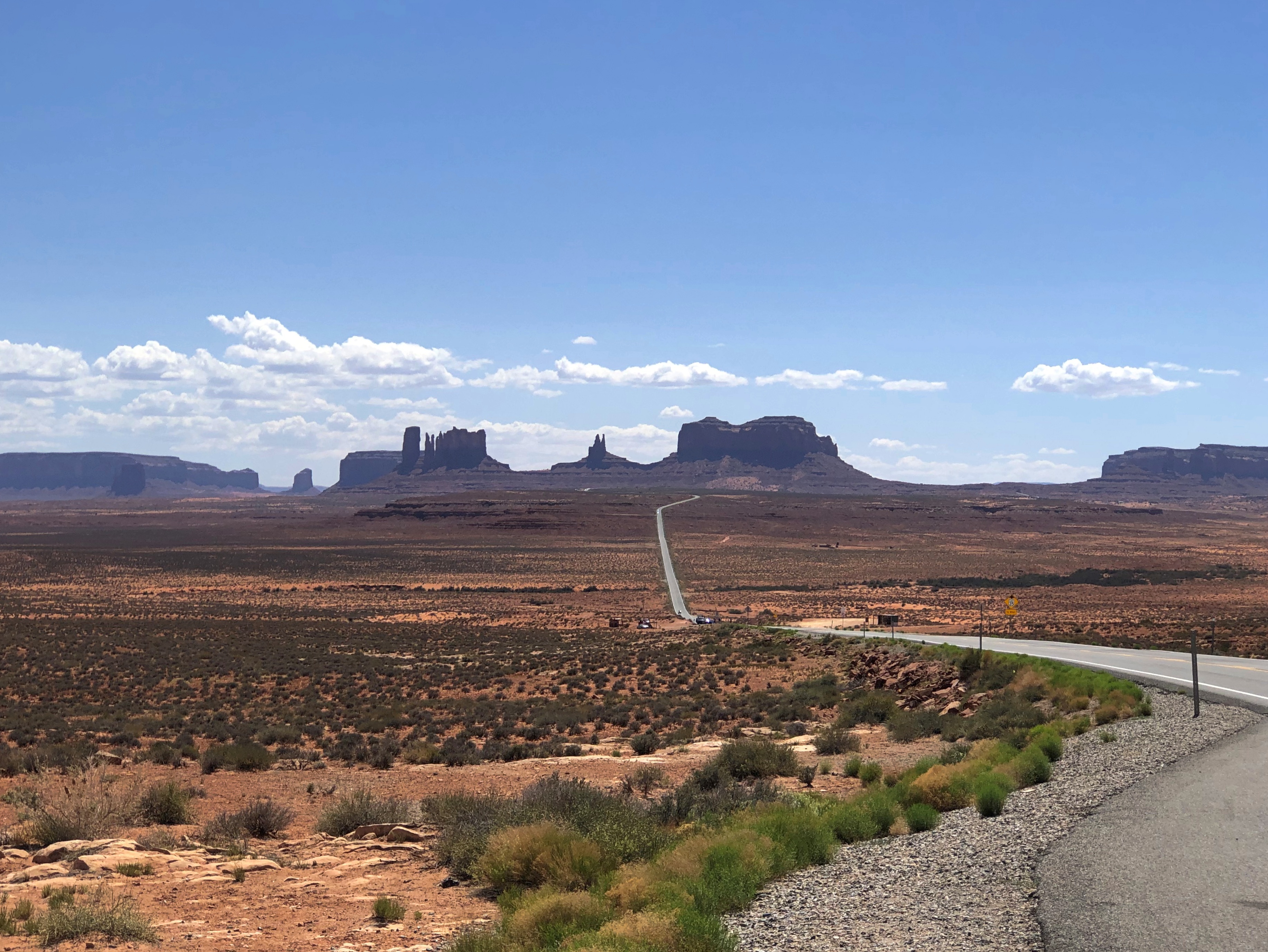
That isn’t quite the “Forrest Gump Stopped Here” place, but I wasn’t about to go back where those yahoos had been standing in the road just for that (unlike Stagecoach, it isn’t a movie I like very much). In fact, I wouldn’t have remembered the view was made famous in that movie, either, but some other people had stopped where we were, and I overheard them talking in German about Forrest Gump.
Thursday Grab Box

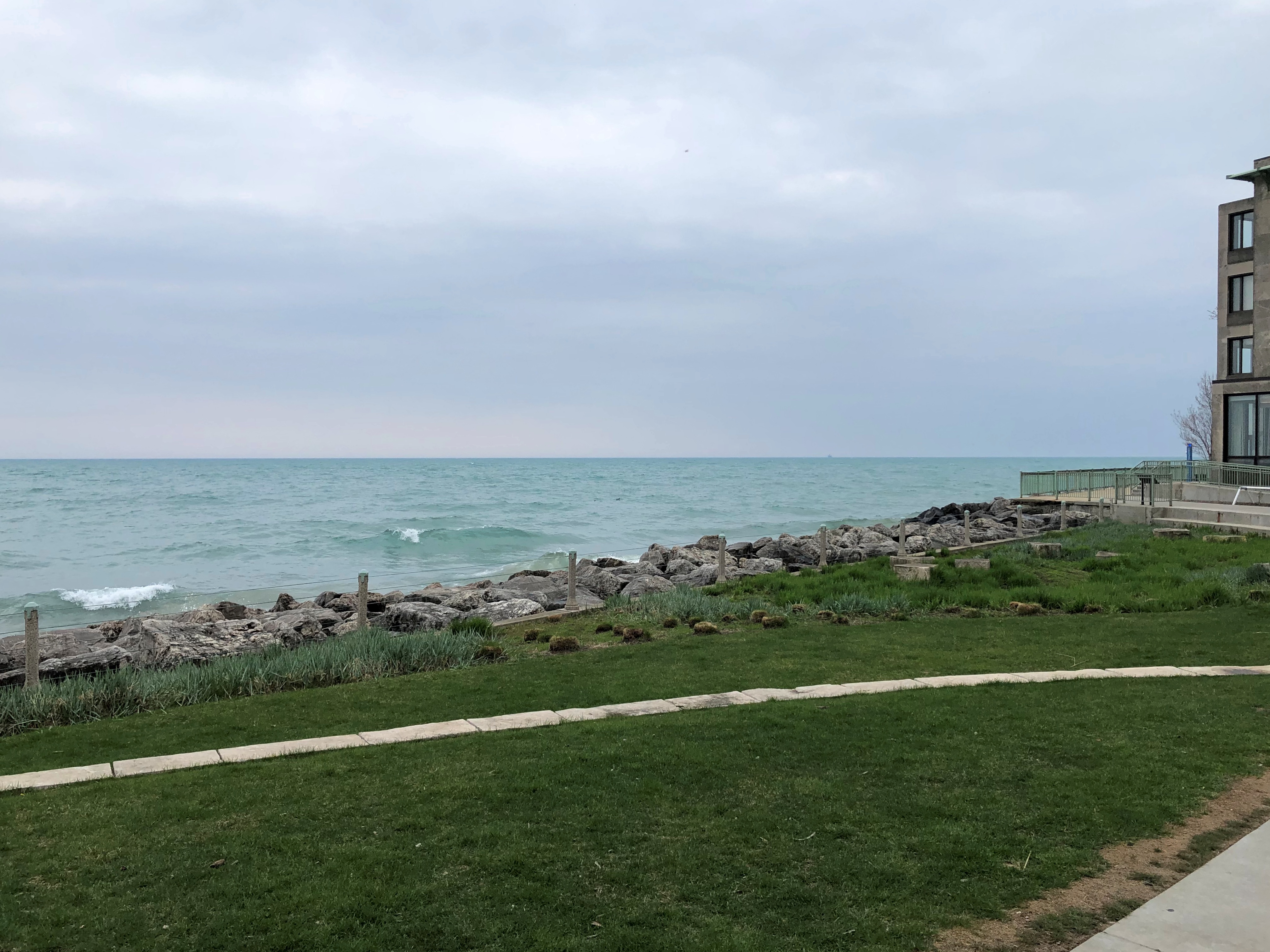
Lake Michigan was active but not stormy on Saturday. Views from Loyola.Lake Michigan 2022 Lake Michigan 2022

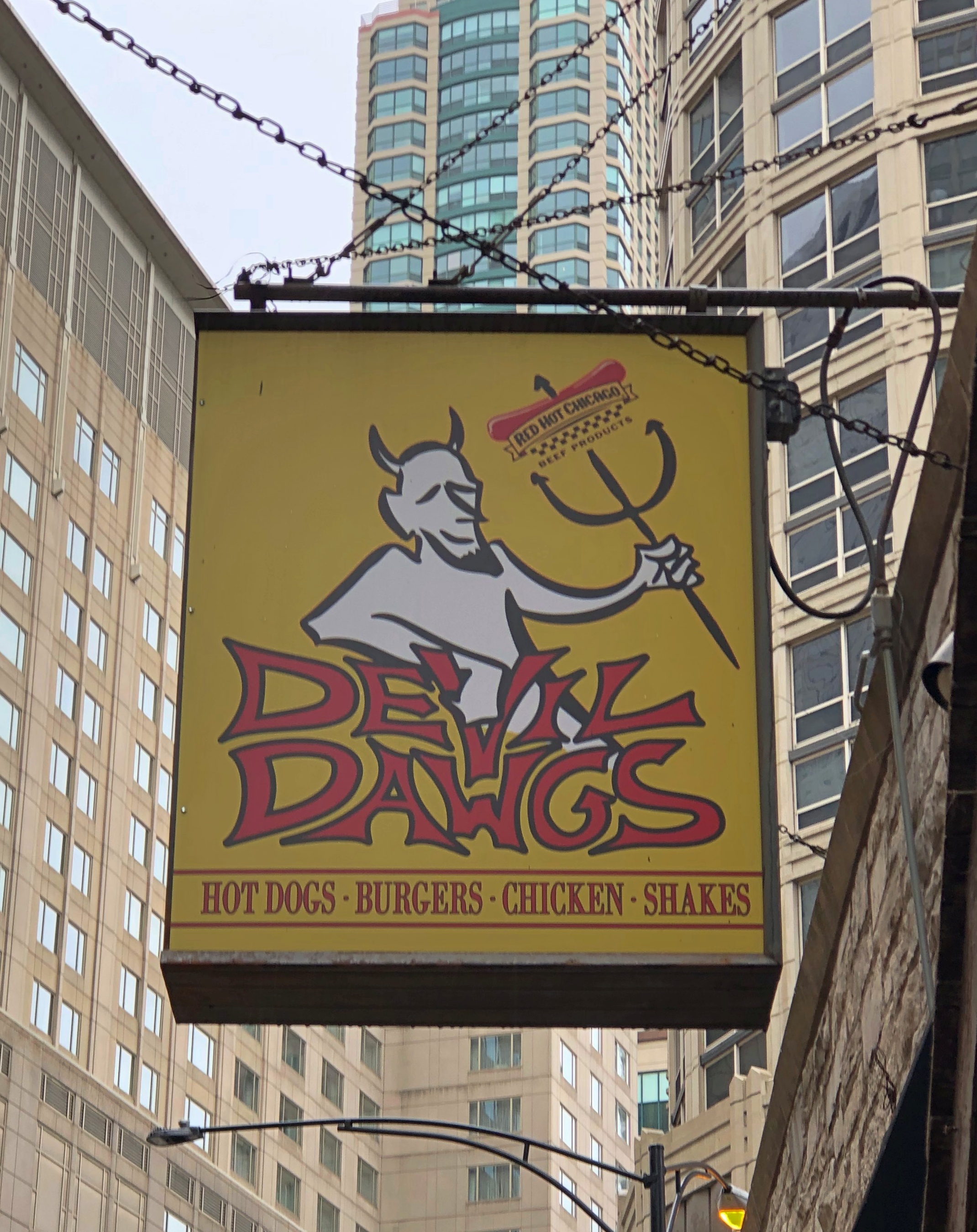
There’s a coffee-table book in this: chain-hung Chicago signs.
Devil Dawgs Chicago

High-res images, of course. Can go on the same coffee table with Austin neon.

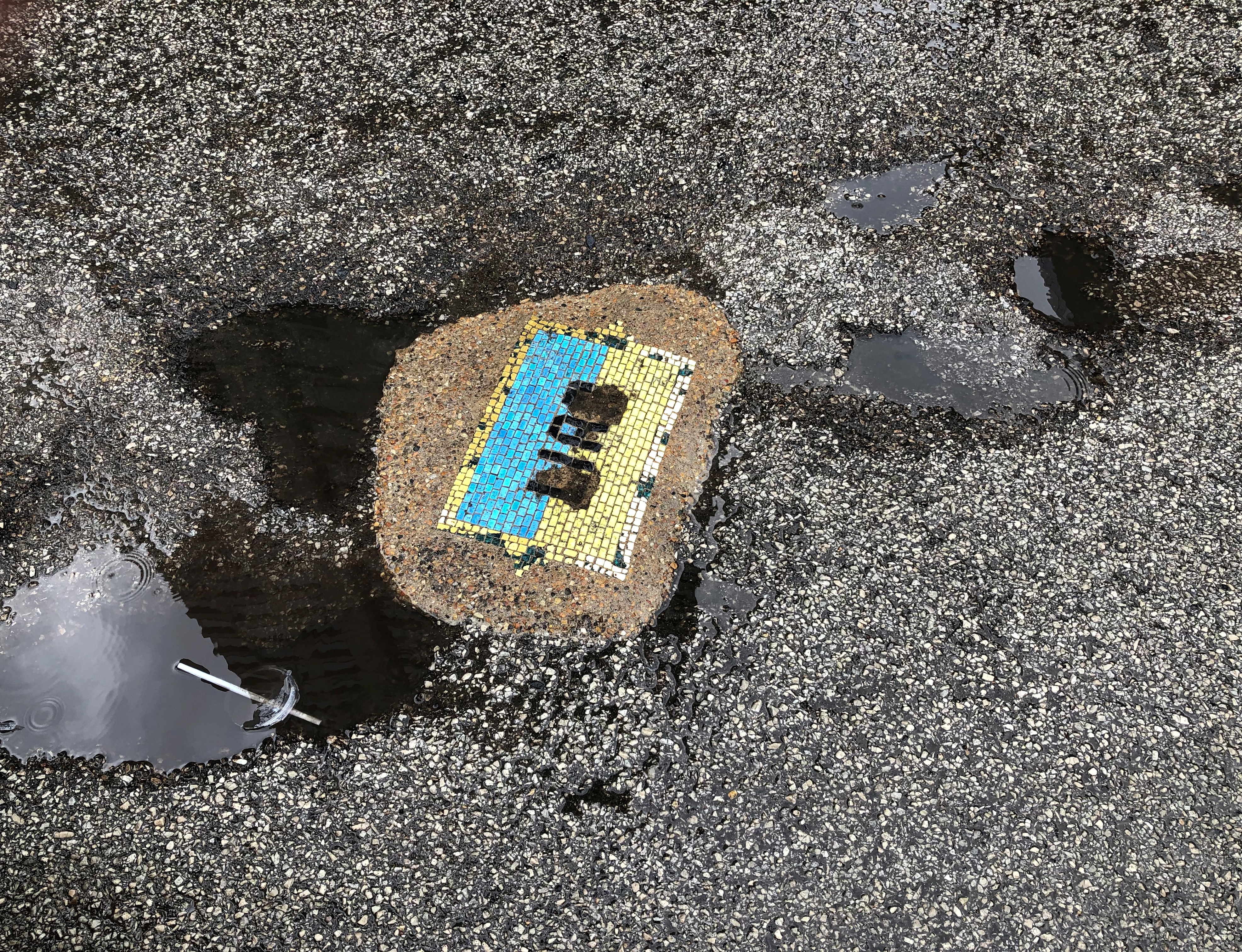
Also Chicago. Specifically, on the street. Make that in the street: a Toynbee tile-like embedment doing its part to remind us of the beleaguered Ukrainians.

Recently I started reading Illegal Tender, subtitled “Gold, Greed and the Mystery if the Lost 1933 Double Eagle,” by David Tripp (2004). A remainder table find some years ago; nice hardback. As it says, the book tells the intriguing (to me) story of the 1933 Double Eagle, which tends to make lists of the world’s most valuable coins, along with the likes of the Brasher Doubloon, the 1804 Bust Dollar and the 1913 Liberty Nickel. Coins so special that their names are capitalized.

On that particular list, I hadn’t heard of the 723 Umayyad Caliphate Gold Dinar, but wow, what a name, with images of ancient treasure in distant lands woven right into the words. The 1913 Liberty Nickel was the MacGuffin in an episode of the original Hawaii 5-0. Namely, “The $100,000 Nickel,” which first aired on December 11, 1973.

“A rare 1913 Liberty Head nickel, one of only five ever made, is to be auctioned at a coin show held at the Ilikai Hotel,” says the imdb entry on the episode. “European master criminal Eric Damien gets con artist and sleight-of-hand expert Arnie Price freed from jail so that he can switch a cleverly-made fake with the original before the auction. But things do not go as planned, as Price, fearing capture, tries to dispose of the nickel in a news rack, and the chase is on to recover the nickel before anyone else finds it.”

Naturally, McGarrett and his men recover the nickel. I don’t remember that specifically, even though I saw that episode either that day or on repeat, but that’s a safe assumption for the denouement. I do remember that I’d heard of the nickel before, probably in a Coins or Coinage article.

I think the episode at least partly inspired one of the Super 8 movies I made with friends David and Steve in junior high, The $300,000 Dime, which I think involved Swiss operative Hans Lan foiling the theft of the titular dime. Sadly, this and the other Hans Lan story, The Assassin, plus the SF non-epic Teedees of Titan and a couple of others whose names I’ve forgotten, are lost as the Hanging Gardens of Babylon, except that no one cares.

An NFT 42 Years in Development

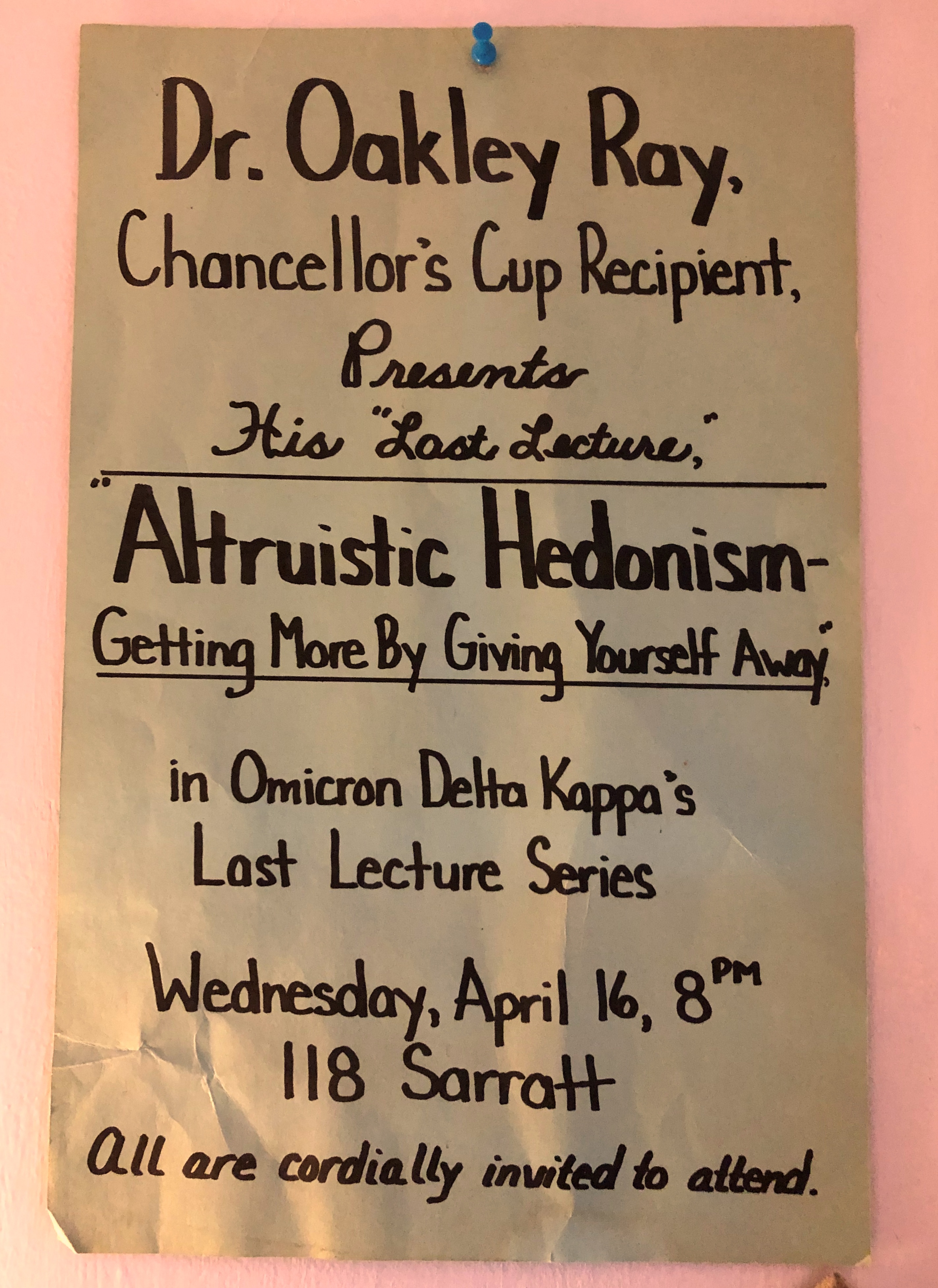
Not too long ago, I found this poster tucked away in a corner of my house. The year had to have been 1980, considering that April 16 was a Wednesday that year. Not only do I not remember the event mentioned on the poster — a lecture at Vanderbilt — I don’t remember why I saved it in the first place.

So I decided to post it in the downstairs bathroom, which has been pending renovation for some years now. At 17 inches tall and 11 wide, it covers 187 square inches of bald and unconvincing wall.

I remember Oakley Ray, VU professor and text book author, but faintly. I audited one of his classes, attending maybe 10 times at most. I don’t know whether I went to the event or not, but I do remember one other thing from that week, something that stands out a lot darker in memory — a dark star of a memory from April 1980, seeing Eraserhead at a movie theater.

NFT 4.24.22Simply put, that movie depicted a nightmare. That was my take on it 40+ years ago, and I don’t see any reason to revise it now. I emerged from the theater that night positive I never needed to see it again. I’ve stuck to that, too.

Never mind all that. I’ve created a bit of digital artwork that’s an NFT. Bidding starts at $100,000.