Thursday Whatnots

News I missed, and I miss a fair amount, which I figure is actually healthy: “For the second time in history, a human-made object has reached the space between the stars,” a NASA press release from December says.

“NASA’s Voyager 2 probe now has exited the heliosphere — the protective bubble of particles and magnetic fields created by the Sun…

“Its twin, Voyager 1, crossed this boundary in 2012, but Voyager 2 carries a working instrument that will provide first-of-its-kind observations of the nature of this gateway into interstellar space.”

Voyager 2 is now slightly more than 11 billion miles (18 billion kilometers) from Earth. Or 16.5 light hours. That’s still in the Solar System, though. “It will take about 300 years for Voyager 2 to reach the inner edge of the Oort Cloud and possibly 30,000 years to fly beyond it,” NASA says.

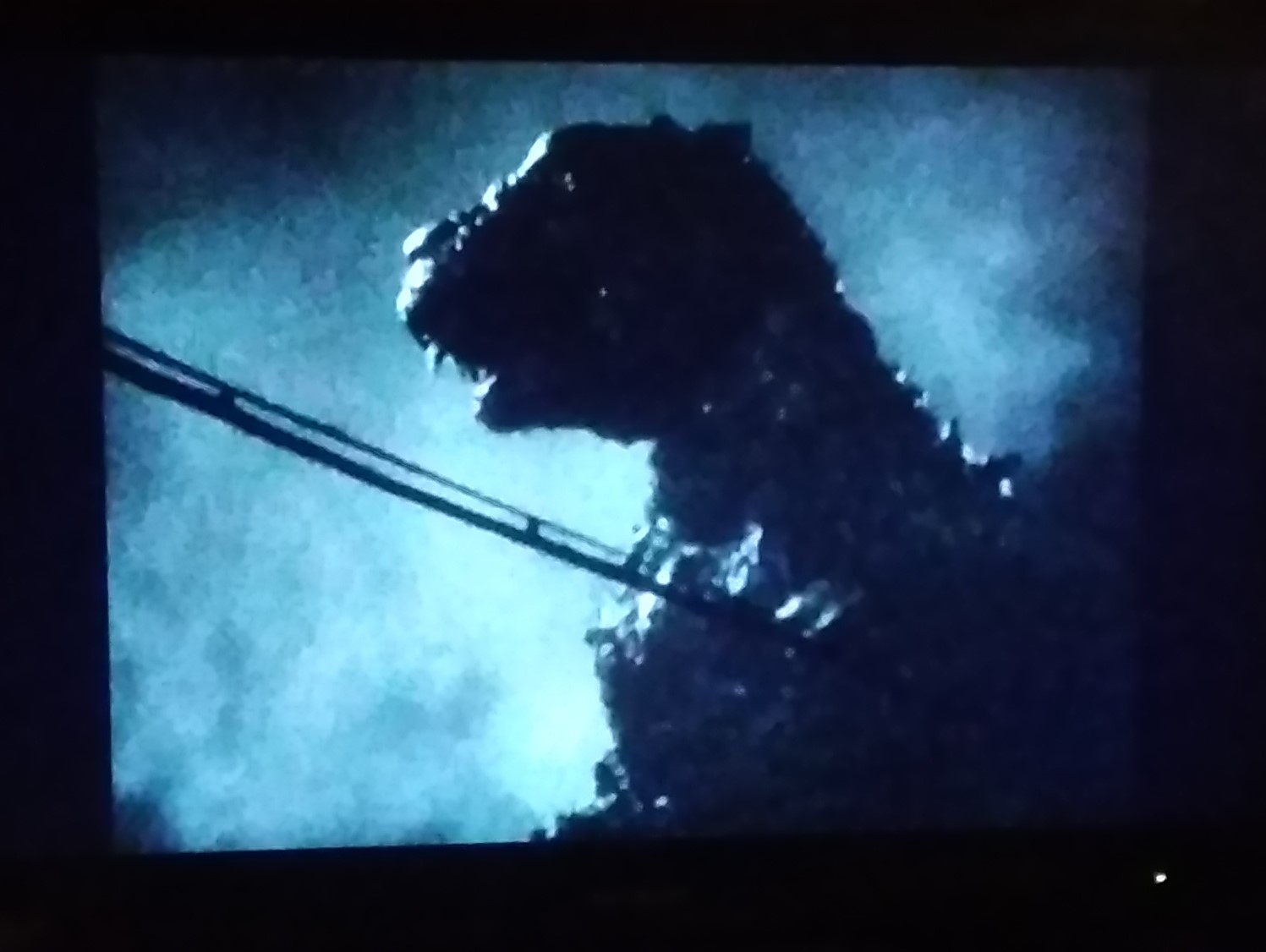
Not long ago, the original GodzillaGojira, to be pedantic — appeared on TV, in Japanese with subtitles. Not that the famed atomic beast needs any subtitles. I had my camera handy.
I didn’t watch it all, but that’s one way to approach televised movies. Not long ago, I watched the first 15 minutes or so of The Sting, a fine movie I’ve seen a few times all the way through. But other tasks were at hand, so I quit after Luther is murdered.

Later, I had the presence of mind to turn the TV back on and watch the last 10 minutes or so, when the sting is put on gangster Doyle Lonnegan. It’s a satisfying ending, but it got me to thinking.

A con with that many people would surely generate rumors. Just as surely, the rumors would make their way to the murderous Lonnegan, who wouldn’t rest until Henry Gondorff and Johnny Hooker were dead. But that’s overthinking things.

Here’s another example of a dim algorithm. Just about every time I use YouTube, I see anti-teen smoking PSAs. Or maybe they’re blanketing the medium, regardless of audience. Still, if I didn’t take up smoking 45 years ago, I’m not going to now.

That brings to mind the first time I remember seeing one of my contemporaries with a cigarette. That was about 45 years ago at a place called the Mule Stall.

The Mule Stall was a student space on the campus of my high school with a few rooms, chairs, a pool table and I don’t remember what else. It was tucked away about as far as you could get from the rest of the school, opening up to the street behind the school.

High schoolers used it, but junior high kids from the district had gatherings there occasionally as well. The event I remember might have been the wrap party for one of the plays I was in. Besides not acquiring a taste for smoking back then, I also discovered the theater wasn’t for me, except as an audience member. But ca. 1974, as a junior high school student, I did a few plays.

There we were, hanging out at the Mule Stall, when we noticed a girl named Debbie, who was in our class, pass by with a cigarette between her fingers. I didn’t know her that well, and I don’t remember much about her now, though she had curly hair, glasses and the sort of development adolescent boys pay attention to. At that moment, I guess she was on her way out to smoke the thing, though we didn’t see that.

I don’t know anything about her later life. She attended high school with us for a while, but either moved away or dropped out before the Class of ’79 graduated. I wonder if even now, she holds her cigs in yellow-stained fingers and spends part of the night coughing.

As for the Mule Stall, we had occasional high school band parties there later. One in particular involved almost everyone lining up to dance to the “Cotton-Eyed Joe.” That was fun. As Wiki accurately says, the dance was very much alive in Texas in the 1970s.

In fact, the Wiki entry has a description of the style of dance we did. Someone who did the dance seems to have written it, because this is exactly right.

“This dance was adapted into a simplified version as a nonpartner waist-hold, spoke line routine. Heel and toe polka steps were replaced with a cross-lift followed by a kick with two-steps. The lift and kick are sometimes accompanied by shouts of ‘whoops, whoops,’ or the barnyard term ‘bull s–t.’… The practice continues to this day.”

We used the barnyard term. An administration with no sense of history apparently razed the Mule Stall in the 1990s. Now the site is parking.

Geezer Mail

Got a paper catalog in the mail today, one that comes periodically despite the fact that I’ve never ordered anything from it, not once in however many years I’ve been on the mailing list. The merchant must be waiting patiently, hopefully, like a dog under the dinner table waiting for some food to fall its way.

It offers DVDs. I look at it and always see a few movies I’ve never heard of and probably won’t ever see. Not that I dismiss old movies, or black-and-white movies, or subtitled movies out of hand, though I hear that some people do. Rather, there isn’t enough time to see everything, or even everything worth seeing.

Besides, my attitude toward DVDs is rent, not buy.

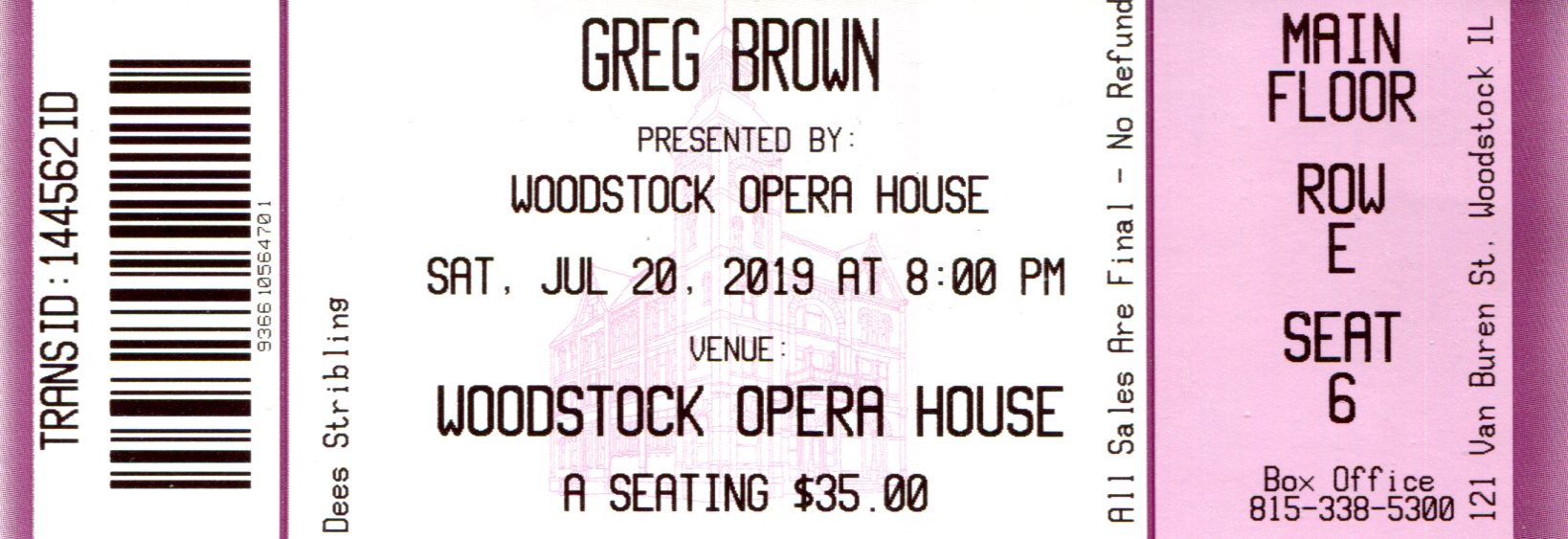
Speaking of the passage of time, when I opened the catalog this card fell out.

Catalogs are increasingly geezer mail, and if you need any evidence of that, look no further.

Thursday Bunkum

Our latest snow was less convenient than previous ones this winter, falling in mid-week. I spent a fair chunk of Wednesday shoveling more snow around, this time wetter masses than the last snowfall. Now an arctic blast is blasting its way toward northern Illinois. Subzero temps ahead.

Ah, fun. We’ve been down this road before, of course.

I just found out today that the Emperor of Japan is going to abdicate on April 30. That was news in December, but I missed it. I chanced across the information in a copy of the bilingual Chicago Shimpo, a paper Yuriko picks up for free periodically at the Mitsuwa grocery store.

The Imperial Household Agency, known for its mossback ways, is on board with that?  Yet abdication from the Chrysanthemum Throne isn’t unknown. The most recent abdication was of Kōkaku, who quit in 1817. Pretty recent, considering the longevity of the Yamato Dynasty.

In even earlier times, back when the emperor was more of a political football than in recent centuries, one emperor was sometimes forced out to make way for another.

Now that I’ve finished reading Stalin — which I read after John Wayne: The Life and Legend by Scott Eyman (2014), an excellent book — I’ve decided to read some more biographies. A biography bender. Next I want to pick one from around the house, one that I haven’t read.

My choices, at least those I’ve found so far, include works on Francis Bacon, Benedict Arnold and Babe Ruth.

Something called Indywire asserted recently that: Coen Brothers Shock With ‘Buster Scruggs’ Oscar Nomination

I’m not shocked. I’ve seen five of the six stories in the The Ballad of Buster Scuggs so far and they’re really good, especially “Meal Ticket” and “The Gal Who Got Rattled.” Not that being good necessarily gets a movie nominations, but it helps.

All the stories get the Coen Brothers treatment, so you know that something bad is going to happen to at least one of the characters. In the “The Gal Who Got Rattled,” the feeling was particularly poignant, because as the story moved along, both the man and woman evolved into remarkably sympathetic characters. Then one of the dangers of the 19th century smites them.

Parts of the movie were based on sources much closer to the 19th century than our own, such as “The Girl Who Got Rattled” by Stewart Edward White and Jack London’s “All Gold Cañon,” while other parts evoke cowboy pictures of yore.

That only goes to show that there’s a vast and largely untapped galaxy of source material for movies — books, short stories, historic events, myths, graphic novels and on and on. Do moviemakers show any interest in mining these riches? Mostly not, seems like, and if they do, commercial pressures disabuse them of the notion. The Coens are exceptions. I’m glad they’re able to make the movies they want to.

Joe the Georgian in Story and Song

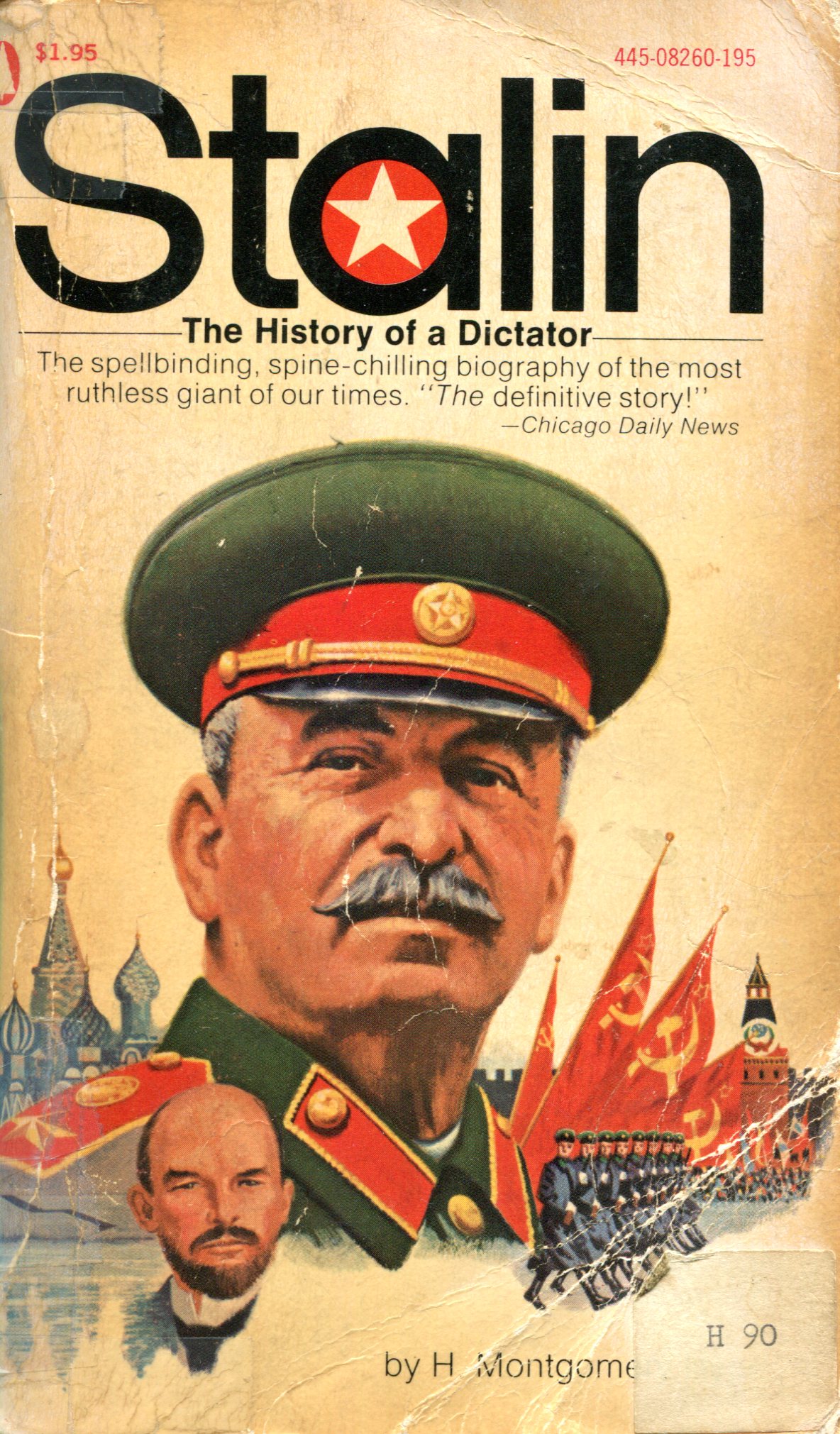
Sometimes you pick up a book that’s been on the shelf unread for many years and you think, time to read it. So it was around the beginning of the year with a copy of Stalin, subtitled “The History of a Dictator,” by H. Montgomery Hyde (1907-89).

It’s a paperback, originally published in 1971 and which no doubt my brother Jay bought. The copy’s pages are yellow and a little brittle with the passage of so much time, and the front cover is partly torn — and repaired with tape — but the book withstood my reading it. Not bad for a paperback not meant to last long.

Of course there are newer biographies of Stalin, such as the work of Stephen Kotkin, whose three-volume bio had its second volume published in 2017. Those sound really good. Later books have the advantage of at least partly open former Soviet or other Communist archives, including things unimaginable in 1971, but even so I wanted to read Hyde’s book. For one thing, it’s on my shelf.

More than that, I was curious how Hyde approached the subject without access to those archives. With a fair number of workarounds, it turned out, and perhaps leaning a little too much on Khrushchev, who has to count as an unreliable narrator. On whole, though, I’d say Hyde did a good job with the material he had to work with.

Sometimes, Hyde pointed out, history and the fate of millions (very possibly) turn on a small event: “If the final stroke of apoplexy had been delayed for a few months or weeks, or even days, Lenin might have succeeded, even without Trotsky’s help, in ousting Stalin from his place of power, such was the immense following Lenin could command in the Party and country. But it was not to be.” (p. 203)

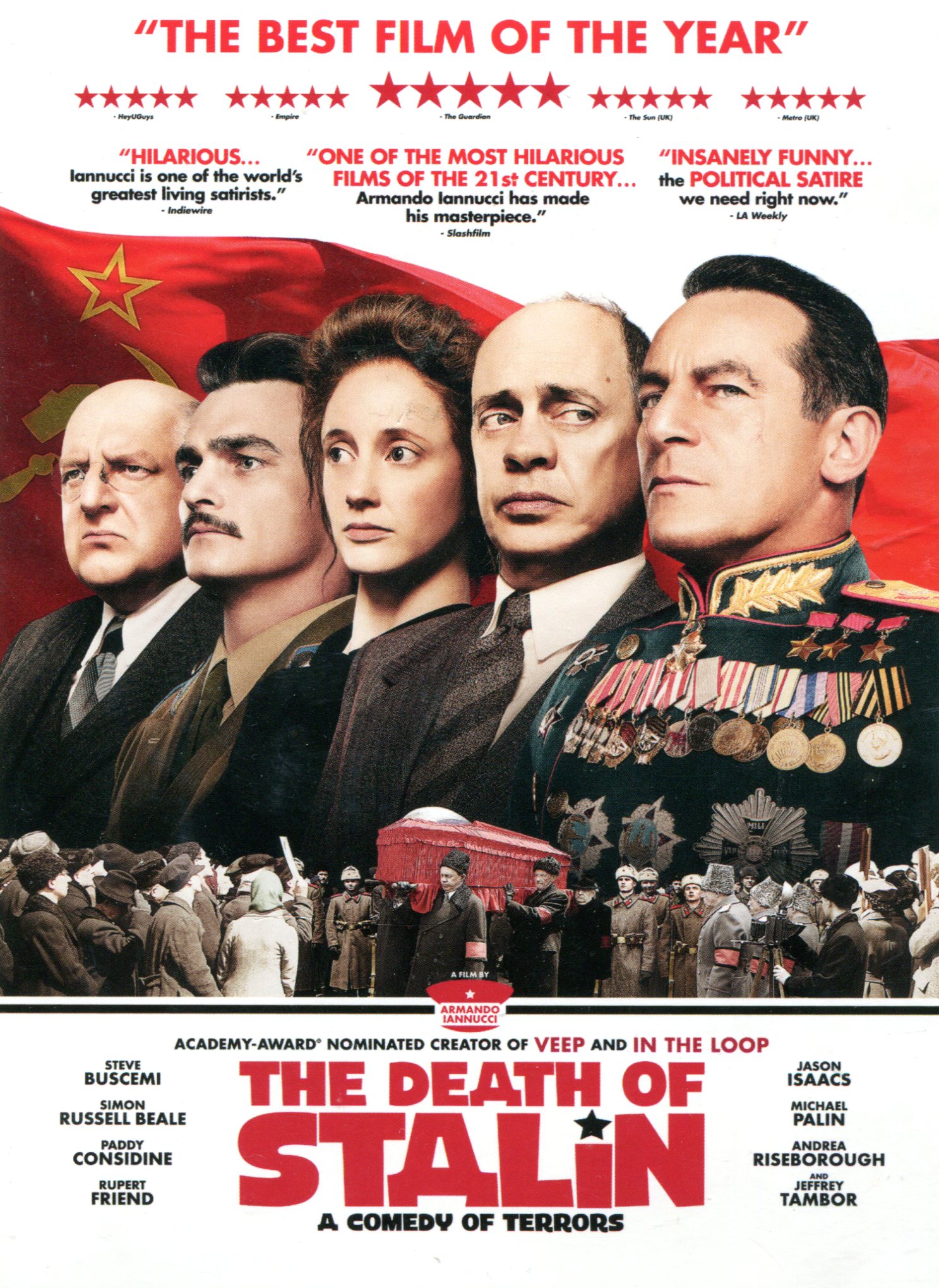
The book isn’t the only Stalin-related diversion for me lately. As in the last year or so. While in New York last March, I went to the Brooklyn Academy of Music’s Rose Cinemas, where I paid New York prices to see The Death of Stalin, then a first-run movie.

It was worth full price. As dark as comedy gets, Death managed to be a funny movie about one of history’s most unfunny subjects, Stalinism. Loosely based on actual events and hardly solid history, but that didn’t matter because of the rule of funny.

Another reason to like the movie: it irritated humorless, authoritarian bureaucrats. According to the imdb: “The movie was banned in Russia on January 23, 2018, two days before it was due to be released… One member of the Culture Ministry’s advisory board was quoted as saying, ‘The film desecrates our historical symbols — the Soviet hymn, orders and medals, and Marshal Zhukov is portrayed as an idiot,’ and added that the film’s release in advance of the 75th anniversary of the end of the Battle of Stalingrad (February 2nd), would be ‘an affront to Russia’s World War II veterans.’ ”

Whatever, Ivan. I will point out that Zhukov wasn’t played as an idiot, but as canny and flamboyant. Canny the real Zhukov surely was, but flamboyant I doubt. Again, the rule of funny. The movie Zhukov was a hoot.

One more Stalin-oriented bit of entertainment: “Joe the Georgian,” an Al Stewart song (1995). Back when I saw him at the Woodstock Theatre in 2008, he sang it, and did his usual patter beforehand. I don’t remember the exact words, but he said that his agent or his label or someone encouraged him to write a dance song. Dance songs sell.

“So I wrote a dance song,” he said. “The trouble was, it was about Joseph Stalin.” Enormous laughter from the audience.

In the song, an unnamed Old Bolshevik, newly arrived in Hell, ponders how he got there.

We all set off together
On this sorry ship of state
When the captain took the fever
We were hijacked by the mate
And he steered us through the shadows
Upon an angry tide
And cast us one by one over the side

His consolation is that when Stalin arrives in Hell, as he surely will, the Old Bolsheviks will torment him with heated pitchforks for “the next few million years” while they “dance, dance, dance.”

Thursday Detritus

The rains have cleared away, leaving cold air in their wake. This pattern will keep repeating in the coming months, getting successively colder until snow replaces rain and mere cold air is a polar vortex or some such. Bah. At least the trees are coloring up nicely.

An open question for YouTube: how, in the age of digital spying on consumers — so I hear — can YouTube offer me such wildly off-the-mark ads? Lately I’ve been getting a lot of anti-vapping ads, for instance. Aimed at teenagers. Not, I have to add, ahead of much content that that demographic might watch on YouTube. The chances of me taking up vapping are pretty close to zero, YouTube.

Some time ago I picked up a copy of The Shipping News by Annie Proulx (1993) for $1 at Half Price Books. Now I’m reading it. It’s a good read and there are some good lines in it. Here’s one that helps introduce a character:

For the devil had long ago taken a shine to Tert Card, filled him like a cream horn with itch and irritation.

One of the author’s idiosyncrasies is constructions like that, with “filled” instead of “filling.” But you get used to it, and it works. That’s a wonderful sentence that pretty much sets the tone for Tert Card. We’ve all met people like that.

From a press release over the transom the other day, a subject I have no professional interest in. I’m more interested in how the thing was written. I suspect the writer is a fairly fluent but nevertheless non-native speaker of English (all sic):

Businessmen hailing from UAE have an interest in making some investments in Armenia. The trade turnover in between the two countries has risen 10-folks from twenty-five million to about 250 million USD in the last five years as told by Zaki Nusseibeh, the Minister of the State after the sidelines of the ministerial conference of 17th Francophonie summit…

After Ruddigore on Saturday, Ann wanted ice cream. At about 10 in the evening in Evanston, Andy’s Frozen Custard seemed the only place still open serving something close to ice cream. She agreed that was close enough, so we went.
That image doesn’t have many people in it, but not long after we got there, the place was packed. Seems that selling frozen custard late on Saturday evenings near a major university is a pretty good business.

I’d never been to Andy’s before. Turns out there are about 60 of them, mostly scattered around the central U.S., though as far north as metro Chicago and as far south as central Florida. Andy’s makes a good frozen treat. Too good, in fact. I should have gotten a small triple chocolate instead of a medium.

Who did the score for Doctor Zhivago? I found myself wondering that yesterday. Maybe that’s something I should know, but I looked it up: Maurice Jarre.

That came to mind because I’d turned on the TV and DZ was playing. In fact, the very scene in which Yuri and Lara reunited. The Lara’s theme leitmotif was part of the action. I watched about 15 minutes of it.

“What’s this movie about?” Ann asked. I had to think. It’s been how long since I’ve seen it? In the summer of ’81 at the Texas Union Theatre, or in Japan in the early ’90s, when I saw so many movies on VHS? Either way, over 25 years ago.

“Well, let’s see. Doctor Zhivago, that’s him there, Omar Sharif. He’s a doctor of course, and he has a wife. He likes her well enough, but he really loves this other woman, who’s on screen now. I don’t remember who played her. Anyway, there’s a love triangle and they all get caught up in the Russian Revolution and are often in danger. Bolsheviks show up. Zhivago’s also a poet and sensitive fellow. He spends a lot of time looking off in the distance. And there’s a lot of scenery. Wide shots of the steppes of Russia. It’s an epic of a movie. Did I mention that it’s over three hours long? It’s an epic of epic proportions.”

Despite my flip description, I remember liking the movie whenever I saw it. Odd how details of most movies you see or books you read or music you hear or places you go tend to evaporate over the years, leaving a residue like the one I told to Ann.

Never have read Pasternak, so I don’t even have a residue of the book. Maybe I should, but life is short and Russian novels are long. The most recent one I read, a few years ago, was August 1914. Pretty soon into it, I gave up trying to keep track of all of the many characters.

Maurice Jarre, I learned, is the father of Jean-Michel Jarre, known to me for Oxygène. Back when people had record collections, there was always one kid on each floor of each dorm at your college who had unusual records, things no one else had ever heard of. I can’t remember the lad’s name, but he was on my hall freshman year, and that was one of the records he had.

Mass Entertainment

Here’s a list I spent some time with recently: Wiki’s List of highest-grossing media franchises. Being Wiki, there’s no telling how accurate it is, but I will note that there are an enormous number of notes and references. So I’ll take it as accurate enough.

The list is interesting for a number of reasons, but mainly for information on the high-grossing franchises I’ve never heard of, which are quite a few.

Most of them are Japanese: anime, manga, even franchises whose most profitable expression is pachinko machines. As far as I could tell from my years in Japan, pachinko parlors were insanely bright, intensely noisy places to throw away money. But I was just a barbarian outsider. Apparently the machines are branded, and the branding is big business.

Take Fist of the North Star which, originating way back in 1983, would have been around when I was in Japan. I’d never heard of it until today. Though starting as manga, the franchise has enjoyed nearly $16.8 billion in pachinko machine sales, plus a few billion more in manga and other games.

Pachinko, incidentally, comes up 13 times on the list. Most of those are Japanese franchises, but not all. There have been $2.85 billion in Disney Aladdin pachinko (and arcade) machines sold. Spider-Man pachinko machines are popular to the tune of $308 million in sales, and Tomb Raider has sold $300 million.

I was curious how many of the franchises I’ve supported, either for myself or my children, so I counted: more than I would have thought, about 50. That includes mostly through ticket sales, as well as small-screen viewing (at least occasionally), but also the quarters I spent on Pac-Man and Space Invaders, and things my daughters watched that I never would, such as Sailor Moon and Dora the Explorer.

Mass-market entertainment’s pervasive. Even when your tastes tend to run to less successful shows.

Thursday Plattero-filleto-mulleto-turboto-cranio-morselo-pickleo-acido-silphio-honeyo-pouredonthetopo-theouzelo-throstleo-cushato-culvero-cutleto-roastingo-marowo-dippero-leveret-syrupu-gibleto-wings.

Just having fun with the head. As I did a few years ago. It’s one of the English translations of the Greek, which is transliterated lopado­temacho­selacho­galeo­kranio­leipsano­drim­hypo­trimmato­silphio­parao­melito­katakechy­meno­kichl­epi­kossypho­phatto­perister­alektryon­opte­kephallio­kigklo­peleio­lagoio­siraio­baphe­tragano­pterygon.

I didn’t even have to find my copy of the Book of Lists to find it. All I did was Google “long Greek word leftovers,” and I found it right away.

Considering that it’s the “first day of summer,” it’s pretty cool and rainy around here. That’s nonsense anyway. It’s the Summer Solstice. That’s all.

Saw a few fireflies early in the week, but not since. They’re just the early ones. Around here most of them show up in July.

Not sure whether the rain pleases the toads or not, but I’ve seen some lately.

Something I didn’t know until recently that I found out in my work: the Seminole Tribe of Florida owns Hard Rock Cafe Inc. Since 2007. I probably should have known that, but I didn’t.

Not long ago I sat down with Ann and watched the 2011 Captain America movie on DVD. I’m rarely in the mood for comic book movies, but I thought I’d give it a go.

Not bad. I thought the best idea — which might be true to the comic, I have no clue — was that Captain America, after his conversion by Science from a 98-lb. weakling into a super-soldier, spent much of WWII on bond tours.

Then, of course, through an insane convergence of circumstances, Captain America got to defeat the badies in pitched CGI battles, be sad about his buddy’s death, and fall in love with a tough-but-tenderhearted British bombshell. Right, whatever. That’s what the 15-year-old boys (and some girls) paid to see.

I would have preferred a movie about a fellow who spends the war doing over-the-top patriotic shows, in a ridiculous costume, to sell bonds. He wouldn’t even have to be sad about his situation. Just before V-E Day, he could accidentally take a few hundred Germans prisoner, something like Don Knotts might have. It could be a comedy. That kind of thinking is what I get for not being a 15-year-old boy for a good many decades now.

Space Odyssey

I’m much of my way through reading Space Odyssey by Michael Benson, which was released this year in time for the 50th anniversary of 2001. The book is subtitled “Stanley Kubrick, Arthur C. Clarke, and the Making of a Masterpiece.”

The book doesn’t pretend to be a biography of either Kubrick or Clarke, but a tale of creating the movie, beginning with the extended deliberations by Kubrick about what to do after Dr. Strangelove and the critical ideas Clarke contributed to the genesis and eventual shape of the movie, and taking the story through production, post-production and release, all of which were behind schedule and over budget.

Both Kubrick and Clarke come across as towering intellects, which no doubt they were, but with certain flaws. If he thought it was good for the end product, Kubrick was perfectly willing to take advantage of Clarke or put his actors in danger on the set. For his part, Clarke couldn’t stand up to Kubrick, or say no to a money-sucking leech of a lover, though eventually his association with the project made him wealthy indeed (indirectly, because he had no points in the movie itself).

Since movie-making is such a collaborative effort, a lot of other contributors to the ultimate outcome make appearances in the book. Each is fascinating in his own way, such as the very young man who shot highly kinetic scenes from a helicopter over Scotland, for part of the Star Gate sequence; the mime who choreographed the movements for — and played — the lead ape-man in the Dawn of Man sequence; the designer who built the astonishing centrifuge set; or the stuntman who did the incredibly risky shots of astronaut Poole floating in space.

Perhaps the most astonishing thing about the movie that the book makes clear is how much of 2001 — a multimillion-dollar project with a large staff — was essentially made up on the fly by Kubrick. A fair number of bad ideas were winnowed out along the way, and good ideas came from various and unexpected sources, all of which the director wasn’t shy about using.

I’ve gotten to the chapter that describes the filming of the Dawn of Man. Reading about that process in detail reminds me of the reaction to the movie by someone I recommended it to years ago (in college in fact). He wasn’t impressed by 2001 or its mystique. Afterward, one of the things he asked me was, “What were those damned monkeys doing?”

The Producers

Remarkably, Ann wanted to see The Producers, so we went this afternoon. Another movie released in 1968, but about as different as can be from 2001. She seemed amused by it.

I had given her the gist of the story — the producers schemed to pick a play that would certainly fail, so they could keep the over-subscribed investment, and then it doesn’t fail. I think she had wanted some context for “Springtime for Hitler,” which she must have seen on YouTube (probably the 2005 version, though).

I don’t think I spoiled anything by telling her that. The joy of The Producers is in the execution. In the good many years since I saw it last, I’d forgotten how much fun the movie is. And how much is slapstick. It in the hands of lesser actors and a lesser director, it would have just been low comedy. With Mel Brooks and Zero Mostel and Gene Wilder and Kenneth Mars, what you have is inspired low comedy. For his part, Mars’ loopy German might be the best ever put on film.

As funny as the leads were, I have to say I laughed the hardest at Lorenzo St. DuBois (L.S.D.)’s audition song, as performed by Dick Shawn. Known, according to Wiki, for “small but iconic roles in madcap comedies, usually portraying caricatures of counter culture personalities.” He certainly nailed the dimwitted hippie in The Producers.

Somehow I’d forgotten that he was wearing a can of Campbell’s Soup around his neck during the audition. Nice detail. Ann didn’t ask me about it, and maybe she just considered it a passing oddity. But it was pretty clear to me that Mel Brooks, already entering middle age in 1968, didn’t think much of hippies, Pop Art, Timothy Leary, etc. The rest of the audience — mostly my age or older — got the joke, and laughed a lot at L.S.D’s antics, too.

Something I didn’t know until I did a little reading: Estelle Winwood, who played one of the old women Zero Mostel dallies with to get money for his plays — the one with the most lines — had a long career, acting well into her 90s, and living to be 101. She also was associated with the Algonquin Round Table.

Speaking of longevity, since it was a TCM showing, the movie was proceeded by a recent short interview with Mel Brooks. He’s a hale fellow for 91.

2001 at the Music Box

Just before the screening of 2001: A Space Odyssey at the Music Box Theatre in Chicago at noon on Saturday, one of the theater’s managers spent a few minutes telling us what to expect. Not in terms of content — it was a safe assumption that most (but not all) of the audience had seen the movie sometime in the last 50 years — but that there would be a few minutes of introductory music to a dark screen, and an intermission.

She also mentioned that the Music Box was one of a relatively small number of movie theaters nationwide equipped to screen the new 70 mm print of 2001. Interesting that a neighborhood jewel box of a theater from the 1920s has the latest movie screening tech.

I’d read about the new print. It was made recently from the original negatives, the goal of which wasn’t to clean up the images or digitally goose the movie, but to re-create as closely as possible what an audience would have seen in 1968. When I read about that, I knew I wanted to see it, even though I’ve seen the movie n times over the years.

For one thing, it had been a long time since I’d seen 2001 in a movie theater. I know I did at some point in the early ’70s, when I was old enough to be dropped off at a movie theater, the Broadway Theater in Alamo Heights, but not old enough to drive there myself. I saw it again at some mall theater during high school, after which I read Arthur C. Clarke’s book. In college, I saw it a few more times, at the Vanderbilt student cinema, and I think at an early multiplex in San Antonio during an early ’80s summertime revival.

Since then, I’ve seen it on VHS, DVD and on demand, but not in a theater. I was miffed that TCM didn’t pick it for its big screen series this year for the 50th anniversary, while choosing to show entertaining but lesser moves like Big and Grease. But maybe that’s because the 70 mm version was in the offing elsewhere (including Cannes, where it was first shown not long ago).

More than wanting to see 2001 in a theater, I was intrigued by the idea that it would look like it did 50 years ago. I wasn’t old enough to see it then. I’ll never have the experience of seeing it when it was just a strange new movie — no one ever will again — before it worked its way into the common culture, inspiring volumes of interpretation and giving us an unshakable image of a killer sentient computer with an unctuous voice. Still, this would be as close as I’d get to an original showing.

Ann went with me. Yuriko did not want to go and Lilly had a conflict. The Music Box wasn’t full for the showing, but there was a fair crowd, and not everyone was my age or older. The 70 mm “unrestored” print didn’t disappoint. It also showed, if there was ever any doubt, that 2001‘s special effects were special indeed, from the closest foreground to the furthest background.

Odd how those model spaceships, on actual celluloid, look more real than any GCI spaceships I’ve seen in a digital medium. That observation might be conditioning left over from my youth, or valid for most people, or meaningless all together. I don’t care. That’s what I see.

I noticed a few imperfections in the print: a scratch or two, minor pops of light, that kind of thing. That took me back. Do I remember right that probably as late as the 1980s, movies displayed those kinds of visual ticks?

Speaking of visuals, one new thing that occurred to me during this viewing, and there’s always something new each time, was the visual debt that some of the backgrounds owed to Chesley Bonestell and Luděk Pešek. For instance, a long shot showing the vertical landing of the ship that took Dr. Floyd to the Moon, with unrelated astronauts in spacesuits in the foreground, instantly brought Bonestell to mind — this time. You’d think I’d have noticed that before.

The soundtrack was loud. Except when it wasn’t. At first I thought that was a function of the more advanced sound systems of our time compared with 1968, and so not quite like an original audience would have experienced it. Now I’m not so sure.

“The team also went back to the original six-track soundtrack and faithfully transferred it to the new prints,” the Variety article notes. “ ‘The film is mixed in a very extreme way,’ [director Christopher] Nolan says with awe. ‘There are incredible sonic peaks that are beyond anything anyone would do today.’ ”

Sonic peaks from the get-go, I’d say, as the heavens align to the “Also sprach Zarathustra” fanfare. But for me the most startling sonic peak comes when HAL decides to murder the hibernating astronauts. The cut is from the quiet of the spaceship while Bowman is out retrieving Poole’s body to a sudden, full-screen, flashing COMPUTER MALFUNCTION accompanied by a loud beeping. Louder, I believe, than in other versions of the film. I heard at least one audience member gasp when the scene started.

As well she should have. In my earliest viewings of the movie, that scene disturbed me the most. Sure, you can say HAL went just a little funny in the head because of contradictory programming. Or maybe he was just an evil bastard willing to murder people in their sleep. You know, like some people are. I’m hardly alone in noting that HAL was pretty much the most human member of the crew, for better and definitely worse.

Then again, the sound wasn’t always loud, or even quite intelligible. The more-or-less idle chitchat on the space station at the very beginning of the spoken dialog was a little hard to hear. Everything is intentional in a Kubrick movie, so I suppose that fits with the movie’s well-known lack of exposition.

That was one of the few things I told Ann before the movie. I didn’t want to over-prepare her, but I did say that obtrusive exposition wasn’t one of the movie’s characteristics. Had there been voice-over narration — the original script apparently called for that — I believe that would count as obtrusive, and the movie wouldn’t be regarded as highly. I never did quite like the brief narration at the beginning of Dr. Strangelove, though I can see why it’s there.

Here’s something I never noticed in the soundtrack. Again, during the idle chitchat at the beginning, there’s a background PA voice announcing the following. Twice.

A blue lady’s cashmere sweater has been found in the restaurant. It can be claimed at the manager’s desk.

How did I never hear that before? It popped out at me this time. Maybe that’s a function of the new print. Or maybe it’s just one of those things tucked inside a densely layered work of art that isn’t noticeable early on.

Later, the PA says: Will Mr. Travers please contact the met office.

Whatever that is. Interesting detail, those PA announcements. As if to show that by the end of the 20th century, space travel will have some of the ordinariness of air travel in 1968. Many of the space station details — the customs screening, the restaurant, the phone call — point to that.

Guess that counts as 1968 optimism about the future of space travel. It’s easy to deride that in hindsight, but it wouldn’t have been completely unreasonable at the time. We were well on the way to the Moon, for one thing.

After that would come large space stations, Moon bases, voyages to Mars and rocket engines and spaceships large enough to mount an expedition to Jupiter in 18 months. The idea that extensive space travel would be part of the near future had jumped out of speculative fiction into the realm of serious expectation. Turned out no one wanted to pay for those things, but that was still in the future.

The movie is not, on the other hand, optimistic about future of politics, as you’d expect from Kubrick. That’s another thing that occurred to me for the first time. It’s only hinted at, but the hints are pretty clear. Mainly, the movie assumes that political bureaucracies will be the same prevaricating, susicious entities they’ve long been.

Dr. Floyd is either an important official of the U.S. government, or in a quasi-governmental body, but in any case the lid is slammed down on the discovery of the monolith on the Moon. He offers the official, and secret, reason.

Floyd: I accept the need for absolute secrecy in this and I hope you will too. Now, I’m sure you’re all aware of the extremely grave potential for cultural shock and social disorientation contained in this present situation if the facts were prematurely and suddenly made public without adequate preparation and conditioning. Anyway, this is the view of the council.

Eighteen months later, the monolith is still a secret, even from the astronauts going to investigate where the radio beam pointed. Talk about paranoid secrecy. It’s almost Soviet in its reach.

Floyd expresses the idea, which isn’t unusual in science fiction, that the discovery of extraterrestrials would somehow cause “cultural shock and social disorientation.” Not just science fiction. I seem to remember discussion along those lines — a “fundamental change” in our thinking or some such, if not shock or disorientation — as far back as when the Vikings were digging unsuccessfully for microbes on Mars.

I’m skeptical that any such thing would happen. Say we discovered an alien artifact tomorrow. Something indisputable, except that there would be a group of fools that disputes it anyway. But let’s say most people accepted it for good reasons.

Then what? Assuming the artifact isn’t attacking us or producing pathogens, nothing too dramatic. The reaction would be, how about that. Someone is out there. How interesting. Maybe over the course of decades or centuries, the discovery would change the way we think, but for most people in the here and now, it would be a curiosity. Our lives would go on. Besides, we’ve already been conditioning ourselves, in books and movies and TV and more, to the possibility of aliens for years.

Overall, I’d say 2001 is optimistic, assuming a certain common interpretation of the movie. After much travail — it is an odyssey, after all — mankind does reach for the next level of development, just as the ape-men did.

One more thing I thought about for the first time this time around: Why no redundancy for HAL? The astronauts talk about shutting down HAL and resuming the mission using Earth-based computers, which would certainly be a clunky way to go about it at that distance. And mission control mentions “twin” 9000 series computers at its disposal. So why weren’t at least two HAL-class computers built into the Discovery? In case, you know, one fails in some way, such as trying to go all HAL on the crew.

A nit to pick. After it was over, Ann seemed impressed, and had some questions and observations. She did sleep through some of the movie, though. Especially those long scenes outside the spacecraft.

She may or may not grow to like 2001 as much as I do. It’s an acquired taste, and not for everyone. But I’m glad she went.