Thursday Detritus

The rains have cleared away, leaving cold air in their wake. This pattern will keep repeating in the coming months, getting successively colder until snow replaces rain and mere cold air is a polar vortex or some such. Bah. At least the trees are coloring up nicely.

An open question for YouTube: how, in the age of digital spying on consumers — so I hear — can YouTube offer me such wildly off-the-mark ads? Lately I’ve been getting a lot of anti-vapping ads, for instance. Aimed at teenagers. Not, I have to add, ahead of much content that that demographic might watch on YouTube. The chances of me taking up vapping are pretty close to zero, YouTube.

Some time ago I picked up a copy of The Shipping News by Annie Proulx (1993) for $1 at Half Price Books. Now I’m reading it. It’s a good read and there are some good lines in it. Here’s one that helps introduce a character:

For the devil had long ago taken a shine to Tert Card, filled him like a cream horn with itch and irritation.

One of the author’s idiosyncrasies is constructions like that, with “filled” instead of “filling.” But you get used to it, and it works. That’s a wonderful sentence that pretty much sets the tone for Tert Card. We’ve all met people like that.

From a press release over the transom the other day, a subject I have no professional interest in. I’m more interested in how the thing was written. I suspect the writer is a fairly fluent but nevertheless non-native speaker of English (all sic):

Businessmen hailing from UAE have an interest in making some investments in Armenia. The trade turnover in between the two countries has risen 10-folks from twenty-five million to about 250 million USD in the last five years as told by Zaki Nusseibeh, the Minister of the State after the sidelines of the ministerial conference of 17th Francophonie summit…

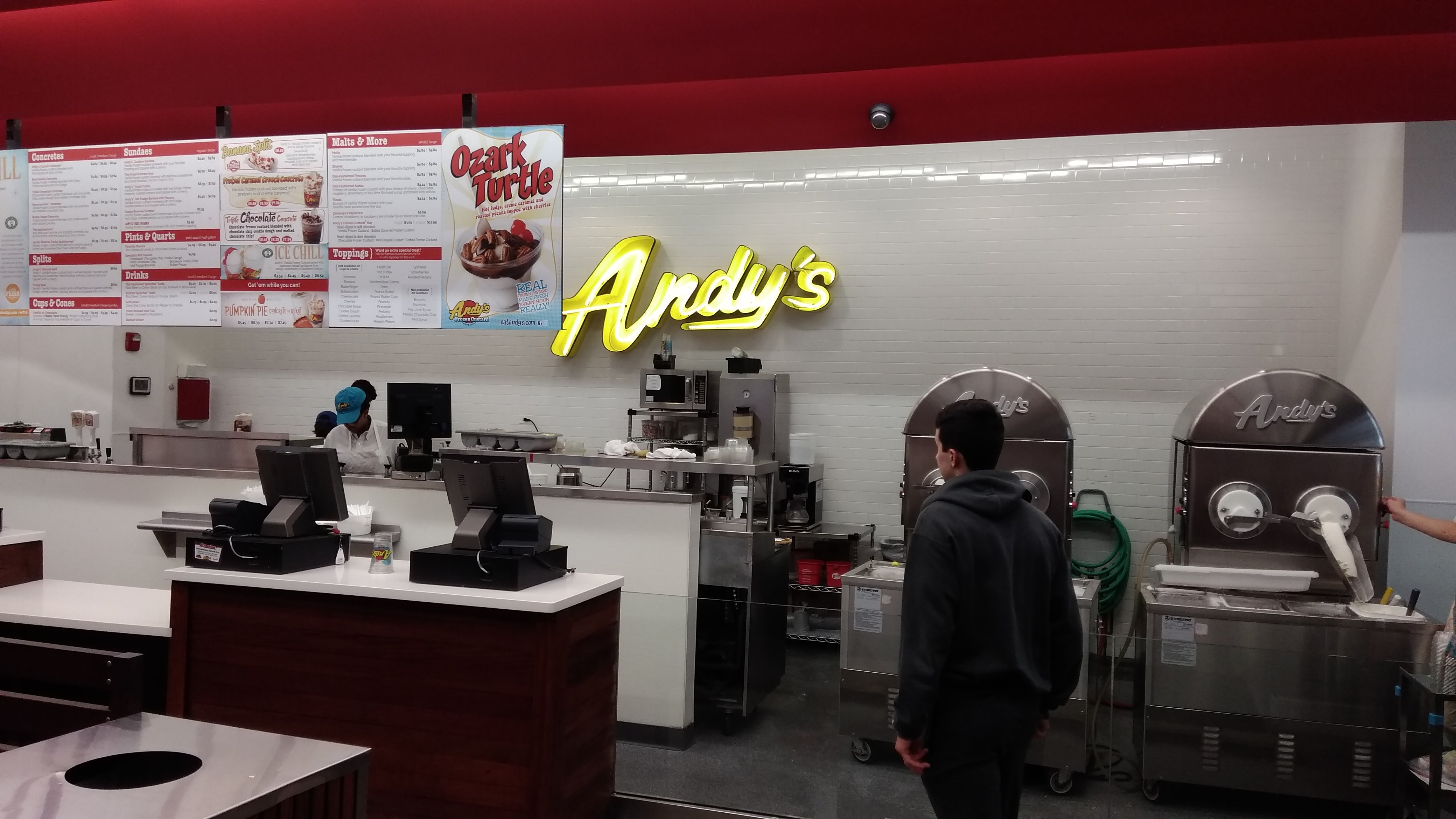
After Ruddigore on Saturday, Ann wanted ice cream. At about 10 in the evening in Evanston, Andy’s Frozen Custard seemed the only place still open serving something close to ice cream. She agreed that was close enough, so we went.
That image doesn’t have many people in it, but not long after we got there, the place was packed. Seems that selling frozen custard late on Saturday evenings near a major university is a pretty good business.

I’d never been to Andy’s before. Turns out there are about 60 of them, mostly scattered around the central U.S., though as far north as metro Chicago and as far south as central Florida. Andy’s makes a good frozen treat. Too good, in fact. I should have gotten a small triple chocolate instead of a medium.

Who did the score for Doctor Zhivago? I found myself wondering that yesterday. Maybe that’s something I should know, but I looked it up: Maurice Jarre.

That came to mind because I’d turned on the TV and DZ was playing. In fact, the very scene in which Yuri and Lara reunited. The Lara’s theme leitmotif was part of the action. I watched about 15 minutes of it.

“What’s this movie about?” Ann asked. I had to think. It’s been how long since I’ve seen it? In the summer of ’81 at the Texas Union Theatre, or in Japan in the early ’90s, when I saw so many movies on VHS? Either way, over 25 years ago.

“Well, let’s see. Doctor Zhivago, that’s him there, Omar Sharif. He’s a doctor of course, and he has a wife. He likes her well enough, but he really loves this other woman, who’s on screen now. I don’t remember who played her. Anyway, there’s a love triangle and they all get caught up in the Russian Revolution and are often in danger. Bolsheviks show up. Zhivago’s also a poet and sensitive fellow. He spends a lot of time looking off in the distance. And there’s a lot of scenery. Wide shots of the steppes of Russia. It’s an epic of a movie. Did I mention that it’s over three hours long? It’s an epic of epic proportions.”

Despite my flip description, I remember liking the movie whenever I saw it. Odd how details of most movies you see or books you read or music you hear or places you go tend to evaporate over the years, leaving a residue like the one I told to Ann.

Never have read Pasternak, so I don’t even have a residue of the book. Maybe I should, but life is short and Russian novels are long. The most recent one I read, a few years ago, was August 1914. Pretty soon into it, I gave up trying to keep track of all of the many characters.

Maurice Jarre, I learned, is the father of Jean-Michel Jarre, known to me for Oxygène. Back when people had record collections, there was always one kid on each floor of each dorm at your college who had unusual records, things no one else had ever heard of. I can’t remember the lad’s name, but he was on my hall freshman year, and that was one of the records he had.

Trans-Pecos & Llano Estacado 3,600+ Mile Drive Tidbits

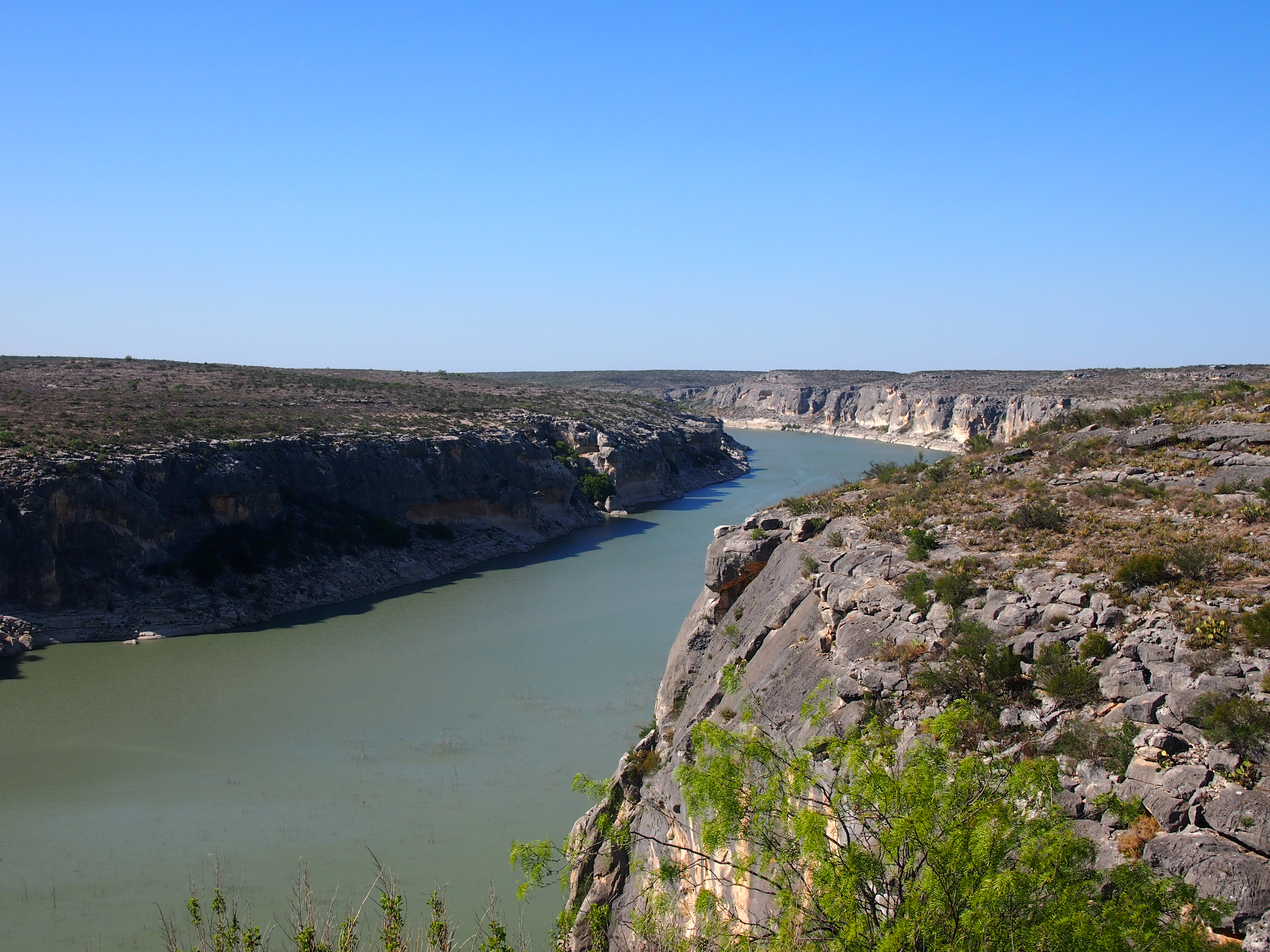
Along U.S. 90, not far west of the town of Comstock, Texas, the road crosses the Pecos River. The east end of the bridge has a place to stop and take in the view. This is looking upriver.
Downriver, toward the Pecos’ meeting with the Rio Grande.
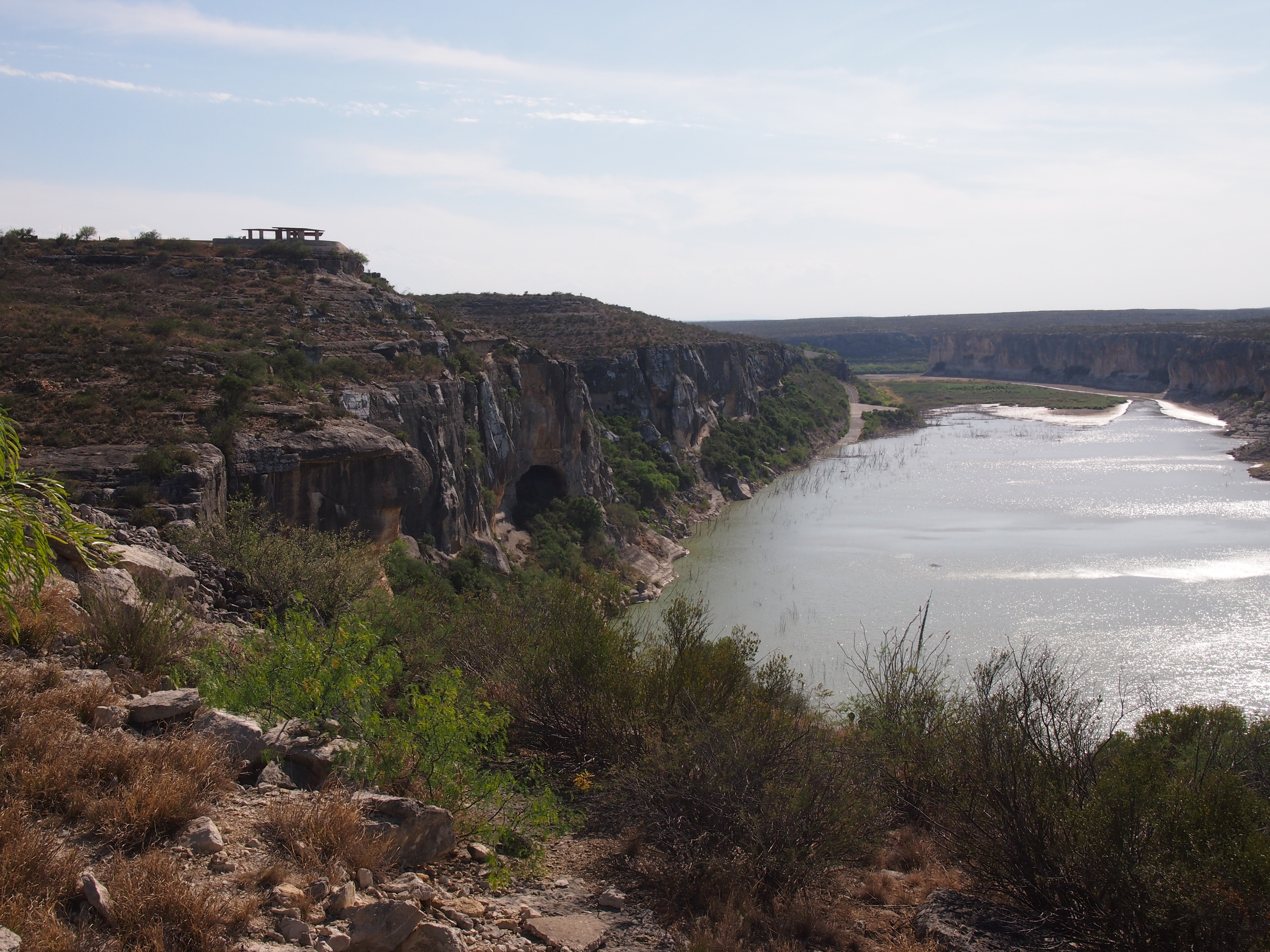
Hard to believe there’s that much water in West Texas. Anyway, the river (of course) marks the beginning of the Trans-Pecos.

One of the grand hospitality properties of the Trans-Pecos is the Gage Hotel in Marathon, originally developed in 1927 by West Texas cattle baron Alfred Gage (born in Vermont), and designed by El Paso architect Henry Trost. Fifty years later, Houston businessman J.P. Bryan bought the rundown property and made it into a modern boutique hotel.

I didn’t stay at the Gage, though I had a good meal there and used its wifi. Instead, I stayed at the Marathon Motel & RV Park down the road. It has all the charms of a tourist court — separate cabin-like buildings of two or four units, even a bottle opener fixed to the wall — at a more modest price than the Gage.

There is an astronomy enthusiast at the Marathon Motel in the evenings, Bob, who sets up a couple of sophisticated telescopes a short walk outside the property and shows guests the night sky, which is pretty dark out in Marathon. I spent about an hour talking with Bob and looking his scopes the first night I was there.

Trouble was, the Moon was waxing gibbous, which made the sky a lot less dark. But we looked at some easy-to-find brighter objects, such as Jupiter and some of the Galilean moons, as well as Mizar and Alcor, and tried to spot the Orion Nebula. Orion was trending toward the horizon, about to bid adieu for the warm months.

Bob said the sky would be dark again a few hours before dawn, but I didn’t get up at that time until the last morning I was at the motel. At about 5 that morning, I woke (for the usual reason), but also got dressed and wandered outside for a few minutes. Bob was right. The Moon was gone, and there was what I wanted to see, no telescope necessary — the wispy, luminous edge of the Milky Way, billions and billions of stars at a glance. It was like seeing an old friend.

Speaking of nighttime spectres, not long after I left Marfa, I stopped along U.S. 67/90 at the Marfa Mystery Lights Viewing Center, which is essentially a rest stop with extra windows in the wall.

I wasn’t about to come that way at night and wait around for a glimpse of a desert will-o’-the-wisp, so I had to be satisfied with a daytime view of the direction of the Marfa lights. Eh.

While driving along I-20 in metro Midland-Odessa, I saw an official highway sign for the Midland International Air & Space Port. What? Space port? Seems a little optimistic on the part of the local airport authority.

Indeed, in 2014 the FAA approved the airport’s application to become first primary commercial service airport to be certified as a spaceport. XCOR Aerospace was due to start flying its Lynx spaceplane from Midland, but the company went bankrupt in 2017 before that ever happened. Oops. Maybe Fireball XL5 will start using Midland International soon. (That theme song has more traction than I realized. Even Neil Gaiman did a cover; once, anyway.)

In Amarillo, I saw another kind of sign. Fake street signs. I was driving along I forget which street, and saw a diamond-shaped sign, off to the side of the road but actually on private property, that said WE CALLED HIM COUNT DRACULA. It was a non-standard color, too: black with red letters.

Huh? But I had driving to do, and other cars not to hit, so the thought passed. Sometime later, I saw another sign — different color, similarly located — that said MINE BY RIGHT OF CONQUEST.

This got me to wondering, and I actually remembered to look into these odd signs. Doesn’t take long to find image collections of the signs, which are all over Amarillo, apparently.

According to Roadtrippers Chronicles — “The Raddest Stories From The Road” — “the strange signs are part of an art installation called The Dynamite Museum. Partially funded by oil heir and patron of offbeat art Stanley Marsh 3 (most famous for his work with Ant Farm on Cadillac Ranch), there are even a few in the nearby town of Adrian (it’s said that Marsh liked the idea of putting the signs in towns that started with the letter A).

“There was no rhyme or reason to the messages on the signs; the people behind the project would come up with ideas, or vote on suggestions sent in, and then install their favorites all over town.”

If I’d known that before I went to Amarillo, I would have looked for more.

The morning I left Amarillo, I had the radio to keep me company on the open road to Oklahoma City (I-40 in our time), and for a while I got a strong signal from Turkey, Texas, to the south. That day was Bob Wills Day in Turkey, and it sounded like a big to-do. The biggest shindig of the year for the town, probably. After all, Bob Wills is still the king.

I didn’t know until I looked it up that the King of Western Swing spent some of his youth on a farm near Turkey. The town of Turkey clearly remembers him. Sounded like fun, but it was too far out of the way. Just another thing missed because of scheduling.

One More Spring Break

The Quasi-Spring Break I had in March lived up to its name, as winter-lite conditions persisted both in metro Chicago and greater New York. Essentially, wherever I was. Even through April until yesterday, we joined much of the nation in complaining about the cold (though I read that Phoenix had its first 100-degree F. day of the year not long ago).

So time again for another Spring Break. Maybe a warmer one. Back posting around April 29.

Till then, some entertaining music videos to watch. Such as the delightful animated video for Caro Emerald’s “That Man,” released in 2010. A fine homage to Saul Bass, and that mid-century style.

For something with a different vibe, “Ghost of Stephen Foster,” a song by the Squirrel Nut Zippers (2000), and another work of homage. This time to the cartoons of Fleischer Studios.

Finally, a charming video for Joni Mitchell’s cover of “Twisted,” which she released in 1974.

I’ve long enjoyed her version, and in fact it’s the first I heard. Listen for the Cheech and Chong vocal cameo.

Thursday Havering

A lot of the ads popping up lately on YouTube have been to promote Canadian tourism. Mostly the ads depict, in music video style, young people doing the kind of vigorous activities that (some) young people must imagine is the essence of traveling to exotic places like Saskatchewan. Actually, one today featured the Yukon.

I’m all for visiting Canada, and encouraging people to do so, but the ads don’t really speak to me. Besides, Canada’s not really top of my mind in November. Then again, it’s good to plan ahead, so you can visit Canada, and even the Yukon, during that short window of opportunity when the place is pleasantly warm.

I never knew until recently that The Proclaimers did a charming version of “King of the Road” back in 1990. No one does it like Roger Miller, but I smile when I hear lyrics like, “destination Bangor, Maine” in that burr of theirs.

“King of the Road,” in the way things go on the Internet, soon leads to a song stuck in mid-60s amber, “Queen of the House.” Even better, the song is done in a Scopitone.

I was in the city not long ago with a camera in the front seat, so I took a few pictures while stopped at traffic lights. Such as this place. So very Chicago.
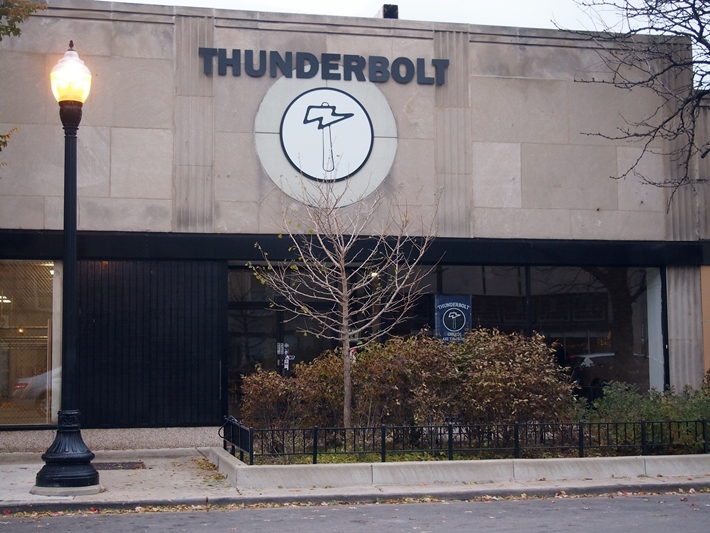
Then there was Thunderbolt.
It’s an ax throwing venue, only the second one in Chicago, according to the Tribune, opening this spring.

“Ax throwing — indoor or outdoor — is a skill-based sport; [owner Scott] Hollander likens it to pool or darts, where participants can take the competition as seriously or lackadaisically as they please,” the paper says.

“Easygoing ax throwers can book an hour at a lane for $15 per person Wednesdays and Thursdays, and for $20 per person Fridays, Saturdays and Sundays. Food and nonalcoholic drink is allowed and can be consumed at the plywood stands behind each pair of lanes or at the picnic tables in the building. Thunderbolt also is available for bachelor or bachelorette parties, birthday parties and corporate events.”

What do I think of when I hear about ax throwing? Ed Ames, naturally. Tomahawk, but close enough.

Thursday Tidbits

Last night Northern Illinois dropped below freezing, and it wasn’t a lot warmer during the day. A taste of winter, dressed like fall.
Fall colors, ChicagoI didn’t know until recently that Lotte Lenya, who can be heard here singing “Mack the Knife,” or maybe more properly “Die Moritat von Mackie Messer,” played Rosa Klebb, the SPECTRE operative who tries to off James Bond with her poison-tipped shoe in From Russia With Love.

Not an important thing to know. Just another one of those interesting tidbits to chance upon.

A rare thing: a YouTube comment that’s actually funny. It’s at a posting featuring “Pack Up Your Troubles in Your Old Kit Bag and Smile, Smile, Smile!” sung by Oscar Seagle and the Columbia Stellar Quartette, recorded January 25, 1918.

Someone calling himself Xander Magne said: ” ‘Praise the Lord and Pass the Ammunition’ ain’t got s–t on this, sonny. Damn 30s kids with their jazz and their swing and their big band and their ‘World War 2.’ We used to have a Great War and it was Great and you liked it!”

One more thing I saw at the International Museum of Surgical Science, a polemic cartoon by Edward Kemble that was part of a display about patent medicine, the Pure Food & Drug Act, etc.

International Museum of Surgical Science, Chicago“Palatable Poison for the Poor.” Whew. Good thing that’s not possible in the 21st century, eh?

Again, too melancholy a note on which to end. Here’s something I saw just before Halloween. Pumpkin π.

Pumpkin π

A bit o’ pumpkin whimsy.

Mr. Hall is Gone, But the Monty Hall Problem Lives On

There needs to be a verb to describe reading an obiturary, or hearing about a recent death, with the reaction: He was still alive? Or she, to be complete. Happens a lot. Example I read about not long ago: Monty Hall.

I can’t deny that I spent some hours of my young life watching him preside over eager costumed contestants vying for a new car! etc. But I didn’t know until a few years ago about the Monty Hall problem.

Another example: Tom Paley of the New Lost City Ramblers, the other musical Tom P who died recently. How many people recorded songs about the war with Spain in the late 1950s?

For an even more obscure version, here’s “The Battleship of Maine” by Red Patterson’s Piedmont Log Rollers. Recorded in 1927, when the war was very much in living memory. It’s a little hard to (easily) scare up information about Red, but it’s possible.

Harvest Moon 2017 & “Harvest Moon” 1992

This year’s Harvest Moon, which I read was a little later than usual, was obscured by clouds last week here in northeast Illinois. The near-full moon was nice and clear the day before, however.

Not long ago I found “Harvest Moon” by Neil Young and its slightly surreal video. I must have missed the song when it came out in the early ’90s. It’s a pleasant tune, practically a lullaby for adults. For middle-aged adults, to be more specific.

And who’s the guy always sweeping as the song goes along? Father Time would be my guess. Everything is swept away by time, after all.

I’ve written about named moons before. A fair long time ago, in fact. I suspect that most of the links at this posting about the Hunter’s Moon, the more obscure relative of the Harvest Moon, are long gone. Ten years is geologic time for YouTube.

September Pause

Back to posting again around September 17. Constitution Day. Maybe I’ll have finished the Federalist Papers by then.

It might also be warm again. A distinct October-like coolness has settled on northern Illinois since Labor Day.

Saw a cherry picker in the neighborhood recently. The man atop the equipment was repairing a street lamp that had gone a little funny. Not out, just flickering from time to time.

cherry picker

Why a cherry picker? Why not apples or lemons? And why do careless or unscrupulous researchers cherry pick their data? Why not grape harvest it?

Speaking of fruit, completely by chance down an Internet rabbit hole recently I came across the Citronaut — the first mascot of Florida Technical University, which eventually became the University of Central Florida. He’s an anthropomorphic orange wearing a space helmet, dating from 1968.

Florida produces citrus and shoots men into space, so it must have seemed like a bright idea. For a very short time. Says Wiki: “After one year, students petitioned the Student Government to establish a new mascot for the university.” Poor old goofy Citronaut was ignominiously dumped. You’d think he could have gone on to shill Tang or something.

The thought of Tang led me to another Internet rabbit hole. Eventually I came across the Tang Pakistan page. Is Tang popular in Pakistan? Could be. At least it seems more advertised there than its country of origin.

The About Tang page is in English, and includes such sentences as: “Being the king of flavours, its fruity and refreshing taste wins millions of hearts every day. Be it family gatherings, group studies, play days or summer struck – Tang is the Neverland for everyone to indulge, lift their moods and bond together to share good times.”

Not a peep about astronauts.

Over the Labor Day weekend, I watched The General on DVD. I’d only ever seen clips of it. It’s one of the most kinetic movies I’ve ever seen. Fittingly, with locomotives chasing each other and Buster Keaton all over the place, doing his own stunts. Funny stuff. I’m glad a movie more than 90 years old can still be so amusing.

Some scenes were flat-out amazing. Best known, probably, is when a locomotive causes a trestle to collapse, precipitating the engine into the river below. As I looked at that, I thought, that looks awfully real, not like a model. Turns out it was a real locomotive shot falling into a river (like the train fall in Bridge On the River Kwai).

Sean Axmaker writes in Silentfilm.org: “For the scene in which Johnnie sets fire to a bridge to prevent the North’s engine from crossing the river, Keaton had [set designer Fred] Gabourie construct a stunt trestle designed to collapse under the train’s weight. It was the only sequence that did not use existing track and it has been called the most expensive single shot in silent film history (Keaton biographies put the cost at $42,000).

“It is certainly the most expensive that Keaton ever executed. He had only one shot at the scene and ran six cameras to capture the spectacle. The engine that plunged into the river was one of the doubles used to stand in for the working engines and it rested there in the water, rusting away for 15 years until it was hauled out for salvage in the scrap drives of World War II.”

Later I looked up the female lead in the movie, Marion Mack, a one-time Sennett Bathing Beauty. She got tired of being in movies around the time talkies started, and lived a long time after, until 1989, including a career as an Orange County real estate broker. As for Glen Cavender, an original Keystone Cop who played antagonist Capt. Anderson, he lived until 1962. He seems to be an example of one of those actors that didn’t transition well to talkies, though he kept working.

The actual leader of the 1862 Great Locomotive Chase was James J. Andrews, a civilian scout for the Union Army. Things didn’t turn out well for him, since the Confederates hanged him. He lost out posthumously, too. This from Wiki: “Some of the raiders were the first to be awarded the Medal of Honor by the US Congress for their actions. As a civilian, Andrews was not eligible.”

You’d think Andrews should get something, even now, such as the Presidential Medal of Freedom or the Congressional Gold Medal, which go to civilians.

One more thing about a movie. Recently I happened across this video on You Tube.

It’s a remarkable bit of editing to go along with Elmer Berstein’s justly famous, magnificent Magnificent Seven main theme, right down to Steve McQueen’s smile in the last frame. The video featuring the theme from The Good, The Bad and The Ugly is also worth a watch.

The Act You’ve Known All These Years

On the radio the other day, I heard an ad for the upcoming Fest for Beatles Fans at a Chicago-area venue, which is what I got for tuning into geezer radio at that moment. Not that I dislike the subject matter. Just the opposite. But I don’t feel the need to attend a convention about the Fab Four.

Still, I was amused to hear that one of its featured speakers is Leon Wildes, senior partner of Wildes & Weinberg P.C. He’s the attorney who successfully represented John Lennon in his deportation proceedings in the 1970s, which ultimately allowed him to stay in the United States. It probably would have been better for Lennon had he been out of the country in 1980, but no one could have known that beforehand.

In June, I was reminded of the 50th anniversary of the American release of Sgt. Pepper’s Lonely Hearts Club Band, which I have on CD. I hadn’t listened to it in quite a while, so I decided to during a somewhat rare daytime moment when I didn’t have any pressing business, and no one else was home.

But the only device I have now to play CDs is the DVD player connected to the TV. Older standalone CD players have all gone kaput, never to be replaced, and the CD trays of our laptops have all likewise broken, one after the other — a clear mechanical weak spot in laptops. So I played the disk (I really want to call it a record) on the DVD player, using the TV speakers.

My conclusion? Those speakers aren’t nearly good enough for a work of sonic charm like Sgt. Pepper’s.

An Exaltation of Victrolas

Supposedly the collective for larks is an exaltation, though I don’t know that anyone familiar with larks actually uses it. Seems like one of those made up, like so many others, for the Book of Saint Albans in 1486, and surviving on lists to this day.
That comes to mind because I was wondering what the collective for Victrolas might be. Exaltation fits. An Exaltation of Victrolas.

The suburban mansion we toured in July not only had massive orchestrions that played orchestral music without any human musicians, and many arcade machines of yore, but also Victrolas and other phonographic systems with pronounced horns. A lot of them. An exaltation of them.

I went all snap-happy and spent time taking pictures of them. The horns, not so much the mechanisms. I’d never seen such an array. The only thing close was the selection of 78 players for sale at Harp Gallery in Wisconsin.

Note the collection of Edison Records cylinders that the machines above use.

In this room there was one machine — not pictured — that was powered by the heat of a candle. Light the candle, put it inside the cabinet, let it play. “I wanted to show you this machine,” the guide said as he held up the candle. “But we almost never play it. It can catch fire.”

All of the mansion’s Victrolas are in working order, I understand. All you need is a vinyl record (or cylinder) of some early kind, which are still around. In a century’s time, will there be a collection of iPods and other gizmos like this? They will probably be hopelessly unplayable.