The Noah Bell on My Nightstand

Ted Striker: Mayday! Mayday!

Steve McCroskey: What the hell is that?

Johnny: Why, that’s the Russian New Year. We can have a parade and serve hot hors d’oeuvres…

April ended with heavy rains and chilly air. May Day passed under gray skies, with equally chilly air. Yet the grass is long, buds are everywhere, and birds are noisy in their pursuit of making baby birds.

Sometime in the spring of 1986 (probably), I bought a noah bell at a Wicca gift shop in Austin. Strictly speaking, I don’t think Wicca had anything to do with the store, which was stocked with crystals and incense and other esoteric-flavored knickknacks, but that’s how I referred to it later. Maybe that’s gross insensitivity to Wicca, but even my enlightened Austin friends got a chuckle out of the description. Things were different in the ’80s, I guess.

In our time, naturally, one doesn’t even have to go out to find Wicca supplies.

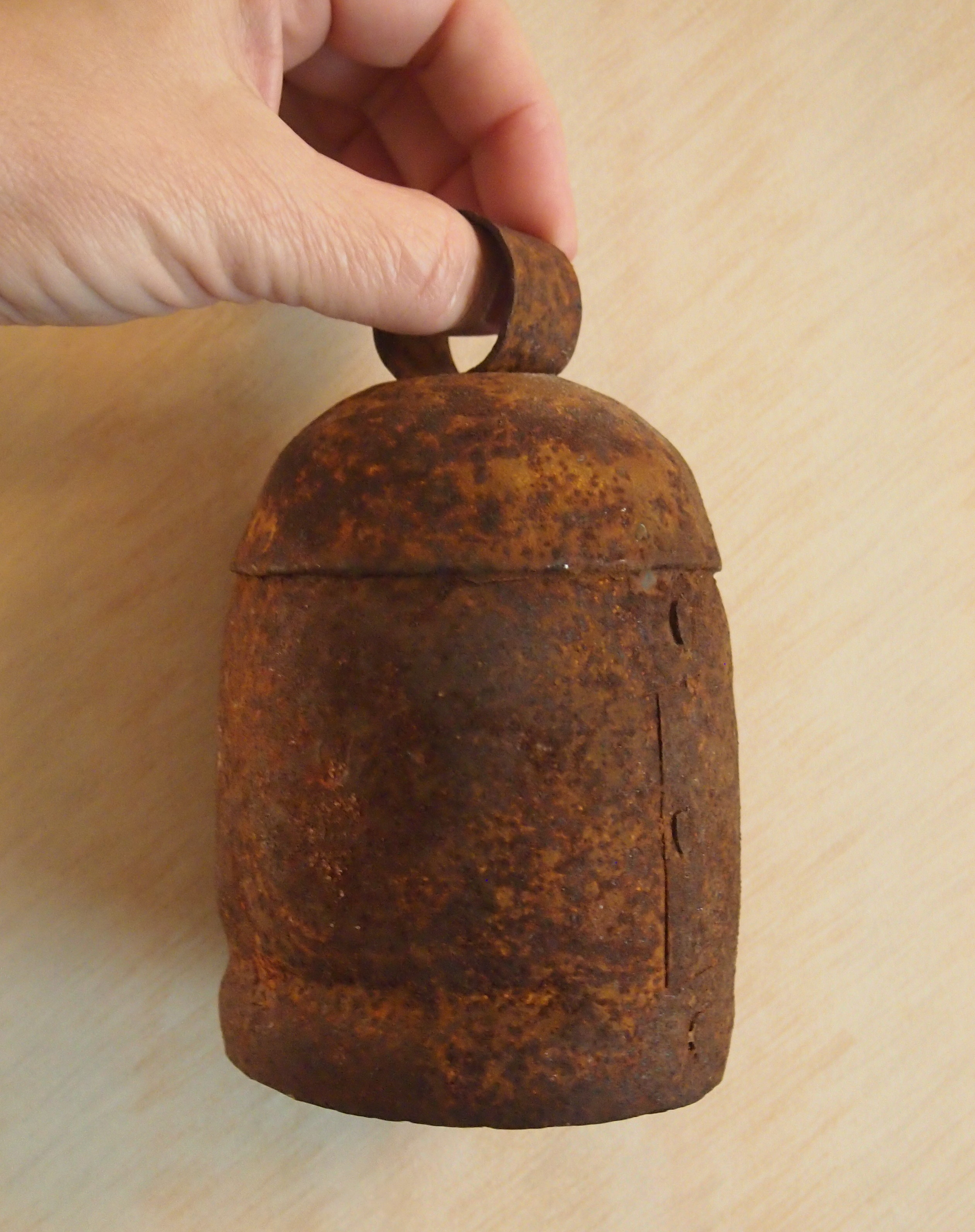
Thirty years later, this is my noah bell.

noah bellThis is what it sounds like, struck with a stainless steel spoon: Noah bell rung three times.

Interestingly enough, it sounds about the same when struck with a plastic pen. Note that there’s no clapper. There used to be one, which was made of wood, but it disappeared sometime over the last three decades. It wasn’t made of copper, so I know it wasn’t stolen.

My bell is about 4¾ inches (12.5 cm) tall, not counting the ring on top, and 3 to 3½ inches (up to 9 cm) in diameter, since it’s more oval than circular. A smaller noah bell with a clapper sounds like this.

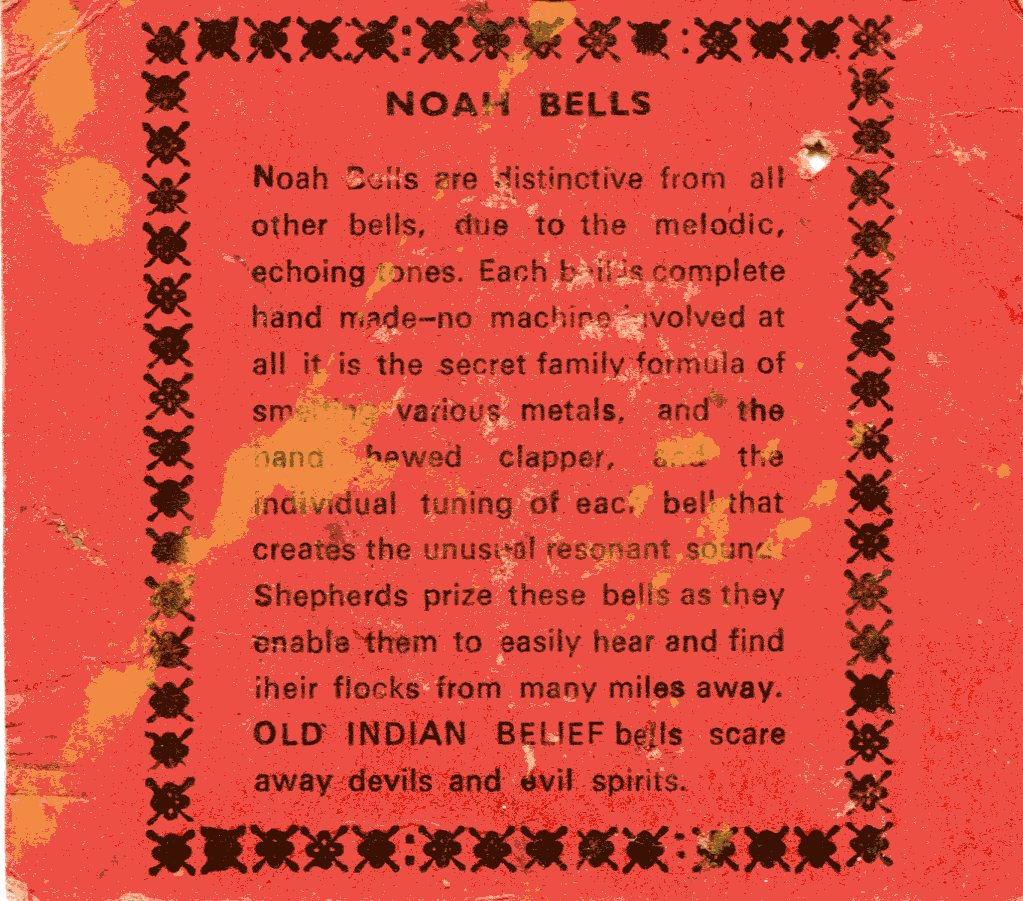
I still have the large tag that came with my noah bell, because of course I do.

Noah Bell FrontSo it’s not just a noah bell, but a Maharani brand noah bell. A maharani is the wife of a maharajah, so I suppose that’s like naming your brand Queen or Empress.

Noah Bell BackOLD INDIAN BELIEF needs to be all caps? That’s told of other bells as well, and I have to wonder what kind of lily-livered devil or evil spirit would be scared off by the sound of a bell. Don’t they cover that in evil spirit training? Then again, I ring it around here sometimes, and we’re not bothered by evil spirits that I know of.

The company that imports these bells from India is called Maharani Imports. According to its web site, “Maharani Imports specializes in whimsically themed wind chimes and mobiles made with recycled iron, handmade fused glass beads, and Noah Bells all assembled together in Mumbai. We also have many costume and semi-precious necklaces, earrings, and bracelets…

“We are based outside of Dallas in a small rural town called Bartonville. The company has been in that location since 1980 and we are located on a 30 acre ranch property with many rescued animals. Namely we have about 6 donkeys and 9 llamas, which we welcome you to come visit by appointment if you are nearby!”

Bartonville’s just south of Denton, and I’m not so sure that it’s particularly rural any more. But I can see how the good folks at Maharani Imports might have discovered Austin early as a solid market for their products. My own noah bell now spends most of its time on the nightstand near my bed, along with a lamp, a stack of books, a small statue of Lincoln, and some other bibelots.

Ravinia Circular ’16

The annual circular advertising this summer’s shows at Ravinia Festival arrived in the mail recently. Wonder how long printed circulars of this kind will be mailed at all, but for now they are.

It’s been a while since I’ve been to the venue, but I’ve enjoyed all of my visits, such as the long-ago August night in 1989 when a lunar eclipse was visible high over the concert. Or our attendance of a children’s concert in July 2002.

Ravinia 2002Ravinia, in Highland Park, Ill., on the North Shore, is the Midwest’s Wolf Trap. Or rather, since Ravinia’s a lot older than Wolf Trap, with outdoor music performances held there for more than 100 years — Wolf Trap is the Ravinia of the East Coast, open only since 1970.

In any case, Ravinia gets some A-list acts, and charges accordingly. Prices are for seats in the pavilion or for lawn seating, and they’re printed on the circular. Some of the concerts, especially lawn seating for some classical musicians, charge a reasonable $10, and I’d seriously consider paying $25 to hear the CSO play the entirety of The Planets while I relax on the lawn. (And ponder whether that should be “The Planets” or The Planets.)

On the other hand, I was curious to see who commands the highest pavilion seating ticket prices. Is it Bob Dylan? No. Paul Simon? No. Don Henley? Dolly Parton? Diana Ross? Nope. Those are all close, but Duran Duran tops the list at $160 a pavilion seat, and a steep $55 for a lawn ticket. Moreover, they’re playing two nights in a row, which is fairly rare at Ravinia.

Am I missing something? I remember Duran Duran as a tolerable early ’80s band that had a handful of hits. Must be their fan base is larger than I realize. Even so, here’s something I’m sure I’m missing: Duran Duran at Ravinia for $160 a pop.

The Impermanence of the Wisconsin Buddha

The Wisconsin Buddha cracked apart sometime this winter. (How many times in the history of English has that exact sentence been written?) A little background is in order. Some years ago — when we lived in the western suburbs of Chicago in the early 2000s — we visited southern Wisconsin one weekend, and chanced across a yard sale, though I forget exactly where. We acquired the Wisconsin Buddha there for a modest sum.

It’s an inexpensive ceramic yard ornament, jade green with flecks of blue. It’s also an Indian-style seated Buddha, in as much as I understand Buddhist iconography. Could be a bodhisattva for all I know. Very likely the operators of the Chinese factory that churned out thousands of them cared little about their representational meaning, though at some point, someone had to design the thing, and perhaps they had something specific in mind. Maybe it’s patterned after a sculpture I don’t know.

That reminds me of the estimable Charles Hambrick, the professor who taught my Eastern Religion class. Professor emeritus these days, but last I heard still with us. The concept of the bodhisattva came up in his class. A friend of mine was sitting next to me, and he said, “That’s what the song is talking about!” Yes, indeed.

Since we acquired it, the Wisconsin Buddha’s been for us, fittingly, a yard ornament. Does that count as doing its dharma? But it’s inanimate so — I don’t know, and will leave it at that. First the statue was in our back yard in the western suburbs, but for the last 13 years or so, it’s been perched here in the northwestern suburbs under some bushes near a fence that divides the back yard from a small bit of land that connects to the front yard. If you didn’t know it was there, it would be hard to spot.

On Sunday I was cleaning debris off our deck and noticed that the figure was face down on the ground. Looking more closely, I saw that it had cracked all the way across horizontally, a few inches from its base, and the top part had fallen over. A cycle of freezing and thawing? Wind? The dog, who sometimes goes near that fence? Something else?

I put the pieces back together again, and I may or may not glue them together. I’ll take this as a lesson in impermanence.

When It’s Springtime Around the 42th Parallel

So many signs of spring. So many, in fact, that they aren’t signs any more. They’re simply things that happen in early spring.

It’s warm enough to eat lunch on my deck, for instance. Which I did today for the first time since some day in the fall when I sat there and wondered when the next time would be — not till April, I probably thought. (Not counting a couple of al fresco meals in Austin last month.)

The birds are noisy and the robins in particular are doing their bob-bob-bobing, as famed in song. I spotted a large rabbit near the house this afternoon. Pregnant, probably; breeding like, well, a rabbit. The grass is green and post-crocus flowers are emerging, including dandelions. A few men on the block can’t wait to mow the still-short grass, and I’ve heard them mowing it. I can wait. Today kids were playing baseball in the park behind my house.

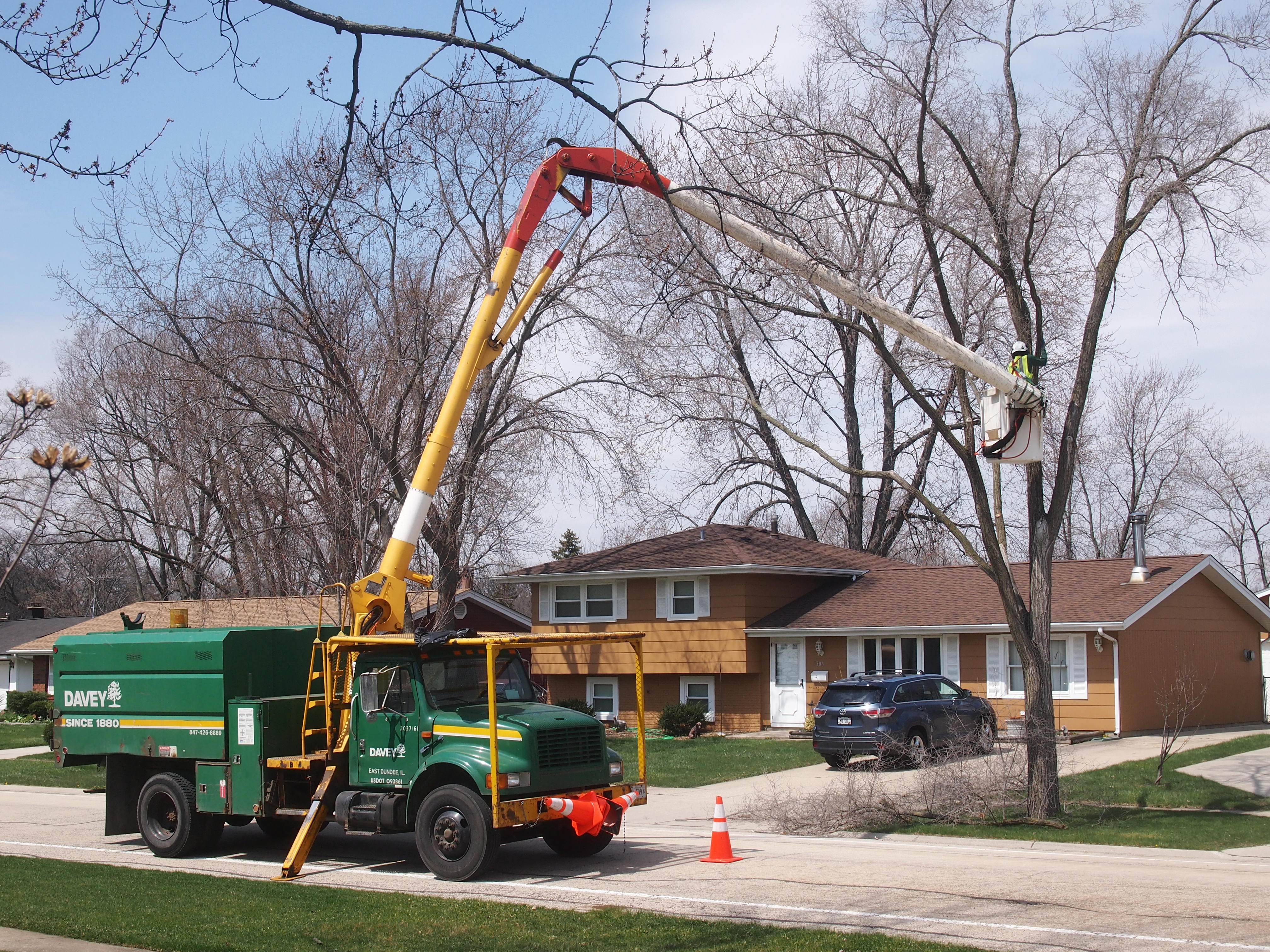
Then there’s the cherry-picker on my street.

Cherry picker, Schaumburg, IL April 2016A crew contracted by the village came by recently to trim the trees along the street. A new thing. Unless I’ve happened to miss them every spring for more than a decade, which is unlikely, considering my self-employment, which started 11 years ago today. Blimey.

RIP, Jim Ridley

I didn’t know Jim Ridley, but I knew of him, and had I lived in Nashville longer than I did, I might have easily made his acquaintance. Lately he was the editor of The Nashville Scene, the alternative paper in that city, but was best known as a film critic. Stricken with heart attack late last month, he died Friday at the unnerving age of 50.

As it was, I also just missed knowing him at Vanderbilt, which he attended as a freshman the year after I graduated. He wrote for both Versus (the student magazine) and The Hustler (the student newspaper) that year, both of which I had just finished writing for. This is the picture of the Versus ’83-84 staff from the ’84 yearbook.

Versus Staff 1983-84Jim Ridley’s the large fellow toward the right of the picture with his hand on his head. As I said, I didn’t know him, but I did know more than half of the other people in that picture, all of whom were involved in one way or another with VU student publications when I was there.

Here’s his obit from his own publication, and an appreciation from another film critic. RIP, Mr. Ridley.

Also: a fellow named Archie Dees has died. I didn’t know him either, but Indiana University remembers him as a basketball star whose heyday was in the 1950s (he was 80 when he died). I noticed that he was originally from Ethel, Mississippi, though he went to high school in Downstate Illinois. His central Mississippi roots and his surname very likely mean we’re cousins of some kind. Go back far enough — a century and a half, maybe — and we’re sure to have some common ancestors.

The Seven Wonders, Overheard

Today I overheard another conversation, this time in line in an ordinary store in the ordinary suburb I call home. A man and a boy were taking, father and son, I assume. They too were about as ordinary as could be, both wearing sports logo shirts (Backhawks and Cubs).

“There was the Great Pyramid,” the father said.

“And the lighthouse and statue of Zeus,” the son said.

“Yes, and the mausoleum and the hanging garden and the lighthouse, and what else?”

“I already said the lighthouse.”

“Right. Now let’s see…”

They were talking about the Seven Wonders of the World. Maybe the boy, about 10, had been studying them, though I’d be hard-pressed to imagine they come up in school any more. Or in living memory. I didn’t learn about them in school. Maybe the boy had his own interest in them, or maybe the father did. Anyway, it isn’t something you overhear in line every day. Or ever. Until now. It made me smile, though I didn’t say anything.

I’m reminded of them time when some friends and I were in line to see a movie in Nashville, ca. 1986, and somehow the subject of the Frisian languages came up, including the notion that Frisian is as close to English as any language is, without actually being English. We’d heard that was the opinion among linguists.

A fellow behind us in line — this was at the movie theater at Vanderbilt — was visibly astonished. He felt he had to speak up, apparently, and he asked us how we’d heard about Frisian. He was from the Frisian Islands, he said, though at school at VU.

I don’t remember what we told him. I’d heard of Frisian somewhere before, maybe first in my American Heritage College Dictionary, which has a fine family tree diagram of Indo-European languages, with Frisian on it as a close cousin to English. No doubt he’d resigned himself to not bothering to tell Americans he was from the Frisians, but rather from the Netherlands or Germany.

See You Later, Alligator

While walking the dog during the most recent warm day — a few days ago now — I passed a knot of grade-school kids and their bicycles across the street. I didn’t pay them much attention, but after I’d passed by, I clearly heard one of the boys say, directed at one or more of the others, “See you later, alligator! After a while, crocodile!”

People still say that? Kids still do? It sounded old even when I was young, though I can’t say I heard it much. Later I heard the mid-50s song of that name, recorded by Bill Haley, which seems to have popularized the phrase, but not invented it.

I’d always imagined it was from the ’20s. It sounds like it belongs in the same league as the bees’ knees or 23 skidoo or the like, but after looking around a little, its exact origin and timing remain elusive. One source speculates it started with Swing devotees of the late ’30s, which is plausible, but who knows?

On the other hand, I do know that the phrase lives on in the 2010s. Maybe some celebrity who appeals to kids is saying it now.

The Manliest Vegetable

Today was one of the days that should be warm, but isn’t. Winter doesn’t want to let go. It even snowed a little, with cold rain predicted for the rest of the week. Bah.

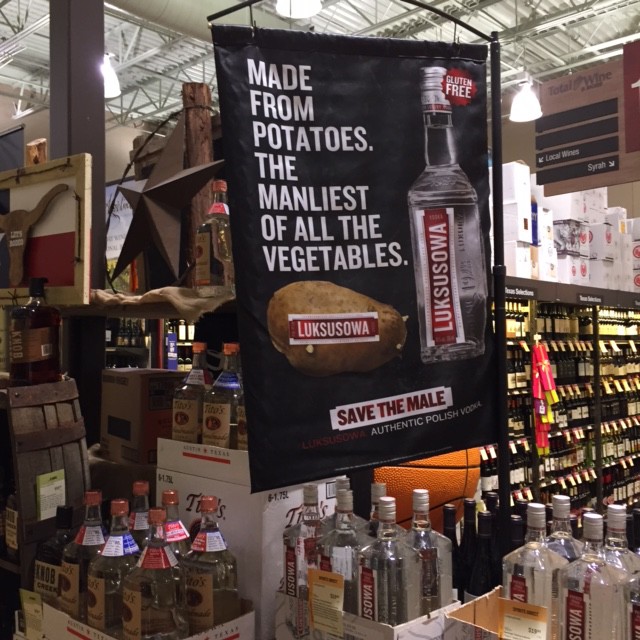
I don’t have what it takes to be a drinking man, but I did visit a large liquor store not long ago, along with my brother Jay. That’s where I learned that potatoes are the manliest of all vegetables. Who knew? That’s a promotion for the humble spud, I think. Jay documented the evidence with his phone.
Total Wine & More San AntonioDeutsch Family Wine & Spirits imports the vodka into the United States, and its web site says: “Luksusowa Vodka (pronounced LOOK-SOO-SO-VAH) was created in 1928 in Poland. Luksusowa means ‘Luxurious’ in Polish… A smooth, rich, high-quality imported vodka that beats the competition in terms of flavor, mouthfeel & price.”

Mouthfeel? I’ve never heard of that before, but it’s one of those words that instantly explains itself.

Man’s Fierce Hand

Leap Day once again. It’s a Monday, so it should be a holiday, but Congress doesn’t have that kind of imagination.

Does anyone really shoot fish in a barrel? Did anyone ever do that? Was that sport somewhere, say in the 19th century, when firearms and barrels were readily available, and many strange things were done in the name of entertainment?

The saying represents something exceptionally easy, of course, but even so I’m not sure it would be. Let’s assume the barrel is full of water as well as fish. Unless we’re talking about really large carp or some such, you might disturb the water and scare the fish, but I’m not sure how many small fish would actually be hit. Also, you’d think that shooting would soon destroy a wooden barrel and cause a dangerous amount of flying debris. Or if it were a metal barrel, such as a steel oil drum, the danger of ricochets might be high.

This is something for the Mythbusters fellows to investigate, but I suspect that shooting fish in a barrel never was anything but a metaphor, and by now a hackneyed one at that. So I’m reluctant to say that making fun of a press release I received recently — especially the first line — is like shooting fish in a barrel. But it cries out to be mocked. Here’s the first line:

“When people picture the Appalachian cultural region of the Eastern United States, they envisage a beacon of wonder and natural beauty left untouched by man’s fierce hand.”

There’s certainly still natural beauty in the Appalachians, but as for the “cultural region,” that’s not the first thing that comes to mind. Then there’s the matter of mountaintop removal mining. Among other feats of mineral extraction. I’m fairly sure that counts as man’s fierce hand.

All My Eye and Betty Martin, Thursday Edition

Sure enough, more snow yesterday. But not much more, and most of it melted today. The snowfall didn’t even mess up the roads very much. Or my driveway. If you don’t have to shovel it, you can’t say it really snowed.

Been reading more by the chattering classes than usual lately, maybe because they’re chattering a lot now. With some reason. There’s also a sizable share of hyperventilating Chicken Little-ism about the political rise the short-fingered vulgarian. He’s going to be the end of Republican party! Of movement conservatism! Of American democracy! Of truth, justice and the American way!

I have to be skeptical on all counts. Of course, I could be wrong, and I’ll be the first to admit it as soon as goons come to take me to one of the detention camps of the new order.

This is some hard candy Yuriko brought back from Japan last month. Or rather, these are images of the Gold Coin of the Meiji Era tin, front and back. We’ve almost finished the candy inside.

Gold Coin of the Meiji EraGold Coin of the Meiji EraThe candy, which is roundish and yellow, is pretty good, but I like the name best of all. The coin pictured on the tin isn’t some fanciful latter-day re-creation, but an image of an actual gold coin of the Meiji era, just like this one, dated 1870 (Meiji 3). Except that the one on the tin is a 20-yen piece, rather than two yen.

Quite a bit of money at the time, and a coin of great beauty, from the looks of the photo. I wouldn’t mind having one, but it isn’t something I want to spend big bucks for. I’ll settle for the Meiji-era copper two-sen coin that I do have, which only cost a few modern dollars.

One more thing along these lines: We cast pearls before swine. The Japanese give gold coins to cats: 猫に小判 (neko ni koban).

And one more coffee cup currently on our shelf.

Oh ShitLilly got that from a friend of hers for Christmas this year. Ha-ha. It reminds me that adults should not use that word. In fact, anyone older than about six or seven should steer clear of it. Certain words should be confined to little children, and that’s one of them. Yet I’ve seen poop used in more-or-less serious writing by people whom I assume are grown. Knock it off.

Coffee Makes Me Crap would be the slogan for short-fingered vulgarians, maybe. Funnier would be Decaf Makes Me Defecate. I don’t drink coffee anyway. Better for me would be Tea Makes Me Pee. True indeed.