Air Plant Trio

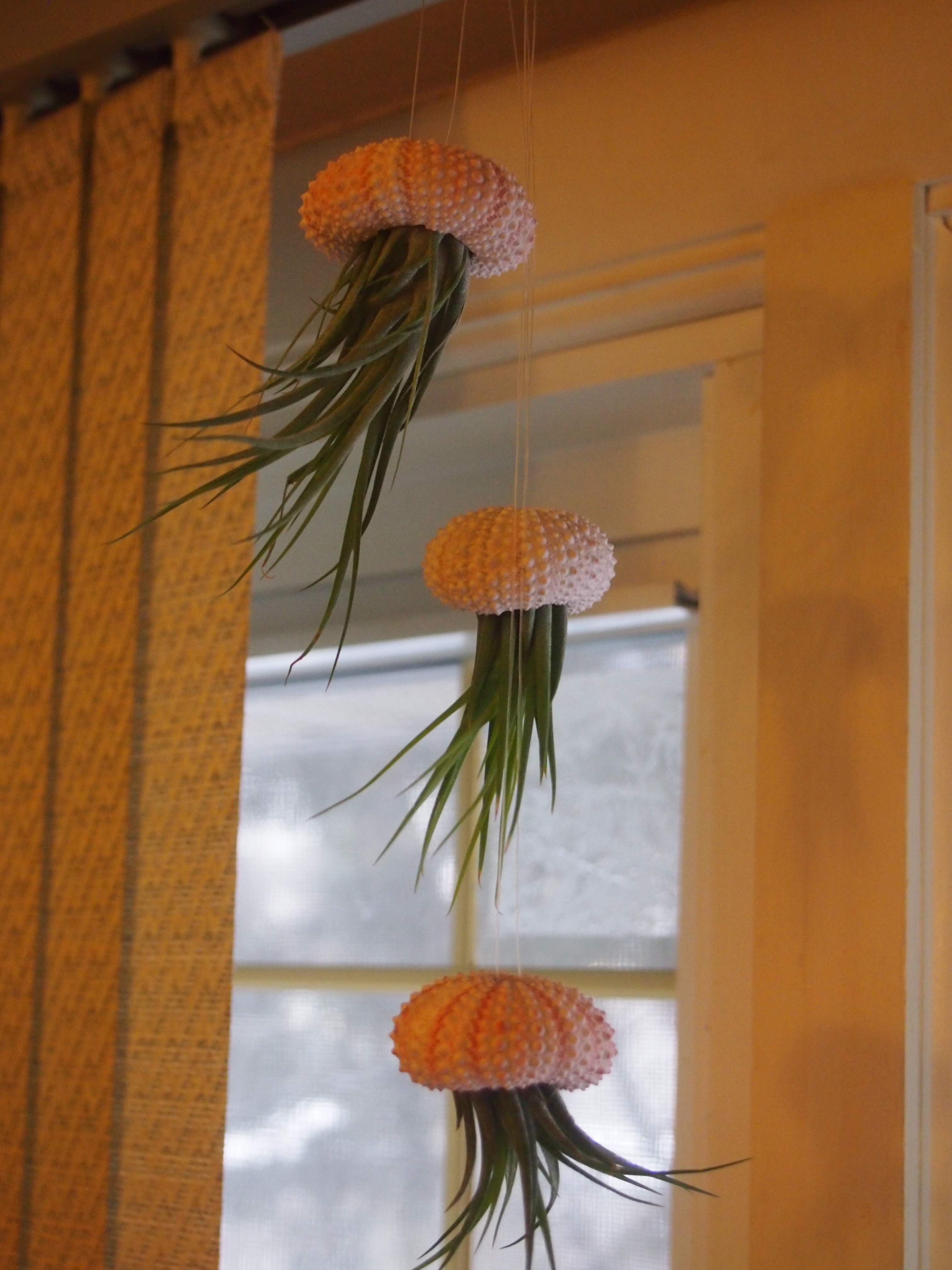
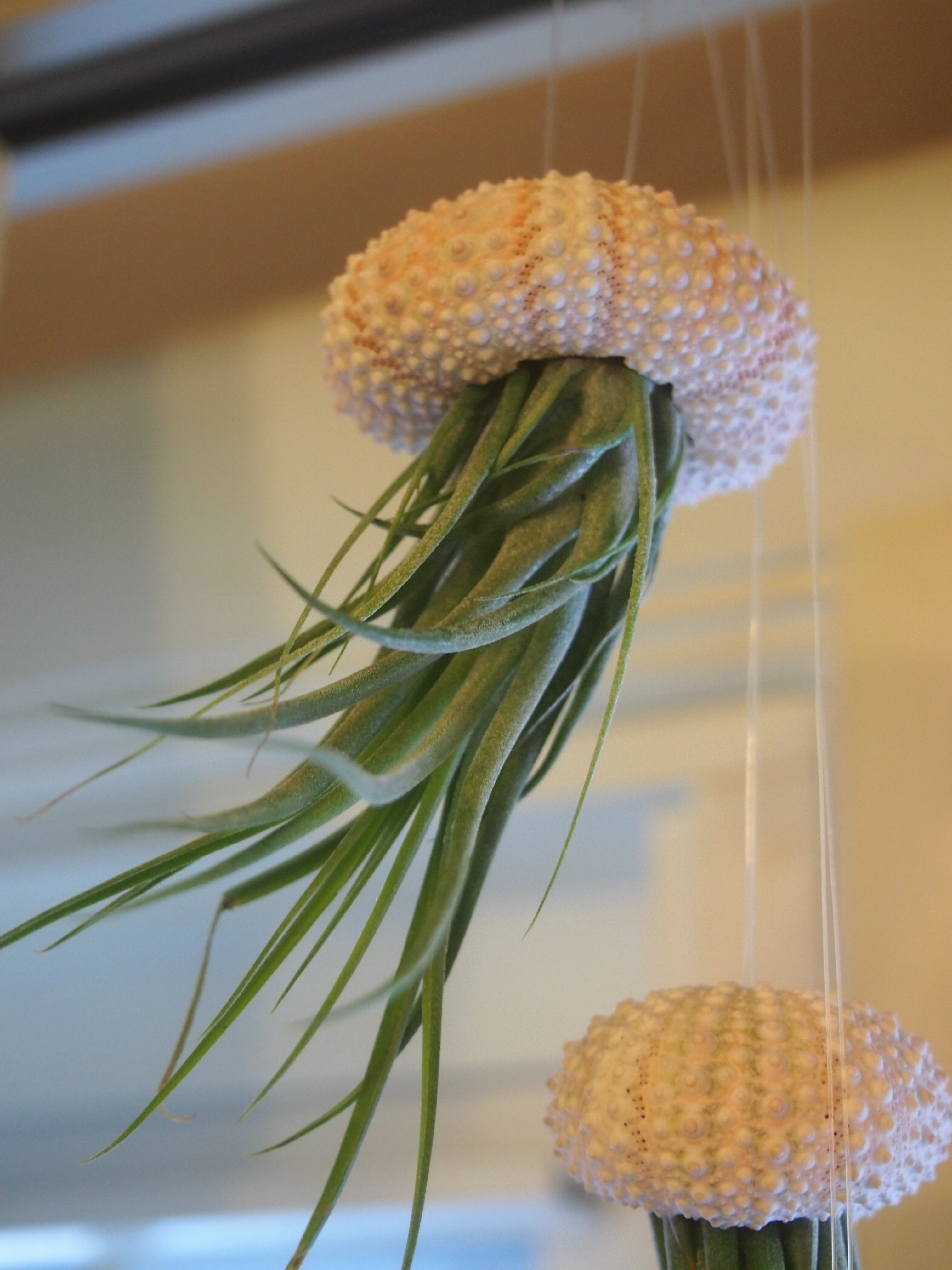
Lately we can look up from our dining table and see a trio of tillandsias.

Air plants 2015“Tillandsia is the largest genus in the bromeliad family, accounting for approximately 550 of the over 2,500 species of bromeliads,” the aptly named Plant Oddities web site tells us. “They are native to the warmer climates of the Americas. Commonly known as air plants, they are found from jungle to rain forest to arid desert environments – from sea level to high mountain regions.

“Most Tillandsia species use their root systems to attach themselves to trees or rocks and absorb moisture and nutrients through their leaves. This classifies them as epiphytes. Absorption occurs through small scales on their leaves called trichomes… Since Tillandsia’s are epiphytes, the mounting medium you choose is limited only by your imagination. These hardy plants are adaptable and tolerant to a wide range of environmental conditions and require minimal care.”

boss air plant 2015My nephew Dees and his girlfriend Eden thoughtfully sent us these air plants for Christmas. The last time I was at their apartment in Austin, I’d seen some hanging near one of their windows and asked what they were.

Efficient Neighbors & Us

Rec’d a letter from our electric utility, ComEd, a while ago — a “Home Energy Report,” it says, for the period October 25 to December 26. I don’t remember seeing one before. Could be members of utility middle management cooked them up for the purpose of better serving the energy-consuming public. That or keeping busy.

The letter says we’ve used 2 percent less electricity than my “efficient neighbors” for the two-month period above. Who? It helpfully explains the universe of neighbors in this case is about “100 occupied nearby homes that are similar in size to yours and have gas heat.” Efficient neighbors are the “most efficient 20 percent from the All Neighbors group.”

Ah, but over the last 12 months, we’ve used 20 percent more electricity than those efficient people, the letter also says (yet still less than the universe of 100 neighbors). Makes me think the most recent months are a fluke. Can’t think of anything we’ve been doing to cut electric use, though I’ve switched off a lot of lights in empty rooms. But I’ve always done that.

Never mind, we can still claim to be righteously green. A nice letter is one thing, but what about a rate reduction. No? I didn’t think so.

Thursday Odds and Ends

Throwback Thursday? Where did that come from? I’m always late to the meme party, not that that makes any difference. I first saw the term after I sent my old friend Tom an image of him that I scanned from a color slide.

TomJones1979I took it outside my house in the spring of 1979, and it’s now proof that Tom once had hair. He posted it on his Facebook page on Jan. 1, calling it a “Throwback Thursday” picture (though curiously, Jan. 1 is a day people tend to look ahead). I don’t think I’ll throwback on Thursdays, except for this picture. Thursday’s a good day for odds and ends, though.

Part of Isaac’s Storm, which is mainly about the Galveston Hurricane of 1900 (see Jan. 19), mentions previous big blows in passing, such as the Great Storm of 1703, which slammed into Great Britain. I didn’t know, for instance, that that storm destroyed — completely scoured off the rocks — the first Eddystone Light. With builder Henry Winstanley and his crew, who were doing repairs, still inside. More about all four lighthouses on those rocks is here, including the incredible fate of the lighthouse keeper when the second one burned down. Here’s a short of a fellow visiting the current lighthouse (a cool destination if there ever was one).

I don’t think I have the patience to read Daniel Defoe’s work on the subject, The Storm — or, to give it its full name, The Storm: Or, a Collection of the Most Remarkable Casualties and Disasters Which Happen’d in the Late Dreadful Tempest, Both by Sea and Land — which is available thanks to Project Gutenberg. But it’s good browsing. Some people died in 1703 from falling chimneys, for instance:

In Threadneedle-Street, one Mr. Simpson, a Scrivener being in Bed and fast a-sleep, heard nothing of the Storm; but the rest of the Family being more sensible of Danger, some of them went up, and wak’d him; and telling him their own Apprehensions, press’d him to rise; but he too fatally sleepy, and consequently unconcern’d at the Danger, told them, he did not apprehend any Thing; and so, notwithstanding all their Persuasions, could not be prevailed with to rise: they had not been gone many Minutes out of his Chamber, before the Chimneys fell in, broke through the Roof over him, and kill’d him in his Bed.

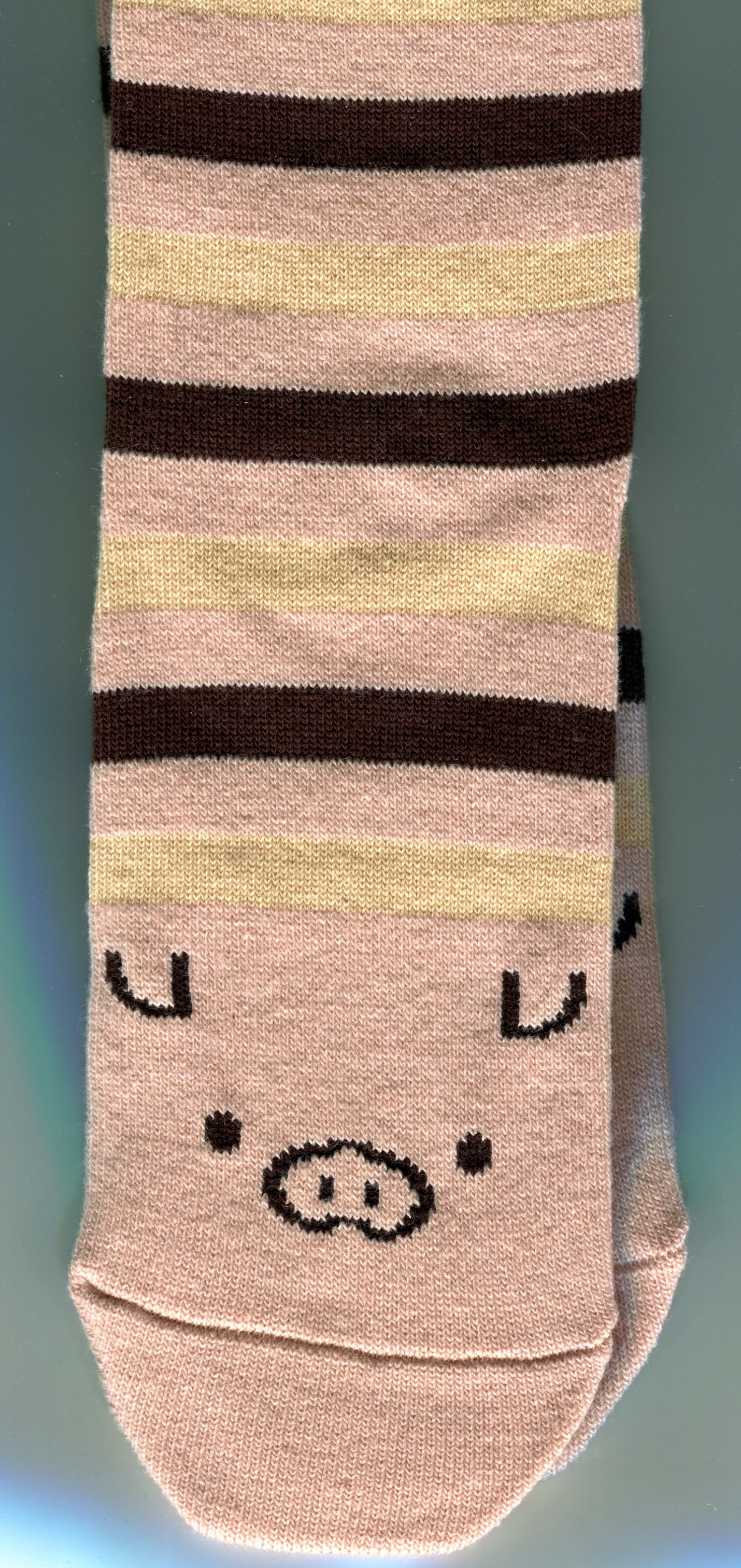
I suppose that counts as a throwback, too, though I bet most people who use the term don’t go back as far as 1703. So here’s something new: socks that Yuriko brought back from Japan for Ann.

JsocksToo cute for words, as Japanese design sometimes is.

An Early Three-Cent Card

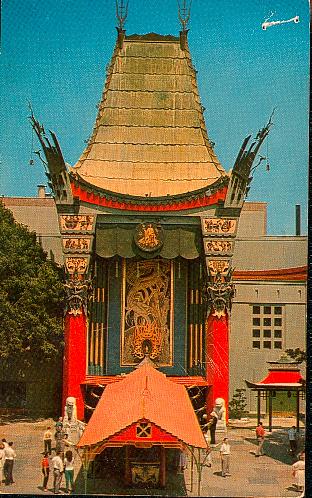
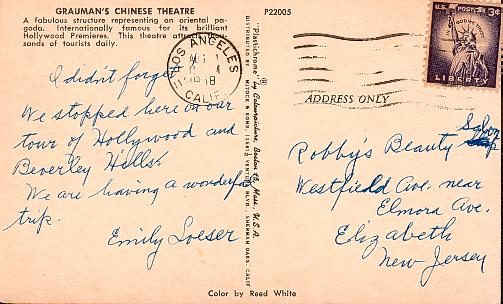
The U.S. domestic postcard rate went up to 3 cents on August 1, 1958. The postmark on the following card clearly says August 1958, but the exact date is impossible to suss out. Its message is also short and to the point — from the West Coast back to the East Coast, an image of Grauman’s. Lots of people have been there before and since. Graumans1958.1Gaumans1958.2I didn’t forget! We stopped here on our tour of Hollywood and Beverly Hills! We are having a wonderful trip.

Emily Loeser

It’s addressed to Robby’s Beauty Salon (originally “shop,” but it’s crossed out) in Elizabeth, New Jersey. Note the staple holes in upper-right corner. I like to think that the recipients at Robby’s stapled the card to a bulletin board or the like for a while.

Another Two-Cent Card

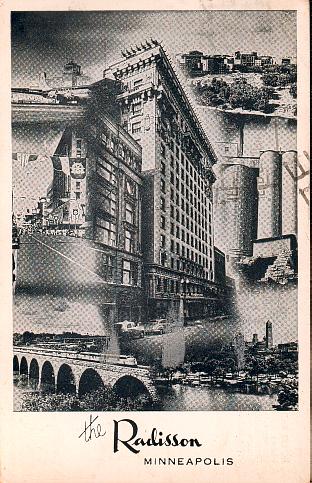
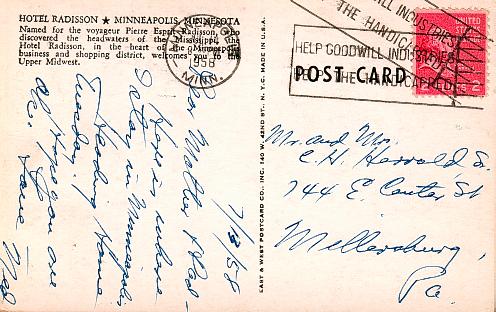
On July 13, 1958, a fellow named Ned mailed a hotel card – one depicting the Radisson Minneapolis surrounded by what I take to some Minneapolis sights. A busy design, but the Radisson has had a long history in the city.

Raddison1958.1Raddison1958.2Dear Mother & Dad

Here is where I stay in Minneapolis. Heading home Tuesday. Hope you are OK.

Love, Ned

Ned could have put that in a tweet, I think.

Two-Cent Card from California

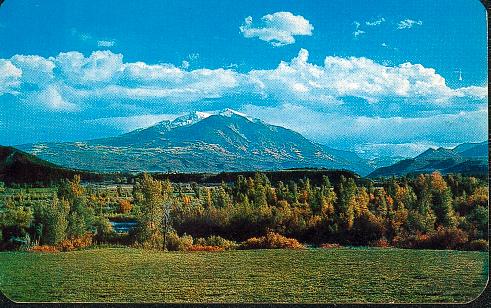
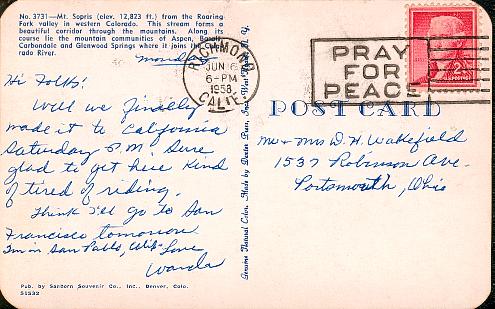
Another card among those I bought recently has a postmark date of June 6, 1958, and an image of Mt. Sopris in western Colorado, but it was mailed from Richmond, Calif. Postcards are now 2 cents — but not for much longer — and the postmark says in big block letters, PRAY FOR PEACE.

Sopris1958.1 Sopris1958.2Monday

Hi Folks!

Well we finally made it to California Saturday P.M. Sure glad to get here kind of tired of riding. Think I’ll go to San Francisco tomorrow. I’m in San Pablo, Calif.

Love, Wanda

One of the Last Penny Postcards

Not long ago I bought a box of old postcards for what worked out to be 10 cents each. I haven’t done a complete survey, but most seem to be from 30 to 60 years old. Many are old hotel and motel cards; many others are destination cards. Some present an interesting subject artfully, others clearly fall into the Boring Postcards genre.

A few of them were mailed. Someone, decades ago, spent a few minutes composing a few lines to someone else far distant, stamped the thing, and dropped it in a mailbox or letter slot. The recipient presumably read it, looked at the image, and maybe even told the sender – when they met again in person – about getting the card. And that was probably that. Off to a shoebox or a drawer or somewhere and left to the vicissitudes of time.

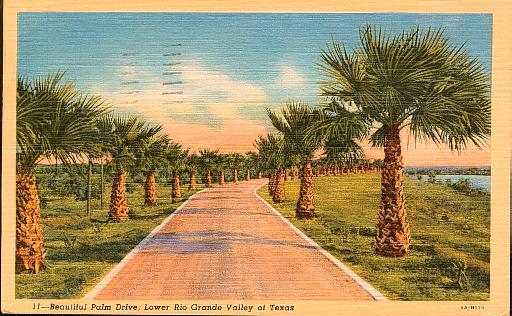
Somehow, they were eventually among the cards that I acquired, even though none were originally sent to this part of the country. I’ve scanned four cards, all mailed in the 1950s. The first is dated and postmarked December 18, 1951, and sent it from Harlingen, Texas, addressed to Mr. & Mrs. C.L. Cahoon of Brockton, Mass.

ValleyCard1951.1

Valley1951.2All text sic.

12/18/51

We are already to leave Harlingen now and the car is packed to the top. As usual we brought more than we needed, but it has been fun. It has been cold here, but now is hot again. We went to Mexico Monday and thru the market district. It won’t be long now before you will see what we have purchased. Looking forward to X-mas and seeing you all and all our wedding gifts. Coming home thru the South to Sea Island Georgia, Florida, South Carolina, etc. Too much snow + ice up North for safety.  Love, Mary + Warren. See you in a week.

Young newlyweds maybe? Hope they made it back for Christmas. Postage, incidentally, was 1 cent. Two weeks later, on January 1, 1952, the penny postcard would be no more, with a 100 percent rate increase to 2 cents.

Early Winter Sky

After a brief not-cold spell on Saturday and Sunday – I can’t call it warm, but still not bad – it’s winter cold again. Diligent neighbors used the interlude to sting lights on their houses or finishing removing leaves from their lawns. I did no such things.

The sunset on Saturday was shot with pink and gold.

Northern Illinois, Nov 29, 2014

I did manage to read Fahrenheit 451 over the long weekend. Or rather re-read, because I read it when – 40 years ago? Does that even count as re-reading? I picked it up because Lilly read it for school not long ago, and asked me about the story sometimes, but I had to confess to remembering very little about it, besides colorful scenes of book burning and the idea of becoming a living book.

I understand that it’s an important work. But I’m not particularly taken with Bradbury’s writing style. Not sure what it is. Also, Bradbury was clearly afraid of the pernicious effects of dumbing down society, especially as expedited by television, and I’m not entirely persuaded. Maybe the level of stupidity is always about constant, just manifesting itself in different ways across the decades.

Two Demonitized European Coins

Here’s another interesting disk from my bag o’ cheapies: 200 Italian lira. Pre-euro, of course, and in this case 1993, and a special commemorative. Or not so special, considering that 170 million of them were made, and that they’re a aluminum-bronze combination. I’ve seen the obverse bust simply referred to as an “allegory,” so presumably that’s Italia personified.

L200ObvThe one to have would be the proof version, of which only 6,500 were made. In any case, the coin commemorates the 70th anniversary of the Italian Air Force (since 1946, the Aeronautica Militare Italiana, but before that the Regia Aeronautica Italiana), or maybe just military aviation in that country.

L200RevAll kinds of interesting detail. But when I think of Italian military aviation, I think of Italo Balbo, who didn’t found the independent Italian Air Force, but built it up as an instrument of fascist power. Even so, he has a street named after him in downtown Chicago to this day.

Next, another sort of flying: the common swallow, or hirundo rustica. Who would put a swallow on their coins?

Slov2The newly independent Slovenia, that’s who. This is a 2 tolarja piece, and during the pre-euro period that country was fond of animals on its small coins. I see a fish, a fly, an owl, and others, all helpfully with their scientific names.

Slov1During its first year of issue,1992, the 2-tolarja piece was a brass coin with a non-proof mintage of over 5 million. The tolar used to be the country’s base unit, with tolarja as a plural. Clearly a cognate with dollar, a word that gets around.

Stray Dominican Coins

My latest acquisition of cheap foreign coins included some Dominican pieces, such as a nickel-clad steel 25 centavo coin, featuring an ox-drawn cart. A little investigation reveals that 25 Dominican centavos isn’t much money at all — the equivalent of a little more than half a U.S. cent. Even in the Dominican Republic, I can’t believe that buys very much.

DomRep2RevSo they probably don’t circulate much any more.  Presumably 25 centavos had a more purchasing power in 1991, though sometimes coins linger well beyond their strict usefulness (e.g., the U.S. cent). Some 38 million of them were minted in 1991. On the reverse — I think it’s the reverse — is the Escudo de armas de la República Dominicana, which, in case it’s hard to read, proclaims Dios, Patria, Libertad.

DomRep2ObvAlso in the lot: a Dominican peso. The portrait is of Juan Pablo Duarte y Diez (1813-1876), one of the founding fathers of the Dominican Republic. DomRepObvIt’s brass, and apparently about 80 million of them were minted in 2002, so it’s a very common coin.

DomRepRevAgain with the escudo. A quick look at images of Dominican coins shows it to be a common feature, maybe even one mandated by law.