The Forgotten Cosmonaut

Got a packet in the mail recently telling me about the Vanderbilt 2013 Reunion and Fundraising Opportunity. Actually, those last three words aren’t in the title of the event, but they’re more than implied. One of the “class goals” is fundraising to the tune of $1,000,000 “with 32 percent class participation.”

I don’t think 32 percent is necessary. Between the right four or five alumni of my class, that much could be raised right away. But the school might have to name something after them.

Anyway, in an effort to drum up some nostalgia for the early ’80s, the invite includes the following verbage: Motorola debuts mobile phones; Who’s at Exit/In tonight?; Sally Ride is 1st woman in space; Meat sticks at Rand; Campus computer use up 100%; Housing lottery equals stress.

Some of those are self-explanatory, and others are enigmatic if you didn’t attend VU, such as “meat sticks at Rand,” which I will leave to the readers’ imagination. But I kick into copy editor mode at that business about Sally Ride, first American woman into space.

Is it too much to ask someone with a Vanderbilt education know who the first woman in space was? Valentina Tereshkova, forgotten again here in North America. But I expect she’s honored enough at home, even without the Soviet Union. Remarkably — I just checked — she’s still alive, and not even that old (76). I guess spacefaring in the early days was a young woman’s game.

New Zealand in my Pocket

Maybe here or in Texas recently, I got what I thought was a Canadian five-cent piece in change. It was nickel-sized and had Queen Elizabeth on it. Nothing too unusual about getting such a coin, even in Texas.

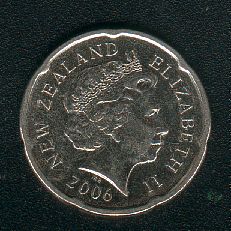
Yesterday I was picking through my change for quarters and took a closer look at the presumed Canadian nickel. It was no such thing. Instead, somehow or other I’d gotten a New Zealand 20-cent piece in change. I’d never seen one before, not even in Australia, where surely some kiwi coins must end up. A coin’s trip from New Zealand to the U.S. isn’t inconceivable, but it sure is unusual.

The Queen, of course, is on the obverse (seen below at 150 percent). Nothing odd in that. (Unless Yuriko sees the coin. That Elizabeth is the sovereign of New Zealand she finds a little strange.)
The reverse, on the other hand, has something no other coin has: Pukaki. My scan hardly does it justice.
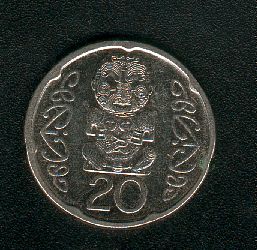
The Reserve Bank of New Zealand says: “New Zealand’s 20 cent coins issued since 1990 feature a remarkable Maori carving, as illustrated above. This is no generic image. Rather it is a reproduction of a specific carving of an 18th century Maori warrior leader called Pukaki, who was a Rangatira (Chief) of the Ngati Whakaue iwi of Te Arawa in the Rotorua district. The carving was made in 1836 and today it can be viewed in the entrance of the Rotorua District Council…

“Pukaki came to the attention of the Reserve Bank as a result of the 1984-87 Te Maori exhibition and the use of Pukaki’s image on a particularly striking Maori Language Commission publicity poster. At the time the Reserve Bank was looking for a new image to put on the 20 cent coin, given that the kiwi was being moved to the new $1 coin. The first Pukaki 20 cent coins were issued in 1990. More recently, a gold $10 collectors’ coin featuring Pukaki has been minted.”

The entire article about Pukaki is here. Also interesting to note: the coin is plated steel, which is more common than I realized, and has even been suggested for U.S. 1 cent and 5 cent coins. (And even though advocated by former Rep. Ron Paul in the same breath he hyperventilated about the boogeyman Fed, it seemed to be a serious proposal.)

The NZ 20c edge is also novel: a treatment called Spanish flower, which is seven indents evenly spaced. Why “Spanish” flower? I wondered. Wiki to the rescue (almost): “The 50 Spanish peseta coin issued between 1990 and 2000 were the first [citation needed]  that featured the Spanish flower.” Presumably for benefit of the blind, though it also makes differentiating the coins easier for the sighted.

Anyway, the NZ 20c piece a nice little design. And who knows that the United States minted a 20c piece, once upon a time? Not for long, though. It was one of the great coinage failures of the ’70s. The 1870s, that is.

U.S. Coin Values speculates that “perhaps the coin might have gained a foothold in American society had it not been so easily confused with the quarter of that era.” In other words, it suffered the Susan B. Anthony effect long before that coin ever did.
The Slow Decline of the Yellow Pages

A book of yellow pages showed up at our door the other day. Fewer of those arrive with each passing year, but arrive they do. It’s a little hard to remember when they were essential reference works for the house, but so they were.

And like any good reference work, it was good to browse through them occasionally. Almost 30 years ago, in Nashville, I remember thumbing through one edition – it must have been an “official” one by one of the Baby Bells – and coming across a quarter-page ad for a roofing contractor that promised DEATH TO ROOF LEAKS, complete with skull-and-cross illustrations. Who knows, maybe the Republican Guard was getting into the roofing business in those days.

The edition we just got covers a big chunk of the Northwest suburbs. It has some standard reference information in the front, including a map of North American area codes. The metro New York and Los Angeles insets are very crowded with numbers, and metro Chicago could probably stand its own inset, too, but doesn’t get one. Are there still any states with one area code? Yes. Quite a few, actually: Alaska, Delaware, Hawaii, Idaho, Maine, Montana, New Hampshire, North Dakota, Rhode Island, South Dakota, Vermont, and Wyoming.

Next are “City, County, State and U.S. government offices” pages, which were blue in some yellow pages, but white in this one. These are always good for finding some oddities, such as a toll-free number for information on adopting wild horses and burros, a number of the inspector general of the Peace Corps, and a general information number for St. Lawrence Seaway Lock Operations.

My packratish nature won’t let me throw it away for a while. But I doubt that I’ll need it to use it to call the St. Lawrence Seaway or anywhere else.

Come May, We’ll be in Clover

Winter refuses to go quietly. Today was windy and raw, and just before dark, snowy. Not a vast amount, just enough to re-whiten the ground. But even so, winter is losing its grip. Before the snow started, I walked by a front yard that had the remains of a snowman: a lump of unmelted snow, a hat on top of that, and a carrot and some apples on the ground nearby. (Ann told me the apples were the snowman’s “buttons.”)

Got a note from a friendly yard-care company rubber-banded to my front doorknob the other day, offering its services in the spring. The note featured a checklist of “undesired weeds” in our yard, and according to the checklist we have chickweed, henbit, dandelions, and clover. How did this company know what I have in my yard? Yard spies wandering down the sidewalks last summer, making notes? It’s too soon yet for drones to do that, but someday no doubt they will.

Never mind. Those last two are easy enough, but I had to look up the others. Chickweed refers to a lot of different plants, so it’s one of those unhelpful common names that spurred Carolus Linnaeus to do what he did. Henbit is Lamium amplexicaule. I’m pretty sure we do in fact have henbit, dandelions, and clover in the yard. But they missed our pockets of mint, maybe because most of those are in the back yard, and yard spies who go there are trespassing.

But why are those three weeds? I’ve written about dandelions. As for clover, it’s clover. We’re not talking kudzu here. Clover is good. The expression “in clover,” though a bit old-fashioned, reflects that.  The OED puts it this way: “to live (or be) in clover: ‘to live luxuriously; clover being extremely delicious and fattening to cattle.’ ” We don’t have cattle, but who can look down on those little green plants mixed in with other grasses, with their three leaves and hardy constitutions, and think weed?

Dodging a Few Maintenance Bullets

Earlier this week my ancient Sienna started shaking like an old wino, and I imagined that a wheel was coming off. A visit to my trustworthy mechanic — glad to have found him — revealed it sounded and felt worse than it was. Repairs came in at only a couple of hundred bucks. Annoying, but passable.

If it had been a more expensive job, that would have been the end of the line for the car. It’s reached that point. Going to have get another car soon. Some people seem to enjoy acquiring cars, but not me. I once worked with a fellow who bought a car every other year or so, trading the old one in each time. I never understood that psychology. When you have a car the object of the game is to keep it as long as possible.

Also this week, a large amount of vile water collected in our dishwasher, which we seldom use, and refused to drain. Meaning that water from the kitchen sink drain had diverted into the dishwasher because of some blockage somewhere. Would Power Plumber fix this?

First, though, I had to get the nasty gray water out of the dishwasher. I considered various ways to do that before I remembered, having stupidly forgotten, that I have a small Craftsman wet/dry vac out in the garage. The water responded to its suction, and then I applied Power Plumber to the underlying problem. It worked. How often do I get to dodge two potentially expensive problems on the same day? Not often.

That’s what we need nanobots for. To make things that fix themselves. Of course, self-repairing machines would upend a lot of the service economy, but then again the economy’s been continuously upended since the Industrial Revolution. Not that I expect to live to see such things, but it’s a nice techno-pipe dream.

Dozenal Day

Come to find out, at no point in Lilly’s schooling has anyone taught her about alternate numeral systems. You know, binary numerals, to cite the best known example, or Base 12 or any of the other bases. She’d never heard of it.

How did that happen? I remember learning about bases in the sixth grade. A number of students did presentations about various bases. Rick Reynolds, rest his soul, did Base 12 by coloring his face green and tying a pencil to each hand to be a 12-fingered Martian who counted from 0 to 9 and then t and e. I’m not making that up.

So I introduced the concept to her. For everyday living, it’s useless knowledge, which is often the sweetest kind.

Naturally, I had to look further into this other base business, especially Base 12, here in the age of the Internet, and it wasn’t long before I learned the term dozenal to refer to Base 12, and that there’s such a thing as the Dozenal Society of Great Britain and the Dozenal Society of America, which have a web site with a dozenal clock, among other things.  Man, I’m glad to be living in a world with eccentrics like this on the loose.

The web site says: “The Dozenal Society of Great Britain (founded 1959) and the Dozenal Society of America (founded 1944) are separate organisations with a common aim: to draw attention to the advantages of the Dozen (or twelve-based) system for numeration and measurement. We consider that the decimal system is inadequate and of limited competence in many aspects of numeration. Decimals handicap the teaching of arithmetic and so inhibit understanding of the physical world and the decimal system is unable to express in simple terms the common proportions by which we order our practical and economic activities”

I don’t know if this bloke is a member of the British society, but he knows about their arguments. Not-too-vehement arguments, but arguments all the same.