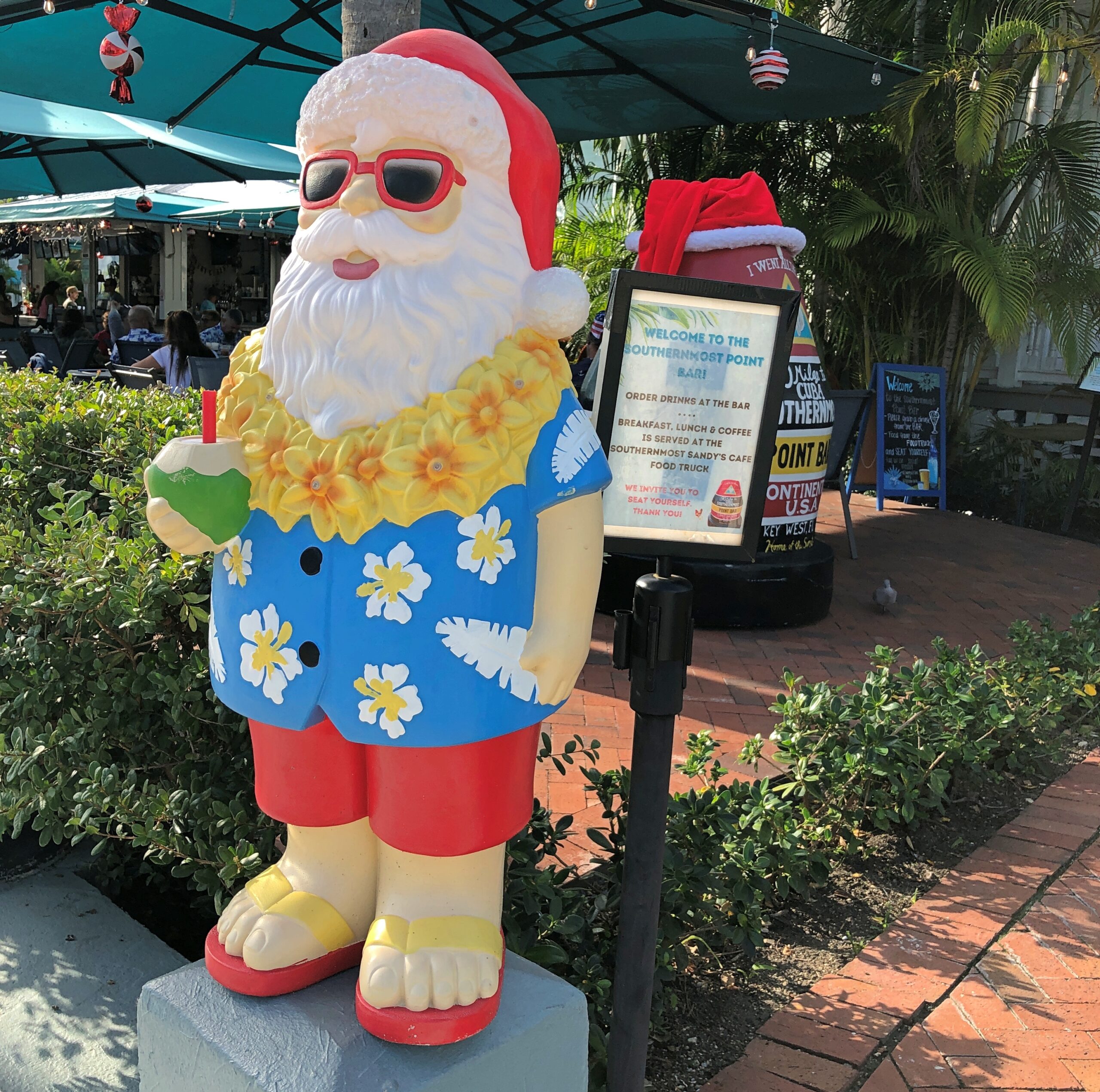
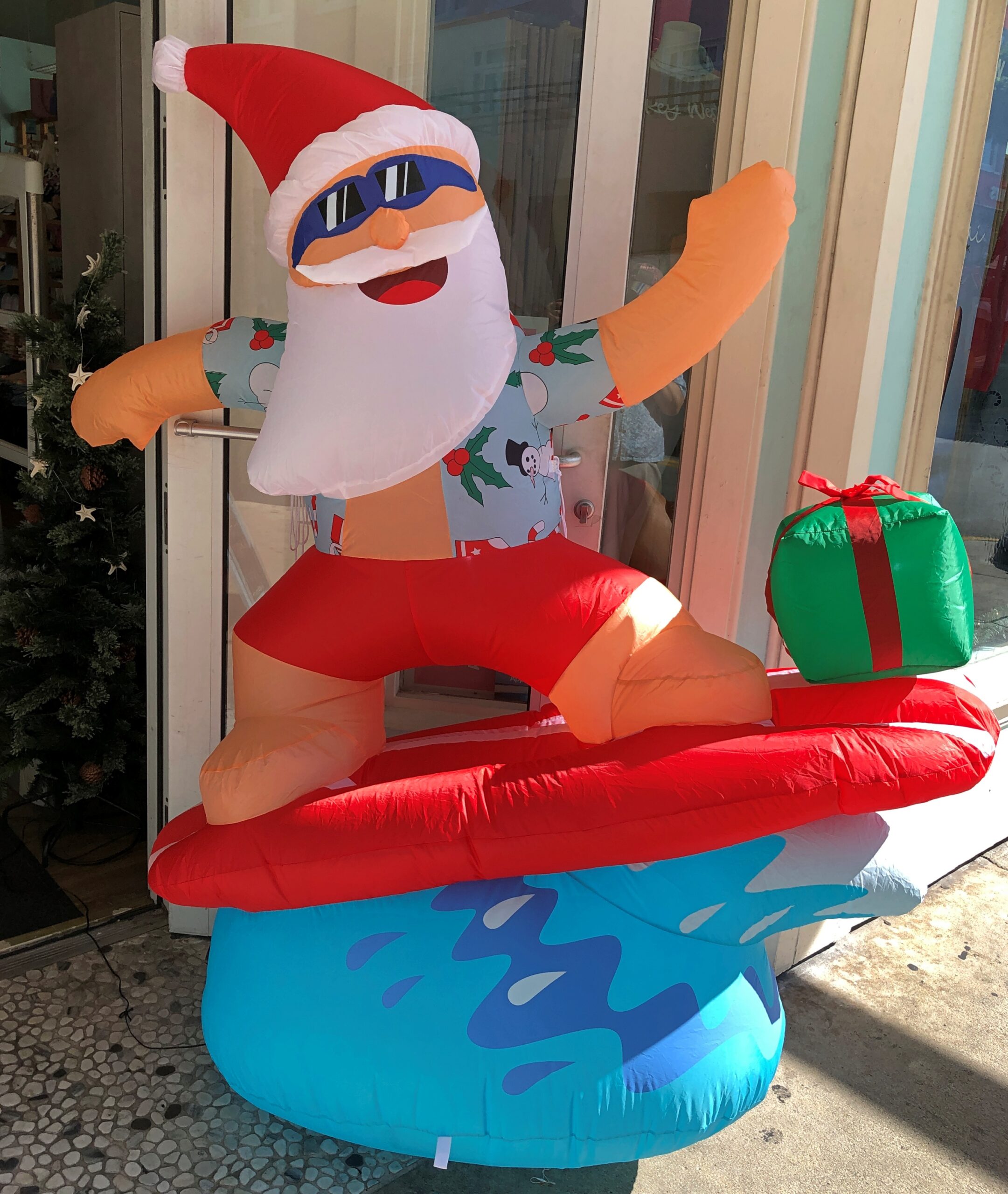
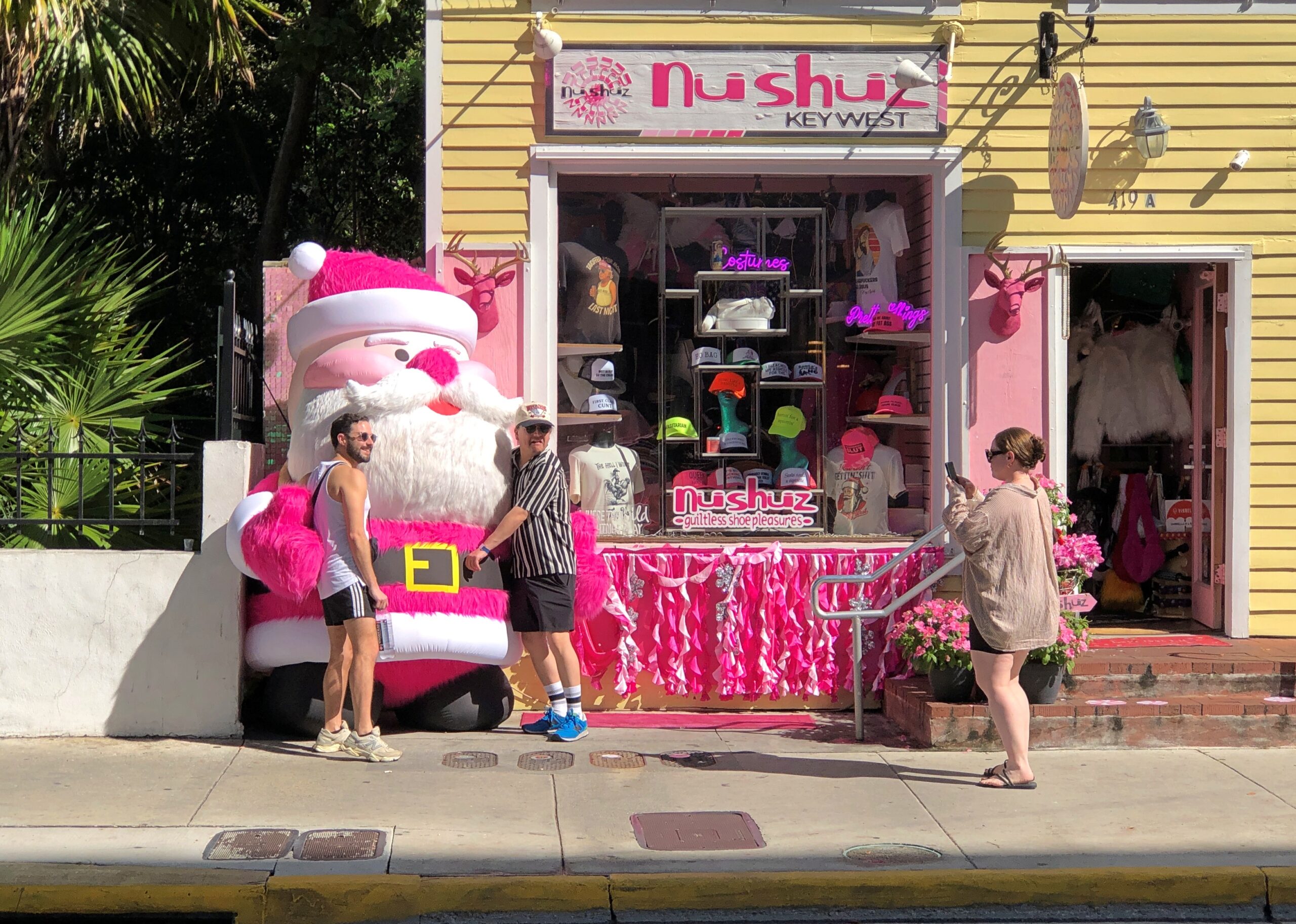
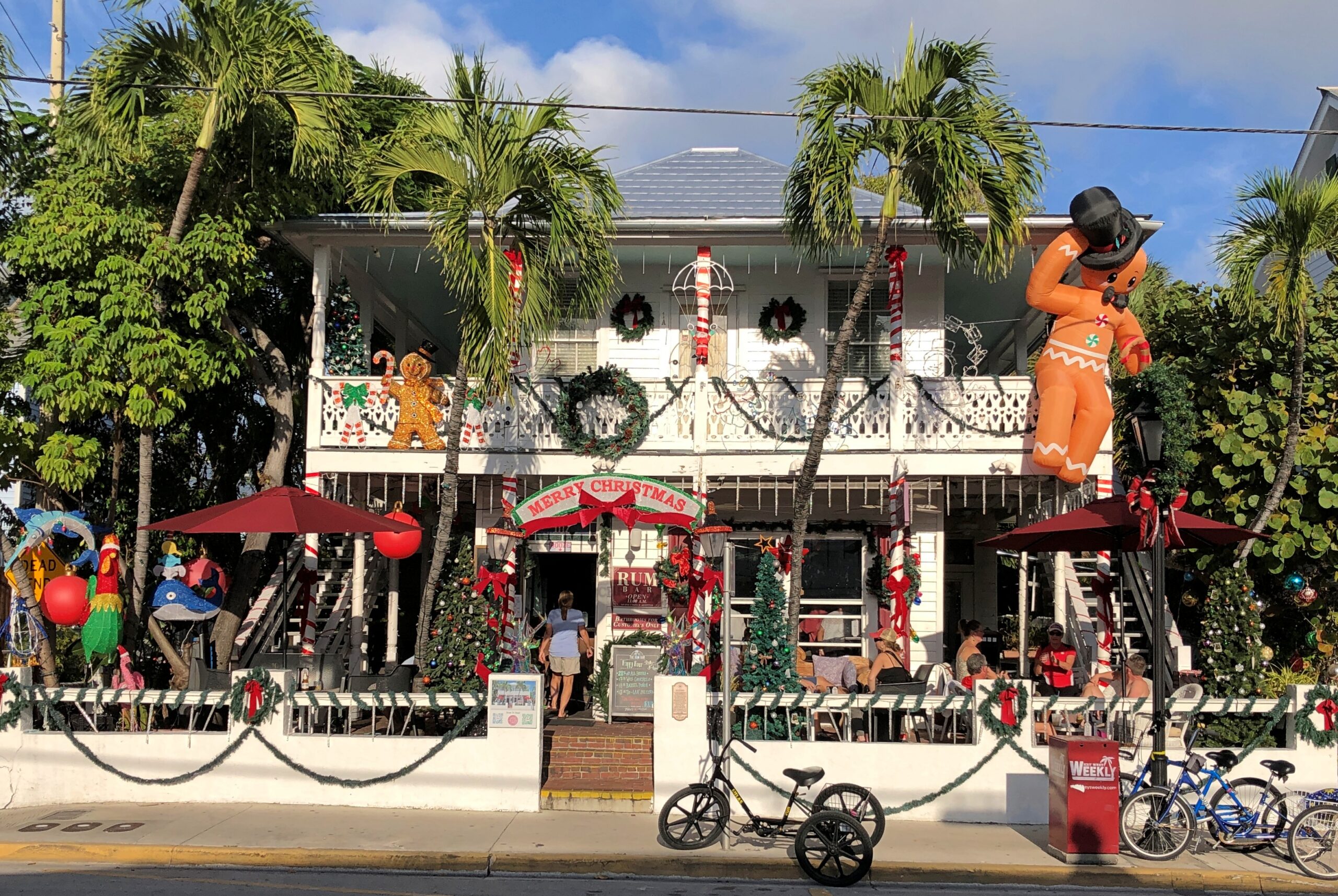
Island-vibe Santa Claus can be found in Key West in mid-December. In fact, I was expecting more such Santas. Even he needs to vacation, preferably somewhere warm (see #13).
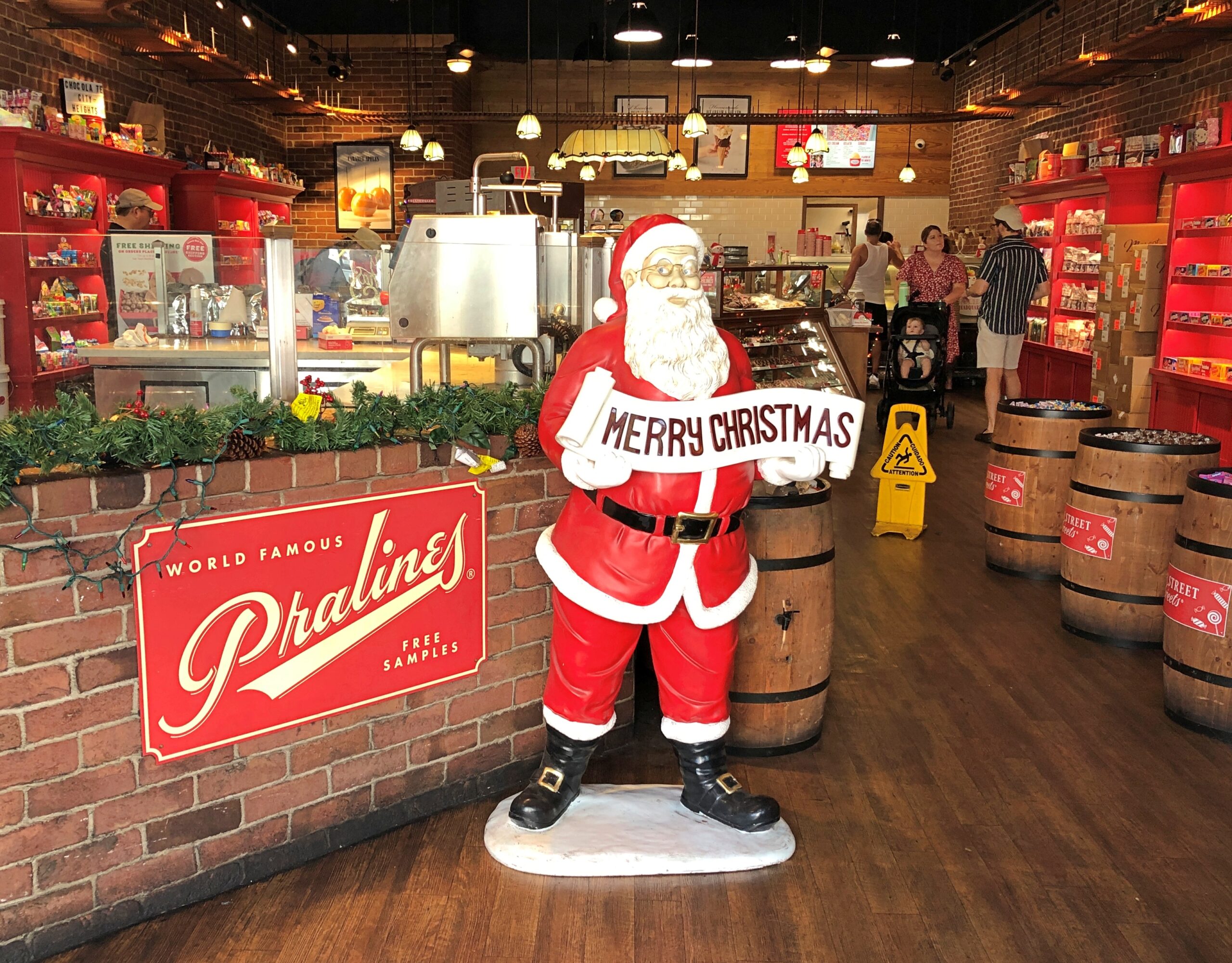
We spent two days walking around Old Town in Key West, which is time enough to cover a fair amount of ground, considering the small size of the place. More conventional St. Nicks were also to be seen, some of them finding their place in a place of business.
Not sure if pink counts as conventional Santa Claus. Usually he’s red, of course, a depiction of jolly old elf owes to Coca-Cola, but pink is pretty close. Anyway, pink Santa had a few fans.
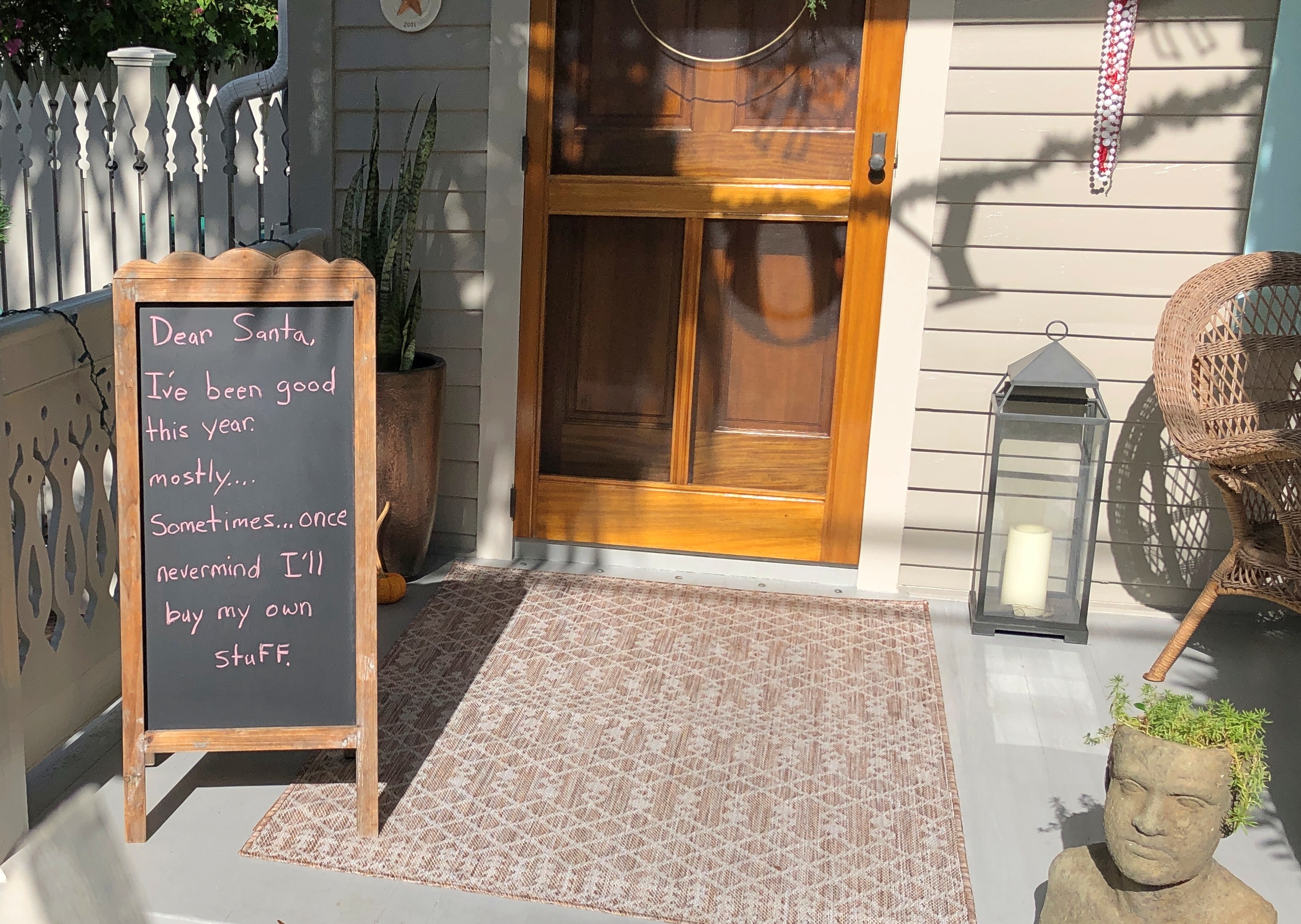
A message for Santa, going for ha ha ha, rather than ho ho ho.
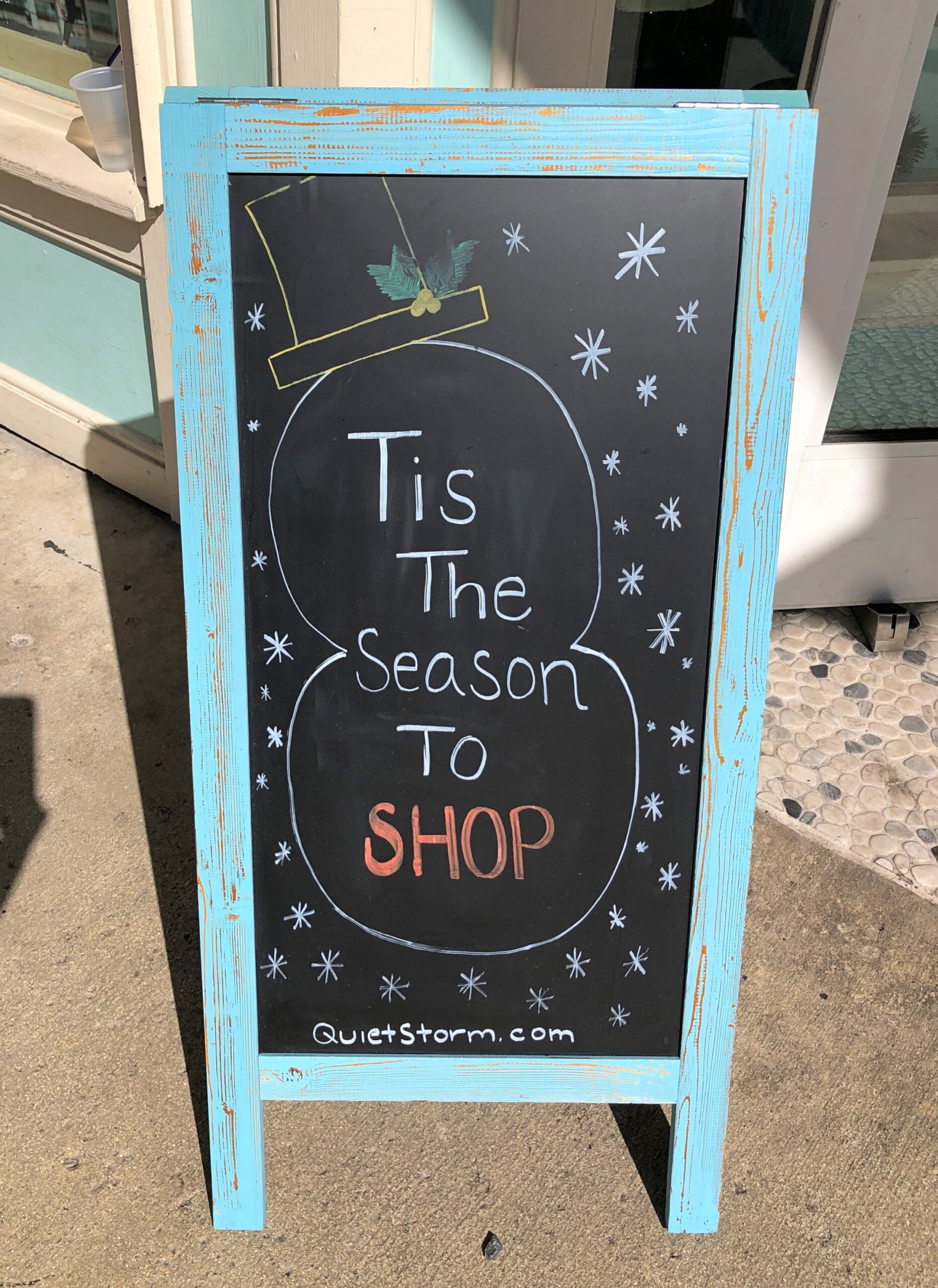
This retailer gets right to the point.
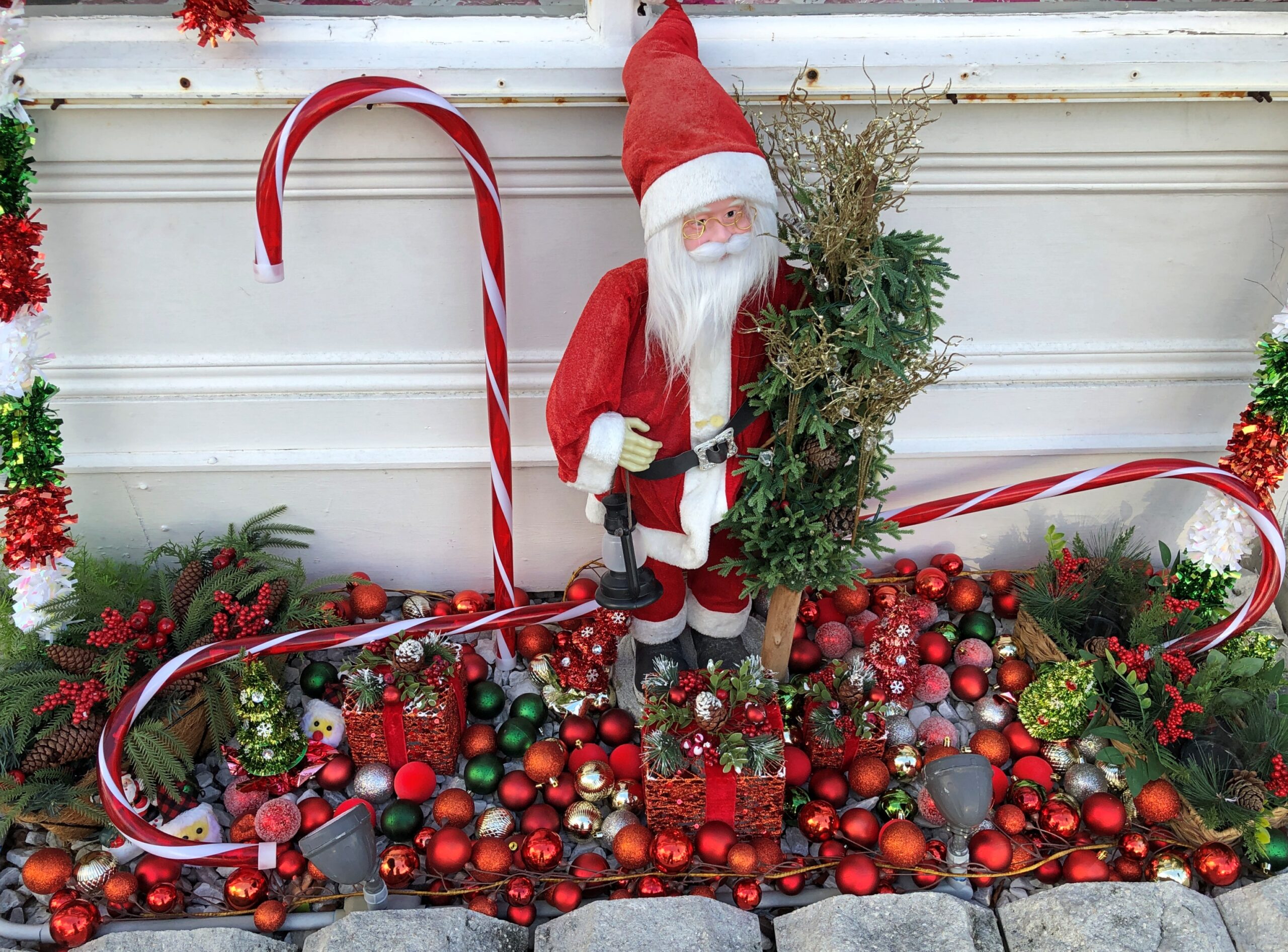
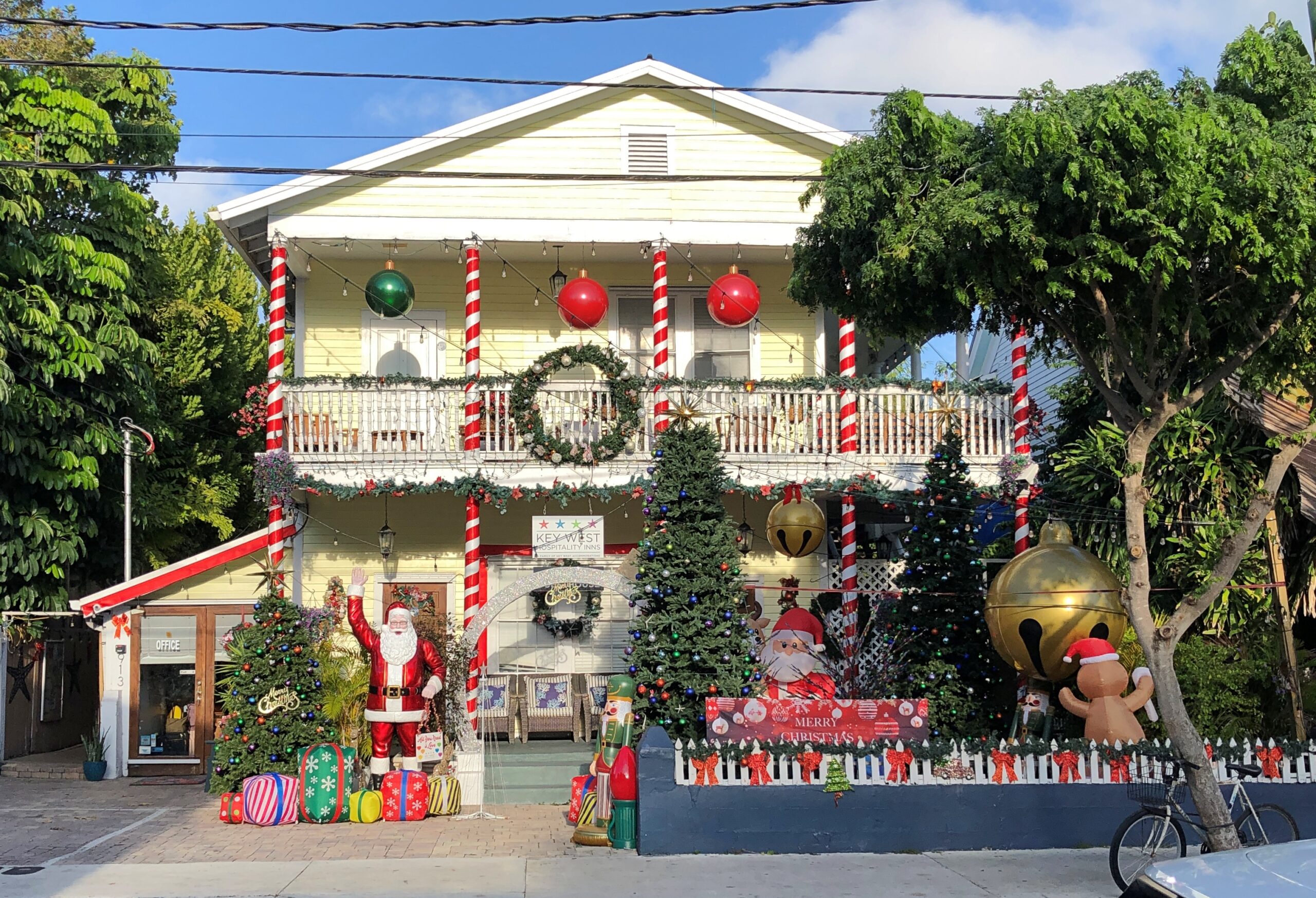
Maybe not the full Griswold, but decked out in quantity.
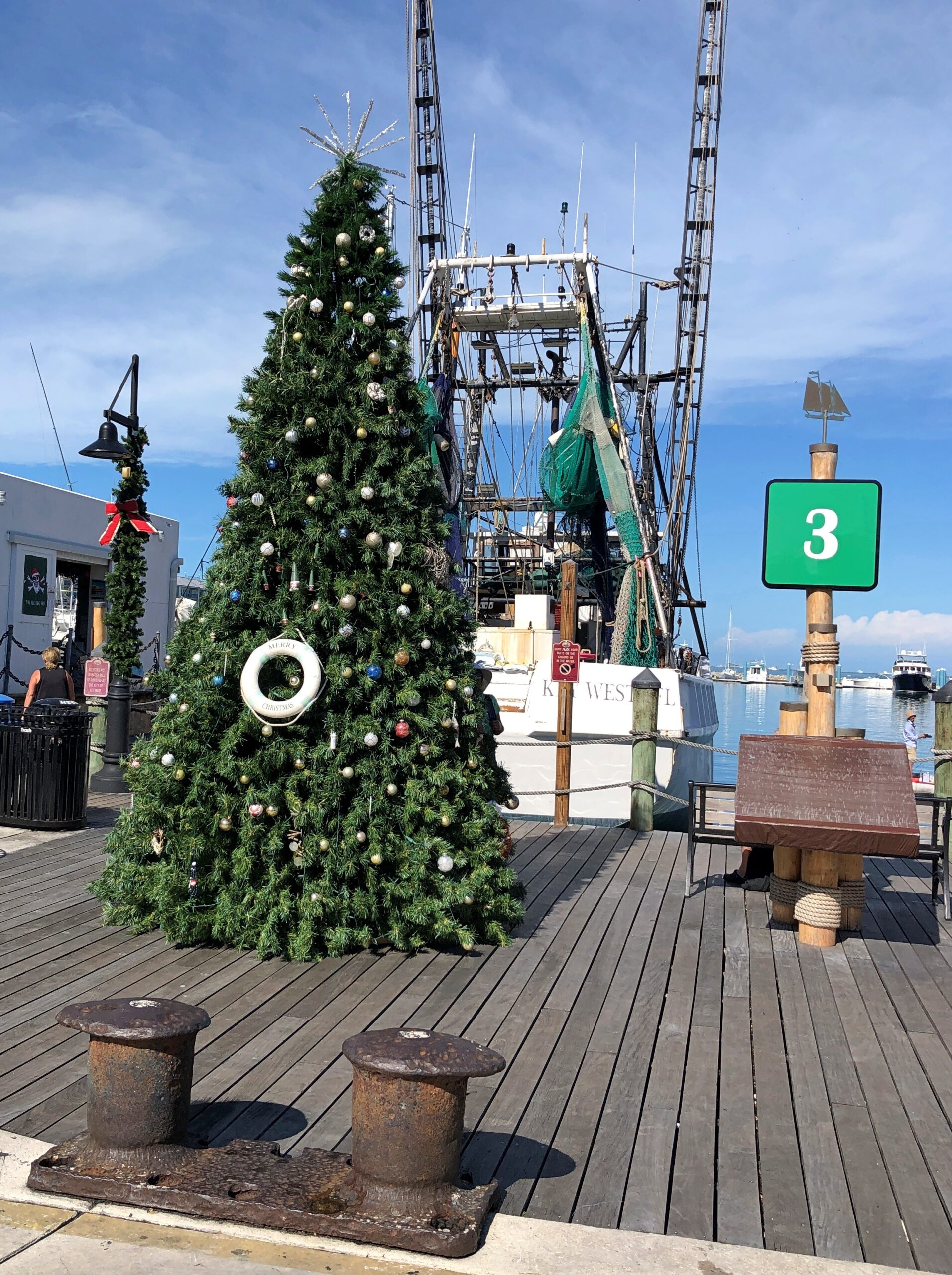
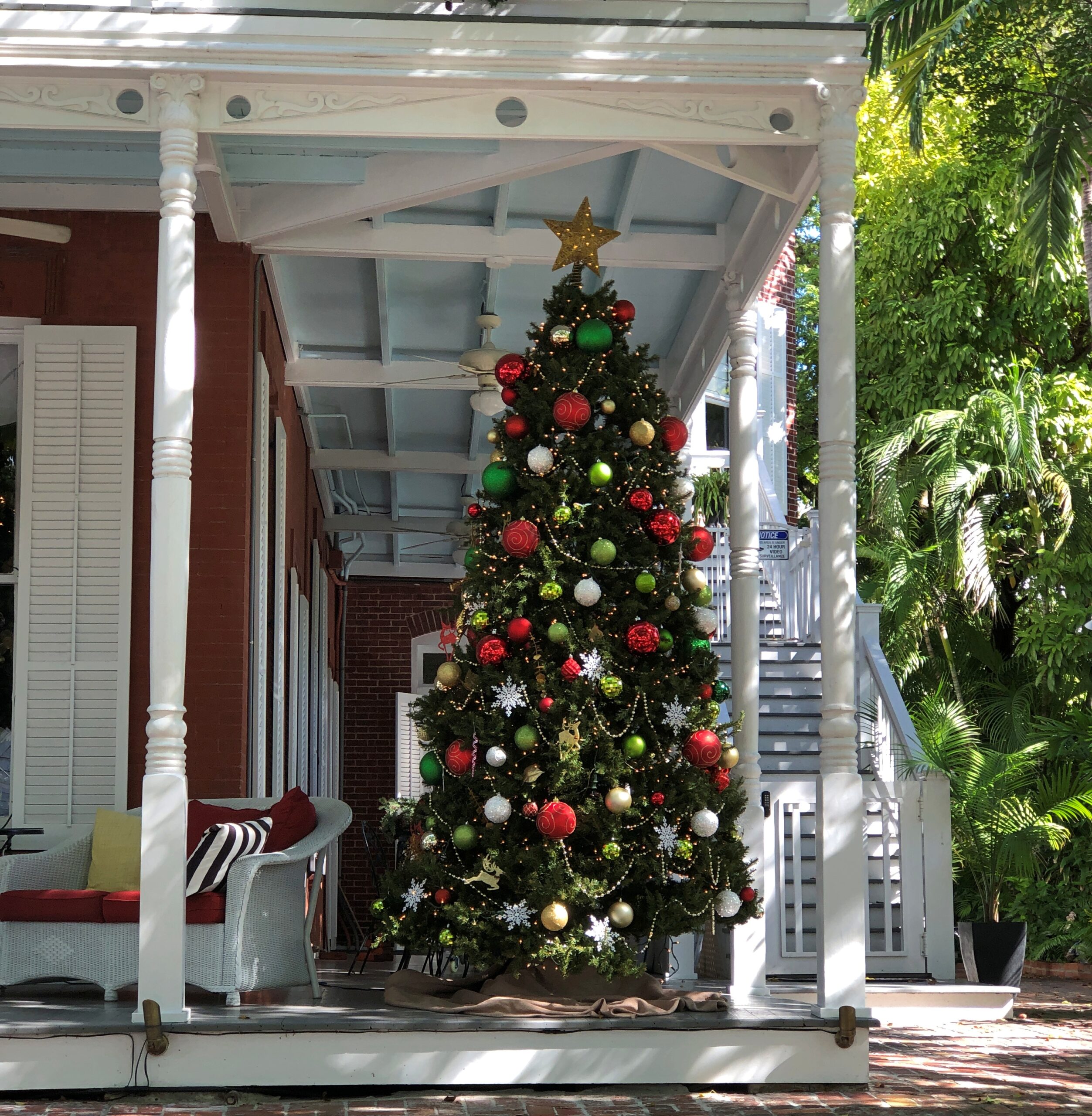
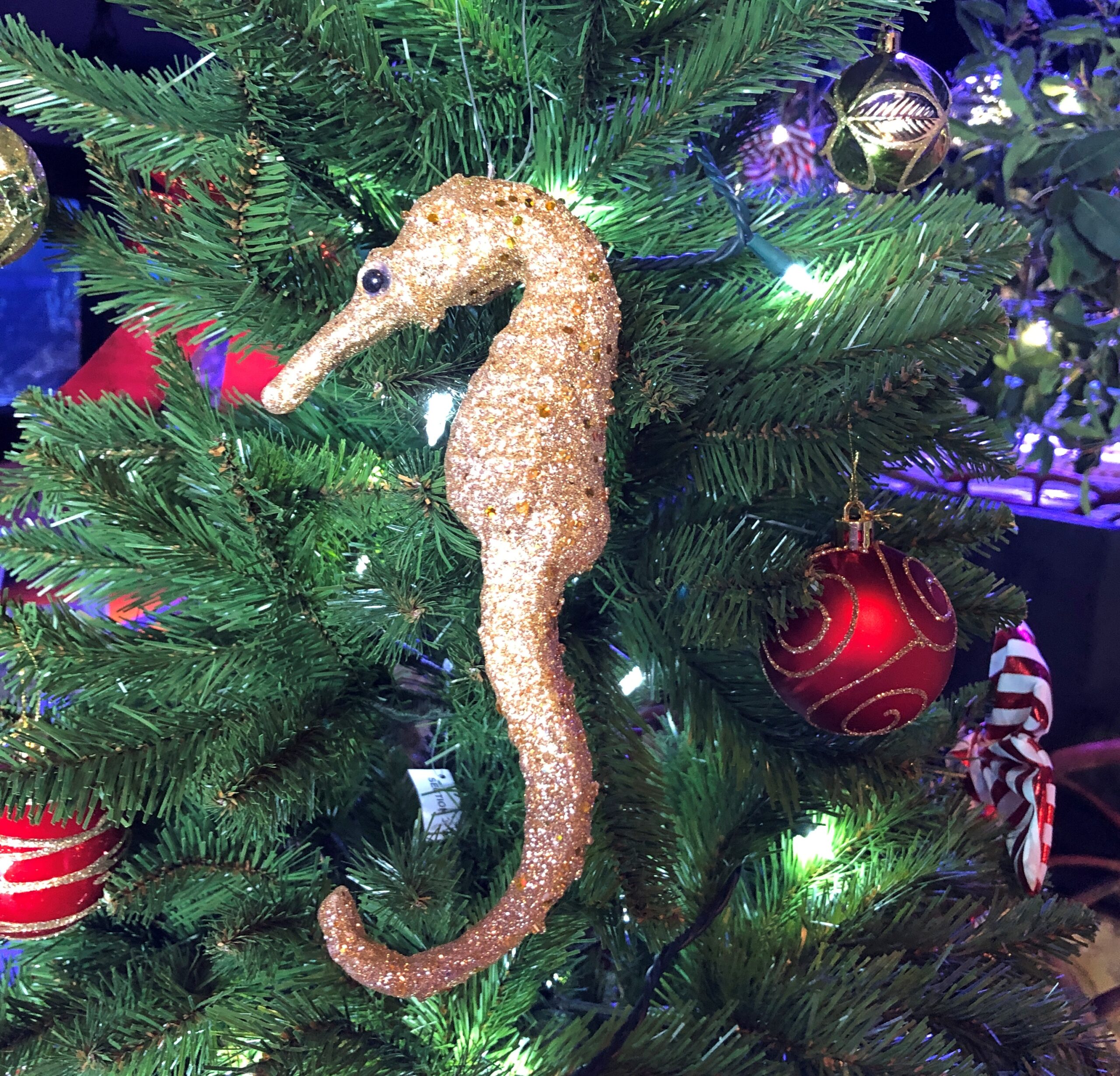
Trees: evergreen simulations, which seem a little out of place. But why not?
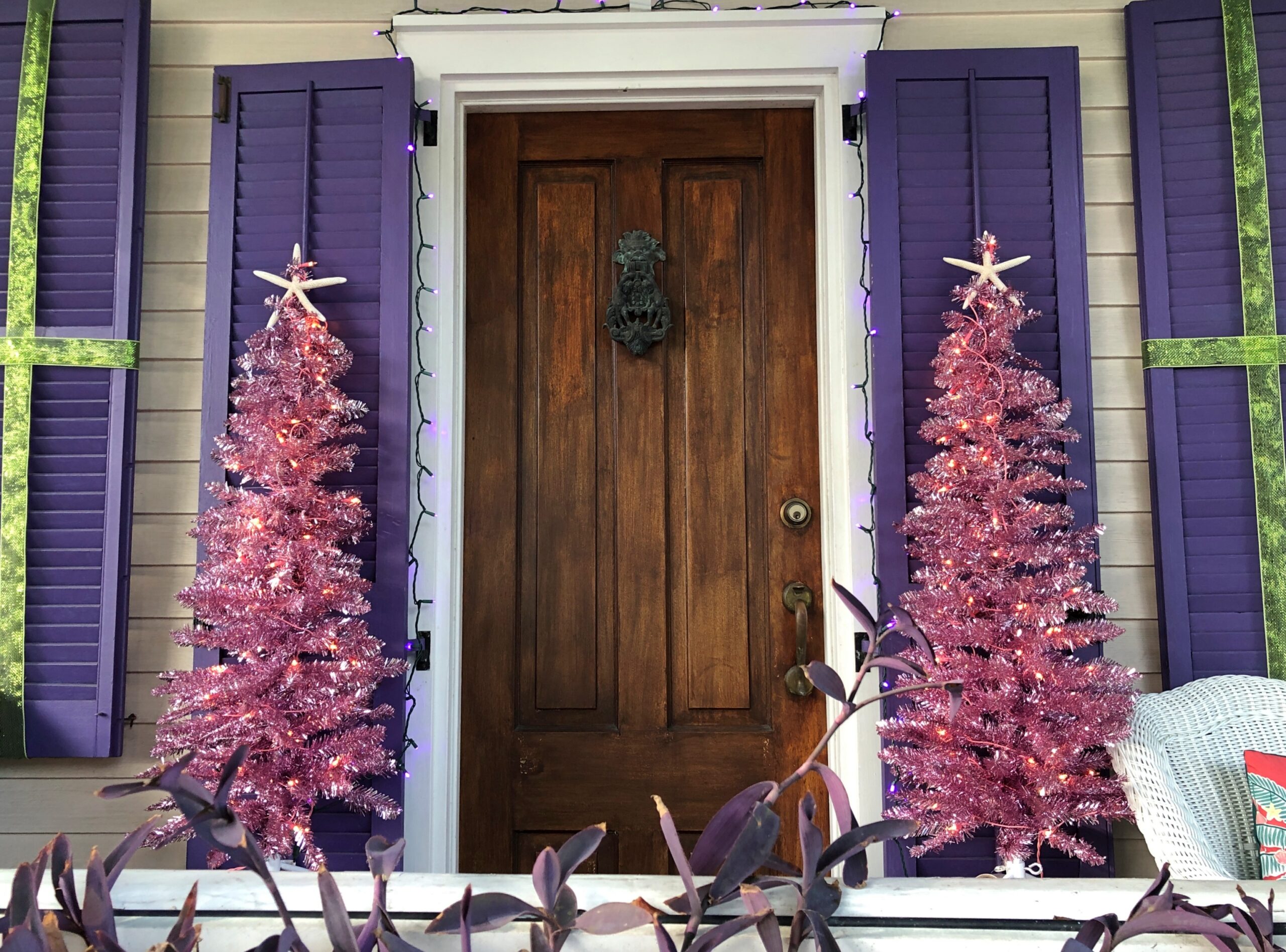
A pair of pink aluminum trees.
We need a revival of the aluminum tree. Not everywhere during the season, but up a notch in the Xmas décor world. Unless that’s already happened. It might have and I wouldn’t have noticed.
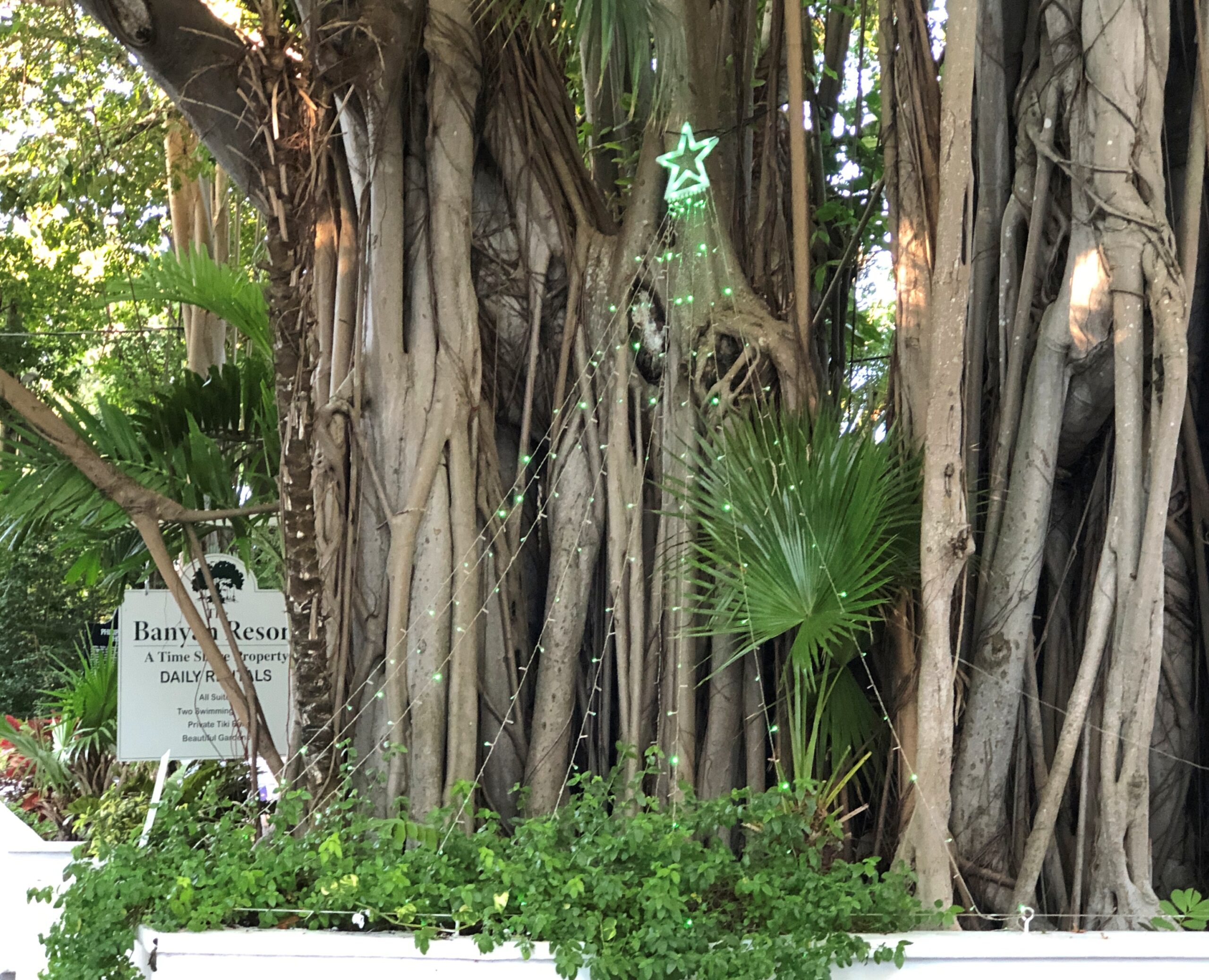
Tree in the abstract. Fronting a banyan. That, I think, counts as Key West local.
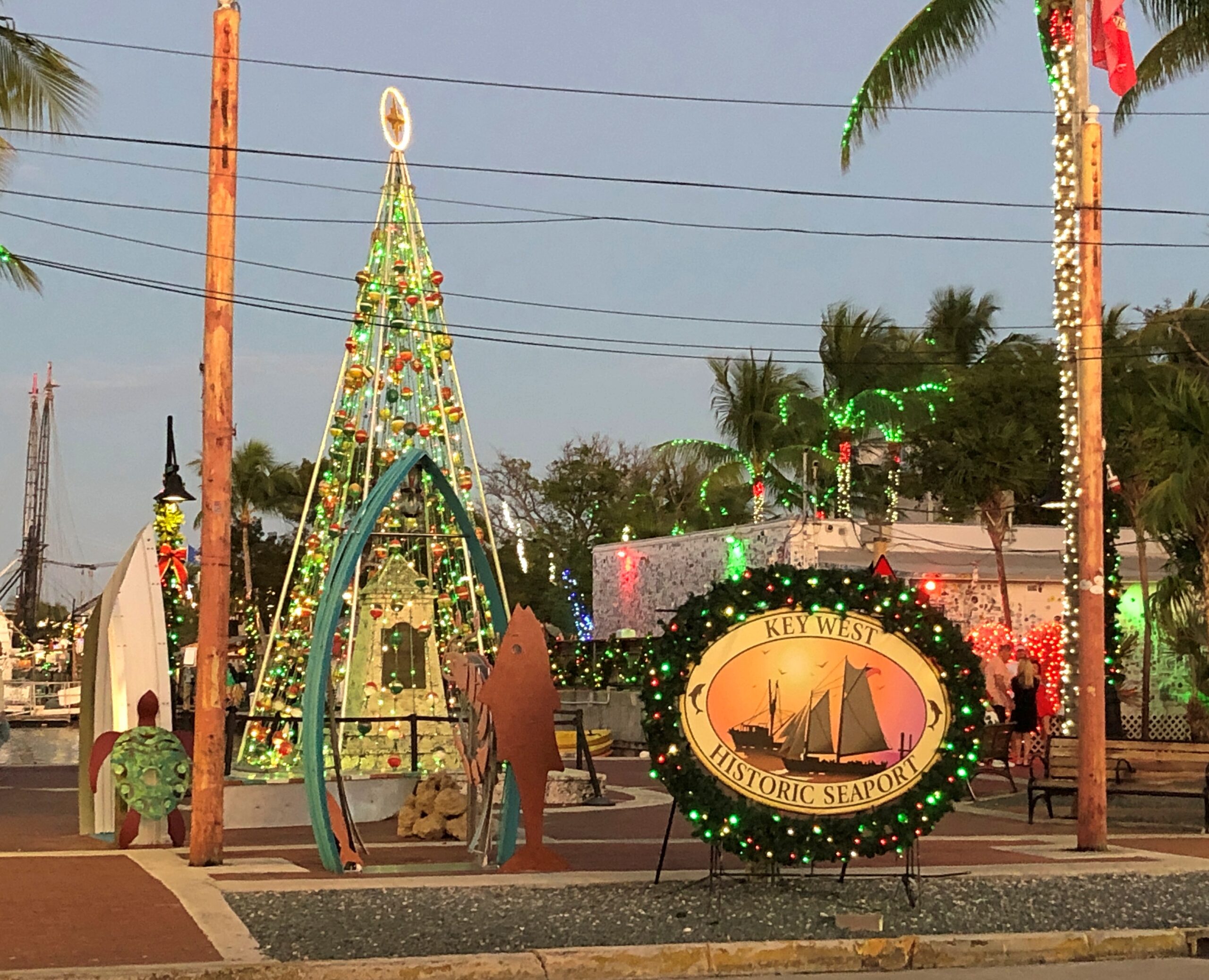
So does this.
Near dusk the first day was a good time to see lights.
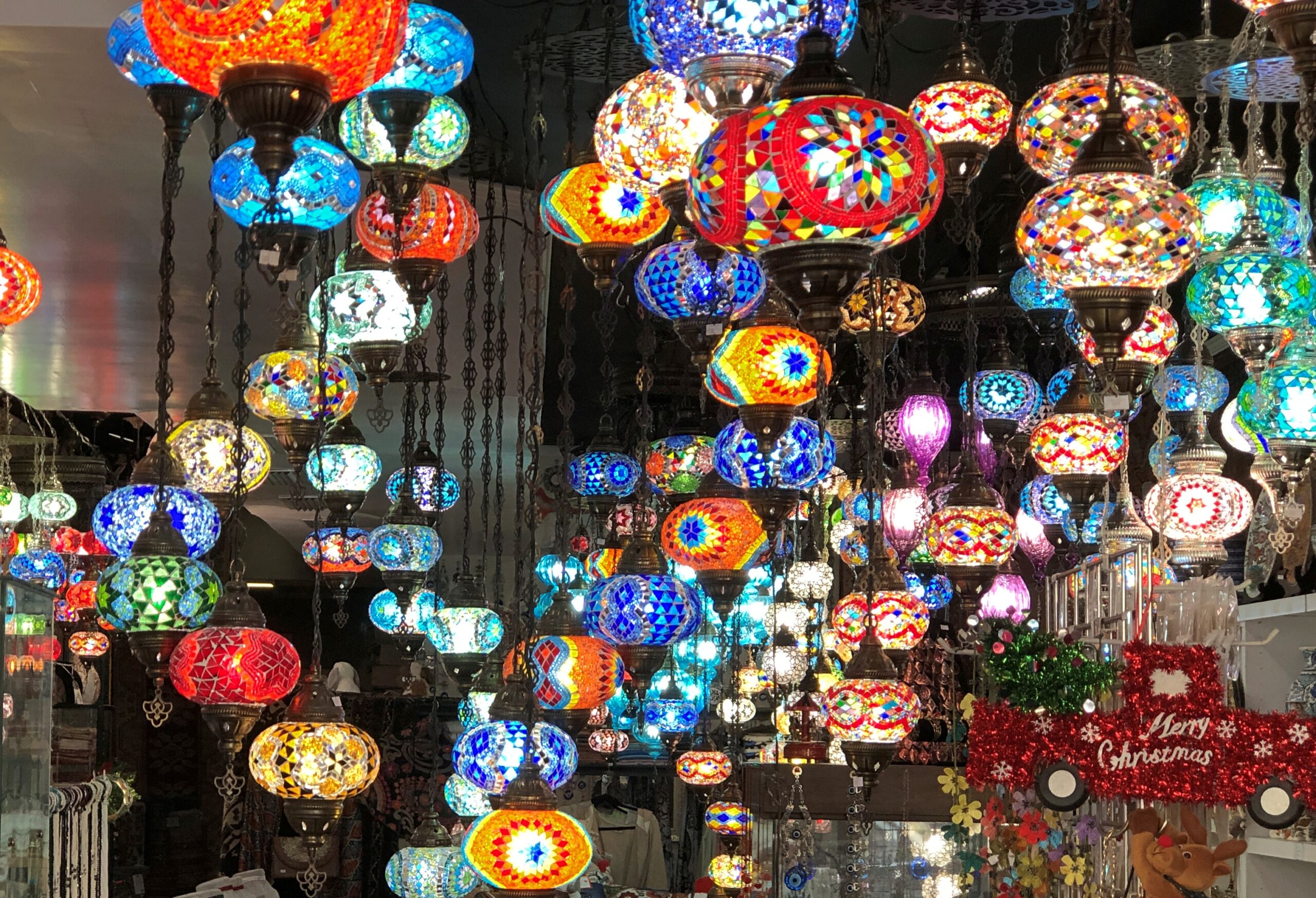
Not Christmas lights, but colorful all the same, and available to take home. We didn’t.
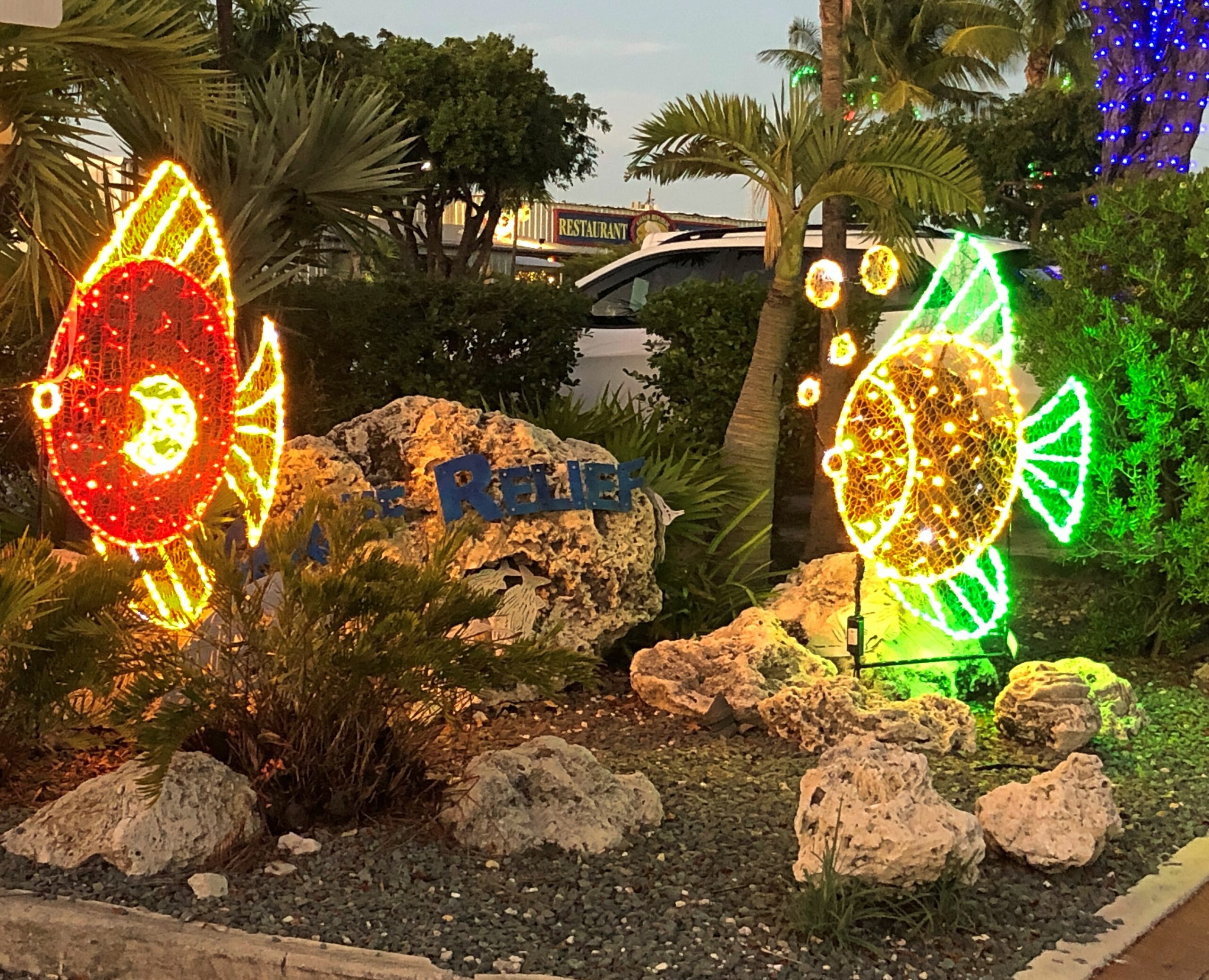
Not specifically Christmas either, but also colorful.
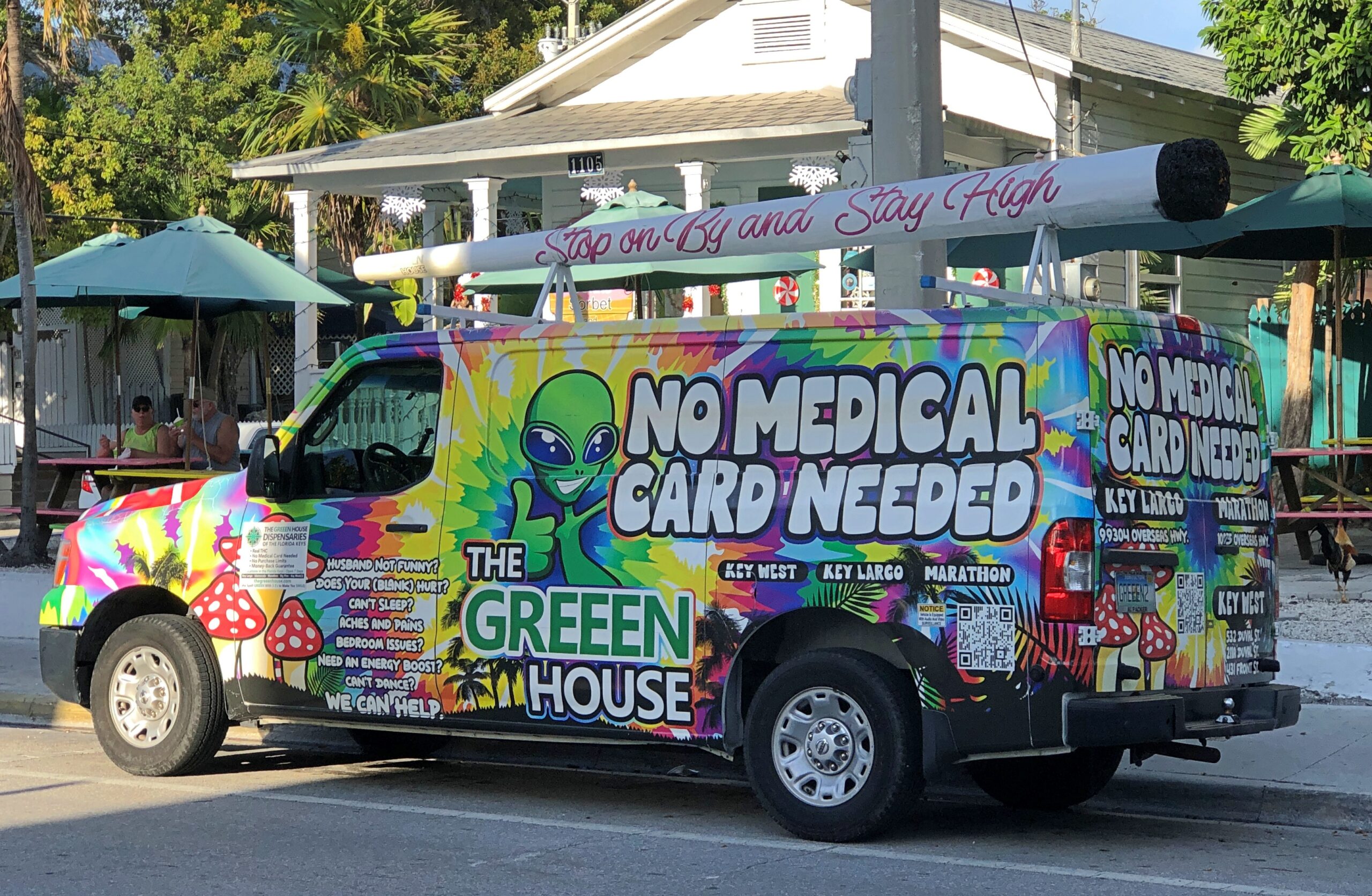
Countering the spirit of Florida cannabis law, if not the letter? Not sure. This truck wasn’t the only one we saw. Didn’t patronize them either. Ho ho ho.
I have to admit it, we bought gas at Buc-ee’s more than once on our trip to Florida. Turns out that the chain’s gas prices are comparable with Costco. That is, 20 to 30 cents cheaper per gallon than most standard gas stations. Costco tends to be on main thoroughfares in densely populated places, which is sometimes convenient, sometimes not. Buc-ee’s is the flip of that, tending to be on major highways at some distance from densely populated places. Sometimes convenient, sometimes not.
We gassed up at the Smiths Grove, Kentucky Buc-ee’s just off I-65 on December 5, early in our trip. We had to make a decision on how to proceed from there. One choice: continue on I-65 to Nashville, take I-40 east from there roughly to Cookeville, Tennessee, and take smaller roads into Jackson County, to reach our friends’ home in the holler. Or: take smaller roads across southern Kentucky and into Tennessee, bypassing metro Nashville and going through towns and hamlets and farmland and woods we’d never seen before, ultimately connecting to the appropriate small roads in Jackson County. It isn’t too hard to guess what we did.
Kentucky 101
It so happened that exiting from Buc-ee’s in Smiths Grove takes you to Kentucky 101, a two-lane highway that can either take you back to I-65 or south through Warren and Allen counties. Coming from the crowds of Buc-ee’s, people and cars, the contrast of heading south on Kentucky 101 is clear.
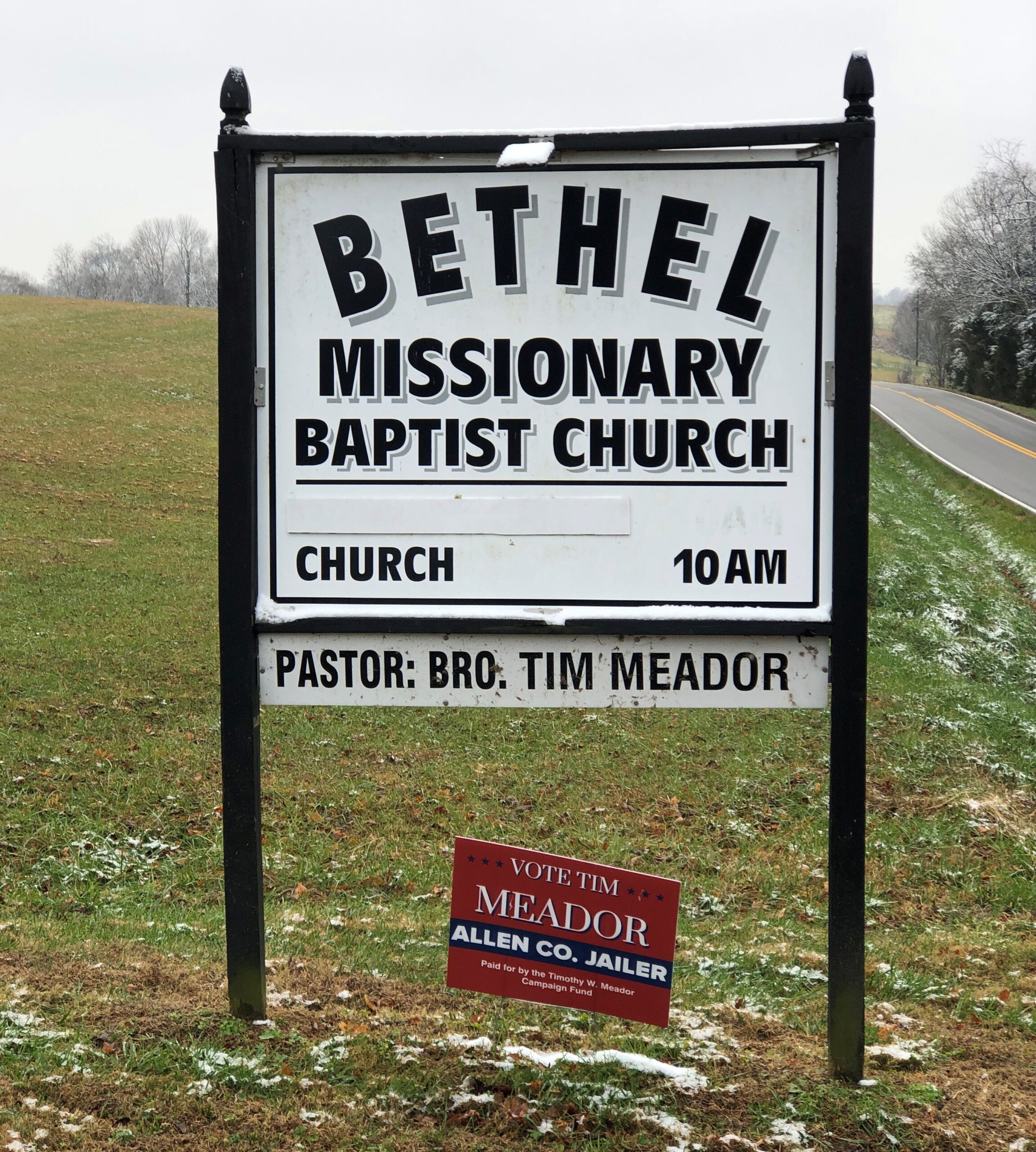
As of now, at least, Bro. Tim Meador is the Allen County Jailer, so I assume he won the most recent election.
I know that’s a county job that probably involves a fair amount of paperwork. Still, I picture the Jailer as an official who, like in a movie, puts offenders in the jug himself, turning a skeleton key (one of a few jangling on a big ring) to lock the cell.
Scottsville, Kentucky
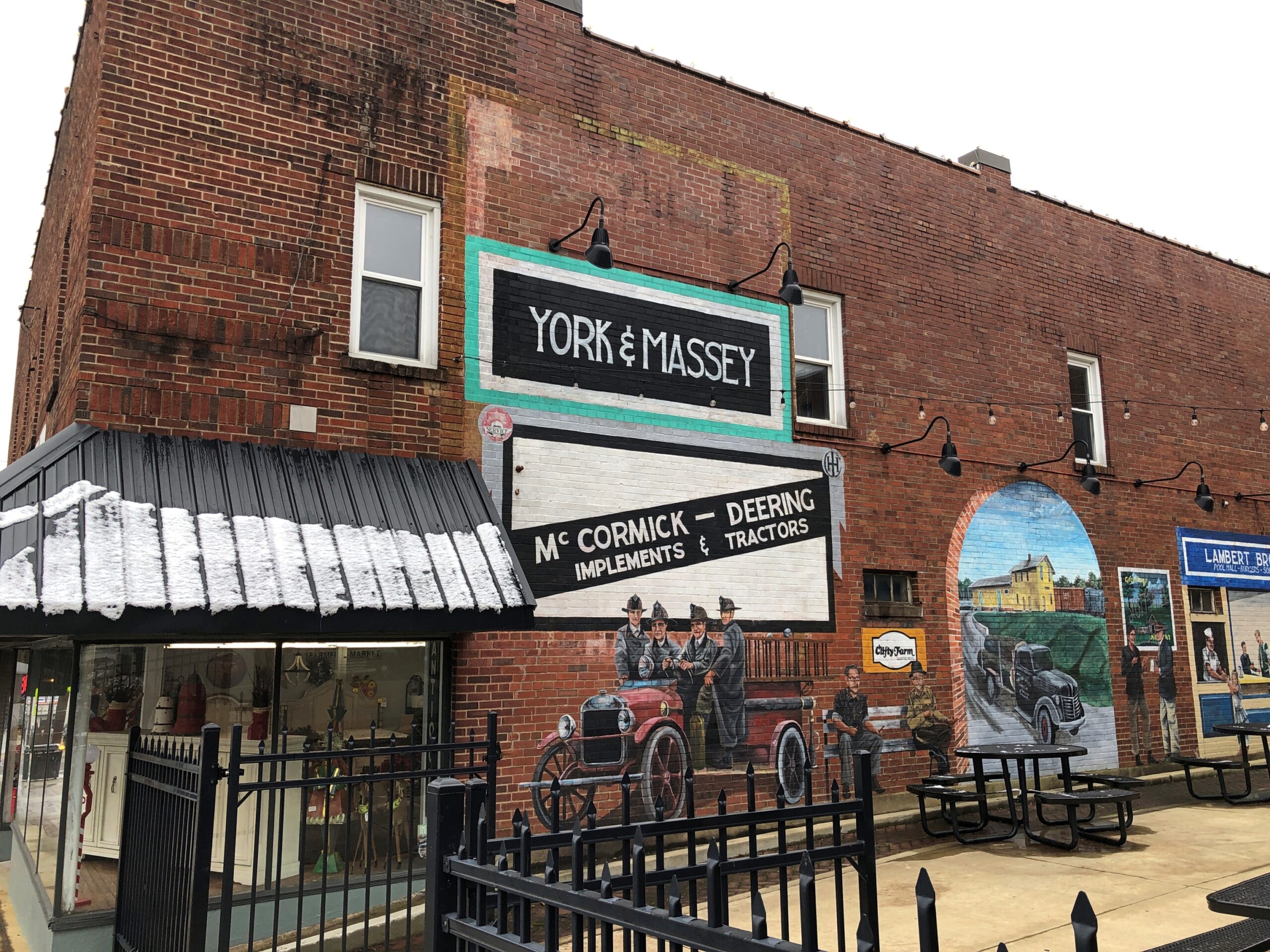
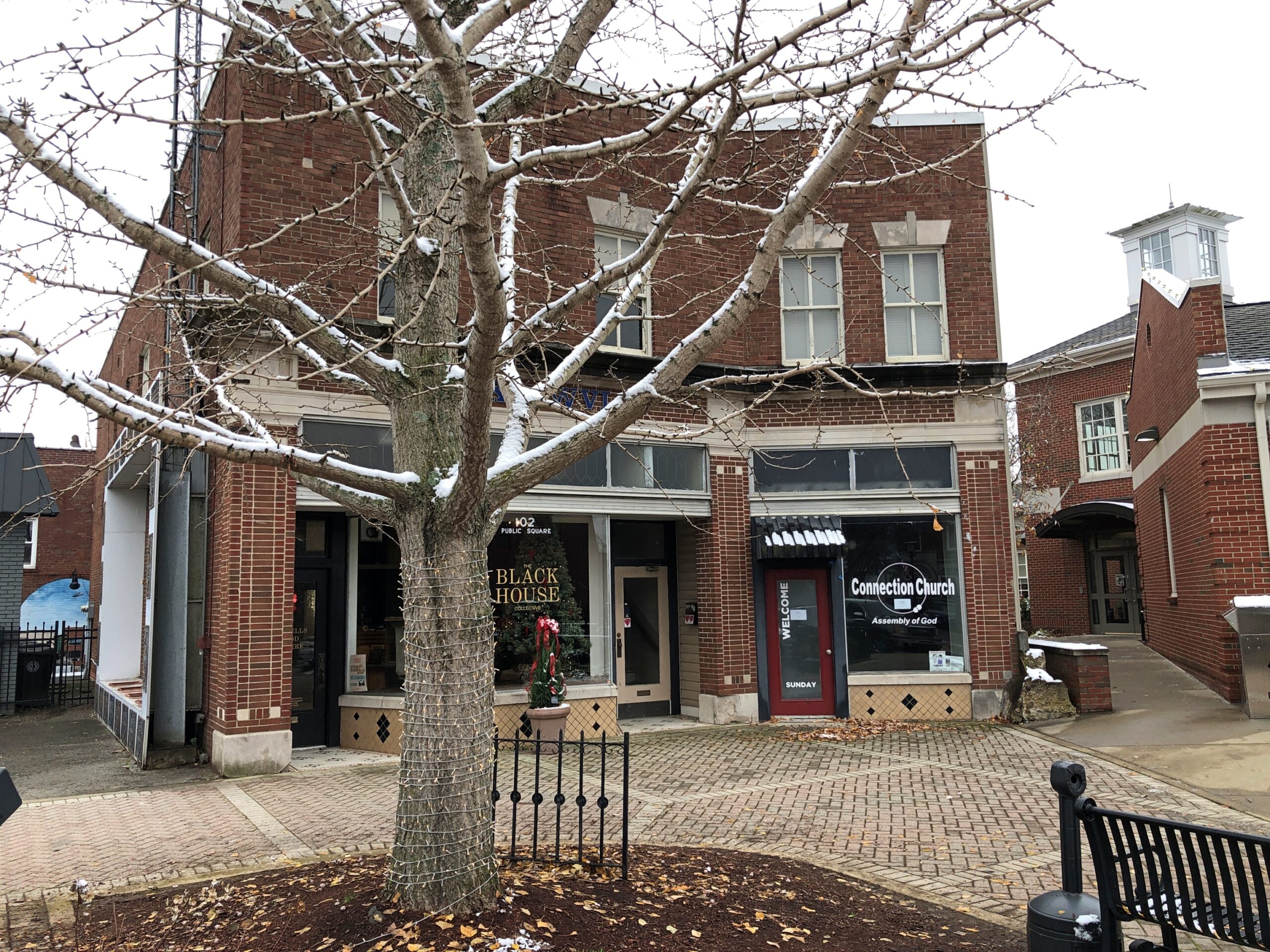
The main traffic hub of Scottsville (pop. 4,300), the seat of Allen County, is the junction of Kentucky 101 and 98, known as Main and Court streets locally. Instead of a county courthouse, the hub is in the form of a square with businesses around it and a lot of traffic passing through. More than I would have guessed.
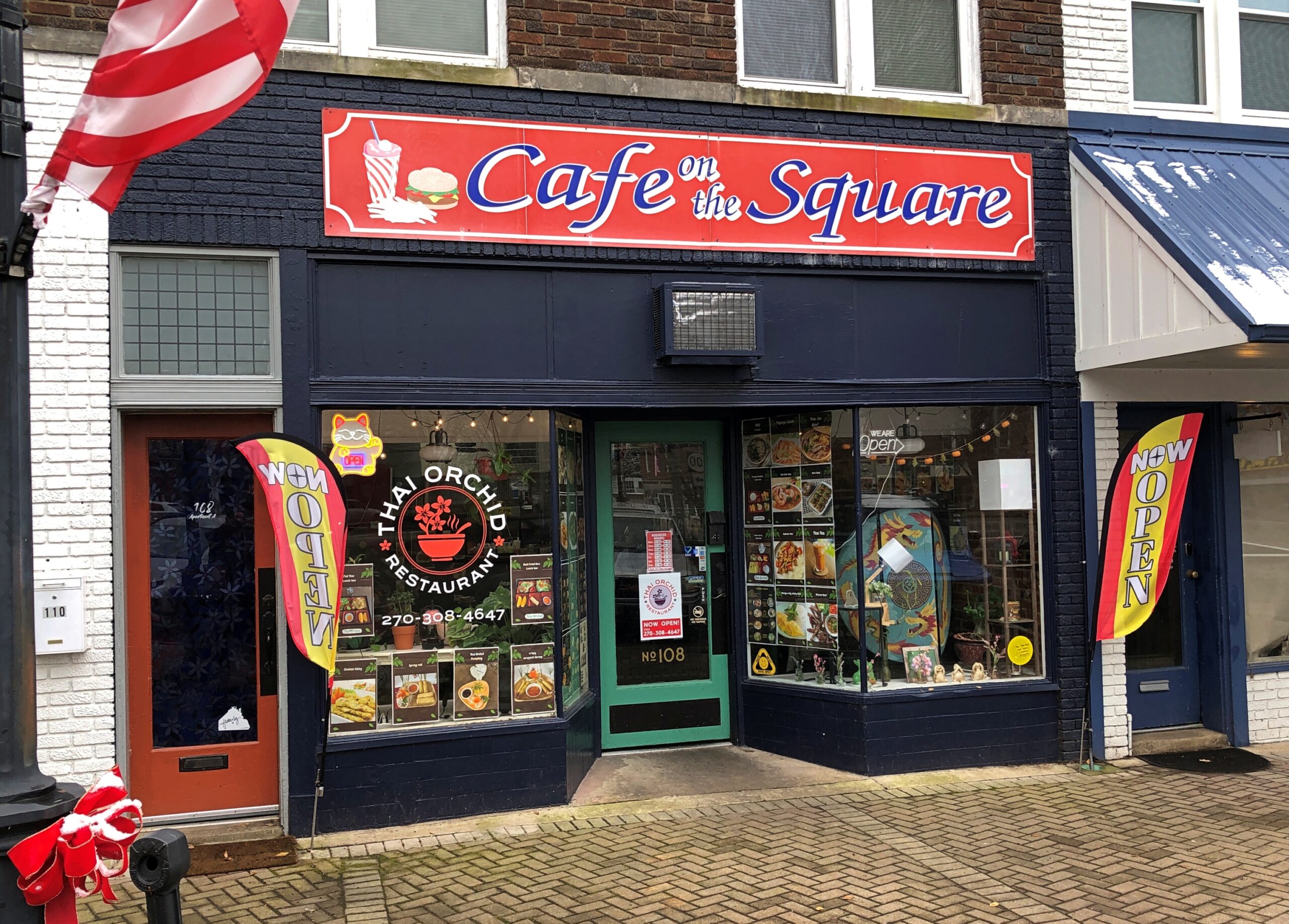
It was lunchtime. I can report that Thai Orchid is as good as you might find in a larger town. In our time, Thai has pretty much joined the tapestry of American cuisine as thoroughly as Chinese or Mexican food did in previous generations.
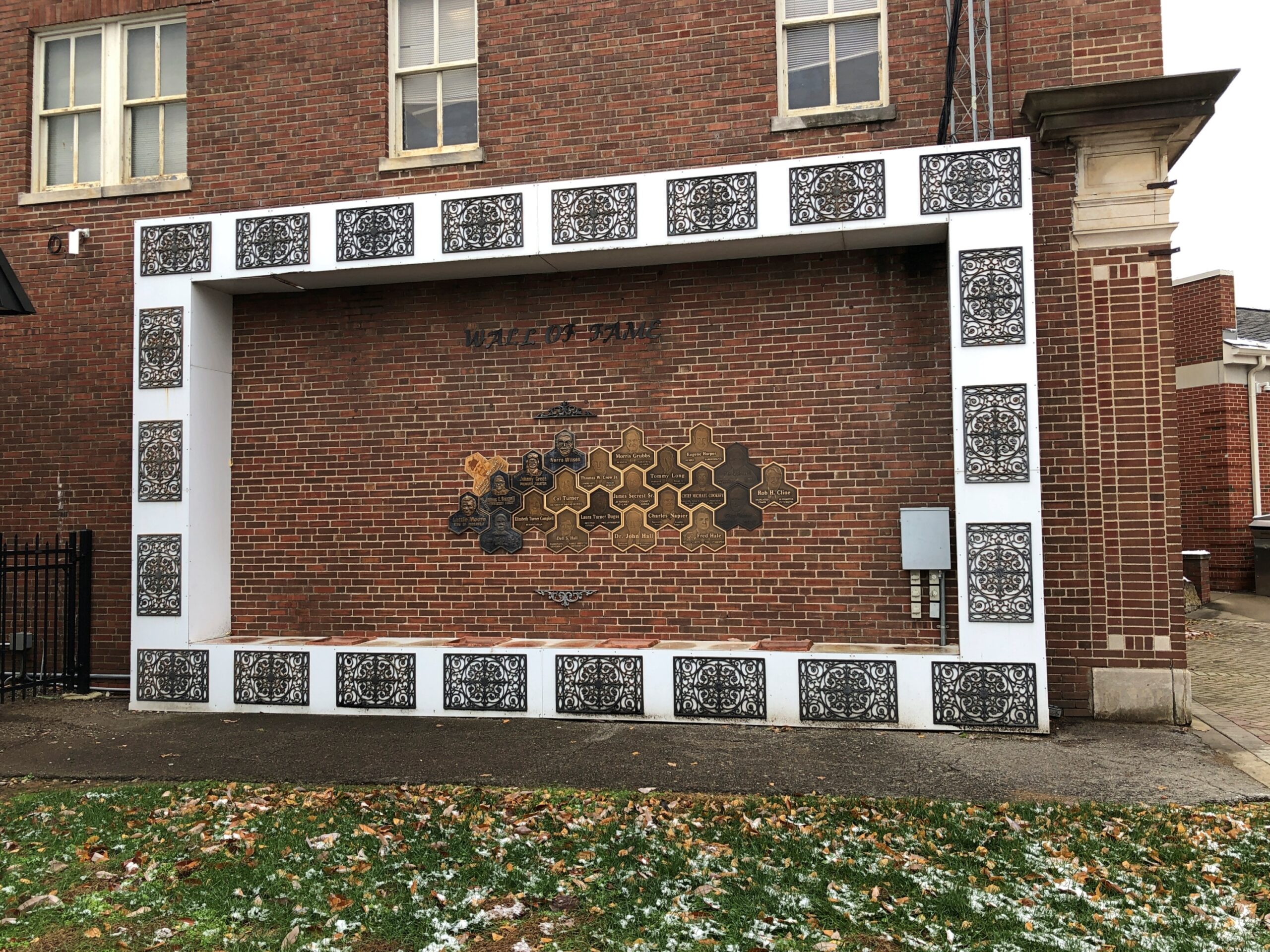
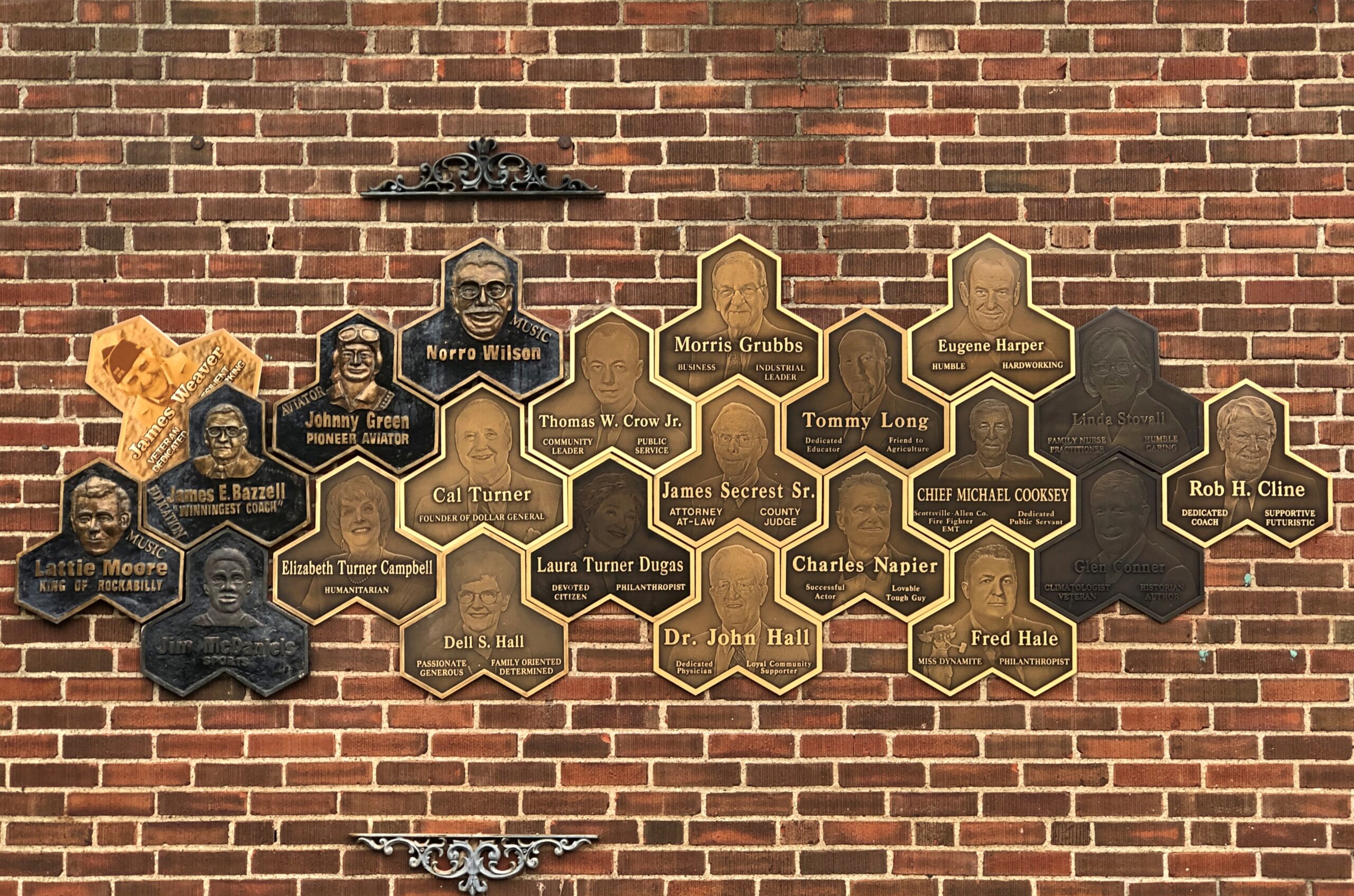
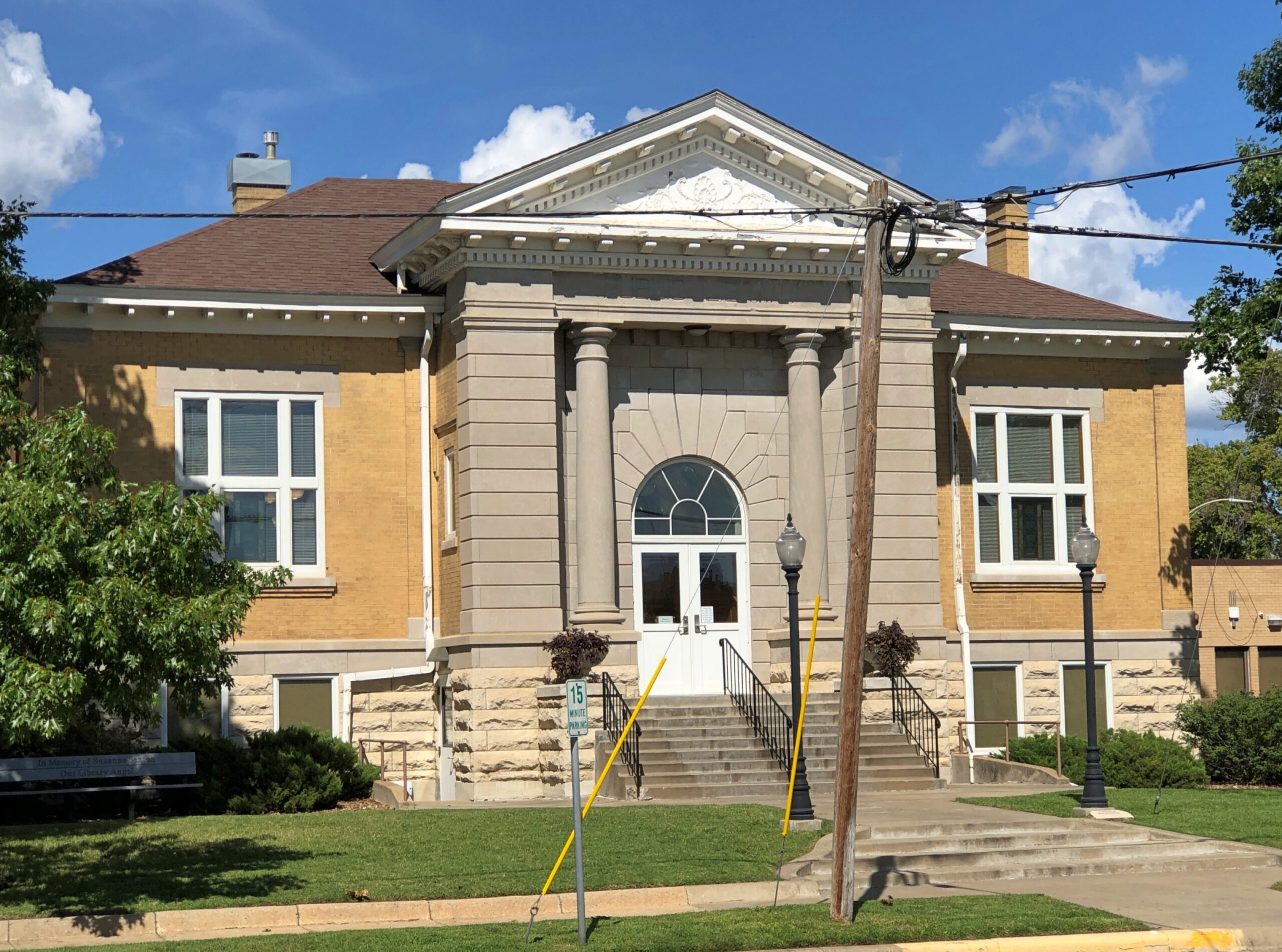
The main public library is near the square, sporting a local Wall of Fame.
The names include Lattie Moore, who sang, “I’m Not Broke but I’m Badly Bent,” a song with pretty much the same theme as Al Dexter’s “Wine, Women and Song.”
I won’t look all the names up, but the Scottsville Wall of Fame also includes Johnny Green, pioneer aviator, who did the first commercial flights between Florida and Cuba, apparently.
Red Boiling Springs, Tennessee
We drove on Kentucky 98 east to the near-border town of Gamaliel, pop. 391, still on the Kentucky side of the line. A lesser-known Biblical name, but I also can’t help thinking of the G. in Warren G. Harding.
South from there, Kentucky 63 turns into Tennessee 56 after a few miles. There’s no sign marking the border, just one announcing the Tennessee highway number. Pretty casual for a line that might have been an international border, had the secessionists had their way (unless, of course, Kentucky left the old US).
Besides a cool name, Red Boiling Springs (pop. 1,205), Tennessee, has a history. As the name suggests, people took the waters there.
“As recently as 1920, Red Boiling Springs had about a dozen places in which visitors could stay,” The Tennessee Magazinereported a few years ago. “The largest was the Palace Hotel, which had 180 rooms. Over the next several generations, business declined… and… a 1969 flood destroyed large parts of the town. However, three of the Red Boiling Springs resort hotels are still open. They were in (nearly) continuous operation throughout the 20th century and still reflect more of the lifestyle of the late 19th century than they do the 21st.”
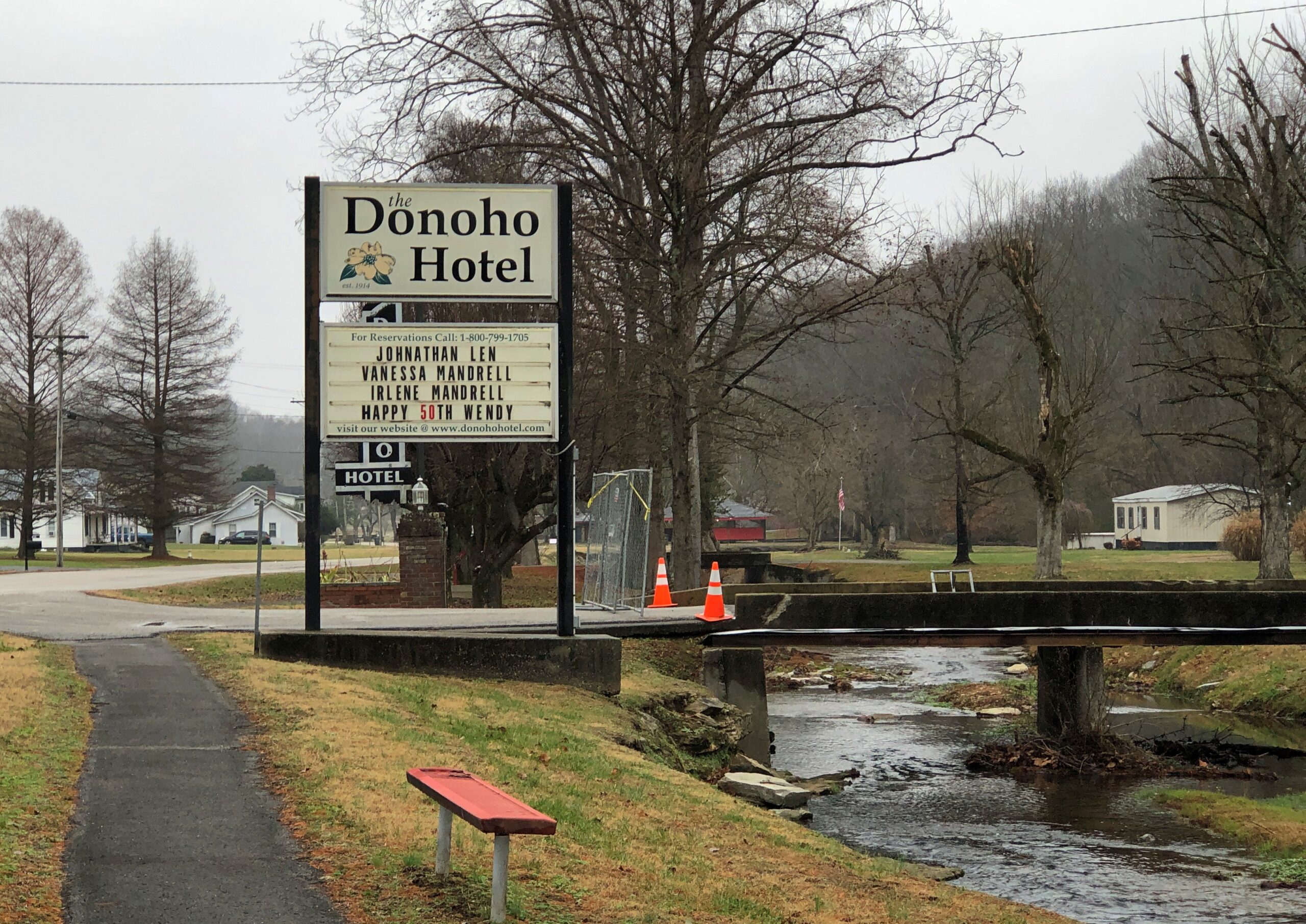
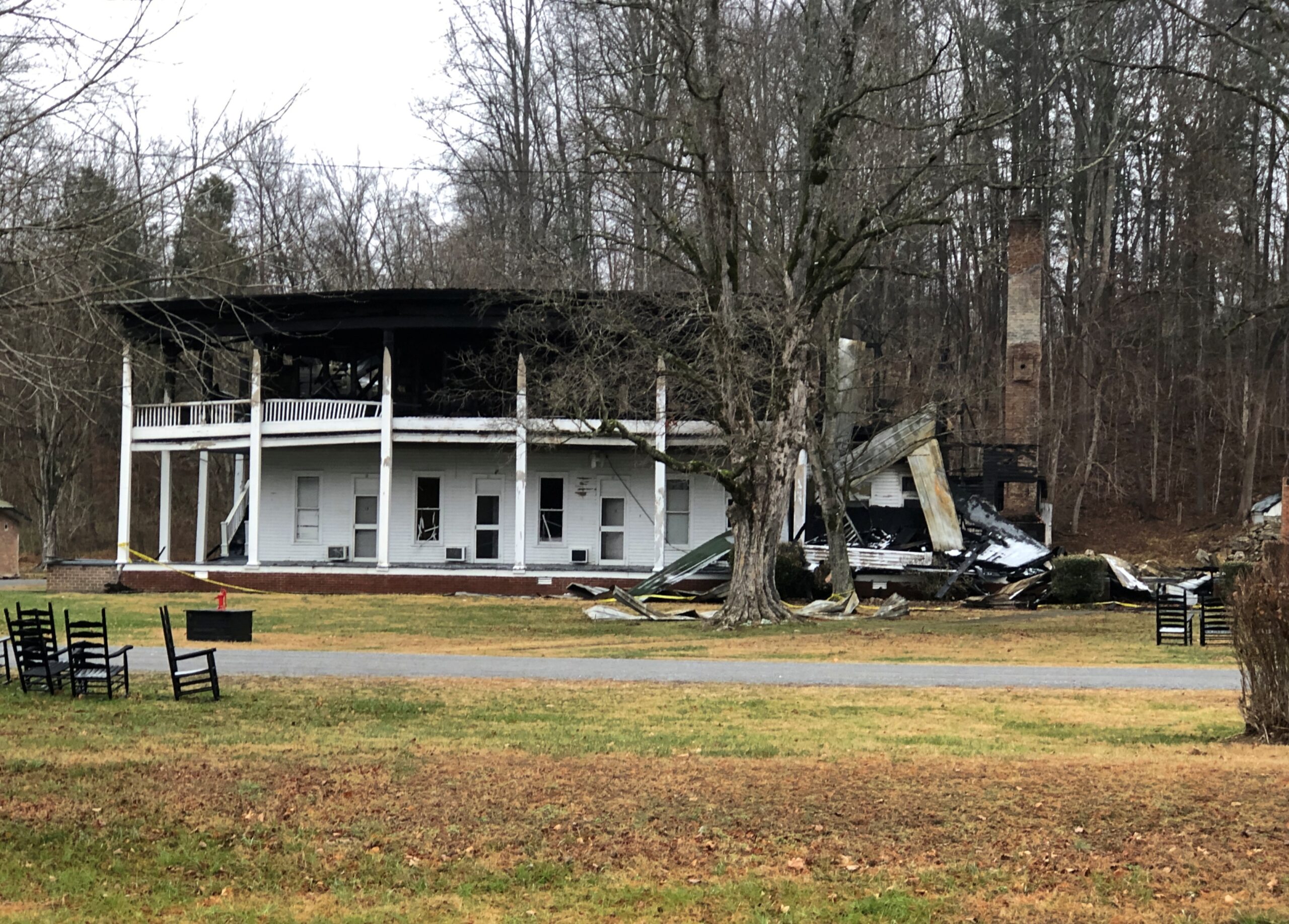
Make that two hotels. One of those mentioned in the article, the Donoho, burned down in November.
The gray, chilly day somehow fit the scene of a wrecked historic hotel.
Damned shame. I can’t leave it at that. Soon after passing through Red Boiling Springs, we arrived at our destination in eastern Middle Tennessee. The next day, we enjoyed a Tennessee hootenanny.
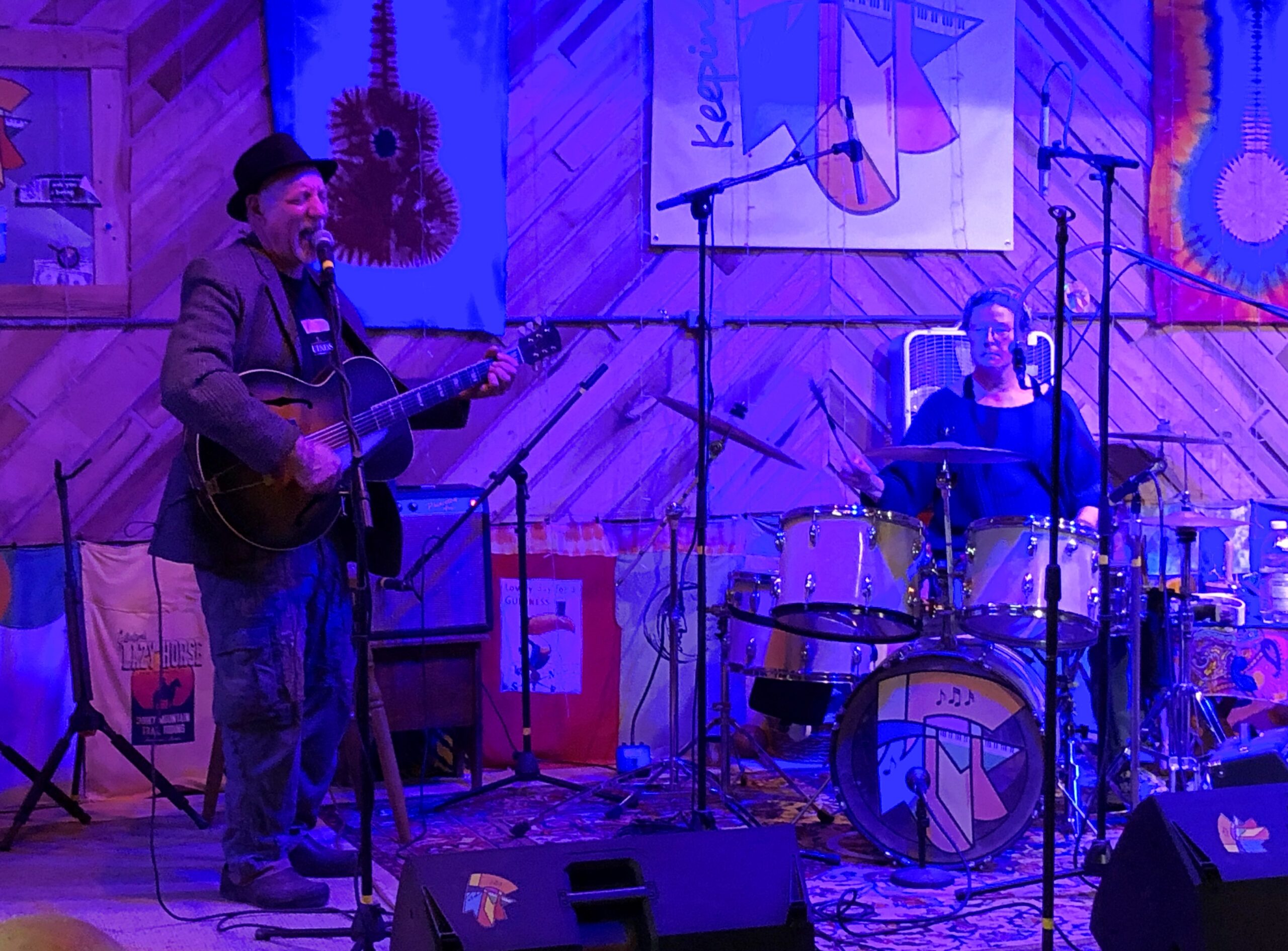
Our hosts, Dave and Margaret, on guitar and drums.
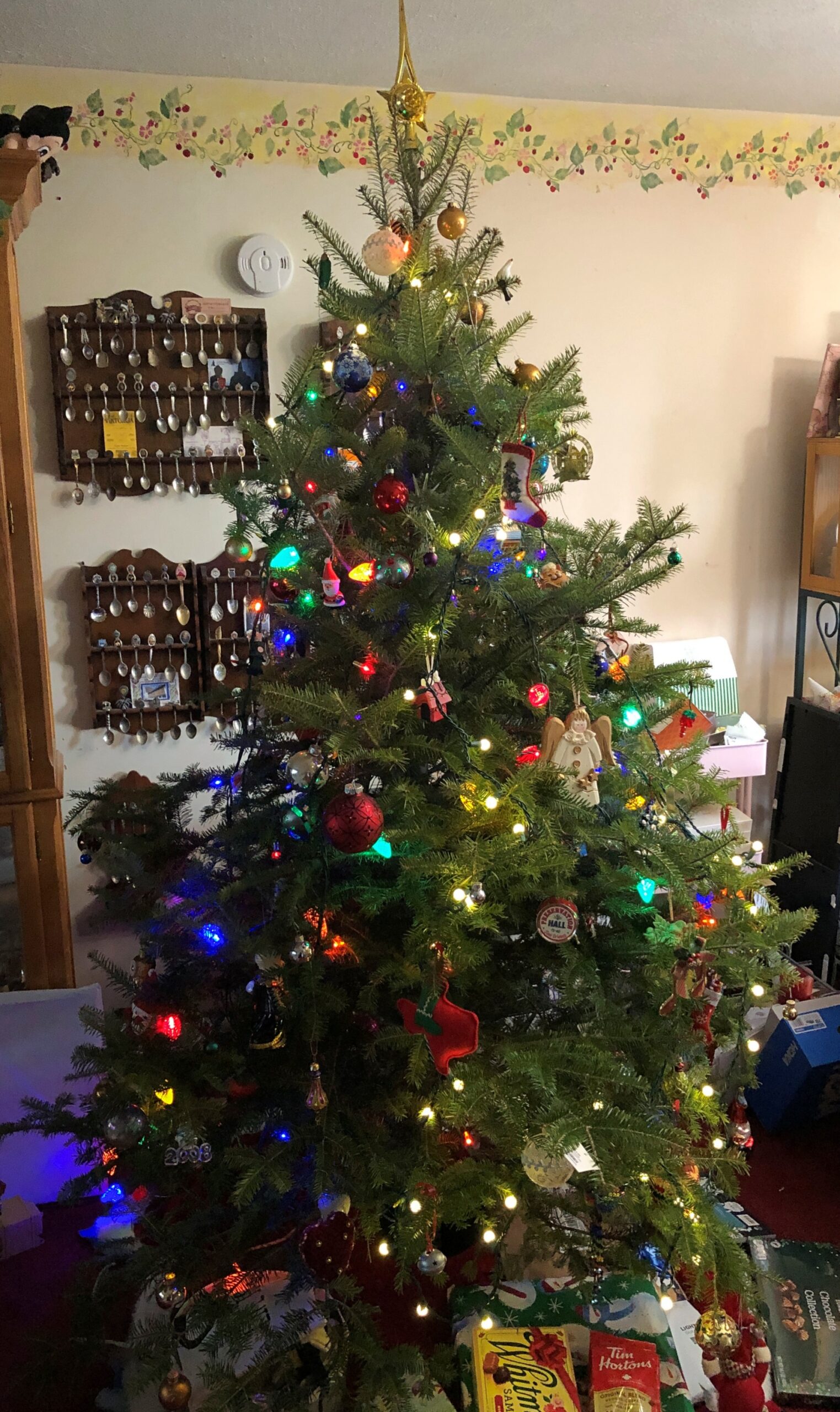
Decorating for Christmas this year meant a rapid set-up. We spent a fair number of hours on the 23rd making the living room ready for a tree – moving clutter, mostly. On Christmas Eve, I brought the tree in from the garage, and Ann mostly decorated it. Finishing touches, by me, were in progress even on the morning of Christmas Day, but since that moment in the life of our family doesn’t involve an early-morning rush downstairs by children anticipating Santa’s bounty any more, that was doable.
Ann did a fine job of decorating, in the style of our family: fill up the tree with a wide variety of glowing and glinting objects accumulated across the decades.
We got a late start on decorating for Christmas, though when I think about, decorating after the Solstice discourages the sort of front-loading of Christmas that a lot of people complain about, but which they do anyway.
We had a good reason for the late start: a drive to Florida and back, beginning on December 4 and ending on the 22nd. Not just to Florida, but as far as you can go in that state, at least by car, namely to Key West and back. Early to mid-December seemed like a good time to do such a thing, after any traveling people do for Thanksgiving but before the worst of the Christmas-New Year’s rush. A short shoulder season in other words, but a good one, with room rates not quite subject to surge pricing, and crowds thick in some high-volume tourist destinations, but not impossible.
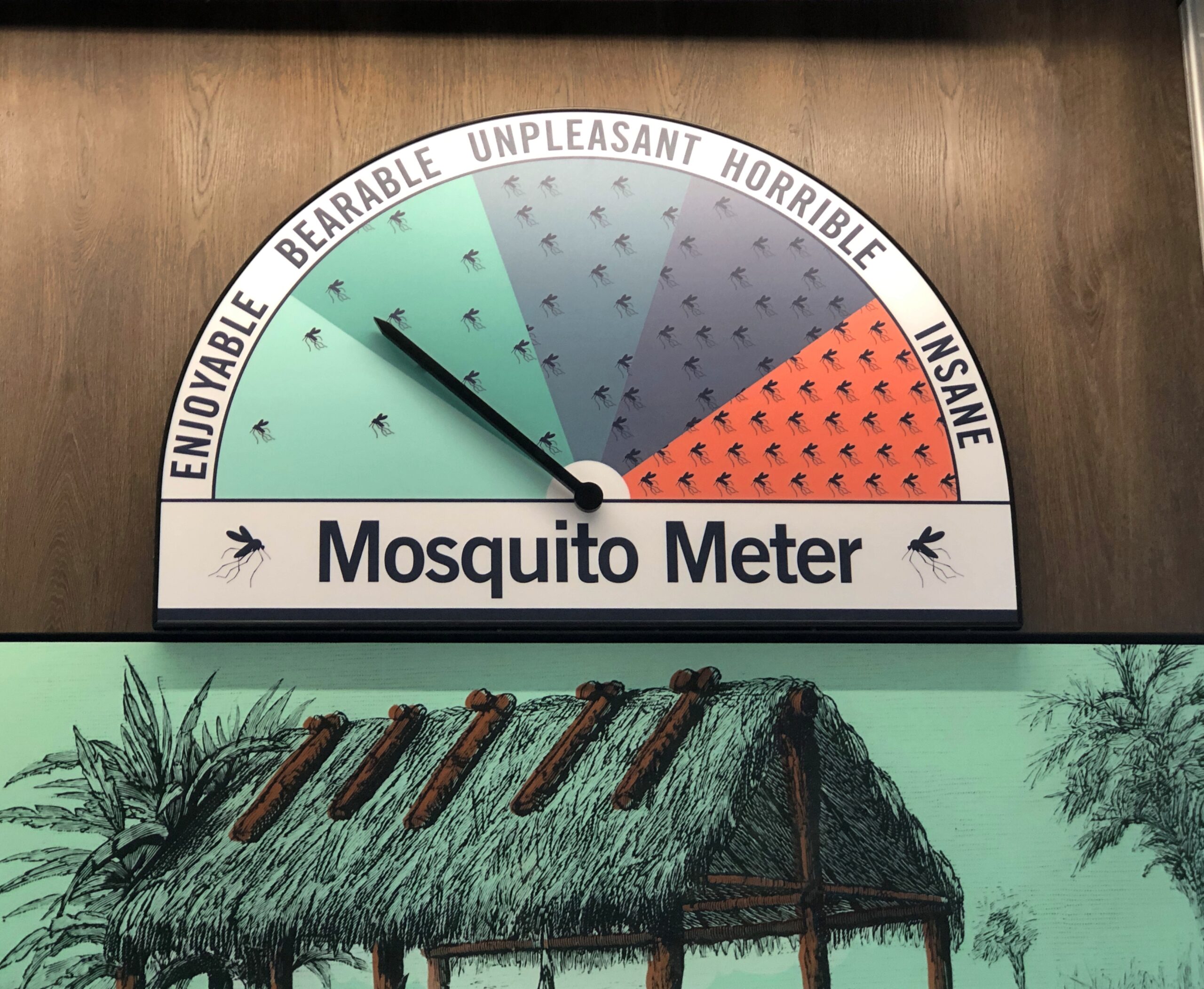
Also, Florida has few mosquitoes this time of year. Not no mosquitoes, as we found out one day in the southern reaches of the peninsula, just a “bearable” number.
Sometime earlier this year, I got the idea that I wanted to take four long drives after turning 64. Four for 64, you could say. Doing so by the end of 2025 wasn’t part of the idea, but that’s how things worked out. The drive to Florida and back, by way of such places as Indianapolis, Louisville, Chattanooga and Atlanta, totaled 3,682 miles. For all four trips since June, the total is about 14,300 miles.
That could be made to sound impressive, but in fact American men my age average more than that every year, about 15,000 miles, at least according to this source, which cites US DOT data. Younger men drive even more annually. Most of that is commuting, however. My commuting mileage by car has been exactly zero this year, and while I drive locally to stores and such, it couldn’t be more than a few thousand miles. So it seems clear that, as an American man, it was my duty to get out and drive.
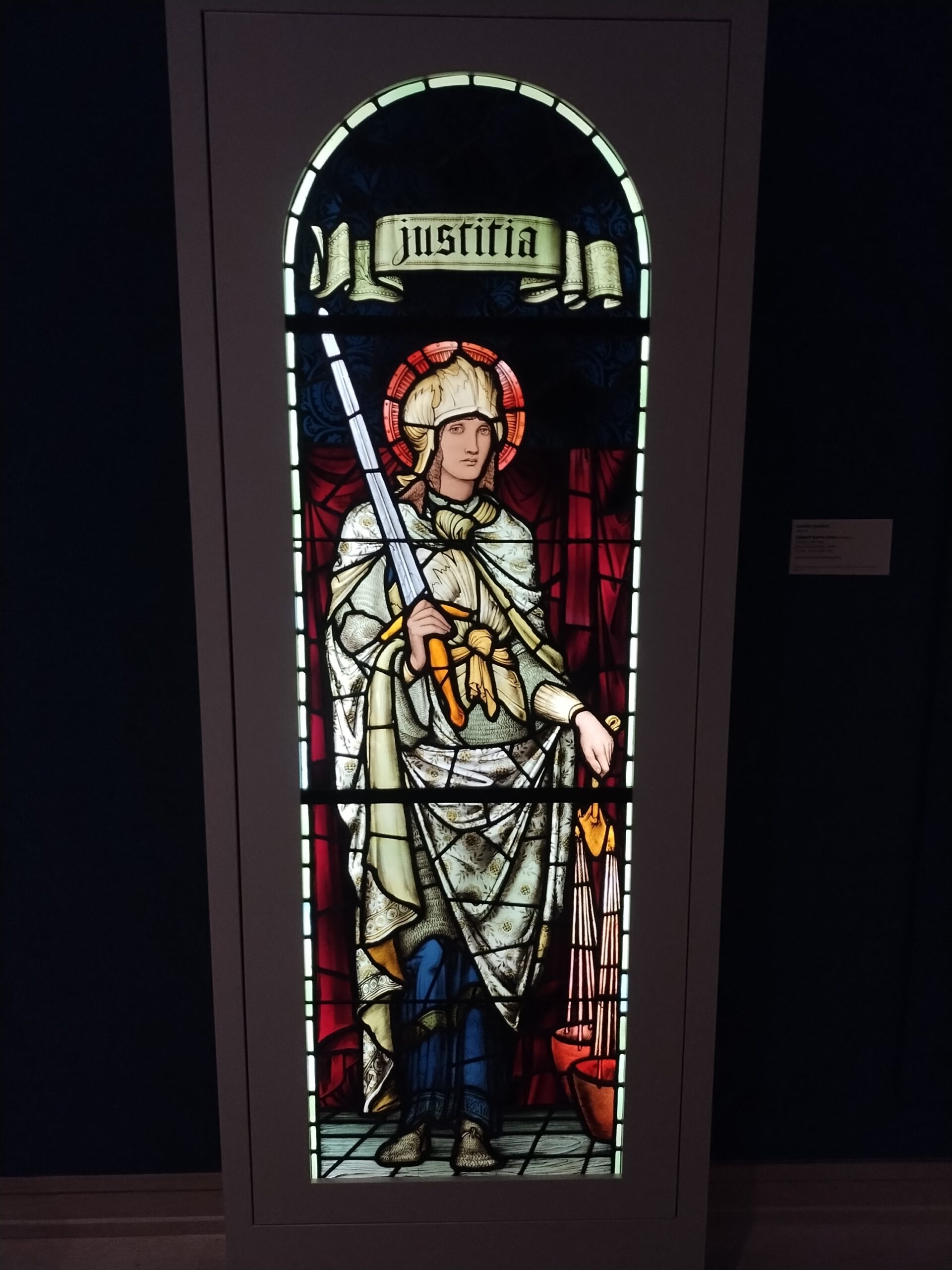
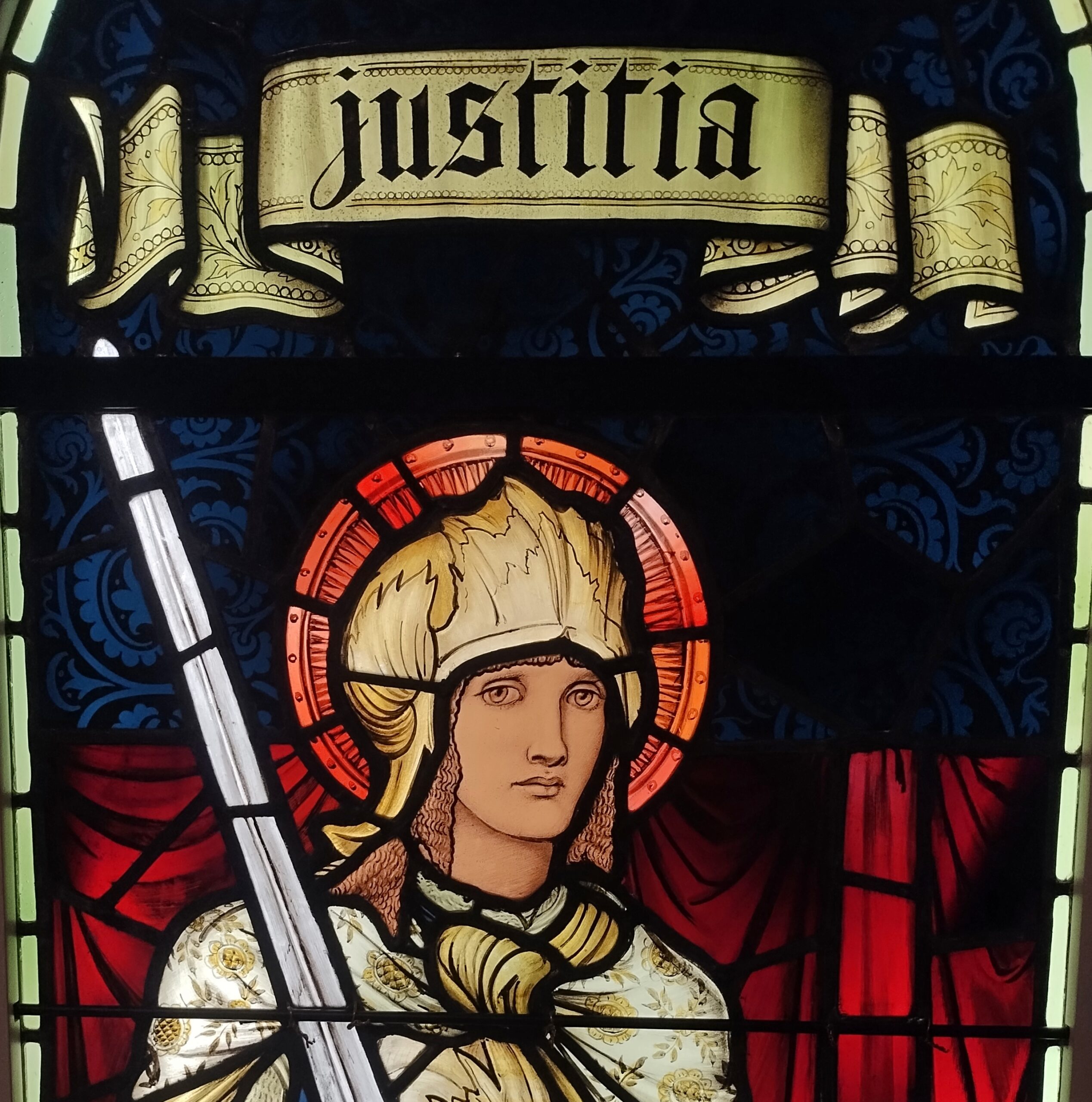
When we headed south in early December, snow covered the ground all the way past Indianapolis, where we stopped for a few hours at the Indianapolis Museum of Art, which is part of a larger campus called Newfields – and better examined in summer, I think. But the museum is a good one, with a solid collection, especially 19th-century American and European works. Such as “Justitia,” a Morris & Co. work from the 1890s.
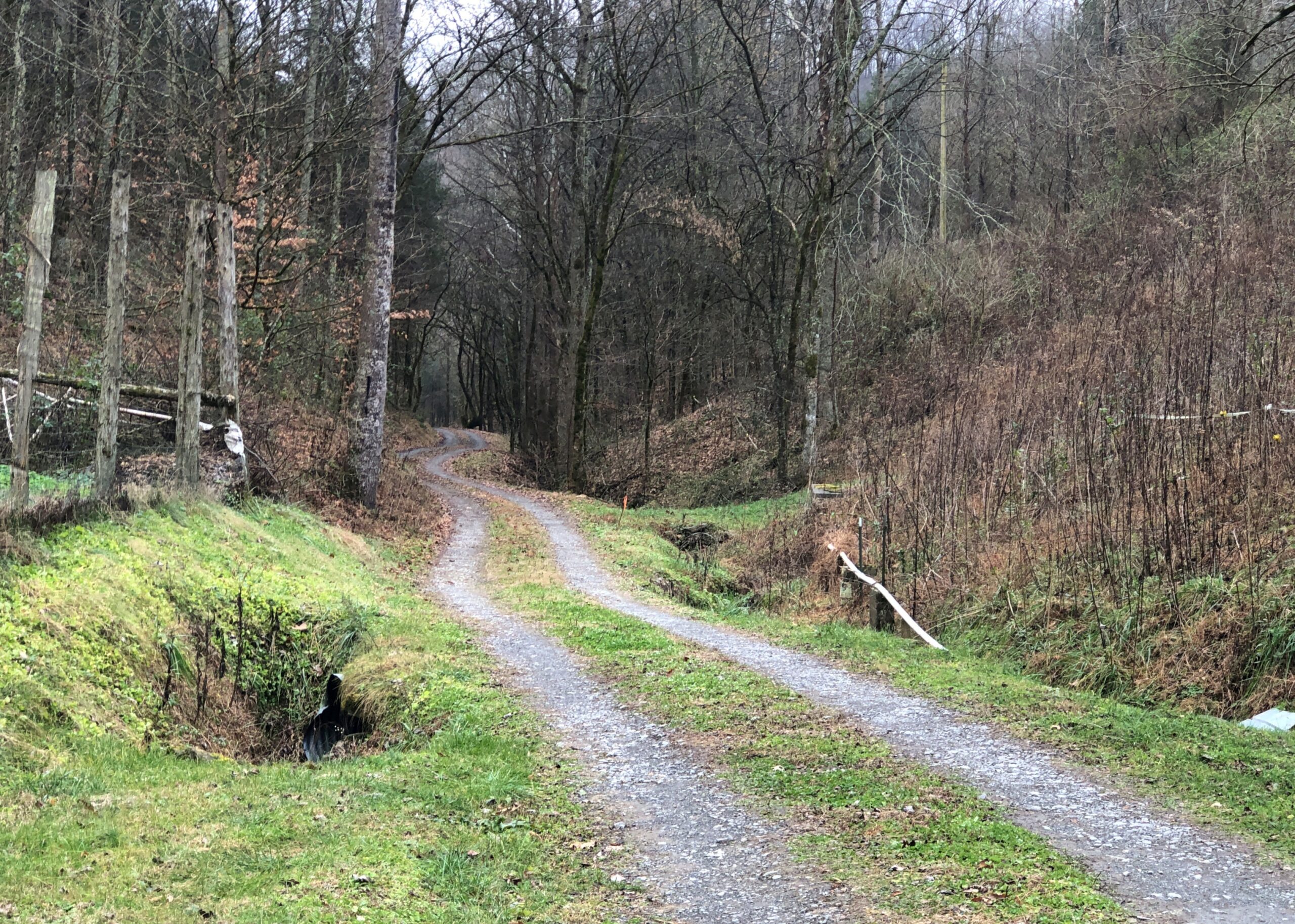
After overnighting south of Louisville, we diverted from I-65 and took smaller roads through southern Kentucky and into Tennessee to a holler in Jackson County, where we were the guests of dear friends. Tennessee musicians from those parts — some professional, others skilled amateurs — gathered on the the evening of Saturday the 6th, for one of the periodic jams in our friends’ barn, which houses no animals these days, but a small stage and some sound equipment and a fair number of folding chairs. A joyful jam it was. Food was potluck. I like to think we went to a hootenanny.
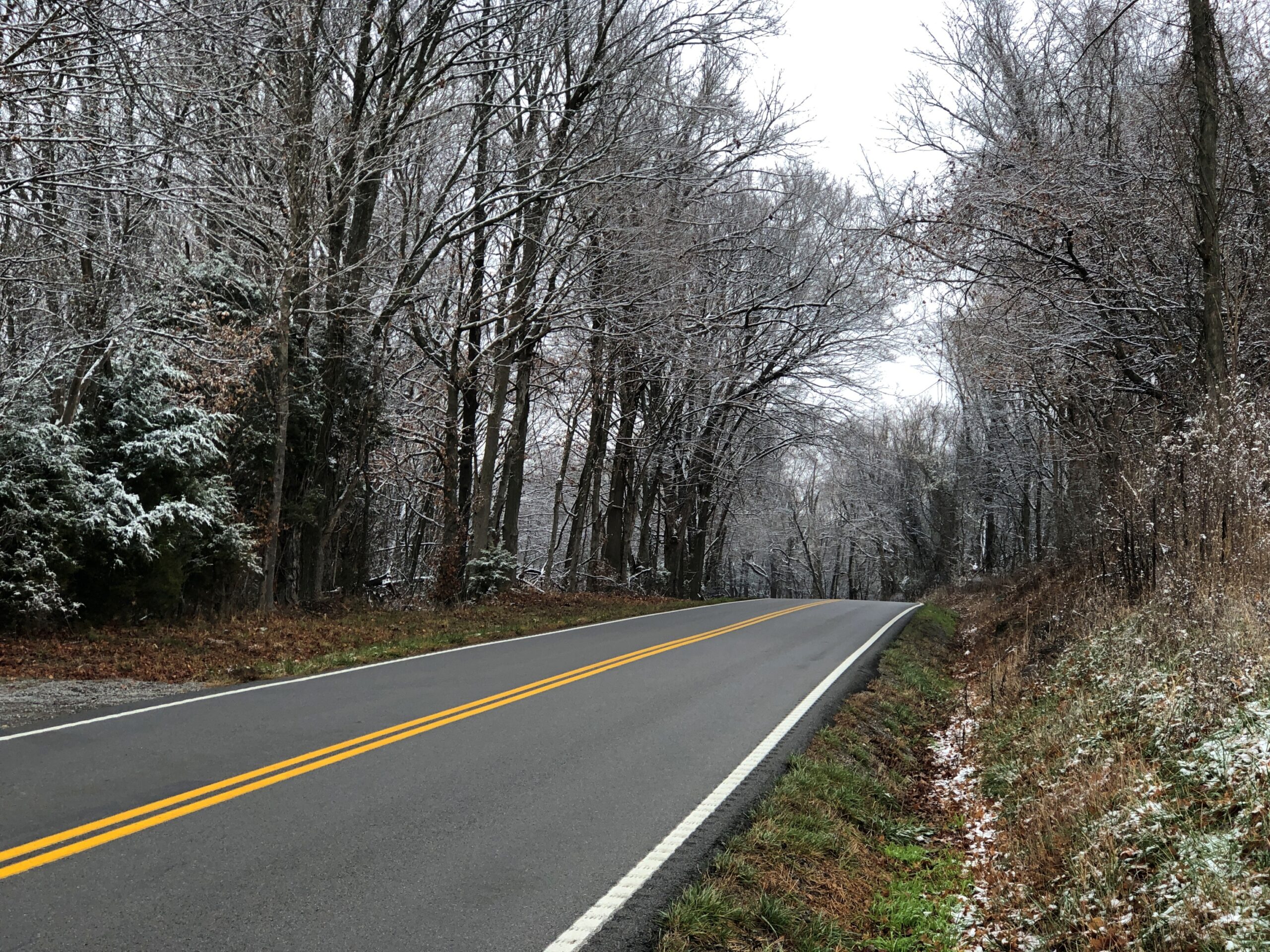
The road through the holler. By this point, no snow. We were trading cold for warmth. That was one of the goals of the trip. Maybe the main one.
From there it was mostly a straight shot down through Georgia on I-75 to Florida, and eventually US 27 to Orlando by way of non-coastal Florida places like Gainesville, Ocala and Lady Lake, a string of settlement less agricultural and less pastoral now than ever, more like an endless outer suburb. Heavy traffic is an invasive species in this part of Florida, surely as pythons are in damper parts of the state. Not just masses of cars and trucks, either, but also golf carts. We passed close enough to The Villages to see billboards advertising legal representation in the event of golf cart accidents. Carts, I’ve heard, provide transport in great numbers in that sprawl of a settlement.
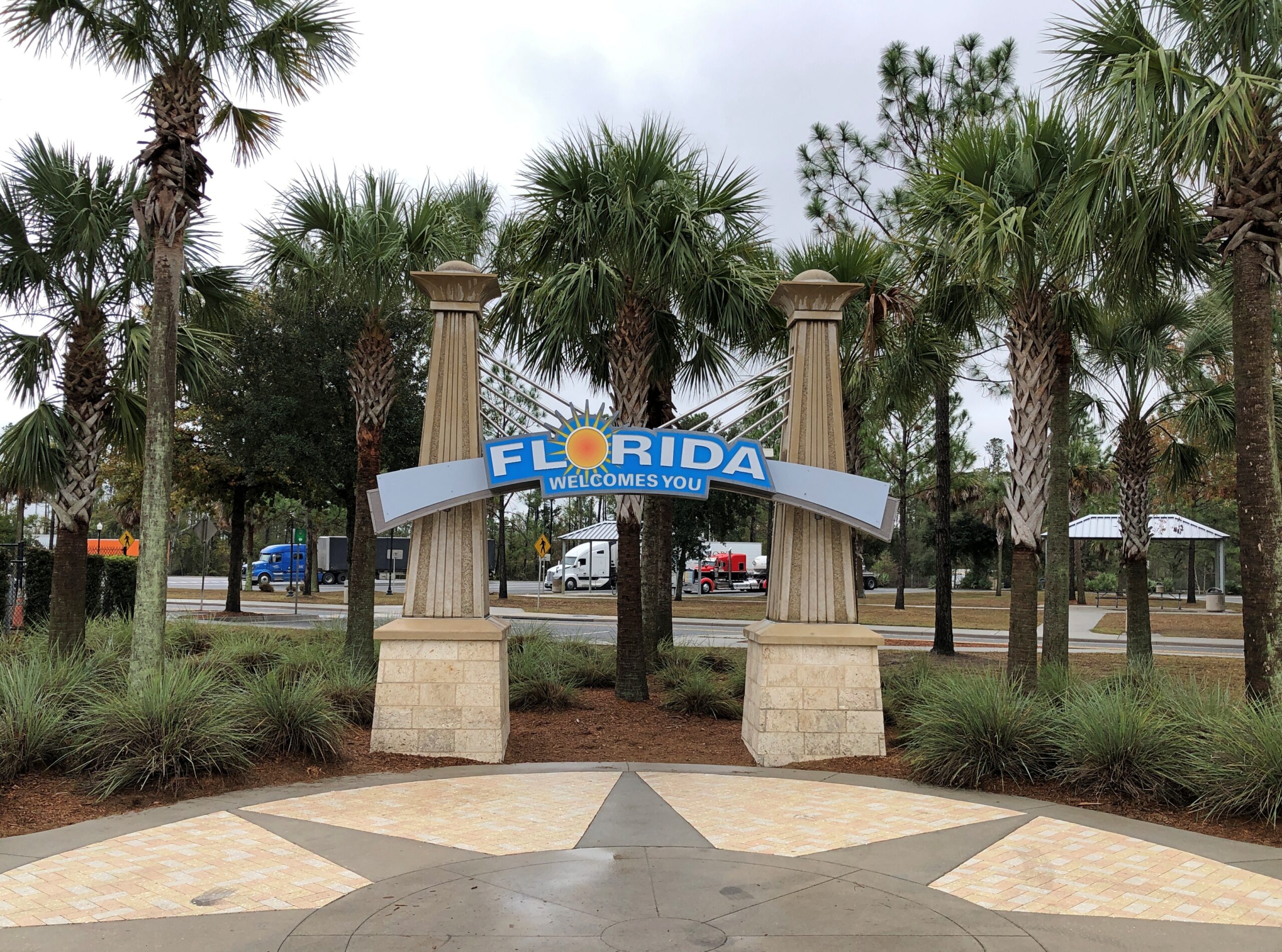
The drive to and in Florida involved the usual North American mix of large and small roads, smooth and ragged, grid-like and irregular, though Florida cities tended toward the irregular (except for Key West), and as crowded as can be and as empty as can be. Snow lined the way up north, thinning out the further south we went, giving way to brown landscapes and bare trees. Then we came into greenery – evergreens and palms and even deciduous species turning color. We crossed mighty bridges over mighty rivers, small culverts over alligator haunts, and the string of bridges that make up the civil engineering marvel known as the Overseas Highway (US 1). We crossed barely acknowledged borders and signs at the Florida visitor center on I-75 proclaiming The Free State of Florida.
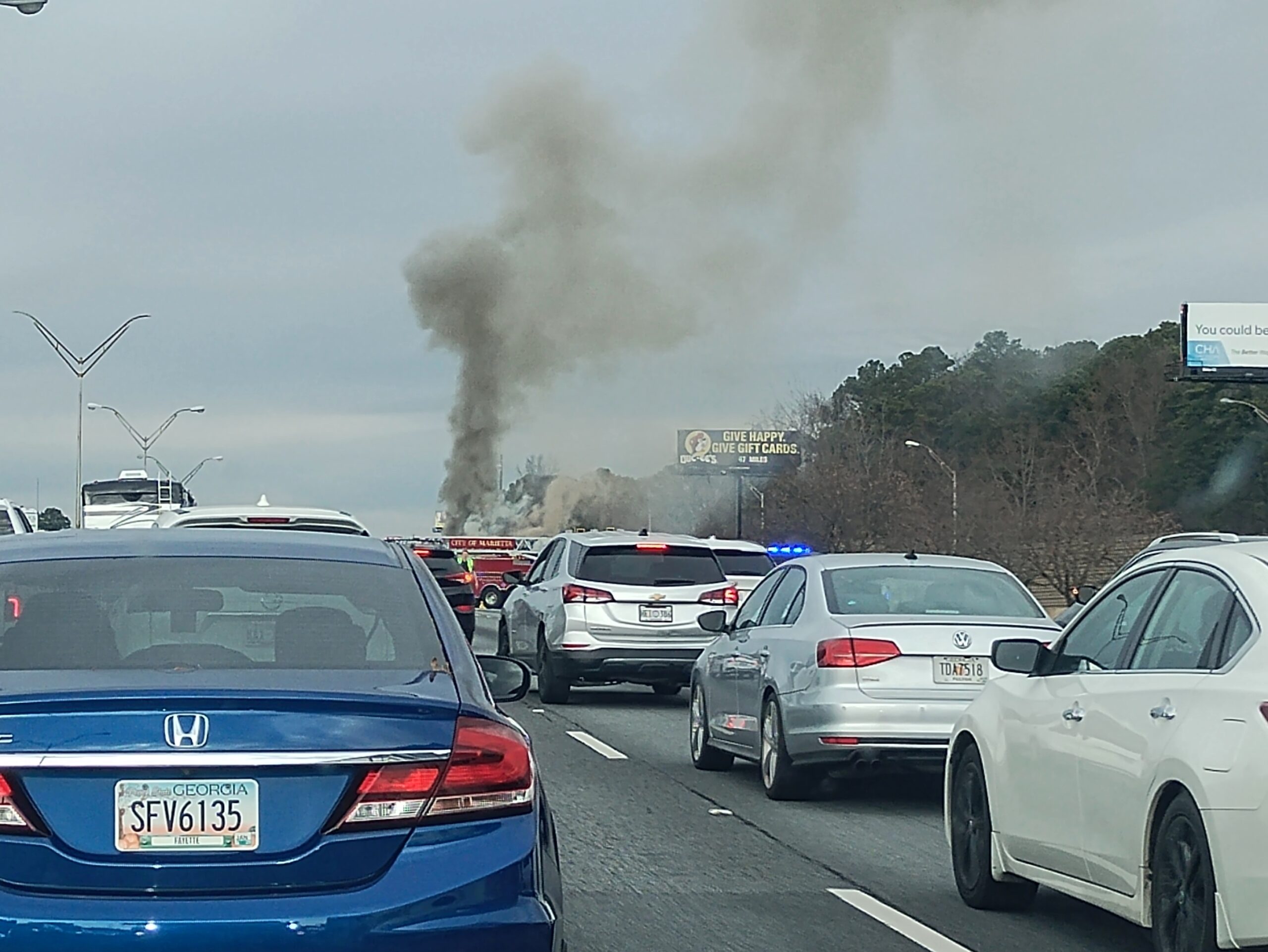
Florida Man was out and about, weaving in and out of high-speed traffic, pushing 100 and pretty sure that physics doesn’t apply to him, though I have to admit that Florida isn’t different from any other state in that way. Traffic stopped cold more than once: for a banged up, upside-down SUV; for a raging RV fire, attended by a half-dozen firemen; for a serious two- or maybe three-car wreck on the other side of a divided highway; for construction, usually without any workers in sight; and once for no reason that we could tell at all.
In Orlando, we spent all December 9 at Universal Epic Universe, a theme park that only opened in May. Ann flew in the day before we went to the park and flew home the day afterward, taking advantage of the low prices that discount airlines offer to high-volume places in a shoulder season, if you take no bags and buy nothing to eat or drink at sky-high prices, literally and figuratively. A small bag of hers had been stowed in our car for the visit.
A theme park is one thing, but I wanted a look at Orlando, at least a sliver of it, the next day. Ann’s flight was fairly late that day, so we were able to spend part of it in posh Winter Park, including a tour boat ride through the town’s small lakes, lush with greenery and expensive houses on their banks, and connected by canals.
A drive that included the stretch of US 41 that passes through the Everglades took us to Homestead, Florida, and the mid-century charms of The Floridian motel. A day in Everglades NP followed, including an airboat tour and a drive to the coast at Florida Bay. The next day, before leaving Homestead for a drive in the rain across the Overseas Highway to Key West and while the sun still shined, we toured the Coral Castle, a one-man construction project using 1,000 tons of oolite to make walls, carvings, stone furniture, and a castle tower.
Key West was a two-day, three-night mid-December ramble on the busy and less busy streets of Old Town, including humans but also chickens, taking in the likes of the Hemingway House, the Little White House, Mallory Square, the San Carlos Institute, the Key West Aquarium, and the Key West Cemetery. Also, tourist shops, boutiques and the building where Pan-Am was founded. We ate and drank, though as our wont, nothing alcoholic. Key West was decked out for the holidays but not over the top. We walked and walked some more. It felt like a couple of pleasant summer days.
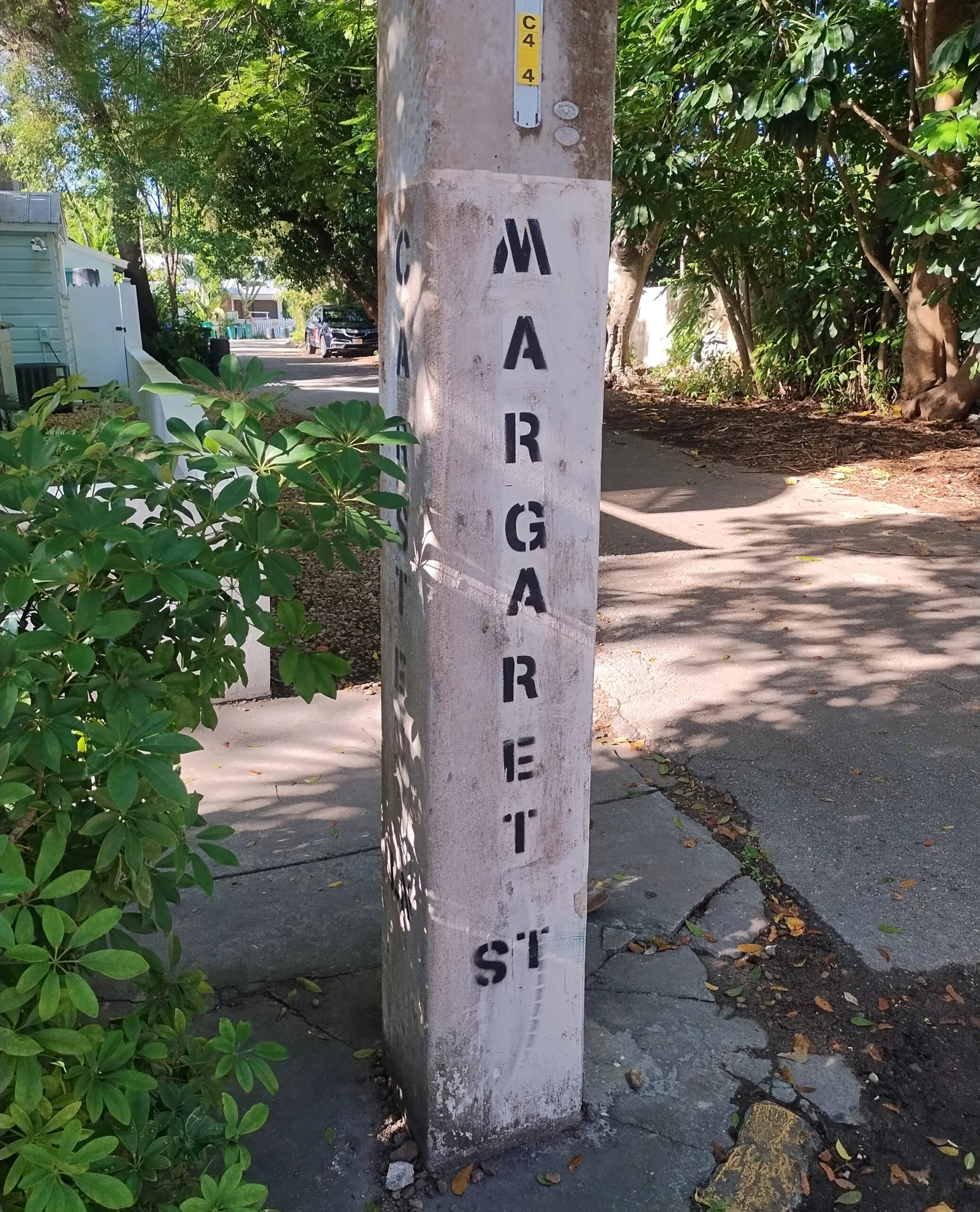
From my 2014 visit, I knew that on the back streets near the little-visited cemetery, parking was possible on an otherwise cramped island. So it was. On Margaret Street, within sight of the cemetery.
The return drive took us up the eastern coast of Florida, but avoiding the worst traffic in Miami-Dade by taking Florida’s Turnpike. By December 17, we’d arrived in Orange Park, a large suburb of Jacksonville, for a stay with two other dear friends, former Austinites now in northern Florida. Part of the next day was in and near downtown Jacksonville, one of the larger U.S. cities I’d never visited before (I believe San Jose is now the largest on that list). During our downtown stroll, we encountered the coolest building in Jacksonville and certainly one of the coolest in Florida.
We quit Florida on the 19th, but weren’t quite done with the trip. Yuriko had never been to Atlanta and wanted to go. Though I’d been however many times since 1982, I was happy to oblige, so we spent two nights and a day there, using the day to see the astonishing Georgia Aquarium and the impressive but somewhat overpriced World of Coca-Cola.
The last legs of the trip were long drives: Atlanta to Elizabethtown, Kentucky; and from there to home the next day. I wasn’t about to let them be completely dull drives, so we stopped on the second-to-last day in Chattanooga, to see the conveniently located, blocks-from-the-highway Chattanooga Choo-Choo redevelopment. On the last day of the trip, we stopped in Jeffersonville, Indiana, and walked across the Big Four Bridge, a former RR bridge across the wide Ohio, now serving pedestrians and bicyclists.
Home and then — Christmas, when things slow down for a week or so. Good timing.
At least a foot of snow covers the ground outside, so it’s good to be inside. Winter has fully returned, but at least the early part, when the holidays are yet to come, and not the post-New Year grind of January or the interminable days of February, the alleged shortest month.
Thanksgiving was low key. I expect that’s actually true for most people, however many anecdotes there are about fractious Thanksgivings. Low key doesn’t get into sitcoms or in real or made-up tales on a Thanksgivingishell subreddit.
Back to posting after Christmas, maybe the first Sunday after. Got a lot to do before then.
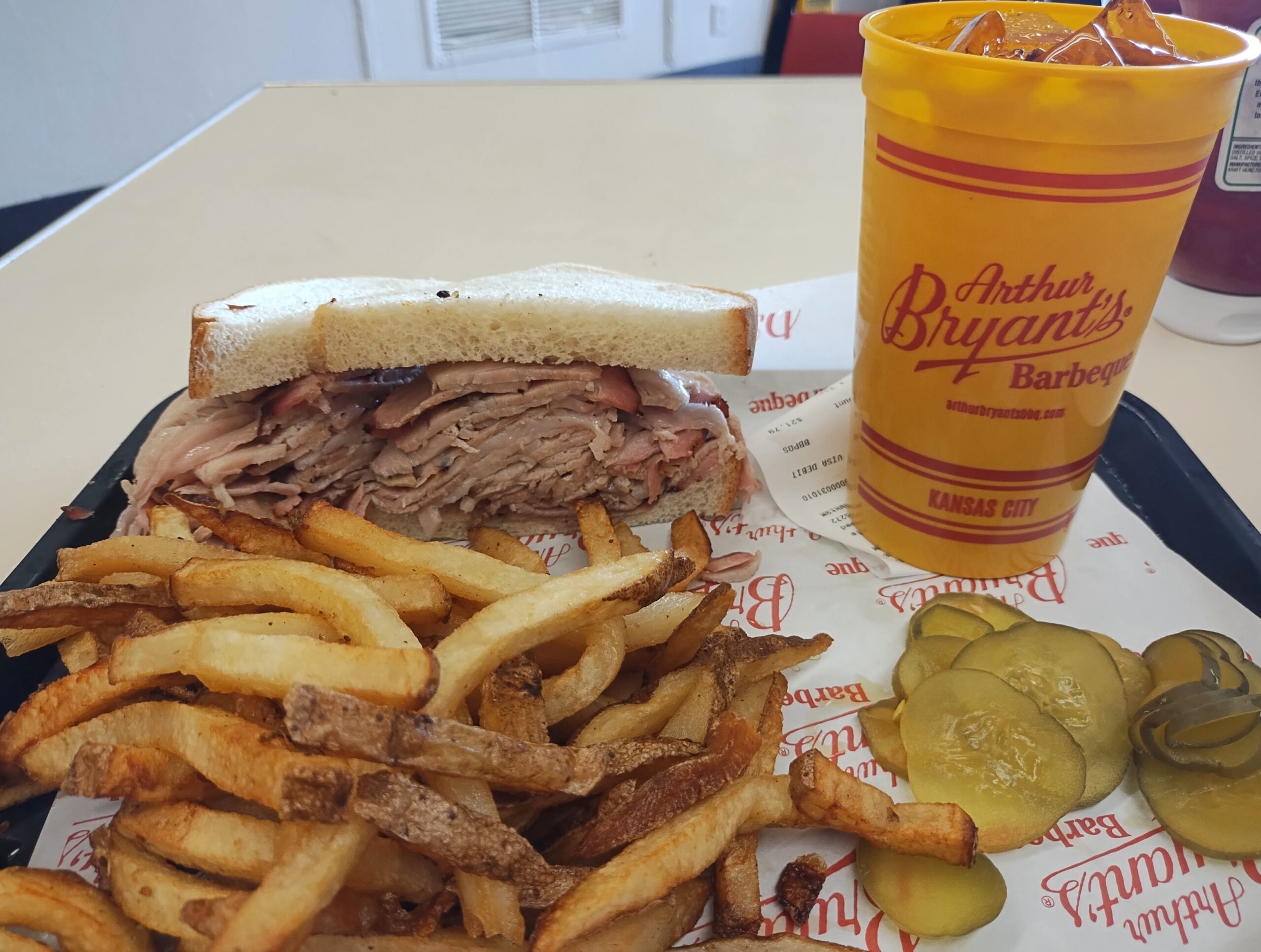
One more note about Kansas City in September. Besides the World War I Museum and Memorial, there was one more place I wanted to be during my visit: Arthur Byrant’s, for the barbecue I remembered so fondly from the late 1990s. Good ‘cue has sustained AB long after the pitmaster of that name died in 1982.
I’d go again.
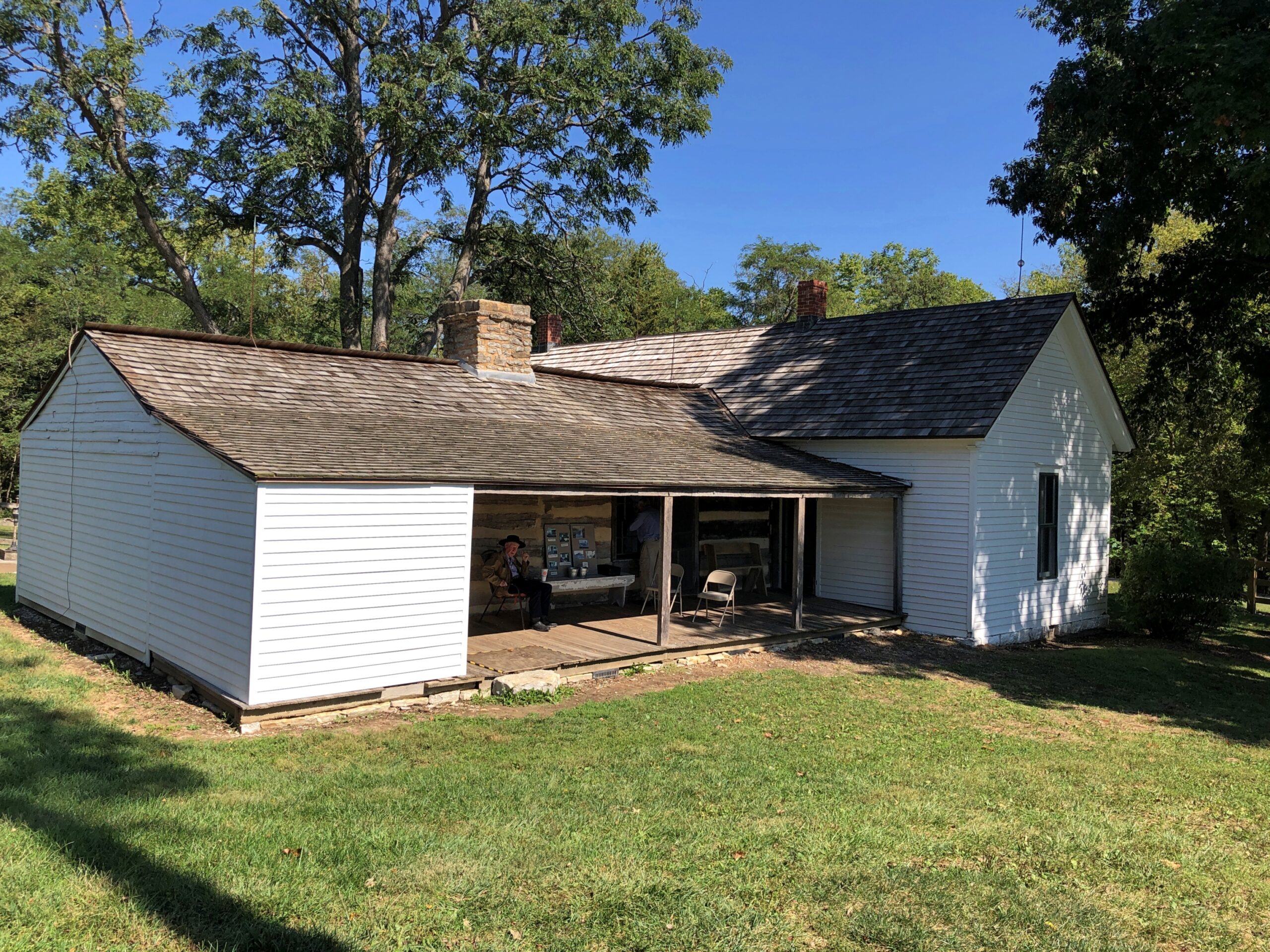
After I left KC, I headed not too far northeast to the Jesse James Birthplace Museum.
The birthplace museum, like the house, isn’t a large place, but it does convey some of the life and times of the famed outlaw, with some good artifacts and reading. Posters, too. I hadn’t realized that Jesse James was a character in the very last Three Stooges theatrical release, The Outlaws is Coming (1965), but there was the poster, along with ones advertising better-known biopics or Jesse James-adjacent movies. Somehow I missed that Stooges picture on TV as an impressionable kid, though I saw the likes of The Three Stooges Meet Hercules.
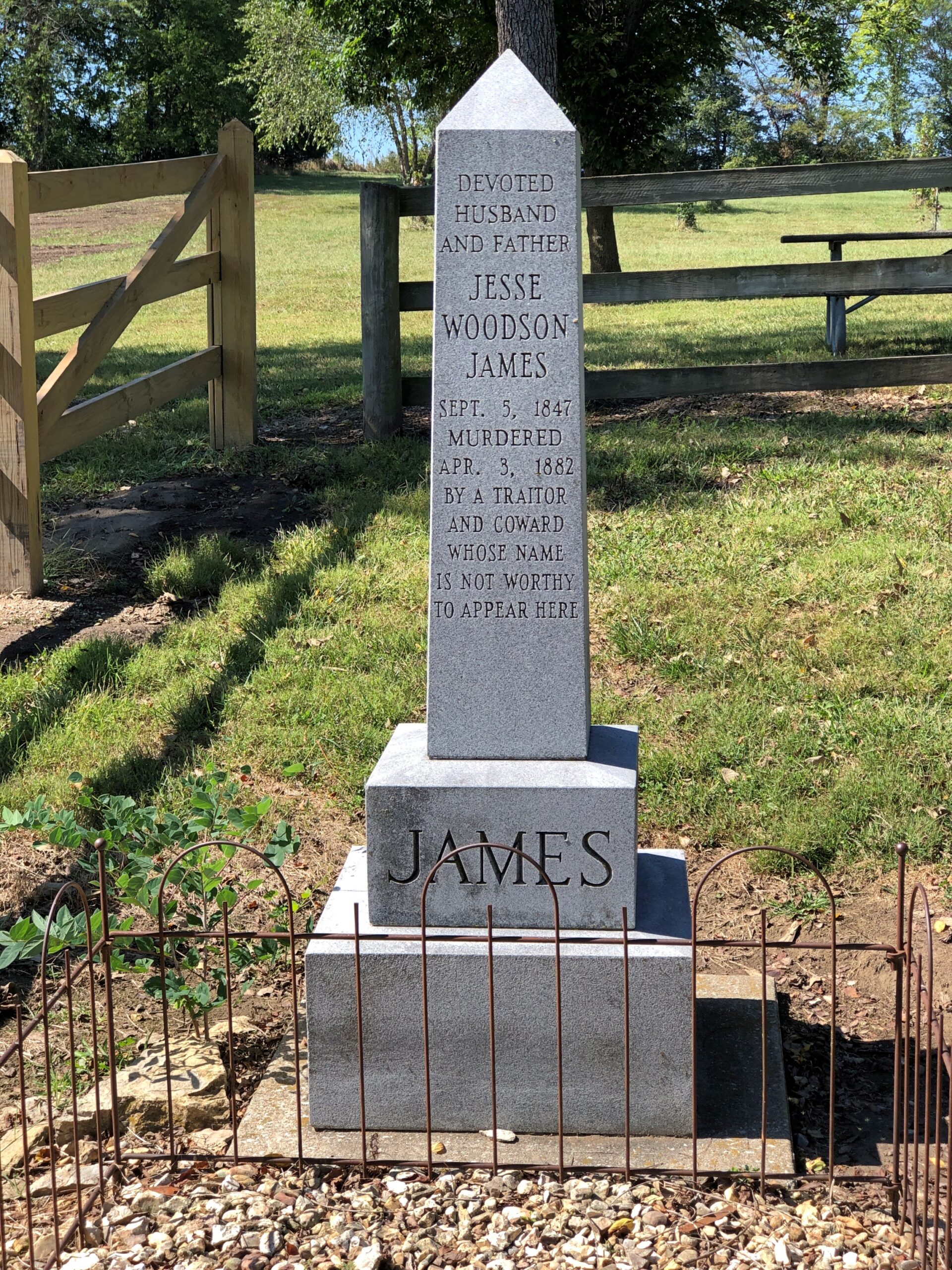
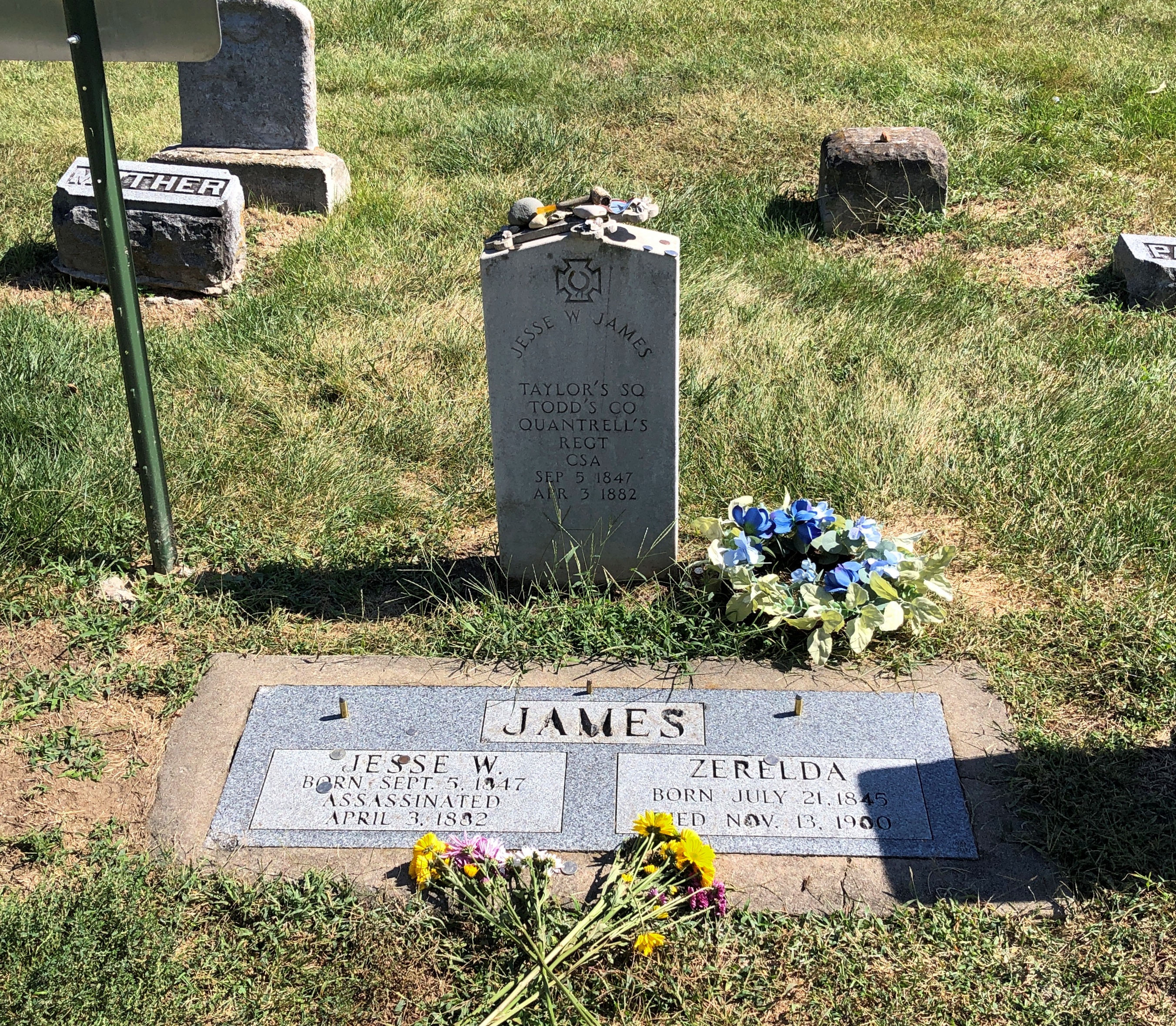
Jesse used to be buried at the homestead.
But at some point he was moved to Mount Olivet Cemetery in nearby Kearney, Missouri. Jesse receives rocks and flowers and coins from visitors 140+ years after his assassination by the Coward Robert Ford (“coward” capitalized, because the word is welded to his name in popular memory). As for Jesse, not a bad posthumous haul for a train robber.
Just as an example, do the Newton Boys get that kind of attention? No, they do not.
“The Newton boys were a criminal gang composed of brothers Willis, Joe, Jess and Wylie (Doc), who operated mostly in Texas during the 1920s,” says Texas State Historical Association. “Willis ‘Skinny’ Newton robbed over eighty banks and six trains from Texas to Canada with his brothers and other outlaws, including the single biggest train robbery in United States history. By the time they were captured, they may have stolen more money than all other outlaws at that time combined.”
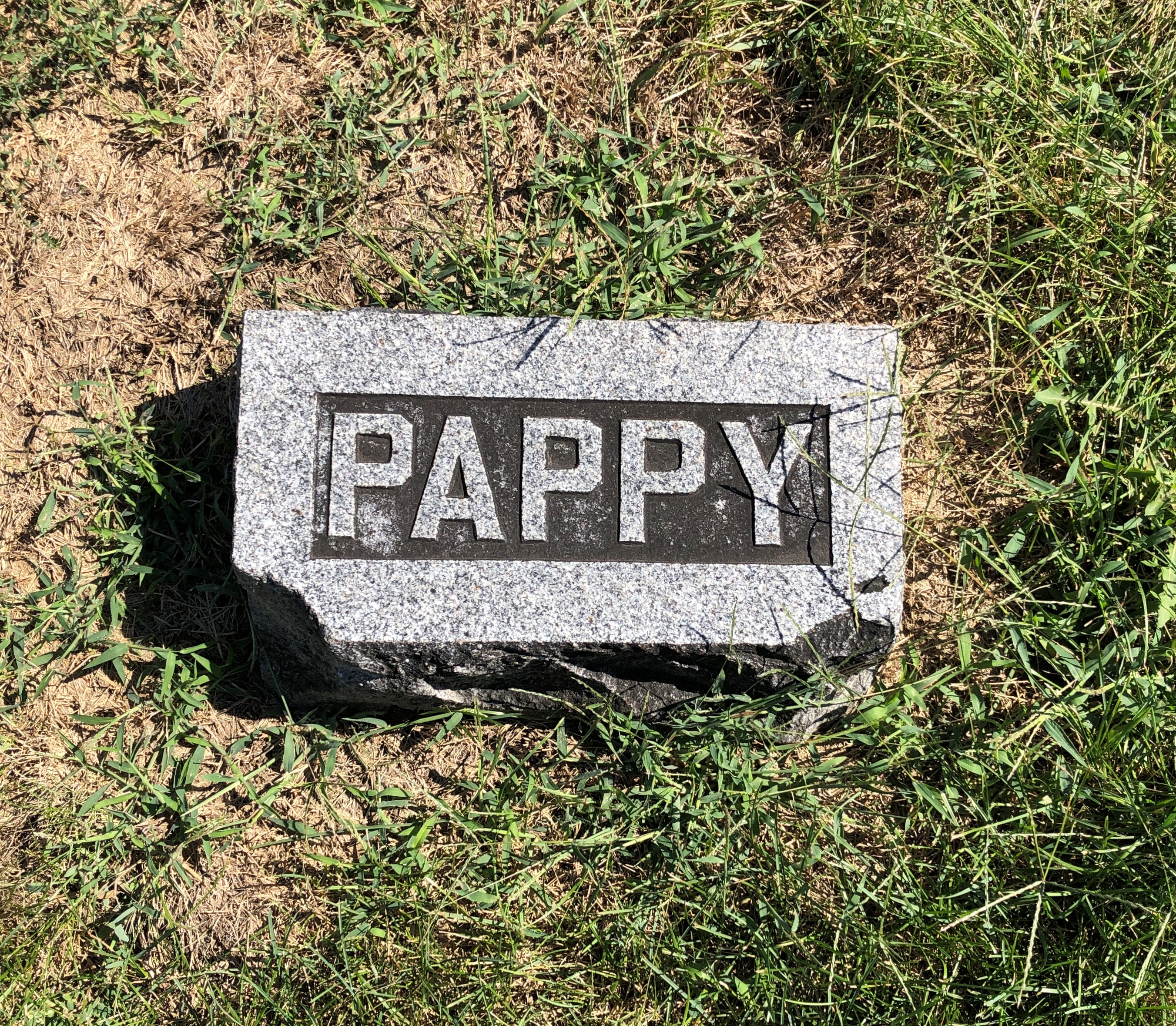
I liked Mount Olivet. Got some stones of yore.
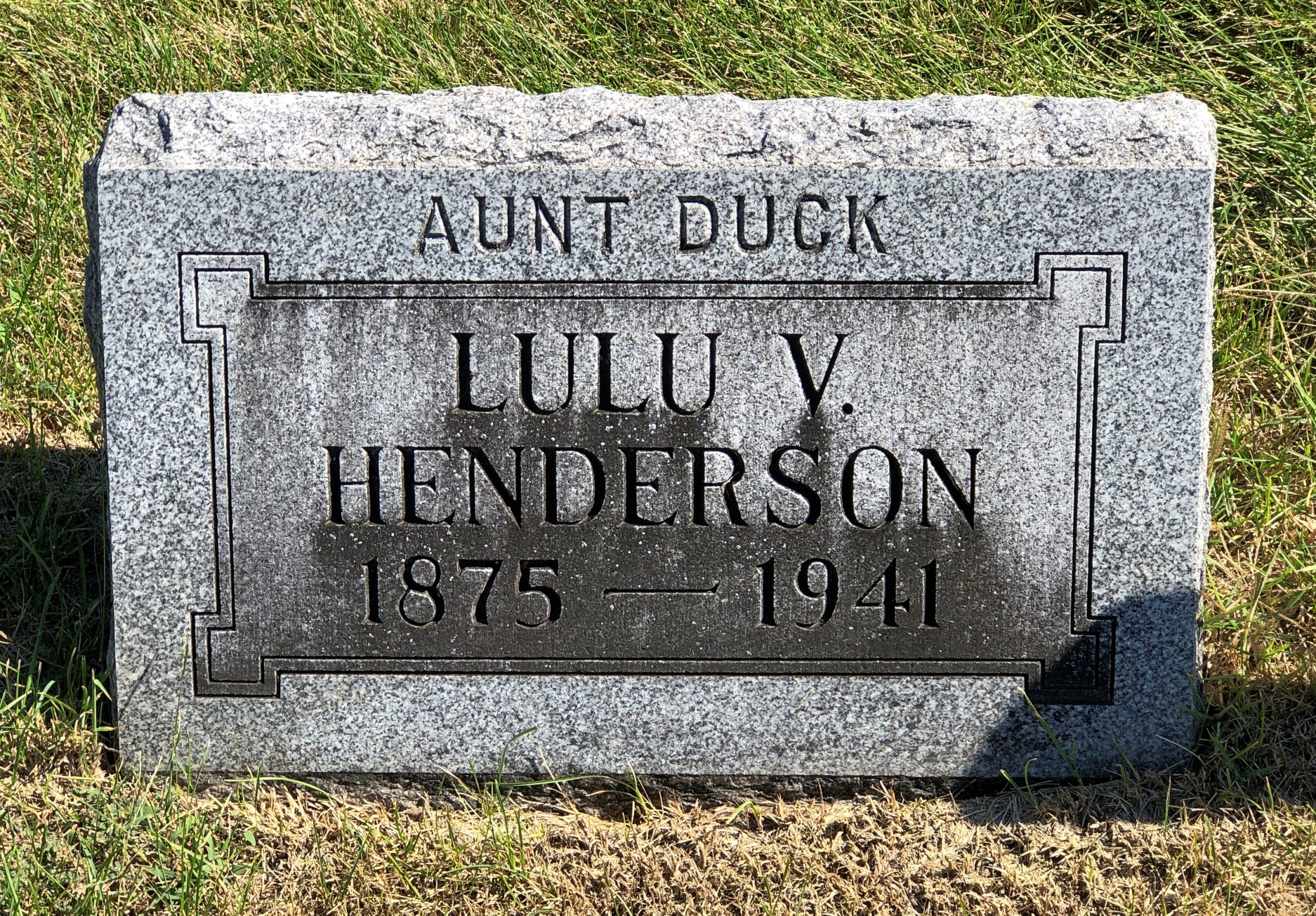
Aunt Duck had to have been a character.
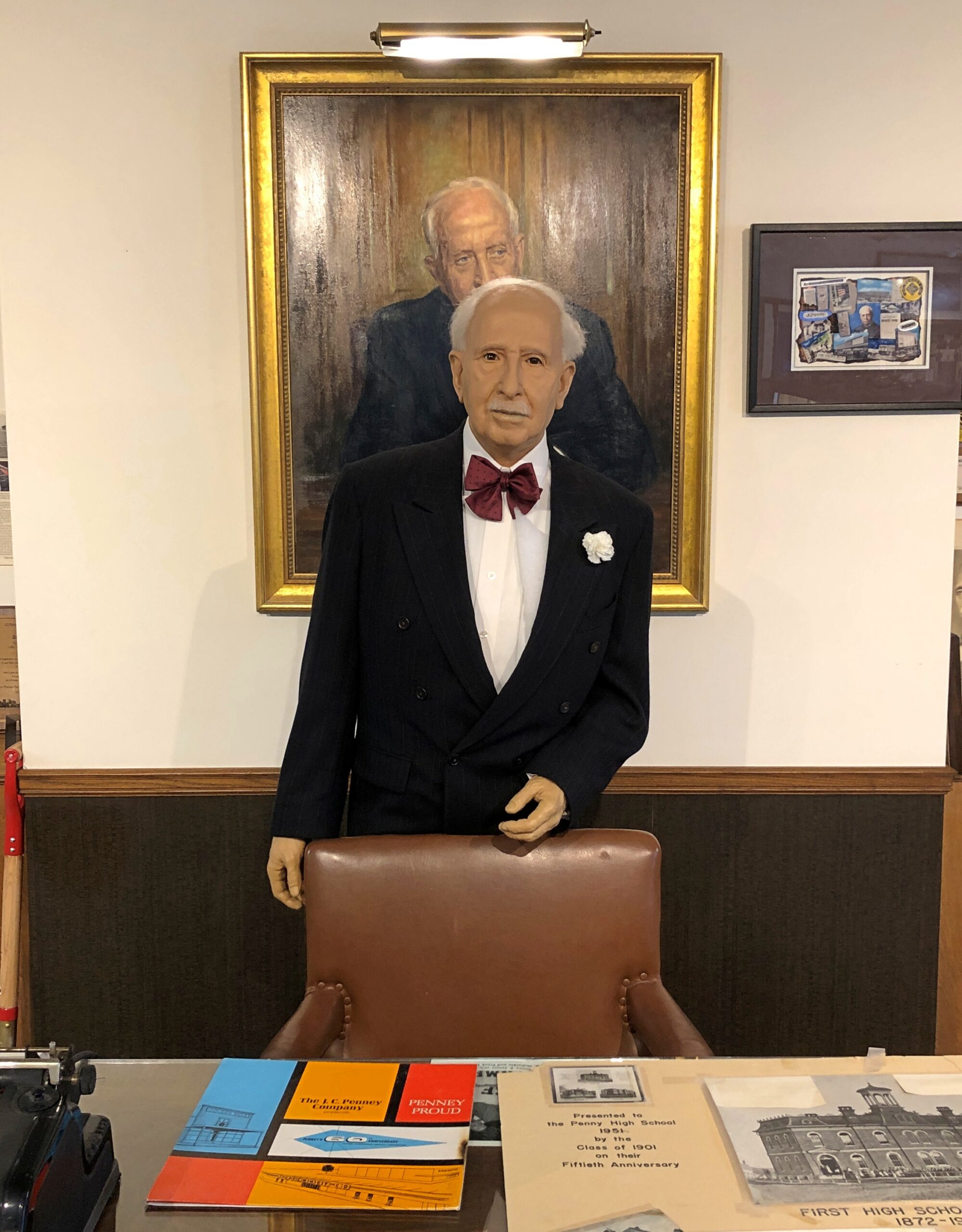
Further east, along U.S. 36 in Hamilton, Missouri, is the two-roomed JC Penney Library and Museum. The town library is in one room, the museum in the other. Most of the Penney artifacts are under glass. A wax JC Penney stands in front of a portrait of the department store mogul.
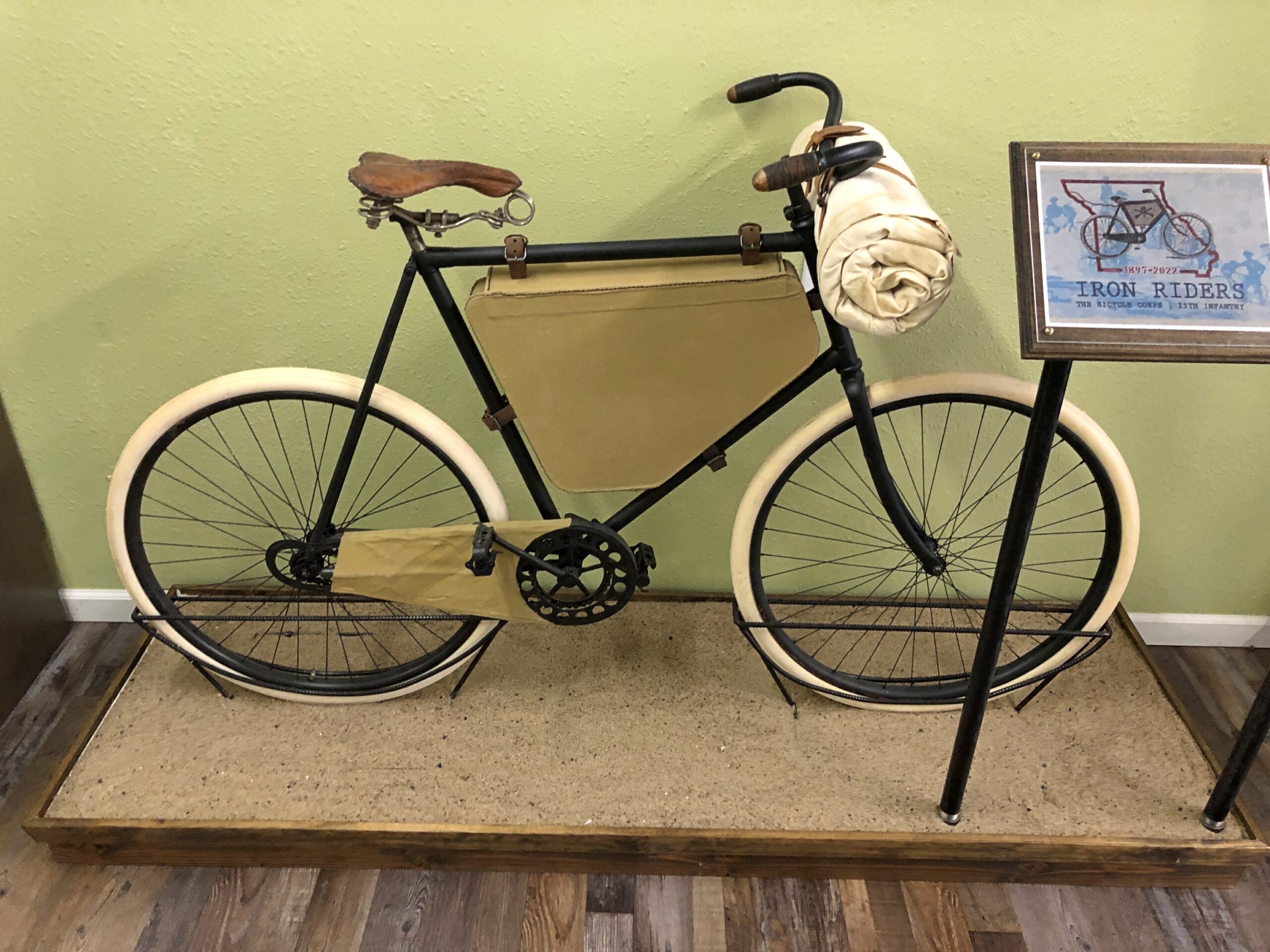
In Laclede, Missouri, is the Gen. John J. Pershing Boyhood Home State Historic Site. A fine museum about the General of the Armies, including an exhibit on something unknown to me, the Twenty-Fifth Infantry Bicycle Corps — the Iron Riders. The Army tested long-distance bicycling in 1897 as a strategy for troop movement, with the corps riding from Missoula, Montana to St. Louis. Pershing wasn’t involved in that effort, but it did happen during his time in the military. Quite a story. Deserves to be better known.
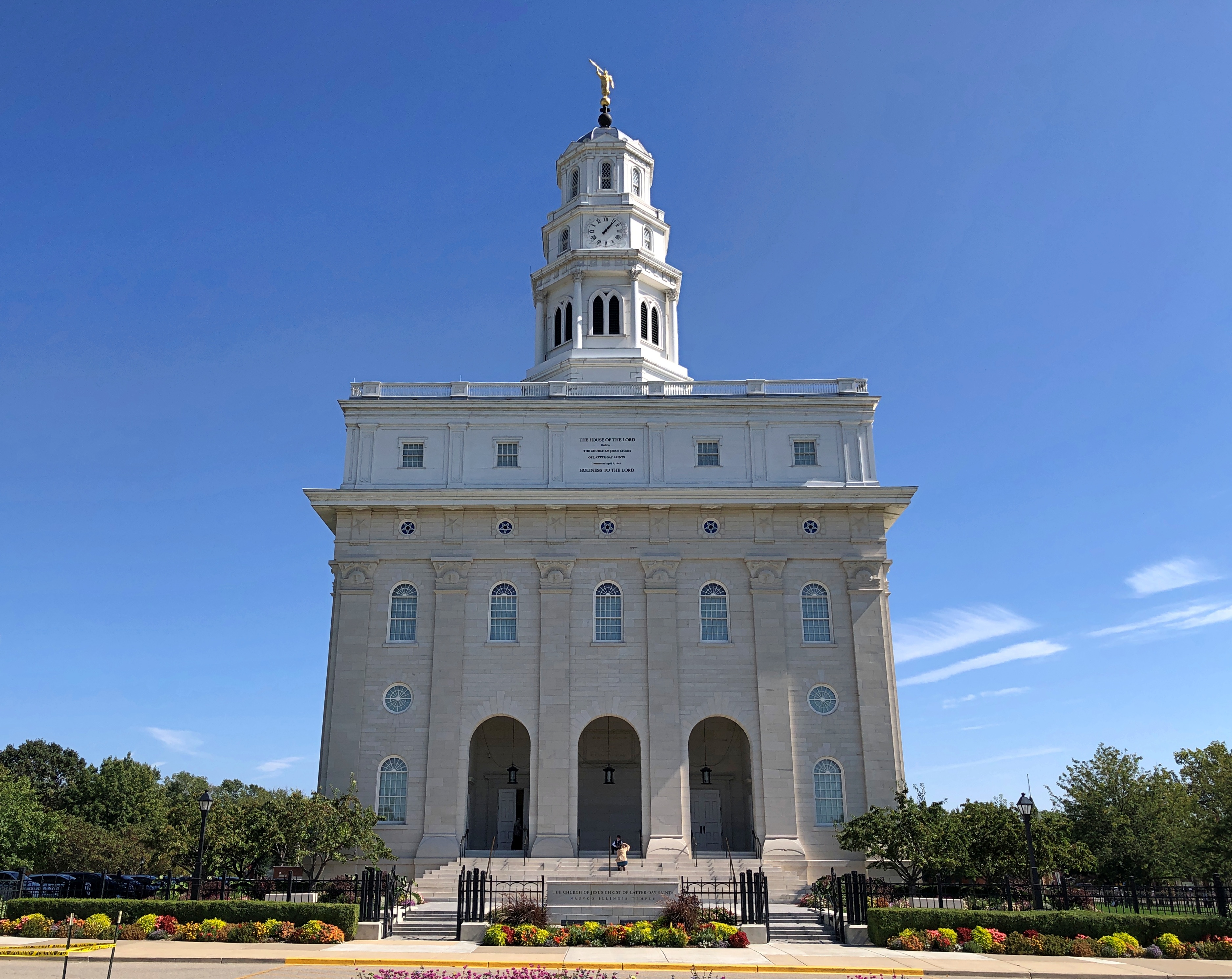
One the last day of my driving, I didn’t want to stop for much, but I did spend a while in Nauvoo, Illinois.
There’s a LDS temple there now. It wasn’t the last time I came this way, in 1997. I couldn’t go in, of course. For that you’d have to join the club.
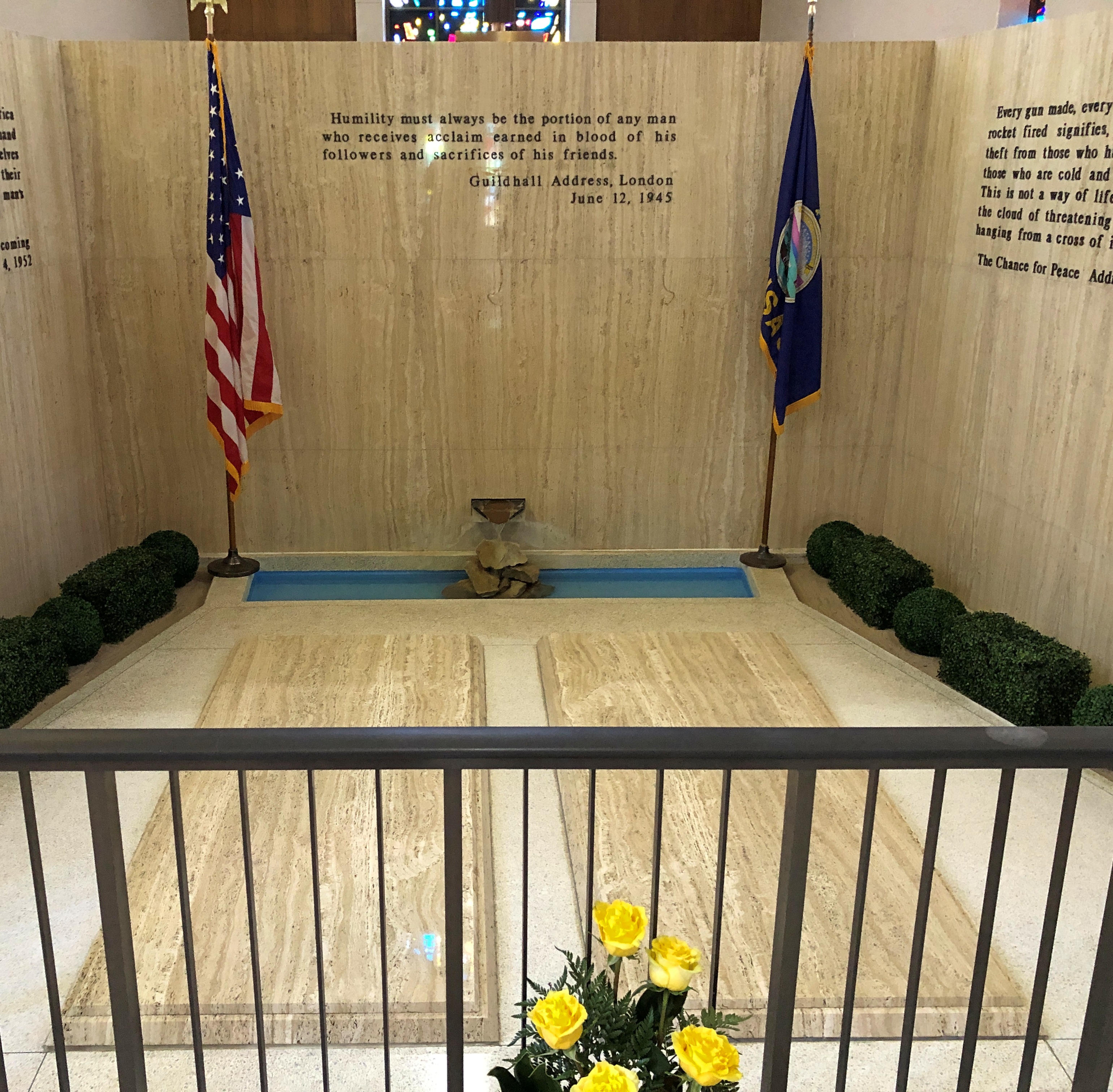
In Abilene, Kansas, not long ago, I found myself wondering, whatever happened to Manus Hand? That’s because I stood at that moment near the graves of President and Mrs. Eisenhower, Ike and Mamie.
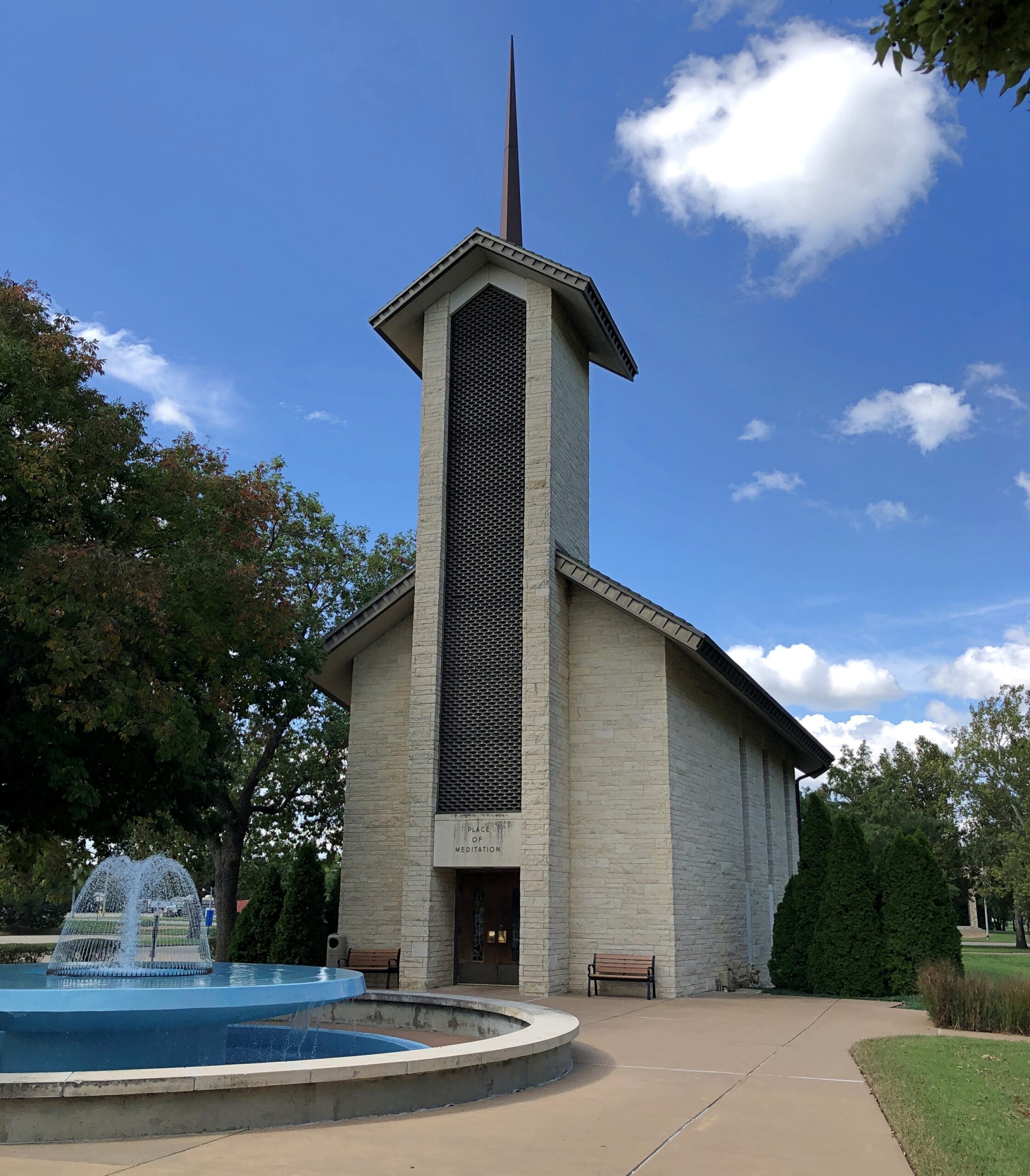
The 34th President of the United States and the First Lady repose in a chapel-like structure on the grounds of the Dwight D. Eisenhower Presidential Library, Museum and Boyhood Home in Abilene, pop. 6,400 or so, the town where the president came of age.
I’ve been told I visited before, with my family during a trip to Kansas when I was a wee lad, but I don’t remember that at all. So I count this as a new visit to a presidential sight, including a grave site, which makes 21 presidential graves all together. But for the federal shutdown in October, there would be four more at least: Adams père et fils, FDR and TR.
I thought of Manus Hand because, back in the Neolithic age of the Internet, he had a web site featuring photos of him at presidential grave sites. In my own dead presidents days, I found Hand’s site at some point. He had visited almost all of them by then, 36 by his count. His site is still in existence, without much change, except an update to note that George H.W. Bush had died (2018), but not Jimmy Carter.
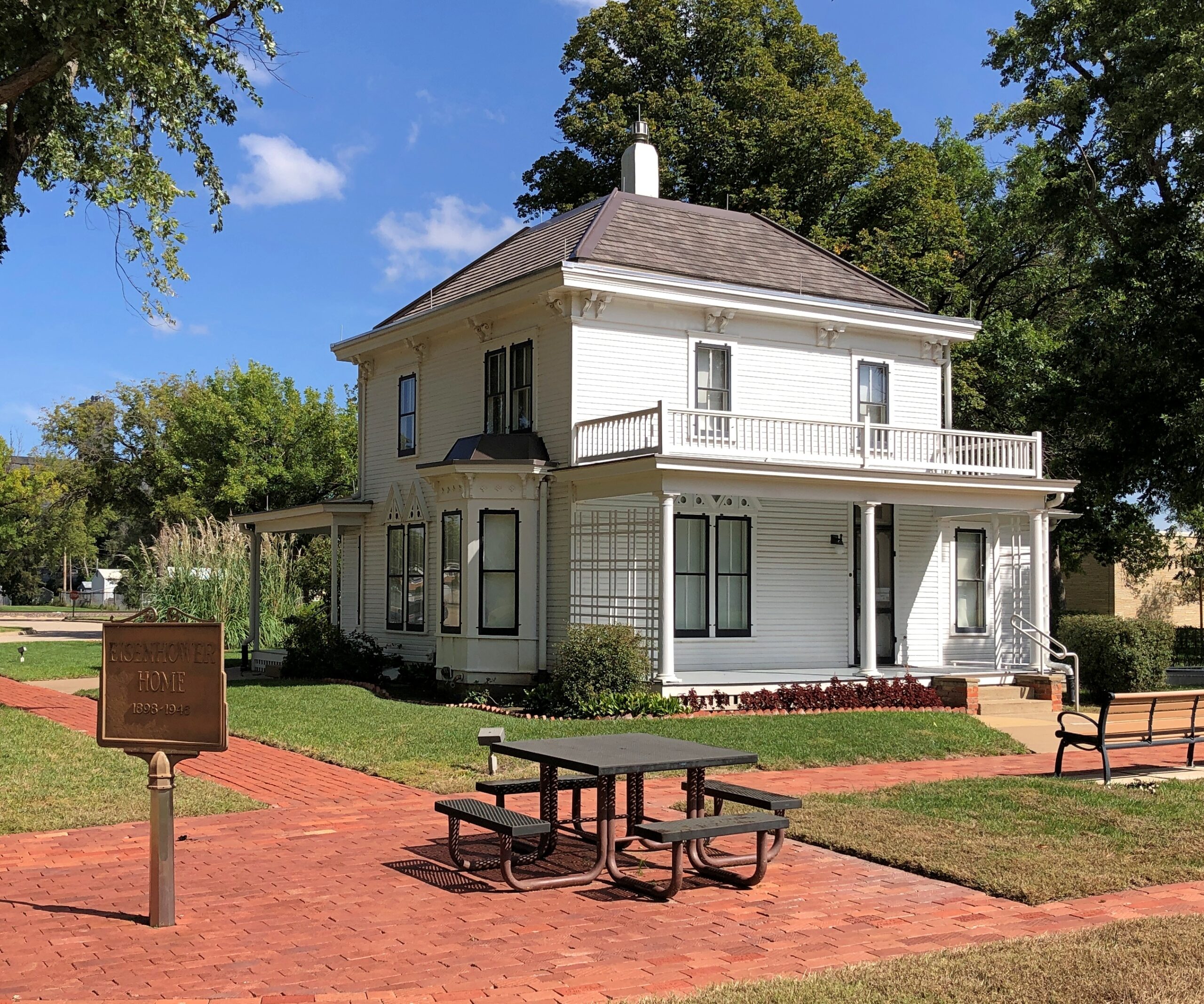
The Eisenhower Boyhood Home, moved to the site. No tours available when I came by.
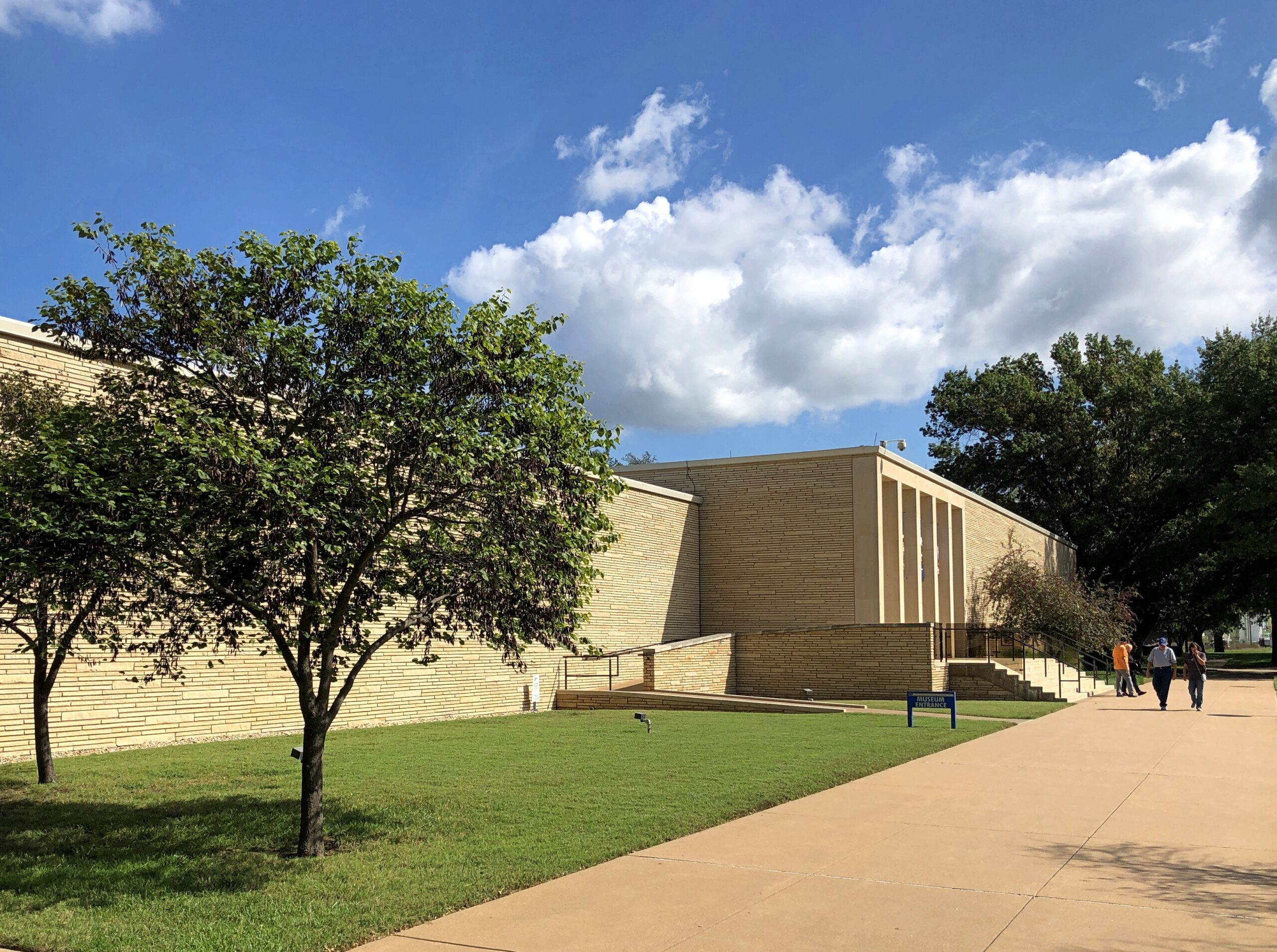
The Eisenhower Museum.
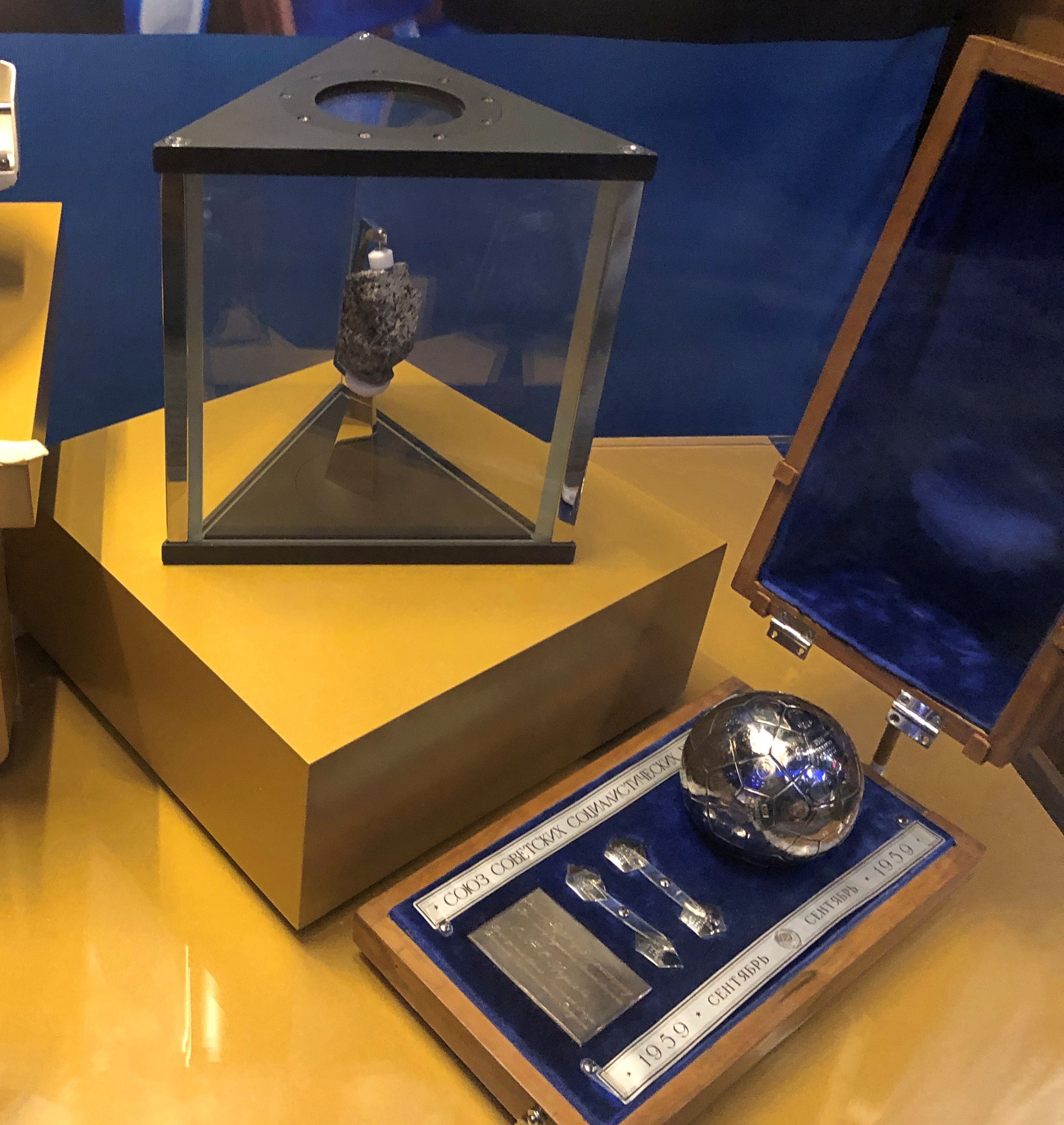
Midcentury, and what could be more fitting for Eisenhower? It’s chronologically organized: early Ike in Abilene; his Army career before WWII, including his cross-country epic; during that war and right after the war; his presidency and post-presidency, and a gallery about Mamie. Well organized, interesting artifacts, but (for me) none more interesting than a titanium sphere.
The sphere is a replica of the pennant sphere that traveled to the Moon in 1959 aboard the Soviet spacecraft Luna 2, which was the first manmade object to reach the lunar surface, or any celestial body. The sphere was a detail that I remembered from long-ago reading about space exploration. I didn’t realize one existed any more, even in replica form. Khrushchev presented it to Eisenhower during his famed visit to the U.S. that year (Khrushchev’s due at Idlewild!).
Luna 2 carried two spheres filled with liquid and an explosive charge, designed to burst apart on impact and scatter pentagonal pennants, the Moon Registry says. The pennants were imprinted with: 1) Sentiabr 1959 (September 1959); CCCP… ; and the state seal of the USSR, a wreath of grain around the hammer and sickle. It is theorized that the medallions vaporized on impact.
Russia is still shooting Luna missions to the Moon. The most recent, Luna 25, crashed near the lunar south pole in 2023 but, unlike Luna 2, not on purpose. Oops. More about the many pennants the Soviets sent into space is here. On display next to the sphere is a lunar rock, which must have been a posthumous gift, since Ike didn’t live quite long enough to benefit from astronauts rock-gathering on the surface, though he was still alive during Apollo 7, 8 and 9.
A close second excellent artifact was a dagger Marshal Zhukov presented to General Eisenhower on the occasion of the defeat of Germany, a good-looking blade with an ivory hilt and gold decorations. I picture an exuberant Zhukov, as in The Death of Stalin, handing the knife to Ike and saying something earthy. Apparently the two, Ike and Zuke, got along well in the early months of the joint occupation of Germany. Differences aside, they had job experience in common. I don’t remember seeing anything about that in the museum, but there was a lot of material, so that could have been easily missed. That and any reference to Kay Summersby.
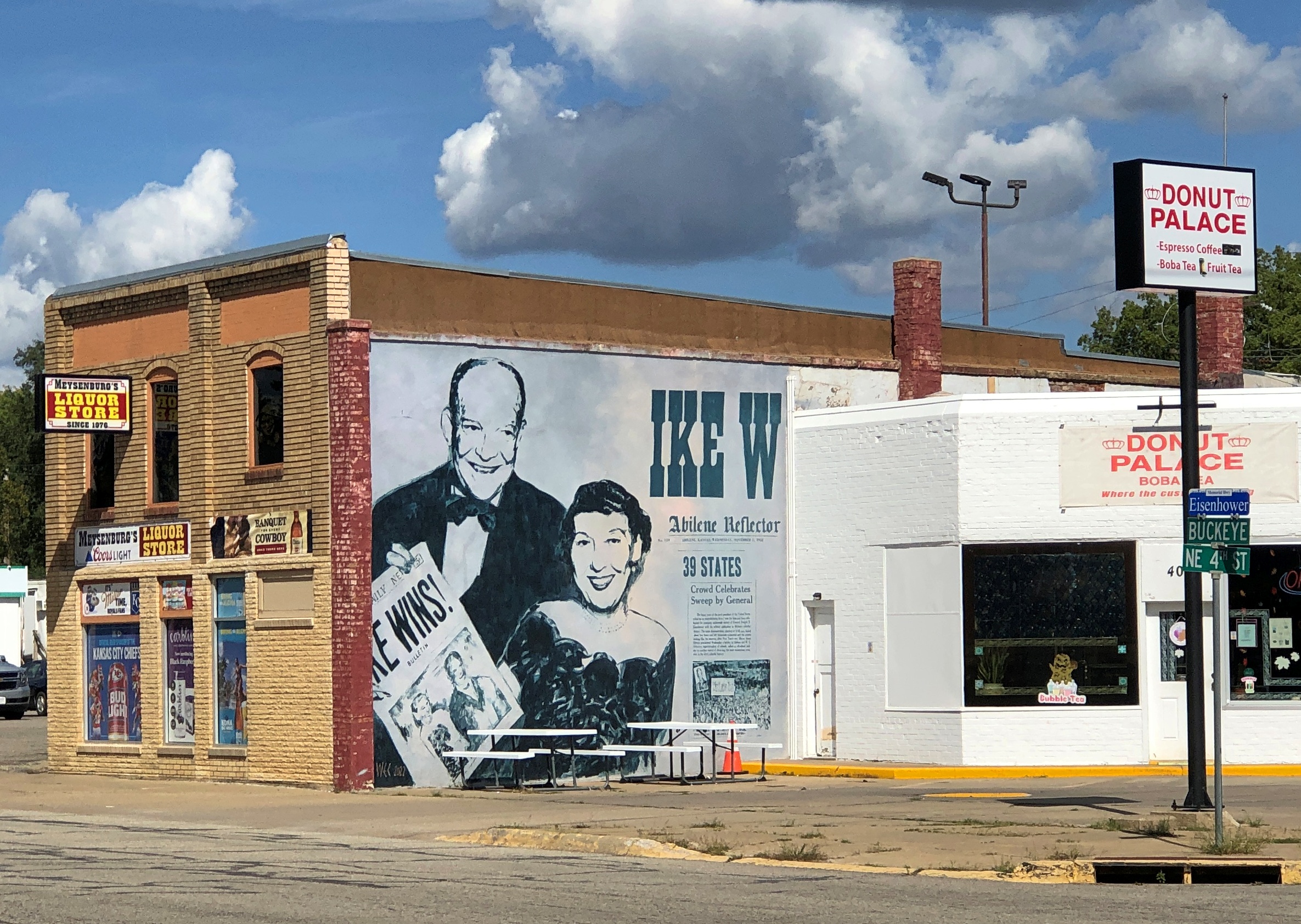
It was hot that day, September 24, but after visiting the museum, I took a look around Abilene anyway. The town hasn’t forgotten its most famous native son. Also, Donut Palace was closed.
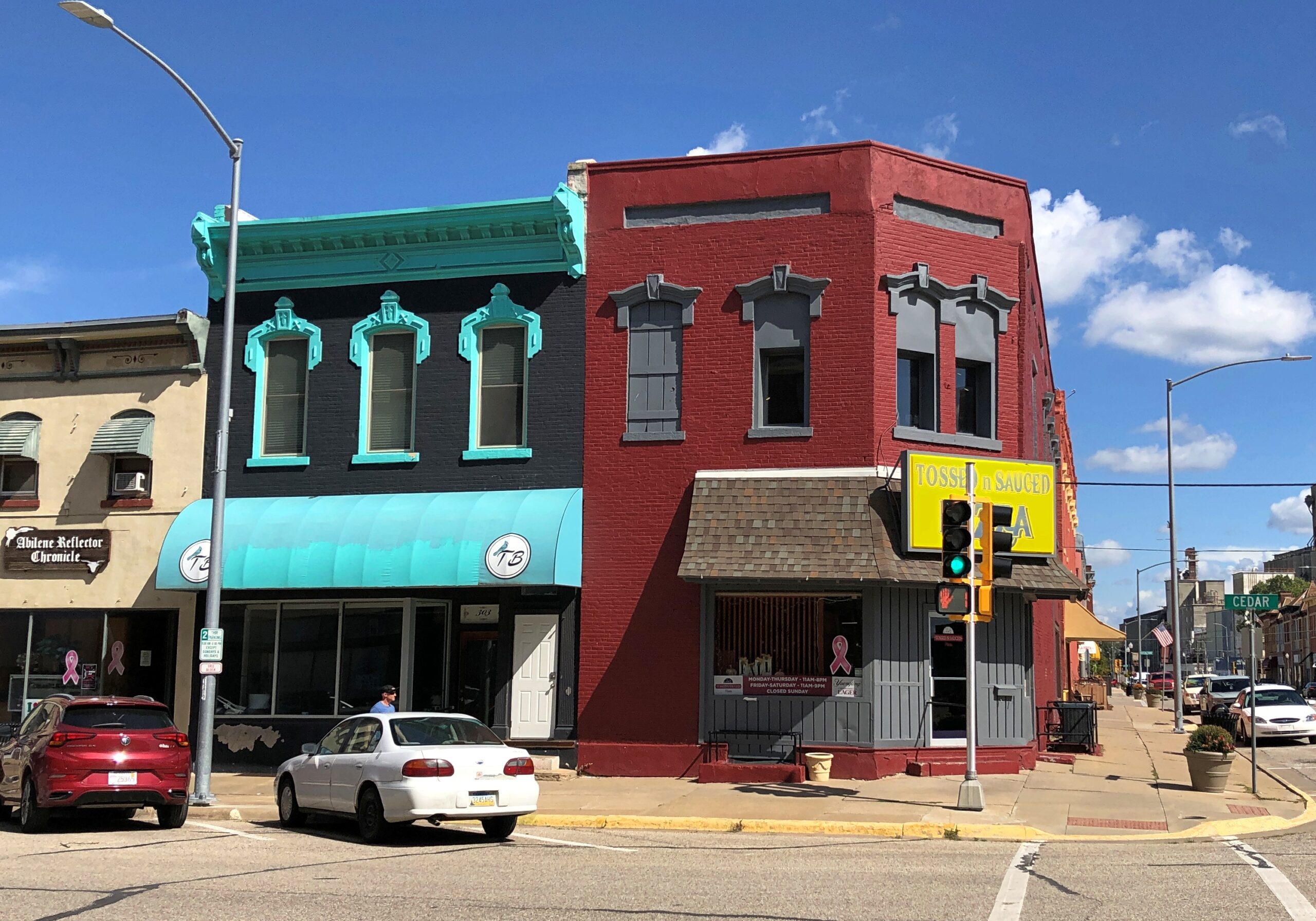
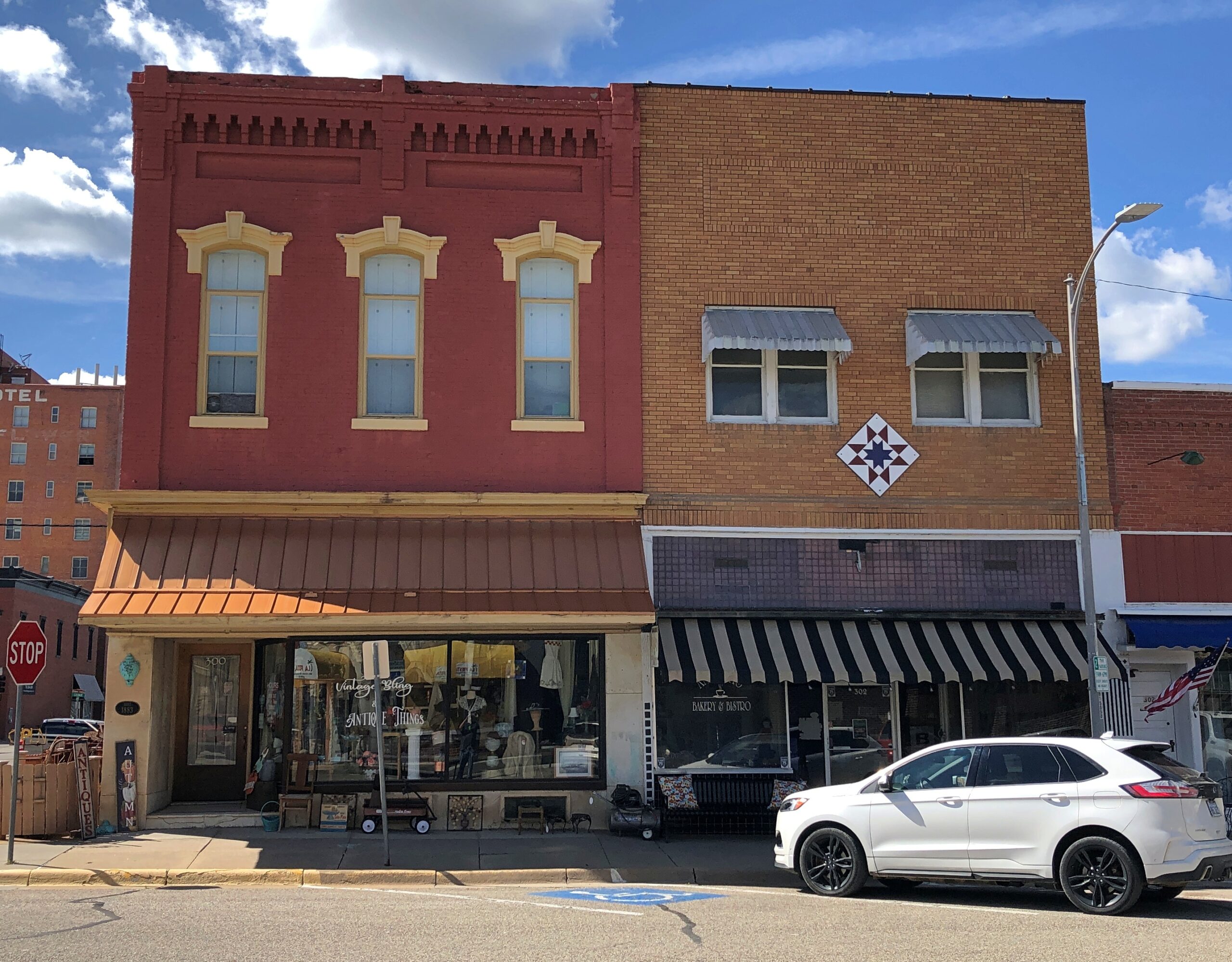
A lot of the detail would be different, but I’ll bet Ike would still feel at home with the scale of Abilene. Small town, small buildings, but some solid touches.
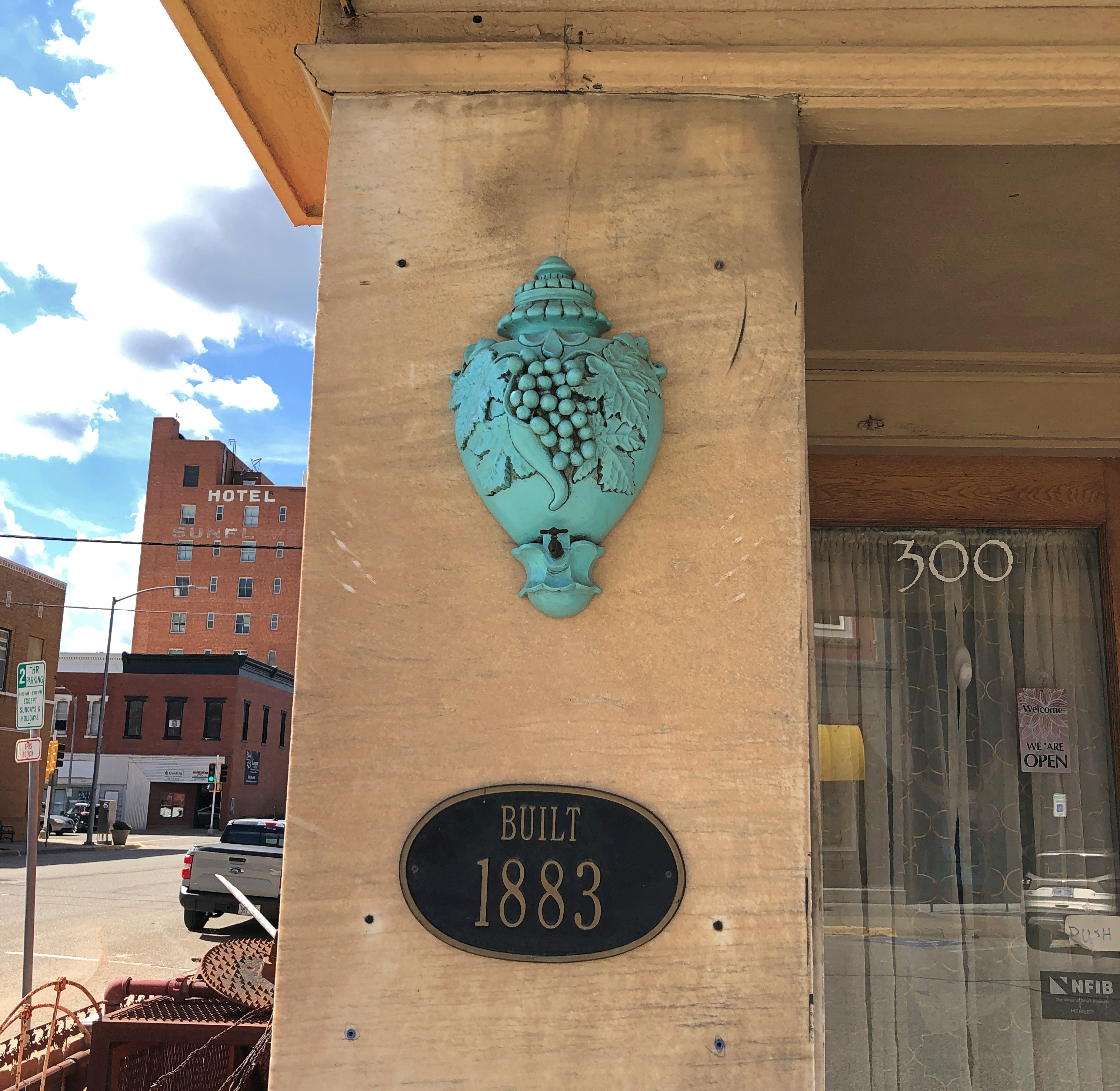
Including at least one building Ike would have known.
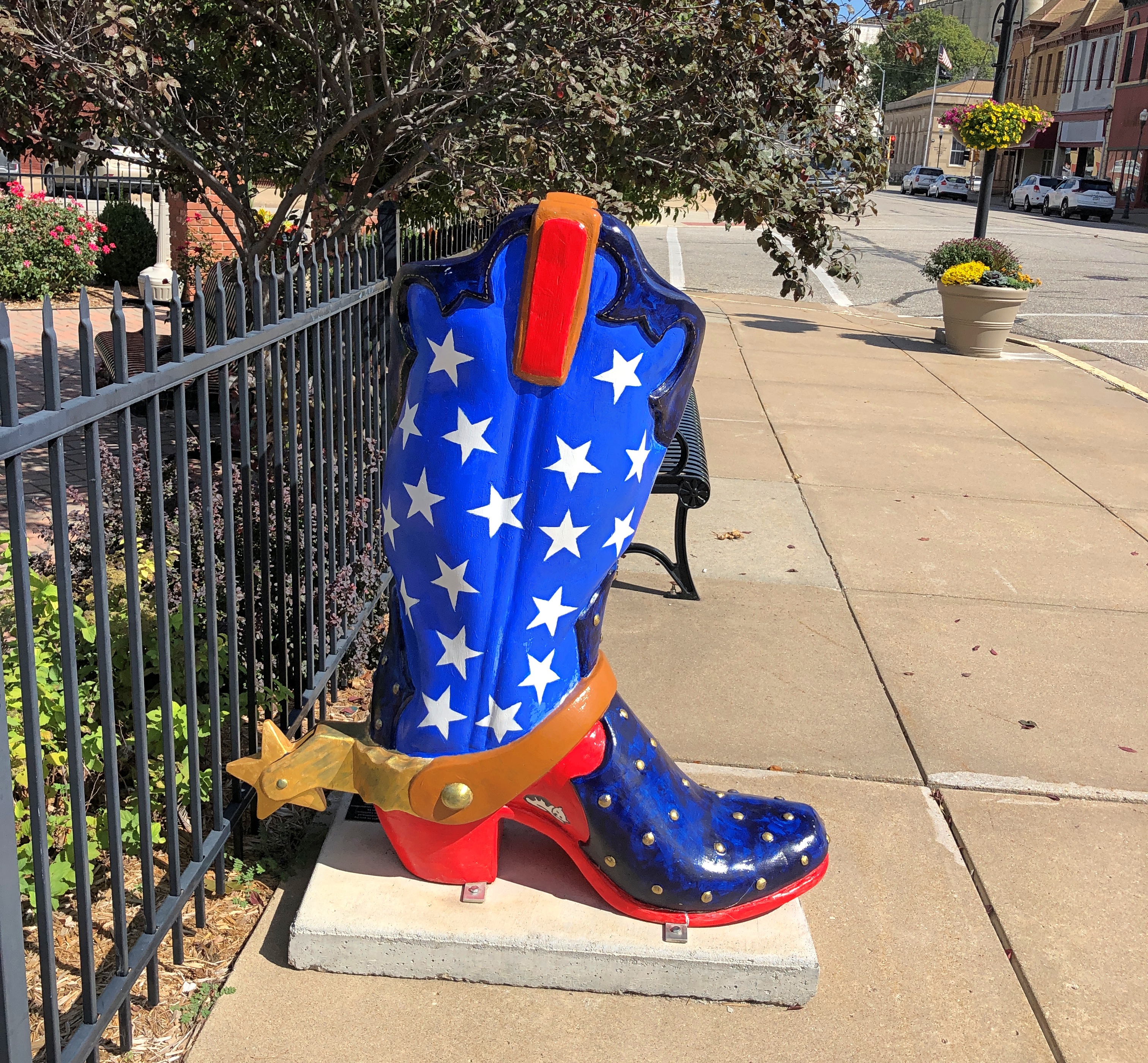
Chicago had cows, Abilene has cowboy boots.
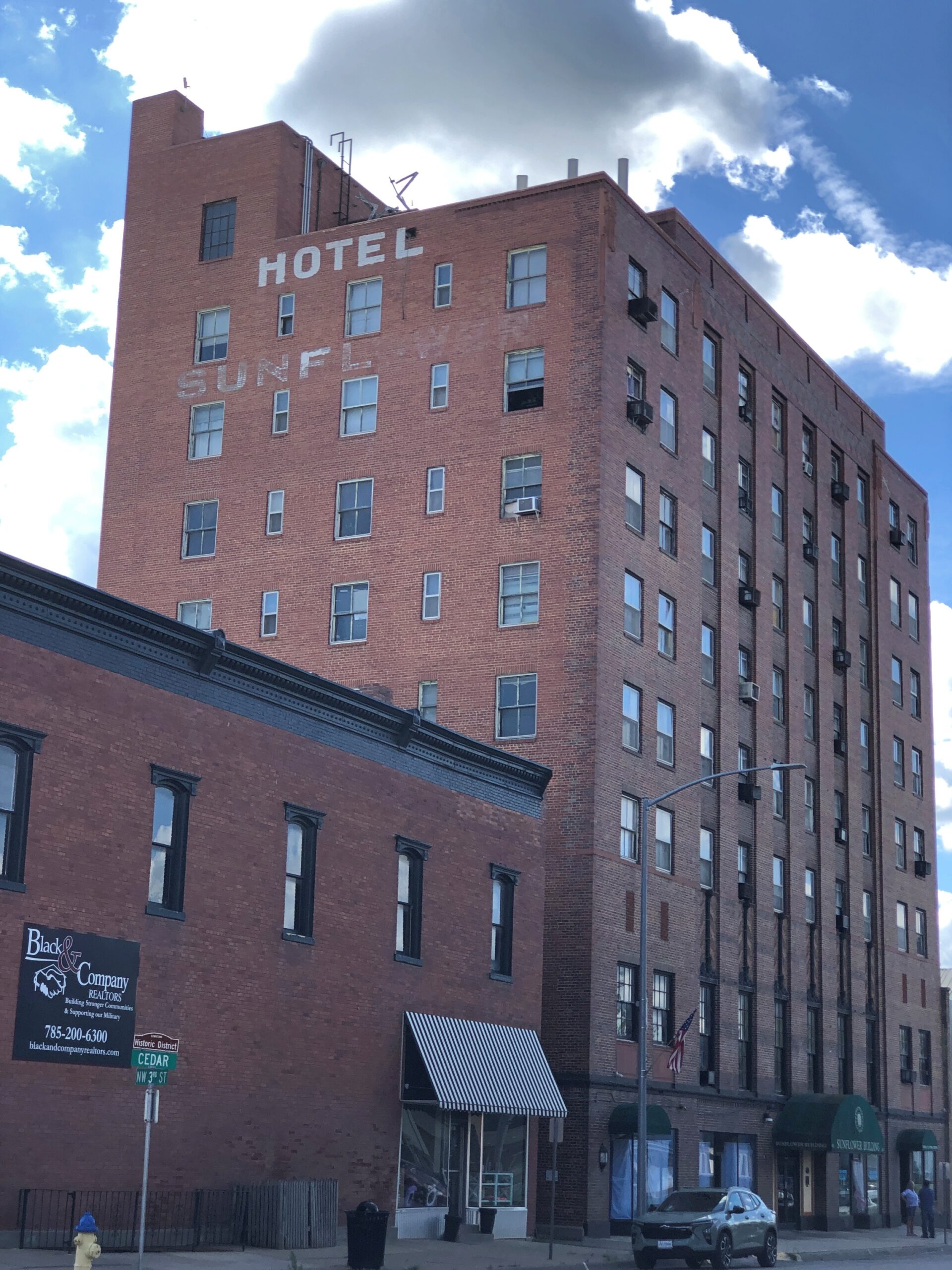
The Hotel Sunflower. Former hotel, that is, now apartments.
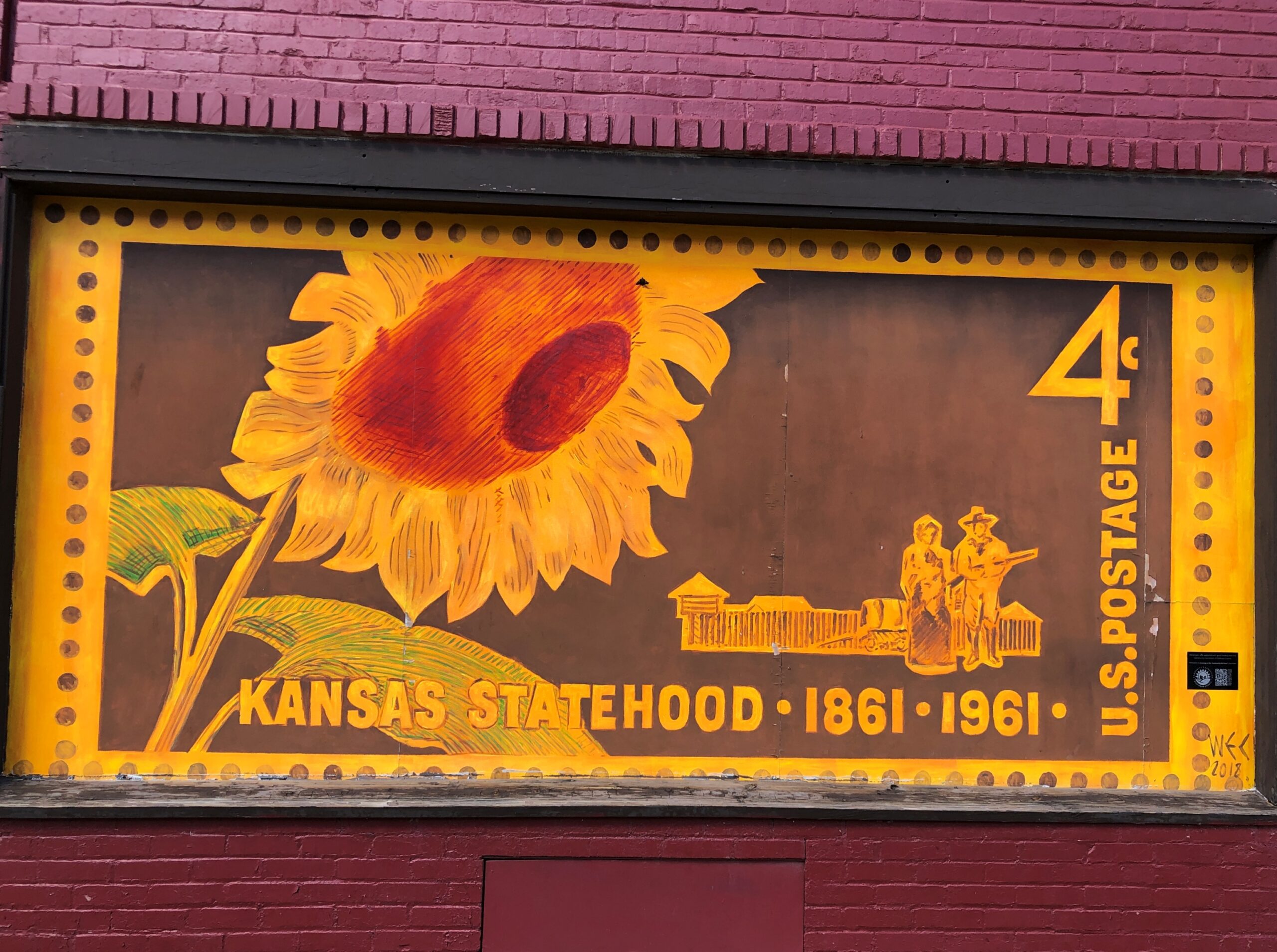
The Sunflower State. The flower looks a little ominous, peering down at the settlers.
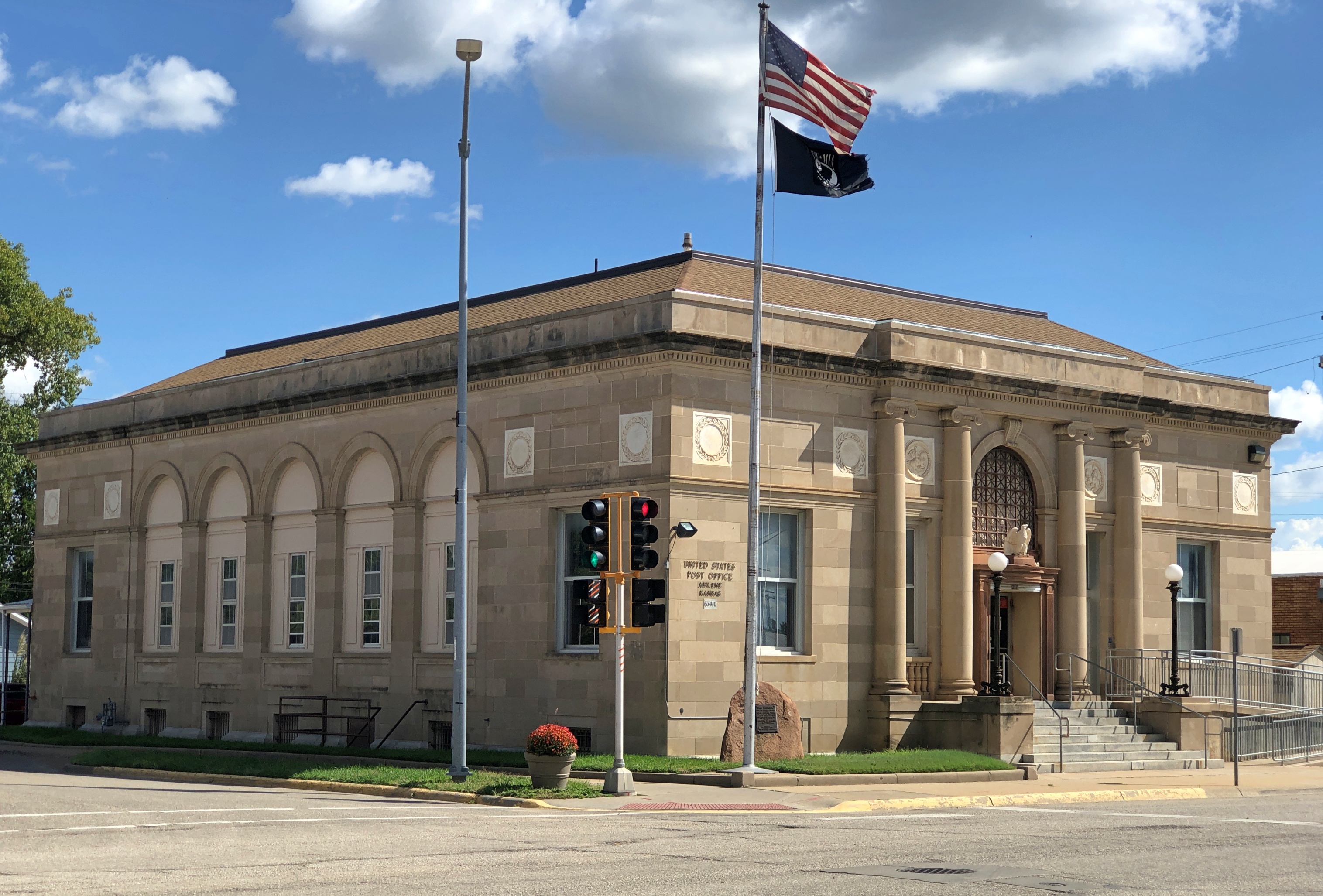
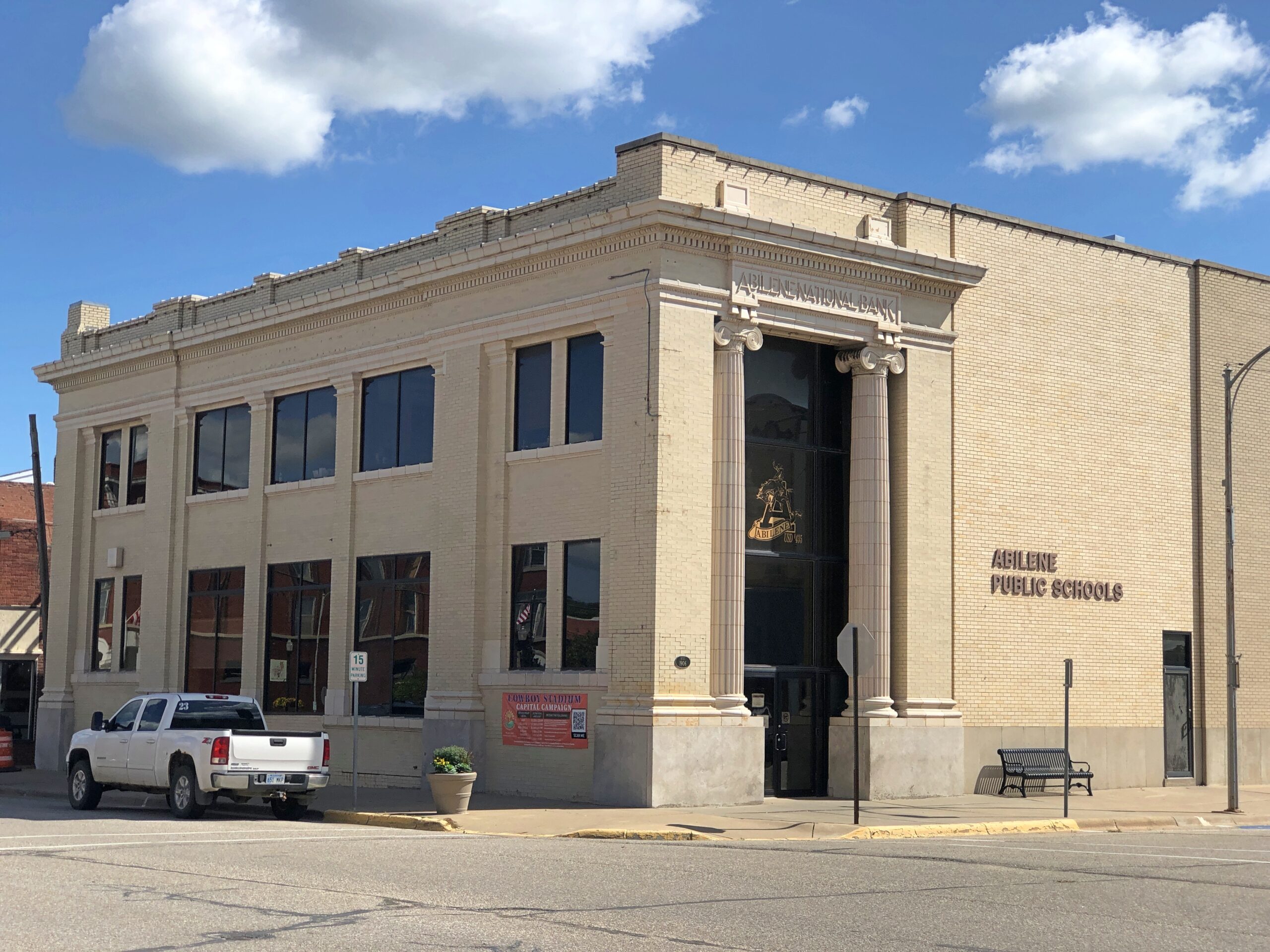
Structures that aren’t grand, but stately even so. Petite stately, you might call them.
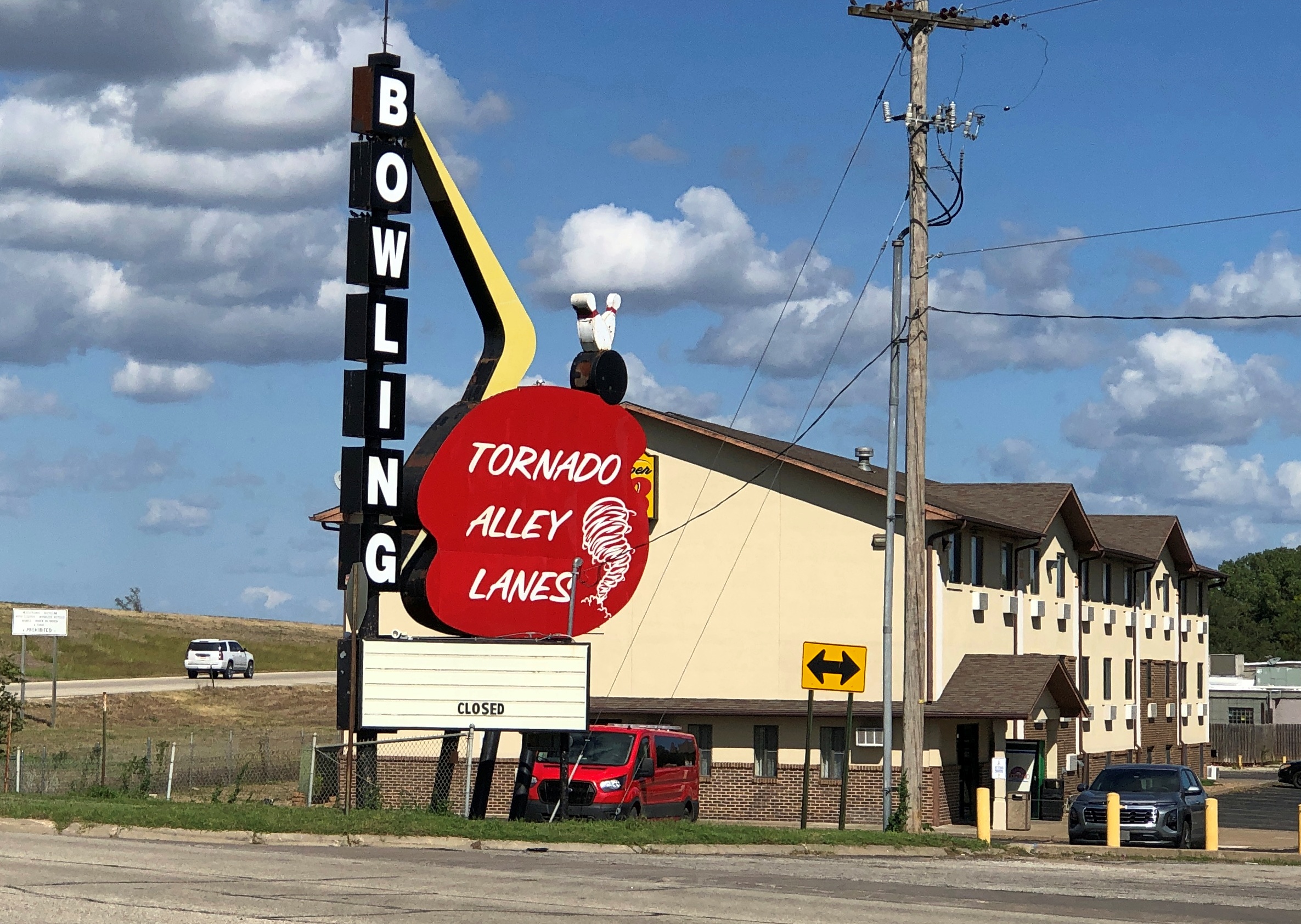
Out near the highway: truth in naming. But note also, the bowling alley is closed. I could go either way on the reopening of an alley in that location, but I really want the sign to stay.
One more thing Abilene is known for, at least since 2022.
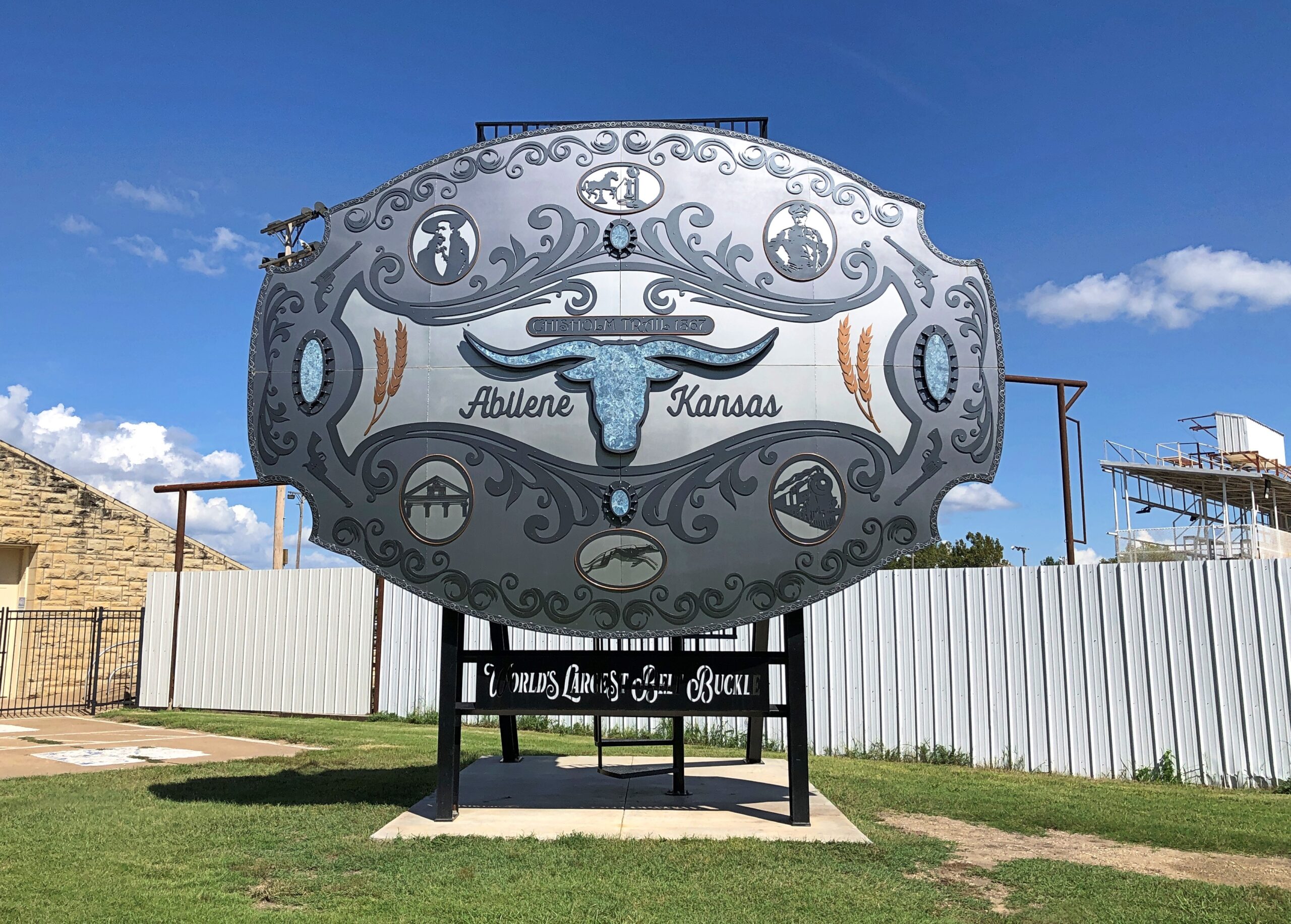
The World’s Largest Belt Buckle. Says so right there on it. How large would that belt have to be?
“Designed by local artist Jason Lahr, Fluter’s Creek Metal Works, the buckle features Dwight D. Eisenhower, Wild Bill Hickok, Abilene & Smoky Valley Railroad, Historic Seelye Mansion, C.W. Parker carousel horse, C.L. Brown telephone, a racing Greyhound and Chisholm Trail longhorn inlaid with blue quartz,” says the city of Abilene, Kansas.
“The buckle is a project of the Abilene Convention and Visitors Bureau which hopes the new roadside attraction will entice travelers to stop and visit the Best Historic Small Town.”
Cold winds rolled through northern Illinois today. Seven inches of snow are forecast for Saturday. What? Right, it’s winter. The winter solstice is just the shortest day of the year.
Back to posting on Sunday. Regards for Thanksgiving.
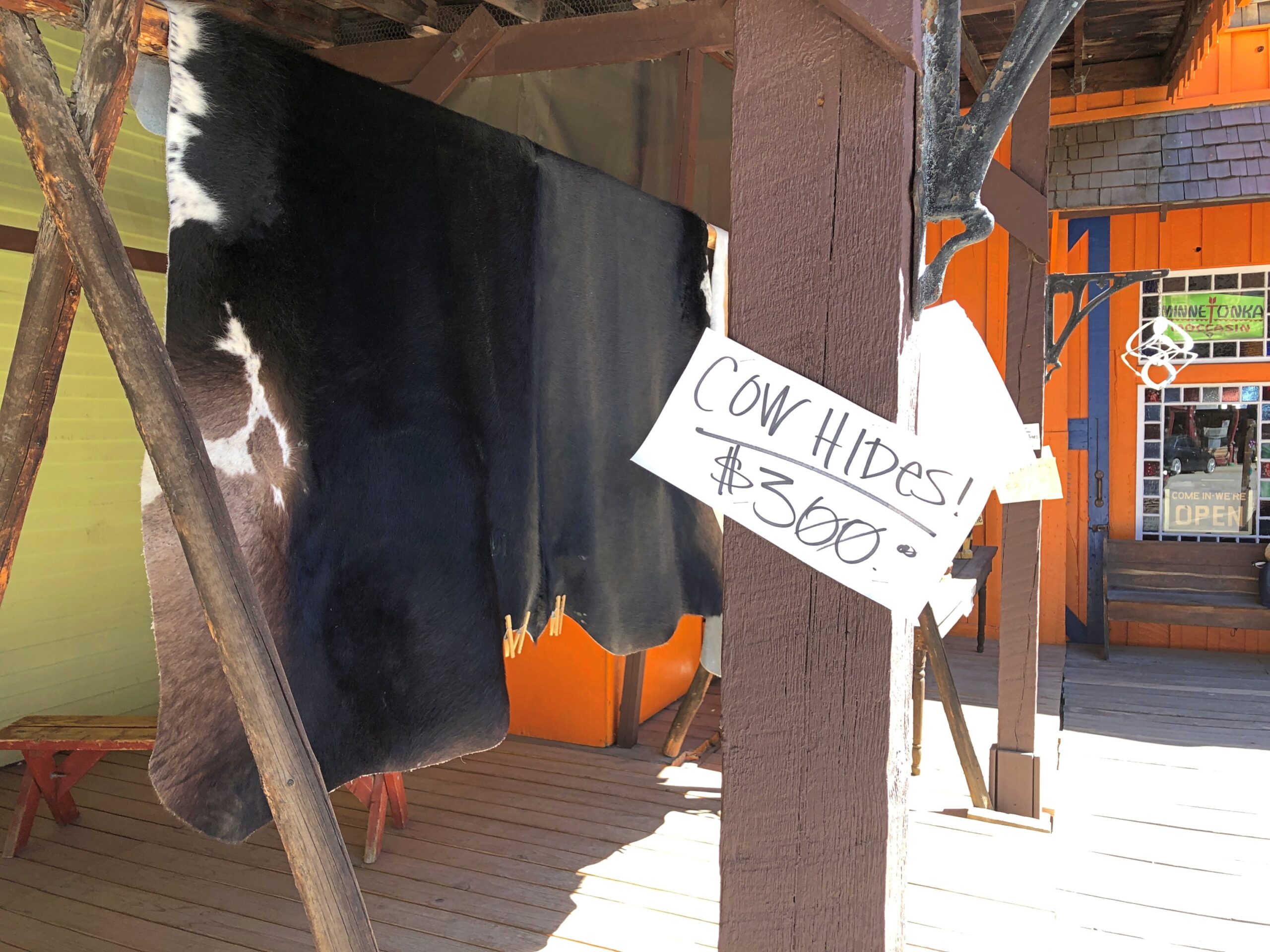
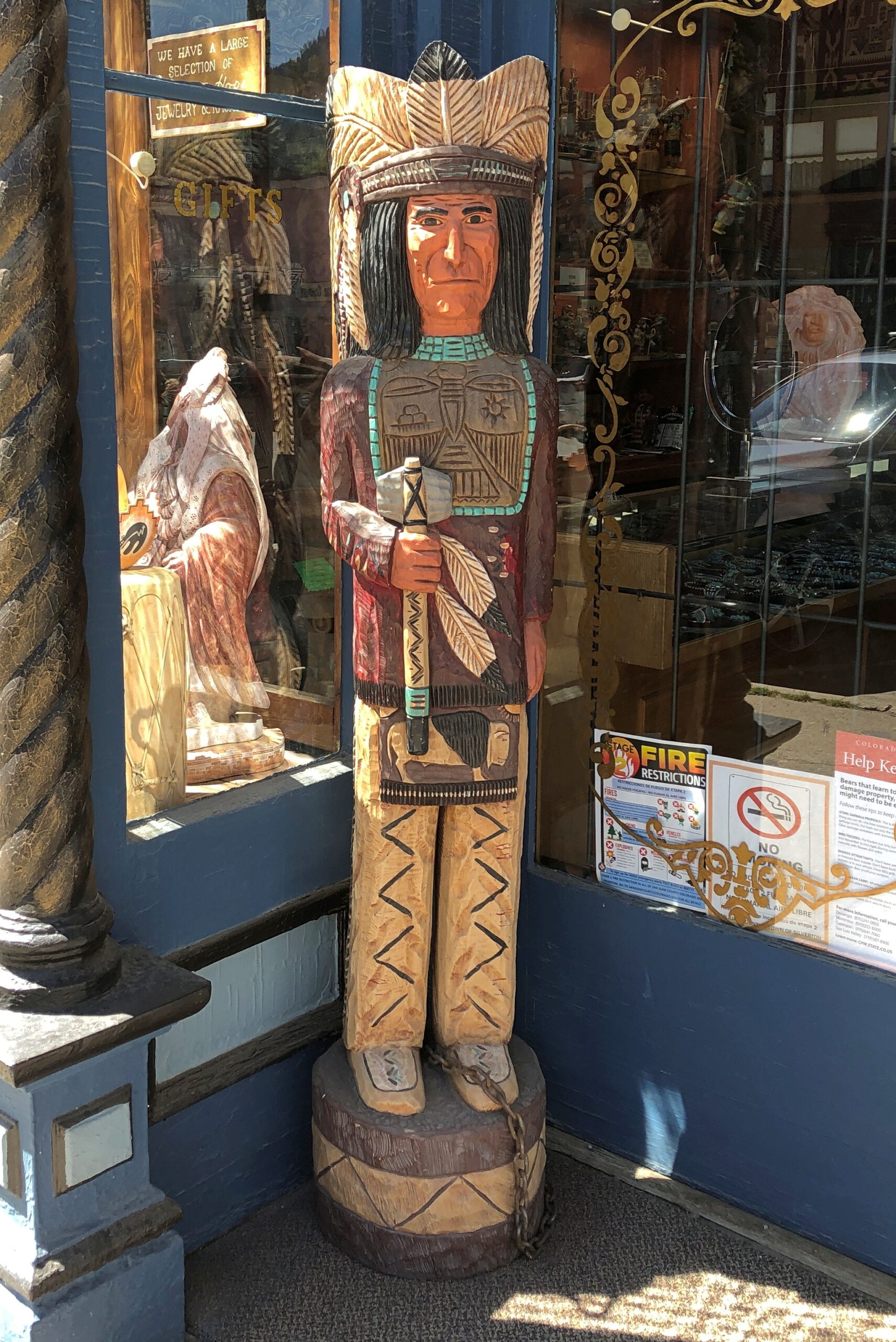
Something to upset PETA sympathizers.
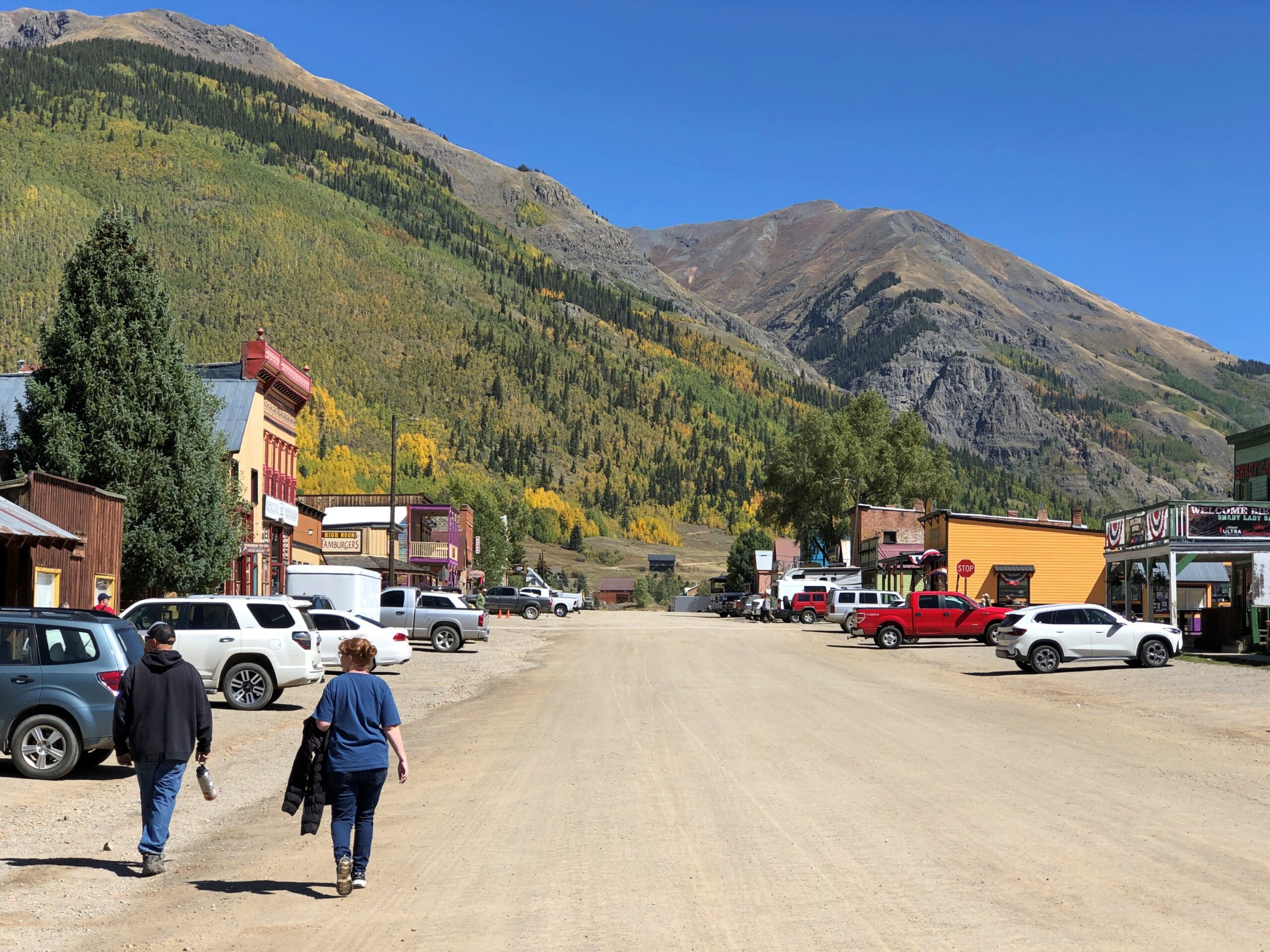
Stroll down Greene St. in the mountain town of Silverton, Colorado, at least in mid-September this year, and you’d have had the opportunity to buy a hide for $300. We did, but declined. Still, it wasn’t just a Colorado detail, but a Western one. The West, where men are men and cow hides hang in the sun. As far as I could tell, you couldn’t buy a hide with Bitcoin, but I suppose you’d have to ask the seller to be sure.
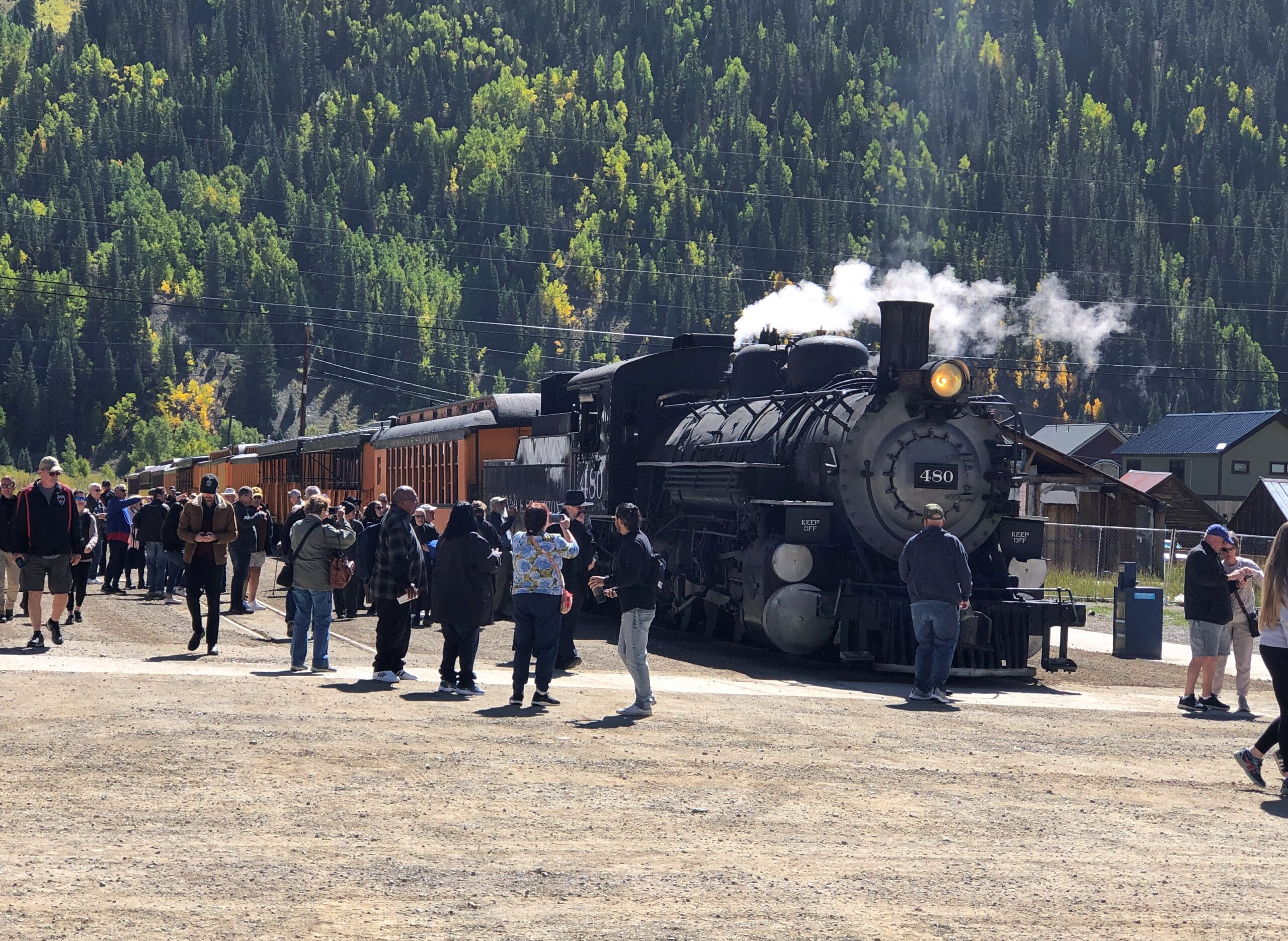
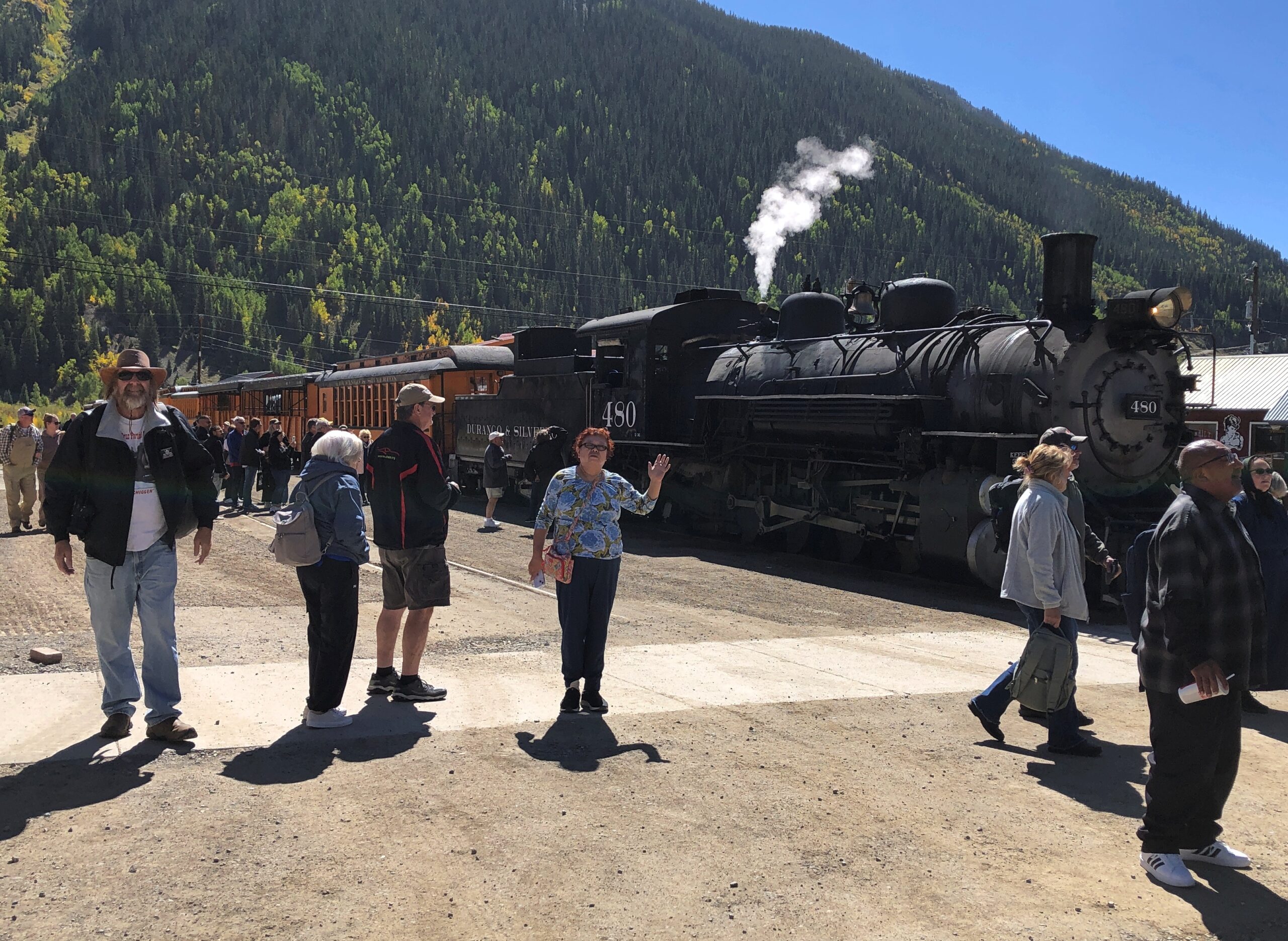
Not five minutes after we’d parked off the main thoroughfare of Greene Street in Silverton, on a large side street, a steam locomotive hauling a valuable cargo — tourists — pulled into town, a block from where we parked. The Durango & Silverton Narrow Gauge RR train from Durango had arrived. Instantly the streets around the train were thick with those same tourists who had paid roughly $100 a head for the scenic ride, though I suppose many, the majority maybe, had gotten a slight discount as seniors.
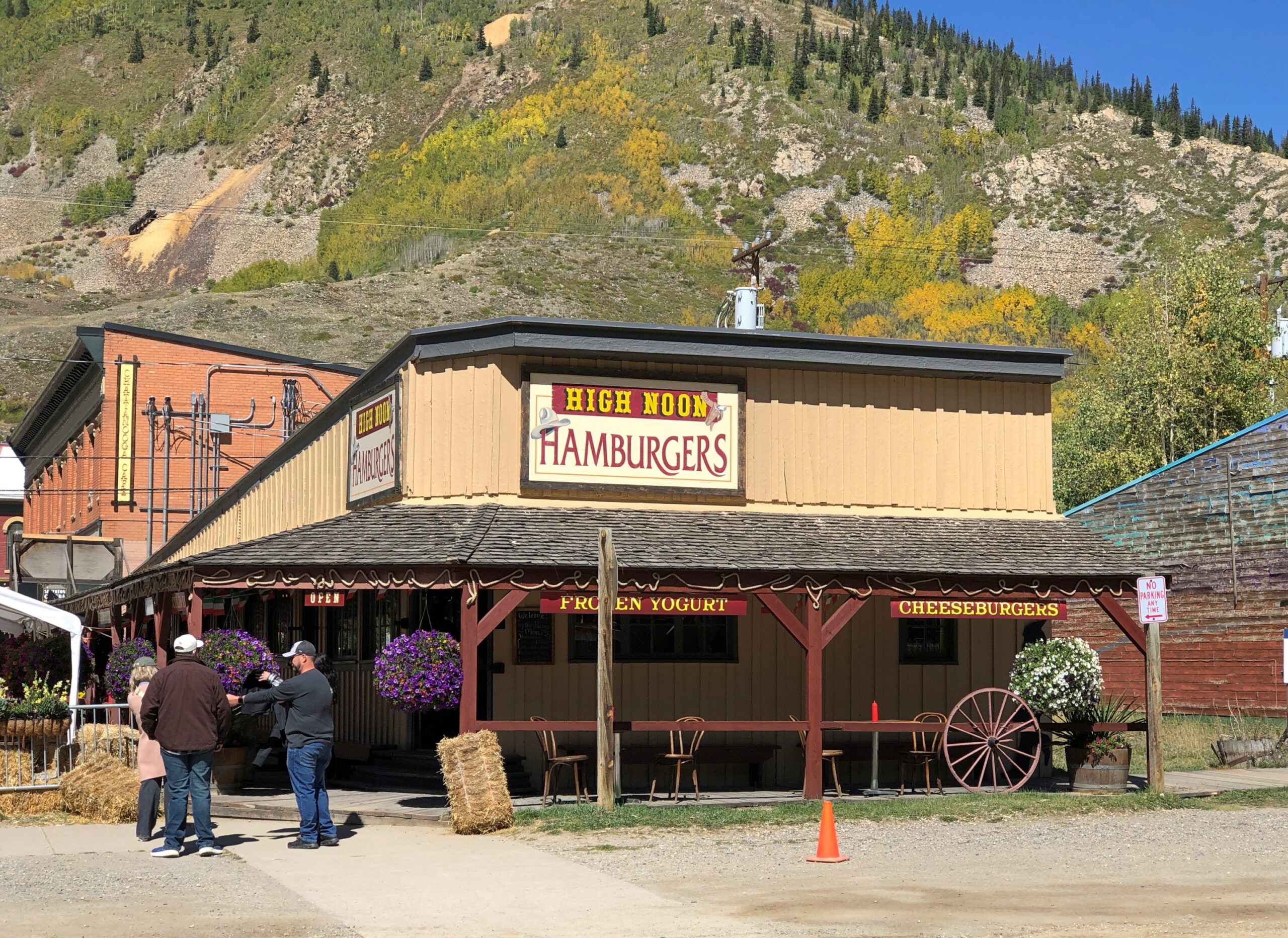
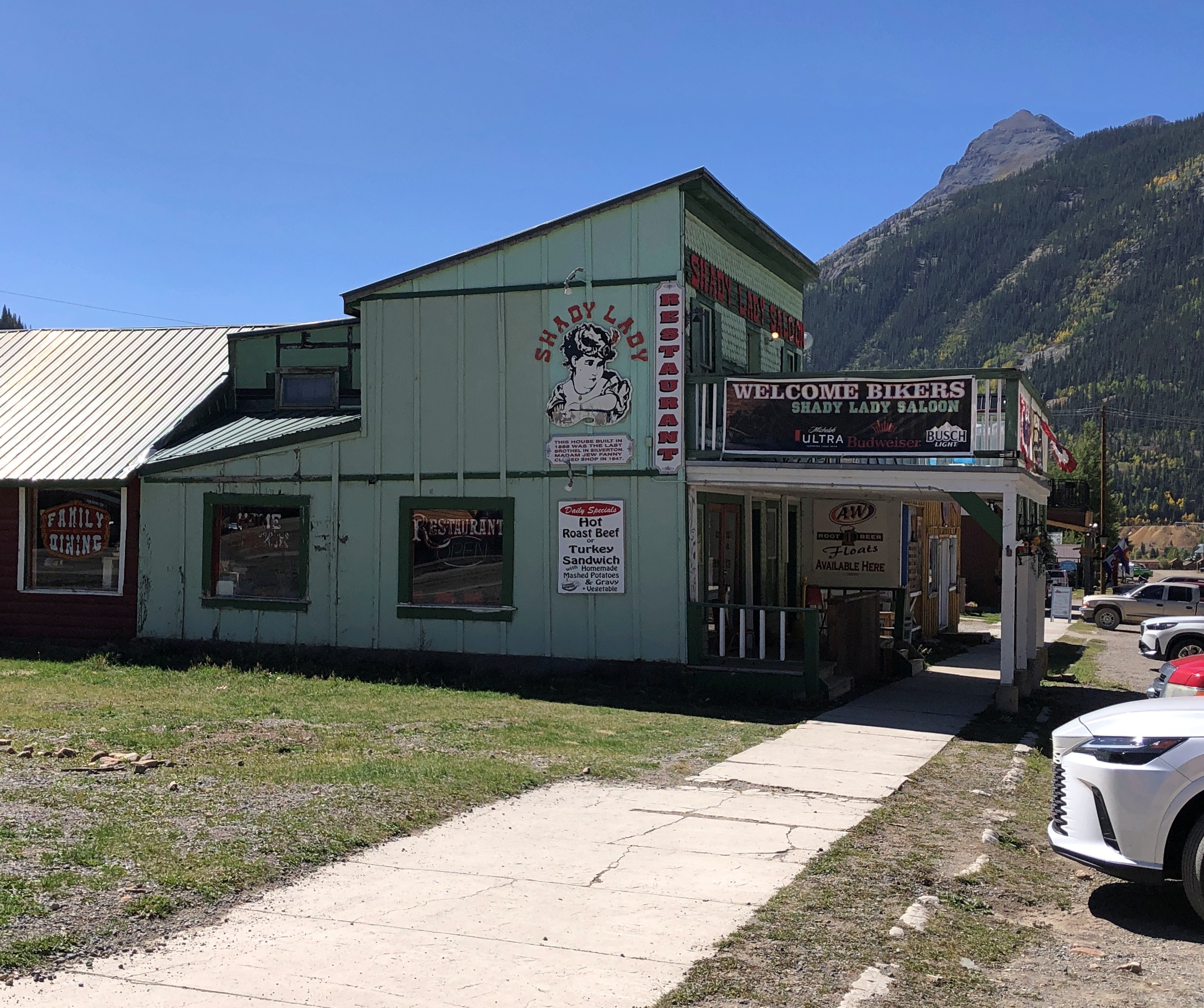
I assume the economy of 21st-century Silverton depends pretty heavily on these arrivals, at least in the warm months, as day after day the line disgorges its many passengers for their layover. No doubt the likes of High Noon Hamburgers or the Shady Lady or a lot of the other businesses in town wouldn’t be viable otherwise.
Blair St., paralleling Greene St. a block away. No need for pavement.
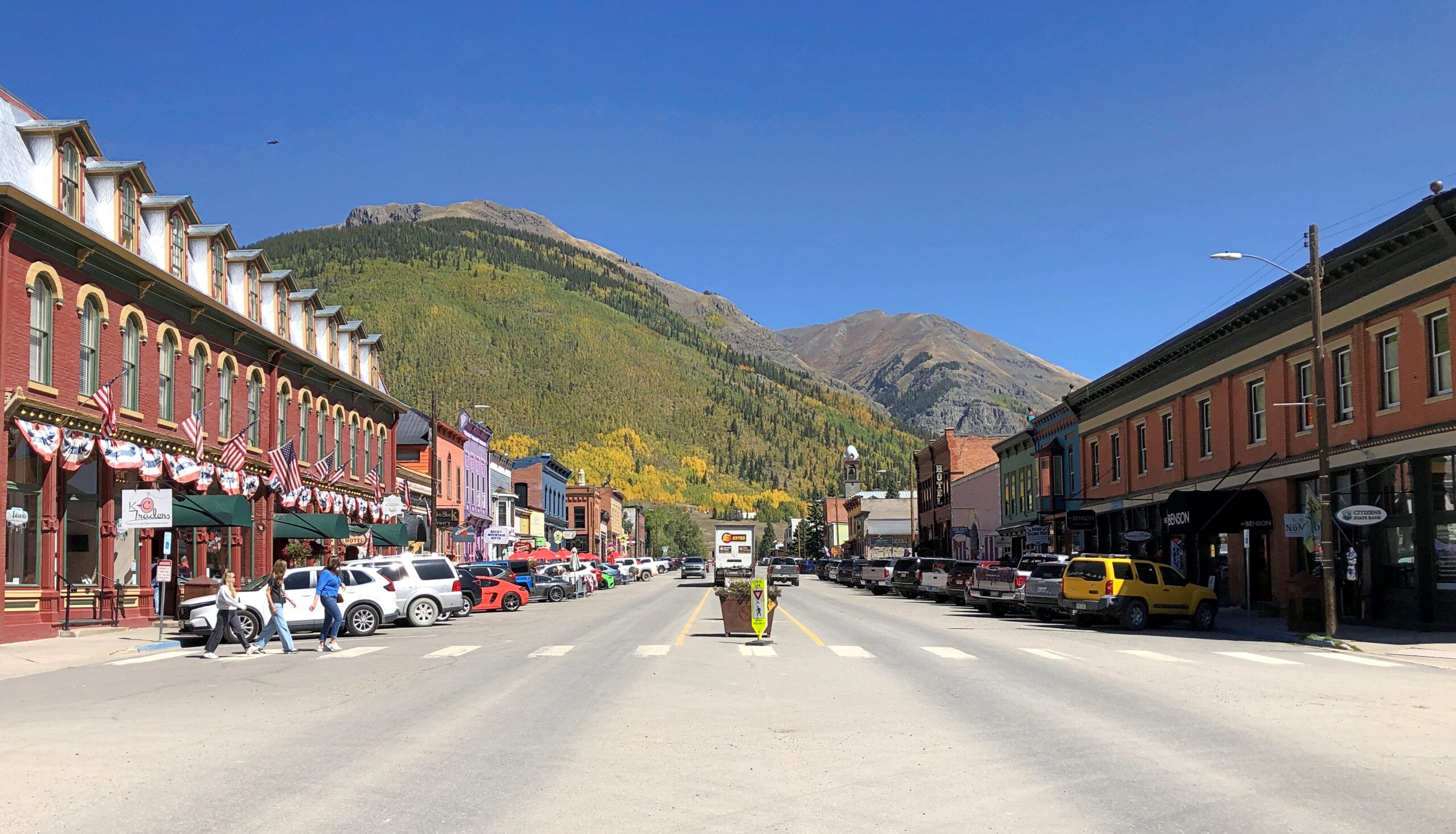
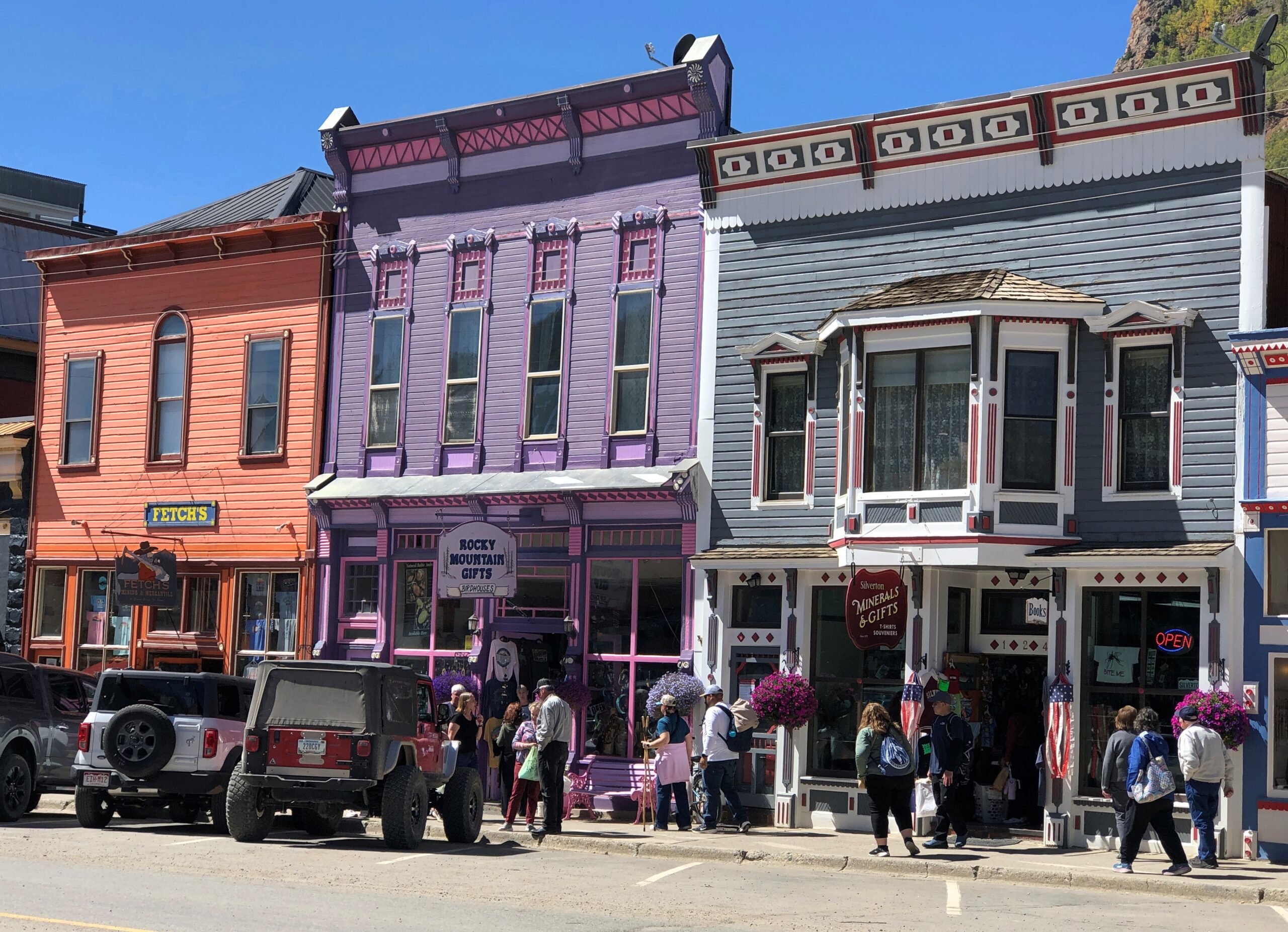
Greene St.
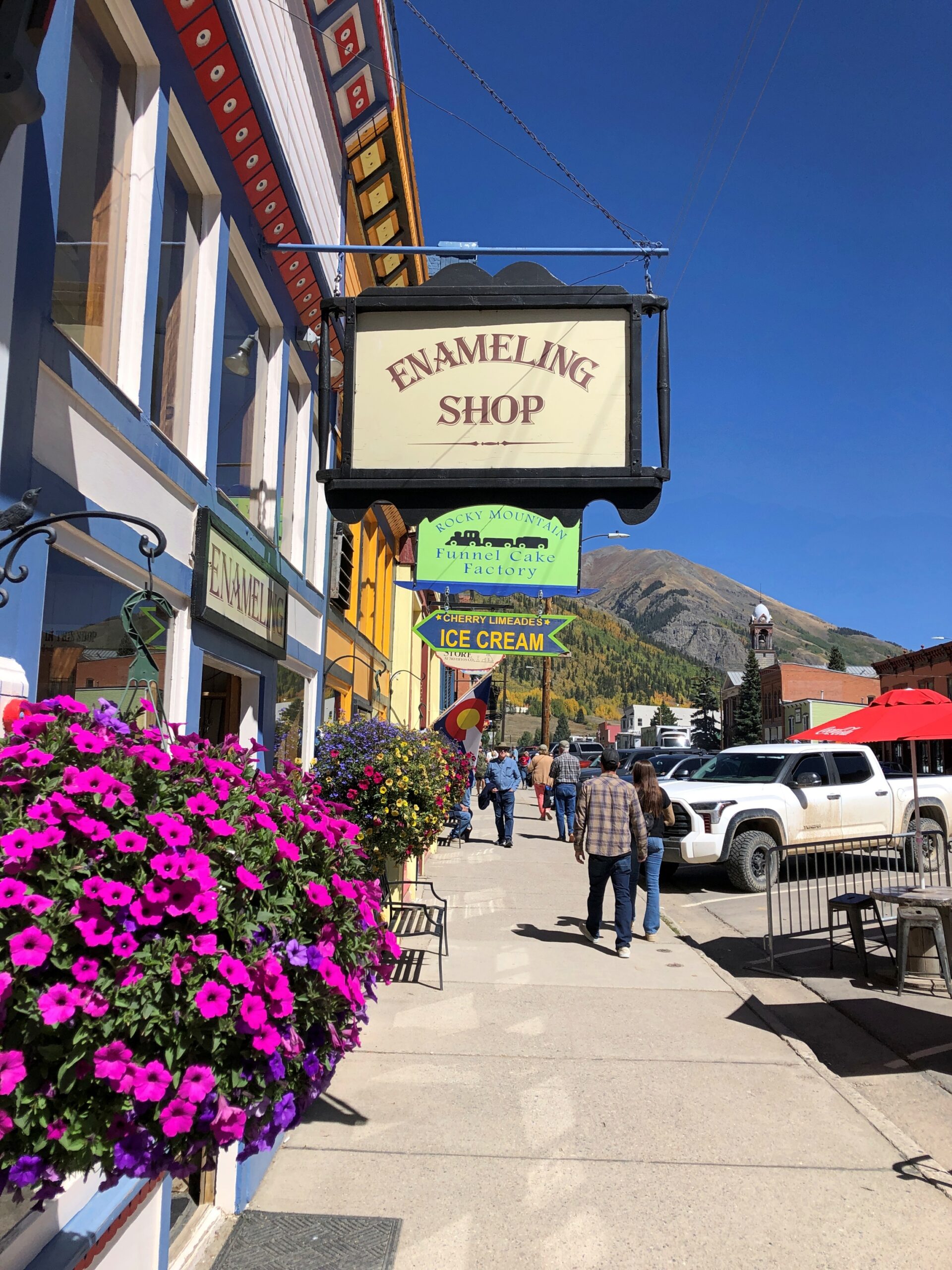
Lots to see on Greene.
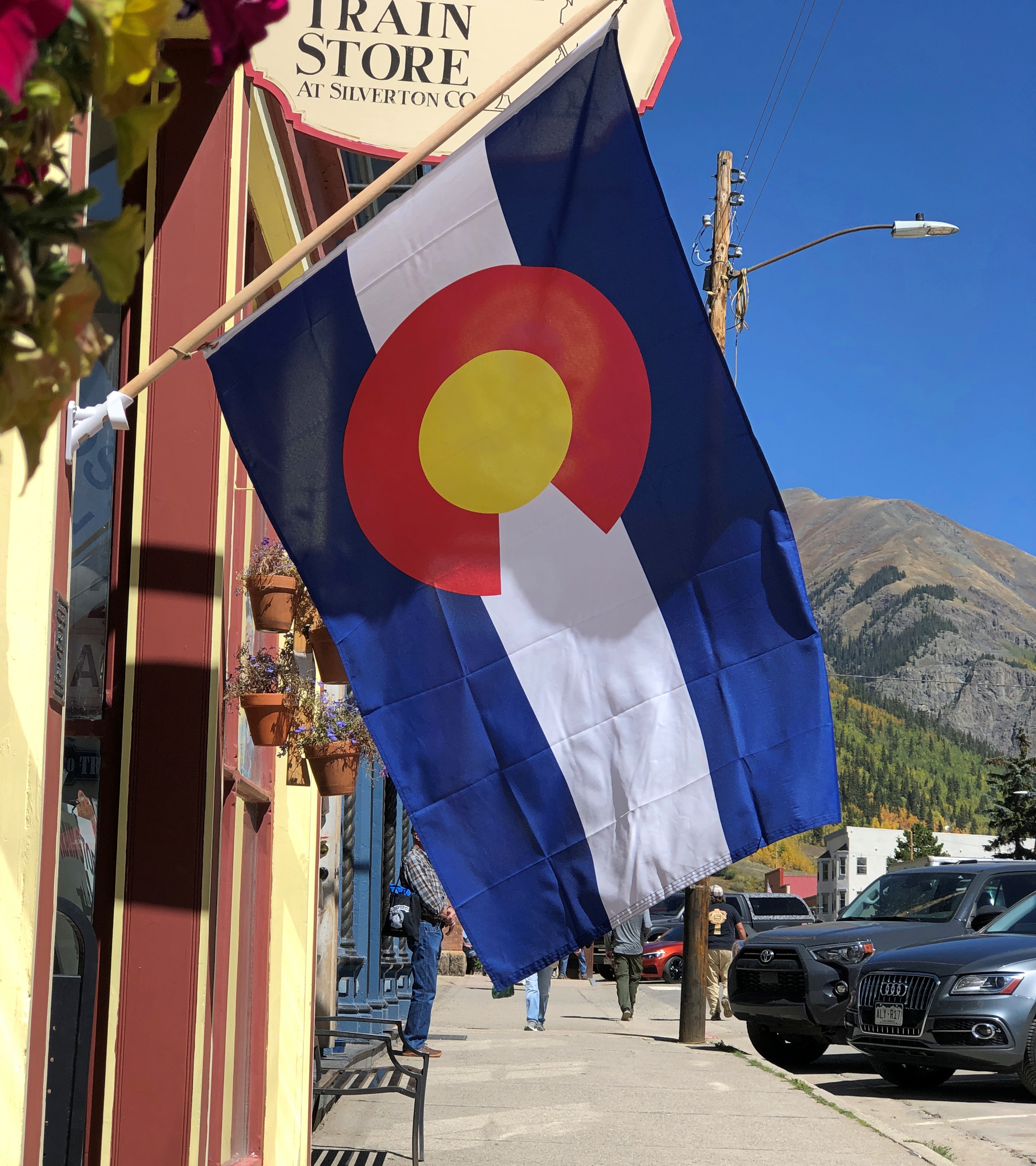
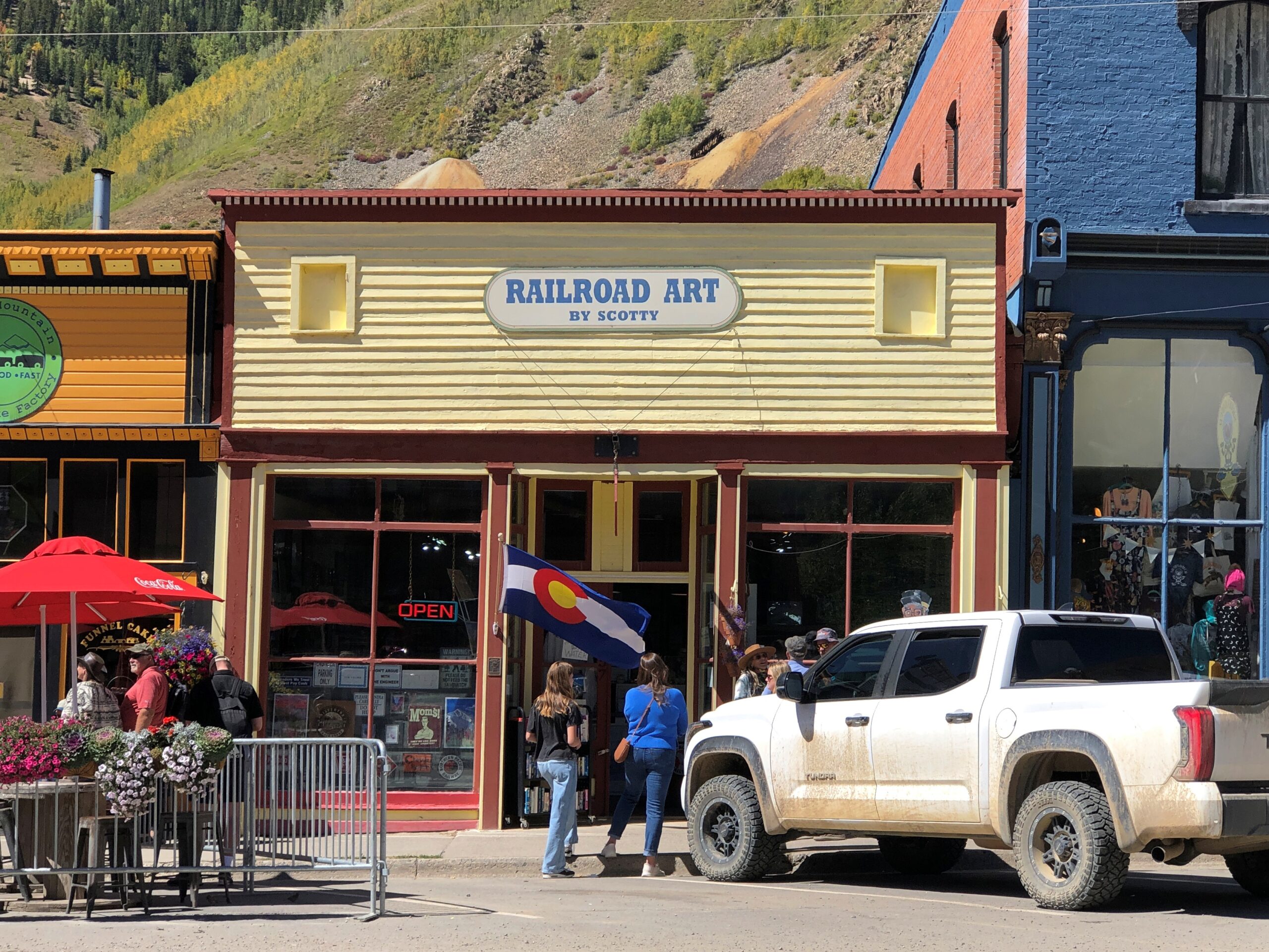
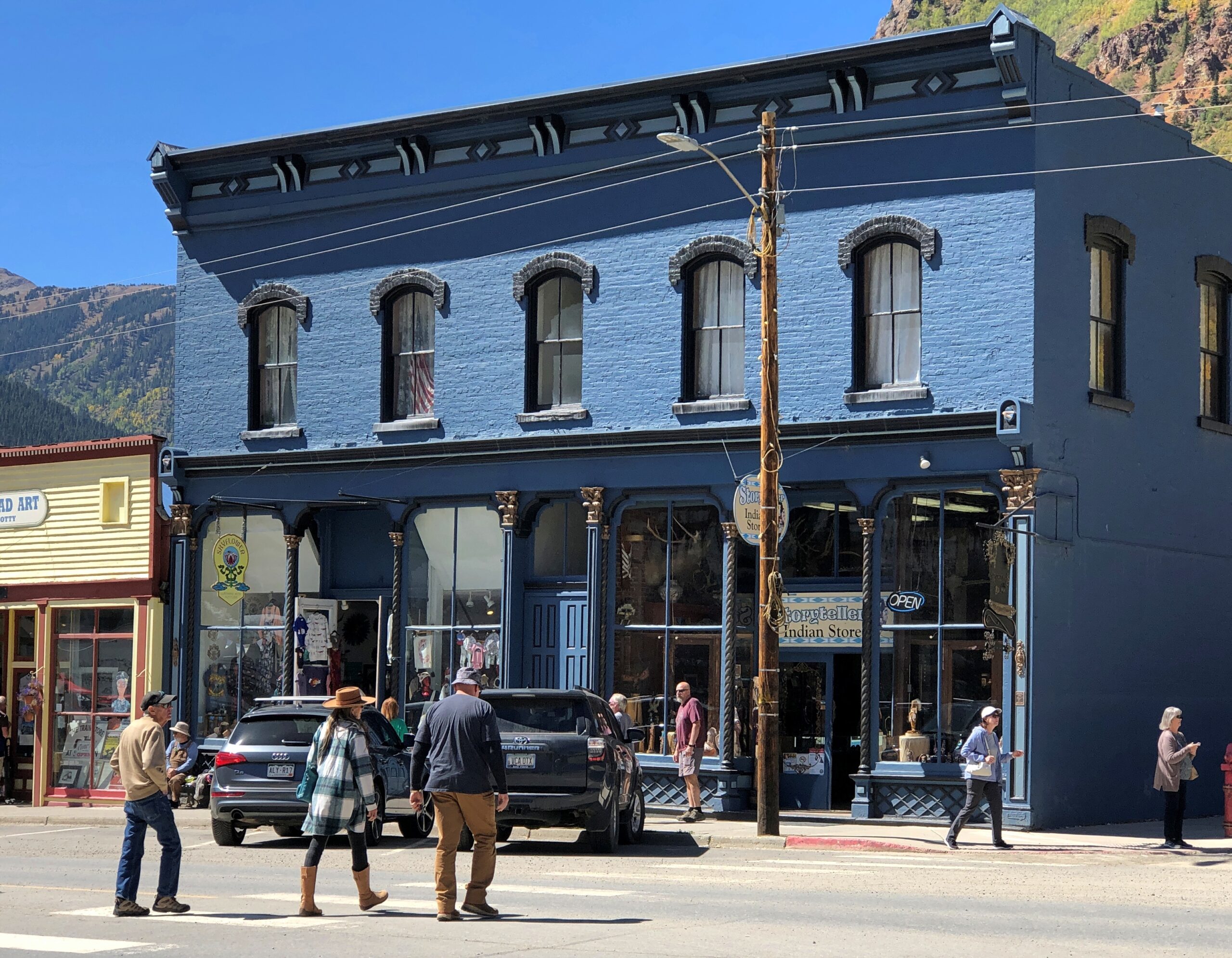
Including the fine Colorado flag, flying at Railroad Art by Scotty, a seriously cool gallery.
“Railroad Art by Scotty presents the custom matted and framed collector Railroad Art Prints by renowned railroad artist H.L. Scott, III,” its web site says. “These are not photographs and they are not created on the computer. These are pen & ink drawings created by Scott using the technique known as STIPPELING or pointillism.”
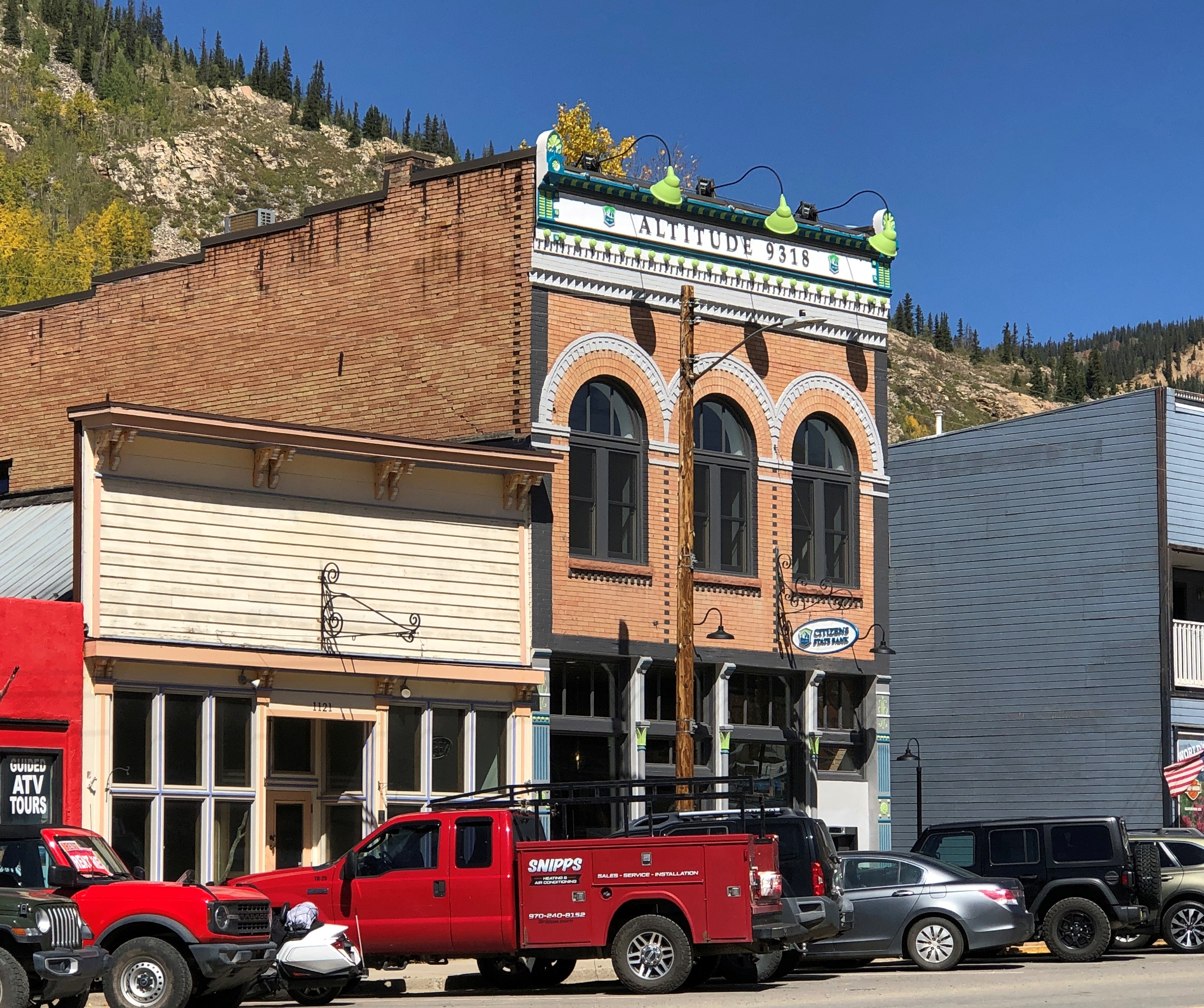
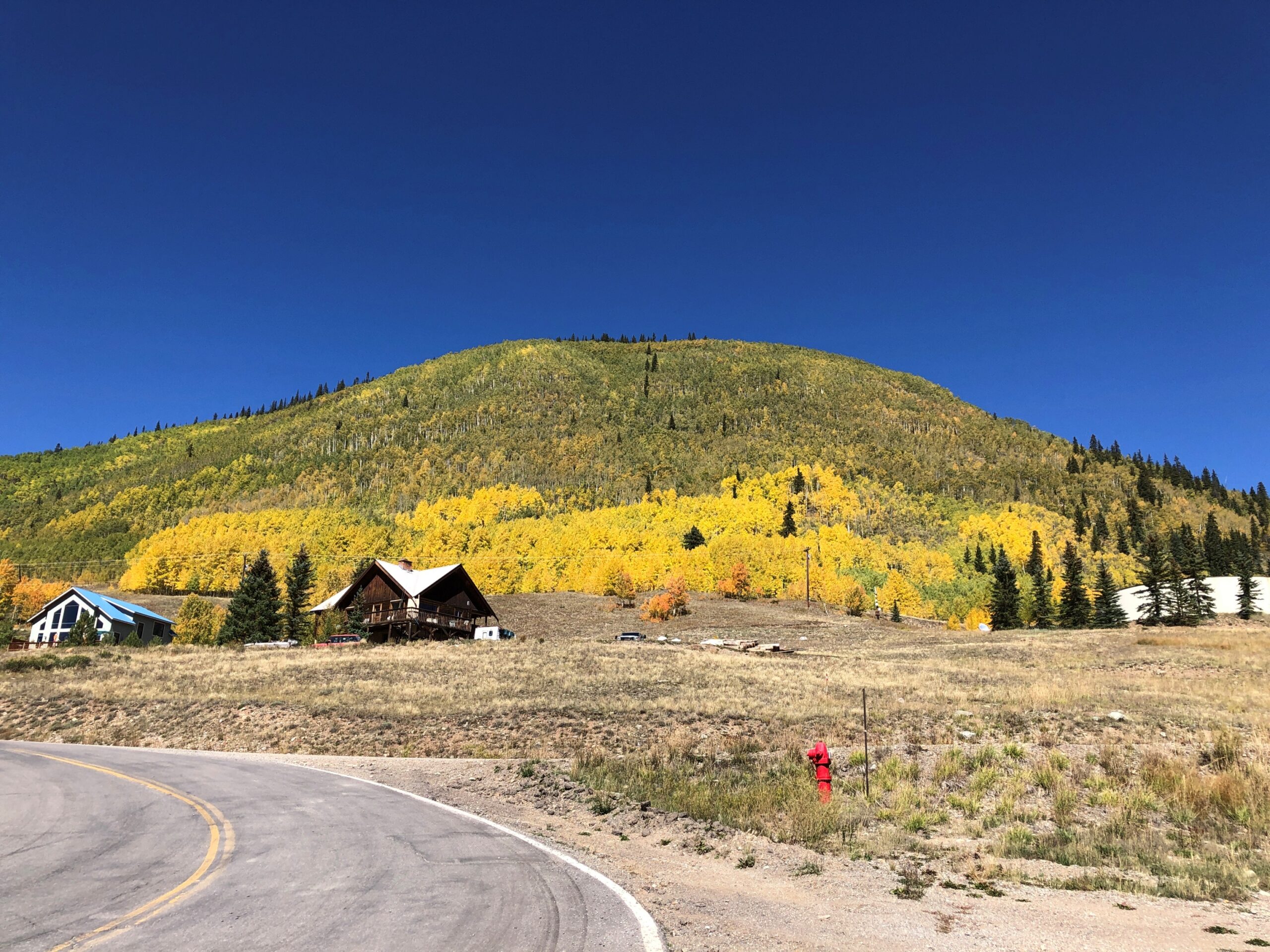
One of the few buildings I’ve seen that clearly states its elevation.
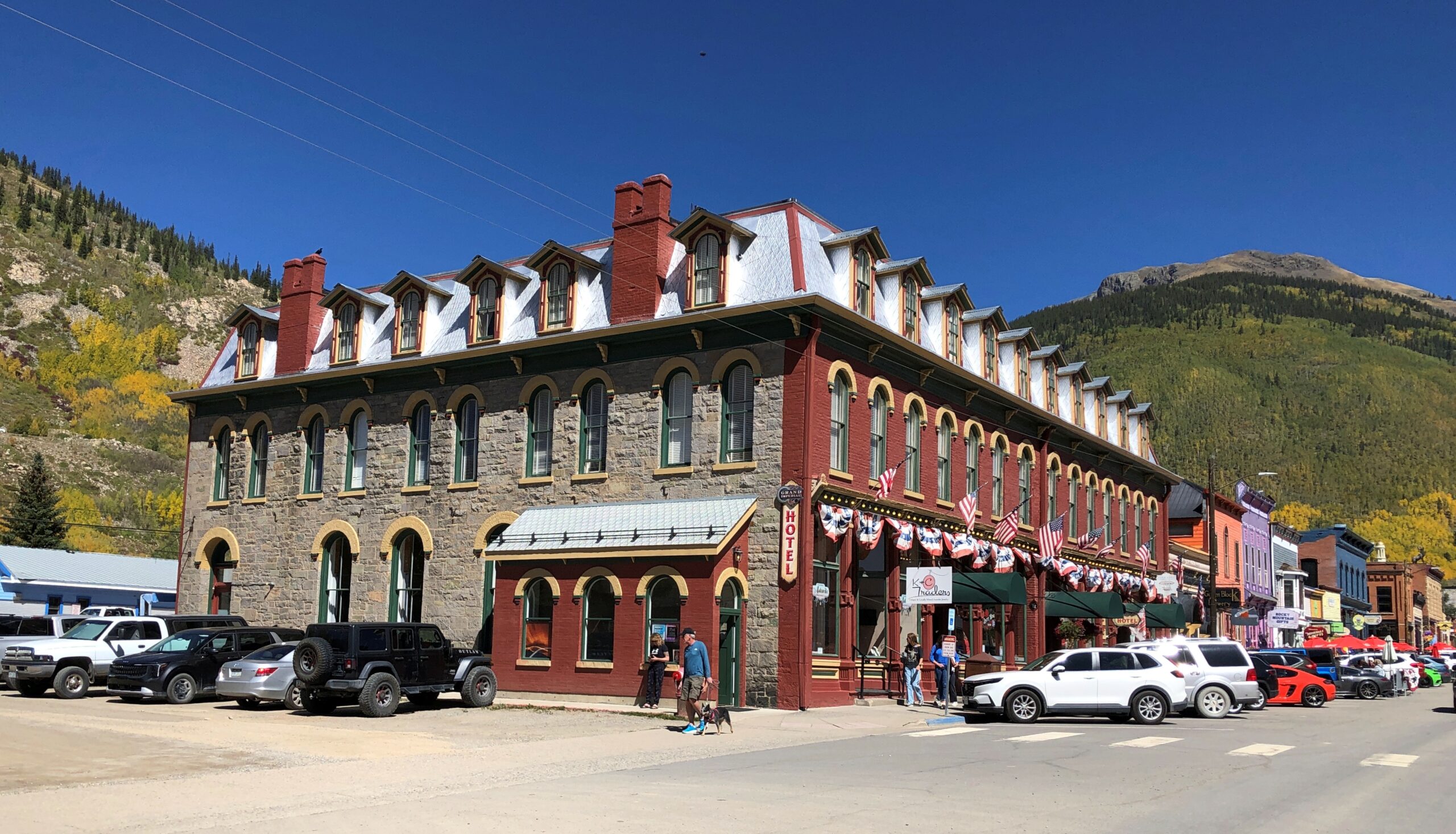
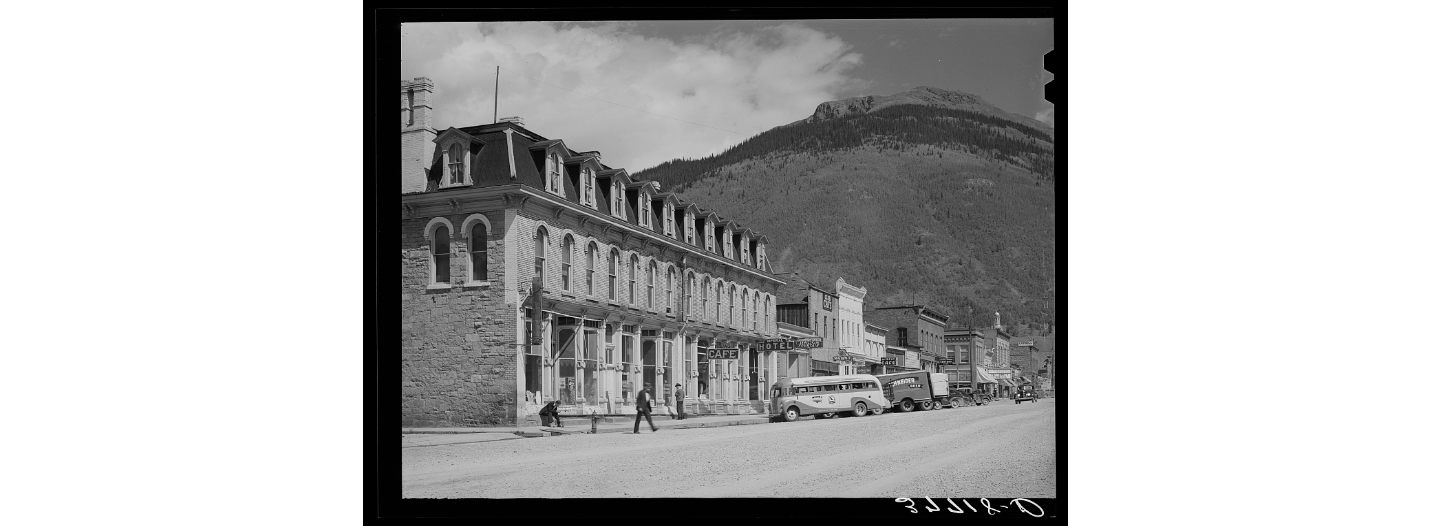
The Grand Imperial Hotel. A lofty name to live up to, but probably posh enough to do so.
Restored to its 1880s appearance in the 2010s, no doubt at considerable expense.
As it looked in 1940, a photo from the Library of Congress, Farm Security Administration-Office of War Information Photograph Collection.
More Greene St.
Greene is short, because Silverton isn’t very large, and so the street, now a road, soon heads for the hills.
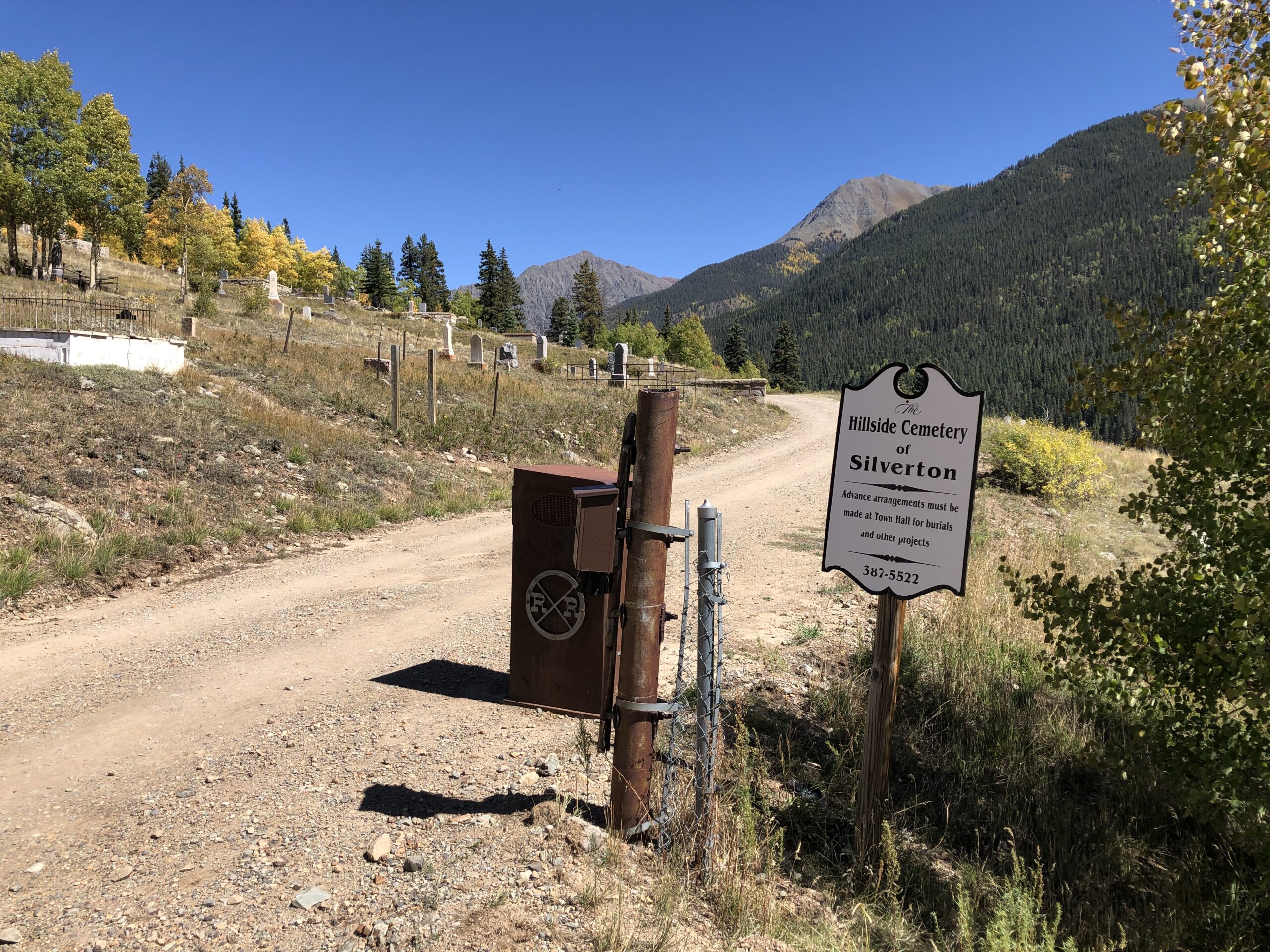
The Hillside Cemetery of Silverton.
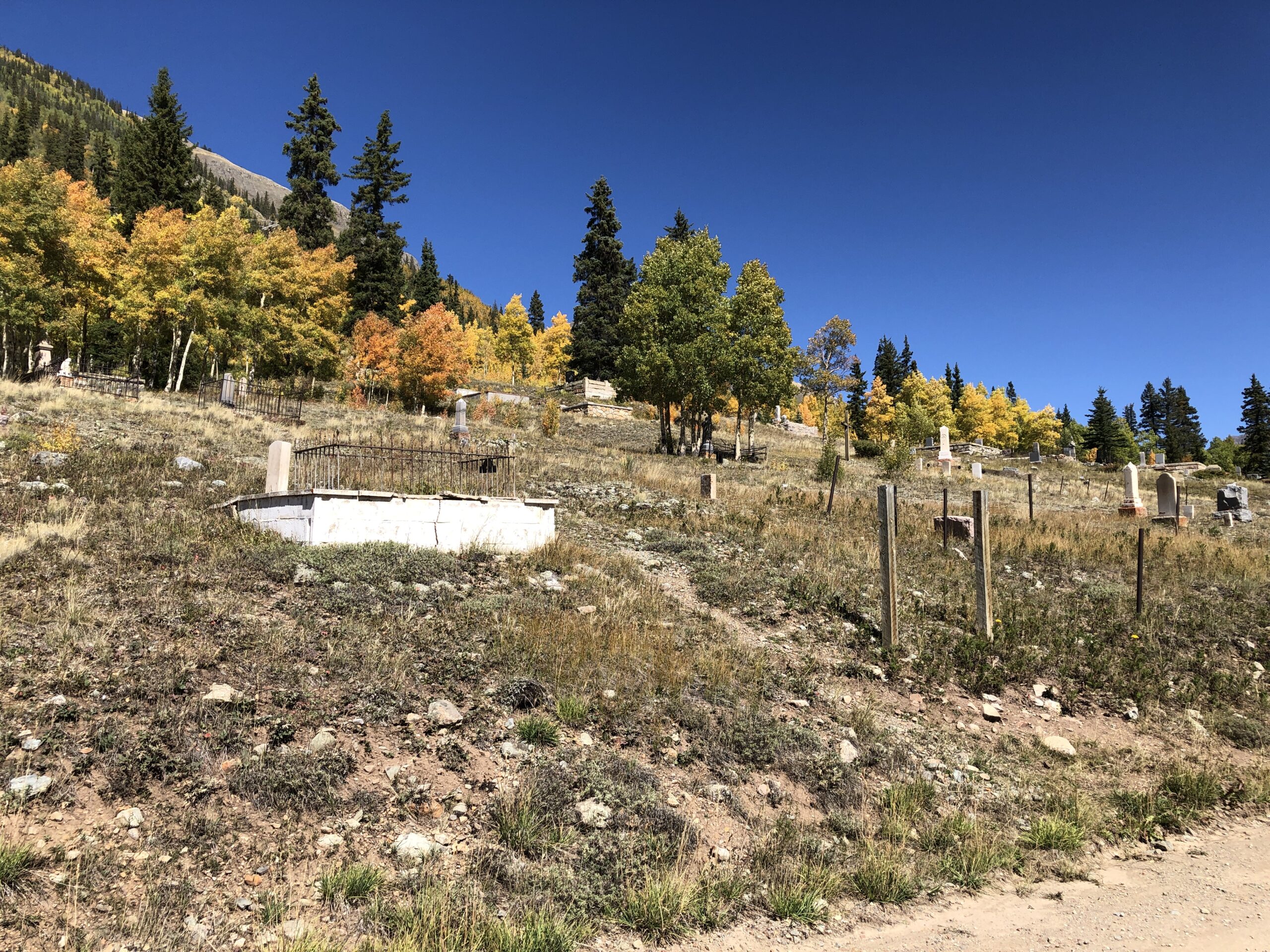
An apt name.
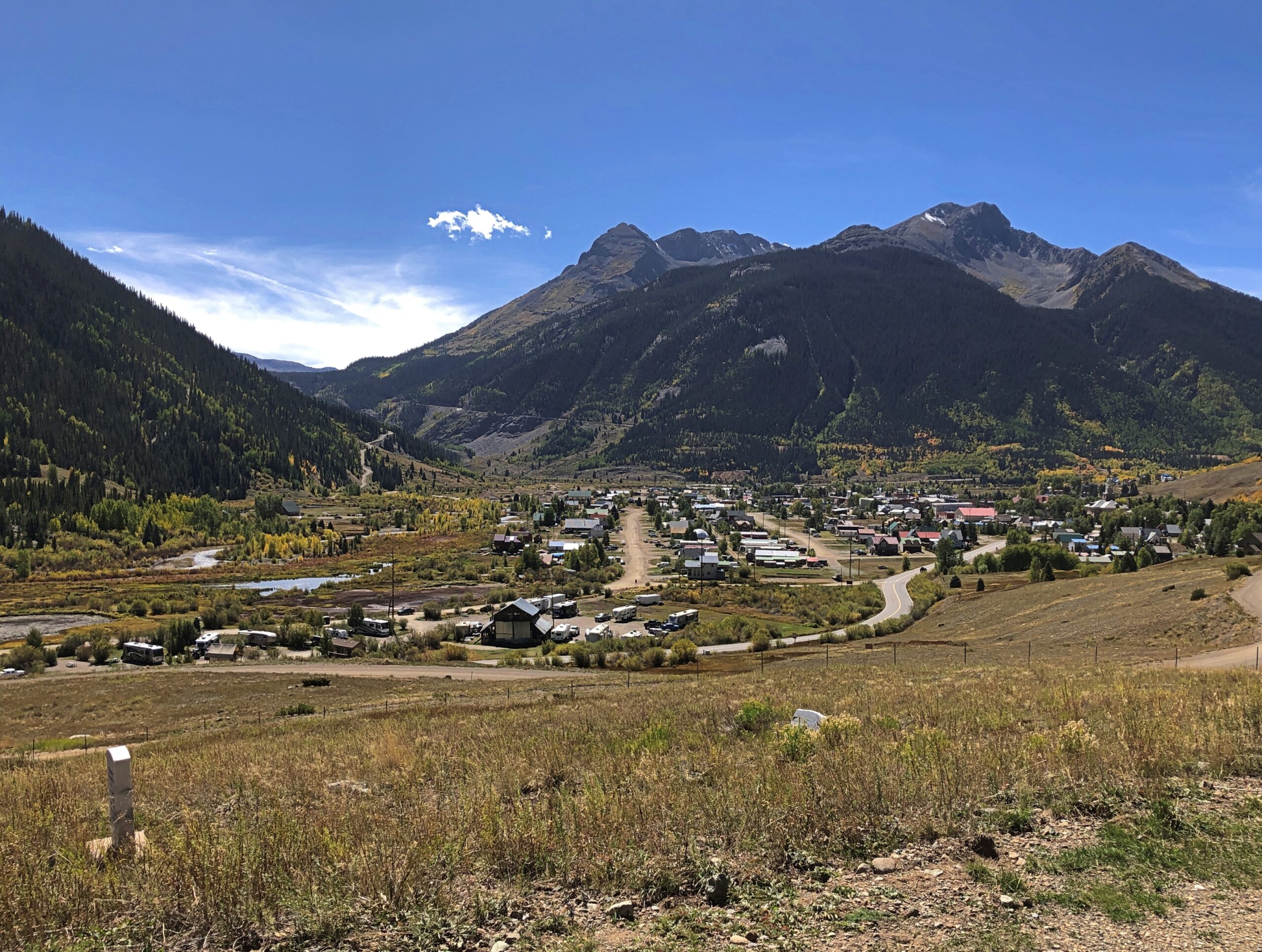
With a good view of the town.
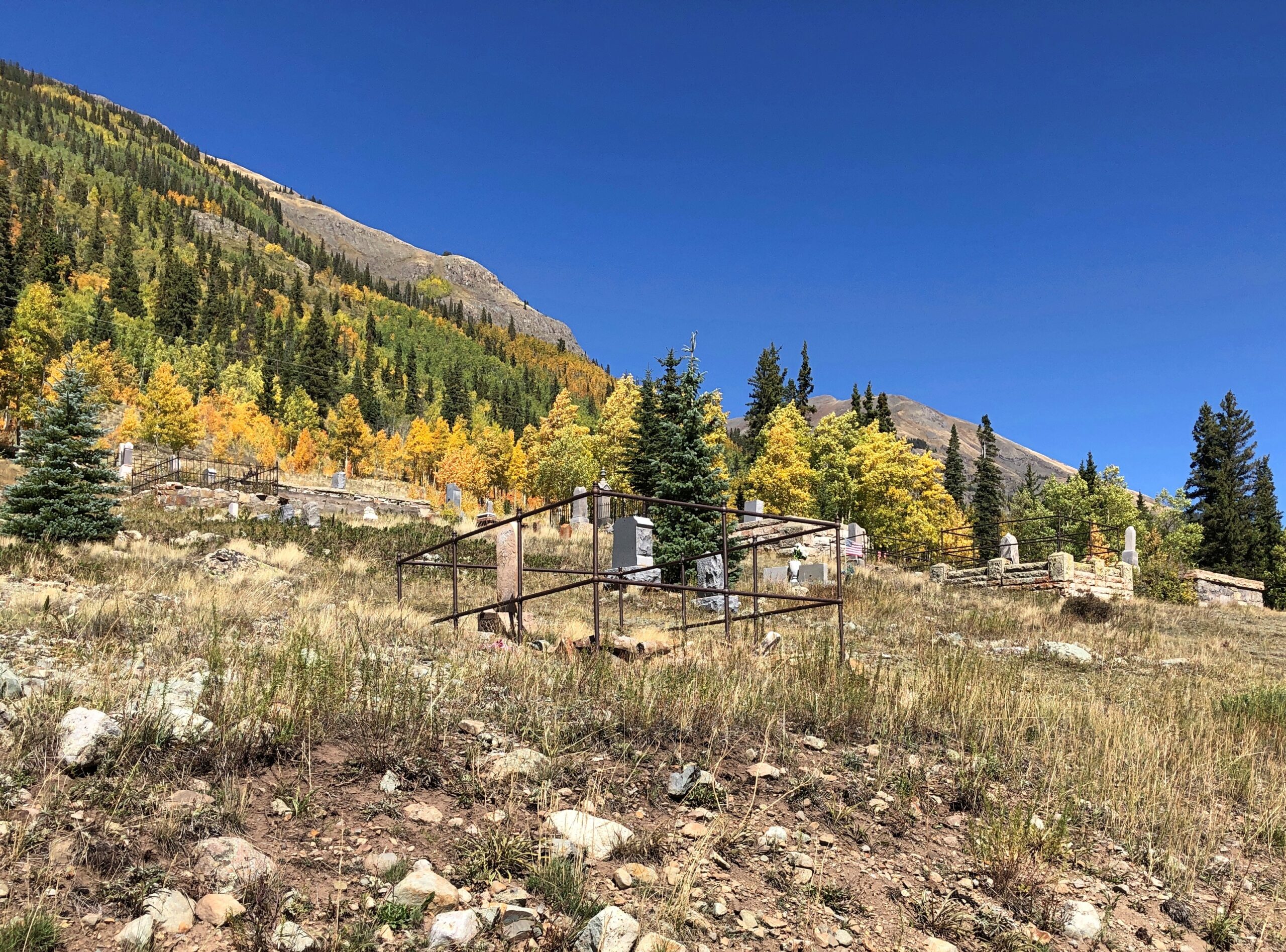
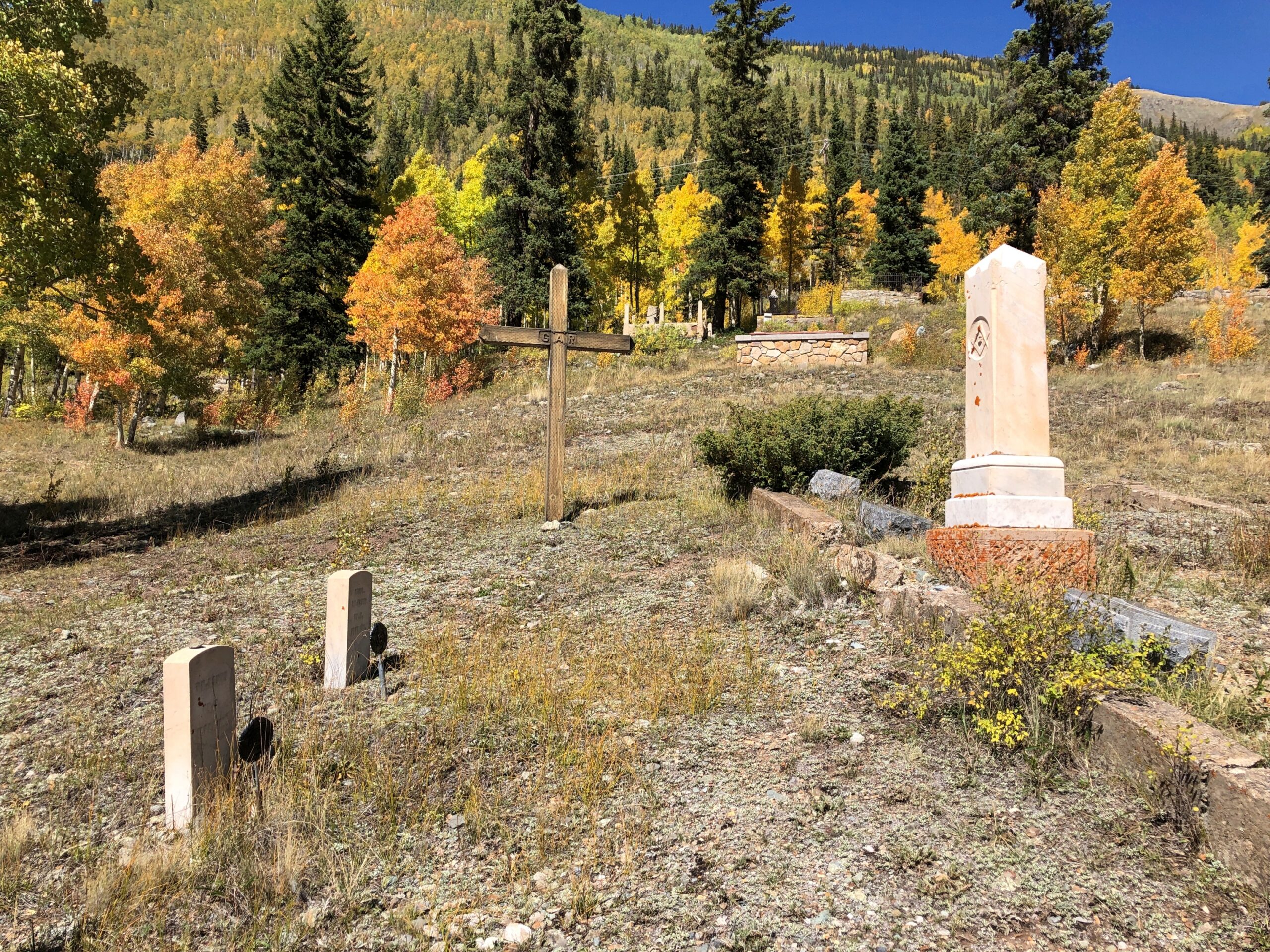
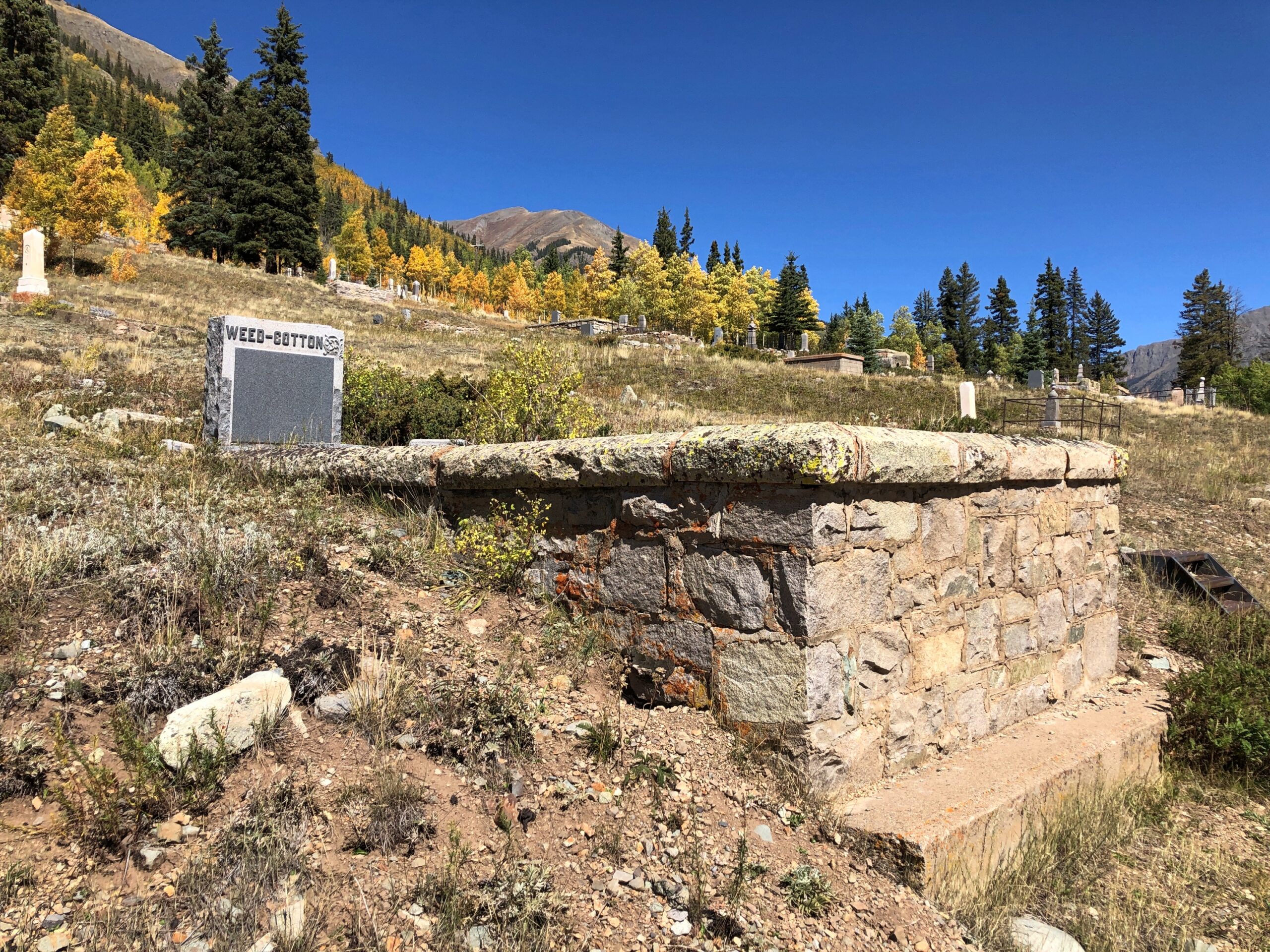
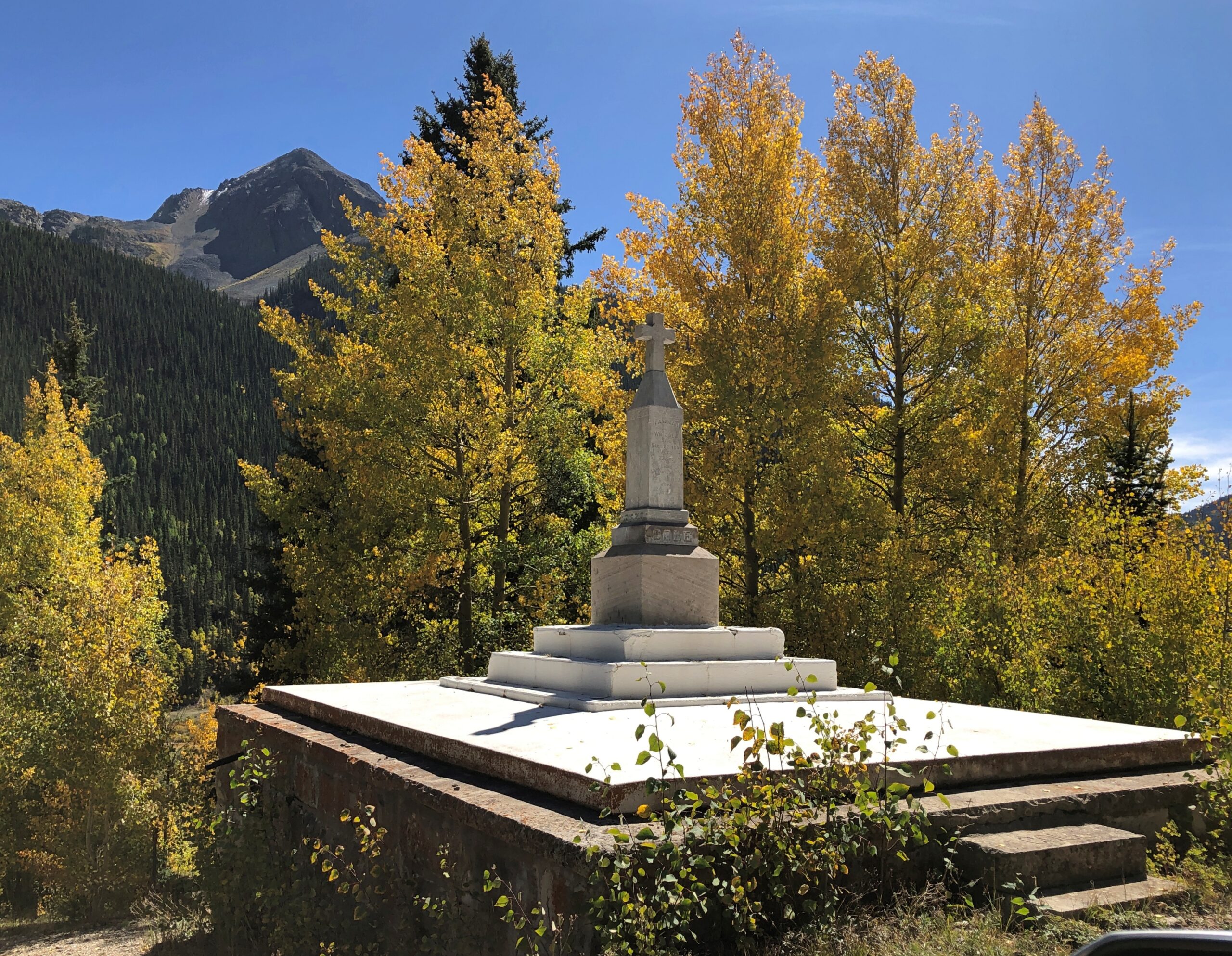
Some sizable memorials.
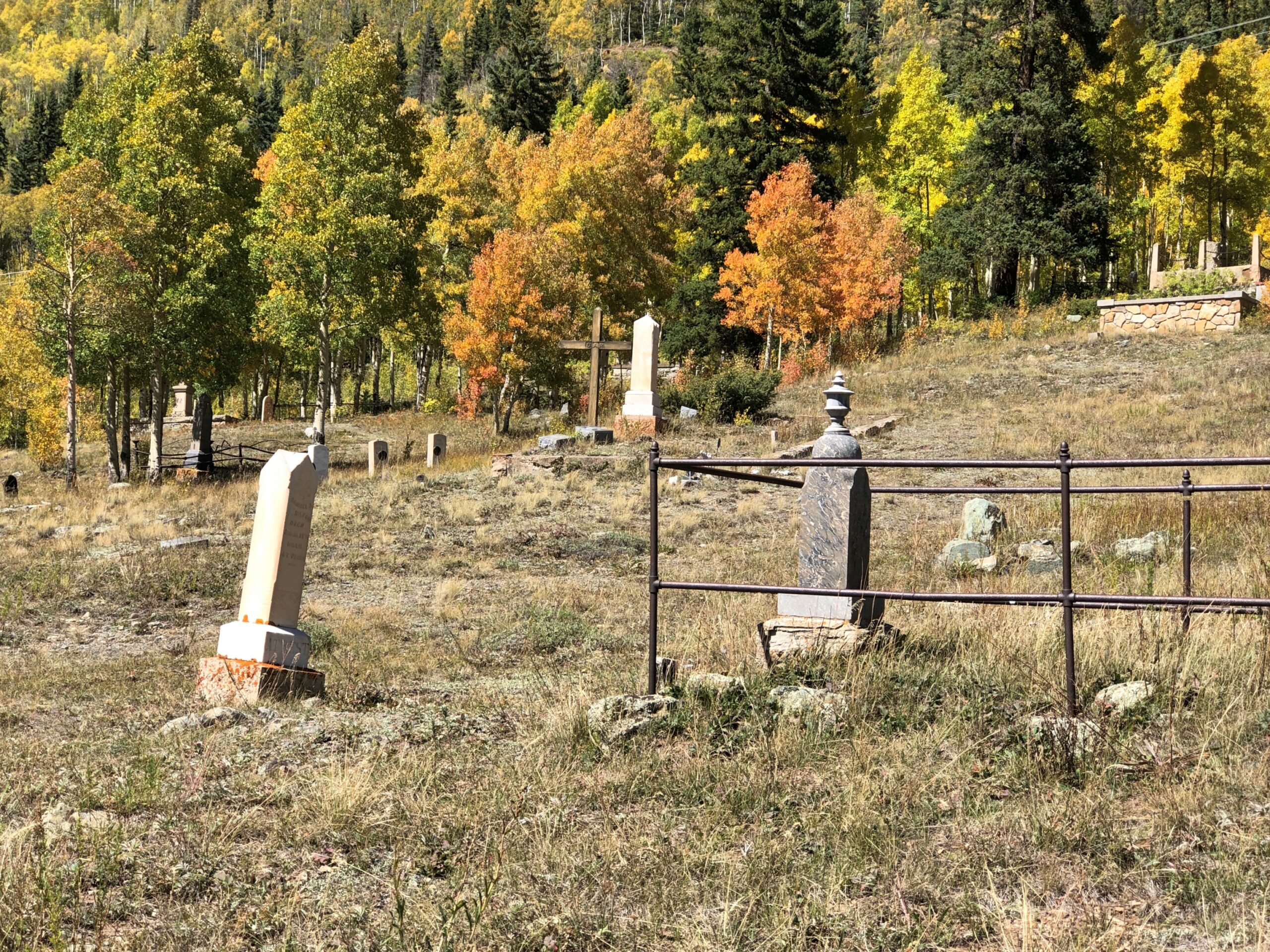
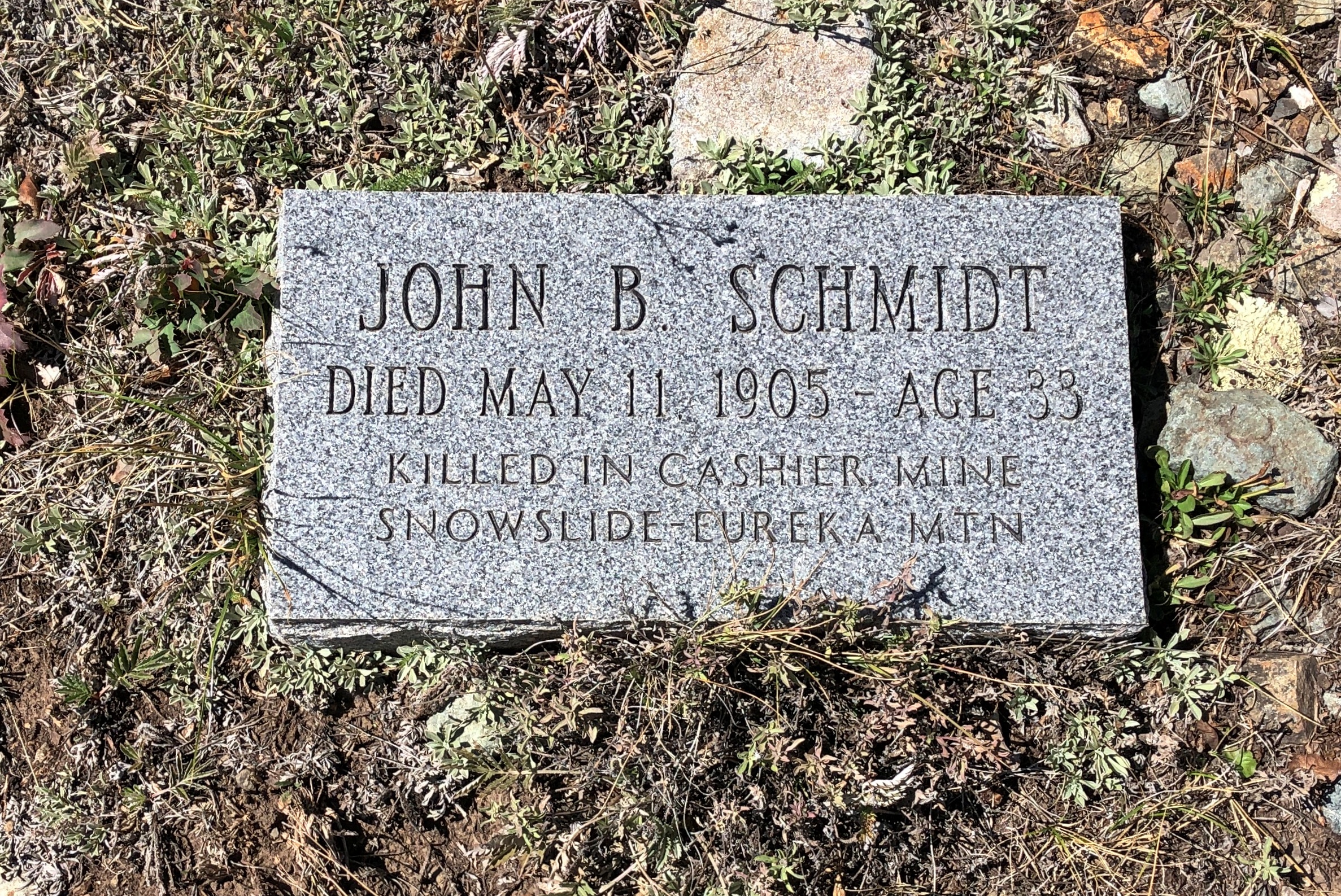
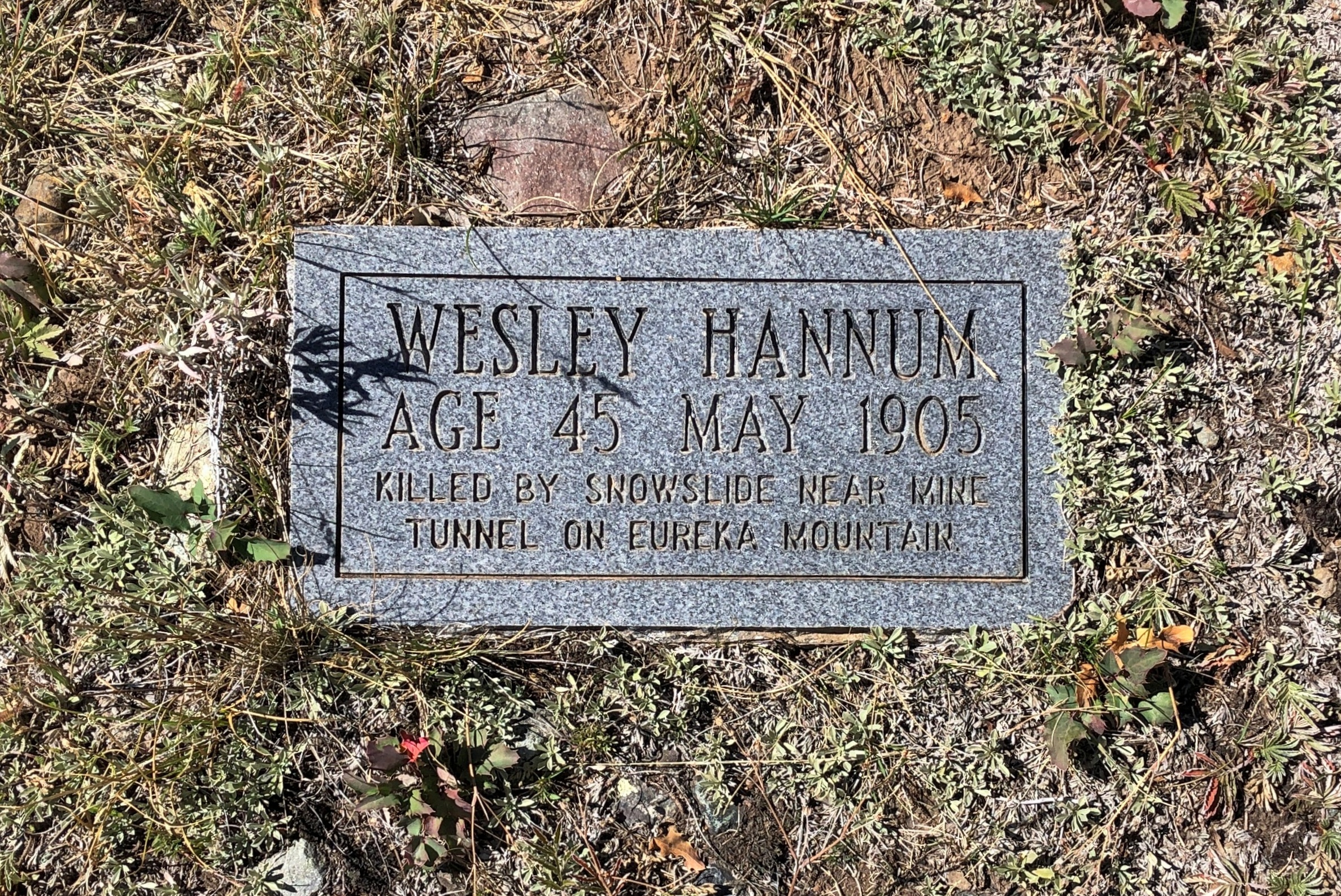
More modest ones.
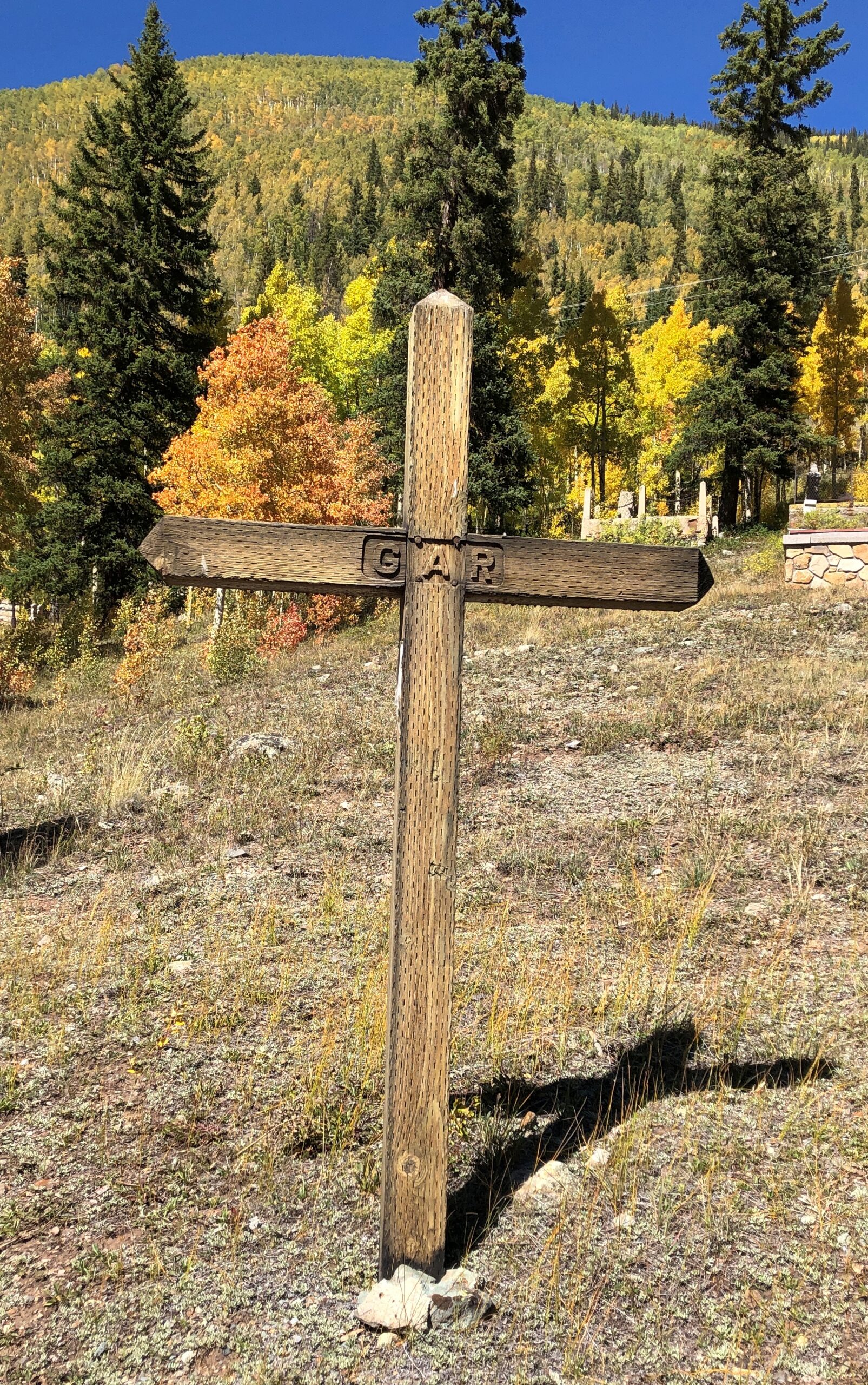
Echoes of lost men from another time. Beyond the outstanding beauty of a hillside cemetery in the flush of autumn, reason enough to visit the cemetery.
“Good morning,” Walter said in response to me, but in a hushed tone that somehow made his Austrian accent more distinct. “Do you want to see some bears?”
Yes. I followed him out to the large deck off the large common room of the Country Sunshine B&B. Outside we met with cool air, bright morning sun, and the strong smell of pine. The deck was a floor above the grassy ground, which sloped downward away from the bed and breakfast, shaded by a small copse of enormous pines.
We’d just spent the night at Country Sunshine B&B, the first of three for our visit to Durango, Colorado, a place I’d wanted to visit since the moment, years ago, when I heard Garrison Keillor describe the place in the engaging way that he had. I’d come out of our room – one of the three or four bedrooms off the common room – ahead of Yuriko, to examine the breakfast spread at the main table when Walter asked me about bears.
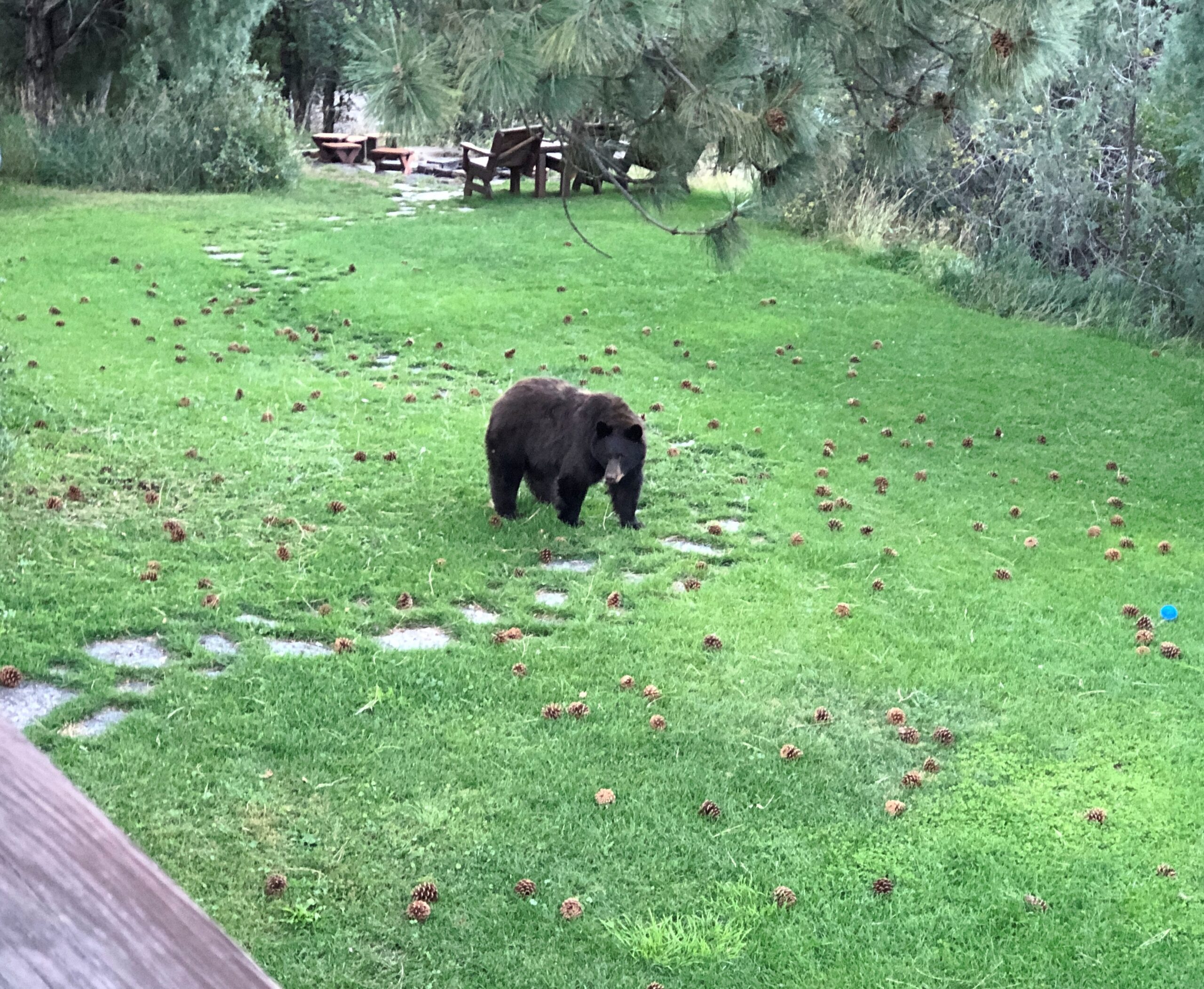
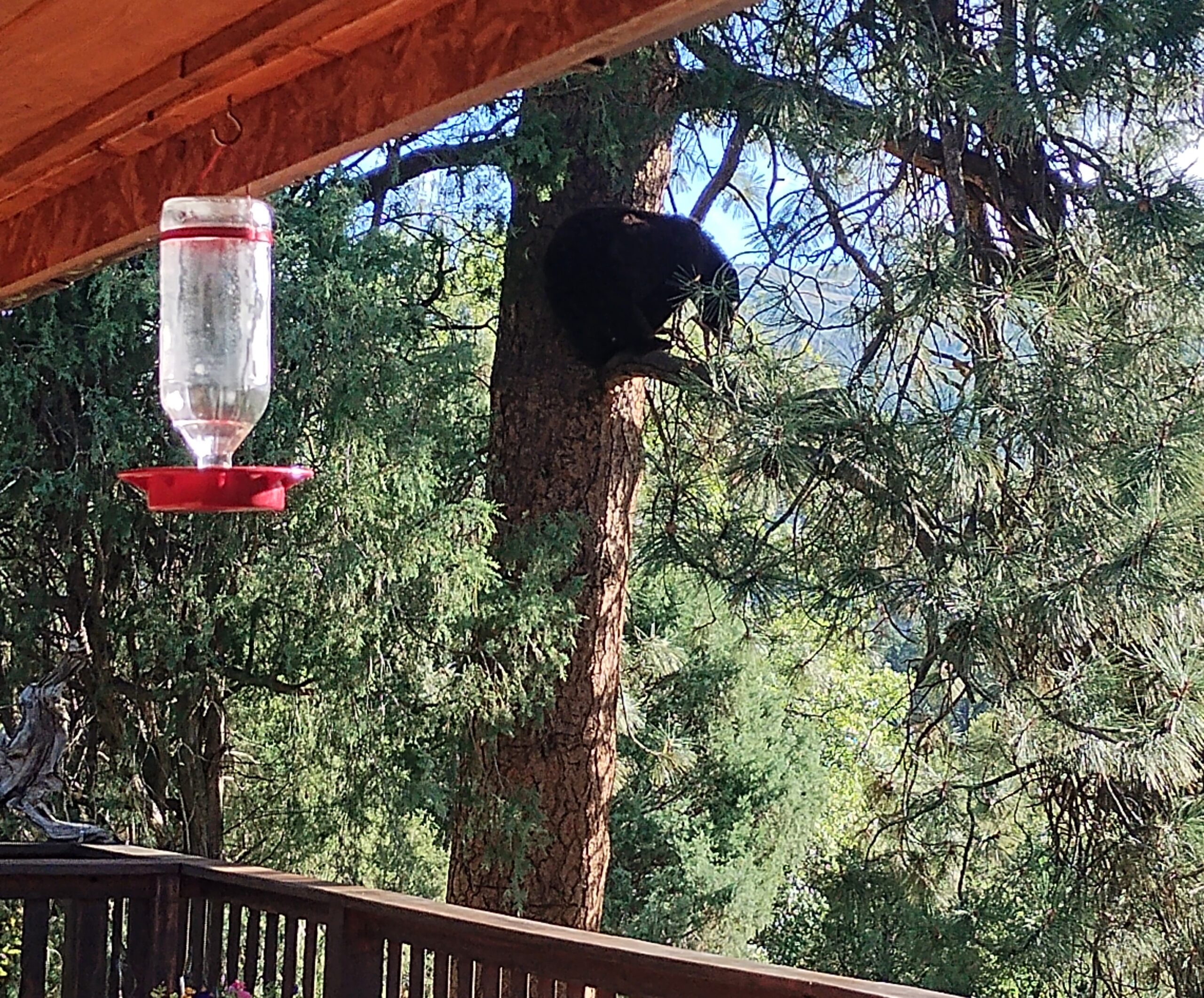
Under one of the tall pines, and among the many pine cones dotting the ground, was something dark and much larger: a bear.
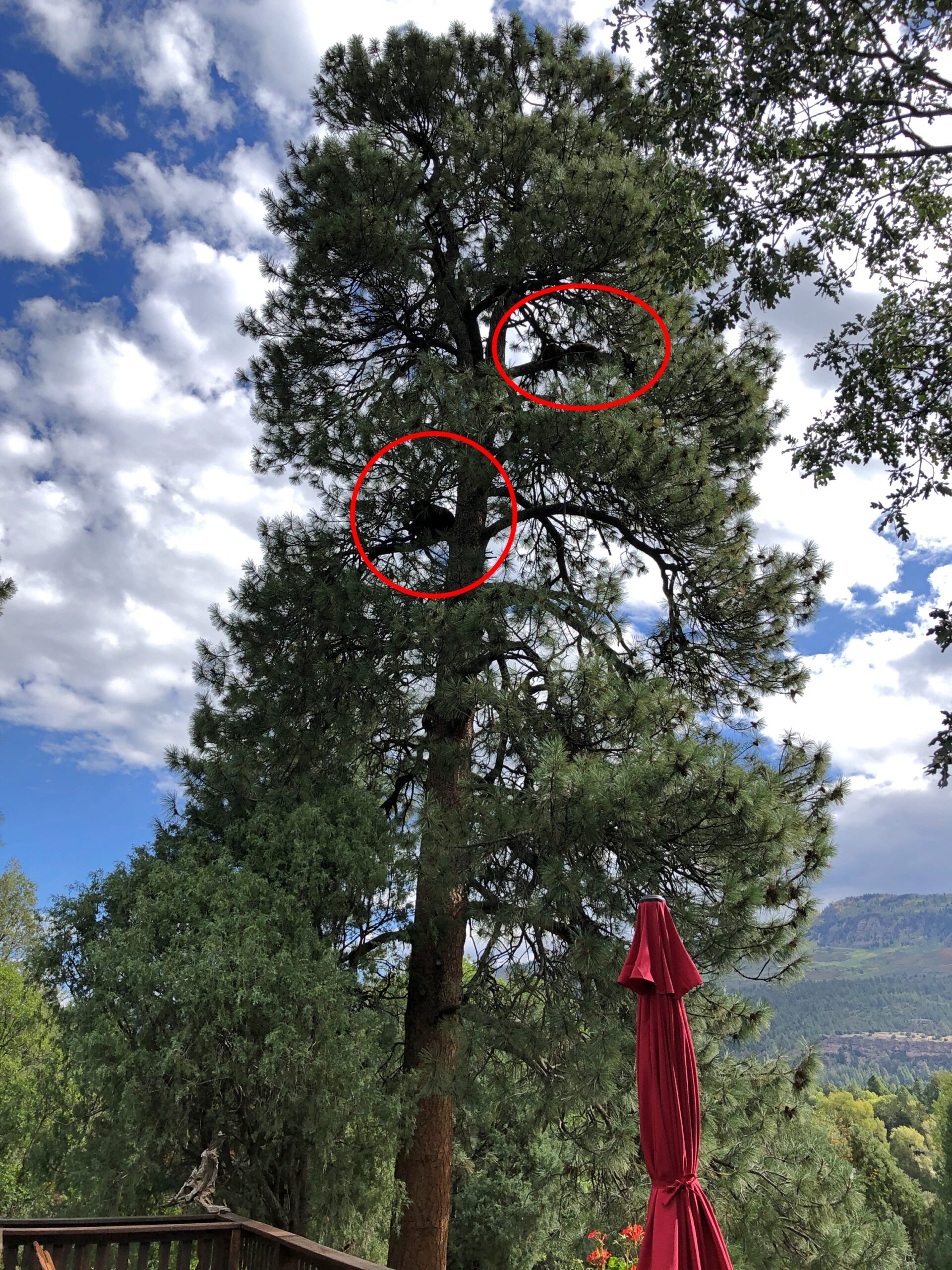
“He isn’t the only one,” Walter said, pointed upward. Another sizable bear was perched part way up the largest pine. I didn’t say anything, or maybe I did. Something along the lines of, How about that. When I spend time on my deck, squirrels are about as large as the animals get, except occasional rabbits and raccoons.
“Look way up,” Walter said.
Two more bears – smaller bears, though I wouldn’t want to be face-to-face even with them – clung to the branches toward the top of the tree. They were hard to see, and my photos barely show them, but they were there, not moving a bit.
Soon Yuriko, and some other guests, had come to the deck to see the bears and take pictures. Every few minutes while we watched, the largest of the bears, the one on the ground, would start shimmying up the tree. The bear in the tree snarled at his approach, and, after pausing for a few moments, the first bear returned to the ground.
We were about 10 miles north of Durango, where the human settlement is fairly thin, and bears known to prowl the mountains on either side of the single road, US 550.
In the two decades of so that Walter and his wife Jodi have owned the B&B, he said bears had been sighted. Of course they had. Get careless with closing an outdoor garbage receptacle and bears will make an appearance in the neighborhood. During dry spells, they come for the creek waters near the property, and Walter pointed out that this summer had been fairly dry in the region.
But this was a first, Walter said: probably a male bear out to do harm to some cubs, a female bear standing in his way — a bear drama playing out in the tree near the B&B.
Late that afternoon, we returned to the B&B. Papa Bear, as everyone was calling him now, still lingered under the tree. Mama Bear still watched him from the lower branches, and the cubs still clung to the upper branches. Papa Bear had mostly quit trying to climb the tree, Walter said, but he was still waiting around.
The bears stayed in place through that evening, but when I went to the breakfast table the next morning to examine the bagels and spreads and fruit and hot drinks, the bears – I checked from the deck – they were not to be seen. After their one-day show (from a human point of view), they’d taken their drama somewhere else,
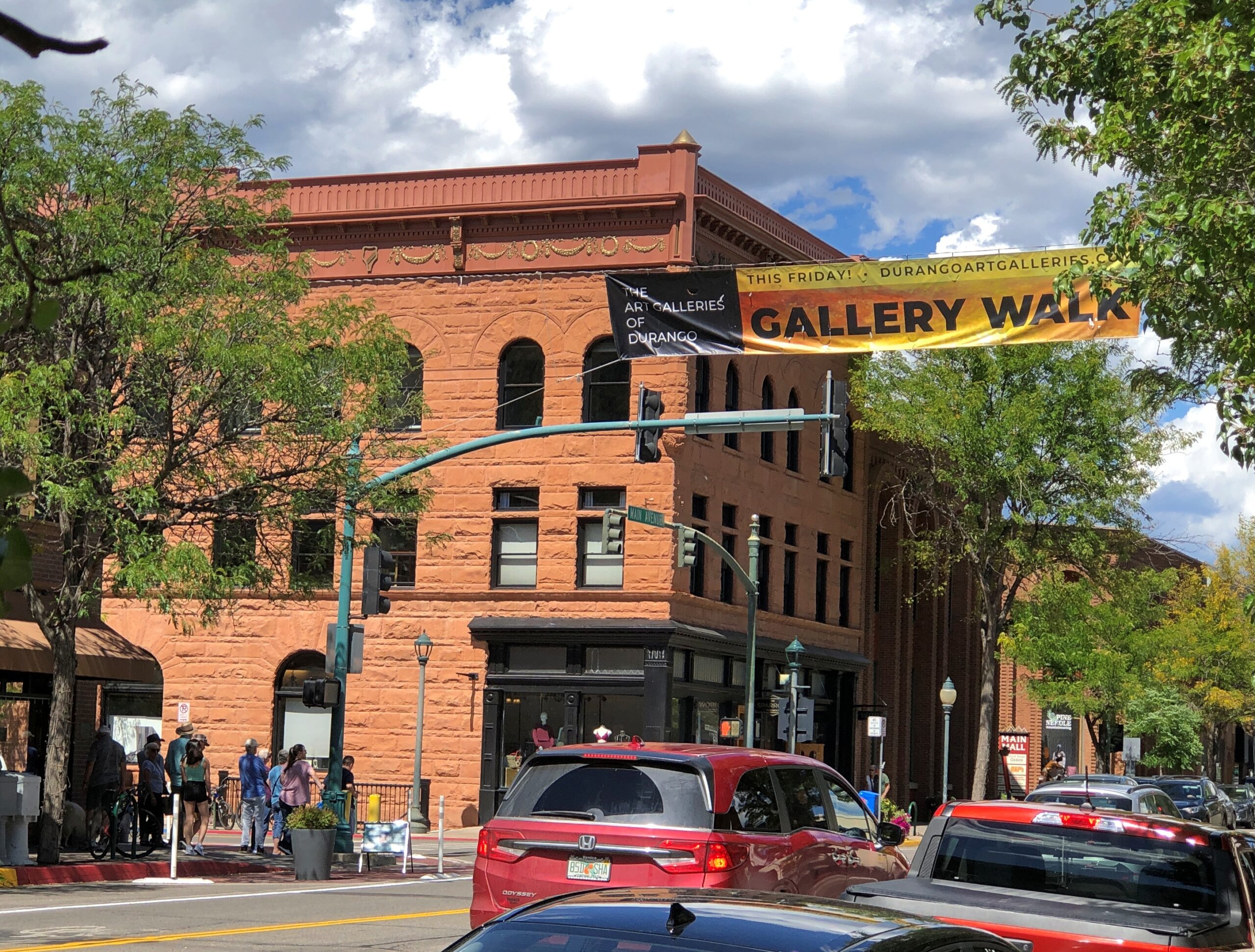
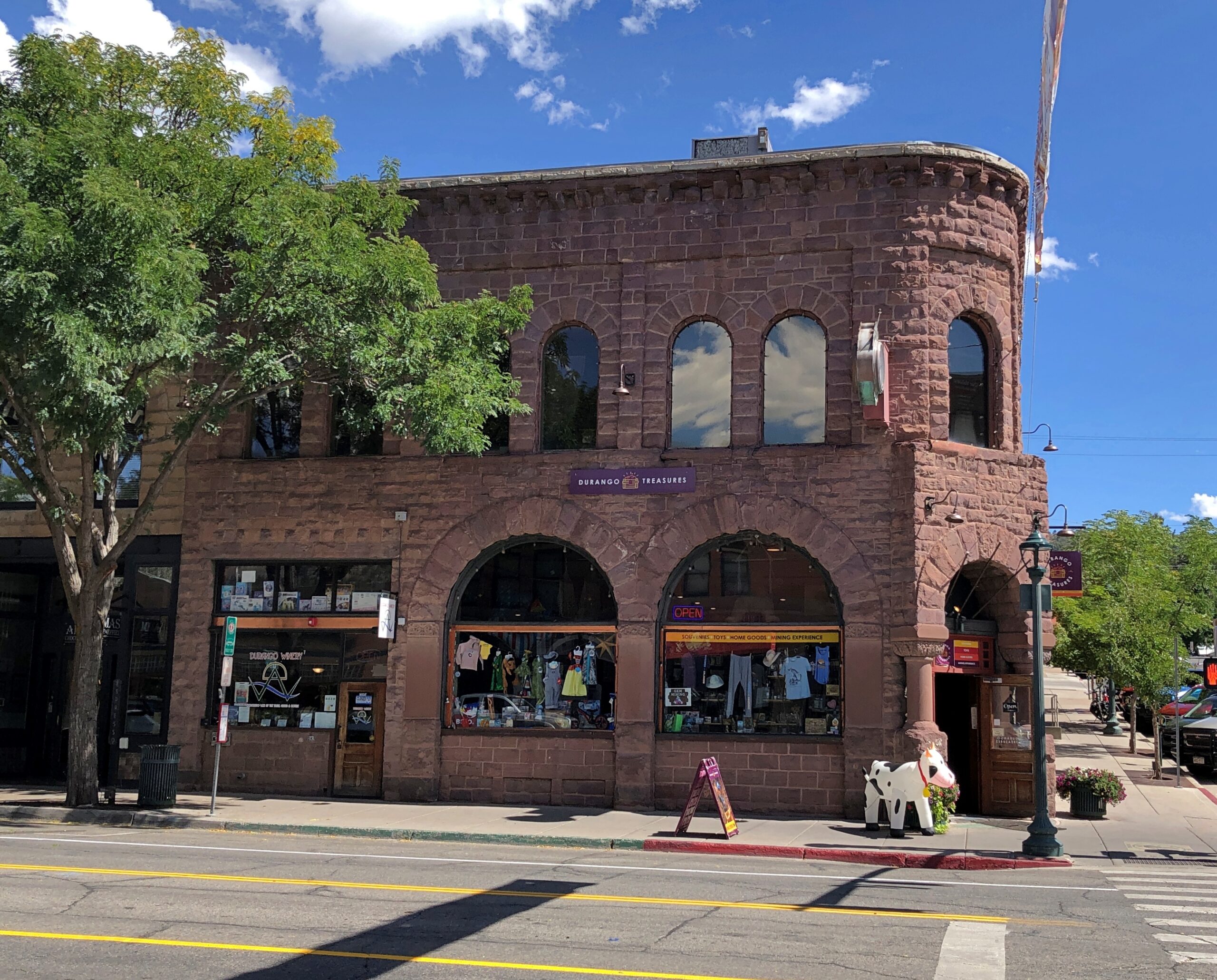
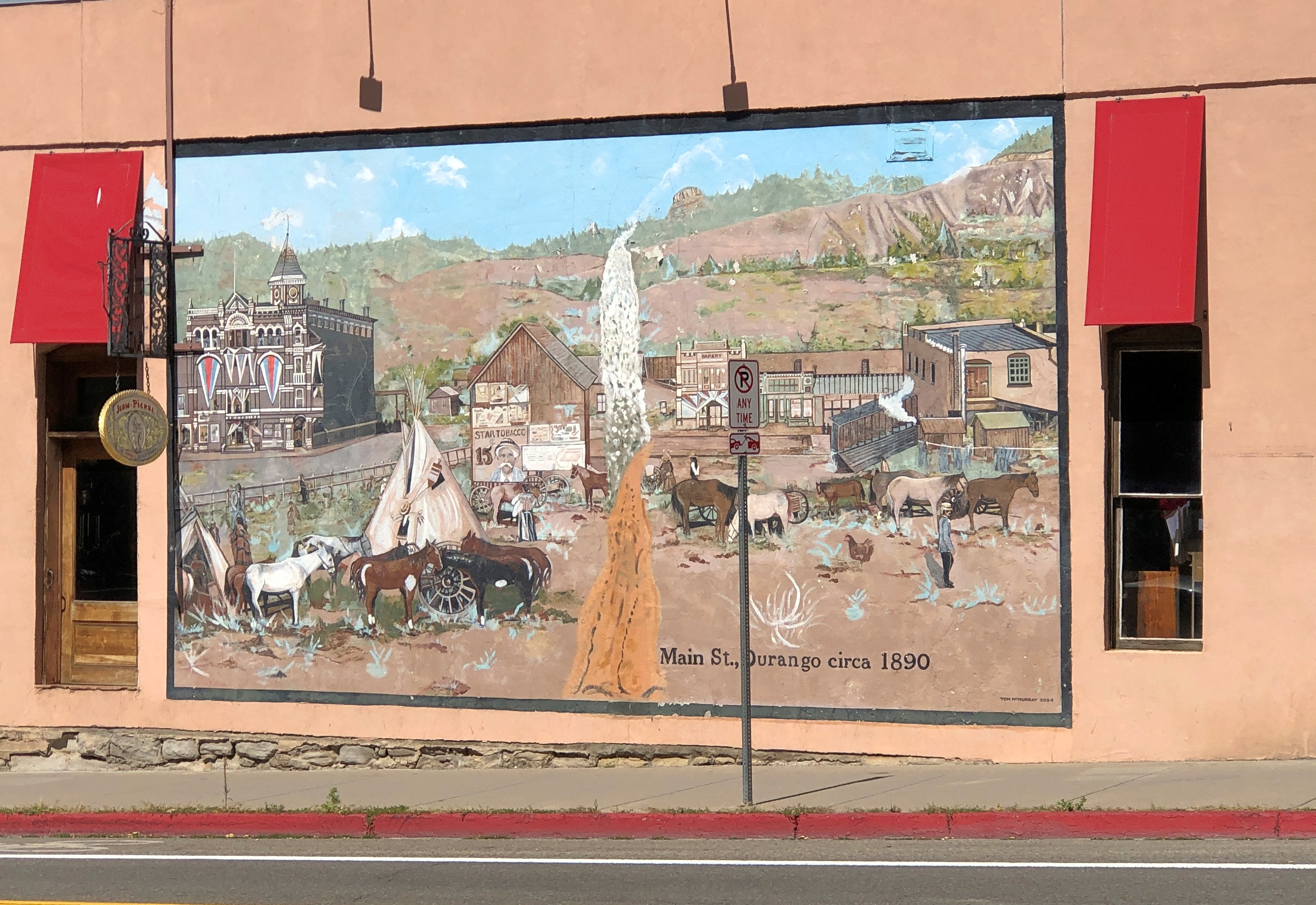
We spent that first day (September 16) wandering around town and nearby. In downtown Durango, small buildings that have endured for more than a century line Main Street.
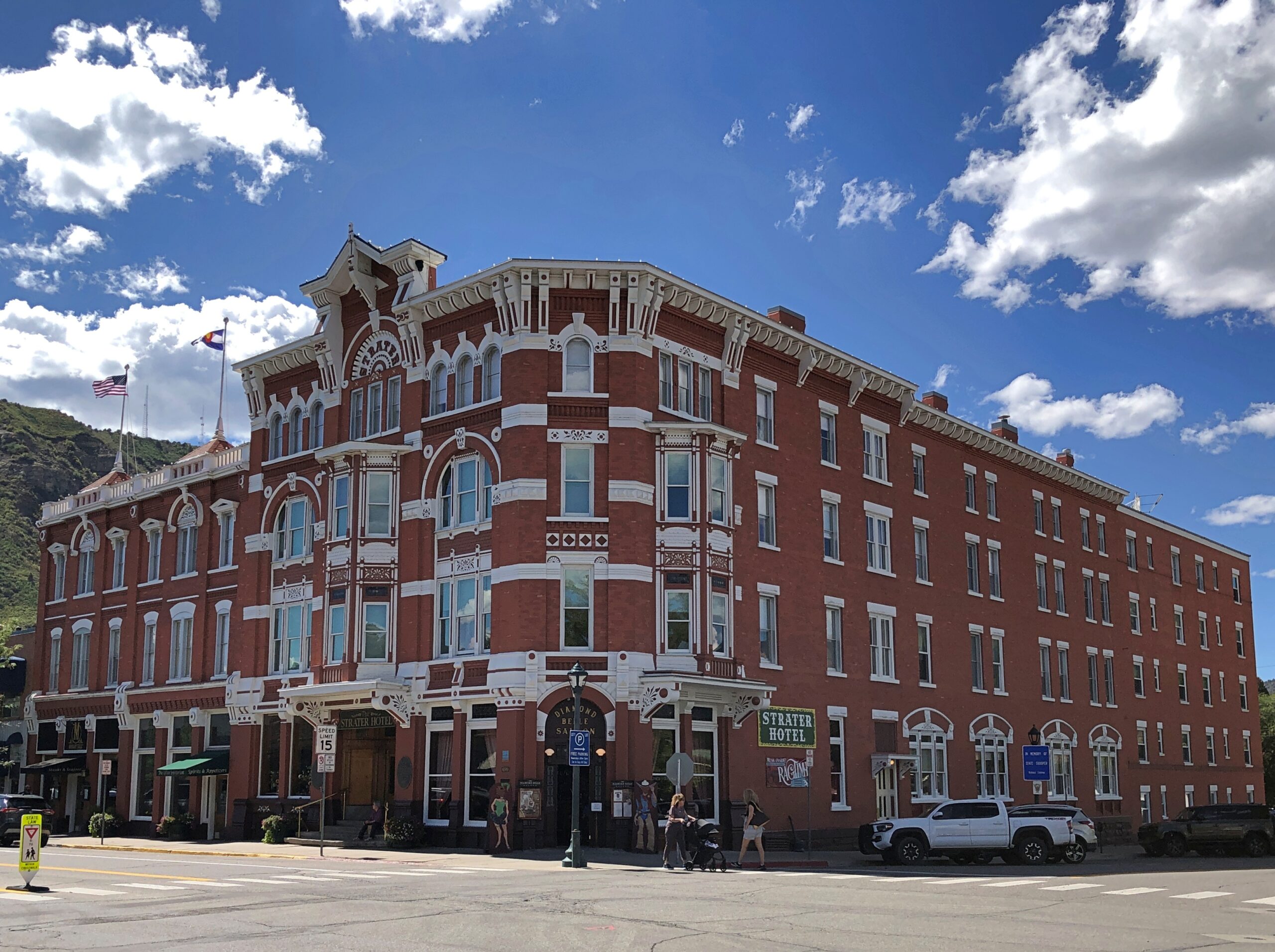
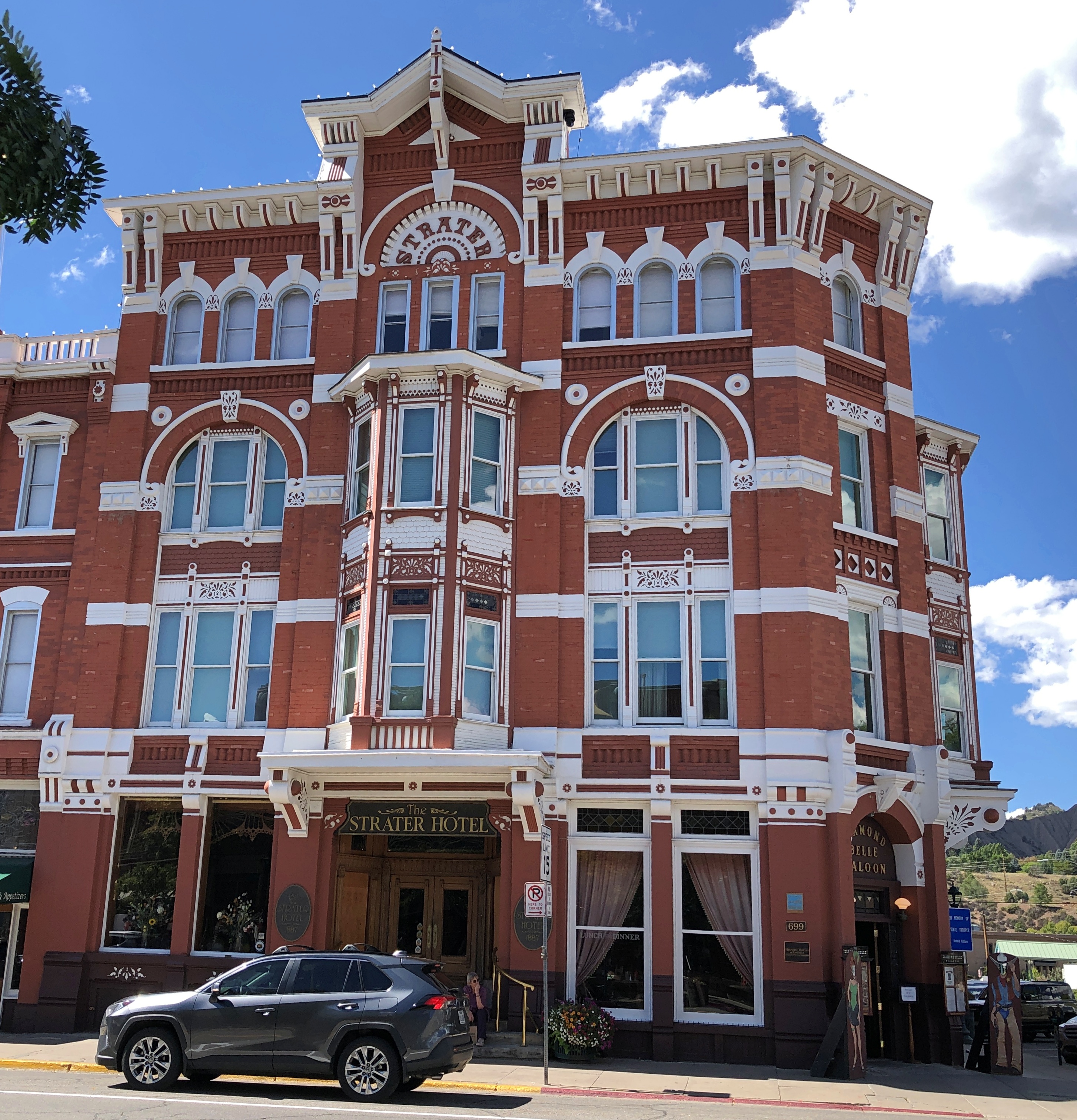
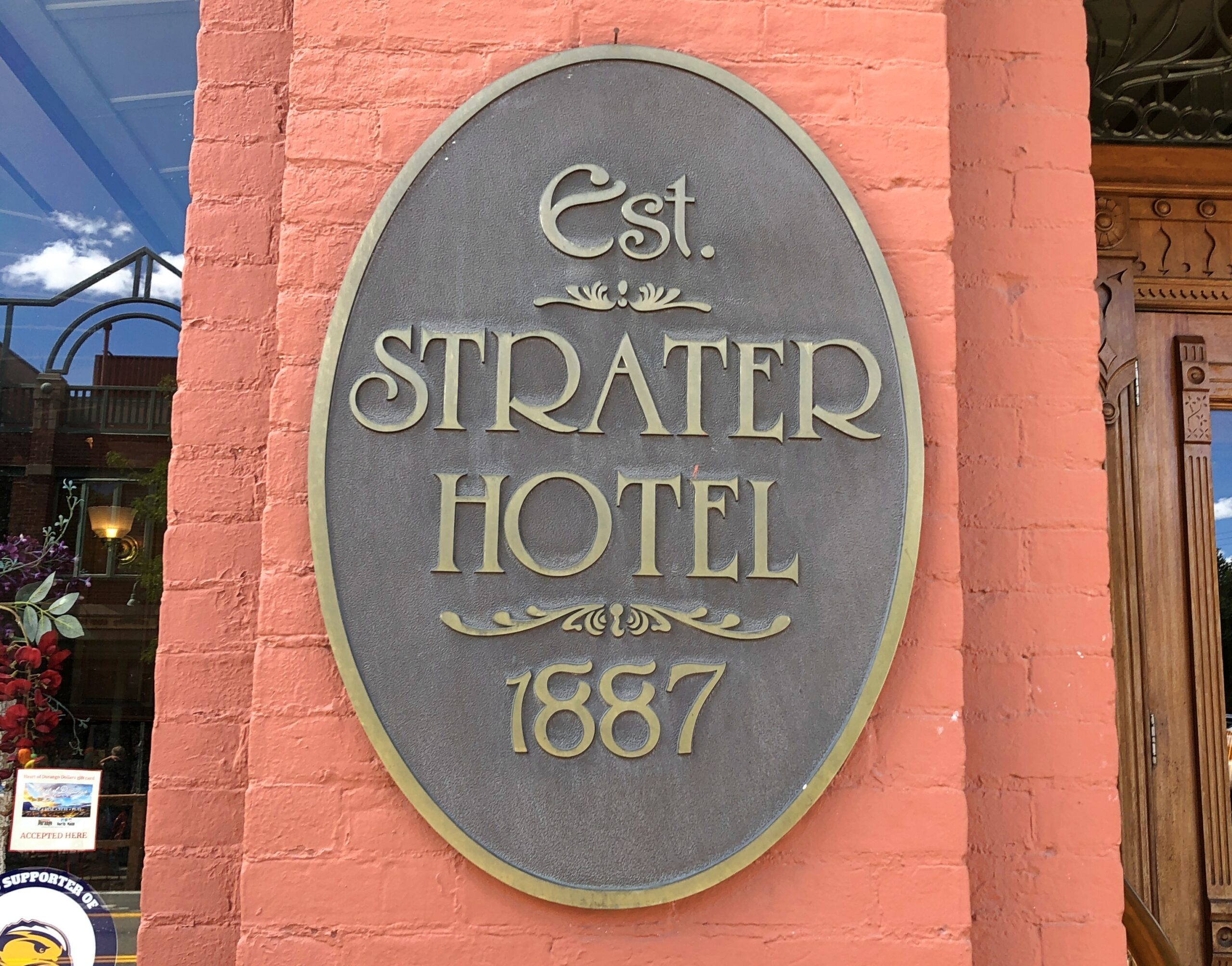
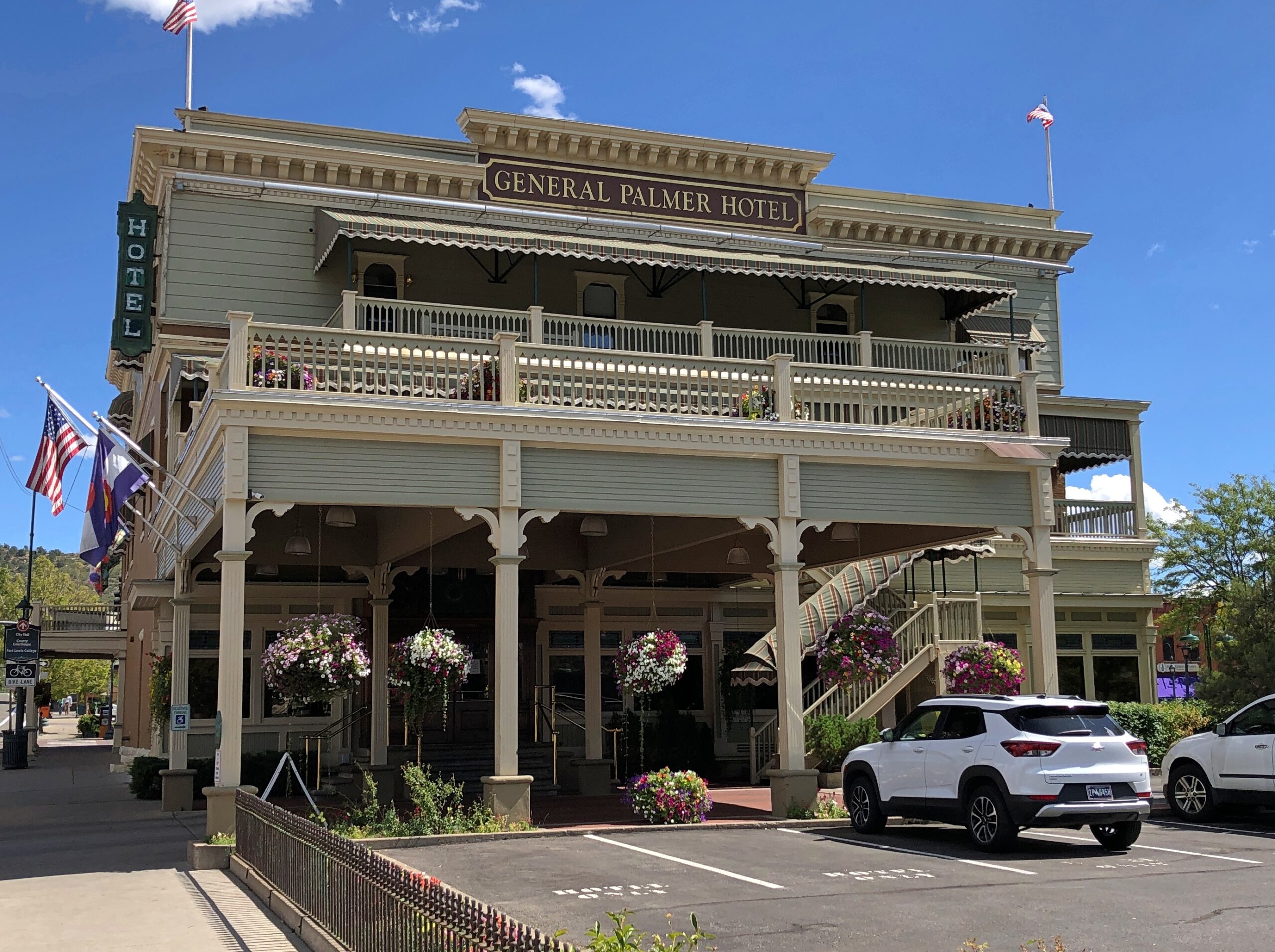
Or not so small. Such as the magnificent Strater Hotel, built in 1887.
The sort of place where presidents stay, or used to. Did any? The hotel web site doesn’t say. I’d ask ChatGPT, but it would probably tell me that FDR stayed there during his Grand Western States Whistle Stop Tour in 1939, a wholly fictional event. Wiki says Gerald Ford stayed there. Louis L’Amour did too, and now has a room named after him.
A competitor. Named for this fellow, Union (brevet) brigadier general and railroad man, who co-founded the Denver and Rio Grande RR.
Downtown Durango is well supplied with retail.
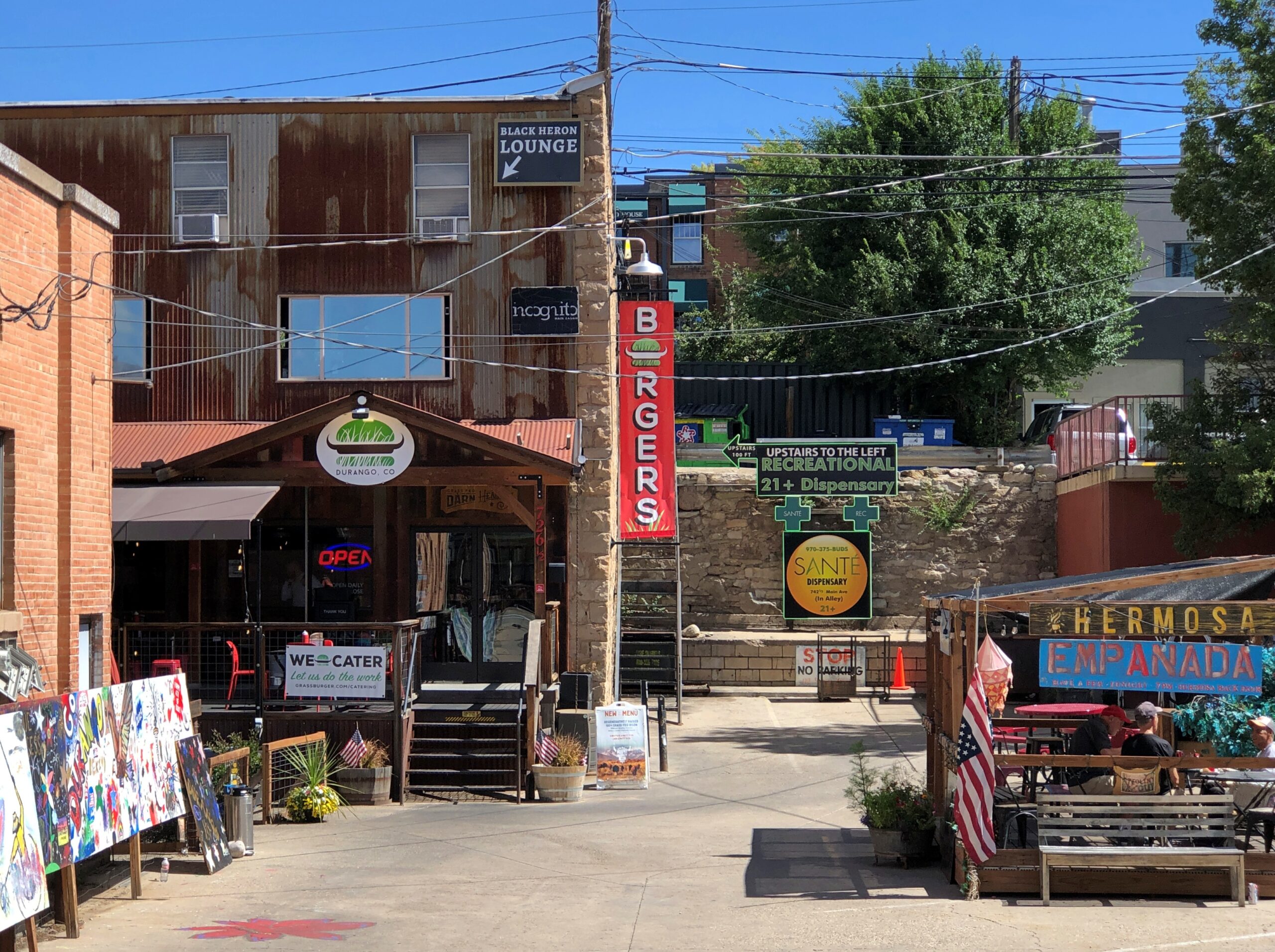
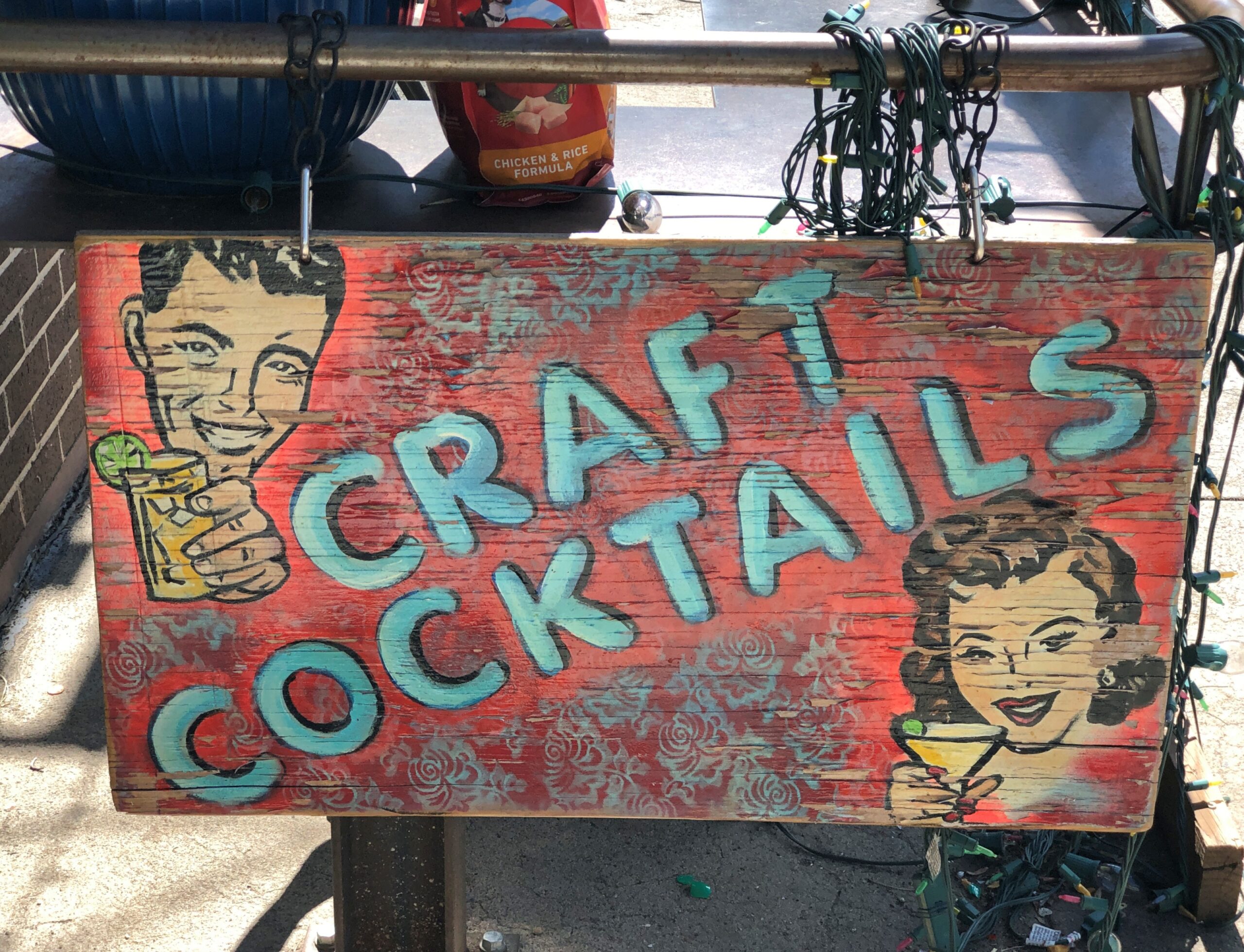
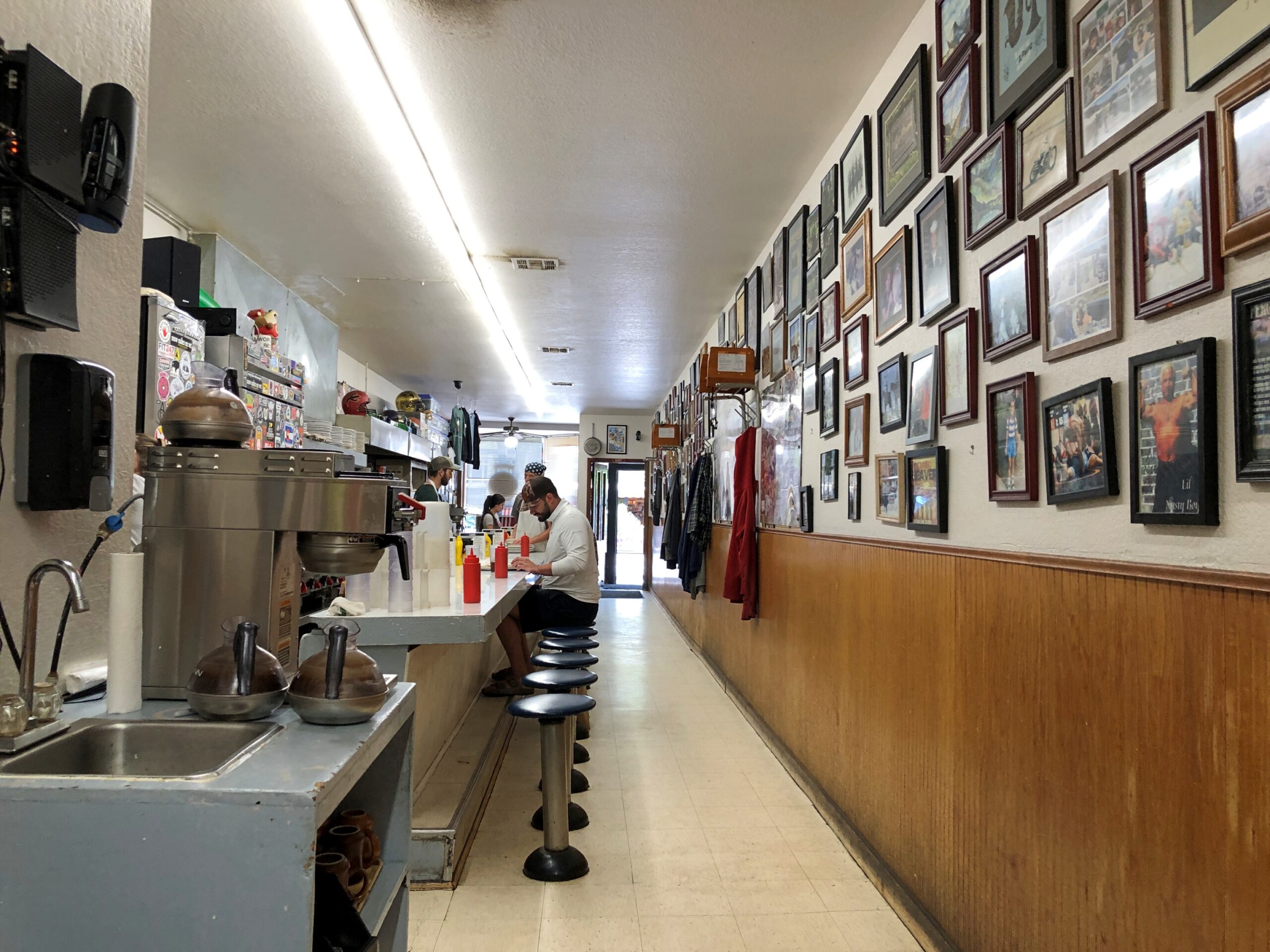
Lunch options, besides burgers and empanadas or a liquid lunch, included the likes of the Diamond Belle Saloon, Seasons of Durango, Chimayo Stone Fired Kitchen, Steamworks Brewing Company, and Eolus Bar & Dining. All very nice, I’m sure, but we chanced on something more to our tastes at that moment: the Durango Diner. In business for 60 years.
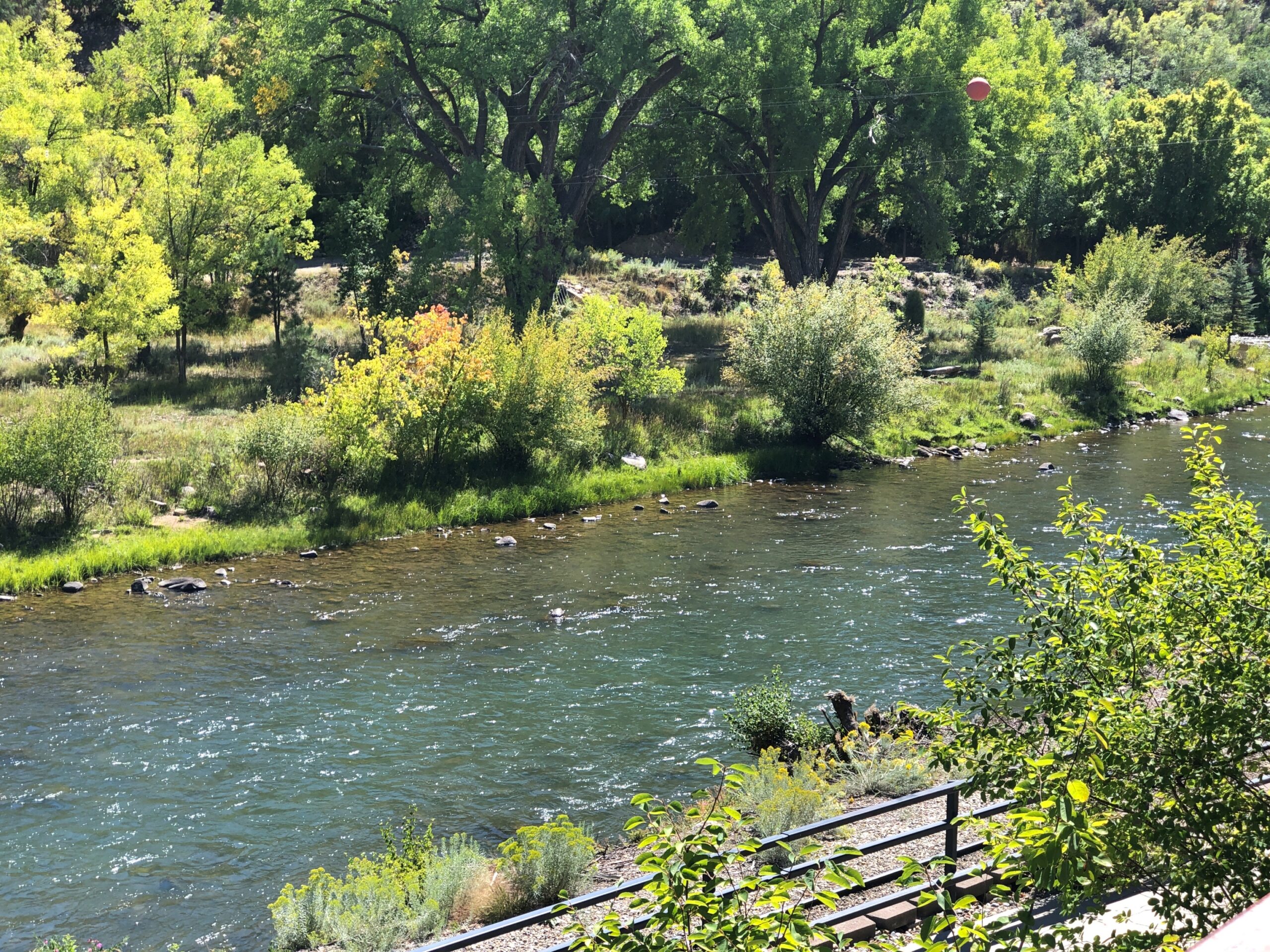
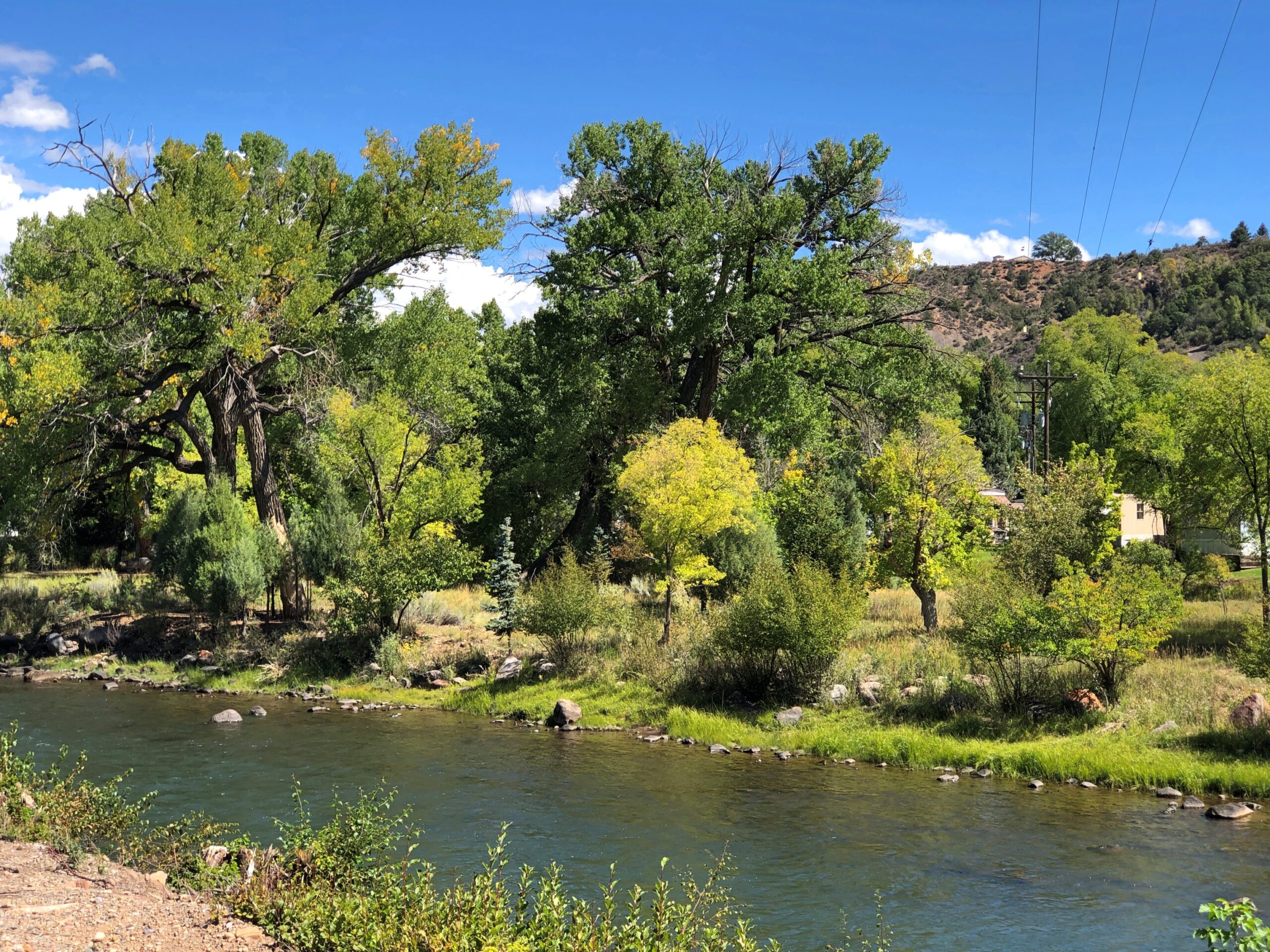
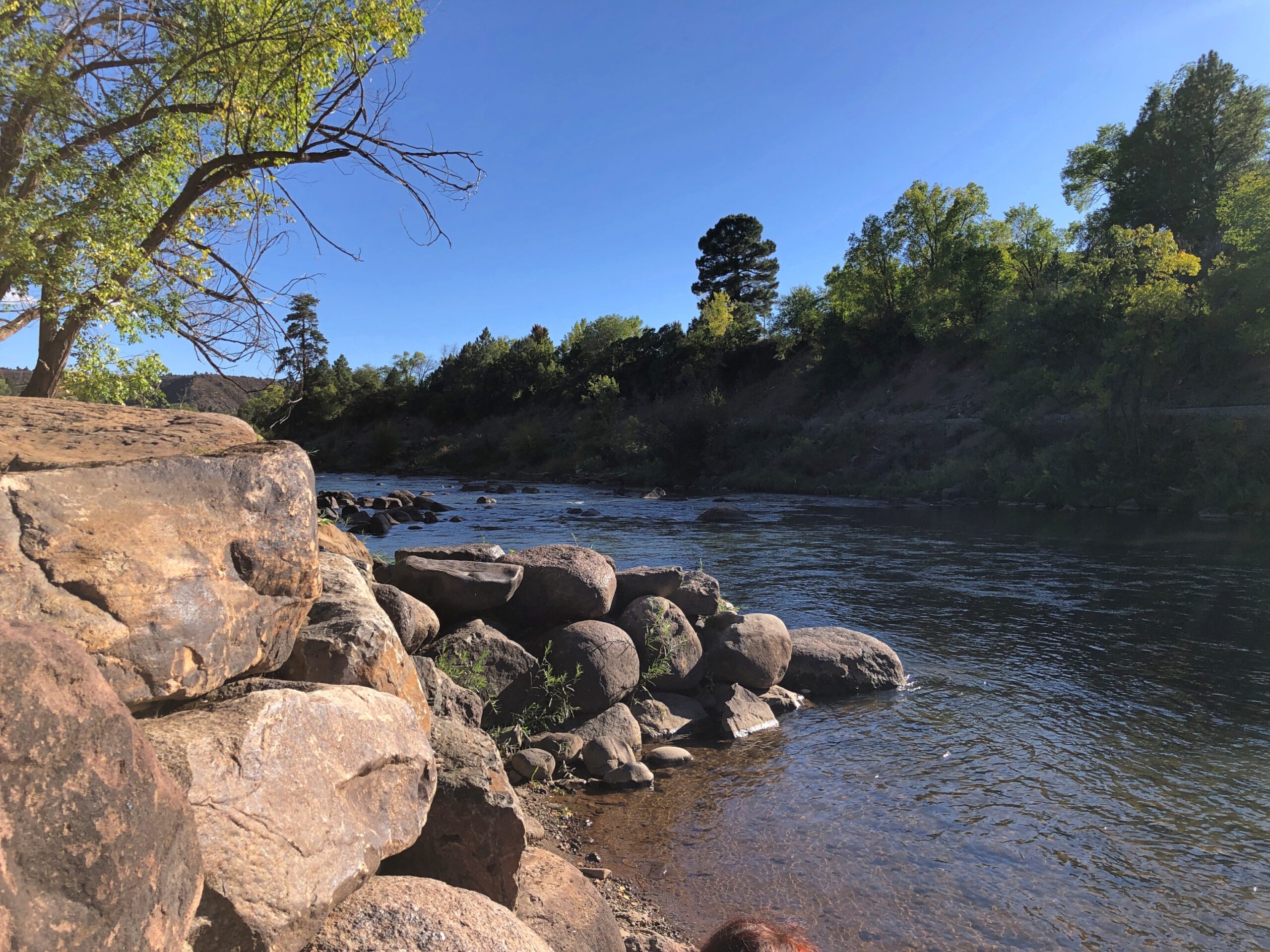
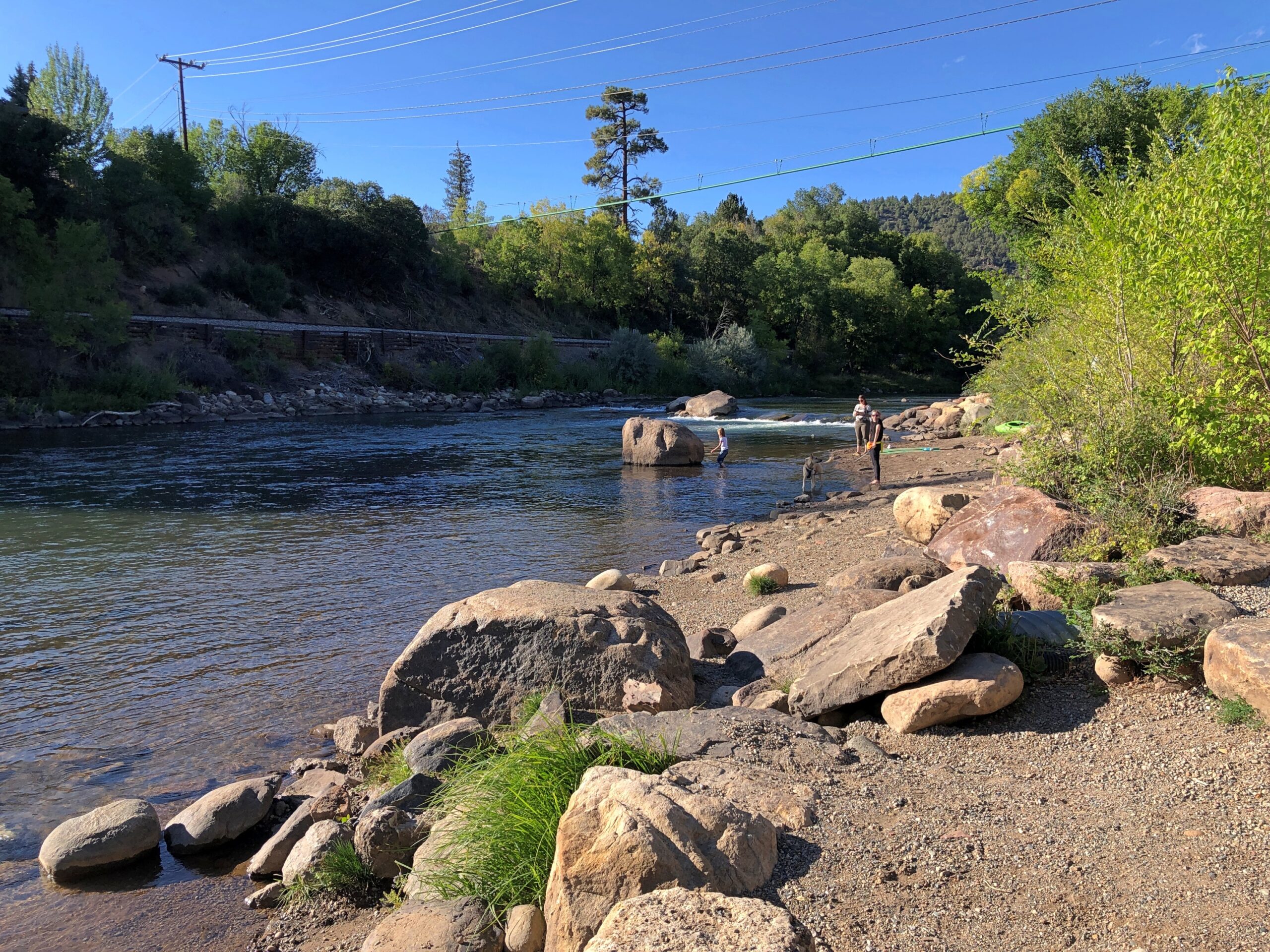
Durango started not so much as a mining town, but a railroad node that served the mines further up the line. Silverton, for instance. One reason Durango is where it is: the Animas River. These days, the river is accessible to pedestrians in a number of places in town. One was near the Durango Library, also the location of a shady sculpture garden.
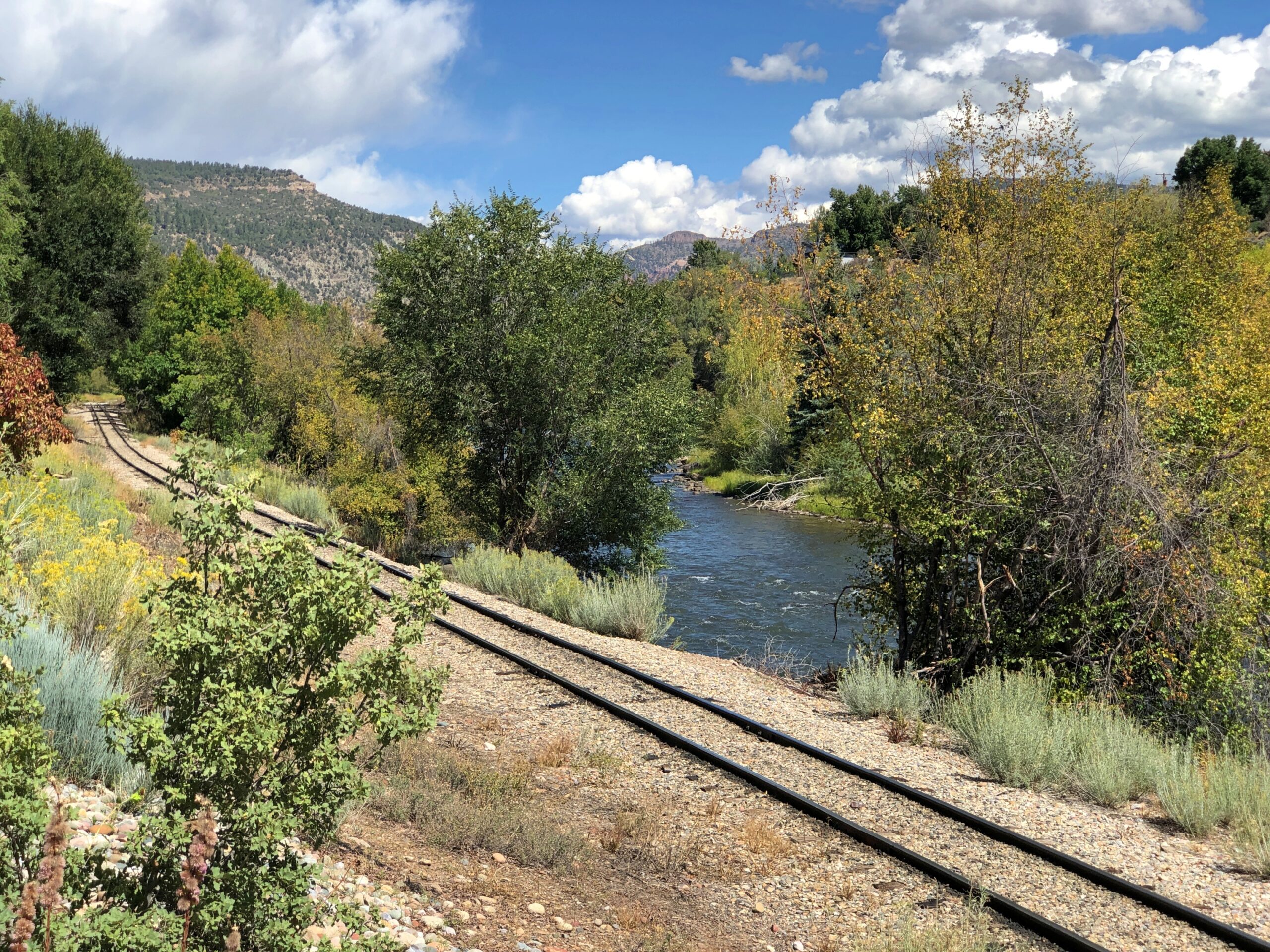
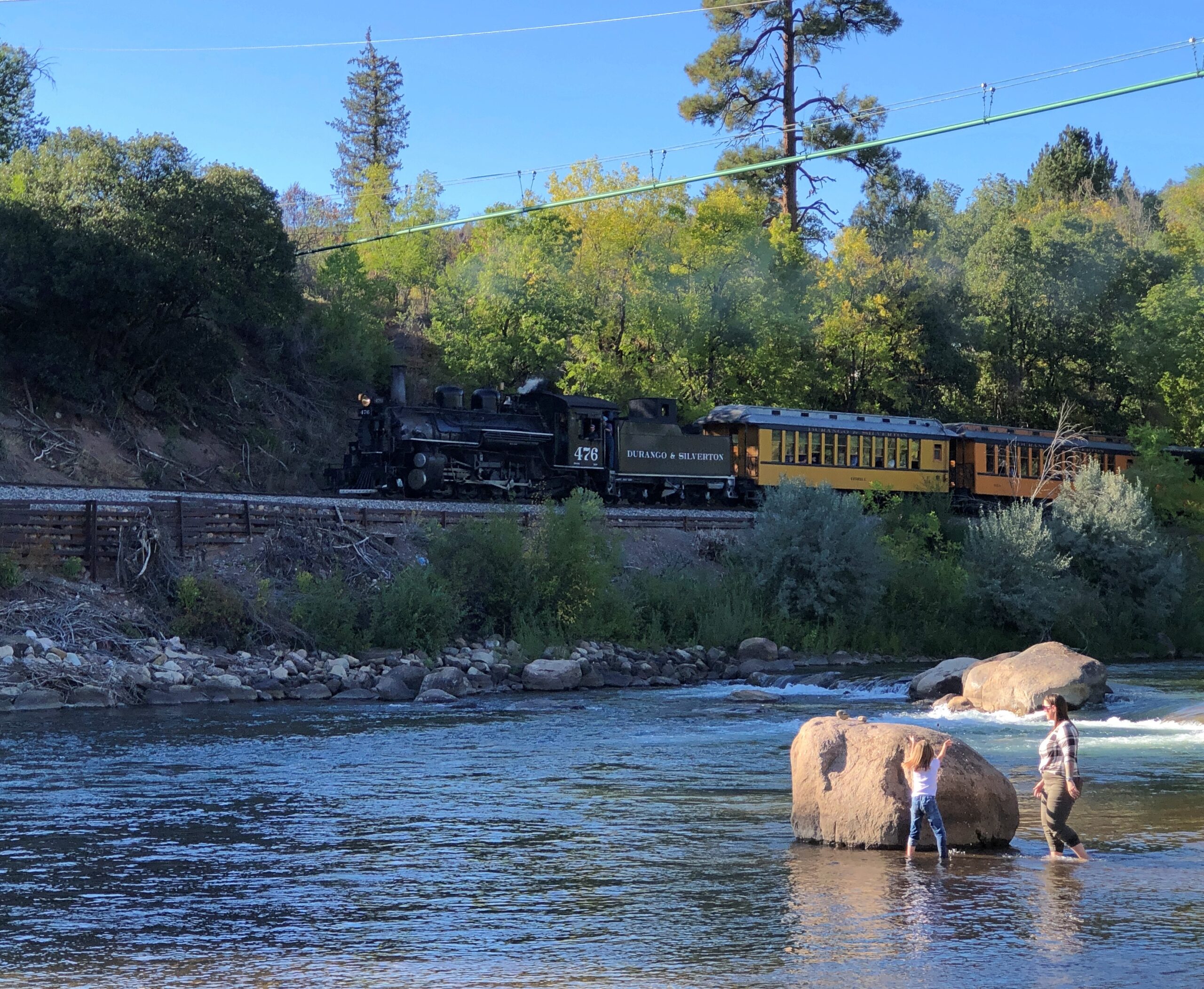
At this place, the tracks of the Durango & Silverton Narrow Gauge RR run along the river.
That was also true at the 29th Street Park, though the tracks were on the other side of the river.
North America is vast and contains multitudes. There’s no doubt about it. How else to account for Crestone, Colorado?
Spiritual Travels tells the tale:At 7,500 feet in elevation and ringed on three sides by mountains, Crestone is both beautiful and isolated, subject to extremes of weather, wind, and temperature. It includes an amazing array of spiritual sites: more than two dozen ashrams, monasteries, temples, retreat centers, stupas, labyrinths, and other sacred landmarks. There’s even a ziggurat, a structure modeled on the temples of ancient Babylon.
Beautiful yes, but not so isolated these days: we drove in via two-lane, high-quality paved roads, Including, on the highway Colorado 17, past the UFO Watchtower, regrettably closed at that moment. I’d pay five bucks a head to take a look at that.
Crestone began as a mining town, as so many others did in Colorado. After the mines played out by the early 20th century, the area around the town was given over to ranching. That seems reasonable, considering its location in the sprawling San Luis Valley, though the town itself is hard up against the Sangre de Cristo Mountains.
Spiritual Travels continues: Maurice Strong, a Canadian businessman and United Nations diplomat, and his wife, Hanne Marstrand Strong, purchased a large tract of land in the Crestone area [in the 1970s]. It had been subdivided for use as a retirement community, but the Strongs changed their plans for it after a wandering mystic told them that the land had unique spiritual qualities (a message echoed later by Native American elders).
So the Strongs decided to give free land to religious groups that agreed to establish centers there.
Awandering mystic told them? That’s an incident that could use a little more elaboration. Visiting Mormons and Jehovah’s Witnesses and even a weirdly masked devotee of Dahn Yoga have all come to my door, but I’ve yet to have any wandering mystics show up, at least along the lines of a sadhu or a strannik or a sufi. That I know of. Maybe one of those home repair outfits who are “doing work in your neighborhood” are really mystics, offering soul remodels.
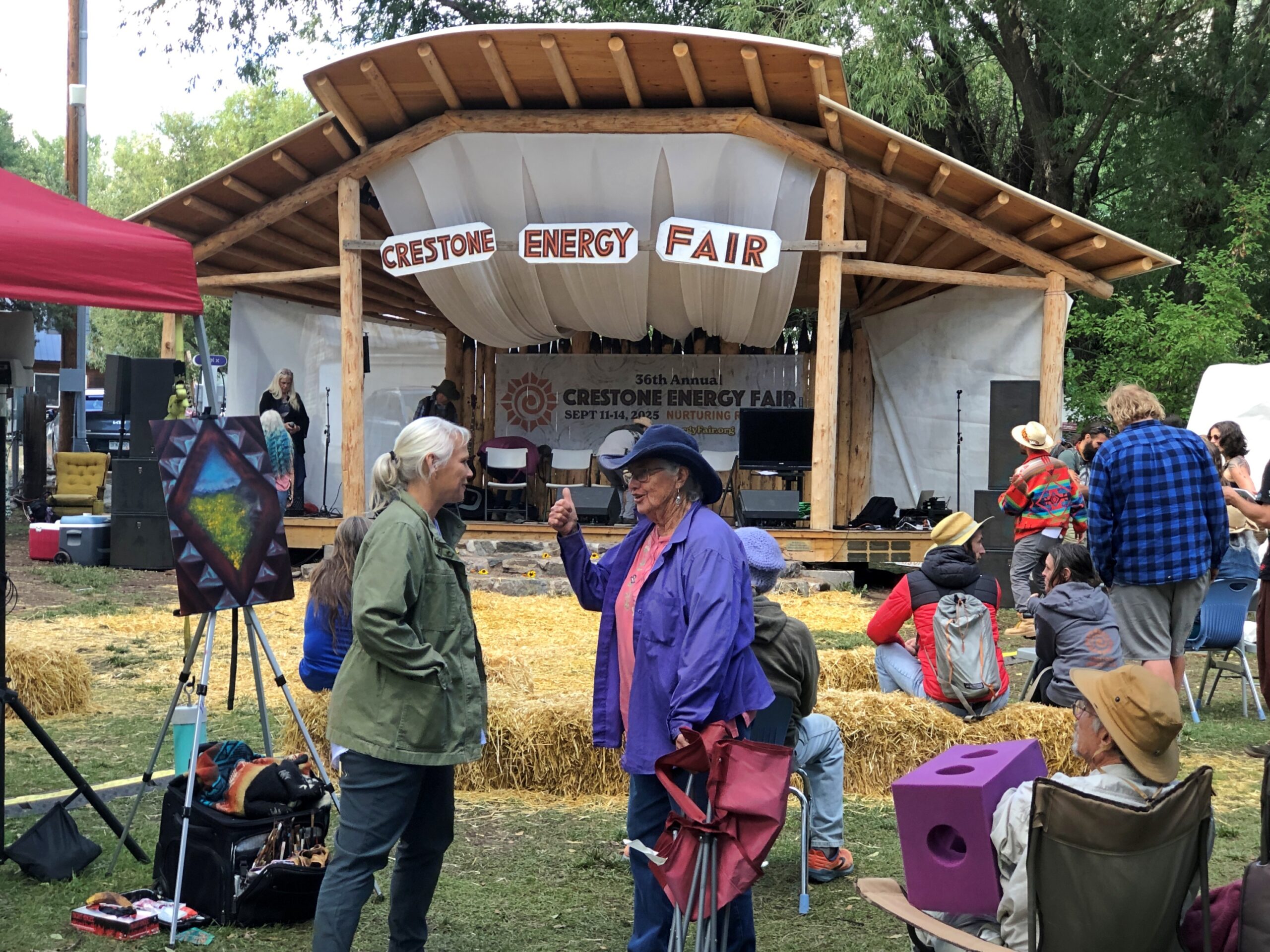
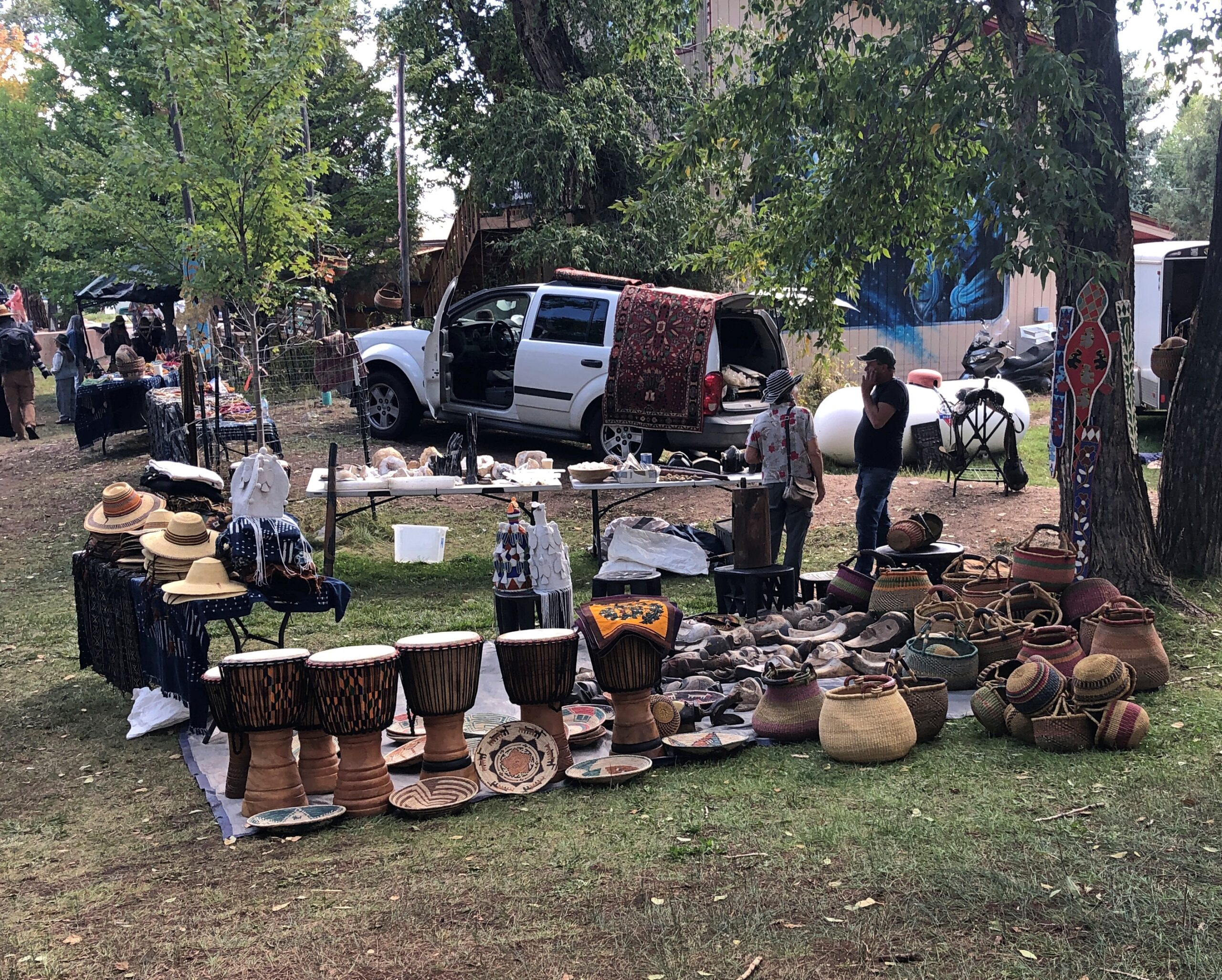
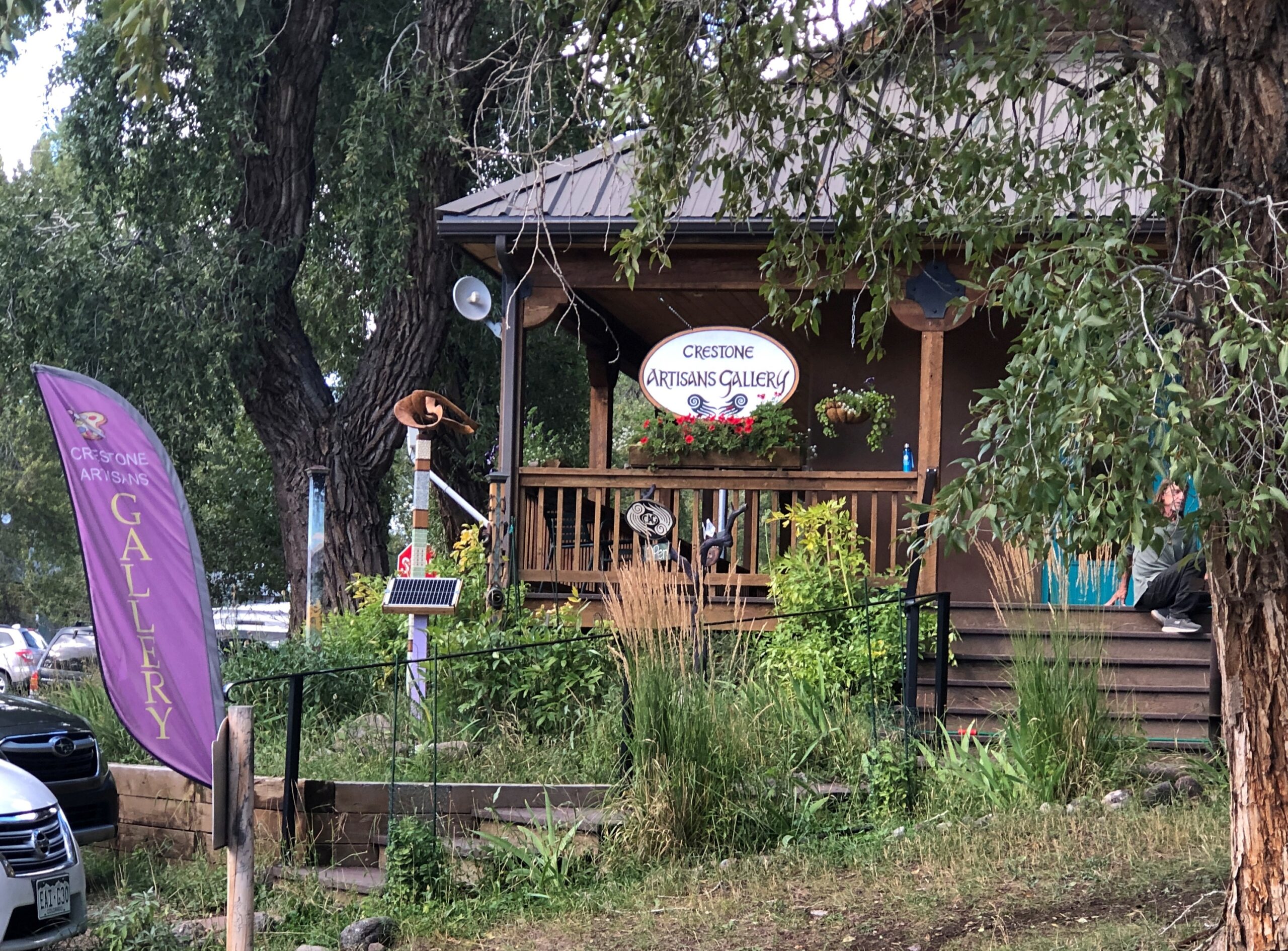
We arrived in Crestone on September 14 after our visit to Great Sand Dunes NP. Mystical insight is one thing, but we were looking for a late lunch. The town itself isn’t large, with a permanent population of 140 or so, but I’m sure it expands and contracts. Such as during events like the Crestone Energy Fair. We added ourselves temporarily to the population during the tail end of that event on that Sunday afternoon.
We bought a few things at the town’s grocery store, Elephant Cloud Market – small and aiming at what Whole Foods might have been in its earliest days – and I asked the checkout clerk about the Energy Fair. As in renewable energy?
He looked a little puzzled for a moment. “Sure. But it’s more about psychic energy.”
So, wind turbines of the soul, geothermal from the heart. But I’d guess mindful yet small modular reactors wouldn’t be part of the discussion. I didn’t say that any of that, of course. I just said, “Oh.”
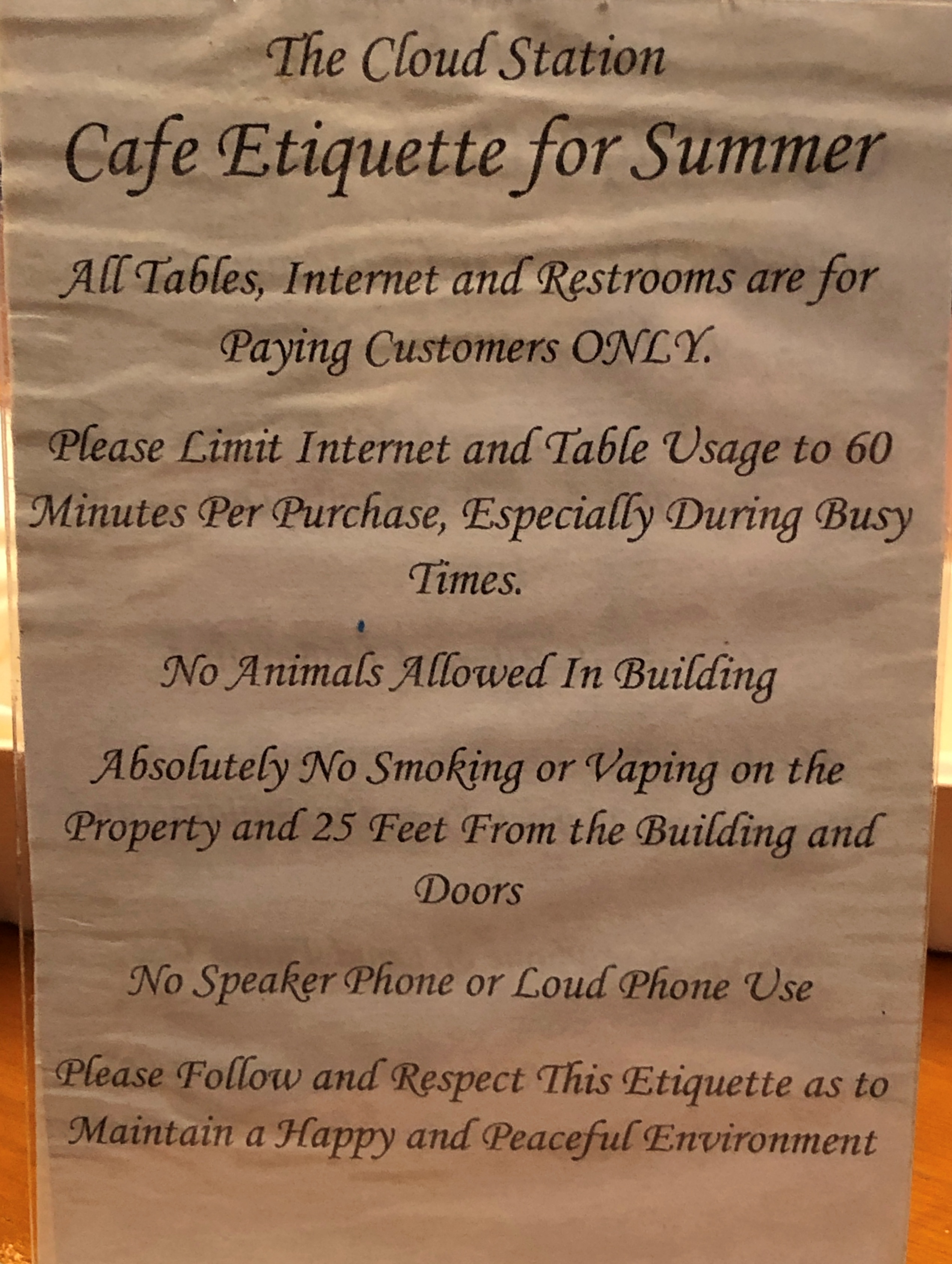
Next to the grocery store was a small eatery, the Cloud Station. We’d arrived just in time to order before closing: a couple of most delicious panini. While waiting for the order, I had time to study the rules.
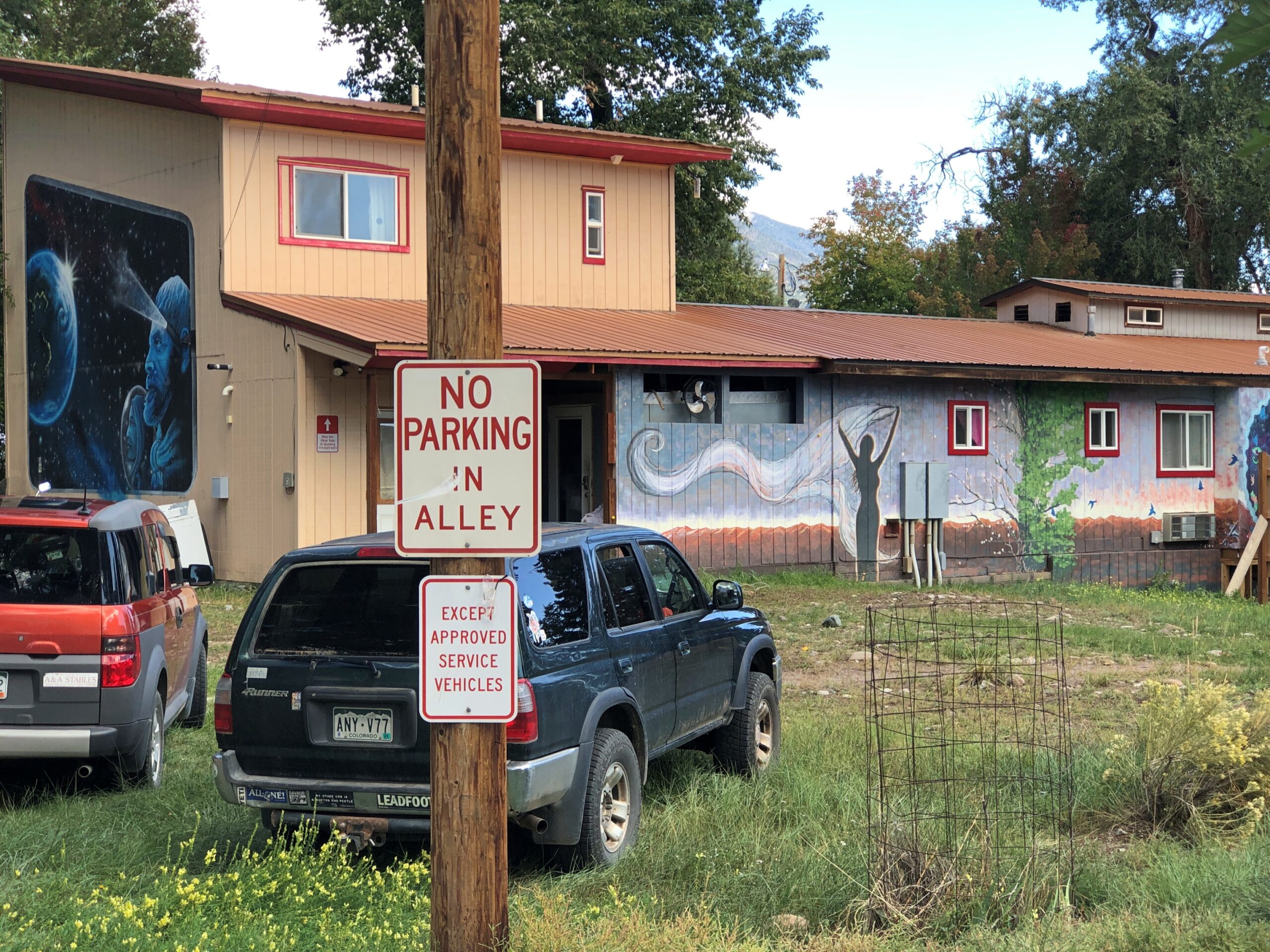
Afterward, we spent time looking around the few streets of Crestone.
You never know what you’ll see. Enough reason to come.
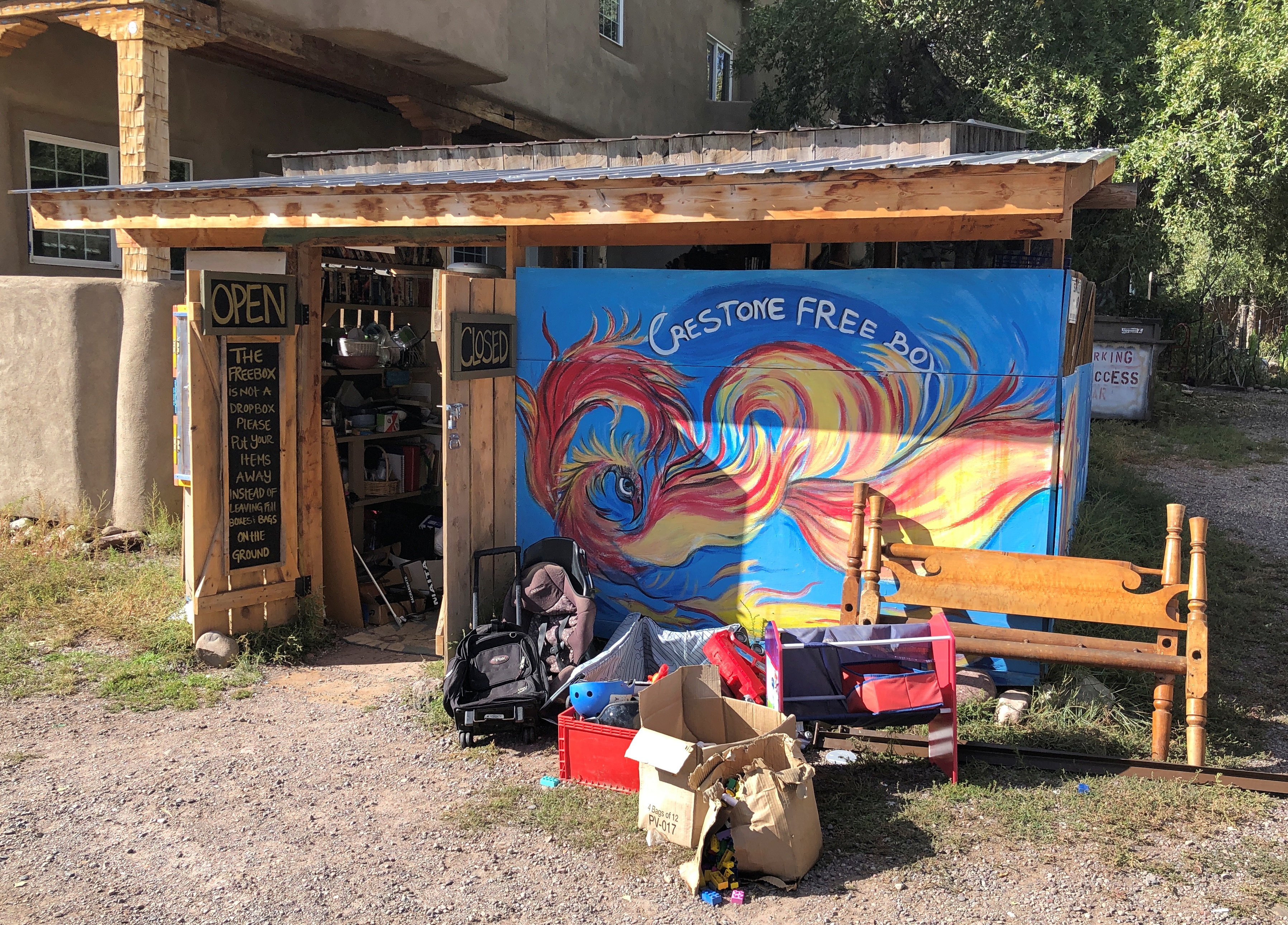
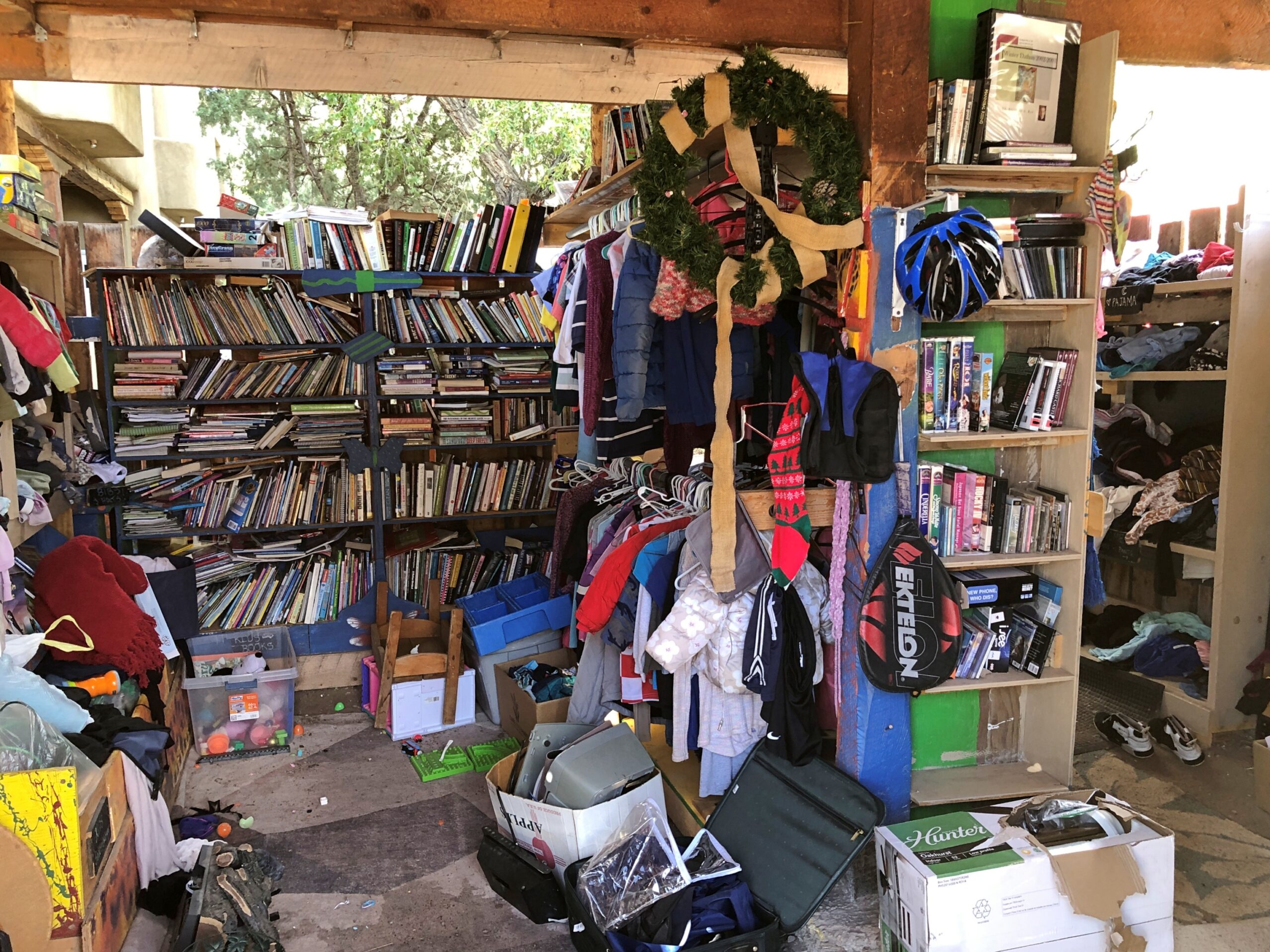
Something not mentioned in the tourist literature: the Crestone Free Box. Leave stuff, pick up stuff, no medium of exchange involved.
I’d argue that in the widest interpretation of spirituality, and Crestone is pretty wide in that regard, the Crestone Free Box counts as a spiritual site. It is, after all, about freely giving of yourself to the wider world. Squint hard enough, and that fits.
As for the other spiritual sites, except for a handful of mainline Christian churches, most of them are not in the town of Crestone proper. Rather, the land grants inspired by that wandering mystic sprawl to the south of the town’s small street grid, along a warren-like network of roads up and down the foothills of the Sangre de Cristo Range – mostly gravel roads, if our limited experience is any guide.
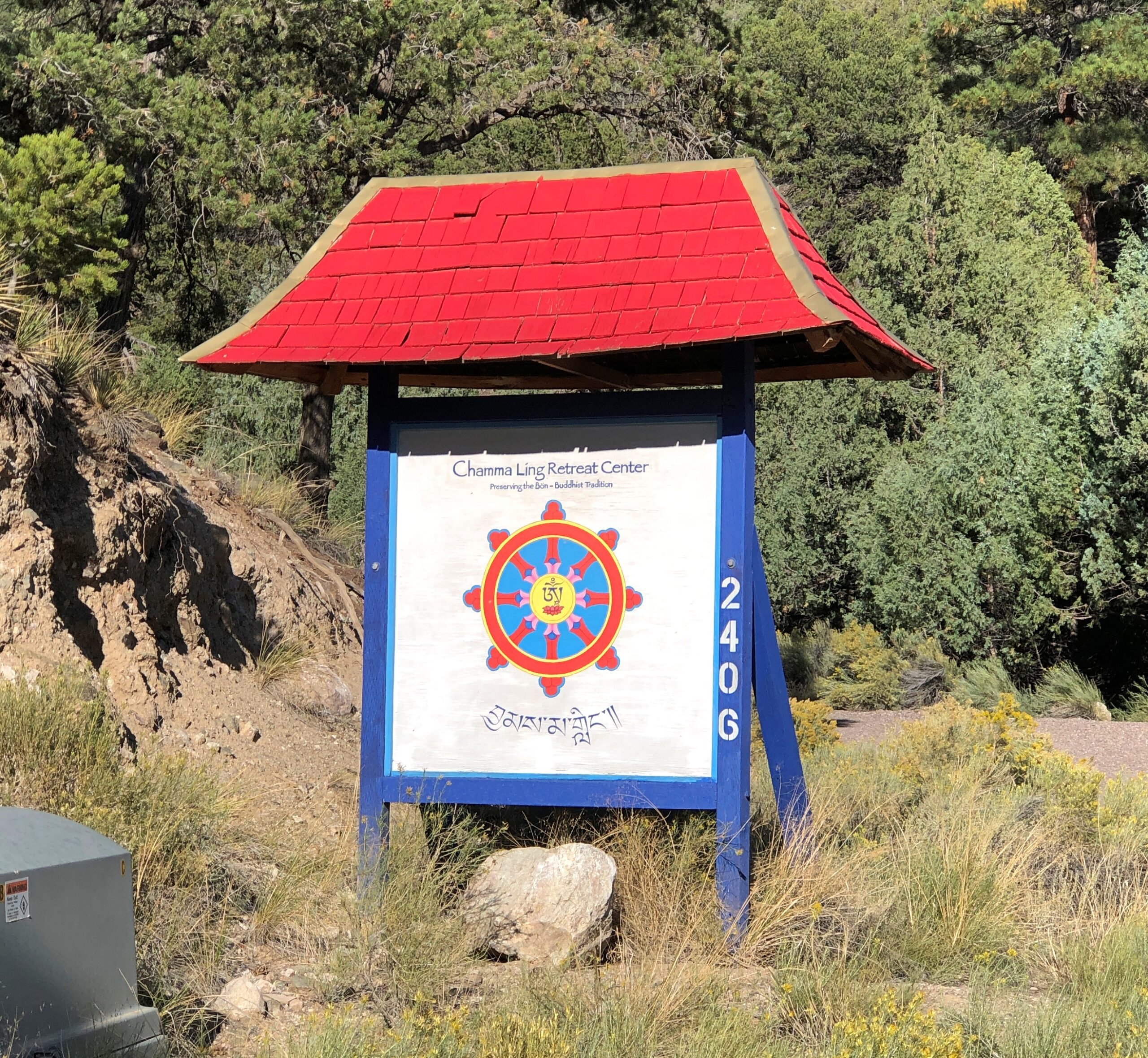
I had the idea that exurban Crestone was dotted with temples and shrines and other such places. But as we drove along, and especially as I studied the map, I came the realize that most of the establishments are retreats, such as Blazing Mountain Retreat Center, Chamma Ling, Crestone Mountain Zen Center, Crestone Retreat Center, Dharma Sangha, Dharma Ocean, Haidakhandi Universal Ashram, Shumei International Institute, Sri Aurobindo Learning Center, Vajra Vidya Retreat Center and Yeshe Khorlo USA. The sort of place that might briefly tolerate, but not really appreciate, casual visitors. More importantly for me, not the kind of religious – I mean, spiritual – sites that I tend to seek out.
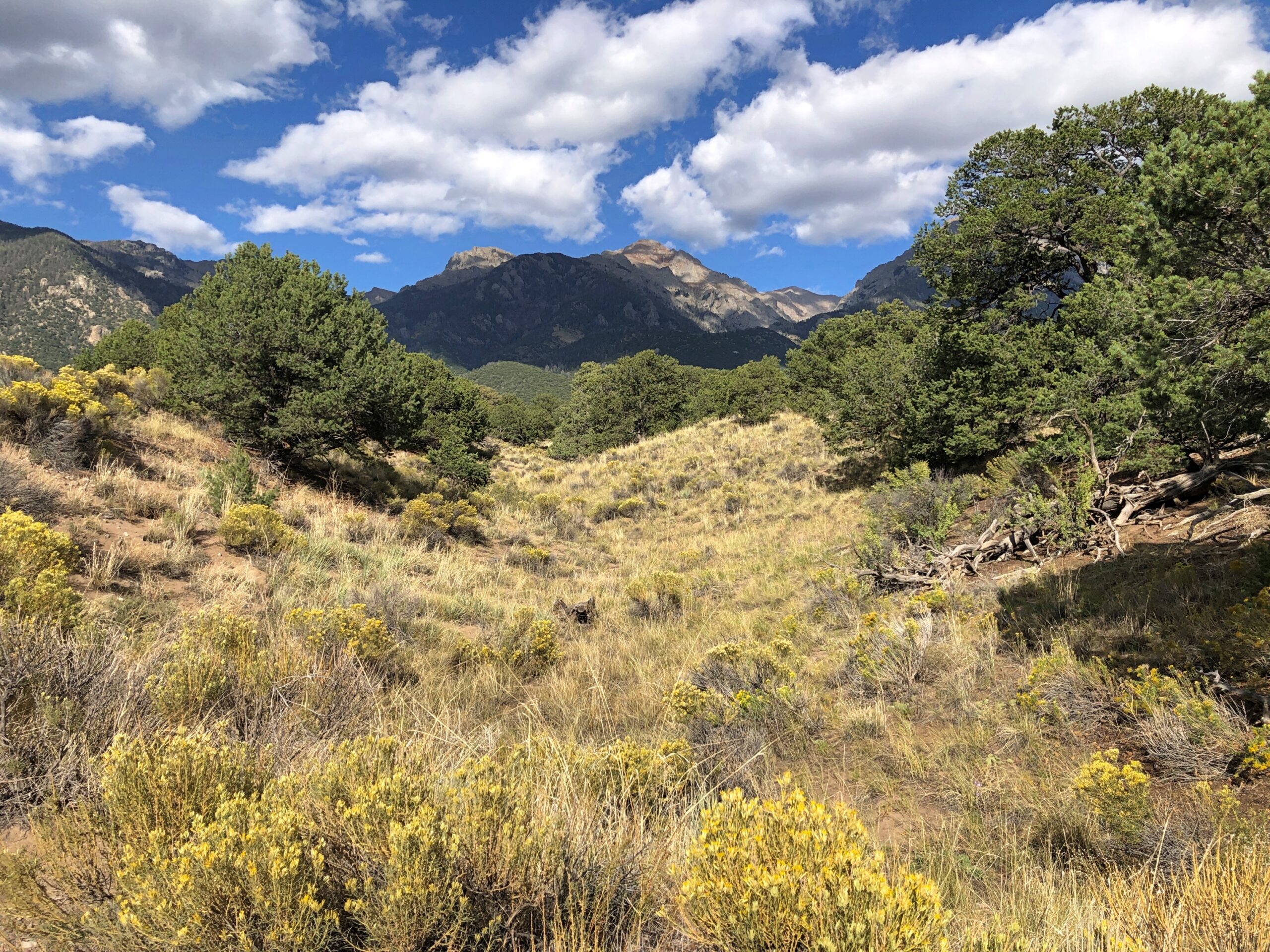
I will say this for the area, facing as it does the Sangre de Cristo: wow. The Strongs picked a striking setting.
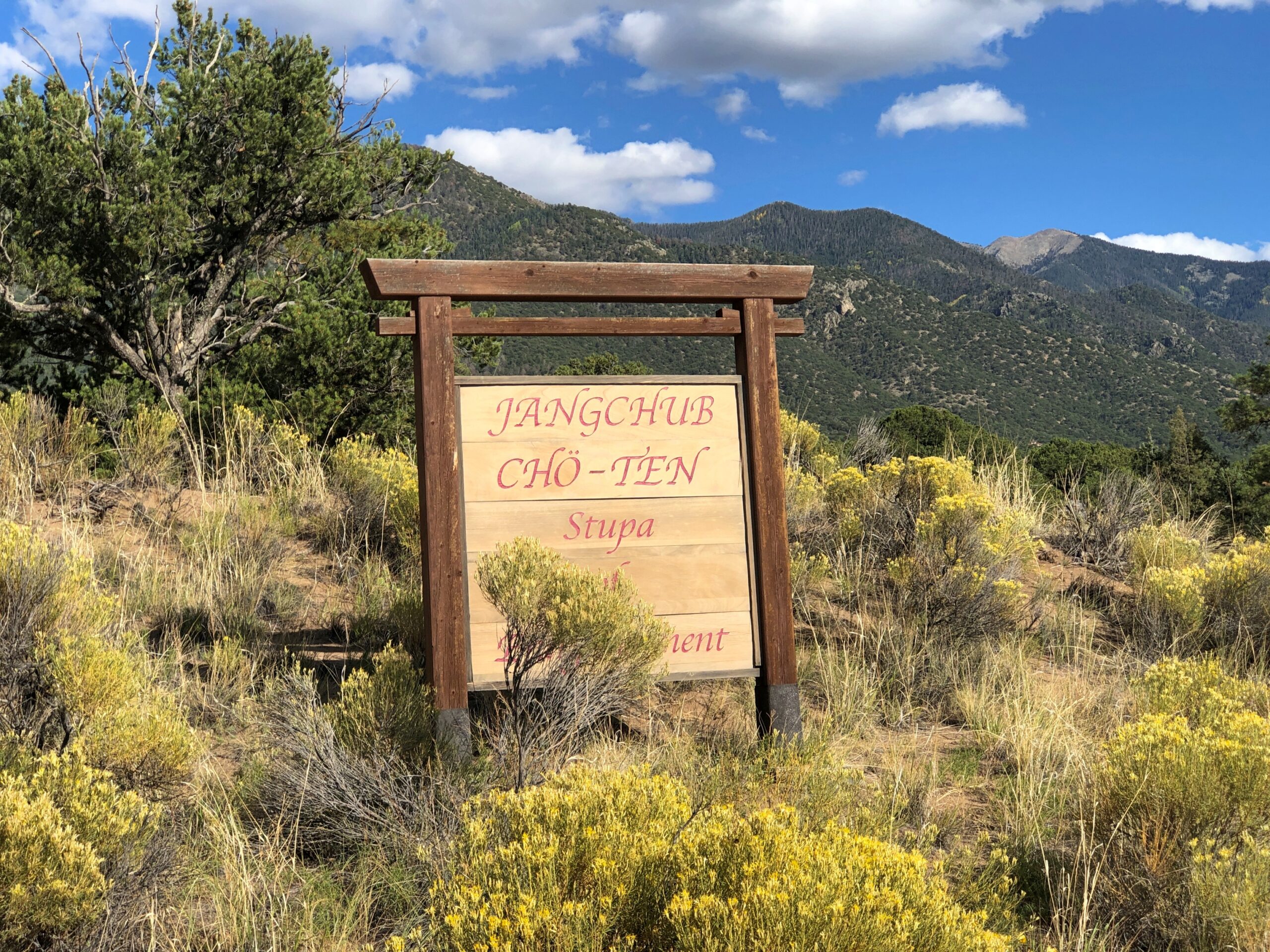
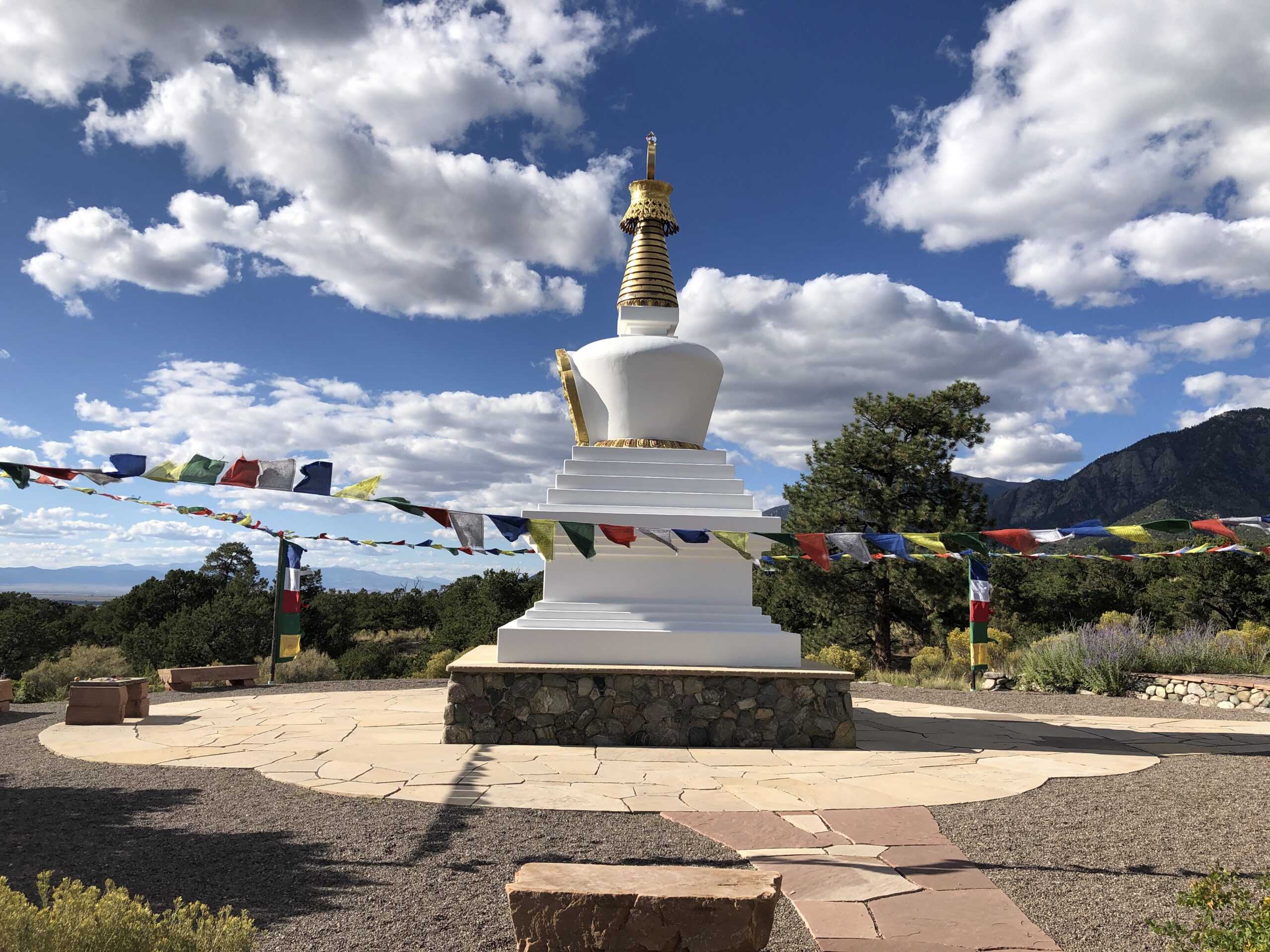
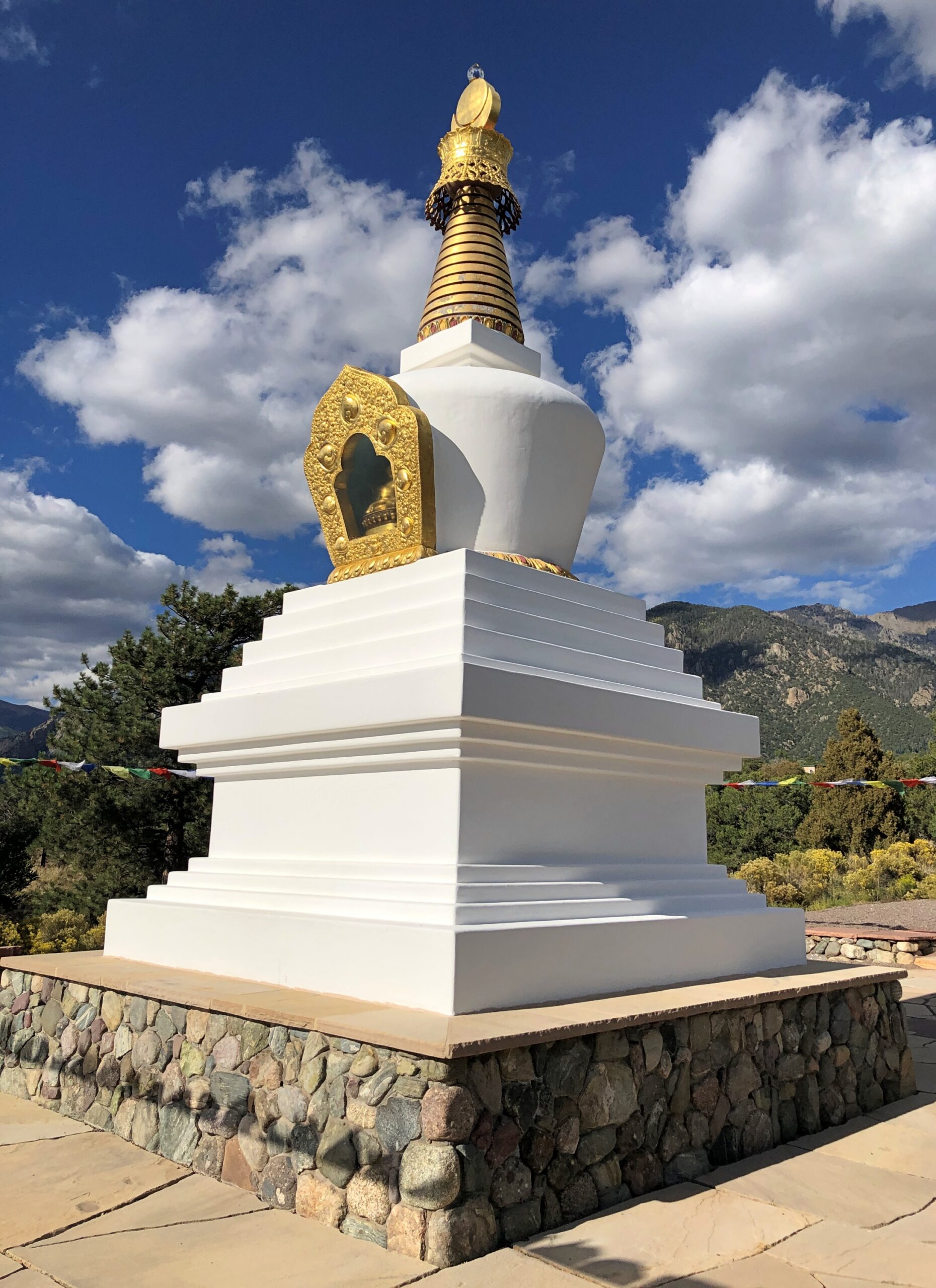
The Stupa of Enlightenment had the advantage of being not that far from town, besides not involving admission to a retreat.
I wanted to see the Crestone Ziggurat, deep in the warren. I like a good ziggurat as much as the next guy, and they’re hard to come by in North America. But as we drove along, and up and down the twists, the road crunching and pinging our undercarriage with little stones and kicking up dust, I lost my enthusiasm to find it.
Visible for miles, the Crestone Ziggurat rises from a rocky hill on the southeast edge of the Baca Grande, notes Atlas Obscura. After purchasing the land in 1978, American businessman and father of Queen Noor of Jordan, Najeeb Halaby, commissioned the ziggurat as a private place for prayer and meditation.
Today, the ziggurat is open to the public. Visitors can climb the spiral ramp to the top, which offers stunning views of the surrounding area, making it a perfect spot for reflection and quiet contemplation. Visitors are encouraged to arrange rocks in a personal design at its base as a form of meditation and intention setting.
Note also that the twisty roads also serve a residential population, living in homes suitable (I hope) for a semiarid climate, with many properties xeriscaped to emphasize the point.
The religious – I mean, spiritual – sites of Crestone would take a full day at least to examine, considering the ground you need to cover. Who knows, I might be back. For now, I stand in admiration of the place. It’s easy to make fun of some of the New Age pretentions of the town, and sometimes I give in to that urge (and occasionally, of course, out-and-out cultists show up nearby). But no: Crestone represents fine threads added to the tapestry that is North America and an inspired bit of placemaking.
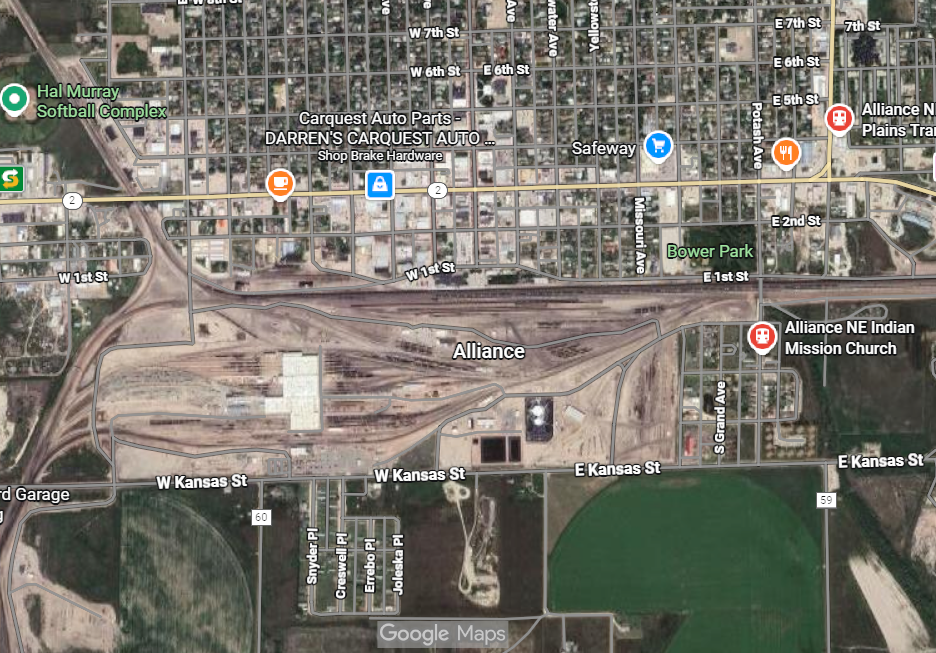
The highway Nebraska 2 passes through the town of Alliance, as do the BNSF railroad tracks paralleling the highway. During my drive across the Sandhills, I saw train after train headed east from Alliance. Long trains, the seemingly endless sort, even though they’re going the opposite direction you are, so they’re passing by at your speed plus their speed: well over 100 mph probably.
Every single one was a coal train. The industry isn’t what it used to be, but it isn’t dead, and much extraction takes place in the Powder River Basin, with rail from there converging in Alliance and then heading to the markets in the east. For a fairly small place, Alliance (pop. 8,150 or so) has a large rail yard.
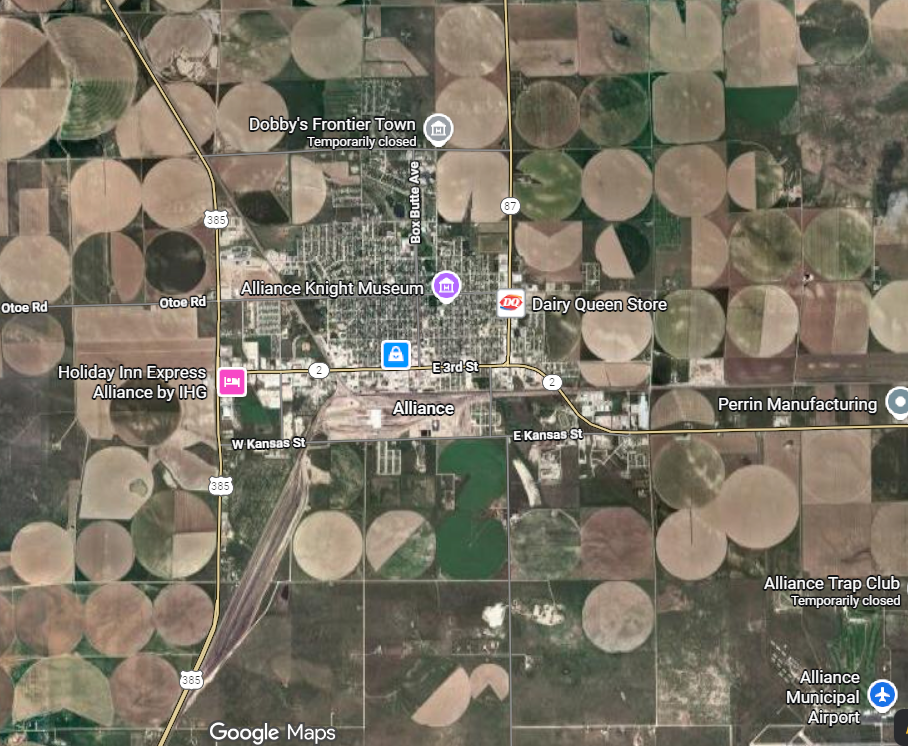
Back up a little further, and the region reveals clear signs of circle-pivot irrigation.
In ag terms, most production in Box Butte County – a favorite of mine among county names – is actually livestock, raised on non-irrigated grassland, which you can also see driving in. As for the irrigated places, that’s corn and wheat, with a smattering of alfalfa, beans, sunflowers and sugar beets. Somewhere up north is a rock formation called Box Butte, a name that I understand the railroads were using in promoting settlement this way, before it was ever official.
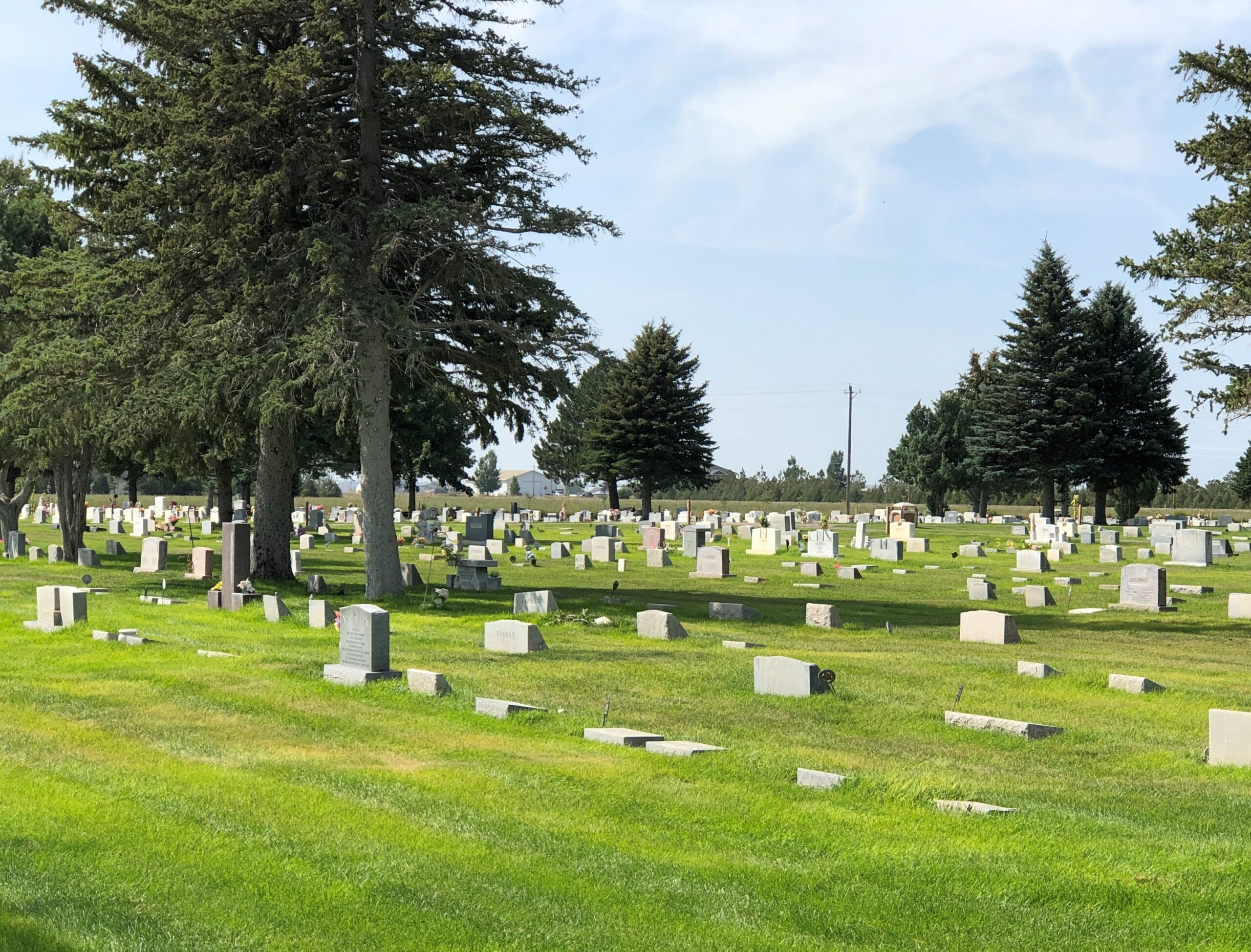
I didn’t come to town to learn all that, but I did later. Mainly I came to see Carhenge. The weather that day, September 7, was clear and very warm, which inspired some further looking around. First stop, Alliance Cemetery.
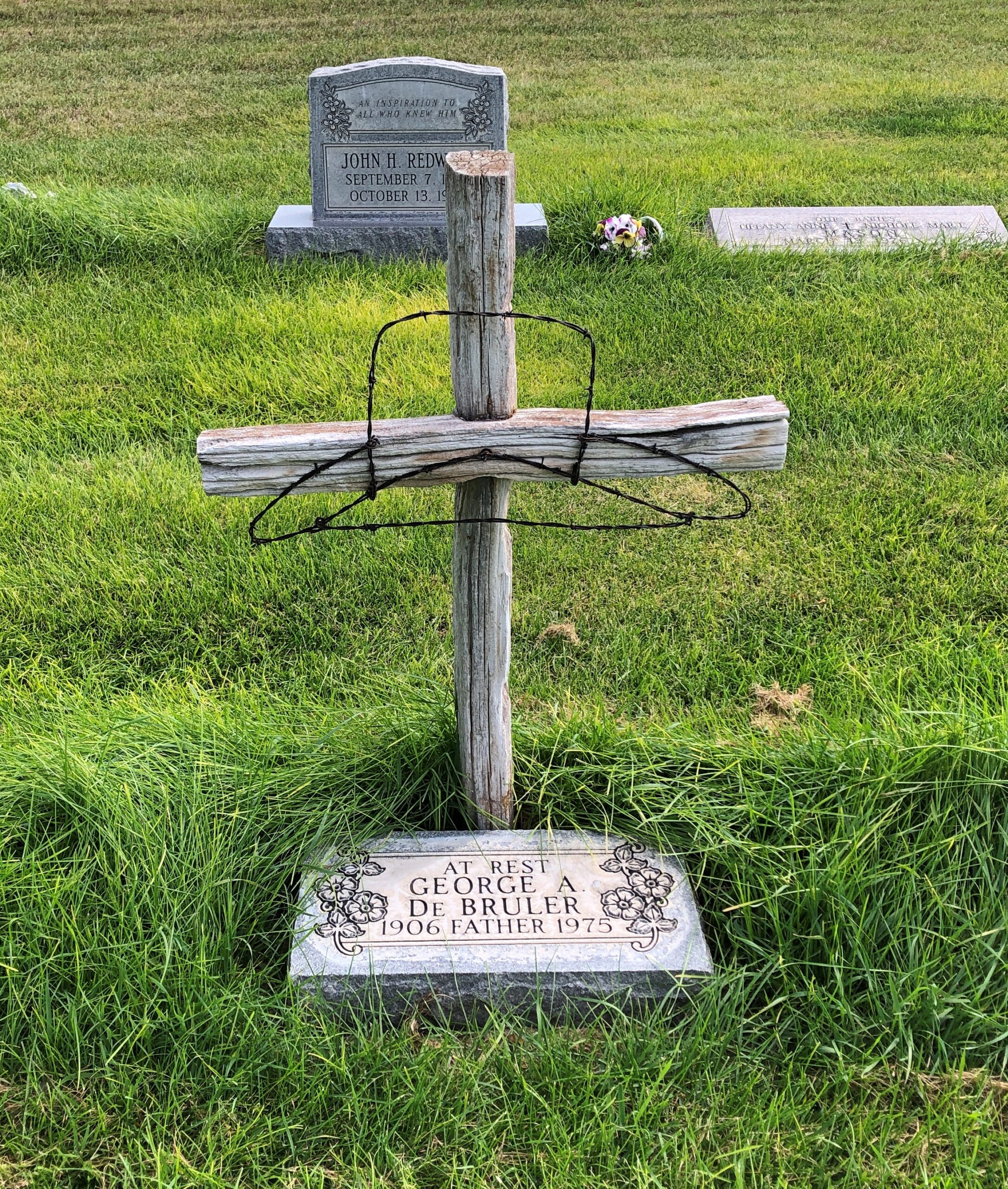
“Bury me in old Box Butte County.” There’s a western swing title in that.
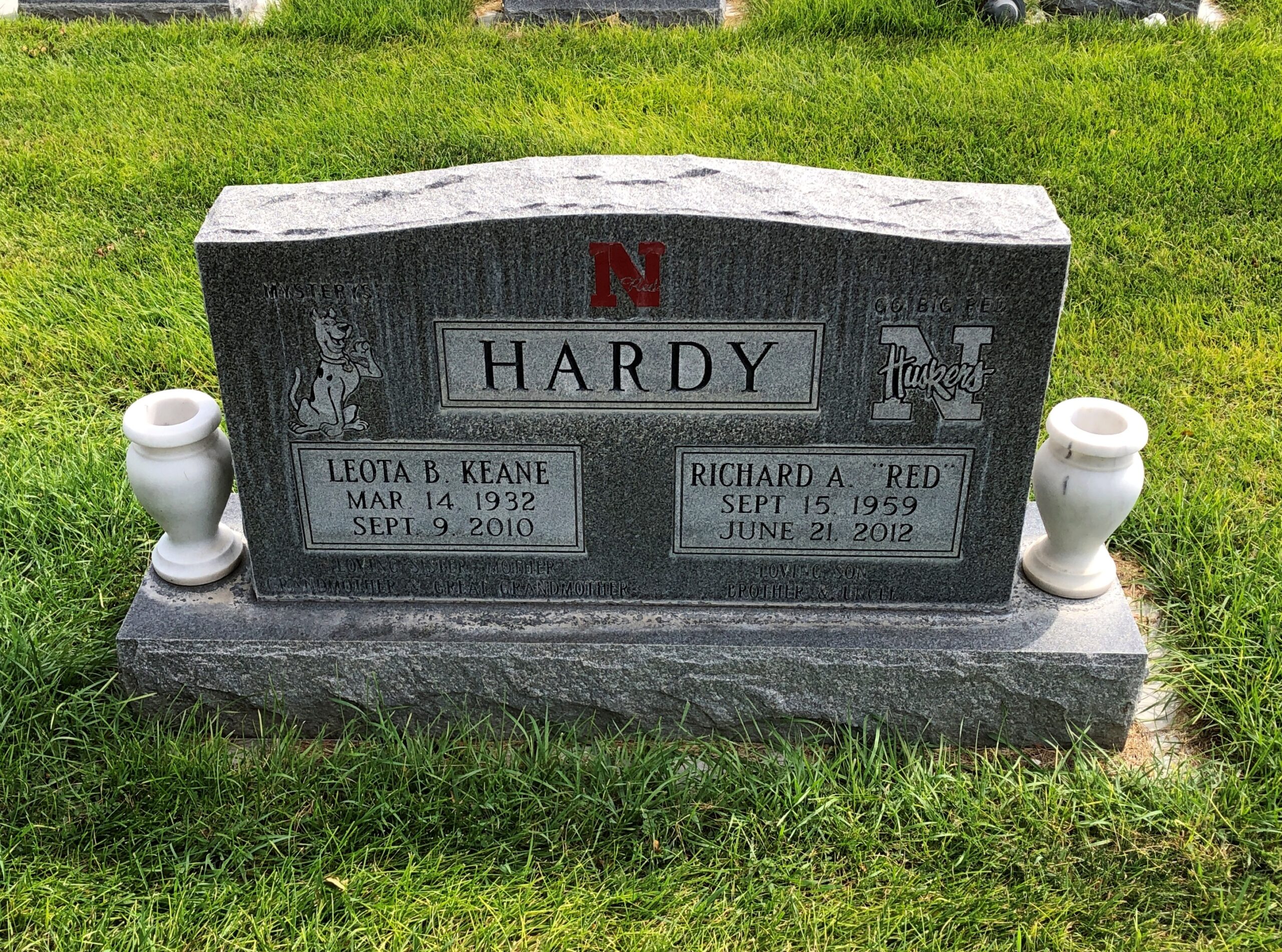
Something I’d never seen on a gravestone before: Scooby-Doo.
Go figure. Maybe Richard “Red” Hardy is the one who wanted it on the stone, since he would have been almost 10 when that cartoon premiered (September 13, 1969), and that’s about the right age to get hooked on such a thing. Then again, I was eight — saw the first episode myself — and yet somehow I’ve remained immune to its charms.
As for the Huskers, I saw them on some other stones in this cemetery. Hardly the only example of fandom from the grave.
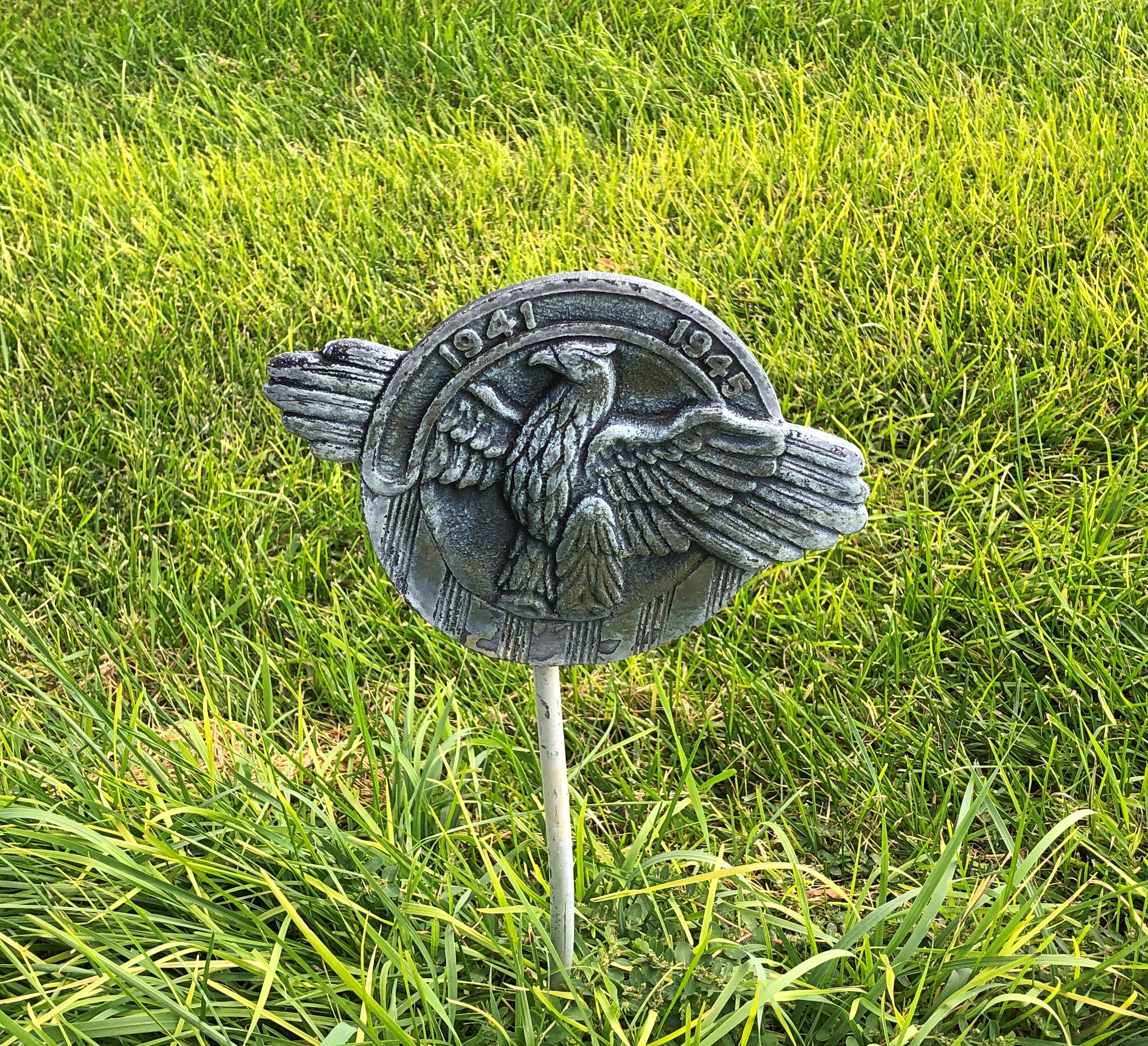
I’ve seen cowboy churches and I’ve seen cowboy graves.
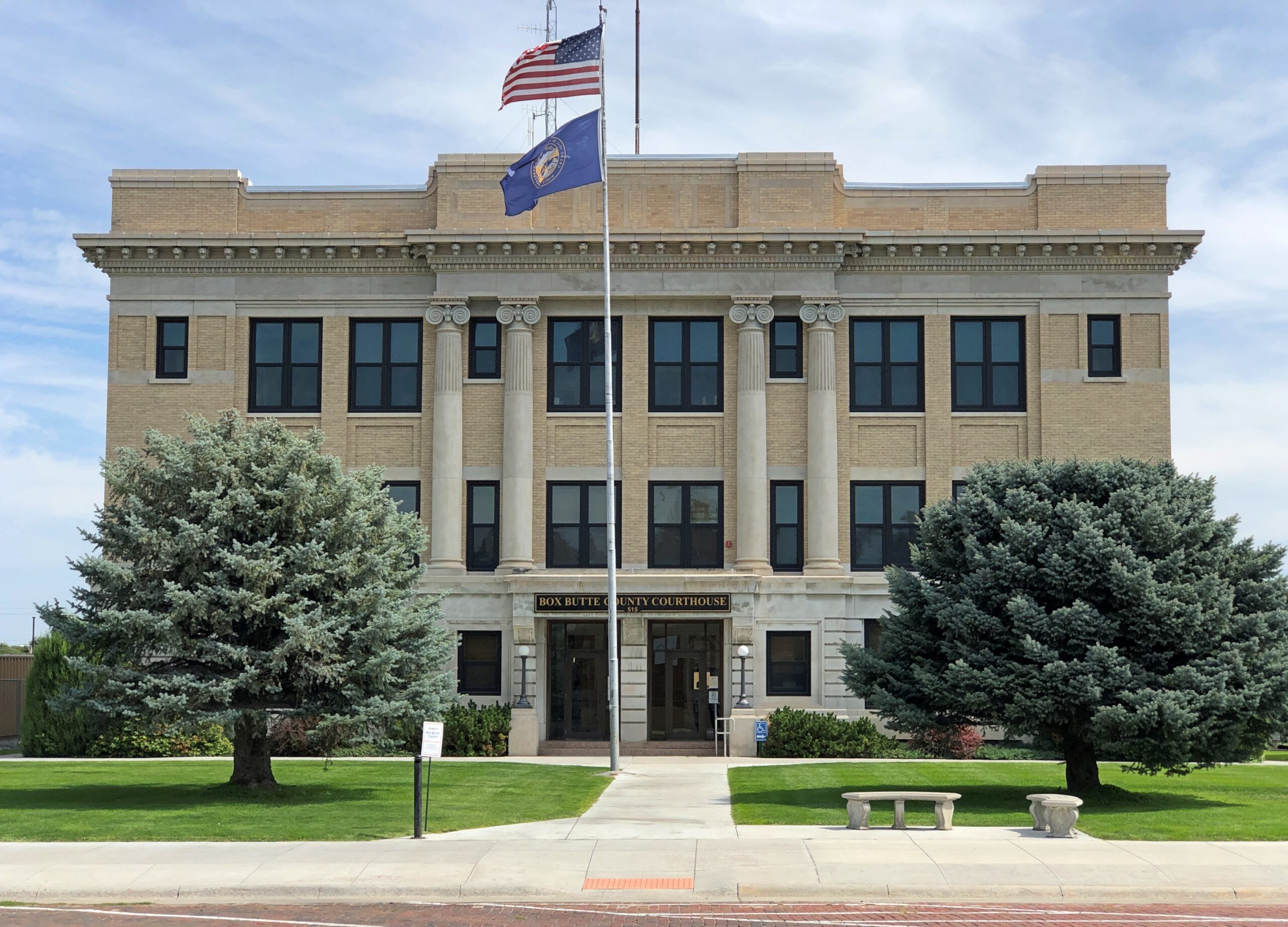
The cemetery is east of downtown Alliance, but not that far away. The Box Butte County Courthouse is on Box Butte Ave.
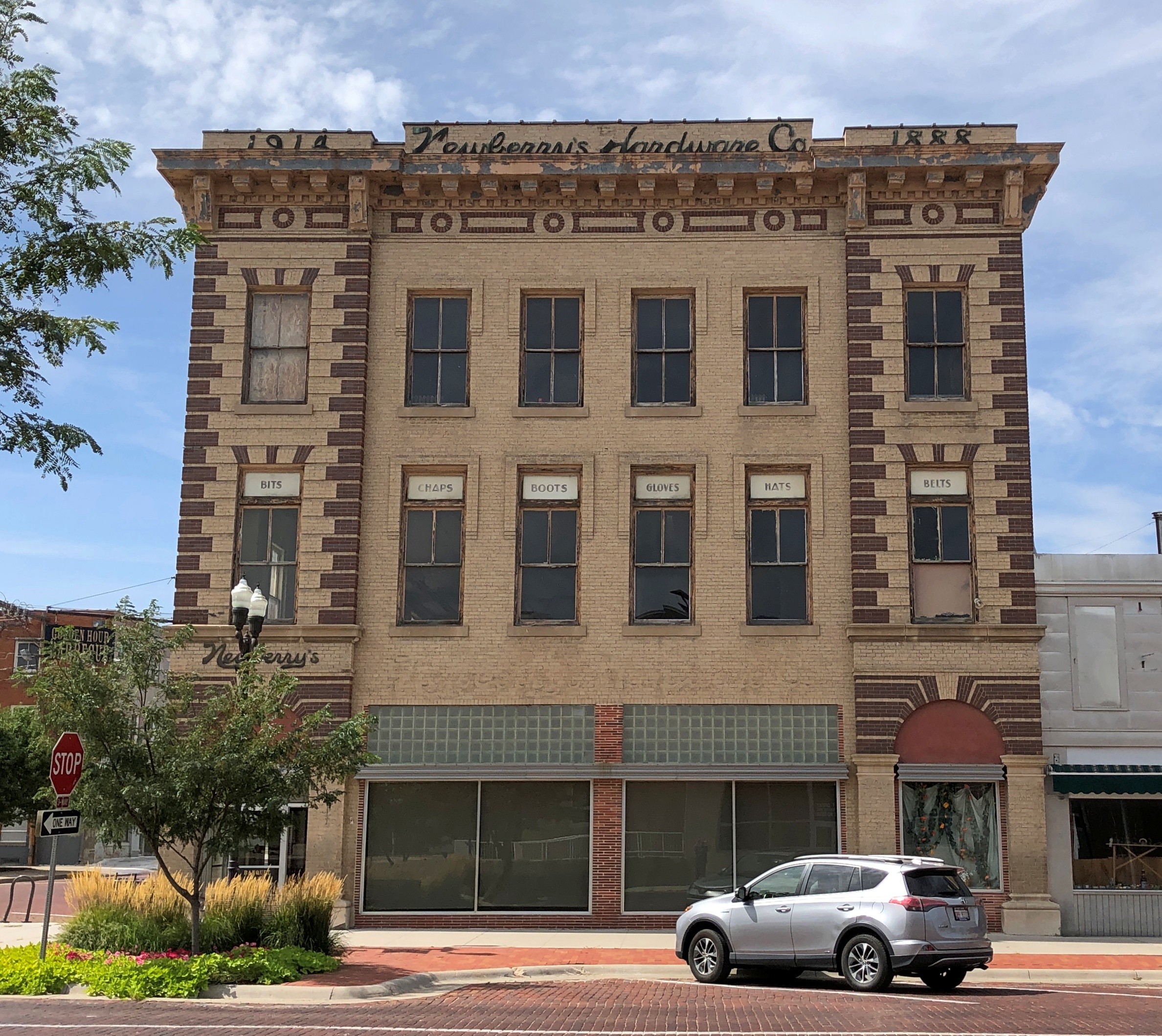
Along with a number of other vintage buildings. Newberry’s Hardware Co., once upon a time, which seems to be 1888 and then maybe an enlargement in 1914? Looks like it needs an occupant.
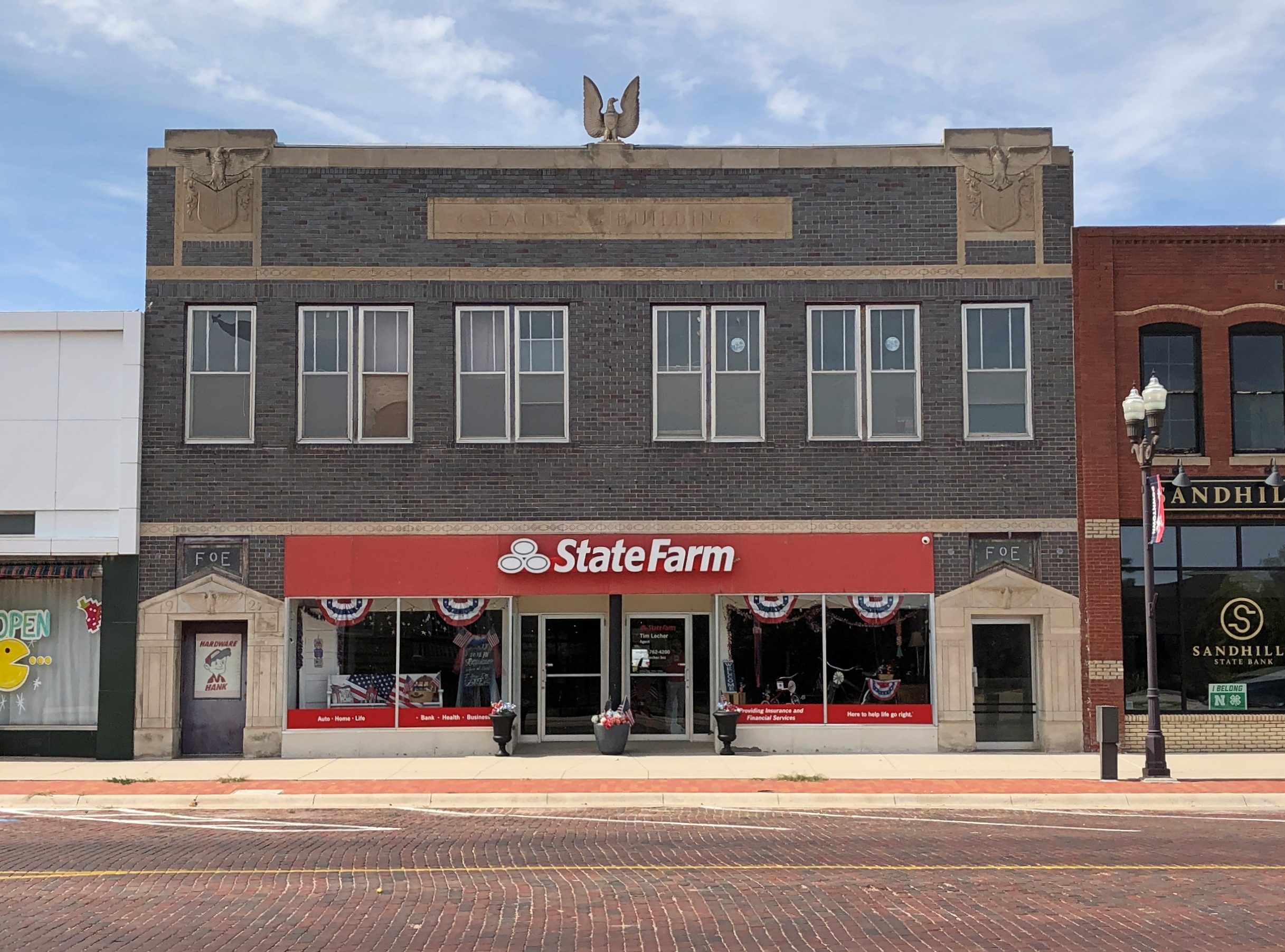
The 1927 Fraternal Order of Eagles Building.
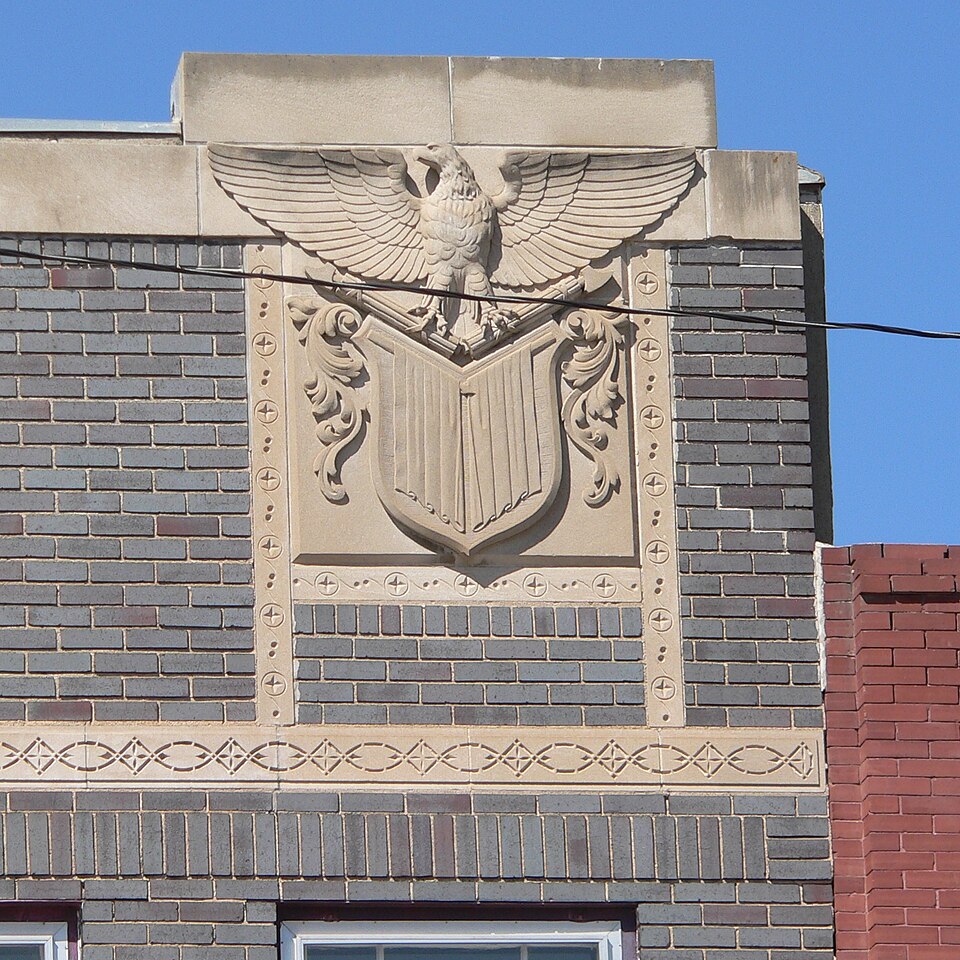
Slacker that I am, I didn’t take many detail shots, but one of this particular building is available (public domain) that shows how seriously the local FOE took its eagles about 100 years ago.
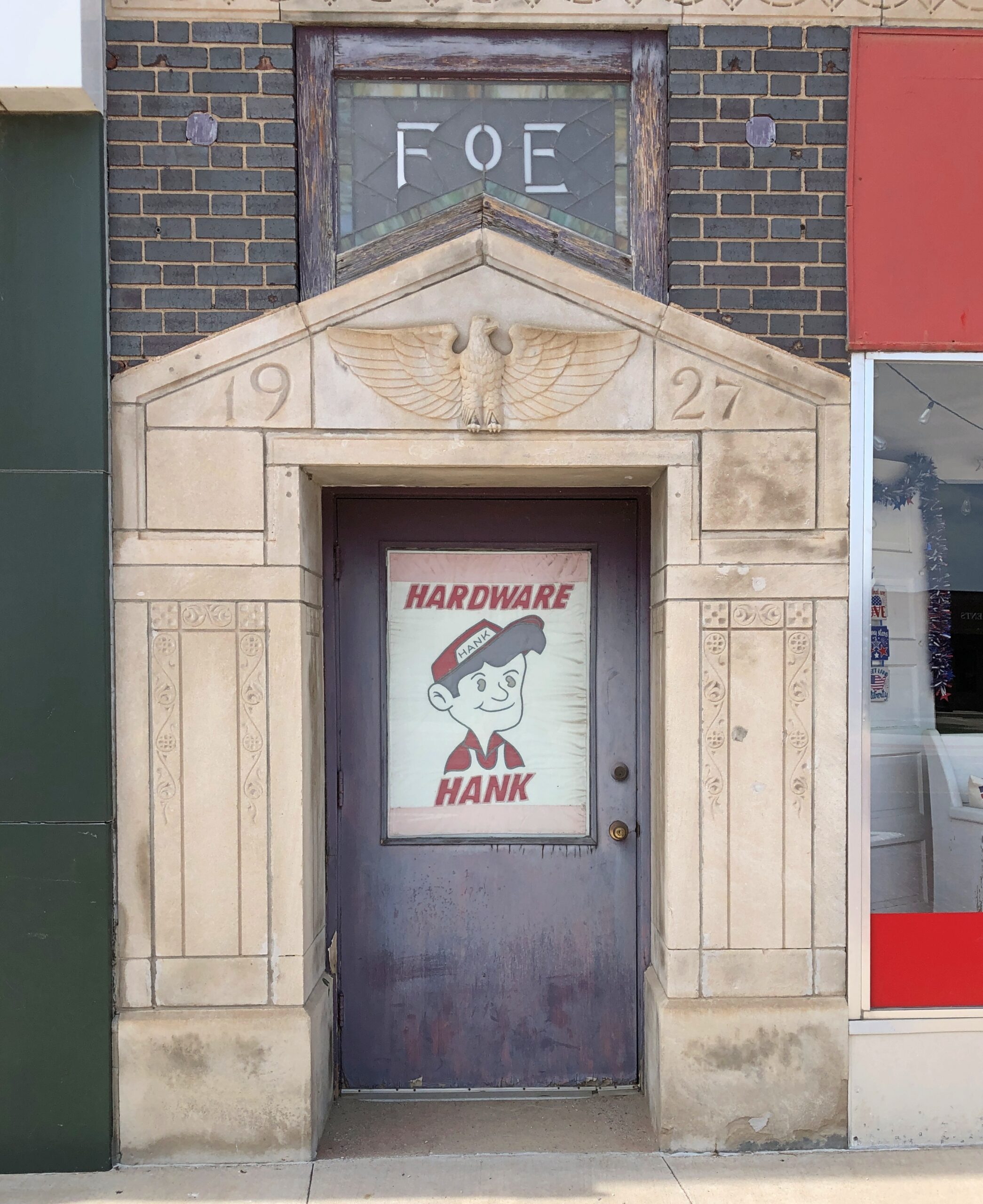
Hardware Hank is a hardware cooperative. New to me, but that only means I need to get out more.
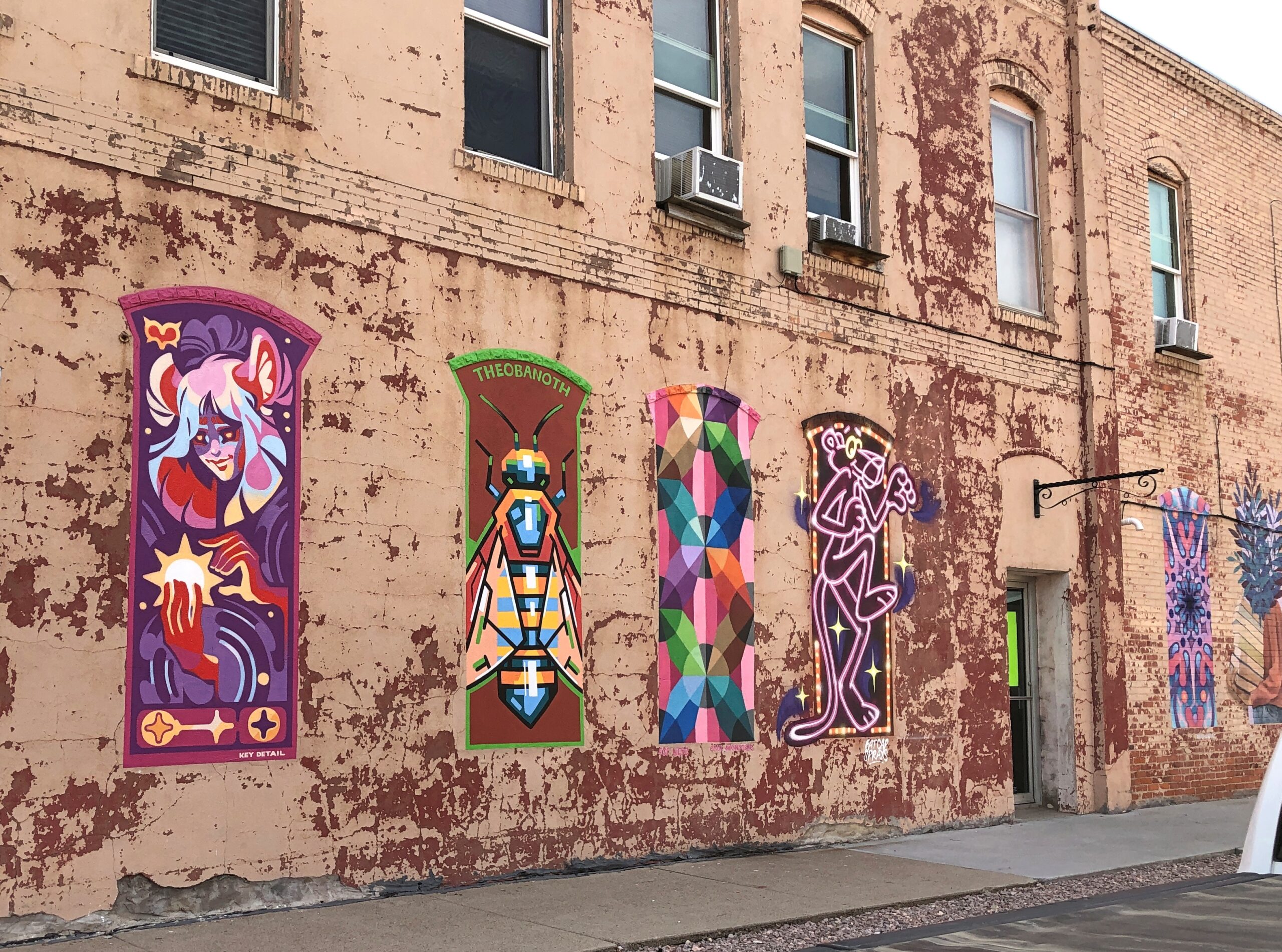
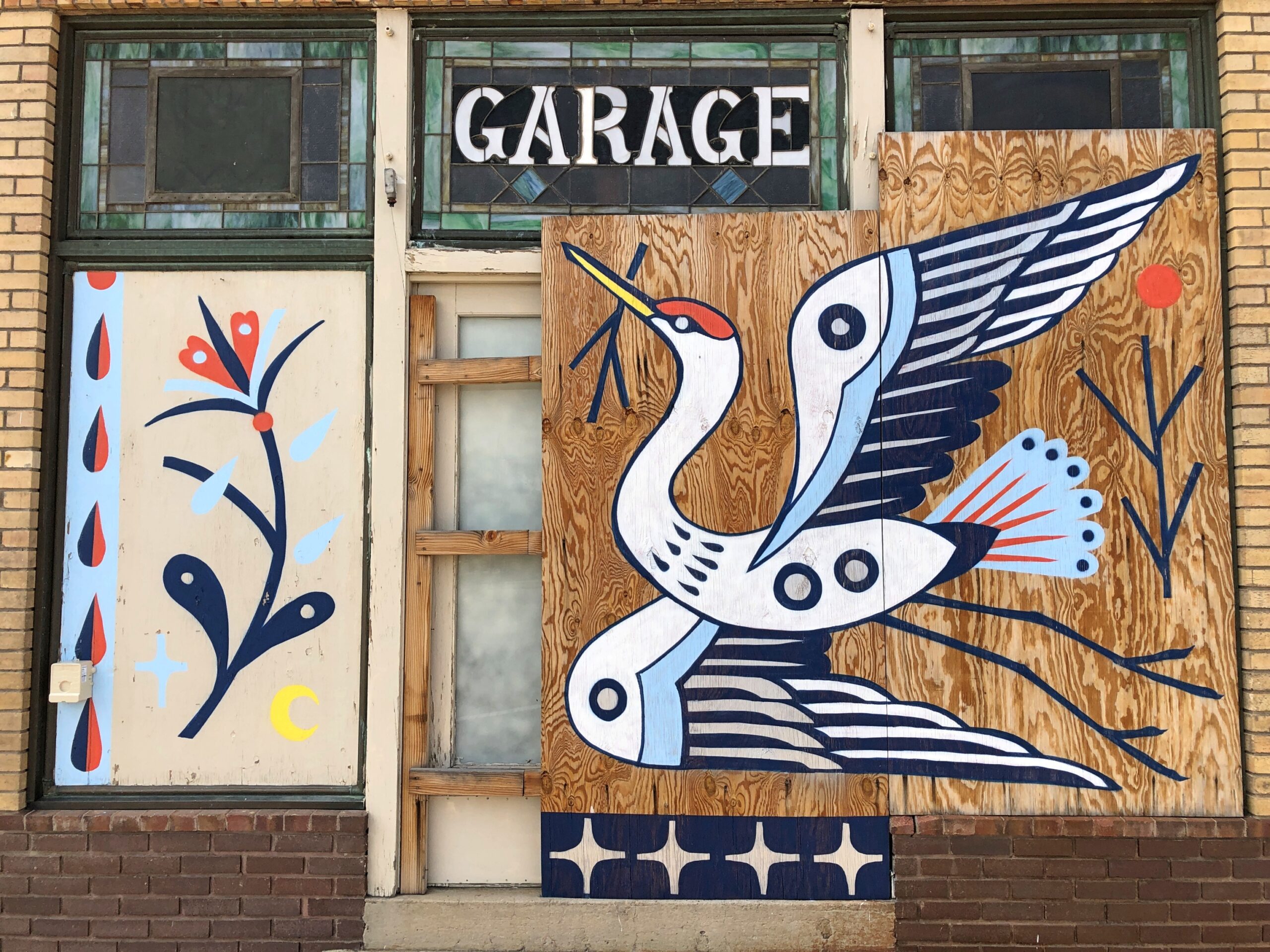
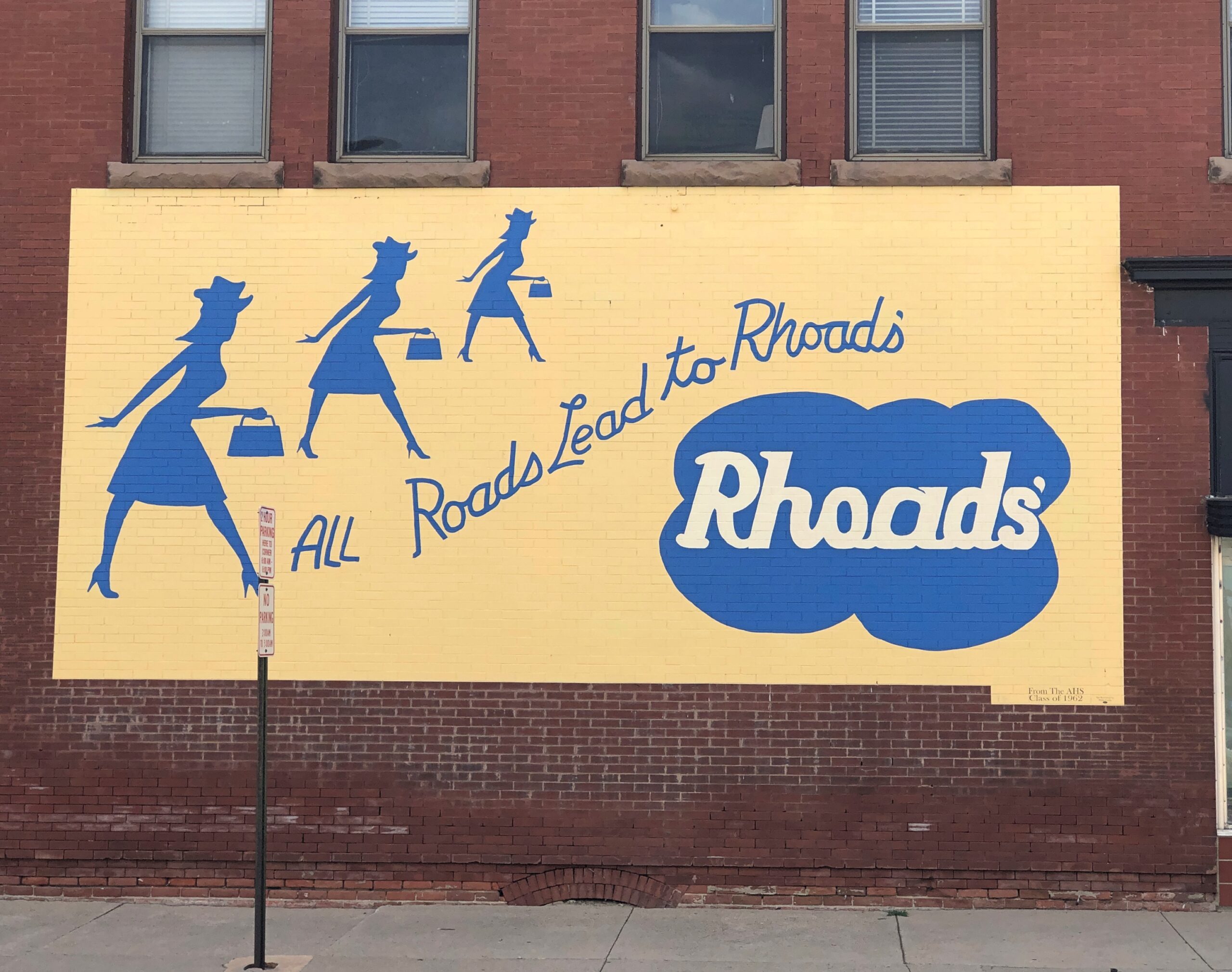
More murals.
Rhoads’ was a local department store. Gone but not forgotten, at least if you read the mural, which looks refurbished recently. The tag at the bottom says it was a gift of the Alliance High School Class of 1962.
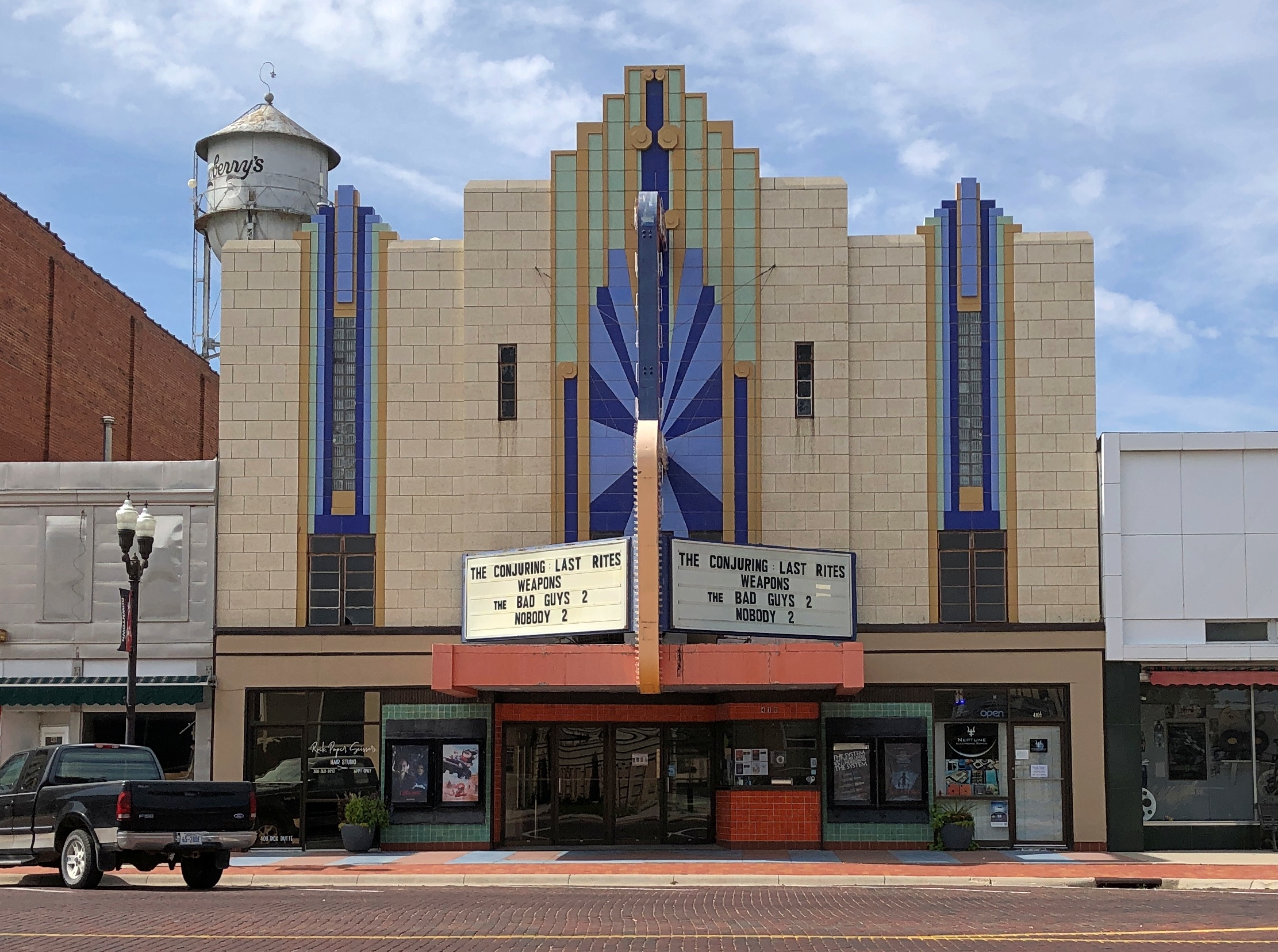
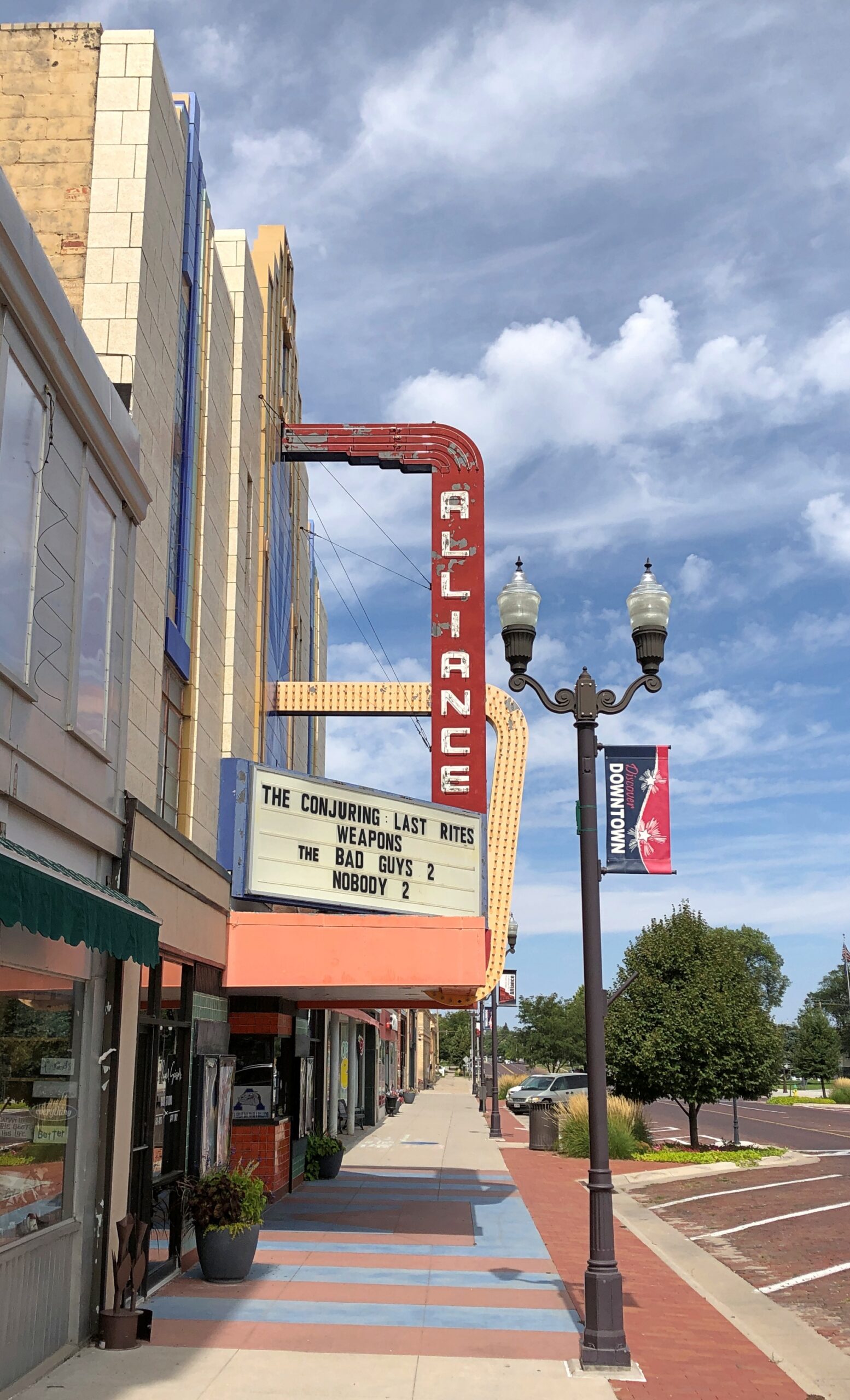
An art deco theater. Nice.
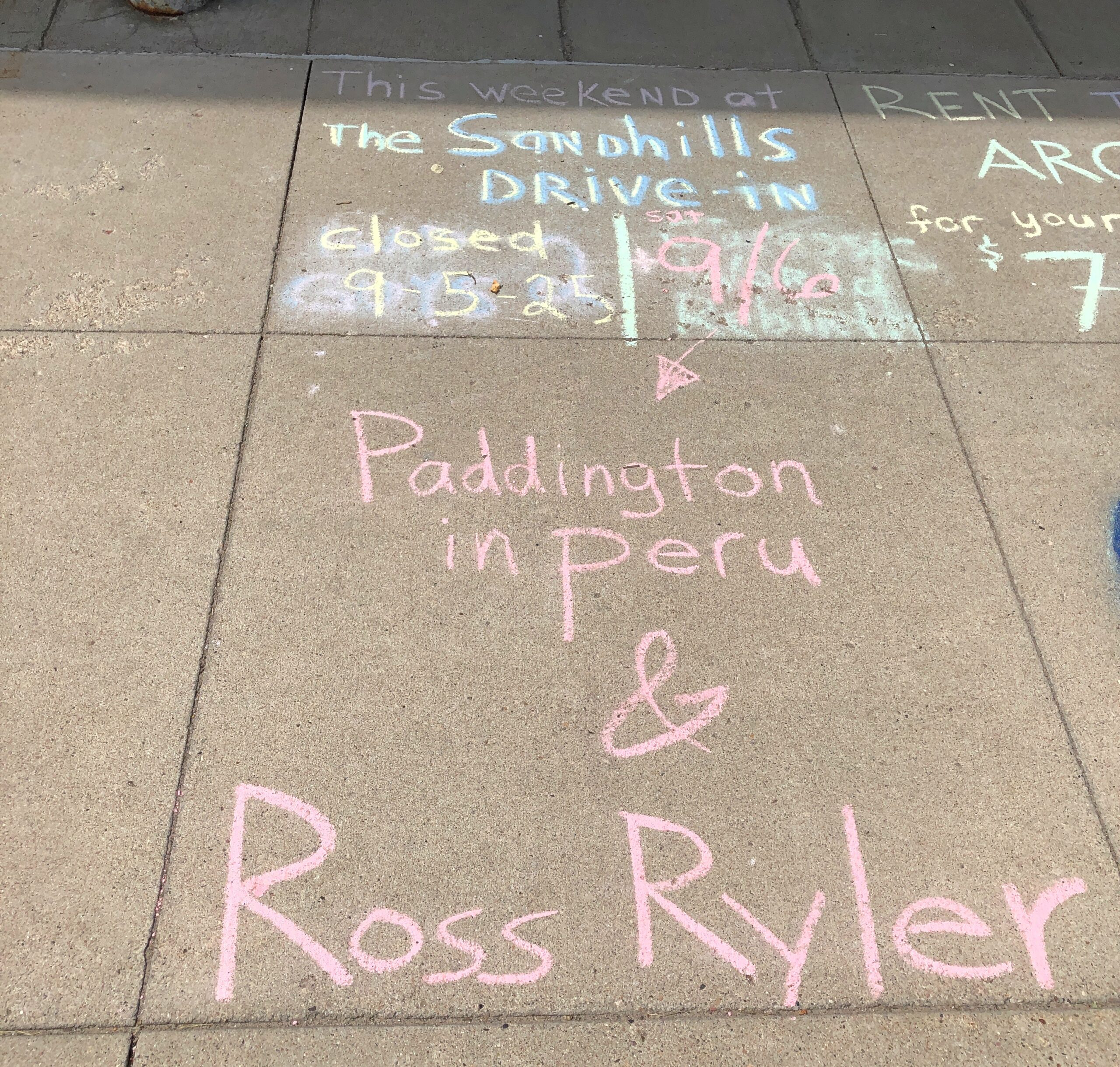
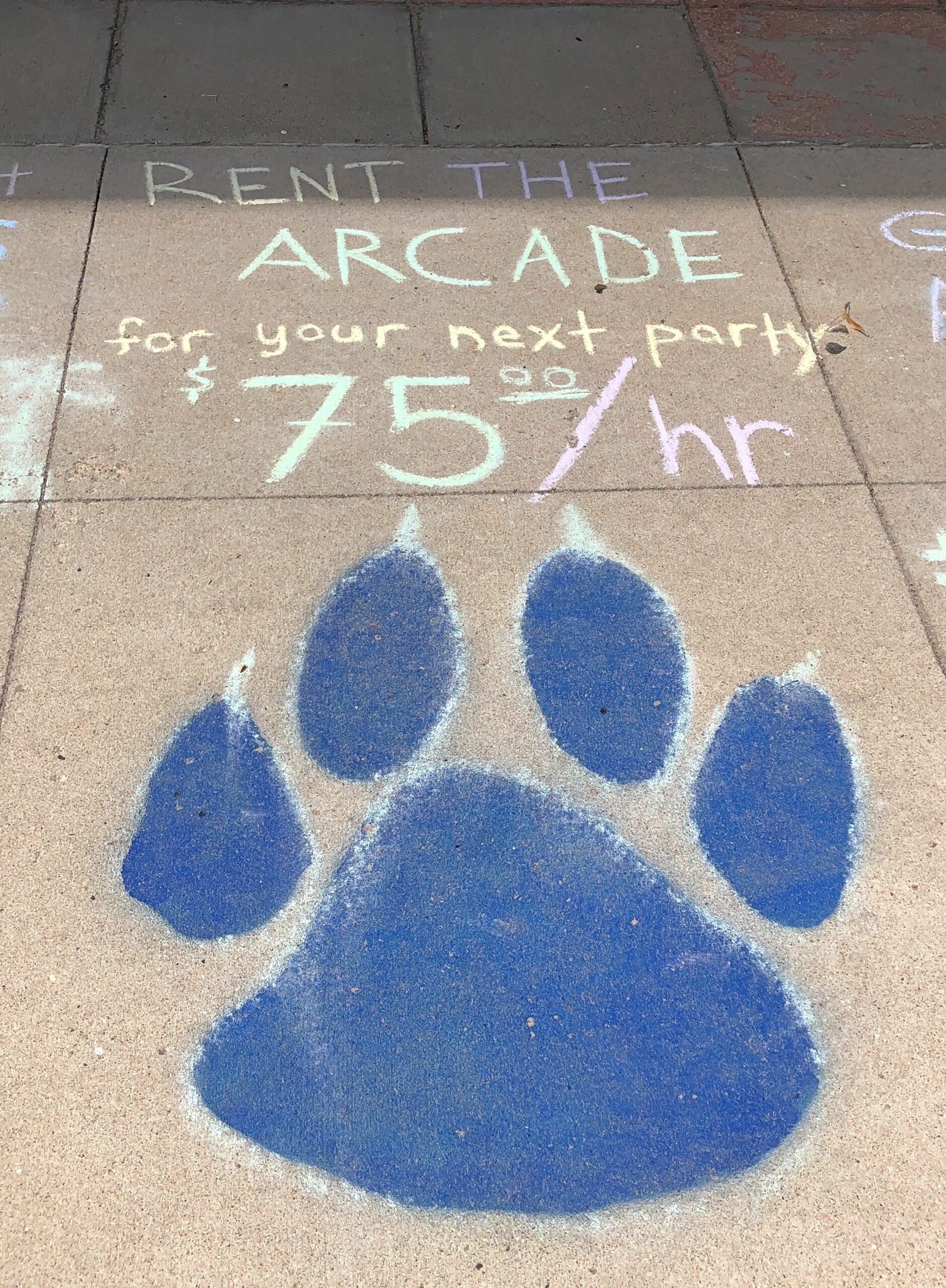
A really cheap way to advertise.
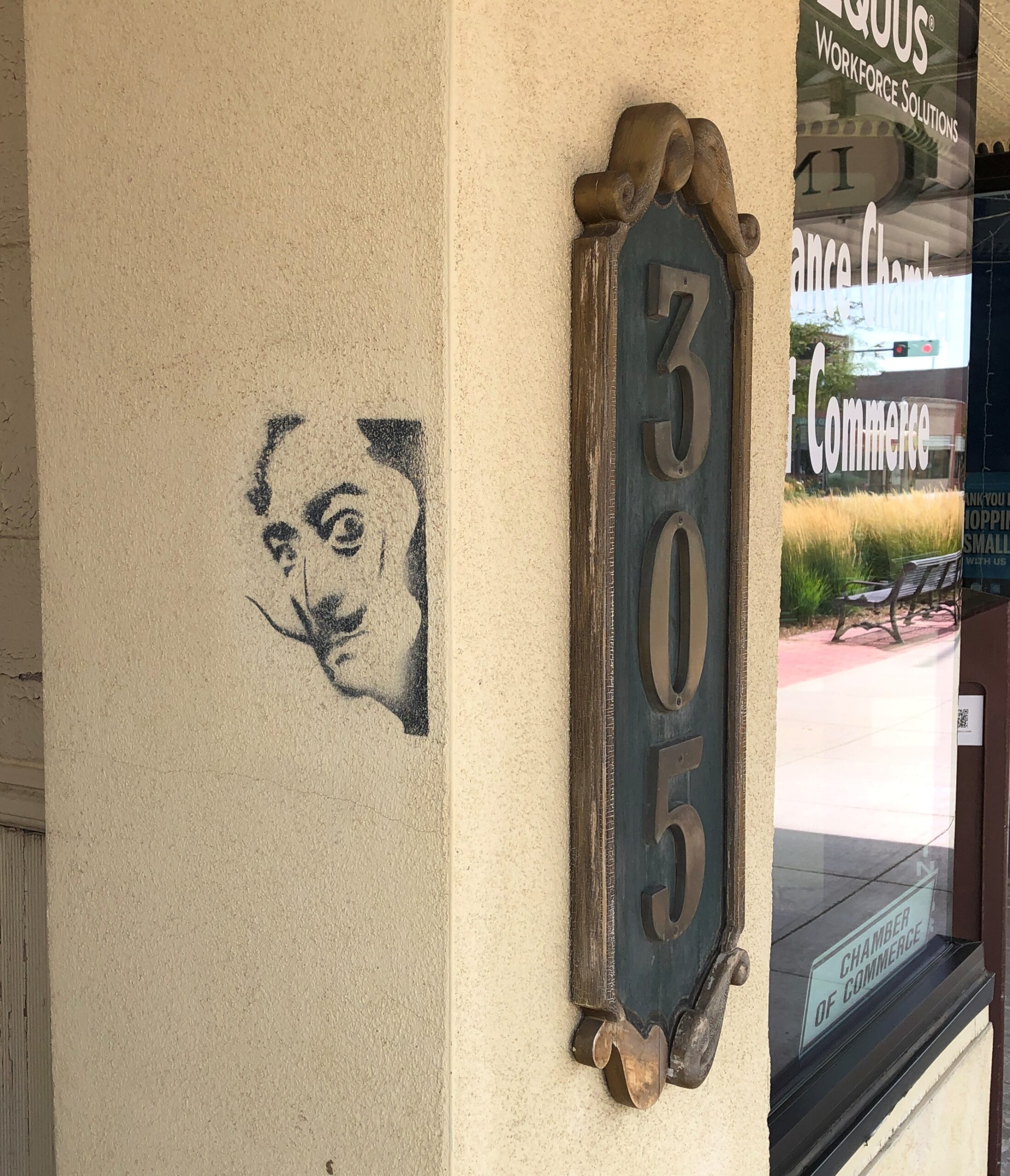
You never know when (and where) Dali will show up. Enigmatic fellow.
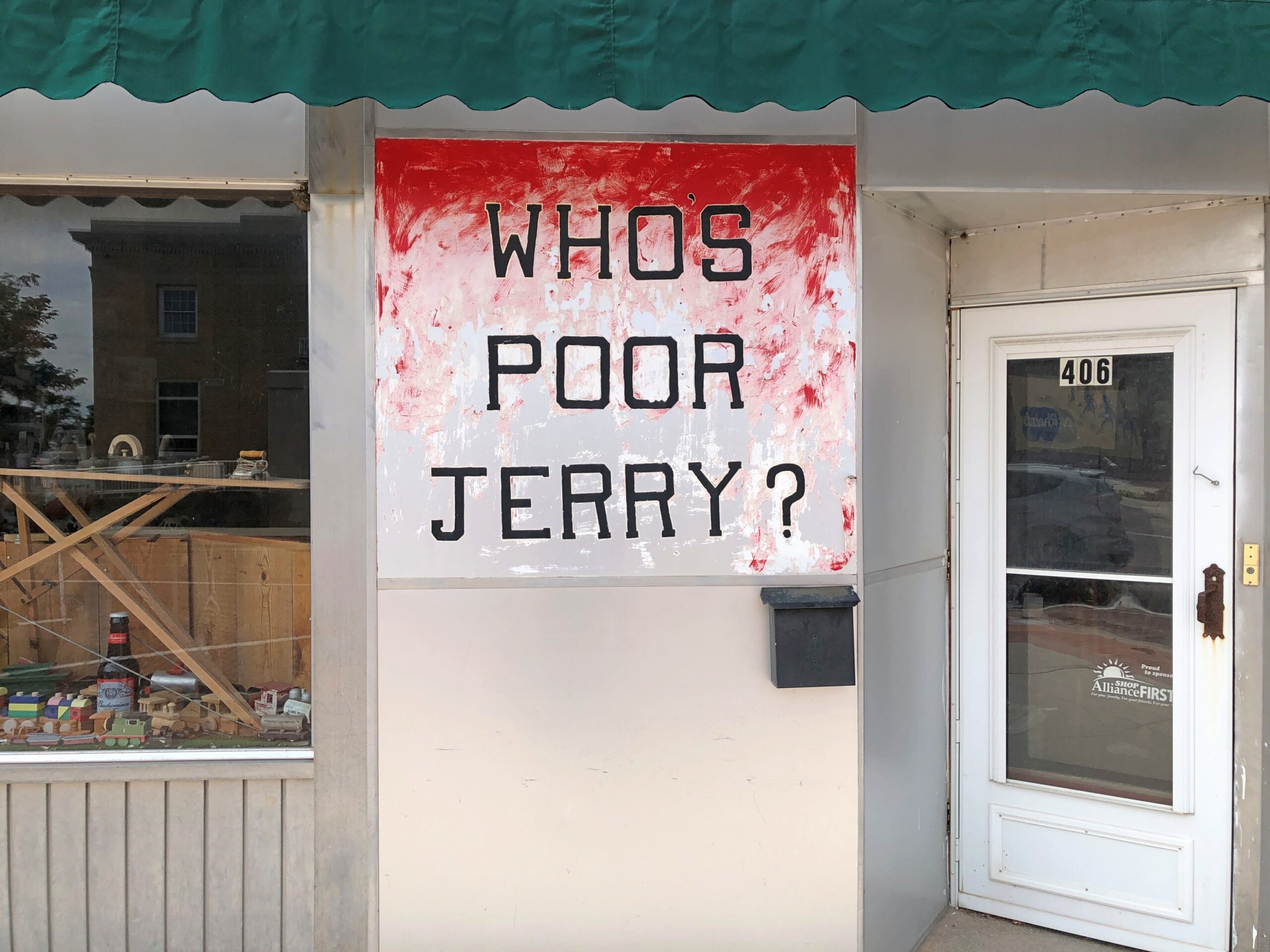
And who is poor Jerry?
Antique shop within? A simple desultory Google search doesn’t reveal much. Street View puts the sign’s appearance between 2007 and 2012 (Google didn’t come that much to Alliance.) Even the Library of Congress wants to know.
I found lunch in Alliance that day at Golden Hour Barbecue, which promised (and provided) Texas-style ‘cue. I enjoyed it thoroughly. Same league as Salt Lick, though a little expensive, considering how close the cattle are. Then again, everything seems expensive these days, and it was such a large lunch that I barely needed to eat that evening in my room in Scottsbluff, so that mitigated the upfront cost.
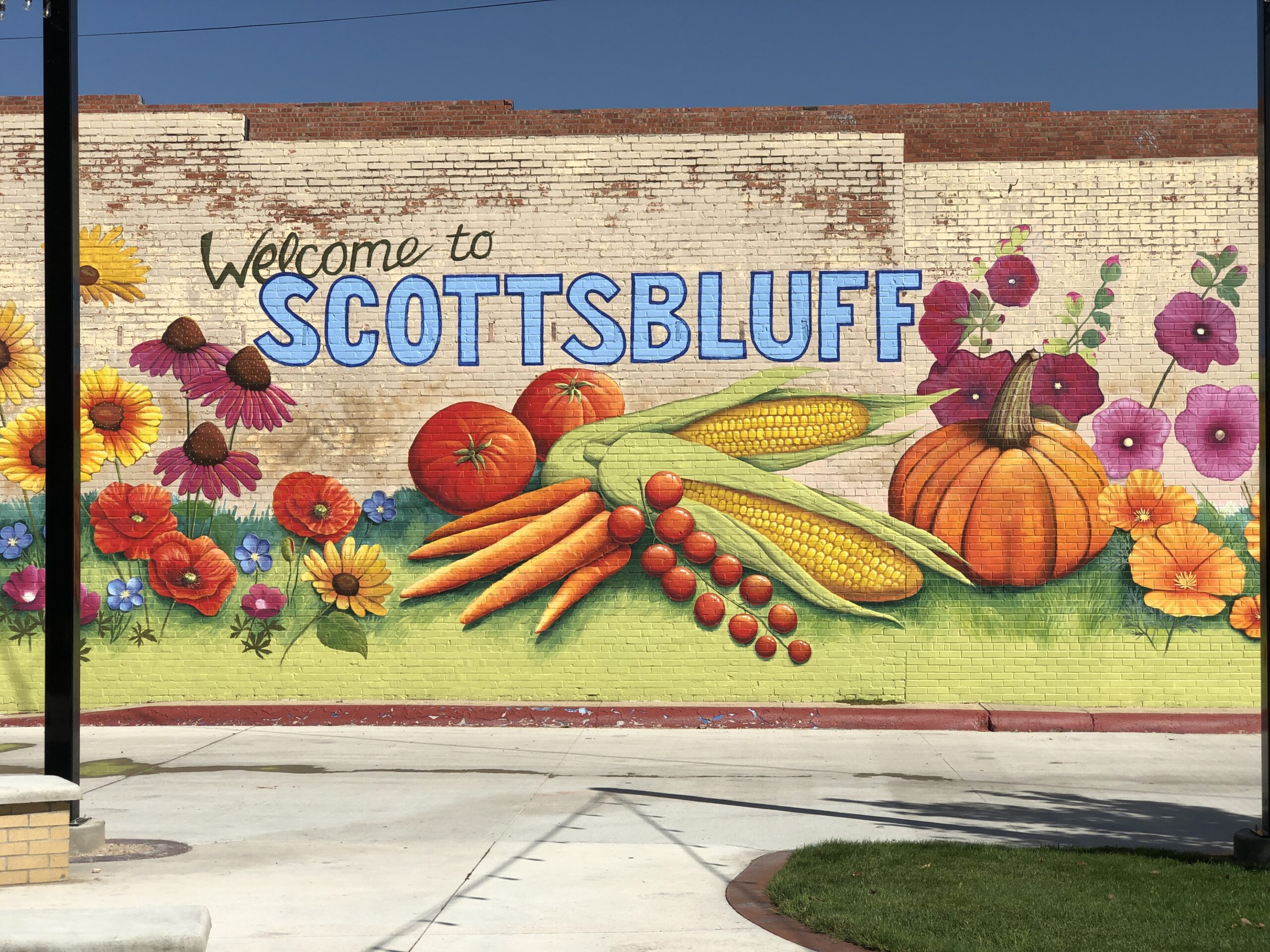
Before heading to the big rocks near Scottsbluff on the morning of the 8th, I took a look around that town as well.
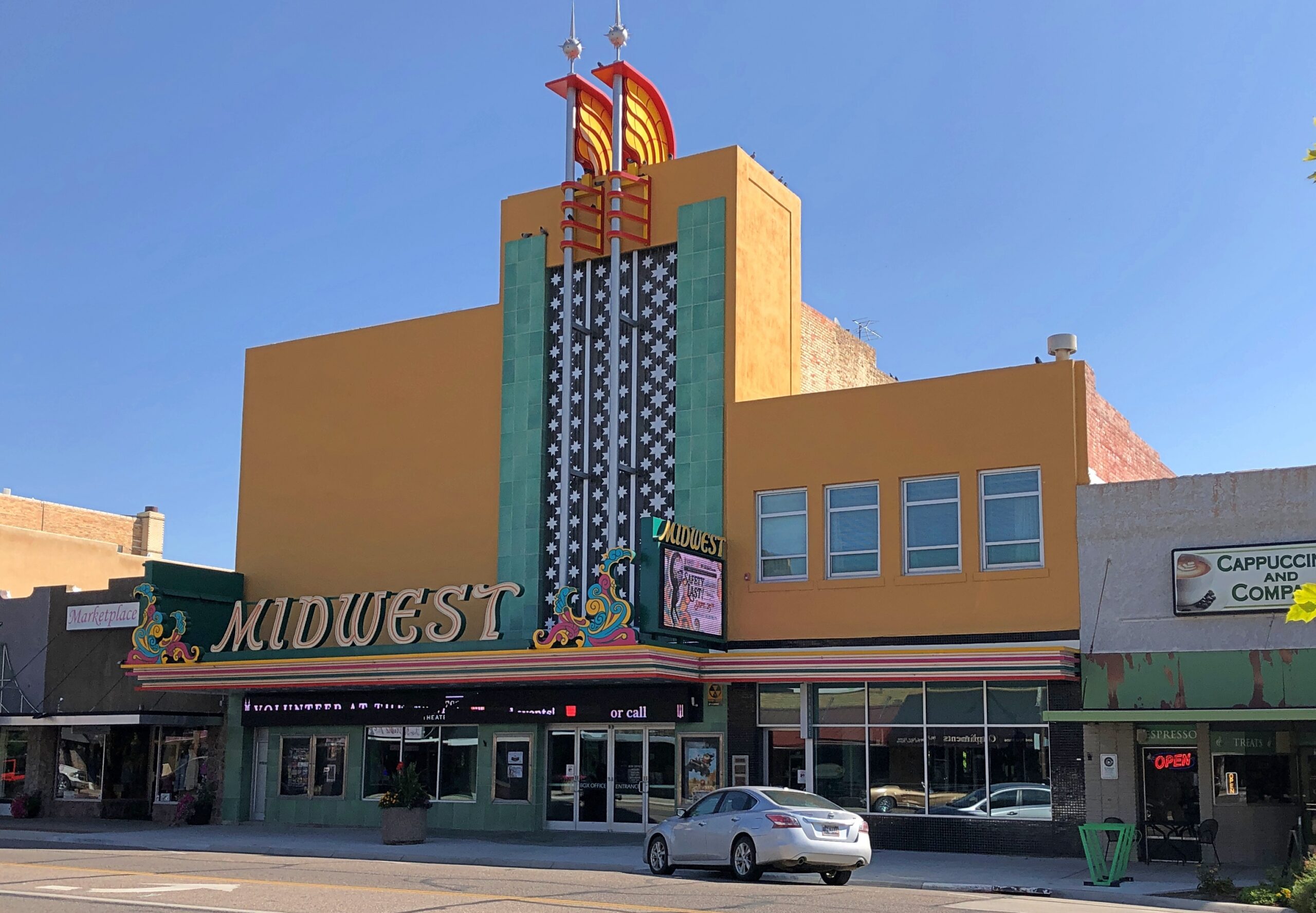
Can’t have too many art deco theaters. When I’ve done image searches for Scottsbluff, the Midwest theater comes up often as not.
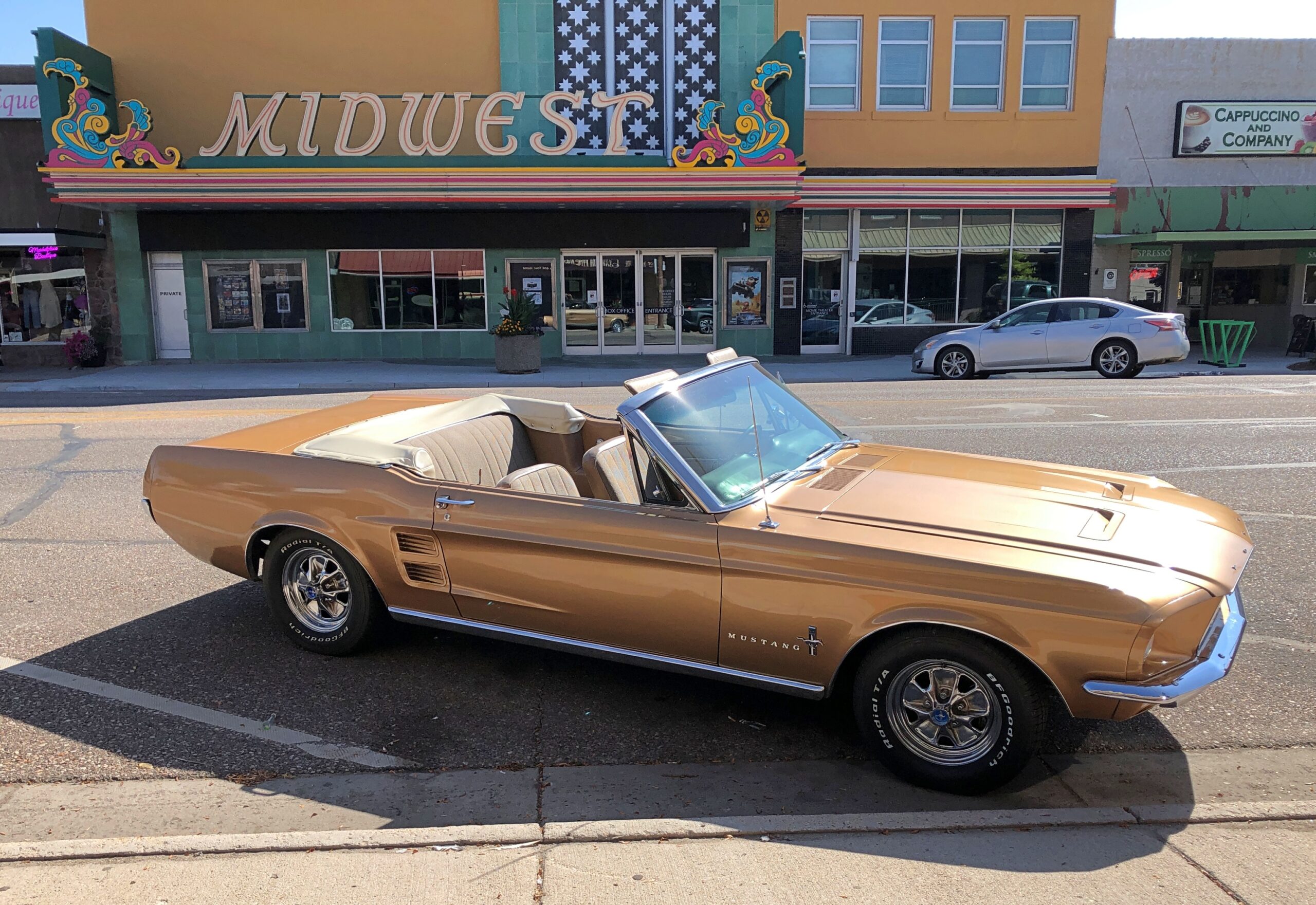
A car to match. At least that morning.
Another former small department store, now private offices.
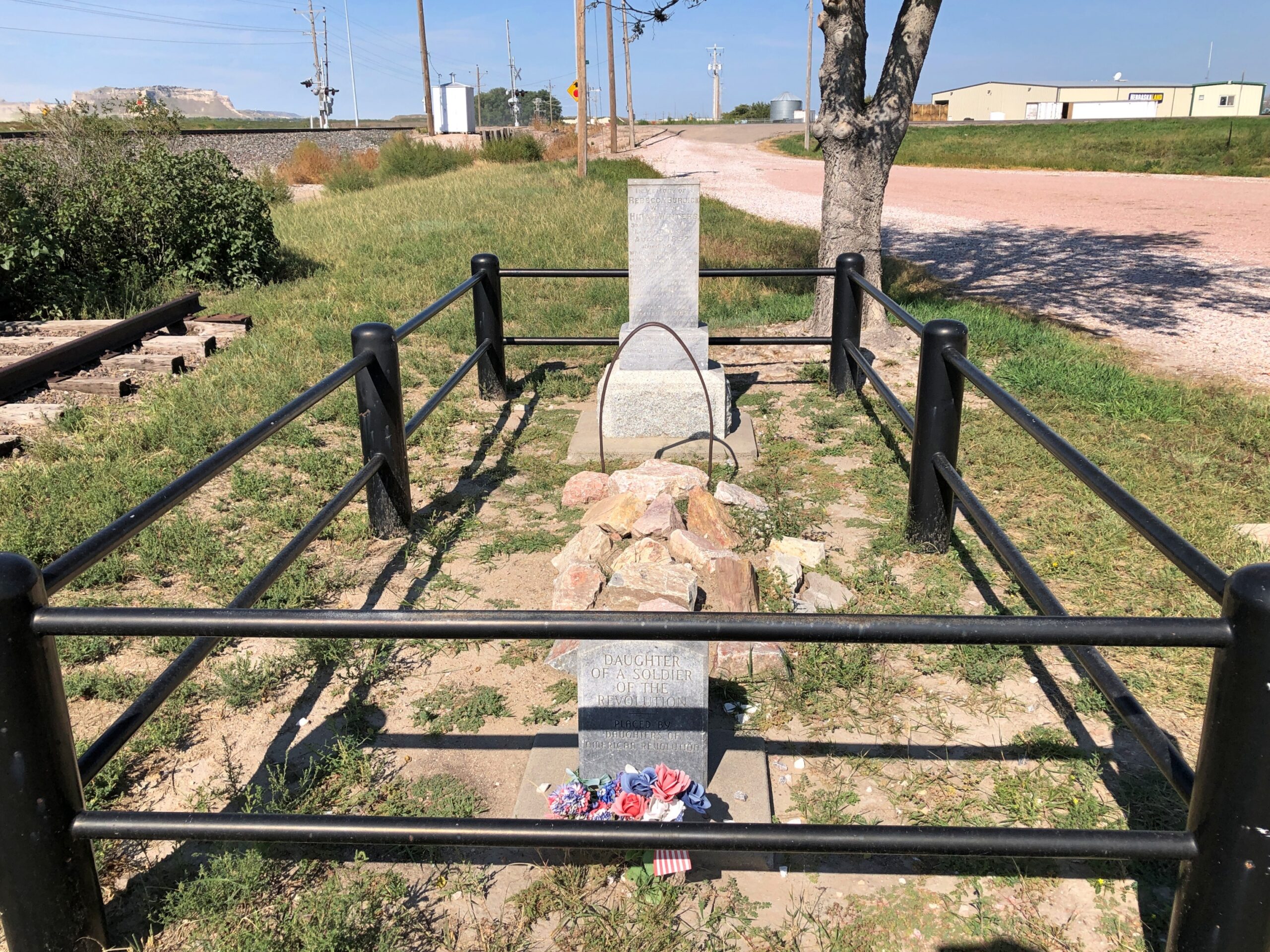
Just outside Scottsbluff is a single grave.
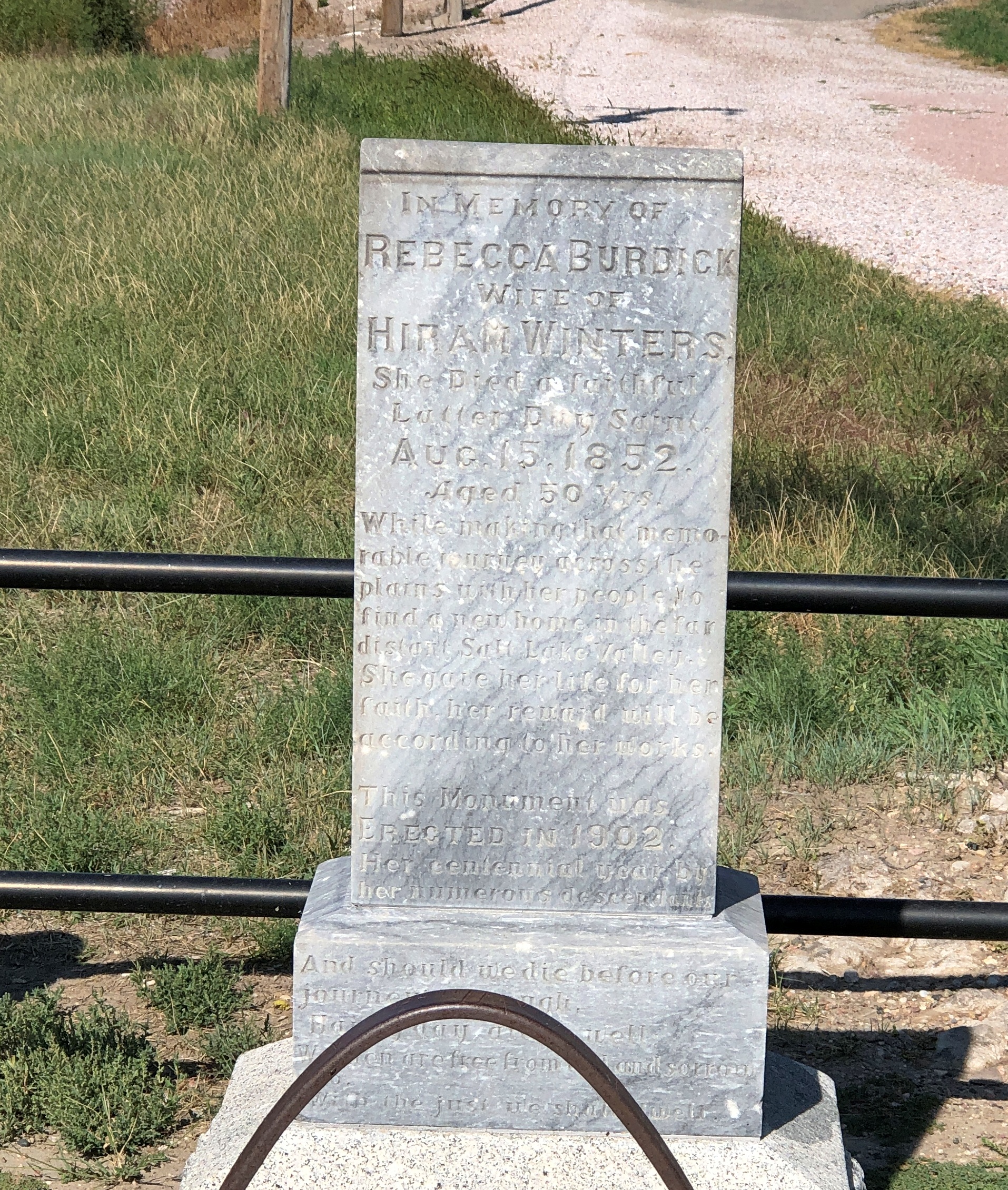
The grave of Rebecca Burdick Winters (d. 1852) She died a faithful Latter-Day Saint, her stone says, on her way to Utah. Officially, it is Rebecca Winters Memorial Park.
“Seven miles northeast of Scotts Bluff National Monument lies a solitary grave,” says Find a Grave. “This site marks the final resting place of Rebecca Winters, who died of cholera on August 15, 1852. Rebecca was only one of thousands of people who succumbed to disease as they made their way west on the overland trails, but her grave is one of only a few that remains identifiable today.”
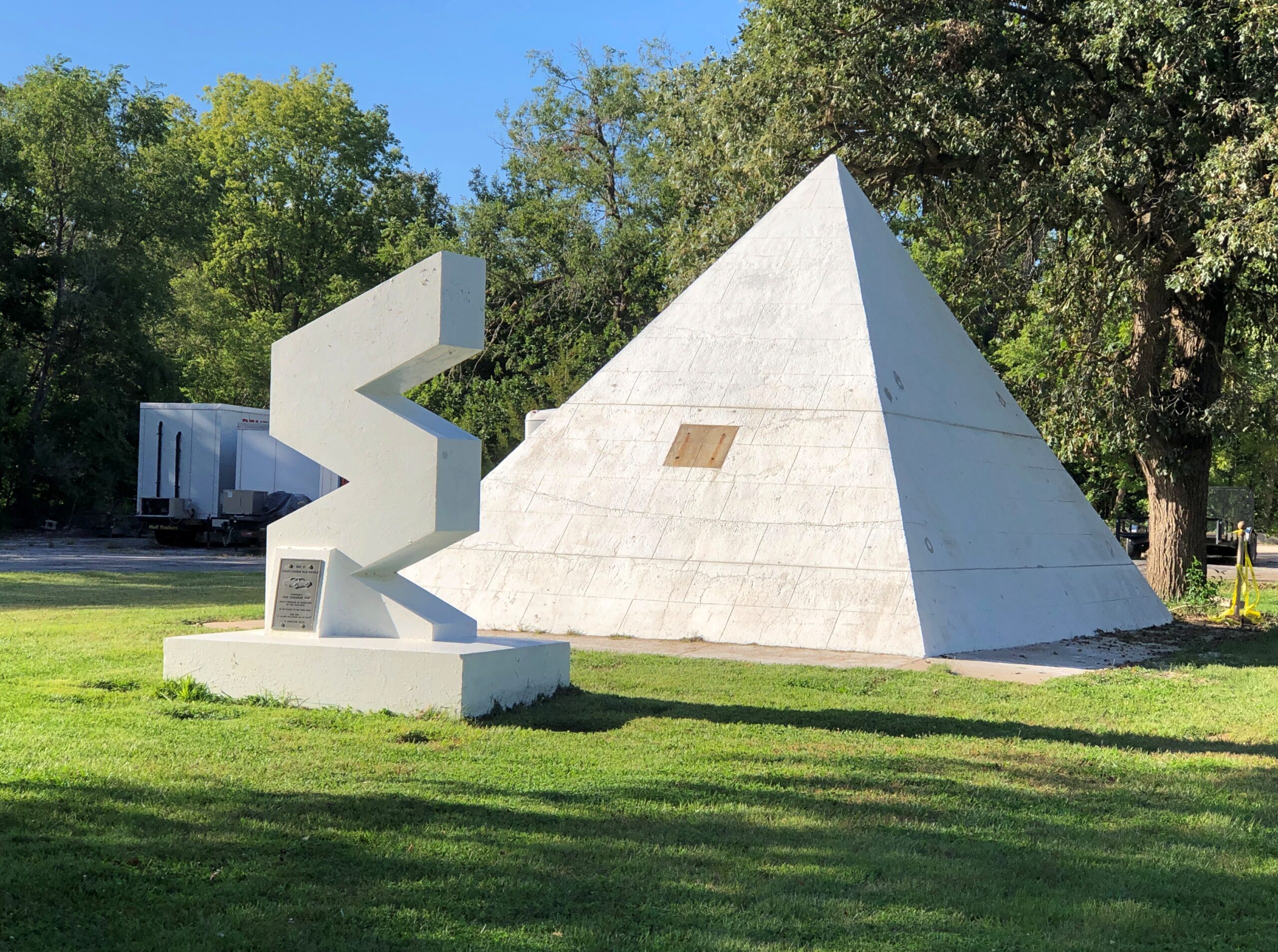
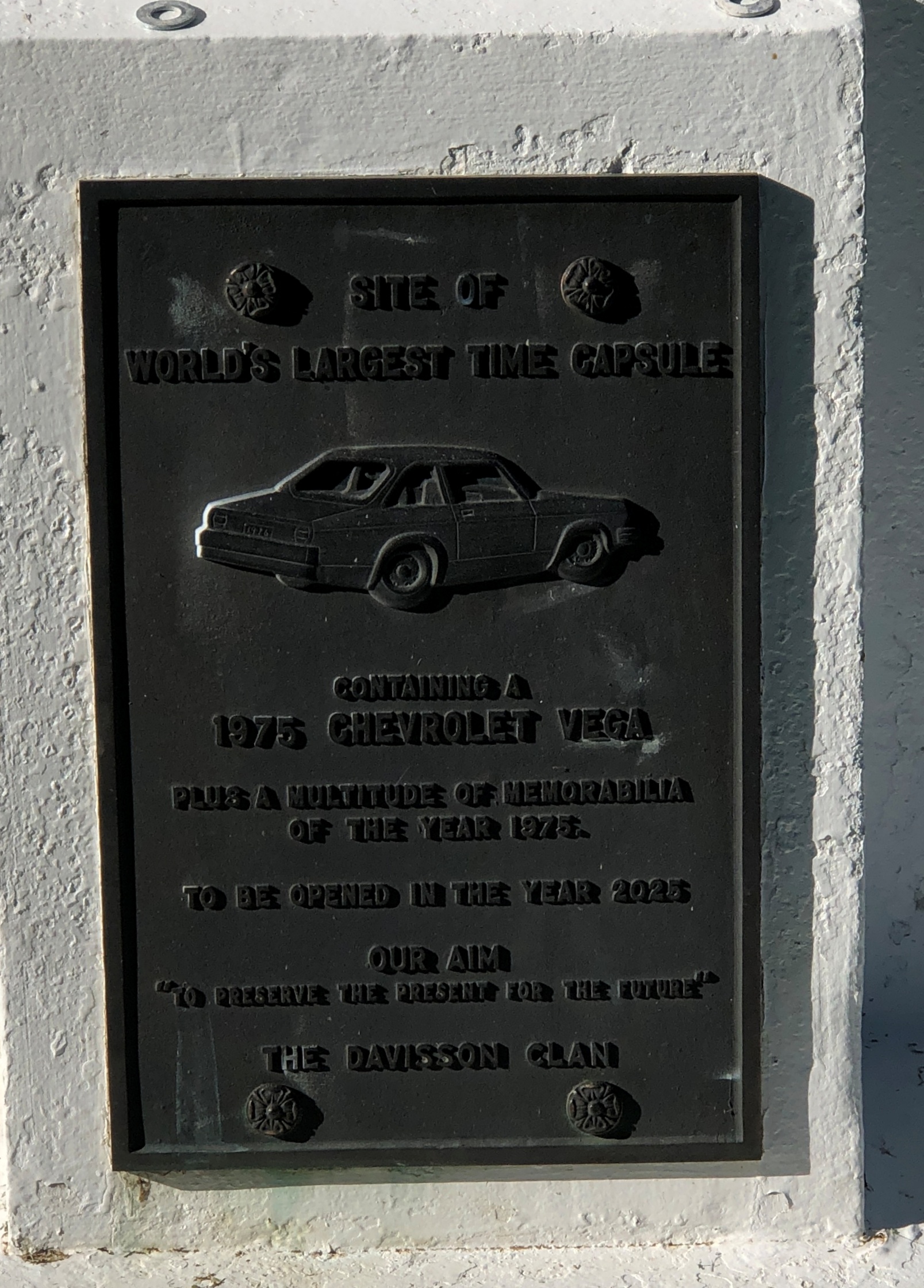
There I was, in Seward, Nebraska, parked on a side street lined with single-family houses. Interrupting the pattern of houses was a large open space, with buildings behind it — a large house, and maybe a workshop. In the open space, which was a green lawn, stood a sigma-shaped structure, and behind that, a white pyramid.
Both taller than a grown man. A plaque was fixed to the sigma. From the point of view of the time capsule, the sigma shape could be a 3. So – third millennium?
World’s Largest Time Capsule.
I wasn’t quite sure what to make of that claim. The world’s largest time capsule would surely be the one entombed in 1939 at the New York World’s Fair for an opening in the year 6939, an exercise in official optimism if I’ve ever heard of one. Wouldn’t it? No. It grew in my memory, but was actually quite small. The Crypt of Civilization instead might be a candidate for largest.
Anyway, there’s no doubt Seward’s is a whopper among time capsules.
The capsule, buried by Seward resident Harold Davisson, had more modest ambitions, time-wise, than the NY time capsule: only 50 years. Looking at the plaque, I wondered if the opening, promised for this year, was going to happen.
Later I learned that it had already happened, earlier in the summer. NBC reported that the opening revealed “letters, pet rocks, artwork, a groovy teal suit and even a yellow Chevy Vega.” A video of the opening of the time capsule, and the removal of its contents, has been posted to Facebook. The opening including removal of the car, by means of an enormous wench. News reports suggested that Vega was going to be reconditioned and run during the town’s bang-up Fourth of July festivities. Hope so.
The pyramid lid had been put back on. If you look closely, you can see the line marking the bottom of the lid. Put it back on expertly, since you have to look closely to see there was a separation. So I missed the grand opening by a few weeks. As they say in those parts of Nebraska, c’est la vie. Hard to attend an event you’ve never heard of, though not impossible, as I found out years ago when I happened across Northalstead Market Days one summer day. That one was an eye-opener.
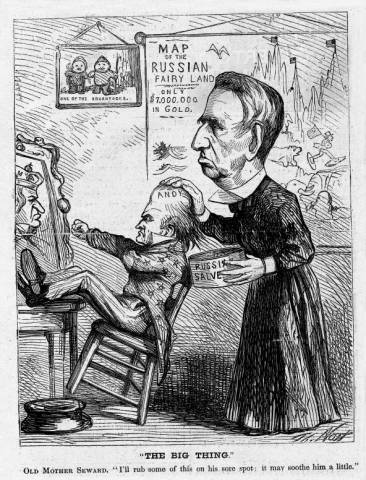
The Big Thing, Thomas Nast, 1867
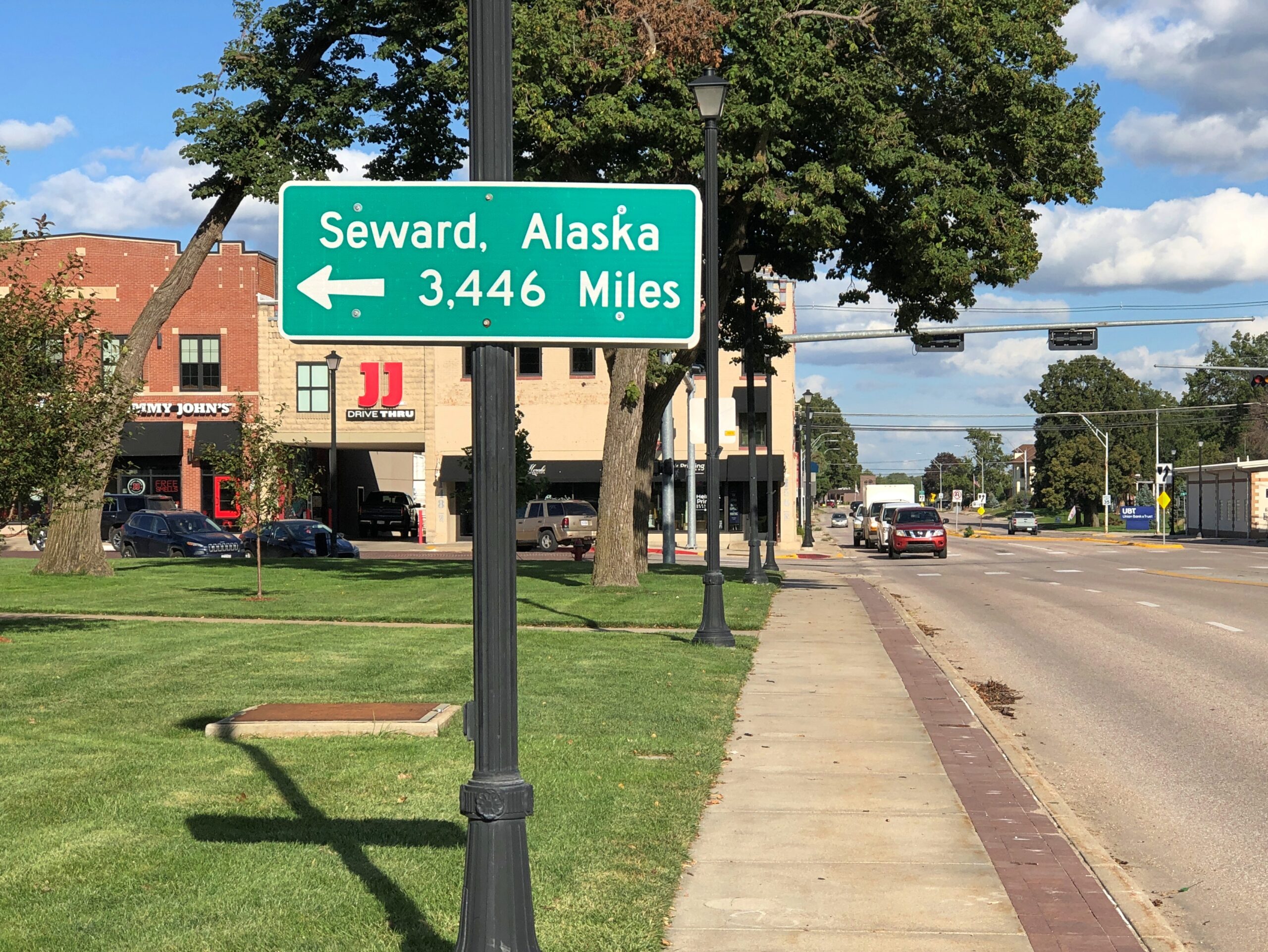
Seward honors the Seward of Alaska purchase fame, though if pressed I’d bet most Americans have sort of maybe heard of him, but don’t remember anything about him, even though he (likely) still gets passing mentions in school.
Seward, seat of Seward County, there in the populous (for Nebraska) southeast corner of the state, is close to Lincoln – fitting, isn’t it? – and I-70.
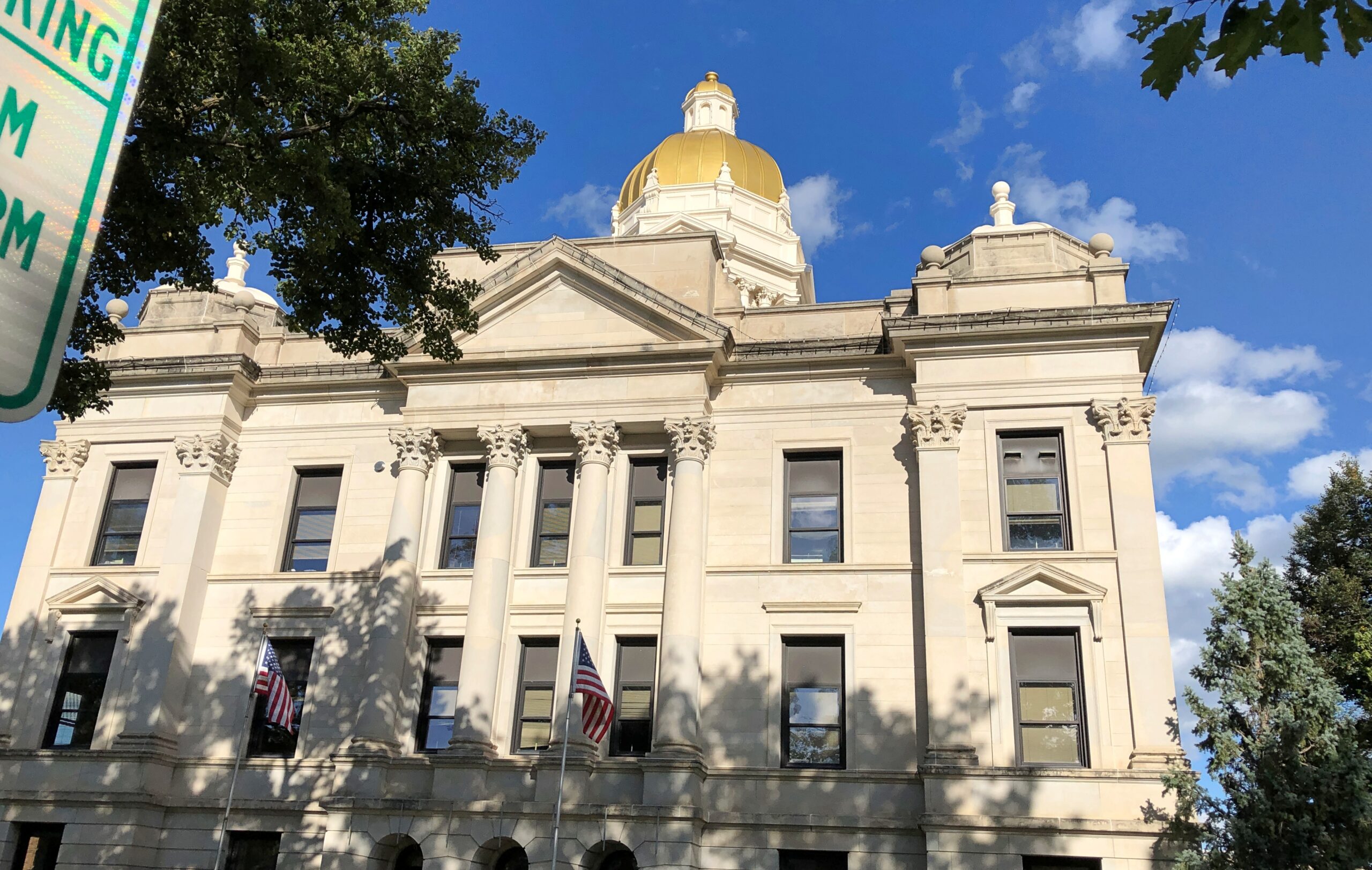
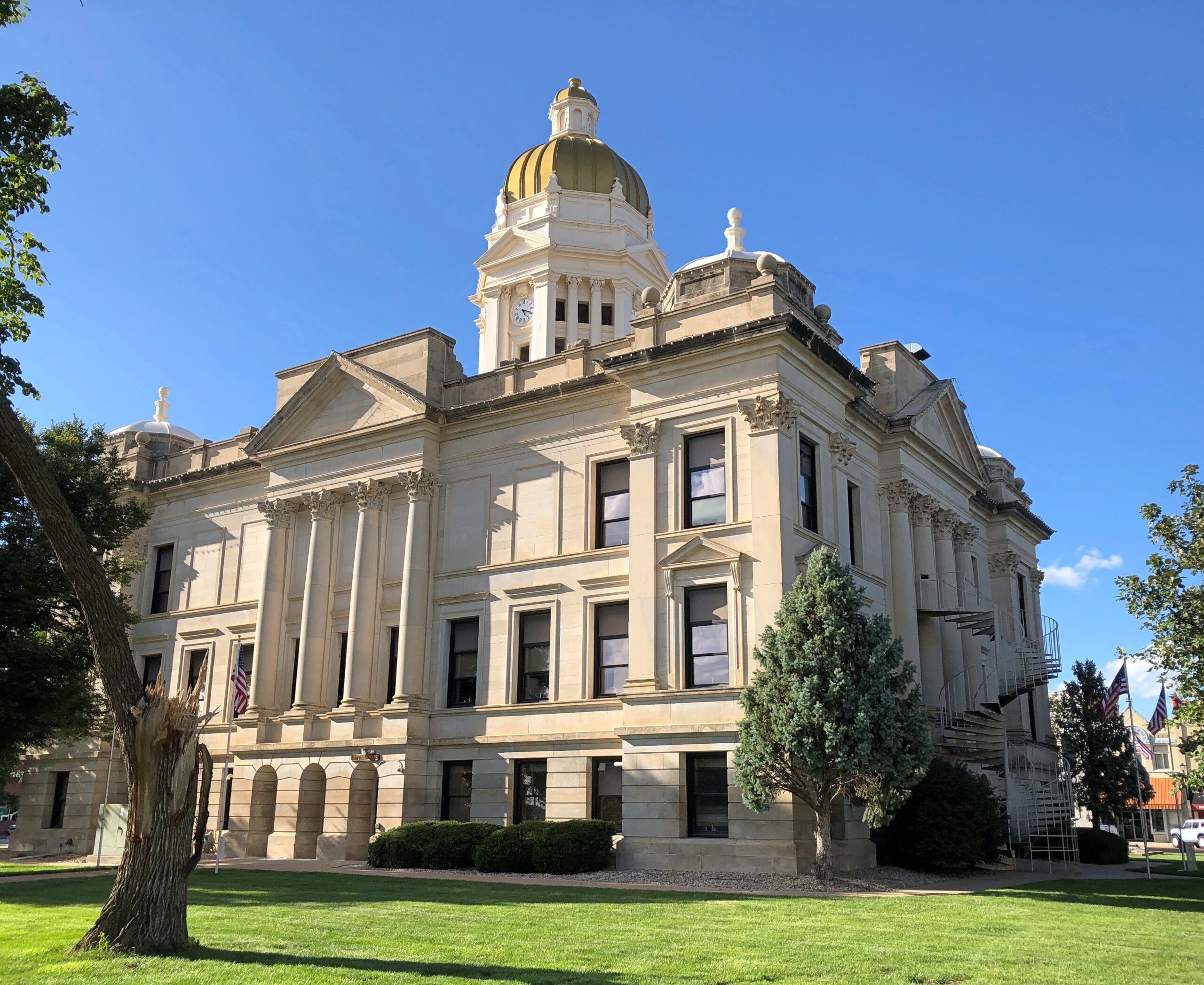
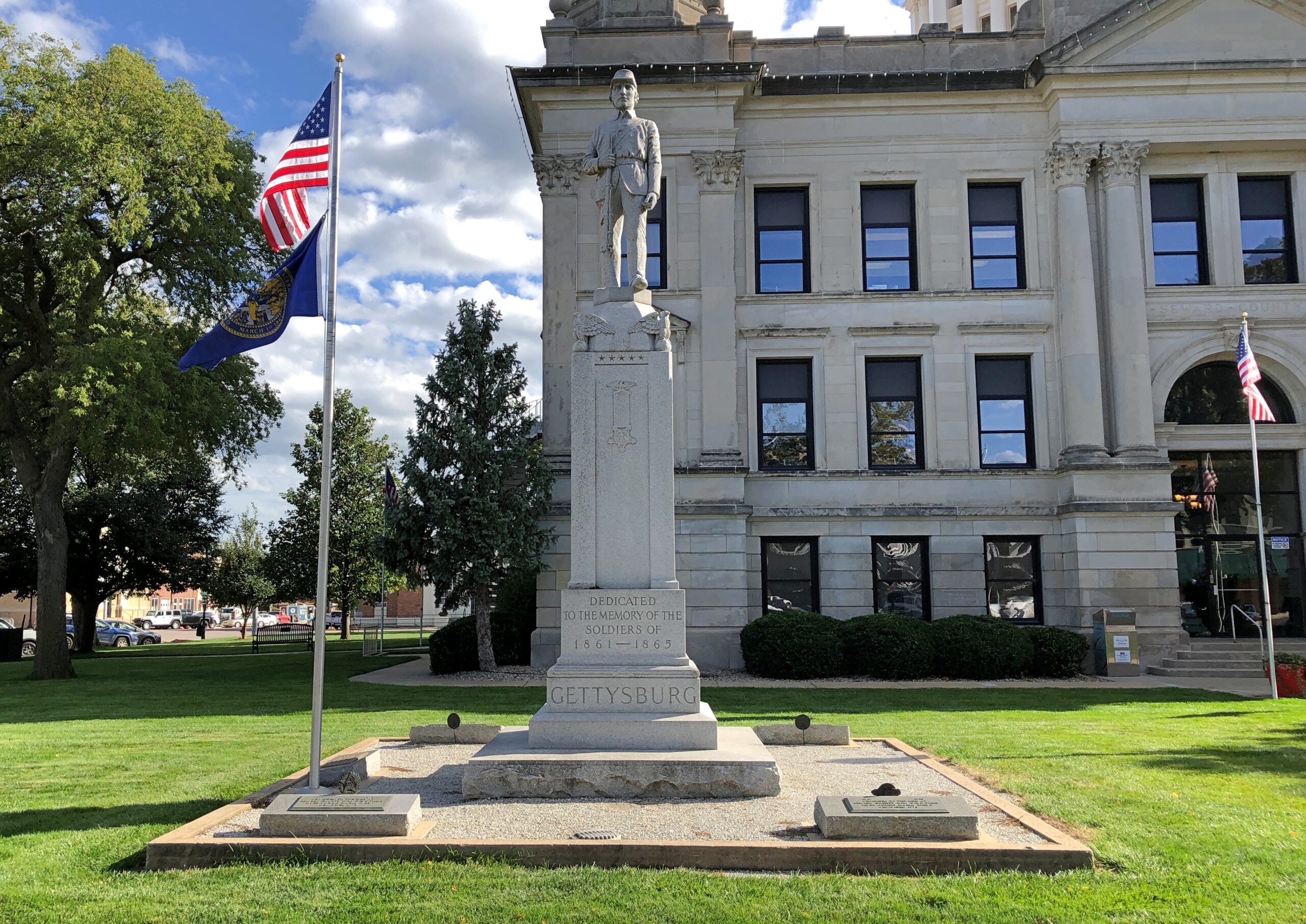
Seward County built itself a handsome courthouse, once upon a time. Classical Revival when the getting was good for that style, in the first decade of the 20th century. It was a popular style around this part of Nebraska at the time, with the National Register of Historic Places Registration Form telling us there are 18 buildings like it still extant in Nebraska. Architect George Berlinghof (d. 1944) designed a lot of them, including this one.
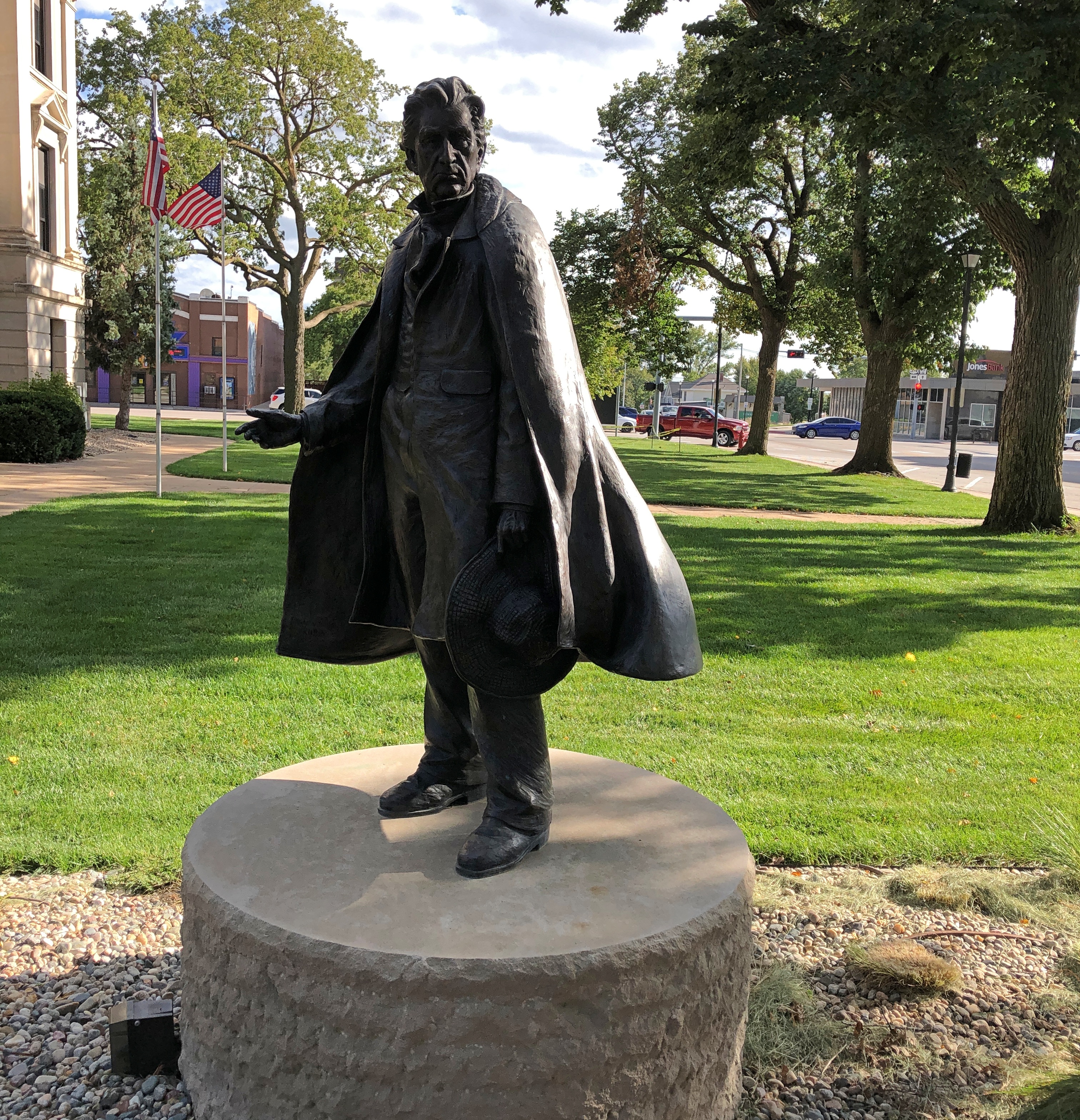
On the grounds, Seward in bronze. I know there are other statues of Sec. Seward, but not that many.
Sporting a cape. How many bronze figures honored with public statues are in capes? More than I know, probably. The Maid of Orleans in New Orleans comes to mind; she’s wearing a cape, over that armor.
A plaque identifies the artists, brother and sister David and Judith Rubin, and the vintage, recent. Alaska commissioned them to do one of Seward for the 150th anniversary (2017) of the sale of Alaska to the United States. Interested parties in Seward, Nebraska, wanted one for the their town, and so commissioned another one.
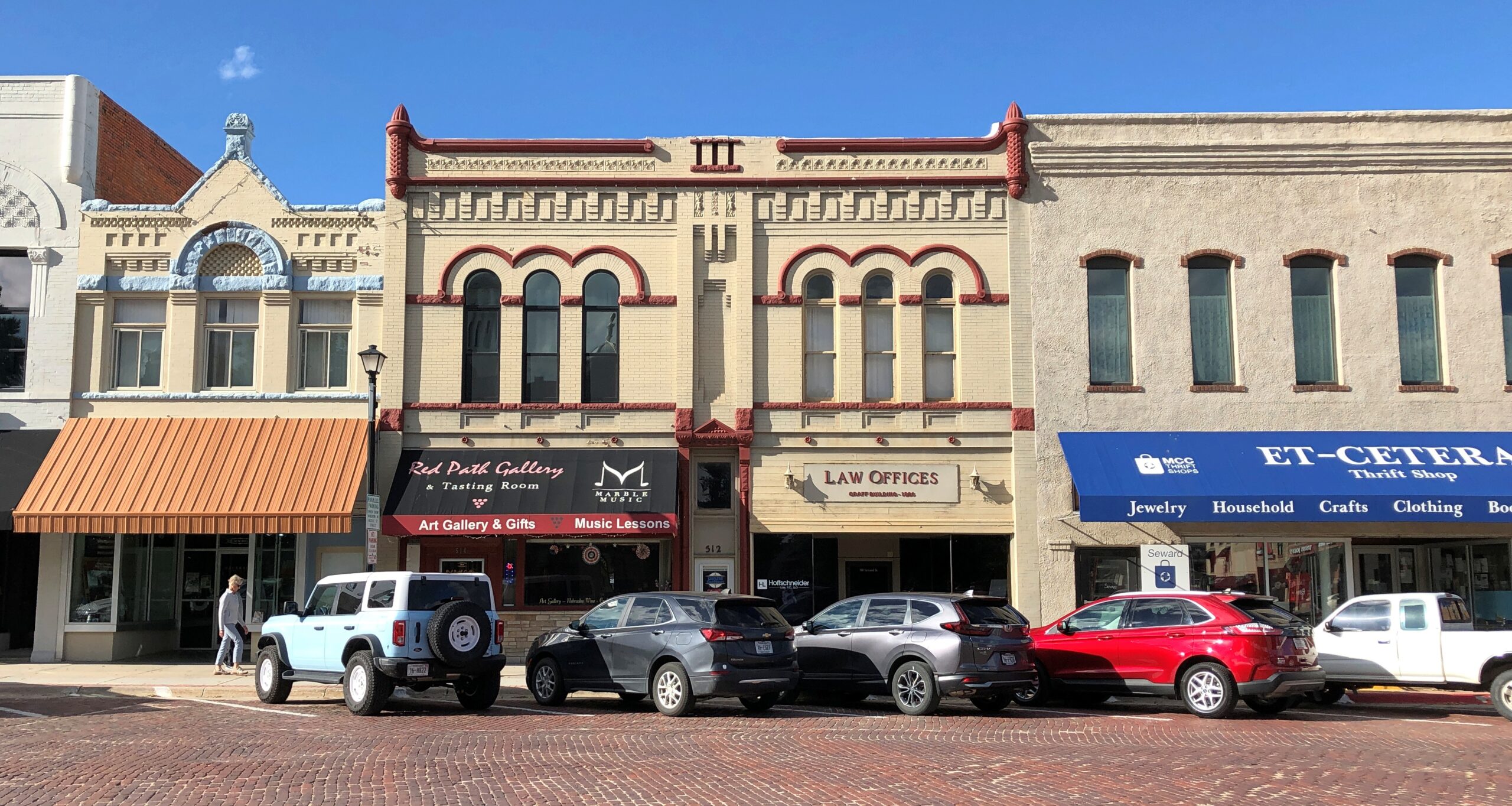
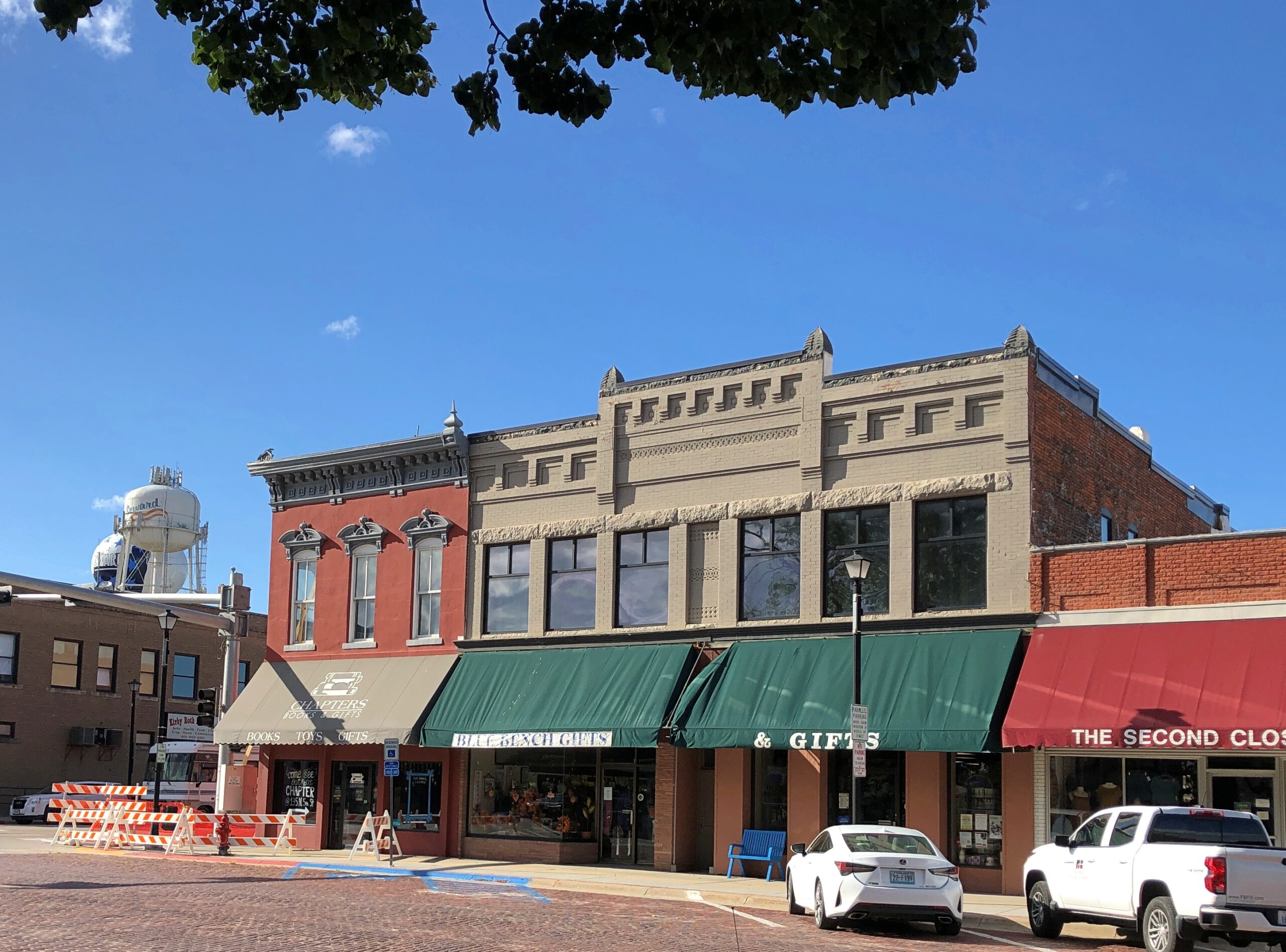
The square is right handsome, too.
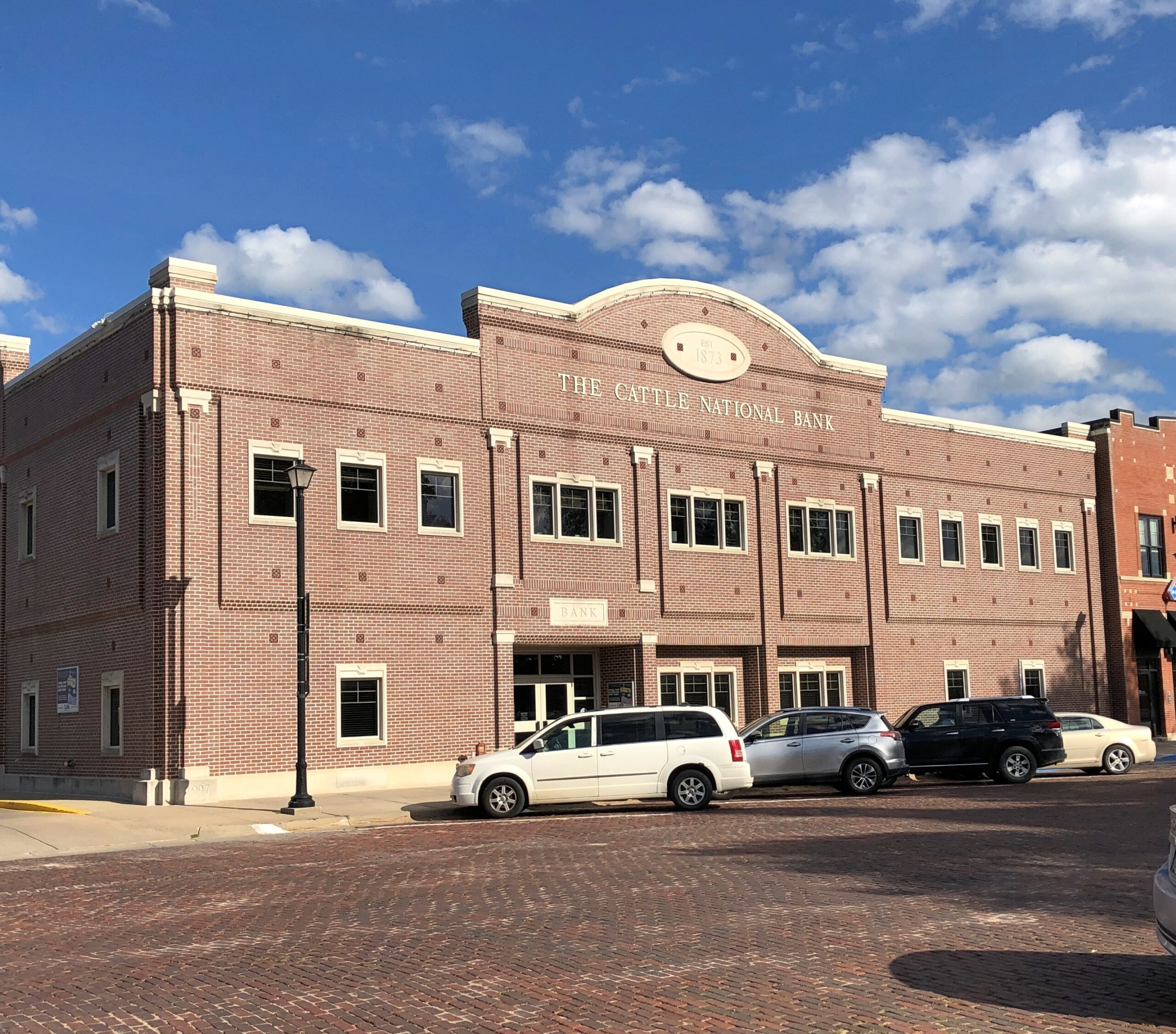
Cattle National Bank. Reminds me of Gary Larson, somehow. I’m glad to report that it’s one of four locations for Cattle National Bank & Trust, a community bank owned by the Cattle family. Has been since 1881. If I lived in Seward, I’d bank there just for the name.
One more thing about Seward. This isn’t the one further north.
Seward was a flyby on September 5 on the way to Grand Island, Nebraska, that evening, which would be the jumping off point for my drive through the Sandhills. The highlight of my short stay in Grand Island wasn’t the false alarm that got us all out of our rooms at the motel around 10, thrilling as that was, but the next morning, on my way out of town.
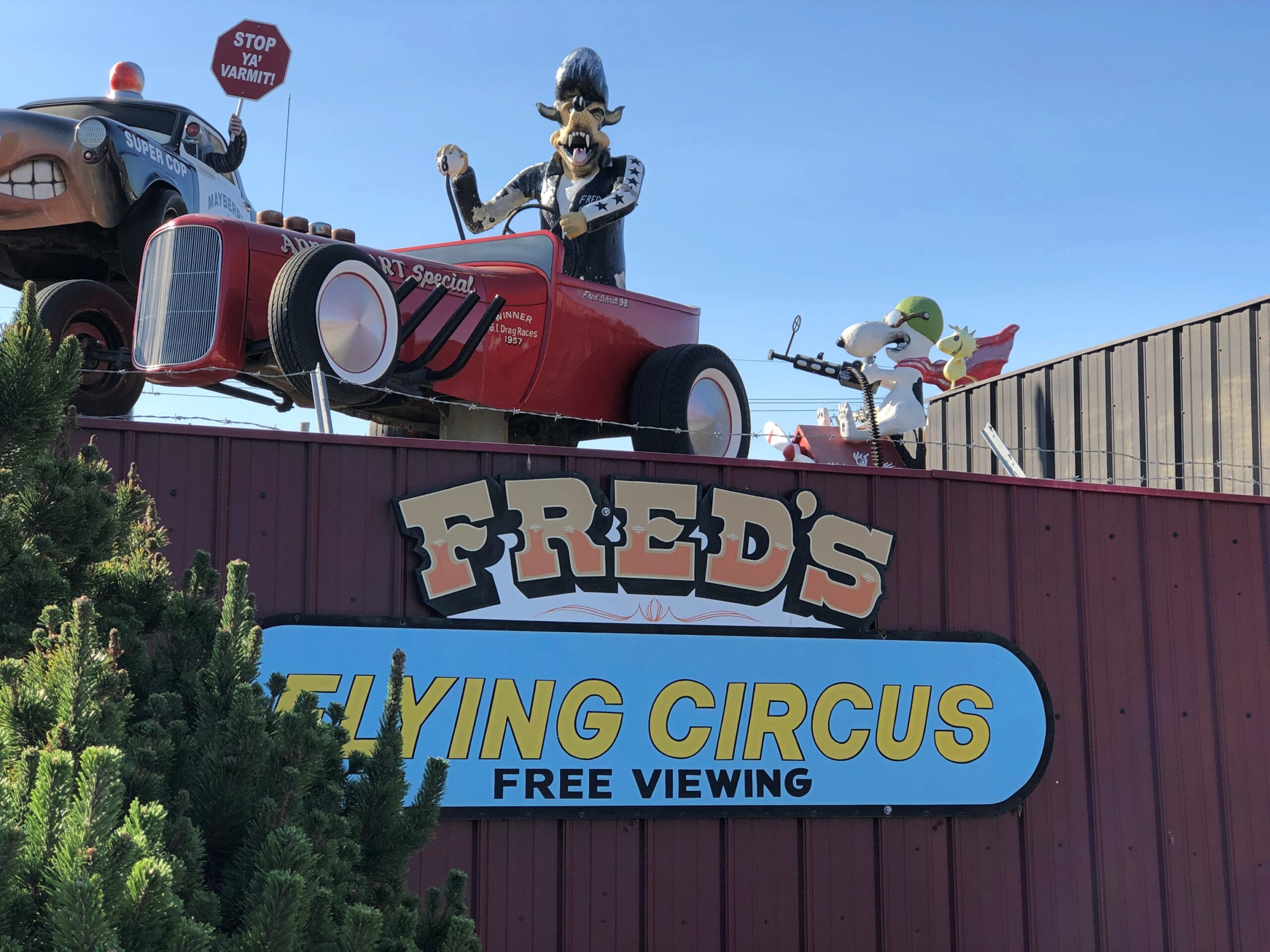
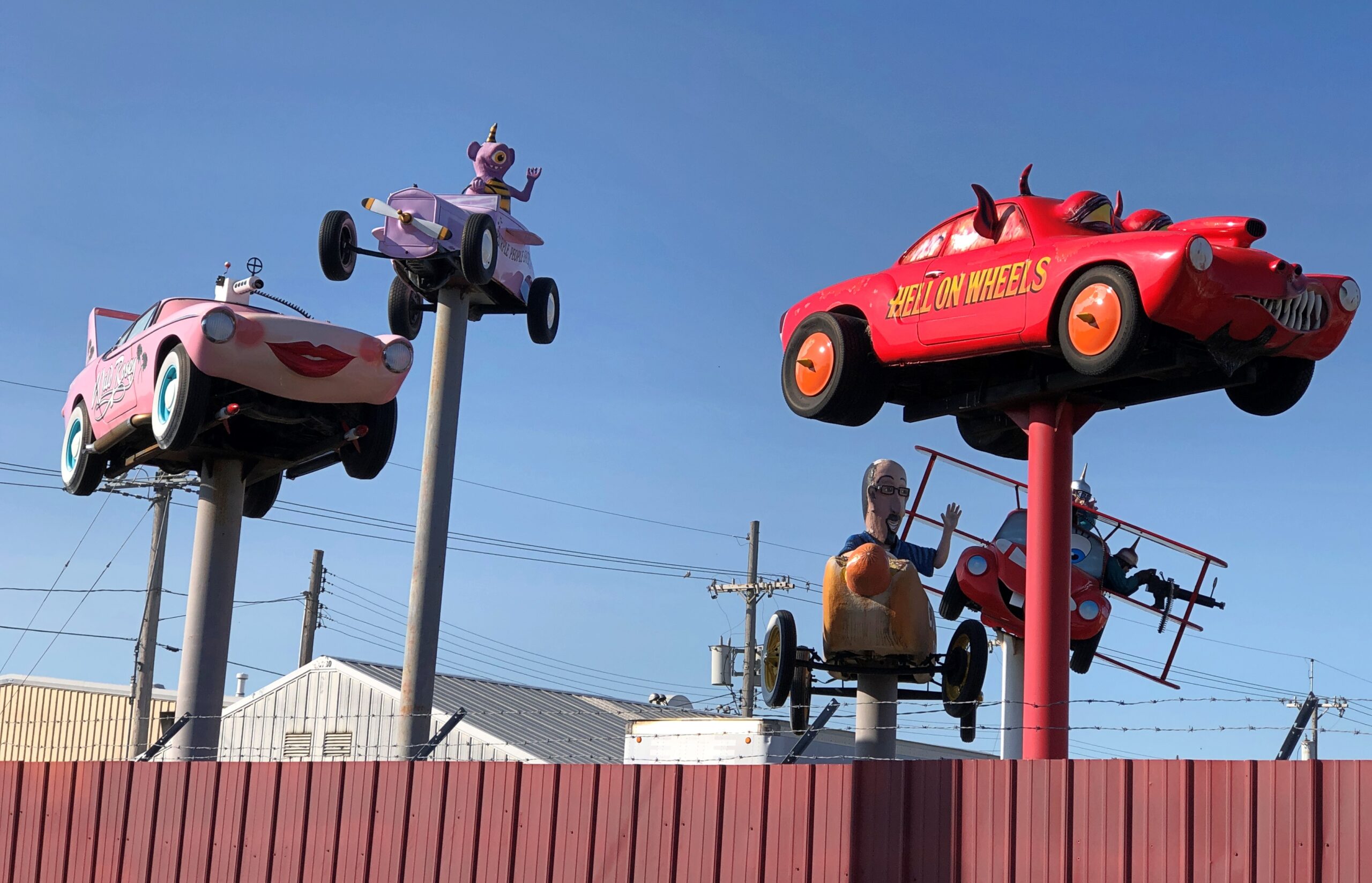
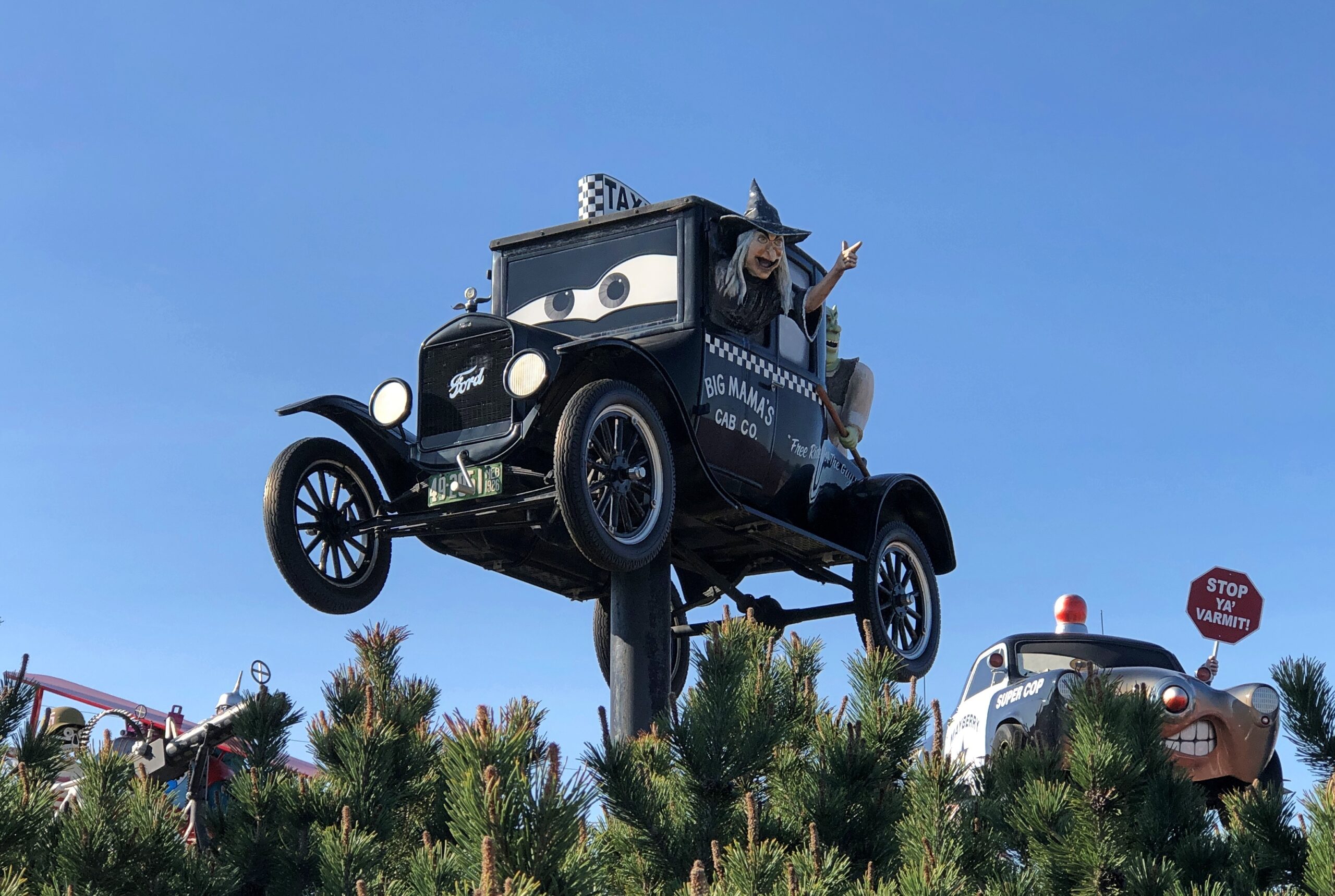
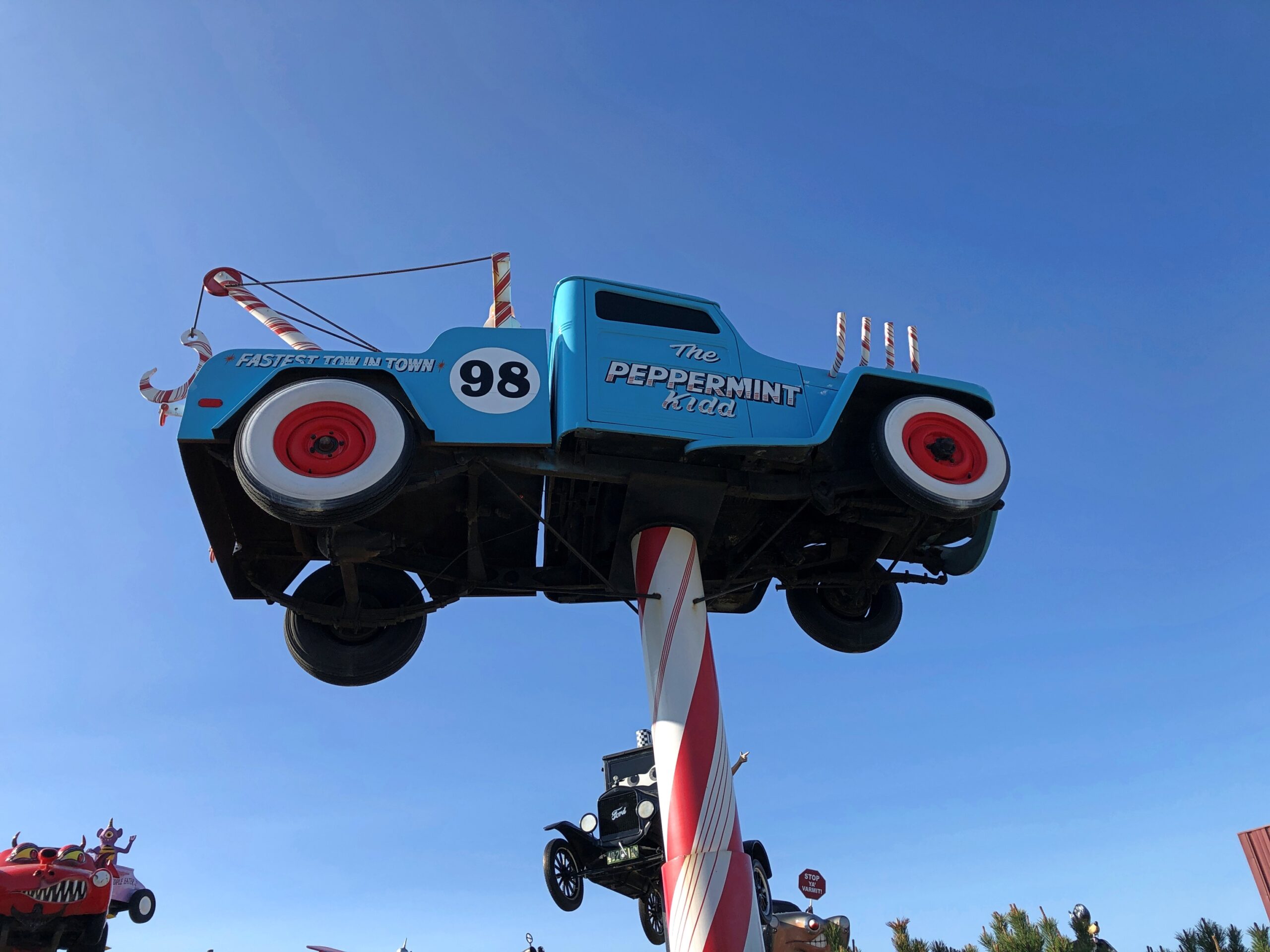
I’ll give credit where it’s due: I found Fred’s Flying Circus on Google Maps. Attaboy, algorithm.
The work of body shop proprietor Fred Schritt (d. 2016), on his place of business, with the shop now run by his daughter and son-in-law. An informal sort of memorial to the old man, I hope they believe. One of the more cheerful memorials you’ll see.