A Wad of Paper Circulars

We still get a paper newspaper some days of the week, and last Wednesday’s newspaper was the heaviest I’d lifted off the driveway in years. It was a regularly sized mid-week paper supplemented by a weighty array of circulars, mostly from retailers fighting the battle against stagnant physical-store sales, though of course most have online sales as well.

They included (no special order): Macy’s, World Market, Sprint, Carson’s, The Dump, Best Buy, Abt, Duluth Trading, La-Z-Boy Furniture Gallery, AT&T, JC Penney, Kohl’s, Guitar Center, Mattress Firm, Bed Bath & Beyond, The Tile Store, Home Depot, Fannie May, Verizon, Sears, Art Van Furniture, Ulta Beauty, JoAnn, Staples, Office Depot/Office Max, Ashley Homestore, Value City Furniture, Walgreen’s, Sleep Number, Kmart, Walmart, HOBO (Home Owners Bargain Outlet), Bose, Toys R Us, Lowe’s, CVS and Target.

Some of these retailers aren’t just fighting to keep their physical stores busy, but against ending up in the dustbin of retail history. If you know even a little about retail, you can guess which ones those are.

The only one on the list I’d never heard of was The Dump. It calls itself “America’s Furniture Outlet.” As far as I can tell, there’s only one in the Chicago area, in west suburban Lombard. The brand is in nine other markets around the country and, strangely enough, notes its web site: “Regular stores open every day of the week and you pay for. [sic] We are only open Friday, Saturday, and Sunday, which keeps our cost of doing business down.”

The Illinois Heritage Grove

At Spring Valley Nature Sanctuary is the Illinois Heritage Grove. A sign there says that the grove “represents a sampling of native Illinois trees and shrubs specifically adapted to our climate and soils.” It’s a modest enclosure, with an oval footpath making its way around the grove.
Illinois Heritage GroveSpring or summer might have been the time to take pictures at the Illinois Heritage Grove, but there’s also something intriguing about bare trees. This is a cockspur hawthorn, Crataegus crusgalli.
Illinois Heritage GroveA surviving American elm tree, Ulmus americana.
Illinois Heritage Grove-elmThe USDA explained that “shipments of elm tree logs from France to Cleveland, Ohio, accidentally introduced the fungus into the United States in 1931. Within 4 to 5 years, scientists could trace the logs’ trip inland by looking at elm trees along the railroad route. The death trail ran all the way to furniture manufacturers in Cleveland and Columbus, where the imported elms were used for making veneer.

“By 1980, Ophiostoma ulmi — the fungus that causes Dutch elm disease — had virtually wiped out 77 million American elms. The loss of those prized shade trees denuded hundreds of tree-lined streets in towns and cities across the country.”

White ash, Fraxinus americana.
Illinois Heritage Grove - ash treeThe species in North America is under siege by the dread emerald ash borer. We’ve had personal experience with the loss of ash trees, ones we used to see every day near our front yard.

A black maple, Acer nigrum.
Illinois Heritage GroupNote the brass plaque hanging from the tree. It says:

IN LOVING MEMORY
CHRISTOPHER M. STANCZAK
6/6/76      5/19/95

I don’t know why his family, or friends, decided to memorialize him that way, but there it is. A modest search reveals that Christopher died in a car accident in Oklahoma, and is buried at Saint Michael The Archangel Catholic Cemetery in Palatine, across the road from the smaller St. John UCC Cemetery.

That’s entirely too melancholy a note on which to end. Here’s a little whimsy, then. I’d never heard of Bird & McDonald until today, but that’s what YouTube is for. Not sure when the clip was made, but with Redd Foxx in it, and from the looks of things, ca. 1980.

Spring Valley Fall

I find myself at the Spring Valley Nature Sanctuary in Schaumburg fairly often, because it’s close by and pleasant. I’ve heard a bird soap opera there, seen statues draped in winter clothes, and noted the aftermath of a controlled burn. I saw a frog looking like a bit of driftwood and encountered the glorious peonies during the warmer months, but also experienced the place in the bleak mid-winter.

Sunday was clear and not exactly warm, but it wasn’t cold either, so we thought Spring Valley would be just the place. Fall is well advanced, even though it hasn’t been so cold this month, not even quite freezing.

Spring Valley Nature Center Schaumburg

Spring Valley Nature Center SchaumburgBut not quite all the leaves have taken leave.
Spring Valley Nature Center SchaumburgAt the Volkening Heritage Farm, which is part of the preserve, the animals were enjoying the mild day.
Spring Valley Nature Center SchaumburgSpring Valley Nature Center SchaumburgThe pigs might not have been so placid if they’d realized that next weekend is the “From Hog House to Smokehouse” event at the farm. According to the Schuamburg Park District, “Visit the Heritage Farm to find out where bacon comes from and help preserve food and meat for winter as they did in the 1880s. Visitors will make sausage, smoke hams and learn other pork-related activities.”

I don’t think they’ll baconize all of the pigs. Just a number of them, as farmers would have in the 1880s. No preternaturally intelligent spider is going to come along to save any of them, either.

Four Houses of Worship

A number of churches — and other houses of worship — were part of Open House Chicago. That’s one of the attractions of the event, as far as I’m concerned.

In Evanston, we visited First Presbyterian. It’s not just a church. It’s a Daniel Burnham church.

First Presbyterian, Evanston

The church’s web site says, “In July 1876 a new church building was dedicated after the original church burned down. However, this church only stood for 18 years. In February 1894, the second church burned to the ground [and maybe sank into the swamp]. The congregation met in a former roller rink while our current building was being constructed, at a cost of $80,000. Daniel H. Burnham, the famed architect who was the inspiration for Chicago’s lakefront, designed the new church.

“The church is constructed of Lemont limestone, with an interior finish of red oak and Georgian pine. The sanctuary is ninety by seventy-five feet, and with the balcony, seats eleven hundred persons.” A lovely sanctuary it is.
First Presbyterian EvanstonWith a lot of stained glass. This wall includes the Old Testament collection.First Presbyterian, Evanston

In the Uptown neighborhood of Chicago is the Buddhist Temple of Chicago. I’m pretty sure we visited there ca. 1997 during a Japanese cultural festival (I remember the taiko drummers especially). Seems that there’s an new building on the site now, or newer anyway, built 10 years ago. The religious organization goes back much further, to when Japanese and Japanese-Americans forced off the West Coast resettled in Chicago.

A fine altar.Buddhist Temple of ChicagoAnd a nice collection of wood panels. This one illustrates Gautama under the Bodhi Tree.

Buddhist Temple of Chicago

In the Rogers Park neighborhood of Chicago, on the same street and the same block — Lunt Ave., near Ridge — are St. Jerome, a Catholic church, and the local HQ of the International Society for Krishna Consciousness (ISKCON Chicago).

Here’s St. Jerome, a century old this year, with its Italian Renaissance exterior. The architect was one Charles H. Prinderville.St. Jerome, Chicago

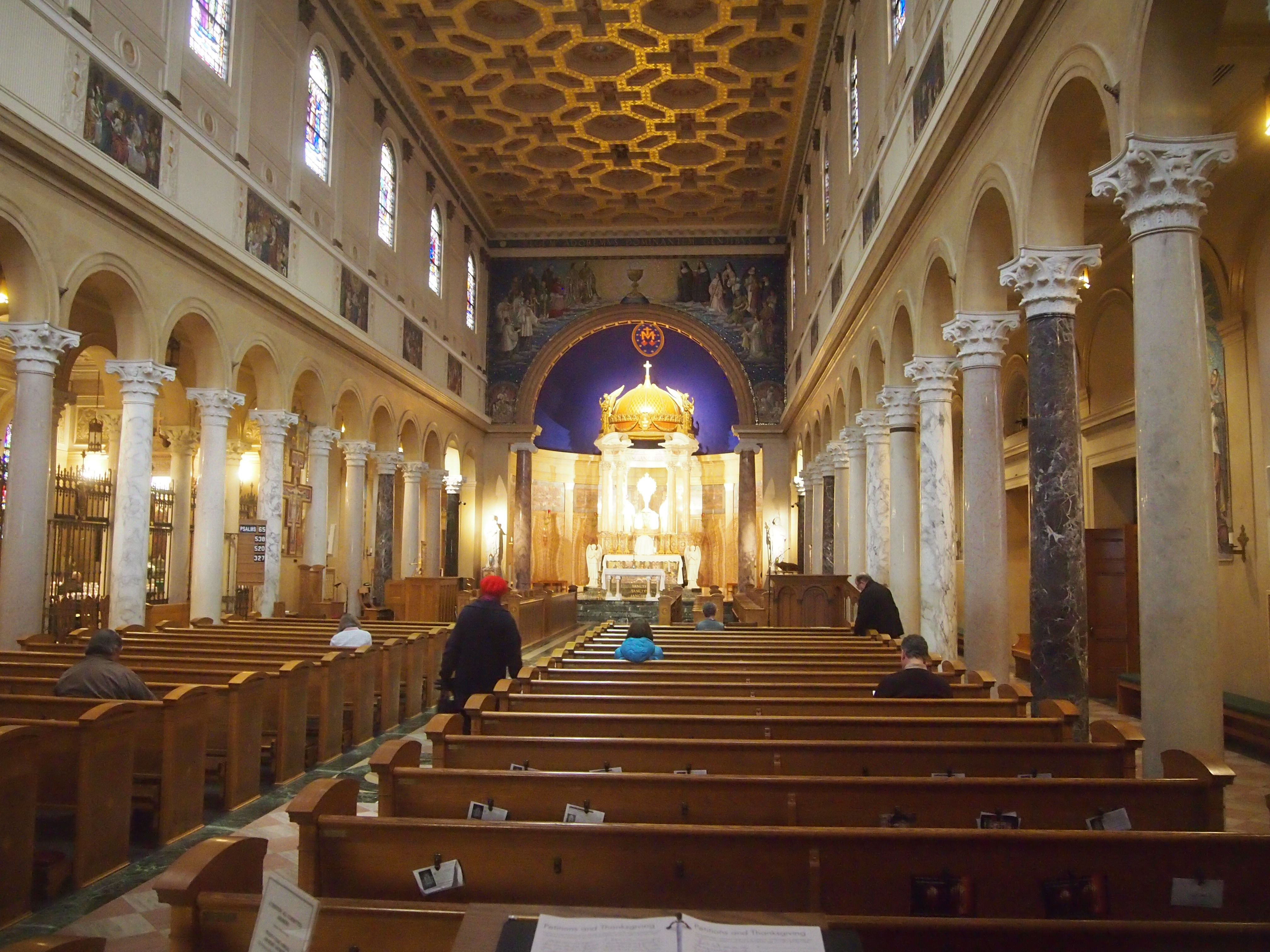
Inside, an ornate Baroque sanctuary. At some point, the building was lengthened, becoming one of the longer church buildings I’ve seen lately.

St Jerome, Chicago interior

Practically across the street, the devotees of Krishna do what they do. Until 1980, the structure was a Masonic temple. Now inside you can see depictions of Sri Kishora, or the youthful Krishna, and Sri Kishori, or the youthful Radharani.

ISKCon Chicago

Then there’s this fellow.

ISKCon Chicago

That’s an awfully lifelike statue of Abhay Charanaravinda Bhaktivedanta Swami Prabhupada (1896-1977), whom you might call a Vaishnavite Hindu missionary to the West. He seems to have done well with that.

I can’t resist one more thing: cutting and pasting his name here in Sanskrit (according to Wiki, anyway), just because I can: अभय चरणारविन्द भक्तिवेदान्त स्वामी प्रभुपाद

The Frances Willard House Museum & The Levere Memorial Temple

Here’s something I learned last Saturday while making the rounds at Open House Chicago. Learned it in fact at the first place we visited. Namely, the Women’s Christian Temperance Union is still in existence.

If you’d asked me beforehand, I would have put the WCTU in the same class as the GAR or Godey’s Lady’s Book or Lydia Pinkham’s Vegetable Compound or other things without much purchase beyond the early 20th century. Not only is the WCTU still around, the organization’s HQ is in Evanston, and it owns the Frances Willard House Museum, which is a few blocks south of the Northwestern campus.

Frances Willard House Museum

Frances Willard was one of the founders of the WCTU. As the organization’s web site says, “Willard recognized, developed, and implemented the use of the Woman’s Christian Temperance Union as a political organizing force. Under her leadership, the Union increasingly saw its role as an organization advocating for broad social as well as political change.”

Frances Willard House MuseumThat is, she wasn’t the one who took a hatchet to saloons, but I’m sure she smashed them in other ways. She had a handsome home in Evanston, built in 1865 and made a museum only two years after Willard’s death in 1898. Clearly, the other members of the WCTU held her in high regard. Some artifacts are in place, such as this typewriter.

I like to think Frances Willard banged out some anti-demon rum polemics on it, but I’m not sure it looks old enough to be a late 19th-century machine. Maybe WCTU writers used it later to assure everyone that Prohibition was going swimmingly.

According to the volunteer on hand at the house, the place wasn’t open very much until recently, when it was cleaned and refurbished. Now the museum seems to be actively trying to attract visitors, which must have been the reason it was part of Open House Chicago. All the years I’ve visited Evanston I’d never seen or heard of it. Now I have.

At the other end of the alcohol appreciation spectrum is the national headquarters of Sigma Alpha Epsilon, which is closer to Northwestern — across the street, in fact. It too was part of Open House Chicago.

SAE HQA lot has been written about the SAEs lately, such at Inside Higher Ed, which noted that “there’s nothing quaint about the nicknames SAE has these days — on many campuses people say the initials stand for ‘Sexual Assault Expected’ or ‘Same Assholes Everywhere.’ ” (Then again, if you hold the entire frat responsible for the actions of a few, aren’t you badmouthing the United States of America?)

Whatever else you can say about the SAEs, they’ve got a swell national headquarters building, including a library, museum of frat artifacts, meeting and office space, and elegant chapel, which is called the Levere Memorial Temple. It was designed by Arthur Howell Knox in 1930.

Open House Chicago says of the structure: “This understated Gothic-Revival building sits across from Northwestern’s gate. It was the vision of Billy Levere, a Temperance preacher with a key role in the history of the Sigma Alpha Epsilon fraternity… [temperance again? Maybe there’s a ritual toast to Levere at SAE keggers.]

“It was the first national headquarters building of any fraternity (a use it still serves today). It was also a memorial for the fallen of World War I. A local architect and fraternity member designed the building, including its colorful chapel with a large but uncharacteristic collection of Tiffany windows that narrate the history of America and Sigma Alpha Epsilon.”

The fact that it’s called a “temple” led to some discussion with Yuriko about whether the structure was actually some kind of church — it certainly looks like one, complete with pews, stained glass, religious art, and an altar. No, I offered that whatever the SAEs call it, it’s a chapel. No one meets there regularly for services, after all, and I doubt that it’s been consecrated.

I was interested to see that the stained glass windows on one side started by honoring the soldiers of World War I, but didn’t stop there. In fact, there was a window for Persian Gulf War soldiers.
Levere Memorial TempleAnd Vietnam.
Levere Memorial TempleAnd Korea and WWII, going all the way back to WWI. Behind the altar is stained glass with a Union soldier on the left, a Confederate soldier on the right, and Jesus in between, with Pax Vobiscum on the banner below.

One more thing: hanging on the landing between the first and second floors is a painting of President McKinley.

Levere Memorial TempleHe’s the only U.S. chief executive that the fraternity counts as a member, having joined at Mount Union College during his short time there.

The Dearborn Observatory

Nestled among a thicket of other buildings at Northwestern University is the Dearborn Observatory. Whenever you can, visit an observatory. So we did on Saturday, since it was part of Open House Chicago.
Dearborn Observatory 2016This particular building goes back to 1888, with the aluminum dome was added only in 1997, though there must have been some other dome before that. The story of the telescope inside goes back further. The remarkable Frederick A.P. Barnard, chancellor of the University of Mississippi, tasked the also remarkable Alvan Clark & Sons to construct a 18.5-inch refracting lens for the school, the largest yet made.

That was in 1859. By the time the lens was finished in 1861, Ole Miss (not so ole then, I guess) was in no position to take delivery. Before long the Chicago Astronomical Society bought the lens for a telescope at the Old University of Chicago.

Old Chicago — not the same as the modern university — folded in 1886, and eventually Northwestern got the telescope with the Alvan Clark lens, which it uses to this day. It’s quite a thing to stand in the presence of such a storied telescope.
Dearborn Observatory 2016How storied? The One-Minute Astronomer tells us — even though it mistakes E.E. Barnard for Frederick A.P. Barnard — that “in 1846 Alvan Clark established a telescope factory at Cambridgeport, Massachusetts. Clark and his two sons, with almost no formal training, learned how to build the finest refracting telescopes in the world. Many of their instruments remain in use today…

“Many important discoveries were made with Clark refractors, especially related to binary stars, stellar motion, and planetary studies.

• Asaph Hall discovered Phobos and Deimos, the moons of Mars, with the 26-inch USNO telescope. He also discovered a white spot on Saturn that helped determine the planet’s rotational period.

• Percival Lowell (falsely) observed canals on Mars with the famed 24-inch Clark refractor at the Lowell Observatory in Flagstaff.

• And in 1861, Alvan G. Clark made a 18.5-inch lens for E. E. Barnard [sic] at the University of Mississippi. While testing it, he observed Sirius and glimpsed the faint companion predicted by Friedrich Bessel in 1844.”

Astronomer E.E. Barnard would have been about four years old when Clark was working on the future Dearborn Observatory lens. Oddly enough, I’ve known about him a long time — I happened across a reference to Barnard’s Star when I was in junior high, and wondered, who was Barnard and why does he get a star? Good reasons, it turned out. Alas, no Earth-like planets seem to orbit his star. Much later, I learned that Barnard Hall at VU was named after him; he attended Vanderbilt in its early years.

The Dearborn Observatory is open to the public for viewing on clear Friday nights. It’s a bit far to go to Evanston just for that, but one of these days we might do it.

Open House Chicago 2016

Turns out there are two kinds of building-visiting events in the world, Open House and Doors Open, and a good many cities in a lot of countries participate in one or the other. (Shucks, missed Milwaukee’s — next year, maybe). As far as I can tell, the idea is exactly the same in both cases: one weekend out of the year, various buildings are open — maybe a little more open than they’d usually be — and you can wander in and look around. A really good idea, if you asked me.

I was out of town last year, but participated in Open House Chicago in 2013. Yuriko and I went in ’14, and again this year, on Saturday. This time our focus was Evanston and some sites on the North Side of Chicago. All are parts of metro Chicago that we know well, but no matter how well you know a place, there’s always more to it. First we drove to Evanston, and then on foot and by El train, we managed to visit more than a dozen places new to us.

Including, in Evanston: the Francis Willard House Museum, Sigma Alpha Epsilon National Headquarters (Levere Memorial Temple), Northwestern University’s Charles Deering Library and its Dearborn Observatory, Stone Terrace (an elegant B&B near Lake Michigan), the First Presbyterian Church of Evanston, and the Lake Street Church of Evanston.

In the Uptown neighborhood of Chicago, we had lunch at a good Vietnamese restaurant — there are many around Broadway and Argyle — and then went to the Bridgeview Bank Building, the Buddhist Temple of Chicago, the ICA GreenRise and the Preston Bradley Center (the Peoples Church).

In the Rogers Park neighborhood of Chicago, just as our energy flagged, we managed to make it to the International Society for Krishna Consciousness building and then, practically across the street, St. Jerome’s, a Catholic church just about to start one of its Saturday masses, in Spanish.

With Evanston as target for the morning, we naturally spent a while walking around the still-leafy campus of Northwestern. The university, we saw, was quick to honor faculty member and recent Nobel laureate, Sir Fraser Stoddart.

Sir Fraser Stoddard banner Northwestern University 2016

Among other things, Sir Fraser is known for his work on mechanically interlocked molecular architectures. How it’s possible to understand such things, besides what they are in the first place, is a source of puzzled wonderment to me. But I’m glad there are people who do understand such things.

Sir Fraser’s banner was on Sheridan Road, near the southern edge of the school. From there we went further north, into the heart of the campus, where we chanced on Sir Fraser’s parking space.

This amused me for no good reason. Maybe it’s because Sir Fraser drives a Camry too (and does have a license plate, which I’ve blocked). His looks in better shape than mine.

The Last Days of Kiddieland

Once upon a time, Kiddieland Amusement Park in west suburban Melrose Park featured rides and amusements for small fry, and somewhat older children, for a not-too-outrageous price. The park was around long enough for parents who had been taken as children to take their own children, and come to think of it, grandparents who had been to take their grandchildren.

Not being from around Chicago originally, I didn’t have that experience, but I did take my children three or maybe four times in the late 2000s. I don’t remember for sure, but I think one of Lilly’s friends originally suggested that she go. It was a little far to go very regularly, but not too far for an occasional visit.

Kiddieland was an unpretentious place, with rides such as a small but fast wooden roller coaster, a modest-sized Ferris wheel, a merry-go-round, a Tilt-A-Whirl, small car rides, small boat rides, other things that went up, down and around, and a 14-in. gauge miniature railway (always enjoyable to find a miniature railway; the Brackenridge Eagle rides on a 2-ft. gauge, just to compare). I won’t say Kiddleland was a one-of-a-kind place, because it used to be one of a class of locally owned, pre-Disneyland amusement parks. Yet it was a survivor, in the 21st century, from an earlier time.

I can only speculate why. The park wasn’t that expensive or unmanageably large. The staff seemed well trained and polite. Soda — all you wanted — was part of the price of admission (imagine, say, Six Flags doing that). The rides were entertaining even for small children, a real place in an age of electronic faux places.

Kiddieland might still be around but for a dispute among cousins who owned the place, the grandchildren of the founder. Seems like a strange division: One group owned the amusement park; the other owned the land. When push came to shove, the amusement park owners were shoved off the land, and the park closed for good in late September 2009.

When it was clear that Kiddieland was going to close, seven years ago this month, we went one more time. I think Lilly and her friends ambled around themselves, while I took Ann around. Here’s Ann and a couple of the small-fry rides.
Kiddieland 2009Kiddieland 2009There’s a Costco there now. The land owners were clearly looking for bigger bucks. Generally I’m for the highest and best use of real estate, and I like Costco well enough, but still. Something that could be anywhere replaced something distinctive about a particular place, so the world is slightly poorer for it.

Libertarian on the Thoroughfare

Political signage isn’t all that thick here in the northwest suburbs this year, only a scattering of statewide races, and I hadn’t seen a single presidential sign until the other day. Could be that, since Illinois isn’t remotely in play in that election, no one is bothering.

Then again, there’s a certain house on a small road I’ve been driving by regularly for more than a decade, and every election — every one — Republican signage is prominent in the yard, especially the presidential nominee during those contests. This year, nothing. Maybe they’ve moved. Or maybe their presidential nominee just embarrasses them.

But recently I did see a bit of presidential advertising, near the intersection of Schaumburg Road, a major thoroughfare, and Salem Road.

Gary Johnson Sign made of yellow cups

That’s the more visible part, made of yellow cups stuck in the fence. Less visible, and off to the side in blue cups, is # LET GARY DEBATE.

Queen Elizabeth Cake, NW Suburban Style

A recent birthday cake in our house.

Queen Elizabeth Cake, Deerfield BakeryOne candle because no one could be bothered to come up with some other combination. “It’s for your first half-century,” I told Yuriko.

It’s called a Queen Elizabeth Cake, a creation of the always-talented Deerfield Bakery here in the northwest suburbs. The bakery’s web site tells me that it’s “yellow cake filled with strawberries, Bavarian cream and sliced bananas.” That jibes with my experience of eating some of it.

Also, “a single strawberry crowns this dessert, created by Henry Schmitt in honor of Queen Elizabeth’s visit to Chicago in 1959.” That would be part of the Queen’s tour along the spanking-new St. Lawrence Seaway that year. (A bit of major infrastructure that should be better known; I’d bet that only a small number of kids in Lilly’s dorm, just to pick one sample of people that age, know what it is.)

Henry Schmitt, coming from a line of bakers from Germany, founded Deerfield Bakery in metro Chicago in the 20th century. Apparently his QE Cake was an idiosyncratic take, since elsewhere (such as allreipes.com), I’ve read that the term refers to “a date nut cake… crowned with a broiled coconut topping.”

That sounds good too, but it isn’t anything like the Deerfield Bakery creation.

Queen Elizabeth Cake, Deerfield BakeryWhich is very, very good.