America’s Best Train, Toy & Hobby Shop

As expected, today was frigid, near zero to begin with, and not much warmer as the day ground on. As the Monday holiday for the birthday of Martin Luther King Jr., it’s the sort of day on which school is closed and the mail doesn’t come, but otherwise there was work to be done.

There aren’t many stores like America’s Best Train, Toy & Hobby Shop in Itasca, Illinois, any more. It’s an independent hobby shop, largely but not completely devoted to model trains, with its merchandise stacked floor-almost-to-ceiling along a number of narrow aisles. Tight enough to put off the claustrophobic, no matter how much they like model trains or train toys. The store has new and used model train cars, track, and accessories of all kinds and in various scales, a room devoted to Thomas the Tank Engine toys, Playmobil, Chuggington Station — I’d never heard of that — Lego sets, plastic model kits, and a lot more.

The store has a Maplewood Drive address, but it’s visible from Irving Park Road. I’d driven by it countless times over the years, occasionally thinking, I should take a look. But I never did until Saturday. Lilly, Ann, and I had gone to a music store in Itasca to get some sheet music that Lilly needed, but the store didn’t have it. That was annoying, so I decided to make the best of it by visiting America’s Best Train, Toy & Hobby Shop, which happened to be across the street.

I like model trains — I had an HO scale model at one time, a fairly simple layout — but I was more taken with the shop’s stacks and stacks of plastic model kits. I built some of those as a lad, mostly airplanes, but also a Saturn V. (We also had a kit for the Mayflower than was entirely beyond my talents.) I didn’t spend a lot of time looking at America’s Best Train, Toy & Hobby Shop’s model kits, but my impression is that most were airplanes of one kind or another. I didn’t see an Apollo or Gemini or Mercury or even a Space Shuttle.

There were a few fictional spaceships, such as an original series Enterprise. No surprise there. A original series or remake Galactica would have been cool, but I didn’t see those. I did see an Eagle. As in the Space: 1999 spaceships. The kit looked like it dated from the 1970s and had never been opened, and the price was high. Can there be a collectors’ market for unbuilt models? That would be strange if so.

I asked the fellow behind the counter, who probably knows everything about model trains, whether the shop had any railroad postcards. He looked puzzled. For a moment, I might as well have said, “It’s crackers to slip a rozzer the dropsy in snide.” Guess no one had ever asked about that. Thinking on it, he then directed me to one of the aisles and said there might be some cards somewhere around there. One box tucked away on the aisle had a collection of unmarked black-and-white photos of trains — mid-20th century from the looks of them — and several more boxes contained old model RR hobbyist magazines.

But no postcards that I could find. I can’t fault the store for that; it’s too tangential. Even so, it was popular subject for postcards.

The High Line

As a public, linear park in Manhattan, and driver of real estate values in its vicinity, the High Line is so new that it didn’t exist in its current form the last time I was in town in the mid-2000s. It was a derelict elevated railroad line then, but the movement to make it a park was well under way, mostly the efforts of citizens inspired by the similar park in Paris with its suitable French name, Promenade Plantée. (There’s also a linear park in development in Chicago, the Bloomingdale Line, and other places; the idea is catching on.)

More about the effort to transform the old line into the High Line is here. I didn’t know, until I read about it, that construction of the original elevated rail line was done as a safety measure, approved in 1929. It replaced a previous ground-level rail line that had been chugging through the West Side of Manhattan for decades. Turns out that running a freight train at ground level through a crowded metropolis isn’t a very good idea. The train’s path was nicknamed Death Avenue.

On the afternoon of October 10, after visiting the September 11 Memorial and Museum, I was fairly tired, but still determined to walk at least some of the High Line. I made my way to the 14th St. entrance and as soon as I was up on the line, I got my second wind. Walking most of the route, to the 30th St. entrance, didn’t tire me further. I went as far as the work on the Hudson Yards Redevelopment project, which the brand-new section of the High Line curves around beginning at 30th, but it was getting dark by then, and I decided not to go any further. The High Line is best seen in the light, better yet in the twilight.

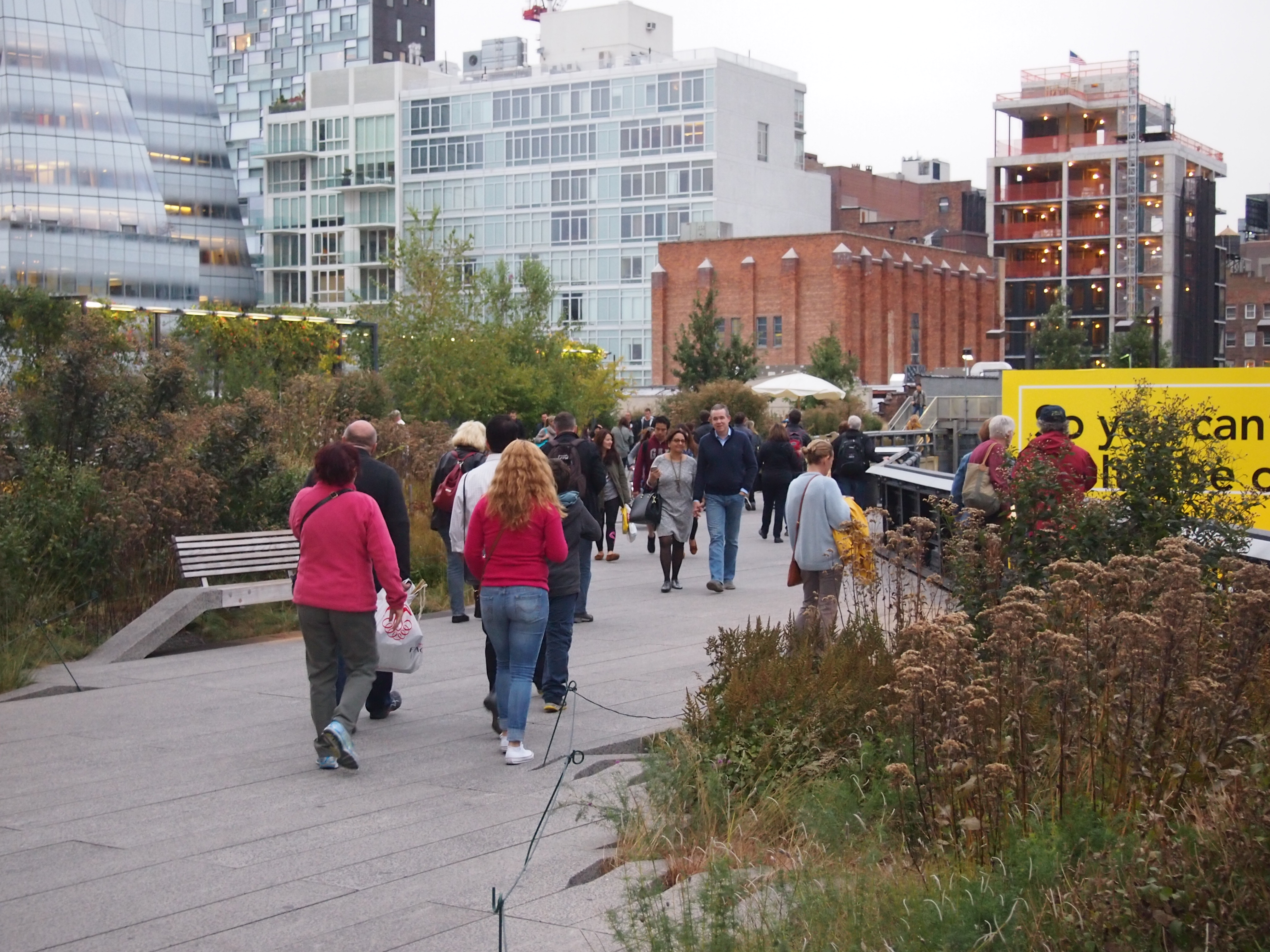
This is the view near the 14th St. entrance, looking north.

High Line, Oct 2014Note the amenities. A plank walkway, plantings on either side, and — sometimes most importantly — places to rest. Not a lot of backless benches, either, but wooden chairs with their backs at a permanently comfortable angle. Not so comfortable you’re likely to fall asleep, but a great place to rest. Sometimes I did. Just a little further north, the High Line passes through the Chelsea Market, where various food vendors are arrayed.

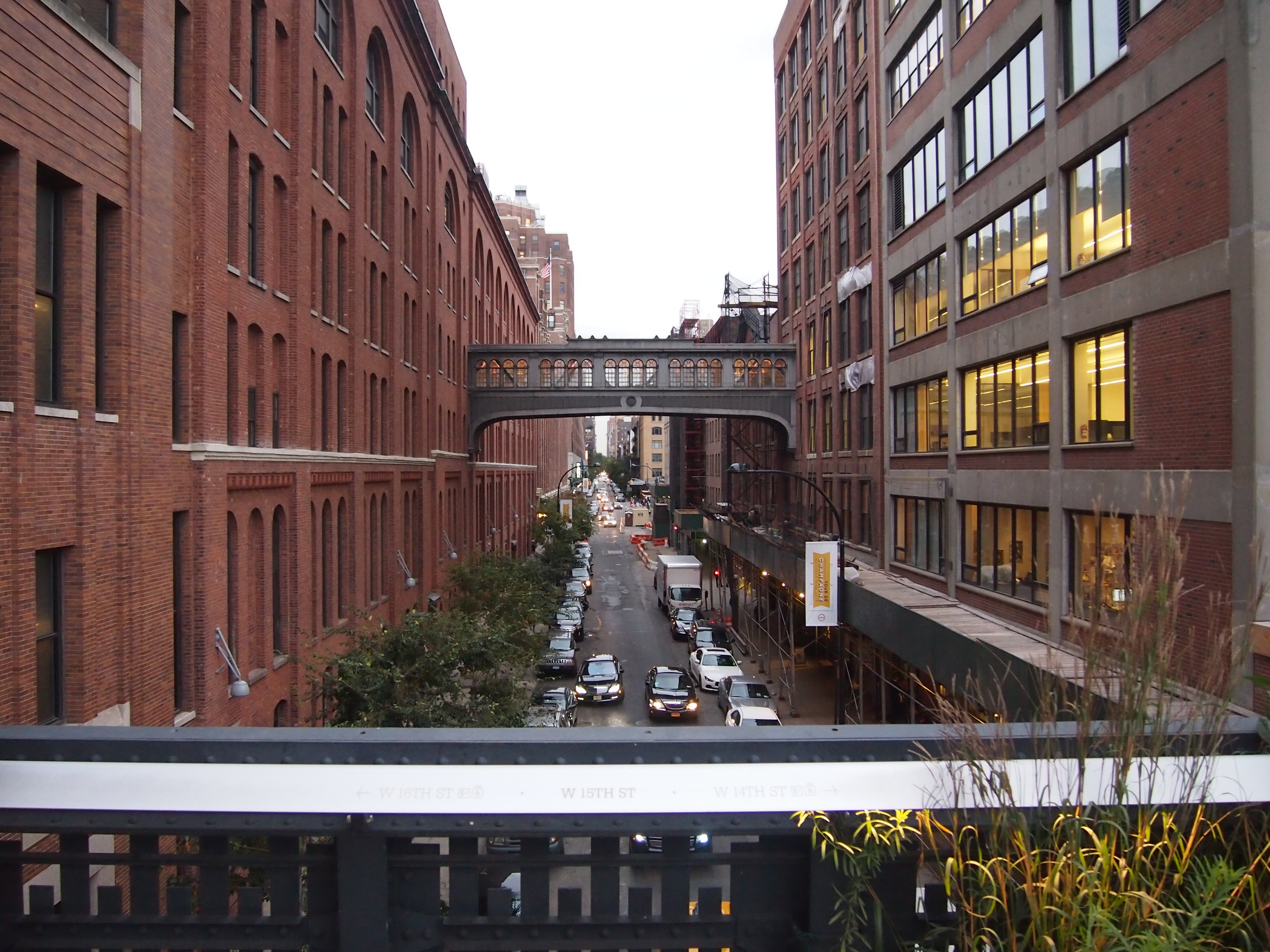
The line also offers some good views of the city below. This is 15th St., looking west.

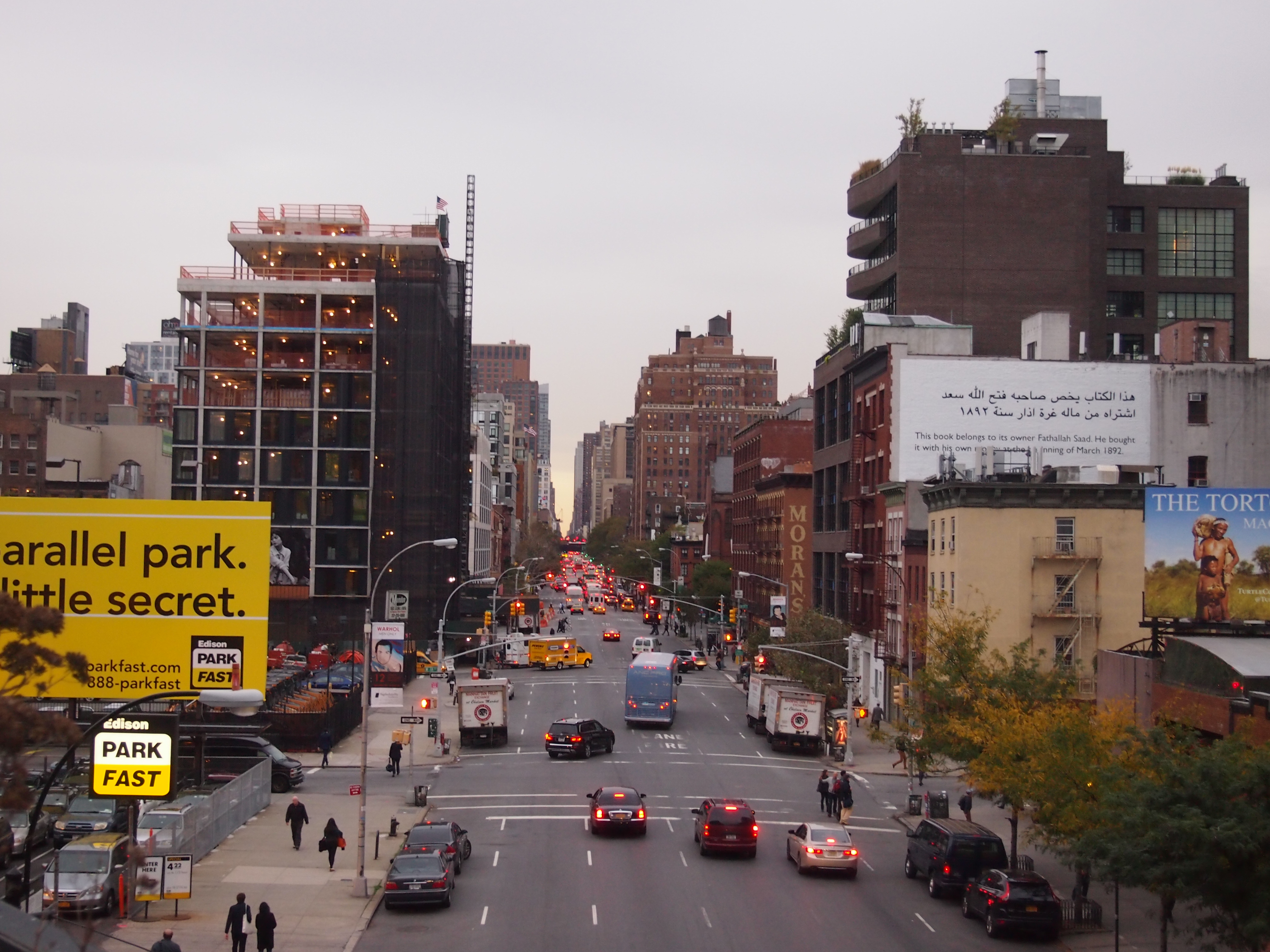
High Line, Oct 2014This is Tenth Ave., looking north.

High Line, Oct 2014On a pleasant fall afternoon, the High Line is a popular place.

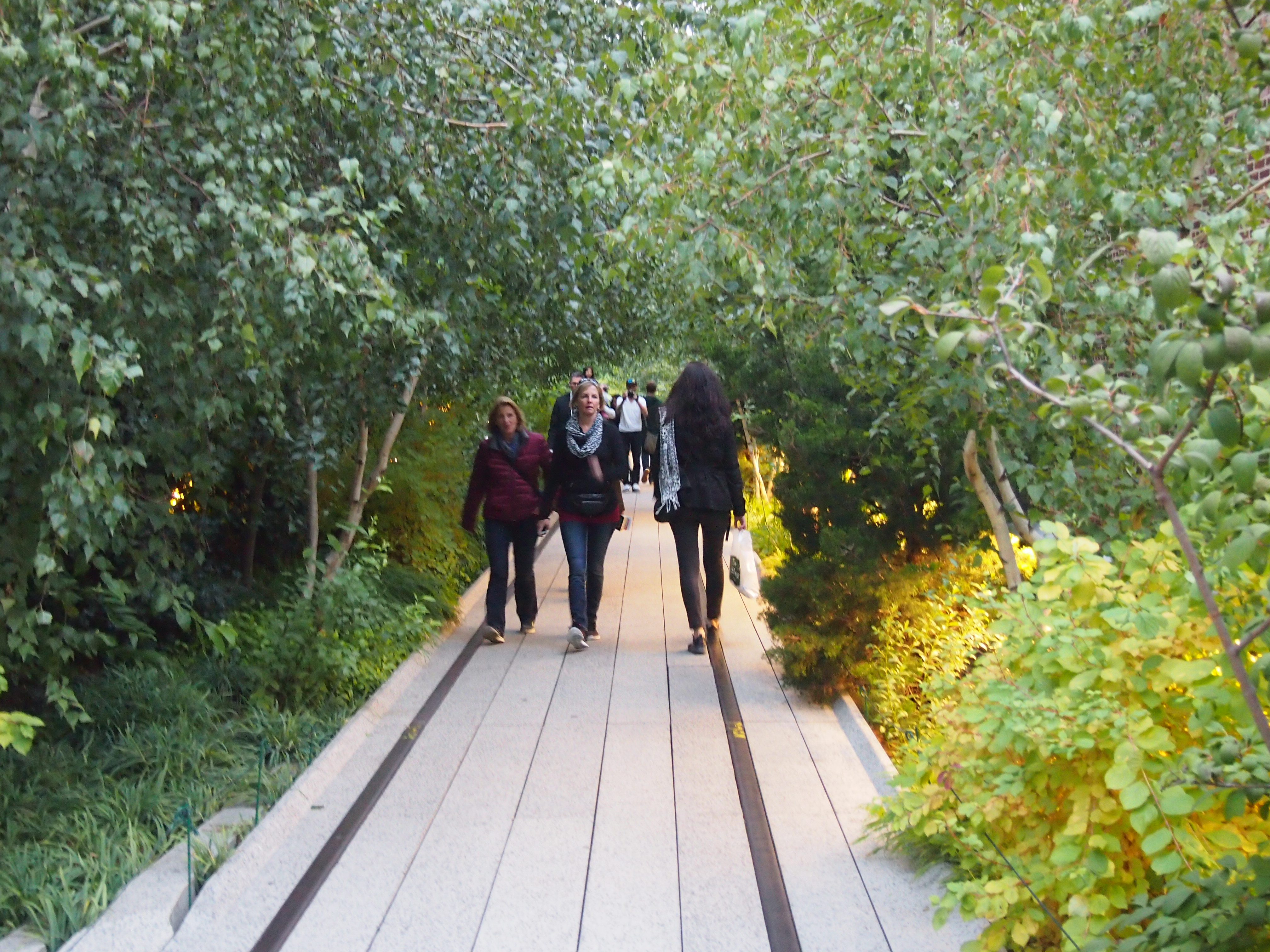
High Line, Oct 2014Further north, there’s even a green tunnel, at least during the warm months.

High Line, Oct 2014At this point, rail lines are embedded in the planks. Must be left over from when the train tracks ran this way. They appear at your feet fairly often, but not always. Sometimes they course through the plantings.

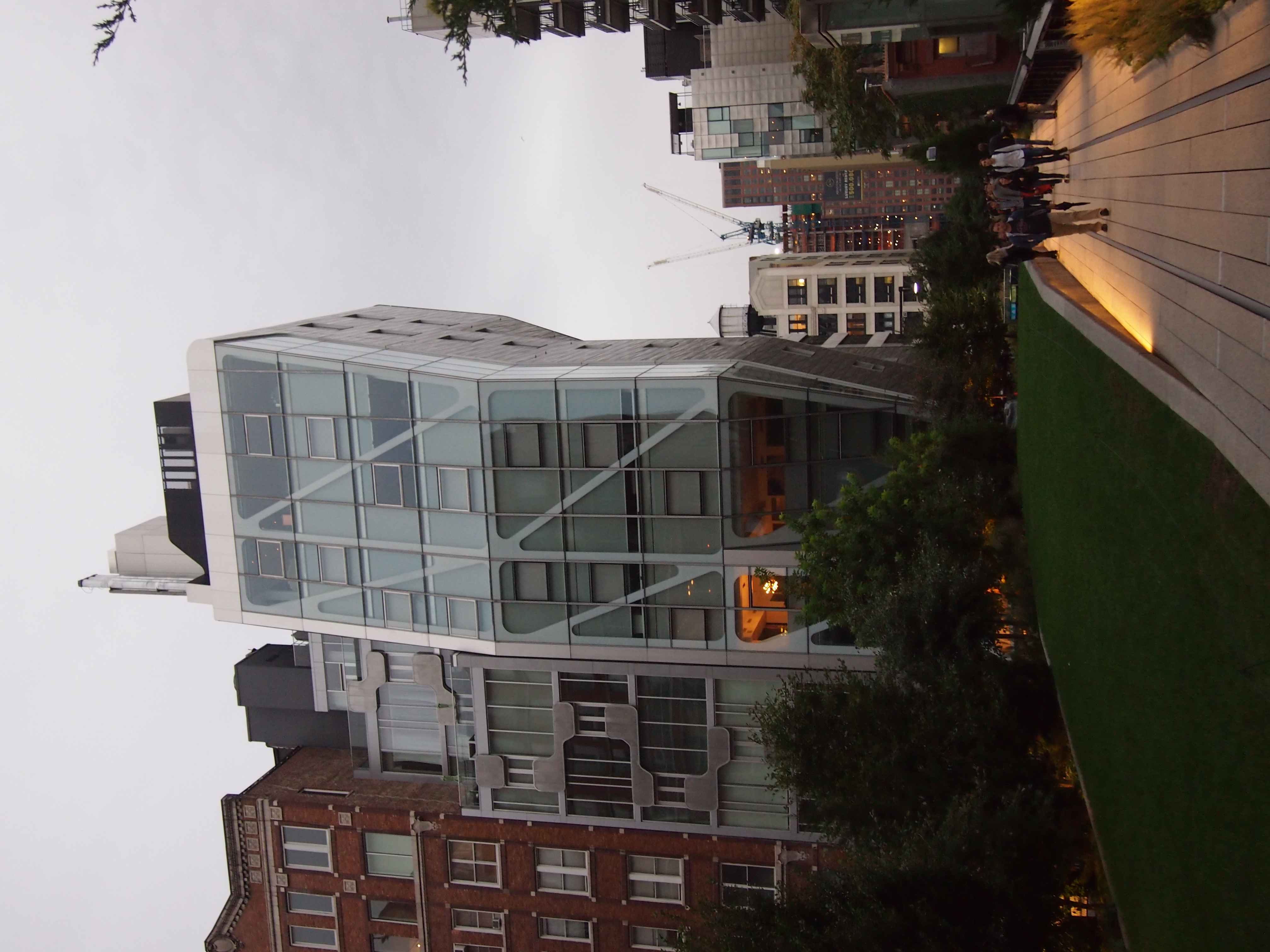
New buildings have sprouted along the line.

High Line, Oct 2014I was amused to see just how many advertisements for nearby buildings bragged about being near the High Line. Once upon a time, property owners in the area wanted the elevated tracks dismantled, never imaging that they’d drive value growth for nearby properties someday.

The Chicago Time Zone Plaque

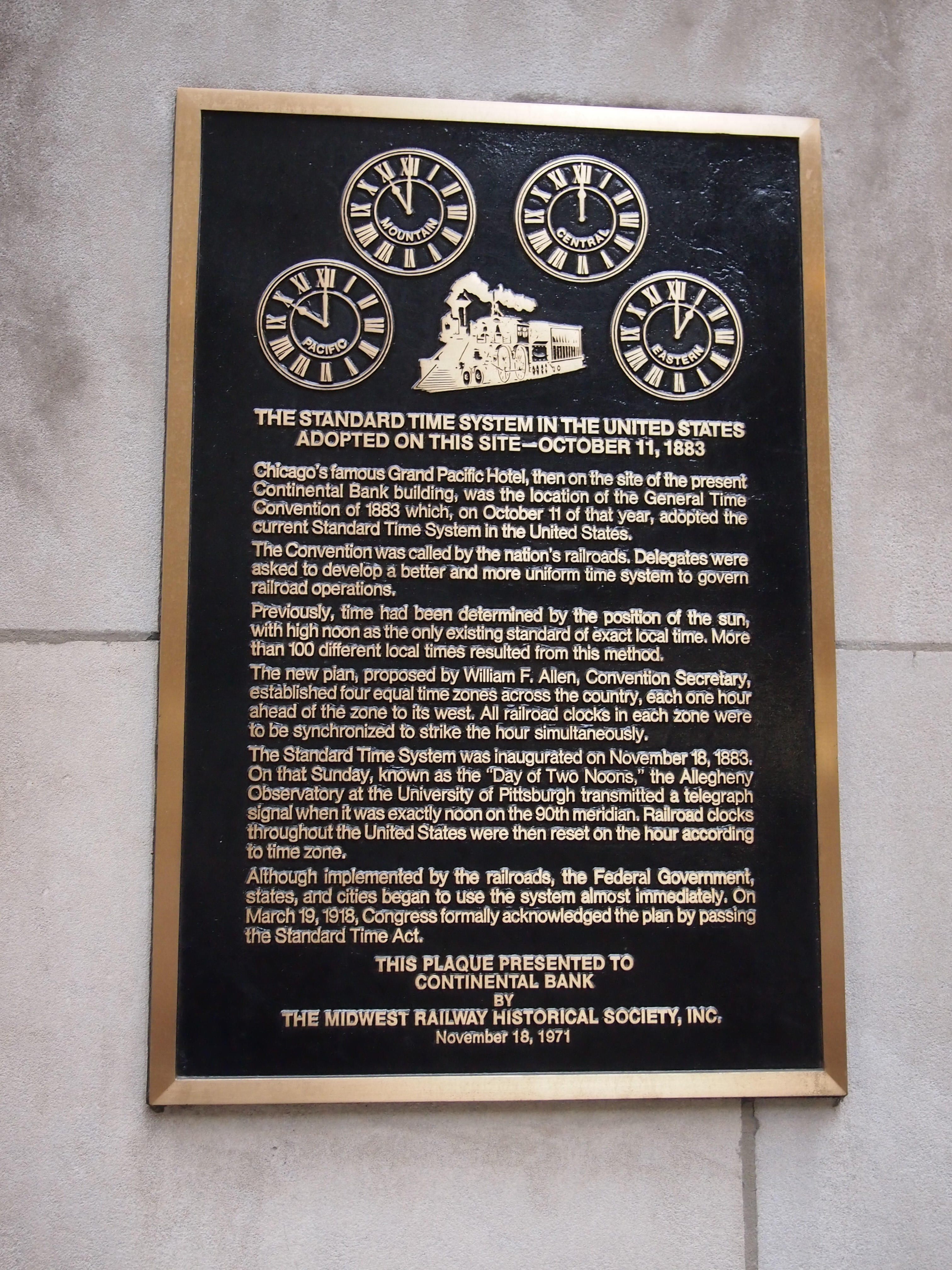
One more item from downtown Chicago, at least until the next time I go there. This plaque, near the junction of LaSalle and Jackson for over 40 years now, memorializes something few people give much thought — few people give it the time of day, you might say. Time zones.THE STANDARD TIME SYSTEM IN THE UNITED STATES ADOPTED ON THIS SITE — OCTOBER 11, 1883.

Chicago’s famous Grand Pacific Hotel, then on the site of the present Continental Bank building, was the location of the General Time Convention of 1883 which, on October 11 of that year, adopted the current Standard Time System in the United States.

The Convention was called by the nation’s railroads. Delegates were asked to develop a better and more uniform time system to govern railroad operations.

Previously, time had been determined by the position of the sun, with high noon as the only existing standard of exact local time. More than 100 different local times resulted from this method.

The new plan, proposed by William F. Allen, Convention Secretary, established four equal times zones across the country, each one hour ahead of the zone to its west. All railroad clocks in each zone were to be synchronized to strike the hour simultaneously.

The Standard Time System was inaugurated on November 18, 1883. On that Sunday, known as the “Day of Two Noons,” the Allegheny Observatory at the University of Pittsburgh transmitted a telegraph signal when it was exactly noon on the 90th meridian. Railroad clocks throughout the United States were then reset on the hour according to the time zone.

Although implemented by the railroad, the Federal Government, states, and cities began to use the system almost immediately. On March 19, 1918, Congress formally acknowledged the plan by passing the Standard Time Act.

Branson ’12

Since the previous BTST broke down, I’ve been a few places, worked a lot, voted in an election that a lot people believed important (and maybe I did, too), even watched “The Great Vegetable Rebellion” on a whim because I saw it was available on Hulu, and because it’s Irwin Allen at his best.

To kick off November, I took a trip to Branson. Not sure how the AP feels about Branson as a dateline, but I think it should stand alone: Branson, rather than Branson, Missouri, so famed has the place become. I’ve heard that I visited Branson when I was small, and when Branson was small, in the mid-60s, but remember nothing of that. En route elsewhere in 2001, we drove into town, ate lunch, and took away vague impressions. Mostly, I remember liking Yakov Smirnoff’s billboards lining the road between Springfield and Branson.

So this time might as well have been a first visit, even though it was my third. It was a busy press trip. Being Branson, that meant seeing more musical-variety-comedy shows than I might see in many ordinary years. In fact, I realized in the middle of my stay that when the variety show died out from television, it was reborn in Branson. The shows I saw included singing, dancing, visual gags, bad jokes, good jokes, sometimes lavish sets and costumes, adaptations of classic theater and movies and the Bible, and even an aerialist – who played violin during her aerial act, which I’ve never seen anyone else do, not even in a circus. We also met a handful of entertainers in person, namely a couple of Lennon Sisters, as well as a fellow whose act is a Neil Diamond tribute.

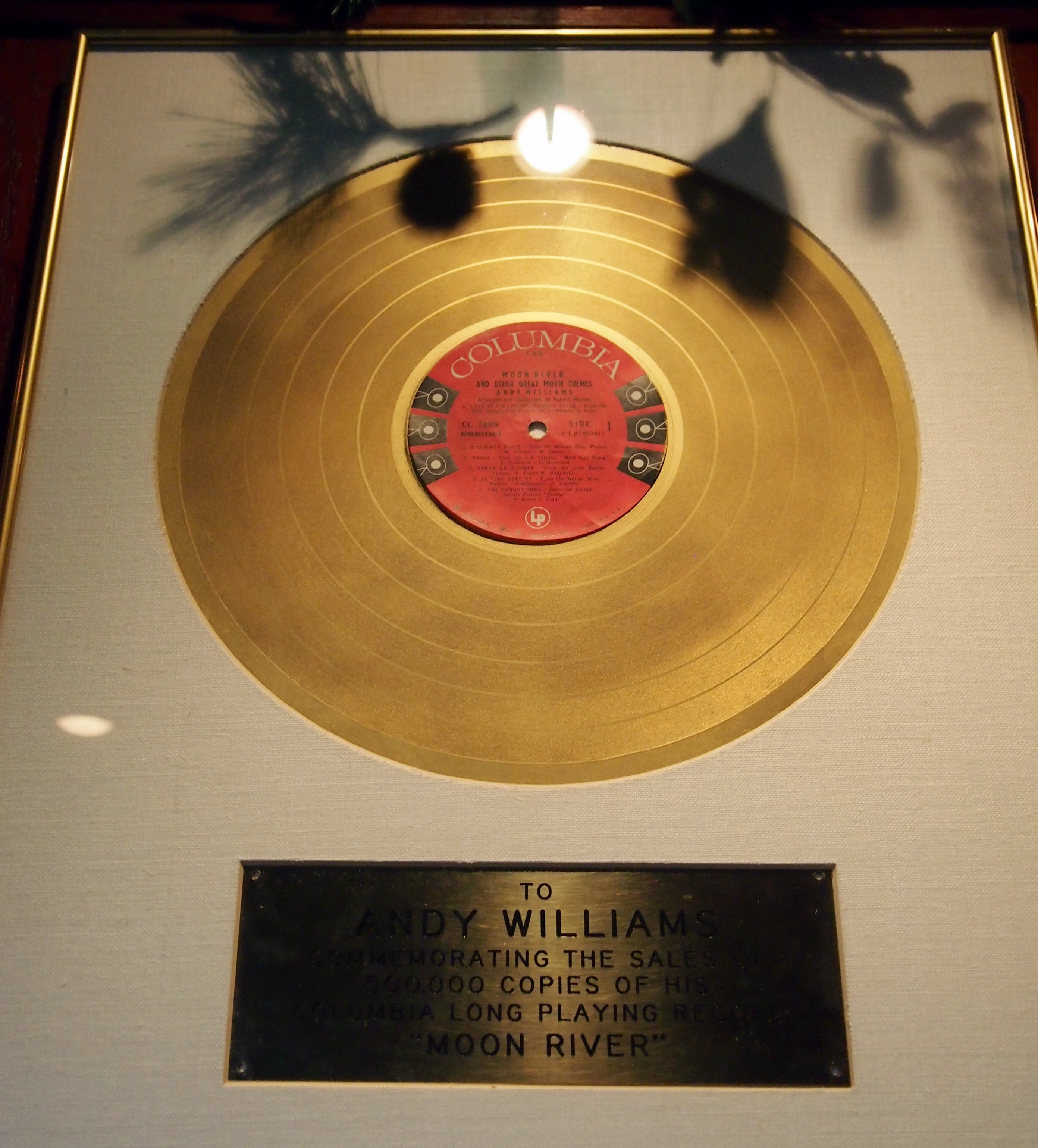
I noticed some relics, too. Saints’ relics aren’t what they used to be, since we tend to prefer celebrity relics in our time. At the Andy Williams’ Moon River Grill, the late entertainers’ gold records are on walls. That includes, of course, the LP Moon River (pictured), but also the Love Theme from The Godfather, among many others. That’s a movie I hadn’t realized had a love theme, much less one sung by Andy Williams. Its actual title, I’ve discovered, is “Speak Softly Love (or You’ll Sleep With the Fishes).” (Parenthesis added by me.)

Branson wasn’t all live entertainment. During my three full days there, I also managed to ride a train made of vintage railroad cars a short way into Arkansas, wander around the Silver Dollar City theme park, take the tour of Marvel Cave, and visit the surprisingly interesting College of the Ozarks – but not, unfortunately, see the Beverly Hillbillies’ truck, which is there. Branson also sports some museums, and I went to three of them – one about a maritime disaster, another about war, and a third, smaller one about Branson and environs.

On foot one day, I checked out the newly developed downtown riverfront and its attendant open-air retail space, and not far away examined a store that called itself a Five and Dime and had an usually large assortment of merchandise, over and above Branson-oriented gimcracks and gewgaws. Those can be found everywhere in great profusion.