Key West Cemetery

Back on Tuesday. A holiday’s a holiday, even if it comes in the pit of winter, where we definitely find ourselves. The memory of Sunny Florida gets a little more distant each time I feel the wind in single-digit temps.

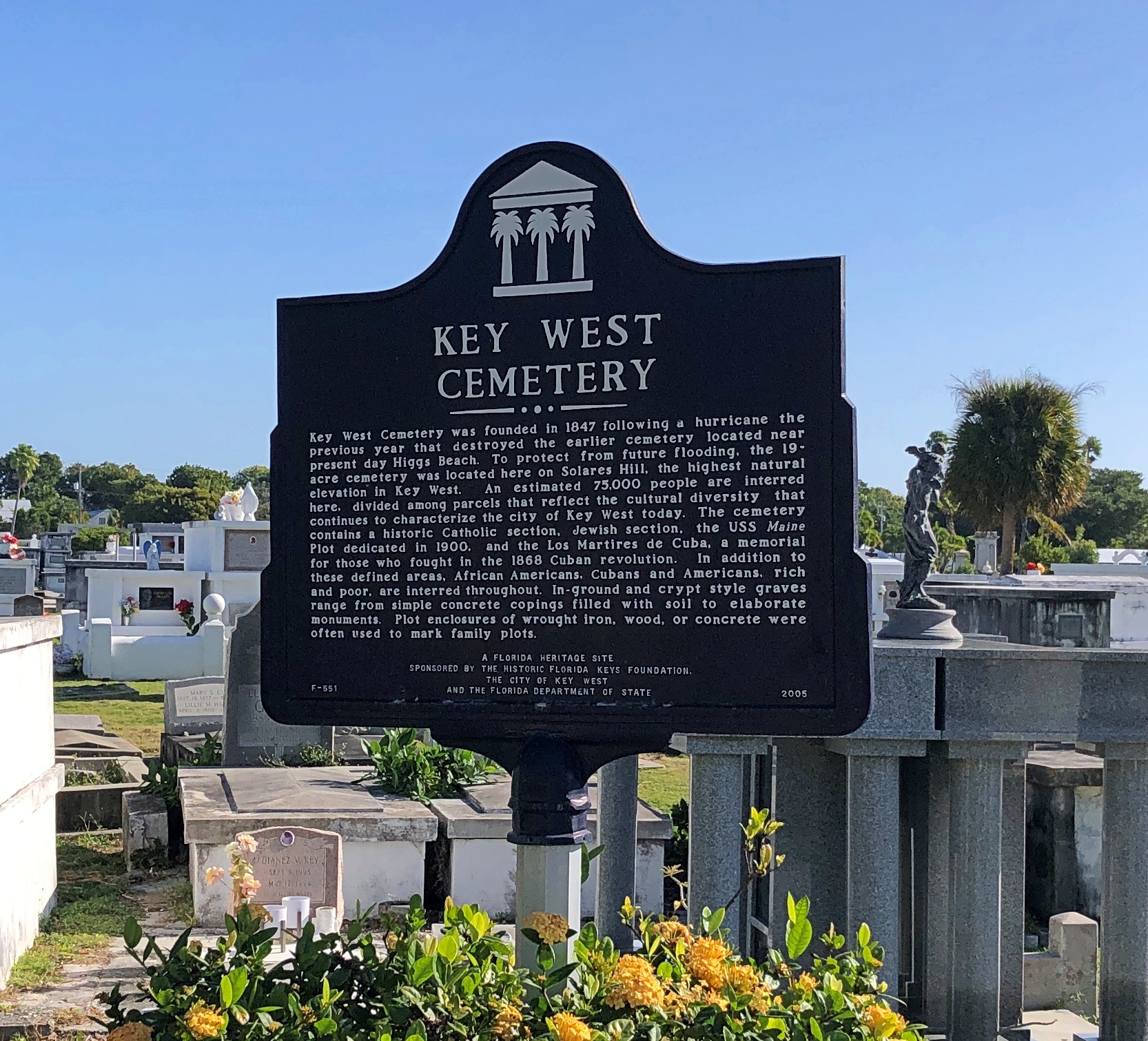
In diminutive Key West, you’ve gone a long way after a few blocks. So a long way from Duval Street in that town is Key West Cemetery, which is also at a distance from the ocean — one measured in a few thousand feet. At the cemetery you’ll find a mix of above-ground tombs and standard stones. Styles from Old Florida and later, in other words.
We drove into Old Town Key West our second day rather than take the hotel shuttle, which we had the first day. I was gambling that the local parking information I’d picked up first-hand more than a decade earlier wasn’t obsolete yet, which it could well have been. The town has notoriously tight parking, for obvious reasons.

Two prayers for such a situation.

O Lord, by your grace

Help me find a parking space

O Jesus, full of grace

Help me find a parking space

Just the thing, provided you’re sure one of the many attributes of the Almighty is a sense of humor. Parking is perhaps a function of Plastic Jesus? (And I like this version, among the many out there.)

Then again, asking for a parking intercession might only seem to be praying for something trivial. For all we know, parking a certain car in a certain place on a certain day might via the butterfly effect prevent a deadly typhoon somewhere.

Anyway, my strategy worked out and we parked for no charge a stone’s throw – and I mean that almost literally – from Key West Cemetery.
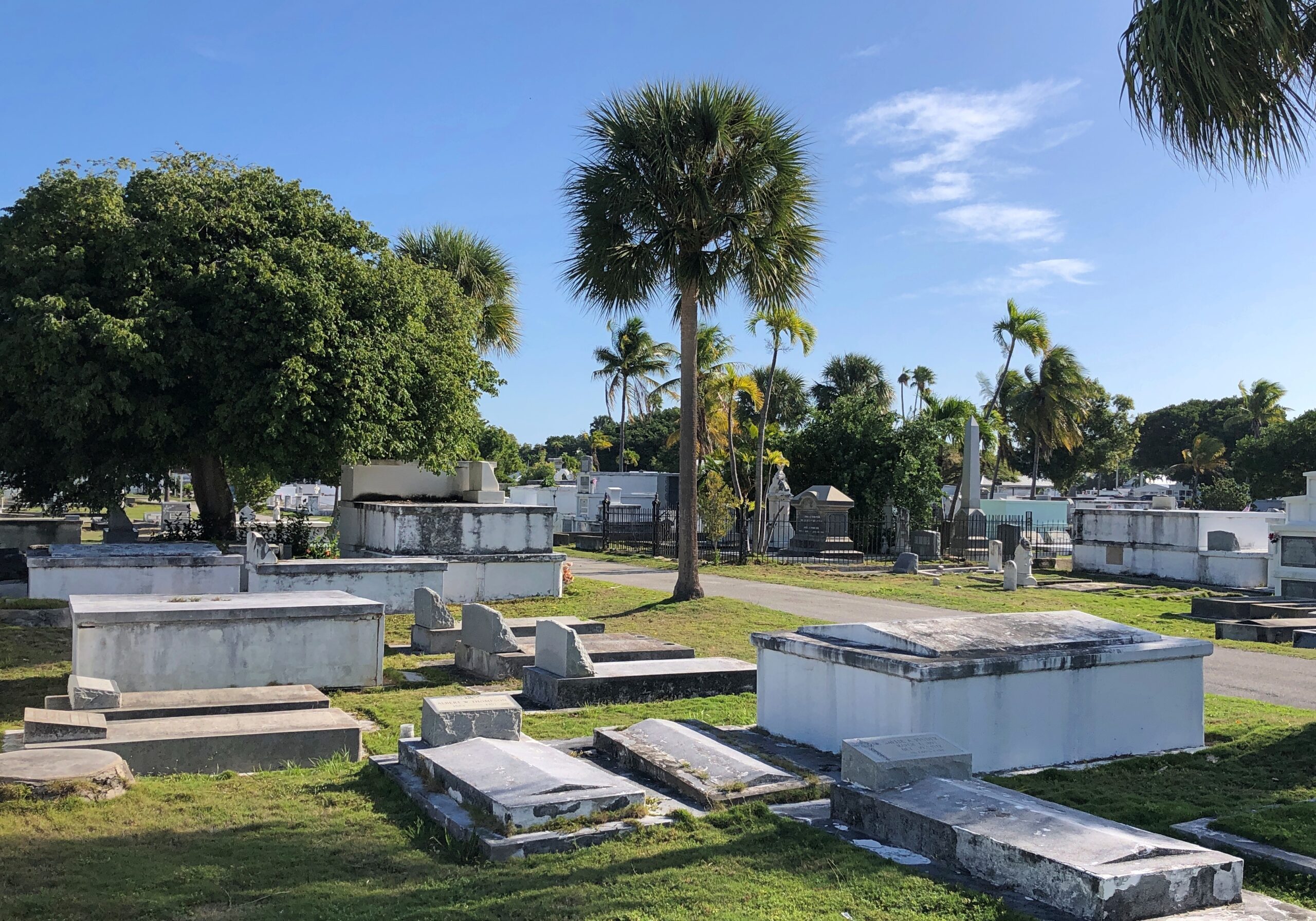
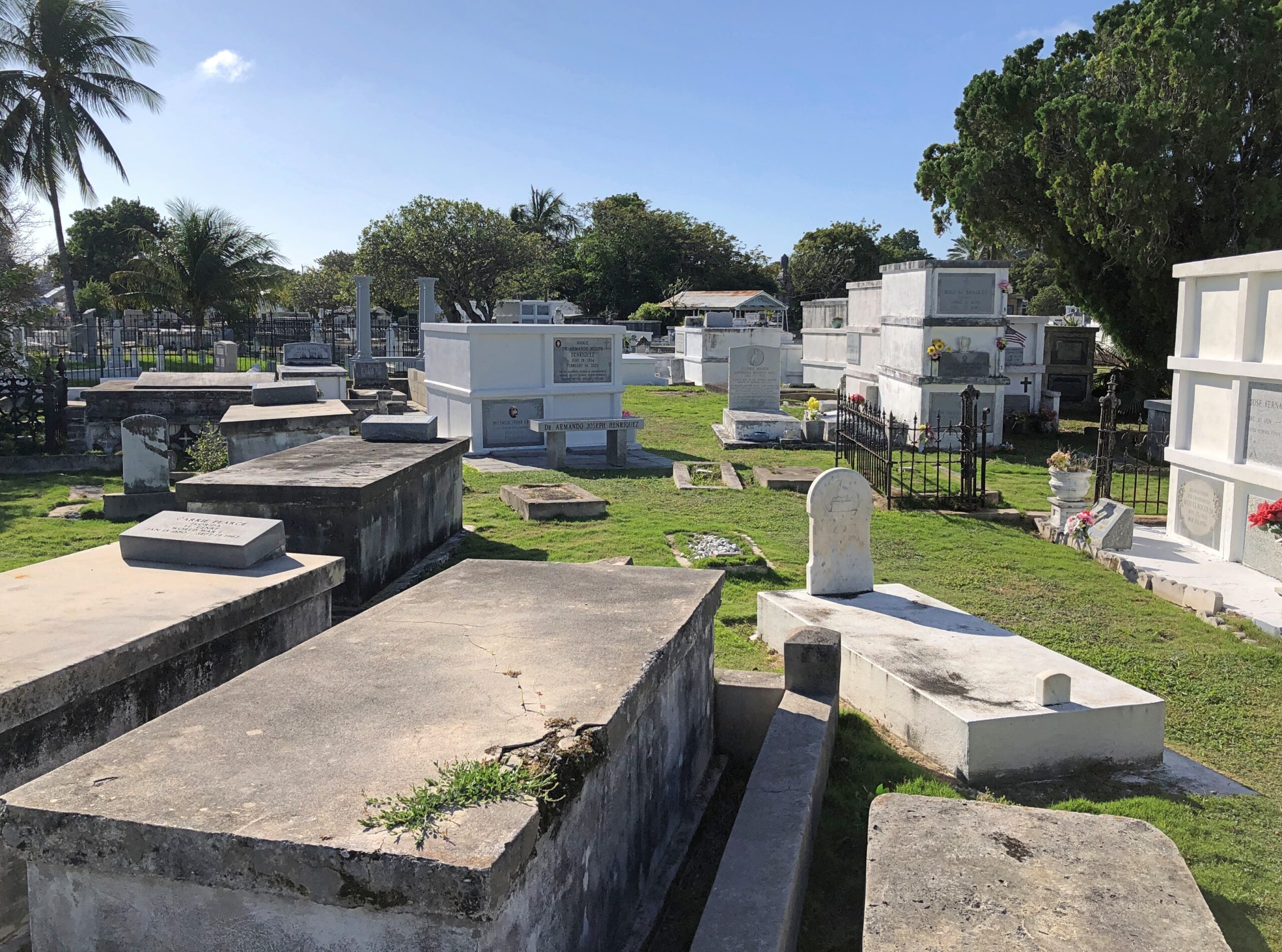
Once upon a time, mid-19th century Key West had a burial ground nearer to the water. A hurricane in 1846 applied a large amount of water and wind to that location in a short time, smashing tombs and markers and returning bodies to the open air. Gruesome to consider, but the incident did inspire Key West city fathers to open a new cemetery on high ground. High for Key West, that is, 16 feet above sea level.

That has worked out. As many as 100,000 permanent residents now rest across 19 acres, roughly three times the living population of the city: all races and stations of life; Protestants, Catholics and Jews; Cuban cigar workers and Bahamian mariners; soldiers, sailors and civilians.
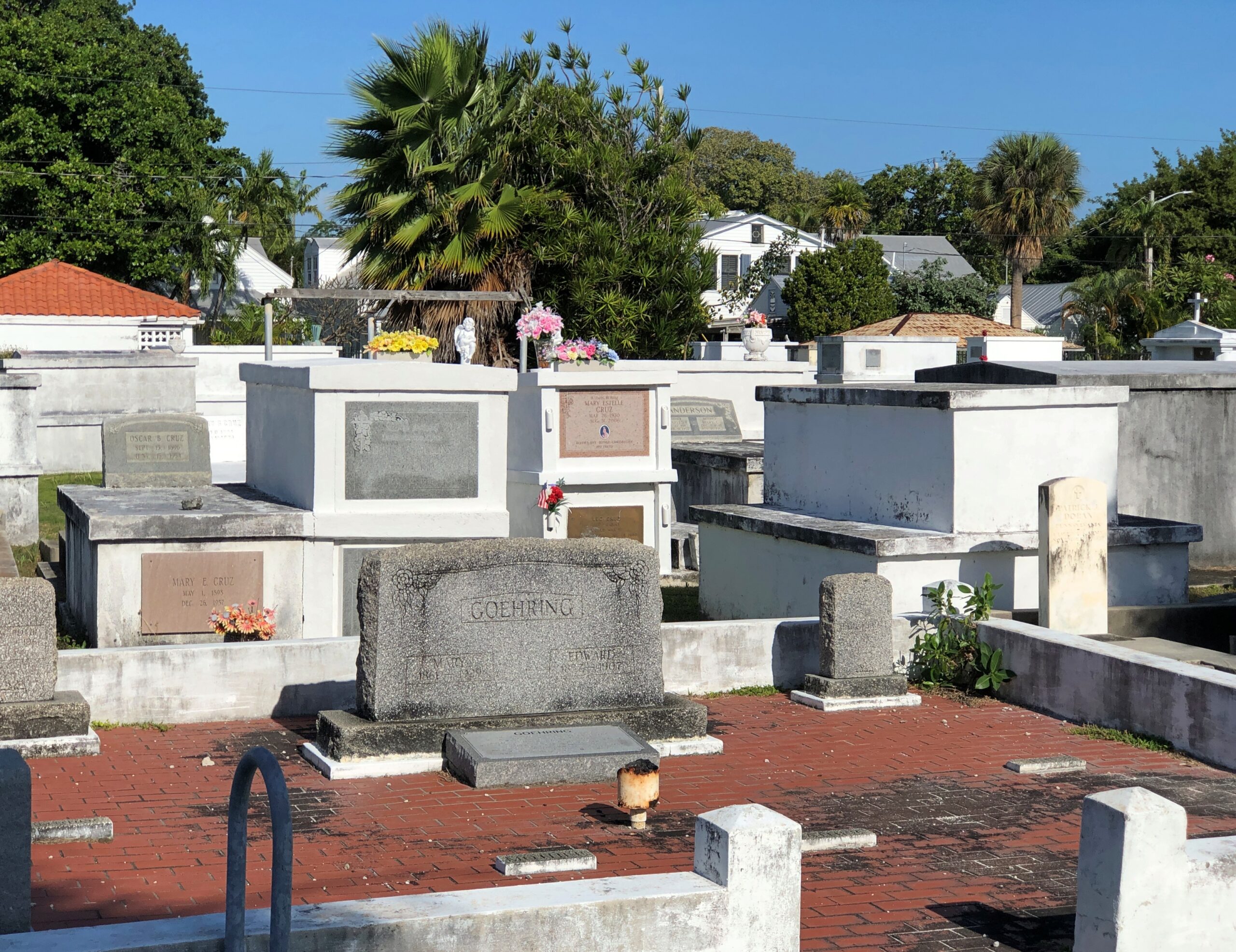
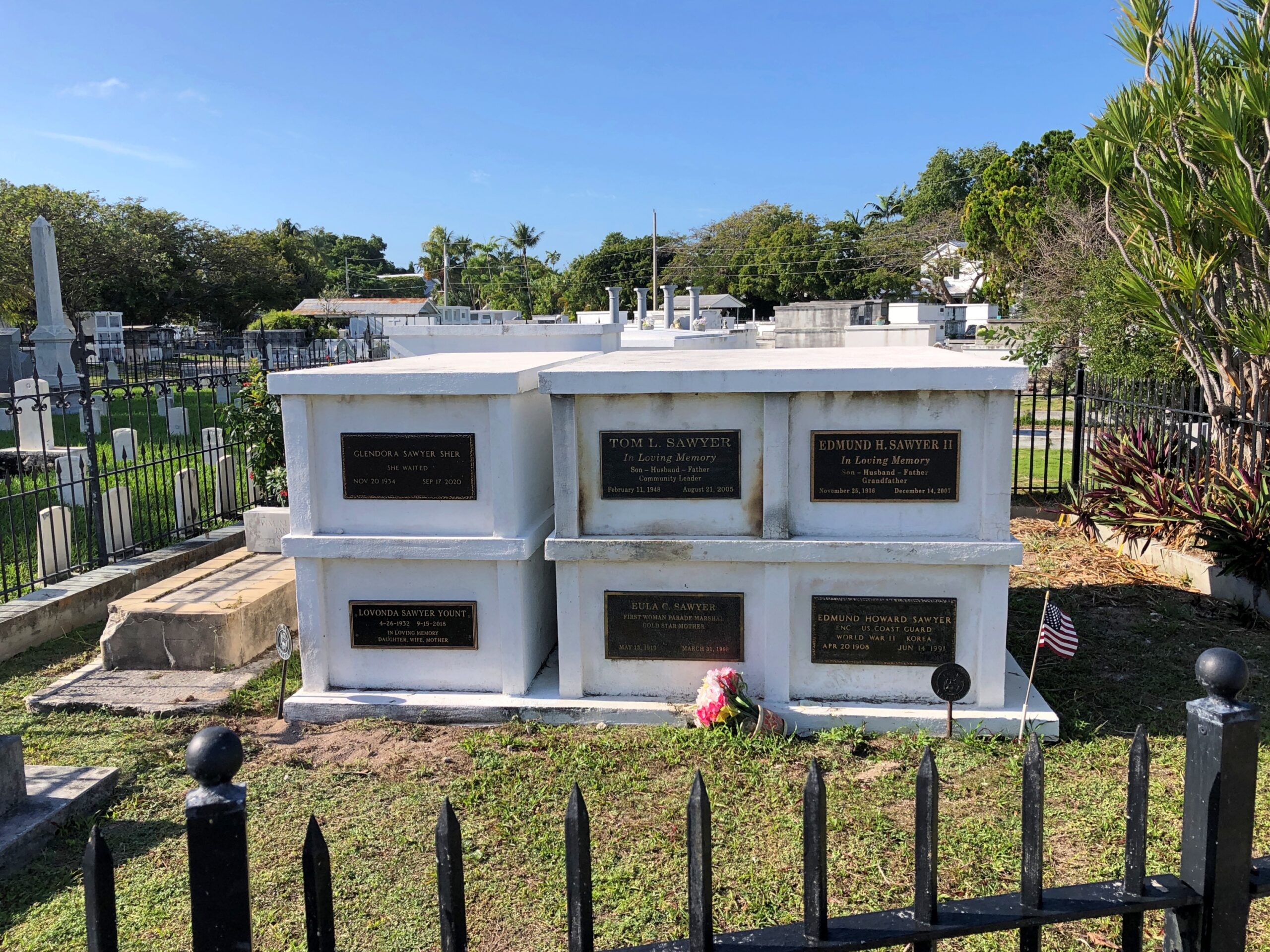
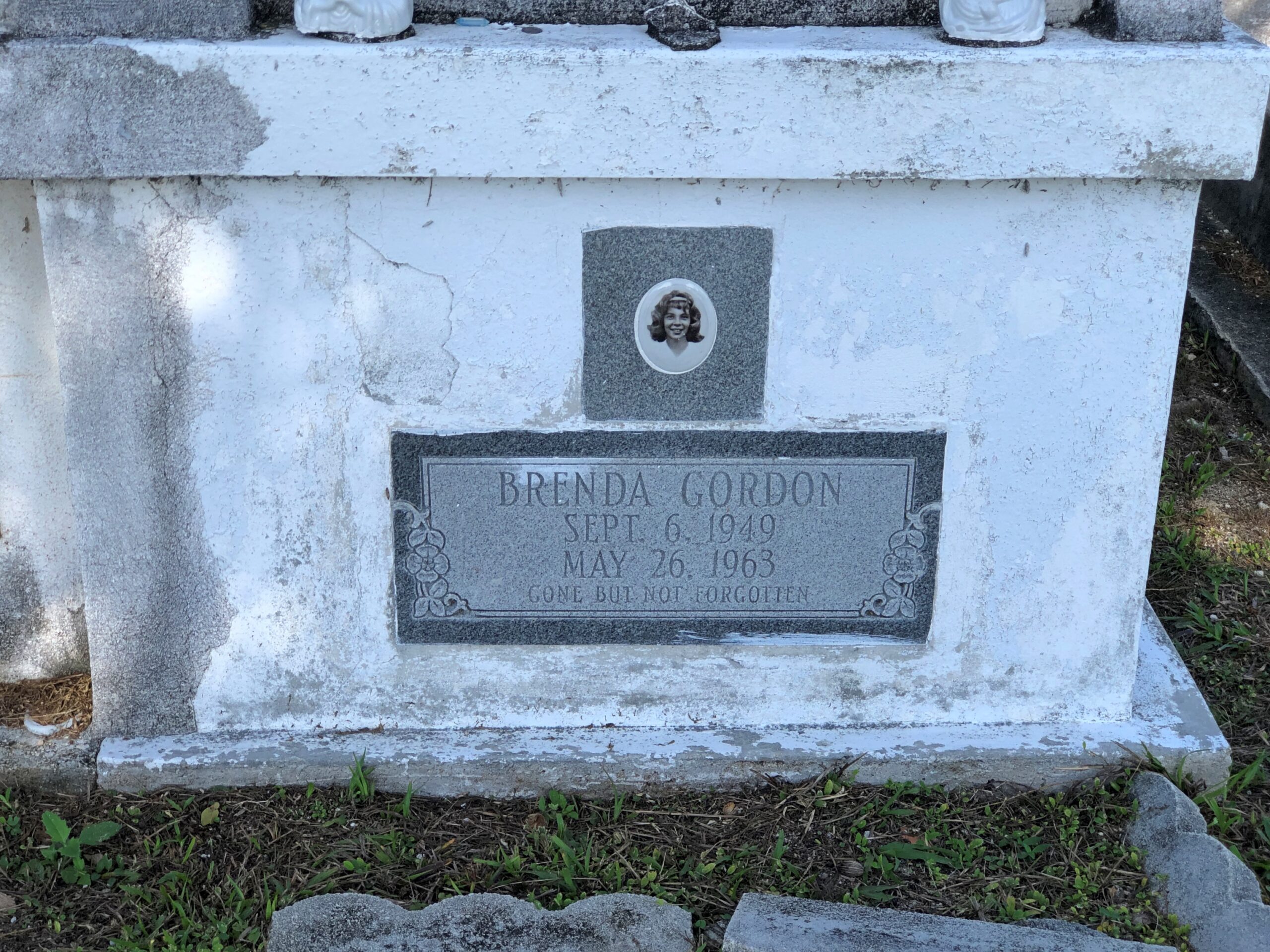
Many sad stories, as usual. Even if we can’t know the details at this distance.
Other residents include one Abraham Sawyer (d. 1939), a dwarf who reportedly refused to be a part of carnivals, instead working for manufacturers to advertise their products. He requested to be buried in a full-sized grave, but since I didn’t read of him until later (today), I didn’t go looking for him.

There is also the story of Elena Hoyos (d. 1931). Read the Find a Grave story, which I promise will be one of the stranger things you’ve read in a while, true or not.

The U.S. Navy Plot is square in the middle of the cemetery.
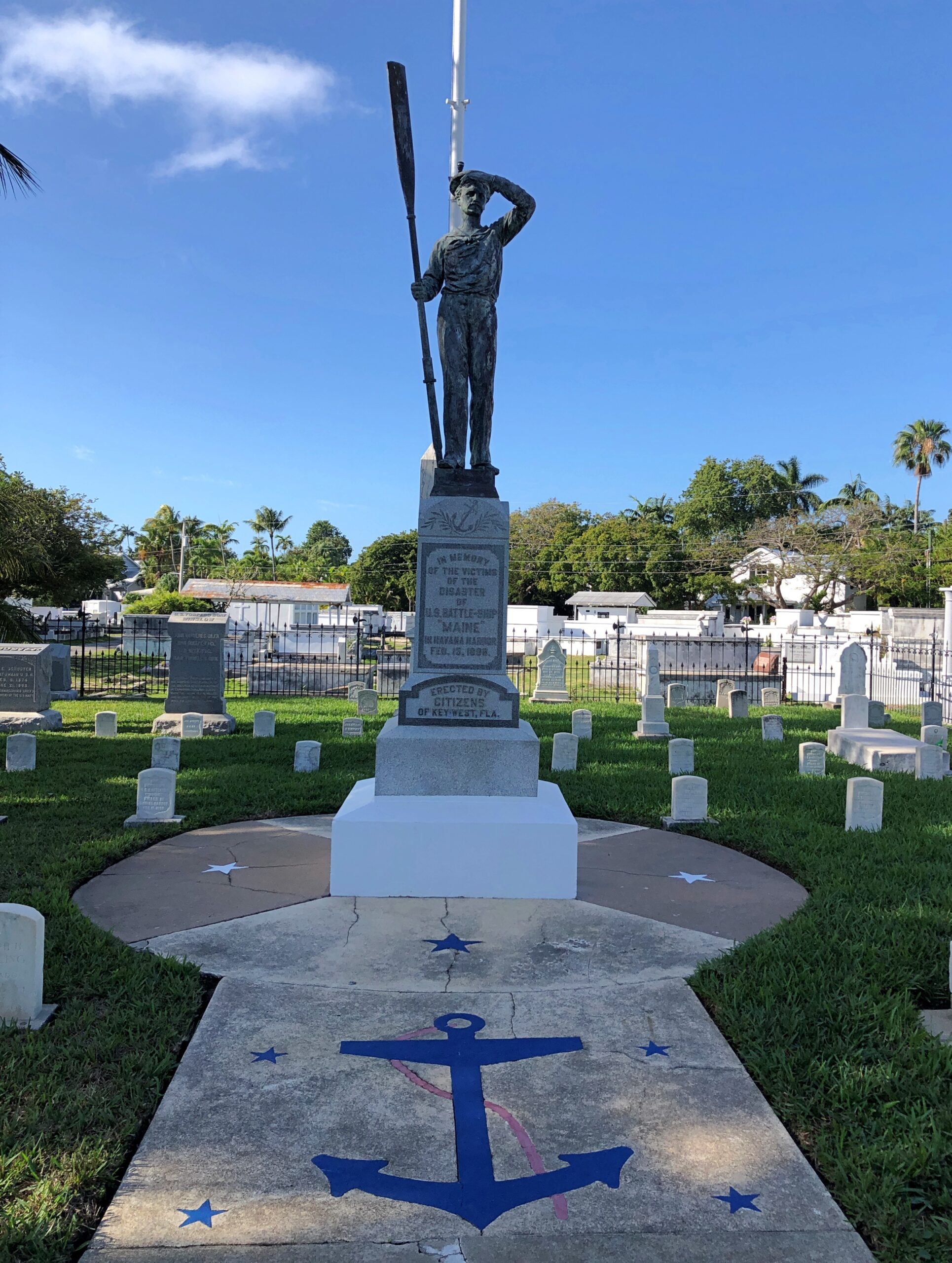
The centerpiece is a memorial to the dead of the Maine. Note the mast behind the sailor statue. That’s from the Maine.
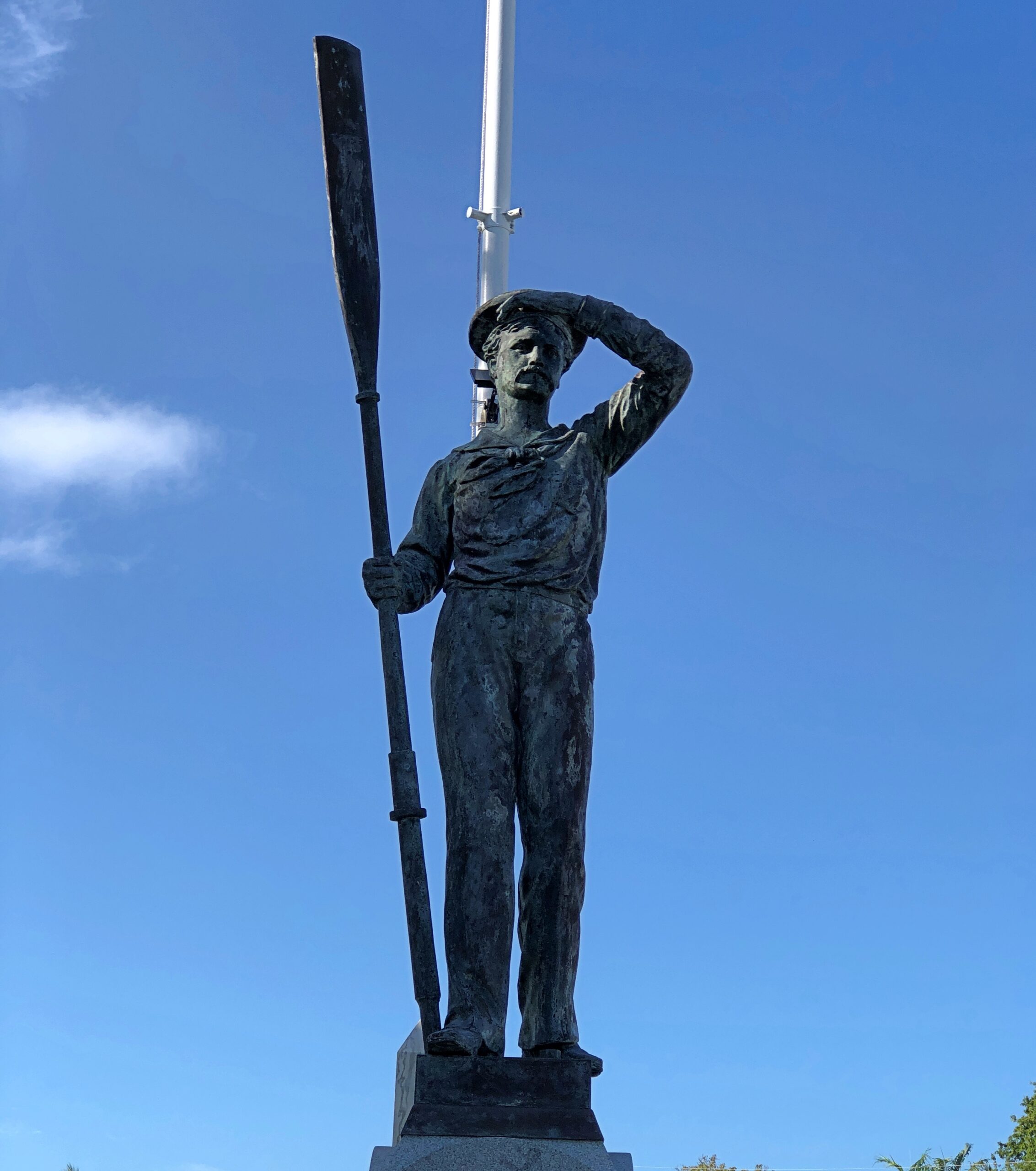
The monument’s granite base says:

IN MEMORY OF THE VICTIMS OF THE DISASTER OF THE U.S. BATTLESHIP ‘MAINE’ IN HAVANA HARBOR FEB. 15, 1898, ERECTED BY THE CITIZENS OF KEY WEST, FLA.

Some of the men who died on the Maine ended up in the Navy Plot: the closest U.S. cemetery when they needed to be interred, and fast. Twenty-four of them, only seven of whom were identified.
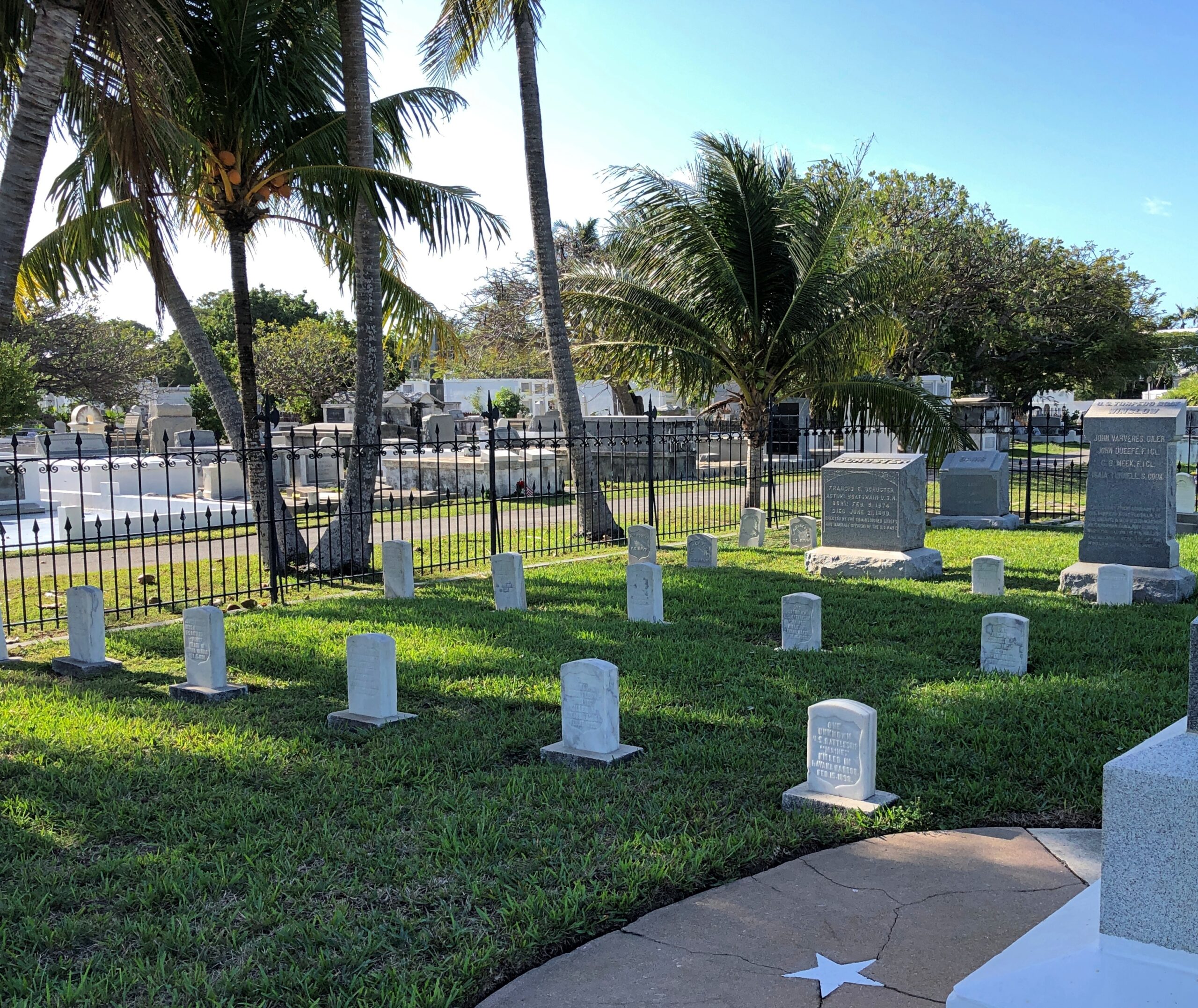
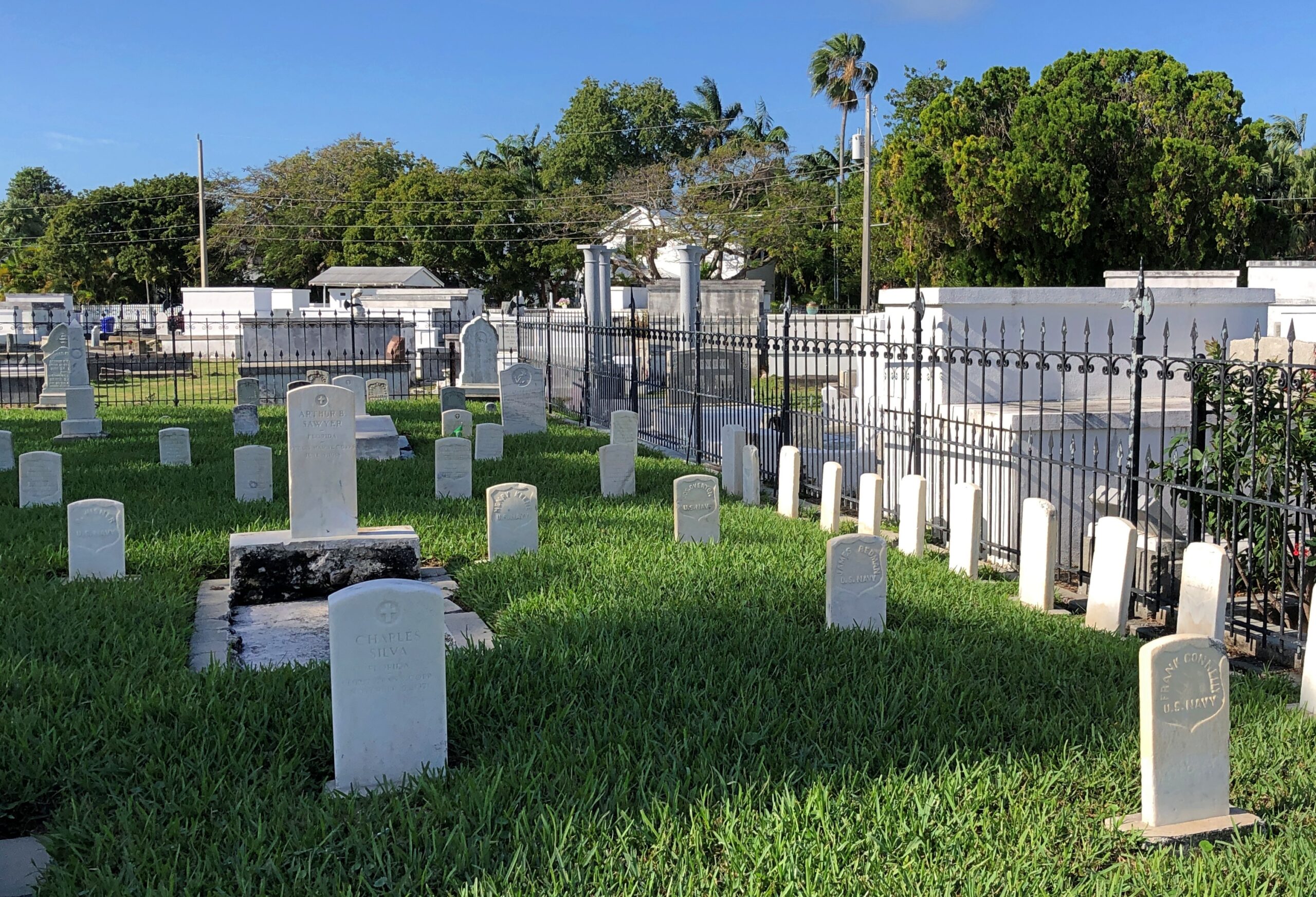
Other sailors repose there as well. Such as Sub-Lieutenant Donald Henry Smith, Royal Navy.
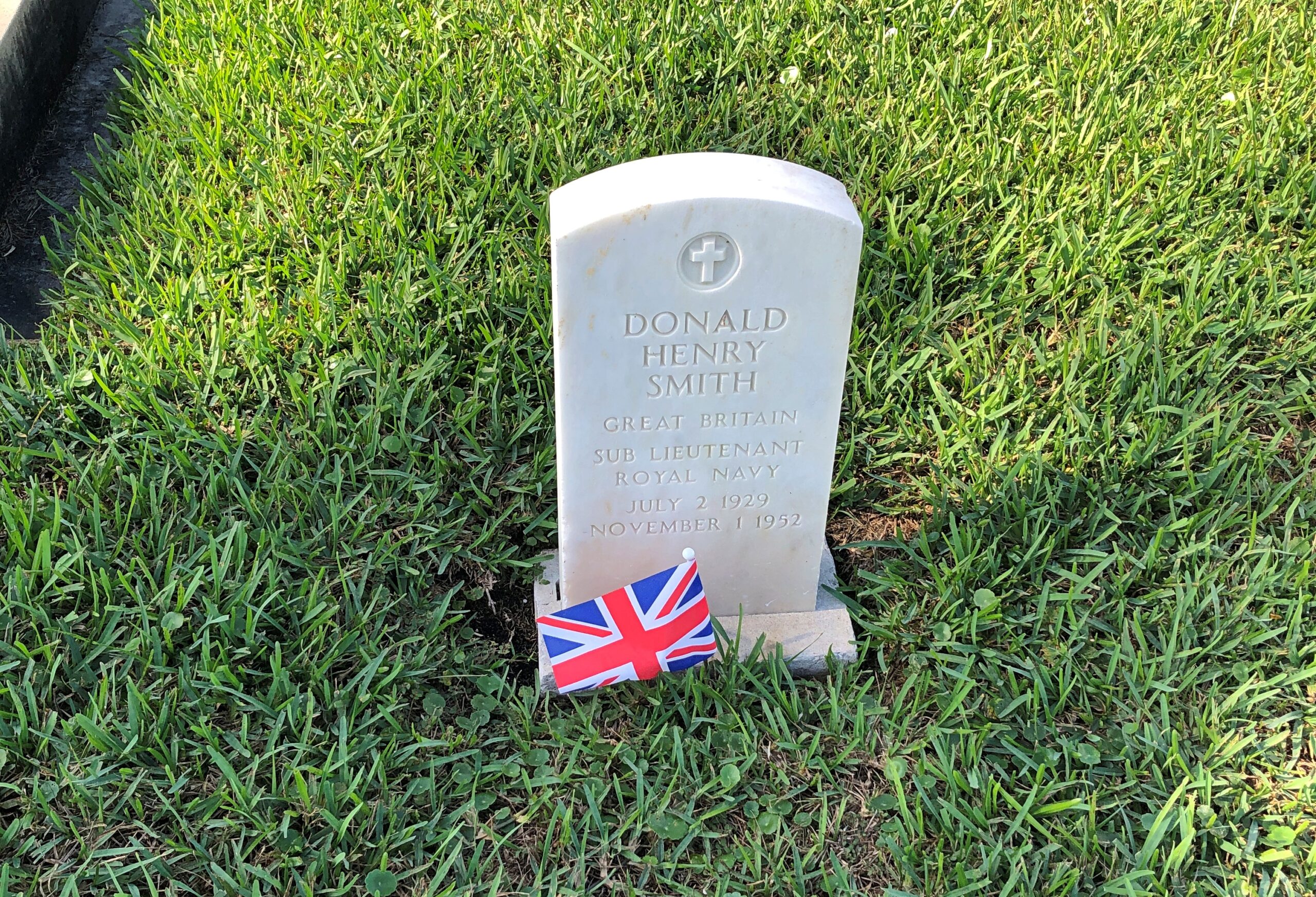
That’s a little odd, but foreign servicemen do sometimes end up in American soil (such as at Vicksburg). I looked around a little, then asked Google AI how Sub-Lieutenant Smith came to be there.

The hive bots said: Donald Henry Smith (1929-1952) is buried in the Key West Cemetery, specifically in the U.S. Navy Plot, likely because he was a young man who died at age 23, possibly serving in the Navy or connected to the naval community, with the plot itself dedicated to fallen sailors, a common burial spot for service members in Key West.

So, navy guys get buried with other navy guys, sometimes. Or maybe because a navy is a navy? Thanks for nothing, AI.

I spotted a Cuban flag and went to investigate.
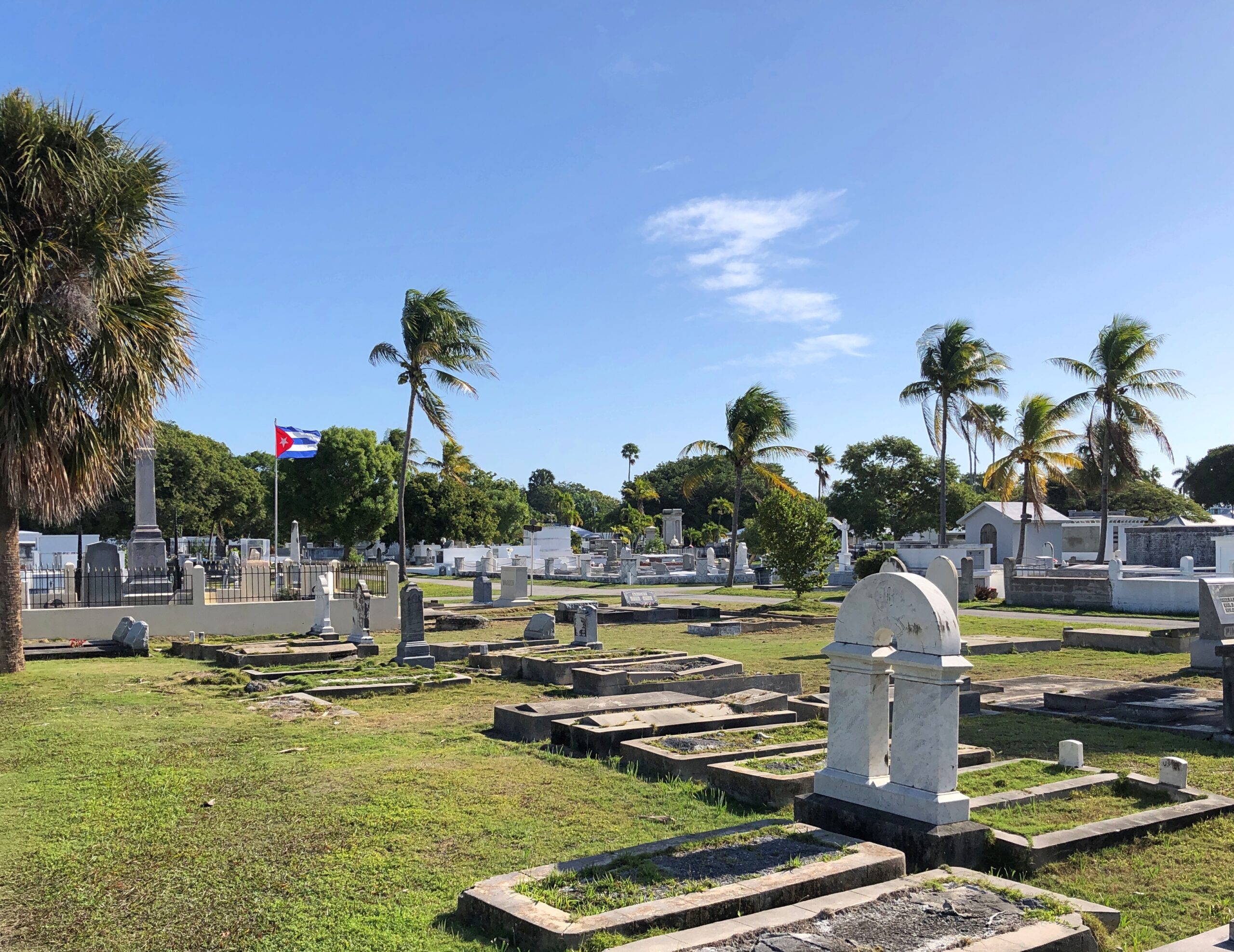
A Los Martires de Cuba.
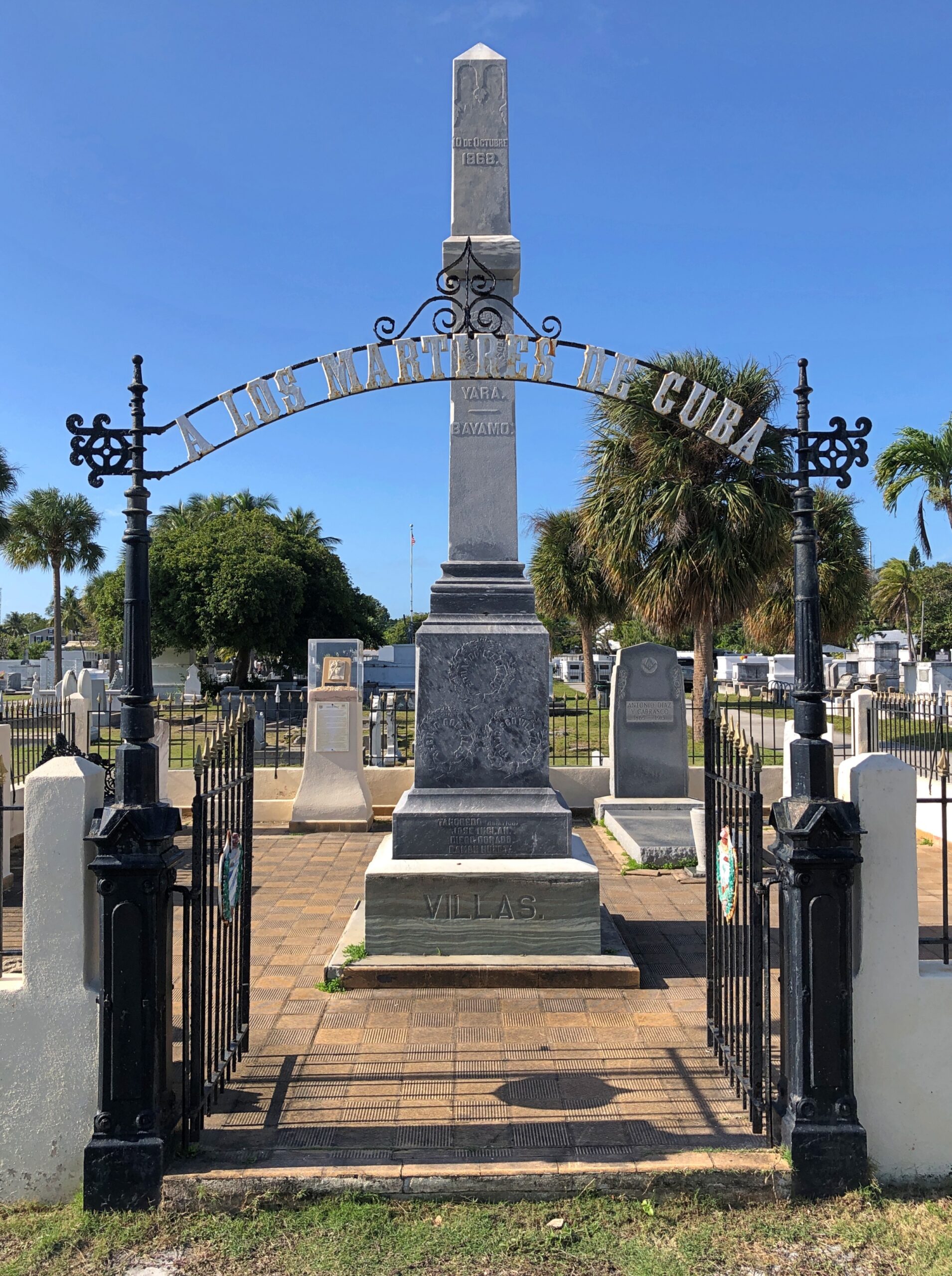
Not all of them are with Jose Marti in Cuba itself. Guess this counts as another of the Little Cubas to be found in warm climes close to the home island.

The cemetery is under the flight path for planes headed for Key West International (EYW).
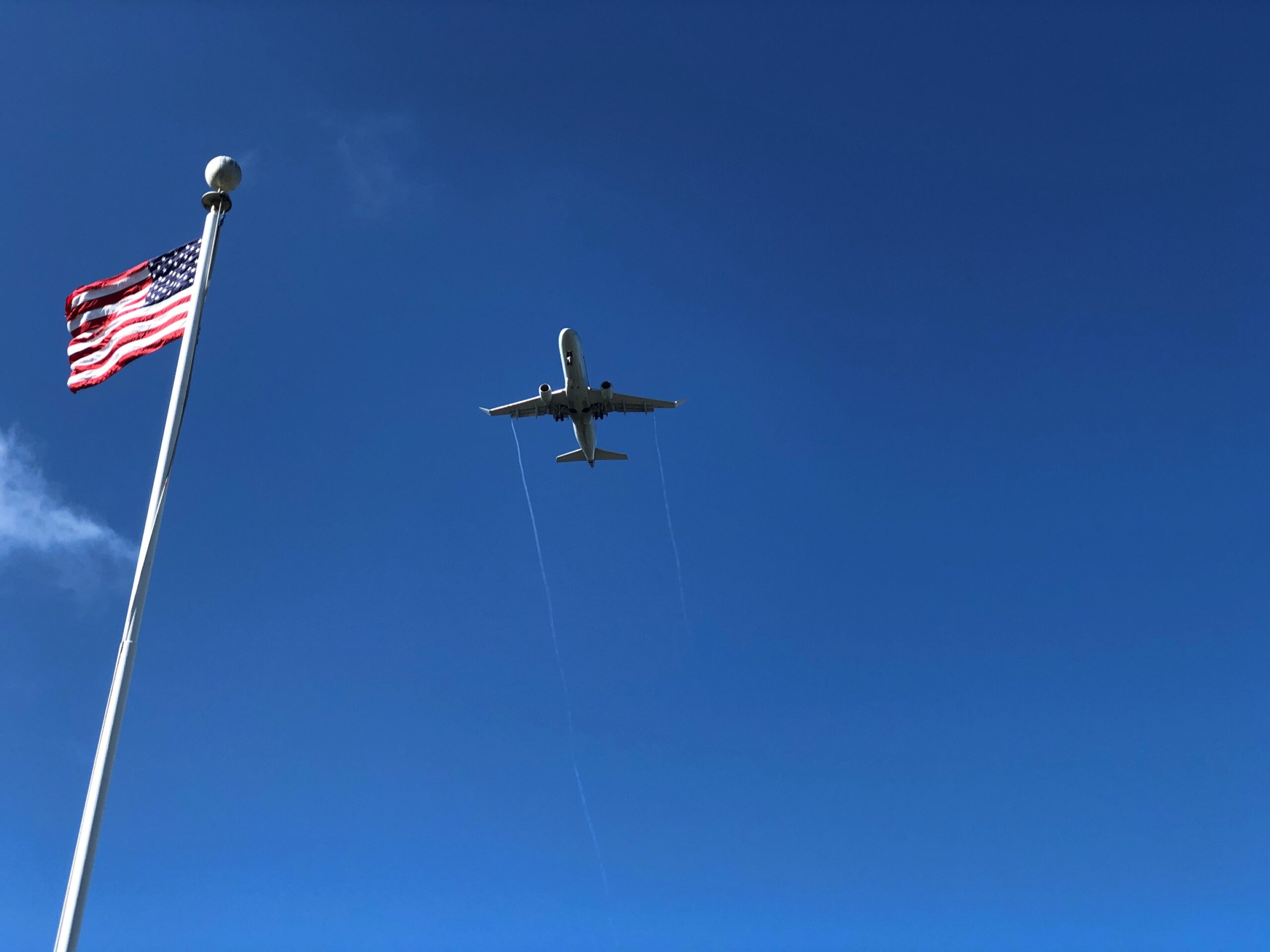
Then again, most of the island must be.

The National World War I Memorial and Museum

As a kid, that is as a kid in the late ’60s and early ’70s, I took an unusual interest in WWI. My grandfather, my mother’s father, had been with U.S. Army Corps of Engineers in France, but it was more than that, since he was gone by the time I could remember, and I only heard bits and pieces about his service from family members who knew him. Some of his gear was still around, such as a bent-up canteen and some binoculars, and a panoramic photo of his regiment, but that was about it.

My interest was more likely sparked by The American Heritage History of World War I, a book we had around the house, along with the Civil War and WWII titles by the same publisher. The WWI volume, a weighty tome lavishly illustrated, had such chapter headings as When the Lights Went Out, Appointment at the Marne, Deadlock, Ordeal of Nations, Crisis in the Allied Camp, Enter the Yanks and Eleventh Hour. I spent quality time with that book.

Just as important, there was a companion record to go with the book: World War I, Historic Music and Voices. I listened to it many times, fascinated by the music and voices from an age that seemed to have nothing to do with the time and place I found myself. That was an illusion of youth. Growing up in the 20th century meant you were in the shadow of that war, know it or not. I’d argue that’s still true. Anyway, I ended up knowing such songs as “Over There,” “It’s a Long Way to Tipperary,” “Keep the Home Fires Burning,” and even “K-K-K-Katy.” all of which were mostly unknown to my contemporaries.
I’m glad to report that the record is available on line. The narrator, Charles Collingwood, had just the right earnest, commanding voice for the record. It was years before I knew anything else about him – his time covering WWII for radio, especially, but also as a TV journalist for CBS.

Like many boyhood interests, WWI carried over into adulthood, faded but never quite gone. I knew, for instance, of the shameful neglect when it came to memorializing the war in the U.S., especially in Washington, DC. The first time I ever visited the National Mall, in 1982, I noticed a (relatively) small memorial, the District of Columbia War Memorial, off to the side at some distance, forlorn and badly aged, though I understand it was finally renovated in the 2010s. The memorial honors the “residents and citizens” of DC who performed military service in the Great War.

There was nothing else in the nation’s capital to honor anyone else in that war, not until National World War I Memorial was completed last year, and even it isn’t on the National Mall.

I haven’t seen the new DC memorial, though I’m sure it’s a worthwhile effort. Still, for a memorial really worthy of the event, go to Kansas City, Missouri.

National WWI Museum & Memorial

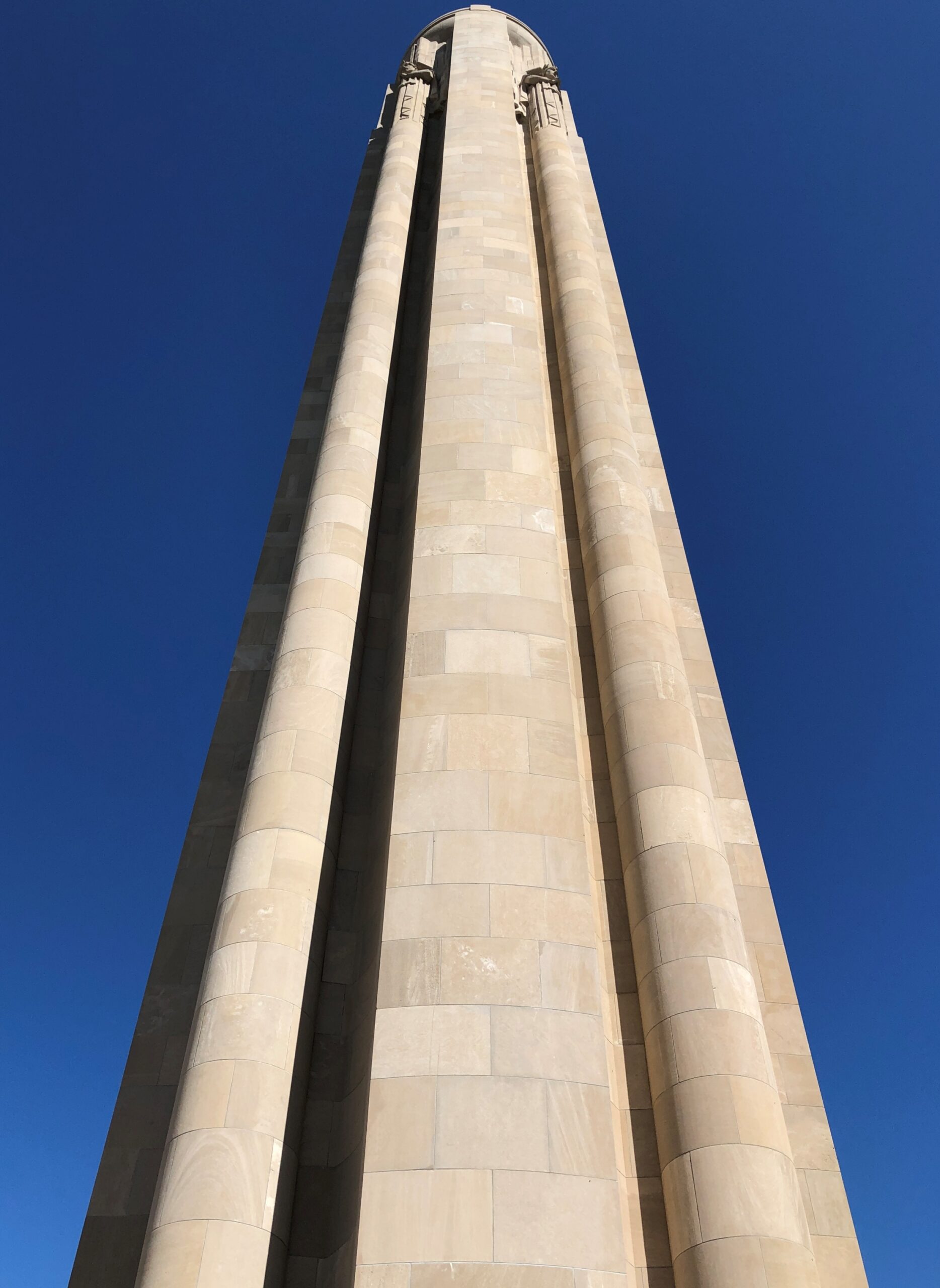
The National World War I Museum and Memorial started as a local memorial soon after the war ended. Long enough ago that Vice President Coolidge was at the groundbreaking, as was Gen. Pershing and a number of other Allied military luminaries. Local, perhaps, but with the heft of a national memorial, designed by Harold Van Buren Magonigle, who was known for his memorial work.

Magonigle’s limestone tower soars.

National WWI Museum & Memorial

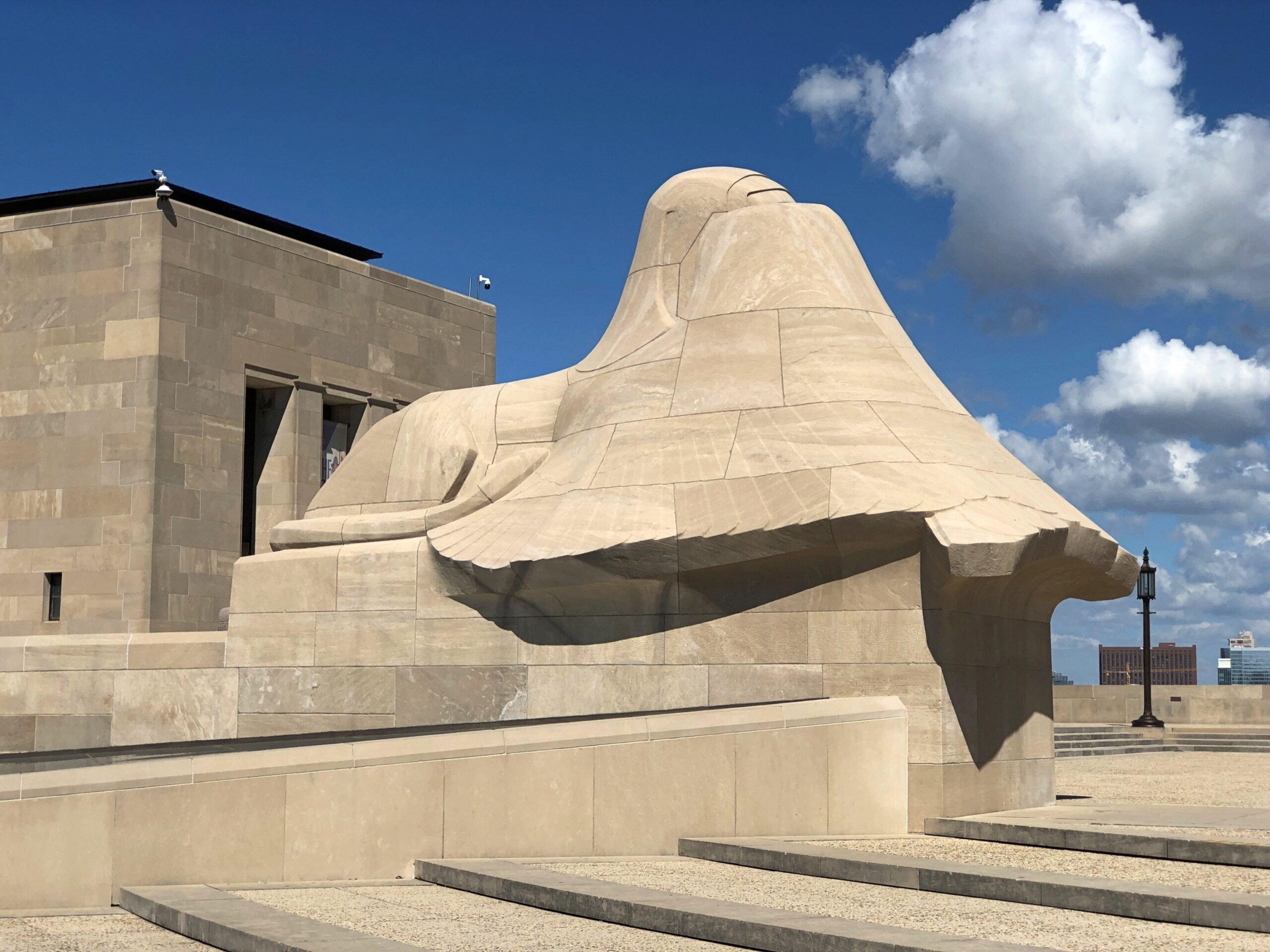
Sphinxes crouch near the shaft, supposedly covering their eyes from the horrors of war.

WWI Museum and Memorial

Naturally the memorial went through a period of neglect, and the museum came later, as the site evolved from a local to a national memorial, finally acknowledged as such by Congress in 2004. I’m glad to report that now the memorial stands renewed, and the museum, built under the memorial, is first rate. Beginning at the entrance: One enters the museum over a glass bridge that crosses a field of 9,000 red poppies, each representing 1,000 combatant deaths during the war.

As usual with any good museum, there is more than you can absorb in one go, organized in two wings: the war before U.S. entry, and after. All together, it holds more than 350,000 items, a collection comparable with the likes of the Imperial War Museum or the Musée de la Grande Guerre du pays de Meaux.

The museum’s scope is wide ranging as well, including not just the U.S. part, but perspectives and memories from people from all of the major participating nations, and some smaller ones. There was even a small display, including a map that explained things well, about the Japanese participation in the war. Japan joined the Allied side early in the game, taking the opportunity to kick the Germans out of China and seize Germany’s scattered possessions in the Pacific. A low cost, high-gain exercise for Japan, unlike the next war in the Pacific.

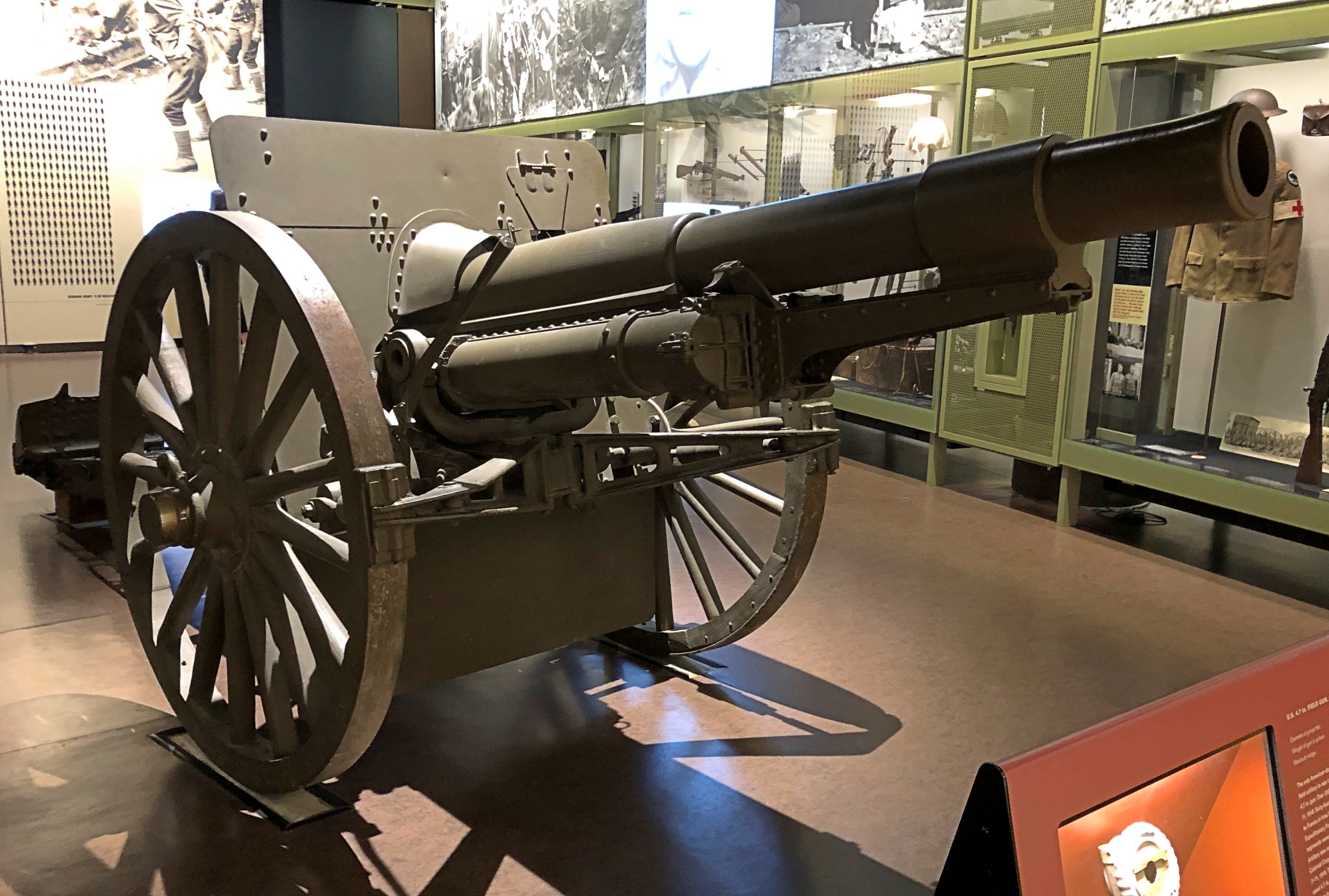
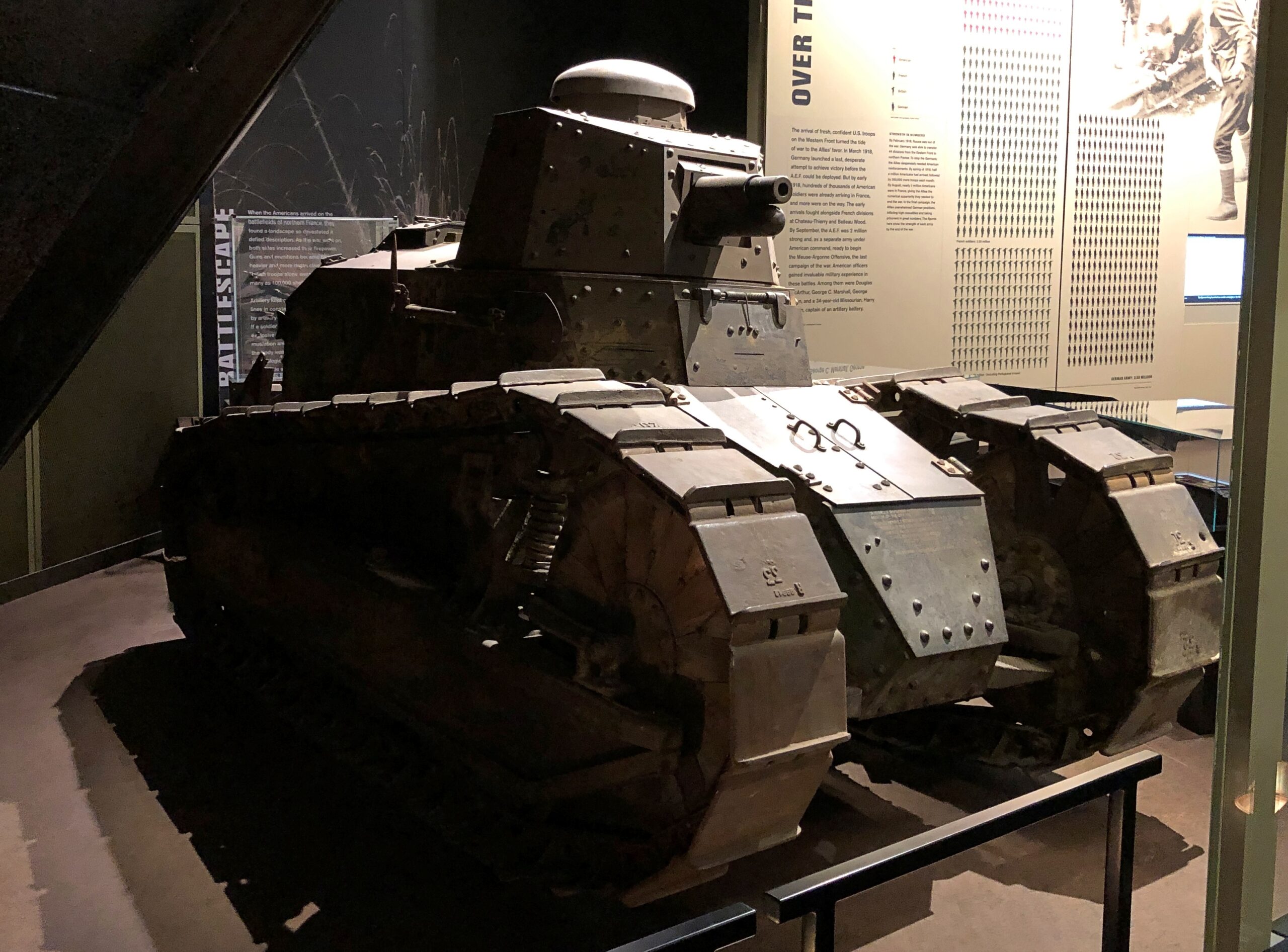
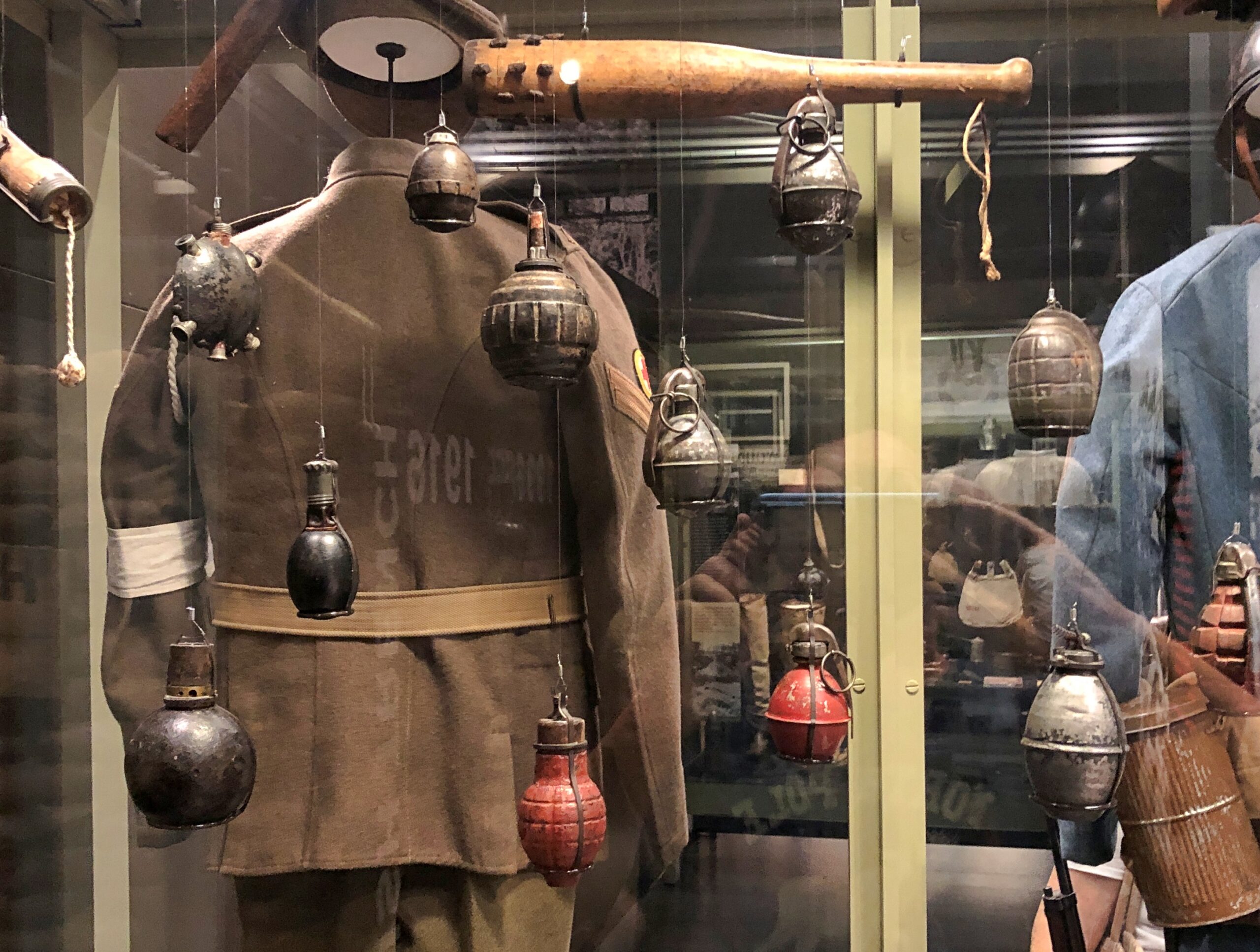
Artifacts were large and small.

Nat WWI Museum
Nat WWI Museum
Nat WWI Museum

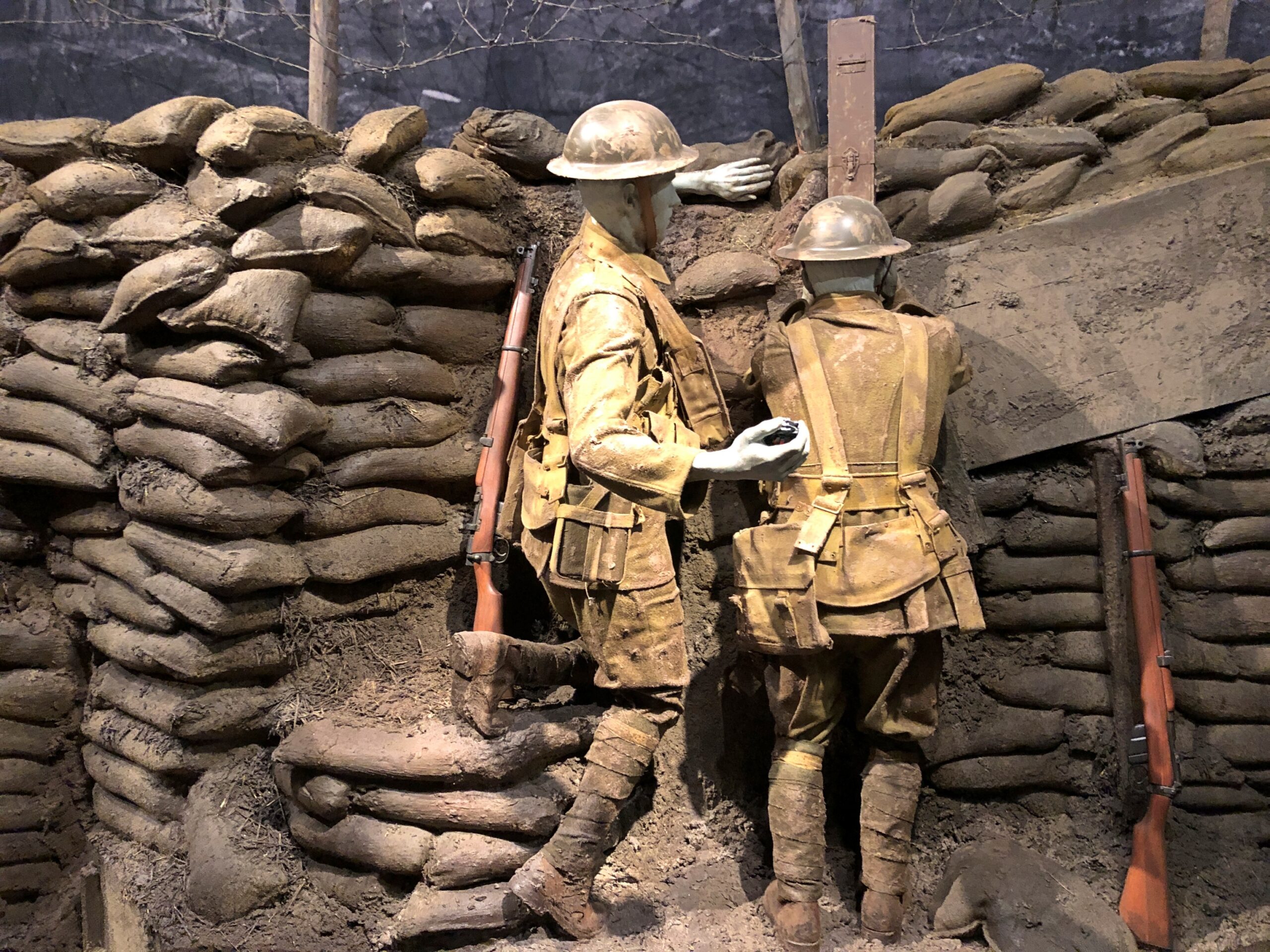
There are only a few life-sized dioramas – there are more to be found at the National WWII Museum in New Orleans – but the WWI museum did a good job of it.

Nat WWI Museum

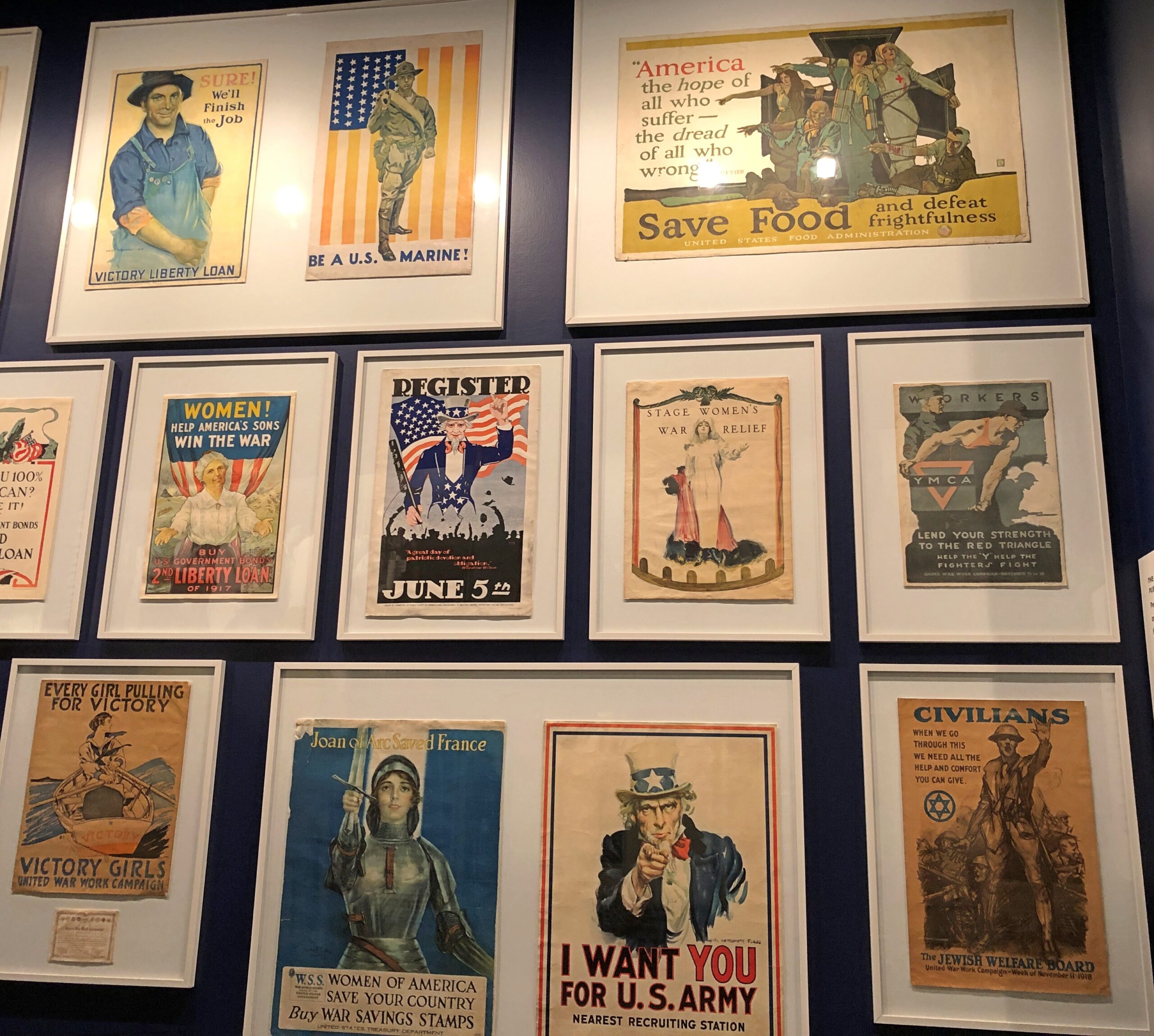
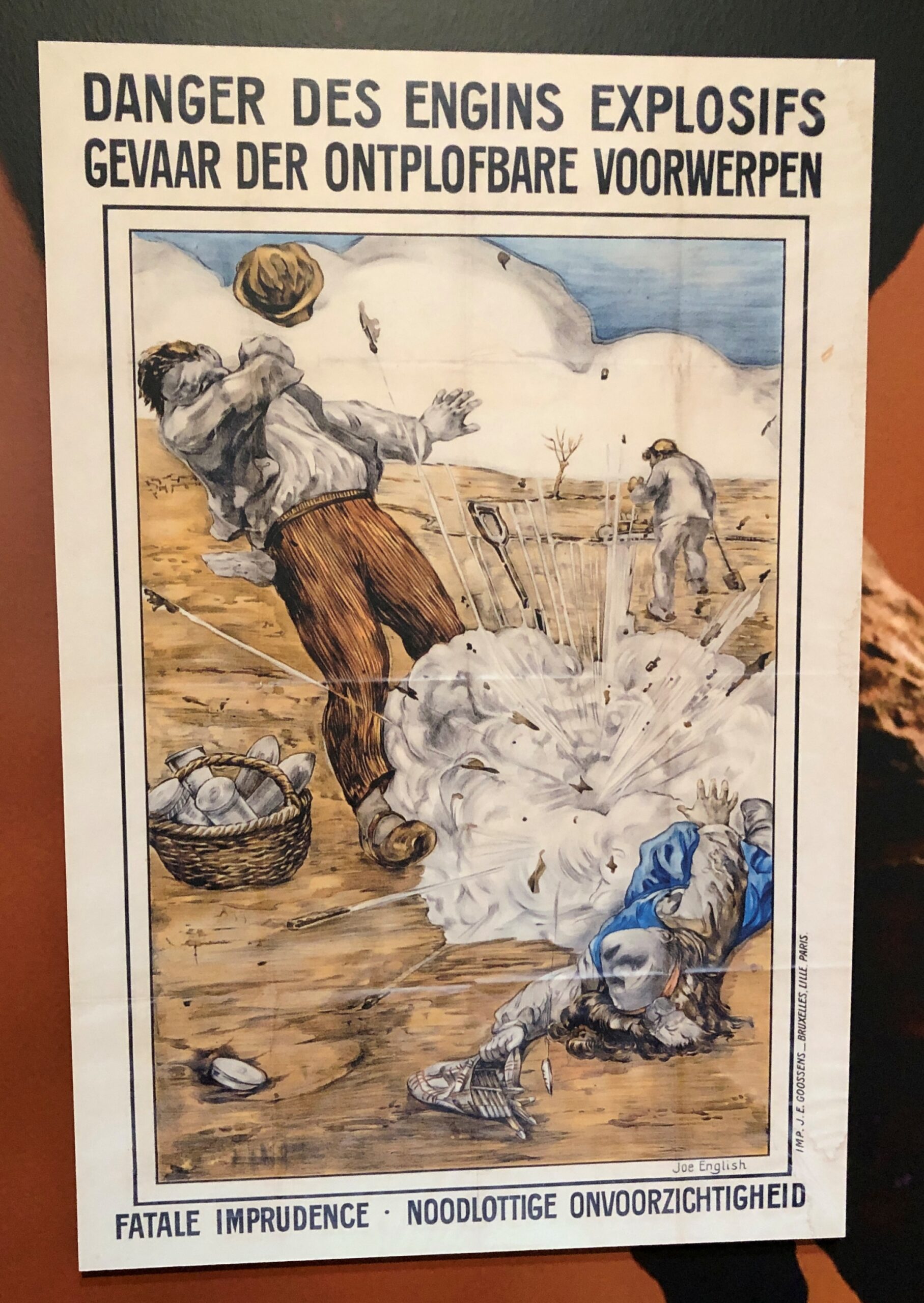
I was particularly taken with the posters. I’d never seen most of them.

Nat WWI Museum
Nat WWI Museum

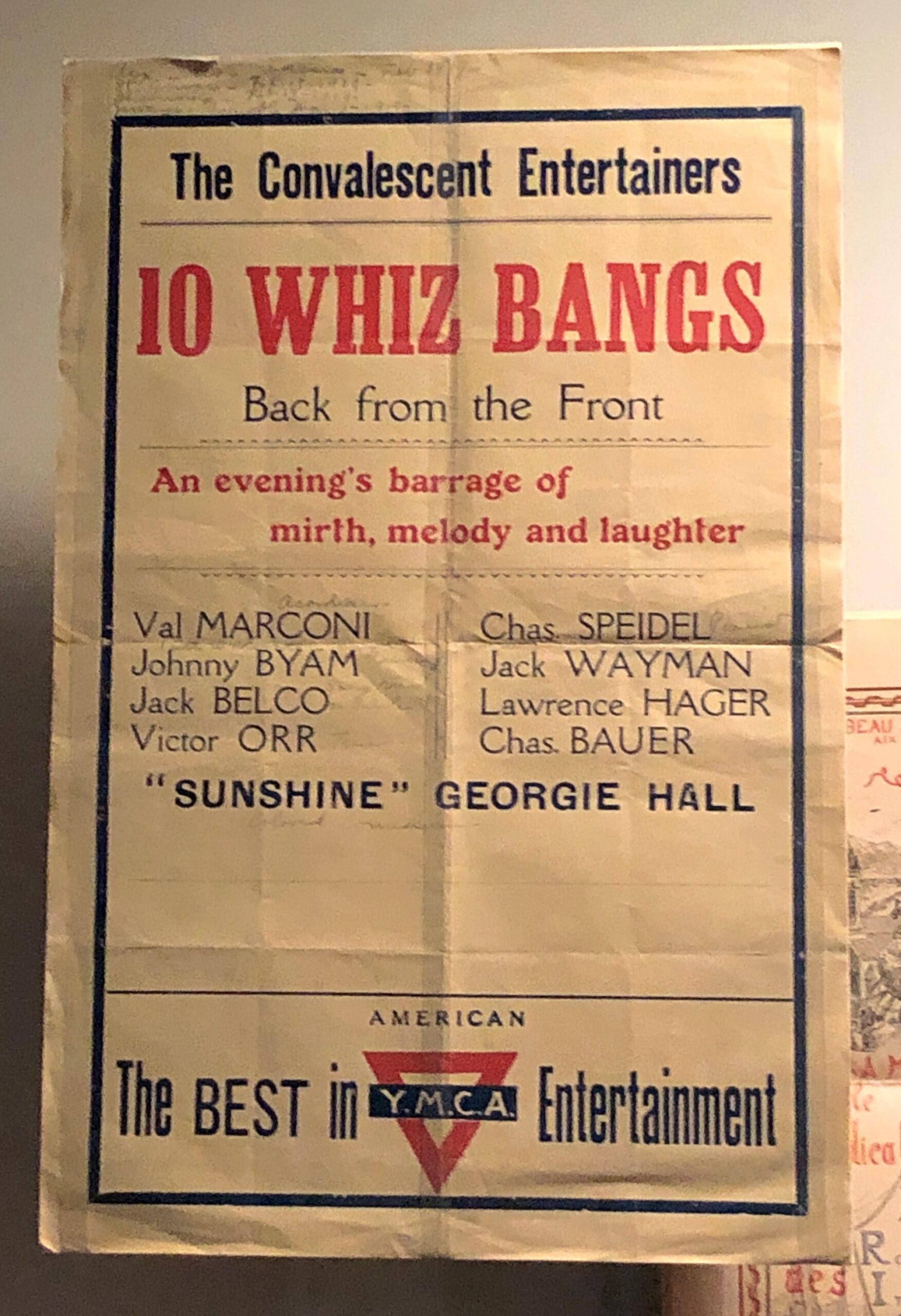
The 10 Whiz Bangs, even though there are only nine names listed. Then I realized that, at least symbolically and maybe literally, the 10th man hadn’t made it home, like so many.

10 Whiz Bangs

Remarkably, you can listen to an article about the Whiz Bangs (in the Whiz Bangs Articles).

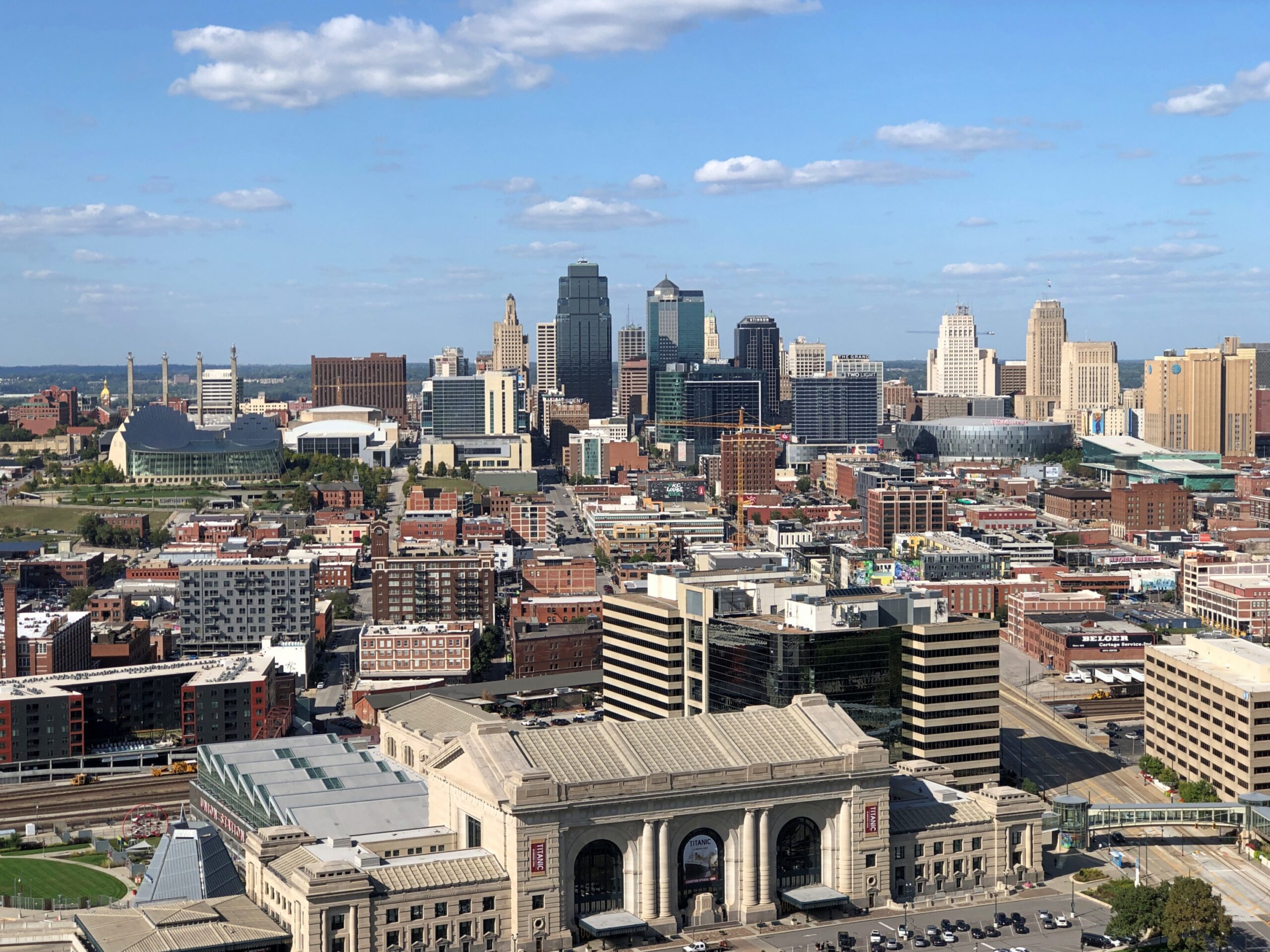
After visiting the museum, the thing to do is take the elevator to the top of the memorial, for a modest extra fee. Elevator, then iron circular stairs, actually, for an excellent view of downtown Kansas City.

Kansas City, hey hey hey

Hey Hey Hey Hey!

Twenty-Plus Years of December Firsts

Chilly days over the last week, a slide into winter even before the calendar turned to December. The first of this month now always reminds me of the sizable snow we got that day in 2006, coming as if winter were actually was signified by a particular day. Why that sticks in memory, it’s hard to say. Memory’s an oddity, often as not.

The following are the first paragraphs from postings on December 1, here at my corner of the Internet. If a year isn’t listed, that means I didn’t post that day. By my count, only eight of the 16 postings started with weather, counting one that is a quote from The Sun Also Rises about how good it is to be in a warm bed on a cold night. A few others mentioned some aspect of the holiday season, such as cops chasing a shoplifter with a taste for German Christmas ornaments.

2022: As expected, full winter is here. Not much more to say about that till a blizzard comes. We’re overdue one, at least when it comes to my completely nonscientific feelings on the matter. Not that I want one, just that it’s been a while, and the Old Man might want to let us have it this year.

2021: Ambler’s Texaco Gas Station is on the edge of Dwight, Illinois, not far from the Interstate, and after our short visit on Sunday, Ann and I went further into town, seeking a late lunch. We found it at El Cancun, a Mexican restaurant in the former (current?) Independent Order of Odd Fellows building, dating from 1916. Looks like the orange of the restaurant has been pasted on the less-colorful IOOF structure.

2020: About a month ago, our long-serving toaster oven gave up the mechanical ghost after how many years? No one could remember. Eventually, its heating element refused to heat, so we left it out for the junkmen at the same time as the standard trash, and sure enough it vanished in the night.

2019: December didn’t arrive with a blast of snow, but instead gray skies that gave up rain from time to time, which — by Sunday just after dark — had turned into light snow. In other words, weather like we’ve had much of the time since the Halloween snow fell, followed by the Veterans Day snow.

2016: Someone’s already thought of the Full Griswold. Maybe I’d heard of it before, but I don’t know where. I thought of it this evening driving along, noting the proliferation of Christmas lights in this part of the suburbs. Some displays, of course, are more elaborate than others, but I haven’t seen any Full Griswolds just yet.

2015: Some years, December comes in with the kind of snow we had before Thanksgiving. This year, rain as November ended and December began. El Niño?

2014: After a brief not-cold spell on Saturday and Sunday – I can’t call it warm, but still not bad – it’s winter cold again. Diligent neighbors used the interlude to sting lights on their houses or finishing removing leaves from their lawns. I did no such things.

2013: I took lousy notes during our four weeks in London in December 1994, so I can’t remember exactly when it was we took a day trip to Canterbury. It wasn’t December 1, because that day I saw a revival of The Prime of Miss Jean Brodie somewhere in the West End, and after the show the lead actress made an appeal for donations to fund AIDS research, since it was World AIDS Day.

2011: On Saturday, we went to Chicago Premium Outlets, which is actually in Aurora, Illinois, just off I-88. I saw something there I’ve read about, but never seen before: an electric vehicle charging station.

2010: Some years, December 1 means snow. This year, for instance, unlike last year. But not that much; an early breath of winter across the landscape. Just enough to dust the sidewalks and streets, but not cover the grass. As if to say, this is only a taste of things to come, fool.

2009: “Whoa! Whoa! WHOA!” I heard that and when I turned around, caught a glimpse of a Chicago cop running by. I’m pretty sure he had said it. A moment before that I’d entered the German Christmas ornament shop at Kristkindlmarkt [sic] Chicago in Daley Plaza to take a look at the large selection of pretty, and pretty expensive, ornaments. Someone else in the shop said something about chasing a shoplifter, so I left the shop to do a little rubbernecking. Cops chasing a guy beats piles of German Christmas ornaments any day.

2008: “After supper we went up-stairs and smoked and read in bed to keep warm. Once in the night I woke and heard the wind blowing. It felt good to be warm and in bed.”
The Sun Also Rises

2006: We were warned, and sure enough sometime after midnight on December 1, 2006, the clouds opened up, as if to tell us that today is the real beginning of winter, and don’t you forget it. First came sleet, then snow. It was still snowing at 6:30 in the morning when I got a call telling me that Lilly had no school. By about 10, it had stopped. We’d had about a foot of snow, judging by my unscientific eyeballing.

2005: Back in the late ’80s, one of the perks of my job at a publishing company was a real-time connection to the AP wire at our workstations. Stories queued up in the order they were published electronically, newer ones pushing older ones down toward the bottom. The interface was simple: green characters, no graphics, no hyperlinks.

2004: I read in the papers that tonight’s airing of Rudolph the Red-Nosed Reindeer represents the show’s 40th anniversary, making it nearly as old as me. I have a sneaking feeling it will be more durable than me, playing for a good many more decades before it finally peters out, but that isn’t because I like it. No, I never cared for it.

2003: Time to start this thing again, before the wheels completely rust up. December 1st is a good day to do it, too, being the start of meteorological winter. No need to wait around for the solstice around here, since it’s pretty cold just about every day now. What better definition of winter do you need?

Thursday Updates &c.

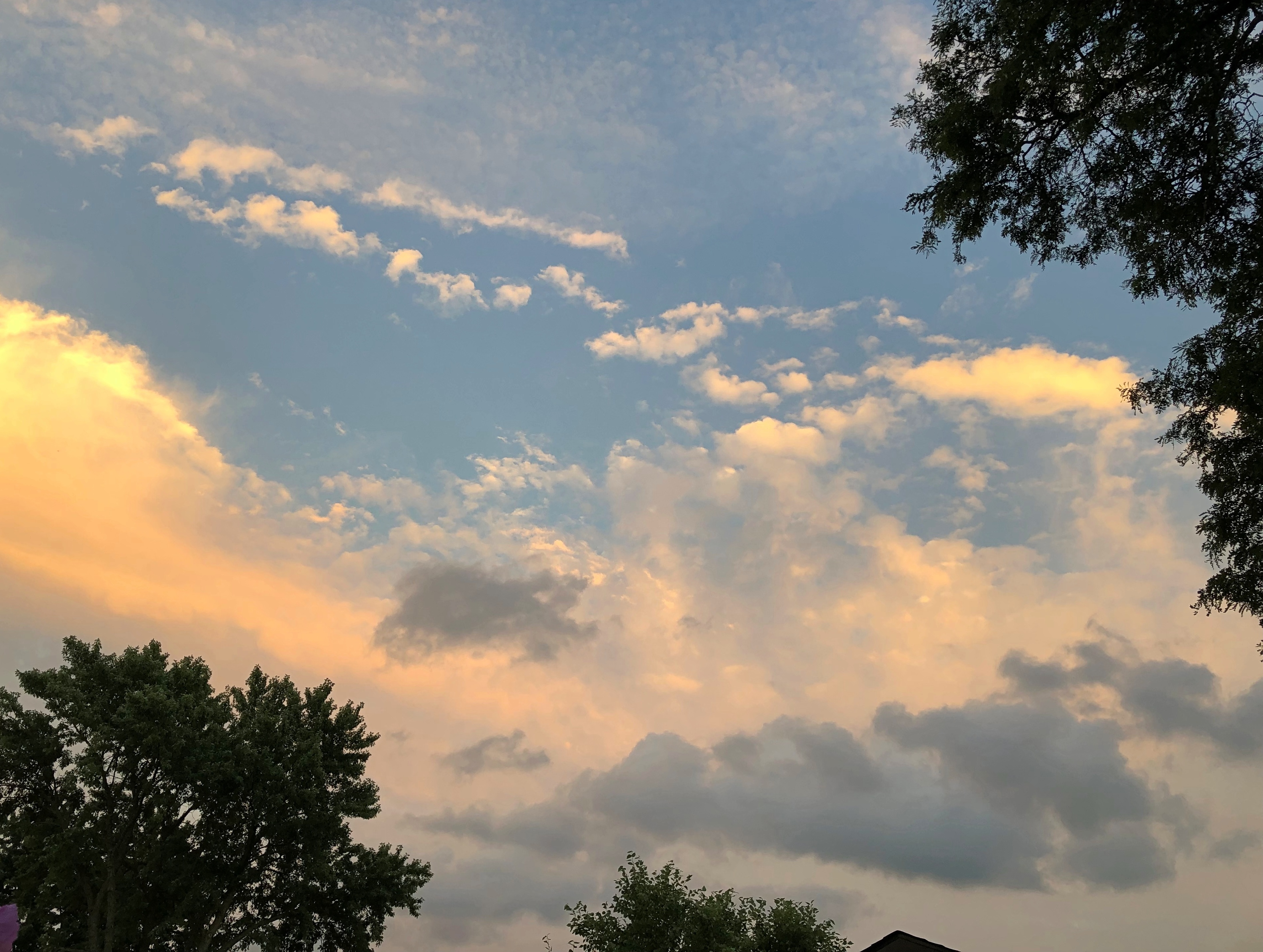
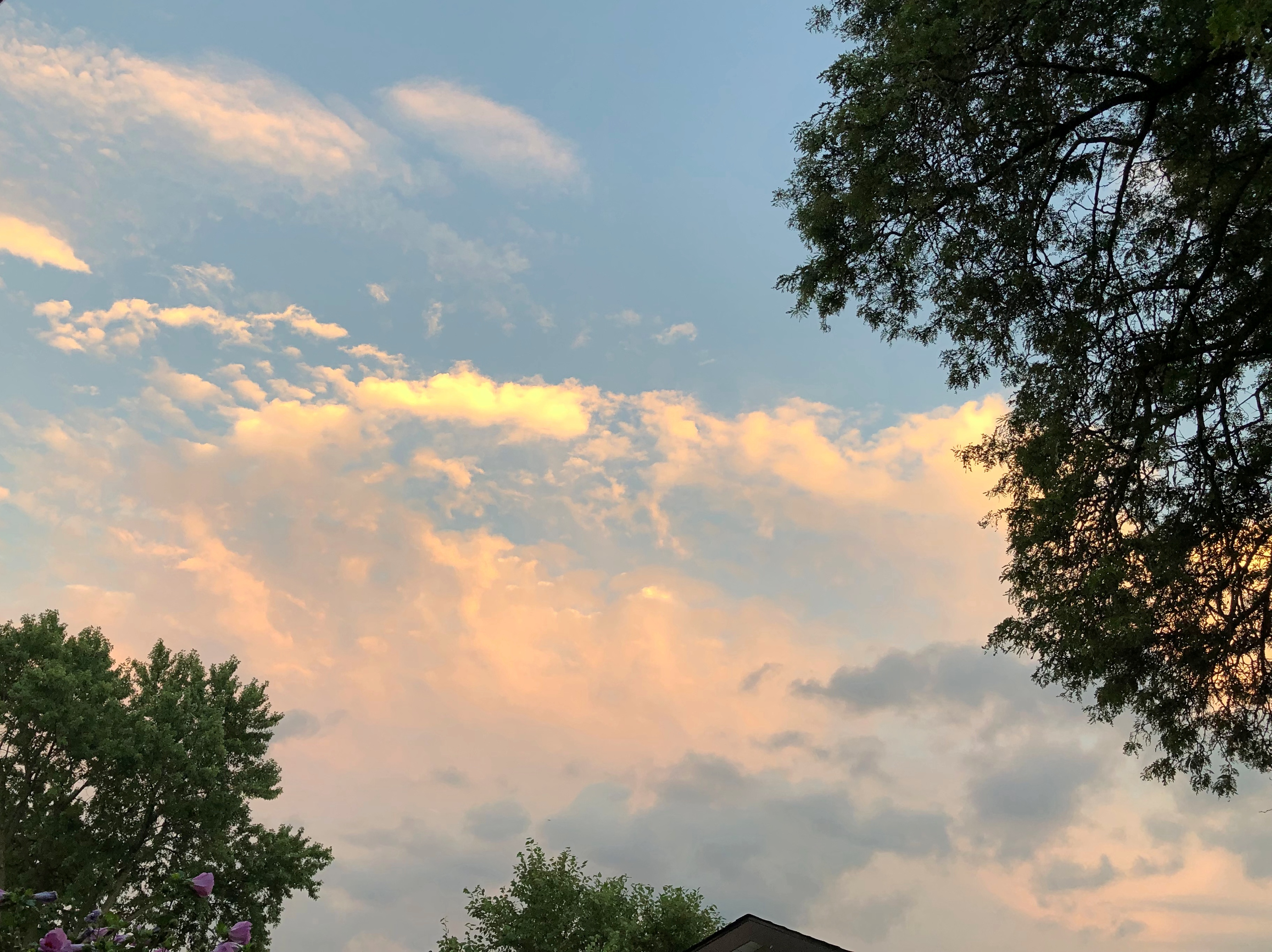
Cerulean days. Thursday dusk on the deck.

It’s come to my attention that Jim Varney did occasionally perform live with Gonzo Theatre. At least, the Tennessean posted an image of him doing stand-up at the Municipal Auditorium in downtown Nashville on November 14, 1982, describing him as a member of the troupe. So maybe he was sometimes; but not specifically on the night we went, and he isn’t in the publicity shot I have in my possession. A Tennessean article about Gonzo Theatre from the year before doesn’t mention him either.

Argh, we could have seen Varney live but, being ignorant young’uns, we didn’t know about the show. Bet he was a hoot and a half.

We were out and about the evening NBC broadcast the Olympic Parade of Nations nearly two weeks ago, so we didn’t see that. Since then, I haven’t felt much like following the Games. But occasionally I look at the medal counts. I see that the UK has 57 and France 56 thus far. Is that the count that the French really care about? No hope to best China or the U.S. (or even Australia), but maybe they’ll top the limeys.

What do the French call the British when they’re in a derogatory mood, anyway? One source says rostbifs.

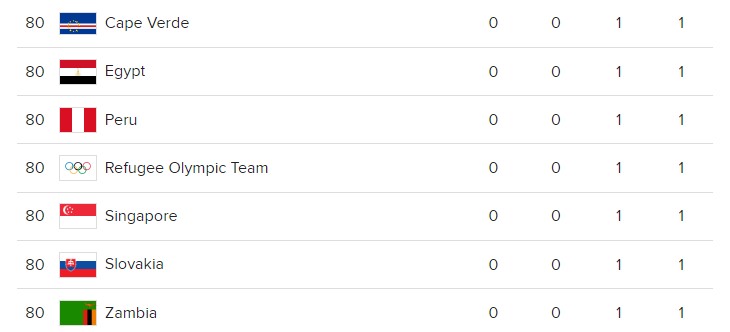
I also checked the nations that so far have a single bronze. They are:

Including one for the Refugee Olympic Team. How about that.

“Boxer Cindy Ngamba became the first-ever Refugee Olympic Team athlete to win a medal this week, giving the team its first piece of hardware since its creation nearly a decade ago,” NPR reports.

“Ngamba was born in the Central African country of Cameroon and moved to Bolton, England, at age 11, according to her official biography. She took up soccer at a local youth club, where she discovered boxing by chance at age 15.

Ngamba, who is gay, cannot return to Cameroon, where same-sex sexual relations are punishable by up to five years in prison… Ngamba qualified for the Refugee Olympic Team earlier this year, becoming the first boxer to do so.”

Good for her. Hope she gets to stay in the UK.

Magic Places

First thing to do today is Remember the Alamo.

There’s been a recent uptick in bogus comments here, which I almost always delete, along the lines of (this example, verbatim): Thanks for a marvelous posting! I genuinely enjoyed reading it, you could be a great author. I will be sure to bookmark your blog and will eventually come back later in life. I want to encourage continue your great writing, have a nice day!

The “author” is usually listed as some service- or product-oriented operation, occasionally lewd but more often personal accessories of some kind, with a gmail address. To recall Buck Turgidson, I’m beginning to smell a big, fat AI rat.

I hung up the last 2024 wall calendar the other day, fourth of four in the house. One might think that illustrates my procrastinating ways, since we’ve burned through a sixth of the year already (the crummiest sixth, I should add). But no, I hung an accurate calendar there around New Year’s. The 2018 Metropolitan Water Reclamation District of Greater Chicago calendar.

The year’s different, but so what? The first two months were the same as this year, but that changed on February 29, so I needed another calendar to avoid confusion, a year in which March 1 is a Friday. The most recent leap year to fit the bill (besides this year) would be 1996, but I didn’t seem to have one of those around or, oddly, any other calendar that qualified. No worries, I saw a wad of ’24 calendars at Ollie’s not long ago and picked one of the lot for $4, compared with a list price of $17. Nice discount, and I get 10 months at 40 cents each, instead of 12 months at about $1.40 each. Not much you can buy for 40 cents these days.

It’s a Plato calendar, an imprint of BrownTrout Publishers, which asserts that it is The Calendar Company. I had to look that up: headquartered in El Sugundo, California, BrownTrout published 1,500 unique titles as of 2020, according to the latest press release boilerplate issued by the company (recommendation, put a few newer releases on your site, BrownTrout). The site also says the company is the largest calendar publisher in the world, and it may be so, if that means calendars sold. Or does it mean days put on paper?

The one I bought at Ollie’s is called Magic Places. Handsome Rocky Places might be more like it. Mostly it pictures extraordinary rock features, natural and partly man-made, the kind of flawless and painterly pics you get from this kind of calendar, including sites in Scotland (three), England, Turkey, Greenland, Russia, and more. The likes of the Old Man of Storr, Cappadocia, Machu Picchu and Hegra in Saudi Arabia. One month wasn’t rocky but a monumental tree in Epping Forest in Essex, which I vaguely had heard of, but didn’t really know.

Just shows that Greater London is so vast, not even a month there is enough to hear of everything, especially in the days before the Internet. Once a royal forest, these days Epping is owned by the City of London Corp., even since – this isn’t hard to guess – the Victorian period.

Magic Places is a good-looking trilingual calendar, including Spanish and French as well to cover North America, and it has most of the standard holidays: U.S., Canada and Mexico civic, Christian, Jewish and Muslim, along with those days peculiar to American calendar-making tradition, such as Ground Hog Day, April Fool’s Day and Grandparents Day. There are also Low Countries holidays, which I suppose is a good market for the calendar maker.

It made my day to learn that besides being Cinco de Mayo, May 5 is Bevrijdingsdag in the Netherlands, Liberation Day. A holiday to celebrate ousting Nazis is one we can all get behind.

V.S. Pritchett ’83 (Part 2)

The VU class that V.S. Pritchett taught in 1983 was fiction writing, which makes sense, since he was a fiction writer of renown and, presumably, Vanderbilt’s attenuated reputation for literature was still important to the English Department at the time. It’s hard to recollect much about the class, though. It’s been 40+ years, of course, but it’s more than that. To undergraduates, professors seemed to ply their trade from the perch of an advanced age, one that was hard to imagine. That didn’t always interfere with a student’s ability to absorb the material, however, provided the professor had some skill as a teacher.

Pritchett was 82. That was more than advanced; that was positively antediluvian, in my youthful estimation. I still feel that way a bit, though I know that advanced age doesn’t necessarily — or even that often — cut into ability in the intellectual arts. Regardless, aged or not, he wasn’t one of the great teachers that one encounters along the way. I’m not even sure he was that good. He seemed to like to listen to students read each other’s stories out loud – we wrote stories for the class, and read them, but not our own. I think. Then we talked about the stories in a meandering sort of way. He made comments, but for a writer of stories, didn’t seem to tell that many in class.

VU prof Walter Sullivan (d. 2006, curiously at 82), whose fiction writing class I’d taken in the fall of 1982, read student stories himself, ones he’d picked to illustrate some point, and then led the discussion. Not with an iron hand precisely, but the firmness of the former Marine that he was.

One student wrote a story about (again, I think) about a little girl and the death of a baby bird, or some such. Dr. Sullivan read it, and then thundered: “Don’t write stories about animals! Or little children! Short stories should be about grown men and women.”

Sullivan was, as I recall, the better teacher. Still, we liked Pritchett. But being in his class was something of a squandered opportunity. We were dense youth, so we didn’t really ask him many good questions. No followup about Orwell, as I’ve mentioned, even though Pritchett did tell us a snippet or two about him.

But here was a man who, for instance, remembered World War I as a youth (though not in the fighting) and who went to Paris in the 1920s as a young man, and who took a ramble through Spain and Ireland during that same decade. I wish I’d thought to ask about those things. Or what about the other writers that he knew? Or his opinions on such luminaries as Chekhov – he must have been thinking about him when he taught us, since he published Chekhov: A Spirit Set Free in 1989. Ah, well. At this remote time, all I can do is shrug.

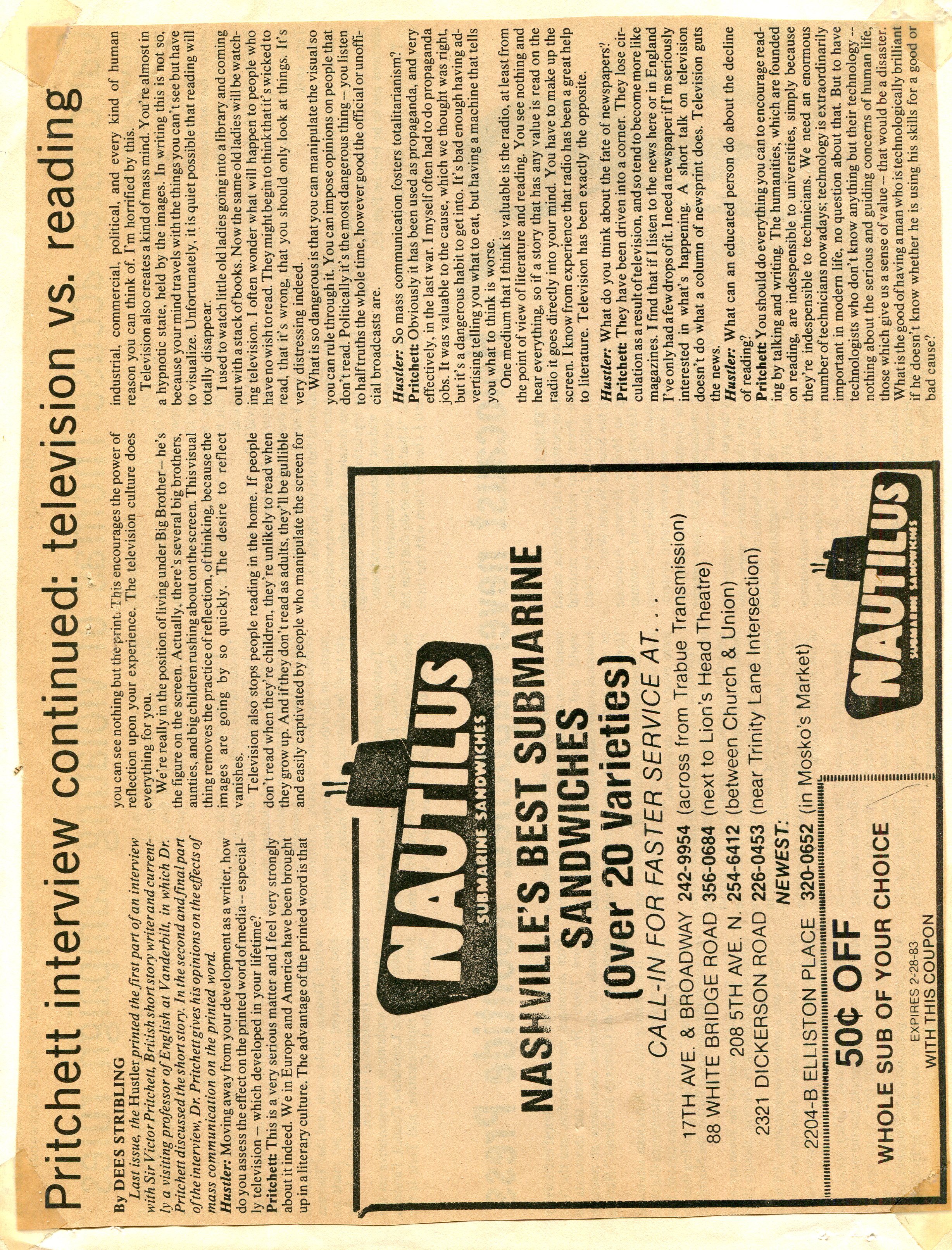
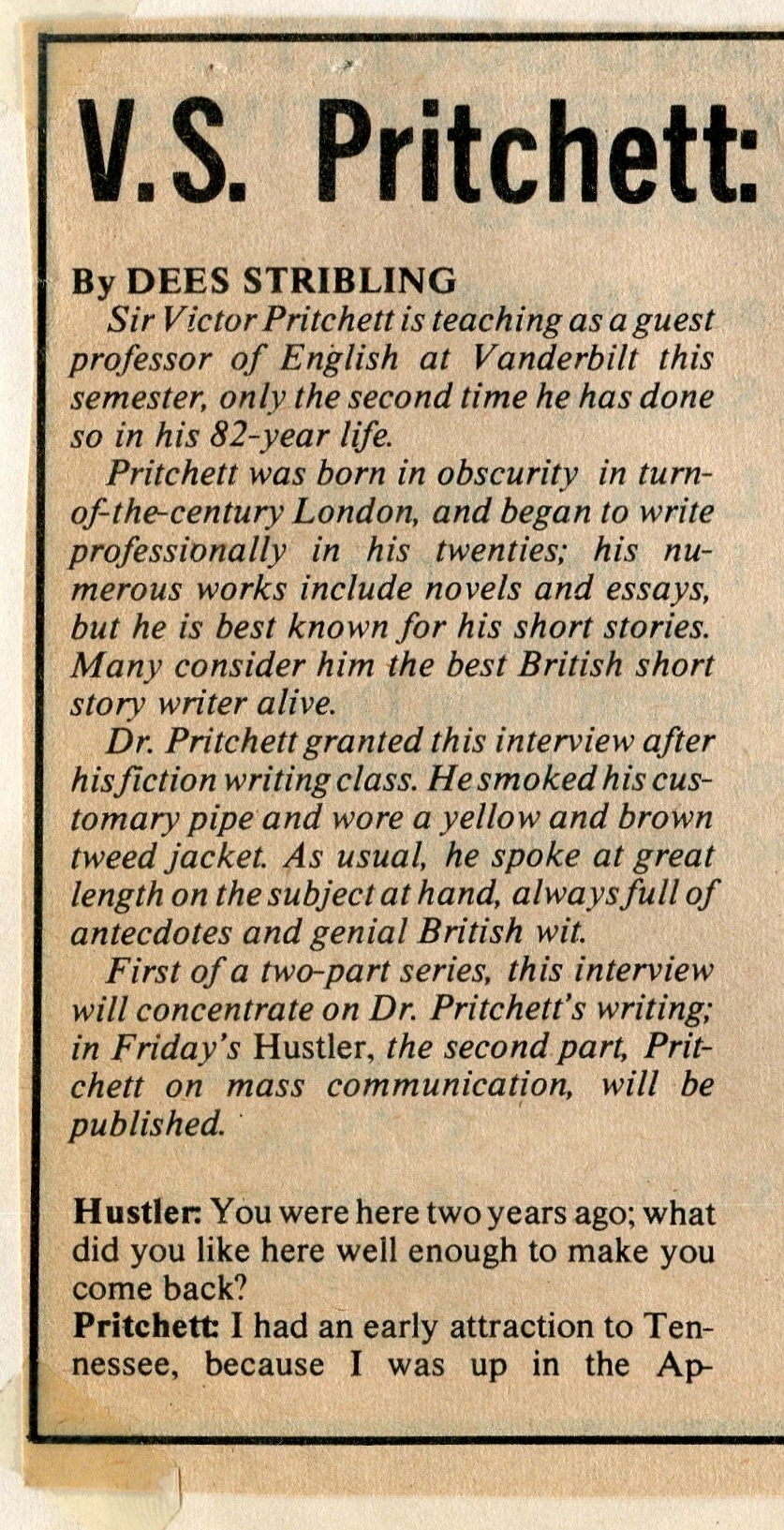
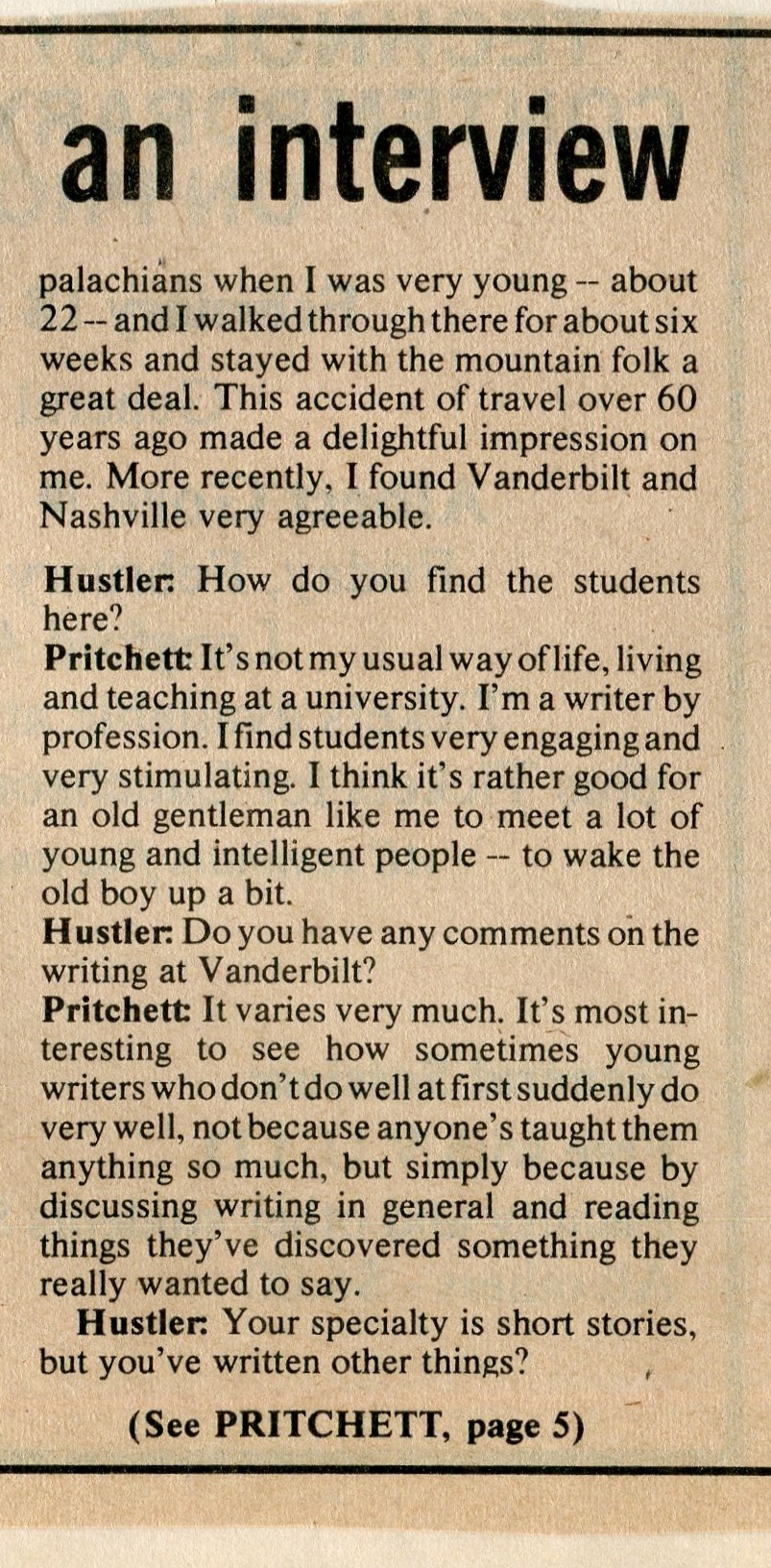
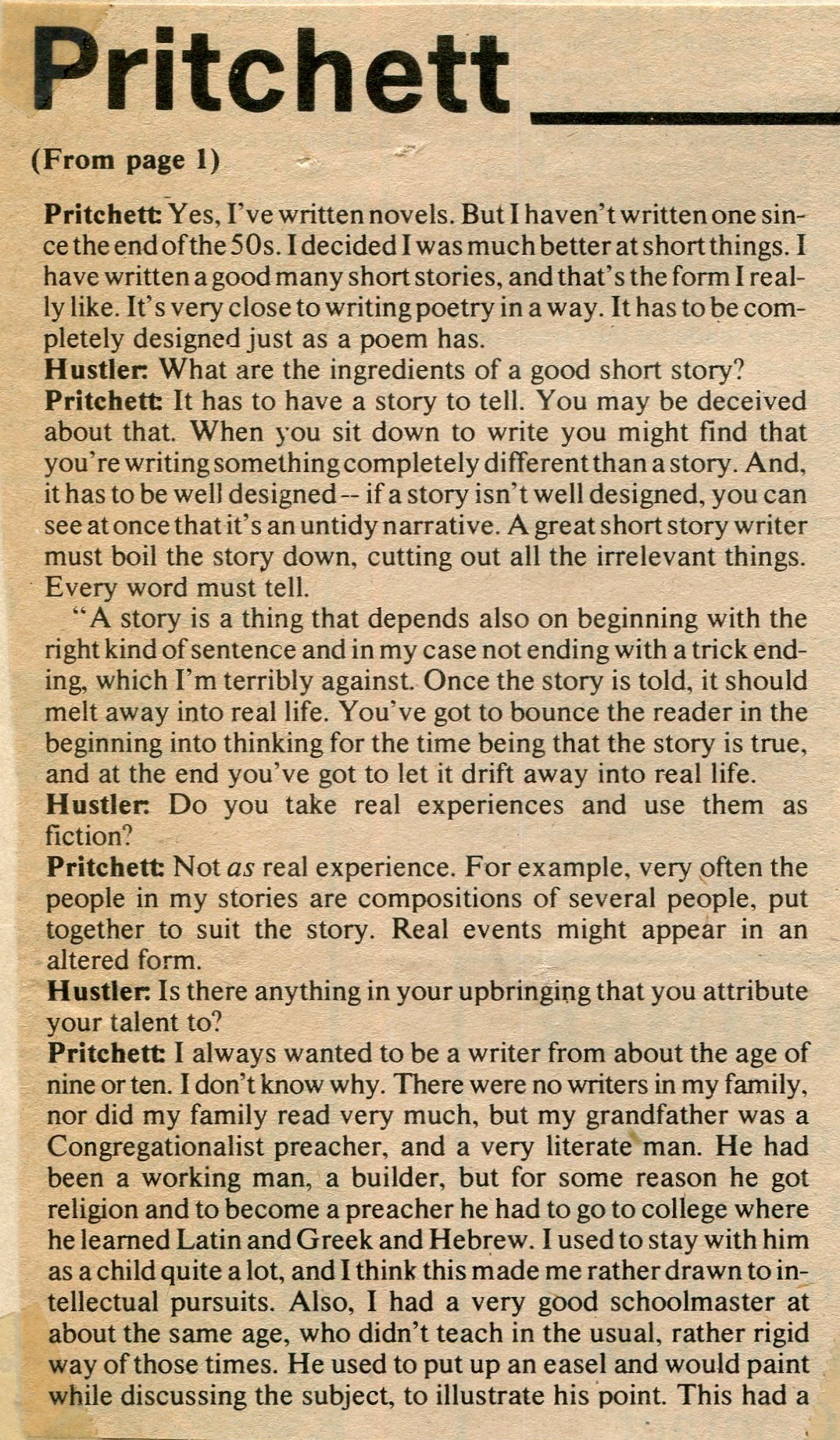
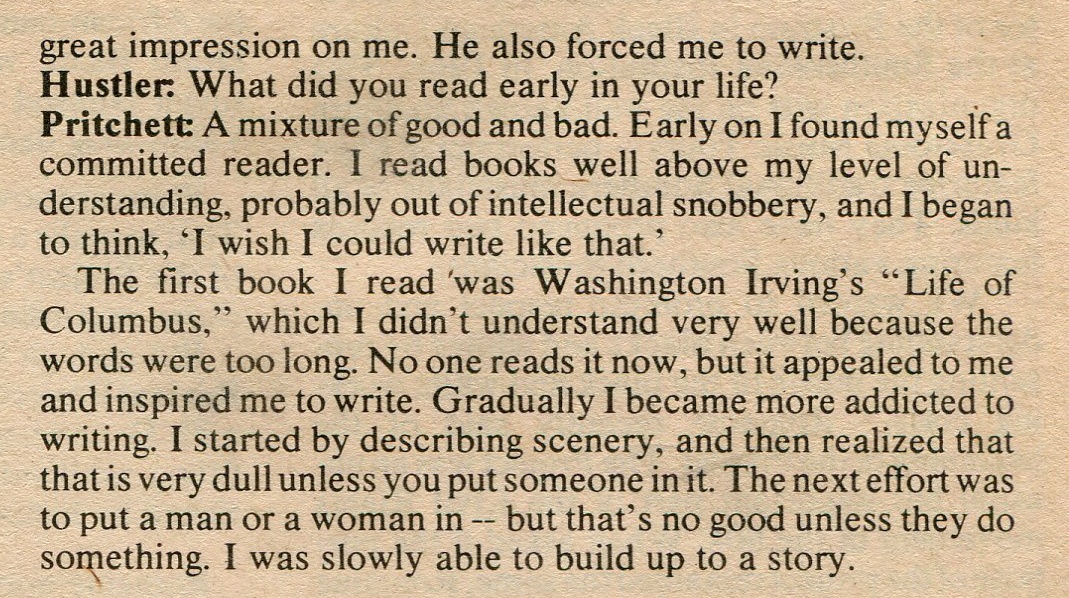
This is the second part of my interview, published February 11, 1983.

Television was killing the printed word in those days; had been since Howdy Doody started shilling for Wonder Bread. Seems almost like a quaint notion now, its dumbing down role famously usurped by social media, though I’d say that TV is still in the game.

I have a collection of Pritchett’s short stories somewhere or other, and I dimly remember reading some of them. I also have a book of his literary criticism, Myth Makers (1981). I know where that one is. That’s pretty close to the time I interacted with him.

“Essays on major European and Latin-American writers of the nineteenth and twentieth centuries, by the distinguished English man of letters, include lucid, sensitive interpretations of Tolstoy, Dostoevsky, Chekhov, Flaubert, Stendhal, Kafka, Borges, and others,” notes the Amazon squib. I ought to get around to reading it.

V.S. Pritchett ’83 (Part 1)

I’m not one to drop names. One reason is I don’t have many to drop. There was that time I was pretty sure I saw Neil Young having lunch at the International Market in Nashville, ca. 1985, or at least someone who was a dead ringer for the musician. I let the man eat his food in peace.

And of course there was the other time (spring 1980) two friends and I saw Gregg Allman and his entourage enter the same Nashville restaurant we were having lunch, making a bee line back to a private room. If one of my friends hadn’t pointed them out, I wouldn’t have known.

The same with Larry David. A colleague and I were passing through the lobby of the Boca Raton Resort & Club in 2004 and he (my colleague) made a startled announcement: “That’s Larry David,” referring to a fellow we’d just passed whom I’d scarcely noticed in the crowd. That was the first I’d ever heard of him. Later I discovered that his brand of humor isn’t really for me.

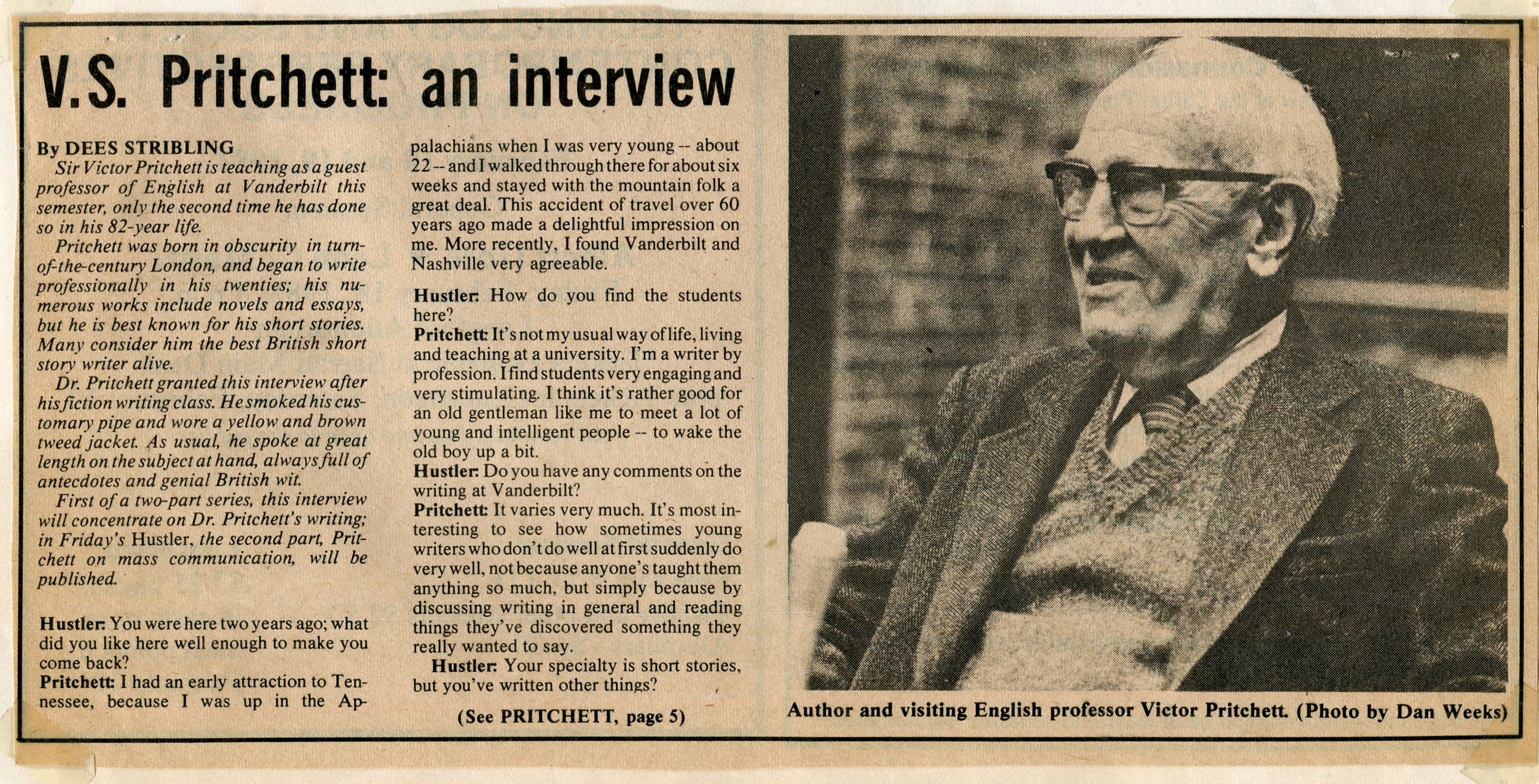
Which brings me to Sir Victor Sawdon Pritchett (1900-97), a British writer best known for his short stories. V.S. Pritchett, his byline is usually styled. I expect many (many) more people, Americans anyway, have heard of the other notables I’ve mentioned than him.

Still, I not only saw Pritchett, I met him, since I took a class he taught as a visiting professor at Vanderbilt in the spring of ’83. I’ve mentioned him precisely once in 21 years, so I can’t call knowing him earth-shaking or otherwise consequential to the course of my life. Even so, I’m dropping his name now.

Besides sorting postcards, I’m opening up old files – physical files, of which there are many – with a mind toward sorting them as well. One I opened this week was labeled “Clips Before 1984.” Most of them are items I wrote for The Vanderbilt Hustler, the VU student newspaper. I was its news editor in the spring of ’83, and one of the items I did was a longish interview with V.S. Pritchett.

I’d completely forgotten about it. But there it was in black and white, to use the cliché. A front-page interview, but below the fold.

The first part ran on February 8, 1983. 

The second part was published on February 11. Not a bad interview for a college kid. But why – why – why didn’t I ask him about George Orwell? He knew Orwell. At least I know my degree of separation from Orwell is exactly two, a thought that pleases me for some reason.

Because of the nation’s absurd copyright laws, I suppose the article technically still belongs to Vanderbilt Student Communications, but I doubt they’d begrudge me posting it nonprofessionally after more than 40 years. If they do object, I’ll take it down. Until then, it represents an interview with Pritchett that probably isn’t posted anywhere else, a thought that also pleases me, though it surely doesn’t add or change anything about the record of his life.

RIP, Sir Victor.

September 13, 1975

A curiosity in my personal chronology: I remember what I was doing from 10 pm to 11 pm Central on Saturday, September 13, 1975. I was 14 and the start of high school was just a few weeks behind me, but that wasn’t so important that evening. During that hour, I was parked in front of our living room television, a black-and-white set because my mother didn’t convert to color until it was impossible to buy black-and-white. That didn’t bother me a bit.

Because the Internet never ceases to amaze, it took me only a few seconds to find the local TV schedule for San Antonio that day, to confirm what I already knew: the 10 pm slot on Channel 12, which was the ABC affiliate, was given over the Space: 1999. Not just any episode of that show – sold to U.S. markets in syndication, so not in prime time – but the first episode, “Breakaway.”

As the most expensive British television program up until that time, the show got quite a buildup, so it was no accident I tuned in. Martin Landau and Barbara Bain, as I recall, had plugged it on The Tonight Show not long before. (That too is online, at least as difficult-to-hear audio.)

So I watched that evening, and every week for a short time afterward. The physics of the premise — the Moon blown out of orbit and traveling the stars — was like something out of the Irwin Allen playbook, but even so the show started with some promise. As time passed, however, its essential dopiness became all too clear.

I think of this when I recall that I saw the first episode of Saturday Night Live on October 11, 1975. Or rather, the last two-thirds of it, switching channels after Space: 1999 was over at 11 Central. My reaction was, What is this? Then I think I remembered that a live comedy show had been slotted for that time, as it had been promoted as well. Within a few weeks, I didn’t bother with Space: 1999 any more, and took up SNL, as many of my peers did.

Despite its failure as science fiction, Space: 1999 did have one thing going for it, something I occasionally still enjoy. Namely, the kick-ass introduction.

Visually, it teases with quick-cuts of the episode ahead, as well as reminders of how the hapless residents of Moonbase Alpha got into their situation, and a sequence that fixed the fictional events of September 13, 1999 in one’s mind (and, lots of crashing space ships!). Aurally, there’s a rousing blend of orchestral passages, jazz and a funky electric guitar by British composer Barry Gray (d. 1984) that had early ’70s all over it.

Nichols Bridgeway ’23

Saw this headline in the WSJ late last week: ‘I’m Not Excited For Him to Become King’: American Royal Watchers Draw the Line at King Charles Coronation

Do we as Americans need to be excited about the coronation of Charles? No, we do not. Interested, if that kind of thing interests you, but I’ll bet even a good many Britons don’t have strong feelings one way or the other. As one of those things that doesn’t happen very often and which harkens back to a long history, the event interested me, but not to the point of distraction.

Reporting on the event makes it seem as if there are only two modes of thinking about Charles, and the British monarchy for that matter: slavish adoration and awe at the pomp, or bitter republican convictions that see the royals as posh parasites. I can’t muster enough emotion to feel either of those, though I could probably sit down and come up with reasons on each side of the monarchy, pro- and anti-, like any former high school debater.

Still, I did a little reading about the sceptre and orb, because who doesn’t like a little reading about orbs especially? Of even more interest, though, is the Stone of Scone, which for years I thought was pronounced the same way that the British refer to their biscuits (but no, it’s “skoon,” which does sound more Scottish). I understand that all it takes to see the stone these days is a visit to Edinburgh Castle. Its presence there since 1996 must count as a physical reminder of UK devolution.

All in all, the coronation didn’t interest me enough to get up at 4 or 5 am on a Saturday for live coverage. Plenty of video was available soon after.

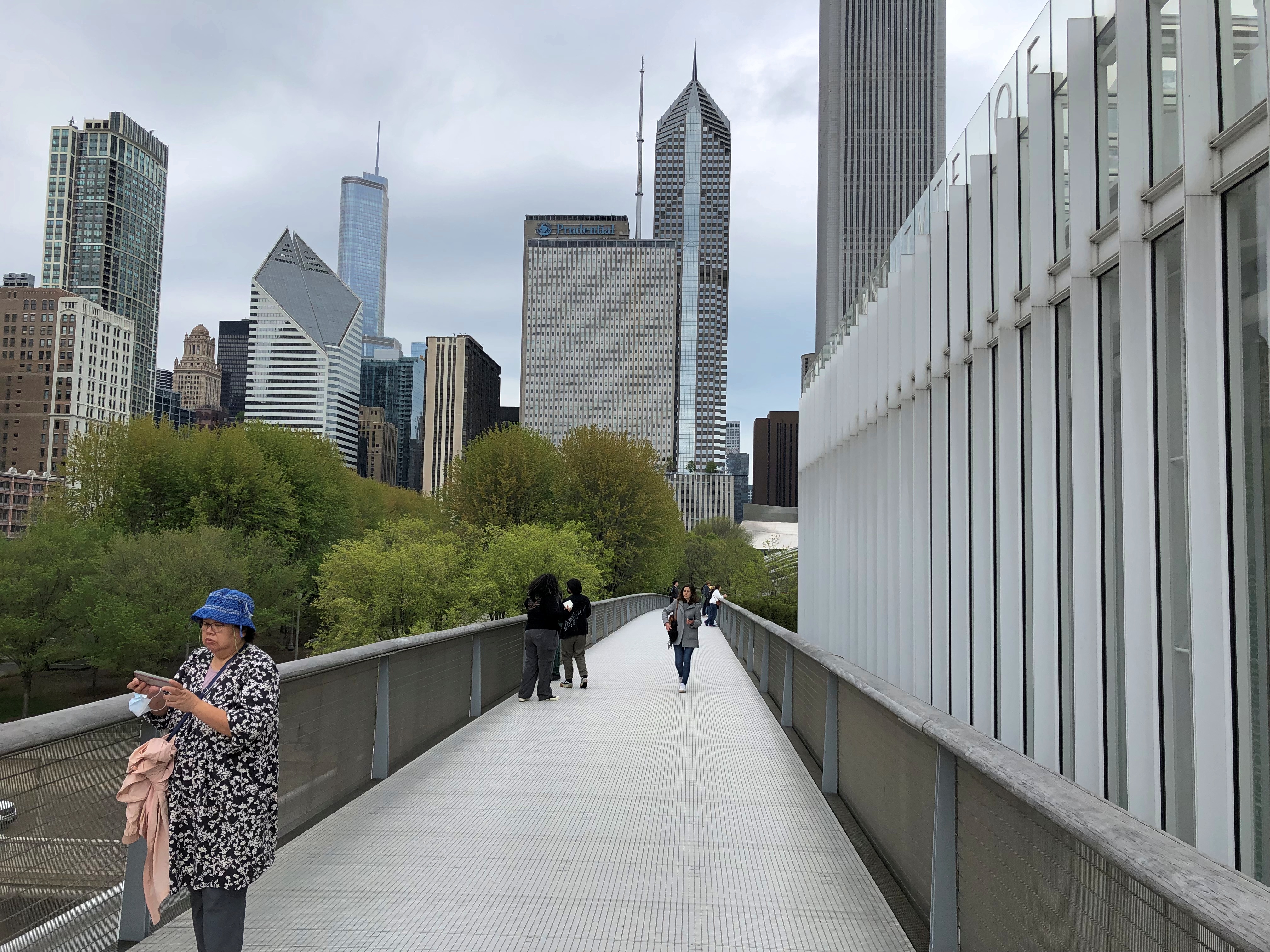
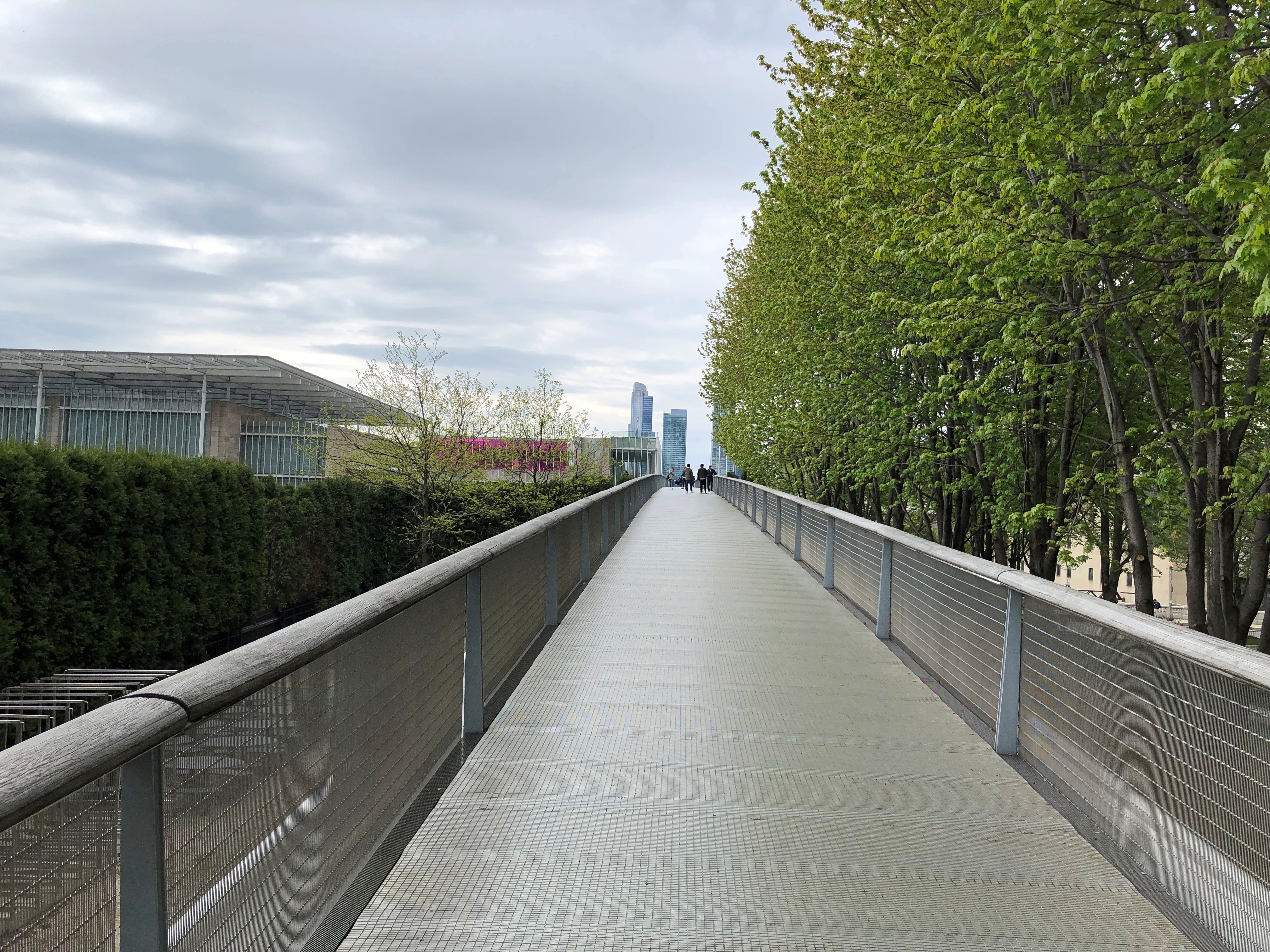
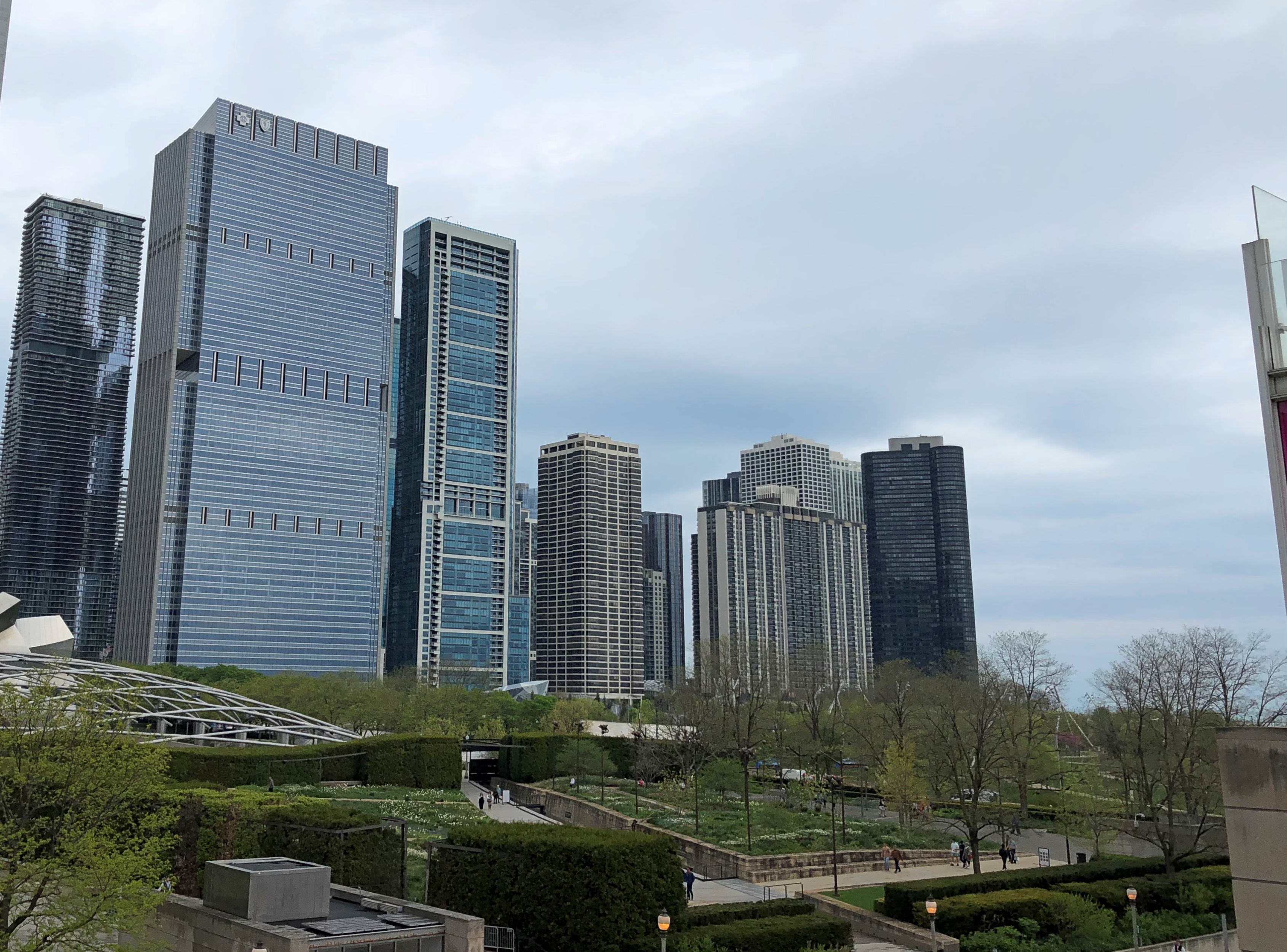
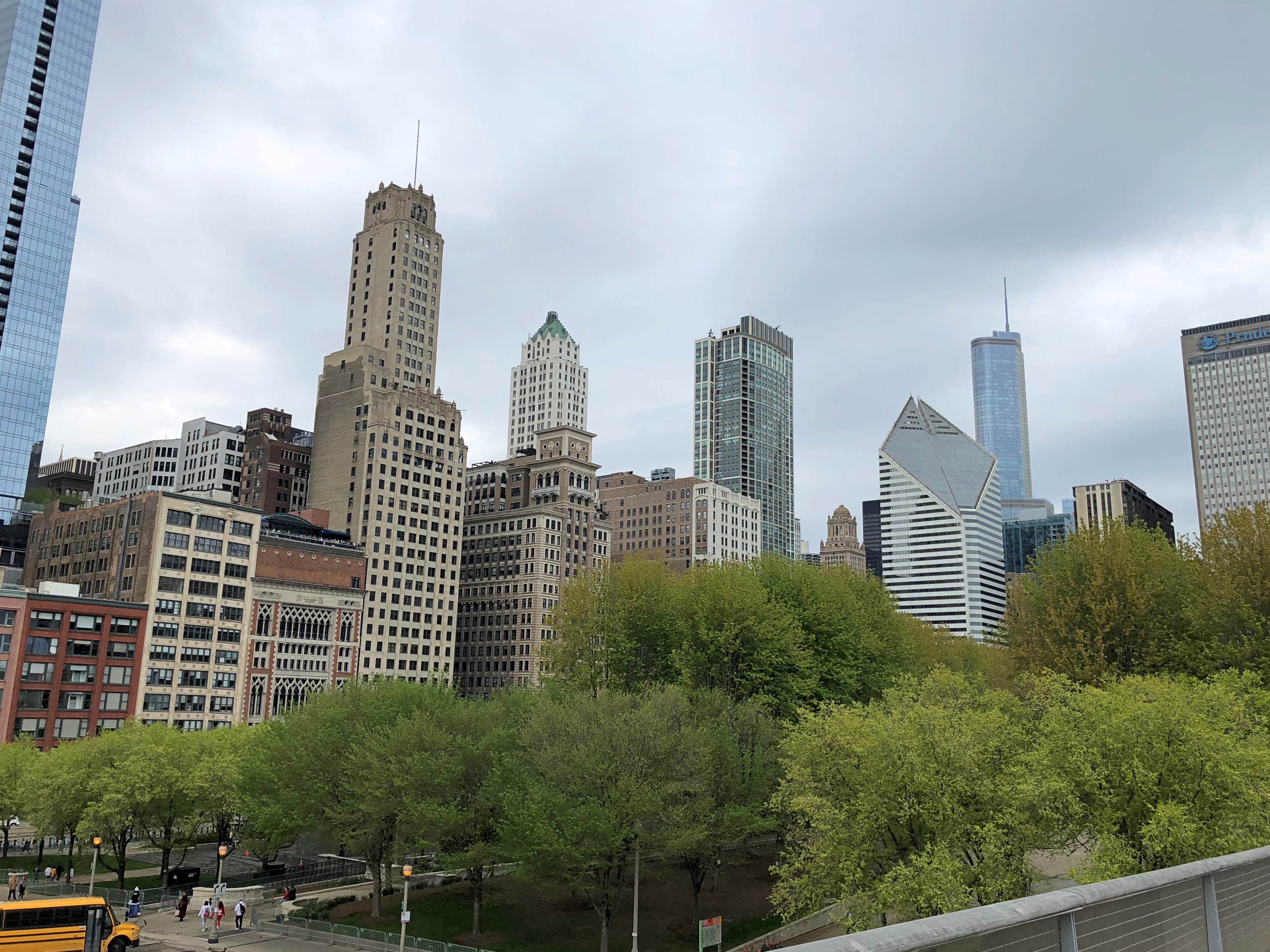
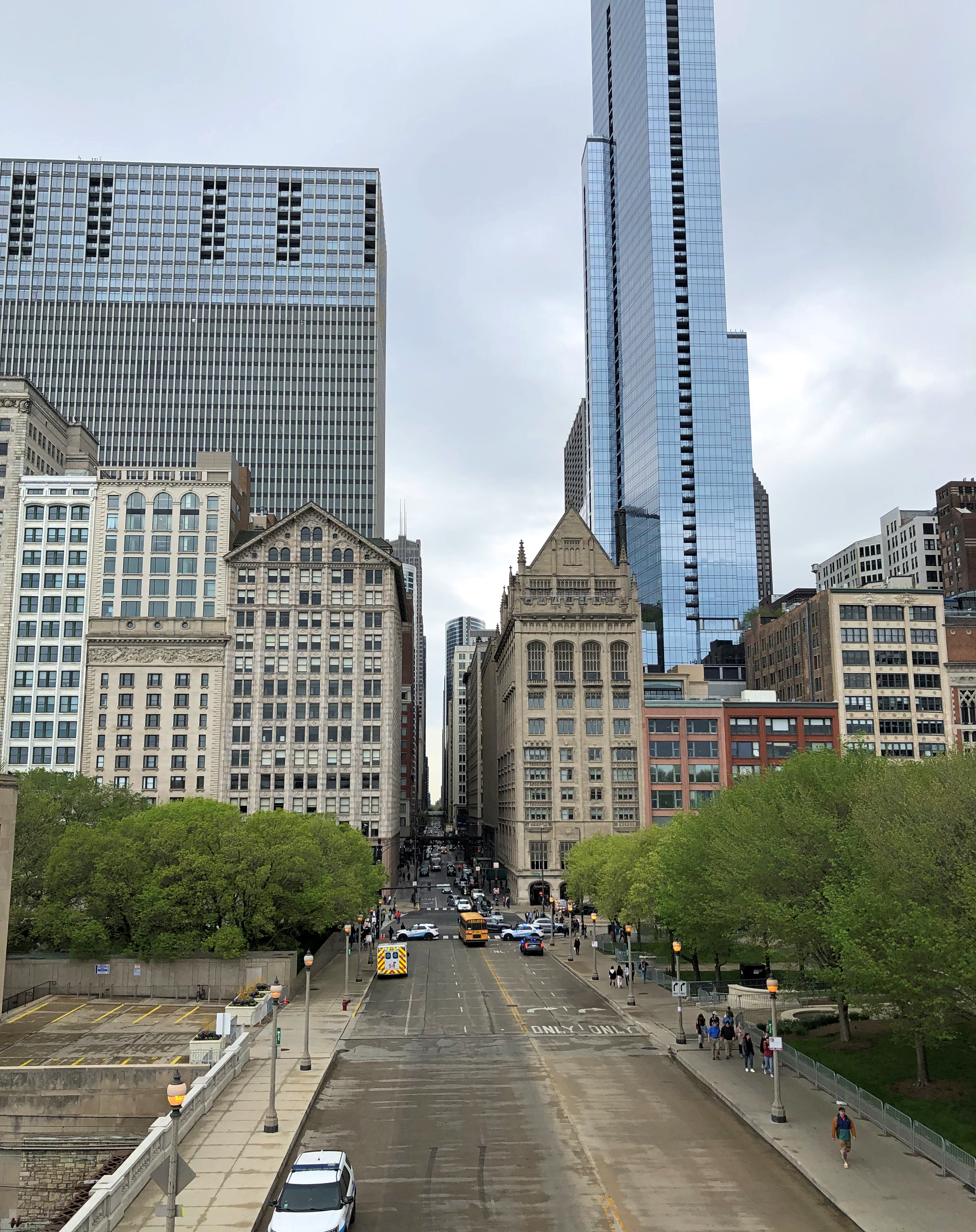
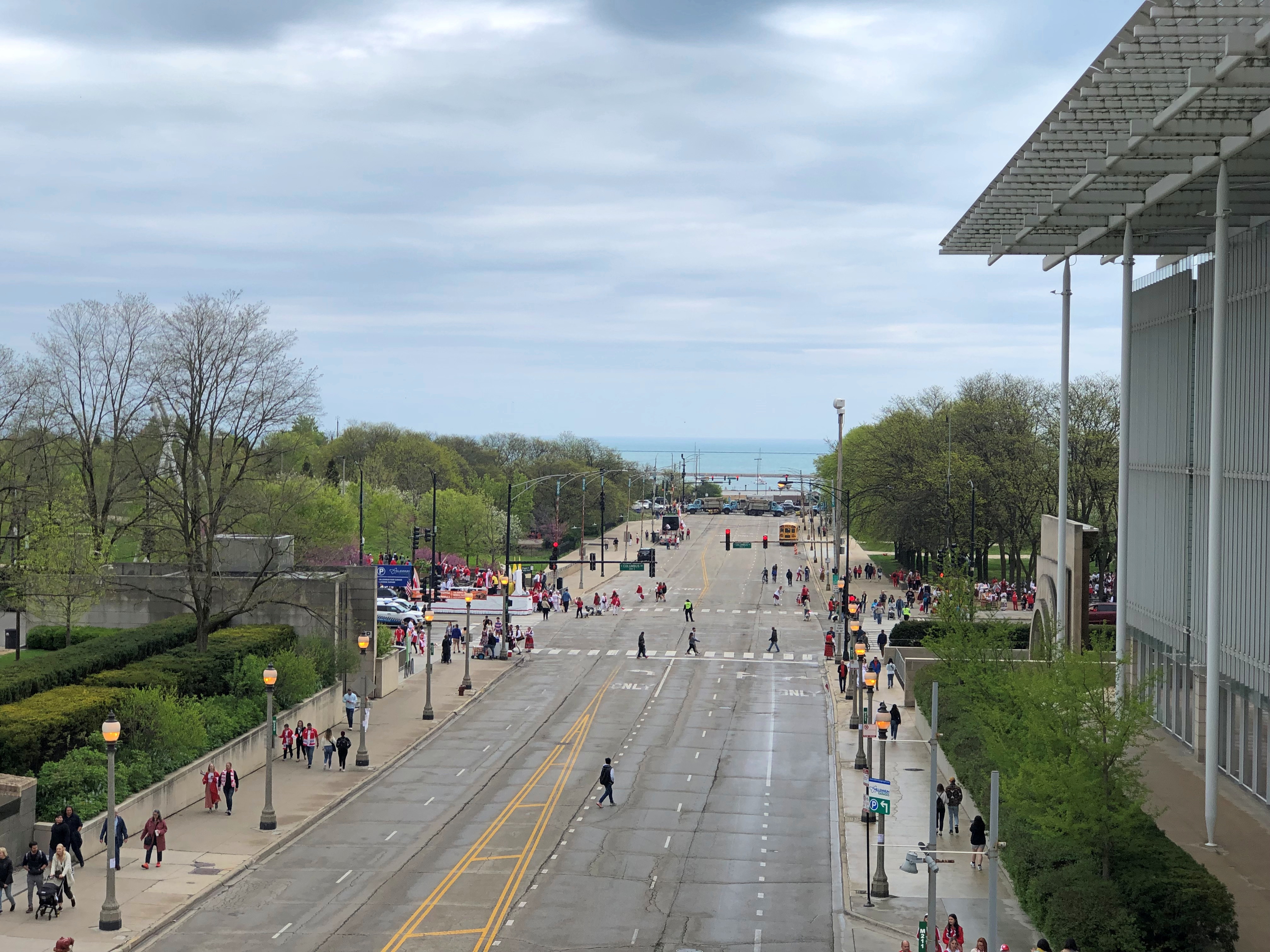
While we were in Chicago on Saturday, we found ourselves on the Nichols Bridgeway, which runs from Millennium Park to the third floor of the Art Institute.

I couldn’t remember the last time we were there. Might have been back in 2011, when we attended my nephew Robert’s graduation from the School of the Art Institute. That’s when I took this picture of him with a faux nimbus.

The bridge still stands, of course. Looking north.Nicholas Bridgeway

South.Nicholas Bridgeway

We went for the views from the bridge. One thing Chicago has for sure is an alpha-city skyline.Nicholas Bridgeway Nicholas Bridgeway

Looking west on Monroe St.Nicholas Bridgeway

Looking east.Nicholas Bridgeway

Note how few cars there are (none) compared with the number of pedestrians. Turns out the Polish Constitution Day Parade had just finished. We missed it. Maybe next year; looks like a spectacle.

Fort Necessity National Battlefield

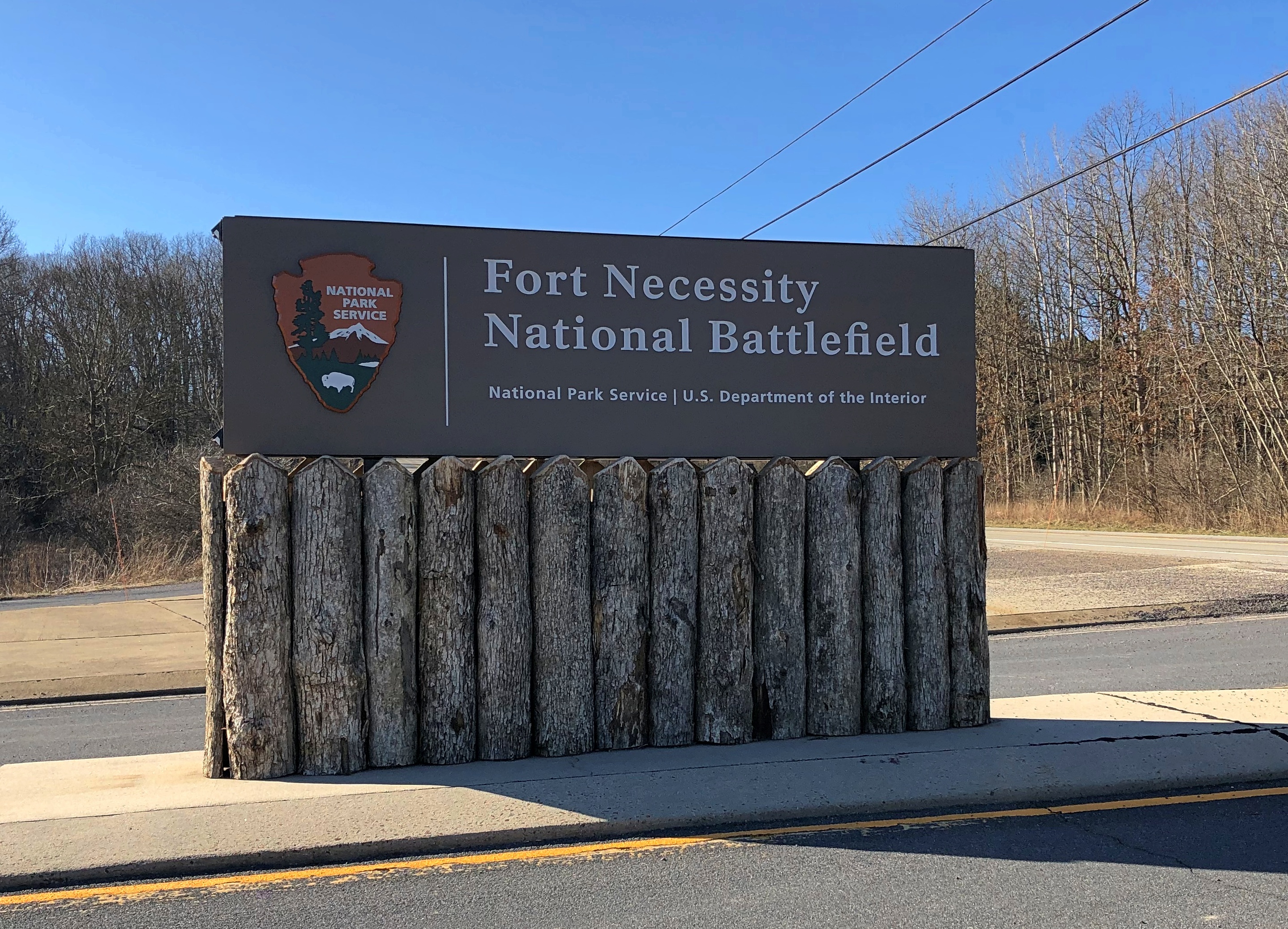
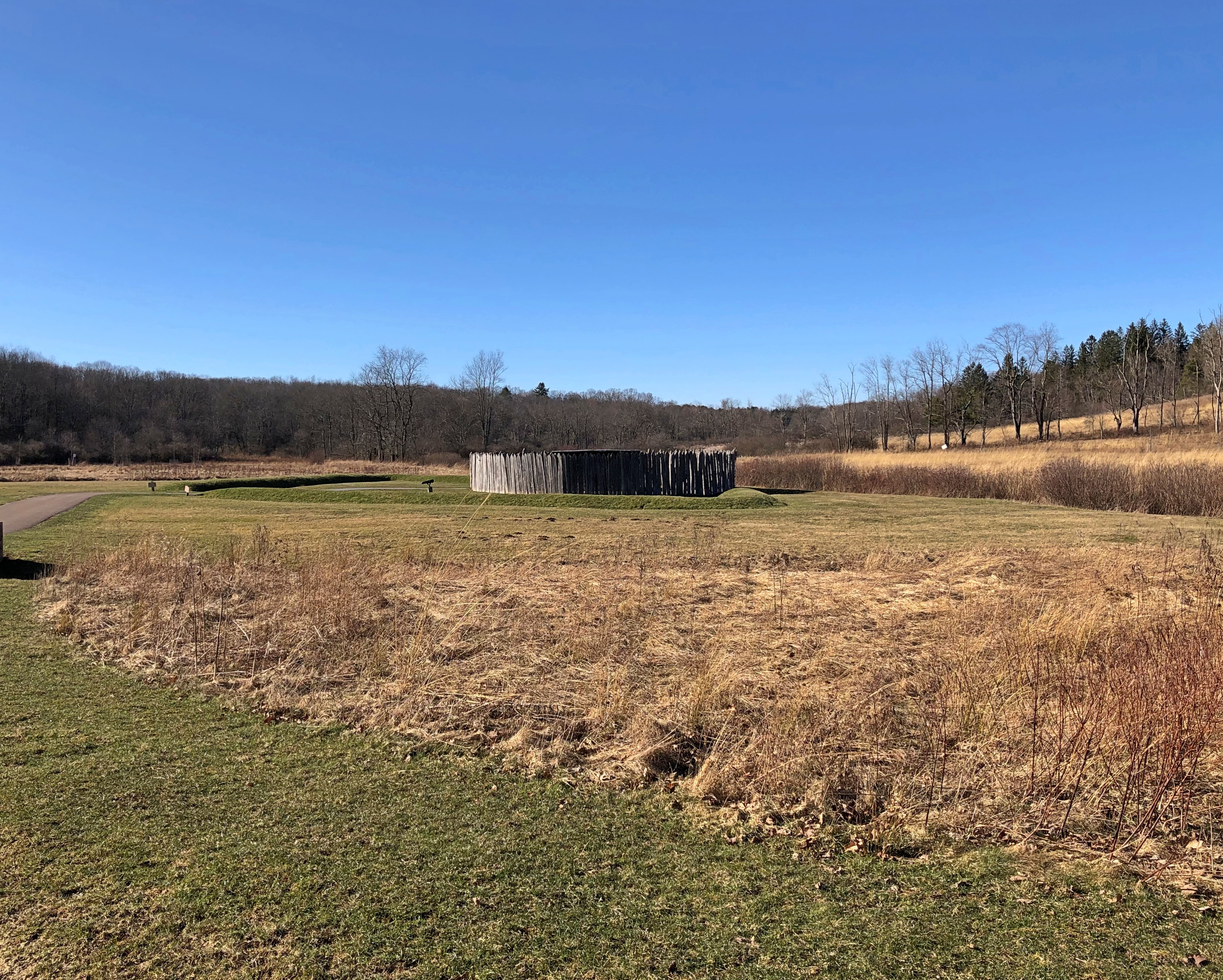
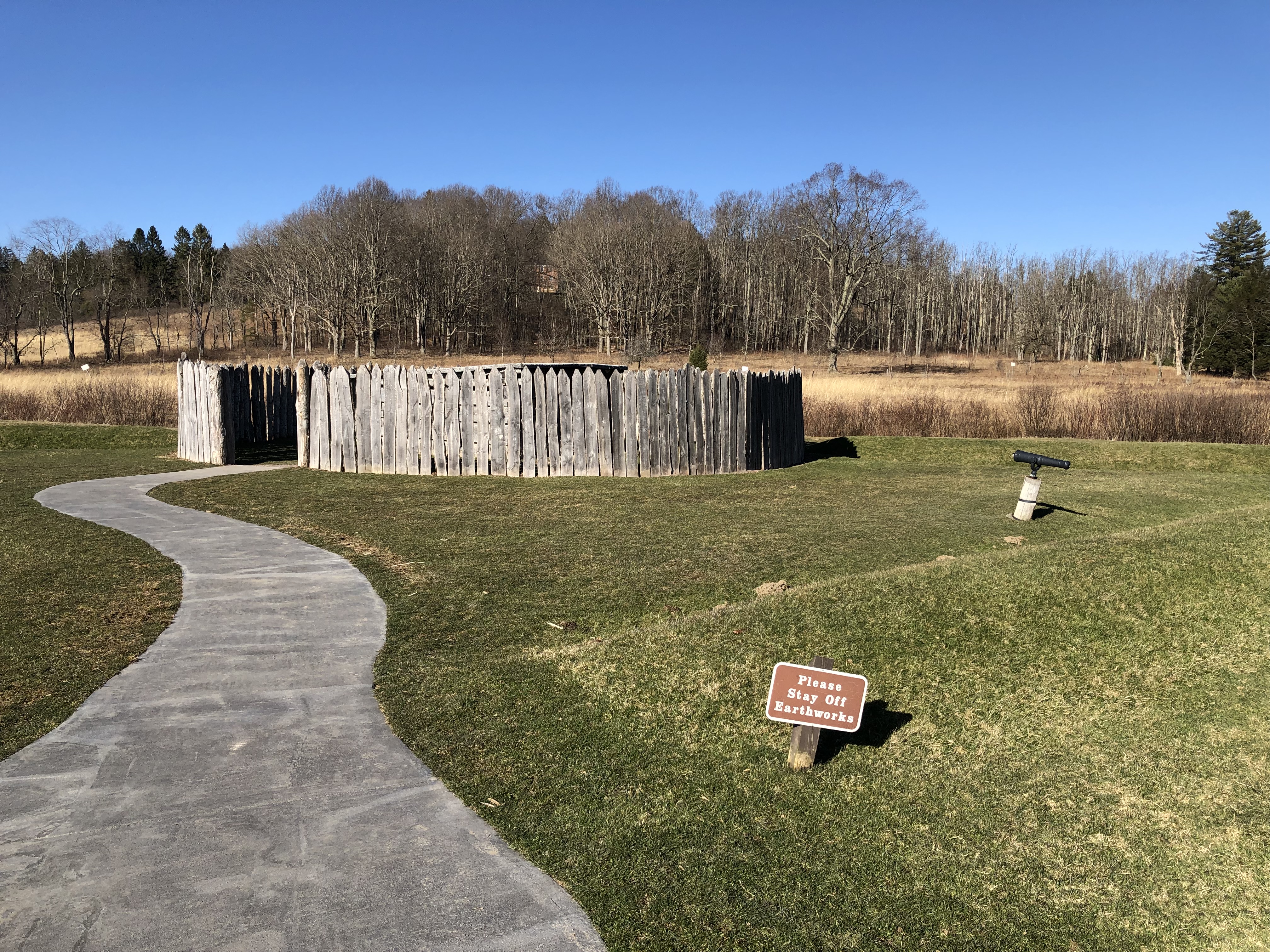
I walked about a quarter-mile from a parking lot to get to the reconstructed log palisade on the site of one hastily built by men under the command of Lt. Col. George Washington, age 22. Fort Necessity, he called it. These days, the site is called Fort Necessity National Battlefield.Fort Necessity

It is the only battlefield associated with the French and Indian War preserved by the National Park Service.

By the time I got there, I’d worked myself into a counterfactual frame of mind. Just what didn’t happen here — that easily could have – that proved so important for the future course of events in North America? Affected the fate of the unborn United States in unknowable but profound ways?

Those are the kind of Big Thoughts you get alone, under a pleasant late afternoon sun, in a meadow amid the rolling hills of rural southwest Pennsylvania, with nothing but a paved footpath and the palisade ahead. I do, anyway.

Consider: Washington and his men had surprise-attacked a French force at nearby Jomonville Glen a few weeks before the battle at Fort Necessity, defeating them and resulting in the death the French commander, Joseph Coulon de Jumonville. Washington was well aware that the French weren’t going to let that incident go unanswered, so he ordered the completion of Fort Necessity to prepare for the counterattack.

Louis Coulon de Villiers, who was Joseph’s brother, led the French response and besieged Fort Necessity from an advantageous position and with a larger force. Many British — mostly members of the Virginia Militia — were cut down, dying in the mud from recent rain. It seems likely that the French could have killed most, if not all of Washington’s command, but Coulon asked for parley and ultimately gave Washington generous surrender terms. Essentially, get out of here, and promise not to come back for a while.

Would a man of a different temperament more aggressively ground the British to defeat, perhaps to the point of seeing its commander dead with his men? Washington, that is. Dead at 22. You can see how this line of thinking puts some counterfactual ideas in your head.

What motivated Louis Coulon to do what he did? Motive’s a hard thing to pin down even in someone alive today, much less a French military commander of the 18th century. From what I’ve read, he was under orders not to massacre the British, and his men were tired and low on ammunition even though the defenders of Fort Necessity were in much worse shape. Those seem like fairly compelling reasons. Still, a more aggressive or ruthless commander could have continued the fight, not really held back in the wilderness by mere orders. This was the force that had killed his brother, after all.

On the other hand, young Washington had a number of near-death experiences as he was surveying in the Ohio Valley before the war. What’s one more?

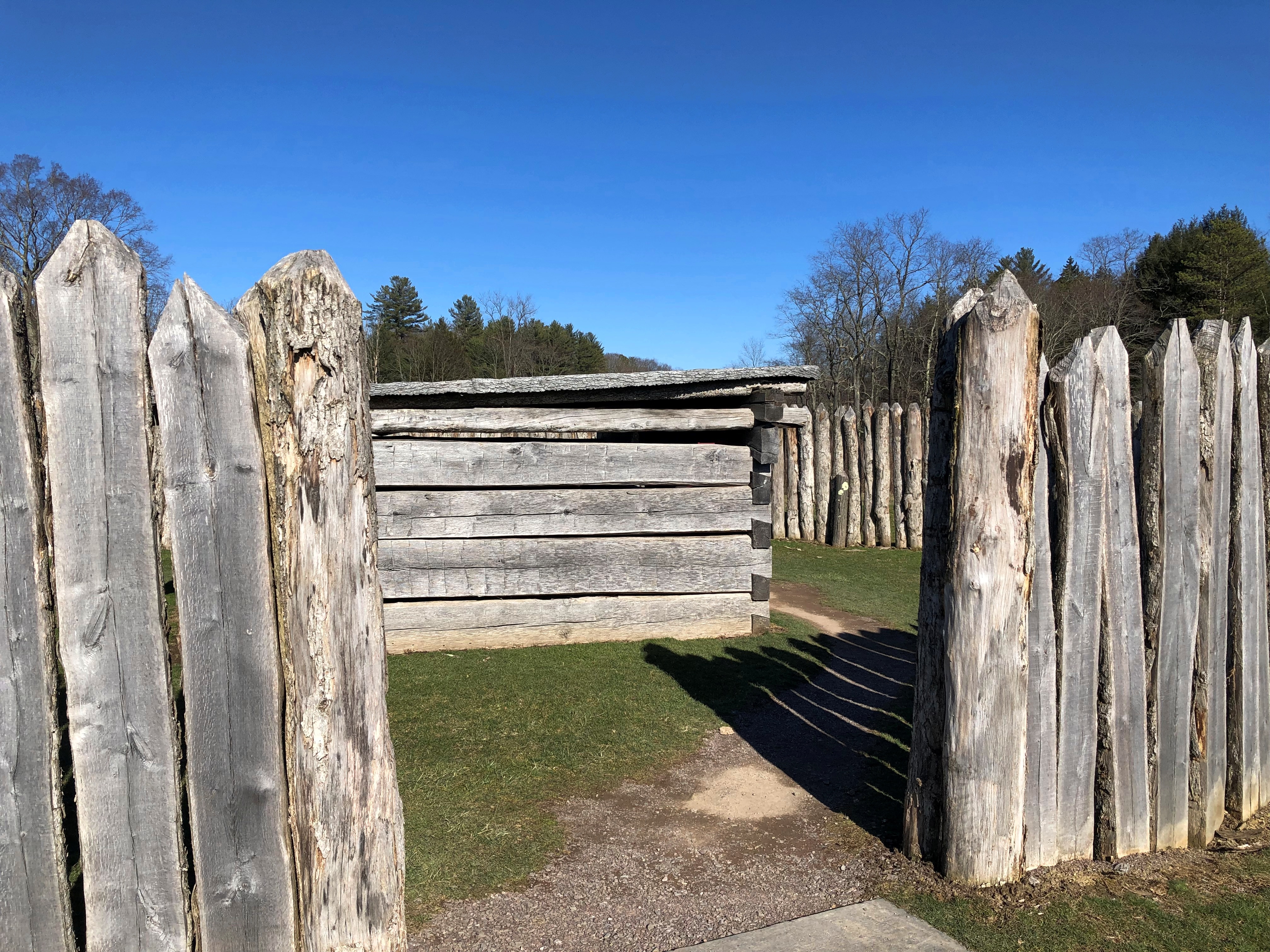
So many questions. Big history pivoting on small fulcrums. I got closer.Fort Necessity Fort Necessity

Inside the palisade.Fort Necessity Fort Necessity

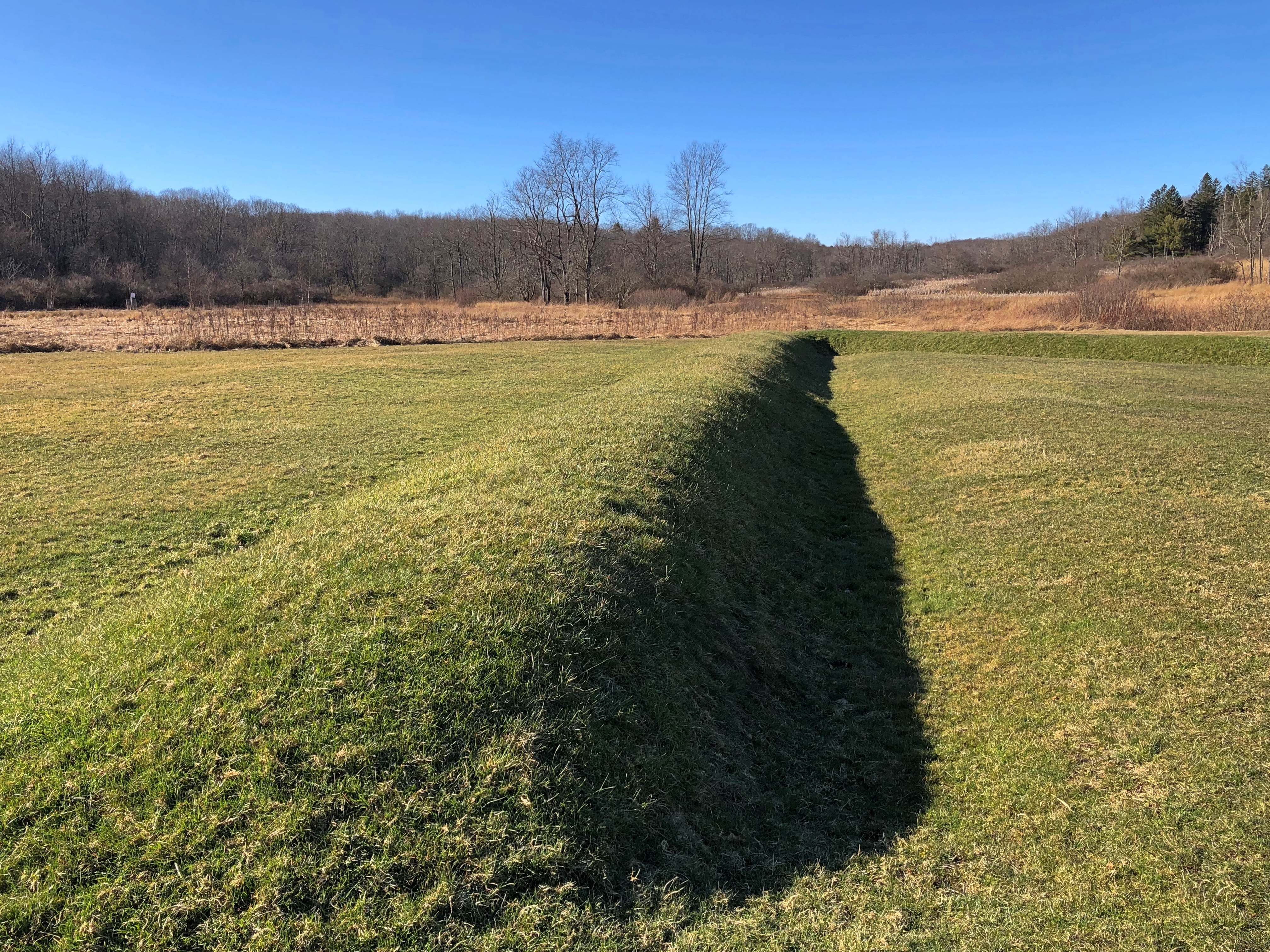
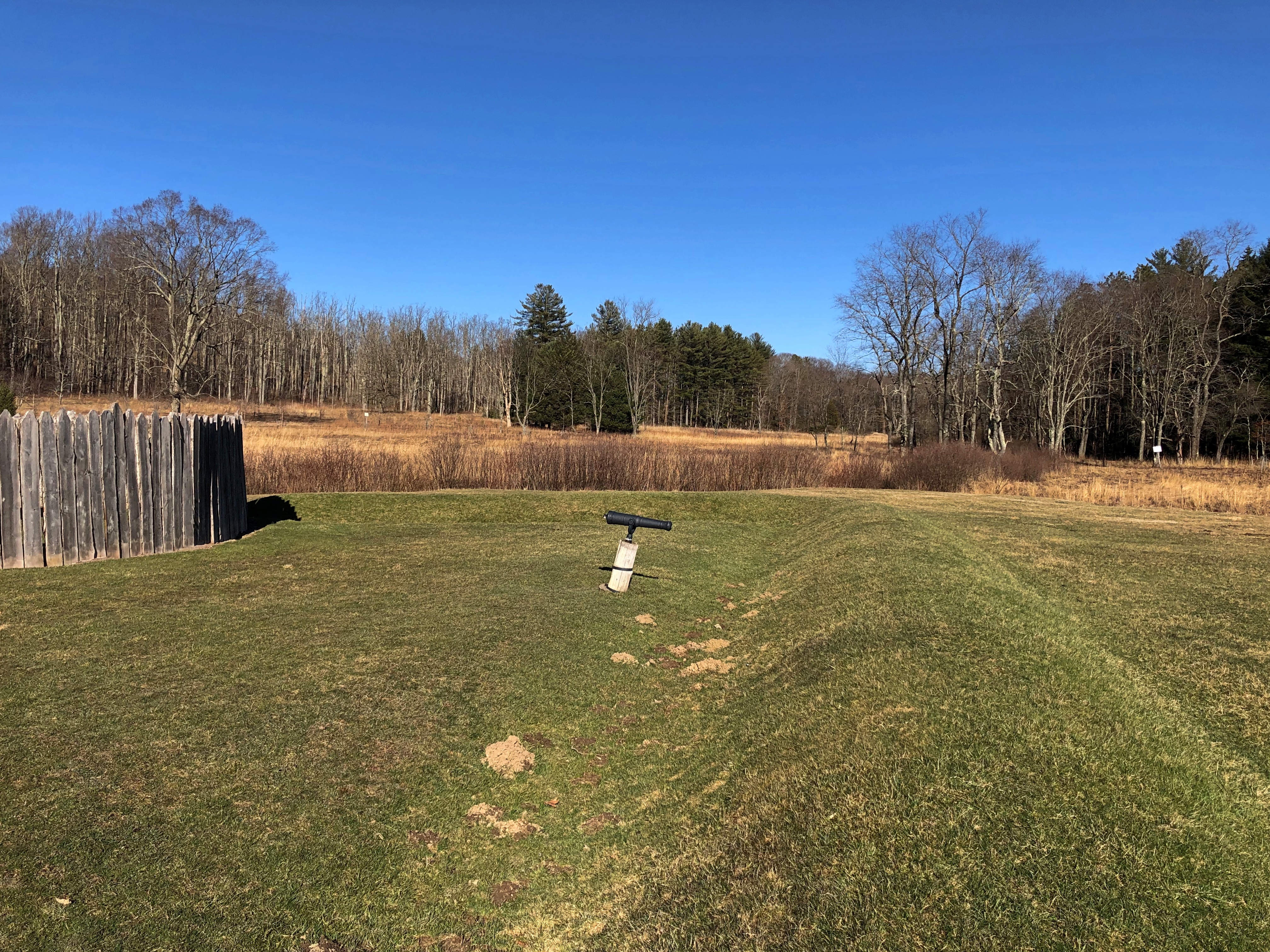
The site isn’t just that. Worn earthworks linger nearby.Fort Necessity Fort Necessity

Maybe Coulon was intensely proud to be under French arms, which were magnificently powerful in those days, even at such a far-flung place, and wasn’t about to dishonor his command with a massacre. Or maybe he didn’t like his brother that much, and was inclined to be philosophical about his fate. C’est la guerre, dear brother.

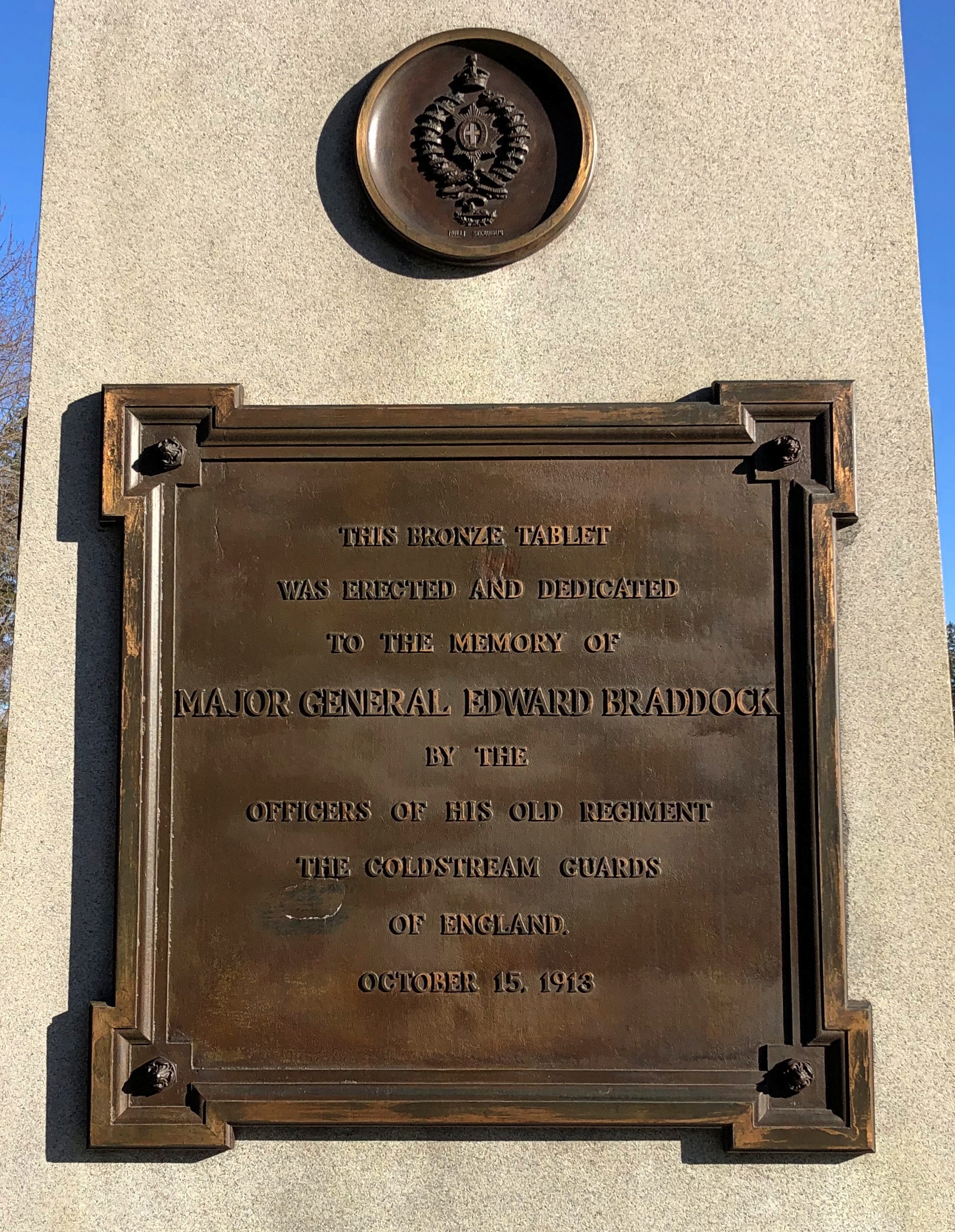
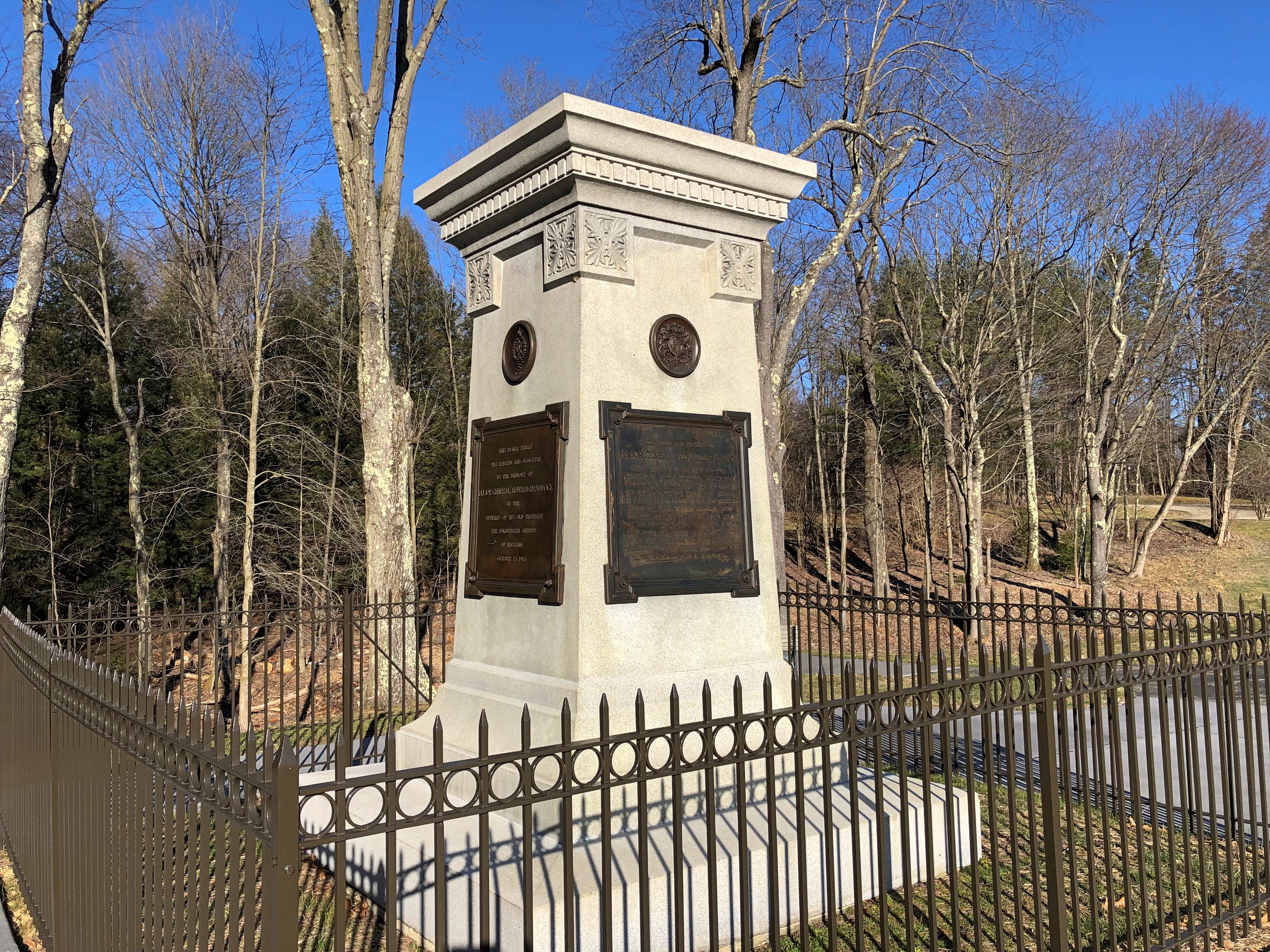
Down the road from Fort Necessity, U.S. 40 that is, is the grave of Major Gen. Edward Braddock.Braddock's grave

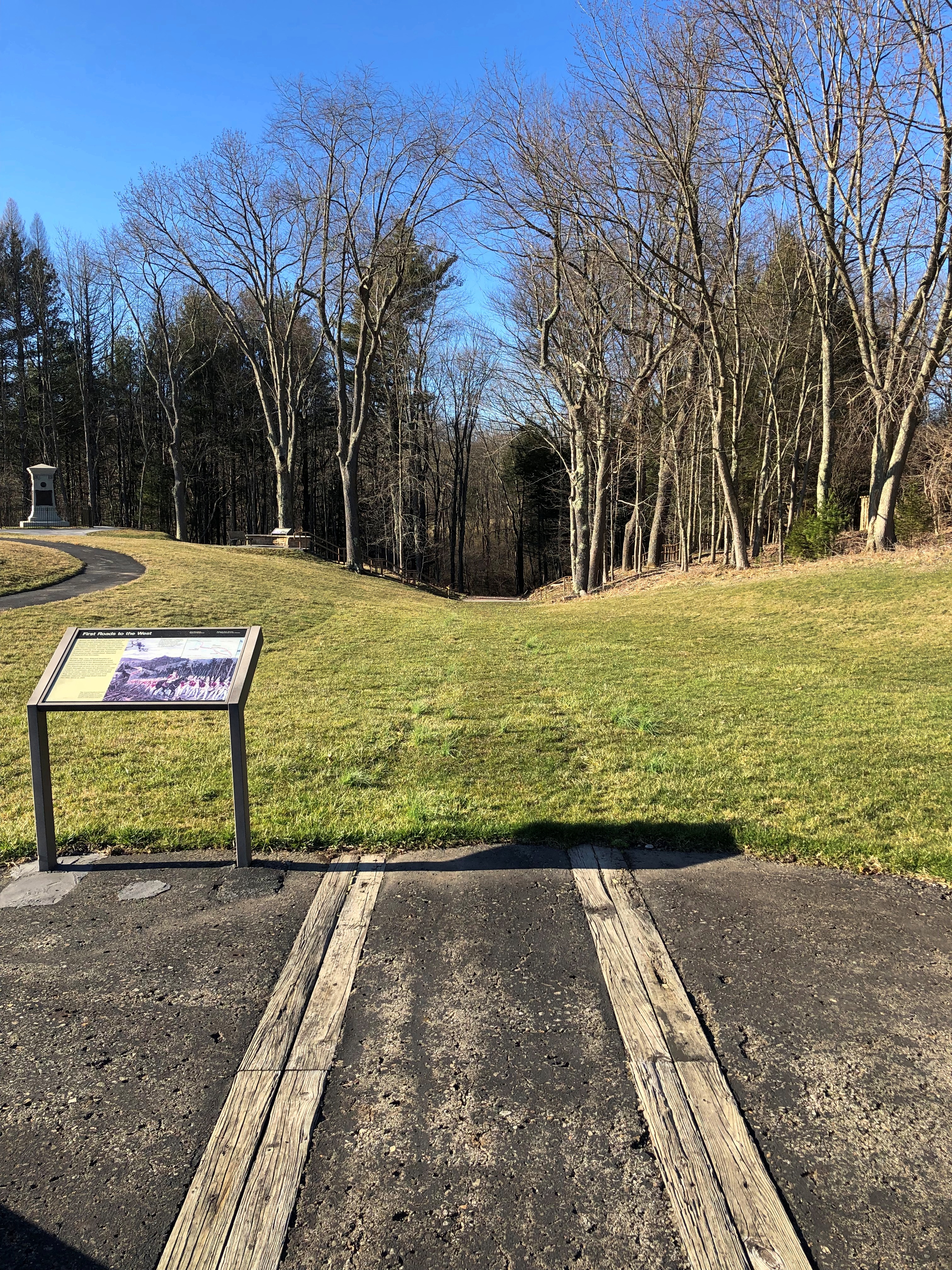
I won’t go into details about why he’s there, except that it’s only indirectly related to the battle of Fort Necessity. He’d been sent with a much larger British force to confront the French the year after that battle. Things didn’t go well for him, and he ended up buried under the military road he had had built as part of his campaign to take the Ohio Valley from the French.

The wooden beams mark the course of the road.Braddock's grave

The monument was erected in the early 20th century. He’s probably under it, but we can’t quite be certain.

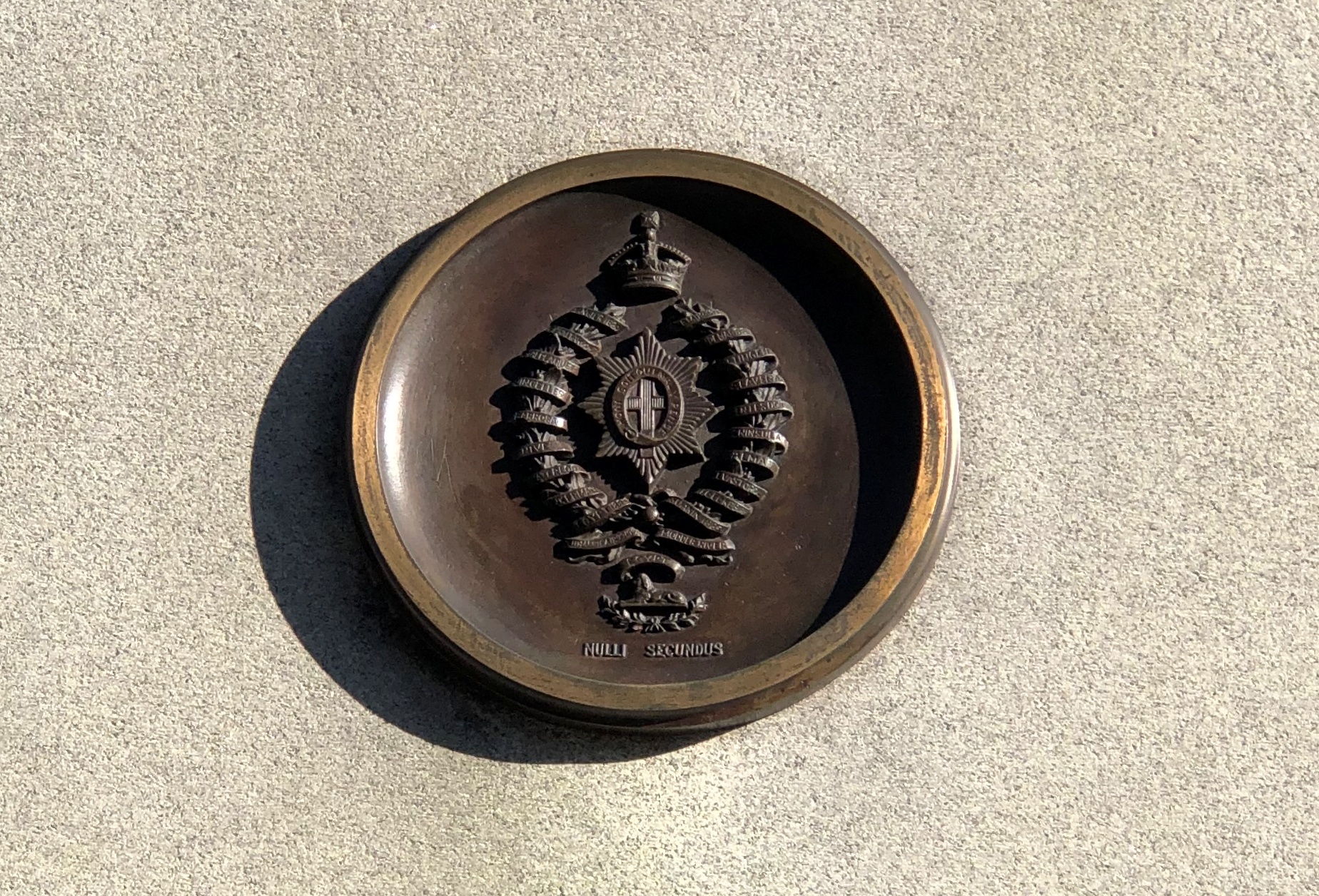
This plaque adds an extra layer of poignancy.Braddock's grave
Braddock's grave

Nineteen-thirteen. It’s probably just as well that the officers of the Coldstream Guards didn’t know what was coming.