Burlington, Wisconsin: Liar Liar

If, in downtown Burlington, Wisconsin – not a very large place, since the entire town’s population is about 11,000 – you pay attention to your surroundings, you’ll start noticing plaques.Burlington, Wis Liar's Club Plaque Burlington, Wis Liar's Club Plaque Burlington, Wis Liar's Club Plaque

They honor winners of a contest put on at the end of every year by the Burlington Liar’s Club. I’ve read that the contest is for tellers of tall tales, submitted by entrants nationwide, but looking at this list of winners, I’d say only some of them count as “tall tales,” along the lines of a watermelon vine dragging a boy in its wake.

The rest are jokes. In the 1978 example, pretty much like one Johnny Carson would have told.

Newspapermen of nearly 100 years ago made up the Burlington Liar’s Club, but the thing achieved a life of its own, quickly evolving into the overseer of a not-very-serious contest with entrants from around the nation. No doubt the contest is unique in the nation, like the Nenana Ice Classic or the Sopchoppy Worm Gruntin’ Festival.

“The club started in 1929 as a joke,” the club website says. “A Burlington newspaper reporter wrote a story to the effect that these ‘old timers’ got together each New Year’s day at the police station, and lied for the championship of the city…

“… city editors, with an eye for interesting features, ‘put it on the wire,’ and the following December the Associated Press and other news agencies began phoning Burlington to find out if the city’s annual contest would be repeated…

“Letters began to trickle in from the four corners of the country commenting on the ‘contest.’ They furnished the inspiration for a real contest instead of a phony one, national in scope, and the Burlington Liar’s Club was formed to carry it on.”

Just the kind of thing to notice during a small-town walkabout. I was delighted. Who isn’t fond of the oddities in Wisconsin? The fiberglass fields and pyramids and Forevertrons.

One Sunday late in June, I took Ann to the southern Wisconsin camp she where is working as a counselor for the summer, and after I dropped her off, spent a little time looking around Burlington and environs.

The small downtown of Burlington, which at this point in history counts as exurban Milwaukee, is a handsome place, with most of its storefronts occupied.Burlington, Wis Burlington, Wis

That is, some handsome old buildings with modern tenants.Burlington, Wis Burlington, Wis

Nothing like a sturdy pre-FDIC bank building. Completed in 1909; that makes it pre-Fed as well.Bank of Burlington, Wis Bank of Burlington, Wis Bank of Burlington, Wis

I couldn’t not look it up. The Bank of Burlington in Wisconsin existed in various forms since the mid-19th century; it was prospering in 1916, according to this article from that year, posted by AccessGeneaolgy. A bank in some form or other was in the building until 2021, which Chase closed its office there. That hints that Chase was the last of a string of banks swallowing other banks in the 20th and 21st centuries.

Also: C.B. McCanna. That would be Charles B. McCanna (d. 1913), who organized the McCanna Cheese and Butter Manufacturing Co., and operated about 20 factories in the area. He was also president of the Bank of Burlington in his later years.

“In 1893, the company was reorganized as McCanna and Fraser, with McCanna serving as president until his death,” says the Wisconsin Historical Society. “In 1898 he founded the Wisconsin Condensed Milk Co., which soon became one of the largest producers of condensed milk in Wisconsin and operated branch factories in Pecatonica and Grayslake, Ill.”

You’ve heard of Wisconsin beer barons. Here we have a cheese baron.

I enjoy the old-fashioned approach of a 1916 article about McCanna, another article accessible via Access Genealogy. Of course, it wasn’t old-fashioned at the time, just standard practice in lauding business men:

“Dairying and the industries which are allied thereto have ever constituted an important source of the wealth and prosperity of Racine County, and among the most enterprising and progressive business men of the district are those who have turned to that line of labor as a source of their business development. One of the well known, successful and highly respected representatives of the business in Racine County was Charles B. McCanna, who became an influential citizen of Burlington and one whose activities constituted not only a source of individual success but also constituted one of the strong elements in the advancement of public prosperity.”

Dublin, Barcelona, Then Venice

After a mostly dry June here in northern Illinois, early July saw some rain, but not quite enough to end the dry spell. Out beyond the grass and gardens of the suburbs, it’s a “stressful time for corn and soybeans.”

June 25, mid-day, at a cornfield in southern Wisconsin, which is suffering a drought as well. Moderate drought for the county that includes this field, at least as of the end of June.

The field looked healthy to my untrained eye, but for all I know that’s what a stressed crop looks like a few weeks into a drought. I might be up that way again next weekend or the next, and I’ll stop by for a look at the same field if so.

I had the opportunity to spend most of a weekend in Los Angeles in early June, so naturally I did. To visit some of the places that I considered but didn’t have time for in pre-pandemic 2020, because that’s how I think, though I didn’t make it to La Brea Tar Pits this time or earlier. Like the Cloisters on the other coast, it’s a place that still eludes me.

On the other hand, I made a point of going to the Los Angeles neighborhood of Venice this time.

Though named for the place in Italy,  Venice has a distinctly American history, invented as it was ex nihilo by a real estate developer looking to reference the Old World in the newest part of the New World, namely California. Not just any developer, but one Abbot Kinney, whose career was circuitous and strange, the way business men could be in the late 19th and early 20th centuries.

Not only that, the arc of history in Venice is very much American: an initial flowering, subsequent decline, much demolition and disfigurement in the name of modernization, years of scraping along the bottom, an effort to save its meager remnants, gentrification and insane property values – all within the span of about a century, specifically within the 20th, though spilling into the 21st. Which is an affluent time for Venice of America.Venice, California 2023

“When it opened on July 4, 1905, Venice of America boasted seven distinct canals arranged in an irregular grid pattern, as seen… in Kinney’s master plan for the community,” KCET says. “Totaling nearly two miles and dredged out of former saltwater marshlands, the canals encircled four islands, including the tiny triangular United States Island. The widest of them, appropriately named Grand Canal, terminated at a large saltwater lagoon. Three of the smaller canals referred to celestial bodies: Aldebaran, Venus, and Altair.

“Soon, a second set of canals appeared just south of Kinney’s. Linking up with the existing network through the Grand Canal, these Short Line canals (named after the interurban Venice Short Line) were apparently built to capitalize on the success of Kinney’s development. Their origins are uncertain, but work started soon after Venice of America’s 1905 grand opening, and by 1910 real estate promoters Strong & Dickinson and Robert Marsh were selling lots in what they named the Venice Canal Subdivision. Built almost as an afterthought, these six watercourses are the only Venice canals that survive today.”

The rest, the originals in their irregular grid and with their celestial names, were long ago filled in and paved over – that would be the demolition and disfigurement.

I arrived in the neighborhood fairly early in the morning, early enough – I realized later – to park on Venice Blvd. within walking distance of both the canals and the beach, which is more difficult later in the day. Venice Blvd., near the ocean at least, also happens to be the locus of a handful of residents living in parked RVs and, for those who can’t swing that, tents in the boulevard median.

The canals form a neighborhood unlike any I’ve seen and, I have to say, flat-out gorgeous in our time.Venice California 2023 Venice California 2023 Venice California 2023 Venice California 2023

Public sidewalks run between front yards and the canals, with occasional footbridges crossing the canals. This arrangement, I’ve read, is the result of renovation that occurred in the early 1990s. The only vehicular street running through the neighborhood is Dell Ave., which connects with alleys behind the houses with the wide expanse of LA streets. The way residents drive in and out of the area, that is.Venice California 2023 Venice California 2023

The yards are lush, at least they were in June. Temps weren’t that warm the day I visited, and the skies fully overcast and sometimes drizzly, since southern California seems to be in some kind of weird weather bubble these days. Made for a good walking environment, though.Venice California 2023 Venice California 2023 Venice California 2023 Venice California 2023

Hard to believe the area spent much of the 20th century as a slum; a quick look at Zillow’s estimates puts no property along the canals at much less than $2 million, and many a good deal more, with a scattering of new houses under way as well. Such is real estate across the decades.

(Former) Dead Man’s Curve

Time for a genuine spring break, now that genuine spring has arrived. Back to posted content around May 24.

Returning from Normal on Sunday, I took another short detour fairly close by, in the wonderfully named town of Towanda, pop. 430 or so, originally a central Illinois project of the busy 19th-century businessman Jesse Fell. I’d seen signs for Towanda on the Interstate for years, but never stopped.Towanda, Illinois

Towanda is the home of a massive grain elevator, owned by Evergreen FS of Bloomington.Towanda, Illinois

For a more ordinary tourist, a stretch of the former U.S. 66 passes through town, and has a walking path next to the road. I took a stroll.Route 66 Towanda

Also part of the former highway: Dead Man’s Curve.Dead Man's Curve Route 66 Towanda Dead Man's Curve Route 66 Towanda

The nickname isn’t too hard to figure out, but a sign offers details.Dead Man's Curve Route 66 Towanda

It doesn’t offer a death toll, which may not be known, but does say that from 1927 until a bypass was built in 1954, the curve was the site of “many disastrous accidents,” especially involving drivers from Chicago, “unfamiliar with the road and accustomed to higher speeds.” Oops. Once a hazard, now a minor tourist attraction.

Note the Burma Shave signs. They look fairly new, so I take them to be modern homages, in this case noting the dangers of Dead Man’s Curve.Dead Man's Curve Route 66 Towanda

There’s a rhyme for each direction of travel on the road.

Northbound: Car In Ditch/Driver In Tree/The Moon Was Full/And So Was He/Burma Shave.

Southbound: Around The Curve/Lickety-Split/Beautiful Car/Wasn’t It?/Burma Shave.

South Side Cemetery, Pontiac, Illinois

Across the Vermilion River from Chautauqua Park in Pontiac, Illinois, is South Side Cemetery, which predates the town’s Chautauqua activity by some decades, since its first burials were in 1856. At 24 acres, it’s still an active municipal burial ground. I saw at least two memorials with death dates in 2023.

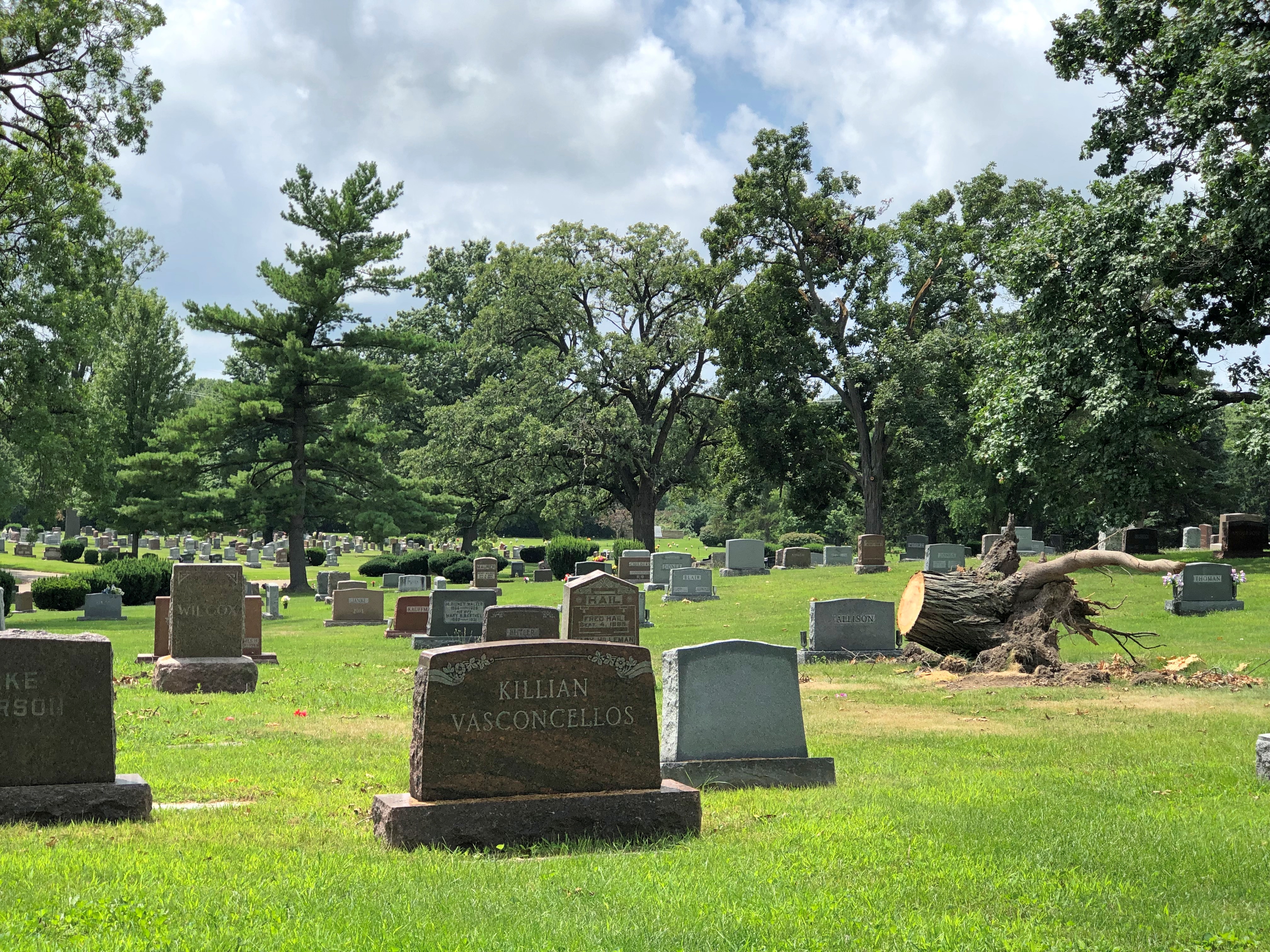
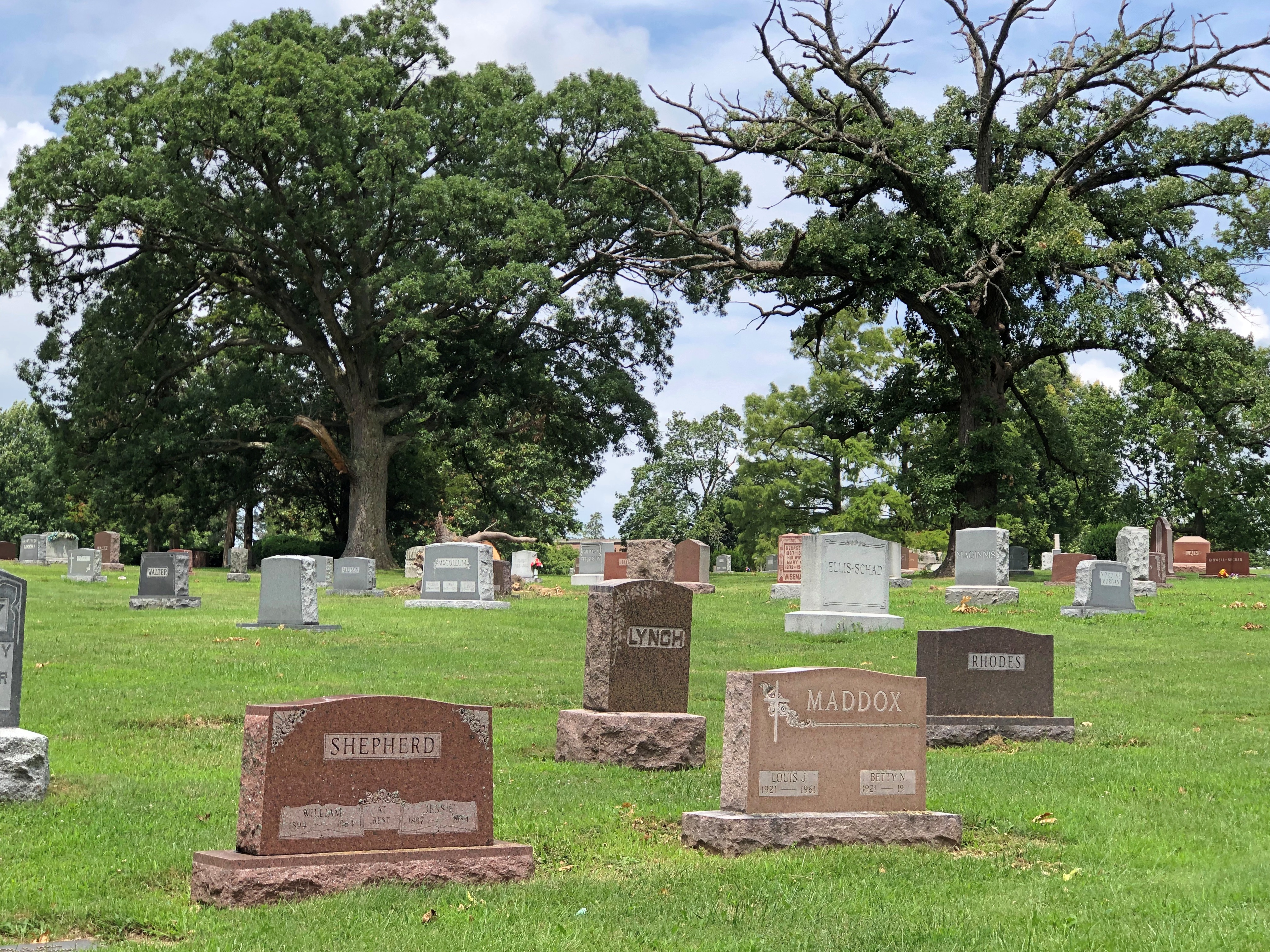
Overall, a nice place for a stroll on a warm day in May, if you don’t mind being in a cemetery. I can’t say I ever have been.South Side Cemetery, Pontiac, Illinois South Side Cemetery, Pontiac, Illinois South Side Cemetery, Pontiac, Illinois

Some older stones, including a scattering of Civil War veterans.South Side Cemetery, Pontiac, Illinois South Side Cemetery, Pontiac, Illinois

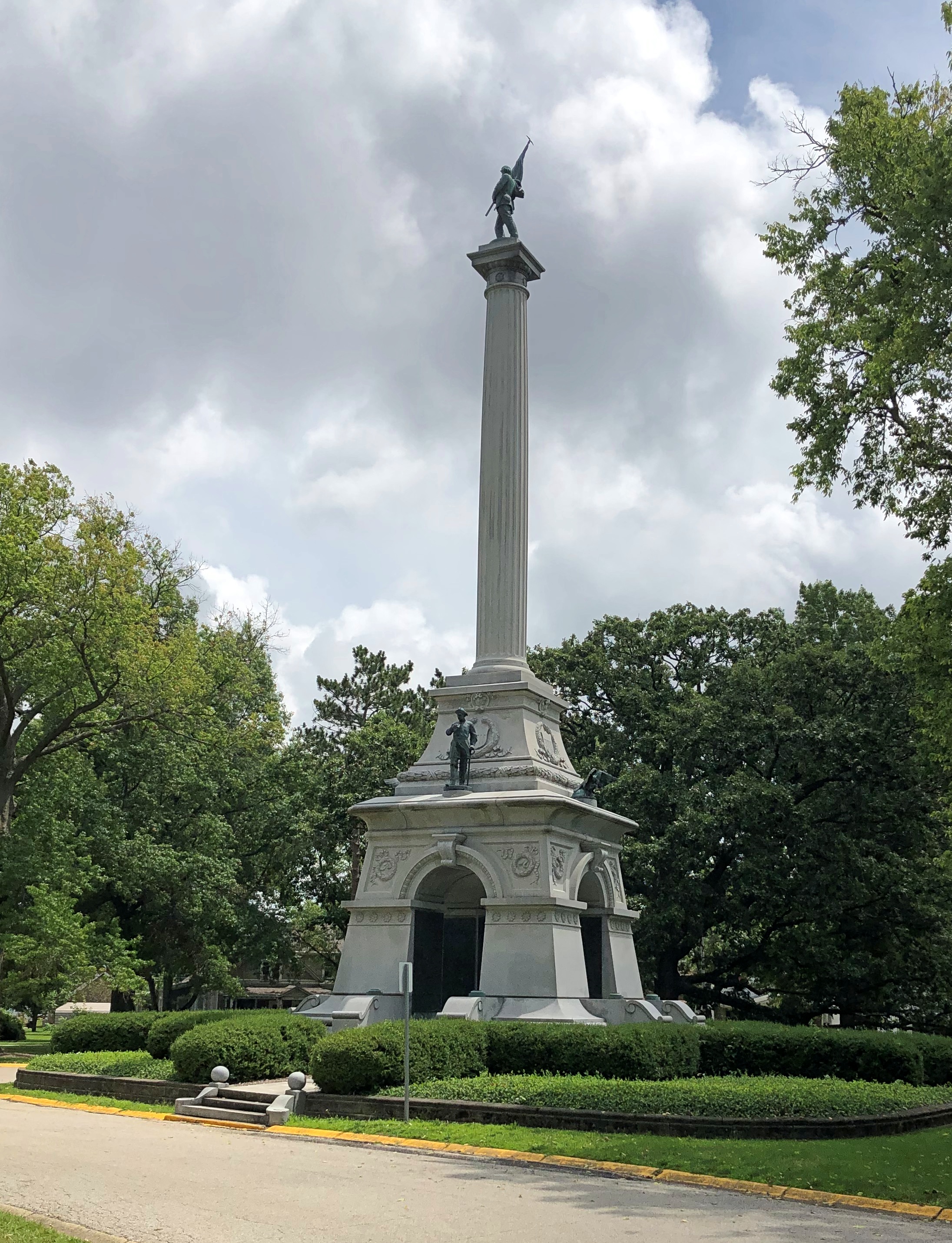
As usual with small towns, not many mausoleums or large monuments, but there are a few.South Side Cemetery, Pontiac, Illinois

Lemuel G. Cairns fought for the Union, too, but has no ordinary soldier’s stone. According to Find a Grave, he achieved the rank of sergeant and after the war dealt in cattle in Texas, before moving to Illinois. I suspect he did well in that business in Texas, but maybe got tired of the heat.

The only sizable mausoleum I spotted.South Side Cemetery, Pontiac, Illinois

A number of Gaylords reside there, including this fellow, it seems, a doctor and Union veteran.

This is a surname you don’t see much: Hercules. Also, an unusual design for a stone.South Side Cemetery, Pontiac, Illinois South Side Cemetery, Pontiac, Illinois

Rare, but not unknown.

“Early examples of the surname recording taken from surviving church registers include those of William Hercules (also recorded as Herculus) at the church of St Margaret’s Westminster, on January 16th 1603, and in the Shetlands, William Herculason who married Christian Harryson at Delting, on January 24th 1752,” says the Internet Surname Database.

A prominent Pontiac family, no doubt. With a name like that, they’d better be. One of them – J.W. Hercules – is mentioned as the designer of the Pontiac Chautauqua pavilion.

Chautauqua Park, Pontiac

A total of four hours behind the wheel there and back from the northwest suburbs of Chicago to Normal, Illinois, could be considered a chore, but not if you have time to stop a handful of places along the way. That isn’t always possible – weather or scheduling might prevent it – but when it is, you might happen across things to see. Maybe even things you won’t see anywhere else.

Such as in Pontiac, Illinois, pop. 11,150. It’s been a surprisingly good source of stopover sights since I started driving to Normal on a regular basis, and so it was on Sunday, when I headed down to Normal to load up the car with some of Ann’s possessions. She’ll be done with school for the semester later this week, so the goal was to not be overloaded when she finally returns.

Plunge into the small streets of Pontiac – that might not be the right verb, since its grid is pretty small – and soon you’ll be at Chautauqua Park.Chautauqua Park, Pontiac

Spring green and on Sunday at least, warm enough to inspire a little sweat.Chautauqua Park, Pontiac

A good place to walk around, but also to read, with a good many signs like this.Chautauqua Park, Pontiac

I read at least a half-dozen. Most of them told me about the history of the park as the setting for the Pontiac Chautauqua, as the park name suggests.

A few quotes from the various signs:

A.C. Folsom

“Under the leadership of A.C. Folsom, a group of civic-minded citizens organized to bring a Chautauqua to Pontiac. Between the years 1898 and 1929, the Pontiac Chautauqua Assembles developed into one of the Midwest’s most popular and successful summer festivals.”

“As the Pontiac Chautauqua grew, dramatic presentations became particular favorites of the crowd. Shakespeare, melodramas, domestic comedies, mysteries, and tragedies graced the stage of the pavilion. Troupes of actors from New York, Chicago and elsewhere traveled the Chautauqua circuit, playing a repertory of four or five plays.”

The Chautauqua pavilion as it appears now.Chautauqua Park, Pontiac

Theatrical presentations still occur there. According to a non-historic sign, the next one will be the Broadway musical version of Beauty and the Beast, June 14-18, 2023, by the Vermillion Players.

More Chautauqua Park history-sign verbiage:

“Specialty acts from all over the world brought exotic sounds which floated over the park on warm summer evenings. Here are just a few of the individuals and groups which graced the Pontiac Chautauqua: Mme. Schumann-Heink, opera star; The Weber Male Quartette; Colangelos Band; The Honolulu Students; Mr. & Mrs. Tony Godetz, Alpine Singers & Yodelers.”

“Each year of the Pontiac Chautauqua Assembly, noted lecturers, politicians and educators came to edify the event’s patrons… some of the most notable speakers include: Booker T. Washington; William Jennings Bryan; Samuel Gompers; Rev. Dr. Thomas DeWitt Talmage; Carrie Nation.”

Yep, there’s Carrie Nation at the Pontiac Chautauqua.

No visible hatchet. It’s clear she didn’t wear a corset. She considered them harmful.

As fascinating as the park’s Chautauqua history is – and there’s the basis of another limited costume series on prestige streaming, namely the story of a plucky, slightly anachronistic woman entertainer on the Chautauqua circuit, ca. 1900 – that isn’t all the park has to offer.

Namely, it sports two of the town’s three swinging bridges. Dating roughly from the time of the Chautauqua. Original iron work, with wooden planks that have been replaced many times.

Naturally, I had to cross them. One of them:Chautauqua Park, Pontiac Chautauqua Park, Pontiac
And the other.Chautauqua Park, Pontiac Chautauqua Park, Pontiac Chautauqua Park, Pontiac

They don’t swing, exactly, at least when you walk normally, but they do wobble, and it takes a moment to get used to the motion. Nice views of the Vermilion River along with way.Chautauqua Park, Pontiac Chautauqua Park, Pontiac
Bigger than I would have thought. At this point, the waters are on their way to the Illinois River, then of course Old Man River.

One more item in the park: a plaque-on-rock memorial.Chautauqua Park, Pontiac

Not just any memorial, but a fairly unusual one.Chautauqua Park, Pontiac

But not unknown. Naturally, I had to look up Fred Bennitt. I’m cursed that way.

We’ve Stringbeans and Onions, Cabbages and Scallions, and All Kinds of Fruits and Say —

I’ve been lax, letting the 100th anniversary of “Yes, We Have No Bananas,” go unmentioned until now. The song was published on March 23, 1923. The only popular song about Greek grocers that I know, except maybe for “I’ve Got The Yes! We Have No Bananas Blues.”

I found an article that promises the story behind the song, and offers some detail about the fruit trade in New York, past and present.

“The story of New York produce goes far back beyond Hunts Point,” says an article on the web site of a company specializing in credit rating and market information for the produce industry, referring to the Hunts Point produce market in the Bronx, an enormous operation.

“The city’s colorful history includes the Banana Docks of the nineteenth and early twentieth centuries, which were located at Old Slip in lower Manhattan,” it says.

Banana Docks, New York City

The article goes on to say that the songwriters took their inspiration from a Greek fruit stand owner who said the famous line to him, but the account published in Time magazine in the summer of 1923 is, I think, more believable. Especially since it quotes the songwriter himself only months after the monster hit song came out.

“I am an American, of Jewish ancestry, with a wife and a young son,” songwriter Frank Silver told Time. “About a year ago my little orchestra was playing at a Long Island hotel. To and from the hotel I was wont to stop at a fruit stand owned by a Greek, who began every sentence with ‘Yess.’ The jingle of his idiom haunted me and my friend Cohn. Finally I wrote this verse and Gohn [sic] fitted it with a tune.”

It was the first song Silver ever sold. For a most harmonious recording of it, listen to the Mellomen version. With Thurl Ravenscroft. (!) For a sing-along version that also happens to be an early product of the remarkable and mostly unsung Fleischer Studios, and thus has a surreal edge to it, watch this video.

Here’s an series idea for a prestige streaming service: Banana Dock Empire. Criminals vying for control of the Banana Docks in 1890s New York. Too bad Daniel Day-Lewis is too old now to play the part of a rising young thug who murders his way into control of the city’s banana supply.

Springtime Thursday Musings

Warm again early in the day. Thunderstorms rolled through in the morning and again in the afternoon. Cool air came back late in the day.

Ahead of the rain, we walked the dog around a pond, where a good many red-winged blackbirds flitted around. Hardly our first encounter with them, though there don’t seem to be as many after spring is over.

Moths are back in the house. How did this happen? There’s no lasting victory over moths, looks like. So I put out fresh glue traps, and some dozens have been caught. I still see a few flitting around, and slap them when I can, but I hope they too will either die in the traps, or die mateless and without descendants.

Rabbits are back in numbers too, often in the back yard, but I leave them alone. The dog does too, seemingly not interested in chasing them any more. Such is old age.

Completely by accident, and speaking of rabbits, I learned that today is the 44th anniversary of a swamp rabbit attacking President Carter’s boat (which wasn’t known till later in 1979). Even better, I learned that the photo of the incident is in the public domain, being the work of a White House photographer. This copy is via the Carter Library, though I don’t remember it being on display there.

With the looming deadline for renting more Netflix DVDs in mind, I watched part of the disk I currently have at home, Judgment at Nuremberg. I don’t remember why I put it in the queue, except that I’d never gotten around to seeing it, and Spencer Tracy and Burt Lancaster are always worth a look.

I didn’t realize that William Shatner was in it until I saw his name in the opening credits. As it happens, he plays a captain. In the U.S. Army, but still a captain.

I also didn’t know that Werner Klemperer played a part, one of the defendants. Naturally, I had a silly thought when he entered the courtroom: Col. Klink was put on trial at Nuremberg? No! His incompetence consistently aided the Allied cause. Call Col. Hogan as a character witness.

I’m reminded of something I once heard about Klemperer on stage: “Kevin D. told me that, during a production of Cabaret at the Chicago Theatre in the late ’80s, Werner Klemperer played [a Jewish merchant not in the movie version], and got the biggest applause of the night. ‘Everyone knew it was because he played Col. Klink,’ Kevin said.”

In the staged revival of Cabaret I saw in 2002, Hal Linden played the same part, and likewise got a vigorous round of applause on his first appearance. For playing Barney Miller, I figure. Such is the power of TV.

West Virginia, #48

One thing you’ll find in Moundsville, West Virginia, which is in the panhandle not far south of Wheeling, is a mound of impressive height – 62 feet. The Grave Creek Mound.Moundsville, West Virginia

Look carefully enough and you’ll note that a footpath leads to the top. We were too tired for it at that moment, but it was a moot point anyway, since the Grave Creek Mound Archaeological Complex had just closed for the day when we arrived, though the gift shop was still open.Moundsville, West Virginia

“The Grave Creek Mound is one of the largest Adena mounds and an impressive sight for any visitor to Moundsville,” says the West Virginia Department of Arts, Culture and History. “A massive undertaking, the total effort required the movement of more than 57,000 tons of sand and earth. Construction of the mound took place from about 250-150 B.C. and included multiple burials at different levels within the structure.

“Although Grave Creek Mound is today an isolated feature on the landscape, the flat area now occupied by the city of Moundsville was once covered with small and large mounds and associated earthworks. Unfortunately, these structures and many others all over the region have been destroyed by treasure-hunters and farmers who plowed over these in the past.”

The complex takes up a large town block in Moundsville, but even larger is the West Virginia Penitentiary, which is across the street from the mound. I’d asked the clerk at the Grave Creek Mound gift shop about its hulking presence, and she told me it had once been a state prison, but was long closed as a prison.Moundsville, West Virginia

I was reminded instantly of Joliet, and it seems that the state of West Virginia took direct inspiration for its new pen from the Illinois prison.

“No architectural drawings of the West Virginia Penitentiary have been discovered, so an understanding of the plan developed by the Board of Directors must be obtained through their 1867 report, which details the procurement of a title for ten acres of land and a proposal to enclose about seven acres,” says the prison web site.Moundsville, West Virginia Moundsville, West Virginia

No cons have occupied this particular stony lonesome since the 1990s and now the old pen supports a cottage industry of tours, many stressing the macabre or supernatural stories clinging to a place that saw the execution of dozens of men. Seems like a good use for the imposing old structure, whatever you think of ghost stories. We’d have been in the market for a daylight (non-spook) tour ourselves, but again the timing was wrong.

We passed through Moundsville twice.Moundsville, West Virginia

Once on a cold, windy day, then a few days later when it was warmer, when we were able to eat at a picnic shelter in a small park along the Ohio River. The park has a view of the elegant Moundsville Bridge, which crosses to Mead Township, Ohio.Moundsville, West Virginia

Officially, it’s the Arch A. Moore Bridge, named for the longest-serving governor of West Virginia, who also did a spell in stir for corruption. Moore was in office, still unindicted, when the bridge opened in 1986. He was a Moundsville native son, so perhaps a little corruption isn’t enough to scrub his name from the bridge – if in fact anyone calls it that anyway.

In the southern reaches of New River Gorge NP, near Grandview, a trail wanders through outcroppings of what I take for sedimentary rock.Grandview, New River Gorge NP Grandview, New River Gorge NP

Reminded me a bit of Cuyahoga NP, though that park’s rock formations seemed larger and more extensive.

Near Gauley Bridge, West Virginia, and just off U.S. 60 – which follows the Midland Trail at this point, another lost-to-time road – is a wide place in the road that marks access to Cathedral Falls.

Easy access, since it’s less than a minute from the parking lot to a close view of the falls.Cathedral Falls

Nearby is a homemade memorial to one Hugh Rexroad, who is clearly this person. Did Hugh die here, say of natural causes while admiring the fall, or was he merely very fond of the place? Whatever your story, RIP, Hugh.Hugh Rexroad memorial Cathedral Falls

The channel takes the waterfall flow to the Kanawha River, which U.S. 60 follows into Charleston.

Kanawha was a proposed name for a breakaway entity from Virginia, but in the event the more pedestrian West Virginia was picked.

A number of memorial statues rise near the West Virginia capitol, but rain kept me from lingering too long. I did see the coal miner, dating from 2002.

Sorry about your mistreatment, especially before you were able to organize. Here’s your statue.

The industry has contracted in recent decades, of course, not just in West Virginia, but the entire country. Still, in 2020, West Virginia provided about 5% of the nation’s total energy, more than one-third of it from coal production, the U.S. Energy Information Agency reports.

“However, because of increases in natural gas and natural gas liquids production from the Marcellus and Utica shales in northern West Virginia, natural gas surpassed coal for the first time in 2019 and became the largest contributor to the state’s energy economy.”

After spending a couple of nights in West Virginia, it occurred to me that I now haven’t spent the night in only two states: Delaware and Rhode Island.

More From the Commonwealth of Pennsylvania

Our most recent trip took us to fully 25% of the nation’s commonwealths, to celebrate a famed example of a distinction without a difference.

It wasn’t quite full spring in Pennsylvania last month, but warm enough most of time.

We drove the National Road (U.S. 40) in Pennsylvania, from where it crosses the border near Wheeling, through to Uniontown, and later drove the segment that goes into Maryland.

Didn’t quite make it to the eastern terminus, in Cumberland, Maryland. Once upon a time, maybe a small detour during a late ’90s return from Dallas, we saw the western terminus in Vandalia, Illinois.National Road National Road

One minor landmark along the way.National Road National Road

Searight’s Tollhouse, built in 1835 by the commonwealth of Pennsylvania to collect tolls, since the federal government had turned the road over to its various states that year. The structure, near Uniontown, is one of two surviving tollhouses, out of the six built. No tolls have been collected there since the 1870s.

The structure was built near the tavern of William Searight, the state commissioner in charge of the roadway, per Wiki.

Barman and toll collector. There’s an idea for a Western revival limited series on streaming: Will Searight, Frontier Toll Collector. I’m thinking a comedy, in the same Shakespearean writing style as Deadwood, but no one gets killed.

A church on the National Road, east of Uniontown: Mount Washington Presbyterian, founded in 1842.National Road

The church cemetery provides a view of the National Road.National Road

In Uniontown itself, I stopped by briefly at Oak Grove Cemetery, originally the Union Cemetery of Fayette County, which has been accepting permanent residents since 1867.Oak Grove, Uniontown
Oak Grove, Uniontown Oak Grove, Uniontown

Famed permanent residents? I checked with Find-A-Grave (just now), and the pickings are slim: mostly forgotten members of the U.S. Congress, though there is a Civil War officer, Silas Milton Bailey (d. 1900). I just made his acquaintance. Quite a story. Uniontown jeweler in civilian life; solider that didn’t let getting shot in the face keep him from action for long.

Fort Necessity is just off U.S. 40 and thus the National Road. Something I noticed there, featured on a park service educational sign. Of course. How could they not be involved?

The camp, Pennsylvania SP-12, existed from 1935 to ’37, with about 800 men, planting trees and laying out trails and roads. This is the first time I’ve seen the CCC seal depicted at any of its sites, though of course the men sometimes rate bronze recognition. There is evidence that the seal dates back to the active period of the corps.

Just as we left Pennsylvania for the last time, I was able to stop at the border with Maryland on U.S. 219, just south of Salisbury, Pa. Not just any border, but the Mason-Dixon Line. It’s one thing to cross it, as I have who knows how often. It’s another thing, according to my eccentric lights, to stand on it.Mason-Dixon Line

Yuriko had never heard of it. I explained a little about its history and its wider but not quite literal meaning as a line between free and slave, North and South, but she didn’t find it all that impressive.

Ohio Timbits

Finally, a string of warm days here in northern Illinois, as in 80s in the afternoons. The grass is green and some bushes are coloring up, too. Trees are a little more hesitant, but it won’t be long. Of course, come Saturday, weather from up north will end our balmy run.

One thing I was glad to learn during our recent trip east was that Tim Hortons territory in the U.S. extends as far as Columbus, Ohio.

What is it about TH doughnuts that is so good, even in small form? The excellence of the dough, presumably, but that doesn’t really answer the question.

Another ahead-of-the-road-foodies discovery: Tudor’s Biscuit World. From a recipe dating back to the kitchens of Hampton Court Palace in the time of Henry VIII?

Of course not. The 20th-century founders were named Tudor. Though there’s a scattering of Biscuit Worlds in Ohio and Kentucky, and an outlier in Panama City, Florida, it’s largely a West Virginia operation. As we drove south through that state, we kept seeing them along the way. That inspired me, the next morning, to visit one and buy breakfast sandwiches for us.

Its sandwiches are much like McDonald’s breakfasts, the best thing that fast-food giant makes, except more variety, and Biscuit World’s various sandwiches were larger. Pretty much the same high quality. I can see why they can compete with McD’s.

The Basilica and National Shrine of Our Lady of Consolation rises over the small-town streets of Carey, Ohio (pop. 3,500). I spotted it as a point of interest on one of my road atlases.Basilica and National Shrine of Our Lady of Consolation Basilica and National Shrine of Our Lady of Consolation

I’ve read that a lot of people show up for Assumption Day, but in mid-March, only a few other people were in the basilica.Basilica and National Shrine of Our Lady of Consolation Basilica and National Shrine of Our Lady of Consolation

The next day, we saw St. Nicholas Catholic Church in Zanesville, Ohio, a handsome church that needs a grander setting, one not hemmed in by busy streets.St Nicholas, Zanesville St Nicholas, Zanesville St Nicholas, Zanesville

Zanesville is known for its Y Bridge, and I have to say driving over the thing was less interesting than driving down any of the other streets in Zanesville. As Wiki states: “It has received criticism for a tunnel-like effect due to its solid railings, providing hardly any view of the scenery.”

I agree. I know public budgets are tight in a place like Zanesville, median household income, $26,642. Still, there has to be a way that’s not too expensive to make experiencing the bridge genuinely distinctive, like the Tridge in Midland, Mich., except with vehicular traffic.

(Chin up, Zanesville. The Midwest is going to rise again, with its cooler temps and access to water. You or I might not live to see it, but still.)

West of Zanesville – where you can find the National Road & Zane Grey Museum – you can also stand in front of this pleasant house in New Concord, Ohio.Glenn Museum

Behind the white picket fence, the John and Annie Glenn Museum.

Then.Glenn Museum

Now.Glenn Museum

Leaving that early sign outside is a nice touch. Not every artifact needs to be behind glass.

Both the Glenns and Zane Grey were closed for the season. I didn’t need a museum to tell me that we were partly following the route of the National Road as we drove on U.S. 40 in Ohio and more so in Pennsylvania.

Route 66 has had better publicity, but the National Road – the original stab at an interstate – now that’s a traveler’s road, a route to seek glimpses of a past remote and tough. Well, from the vantage of today’s macadamized roads.

A mile marker on U.S. 40 in Ohio, but only 25 miles from Wheeling, West Virginia – as the marker tells us, and the fact that Zanesville is 50 miles west.National Road

At the courthouse square in Newark, Ohio, bronze Mark Twain can be found looking Mark-Twainy except – no cigar. Come now, he even smoked cigars when he made an appearance on Star Trek: The Next Generation. Or maybe this is the reformed Mark Twain, who promised to give up cigars after the 1910 arrival of Haley’s Comet. No, that’s not it. I made that last part up. But he did in fact give up cigars that year.Columbus, Ohio

Outside the Ohio Statehouse, a couple danced and was photographed. For reasons, presumably. A spot of romantic whimsy, I hope.Columbus, Ohio Columbus, Ohio

The capitol grounds are well populated with bronzes, including from just after the Great War.Columbus, Ohio Columbus, Ohio

And a little earlier, historically speaking. Quite a bit, actually: Columbus, as in the Admiral of the Ocean Sea, in a 1892 work.Columbus, Ohio

See him, and reflect on the vicissitudes of history.

Columbus (the city) has a good skyline, at least from the capitol grounds.Columbus Ohio

We had lunch that day in the Columbus neighborhood of German Village, or maybe more formally, German Village Historic District, which has the hallmarks of fairly far along gentrifying, an old ethnic neighborhood revived some years after its ethnicity melted into the population.

We got takeout from a small-chain chicken wing joint, which was packed with a youngish crowd at the brunch hour on Sunday, and ate with gusto in our car, out of the wind and collecting enough sunlight to warm the inside of the car.

Across the street was a sizable park.Columbus Ohio

After eating, I took a look around. Schiller is honored in German Village. Check.Columbus Ohio

Then there’s Umbrella Girl, a fixture in a fountain still dry for the season.Columbus Ohio Columbus Ohio

Instructions.Columbus Ohio

I’d say bilingual, but I don’t see that dogs have a lingua, as expressive as they can be.