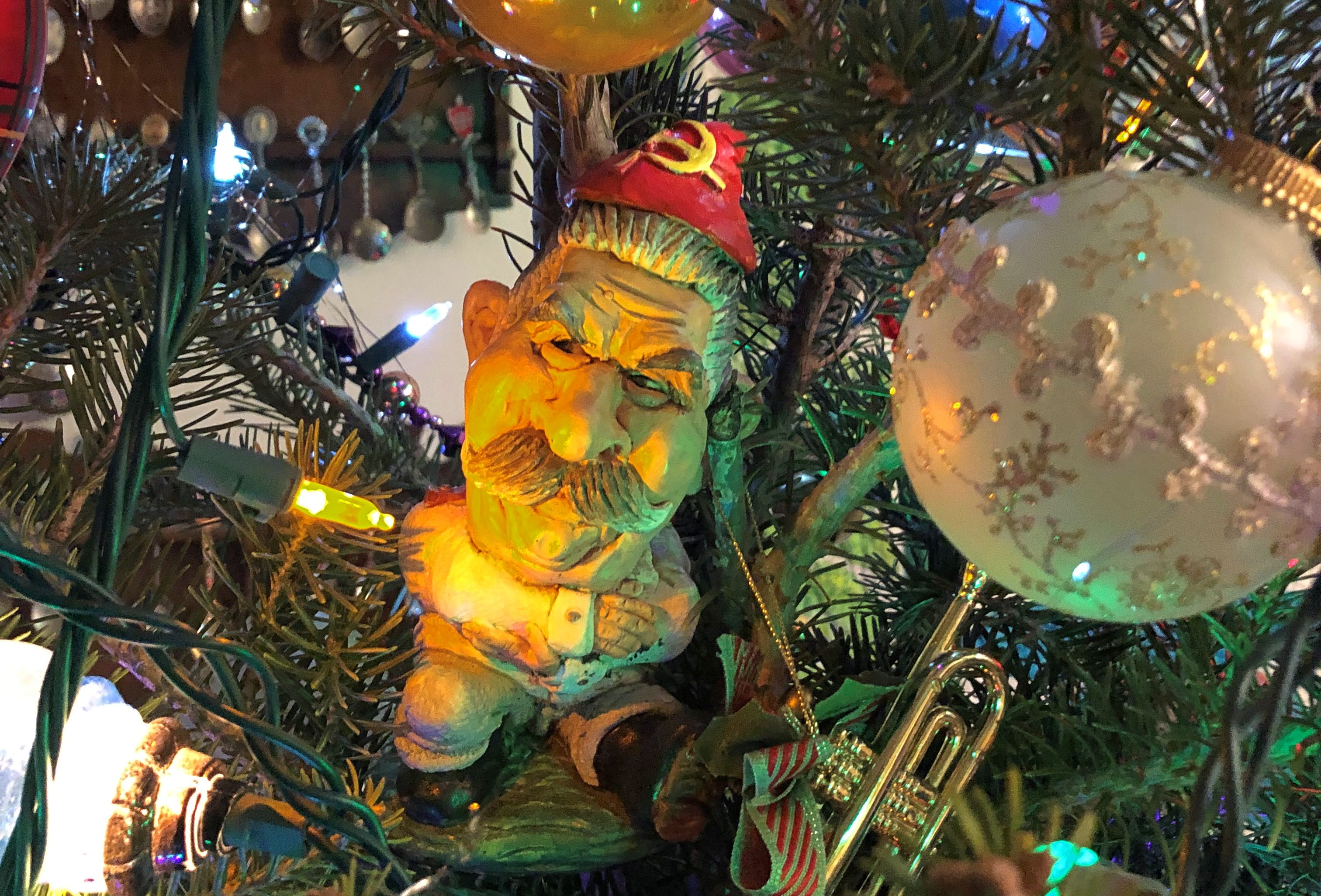
Even More Peoria: The Cathedral of St. Mary, The Great Agnostic & The Bolshevik Cookie Monster

Near downtown Peoria is the Cathedral of St. Mary of the Immaculate Conception, mother church of the Diocese of Peoria, completed in 1889 and restored in the 2010s. I was able to catch it resplendent in the full eastern sun on a Sunday morning, before it opened for mass.

Cathedral of St. Mary of the Immaculate Conception Peoria

Cathedral of St. Mary of the Immaculate Conception Peoria

Cathedral of St. Mary of the Immaculate Conception PeoriaCathedral of St. Mary of the Immaculate Conception Peoria

The adjacent cathedral rectory and, on the lower level, the diocesan chancery.
Cathedral of St. Mary of the Immaculate Conception rectory
Other details, including a statue of Mother Teresa.Cathedral of St. Mary of the Immaculate Conception Cathedral of St. Mary of the Immaculate Conception Cathedral of St. Mary of the Immaculate Conception

Later, we popped inside just before the beginning of mass. The interior is just as grand as the outside.

The cathedral isn’t the only church in the neighborhood. Not far away is Christian Assembly Church.
Christian Assembly Church, Peoria
West of there looked to be a hill made of buildings.
OSF Saint Francis Medical Center, Peoria
This is at the base of that “hill.”
The Irving School Peoria

The Irving School was the Peoria School District’s oldest school, built in 1898, when it closed in 2012.

“Irving and Peoria City Hall are the city’s only two representations of the architecturally significant Flemish Renaissance design,” noted the Journal Star at the time. What are the odds that I’d see both of them on the same morning during a ramble in Peoria? Not bad, actually, since Peoria isn’t that large.

Looks like it’s being redeveloped, to judge by the construction truck. The buildings on the hill, incidentally, form the OSF Saint Francis Medical Center, the largest hospital in metro Peoria.

Last time we went to Peoria, we visited the Springdale Cemetery. Next to it is the Peoria Zoo, Luthy Botanical Gardens and Glen Oak Park. This time we stopped for a few minutes at the entrance of that park, which happens to be on Dan Fogelberg Parkway.

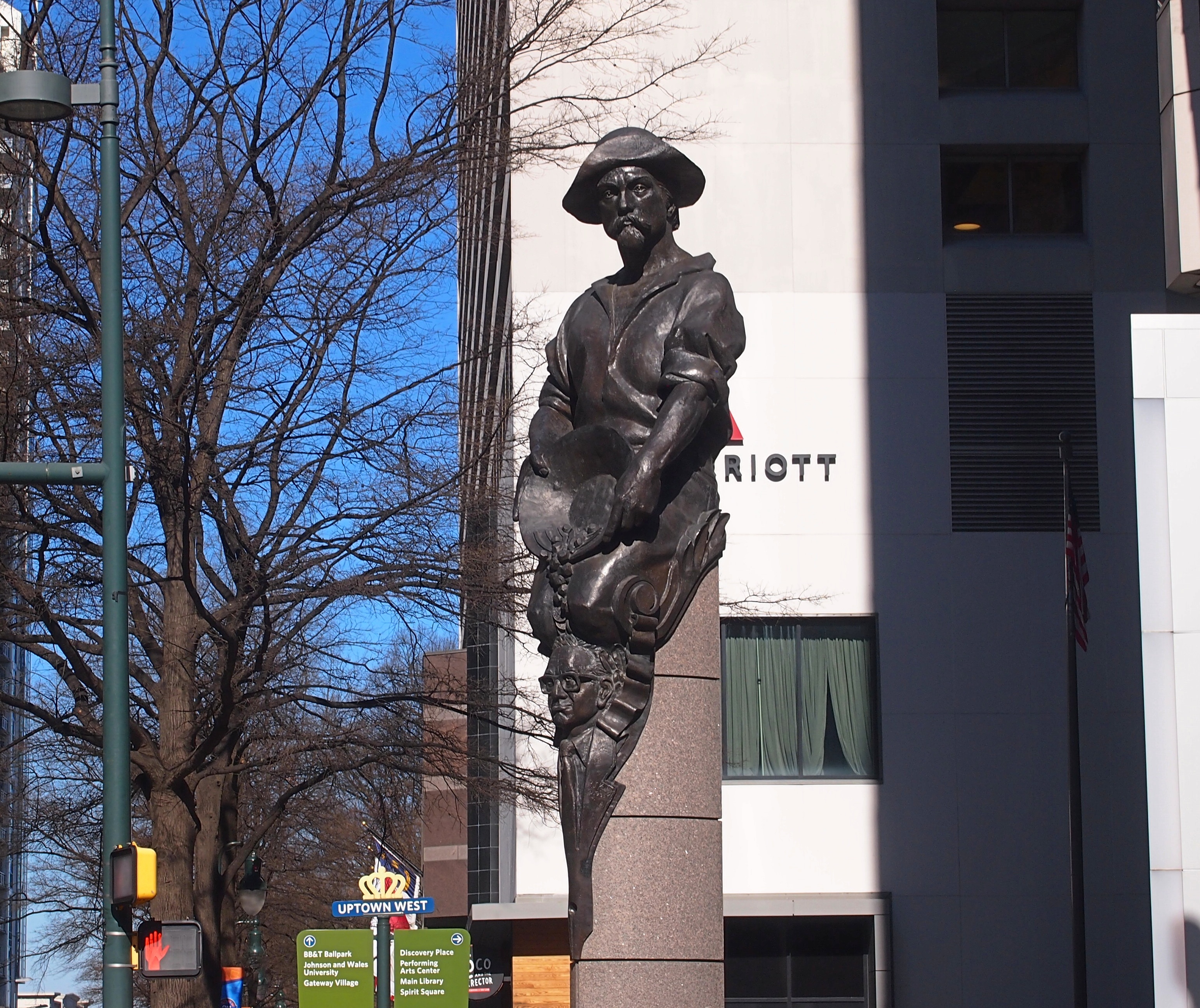
We went there because I want to see the statue of the Great Agnostic. I’m glad to see that the artist — no other than Fritz Triebel — wasn’t trying to hide the man’s portliness. That was insurance against 19th-century wasting diseases, anyway.
Robert Ingersoll statue Peoria
If I ever knew it, I’d forgotten that Robert G. Ingersoll (1833-99) spent much of his adult life in Peoria, though he lived other places, such as Shawneetown (before it was Old Swaneetown). He’s not buried in Illinois, however, but Arlington National Cemetery, as befits the commander of the 11th Illinois Volunteer Cavalry of the Union Army.

I can’t remember how I first heard of him, but it was in high school. He’s another of those interesting public intellectuals who’s been completely forgotten, which would be almost all of them. Forgotten except by his hometown, though I expect most Peorians don’t know who he was either.

While driving on I-74 just west of downtown, I saw a sign pointing to an individual’s grave nearby — a rare thing, now that I think about it. The individual was Susan G. Komen. I was still by myself at that point, so there was no one to object to checking out yet another cemetery.

She’s in a niche in Parkview Cemetery.
Susan G. Komen grave

It occurred to me as I read the nearby plaque that I knew nothing about her, except that her name is attached to the breast cancer foundation. She died from the disease in 1980 at age 36. It was her sister, Nancy G. Brinker, who established the foundation.

Later Nancy Brinker was U.S. ambassador to Hungary, early in Bush the younger’s administration, a job I expect she got since she and her husband, the inordinately successful chain restaurateur Norman Brinker, were serious donors to the Bush campaign. (Seems she also had enough pull to have a sign put up directing people to her sister’s memorial.)

Parkview is pleasant enough, but not nearly as picturesque as Springdale. Still, I found an interesting but probably informal section where a good many Greeks or people of Greek ancestry are buried.
Parkview Cemetery Greek section Parkview Cemetery Greek section Parkview Cemetery Greek section

This structure says, 1931 American Greek Society Homer on top. Below it says, Erected by Charter Members, with a list of names of a distinctly Hellenic cast.
Greek American memorial Peoria

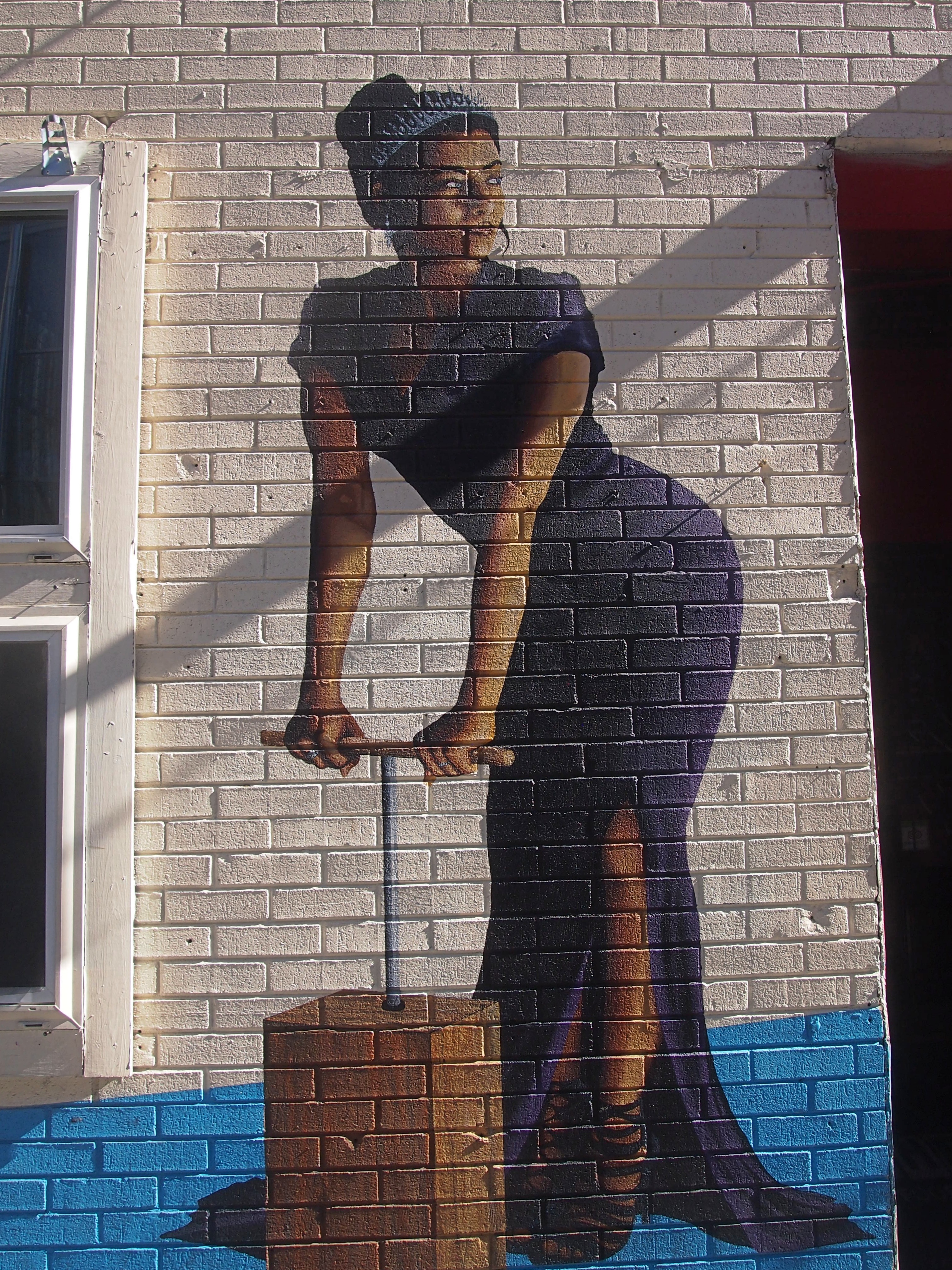
The afternoon we arrived in Peoria, we were driving along Adams Street not far from downtown when suddenly we saw the famed (well, 15 minutes) Cookie Monster mural. Imagine my delight. I had to stop to take pictures of that.
Bolshevik Cookie Monster Mural, Peoria

The mural got national attention late last year. As reported, the story was that a mysterious man (Fake Nate) paid an artist (Joshua Hawkins) to do the mural, claiming he was the building’s owner. The real owner (Real Nate) came back from a Thanksgiving trip to find the mural, and expressed outrage. The artist said he’d been tricked, too. Then Real Nate painted over the mural. Fake Nate’s identity and motive — and there must have been a strong one, since Hawkins reported being paid “a lot” in cash for the work — remained elusive.

It’s an odd story. But soon I’d forgotten that the small building, which is absolutely nondescript in every other way, was in Peoria. When I saw the mural, I remembered.
But wait — wasn’t it painted over? Whitewashed is more like it, since spring rains had clearly removed most of the covering, rendering Bolshevik Cookie Monster visible again.

As I stood across the street taking pictures, a stubby, wrinkled, gray-haired man got out of his car not far away and tried to enter a small bar on my side of the street. He found it closed.

“It’s closed,” he said to me, heading back toward his car.

“What’s the deal with that?” I asked, pointing toward the mural.

“It’s some kind of joke,” he said, and related a bit of the reported story. But then he expressed skepticism that it really happened that way. Rather, he suspected, the artist and the property owner cooked up the story to help sell the building — which, I read later, the owner did not long ago — and help get the artist some attention, too.

That’s certainly plausible. There’s no doubt that the artist is capitalizing on it. If it didn’t involve paying $35 ($25 for the item, $10 for shipping), I’d consider buying a t-shirt with the mural on it, as offered at the artist’s web site along with other merch. (That’s too much for any t-shirt.)

Maybe, maybe not. Doesn’t matter. It’s an inspired bit of whimsy. Мир, земля, печенье (Peace, Land, Cookies) is a play on the Bolshevik slogan, Мир, земля, хлеб (Peace, Land, Bread), and there is a touch of early red propaganda poster to the thing.

If the new building owner, and the city of Peoria, has any sense, they’ll keep the mural. Restore it, in fact. Besides being funny, at least to some of us, it’s a distinct thing to be found there and absolutely nowhere else.

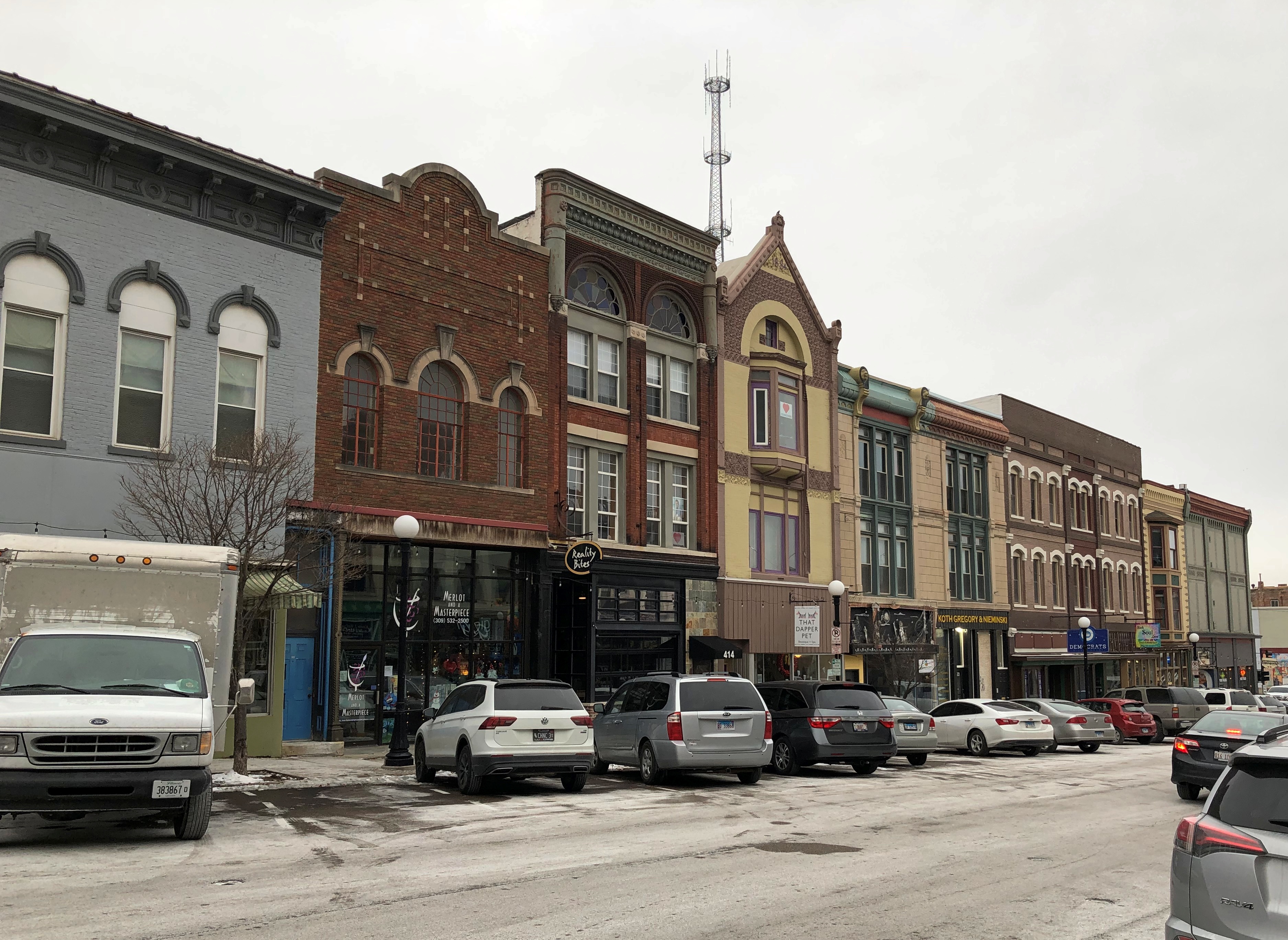
Downtown Peoria

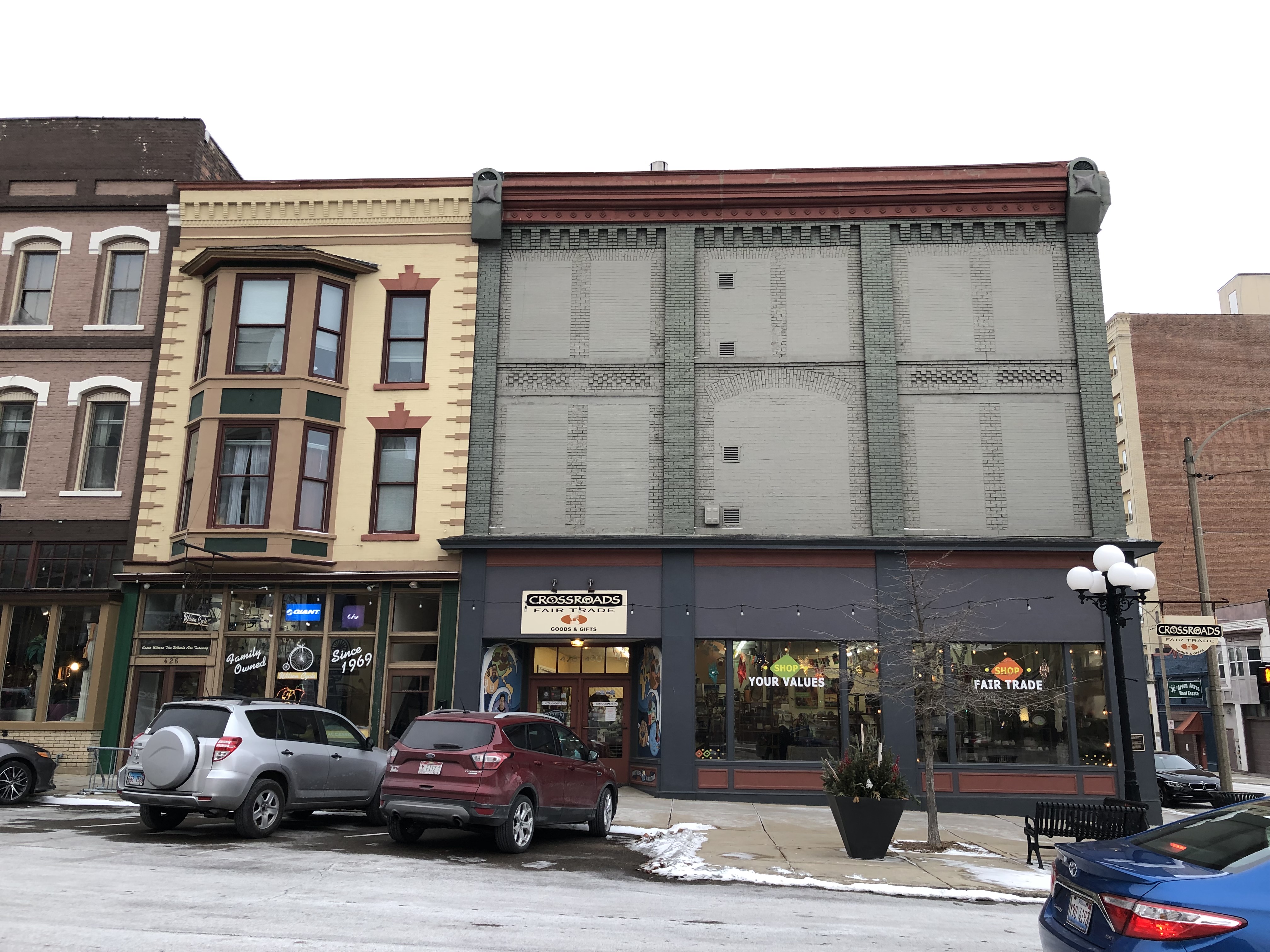
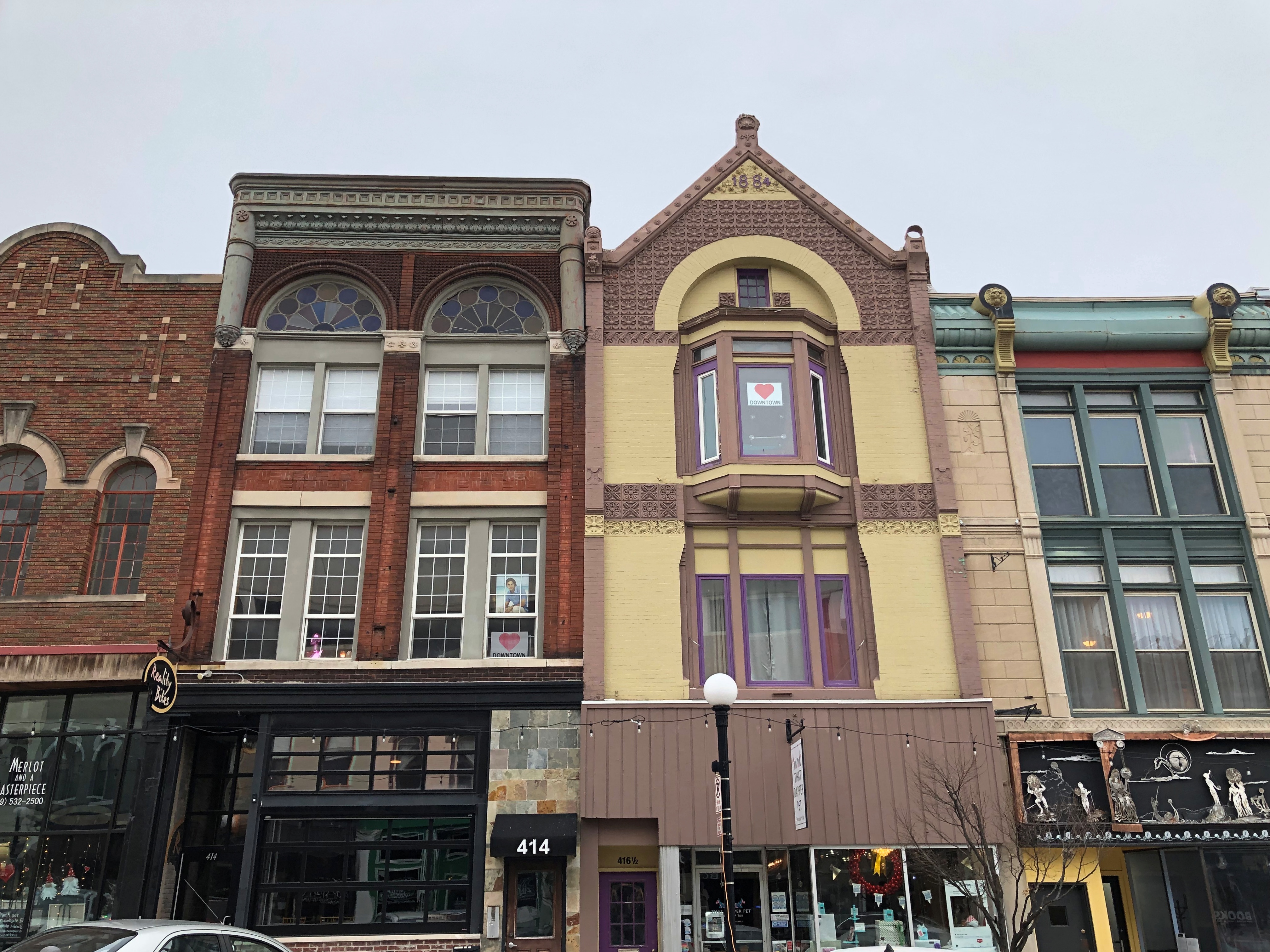
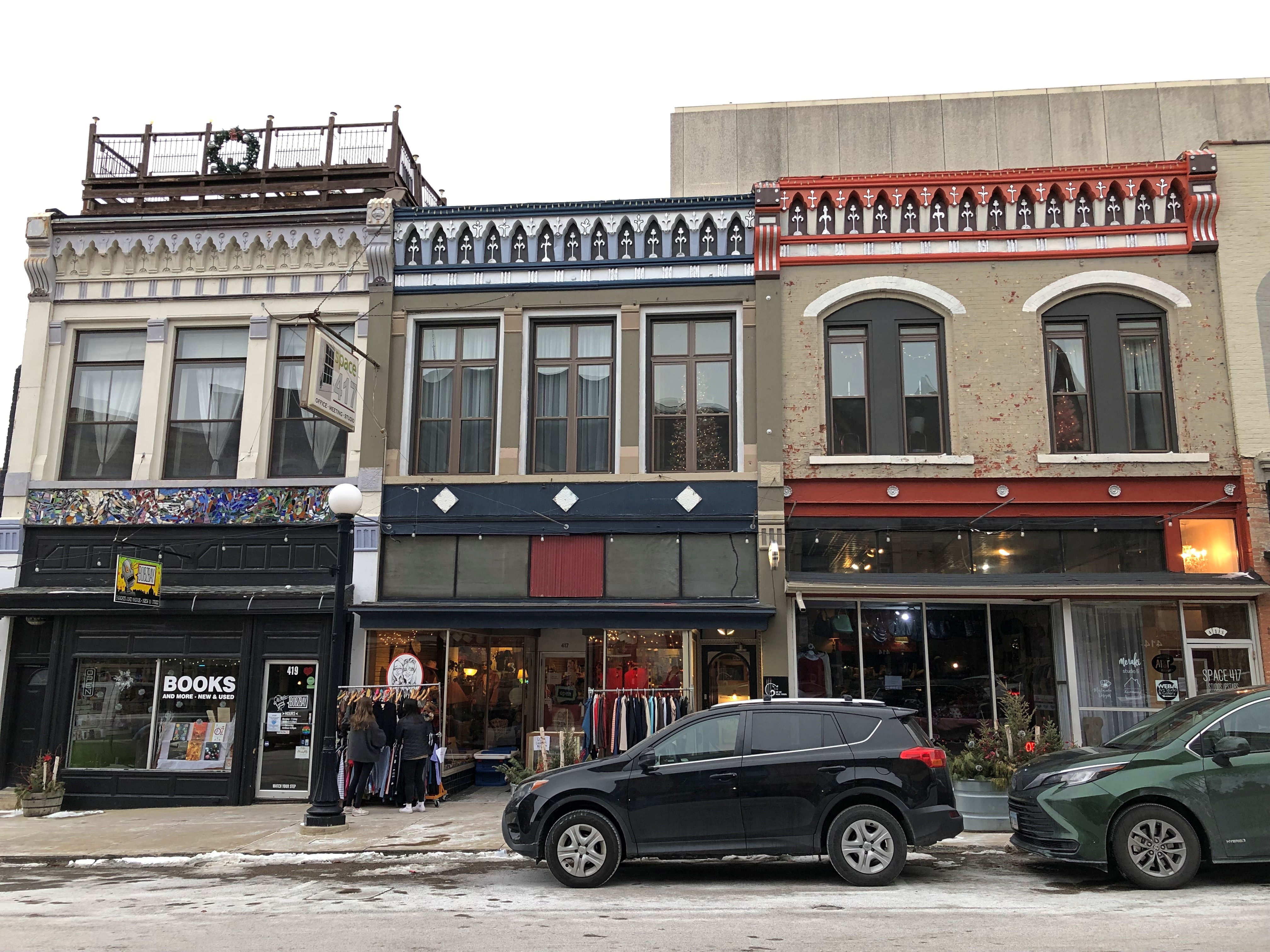
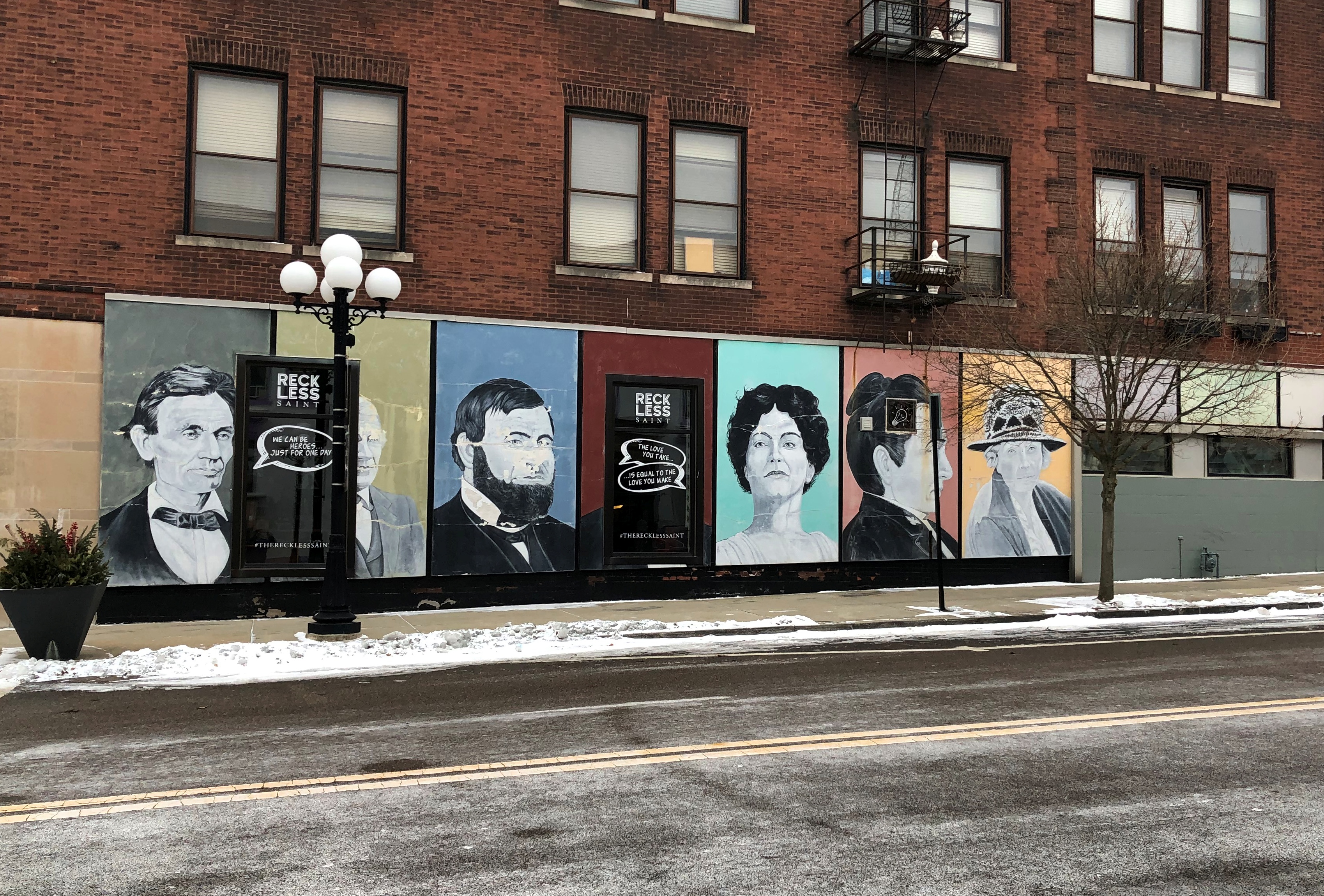
On the Sunday morning we were in Peoria, I popped out for a look around as my family still slept, as my wont. We were staying in East Peoria, so downtown Peoria was just across the Murray Baker Bridge. Soon I made my way to Main Street, which features buildings short —

Downtown Peoria. Main Street

— and tall, at least for Peoria, such as the Commerce Bank Building.Downtown Peoria. Main Street

On Main Street, I mostly focused on Courthouse Square, where there’s a sizable old memorial, the Soldiers and Sailors Monument, along with a sizable new mural, “Abraham Blue,” which is perched on the side of the Peoria County Courthouse.Downtown Peoria. Main Street, Soldiers and Sailors

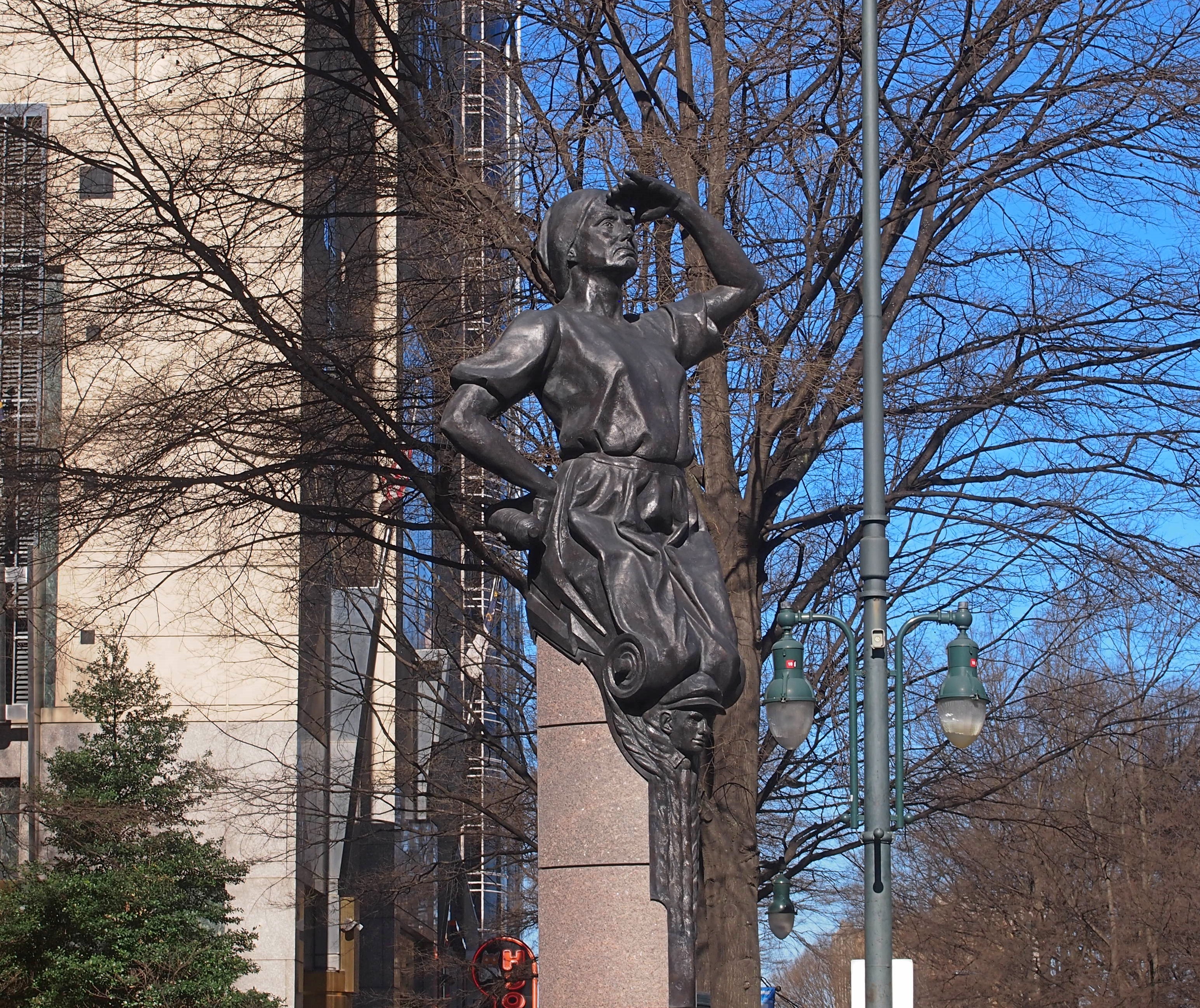
First, the Soldiers and Sailors Monument. Impressive bronze.Downtown Peoria. Main Street, Soldiers and Sailors Downtown Peoria. Main Street, Soldiers and Sailors Downtown Peoria. Main Street, Soldiers and Sailors

The memorial has been there since 1899, a project of the Ladies Memorial Day Association. A plaque nearby quotes the president of that organization, one Lucie B. Tyng, who said it would the work would “last for all time, and tell our children and children’s children our loving gratitude to these brave men who took their lives in their hands and went forth to vindicate and sustain our Government in its hour of peril.”

The association tapped Fritz Triebel, a native Peorian artist resident in Rome, to create the monument. He also did the intricate bronzes at the Mississippi State War Memorial Monument in Vicksburg. That’s the spirit of sectional reconciliation at work, by golly. Or maybe a commission was a commission for Triebel.

As for “Abraham Blue,” the Journal Star reported before it was hung on the courthouse in 2018 that “the Lincoln portrait was created by Doug Leunig several years ago as part of a work that captured the likenesses of the famous Americans that adorn the nation’s currency.

” ‘It’s called “Abraham Blue” because it’s tinted blue. That symbolizes the fact that Lincoln suffered from depression but was able to overcome that problem to be a great president,’ said Leunig.”

It adds quite a presence to Courthouse Square. And to the courthouse itself, a brutalist box if there ever were one.
Downtown Peoria. Main Street, Abraham Blue

Further wandering in downtown Peoria took me to City Hall, designed by Reeves and Baillee and dating from 1897. No boxes for them; Le Corbusier was still in short pants in those days.Peoria City Hall

Down the block from City Hall is Sacred Heart Catholic Church, dating from 1905. Closed. I was too early for it to be open for mass. Sacred Heart Catholic Church

Sacred Heart Catholic Church

Elsewhere, there’s a former church — I haven’t found out what kind yet — that’s now Obed & Issac’s Microbrewery & Eatery. Looks like a nice adaptive reuse.Obed & Issac's Microbrewery & Eatery

We didn’t eat in any restaurants on this little trip. But it won’t be long now.

Peoria Dash ’21: A Couple of Hours in Freeport

The week after I returned from Dallas was second-dose vaccination week for all of us in our house. When I set things up in late March, the only first-shot appointments were at far-flung pharmacies in northern Illinois, meaning the boosters would be at the same places. By the time I got back, I had the sense that I could have rejiggered things to get shots closer to home. But I didn’t. I still wanted to go to those places.

Such as Freeport, Illinois, the only town of any size between Rockford and Galena, and actually much bigger than the latter (23,700 vs. 3,100). When driving into Freeport, I saw a sign advertising a Wrigley Field replica, or miniature, or something. It wasn’t hard to find after our vaccination was done.

Little Cubs Field, it’s called, which is used for Little League, T-ball and other events, and completed in 2008 by serious Cubs fans.
Little Cubs Field Freeport

The bicycle in that picture belonged to one of about a half-dozen boys, all maybe about 10 years old, who were hanging out at Little Cubs Field when I arrived and started taking pictures.

“Are you a tourist?” one of them asked me.

“Yes, I’m just passing through,” I said.

“They always take pictures,” another of the boys said to yet another, not me. The first boy then asked where I was from, and I simplified matters by telling him Chicago. I got the sense that he felt that was quite a distant location. A reasonable thing to think at 10.

Off they went, and I took some more pictures.Little Cubs Field Freeport Little Cubs Field Freeport Little Cubs Field Freeport

A short drive away, in Freeport’s small downtown, is its Lincoln-Douglas memorial. I couldn’t very well pass that up.Lincoln-Douglas Freeport

Lincoln-Douglas Freeport

Every place they had a debate has a memorial now. This was the first of the statues to memorialize one of the events, unveiled in 1992, but hardly the last. Chicago sculptor Lily Tolpo (d. 2016) did the bronzes. Both she and her husband Carl did Lincolns.

The memorial also featured a plaque on a rock.
Lincoln-Douglas Freeport TR Rock
Not just any plaque, but one dedicated by TR in 1903. A president, I believe, who understood the gravitas of the office he held. Probably felt it in his bones. Not all of his successors have.

We were about to leave, but couldn’t help noticing an ice cream shop next door to the memorial.Union Dairy Farms Freeport Union Dairy Farms Freeport

The Union Dairy Farms, founded in 1914 and serving ice cream since 1934. We couldn’t pass that up, either, figuring it had to be good. Was it ever.

Boneyards Along the Way

On the second day of my recent trip, as I was leaving Carbondale, Illinois, I spotted the small but pretty (and unimaginatively named) Woodlawn Cemetery. Founded in 1854, it’s two years older than the city. Everything was wet from the heavy rain the night before. Woodlawn Cemetery, Carbondale Woodlawn Cemetery, Carbondale Woodlawn Cemetery, Carbondale

There are a number of Civil War graves.Woodlawn Cemetery, Carbondale Woodlawn Cemetery, Carbondale

“In April, 1866, three Carbondale-area Civil War veterans… proposed that the community… gather on the last Sunday of April to honor their fallen comrades and neighbors, by cleaning and decorating their graves,” says the cemetery’s nomination for the National Register of Historic Places.

“On the appointed day, April 29, more than 200 veterans plus approximately 4,000 area citizens gathered at Woodlawn Cemetery… Gen. John A. Logan addressed the assemblage.”

Evidently, this and later commemorations deeply impressed Logan, who on May 5, 1868, issued GAR General Order No. 11.

The 30th day of May, 1868 is designated for the purpose of strewing with flowers or otherwise decorating the graves of comrades who died in defense of their country during the late rebellion, and whose bodies now lie in almost every city, village, and hamlet churchyard in the land…

While visiting Clarksdale, Mississippi, I spent a few minutes at Heavenly Rest Cemetery.

 Heavenly Rest Cemetery Clarksdale

In the background are two buildings of First Baptist Missionary Baptist Church (1918), historic in its own right.

 Heavenly Rest Cemetery Clarksdale

At Vicksburg National Military Park is the 116-acre Vicksburg National Cemetery, which holds the remains of 17,000 Union soldiers, a higher concentration than any other cemetery, according to the NPS.

Vicksburg National Cemetery Vicksburg National Cemetery Vicksburg National Cemetery

“After the creation of Vicksburg National Cemetery [in 1866], extensive efforts were made by the War Department to locate the remains of Union soldiers originally buried throughout the southeast in the areas occupied by Federal forces during the campaign and siege of Vicksburg — namely, Arkansas, Louisiana, and Mississippi. However, by the time of these re-interments many of the wooden markers had been lost to the elements, and identification of many of the soldiers was rendered impossible.

“Nationwide, 54% of the number re-interred were classified as ‘unknown.’ At Vicksburg National Cemetery, 75% of the Civil War dead are listed as unknowns…”

The cemetery is closed to burials now, but after the Civil War a number of later servicemen were buried there, including the curious story of Flight Sgt. Edgar Horace Hawter of the Royal Australian Air Force, re-interred there in 1949 from New Guinea.

“Confederate dead from the Vicksburg campaign originally buried behind Confederate lines have now been re-interred in the Vicksburg City Cemetery (Cedar Hill Cemetery), in an area called Soldiers’ Rest,” the NPS says. “Approximately 5,000 Confederates have been re-interred there, of which 1,600 are identified.”

Cedar Hill Cemetery wasn’t hard to find.

Cedar Hill Cemetery Soldiers' Rest Cedar Hill Cemetery Soldiers' Rest

Most of the cemetery isn’t Soldiers’ Rest.

Cedar Hill Cemetery Vicksburg Cedar Hill Cemetery Vicksburg Cedar Hill Cemetery Vicksburg Cedar Hill Cemetery Vicksburg

Most of the stones are modest, but there are a few larger ones.

Cedar Hill Cemetery Vicksburg Cedar Hill Cemetery Vicksburg

Evergreen Cemetery in Paris, Texas, was green enough, and wet with recent rain when I arrived there on April 16.

Evergreen Cemetery, Paris, Texas Evergreen Cemetery, Paris, Texas

As a veteran of the Texas Revolution, Dr. Patrick W. Birmingham (1808-1867) rates a Texas flag.
Evergreen Cemetery, Paris, Texas
Another plaque told me that Jesus in Cowboy Boots was part of a memorial at Evergreen, but maddingly it didn’t offer any direction about where such a thing would be found. So I did what we moderns do, and did a Google Image search for that term. I got an image easily.

Turned out I was practically standing next to it.

Evergreen Cemetery, Paris, Texas - Jesus in Cowboy Boots Evergreen Cemetery, Paris, Texas - Jesus in Cowboy Boots

It was a little hard to make out at first, but yes, it does look like that figure is wearing boots rather than, say, sandals. It’s not clear it’s actually a depiction of Jesus, but as Atlas Obscura points out, the name has stuck.

Fort Smith National Historic Site

As historic sites go, Fort Smith National Historic Site is definitely worth a look, with its main building (former barracks-courthouse-jail), reconstructed gallows, site of a first fort, outline of the second fort’s former walls, parkland and walking paths, and a nice view of the Arkansas River.Fort Smith National Historic Site

But what really caught my attention during my visit on April 17 was painted on one of the sidewalks.Fort Smith National Historic Site Fort Smith National Historic Site

“The line on the sidewalk behind you represents the 1834 boundary between Indian Territory and Arkansas,” the sign nearby simply says. “Indian Territory was defined as the unsettled land west of the Mississippi River not including states or previously organized territories.”

I should note that the line on the sidewalk isn’t the current border between Arkansas and Oklahoma. But it’s pretty close — at that point the line is on the eastern bank of the Arkansas River, at least according to Google Maps (not quite an infallible source).

The pink arrow points to about where the painted line is. As you can see, the modern border zags a bit to the west at that point, so that all of the land of the historic site — and the city of Fort Smith, for that matter — is in Arkansas.

At some point, that line must have been straight and a slice of land east of Arkansas-Poteau confluence was Indian Territory, if the sidewalk line is correct. This Encyclopedia of Arkansas article seems to deal with a border adjustment in the area, in the context of the Choctaw Nation-Arkansas border, which was the subject of decades of dispute.

But the article says the strip was “two miles wide and twelve miles long,” and the Fort Smith slice looks nowhere near that large, so I don’t know how the above border adjustment was made. Some Arkansas or Choctaw historian might, but I’m going to leave it at that.

The fort was originally established in 1817 to patrol the neighboring Indian Territory and named for the otherwise little-remembered Gen. Thomas Smith. The U.S. Army abandoned the first fort in 1824, but by that time a town had grown up near the fort. The Army built a second fort in 1838 that it occupied, except for a short Confederate period, until 1871.

The site of the first fort, entirely forgotten and not re-discovered until 1958.
Fort Smith National Historic Site

During the Army period, the handsome main building of the second fort served as a barracks. Late in the 19th century, it was a federal courthouse and jail. Now it’s a museum. Closed when I visited, unfortunately.

Also handsome: the Historic Commissary Building. It too was closed.Also handsome: the Historic Commissary Building. It too was closed.

Flat stones that mark where the second fort wall used to be. A sign pointed out that most later U.S. Army forts didn’t bother with walls.
Fort Smith National Historic Site

Another prime attraction — maybe the prime attraction — is the rebuilt gallows.
Fort Smith National Historic Site

“With the largest criminal jurisdiction of any federal court at the time, the Western District of Arkansas handled an extraordinary number of murder and rape cases,” a sign in front of the gallows says. “When a jury found defendants guilty in these capital cases, federal law mandated the death penalty. In Fort Smith, that meant an execution by hanging on a ‘crude and unsightly’ gallows.”

A separate sign lists everyone hanged at Fort Smith during the years (1873-96) that federal executions took place on the site, 87 men all together. The famed Judge Isaac C. Parker sentenced 160 people (156 men, four women) to death in that court, 79 of whom were eventually hanged. “George Maledon, known as the Prince of Hangmen, served as executioner at over half of the Fort Smith hangings,” the sign also noted.

Main Street, Van Buren, Arkansas

I spent the night of April 16 in Alma, Arkansas, a part of greater Fort Smith, and the next morning I decided to see Fort Smith National Historic Site, so I headed into town via U.S. 71 Business. My breakfast was in a sack in the seat next to me, so I was also looking for a place to stop and eat. Sometimes small parks are just the place, either to eat in the car away from traffic whizzing by, or to find an outdoor table.

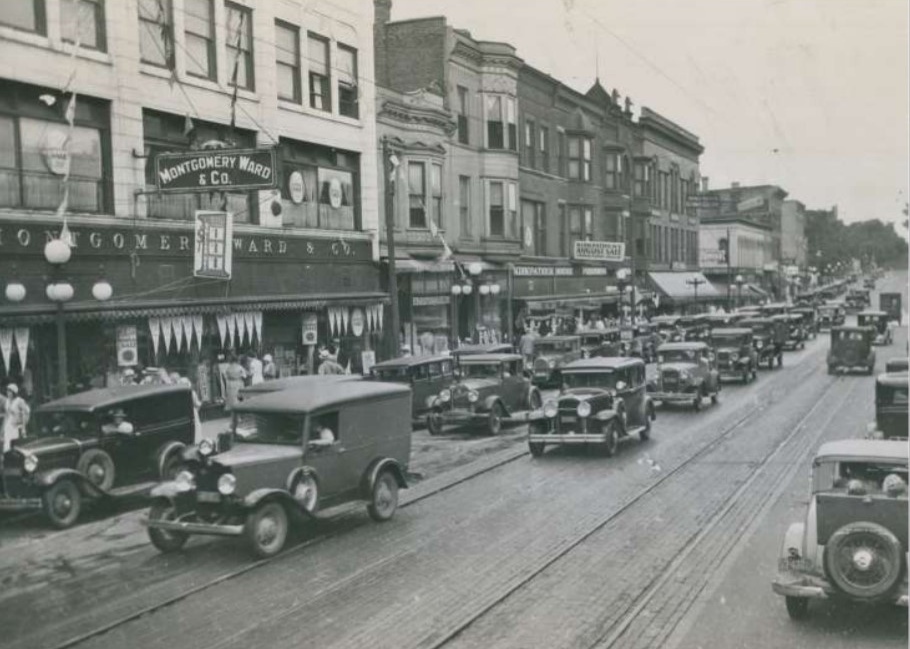
I saw a small sign that said PARK –> , so I turned right off the main road. Soon I found myself at the intersection of 6th and Main Street, main artery of the picturesque Van Buren Historic District. I parked on Main and ate my breakfast, and naturally got out for a walk after that.Van Bureau Main Street
Van Bureau Main Street
Except for Fort Smith itself, Van Buren is the largest place in the Fort Smith MSA, with about 23,600 residents, founded on the Arkansas River well over a century and a half ago. Van Buren, Arkansas

Much more recently, the river got pretty angry.

Though a bit chilly that Saturday, the weather was comfortable enough for a walk on Main Street, mostly sporting buildings of a certain vintage.Van Buren Main Street Van Buren Main Street Van Buren Main Street

Older buildings, but with distinctly contemporary uses, including the likes of Rethreadz Boutique, The Vault 1905 Sports Grill, Sophisticuts, Corner Gifts, The Vault, and Red Hot Realty.Van Buren Main Street Van Buren Main Street Van Buren Main Street

At Main and 4th is the Crawford County Courthouse, dating from 1842 and as such, according to Wiki anyway, the oldest operating courthouse west of the Mississippi.

Crawford County Arkansas Courthouse
It wouldn’t be much of a Southern courthouse without its Confederate memorial, dating from 1899.Crawford County Arkansas Courthouse

A detail from the base. Something you don’t see too often.
Crawford County Arkansas Courthouse

Something you see even less at courthouses, North or South: a Greek goddess, namely Hebe, goddess of youth and youthful joy.Crawford County Arkansas Courthouse Hebe Crawford County Arkansas Courthouse Hebe

The original was a 1908 gold-painted iron statue, according to a sign on site. This 2003 bronze is a replacement for the original, which now resides in the Crawford County Museum.

Off to one side of the courthouse is the Albert Pike Schoolhouse, thought to be one of the oldest extant buildings in Arkansas, built ca. 1820 and later relocated to its current spot.
 Albert Pike Schoolhouse

Another memorial on the grounds. I’d never heard of Cyrus Alder before; now I have.
Cyrus Alder memorial
Finally, I spotted some interesting walls in the vicinity of the courthouse. Such as what looks to be a palimpsest ghost sign wall.
Van Buren ghost wall

In an alley across the street from the courthouse, this. It’s fairly new, as you’d think. Streetview of May 2018 has a blank wall there.Van Buren You Are Here mural Van Buren You Are Here mural

My knee-jerk reaction: izzat so? I never did find the park that I thought might be a good place for breakfast. I did much better, enjoying a bit of serendipity on the road, since I had no inkling of Van Buren, Arkansas before I found myself there.

Poverty Point World Heritage Site

West from Vicksburg and a little north of I-20 on US 65 is Transylvania, Louisiana, pop. scant. Now I can say I’ve been to Transylvania. I missed a turn, and realized it after a few miles, by which time I was near a school that needs roof repairs. Or an abandoned school building. I pulled over within sight of the structure to consult my maps.

Transylvania, Louisiana

Soon I was headed by the correct small roads to Poverty Point World Heritage Site, which has an address in Epps, Louisiana, but that’s just the nearest currently inhabited town. The site is firmly in the countryside.

Its signs stress the World Heritage status accorded the site a few years ago. Poverty Point also happens to be a U.S. National Monument.Poverty Point Louisiana

On this site, in the second millennium BC, the people who dwelled here spent centuries building enormous mounds and ridges of earth by hand. The thought of that conjures up a past so remote that our image of them is one of shades, whispering in a language we can’t comprehend, pushing this collective building goal forward for reasons we cannot possibly know.

What you see close after the beginning of the third millennium AD is wide green fields, modestly undulating. Off in the distance are copses of trees, more fields and other natural land contour. The day was pleasantly warm.Poverty Point Louisiana

Poverty Point Louisiana

Poverty Point Louisiana

“Hand by hand and basketful by basketful, men and women shaped nearly 2 million cubic yards of soil into stunning landscapes,” the site’s web site says. “The result was a massive 72-foot-tall mound, enormous concentric half-circles and related earthworks that dwarfed every other earthen monument site for 2,200 years.”

Mound B beats them all. The largest ever built by a hunter-gatherer population.

Poverty Point Louisiana

Poverty Point Louisiana

A further estimate on a sign near the mound says it would have taken 15.5 million loads of earth to build this single mound.

Poverty Point Louisiana Poverty Point Louisiana

Poverty Point Louisiana

It’s a brain bender. Imagine a time and place when virtually everything you know, or have seen, or believed, wouldn’t exist for thousands of years.

Vicksburg National Military Park

Had my second shot today. Now George Soros is controlling my brain. Or is it Bill Gates? Hard to keep all these kaleidoscopic alt-realities straight, you know.

Over the years I’ve bypassed Vicksburg, the city and the battlefield, a number of times, so I made a point of visiting this time. I arrived at Vicksburg National Military Park just after noon on April 11, pausing to eat lunch in my car in the parking lot.
Vicksburg National Military Park

At more than 2,500 acres, it’s a large park, but actually smaller than most of the other national military parks, such as Chickamauga (9,500+ acres), Shiloh (9,300+ acres), Fredericksburg (8,400+ acres) or Gettysburg (6,000+ acres). Takes a lot of land to wage near-modern war, after all.

Still, with its winding roads, thick woods, open fields, and monuments of all sizes and descriptions, the place feels expansive. And lush. Full spring had come to Mississippi, along with a pleasant warmth in the air that must have been blazing hot by the time the siege happened in the summer.Vicksburg National Military Park
Vicksburg National Military Park Vicksburg National Military Park

Everywhere you look, a few more cannons. According to Wiki, there are 144 emplaced cannons in the park.Vicksburg National Military Park

Only fitting, since the event was largely a duel of artillery. Also according to Wiki, the park includes 1,325 historic monuments and markers, 20 miles of trenches and earthworks, a 16-mile tour road, a 12.5-mile walking trail, two antebellum homes, and the restored gunboat USS Cairo, the luckless Brown Water Navy vessel that became first ship ever sunk by a remotely detonated mine.

Each state on both sides that sent men to the campaign has a sizable memorial — as many as 117,000 soldiers took part — but it looks like none is more sizable than Illinois.Vicksburg National Military Park - Illinois Vicksburg National Military Park - Illinois

“The design was by W. L. B. Jenney and sculptor was Charles J. Mulligan. Jenney served with distinction as a major in the Union Army during the Civil War as an engineer,” says the National Park Service.

“Stone Mountain (GA) granite forms the base and stairway. Above the base is Georgia white marble. There are forty-seven steps in the long stairway, one for each day of the Siege of Vicksburg.

“Modeled after the Roman Pantheon, the monument has sixty unique bronze tablets lining its interior walls, naming all 36,325 Illinois soldiers who participated in the Vicksburg campaign. Atop the memorial sits a bronze bald eagle sculpted by Frederick C. Hibbard of Chicago, who would also sculpt the statue of General Ulysses S. Grant in the park.” Vicksburg National Military Park - Illinois
Vicksburg National Military Park - Illinois

Near the Illinois memorial is one of the aforementioned antebellum homes, the well-restored Shirley House, which survived 1863 against all odds.

As it is now.
Vicksburg National Military Park - Shirley House

As it was then.
Shirley-House-During-Siege-of-Vicksburg

Just down the road from the Shirley House is a statue of Gen. John Logan, who commanded the 3rd Division of the XVII Corps of the Union Army in this area, and who ought to be better known for a number of reasons, such as fostering Memorial Day and for his change of heart about black people during the war.
Vicksburg National Military Park - John Logan

“But what of JOHN A. LOGAN? I will tell you. If there is any statesman on this continent, now in public life, to whose courage, justice and fidelity, I would more fully and unreservedly trust the cause of the colored people of this country, or the cause of any other people, I do not know him. Since [Charles] Sumner and [Oliver. P.] Morton, no man has been bolder and truer to the cause of the colored man and to the country, than has JOHN A. LOGAN. There is no nonsense about him. I endorse him to you with all my might, mind, and strength, and without a single shadow of doubt.”

— Frederick Douglass’ endorsement of John Logan during the 1884 presidential election.

Because of heavy rains (I assume) some of the roads were closed, including the one to Grant’s headquarters, where his equestrian statue is, so I didn’t see that.

Moving along, I came to another impressive state memorial: Mississippi. The home team, so to speak.Vicksburg National Military Park - Mississippi Vicksburg National Military Park - Mississippi

Wisconsin. That’s no mere eagle on top, but Old Abe.
Vicksburg National Military Park - Wisconsin

Missouri, which is dedicated to combatants on both sides.Vicksburg National Military Park - Missouri

Besides the state memorials, there was an array of statues and stones and plaques honoring other men and groups of men, or detailing movements during the siege.Vicksburg National Military Park Vicksburg National Military Park Vicksburg National Military Park Vicksburg National Military Park

The USS Cairo, partly protected from the elements. Its visitor center was closed, not for Sunday but still for the pandemic.
Vicksburg National Military Park

The view from Fort Hill.
Vicksburg National Military Park

I’m glad I got around to Vicksburg. Also glad to report a fair number of other visitors, most clearly tourists from other places, though some people were out jogging or walking their dogs. Best of all, I spotted some people with their kids (or grandkids) in tow. Maybe being the weekend had something to do with that, or that the city of Vicksburg is fair-sized. Even so, I remember how few other people I saw on the summer day I visited Shiloh — and only one or two families with children.

Clarksdale and Vicksburg Walkabouts

No question about it, Clarksdale, Mississippi, is a poor Delta town. The median household income in Coahoma County, of which Clarksdale is the seat and only town of any size, is $29,121 as of 2019, according to the Census Bureau, and over 38% of the population lives below the federal poverty level. For all of Mississippi — by household income the poorest state in the union — median household income is just over $45,000, and 19.6% of the population lives in poverty. (The U.S. figures are about $68,700 for median household income, with 10.5% living below the poverty level.)

Coahoma County is also majority black, 77.6%, compared with 37.8% for Mississippi as a whole. Since 2010, the county has lost 15.4% of its population; Mississippi has managed to eke out a 0.3% gain over the same period.

By contrast, Warren County, whose seat is Vicksburg, Mississippi, is considerably more prosperous by the same metrics, though it too lost population in the 2010s: down 6.9%. Median household income is $45,113, just over the state median, and about 20% of the population officially lives in poverty. Black and white are more evenly divided in Warren County, at 49.3% and 48.4%, respectively.

I took a walk around the downtowns of both Clarksdale and Vicksburg on the same day, Sunday, April 11, fairly early in the morning for the former, and late in the afternoon for the latter.

Poor it may be, Clarksdale is distinct as the hub of the Delta blues, a fact that the town very much plays up in the early 21st century, with a museum, music venues, plaques, public artwork and more. Funny, I have a hunch that the city fathers in segregationist Clarksdale a century or so ago didn’t give a fig for the music that the black population was creating and exporting to Chicago and other places.

Few other people were about on that Sunday morning. The first thing that caught my attention was a large mural.Clarksdale, Mississippi mural, Ground Zero Club 2021

Clarksdale, Mississippi mural, Ground Zero Club 2021 Clarksdale, Mississippi mural, Ground Zero Club 2021

That’s the back wall of the Ground Zero Blues Club, and the mural must be of recent vintage, since a Streetview image from September 2019 shows a few smaller murals, but mostly a blank wall.

That’s hardly the only public artwork in downtown Clarksdale.Clarksdale, Mississippi public art Clarksdale, Mississippi public art Clarksdale, Mississippi public art

The town sports a lot of interesting old buildings in various conditions, some music oriented, some ordinary commercial structures.Clarksdale, Mississippi public art Downtown Clarksdale, Mississippi Downtown Clarksdale, Mississippi

One of the music businesses is a place called Deak’s Mississippi Saxophones and Blues Emporium. Not something you’re likely to see anywhere else.

Deak's Mississippi Saxophones and Blues Emporium

Deak's Mississippi Saxophones and Blues Emporium
Late that day, I took a walkabout of similar duration in Vicksburg, after visiting the local battlefield.Welcome to Vicksburg

It’s a larger town with larger buildings, such as The Vicksburg, formerly the Hotel Vicksburg, which I’ve read is the tallest building in town and in recent years an apartment building. Next to it are the Strand Theatre and the B.B. Club, formerly the B’nai B’rith Literary Association building, and now an event venue.Former Vicksburg Hotel Strand Theatre Vicksburg

downtown Vicksburg

Some smaller structures grace downtown Vicksburg as well, of course.downtown Vicksburg

The city is mostly on a loess bluff overlooking the Mississippi.downtown Vicksburg

Old Man River.
Mississippi at Vicksburg
The damage that Old Man River can do, when he’s in the mood. There’s no doubt that 1927 is the one to beat, and not just in Louisiana, though 2011 was a whopper too.

Mississippi at Vicksburg
That’s on the river-facing side of the modern floodwall system protecting Vicksburg. On the town-facing side are a lot of different murals. Some details:

Vicksburg floodwall murals Vicksburg floodwall murals

My own favorite, “President McKinley Visits the Land of Cotton,” is based on a photo of an arch built from cotton bales to greet the president, who visited for a little less than two hours on May 1, 1901, not long before his date with Death in Buffalo.
Vicksburg floodwall murals

If possible, I like to see a presidential site on each trip. That counts as one for the trip.

West Tennessee Dash

On April 10, after leaving Illinois via a white-knuckle, two-lane bridge across the Mississippi into the state of Missouri, I headed south to catch the ferry back across the river at Hickman, Kentucky (green arrow). The point of this exercise was to continue from Hickman on small roads to the Kentucky Bend, marked here with a pink arrow.

There’s nothing distinctive about the Kentucky Bend except its odd status as an exclave of the commonwealth of Kentucky. I’d planned to snap a picture of whatever sign was at the Tennessee-Kentucky border at that point, and maybe visit the small cemetery just inside the bend.

It wasn’t to be. When I got to the ferry, the Mississippi looked a mite testy, swollen from the storms the night before, and probably other spring rains. A phone call confirmed that the ferry wasn’t running.Hickman Ferry

Without the ferry crossing, visiting the Kentucky Bend would have meant considerable backtracking, so I blew it off, and continued southward in Missouri. I got a glimpse of the bend from the riverfront at New Madrid, but I didn’t linger because I needed to find a bathroom.

Later I crossed into Tennessee on I-155 and soon connected with U.S. 51, which goes straight into Memphis. Despite the years I lived in Tennessee once upon a time, it was a part of the state I’d never seen, except for Memphis itself.

I didn’t quite make the straight shot into the city. Not far from U.S. 51 is Fort Pillow State Historic Park, site of the Battle of Fort Pillow, also known as the Fort Pillow Massacre, on bluffs overlooking the Mississippi. It’s been a state park for 50 years now. The day was as brilliant and warm as a spring day could be by that time, a contrast from the cool rain and less lush conditions further north.

Fort Pillow State Historic Park

I only spent a little while at the museum and visitor center, but got the impression that the bloody history of Fort Pillow isn’t emphasized. Be that as it may, I was keen to see whatever was left of the fort, or what had been rebuilt. Signs pointed the way.
Fort Pillow State Historic Park
An longer interpretive sign at this clearing said Nathan Bedford Forrest set up his command there.
Fort Pillow State Historic Park
On the trail went.Fort Pillow State Historic Park Fort Pillow State Historic Park Fort Pillow State Historic Park

It would have been nice had the FORT –> signs said how far was left to go. Also, I couldn’t quite follow the track I was taking, as compared to the map I acquired at the visitors center, which was a little unusual. Anyway, I climbed another couple of rises and came to a spot where I could just barely see the river.
Fort Pillow State Historic Park

I figured surely there must be earthworks or something at such a high point, but I didn’t see anything. Then I noticed another FORT –> sign pointing me down another staircase. That meant I’d have to go up again somewhere, because forts aren’t built in lower places. Then to return, I’d have go down and then up again. I didn’t have the energy for all that, I decided, so I made my way back. Still, I had a good walk. By the end of the day, I’d walked about two and a half miles.

Besides, I wanted to get to Memphis. When I arrived about an hour later, I found a spot in Mud Island Park with a view of the skyline.
Where the hell is Memphis?

The Hernando de Soto Bridge. More bridges ought to be named after explorers.Where the hell is Memphis?

Back on the mainland, I found the Memphis Pyramid. It wasn’t hard to spot.
Memphis Pyramid

Or more formally, Bass Pro Shops at the Pyramid.
Memphis Pyramid
Taller than the Pyramid of the Sun in Mexico, according to this source, but somehow that ancient Mesoamerican structure has much more of a presence. The Memphis Pyramid has been standing for 30 years now, and seems to be making it as a retail store, after failing as a municipal arena.
Memphis Pyramid

The blue-lit structure is an elevator to a view from the top of the pyramid.
Memphis Pyramid

Probably worth the price, but the line was long, so I headed for the exit. But I couldn’t leave without buying something to support the Memphis Pyramid, so I bought a box of Moon Pies.