The National September 11 Memorial

I knew that the centerpieces of the National September 11 Memorial were the footprints of the World Trade Center towers, and that some kind of pools had been built there. But I hadn’t followed the design or construction very closely.
So I wasn’t prepared for the square black pools with water cascading far down all four sides, down to another, smaller square into which the water seemed to vanish. Or the rows of trees canopying the grounds. Or the people on all sides, looking down into this metaphoric void. Or the names of the dead, etched in black on the parapets around the waterfalls. It was a place to stand and look.

The National September 11 Memorial

The National September 11 MemorialAnd take photographs.

The National September 11 MemorialThe National September 11 MemorialThe National September 11 MemorialThe National September 11 MemorialI understand that an organization puts flowers on the names of victims on their birthdays. So October 10 was James Andrew Giberson’s birthday. He was a fireman who lived on Staten Island, belonging to Ladder 35 in Manhattan, and last seen entering Tower 2.

The Illinois Centennial Monument

Rain in the morning, sun in the afternoon, drizzle in the evening. At least that’s variety. And it isn’t cold yet.

Illinois Centennial ColumnHenry Bacon’s well known for the Lincoln Memorial, as well he should be. He isn’t very known for the Illinois Centennial Memorial Column, a.k.a., the Illinois Centennial Monument, in Logan Square in Chicago, which is on the Northwest Side. I’d never taken a look at it up close until recently.

It’s a little forlorn. One of those monuments with passed by thousands daily, noticed by few if any, and marked with a little graffiti just to drive home the point. Then again, it’s been quite a while since the 100th anniversary of Illinois’ statehood, which was in 1918.

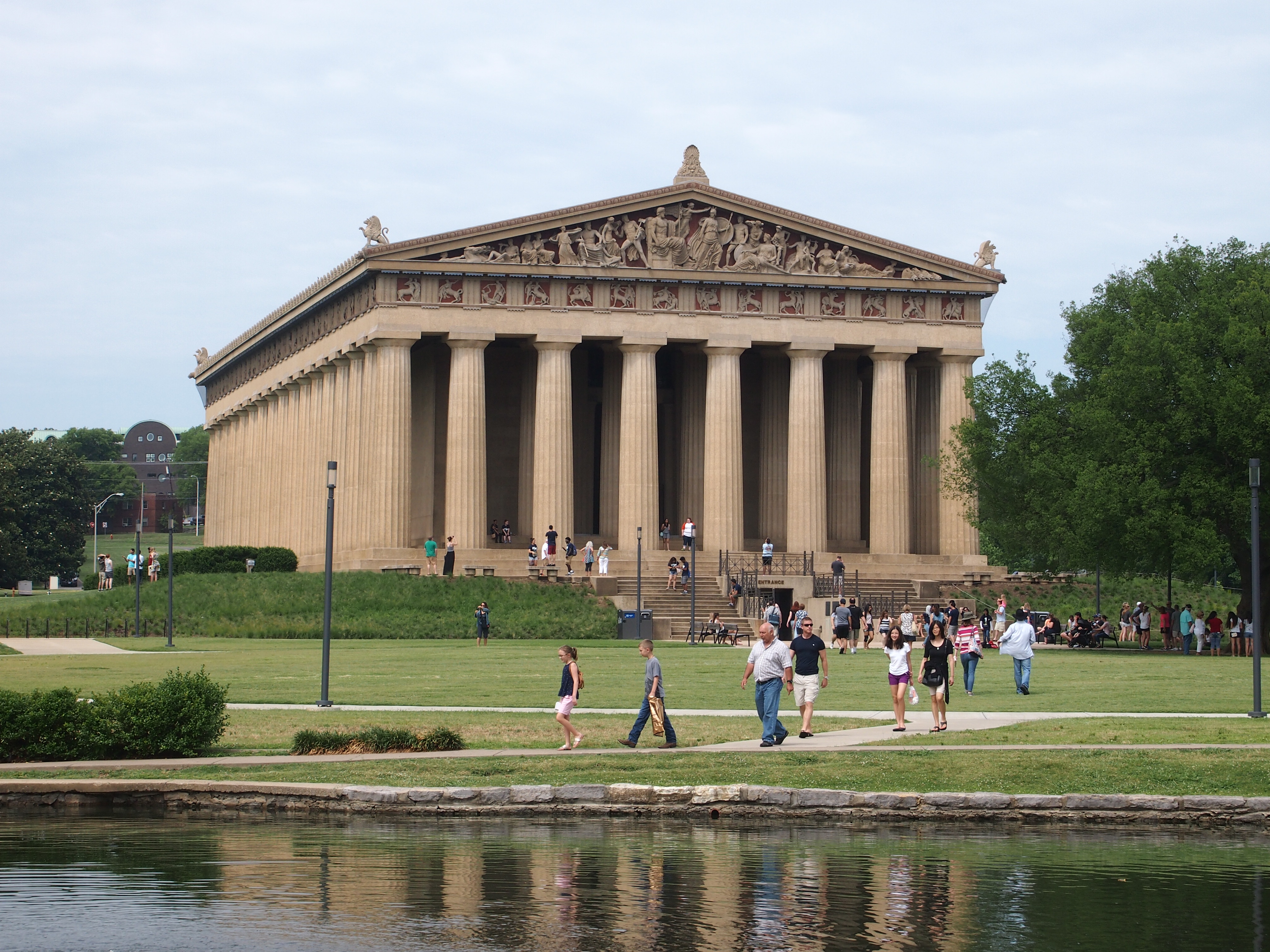
It’s a Doric column, and according to one source at least, made up of 13 solid marble segments based on the same proportions and scale as the columns of the Parthenon colonnade in Athens (or Nashville, come to think of it). The eagle on top, done by sculptor Evelyn Beatrice Longman, evokes the one on the Illinois state flag.

She did the reliefs along the base of the column as well, depicting Indians, explorers, farmers and laborers.

Illinois Cenntenial MemorialPlus a few figures from Antiquity. I’m pretty sure that’s Hermes holding a train and a steamship, maybe offering them to the laborer holding the hammer, and it looks like Ceres is to the workingman’s left. On Hermes’ right – is that Eratosthenes? He looks Greek enough, and he’s got a globe, fitting for the father of geography and the first person to more-or-less figure out the circumference of the Earth.

It’s too much to expect an Illinois Bicentennial Memorial in a few years, but may this one can be cleaned and restored for the occasion.

Humboldt Park Bronzes

As you’d expect, there’s a statue of Baron von Humboldt in Humboldt Park in Chicago, and it’s a good one, a ten-foot bronze by Felix Gorling. He’s standing next to a globe and an iguana. I like those details. But by the time I got there, my camera’s battery was exhausted – the modern equivalent of running out of film. Public Art in Chicago always features better pictures anyway, so here’s Humboldt.

The baron and I go back a ways. I did a report on him in the fifth or sixth grade. His science is impressive, but what I think really impressed me at the time, and still does, was how he successfully explored parts of South America without much in the way of modern equipment (though I guess what he had was state-of-the-art).

Also in Humboldt Park – another legacy statue of the long-gone German population in the area – is a bronze of Fritz Reuter by one Franz Engelsman. My knowledge of Fritz Reuter is meager, and at first I confused him with the fellow who started the news agency (Paul Reuter, as it happens).

Fritz - Humboldt ParkThe park district tells us that “Reuter is best known for Otto Kanellen, a volume of prose stories. But he is also remembered for writing against political oppression, a subject he understood first-hand. The Prussian government sentenced Reuter to death for high treason because he had participated in a student-run club promoting political activism. This was commuted to imprisonment, and despite poor health, Reuter continued to write throughout his years in prison. Reuter’s work included several comic novels that were popular with many of Chicago’s German immigrants.

“On May 14, 1893, more than 50,000 Chicagoans of German descent attended the dedication ceremonies. While Reuter is less well-known to the wider community than Goethe or Schiller—for whom monuments were also dedicated in Chicago parks—the impressive attendance at this dedication shows the great enthusiasm for Fritz Reuter within the city’s German community. Four bronze relief plaques of scenes from Reuter’s best known works originally ornamented the granite base of the monument; however, they were all stolen in the sometime in the 1930s and have never been recovered.”

Germans weren’t the only ones living near Humboldt Park more than 100 years ago. More from the park district: “On October 12, 1901, tens of thousands of flag-waving Scandinavian-Americans participated in events to celebrate the monument’s unveiling. Despite heavy rain that day, the festivities included a parade and a two-hour ceremony in Humboldt Park.”

The monument this time: a bronze of Leif Ericson on a granite bolder, the work of a Norwegian come to Chicago around the time of the world’s fair, Sigvald Asbjørnsen.

Leif Ericson, Humboldt Park, August 2014

Humboldt Park, Chicago, August 2014A determined “We’re off to Vinland, men!” look on his face? Maybe. Sure, among Europeans, he got to America first, not counting nameless Vikings who may or may not have been shipwrecked there. If I’m ever out that way, I’ll definitely take a look at L’Anse Aux Meadows. But it’s a historical curiosity more than anything else, and this kind of memorial speaks more of modern ethnic pride than anything else. Even if the Vikings had told anyone else, which they didn’t, what could have 11th-century Europe done with that information?
Team of Rivals

Rain early in the morning, again in the afternoon, and more promised for Friday morning. You could call it a rainy spell. Just when the grass and other flora were looking a little thirsty from the intermittent August heat.

The other day I picked up Team of Rivals at a resale shop. Hardcover version, in decent condition. Cost: $1.75 plus tax. Considering my known interest in presidential history, it’s about time I got around to reading some Doris Kearns Goodwin. I haven’t gotten far yet, but so far so good. I’m looking forward to a detailed account of the Republican Convention of 1860. Remarkable how history turns on such seemingly small events.

And I’m going to wonder, where did I see Goodwin speak? I know I did, at some real estate convention or other in the early or mid-2000s, back when I used to go to such things more regularly. Can’t remember exactly when or where, though. Speakers I saw at one time or other included her, but also the elder George Bush (post-presidency), James Cavill, Newt Gingrich, James Lovell, and Colin Powell.

Come and Take It

There probably aren’t too many Come and Take It flags flapping in the Illinois wind, but there’s one in my back yard. It’s along with a Stars and Stripes, one of many that a Realtor posted on our block – all near the street – for the Fourth of July this year.

Come and Take ItIt’s the flag I bought as a souvenir of my visit to Washington-on-the-Brazos State Historic Site in April. It was a little long to take in a suitcase on an airplane – and it’s a little pointy, just the kind of thing that might alarm a literal-minded TSA agent and who might indeed take it – so I left it at Jay’s house, intending to pick it up in July, when I could take it back in my car. Remarkably, I remembered to do just that, though it’s been in the car for a few weeks.

Nothing like an obscure historic flag of defiance to brighten up your deck. Unlike the Gadsden Flag, it hasn’t been co-oped by anti-government radicals (anti-government, except for their Social Security and Medicare).

Mother Jones in Mt. Olive

Gene Autry – the singing cowboy, “Rudolph the Red-Nosed Reindeer” Gene Autry – recorded “The Death of Mother Jones” early in his career: 1931, shortly after the death of labor agitator Mother Jones (Mary Harris Jones). It’s worth a listen.

For years I’ve been seeing the sign on the Interstate advising me that Mother Jones’ memorial is off Exit 44 in Mt. Olive, Ill., not far outside greater St. Louis, but it’s been a one-of-these-days destination. The day turned out to be July 27, 2014, our last day of the trip. I’d planned to have lunch at Crown Candy Kitchen in St. Louis, and remarkably enough, I didn’t have any trouble finding that establishment. But at about 1 on that Sunday afternoon, a line was out the door. Crown Candy might be good, but not that good.

So we pressed on into Illinois. I’d stopped for lunch in Litchfield some years ago, and had a good enough memory of that, so that was the target. But then I saw the Mother Jones sign, and a billboard for a diner in Mt. Olive, pop. 2,000-plus. A winning combo. We got off at Exit 44 and followed the signs to the Union Miners Cemetery, final resting place of Mother Jones and presumably a lot of mining men. This is the view from her memorial.

Union Miners CemeteryThe view of her memorial.

Mother Jones Memorial, July 2014Why Mt. Olive? The Illinois Labor History Society tells us that Mother Jones herself made the request a few years before her death.

A Special Request to the Miners of Mt. Olive, Illinois:

When the last call comes for me to take my final rest, will the miners see that I get a resting place in the same clay that shelters the miners who gave up their lives of the hills of Virden, Illinois on the morning of October 12, 1897 [sic], for their heroic sacrifice of [sic] their fellow men. They are responsible for Illinois being the best organized labor state in America. I hope it will be my consolation when I pass away to feel I sleep under the clay with those brave boys.

— Mother Jones

Mother Jones Memorial, July 2014The monument was dedicated in 1936, and according to the society, “The cash raised for the monument was $16,393.25. All of the labor involved was donated. It stands 22 ft. high on a 20 x 18 ft. base. It is built of 80 tons of pink Minnesota granite. The name of the sculptor is lost from the record.

“The dedication was, itself, a monumental event. Five special trains and 25 Greyhound buses brought celebrants to Mt. Olive. Others came in private cars or hitch-hiked to the town. The crowd was estimated at 50,000. There were 32,000 in the line of march.”

The memorial also includes plaques to men killed in the Virden Massacre, which Jones mentioned, a gun battle in 1898 between union men and company guards over whether strikebreakers were going to detrain at a major mine in Virden. The miners prevailed, in that no one got off the train, but a number of them died. The names of the dead I saw included E.W. Smith, E. Kraemmerer and Joseph Gitterle. “General” Alexander Bradley has a plaque too, though he died in 1918.

“Who were the miners who led this fight? The best known was Alexander Bradley, a 32-year-old mule driver who worked in the Mt. Olive mines,” says Illinois Labor History… By the mid-1890s, Bradley had traveled widely throughout the Midwest, tramping with other unemployed miners to Chicago and taking part in the famous march to Washington DC of Coxey’s Army of the unemployed of 1894.

“In the course of the strike, ‘General’ Bradley, as he became known, developed a well-earned reputation as a colorful and charismatic figure. Arriving with his ‘troops’ in Collinsville, for instance, Bradley sported ‘corduroy trousers, a light blue coat, white shirt, brown straw hat, toothpick (narrow and pointed) shoes, at least three emblems of secret societies and several rings on his fingers…[as well as] a light cane or a furled umbrella.’ ”

More about Virden – “Hotter than San Juan Hill” — is here.

Things You See in Mount Carroll

Somewhere or other at some time, I read that Mount Carroll, Illinois, had enough things to see to recommend a short visit (how’s that for source amnesia?). Wherever I got it, I can pass along that recommendation. It’s a small place, with only about 1,800 people, but it has a sizable concentration of historic structures. We took a look at a few of them on the afternoon of June 20.

That includes a fine courthouse, the Greek Revival part of which dates back to before the Civil War. Elsewhere on the courthouse grounds are a few monuments – but not quite as many as some courthouses I’ve seen – including a tall one dedicated to Union veterans. Turns out that Lorado Taft sculpted the cavalryman at the top of the monument, which is formally called the Carroll County Civil War Soldiers And Sailors Monument.

Mount Carroll, June 20, 2014

Writing in the short-lived blog Larado Taft: The Prairie State Sculptor, Carl Volkmann says, “Lorado Taft was a member of a team of artists who was commissioned to create the Carroll County Civil War Soldiers And Sailors Monument. George H. Mitchell designed the monument, and Josiah Schamel constructed the foundation. John C. Hall designed the annex that was added later when county officials determined that there were many names missing from the original honor roll list.

Mount Carroll, June 20, 2014“The monument consists of a fifty-foot vertical shaft with a Lorado Taft-sculpted soldier holding a flag at the top. Lewis H. Sprecher of Lanark posed for the statue and made several trips to Taft’s Chicago studio to model for it. Two additional statues are attached to the base of the monument, one an infantryman and the other a cavalryman.”

Not far from the town square is a genuine, honest-to-God Carnegie Library that is, in fact, still a library. We went in for a look around. It seemed like a nice facility for a town the size of Mount Carroll. We were the only ones in the library except the librarian – it was about 30 minutes ahead of closing time on a Friday afternoon – and I spoke briefly to her, telling her that I wanted to show my daughters what a Carnegie Library was. I also wanted to come in because they aren’t exactly common sites.

Later, I checked, and my feeling wasn’t quite right. At least according to this Wiki list, some 60-odd Carnegies are still functioning libraries in Illinois alone, out of more than 100 originally built. Seems like most of them are in small towns away from metro Chicago, so unless you frequent that kind of small town, you won’t see them much.

Just before we left town, we came across something that’s presumably not always near the courthouse in Mount Carroll: this unusual car.

Mount Carroll, June 20, 2014Unusual for American roads, that is. I don’t think I’ve ever seen a Morris Minor in this country. It’s so unusual that besides it being a Morris, I didn’t know anything else about it.

Naturally, I had to look it up. Through the marvel of Google images, I was able to pin it down to a Morris Minor 1000 Traveller. In its pages on Morris Minor history, Charles Ware’s Morris Minor Centre Ltd. in Brislington, Bristol, says “there is only one other car on British roads today which is as familiar as the Morris Minor, and that’s the Mini. That both were designed by the same man is no coincidence, and indeed Sir Alec Issigonis is one of the very few car designers whose name is recognised by the man or woman in the street and not just by enthusiasts or fellow engineers. [This might be true in the UK, but I have no way to judge that.]

“The products of Sir Alec’s genius have had a profound and highly beneficial influence on the British motor industry, so it is hardly surprising that it is his first car, the Morris Minor of 1948, which has become the subject of this proposal for a long-life car.” Morris Minor 1000 Traveller, Mount Carroll, Illinois, June 2014

More about Sir Alec here. I’m not sure I’d want to own a Morris Minor myself, but it’s a distinctive design. Good to see one loose on the roads of North America. I’m glad there are enthusiasts in this country. Any fool with money can buy a snazzy new sports car or a Lexis or the like, but it takes some imagination to invest in a Morris Minor.

Mercy Otis Warren

Heavy rains last night. Didn’t hear a drop of it. Guess I was too busy with weird dreams. This morning I noticed the soaking. The yard’s really lush so far this summer.

It’s summer, never mind the solstice. Rising summer. The mosquitoes are out, but not quite in force. No fireflies yet, but I’ve seen a dragonfly or two.

Ann and her class did their class presentation this morning, which I attended, called “I Am the Nation.” Each student dressed up as, and recited a short report they’d written about a figure from the American Revolution. I’m only mentioning this because I actually learned something from Ann’s choice: namely who Mercy Otis Warren was.

If I’d heard of her, I’d forgotten about her. Or maybe I missed her entirely; Revolutionary history, while interesting, hasn’t ever been a special period of fascination for me. She did a number of things, but mainly seems to be remembered as a polemicist of the Revolution, and afterward, an historian of it. Needless to say, though it’s pointed out a lot, those were unusual occupations for a woman of the time.

More about her is here. If ever I’m in Barnstable, Mass., I’ll go see her statue, and her brother’s too. James Otis was also a patriot and polemicist, and had the distinction of being killed by lightning one day in 1783.

Other than Warren, I’d heard of the rest of the notables the children eulogized, even Deborah Sampson and Phyllis Wheatley, whom I first encountered years ago in San Antonio, when one of the school districts there wanted to re-name a high school in her honor, and not everyone was on board with that idea.

Though I’ve cited three women examples, most of the characters were in fact men. The usual suspects, too: Washington, Adams, Jefferson, Hamilton, Franklin, Paul Revere, Patrick Henry, Nathan Hale, et al.

All well and good, but I hankered a bit for some more unusual names. Such as Francis Marion (the Swamp Fox), Baron von Steuben, Nathanael Greene or, besides military men, Roger Sherman (he of the Connecticut Compromise), or Robert Morris and Haym Soloman  (financiers of the Revolution). And throw in a couple of loyalists, just to show what’s what, such as William Franklin, Ben’s son and governor of New Jersey, or the interesting footnote character William Augustus Bowles. 

Independence Hall & The Brazos

The main attraction at Washington-on-the-Brazos State Historic Site, as far as I’m concerned, is Independence Hall. Texas Independence Hall, that is, a much more modest and lesser-known structure than the one in Pennsylvania.

Independence Hall, Texas 2014Actually, it’s the second replica of the original building, dating from the 1950s, which replaced a 1910s replica put on the site. There’s something to be said for replicas or even hasty copies. After all, much of what survived the golden age of Greek civilization was through Roman copies.

The display inside is refreshingly informal. Go in through the open door and there you are. There are no roped off areas, probably because everything inside’s a recent copy. Not that there’s much inside. Just a few long wooden tables, some straight-back wooden chairs, and a couple of jugs, maybe to represent the hard cider on hand to steady the delegates’ nerves. The small obelisk just outside the door says On This Spot Was Made the Declaration of Texas Independence – March 2, 1836.

There isn’t much else, at least in the way of structures, near Independence Hall. Various paths lead off from it through the rest of the historic site, including one to the Brazos River. The scenery along the way looks like this, at least in late April in a non-drought year.

Texas4.25.14 064Before long you arrive at the banks of the Brazos. It seems like an under-appreciated river. For a moment I thought I’d never been to its banks before, but of course I have – and not that long ago, when I walked along the Brazos in Waco in 2009, and even crossed it on a footbridge. But it hardly seems like the same river, even though maps tell me that it is.

Texas4.25.14 065Something I didn’t know about the Brazos before today: it’s the 11th longest (source-to-mouth) river in the United States, according to the U.S. Geological Survey, and for that matter the longest within Texas. It used to be navigable as far north as Washington-on-the-Brazos, but its career as a river of commerce didn’t really take off. Finally, no less an authority than Hank Hill says that Alamo Beer is “from the lukewarm headwaters of the mighty Brazos River.”

Washington-on-the-Brazos State Historic Site

Not far south of College Station and Bryan is Washington, Texas, an unincorporated place with a small population. In some alternate universe, it’s a major city sprawling along the Brazos River in Washington County – and it’s the capital of Texas (the state, or an independent nation; maybe that’s two different alternatives), best known for a large public university, its tech industry, and a thriving music scene. Popularly called Brazos, to distinguish it from that other Washington on the Potomac, the city also has a countercultural streak: Keep Brazos Weird, the bumper stickers say.

For a while, little Washington on the Brazos River was the capital of the Republic of Texas – 1842 to the end of independence in 1845, but then a town further west permanently won the prize of state capital, where it remains. Along the way, the back-and-forth of the Texas capital location led to the odd incident known as the Archive War, which wasn’t really a war, and which I don’t remember being discussed in 7th grade Texas History class.

These days, Washington, Texas, is best known as the site Texas declared independence from Mexico in 1836, a fact that was taught in Texas History class. That event is memorialized at the 293-acre Washington-on-the-Brazos State Historic Site, owned and operated by the Texas Parks and Wildlife Department. More about it here.

Jay and I took a look at the site on the way from College Station to San Antonio on April 25. I’d never visited before. The site has three major components: Independence Hall, the Star of the Republic Museum, and the Barrington Living History Farm. We saw the first two, along with the visitors center, where we each bought a small Come and Take It flag in the gift shop because how many places can you do that? (Amazon doesn’t count.)

Near the visitors center is a bronze of this fellow: George Campbell Childress (1804-1841).

Childress, April 2014Another of the long line of Tennesseans who came to Texas early, and a brother-in-law of James K. Polk, Childress was honored with this bronze because he’s acknowledged to be author of the Texas Declaration of Independence. Note the quill and scroll. He was head of the committee tasked on March 1 to write a declaration, and it was ready the next day, so it seems likely that he’d already prepared the thing. The document clearly owes a rhetorical debt to Jefferson. The first paragraph says:

When a government has ceased to protect the lives, liberty and property of the people, from whom its legitimate powers are derived, and for the advancement of whose happiness it was instituted, and so far from being a guarantee for the enjoyment of those inestimable and inalienable rights, becomes an instrument in the hands of evil rulers for their oppression.

Even so, the list of grievances is specific to the time and place, such as abrogation of the 1824 Constitution of Mexico and the annoying union of Texas with the state of Coahulia, but mainly boiling down to the assertion that no dictator in Mexico City’s going to tell us what to do.

Texas4.25.14 052The deco-like statue itself dates from 1936 – the centennial of Texas independence – and was done by Raoul Josset, a French sculptor who immigrated to the United States in the early 1930s, and left behind a number of works, including Childress but also “The Spirit of the Centennial,” now in Fair Park in Dallas, and the Fannin Monument in Goliad, Texas. More about Josset here.