Late Spring Break

Time for a spring break. Later than the standard breaks taken by students, but it’s been a long time since I could call myself that. Back again around May 21.

Congratulations to my nephew Sam and his wife Emily, whose second child, Georgiana, was born healthy late last week. Nothing like having a daughter. I liked the experience so much I did it twice.

It’s a sobering thought to realize that she and her brother could well live to see the 22nd century.

Closer to home, spring can’t decide whether to be warm or cool, as usual. But there has been rain in quantity when there hasn’t been snow.

I tried to start my lawnmower last week during one of the cool days, while it was still in the garage. Nothing doing. So I anticipated draining its gas tank of old fuel, something I forgot to do in the fall.

On Saturday, when it was very much warmer, I parked the mower outside for a while and let it warm up in the sun. Then I tried to start it and voilà, it woke from its hibernation, ready to trim the grass in its noisy way.

During our recent visit to UIUC, we wandered past Davenport Hall.

From the looks of it, an ag building. But not any more. These days, it houses the university’s geography and anthropology departments. Dating from 1899, it’s one of the older buildings on campus. Nice facade. Reminds me of Texas A&M.

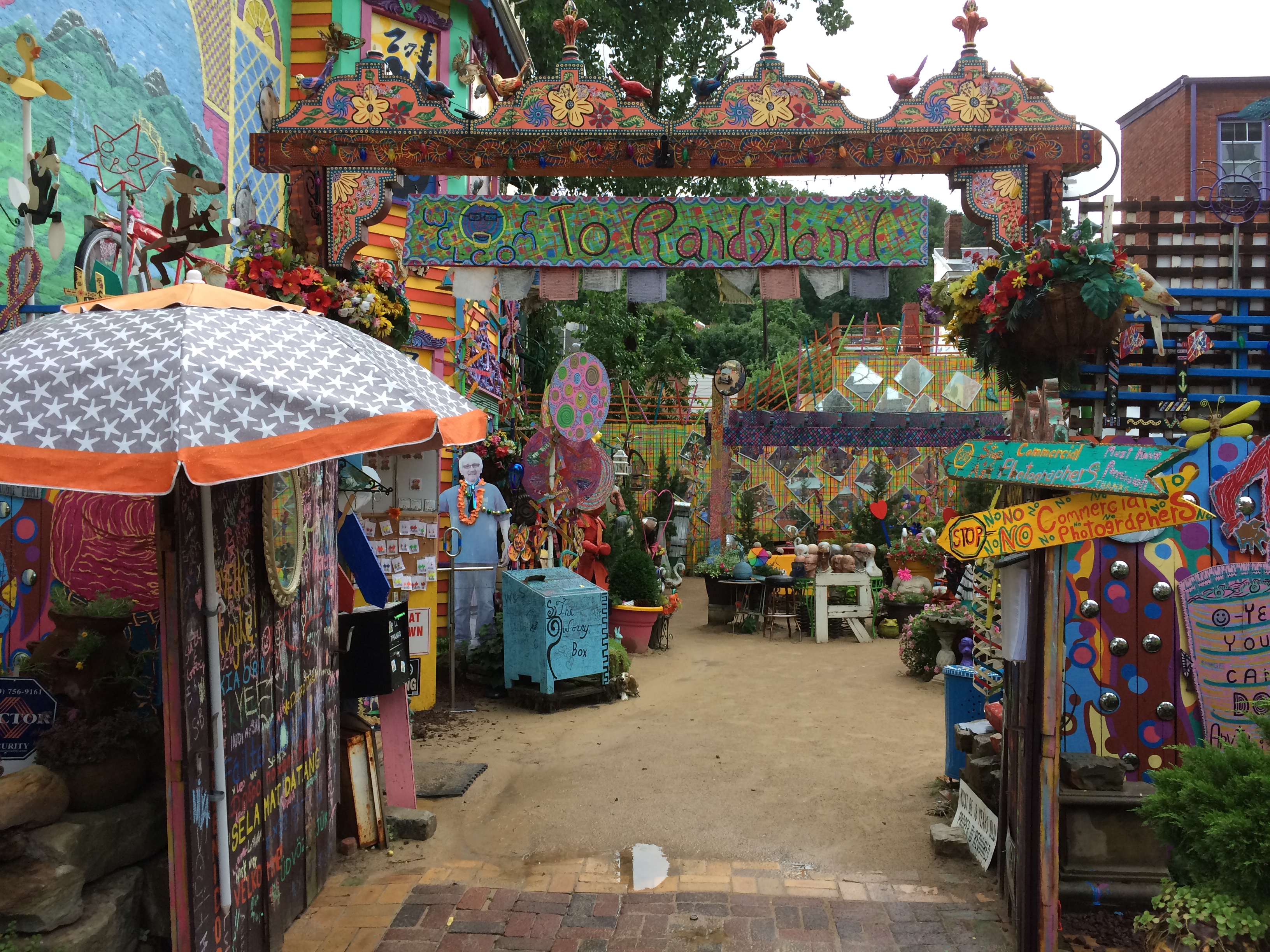
Not far from campus, an all together different kind of building. And yet a building. That’s a broad concept, after all. A bit of local color usually not acknowledged as such.

Some music for spring. Electroswing. Seems fitting somehow.

The first number, “Zoot Suit Riot,” released in the late ’90s, seems vaguely inspired by the incident in early ’40s Los Angeles. The quality of the video is poor, but with the crisp audio that doesn’t matter.

A more recent swing, dating from this decade, though in the case of “Bei Mir Bist Du Schoen,” with a helping of “Diga-Diga-Doo,” the songs are original swing vintage. I’m fond of other versions as well, such as Max Raabe’s, which I saw him do.

Also recent, the lively “Gimme That Swing” and its kinetic, or maybe frenetic, video.

Speaking of music, I’ve picked one more biography to read, now that I’m done with Alexander Hamilton. A genius of a different sort: Cole Porter.

Othello

Not long ago we went to the Factory Theater in Chicago’s Rogers Park neighborhood to see a staging of Othello by the Babes With Blades Theatre Company. I suggested we go because I’d never seen that play staged. Also, Ann read it not too long ago for school — wrote some papers and so on, the usual sort of things you do in high school.

The Factory is a small venue, about 70 seats on three sides of a simple stage. As far as I could tell, we saw a completely traditional staging of Othello, complete with well-done period costumes and actual swords and knifes, except for one thing. Babes With Babes is an entirely female theater company.

But not just a female company. A company of players with some specific talents.

According to the BWB web site: “Our initial showcase, in 1997, was conceived by founder Dawn ‘Sam’ Alden as a two-day presentation of fights and monologues, intended to bring to the Chicago art world an awareness of the large number of stage combat-trained women it had in its midst whose talent was being consistently underutilized.”

While not an overly stabby play (unlike Titus Andronicus) Othello certainly has its share of swords and knives as a part of the action, and the troupe handled them well.

More importantly, they handled their parts well. The novelty of women in the parts always played by men — Deveon Bromby as Othello and Kathrynne Wolf as Iago, to name the principals — lasted for a few minutes. Then it wore off and you were simply watching a solid production of Othello.

Wolf was particularly good as Iago. If you’re not going to have a spot-on Iago, a character that believably exults in the art of deceit, you might as well not do the play, since everything turns on that performance.

Much has been made of the muddled motives of Iago, or perhaps his motivelessness, but I’m not sure that matters. If it’s perversely captivating to watch his glee at destroying the Moor, I’d say the actor has done his, and in this case, her job.

A Festival of Music, 1973

I found this bit of ephemera at my mother’s house last year. She had saved it, tucked away in a envelope. I’d forgotten about the event, but it jogged my memory.

Jog might be too strong a verb. I still don’t remember much about the event, including why I participated. I was in the sixth grade, toward the very end of that year, and didn’t usually participate in choruses. Mainly, I think, because I can’t sing. But somehow or other I decided to do it, and there I am along with scores of other kids.
At the time, Alamo Heights had four elementary schools that fed into a single junior high and high school. Among the names of the kids at the three other elementary schools that I didn’t attend, I recognize a lot of people I didn’t know in 1973, but whom I would know by the time I finished high school six years later.

Considering the structure of the district’s schools, and the passage of time, and the way social interaction goes, that isn’t really so strange, and yet it feels strange when I think about it.

Another irrational feeling that comes to me when looking at the list is how normal most of the first names sound. Especially the girls’ names, like Amy, Barbara, Caroline, Laura, Lisa, Lynn, Mary, Melissa, Patricia, Sharon, Susan and variations on Deborah, Julia, Rebecca and Sandra.

The evening’s program.

Three of the four songs by the elementary chorus were from Up With People. I didn’t know that until reading the program recently. Guess they produced the kind of anodyne songs considered good for elementary school children in the early ’70s.

I’ve read a little about that organization, though I can’t say that I know much about it. But I can’t shake the lingering idea that if Ned Flanders founded a cult, it would be something like that.

Raumpatrouille

Rain is more typical than snow for late April/early May, and we’ve gotten buckets of it since the snow melted on Sunday. The grass has responded by taking on new hues of lush green. I expect scads of the much-maligned dandelion to follow. The back yard already has some, but the rain beat them down. They never stay down for long.

How did I not know about Raumpatrouille until the other day? In full, as befitting a title in German, the TV show is called Raumpatrouille – Die phantastischen Abenteuer des Raumschiffes Orion. That is, Space Patrol – The Fantastic Adventures of the Spaceship Orion.

Naturally, when I found out about it, I wasn’t looking for information about the German science fiction television program of that name that’s an exact contemporary of the original Star Trek, premiering on German TV on September 17, 1966 (Star Trek first aired on September 8).

Yet in wandering the Internet’s twisty little maze of passages, or maybe its maze of twisty little passages, I chanced across Raumpatrouille not long ago. I didn’t have time to follow up on the information right when I found it, but I had the presence of mind to do some bookmarking.

Later, it was easy enough to find the episodes — there are only seven of them — on YouTube, which have helpful English subtitles. I watched the first one. Though I’d read it was good, I was taken by surprise by how good it was. As good as anything Star Trek did, and without that annoying Roddenberry vibe.

Actually, there’s a bit of his outlook. By the unspecified year in which the show is set, Earth has a world government. What little you hear about that government, or at least its military, makes it seem officious and a touch German, but not totalitarian.

The characters are supposed to represent a cross-section of Earth’s population. As Television Heaven puts it, “While Major McLane [the commander] is American, his crew includes a Japanese navigator and star cartographer, a Scandinavian engineer, and an Italian computer specialist and armaments officer. This is clearly not a projection of a desire for a Teutonic world order.”

In the single show I’ve seen so far, the story has some intelligence and suspense, plus some character development, and the pacing is good. The sets and props strongly resemble Doctor Who in its early days, since Raumpatrouille clearly had a slender budget. But they did well with what they had.

Also, there are a few moments of unintentional comedy. One scene has the characters at a bar near wherever their ships launch from, and the characters are having a discussion in the foreground. In the background, extras are dancing, as if it were a dance club. Except that they were obviously doing “a dance of the future.” It’s a strange sight with a lot of odd moves, and gets more funny as it goes along.

I’ll watch the rest of Raumpatrouille in the fullness of time. Don’t want to hurry, though. This is where I found out about it.

The Chicago Riverwalk ’19

Returning from my appointment on Friday, I took a walk along the Chicago Riverwalk — a section that wasn’t completed the last time I was paying attention — from N. LaSalle St. around to W. Lake St.

Parts of the waterfront walkway to the east were started back in 2005; the western section was only completed in 2017. The San Antonio Riverwalk, it isn’t, but Chicago has done well with what it has.

From the north end of the LaSalle St. bridge, you can see the “River Theater.”
To the west of that feature is a walkway that crosses under the LaSalle St. bridge.
I noticed that besides building the riverwalk, the city cleaned up the underside of all the bridges you can see from the riverwalk. Once upon a time, they wore their peeling paint and rust like badges of honor.

From the LaSalle St. bridge to the Wells St. bridge is a straightaway with a tubular fountain sort of feature.
On the west side of the Wells St. bridge is a fine view of that structure.
The afternoon sun in late April left a curious trace on the 300 N. LaSalle building, which rises above the Wells St. bridge.
Further to the west of Wells St.
This section, west of Wells, sports floating wetland gardens. Or maybe you can call them the Floating Gardens of Chicago. But what the city really needs are hanging gardens. Maybe they can go next to the Obama Library.
From there, the path crosses under the Franklin St. bridge, and goes to its end at Lake St., with the Merchandise Mart dominating the view. Workmen were busy installing turf on the small slope to the right (in this pic) of the sidewalk.
All the while, you can see boats plying the river.
Interesting that yellow means taxi, even on the water. I recognized the vessel in the second pic. The good tourist ship Lila passing Wolf Point.

Wolf Point & The Merchandise Mart Hall of Fame

On Friday I went to downtown Chicago for business. Since it was a warm, clear spring day, I wanted to do a more extensive walkabout, especially in the River North area, where I attended to business. But I didn’t have much time.

Instead I was able to take a quick walk near the Chicago River, mostly on the way to my appointment and heading back to Union Station afterward. I was near the place where the river divides into its North and South Branches, which is known as Wolf Point and is the origin of the Chicago Municipal Device.

For quite a while, Wolf Point was oddly underdeveloped, at least compared with the rest of the riverfront. For instance, until recently the point was occupied mostly by a parking lot.

No more. The latest project there, Wolf Point East, is still under construction.

So Wolf Point looks a little different than at the beginning of this decade, and a lot different than it did in 1833.

Hines, Joseph P. Kennedy Enterprises, the AFL-CIO Building Investment Trust and PNC Realty Investors are the developers of Wolf Point East; Pelli Clarke Pelli did the design. The 60-story tower will have 698 residential units — upper-end rentals — that will be available late this year.

Just to the east, of course, is the 4 million-square-foot Merchandise Mart, seen here catching a shadow in the mid-afternoon.

A street runs between the Merchandise Mart and the river — the unimaginatively named W. Merchandise Mart Plaza — and from there, you can see the Merchandise Mart Hall of Fame. That is, eight bronze busts honoring one-time U.S. merchant princes, each facing the building. Joseph P. Kennedy himself commissioned the busts in the early 1950s, which was possible because the Kennedy family owned the Merchandise Mart for many decades.

The busts are in two groups of four. These are the busts to the west. They don’t look so large from across the street, but the heads are four times the size of a regular human head.
From left to right: John Wanamaker, founder of the stores by that name; George Hartford, founder of A&P; Edward Filene, founder of those stores; and Montgomery Ward.

These are the busts to the east.
Construction and taxis whizzing by made it a little harder to make an image, but in any case they are Robert Wood, a chairman of Sears; F.W. Woolworth; Julius Rosenwald, another chairman of Sears and founder of the Museum of Science and Industry; and Marshall Field.

More about each of the busts is here. Twelve years ago, at least, they looked like they needed some restoration. I didn’t get quite close enough to them this time to know whether that has happened.

The Snows of April 27

Last Friday was a perfectly brilliant spring day, temps in the 60s. Come Saturday afternoon, snow fell. About three inches. It stuck until Sunday morning.

The green was slowly covered by white.
On Sunday, the sun came out and almost all of the snow melted. The surviving bits in the shadows disappeared with this morning’s rain. It’s pretty soggy out there now.

The grass and flowers and greening bushes and the new-leaf trees don’t seem to mind the snow. But it must be upsetting to lawn-care enthusiasts who are eager to get out there and mow their lawns.

Indianapolis Artsgarden, 2014

Easter fell fairly late five years ago, April 20, and we traveled that weekend as well. That time to Indianapolis, where we saw the Eiteljorg Museum and ate at Maxine’s Chicken & Waffles. A good little trip.

We also spent part of that Saturday afoot in downtown Indianapolis, including a short stop at an interesting public space: the Indianapolis Artsgarden, a large domed structure built over a major intersection.

Besides connecting the adjacent Circle Centre Mall to a nearby hotel and other buildings, the Arts Council of Indianapolis — which owns the space — holds public performances there, along with art exhibitions.

Ehrenkrantz Eckstut & Kuhn Architects (now part of Perkins Eastman), who designed Circle Centre, did the Artsgarden too in the 1990s. Actually not so much a single dome as a series of glass vaults. Makes for a light, open space.

Even when occupied by fully grown trees.

No event was going on when we were there, but it was a pleasant place to hang out. I did that while everyone else went shopping at the adjacent retail. If I remember right, they found some spring clothes.

Champaign Stroll & Digressions From Kung Fu to the Match King

After visiting the University of Illinois Arboretum on Easter, we returned to Lilly’s apartment briefly and took a walk from there a few blocks to the UIUC campus. Blocks heavy with businesses supported by students. Along the way everyone else went into one of them, Kung Fu Tea, for bubble tea to go, while I waited outside with the dog.

Kung Fu Tea is a chain I’d never heard of. Lilly didn’t understand why I was amused by the name. But she’s unable to imagine the following variation on an old TV narrative.

“Grasshopper, when you can take the tapioca pearl from my hand, it will be time for you to leave.”

I just found out that Kung Fu is available on Amazon for no extra charge. I was an intermittent viewer when the show was originally on the air, which was 45 years ago anyway, so I might give it another go.

From Kung Fu Tea, it was a short walk to Altgeld Hall, which I’ve seen before, but not from this vantage.

On we went. A fine day for a walk. The sunny warmth had drawn a number of students to the Main Quad, where they parked themselves on the grass. That’s the Illini Union in the distance.
Some students lolled in hammocks. That’s something I don’t ever remember seeing at any of the green fields of Vanderbilt.

We circled back around the other side of Altgeld Hall and happened across this statue.
That’s the goddess Diana.
A nearby plaque says: The Diana Fountain is a creation of the Swedish sculptor, Carl Milles. It was designed for the court of a building at 540 North Michigan Avenue, Chicago, where it remained from 1930 until it was generously presented by Time Incorporated to the University of Illinois at the request of the Class of 1921.

The Fountain was dedicated here on October 23, 1971, as a class memorial, at the Fiftieth Anniversary Reunion of the Class of 1921.

Then there’s a list of “members and friends” of the Class of ’21, all of whom presumably ponied up some money for moving the statue, as well as the site work and installation. It’s a long alphabetical list from Allman to Zimmer: eight columns of 35 names each. More, actually, since some of the names represent married couples.

Fifty years plus nearly 50 more. Safe to assume all of the Class of ’21 have shuffled off this mortal coil. As has Carl Milles (d. 1955).

Here’s a digression. Another Diana Fountain by Milles is in Stockholm, at a place called the Matchstick Palace. Who built the Matchstick Palace?

The Match King, Ivar Kreuger, that’s who. I ran across him years ago in the wonderful Webster’s New Biographical Dictionary. Wiki gives a fuller description of his activities. His is an astonishing story.

University of Illinois Arboretum & Japan House

On Easter Sunday, I drove Lilly back to UIUC, and this time the rest of the family came along for the ride: Yuriko, Ann and the dog. Been awhile since we’ve been on a trip of more than a few miles with the dog, but we figured she’d enjoy it and not be too much trouble. Except for the soda spill she caused toward the end of the trip, she wasn’t.

So we had a few pleasant hours in Champaign-Urbana, with temps in the 70s and greenery budding everywhere. Especially at the University of Illinois Arboretum.

“The University of Illinois Arboretum was developed in the late 1980s to early 1990s,” according to the university. “The original 1867 campus master plan placed the Arboretum north of Green Street where the College of Engineering currently exists. During the 1900s, the site moved to south campus, located near the Observatory, and Smith Music Hall.

“Now located at the intersection of South Lincoln and Florida Avenues, the Arboretum’s gardens, collections, and habitats are transforming 160 acres of the University’s south campus in Urbana-Champaign into an exceptional ‘living laboratory’ for students in plant sciences and fine and applied arts, as well as an oasis of natural beauty open to the public.”

I don’t know about natural beauty, since an arboretum, though working with living materials, is man-made. But if you called it artificial beauty, people think plastic or some other synthetic material. So let’s just say it’s a beautiful spot.

A trail leads from the small parking lot and toward the arboretum’s large pond.

Also on the grounds of the University of Illinois Arboretum is Japan House.
Japan House is a unit of the College of Fine and Applied Arts at the UIUC, beginning when a Japanese artist-in-residence, Shozo Sato, came to the school in 1964, with the building completed in 1998. Such rarefied arts are calligraphy, tea, ikebana and sumi-e are taught there.

Japan House itself wasn’t open on Sunday, but the grounds were.
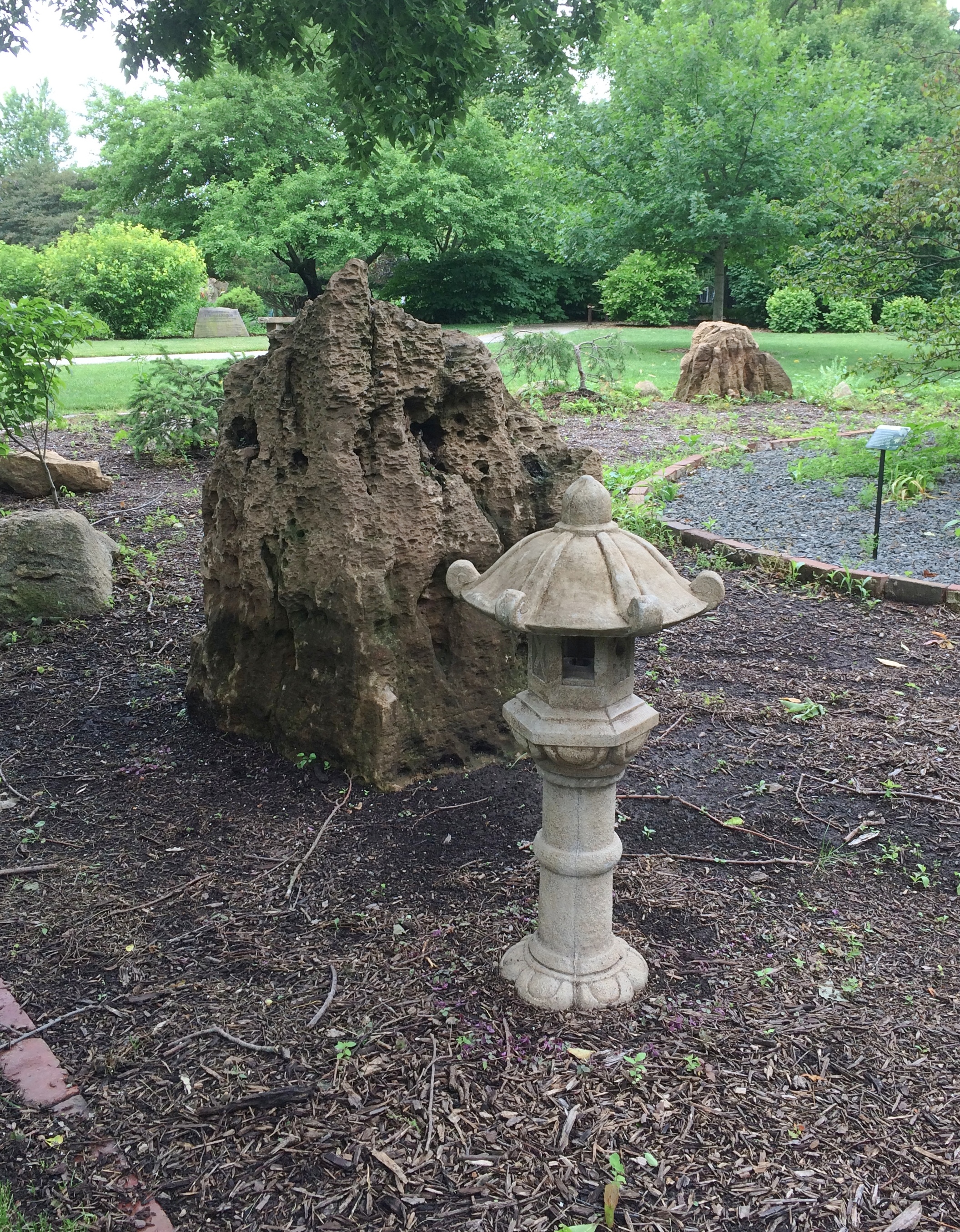
Including a view of the zen garden.
The grounds would be a good place for moon viewing, or tsukimi. Wonder if that’s ever happened there.