Recommendation Thursday

Recommended: Terro Liquid Ant Baits. About two weeks ago, itty-bitty black ants started appearing around the kitchen sink. Maybe that’s a sign of spring.

At first, just a few. But as these things always go, a few more and a few more. Pretty soon anything left unwashed in the sink, or any stray bit of food, especially something sweet, would draw a crowd of the little bastards, eager to serve their queen and do their bit for world domination.

I bought some Raid Max Double Control Ant Baits. Double Control. How could you go wrong with a name like that? I set the traps — that is, I took them out of the package and set them on the counter, near the sink — and waited for them to do their extermination work.

The first time I encountered ant bait was in the early days of my time in Japan. One day, large black ants showed up and wanted to share my apartment with me. Larger than the more recent infestation, anyway. So I learned the Japanese for “kill ants” and visited a couple of retailers who might be able to help me.

If I’d been of a more poetic bent, I might have learned “the invader ants must die!” but in any case no language skills were necessary, since the box had a cartoon illustration of what it promised to do. I wish I’d kept it, since it was a gem of commercial manga. Ants see bait. Ants enter bait. Ants find poisoned goodies in bait. Ants take goodies back to nest. Ants feast on goodies. Ants die. Including the queen.

Sure enough, that’s what happened. The day after I put the bait down, I was surprised to see lines of ants entering and leaving the bait, which was a green bit of rectangular plastic with small holes on the side, carrying brown particles away with them. The next day, no ants were to be seen. Over the coming weeks, I’d see a straggler ant or two. Maybe they’d been out on long-range recon and returned only to find a dead colony. Soon even they were gone, and no ants infested my apartment again during the four years I was there.

With that happy experience in mind, I waited for Double Control to do its job. And waited. And waited. But the sink-ants didn’t seem interested. They were probably taunting me and farting in my general direction, inaudibly.

So I looked around for alternatives and found Terro Liquid Ant Baits, also easily available at your neighborhood hardware store. A product of Senoret Chemical Co. of Lititz, Pa., who seem to specialize in pest control.

I put a few baits down, next to the useless Double Control units, and the very next day, the little ants were inside the Terro baits. The Terro baits have a clear top, so you can see it working. This was on Sunday. On Monday, no ants were to be seen around the sink. I’ve seen one or two in the days since; must be that ants are keen on long-range recon.

It’s safe to assume that Terro worked while Double Control did not. What’s up with that, SC Johnson? You used to be so good at killing cartoon insects. Raid kills bugs dead. Not this time.

“Nuclear Energy”

If you visit the Smart Museum of Art at the University of Chicago, you can also easily visit “Nuclear Energy,” which is on a small plaza only about a half a block to the south, on Ellis Ave. (but not part of the museum’s collection). I’d seen it before — I couldn’t say exactly when — but Yuriko and Ann hadn’t. So we took a look.

“Nuclear Energy” is a Henry Moore bronze on the site of the first manmade self-sustaining nuclear chain reaction, the 75th anniversary of which just passed last December 2.

As for the sculpture, it was dedicated exactly 25 years after Chicago-Pile-1 was built and tested on the site, so its 50th anniversary was on December 2 too. Looks good for being out in the Chicago weather for so long, but I suppose it’s maintained.
Abstract, as Henry Moores tend to be, but of course you think of a mushroom cloud. Moore denied that, offering up (I’ve read) some art-speak about a cathedral, but I’m not persuaded. A mushroom cloud is perfectly fitting.

The Smart Museum of Art

I hear that the Northeast got blasted again by late-winter snow and wind. For our part, we did get some fast thick snow for a few minutes today. It was just beginning when I looked out my back door.
Not much all together, but it reached impressive near-whiteout for a short time. Reminded me of a moment in 1980 — I think it was March — when Nashville experienced about five minutes’ of snowy whiteout. I watched it unfold from my fifth-floor dorm window; it was like a giant feather pillow had been opened in the sky. Made an impression on a lad from South Texas.

On Sunday, I tried to time our visit to Hyde Park to see Patience so that we could see something else as well. Namely, the Smart Museum of Art, which is the fine arts museum of the University of Chicago. I couldn’t remember the last time I was there. Sometime in the 2000s, probably.
In full, it’s the David and Alfred Smart Museum of Art. The Smart brothers were big-time publishers once upon a time, whose publications included Esquire and Coronet. Their foundation ponied up funds to establish the museum long after they were dead, with the building going up in the early 1970s. It’s a smaller work by architect Edward Larrabee Barnes, who’s better known for the Dallas Museum of Art, Walker Art Center, and the IBM Building in Manhattan.

It’s a small museum. That’s one of its virtues. Also, no charge to get in. Most importantly, the museum has an interestingly varied collection, including 20th-century American works, European paintings from earlier centuries, even earlier works from China, and some very new items.

A number of works caught my eye. Such as “Still Life #39” by Tom Wesselmann, 1964.
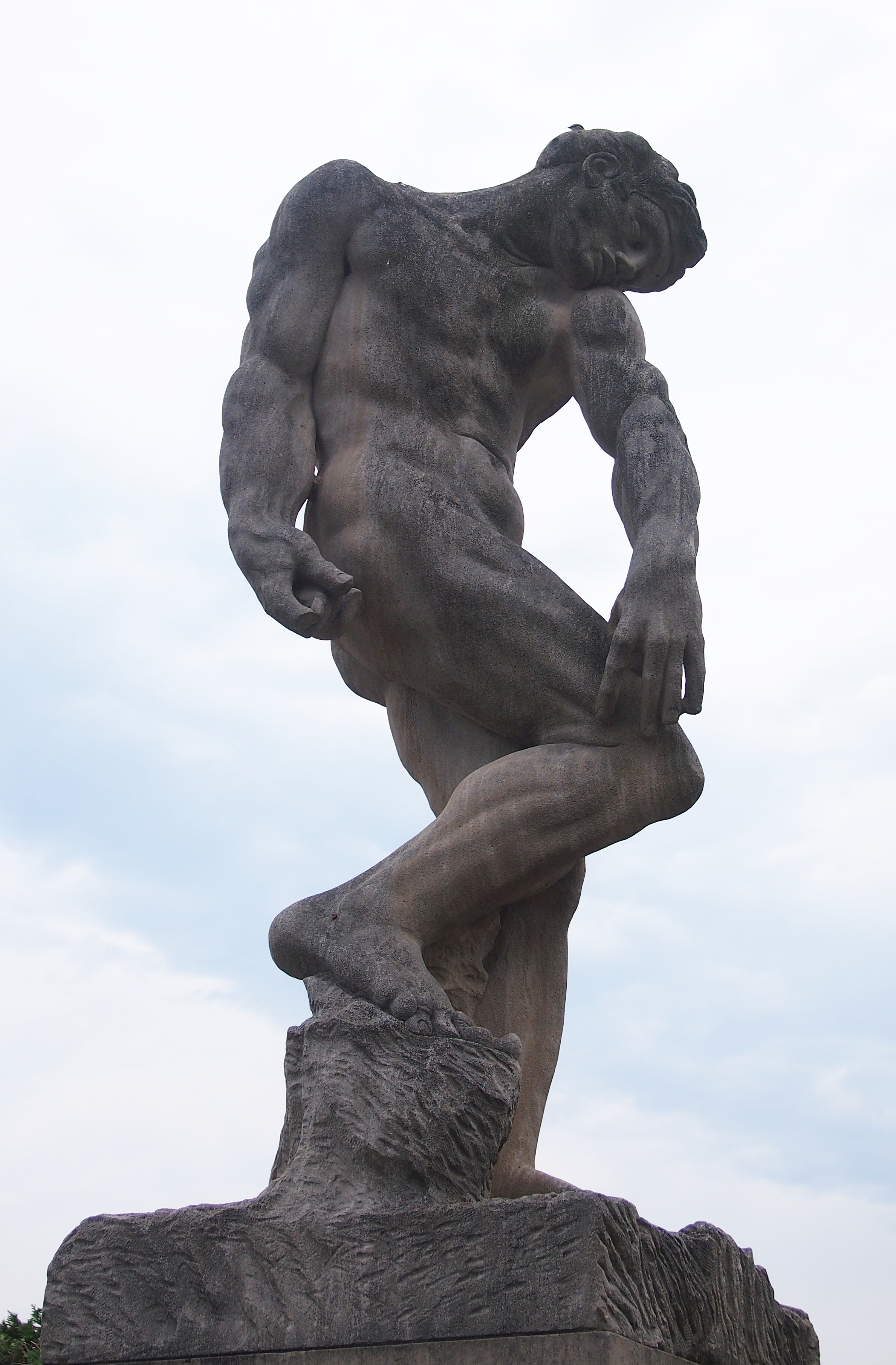
A “Thinker.” Yuriko wondered just how many Thinkers there are. I couldn’t say.
“Untitled” by Norman Lewis, 1947.
“#9 New York 1940” by Charles (Karl Joseph) Biederman, 1940.
In a room by itself, we found “Infinite Cube” by Sir Antony Gormley, 2014.
Wow. The sign described it as “mirrored glass with internak copper wire matrix of 1,000 hand-soldered omnidirectional LED lights.” Sounds labor-intensive. We spent a while admiring the thing, which was a different experience each time you moved closer or further away.
I even got a self-portrait with it — accidentally. Ann’s on the other side, with only her feet visible.
Nice work, Sir Antony.

Patience

The Gilbert & Sullivan Opera Company’s performance of Patience drew a sizable crowd to Mandell Hall at the University of Chicago on Sunday (including us), as did previous Gilbert & Sullivan productions that we saw, Yeomen of the Guard and Iolanthe.

For good reason. The company, directed by Shane Valenzi, did a fine job of it, their talent augmented by the skillful University of Chicago Chamber Orchestra, a 40-member ensemble.

Remarkable how something funny almost 140 years ago can still be funny. Not only that, spot-on satirical. Then again, while the aesthetic poetry movement might be a thing of the increasingly distant past, fads — and more particularly, the fickle adulation of male sex symbols — are still immediately recognizable.

All of the leads, including Jeffrey Luksik as Bunthorne and Olivia Doig as Patience, brought considerable talent to their parts, but I was especially amused by Brandon Sokol’s take on Grosvenor. As the program notes put it, “Grosvenor is Fabio, a pure sex symbol without anything resembling artistic sensibilities,” and Sokol played it up delightfully.

Also amusing was Grosvenor’s transformation into “appearance and costume absolutely commonplace.” He came out with his golden hair shortened and wearing sports apparel, namely a Cubs cap and a Bears t-shirt. That was part of the costuming of the entire production, overseen by costume designer Rachel Sypniewski. The costumes were decidedly not Victorian, but that design decision worked.

“We’ve attempted to draw that comparison [between Victorian and modern faddishness] more or less overtly,” the program says, “modernizing the dress of the women and the poets to reflect a Poe-ish aesthetic evocative of the vampire-esque gothic movement that evolved from aestheticism and [which] enjoyed a revival during the popularity of the Twilight saga… The men [Dragoons] are Canadian Mounties who, despite their fearsome competence and justifiable pride, and nonetheless often the subject of light ridicule in American popular culture.”

(Such as Dudley Do-Right. Something I didn’t know about the Mounties, per Wiki: “Although the RCMP is a civilian police force, in 1921, following the service of many of its members during the First World War, King George V awarded the force the status of a regiment of dragoons, entitling it to display the battle honours it had been awarded.”)

Three of the Dragoons, usually dressed as Mounties, got the biggest laugh of the night when they tried to be aesthetics, dressed in tights. Actually, the very biggest laugh came when one of their members, the Duke of Dunstable, played by an enormous, hairy actor named Dennis Kulap, came out in pink tights.

One more thing about Patience, which I discovered just today: Oscar Brand and Joni Mitchell singing “Prithee Pretty Maiden.”

Thursday Debris, Online Edition

As part of my work, I spend a fair amount of research time on sites devoted to news in specific cities, and besides the items I’m looking for, I see a lot else besides. It doesn’t take long to realize that murders and traffic accidents and fires still lead, even in the age of digital media. Pop any major city name in Google News and that much is clear.

Sometimes the headlines, or the lead paragraphs, are a little lighter. Even if violence is involved.

Wanted Akron Pimp Shot through the Ear in Cleveland

Painful, I bet, but with time and maybe plastic surgery, the Akron pimp might recover. He’ll also have a story to tell at the pimp conventions.

Then there’s news about things I’m only vaguely aware of. I don’t mind it if they stay that way.

Sharknado 6 is set to be released on July 25, 2018… the film will feature time travel, Nazis, dinosaurs, knights, and Noah’s Ark.

Six? Anyway, the movie will be full of things any 12-year-old boy might want. Left out were cowboys, astronauts, UFOs, and the Bermuda Triangle, though I guess boys aren’t quite as interested in those things as they once were. There’s always Sharknado 7.

News about thrill seekers. Type T people, I’ve heard them called. Nuts, that is.

Your Facebook and Instagram feeds are full of it: People on vacation pushing themselves to extremes by diving off rocks, skiing dizzying backcountry drops, walking rickety paths above death-assuring canyons.

My Facebook feed is full of no such things. But I do remember interviewing a real estate executive well over a decade ago, and the most interesting part was off the record — and not directly related to commercial real estate anyway. It was about him rafting on some river in Mongolia. Off the record because he didn’t want the other investors in his projects to think he was doing anything they’d consider dangerous.

And other oddities.

Saint Louis University is seeking a name for a Midtown district that straddles part of its north and south campuses and includes the Foundry and Armory projects. Voters can choose from Prospect Yards, The GRID, The Circuit, The 1818, or write in their own name.

I don’t much care for any of those, except maybe 1818. I suggest “Bob.”

Still in Old Assenisipia

I was looking in a seldom-looked at file of images the other day and found a scan I’d made of a page from a collection of Thomas Jefferson’s writings. I’d forgotten I’d made ir. Here it is.

Nearly 15 years ago, I wrote: “Some years ago, I read a curious little document by Thomas Jefferson, who in 1784 made a report to Congress — the Congress under the Articles of Confederation — about how to create states from the Northwest Territory and what to call them.

“Jefferson suggested 10 states for the area that now contains six (Illinois, Indiana, Kentucky, Michigan, Ohio and Wisconsin). It was an exercise in hyper-rationality and hyperliteracy, though if his suggestions had been used, they would be normal and even venerated names — such is the power of custom.

“Hyper-rational because, instead of paying attention to natural features, Jefferson cut the district into rectangles measuring two degrees of latitude north-to-south and roughly four degrees of longitude east-to-west (‘roughly’ because the irregular Mississippi River forms the western boundary of the territory).

“Besides the Mississippi, geographic form did intrude in what we call lower Michigan — even Jefferson wasn’t going to ignore lakes Michigan and Huron in drawing lines — as well as a few other places on his map, but he was doing his best to apply Longitude and Latitude to the new states’ boundaries. It was as if Colorado- and Wyoming-shaped states were to be created in the Midwest.”

Naturally, other sites discuss this odd collection of non-realized states, such as (of course) Strange Maps.

Not Indicted Yet

First things first: Remember the Alamo. Today is a good time to listen to some Dimitri Tiomkin.

Wind and cold yesterday to remind us that winter lingers, that it’s the time of the year when the season is an unwanted guest who gives no indication of packing his bags. Then in the evening, snow. Just a covering, so I figured it would melt today. No. We got more in the morning. Then it melted. Mostly.

Got an oddity in the mail not long ago: an anti-Bruce Rauner campaign booklet called The Governor You Don’t Know, subtitled “The Other Side of Bruce Rauner.” It’s an actual paper publication, and a smallish thing, 4 in. x 6​¾ in., with a four-color cover but all text on its 48 pages (three forms of 16 pages, I bet). And I mean all text — not even any black-and-white illustrations.

The byline names the chairman of the Chicago Republican Party as the author, with a forward by a Republican state representative. Interesting copyright note: “Permission is hereby granted to reproduce any part or all of this book until March 31, 2018.” After that, all rights reserved.

I’m not going to do that, but I will quote from the forward: “In this book, you’ll be taken behind the scenes as the author reviews the salient events that explain why we are taking the extremely rare step of unseating an incumbent governor from our own party.”

The Illinois Republican party, it seems, is a tad peeved at the governor. I can certainly think of some criticisms of him myself, but I will give Rauner this: he’s never been indicted. In some states (Illinois, Louisiana) that’s a pretty high bar for a governor.

On the back of the booklet, we’re informed that the woman looking to unseat the governor in this month’s primary, or rather her campaign, paid for the book. As politicos go, she’s a dime-store demagogue, as noted by the underrated columnist Neil Steinberg.

All very interesting, but I’m still left with a nagging question. Why did I get it? Am I on some kind of dime-store demagogue fan club mailing list? If so, I’d prefer not to be.

Merriam-Webster’s Time Traveler

Found an interesting thing on Merriam-Webster’s web site the other day, a function called Time Traveler. It says: “When was a word first used in print? You may be surprised! Enter a date below to see the words first recorded on that year.”

Elsewhere on the site, the lexicographers are careful to point out that “the date most often does not mark the very first time that the word was used in English. Many words were in spoken use for decades or even longer before they passed into the written language. The date is for the earliest written or printed use that the editors have been able to discover.”

Still, that’s the kind of thing I find interesting. Naturally, vanity got the better of me, so I looked up words introduced to print the same year as I was introduced to the world, 1961. Quite a collection.

There are words that reflect scientific progress: ampicillin, dehydroepiandrosterone, isospin, lawrencium, messenger RNA, mid-ocean ridge, neurotransmission, radioimmunoassay, spark chamber (is that last one a milder version of a Star Chamber?)

There are also words clearly specific to space exploration: A-OK, biosensor (maybe), capcom, clean room, geostationary, low earth orbit, and probably solar panel.

There are hints of things to come, for good or ill: affirmative action, anti-harassment, Black Friday, compassion fatigue, computer science, Eurocurrency, fiber-optic, lip-synch, military-industry complex (hey, Ike), operating system, paparazzo, read-only memory, skyjack, SST, telenova, toaster oven, and wayback machine.

That last one popularized by Sherman and Peabody? The time would be right.

New things to eat and drink: Bibb lettuce, fettucine Alfredo, mai tai and, if necessary, your pot-bellied pig.

There are a few I would have guessed would be older, but apparently not: AA battery, black ice, hard-edge, no-holds-barred, no-win, race-baiting, redistributionist.

And what about chocoholic and wazoo? They’re on the list. I would have placed them later, as inanities of the ’80s.

I Got Great Entertainment Value From My DoDeCaHORN in Early ’90s Japan

In early 1992, a curious-minded friend asked me in a letter about the cost of living in Japan. At the time the oft-used example, probably by lazy journalists, was the $10 cup of coffee (shocking in a pre-Starbucks-everywhere context, I guess). I’m sure you would have been able to find such a brew at upscale hotels in Tokyo, but it wasn’t part of my experience.

So I wrote him the following.

March 1992

Japan is justly famous for its high cost of living. But one can adapt, especially as a single person, though you never really grow fond of the system, the basis of which is to squeeze consumers as much as possible. Luckily, I’m no more a typical consumer in Japan than I was in the United States. Remarkably, my personal cost of living is roughly the same in absolute (dollar) terms, and a little less in terms of percentage of income, than in Chicago.

That might seem strange, but there are several factors to consider. Japanese income tax is a flat 10%, sales tax on everything is 3%, so neither of those is especially onerous. I have no car, which I believe would be a useless luxury in Japan, and endlessly expensive. For instance, gasoline is about four times as expensive as in the U.S. I buy few articles of clothes here. They’re expensive, but it’s also true that it’s hard to find my size anyway. I’ve supplemented my wardrobe during travels outside Japan, especially in Hong Kong, where clothes are reasonably priced (except I couldn’t find shoes there either). A spare pair of glasses was a deal in Hong Kong, too.

I’ve been slow in acquiring household appliances. Some of them I bought new — a gas cooker, about $100; a Korean-made TV, about $200; a bottom-of-the-line VCR, also about $200; a DoDeCaHORN combination CD player/double cassette deck with AM/FM band, again about $200. I’m highly satisfied with the quality of these goods, as you might expect from Japanese (and Korean) electronics.

Other items I’ve bought recently have been from departing foreigners in sayonara sales. Recently I acquired a table, microwave oven, book shelf, a number of books and other things that way, cheap. I’ve found a few things in the street for free. My Osaka Gas Fan Heater 2200 is an example, which I found the first summer I was here, before I needed it, abandoned by its owner. Such finds are called gomi, or so-dai-gomi if the items are large.

Food is a major expense. Some things are insanely expensive, such as bread, at $1.50 for four or five measly slices, or $4 or $5 for a glob of raw hamburger American stores wouldn’t package that small, or liters of milk that cost as much as a gallon in the U.S. You might think those aren’t typical Japanese foods, but they are now. Consumption of “Western foods” is so commonplace that the distinction makes little sense in most cases. Besides, rice and fish aren’t particularly cheap, either.

Properly done, eating out is little more expensive than eating at home, due to high grocery costs. I know a lot these days about (relatively) cheap Japanese eateries, including the location of a score of places that offer meals for $5-$8, most of them filling and excellent nutritionally and gastronomically: noodle soups, chicken and pork cutlet meals, Japanese-style Chinese food, rice dishes, curries and more.

Then there’s the matter of rent. I have a modest place, one-and-a-half rooms, certainly less than I had in Chicago. For it I pay slightly less rent, in dollar terms, and somewhat less as a percentage of income. Except in winter, when gas bills are high, utilities aren’t bad.

One more thing: entertainment. Fun can be dear in this country. Luckily for me, I’m seldom inclined to visit bars, no doubt the greatest black hole for yen around. I do go to an izakaya once a week with friends, but that’s as much cheap restaurant as bar. Video tape rentals are about $4 for new movies, less for others. Movies in the theater run at least $18, but I know a couple of second-run houses for less than half that. Some of the best museums and temples in the country are only a few dollars to get in and, if I really don’t want to spend much for entertainment, I take the subway to some part of town I don’t know well and walk around. That never gets old.