Thursday Leftovers

Late on Sunday evening, a short, intense thunderstorm rolled through. A little later, just before midnight, I looked out of my back door — which has a southern exposure — and saw the most vivid cloud-to-cloud lightning I’ve ever seen, as the storm was a few miles to the south. Quick arcs and pops of lightning, mostly horizontal, illuminating the otherwise inky sky.

I didn’t drag Lilly to a cemetery on our recent short trip. I didn’t see one I wanted to visit. But I did see a presidential site completely by chance. At the entrance to the Michigan Union, which is U-M’s student union, there’s a bronze plaque sporting a relief image of President Kennedy. Technically, Sen. Kennedy, because it said:

Here at 2:00 a.m. on October 14, 1960, John Fitzgerald Kennedy first defined the Peace Corps. He stood at the place marked by the medallion and was cheered by a large and enthusiastic student audience for the hope and promise his idea gave the world.

The medallion says: Conception of Peace Corps. First Mentioned on This Spot. October 14, 1960.

The Peace Corps web site is careful to point out that candidate Kennedy did not, in fact, make a policy proposal that morning. Rather, “Speaking into a microphone at the center of the stone staircase, with aides and students around him, Kennedy began by expressing his ‘thanks to you, as a graduate of the Michigan of the East, Harvard University.’ (A recording shows that this got a shout from the crowd.) The campaign, he said, was the most important since the Depression election of 1932, ‘because of the problems which press upon the United States, and the opportunities which will be presented to us in the 1960s, which must be seized.’

“Then he asked his question: ‘How many of you who are going to be doctors are willing to spend your days in Ghana? Technicians or engineers: how many of you are willing to work in the Foreign Service and spend your lives traveling around the world? On your willingness to do that, not merely to serve one year or two years in the service, but on your willingness to contribute part of your life to this country, I think will depend the answer whether a free society can compete. I think it can. And I think Americans are willing to contribute. But the effort must be far greater than we’ve ever made in the past.’ ”

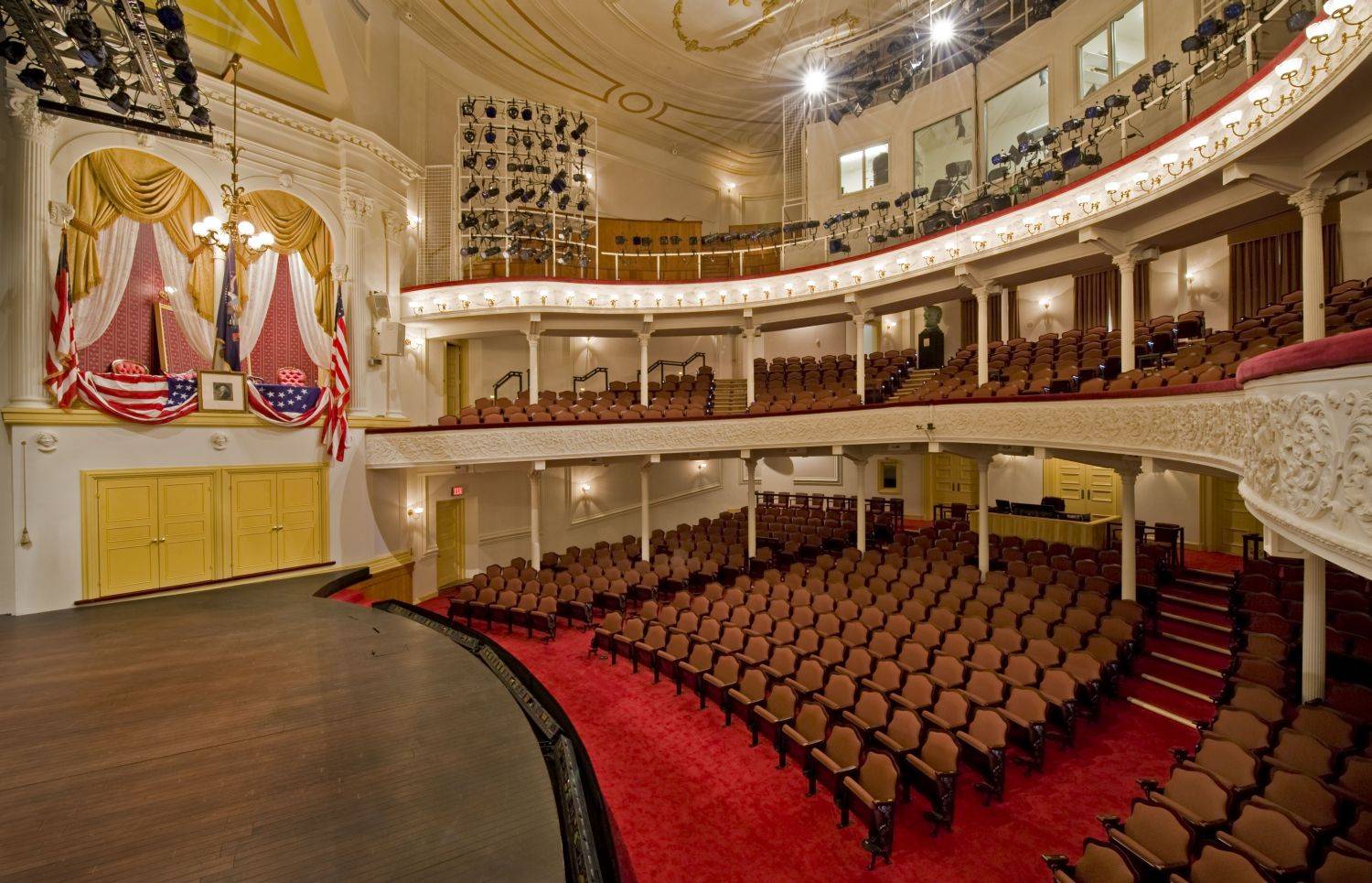
The Toledo Museum of Art’s auditorium — which it calls the Peristyle — looks like this.
PeristylePeristyleA Greek-style auditorium. Can’t say I’ve ever seen one like it in this country. I understand that it’s the home of the Toledo Symphony Orchestra, among other things.

Across the street from the main museum is its Glass Pavilion. Fittingly for a museum built with a lot of glass-industry money, the pavilion features extensive glass exhibits and also a glass-blowing studio, complete with really hot furnaces. We stayed for a glass-blowing demonstration: two young women creating a blue glass bowl. It was an intricate process, more than I knew. Looked tedious, too. Unless you’re a glass-blowing enthusiast.

/Glass PavilionI’m glad the world has a place for glass blowers, but I couldn’t be one myself. Guess that goes for most skilled activities.

Ann Arbor-Toledo Eats

The Ann Arbor-Toledo trip was less than 36 hours and only about 640 miles, but we managed to eat four different interesting meals. Interesting by my lights, anyway: cheap one-of-kinds eking out their living at the margins of a fast-food economy by being better than fast food (actually, two of the places were part of a small local chain; and by small, I mean three or four locations). The food was American and not particularly healthful by current standards: doughnuts, hamburgers, eggs-and-meat breakfast food, and chili dogs.

I did a bit of snooping around before we went. Remarkable what you can find, even apart from the likes of Yelp or Urban Spoon, and soon I got wind of Sweetwater’s Donut Mill, with three locations in Kalamazoo and one in Battle Creek. Just the thing for between breakfast and dinner, without stopping for a delaying lunch. I noted that the main branch was in Kalamazoo just off Sprinkle Road — that’s a good name for a road — which was accessible by an exit on I-94.

Except that the Sprinkle Road exit was closed. Both the exit and the bridge over the Interstate are being completely rebuilt. So I figured I’d wait till the next exit and turn around, but miles and miles passed before the next exit. Soon I decided it was too far to go back for; we’d find something else off of one of the exits into Battle Creek (one of these days, I should take a look at the Hart-Dole-Inouye Federal Center, which used to be the San, but I didn’t want to look for it last Friday).

As soon as we’d gotten to the first traffic light after the exit, Lilly said, “Isn’t that the doughnut shop you’re looking for?” And it was. The Battle Creek branch of Sweetwater’s was right there in a strip center. So we went in and got a half-dozen doughnuts.

Clearly, God wanted us to have those doughnuts. The Lord does not mislead, either. They were large — larger than my palm — tender and delicious, and no more expensive than a large chain shop’s doughnuts. We had chocolate-, vanilla- and custard-filled varieties. They were so substantial, in fact, that we didn’t finish them all till the next day, and they were still good then.

That evening, after wandering around U-M for a few hours, we repaired to Krazy Jim’s Blimpy Burger, an Ann Arbor storefront hamburgery not quite like any other I’ve been to. You order your burger cafeteria style — from the staff who cook and otherwise assemble the meal in a small cooking zone behind the counter as you stand waiting. Posted on the wall are “rules” for ordering. Rather than rules, they’re really more-or-less a description of how the ordering goes down.

When it is your turn to order:
1) First, the deep fryer order: french fries, fried veggies, etc.
2) Then, what size Blimpy: double, triple, quad, quint
3) Next, decide what kind of roll: plain, onion, kaiser, etc.
4) Any grilled items: onions, mushrooms, peppers, etc.
5) Just before the burger comes off the grill, you will be asked to pick what kind of cheese you prefer, if any.
6) After the burger comes off the grill, you will be asked what type of condiments you would like – please start with “wet” items like mayo, ketchup or mustard… and only say what you want and NOT what you don’t want!

The fellow who took our fry order looked like a student doing a summer job. He might be a descendant of the late Krazy Jim. Cooking the burgers was a petite black woman who’s probably the most enthusiastic short-order cook I’ve ever seen. A dervish of a fry cook, this woman. When it was your turn to order, of course you didn’t have to remember what to say. She’d ask in rapid succession — what size? what kind of roll? what do you want grilled? If you started to give your cheese order, she’d respond: No cheese order now! Not interested! Later, when the meat was cooked, she asked about cheese. She not only took orders, she had about three or four orders going at once, kept track of them as they cooked, removed them when they were done, joked with the other staff, and had the most Wicked Witch of the West cackle of a laugh I’ve ever heard — so distinct that we’d hear it periodically as we ate, audible over the noise of the other diners, the sizzle of the grill, and the clanging of cooking utensils.

Another employee, to her left, put on the lettuce and tomatoes and the like, and a fourth person rang up the order and ran around the place doing other things. Quite an operation, but it would have been for nothing if the burgers weren’t so good. All that effort produced a hamburger like you make at home, provided you’re really good at making hamburgers. We left the joint satisfied.

The next morning we had Hippy Hash. Or rather, Lilly did. “Hippy” is just as a colorful moniker, and “hash” in the sense of a breakfast food conglomeration: hash browns topped with grilled tomato, green pepper, onion, mushroom and broccoli topped with feta cheese. Where does one find Hippy Hash in Ann Arbor? At the Fleetwood Diner. It’s a genuine, honest-to-God diner, a small fleck of a survivor of the pre-Ray Kroc time when companies near Lake Eire manufactured diners, and diner kits, for diner entrepreneurs to set up all over the country.

On the outside, it’s a small metal diner with awnings and tables and chairs in front of the entrance. On the inside, there’s a cooking zone, a counter, and space for a few tables. Some hundreds of stickers — geographic, slogans, advertising, all kinds of things — adorn the walls. The grill is always sizzling and the waiter and waitress are in constant motion.

Lilly, as I said, had the house specialty. I had scrambled eggs and bacon and hash browns and toast, the simplest diner food imaginable. It was very good. It wasn’t expensive, even though they didn’t short on bacon: four slices. Lilly said she liked the Hippy Hash, but could have done without the broccoli.

It seems that the diner’s been named the Fleetwood only since the 1970s. Before that, it was the Dag-Wood, because that was the diner’s brand name. “Dag-wood Diner Inc. — This company was located in Toledo, Ohio,” one web site asserts. “They made the kit that became the Fleetwood Diner in Ann Arbor, MI in 1949. They also made a diner that went to Erie, MI that has now been remodeled beyond recognition… One former owner of a Dag-Wood diner mentioned that no more than half a dozen were made, though this has not been verified.”

Ah, but I fear for the future of the Fleetwood. A single investor apparently owns its site and the buildings next to it — that include Blimpy Burger — and isn’t talking about his plans. I know how these things go. In a few years, there will be redevelopment, and it won’t be nearly as interesting as what’s there now. Glad I got to go before that happens.

One more place: Tony Packo’s in Toledo. I won’t evade the point: the only reason I wanted to go there was because Cpl. Klinger told me it was good. Never mind that he’s a fictional character of a generation ago, and he wasn’t speaking to me personally. And I didn’t even remember the name of the place till I looked it up. That is, Googled “Klinger restaurant Toledo.” Tony Packo’s comes up instantly.

The restaurant’s web site says: “The words that came out of Jamie Farr’s mouth on Feb. 24, 1976 would put Tony Packo’s in the spotlight. Farr, a native Toledoan himself, appeared in the television show M*A*S*H, playing Corporal Max Klinger, a crazy [sic] medical corpsman who was also from Toledo. In the episode that made Packo’s future, a man playing a television newsman talked to Klinger about his hometown. Farr wrote a little local color into his reply. The lines read, ‘If you’re ever in Toledo, Ohio, on the Hungarian side of town, Tony Packo’s got the greatest Hungarian hot dogs. Thirty-five cents…’ ”

The character would go on to mention the place a few more times after that, and while the details didn’t stick with me, the notion of a hot dog stand in Toledo did. Turns out “Hungarian hot dogs” are just as fictional as Cpl. Klinger, and the restaurant owns up to that: “Because Tony was Hungarian-American and lived in a Hungarian neighborhood, Tony’s creation was called the Hungarian hot dog. Until Toledo-born Tony invented it, there was no such thing as a Hungarian hot dog, say those who know the Old Country’s food.”

The hot dog, which is in fact a sausage, was tasty. The chili, which is the other signature item, wasn’t bad. The chili you get in Ohio is going to be Ohio chili, after all, whether it’s a Toledo recipe or the 5-way variety in Cincinnati.

The inside of the restaurant looks like a medium-priced chain (Tony Packo’s is a very small chain), except for all of the signed hot dog buns behind plastic bubbles on the walls.
Tony Packo's Aug 1, 2015We sat behind Clint Black, Al Hirt, Joe Mondello, and some members of REO Speedwagon, among others. Hundreds of them line the walls. Apparently famous visitors have been signing them for more than 40 years, even before Jamie Farr mentioned the place. Of course, they’re not really bread, but artfully painted foam, though the autographs are real. More about the faux buns here.

The Toledo Museum of Art

Libbey Inc.’s web site asserts that “the Libbey® brand name is one of the most recognized brand names in consumer housewares in the United States and among the leading brand names in glass tableware. Our products are sold in major retail channels of distribution in the United States and Canada, including mass merchants, department stores and specialty housewares stores.”

Maybe so. But I didn’t know about the Toledo-based glass giant until recently. Corning, I knew. But somehow not Libbey. So I wasn’t sure about the references I saw on Saturday to Libbey and the Libbey Foundation at the Toledo Museum of Art. Having no hand-held Internet access, I couldn’t check (and on the whole, that’s just as well). I guessed that maybe it had something to do with canned food.

Wrong company, wrong spelling, and in fact, Libby’s just a brand, not a company any more. The glass company notes: “Libbey has its roots in East Cambridge, Massachusetts, home of the New England Glass Company which was founded in 1818. William L. Libbey took over the company in 1878 and renamed it the New England Glass Works, Wm. L. Libbey & Sons Props. In 1888, facing growing competition, Edward Drummond Libbey moved the company to Toledo, Ohio. The Northwest Ohio area offered abundant natural gas resources and access to large deposits of high-quality sand. Toledo also had a network of railroad and steamship lines, making it an ideal location for the company. In 1892, the name was changed to The Libbey Glass Company.”

Why is this important to the Toledo Museum of Art? Let the museum take it from here: “1901 — Edward Drummond Libbey, founder, is elected first president of the board of trustees of the newly founded Toledo Museum of Art. The Museum begins humbly with 120 charter members, temporary exhibitions in rented rooms in the Gardner Building in downtown Toledo, and no permanent art collection.”

By gar, if New York and Chicago and Pittsburgh and Cleveland could have first-rate art museums, so could Toledo. Libbey not only founded the museum, he lived long enough to donate a lot more money to it and set it on a course of expansion, including $1 million in his will in the 1920s, back when that meant fat Coolidge dollars. In our time, the museum holds about 30,000 items and has 35 galleries. It would easily be at home in a larger city.

Toledo Museum of Art, Aug 1, 2015Only this part looks like a museum of 100 years ago, with its Ionic columns and such (and in fact it was designed by Edward B. Green and Harry W. Wachter in 1912). Other structures forming the museum include newer designs by Frank Gehry — but without his trademark curls — and the postmodern Glass Pavilion by the Tokyo architects Sejima and Nishizawa and Associates.

All together, it’s the kind of museum that can’t reasonably be seen in one go. So we looked at things until we felt like we weren’t seeing them any more (ah, here’s another room with paintings on the wall…) To begin with, we took in a good bit of the more recent works. I recognized this artist right away.
Toledo Museum of Art“Beuys Voice” (1990) by Nam June Paik, which a sign told us is new to the museum. I saw a larger, but distinctly similar work of his, in Arkansas last year. I like the hat.

And of course it’s good to have a Henry Moore or two lying around (“Reclining Figure,” 1953-54).
Toledo Museum of ArtAnd a Frank Stella hanging around (“La Penna di hu,” finished in 2009).
Toledo Museum of ArtI rarely see artwork by Beninese artists. Never, that I can think of. This piece, “Made in Porto-Novo (MIP),” is by a fellow named Romuald Hazoume. It’s made of found objects — pieces of metal, mostly, stapled together — with sound coming from within.
Toledo Museum of ArtWe also spent time among paintings of recent and earlier centuries. These do not photograph so well at the hands of an amateur like me, but I did do some details. Such as the face from “Portait of a Freedom Fighter” (1984), Julian Schnabel.
Toledo Museum of Art“London Visitors” (1874), James-Jacques-Joseph Tissot.
Toledo Museum of ArtWe couldn’t leave with checking out the ancient art. Nice collection, including the likes of this second-century AD statue.
Toledo Museum of ArtAnd an 18th-century copy of “Laocoön and His Sons.”
Ahhhhhh!I made full use of the opportunity to tell Lilly the story of Laocoön calling out the Trojan Horse as, well, a Trojan Horse, throwing the spear, and being offed for his temerity by sea serpents, a circumstance that the Trojans fatally misinterpreted.

Even if there’s nothing else in Toledo worth seeing — and I know there is — the museum was definitely worth a few miles’ detour.

The Ann Arbor-Toledo Overnighter

I can now, with complete confidence, tell the world I’ve been to Toledo. The one in Ohio, that is. As we crossed the Michigan-Ohio border late on Saturday morning, and the signs for Toledo were abundant, Lilly asked me about the name. It sounded familar, she said. I said it was the same as the city in Spain, except for pronunciation.

Ah, she answered with sudden recognition. We studied about places in Spain in Spanish class, and that was one of them, she said. Why is this town named after that one? Was there some connection?

None that I knew about, I answered. Someone in the settlement’s early days thought it would be a good name, and it stuck. There are North American towns with even less connection to their name-givers, such as every Canton. (According to the Canton, Ill. C of C, for instance, “the city was founded by Isaac Swan in 1825, he named it thus, from a notion he entertained that its location was the antipodes of Canton, China.”)

On Friday morning, Lilly and I set out for Ann Arbor, Mich. She’s entertaining the notion of applying to the University of Michigan, so we both thought this would a good thing to do. Since Ann Arbor is roughly five hours’ drive from metro Chicago, if traffic isn’t too bad, there and back on the same day wasn’t a reasonable option.

So we timed the drive to get a look at campus and environs on Friday afternoon, both on foot and in the car. The central campus is large and pleasantly collegiate. Sidewalks and green grass repose under mature trees in full summer green, and among buildings mostly dating from before modernism. Ivy on some of the walls inspired a discussion about just exactly what people talk about when they talk about the Ivy League. Any school can grow ivy, I told Lilly, but only a few are in the Ivy League (most of which I could name, but not all). Yet there are plenty of other schools just as good as the Ivies.

The campus wasn’t overly crowded, it being summer, but it was well enough populated. I’d been there before, but it was more than 10 years ago, maybe as long ago as 1999, to attend a real estate conference that the university holds every fall. I went at least twice, but digging through my papers to figure out just when is more trouble that I care to take.

One on of those visits, I got a good look at campus, including the of U-M Museum of Art, which had the virtue of being open and being free. Nice collection, too, as I dimly recall. I’ve read that the museum’s expanded significantly in more recent years. We arrived too late to see that or the intriguing-sounding Kelsey Museum of Archaeology, the Stearns Collection of Musical Instruments (which has the first commercial Moog synthesizer, among other things), or the Matthaei Botanical Gardens. Actually we were too tired for that last one, open till sunset, which is quite late this time of the year in the western part of the Eastern Time Zone.

What’s Toledo got to do with this? Toledo’s only a short drive south of Ann Arbor, and I determined that it was barely out of our way in returning home. So as trip organizer, I tacked on a few hours in Toledo on Saturday. Why did I want to go? It’s a distinctive place I’d never been — not counting driving by a few times — yet not really that far away. That’s almost all the encouragement I needed, since that’s the way I think. Also, I’d read that the Toledo Museum of Art is first-rate. And so it is, accessible for a nominal fee: $5 to park. Otherwise, no admission. Behemoth art museums in certain larger cities could learn a thing or two from that.

Everyone at Yellowstone

Has it been ten years since we visited Yellowstone NP? So it has. Tempus fugit, dude.

Ann of course doesn’t remember it. But she was there. On a boardwalk over certain death by scalding. That kind of thing makes parents a little nervous.

Ann, Yellowstone, 2005Lilly claims to remember the trip, but maybe she’s just humoring me. I’ll bet things are fuzzy and conflated with other trips.

Lilly, Yellowstone 2005Originally, we’d just planned to go to the Black Hills. Yuriko persuaded me that we might as well go on to Yellowstone, because we might not have time later. She was right.

Yuriko, Yellowstone 2005The shirt I’m wearing was from another long trip. When we bought our tickets for the Trans-Siberian in Hong Kong from an outfit called Moonsky Star Ltd., whose mascot was a monkey in a cap, smoking a cigarette and holding a bottle of beer, we got a couple their shirts as a lagniappe.

Dees, Yellowstone 2005Also note the pen clipped to my shirt. Probably in case I had any postcards to write immediately.

Tobin Park & Salado Creek

Just south of I-410 on the North Side of San Antonio, you’ll find Robert L.B. Tobin in bronze.
TobinTobin (1934-2000) inherited Tobin Suverys, the largest mapmaker to the oil industry, at only 19 when his father died in a plane crash. Apparently, the younger Tobin made a good run of it, enough to make him a major philanthropist in San Antonio and elsewhere. As the NYT said (and where is the Express-News obit?):

“Mr. Tobin served on the boards of the Metropolitan Opera in New York and the Santa Fe Opera. He was also on the boards of the Museum of Modern Art and of the Spoleto Festival in Italy. He endowed libraries and museums, underwrote operas, sponsored symphony premieres and championed artists and composers in many places.

“The major beneficiary of his philanthropy was the McNay Art Museum in San Antonio [an excellent museum]. Mr. Tobin’s mother, the late Margaret Batts Tobin, was president of the museum’s board of trustees for many years. She built a special wing for the museum on the 50th birthday of Mr. Tobin, her only son.”

I’ve also seen mention of Tobin’s “Lucchese alligator boots,” which can be expensive indeed. This must be them in bronze.
TobinAlso notable on the statue is Tobin’s cane, which has See No Evil, Hear No Evil, Speak No Evil monkeys on it. Not sure why the motto was close enough to his heart for him to want it on his cane, and then in bronze, but there you have it.
Monkeys!The statue is at the trailhead of Robert L.B. Tobin Park, a roughly two-mile segment of the Salado Creek Greenway between I-410 and Eisenhower Road. In a non-drought July, the greenway is green all right.
Tobin ParkTobin himself helped design the park shortly before he died, and his foundation ultimately donated 89 acres of land to the project. It opened in 2008. No wonder I’d never heard of it before Google Maps told me about it this year. All of the while I lived in San Antonio, and for years after, it was simply inaccessible land owned by Tobin (though if you’d asked me or anybody, no one would have known who he was).
Tobin ParkTobin Park is part of the bigger Linear Creekway Parks Development Program, the goal of which is to create linear parks along Salado Creek, Leon Creek, Medina River and the San Antonio River. Remarkably enough — Texas isn’t always the anti-tax place it seems to be — sales tax funding for the project was approved by voters in the 2000s. I wish the municipality well with this project. Greenways are fine things.

This is Salado Creek, with some visible sedimentary rock.
Salado Creek, July 2015It’s surprising there’s still water in it at all, but then again that’s a sign of how wet the weather has been this year. I imagine during some of the downpours in the spring — which is characteristic of San Antonio’s weather — Salado Creek was a torrent.

Nuestra Señora del Espíritu Santo de Zuñigais & Presidio Nuestra Señora de Loreto de la Bahía

Nuestra Señora del Espíritu Santo de Zuñigais is on the San Antonio River, but it’s well downstream from the SA metro area, in the modern town of Goliad. It’s been there since 1749 in one form or another, at first doing what missions did in the early days, such as convert the natives, engage in ranching, and be a part (along with the nearby presidio) of Spain’s claim to the region against French and English inroads.

By the early 20th century, it was a ruin. But not forgotten completely, because the CCC rebuilt it in the 1930s. It isn’t as well known as the chain of missions in San Antonio, including the Alamo, which were tapped by UNESCO as a World Heritage Site earlier this month. That agitated a few simple-minded crackpots, since it’s always something. So the NPS felt obliged to include the following sentence in its press release about the honor: “Inclusion of a site in the World Heritage List does not affect U.S. sovereignty or management of the sites, which remain subject only to U.S., state and local laws.”

Ann and I made our way to Mission Espíritu Santo in the late afternoon of July 11. Only one other group was visiting at the time, and in fact the interior was already closed for the day. But we got a good look at the mission and its grounds.
Goliad, july 2015Some parts are still ruins. It adds a certain something to the site.
Goliad, July 2015Other parts are open to the sky.
Goliad, July 2015A short drive away is Presidio La Bahía, the fort that protected the mission. In full, Presidio Nuestra Señora de Loreto de la Bahía, it was the place to go to when Apaches were coming. During the Texas Revolution, Fannin and his men were imprisoned there before they were killed not far away. In our time, that means people tell ghost stories about the place.
Presidio BahiaWe got there after closing time. The presidio, being a fortress, has a wall all the way around — also rebuilt, I assume — so no peeks inside. That just means I’ll have to come back someday for a longer look.

Fannin Battleground State Historic Site

The easy way to get from the greater Houston glop to San Antonio is via I-10. That route has its interests, such as Flatonia and Schulenburg and not far away, the Painted Churches, a few of which I’d like visit someday. But on the 11th, I had other things in mind, and followed US 59 southwest out of town.

Or rather, the future I-69. Every 20 or 30 miles, a sign told me that the current route of US 59 — which is already mostly a four-lane highway between the outskirts of Houston and Victoria — would someday be a bone fide part of the Interstate system running all the way to Laredo. For ordinary drivers like me, I’m not sure of the value, since on an Interstate you can’t use turnarounds in the medians, as you can — and as I did a few times — on a large US route. But looking at a map, I can also see the advantage of an I-69 through Texas for trucks barreling up from Mexico to points east: they can bypass San Antonio and its traffic.

Just southwest of Victoria is the Fannin Battleground State Historic Site, where Col. Fannin surrendered to Gen. Urrea after the Battle of Coleto not long after the fall of the Alamo. An obelisk marks the site.

Soon after the surrender, of course, Fannin and most of his men were murdered on the orders of Santa Anna, in a move that wasn’t just a crime, but a blunder. The Texas State Historical Association posits: “The impact of the Goliad Massacre was crucial. Until this episode Santa Anna’s reputation had been that of a cunning and crafty man, rather than a cruel one. When the Goliad prisoners were taken, Texas had no other army in the field and the newly constituted ad interim government seemed incapable of forming one.

“The Texas cause was dependent on the material aid and sympathy of the United States. Had Fannin’s and Miller’s men been dumped on the wharves at New Orleans penniless, homesick, humiliated, and distressed, and each with his separate tale of Texas mismanagement and incompetence, Texas prestige in the United States would most likely have fallen, along with sources of help.

“But Portilla’s volleys at Goliad, together with the fall of the Alamo, branded both Santa Anna and the Mexican people with a reputation for cruelty and aroused the fury of the people of Texas, the United States, and even Great Britain and France, thus considerably promoting the success of the Texas Revolution.”

Ann, Fannin BattlegroundA little further to the southwest is the town of Goliad, seat of Goliad County. It has a handsome courthouse, as many counties in Texas do.
Goliad County CourthouseAlfred Giles, a British immigrant who did a lot of work in South Texas, San Antonio in particular, designed the Goliad County courthouse in 1894. A hurricane knocked down the clock tower in 1942, but it was finally replaced in 2003.

On the courthouse grounds is the Hanging Tree.
Hanging Tree, GoliadAccording to a State Historical Survey Committee plaque near the tree: “Site for court sessions at various times from 1846 to 1870. Capital sentences called for by the courts were carried out immediately, by means of a rope and a convenient limb.

“Hangings not called for by regular courts occurred here during the 1857 “Cart War” — a series of attacks made by Texas freighters against Mexican drivers along the Indianola-Goliad-San Antonio Road. About 70 men were killed, some of them on this tree, before the war was halted by Texas Rangers.”

More on this little-known incident here; it isn’t to the Texans’ credit. Even so, across the street from the Hanging Tree is the Hanging Tree restaurant. How very Texas.

The Menil Collection

On the morning of July 11, Ann and I drove into the heart of greater Houston, starting near Hobby Airport and stopping en route at a doughnut shop (Shipley, which has good doughnuts and is genuinely regional), post office, and Half Price Books, all located previously by using that marvel of the age, Google maps. But not, I want to say, using any GPS gizmo or other cheaters’ device in the car, since we had none. Later generations — people alive now, probably — might marvel at that, since they won’t know how to get from point A to B, C, or D without a machine telling them how.

As an adult visitor, I’ve more-or-less bypassed Houston over the years. It could have easily been a much more familiar city if, say, I’d gone to Rice. Or if family or old friends lived there instead of San Antonio, Austin and Dallas. So driving through was both new and oddly familiar. The neighborhoods and the houses and shops feel like Texas, but the greenery’s different, so I’d find myself walking along noticing bushes I couldn’t quite place or drooping leaves that didn’t look quite right or flowers new to my eye. Something like wandering around in Australia, but not quite as weird.

Around 11, as the sun was high and hot, we arrived at The Menil Collection. Perfect time to spend in an air conditioned building looking at art-stuff. I wanted to see one of Houston’s renowned museums, but not an overwhelmingly large one, since I had other plans for the afternoon. The museum also had a locational advantage, with easy access to the highway I wanted to take out of town. It also has a large collection of surrealists.

Nothing like some surrealists to brighten your day. I’m impressed by the raw weirdness of them. How did they think of that? John and Dominique de Menil, the oil millionaires who founded the museum, seem to have an early and abiding interest in the likes of Giorgio de Chirico, Max Ernst, René Magritte, Man Ray, and Yves Tanguy. Plus a few Dalis and Miros, among others. Oddly enough, but fitting, there’s also a room devoted to objects that various surrealists owned that reportedly inspired the artists. Exotic curiosities, that is. I didn’t make any notes, but I’m pretty sure I saw a shrunken head or two and a spiny suit of pseudo-armor.

According to the museum literature, the de Menils were also taken with Cubism and neoplastic abstraction, but we must have missed most of those. Or maybe most of them were off display, since I understand that the museum rotates its 17,000 objects with some vigor. We did happen on a nice collection of ancient Greek and Roman objects and afterward some African art, housing in a gallery looking out on an enclosed and inaccessible (to us) garden.

The museum itself is a spacious, light-filled space, except for some of the intentionally darkened galleries. Renzo Piano designed the structure. Seems like he gets all sorts of plum jobs. This one dates from the mid-1980s. The Texas State Historical Association describes it well: “The main museum building is on a tract of nine city blocks purchased by the Menils in the Montrose section of Houston. In accord with Mrs. Menil’s desire for a building that was ‘small on the outside and big on the inside…’ At forty feet by 142 feet and a maximum height of forty-five feet, the building dominates the neighborhood without overwhelming it, due in large part to its grey wood siding, white trim, and black canvas awnings.

“Renzo Piano, perhaps best known for his high-tech Pompidou Center project in Paris, produced an equally innovative if less visually startling technical miracle for the Menil Collection. Working with engineer Peter Rice he achieved an interior illuminated by natural light that passes through glass and is deflected by a series of 300 ferro-cement ‘leaves,’ thus protecting the works of art from direct sunlight. A series of glass-enclosed interior gardens enhances the natural ambiance of the galleries.” Some good images of the place are here.

Next, we walked over to the Rothko Chapel, which is part of the Menil Collection as well. It’s a short distance to the east, tucked in among the houses and trees of an otherwise well-established middle-class neighborhood. You expect certain things from a chapel, and the Rothko Chapel, with its enormous black Rothkos staring back at you from all around the interior walls, is a marvel at contradicting your expectations. Even so, its form is still clearly that of chapel, without overt religious symbols. But you can also imagine that these big black shapes are fragments of the Void, or something just as unnerving, staring right back at you. Quite a thing for the artist to pull off.

Ann, being 12, wasn’t quite so impressed. She appreciated the air conditioning. The Rothkos, not so much.

Here’s an example of art-speak. Whoever wrote the Wiki description of the Rothko Chapel said this: “The Chapel is the culmination of six years of Rothko’s life and represents his gradually growing concern for the transcendent. For some, to witness these paintings is to submit one’s self to a spiritual experience, which, through its transcendence of subject matter, approximates that of consciousness itself. It forces one to approach the limits of experience and awakens one to the awareness of one’s own existence. For others, the Chapel houses fourteen large paintings whose dark, nearly impenetrable surfaces represent hermeticism and contemplation.”

Submit one’s self to a spiritual experience, eh? Approximates that of consciousness itself? Abstract expressionism is notorious for evoking the kind of reaction Ann had: Why is this rectangle of color art? Why is it hanging here? Is this a joke? I don’t feel that way. The colors are interesting, especially when you start to eye the texture. You know, color is the subject. Look closely and it’s more than a Pantone monocolor; there’s more than one shade. I’m glad people paint this way. But I don’t see the need to discuss the genre with the artistic equivalent of technobabble.

Further away, but not too far, is the Byzantine Fresco Chapel, also part of the Menil (now, I’ve read, simply called the BFC). Sad to say, there’s no Byzantine fresco there. After some years in place, it’s been returned to its home in Cyprus. Now the building will house temporary installations. The one occupying the space now is “The Infinity Machine.” A pretentious title, maybe, but it was intriguing. That made up for missing the fresco.

The installation was a rotating mobile about two stories high, going all the way up to the high ceiling (the room is large: about 116,000 cubic feet). It consisted of dozens of antique mirrors hanging by cords of varying lengths. Some mirrors were hanging high, some low. Some were large, some hand-held mirrors. A mechanism turned the mobile so that the mirrors rotated around the room about twice a minute. The was room was mostly dim, but changing lights from the side illuminated the whirling mirrors in endlessly alternating patterns.

You sat on a bench along the wall and watched. You could, in theory, go over to the mirrors and maybe be hit by some as they passed by, since there was nothing to separate you from them except an admonition from the sole guard in the room not to do that.

There’s an audio component as well: sound files made by converting data gathered by various spacecraft as they’ve explored the outer planets and their moons. Don’t ask me how that’s done, it’s beyond my understanding. Something NASA calls Spooky Sounds, but that’s not quite right. Anyway, together with the motion of the mirrors and the dance of the light, the installation is quite a show. The artists are a married couple from British Columbia, Janet Cardiff and George Bures. More about it here, include a video that’s better than nothing, but hardly does it justice.

Honolulu 1979

Something I spotted at one of the large strip centers near us: a new barber shop, Mad Men Barbershop. I’m not quite sure what they’re suggesting. Come here to look like Don Draper? He was the only male character whose hairstyle didn’t change much during the internal chronology of the show from 1960 to 1970. If short and oily for men is coming back, I want no part of oily. I’m glad that died off in the 1960s and has stayed dead. Grease is not the word.

Slides are an inconvenient medium in our time. I wonder how many billions of slide images are languishing in boxes, never to be seen. Ah, well. I’m doing my little part to bring a few of those to a wider audience here (four or five readers, at least).

Thirty-six years ago this month I visited five of the Hawaiian islands. I had a 35mm camera with me, one that belonged to my brother Jay. I took good care of it and came home with four boxes of images. Many are of lovely, picturesque Hawaii. Green hills, waterfalls, flowers, ocean vistas, volcanoes, lava tubes, black sand beaches, that kind of thing.

But not the following pics. They are urban Hawaii. Views of Honolulu in 1979, that is.
The first one is arguably picturesque. It’s Diamond Head, after all. But hotels and other development seem to be creeping up on it. Not that I object to development of that kind per se. I took this shot from a hotel room balcony. One of the higher floors of the Sheraton Waikiki.
HonoluluDiamondHeadFun fact about that hotel, developed in the early ’70s, I think: it had no 13th floor. Or none with that number. If they’d known how inundated the islands would soon be with Japanese tourists — and there must have been a fair number even 40 years ago — they probably would have not used the number 4 in their floors.

Speaking of hotels, this one only looks a little like the Ilikai, famed in one of the best TV intros ever. I’m not sure what property it is, and while there’s probably an app to find out, never mind. The image comes complete with ugly breakwater in the foreground.
Honolulu79.2Another balcony view, this time of Waikiki Beach. Two young lovers strolling the sands of Waikiki couldn’t be lost in each other’s charms for long without stepping on another beachgoer.
Honolulu79Finally, Honolulu at night.
HonoluluatnightA little fuzzy, but representative of the way the lights — which is to say, development — attached itself to the foothills near Honolulu, looking for every square foot. Even then, Honolulu was the most expensive real estate market in the country.