Otis B. Driftwood for Congress Robocall

Got the first campaign robocall of the election the other day, ahead of the Illinois primary on March 15. It happened to be supporting one of the Republican candidates running for that party’s nomination for the 8th Congressional District. Currently Tammy Duckworth, a Democrat, represents the district, but she’s not up for re-election, so it’s an open seat. Duckworth wants the Democratic nomination for Senate, to have a go at unseating U.S. Sen. Mark Kirk come November.

The following is the kind of thing I like to look up. Quick: how many U.S. Senators from Illinois were members of the Whig party during their terms? None.

But Illinois has had seven U.S. Representatives who were Whigs, most famously Abraham Lincoln. Ballotpedia, at least, lists Elihu B. Washburne as the last Whig Congressman from Illinois, serving from 1853 to 1869, but that’s cheating a little, since he was famed as a Radical Republican leader during Reconstruction. Guess he started out as a Whig, as many Republicans did.

Another tangent: Albert P. Forsythe, Congressman from Illinois from 1879 to 1881, is listed by Ballotpedia as a member of the Greenback Party. Can’t say you hear too much about them any more, though they did support radical ideas for the Gilded Age, such as the 8-hour day.

Anyway, let’s call our robocalling candidate Otis B. Driftwood. The following is the text of his call, using that name, preserved here for posterity (if any).

I’m Otis B. Driftwood, and I’m running for Congress as a Republican in the 8th District to replace Representative Duckworth with a conservative. I’m pro-life and support gun rights. I will vote to lower taxes and build a southern wall to protect our borders. Please visit DriftwoodforCongress.com to learn more about my campaign. I’m Otis B. Driftwood and this message was paid for an authorized by the Otis B. Driftwood for Congress Committee.

Note the harebrained policy position that probably wouldn’t have been mentioned six months ago. Wonder how that got in there.

Back to the Music Box

In December 2003, I posted the following recollection of December 1996: “It’s been a good week leading up to Christmas. On Sunday the 22nd Yuriko and I went to the Music Box Theatre for the double feature sing-along. Between the movies, a Santa Claus — lean and not very old — came out to lead the audience in singing Christmas songs, some standard and some spoofs. The Music Box has an organ for occasions like this, and the organist was in fine form.

“The place was packed, and it was a spirited crowd, jingling the bells they brought and singing along with the bouncing ball (I wonder who thought that up originally?). They also hissed with gusto at Mr. Potter, the villain in you-know-what sentimental holiday movie, which was the other half of the bill with White Christmas.”

For some years I’ve been thinking about returning for the Christmas sing-along at the Music Box. This was the year. On Saturday I went with Lilly and Ann, who each brought a friend. I’m pretty sure 1996 wasn’t the last time I’d been to the Music Box, which is on Southport Ave. on the North Side of Chicago, since I went periodically when I lived in the city and occasionally after that, but I don’t remember my last visit. It’s been some years. I’m glad to report that it looks exactly like it used to, down to the small framed movie poster in the men’s room: the face of Clara Bow, advertising Love Among the Millionaires (1930).

That was probably a picture the Music Box showed in its first year, since it opened as a neighborhood movie palace in the summer of 1929. “The plaster ornamentation of the side walls, round towers, faux-marble loggia and ogee-arched organ chambers are, by Hollywood standards, reminiscent of the walls surrounding an Italian courtyard. Overall the effect is to make the patron feel that they are watching a film in an open air palazzo,” the theater’s web site fancifully asserts.

“The Music Box Theatre opened on August 22, 1929, a time when the movie palaces in downtown Chicago each had seating capacities of around 3,000 people. The Music Box, which sat 800, was considered an elaborate little brother to those theatres. Theatre Architecture magazine noted in 1929 that the theatre ‘represents the smaller, though charming and well equipped, sound picture theatre which is rapidly taking the place of the “deluxe” palace.’

“The building was designed by Louis A. Simon, a local architect who was better known for his Depression-era WPA Post Offices and homes for the nouveau riche. The building was erected by the Southport Avenue Businessmen’s Association and operated by Lasker and Sons, who operated several smaller neighborhood houses in Chicago.”

Naturally the Music Box fell on hard times in the 1960s and ’70s, but in 1983, “management reopened the theater with a format of double feature revival and repertory films. Eventually, foreign films were reinstated, and independent and cult films were added to the roster. The Music Box Theatre now presents a yearly average of 300 films.”

Including It’s a Wonderful Life and White Christmas every December. I only wanted to stay for the former this year. As in ’96, the crowd was festive. An organist played and a faux Claus led the singing, which included lyrics on the screen but no bouncing ball, and no parody songs this time. Still, it was a jolly time.

I can’t say how many times I’ve seen It’s a Wonderful Life all the way through. Maybe four. I didn’t see it when it was ubiquitous on TV in the ’80s because that’s when I had no TV. I probably saw it first in Japan on VHS. That’s no way to see it. You want to be part of an audience that hisses at Potter, rings bells at Clarence, and cheers when George Bailey Does The Right Thing, such as finally getting together with Mary or turning down Potter’s offer of $20,000 a year — which would have the buying power of more than $243,000 now.

(And the money Uncle Billy lost is the equivalent of more than $97,000. Man, that’s carelessness.)

When Bedford Falls reveled itself to be Pottersville, it occurred to me: Wouldn’t have Bedford Falls been a more interesting place with a few of the venues on tap in Pottersville? At least a place to hear some hoppin’ jazz, as Nick’s offered?

Since I didn’t have to pay attention to the arc of the story like my daughters and their friends did (imagine seeing it for the first time), I was able to notice details I’d never noticed before. One thing that struck me is how visually rich the sets are. The building and loan, the Bailey house, and even Potter’s office all look like someone actually uses them day-to-day, sporting the kind of pictures and objects and knickknacks that people accumulate when they’ve been somewhere a long time.

So it’s time to acknowledge the set designer of It’s a Wonderful Life, one Emile Kuri (1907-2000), who also did work on Mary Poppins and Rope, and over the course of his career won two Oscars. I don’t think he gets the attention he deserves when that movie is discussed.

Another detail that jumped out at me — and I guess it would count as a function of costuming — involved Mr. Gower the druggist as an alternate universe ex-con and rummy. When he stumbled into Nick’s to panhandle a drink, his thin coat is slightly open, revealing newspapers inside, added for warmth. I’m certain it would have made no difference to the story or even the scene whether that paper was there. It was just a good touch of a thoughtful costume designer.

One Edward Stevenson (1906-1968) did the costumes for the movie. He also worked on such films as Gunga Din, Citizen Kane, The Magnificent Ambersons, Sinbad the Sailor, and Cheaper by the Dozen, among many others, including some that just credit him for the gowns. He too won an Oscar.

Christmas at Glover Garden, 1993

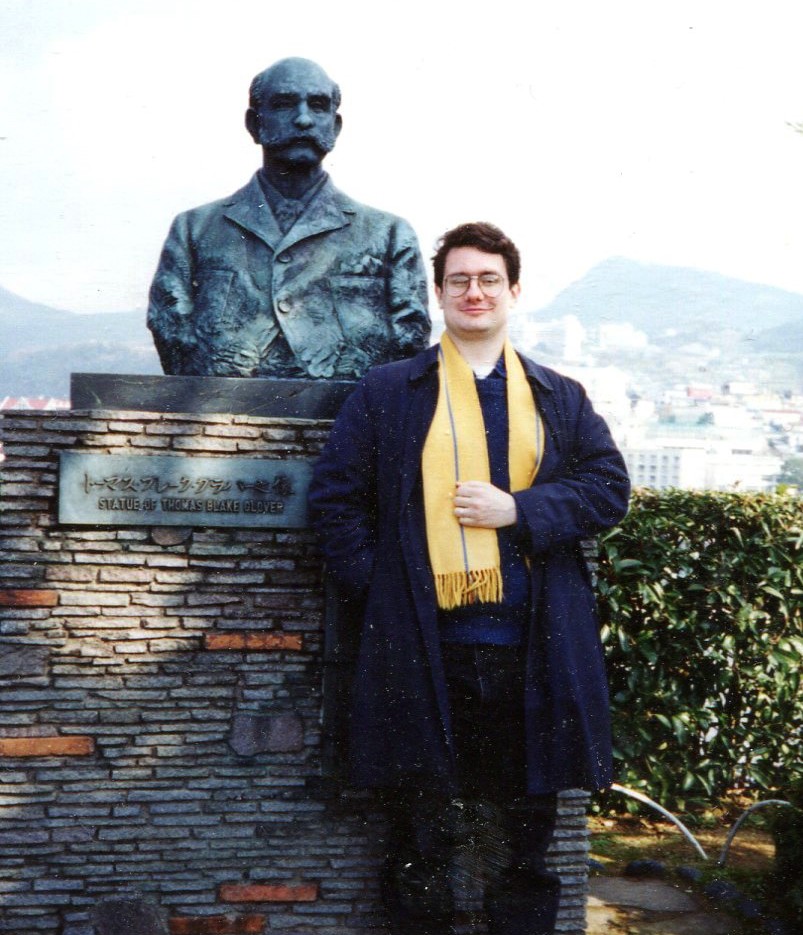
Among the places we went on Christmas Day 1993 was Glover Garden in Nagasaki. Among the things you can find at Glover Garden — which is best known for the Glover House, though I don’t seem to have any images of it — is a bust of Thomas Blake Glover (1838-1911). Naturally I had to pose beside it.

Glover Park 1993Glover was a Scotsman of considerable talent and ambition who went East. The Japan Times noted on the centenary of his death, in something of a rambling article: “When he arrived in Nagasaki in 1859, aged 21, Glover was at first allotted accommodation in the city’s concessions area, called Dejima, where he would soon build up a mini-empire of real estate. In 1861, he founded Glover Trading Co. (Guraba-Shokei) to deal illegally… in ships and weapons with the rebellious Satsuma and Chosu clans in Kyushu and the Tosa from Shikoku, who were all bridling in those tumultuous times against the policies of the so-called bakufu government of the shogunate.”

That is, he was one of the foreign merchants that helped overthrow the Tokugawa shogunate. As you’d expect, after the Meiji Restoration, he profited mightily as a businessman in the new Japan as he helped the new rulers — his old allies — industrialize the nation.

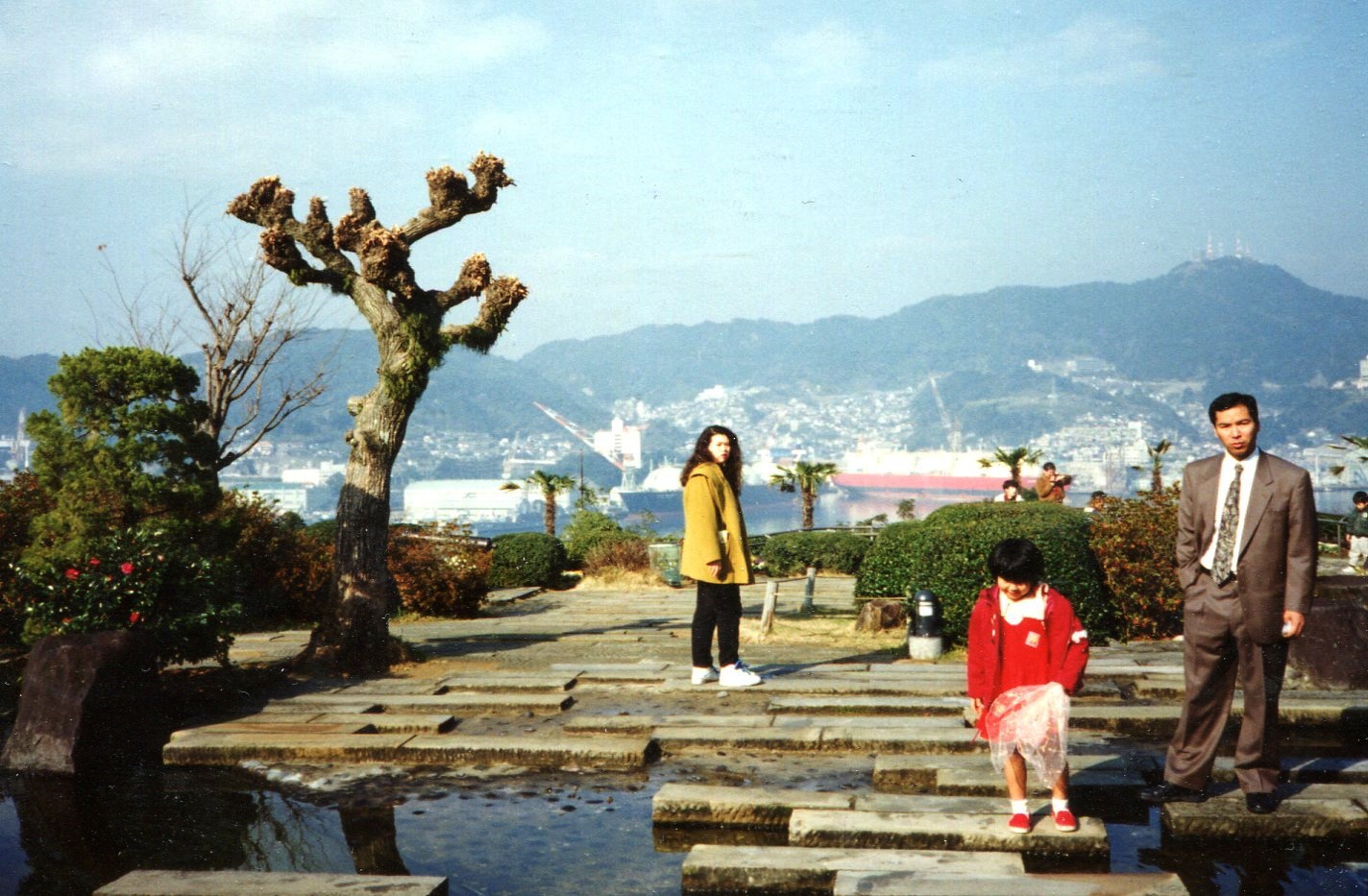
The garden overlooks Nagasaki Harbor. This view shows how hilly the surrounding terrain is. I don’t have any idea who the man or the child are.
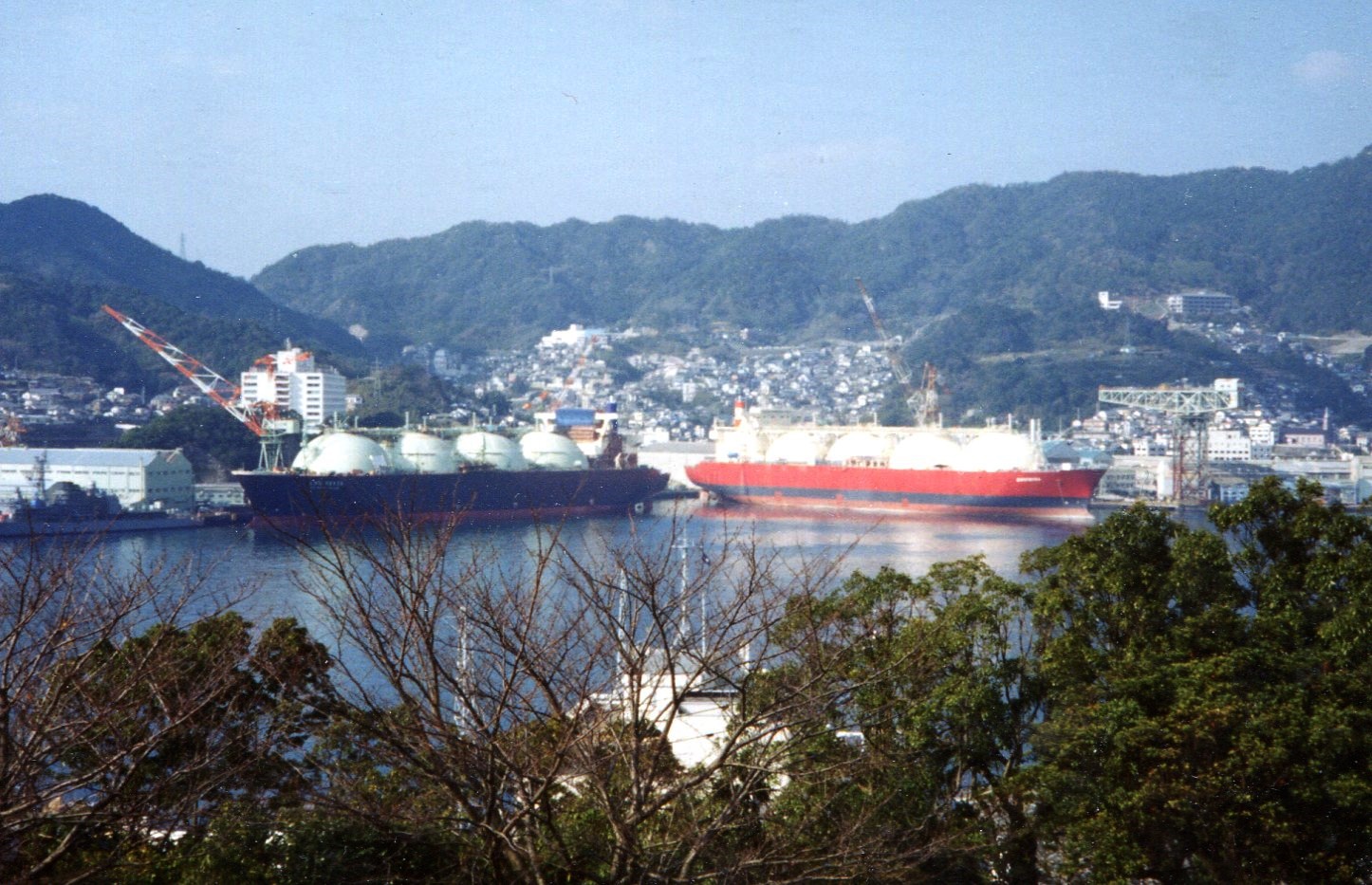
Glover Park 1993A closer view of Nagasaki Harbor.
Glover Park 1993Looks like a couple of liquefied natural gas tankers were in port at the time. Not something that Glover would have ever seen from that view, but he probably would have appreciated it.

Thursday Bits

A lot of rain on Sunday and then more on Monday, creating a week of puddles and mud as temps never quite made it down to freezing during the day. My kind of winter. No risk of slipping on ice, though I did nearly slip on a patch of mud in the yard the other day.

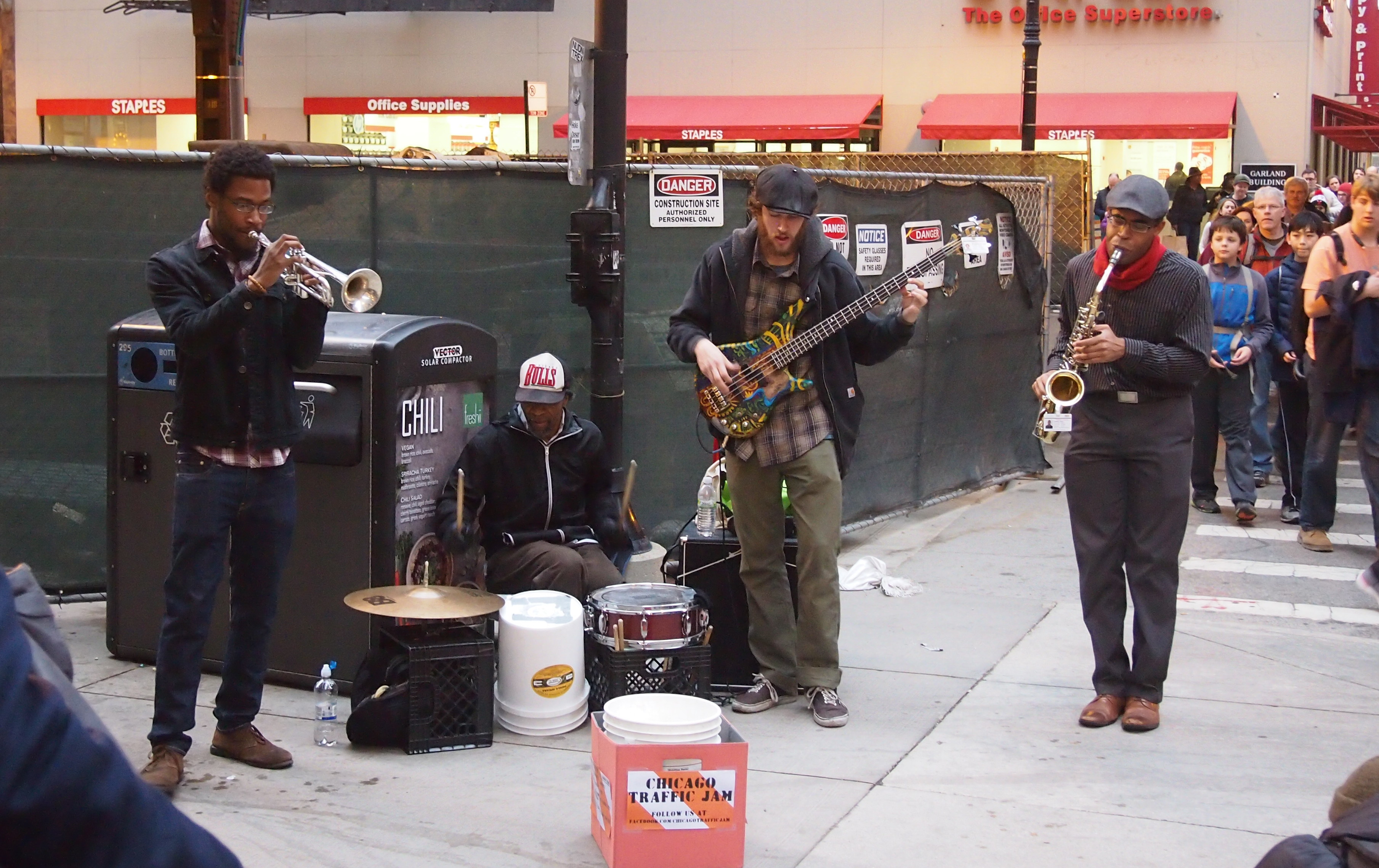
One more picture from Saturday: a street band at the corner of Washington and Wabash who call themselves Chicago Traffic Jam.

Chicago Traffic Jam Dec 12, 2015Jam is right. When we saw them, they were jamming, doing a bang-up job on a ’70s instrumental that I recognized, but couldn’t remember the name of. I pitched a dollar coin in their bucket.

I saw a trailer for Gods of Egypt on YouTube not long ago. From the looks of it, the title’s not quite right. CGI Egypt might be better. Could be one of those movies in which “tell a good story” is about fourth or fifth on the list on the director’s list of things to do, while “make it look badass” is first. Without more information, there’s little chance I’ll spend money to find out. Just another benefit of not being 15 anymore.

Then again, I don’t remember rushing off to any fool movie when I was 15. But the industry was different then.

I missed the obituary of Gene Patton earlier this year, but here it is. RIP, Gene Gene the Dancing Machine. Looks like you had a fun 15 minutes of fame.

Buildings in the Clouds

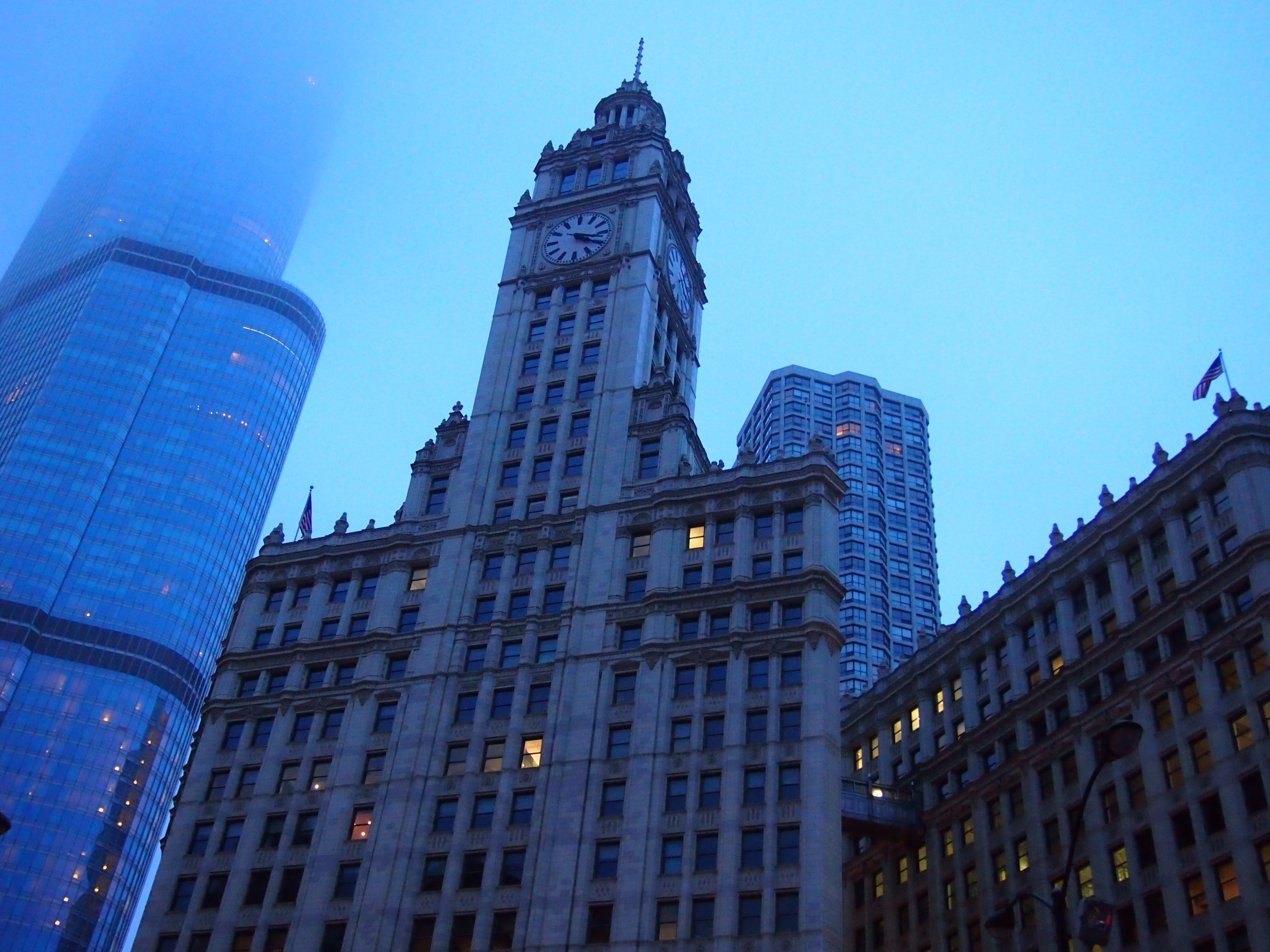
Ann wanted to borrow my camera during part of our walkabout on Saturday, so I lent it to her. She took some good images. Such as the Wrigley Building on Michigan Ave., just as the light faded for the day.
Wrigley Building Dec 12, 2015I’ve read that giant grasshoppers crawled on the building in The Beginning of the End (1957). “You can’t drop an atom bomb on Chicago,” protests a young Peter Graves. That does seem like burning down the house to get rid of the termites, but never mind.

Note the soaring structure beside the Wrigley Building, right up into the clouds. That’s the You-Know-Who Tower, with the name of the property mogul running for president — in classy 20-foot stainless steel letters — slapped on the side facing the Chicago River last year.

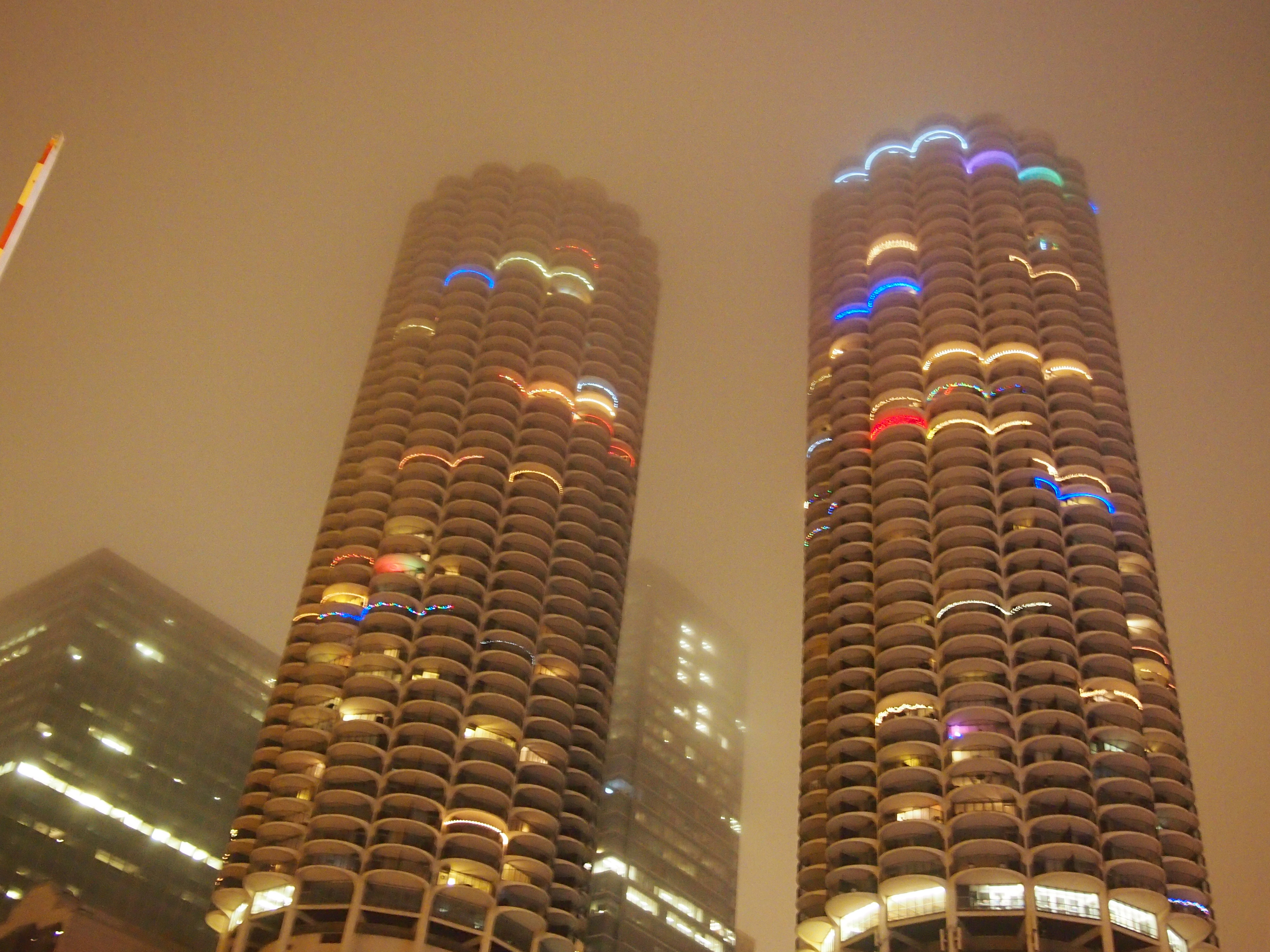
Also reaching into the clouds, as seen from State St.: Marina Towers.

Marina Towers, Dec 12, 2015They too have been in movies, notably The Hunter (1980), which was Steve McQueen’s last picture. I haven’t seen the whole thing, but in the age of YouTube, it’s easy to see just the part in which a car plunges from the towers — which have parking decks on their lower levels — into the Chicago River. The scene was so good that a similar one was created for an insurance commercial, though I have to add that if you’re running from the cops, I doubt that any policy’s going to cover the damage.

“Rock”

The Christkindlmarket in Daley Plaza was insanely crowded on Saturday. So we didn’t spend much time there.

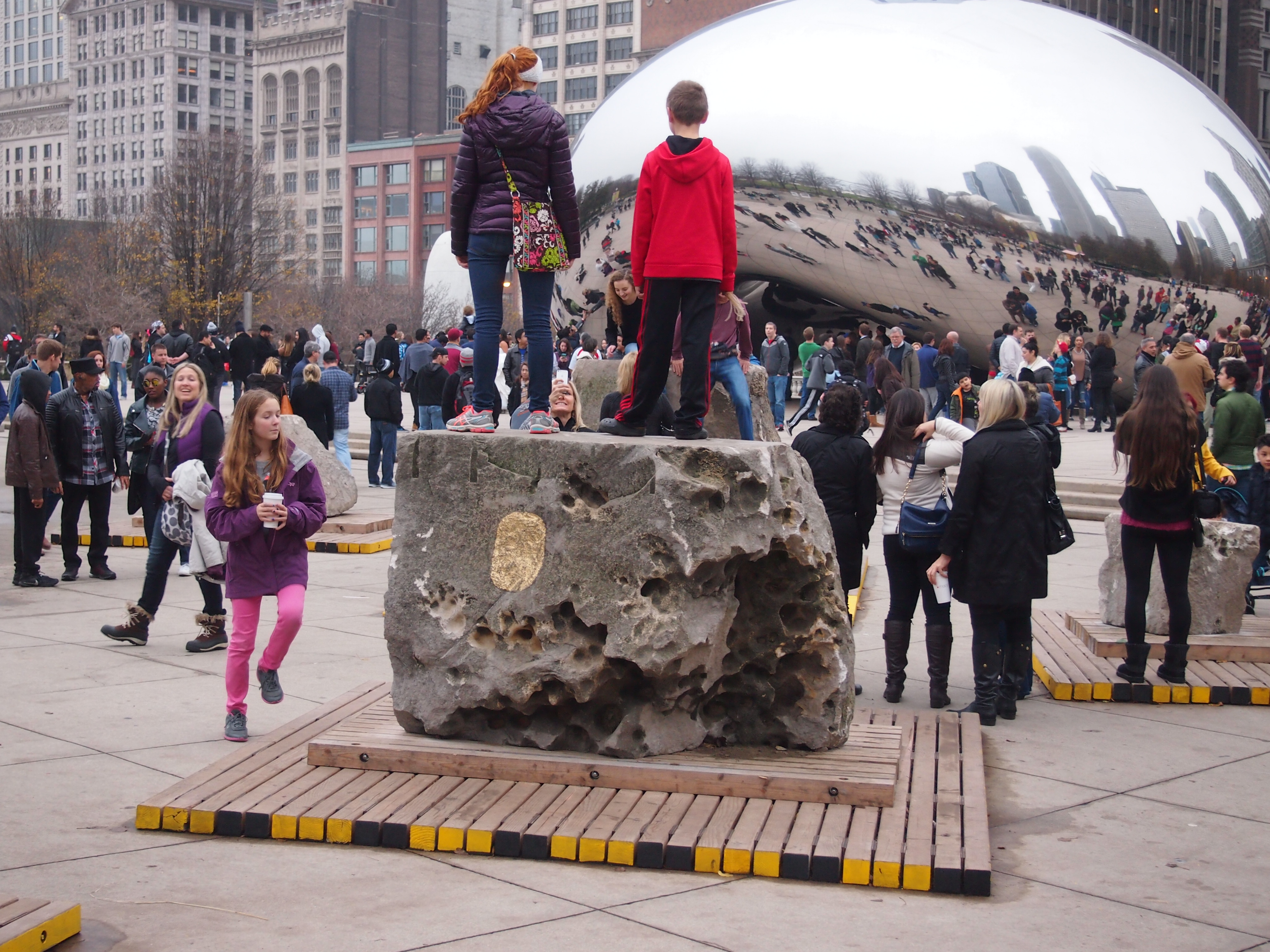
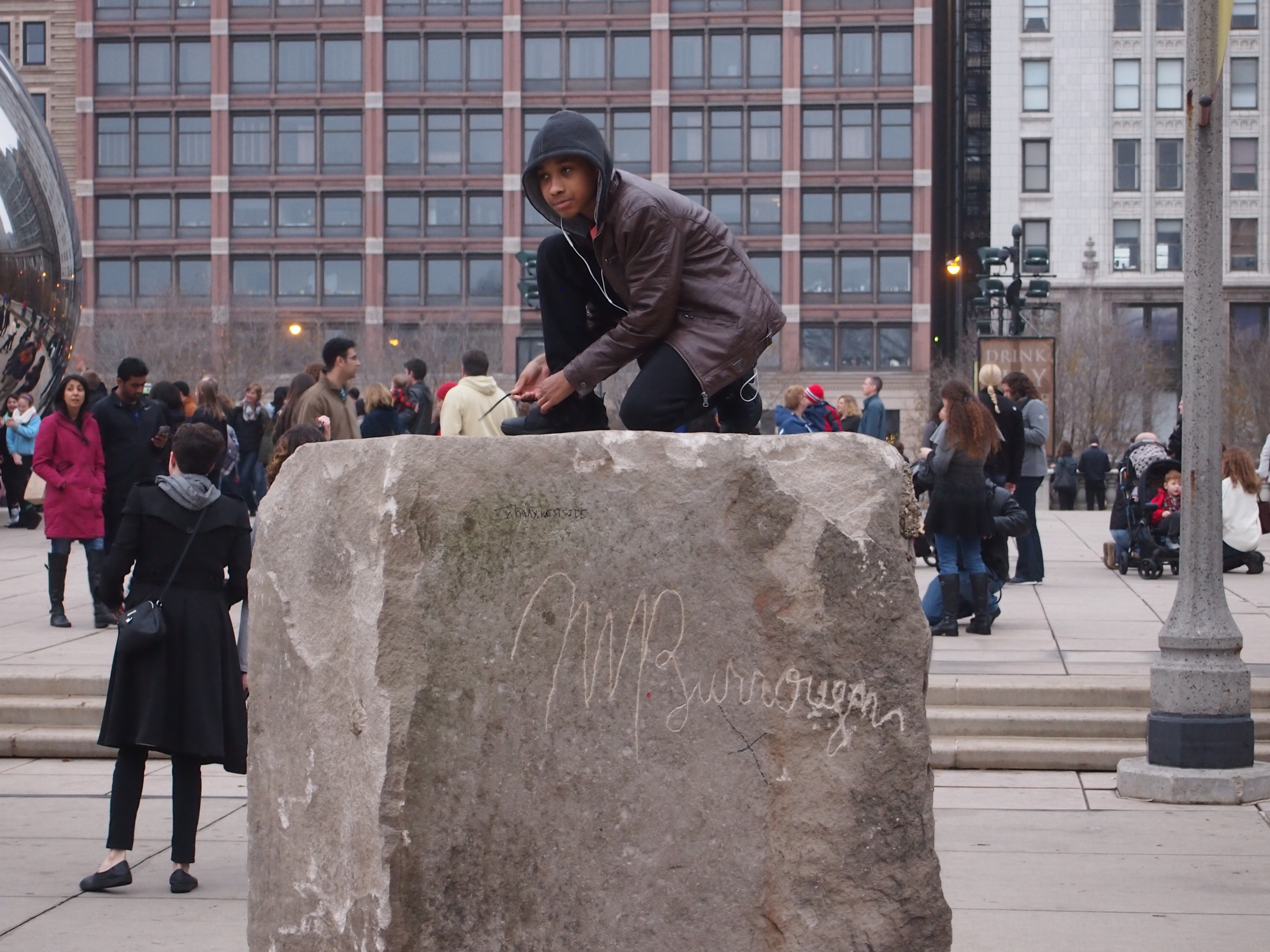
Millennium Park was pretty crowded too, but it’s spacious and holds its crowds better. There’s a new public art installation near the Bean. DNAinfo tells me that it goes by the simple-enough name “Rock,” and it consists of eight limestone rocks — some are borderline boulders — weighing between 3,000 and 9,000 lbs.

“The stones, which were donated by the Chicago Park District out of a Hyde Park storage facility, will be included in an upcoming lakefront kiosk at Montrose Beach as part of this year’s Chicago Architecture Biennial,” writer David Matthews said in September.

“Soon guests will be able to paint and otherwise decorate the stones, which will help support the kiosk when it is built next year…”

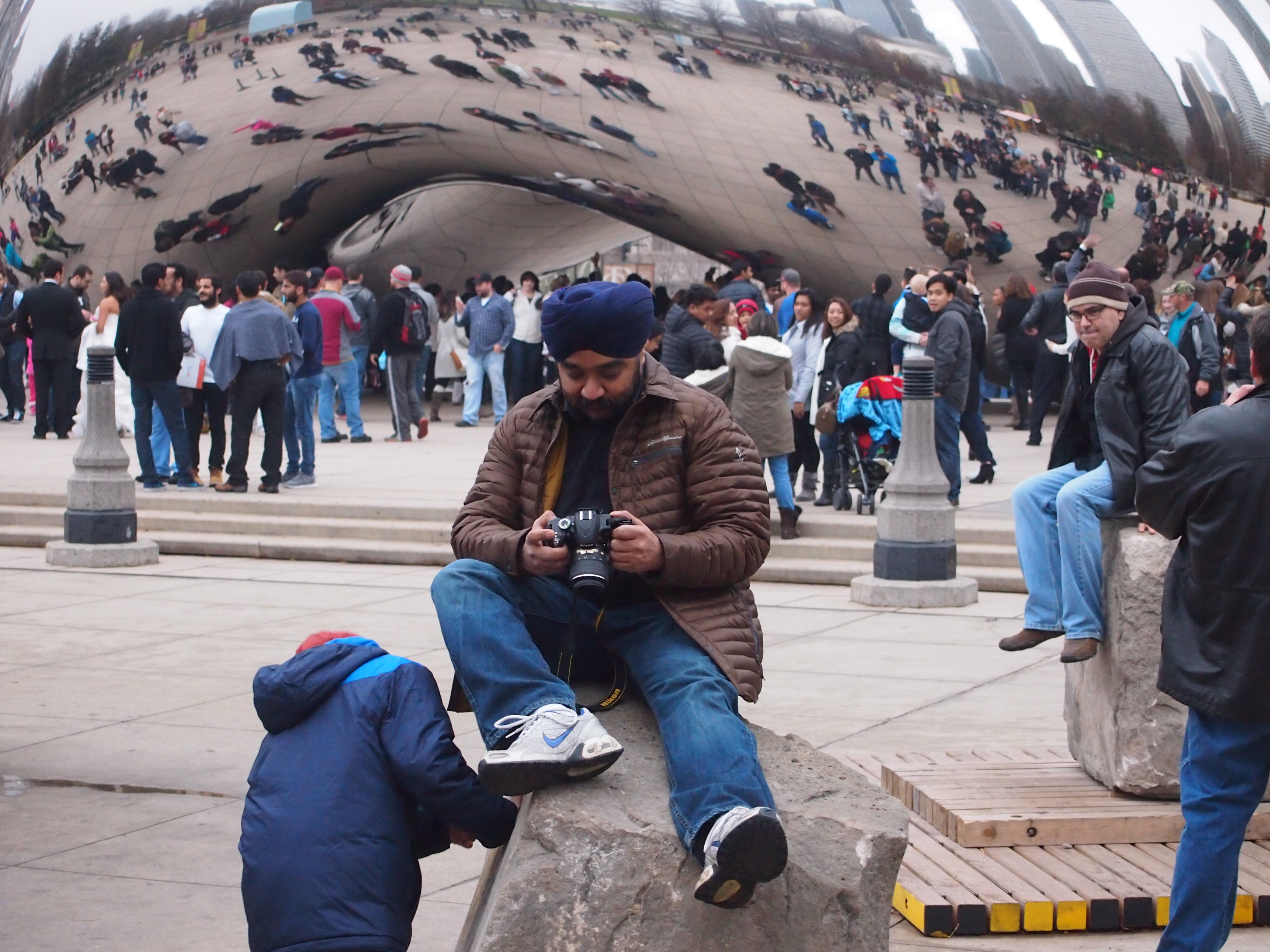
The thing to do when encountering “Rock,” at least if you’re limber, is climb on them.
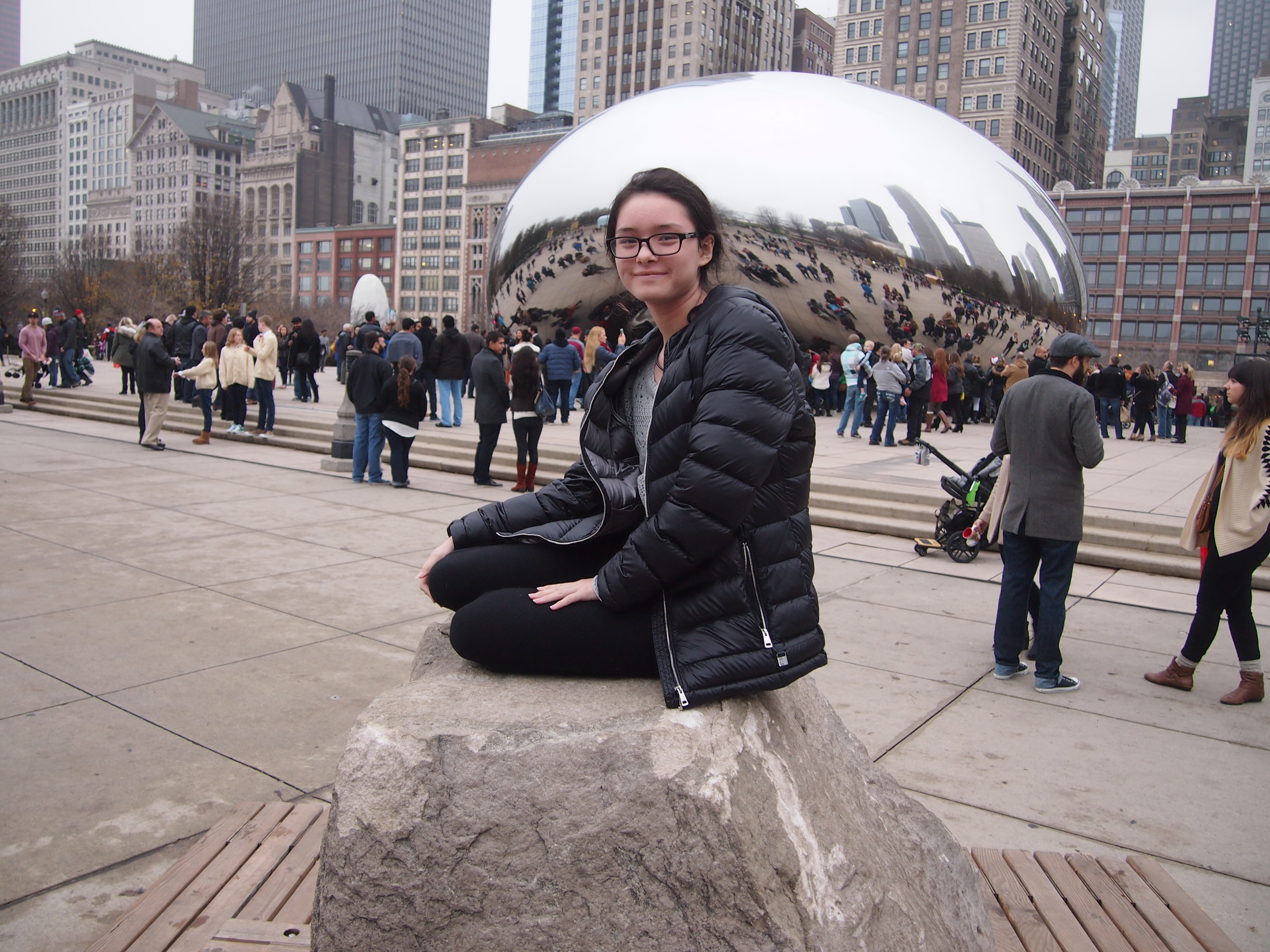
"Rpck" Chicago Dec 2015"Rpck" Chicago Dec 2015"Rock" Chicago Dec 2015That included Ann.
"Rock" Chicago Dec 2015But not me. I never was a limber-American.

Formerly Known as Marshall Field’s Christmas Windows

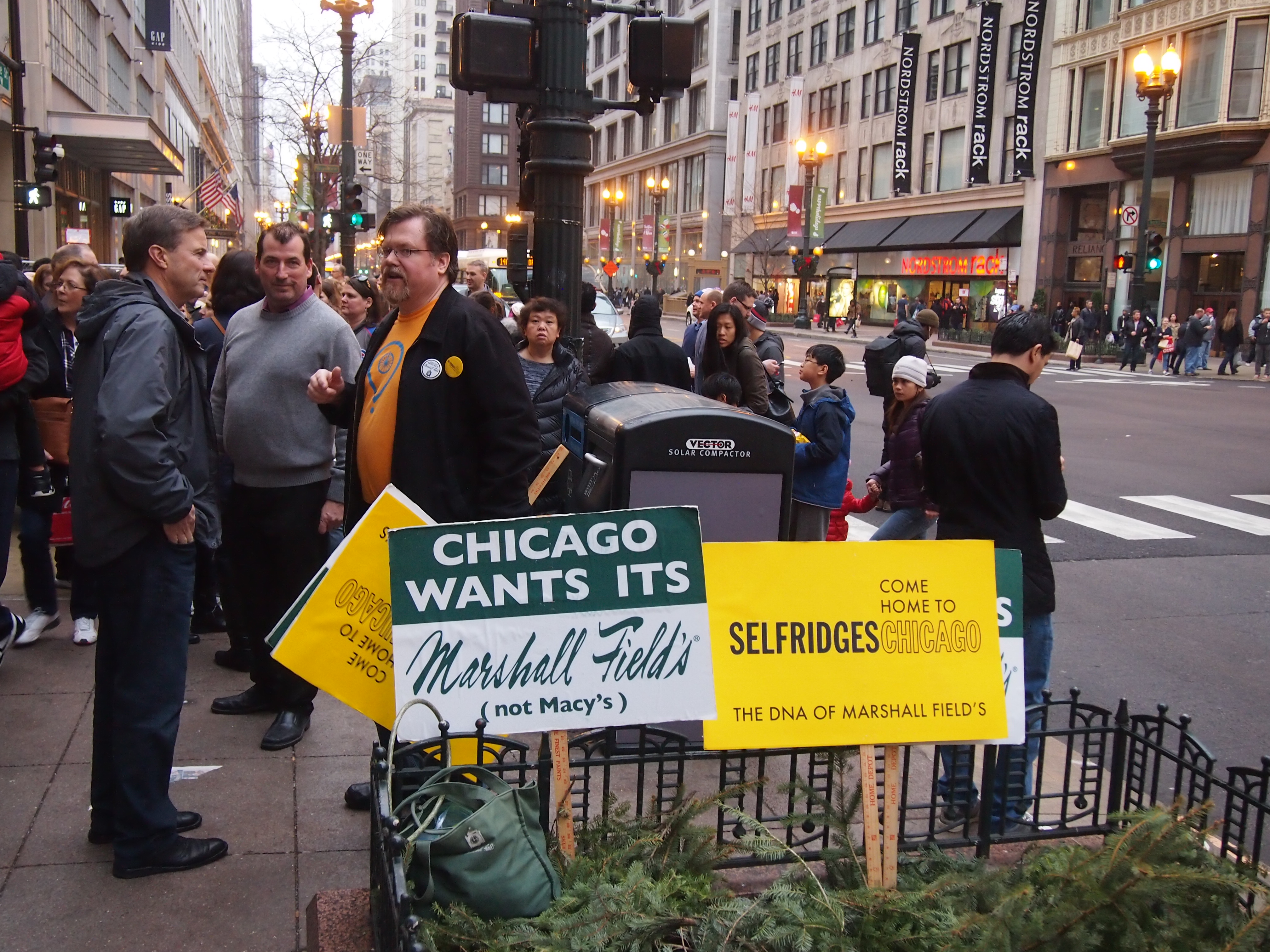
Chicago’s seen a lot of street protests lately, but on Saturday we didn’t see any protesters, even though we passed by City Hall and parts of Michigan Ave., which have been hubs of protest. Except for this guy.

Marshall Field's protester 2015He stood on State St. near its intersection with Washington St., just outside of the Store Formerly Known as Marshall Field’s, as you’d expect. Is the sign advocating that the British retailer Selfridge’s buy the famed old store in Chicago and return it to its original name? Maybe. I didn’t ask him. But after all, Harry Selfridge was an early part owner of Marshall Field’s, and essentially took its techniques to the UK to establish his store.

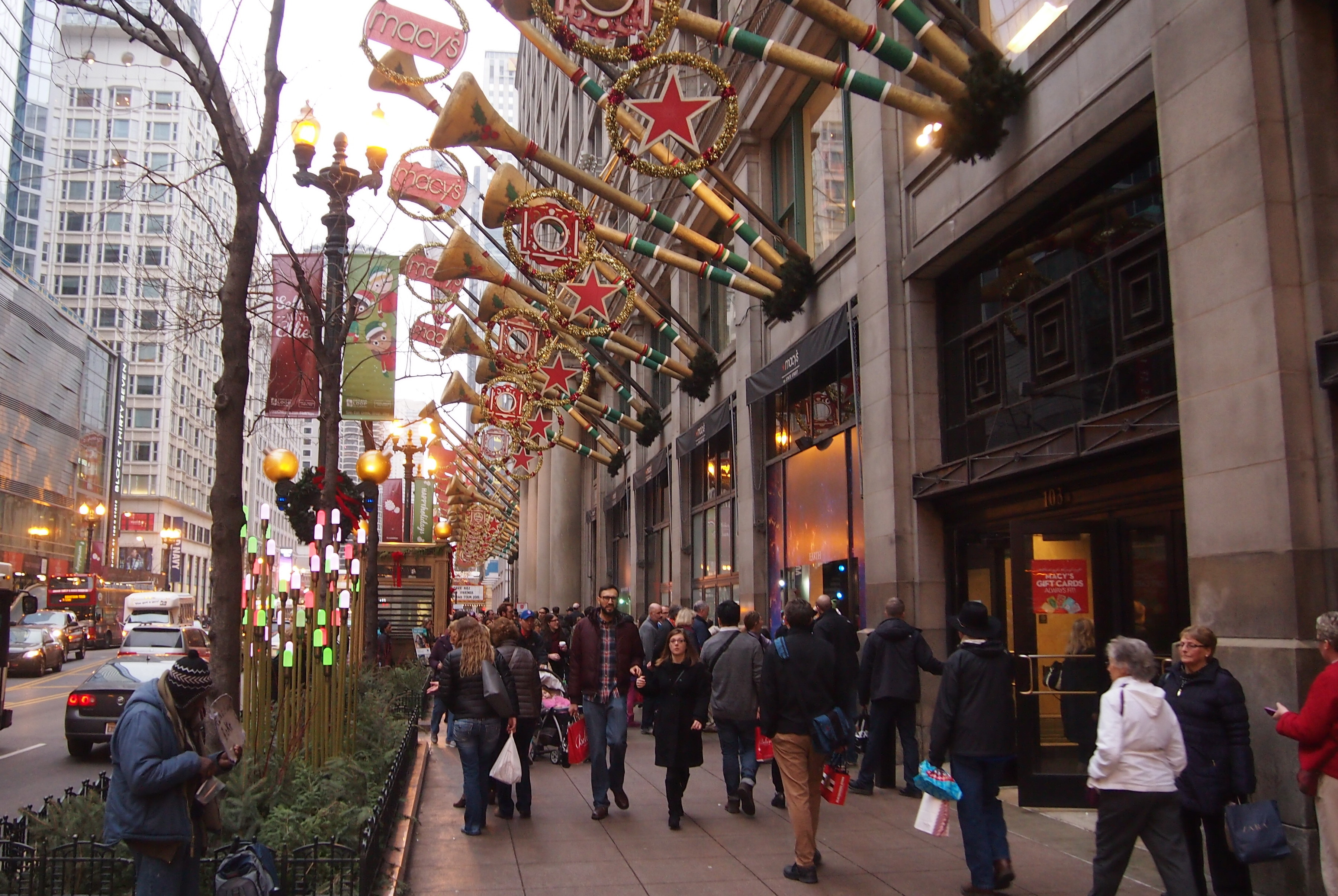
The streets might not have been thronging with protesters, but they were thronging all the same, probably boosted by the fact that it was a Saturday before Christmas, along with the warm temps. Extra helpings of people were in front of the former Marshall Field’s on State St. to see the seasonal windows.
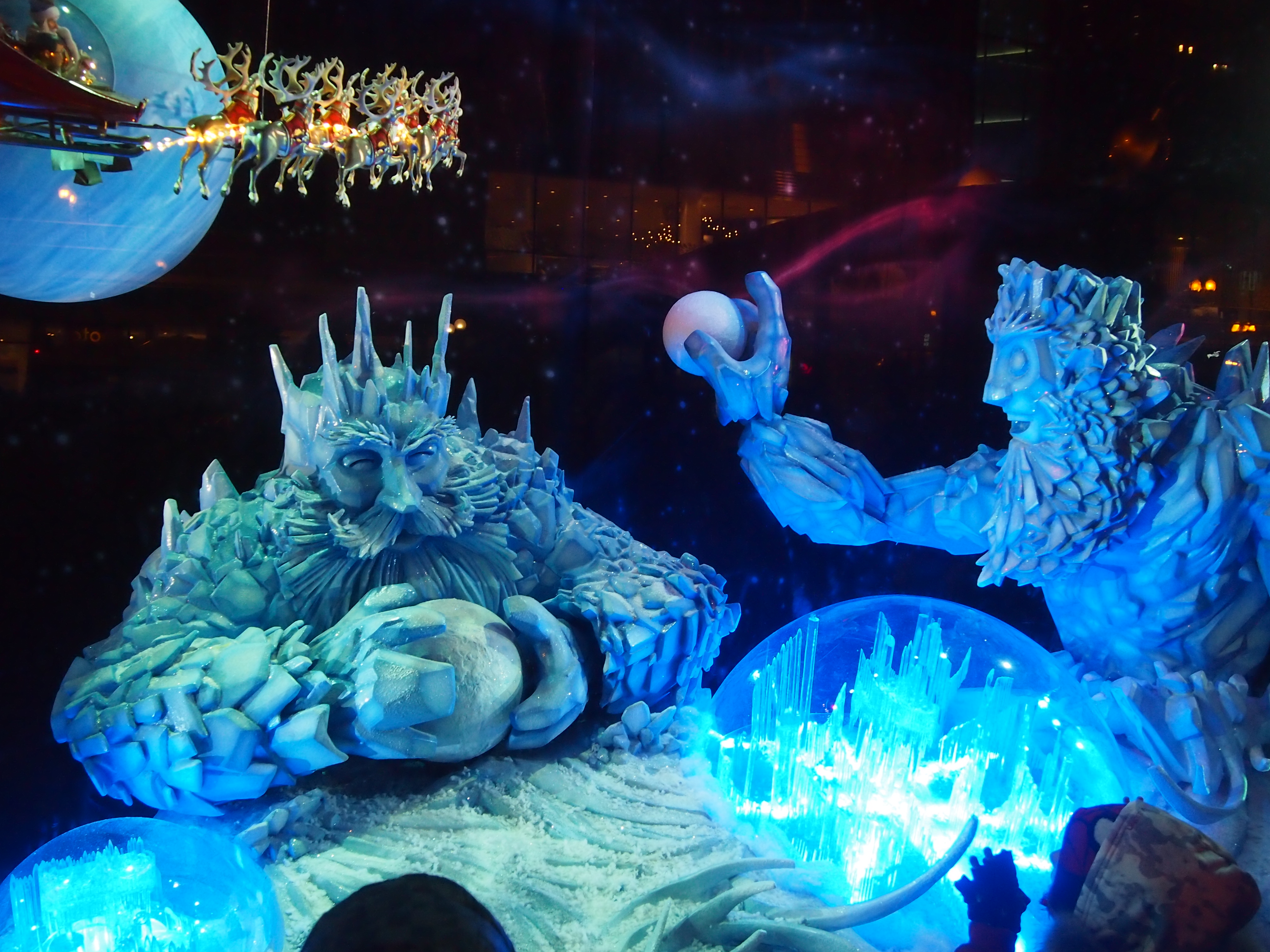
State Street at Macy's Dec 2015Eventually we got a look at the seasonal windows. As usually, they were elaborately creative. Or creatively elaborate, with a Christmas theme. This year it was about a space-flight-enthusiast young boy hitching a ride with Santa to various fantastic versions of the planets (except Pluto), including a return to Earth that seemed to feature a bizarro hybrid of New York and Chicago. Guess that counted as a fantastic version of Earth.

The madding crowd made it hard to look at the windows for very long, or take many pictures, but I did get one of the window I especially liked.
Macy'sChicago Christmas Windows 2015It’s a snowball fight between giant ice creatures inhabiting Uranus and Neptune. Methane snowballs, probably.

Divers Christmas Trees

Time to bring a pine into our home and festoon it with lights and baubles. Which we did on Friday.

Liily & Ann Dec 11, 2015My participation, beyond buying the tree and physically bringing it inside, was fairly modest this year.

Dec 11, 2015On Saturday we went downtown, enjoying a cloudy but amazingly mild day — about 60 F. One of the things to see downtown in December are various Christmas trees.

The city of Chicago moved its tree from Daley Plaza to Millennium Park this year (oddly enough, the tree has its own Wiki page).

Chicago Christmas Tree 2015Behind the tree are the curves of the Pritzker Pavilion. That would be something to adorn with lights, but maybe the logistics of getting it done would be too daunting.

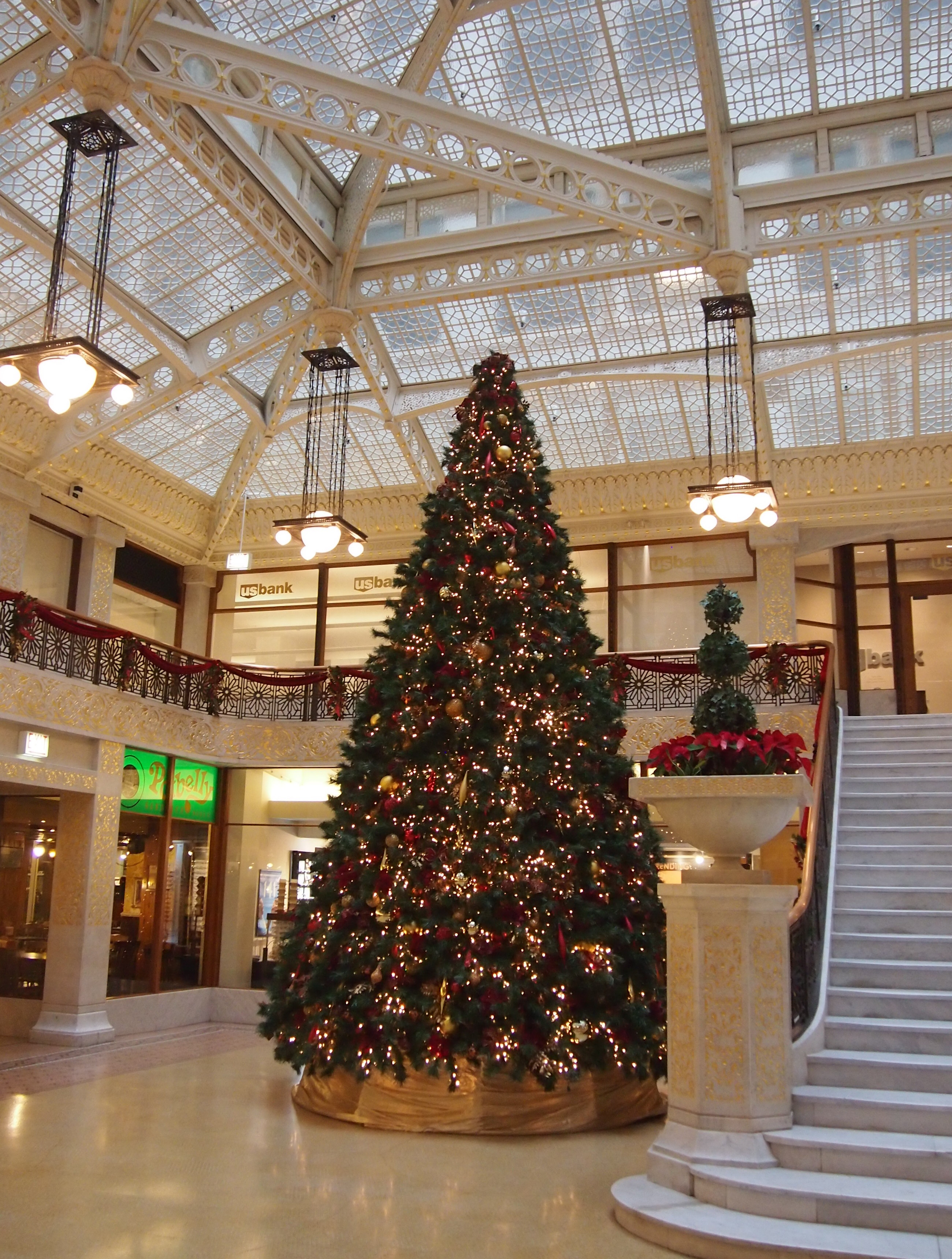
The splendid Rookery lobby had a tree as well.

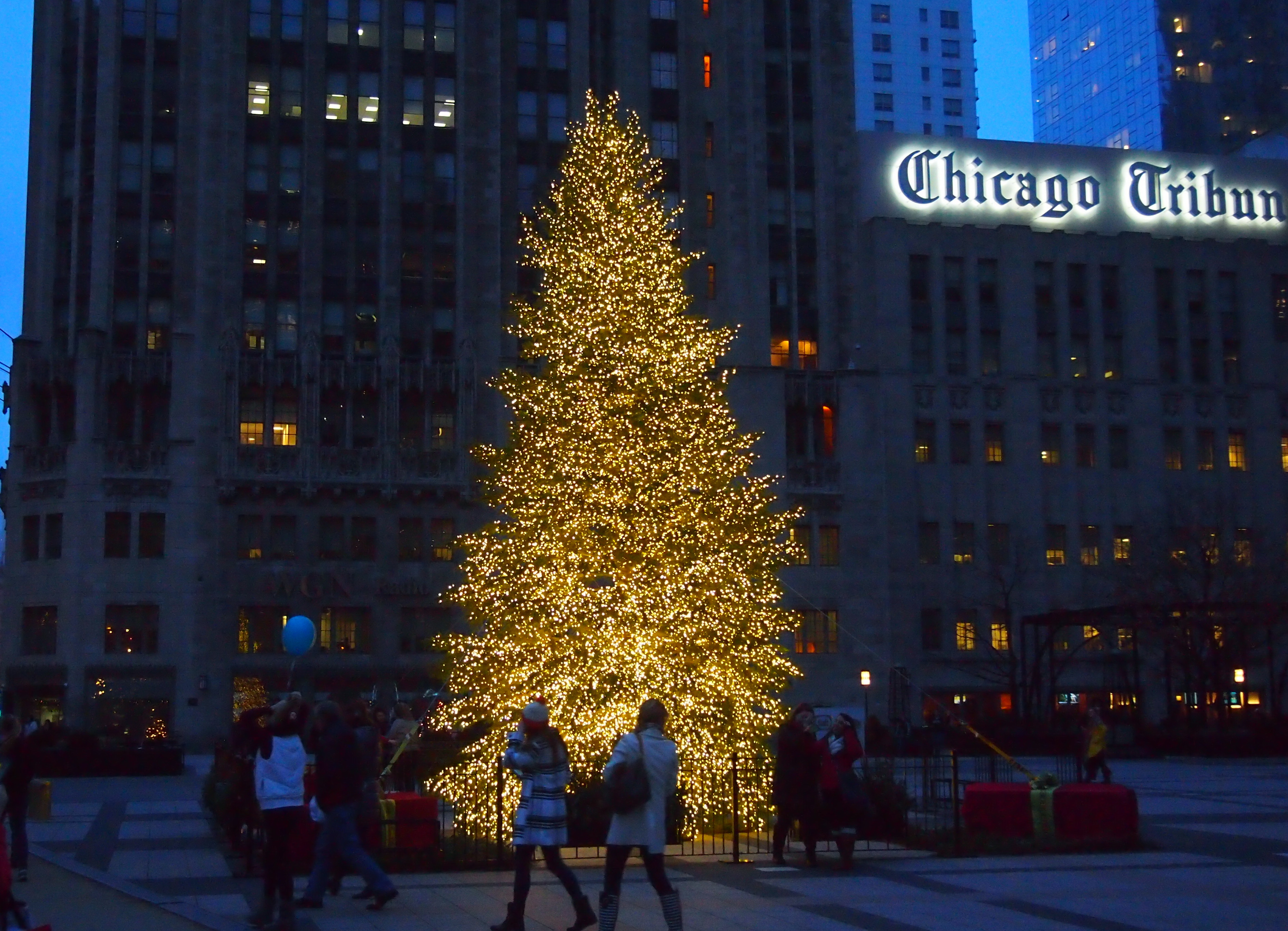
Rookery Christmas Tree 2015As did Pioneer Plaza, which is just south of the Tribune Tower.

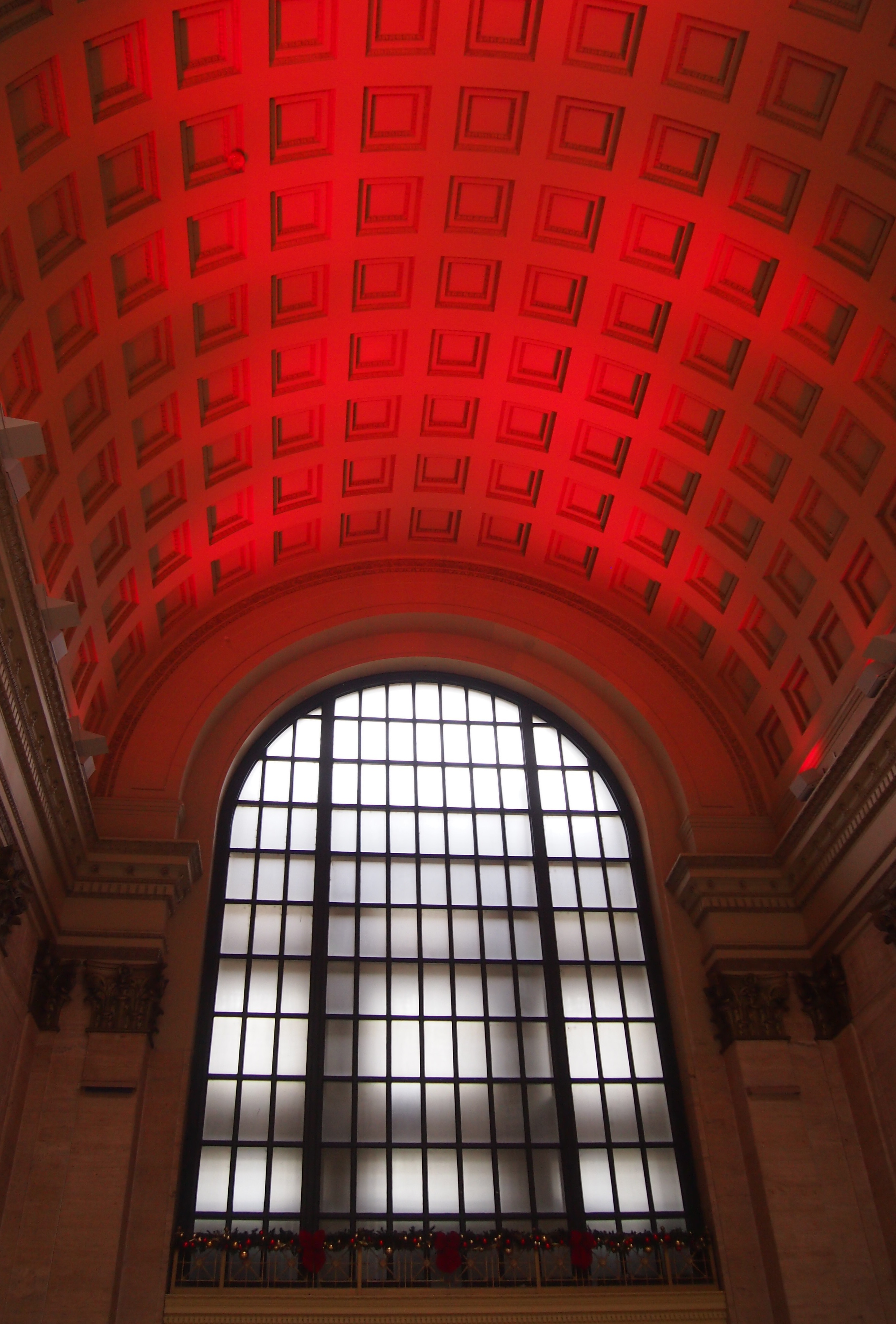
Pioneer Plaza Christmas Tree 2015The tree at Union Station wasn’t particularly interesting.
Union Station Chicago ceiling 2015Better were the vaulted ceilings.

This Wasn’t in the Job Description

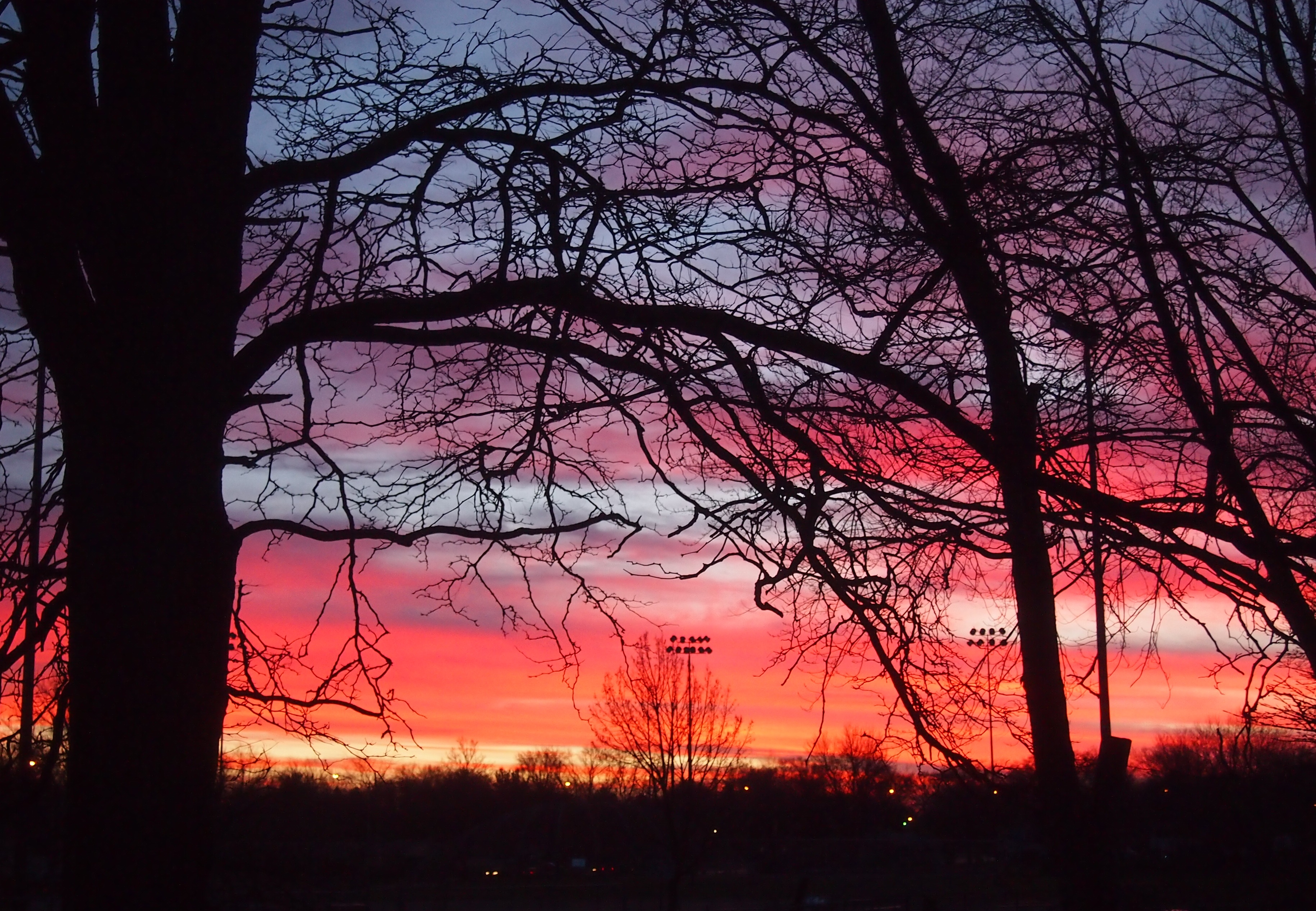
What did we do deserve such a sunset yesterday? I couldn’t say. Maybe there was an extra ration of air pollution in the western sky. The photo doesn’t depict all the subtleties of the hues, but here it is anyway.
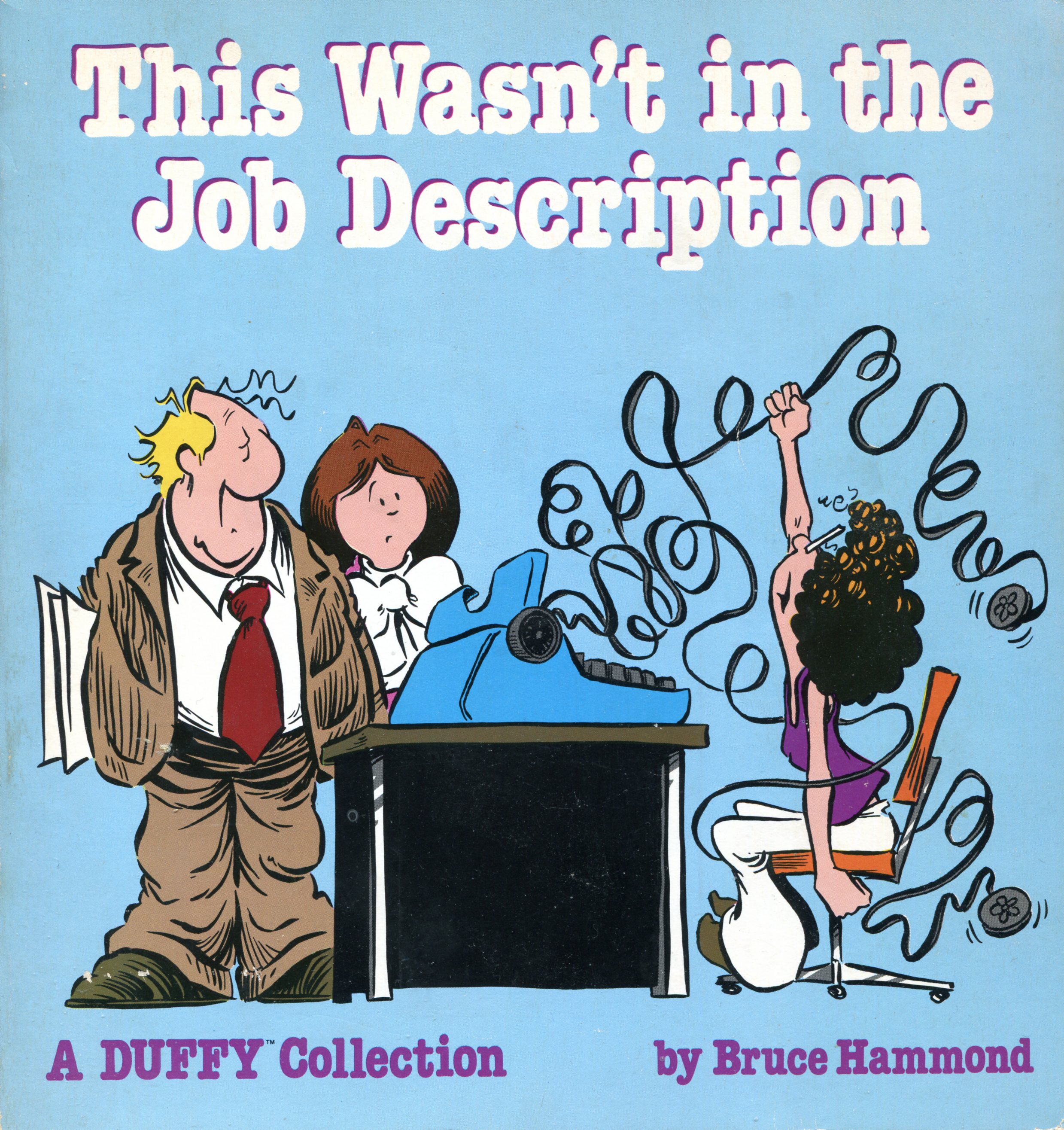
NE Illinois Dec 9, 2015One more book from my shelf: This Wasn’t in the Job Description, a collection of Duffy comic strips by Bruce Hammond, published in 1983. I acquired it in Nashville ca. 1985, around the same time I was introduced to Life in Hell, a different sort of comic whose creator went on to other things.

DuffyDuffy is a pre-Dilbert office comic, beginning syndication in 1981 and petering out in the mid-1990s. “The strip lasted almost a decade and a half, at its most popular was claimed to be running in 90+ newspapers, even got the reprint book treatment once,” writes comic strip historian Allan Holtz (so it seems I have a copy of the only collection). “On the other hand, it is a strip that certainly did seem to fly under the radar for much of its existence…

“With most of the gags about office politics, technology, and upper management, you could think of this as a precursor to Dilbert, but I think that would be off-base. Duffy owed a little more, I think, to the style and gags of Jeff MacNelly’s Shoe. Take off the bird wings, and move the Treetops Tattler gang into a generic office setting, and you get close to the feel of Duffy.”

Mildly satiric, Duffy wasn’t groundbreaking or outrageously funny — I’m hard-pressed to think of many late 20th-century newspaper comics that are either — just consistently amusing, and not all comics are even that. The eponymous main character, the middle-aged and disheveled middle-manager Arthur Duffy, muddles through his days in the office of a company whose exact business is never specified, vexed by the heard but never seen company president G.W. and a dim-witted and sleazy colleague Miles. The other two main characters are women: Jessie, another middle manager, and Naomi, Duffy’s secretary, and Hammond’s a good deal more sympathetic to them than Scott Adams to his female characters.

Jessie: There’s a line on the budget sheet I don’t understand, Duffy.
Duffy: What’s that, Jessie?
Jessie: What does “ancillary administrative expense” mean?
Duffy: Slush fund.

Naomi: How can you moan about owing money, Duffy? You must make four times what I do.
Duffy: It’s a basic law of economics, Naomi. Debt is always greater than income.

Jessie: This is National Secretaries’ Week, Miles. Planning anything special for your secretary?
Miles: You must be kidding.
Jessie: Come on! Why not?
Miles: I don’t observe holidays invented by florists.

It’s interesting how dated some of it is after only 30 years. Desktop computers are new and threatening — at least to Duffy — there’s a series of strips about learning from Japanese management techniques, and there’s no talk of casual Friday, open-plan offices or cell phones. Jokes about incompetence in the C-suite are pretty much timeless, though.

Scenes of Naniwa

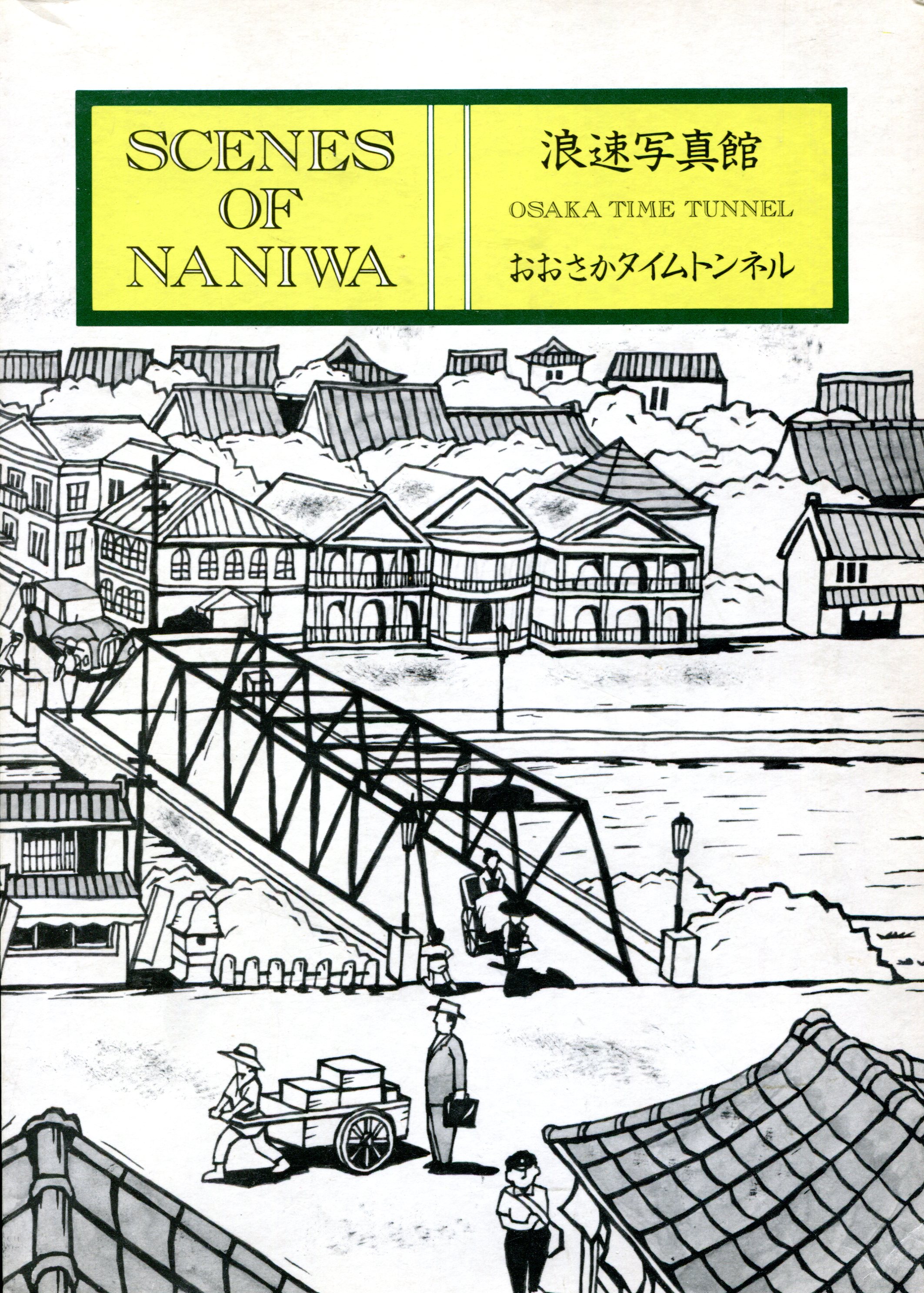
In July 1991 at Kinokunya Books in Osaka, which had a nice selection of English-language titles, I chanced across a large paperback called Scenes of Naniwa, which seems to be subtitled, “Osaka Time Tunnel.” I’m really glad I forked over the ¥2060 to buy it (about $15 in those days), because I’ve never seen it for sale anywhere else, not even Amazon, though admittedly I only checked the English-language version of that site.
Scenes of NaniwaThe book has 40 short chapters, each well illustrated by black-and-white images, of Meiji- and Taisho- and early Showa-era Osaka, which is to say, the latter decades of the 19th century and the early decades of the 20th. In fact, the photographs are the genesis of the book.

It seems that one Teijiro Ueda (1860-1944), who owned a sizable camera shop in Osaka in the early years of the 20th century, also had a sizable collection of photographs of old Osaka. He apparently took some of them himself, though it isn’t always clear which ones. Some of them he probably collected from other photographers.

In the 1980s, with the assistance of Ueda’s elderly daughter-in-law, who had kept track of his 1,300 or so images in a dozen albums, the Yomiuri Shimbun (a daily paper) published the photos and articles to go with them in a serial format. Later the paper put the articles together in book form. A Belgian named J.V.D. Cammen took it upon himself to translate the book into English, and in 1987, Yomiuri published that too. That’s what I have.

I’m assuming that neither Japanese nor English were Cammen’s first language, and if so, he did a remarkable job. The prose isn’t quite as smooth as it might be, but on the whole it’s high-quality writing in English. Someone unfamiliar with Osaka might find the book a chore to read, but the more you know about that city, the more interesting the descriptions will be. You find yourself thinking, “That used to be there?”

It’s a time tunnel all right. The modern urban landscape of Osaka has mostly obliterated the places and sights that Scenes of Naniwa documents. (Naniwa is an older name for the city, and possibly even a poetic one in later times.) As the text notes, “In our time, with ferro-concrete buildings lining the streets, the appearance of Osaka has become almost the same everywhere, but there are plenty of photographs in the Ueda albums of the city before it received this uniformity.”

For example, the book tells of the Osaka Hotel, which used to be on Nakanoshima, a narrow island in Yoda River, which these days is a good place for strolling in fair weather. The book says that: “The hotel [had] arched windows resembling those of palaces in the West. It [had] turrets like castles in the Middle Ages, with dormer windows in the roofs, which [were] covered with asbestos slates, and the ridgepoles too [were] decorated with fine ironwork… The front part of the hotel [was] three-storied, but at the back [was] a basement with a veranda and even an anchorage for the private use of the hotel.”

The structure dated from 1900, but didn’t last long: it burned down in 1924. On the site now is the fine Museum of Oriental Ceramics, completed in 1982.

Then there’s the Tall Lantern (Taka-doro) in Sumiyoshi. I used to live in Sumiyoshi Ward, and south of my residence, about 20 minutes on foot, was Sumiyoshi Shrine (Sumiyoshi-jinja). Not far from there was the Tall Lantern, though not in its original position, as I learned from the book.

“… the Taka-doro was originally an offering made by fishermen to the Guardian Sea-god of the Sumiyoshi Shire at the end of the Kamakura period, but has become best known now for being the oldest lighthouse ever constructed in Japan… In 1950, the Stone Lantern was destroyed by Typhoon Jane, but it was reconstructed in its original form about 200 m farther east. Restored, it stands on its former foundation, is 21 m high, and has a tiled roof like that of a temple.”

Other chapters cover the Juso Ferry (Juso’s a neighborhood; I was married in a church there); the site of the Japanese Mint and its cherry blossoms; the earlier Osaka Stations, before the current and entirely utilitarian one; the site of the Industrial Expo of 1903; a ceremonial arch (long gone) built to commemorate the victory over Russia in 1905; the evolution of the Dotomburi district, which in the age of electric lights overwhelms the eye, but which used to be a home to many kabuki theaters; the earlier iterations of Namba Station and the Nankai Electric Railway; Shitennoji and environs, the clearest memory I have of which is one of the ponds at Shitennoji temple that was infested with an absurd number of frogs; and much more, such as an account of a fire on July 31, 1909, that burned more than 122 hectares of the city and 11,300 houses. Ueda apparently went to the roof of his camera store and took a picture that morning, which shows an enormous billow of black smoke about two kilometers away.

The book also taught me about the miotsukushi. I pulled this image of one, along with a sailboat, from a Japanese web site. The image is in the book, though cropped a bit differently, and dates from about 1877, which surely puts it in the public domain.
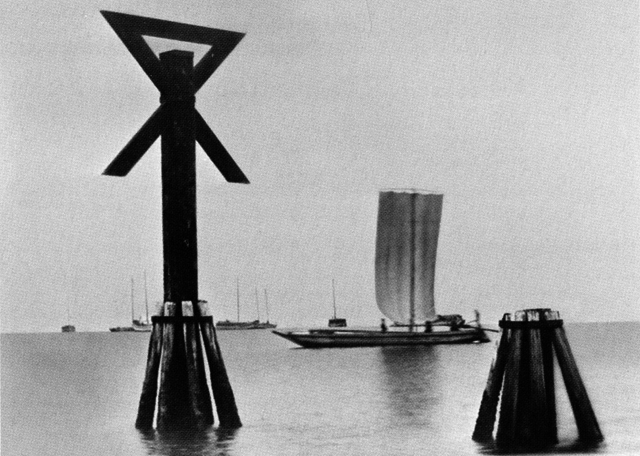
miotsukushi1877Scenes of Naniwa tells us that “the Osaka city symbol, the miotsukushi, originates from the stakes used as water route signals which up to the middle of the Meiji period stood planted in the Kizu and Aji Rivers, both debouching into Osaka Harbor. The depth of the water was difficult to judge because of the abundant bamboo reeds growing in the rivers… the miotsukushi planted along both sides of the rivers were signs showing that within those stakes the water was deep enough to sail through safely.”

Though gone by the end of the 19th century, the miotsukushi were well regarded enough to become the city symbol in 1894, and if you spend enough time in Osaka, you start noticing depictions of them in various places, something like the Chicago municipal device.

Before I left Japan in 1994, I went to a flag shop and, after some discussion, managed to order a miotsukushi flag as a souvenir of my time in the city. (I think they had a hard time believing a gaijin would have ever heard of it.) It was a little bigger than a 3 x 5-inch flag, and I had it until 2003, when it disappeared during the move to my current house.