Mercy Otis Warren

Heavy rains last night. Didn’t hear a drop of it. Guess I was too busy with weird dreams. This morning I noticed the soaking. The yard’s really lush so far this summer.

It’s summer, never mind the solstice. Rising summer. The mosquitoes are out, but not quite in force. No fireflies yet, but I’ve seen a dragonfly or two.

Ann and her class did their class presentation this morning, which I attended, called “I Am the Nation.” Each student dressed up as, and recited a short report they’d written about a figure from the American Revolution. I’m only mentioning this because I actually learned something from Ann’s choice: namely who Mercy Otis Warren was.

If I’d heard of her, I’d forgotten about her. Or maybe I missed her entirely; Revolutionary history, while interesting, hasn’t ever been a special period of fascination for me. She did a number of things, but mainly seems to be remembered as a polemicist of the Revolution, and afterward, an historian of it. Needless to say, though it’s pointed out a lot, those were unusual occupations for a woman of the time.

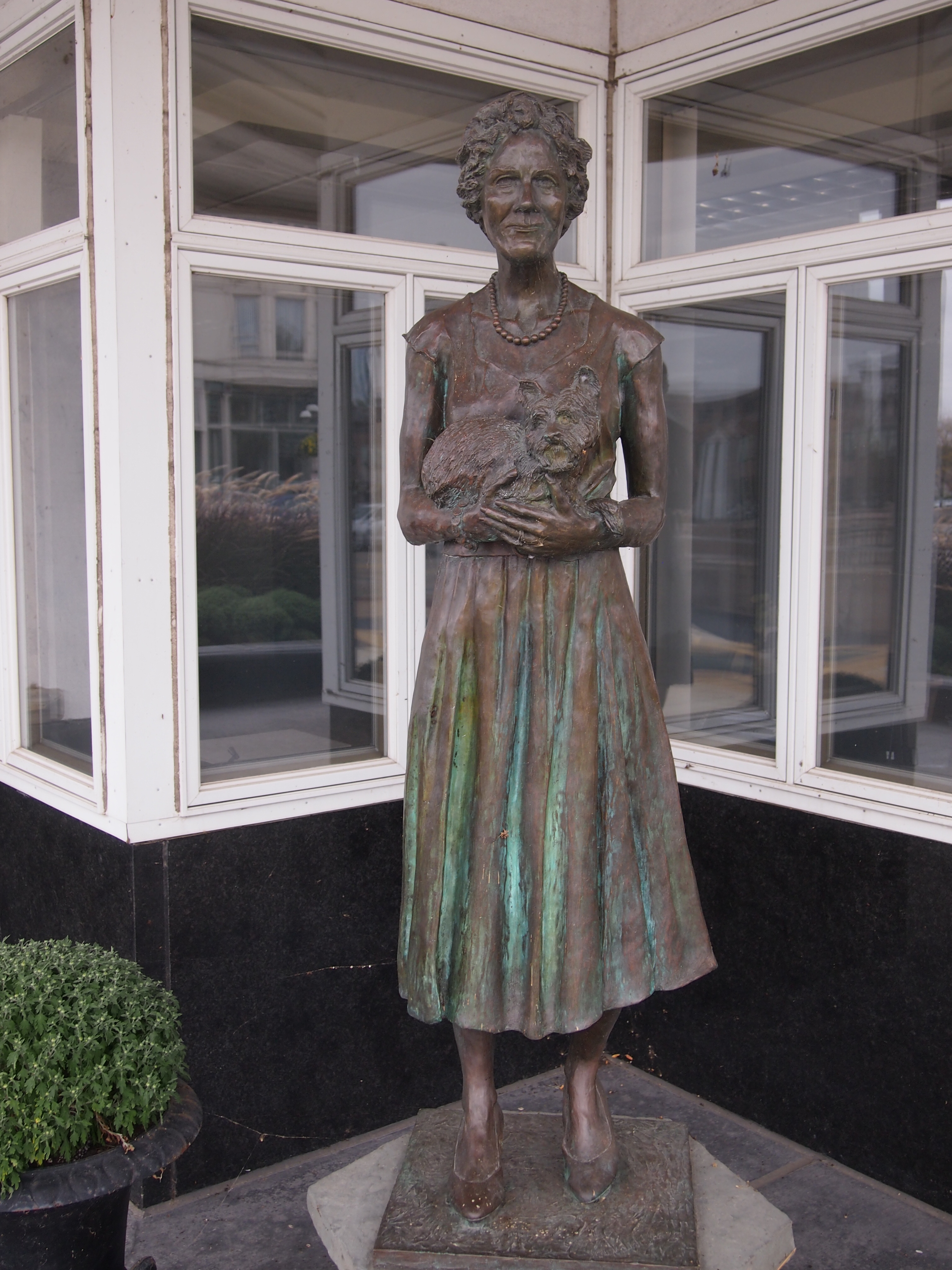
More about her is here. If ever I’m in Barnstable, Mass., I’ll go see her statue, and her brother’s too. James Otis was also a patriot and polemicist, and had the distinction of being killed by lightning one day in 1783.

Other than Warren, I’d heard of the rest of the notables the children eulogized, even Deborah Sampson and Phyllis Wheatley, whom I first encountered years ago in San Antonio, when one of the school districts there wanted to re-name a high school in her honor, and not everyone was on board with that idea.

Though I’ve cited three women examples, most of the characters were in fact men. The usual suspects, too: Washington, Adams, Jefferson, Hamilton, Franklin, Paul Revere, Patrick Henry, Nathan Hale, et al.

All well and good, but I hankered a bit for some more unusual names. Such as Francis Marion (the Swamp Fox), Baron von Steuben, Nathanael Greene or, besides military men, Roger Sherman (he of the Connecticut Compromise), or Robert Morris and Haym Soloman  (financiers of the Revolution). And throw in a couple of loyalists, just to show what’s what, such as William Franklin, Ben’s son and governor of New Jersey, or the interesting footnote character William Augustus Bowles. 

Dear Golf Road Tailgater From This Morning:

Plenty of people tailgate, or at least drive uncomfortably close to the car ahead of them. It’s an intelligence deficit, a failure to grasp the most basic physics that not only risks the offender’s health and property, but someone else’s.

You, however, are a special class of butthole. I could see you well in my rear-view mirror because you were ever so close. I could practically see the steam coming out of your ears, and that scowl on your ugly face.

The tooting of your horn was a nice touch, which you probably believed would inspire me to greater speed. Funny thing about human psychology, though – which you probably grasp as well as basic physics – the noise inspired me only to maintain my speed. I was tempted to slow down.

Speaking of speed, the car next to me and I were both traveling about the speed limit. A little more sometimes, a little less sometimes, but about right for that road. Meaning that you wanted to supplement your recklessness by adding excessive speed to the mix.

Our encounter lasted all of about 30 seconds, since I did eventually move over. You had nothing to do with it. I just wanted to turn left, and needed to stop in the turning lane to yield the right-of-way. Sure enough, you sped off, in a rush to get to the next red light.

But I wish you well, butthole, or at least that you never plow into anyone else. If you must have an accident, make it a solo date with a telephone pole somewhere.

New Product Monday

The rains lately have been tropical-like, without the high heat. The days start warm or warmish, and then the rains come in short, intense downpours. Enough to water the plants and dampen the deckchairs. Afterward, it’s clear and warm again.

I don’t follow the snack-food industry as anything but a consumer, so I didn’t know that Nabisco, as well as Ritz, are brands of Mondelēz International. Mondelēz, eh? A Brazilian behemoth come to North America to buy our brands? A Taiwanese confectioner who picked that name to throw us off? A massive Turkish purveyor of sweets that got its big break when Atatürk expressed admiration for its tulumba and walnut sujuk?

No, Mondelēz company HQ is in Deerfield, Ill., and according to some sources, operates the world’s largest bakery, a whopping 1.8 million-square-foot Nabisco facility in Chicago. Recently we’ve been buying Ritz Toasted Chips because damn, they’re good. They bear the Nabisco logo, complete with the oval and the crux gemina (or antennae?). Everyone likes them, which is no small thing in this house. They’re small, crisp crackers, and exceptionally tasty.

I spent some time with the ingredient panel, trying to figure out what is it that makes them so good. My guess: sugar. And yet, they aren’t sweet. Still, sugar is the fourth ingredient, following flour, soybean oil, and cornstarch. Salt is three more places down the list, though the taste seems more salty than sweet, though not that salty. Must be the balance of sugar, salt and some of the other substances that whip the taste into being. Anyway, it’s a home run for the Mondelēz food technologists, test-kitchen managers, tasters, and so on.

Sorry to say that Santa Cruz ORGANIC lemonade – the label practically screams that at you – is only fair. Coming in a convenient quart-bottle, it’s neither very sweet nor tart, and I think lemonade should tend toward one or the other. I prefer a tart mix myself. It isn’t bad, but it’s more watery than it should be.

The bottle does assure us, however, that Santa Cruz National, which is based in Chico, Calif., is a Green-e certified company that buys enough renewable energy each year to cover its production needs, and “we recycle more than 95% of our waste.” Well, dandy. Now make better lemonade.

Big Buddhas ’94

Go to Asia, see Buddhas, big and small. Or, to be more exact, Buddharūpa of various physical sizes. In early May 1994, we were in Hangzhou, China, and took a bus out to see Lingyin Temple, which I called “Lurgyin Temple” the last time I wrote about it (clearly a transcription error).

“The grounds featured a multitude of buddhas, most looking Indian in inspiration, some remarkably large, with huge feet and hands, carved into the side of a bluff,” I noted. “The place was nearly as popular as the West Lake, so the translation of the temple’s name, the Temple of Inspired Seclusion, didn’t apply any more, or at least on warm spring weekends.”

HangzhouBy early June, we were in Bangkok, where we saw more big Buddhas. Including a favorite of mine, the famed Reclining Buddha of Wat Pho. The image is about 16 feet high and 140 feet long, with the right arm supporting the head. Down at the other end, you get a good look at the enlightened one’s feet.

BuddhaToesThese are the feet and toes of Buddha. The bottom of the feet are inlaid with mother-of-pearl, as can be seen here, and supposedly there are 108 designs, though I didn’t count them. One-hundred and eight is an important number in Buddhism, but I’m a little fuzzy on the details, and explanations I’ve read and heard haven’t helped that much.

On New Year’s in Japan, Buddhist temples chime their bells 108 times; there are supposedly 108 earthly temptations to overcome to before achieving nirvana, one of which must surely be an obsession with pachinko.

Thursday Debris

It’s been a brilliant run of late spring, early summer days here. Rain, but not too much. Heat, but not too much. A few mosquitoes, but not many. Last week at the Klehm we did run into some large clouds of gnats, however, especially on the narrow trails.

Klehm Arbortetum May 2014

See the gnats? Maybe not. The camera’s not that good. But they’re there.

I just finished reading Neither Here Nor There, an entertaining Bill Bryson book. Mostly he dispenses with background detail about the places he visits, and focuses on his own experiences in getting from A to B and seeing what he sees in A and B. Even better, his enthusiasm for going out to see things shines through. Not many writers can pull that off without being a bore, but he does. A small example, describing Rome:

“You turn any street corner in Rome and it looks as if you’ve just missed a parking competition for blind people. Cars are pointed in every direction, half on the pavements and half off, facing in, facing sideways, blocking garages and side streets and phone boxes, fitted into spaces so tight that the only possible way out would be through the sun roof. Romans park their cars the way I would park if I had just spilled a beaker of hydrochloric acid on my lap.”

Since the travels he describes were in Europe in 1990, as well as flashbacks to the 1970s, he’s also detailing an increasingly obsolete style of travel, but one that I well remember myself, at least that of the last two decades of the 20th century. That is, pre-Internet, pre-smartphone, pre-debit card, pre-Ryanair travels. It won’t be long before — if it hasn’t already happened — smartphones or glasses tell tourists absolutely everything about getting to and being at a place. That’ll drain the life right out of the experience.

I wondered today whether the half-season finale Mad Men, broadcast Sunday, used all the lyrics of “The Best Things in Life Are Free.” I wasn’t very familiar with the earliest recorded version, so I looked it up.

As many songs were in the 1920s, much of it is instrumental. So yes indeed, the show used all of the lyrics. The 2010s recalling the 1960s recalling the 1920s. A remarkable scene.

More at the Klehm

One reason I like arboreta and conservatories is the signs. My memory for plant names is sieve-like, so it’s good to be able to look down and find out the name. The age of digital cameras has made it even easier to take notes based on the signs.

For instance, I know this is a W.B. Clarke Anise Magnolia (Magnolia salicifolia). It grows at the Klehm Arboretum & Botanic Garden in Rockford, a fact I documented on Saturday.

Magnolia & Ann May 2014

It isn’t a Southern magnolia (Magnolia grandifora). Good thing, since Rockford isn’t remotely in the South. I’d never seen magnolias quite like this, but then I’ve read there are many kinds.

Magnolia, Rockford, Ill. May 24, 2014

Apparently W.B. Clark was an early 20th-century hybridist working in San Jose, California, traces of whom are accessible to casual Googlers. He seems to have developed some plant varieties that are still with us, such as the Anise Magnolia, whose ancestors are from Japan.

The arboretum sported a few other attractions, such as a pleasant water feature —

Klehm Arboretum, May 2014

–and a maze of bushes. Not a very large one, and easily navigable to a child of 11 and middle-aged householders. The most interesting part wasn’t the maze itself, but the analemmatic sundial within the maze, such as we once ran across at Fermilab.

Sundial, Klehm Arboretum 5.24.14 - 1 pm

I stood on the May stone and my shadow told the time more-or-less accurately, accounting for Daylight Savings Time.

Conifer Man, Conifer Man, Does Whatever a Conifer Can

On Saturday we took a quick hop over to Rockford, Ill., and soon found ourselves face-to-face with Conifer Man.

Klehm Arborteum, May 24, 2014

To me this looks like a guy in a tree suit – that’s how I’d guess it looks, anyway – but it’s really one of the odd-shaped conifers to be seen at the Klehm Arboretum & Botanic Garden in Rockford, which features about 500 species and cultivars of woody plants on 155 acres. Not that I would know even a fraction of those, but still I know an odd conifer when I see one.

This, for instance, is a weeping white spruce. Ann compared it to Charlie Brown’s tree.

Rockford Ill., April 24, 2014

Next, according to the sign, is a procumbent blue spruce or, as I like to think of it, a Christmas tree implosion.

Conifer, Rockford, Ill May 2014

Procumbent. Now there’s a word you don’t see much, a solid Latinate that seems to be used mostly to describe plants with stems that trail along the ground without rooting. Another meaning is simply lying face down, but I’m not sure I’ve ever seen it used that way, with “recumbent” the main choice for lying down in some way. The terms accumbent and decumbent are cousin-words usually used in botany – “resting against another part” and “lying or growing along the ground, but erect near the plant’s apex,” respectively.

As long as I’m on a lingual tangent, the Latin cumbere, to lie down, goes all the way back to the Indo-European base keu-(2), which my American Heritage New College Dictionary appendix tells me is a “base of loosely related derivatives with assumed basic meaning ‘to bend.’ ” Plants certainly bend to be accumbent or decumbent or procumbent, but animals and people do as well, to some degree, so that fits.

Starting in the early 1900s, the site of the Klehm was a commercial nursery, and so it remained until 1985. The original owners planted a good many of the now-large trees, which are sometimes noticeable for being in rows. These days the land belongs to the Winnebago County Forest Preserve District, who have been busy in recent decades making the place less like a nursery and more like a woody museum.

Walk along the main path and you can’t miss the conifers, some of which are very large, unlike the oddities pictured above. Not that you can’t see the likes of pines, firs, junipers, spruces and so on elsewhere, especially as you go north, but even so the Klehm collection is impressive.

Klehm Arboretum, May 2014

Naturally, we had such a casual visit that we missed some of the more remarkable trees – which I read about later – such as the grove of Bur oaks that were there before the nursery, and which might be as old as a pre-settlement 300 years. There are also some fully grown American chestnut trees on the grounds, which I understand are pretty rare, since an invasive blight destroyed most of that species in the 20th century.

Taraxacum on the Lawn

Back to posting on Tuesday, in honor of Memorial Day, Observed, dead ahead. It’s a little early this year, owing to the shifting of the calendar. The closer to May 30, the better, but not this year.

An oxymoron for the day: temporary resilience. That’s what dandelions have in May. I mowed a lot of dandelions down on Tuesday afternoon, in both back and front yards, ahead of the wave of thunderstorms that blew through Tuesday evening and late into the night. I don’t have anything against dandelions, since they’re part of the biodiversity of the suburbs. They just happened to be in the way.

By Wednesday about noon, under warm sunny skies, some of the dandelion stalks were back. So they’ve got resilience. But the stalks won’t last through the summer, whether I mow or not. So they’re also temporary.

My daughters don’t stoop over to pick them any more, just as they don’t ask for toys any more, but the other day — when the dandelions were at their fullest — I noticed a couple of little neighborhood kids raiding our front yard for dandelion blooms.

The Hide Vendor of Giddings

One more item from Central Texas in late April. En route to San Antonio, Jay and I were at a stop light in Giddings, seat of Lee County, when we saw something neither of us had ever seen anywhere else.

It wasn’t the road sign marking the way to Dime Box, which I saw to the right, from the passenger’s seat. I’ve never been to Dime Box, but I remember the peculiar name — and the neighboring town Old Dime Box — from maps and because (I think) it was the capital, or at least the seat of power, in post-nuclear war Texas in the little-remembered SF novel The Texas-Israeli War: 1999.

From the driver’s seat, Jay saw something entirely more remarkable. I handed him my camera and he was able to take a shot just before the light turned green.

Texas4.25.14 067 The van at the gas station is selling Quality Hides, and you can see some hides hanging on display. But that’s not the strange thing, even though I’d never seen van-based hide selling before. This is central Texas, after all. Lots of cattle around. A hide-seller’s no big deal.

Look a little closer, between the Texas flag and the Quality Hides banner.

We Take BitcoinBITCOIN Accepted Here.

Oh, really? What’s the story here? A dealer in hides so libertarian in his sympathies — so anarchist maybe — that he takes, or wants to take, the famed cryptocurrency? What are the odds that someone driving along in Giddings, Texas, on a fine spring day will be in the market for a hide and just happen to have a Bitcoin or two burning a hole in his virtual pocket?

Or is this just the vendor’s idea of a joke? Guess I’ll never know for sure.

Independence Hall & The Brazos

The main attraction at Washington-on-the-Brazos State Historic Site, as far as I’m concerned, is Independence Hall. Texas Independence Hall, that is, a much more modest and lesser-known structure than the one in Pennsylvania.

Independence Hall, Texas 2014Actually, it’s the second replica of the original building, dating from the 1950s, which replaced a 1910s replica put on the site. There’s something to be said for replicas or even hasty copies. After all, much of what survived the golden age of Greek civilization was through Roman copies.

The display inside is refreshingly informal. Go in through the open door and there you are. There are no roped off areas, probably because everything inside’s a recent copy. Not that there’s much inside. Just a few long wooden tables, some straight-back wooden chairs, and a couple of jugs, maybe to represent the hard cider on hand to steady the delegates’ nerves. The small obelisk just outside the door says On This Spot Was Made the Declaration of Texas Independence – March 2, 1836.

There isn’t much else, at least in the way of structures, near Independence Hall. Various paths lead off from it through the rest of the historic site, including one to the Brazos River. The scenery along the way looks like this, at least in late April in a non-drought year.

Texas4.25.14 064Before long you arrive at the banks of the Brazos. It seems like an under-appreciated river. For a moment I thought I’d never been to its banks before, but of course I have – and not that long ago, when I walked along the Brazos in Waco in 2009, and even crossed it on a footbridge. But it hardly seems like the same river, even though maps tell me that it is.

Texas4.25.14 065Something I didn’t know about the Brazos before today: it’s the 11th longest (source-to-mouth) river in the United States, according to the U.S. Geological Survey, and for that matter the longest within Texas. It used to be navigable as far north as Washington-on-the-Brazos, but its career as a river of commerce didn’t really take off. Finally, no less an authority than Hank Hill says that Alamo Beer is “from the lukewarm headwaters of the mighty Brazos River.”