Hong Kong Days

April 12, 1994

Yuriko and I walked around some on Lamma Island today, from the beach at Hung Shing Yeh along a path through grassy, rocky slopes. Some places had been burned by a recent fire, rendering them black and nearly barren. Then we passed through a lusher area, then along a waterfront path smelling of seaweed and debris.

LammaEventually we reached Sok Kwu Wan, a small village, where we saw some fishermen out in their sampans. We wondered whether some of them might live on their boats, but we had time to watch their comings and goings from the deck of the Mandarin Seafood Restaurant, one of a row of eateries facing the water, and figured that they only worked on their small vessels. It looked like an old man’s game. Everyone else probably works in Victoria or Tsim Sha Tsui.

We returned to Hong Kong Island via kaido to Aberdeen. Nice harbor. The town itself, so-so. We bought a few things and spend some time looking for a bus stop. Yuriko tripped on the sidewalk and bruised both knees, but we got back to the Welcome Guesthouse. [Remarkably, it still seems to be in business.]

April 13

We hung out in Kowloon, mostly, and bought tickets at China Travel Services for the ferry Jimei on the 19th to Xiamen (Amoy), each ticket costing HK$545  [about $78 at the time]. I hope its clear, since it’s supposed to be a fine-looking coastline.

April 19

HKHarborDeparture went without much delay, about 45 minutes behind schedule, and the day was partly cloudy and very warm. Victoria Harbour was brilliant. We sat out on deck and watched it recede. I like Hong Kong, but I’m glad to get away. A week would have been enough, and we had 11 days. It made me tired sometimes, this frenetic city.

It’s About Time

It took a long time for me to get around to Time. Or, to use its full name, Fountain of Time, a sizable sculpture by Lorado Taft at the southeast edge of Washington Park in Chicago. I’ve known about it for a long time, and have even seen Taft works in other places, some at a considerable distance from Chicago, but not Fountain of Time. So when we visited Hyde Park the week before last, I made stopping at Fountain of Time an appendix to the trip.

From the AIA Guide to Chicago: “One of Chicago’s most impressive monuments anchors the west end of the Midway, which Taft wanted balanced by a Fountain of Creation at the east end [which never happened]. Inspired by lines from an Austin Dobson poem:

Time goes, you say? Ah, no! / Alas, Time stays, we go…

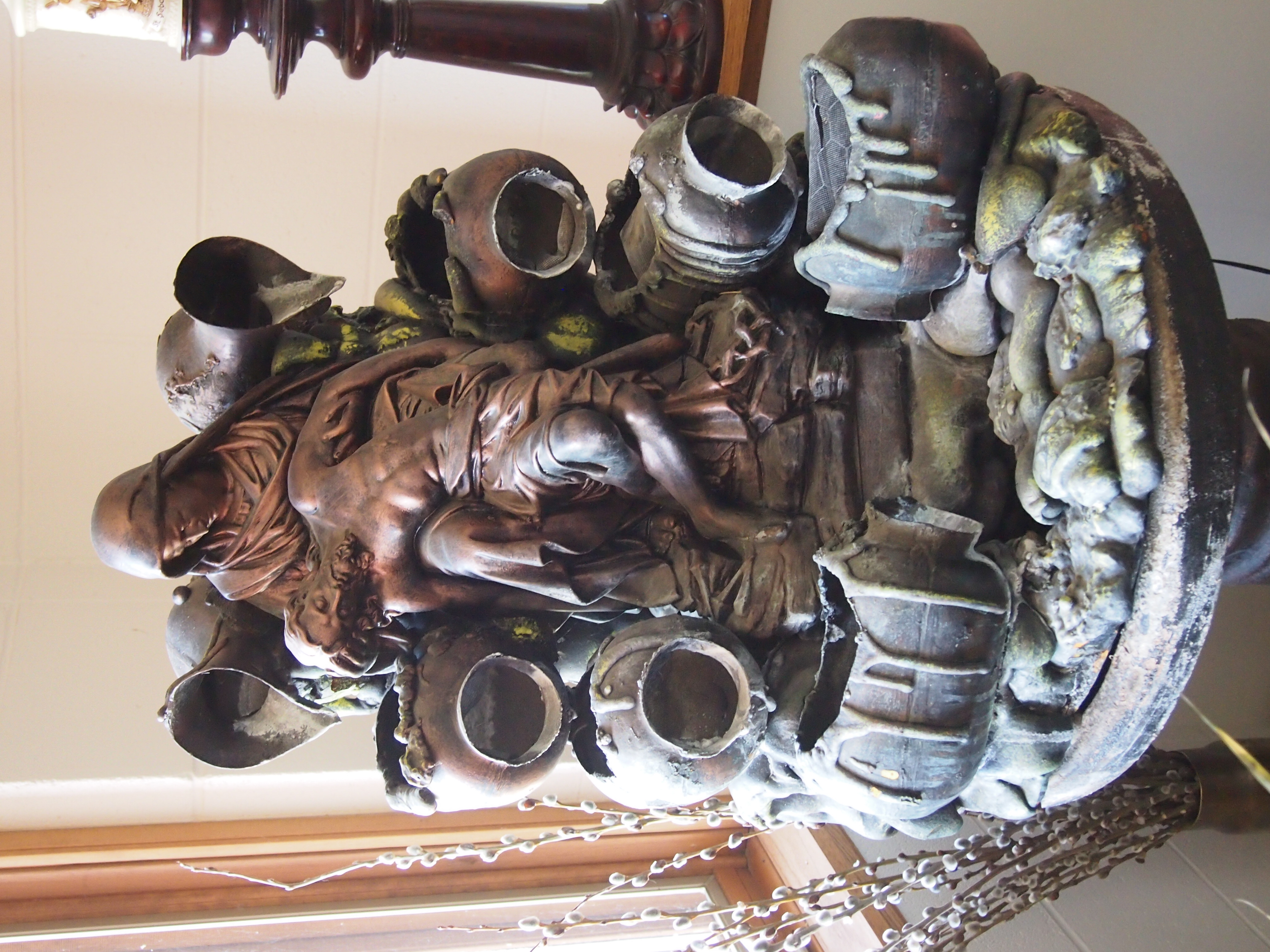
“Taft depicts a hooded figure leaning on a staff and observing a panorama of humanity that rises and falls in a great wave.”

That would be this fellow. Father Time.

Father TimeDoes Father Time that have gender-neutral, 21st-century equivalent? “Temporal Being,” maybe, but that sounds like something Star Trek writers would use. Best to stick with Father Time. After all, Father Time got it on with Mother Nature, and that’s how Life was created. Of course, that’s a heteronormative metaphor, but sometimes you have to run with these things.

This is part of the east side of Fountain of Time. OLYMPUS DIGITAL CAMERAThis is a view of the west side. OLYMPUS DIGITAL CAMERATaft completed it in 1922, working with concrete engineer J.J. Earley. The deteriorated work was restored by the BauerLatoza Studio in 2002. According to the AIA, “Taft envisioned the group sculpted from marble, but the material’s high cost and vulnerability to Chicago’s weather made it impractical. Bronze, his second choice, was also prohibitively expensive, lending to a selection of a pebbly concrete aggregate. The hollow-cast concrete form reinforced with steel was cast in an enormous, 4,500-piece mold.”

Fountain of Time includes a variety of faces.

ArghI like to think of this figure as My Deadline Was Last Week.

Centuries Come, Centuries Go

Last week I took note of some of the monumental items at the Oriental Institute Museum, but of course the museum is home to a lot more artifacts, and most of them were more modest in size. But no less interesting for it. Such as some dice from Roman Egypt.

OLYMPUS DIGITAL CAMERACool. Especially since anyone alive now, two millennia after they were made, could look at them and know exactly what they’re for, even if the games of chance aren’t quite the same. Even cooler is that dice were ancient even then, so much so that their origin is obscure.

Also on display were some knucklebones, an alternative to dice that are probably just as old, if not older (and the ancestor of modern playing jacks?). According the museum, “knucklebones of sheep or oxen were used to determine the number of moves on game boards. The four sides of each bone are distinctive, and each was assigned a specific number. They were normally thrown in pairs, allowing for ten possible combinations.”

The museum also sported plenty of figurines.

Eygptian figurines 1Still charming after all these centuries. Thought to come from a tomb of a courtier named Nykauinpu at Giza, made of limestone and dating from the Old Kingdom, Dynasty 5 of the 25th century BC. So by the time of Julius Caesar, this statue was already older than anything from the time of Julius Caesar is now. Even on a human scale (not to mention geological or cosmological), time’s mind-boggling.

On a sign describing another man-and-woman set of Egyptian figurines, I noted these lines, referring to the way the woman was dressed (emphasis added): “This style of dress was popular for the entire 3,000 years of pharaonic history.” I’ll say one thing about the ancient Egyptians — they found something they liked and stuck with it.

Dog 1, Oompa-Loompah 0

This is a good year to post WWI images, for obvious reasons. I’m not taken with its headline — how much or little Europe has changed hardly seems the point — but this collection of images is worth a look.

Also, here’s a recent dog picture, taken by Ann. Why? Because it’s been a whole year since she arrived at our house. She’s so completely a part of the family it’s hard to remember what the house was like before she came.

OLYMPUS DIGITAL CAMERAShe’s still a healthy young(ish) dog with an appetite for doggish activities, such as chewing things. Recently I found this figure on the floor.OLYMPUS DIGITAL CAMERA A toy Oompa-Loompa. I think it was a promotion from when Charlie and the Chocolate Factory was a new movie. Anyway, our hound clearly did some fang-work on it. From this side, mere flesh wounds. Turn it over, and you see this.

OLYMPUS DIGITAL CAMERAI don’t think any future Toy Story movie is going to depict anything quite like this. Or this.

A Post-Winter, Pre-Spring Stroll

No early greening this year, that’s for sure, though very small buds can be seen if you look closely. Still, Saturday was a fine day for a walk at Meacham Grove Forest Preserve.

April5.14 008It’s been a while since we were there. Despite the warmish temps, not many people were around. That could be because the only entrance to the preserve’s parking lot is off a side street that’s some distance from Lake St., the nearest large road. The forest is highly visible from another large road – Bloomingdale Rd. – but it’s just another roadside feature most of the time. It takes a little effort to figure out where to put your car so that you can walk. An oddly North American situation.

The Curious Statues of Fontana, Wisconsin

Around this time two years ago, during a strangely warm interlude that greened the grass and budded the trees and bushes in March, we spent part of a day at Williams Bay and Lake Geneva, Wisconsin. Lake Geneva is town’s name; Geneva Lake is the lake’s name, supposedly, but I’ve never heard anyone call it that. That was the day we saw this oddity in Lake Geneva.

One of my ambitions that day was to drive all the way around the lake, which we did before returning home (one of these days, I  might walk around the lake, since there’s a trail all the way around; but maybe not all at the same time). On the western edge of the lake is the town of Fontana, whose full name is Fontana-on-Geneva Lake.

We stopped at a little lakeside park in Fontana and found this statue near the beach. PhotoBatch4.10.12 028The plaque says: Dedicated to the memory of ARTHUR B. JENSEN whose generosity and foresight made this beach possible. I assume that’s the same Arthur B. Jensen who wrote Shawneeawkee, friendly Fontana: A history, which can be yours for $100.

Not far away is this memorial.

PhotoBatch4.10.12 027FONTANA WEEPS September 11, 2001. An admirable sentiment, but I have a sneaking feeling that if that plaque happens to survive until 2101, say, people will wander by without the faintest idea what it’s about, even when they notice it, which they won’t. But that’s not a reason to not erect memorials. To paraphrase Mother Teresa, “Memorialize anyway.”

Finally, there was this.

PhotoBatch4.10.12 030Never Say Can’t seems to be the title. Shirley Brost, at least according to one source, seems to be alive and well in Fontana, but I’m not going to track anything else down about her. The oddity about this work isn’t even the frog — but why a frog? — but the not-so-admirable sentiment. I suppose it’s supposed to laud determination, which can be laudable sometimes. But it’s just as important — more important, I’d say — to have a clear idea of what you can, and can’t, do.

Here’s a better idea for a title: Never Say Cant. Except people would think it’s a typo.

Born in Babylonia, Moved to Chicago

The Oriental Institute Museum in Hyde Park, Chicago, houses an embarrassment of riches, a surfeit of treasures, and an abundance of artifacts from times lost to time. Not bad for an organization that isn’t even a century old. The institute’s web site puts it succinctly: “The Oriental Institute is a research organization and museum devoted to the study of the ancient Near East. Founded in 1919 by James Henry Breasted, the Institute, a part of the University of Chicago, is an internationally recognized pioneer in the archaeology, philology, and history of early Near Eastern civilizations.”

Besides the obviously high quality of the collection, which I’m only partly able to appreciate – it’s hard for me to sort out of who was who and when was when in the ancient Near East, except for places that were eventually part of the Roman Empire — I like the museum for two other reasons. First, it’s never been crowded in all the times I’ve been there since the 1980s. Second, it doesn’t pander to visitors with a lot of whiz-bang, touch-it-wow gimmicks. It’s got stuff, and signs describing that stuff. An old-fashioned, static approach to museum organization, for sure. If you go to the Oriental Institute Museum, you’ve got to be prepared to look at things and read about them.

But who’s so jaded that he wouldn’t be impressed by this?

Oriental Institute-2Or this?

OLYMPUS DIGITAL CAMERAOr this?

How'd You Get So Funky?The first item is a colossal bull head from the Hundred-Column Hall of Persepolis, dating from the reigns of Xerxes and Artaxerxes I in the fifth century BC (note: the signs in the museum use BC, not BCE). The horns are lost, which makes me suspect they were made of something really valuable, looted long ago.

Next is a human-headed winged bull — a lamassu — which once was at the entrance to the throne room of Assyrian King Sargon II . Weighs 40 tons. I wouldn’t want to get on his bad side.

Finally, a 17-foot-plus statue of Tutankhamun. Well, sort of. The institute says: “The statue is inscribed for Horemheb whose name was recut over that of King Aye. The statue is assigned to the reign of Tutankhamun on stylistic grounds, for it resembles other representations of that king.” Sure, but it’ll always be King Tut to me.

The Rockefeller Memorial Chapel

Nearly 11 years ago, I wrote, regarding the Rockefeller Memorial Chapel at the University of Chicago and clearly impressed by its size, “John Rockefeller thought big. The structure is huge. A big Gothic thing. I knew that, of course, having passed by it a number of times over the years, but it hit home when I wandered inside. I was the only one there. The glass is mostly clear, so the angled summer sun lighted the place. Several doors were open, so there was a breeze — unusual in such a large church. For large it was, as large as many cathedrals I’ve seen.”

None of that has changed in 11 years, except there was no summer sun or warm breeze last Friday.

Some vital stats, to save a Google search: The chapel is 265 feet long and 102 feet wide at its widest point. The tower, towards the northeast corner, is 207 feet high and can be ascended via a spiral stone staircase of 271 steps. The chapel weighs 32,000 tons, and 56 concrete piers carry the foundations down to bedrock 80 feet below the floor. Its design includes no structural steel.

This is the chapel from the front.

Rockefeller Chapel 1 March 2014From the back, which shows the 72-bell carillon.

OLYMPUS DIGITAL CAMERAAnd inside.

Rockefeller Chapel-2 March 2014The organ is sizable, too. According to the chapel’s web site, it’s an E.M. Skinner creation, vintage 1928, that originally “included four manuals, and had 6,610 organ pipes in 108 ranks; since its 2008 restoration, it now has 8,565 pipes in 132 ranks.” It was quiet when we saw it, but it can make a mighty sound.

Rockefeller Chapel OrganStill fairly light inside for a cloudy day in late March. We spent time looking around and resting on the pews. I took note of the handful of plaques along the walls. Two of them told me that a fair number of U of C men died for their country in both WWI and WWII.

I also noticed a plaque dedicated to U of C academic Ernest DeWitt Burton (1856-1925), a professor of New Testament, director of the University Libraries, and ultimately president of the university. The plaque lauds him highly: His scholarship enlightened religion; his energy completed this chapel; his vision led the university forward.

Naturally I had to look him up. No doubt the professor would have disdained an open-source encyclopedia, but never mind. I can’t help feeling that the groves of academe don’t produce scholars like that anymore.

The Frederick C. Robie House

It was a little hard to get a full picture of the Frederick C. Robie House, which sits horizontally on a 60’ x 180’ lot on the South Side of Chicago. At least it’s hard if you don’t feel like backing up into the street, and I didn’t. The wind was brisk and everyone wanted to get inside.

OLYMPUS DIGITAL CAMERAAs usual with a Frank Lloyd Wright work, it’s just as useful to think of it as a complex work of sculpture as much as a dwelling place, maybe more so. Something you might create with large, very expensive set of Legos, and which needs to be sustained with an IV money drip. The place was expensive from the get-go: the 1910 cost was about $60,000, or roughly $1.4 million in our dollars. For that price Robie got not only the lot and the house, with its long, lean lines, but also the furnishings, which were provided by the architect. And at least FLW didn’t run off with his wife.

OLYMPUS DIGITAL CAMERAYou pick up your tickets at the gift shop (the entrance is pictured above), a space that was originally a garage, since Robie had a fascination for early auto-mobiles, as some wealthy men of the time did. The shop is stocked with architectural-themed books, videos, clothes, games and knickknacks, many associated with FLW, but not all. It included a Lego set – see, you can build architecturally significant Chicago-area houses from Legos – that looked awfully familiar.

OLYMPUS DIGITAL CAMERAThe tour started in the lower level, adjacent to the gift shop-garage, which our guide called the Children’s Playroom, which is habitable but not yet restored. We saw a short video there about the house, including its bumpy history – Robie only lived there a bit more than a year before financial troubles obliged him to sell, to a guy who died shortly after moving in; later, when the Chicago Theological Seminary owned the house, it was nearly razed twice, including a 1950s threat that inspired a 90-year-old FLW to show up to protest.

But of course the building survived, and has even influenced its immediate surroundings . After the video we went outside and took a look at things from the entrance plaza of the Harper Center of the U of C’s Booth School of Business, which is across E. 58th St. The 215,000-square-foot Harper Center, completed only in 2004, references the Robie House with its horizontals and cantilevered elements (a Thornton Tomasetti design: more here).

The house’s entrance is tucked away under one of the large horizontal elements, making it hard to see from the street. The entryway is also only a few inches higher than my height, which makes me speculate that FLW wanted to make it even shorter – why should anything be taller than what he, a short man, needs? If so — and you certainly get that feeling at Taliesin sometimes — WTF, FLW?

But he wasn’t The Genius of later lore quite yet, so he didn’t win on that point. Or maybe it’s that he didn’t really see the design all the way through completion, since he skedaddled to Europe around then.

The second floor, barely visible from the outside through the seeming simple but elegant windows, is an impressive space. The great open room sports interesting glass and wood and lighting features, and I thought it would been a swell place for a swank party – during any decade from the 1920s to the 1950s, since swank was pretty much dead after that. Not sure it would be all that comfortable for daily living, not without more comfortable furniture and more clutter (comfortable for me, at least. What’s life without clutter? Drab.)

Most of the bedrooms aren’t visible on the ordinary tour because they’re on the third floor, which has only one way in or out. For a tour of a dozen or 15 people, apparently, the Chicago Fire Marshall insists on two ways out. So the third floor is accessible via small-group tours that cost more. I didn’t need to see the additional space that badly. We saw one second-floor bedroom, intended to be a guest bedroom, though at the moment it’s devoid of furnishing. I noticed in that room that the electric lights – even though brought up to code by the renovation – are operated by a two-button system, which I don’t see often.

In the not-yet-refurbished kitchen stands a conventional refrigerator, and it doesn’t go with the design at all. But mainly that’s because it stands in front of a dwarf-sized door that leads to a servants’ staircase. That door, the guide pointed out, was for the delivery of ice, and the spot where the refrigerator stands was for an icebox. I hope a little bit of our admission price goes to the purchase of a 1910-vintage ice box, because that spot cries out for one.

Hyde Park ’14

On the northeast corner of S. Woodlawn Ave. and E. 58th St. in Hyde Park, on the South Side of Chicago, is the Frederick C. Robie House, on that site for more than 100 years and best known as an exemplar of the Prairie School of Design. Next door to its north, at 5751 S. Woodlawn, is the Seminary Co-op Bookstore, one of my favorite bookstores anywhere, though new to the site. One block west of the intersection is the Oriental Institute Museum, repository of Near Eastern treasures, most of which they’ve dug up themselves. The Rockefeller Memorial Chapel rises to the southwest of the intersection, an ornate, soaring structure. That’s a lot within a short walk.

Last week was spring break for Lilly and Ann. Last year I took them to Texas for the occasion, but for various reasons this year, the idea of going anywhere never really took root. Still, I wanted to go somewhere – even if only a few miles away and for a few hours – and see something new if possible. In the summer of 2003, I wrote, “I walked by the Robie House, a creation of Frank Lloyd Wright. Him again. One of these days, I will take the tour, but not today.”

I didn’t know at the time that renovation of the Robie House had barely started, and hasn’t been completed even now, though mostly it has. The main goal last Friday was to tour the Robie House, which we did. Afterward we walked over to Rockefeller Chapel, and then spent an hour or so in the Oriental Institute Museum.

It was still fairly cold, but at least the sidewalks were clear of ice, and we didn’t have far to walk. Street parking always seems to be available next to the Midway Plaisance, just south of our destinations. In 1893, the Midway was briefly the focus of the world’s attention as part of the world’s fair, but now it’s a little-known urban green space, at least outside Chicago. That’s too bad, because it’s certainly interesting, if you know what was there.

We didn’t go into the Seminary Co-op Bookstore. I was astonished to see its new location, which I hadn’t heard about. Until a year and a half ago, the store was snugly located in the basement of the Chicago Theological Seminary, at 5757 S. University Ave. Turns out the seminary has moved, too, and now the building is home to the U of C’s Dept. of Economics, so famed in free market song and story.

Wiki, for what it’s worth, says: “The seminary move was controversial: it involved the disinterring of multiple graves.” I didn’t know anyone was buried there. Who was buried there? I’ll have to look into that sometime. Once upon a time, I did enjoy the Thorndike Hilton Memorial Chapel and the collection of rocks embedded in the seminary wall. I assume those are part of the Chicago School of Economics now.

Currently the streetscape between the Robie House and where the Seminary Co-op Bookstore used to be – which is across the street from the Oriental Institute Museum — is under construction.

OLYMPUS DIGITAL CAMERAI was surprised to see the bookstore’s new location, which even seems to include a café, like you might see in a Barnes & Noble. It didn’t seem right. At the basement location, there was no room for anything but books and more books. This video, at least, assures us that the new location still has a “maze aspect” and that Stanley Tigerman did the design (himself or Tigerman McCurry Architects staff?), which I guess counts for something.

But how could the new site have the book-cave charm of the old? Next time I’m in Hyde Park, I’ll take a look, to see if the new can hold a candle to the old.