More on the Farnsworth

Our tour of the Farnsworth House on Saturday took us inside its floor-to-ceiling glass walls, where photography isn’t permitted on weekends. We heard about the mechanical aspects of the house — all those pesky practical items like electricity and water — the guest bathroom, Dr. Farnsworth’s bathroom, the kitchen zone with its long stainless steel prep area, the history of the curtains, the placement of the few lights, and the back-and-forth between client and architect about whether there ought to be at least one closet. Architect said no, client said yes, so ultimately a freestanding wardrobe was fashioned by one of Mies’ employees for the house.

Previously I hadn’t bothered to find out much about how the house came to be. Not to worry, a video at the visitor center and the guide filled us in on some details, such as initially warm (maybe very warm) relations between the unmarried Dr. Farnsworth and the free-with-his-affections Mies, which eventually grew acrimonious. Especially when Mies presented her with a bill she considered inflated. Less might be more, but not when it came to his fee.

Outside again we went to the “back” of the house, that is, the side facing away from the river.

This is a fuller view.

The row of kitchen-counter-like shapes under the brown interior structure are in fact kitchen counters, with the “bedroom” off to the left. The black cylinder-like thing under the main level — the other columns are white — is where water goes in and out, and electricity comes in.

Got a good look under the house, too.

Another bit of the house’s history involves the land to the west. Lord Palumbo built a boathouse there, and just beyond it is a road: Fox River Dr., which crosses the river within sight of the house. In the late 1940s, the road and bridge were small. In the late ’60s, Kendall County took two acres by eminent domain to widen the road and build a bigger bridge. Dr. Farnsworth fought it, but lost. With the increase in population over the decades since then in this part of the state, the road’s now pretty busy, at least on a Saturday afternoon. Quiet isn’t something you get on the Farnsworth grounds these days.

From the back of the house, the property slopes upward to a small hill, which would have been the rational place to build a dwelling, considering its location above the flood plain. But as suggested about some of Frank Lloyd Wright’s works, perhaps it’s best to think of this Miesian creation as a work of sculpture rather than a house. And a right interesting sculpture it is.

The Farnsworth House

I can’t say that I know architecture, but I know what’s interesting. The Farnsworth House is definitely that. Built over 60 years ago in rural – and now exurban – Illinois, it’s a glass-and-steel, but most notably glass, house designed by Ludwig Mies van der Rohe, famed Chicago architect (which he became later in life, another unwitting gift to America from the Nazis), and one of the panjandrums of Modernism. It’s also hard for amateur photographers like myself to get a good image of the place.

This is the “front,” facing the Fox River, illustrating the fact that the house is all about the horizontal: a “deck” (my term) accessible by stairs, a main level accessible by more stairs, and then the flat roof, presumably accessible by ladder. The deck is wide open to the elements, though shaded by trees in our time, and the main level is either outside or inside, as delineated by glass walls. Except that, as I understand it, one of the purposes of the glass walls was to help obviate the distinction between exterior and interior. Unless you close the curtains, which I understand the residents did with some regularity, and which the National Trust does when it isn’t giving tours.

For a while we stood in front as our guide filled us in on the building’s origin and other details of the site, such as its propensity to flood. Mies knew that, of course, and raised the structure to avoid the worst of the Fox River’s periodic rampages. Turns out that because of development upstream, rainwater and snowmelt drain faster into the river than they used to, so the river rises higher than it did in the early 20th century. Oops. Such torrents flooded the house in 1956 and 1996. Not sure that’s what Mies had in mind when he talked of integrating the built environment with the natural one.

Apparently the ’96 flood was especially vicious, popping one of the floor-to-ceiling windows and washing away some of the artwork belonging to Lord Palumbo, the property’s second owner.

We went up the stairs to take in the view from the deck…

…and then to main level. Both levels are floored with Italian travertine, a wonderful stone hand-picked by Mies. According to the guide, so far the National Trust hasn’t been able to locate any exactly like them, so there aren’t any replacements. It’s wonder we were allowed to walk on them at all.

Up on the main level’s “porch,” (my term again) our guide gave us the rules for going inside: no photos, no shoes, and no sitting around on the furniture. We were free to take pictures of the interior through the window-walls which, of course, offer an expansive view of the inside.

Something you appreciate after standing around for a few minutes on the main level, at least I did, is the lack of handrails. That is, in fact, a code issue that would prevent the house from being built in our time exactly as it was in the late ’40s (among a few other things). The drop is only a bit more than five feet, of course, but even so it could be an injurious crash to the ground, or worse, into the narrow space between the deck and the main level. I don’t know if the matter of rails ever came up between the original owner, Dr. Edith Farnsworth, and Meis, but I feel certain any such thing would have been ruled out for aesthetic reasons.

Down by the Fox Again

Saturday found us down near the Fox River again, this time further downstream than Aurora — at a spot near Plano, Illinois. It was a fine day for a walk along the river. Temps were in the upper 70s F and the skies were partly cloudy, and everything was still summer green, even now in the declining part of the season. The path paralleled the river most of the way.

In places, views of the river peeked through the thick foliage.

Underfoot, it was clear the river had overstepped its banks earlier this year. That’s par for the course for the Fox.

So the natural aspects of the property were pleasant, but that isn’t what we’d come to see. We were paying a visit to the Farnsworth House, which is located south of Plano, on the river. To reach the property, which since 2003 has been a house museum owned by the National Trust for Historic Preservation, you park about a half-mile away at the visitors center. Once your tour starts — ours was a 1 p.m. Saturday — you walk via path the half-mile to the site.

In as much as I understand it, the structure is an exemplar of Modernism. It was worth the drive southwest of metro Chicago, and then the walk near the river, to see it. More about that tomorrow.

Kinokawa, 1991

August 18, 1991

Osaka radio, Bonchi Rice Snack, high winds pouring through my window; such is the stuff of today, the last day of O-bon. The highlight of the week was an excursion to Kinokawa, a river about an hour south by train, and then more time by car.

Last Saturday, one of my students, Aiko, spontaneously invited me to go after I ran into her at Keyston, where my friend Don and another guy were playing a gig. Aiko had been in turn invited by her friend Kumiko who – together with her sister and brother-in-law – rented a two-room “cabin” overlooking the Kinokawa. Kumiko is having an affair with Don at the moment. So I was expecting him to come along. Wrong again. Instead, Kumiko invited my friend Bill, who’s attracted to Kumiko in spite of the fact, or maybe because of the fact, that he married another woman earlier in the summer. Why? I don’t know. Maybe Kumiko just likes fanning Bill’s ardor.

[Unsurprisingly, Bill’s marriage – to a Japanese woman – didn’t last very long, and after their divorce, rumor was she dimed on him to immigration, to make sure he’d leave the country. I went to his “deportation party” just before he left, though strictly speaking, I think he left ahead legal action.]

None of those interpersonal complications really concerned me. I just enjoyed a fine two days out of town. The river wasn’t much more than a large creek. The territory, hilly and lush, reminded me of southern Idaho, minus the tall pines. The slopes down to the river were steep, meaning a climb up from the road to the cabin, and another one down to the riverbed, which was shallow, pebbly, and remarkably clean for a Japanese river.

Larger rocks lay here and there in the riverbed. For dinner the first day, we set up a grill on the riverbank and put a watermelon afloat in the cool water, tethered to one of the rocks. That detail sticks in my mind. Almost every cluster of people I saw along the river – and there were many groups – had a melon bobbing nearby.

Most of the people visiting the river had either pitched tents, or were sleeping in their cars, as we discovered when we went to a nearby bridge to shoot off fireworks at 2 a.m. (I can’t remember whose bright idea that was.) One guy emerged from his car and yelled at us a Japanese equivalent of “Shut the f— up!”, which we deserved. I was impressed at the terrific fireworks you can buy at convenience stores in Japan. Big gaudy tubes that spit sparks and fireballs and whiz and pop.

Thursday night we drove in three cars to the Hashimoto matsuri (festival). Getting there only proved that there’s no road in Japan too small for a traffic jam. At one point all four occupants of the car I was in fell asleep while waiting for the cars ahead to move. Good thing the driver had put it in Park. I woke first and noticed that cars behind us were going around us. Odd, because I think that in most places, we’d have gotten honked at.

The festival itself was a mass of people. The centerpiece of the festivities was a big dance circling a band who played continuously. The music wasn’t exactly rock, though there were elements of it, especially the drums. Yet it was bar after bar after bar of the same thing, and forming a circle around the band were the dancers, making steps and hand motions with their fans in a pattern I couldn’t quite follow. It was mesmerizing in a way that a light show is sometimes.

Aurora Across the Millennia

Behind the former Leland Hotel in Aurora is a spot called Millennium Plaza, dedicated on January 1, 2000. It has a nice view of the Fox River, but otherwise isn’t a very inspiring public space. There’s a large bell.

I looked around, but there’s no clue about the bell’s history or what it’s doing there. No doubt it has a history, and maybe an interesting one tied to Aurora’s story. Maybe the municipal committee responsible for creating the plaza ran out of money when it came time to commission a plaque or even a small sign for it.

A tower rises over the plaza.

Not a color or shape I would have chosen. But there it is. Apparently, if you stand at a certain spot not far away on a clear night, the tower will guide your eye to Polaris. The committee found money to add a plaque that explains that. Even though the plaque has been scratched up by bush-league vandals, I’m able to quote it at length.

Millennium Tower stands as Aurora’s Salute to the third millennium. It has brought the business and private sectors of the community together to leave a lasting gift to future generations of Aurora citizens.

Millennium Tower is constructed in a triangular form, with each side having its own plaza representing the past, present and future of Aurora. We enter the tower at Present Plaza, moving to the south and down, we stand on Past Plaza, and to the north and up, we stand on Future Plaza.

I have to say at this point that just wandering around the site as a casual visitor, there’s no sense that it’s divided into three parts, much less ones that sound so temporally disorienting. And not to pick nits — actually, I like picking this kind of nit — what’s the difference between the business and private sectors?

The tower’s orientation is true north. The upper angle of the tower is at 42.5 degrees. Standing on the granite stone at the entrance to the tower, one can sight at the peak of the tower to the North Star.

As the North Star has lead mankind into the future, so today we, the citizens of Aurora, dedicate Millennium Tower to the future generations of Aurorans to guide you into the future millenniums.

Wait, what? It’s interesting that the tower points to Polaris, I guess, though it’s one of easiest stars to find in the sky — the easiest — if you happen to be in the Northern Hemisphere. But what’s this about the North Star leading mankind into the future? As important as Polaris might be to navigation, and even considering that it shows up occasionally as a symbol of constancy in literature, what’s that supposed to mean?

Also, and here’s another nit, I suspect the planners of the tower had never heard of the precession of the equinoxes. That’s something that moves along at a millennial pace. We won’t live to see it, of course, but poor old Polaris won’t be the pole star forever — not even by the beginning of the fifth millennium.

Aurora itself might not last so long, but you never know. Whatever its current troubles, Damascus (for example) has been around a really long time, and probably has thousands of years to go. Aurora might even be a major city someday — where was it that became the capital of a large new empire in the fourth millennium in A Canticle for Leibowitz? Texarkana.

The Leland & The Aurora

This fine building stands at 7 S. Stolp Ave. on Stolp Island in Aurora. The 1920s was clearly an age of  fine buildings, and we’re fortunate to still have so many in Chicago and environs.

Built as the Leland Hotel in 1928, it’s now Fox Island Place Apartments. A helpful plaque on the exterior wall told me that the structure is on the National Register of Historic Places. “Designed by Anker Sveere Graven and Arthur Guy Mayger… it was the tallest building in Illinois outside of Chicago.”

That seems like reaching to find a distinction, but never mind. “In addition to being a first-class hotel, it became an important entertainment center,” the plaque continued. “In the 1930s it was the recording studio for some of the most influential blues musicians of the golden age of blues recording. This plaque honors this historic building, and these artists.”

And it lists some of them. I will too, just as the plaque does. With some links. As the plaque cannot. Not yet, anyway.

John Lee “Sonny Boy” Williamson – Harmonica Legend

Big Bill Broonzy – Guitar/Singer

Hudson “Tampa Red” Whittaker – The Guitar Wizard

Yank Rachell – Mandolin

“Robert Night Hawk” Robert Lee McCoy – Guitar

Bill “Jazz” Gillam – Harmonica

Big Joe Williams – Guitar

Washboard Sam – Washboard

Lester Melrose – Producer

Across the street from the former Leland is the former Aurora Hotel, now the North Island Apartments. It dates from 1917 and is also a nice bit of work.

Not, as far as I can tell, where bluesmen hung out. A simpler plaque on the building says that one H. Ziegler Dietz was the original architect; hope his commissions didn’t dry up because of the war. The redevelopment architect in 1998 was Carl R. Klimek & Associates.

On Stolp Island

I took pictures at the western end of the New York Street Memorial Bridge in Aurora, but naturally I had to walk across it too. Or at least across the western section of the bridge to Stolp Island, because I didn’t realize at that moment that the eastern section of the bridge counted as part of the same bridge.

HistoricBridges.org explains: “The New York Street Memorial Bridge is technically a single bridge spanning the entire river. However, in the 1960s, fill was brought in to expand the island northward, and the center of the bridge was buried in the fill. Today, a parking garage is located south of the former center of the bridge and a casino is located north of the former center of the bridge.”

I made it as far that former center of the bridge, where I saw a plaque dedicated to Gen. Pershing.

It looks like it was tacked on to the parking garage, but the plaque came first, put there in 1960 for Pershing’s centennial (about 12 years after he died). Not far away was a bas-relief, flanked by eagles. I didn’t see a sign describing the work, but it’s safe to say it honors the ordinary soldiers of the Great War.

Across the street, in front of the casino, is the statue “Victory.”

“The Chicago Architectural Bronze Company manufactured the bronze tablets and light fixtures. Roman Bronze Works of New York City cast the bridge’s crowning central figure of Victory,” according to HistoricBridges.org.

Does anyone entering the casino mistake her for Lady Luck? Of course, Lady Luck doesn’t spend much time in a casino, however much gamblers want her to. Or maybe she does, but hews more closely to Fortuna, who inspired both good and bad luck. I think Dame Probability runs the joint – and she’s always on the side of the house.

The New York Street Memorial Bridge

On Saturday afternoon, I got a good look at the New York Street Memorial Bridge in Aurora, Illinois, which spans the Fox River.

My vantage for this image was from the Fox River Trail, next to the river. The bridge connects the west bank of the river to a large island — large enough, in fact, that a good bit of downtown Aurora is built on it — and then another section of the bridge (not pictured) connects the island with the east bank of the river. The building in the background is the Hollywood Aurora Casino, which is located on the northern tip of the island — Stolp Island, to use its euphonious name.

HistoricBridges.org tells me that “the New York Street Memorial Bridge was designed as a memorial to World War I veterans. The bridge is far more than a typical memorial bridge where a simple memorial plaque is placed on the bridge. Instead, the bridge displays a truly beautiful design where the bridge itself is the memorial. At each end of the bridge, a concrete statue titled ‘Memory’ rises up above the railings at the westernmost and easternmost pier points.”

This is one of the “Memory” statues. At the base of this statue — and I suppose the other three, though I didn’t check — is a plaque. Oddly, its language doesn’t explicitly memorialize those who fought in WWI, but considering the date on the plaque, those who built the bridge probably assumed that everyone would know who it was for. The plaque says:

MEMORIAL BRIDGE

Aurora – Illinois

1930-1931

Be this memorial forever dedicated to the defenders of American ideals; as a reverent memory to the departed; as a vivid tribute to the living; and as a patriotic challenge to posterity, that these ideals shall not perish. Anon.”

More from HistoricBridges.org: “The bridge was originally proposed and designed by Aurora City Engineer Walter E. Deuchler, but citizens then requested the bridge be a memorial bridge and so Emory Seidel and Karl Miller of Seidel Studios of Chicago… were hired to redesign the proposed bridge as the memorial bridge seen today.”

More about the bridge is at the site, including information from the National Register Historic District nomination form.

A closer look at “Memory.”

Posterity drives and walks by her every day. Who sees her as anything more than a bridge ornament? A few, perhaps. Could be that “Memory” has mostly been forgotten.

Summer of ’78

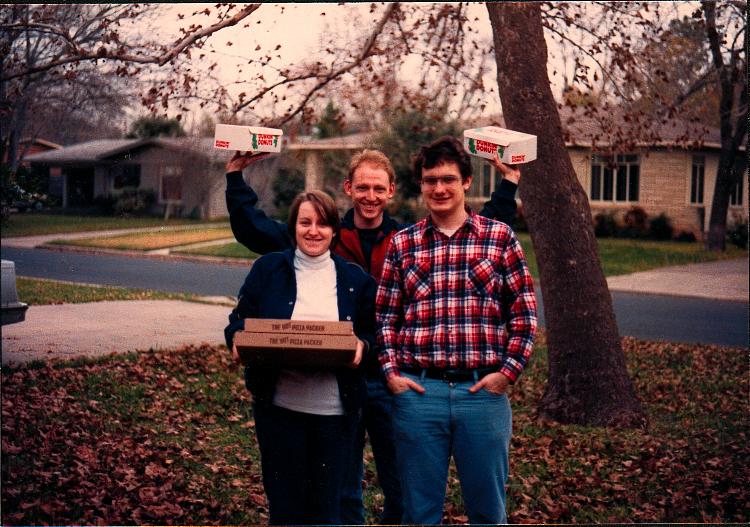
So few are the images I have of high school friends that this might be the only one I haven’t posted at some point. It’s provided to me courtesy of Catherine, who’s in the picture.

From left: me, Ellen, Donna, Tom T., Melanie, Kirk, Nancy, Tom J. and Catherine.

It might have been taken by Catherine and Melanie’s father (R.I.P., Mr. F.). I can’t pinpoint the day, but it was in August before senior year started (senior year for all but two in the shot). Mid-August, because I’d been in Austin early in the month and then on a bus epic of a trip to Stevens Point, Wisconsin, and back from the 5th to the 10th.

It might have been August 14, 1978. I marked on the calendar I kept at the time that I’d gone to Ellen’s – with a fair number of other people – to listen to The War of the Worlds concept album, which was brand new. In full, it was called Jeff Wayne’s Musical Version of The War of the Worlds. I remember all of us sitting in her living room, listening to the whole thing as if it were a live performance. I doubt that very many people even remember that record any more, though I’ve read it was more popular in the UK than the US. Who owned it among my friends, and who suggested we listen to it, I couldn’t say.

This picture was taken at Catherine’s home, not Ellen’s, so either it was another day, or we migrated from one place to the other – entirely possible. I’m glad to report that, as far as I know, everyone in the picture is still alive, except almost assuredly the cat. Among us, we have 15 children, though I might be miscounting that.

Speaking of items from the past, but not quite so long ago, it’s been 10 years to the day since we moved into our house.

Dog v. Skunk

We usually let the dog out in the back yard one more time before we go to bed, and usually she isn’t very noisy. There isn’t much to stimulate her barking – nobody walking their dogs in the park behind our fence, no active squirrels or birds, no kids playing. But one recent night she cut loose and made a lot of noise.

Barking isn’t something that should come from your yard at 11 p.m. or midnight, so I went to bring her in. She was focused on the edge of the deck, snout down, pawing the ground. Something was under the deck. At first I thought the raccoon – a raccoon – had returned, since one seemed to live there for a little while a few years ago. Then I smelled skunk.

I really wanted to get her in. It wasn’t easy, but I did it. By then the reek of skunk was pretty strong. It turned out the dog hadn’t been sprayed directly, or at least the understructure of the deck caught most of it. Good thing, since the dog smells like dog and needs to smell no worse. Soon the stink wafted faintly into the house. It was gone by morning, except for the deck, which still smells of skunk, though not that much (the rest of family feels that it’s more powerful that I do, though).

About 20 minutes later, as I was in bed reading, I heard barking from elsewhere. As I’ve said, that’s fairly rare, but I think it was the dogs a couple of houses down from us, having their own encounter with the skunk.