The Mizumoto Japanese Stroll Garden

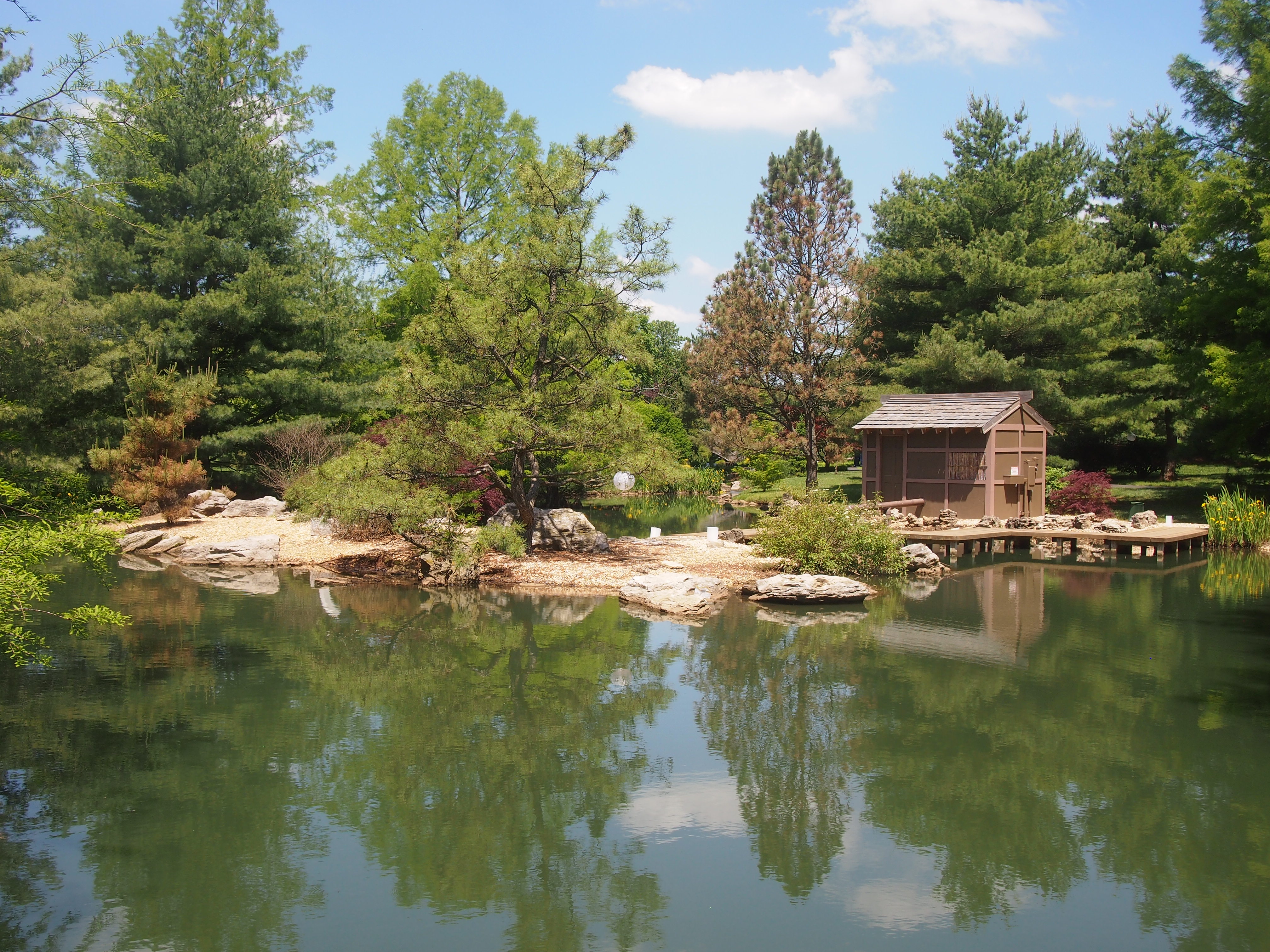
There are a surprising number of Japanese gardens in the United States, as illustrated by this Wiki list of them, though it’s probably incomplete. It had never occurred to me that there might be one in Springfield, Mo., until I spied it on a map: the Mizumoto Japanese Stroll Garden.

The garden is part of the larger Springfield-Greene County Botanical Center, which also includes an azelea garden, dogwood garden, iris garden, butterfly garden, hosta garden, dwarf conifer garden, and more. All that sounds nice, but on the road sometimes you have to focus. The stroll garden it was.

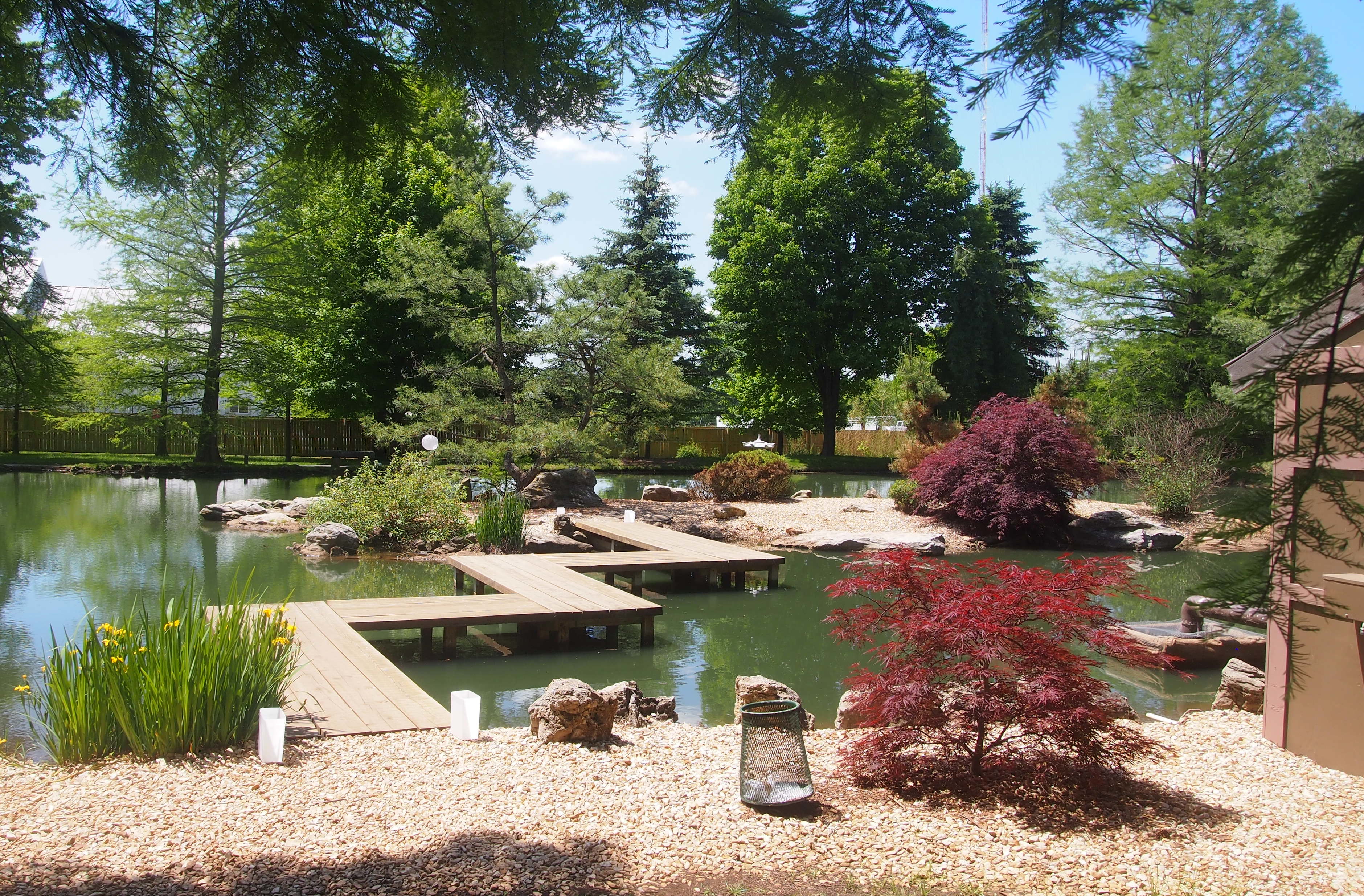
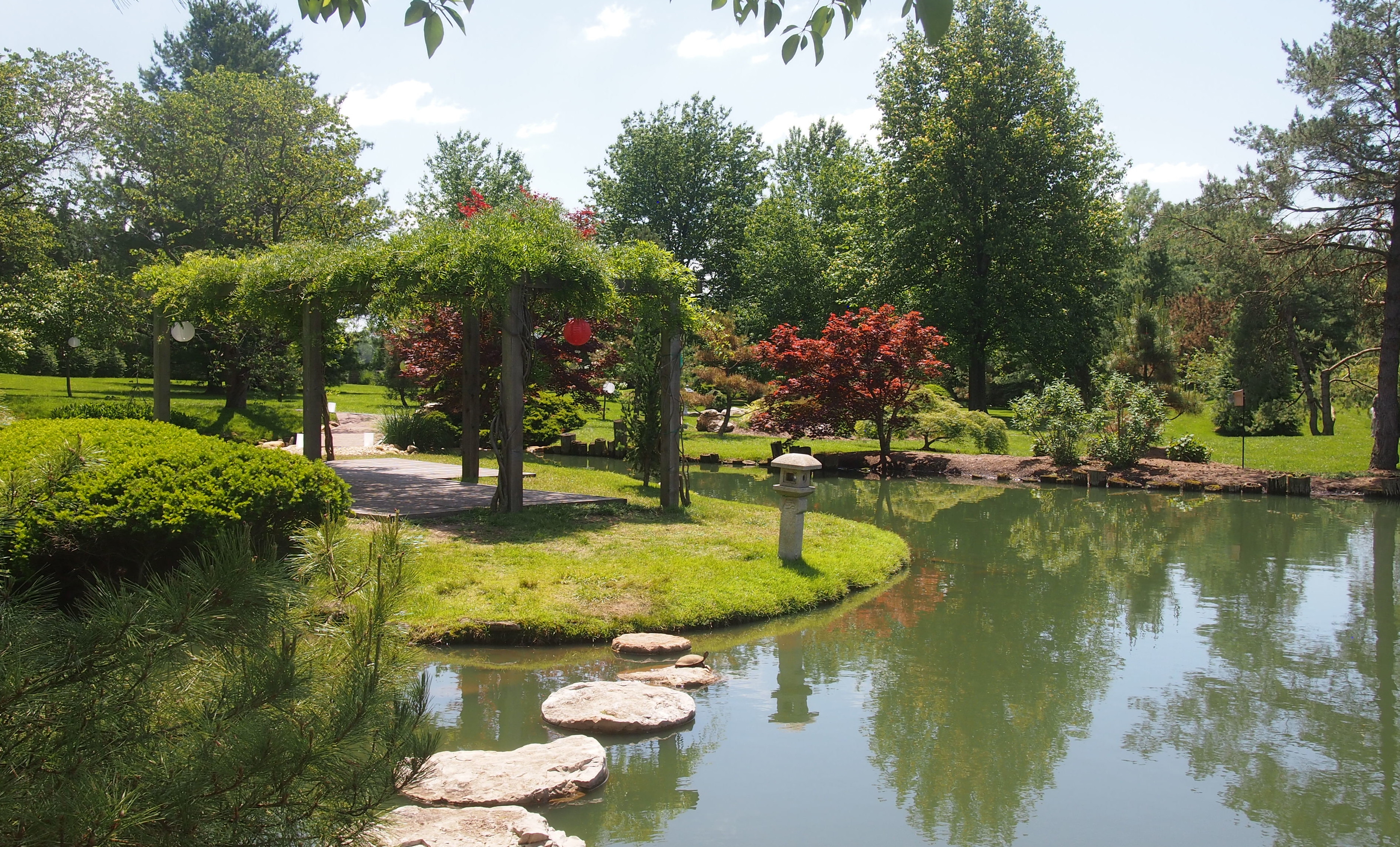
It had everything you’d expect, trees and shrubs and flowers and lanterns and other structures along a winding path, along with water features.
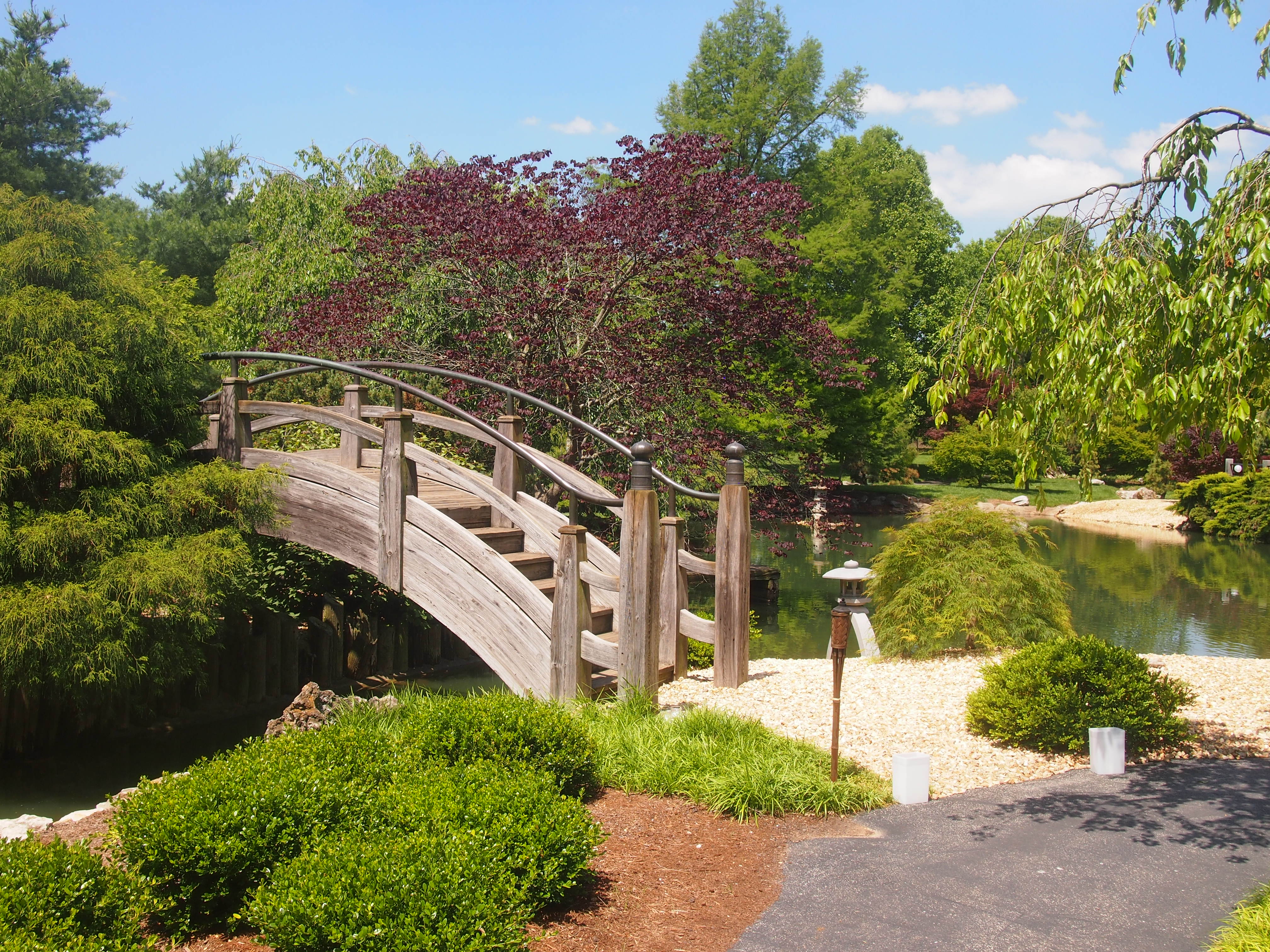
Mizumoto Japanese Stroll GardenA zigzag bridge.

Mizumoto Japanese Stroll GardenAccording to one web site anyway, the notion such bridges were designed to prevent dimwitted evil spirits from being able to cross them is baloney.

THE MYTH: Some misguided Westerners claim that evil spirits can only travel in straight lines and that Japanese gardens have zig-zag bridges to prevent evil spirits from moving through them.

THE FACT: Japanese gardens do sometimes feature zig-zag bridges, but the evil spirit story is complete nonsense. Zig-zag bridges are featured in Japanese gardens partially because they are attractive and because they are interesting to walk over. There is also a charming story that links zig-zag bridges to Japanese literature and culture. [?] The zig-zag bridge motif is a natural fit for many of the Japanese arts including gardening.

A moon bridge.
Mizumoto Japanese Stroll GardenExpanses of lawn.
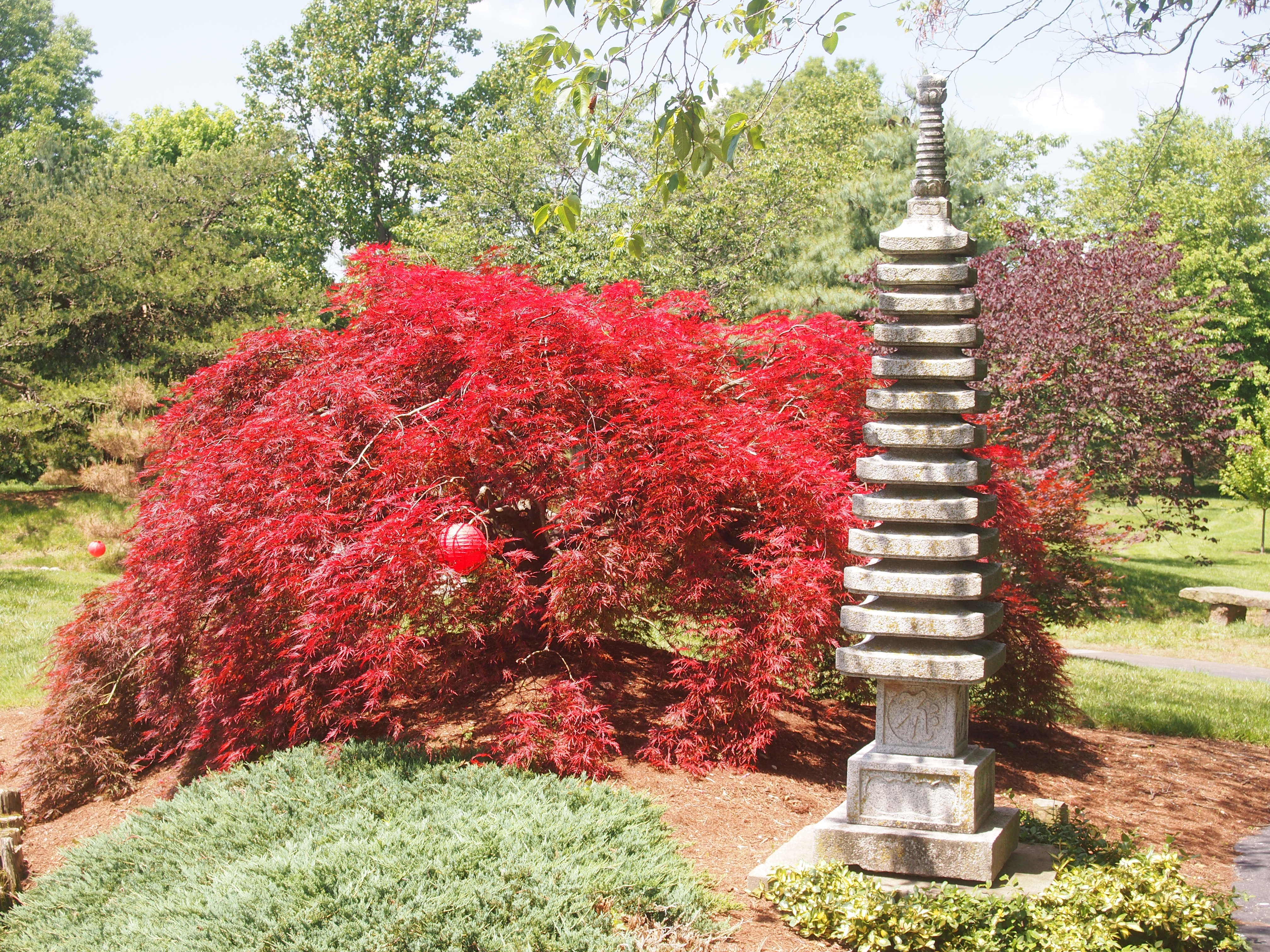
Mizumoto Japanese Stroll GardenNot all the foliage is green in the spring.
Mizumoto Japanese Stroll GardenA trellis.

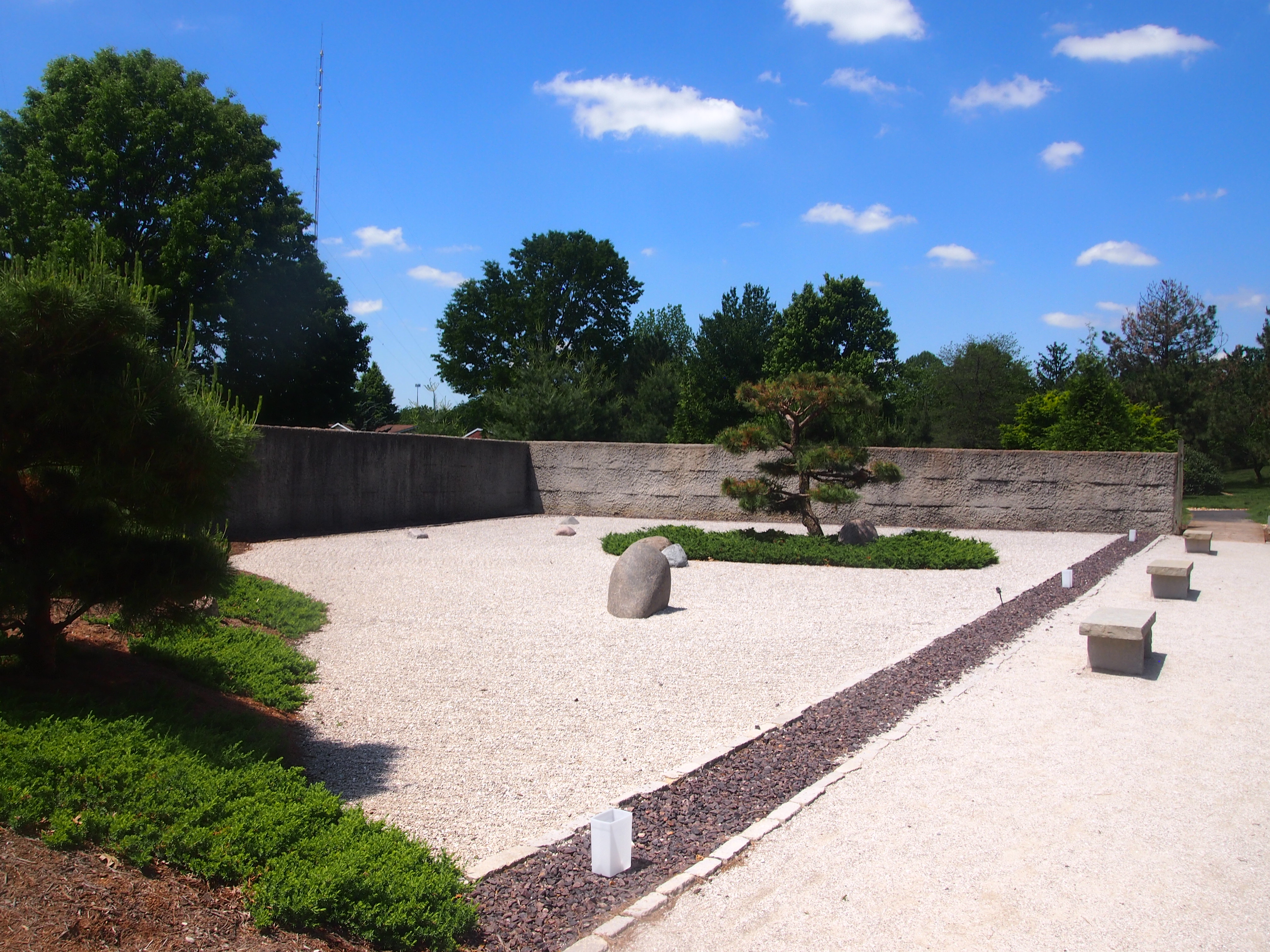
Mizumoto Stroll Garden 2017A zen garden. But of course.
Mizumoto Stroll Garden 2017And some droopy pines, the likes of which I once saw in Rockford.
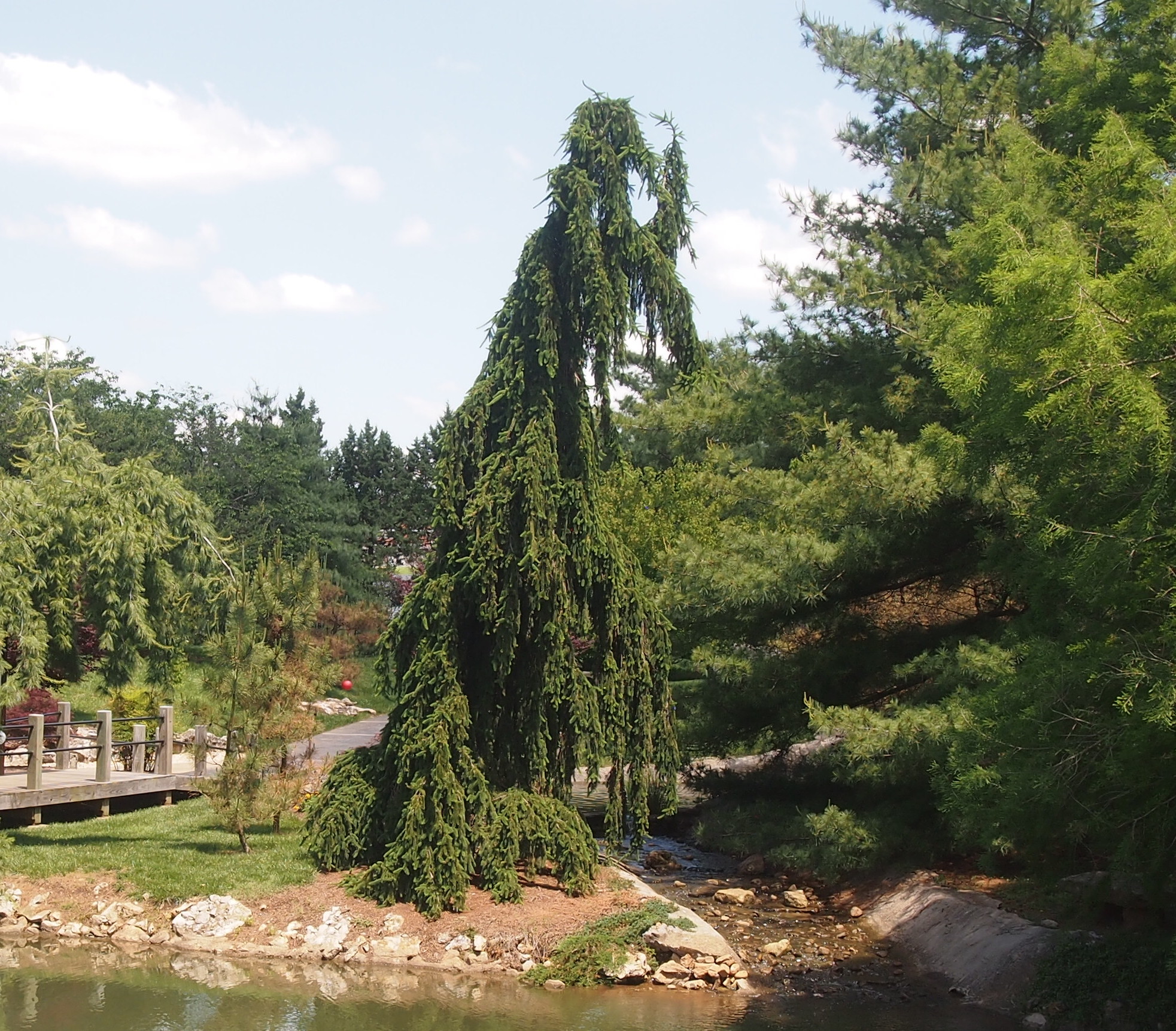
Mizumoto Stroll Garden 2017According to Japanesegardening.org, the 7.5-acre Stroll Garden is the oldest attraction at the Springfield-Greene County Botanical Center, now a little more than 30 years old. “The plan was inspired by a Fort Worth, Texas copy of the Garden of the Abbot’s Quarters in Kyoto,” it says. Probably that means Tofukuji Temple, which is indeed stunning.

“The garden was initiated by the superintendent of park operations, Bill Payne, in the early 1980s and supported with partnerships from the Springfield Sister Cities Association, The Southwest District of Federated Garden Clubs, The Botanical Society of Southwest Missouri and the Friends of the Garden.

“The garden was given the name Mizumoto in 2004, in honor of Yuriko Mizumoto Scott. She generously acts as a bridge between her native Japan and her home in the Ozarks. As the first Japanese War bride brought back to the United States, her insight has the breadth of a bi-cultural history.” First war bride brought to the Ozarks? Not to be pedantic, but I think they mean postwar bride. Or occupation bride.

“Mrs. Mizumoto Scott spent many years as a volunteer in garden maintenance and hosting tour groups. She has also conducted hundreds of tea ceremonies and explained the customs of Japan. The gardens are maintained by the Friends of the Garden Japanese Gardening Group and Park staff. Gardens are supported by the Springfield Sister Cities Association Isesaki Committee.”

Well worth the stop in Springfield, a town I’d only ever known before as the turn off to Branson.
GTT 2017

This month Lilly and I visited Texas for a couple of weeks, beginning when I picked her up on May 12 in Champaign, at the end of her exams at UIUC, and ending with our return to metro Chicago on May 26. Unlike last summer, we mostly took direct routes, there and back. All together, we drove just a shade over 2611 miles through only four states, but ranging from about 42 degrees North to 29 degrees North.

Mostly we spent time with family: her grandmother and uncles and cousins, in San Antonio and Dallas, most of whom she hasn’t seen recently. She also met little cousin Neil for the first time.

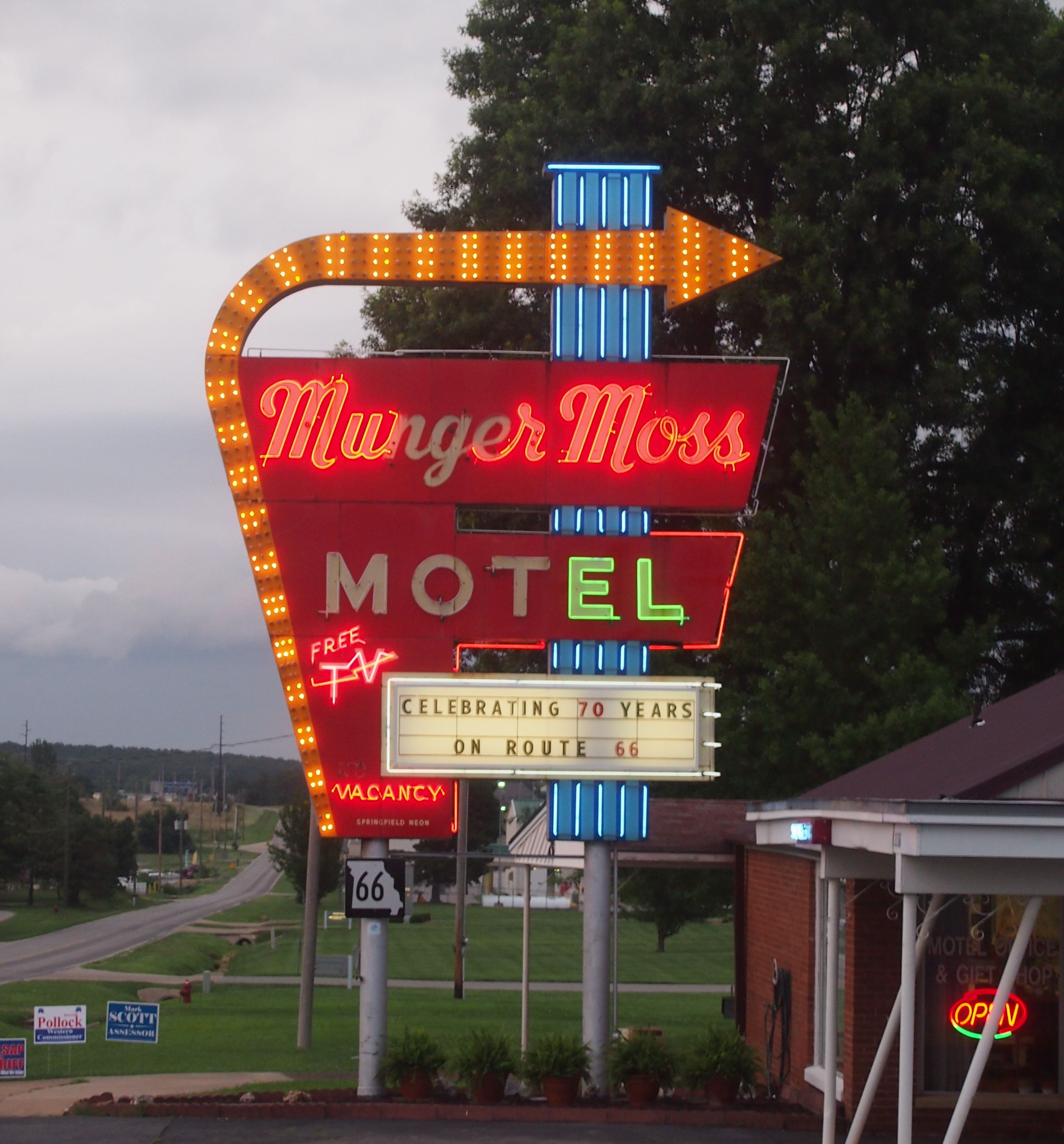
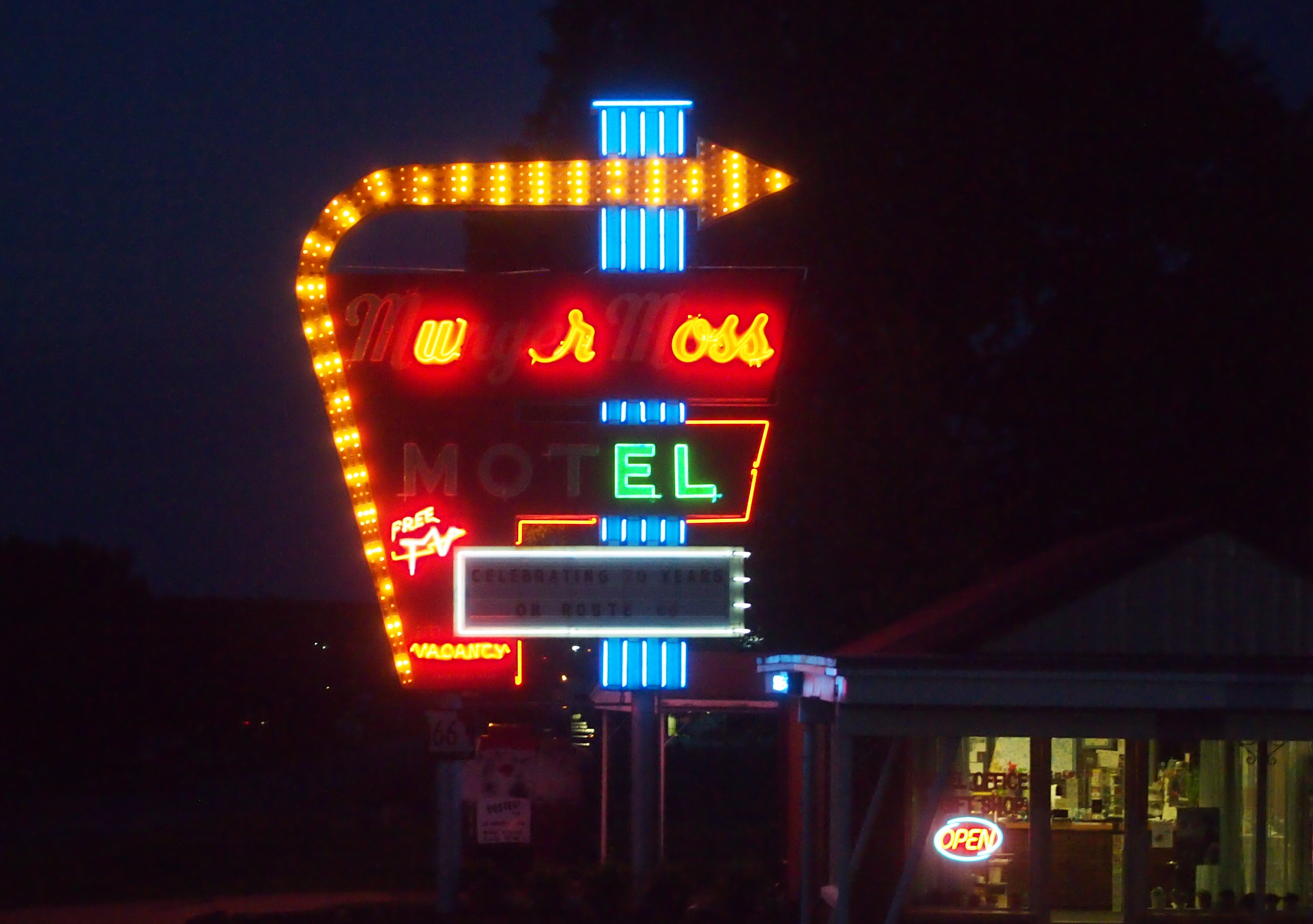
From Champaign, we headed to Effingham, where we passed the giant cross, visible from the highway, but did not stop for it, and then headed west to St. Louis. By evening, we’d made it to Lebanon, Mo., and the Munger Moss Motel, which has had a few more neon burnouts since Ann and I stopped there last year.

Munger Moss sign 2017The second day, we went to Dallas by way of Springfield, Mo., where we stopped to stroll in the Mizumoto Japanese Stroll Garden, a part of the Springfield Botanical Gardens. Later that day, we stopped in Muskogee, Okla., and took a look at the USS Batfish, a WWII-vintage submarine incongruously perched on land and functioning as a museum.

On Sunday, May 14, we proceeded to San Antonio, with my brother Jay joining us. We stopped for a delightful lunch in Austin with Tom Jones that afternoon at Trudy’s, a local brand. Tom was already an old friend of mine when I was Lilly’s age.

Circumstances forced us to scrub our plans to drive to Big Bend National Park for a long weekend beginning on the 18th. While in San Antonio, Lilly went to North Star Mall one day by Uber, and on another day Jay and Lilly and my nephew Dees went to the Witte Museum and then the Sunken Gardens (formally, the Japanese Tea Garden). On Saturday, May 20, we to returned to Jay’s house Dallas via U.S. 281 until north of Austin, picking up I-35 near Killeen, because there’s no reason to go through Austin unless you’re going to Austin.

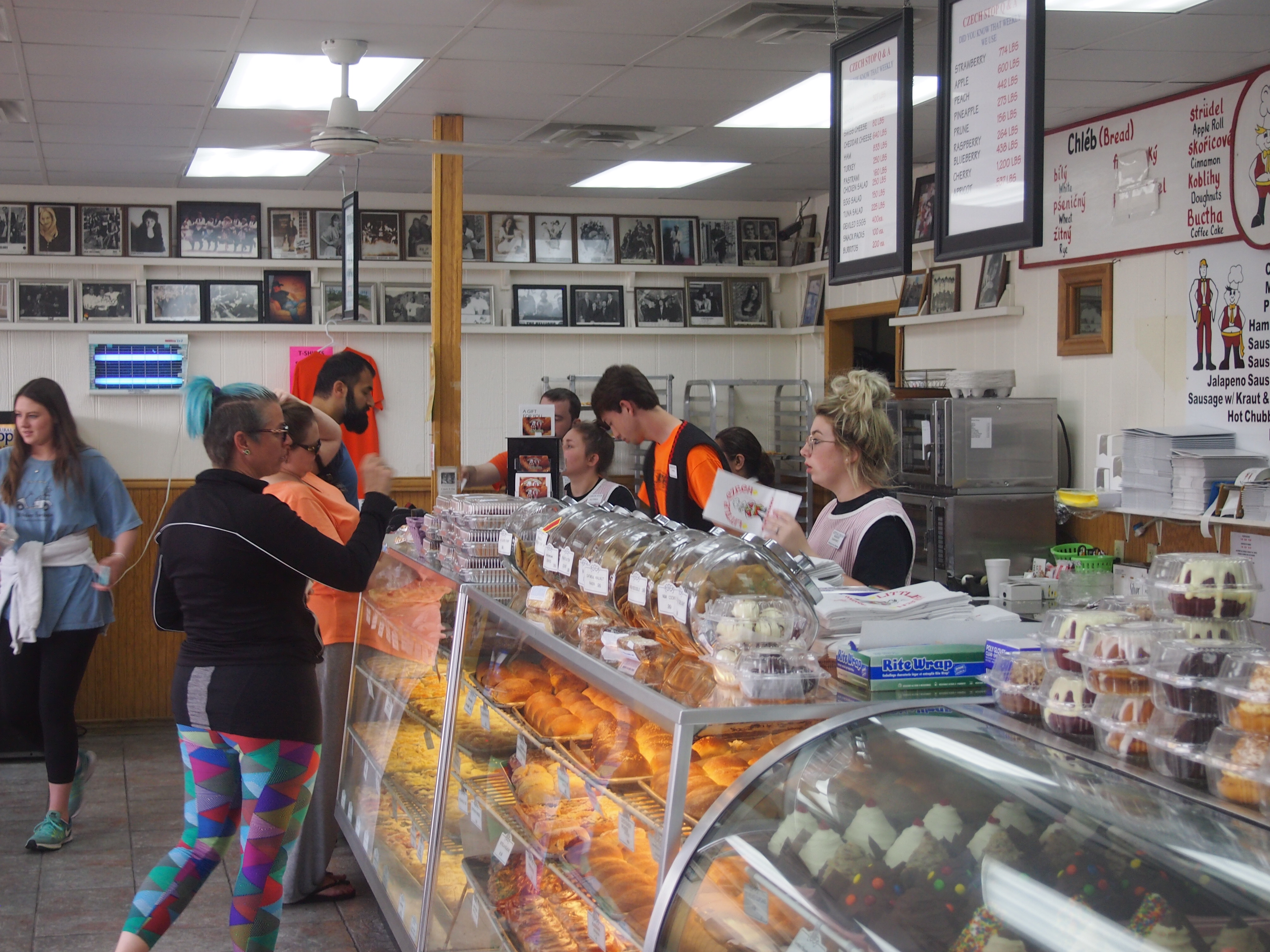
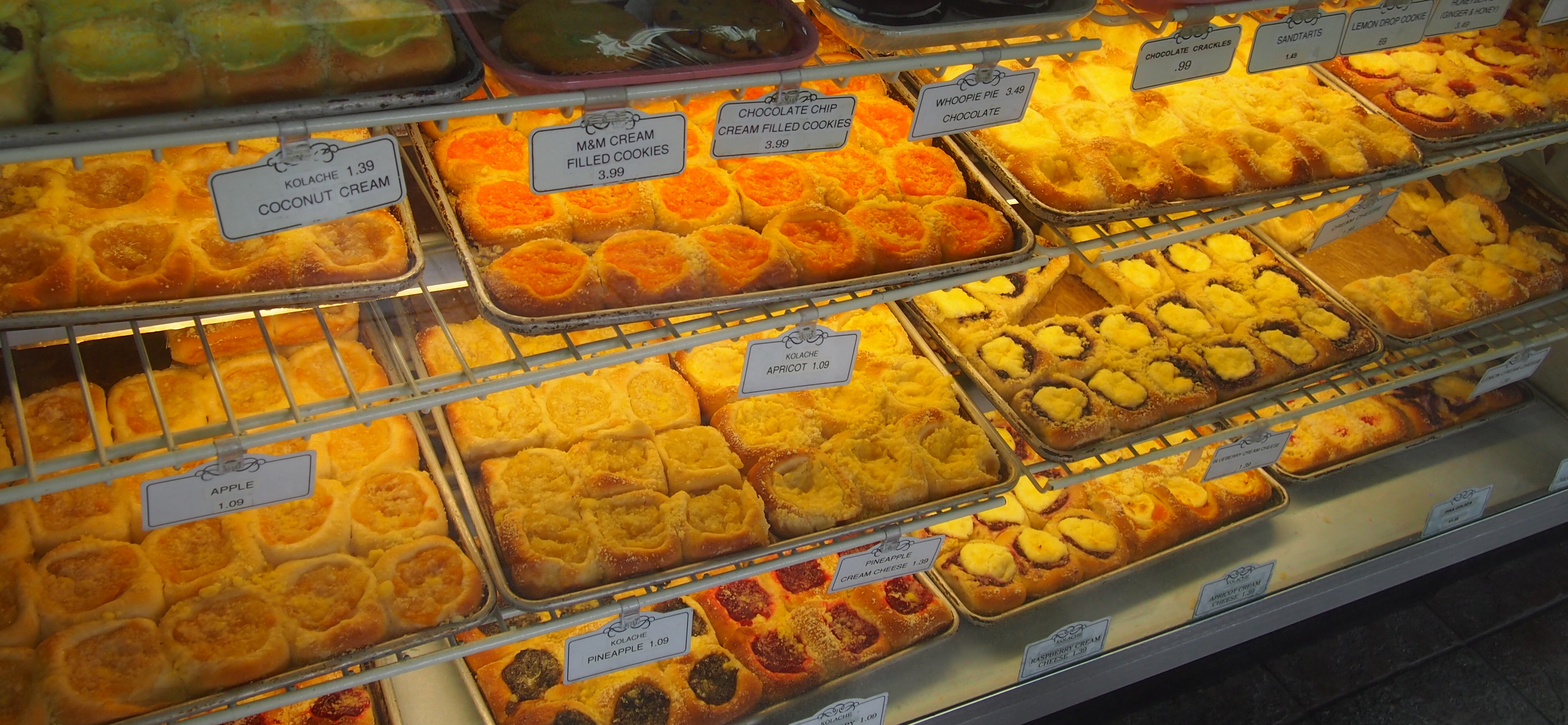
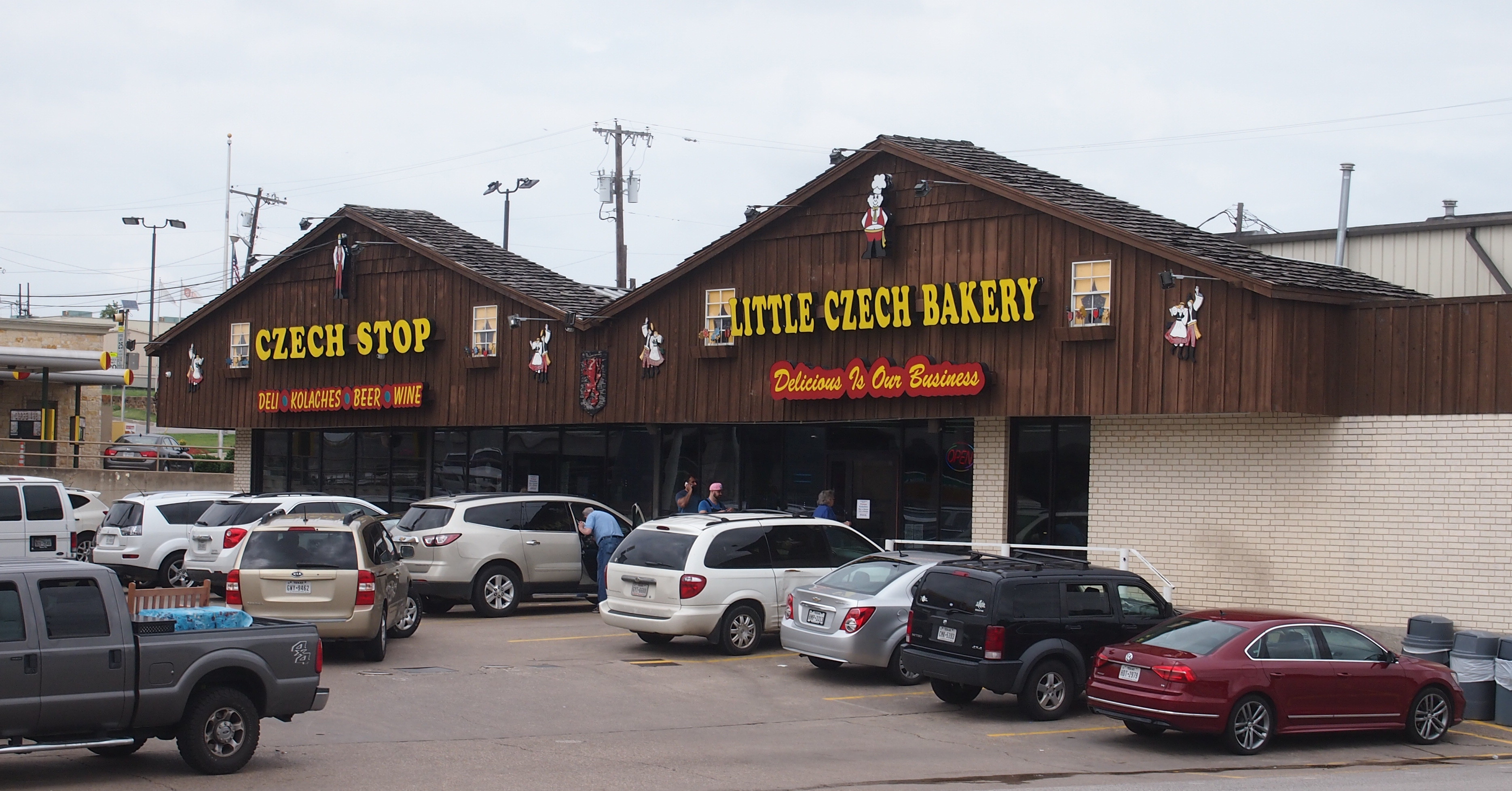
In West, Texas, — which is in Central Texas — we bought some kolaches at the Little Czech Bakery, which is next to the Czech Stop. Been there a number of times since I wrote this.
Czech Stop, West, Texas 2017The line wasn’t quite as long as usual. Good thing.
Czech Stop, West, Texas 2017Czech Stop, West, Texas 2017One day in Dallas we visited the Dallas Arboretum and Botanic Gardens, as lovely a garden as I’ve seen in quite a while. Despite its location on White Rock Lake, close to Jay’s house, I’d never been. Another day I dropped Lilly off at North Park Mall, known for its collection of artwork, and visited the next-door Sparkman-Hillcrest Cemetery, or in full, the Sparkman-Hillcrest Memorial Park Cemetery. A first-rate bit of landscaping.

We headed back for home beginning on May 25, driving from Dallas back to the Munger Moss for one more night (getting room 67; the first time we got 66). The next day we passed through St. Louis en route to the Chicago area and home.

On the last leg of the trip I was determined to stop a few places. First, we saw the abandoned Gasconade River Bridge, which counts as a Route 66 sight, though it could have been along any old road and still be just as fine. In St. Louis we visited the Cathedral Basilica of St. Louis, one of my favorite churches in North America, and then the wooded, hilly Bellefontaine Cemetery north of downtown, which is in the same league as Green-Wood in Brooklyn or Woodland in Dayton. First rate, that is.

Tsūtenkaku and Billiken

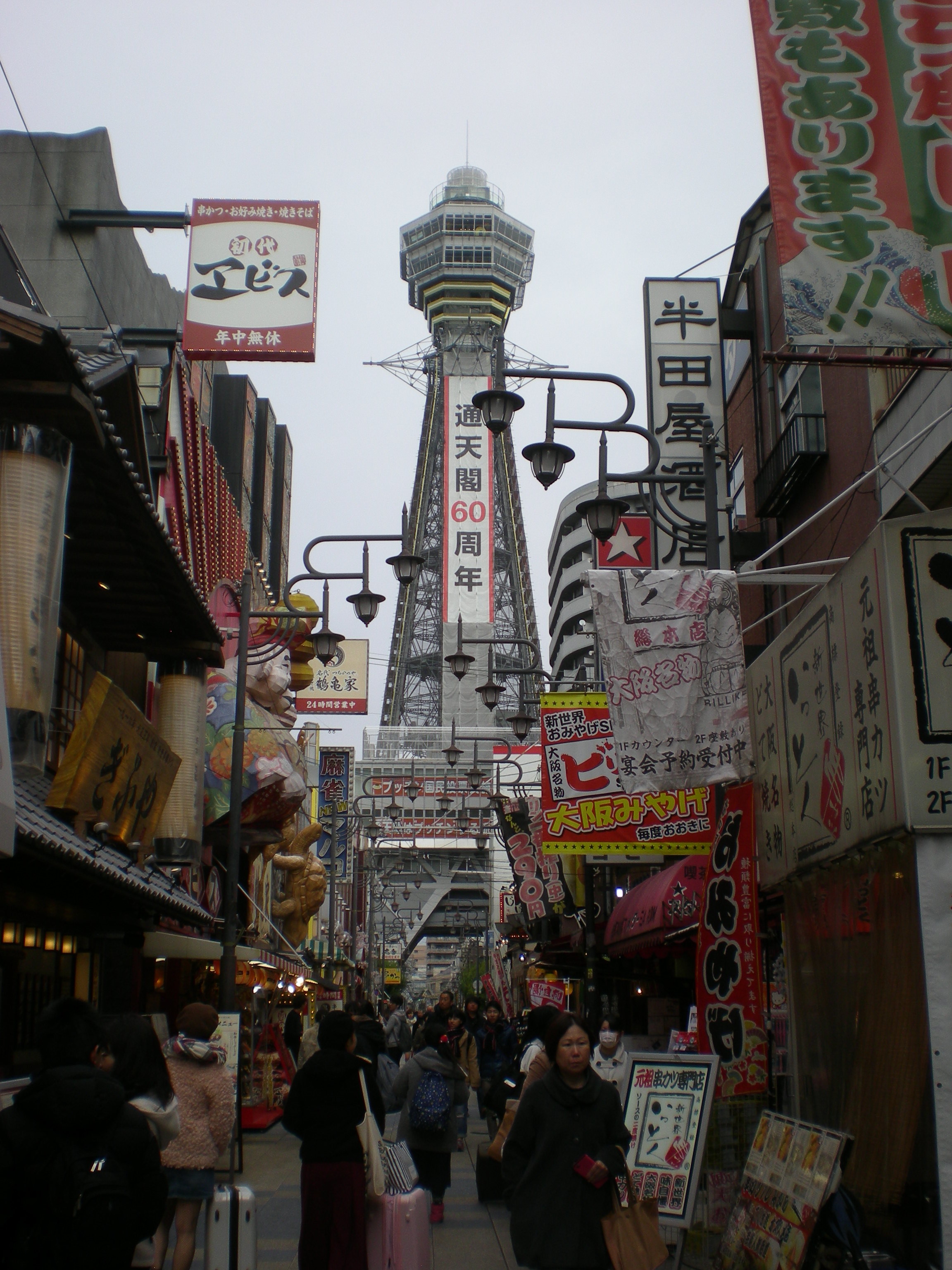
At some point during their recent visit to Osaka, Yuriko and Ann made their way to the Tsūtenkaku, a tower rising above the Shinsekai neighborhood.

dscn8283

I hadn’t thought about the tower in years. I visited it very early during my time in Osaka. The present tower dates from 1956, probably counting as part of the postwar reconstruction. An earlier tower, built in 1912 and which supposedly took inspiration from the Eiffel Tower, stood until a wartime need for steel spelled its end in 1943.

I didn’t know, or had forgotten, that the current structure is the work of one Tachu Naito (1886-1970), Japan’s “Father of Towers.” He had a talent for designing towers that can withstand earthquakes, so he did a fair number of them.

Tsūtenkaku — fancifully translated as “tower reaching toward heaven” — has a mascot, Billiken. The same charm doll that’s the mascot of Saint Louis University, it seems, a creation and fad item of the very early 20th century in the United States.

How exactly Billiken made the transition to Japan isn’t clear to me, and I refuse to go down the rabbit hole looking for the story right now. Wiki says, without a footnote: “The Billiken made its Japanese debut in 1908. A statue was installed in the uppermost level of the original Tsutenkaku Tower as it was opened to the public in 1912. When the nearby Luna Park was closed in 1925, the tower’s Billiken statue disappeared. In 1980, a replacement statue made its appearance in a new Tsutenkaku Tower that was built in 1956.”

He comes in a number of guises near the tower, too.

Billiken Osakadscn8284I can see the appeal, actually. He looks like something that the Japanese would have created. They didn’t happen to, but no matter. He fits right in. The real question is why is he associated with the tower?

Speaking of Billiken, if you listen to the “Billiken Rag,” you might be the only person you know ever to have hear it.

GTT 2016

On June 23, Ann and I left the Chicago area and headed south, returning earlier today. I’m calling the trip GTT 2016, as in Gone to Texas, but also Gone to Tennessee, another destination. Our route took us south to through Indiana and Kentucky and then to Nasvhille; west through West Tennessee and Arkansas and on to Dallas; and south again to Austin and San Antonio. The return was via Dallas and through Oklahoma and Missouri. All together, from backing out of my driveway to coming back to it, I put exactly 3,005 miles on my car, mostly on Interstates and US routes, but also a fair amount on the streets of Nashville, Austin and San Antonio.

None of the routes or places were new to me, except maybe Texarkana, where I’d never stopped before, and it’s been a long time since I’d traveled US 281 north of Johnson City, Texas, or on US 67 on to Dallas. But no matter how familiar the place or the route, you can always find new things.

In central Kentucky, near Elizabethtown, we visited Abraham Lincoln Birthplace National Historical Park, which features a granite and marble monumental building with a not-really-Lincoln’s log cabin inside. Near Mammoth Cave NP, we walked through Diamond Caverns, an unrelated show cave.

By the time we got to Nashville, the heat was on — in the 90s at least every day, which made stomping around outside less pleasant, especially for Ann, but I did manage to take her to the Nashville Parthenon, which she didn’t remember seeing in 2008. The more important thing we did in Nashville was spend time with old friends Stephanie and Wendall, and pay a visit to Mike Johnson’s widow, Betra.

In Memphis, we saw the Peabody Hotel ducks and the National Civil Rights Museum. In Texarkana, we drove down State Line Road and stopped at the only post office in the nation in two states. In Little Rock, I visited Mt. Holly Cemetery in the morning just before the heat of the day and then the Clinton Library (in full, the William J. Clinton Presidential Center and Park) and, just before we left town, the Arkansas State Capitol.

Dallas was mostly given over to visiting my brother Jay and working. Jay joined us for our few days in Austin, including the Fourth of July, and for a few more days in San Antonio. In Austin on July 2, Ann went to RTX 2016 at the Austin Convention Center, a sizable event held by the media company called Rooster Teeth; I was her chaperon. We visited my old friend Tom Jones the next day, and on Independence Day, saw both the Baylor Street Art Wall and municipal fireworks over Lady Bird Lake. San Antonio was mostly about visiting my mother and brother Jim, and (for me) holing up in a cool place with Wifi and doing more work.

Naturally, the trip involved long stretches of driving. I want to do that while I still want to do that. Because of my obstinance in not getting Sirius or the like, terrestrial radio helps fill the yawning spaces between destinations. The trip was bookended by two news events whose coverage was limitless, even when there was no new information beyond speculation: Brexit near the beginning, and the murder of Dallas policemen toward the end. I also listened to more religious radio more than usual, mostly only minutes at a time, except for the erudite Alistair Begg, whom I will listen to until his show’s over or the signal fades.

The selection of music was mostly what you’d expect, drawn from the rigid genres created by the radio business, though there were a few oddities, such as the Mesquite Independent School District radio station (KEOM) in metro Dallas that played teacher and student shows, besides a selection of completely conventional ’70s music. On I-40 between Nashville and Memphis — the Music Highway, according to official signs along the way — I picked up an oldies station whose playlist was a little older and odder than usual. I heard it play “Waterloo” (Stonewall Jackson), “Ahab the Arab,” “and “Running Bear and Little White Dove,” the last two I haven’t heard in years.

We stayed in a nondescript chain motel in Elizabethtown; in Stephanie and Wendall’s fine guest rooms in Nashville; in another, less nondescript motel in Little Rock; with Jay in Dallas; in the Austin Motel on South Congress in Austin, an updated version of a tourist court that’s been there since 1938; and in an updated former company hotel (vintage 1914) in San Antonio, the Havana Hotel, since there were too many of us to be comfortable at my mother’s house.

During the return home, we stayed at the Munger Moss Motel in Lebanon, Mo., last night, because of course we did.

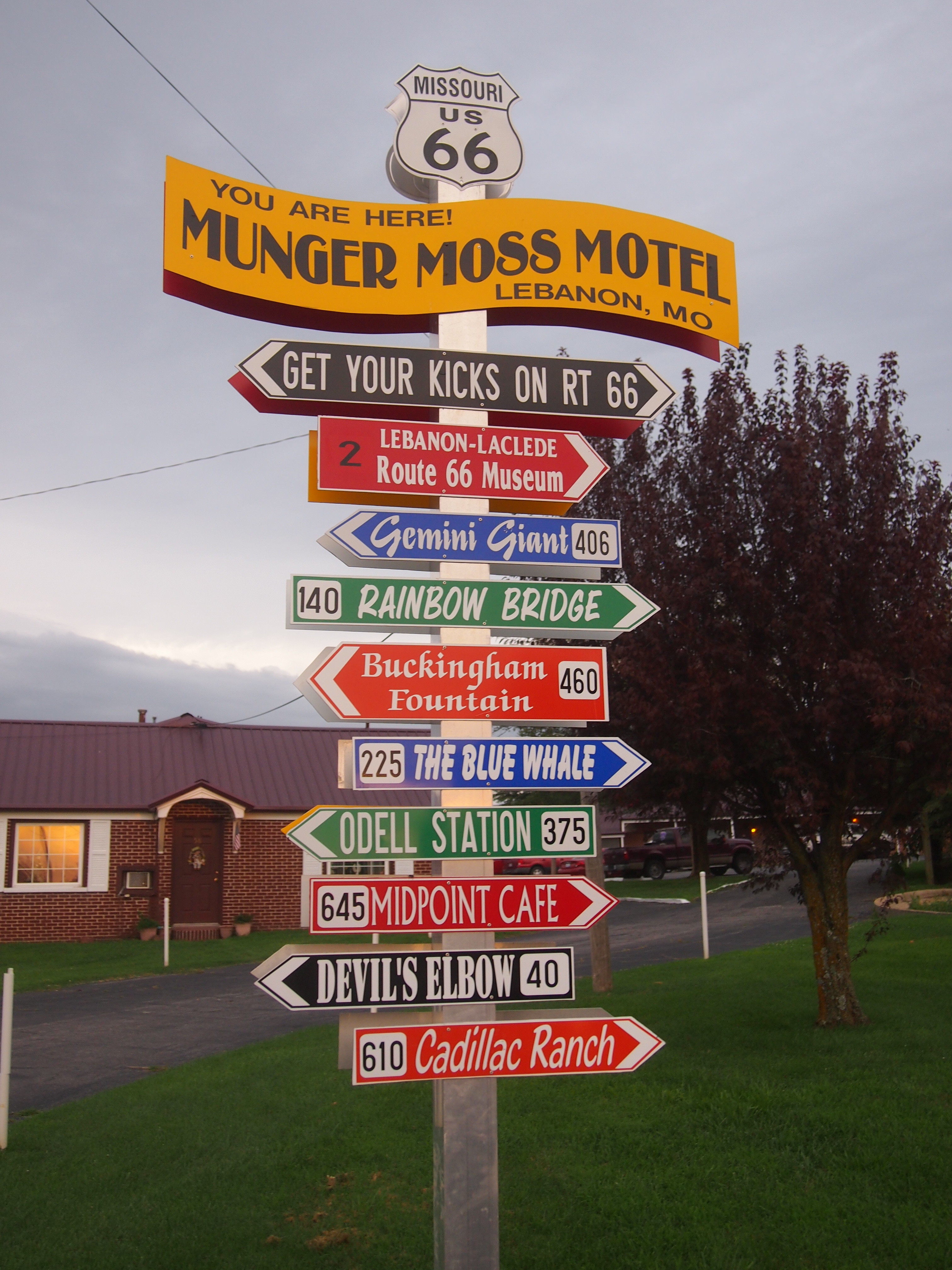
Munger Moss Motel 2016It’s the same as it was in 2009 and two years ago. Except (maybe) a couple of signs like this were added to the grounds.

Munger Moss Motel 2016Motel co-owner Ramona Lehman was selling Gasconade River Bridge postcards, sales of which help support the restoration of the bridge, a structure about 15 miles east of Munger Moss on the former US 66. I bought one. I didn’t stop to look at the bridge — this time — but it’s visible from I-44 if you know when to look, and I did.

Quantill’s Graves

Odd discovery for the day: the remains of William Quantrill seem to be buried in two different places. I was looking at the Wiki page devoted to the notorious raider and noticed, without apparent explanation, pictures of two gravestones for the man, one in Ohio, another in Missouri.

I looked into the subject a little further and this article has some explanation of it. Through a series of convoluted acts of skullduggery on the part of his mother and others, parts of Quantrill ended up in two different places, one close to where he grew up, the other close to where he made his name.

Reminds me of the two gravesites for Daniel Boone, but in that case there’s a dispute about where all of his mortal remain are – Kentucky or Missouri. In Quantrill’s case, the two states seem to have divvied up the distinction of having his final resting place.

Old Tractors & Old Abe

At the College of the Ozarks is the Ralph Foster Museum, and at the Ralph Foster Museum is a modified 1921 Oldsmobile Model 46 Roadster, the truck used in the Beverly Hillbillies. I didn’t get to see that because the museum was closed the day I visited in early November last year.

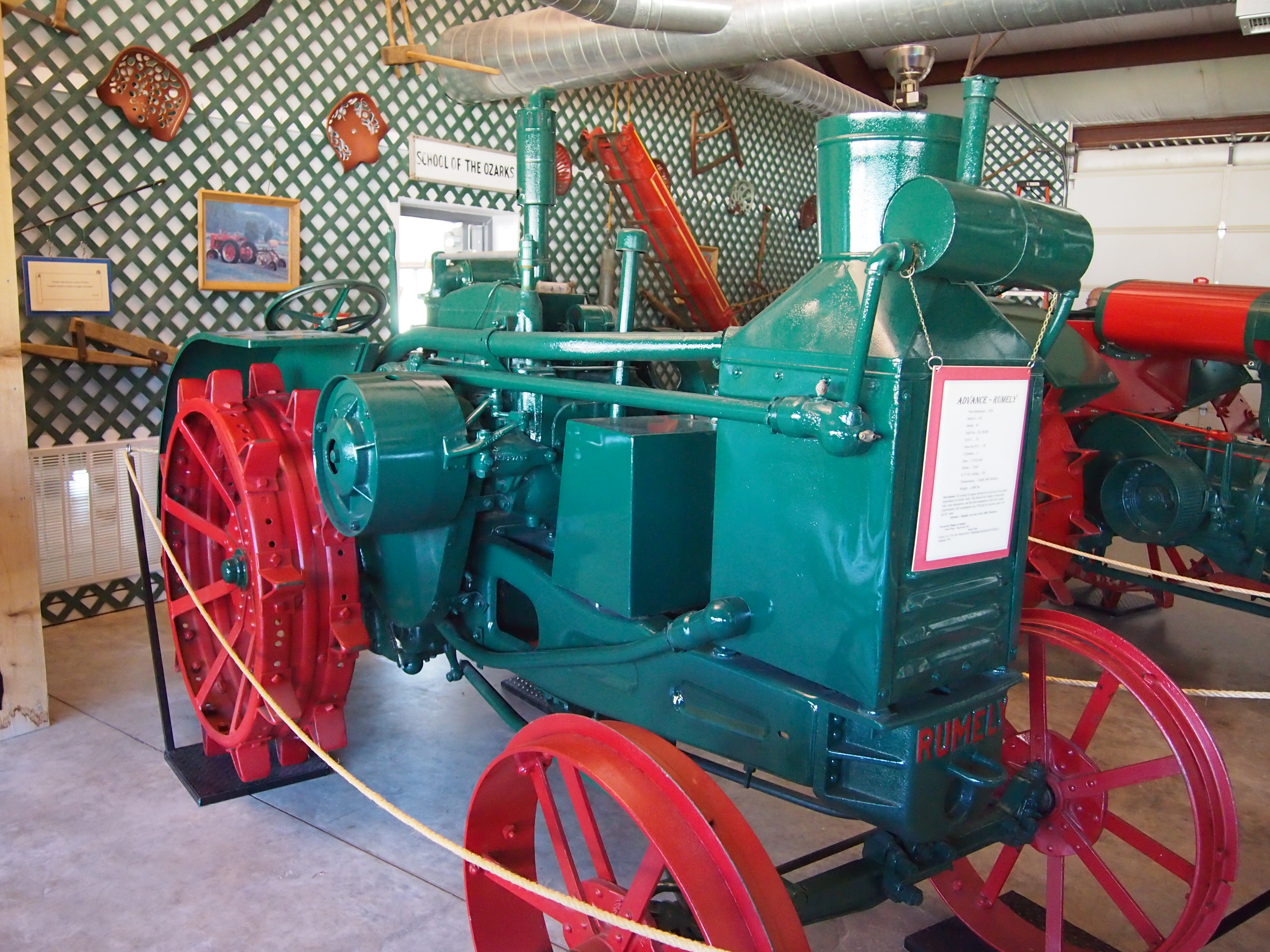
Instead we went to the Gaetz Tractor Museum. On display are such marvels of the machine age as the two-cylinder, three-ton Advance Rumely, introduced in 1924.

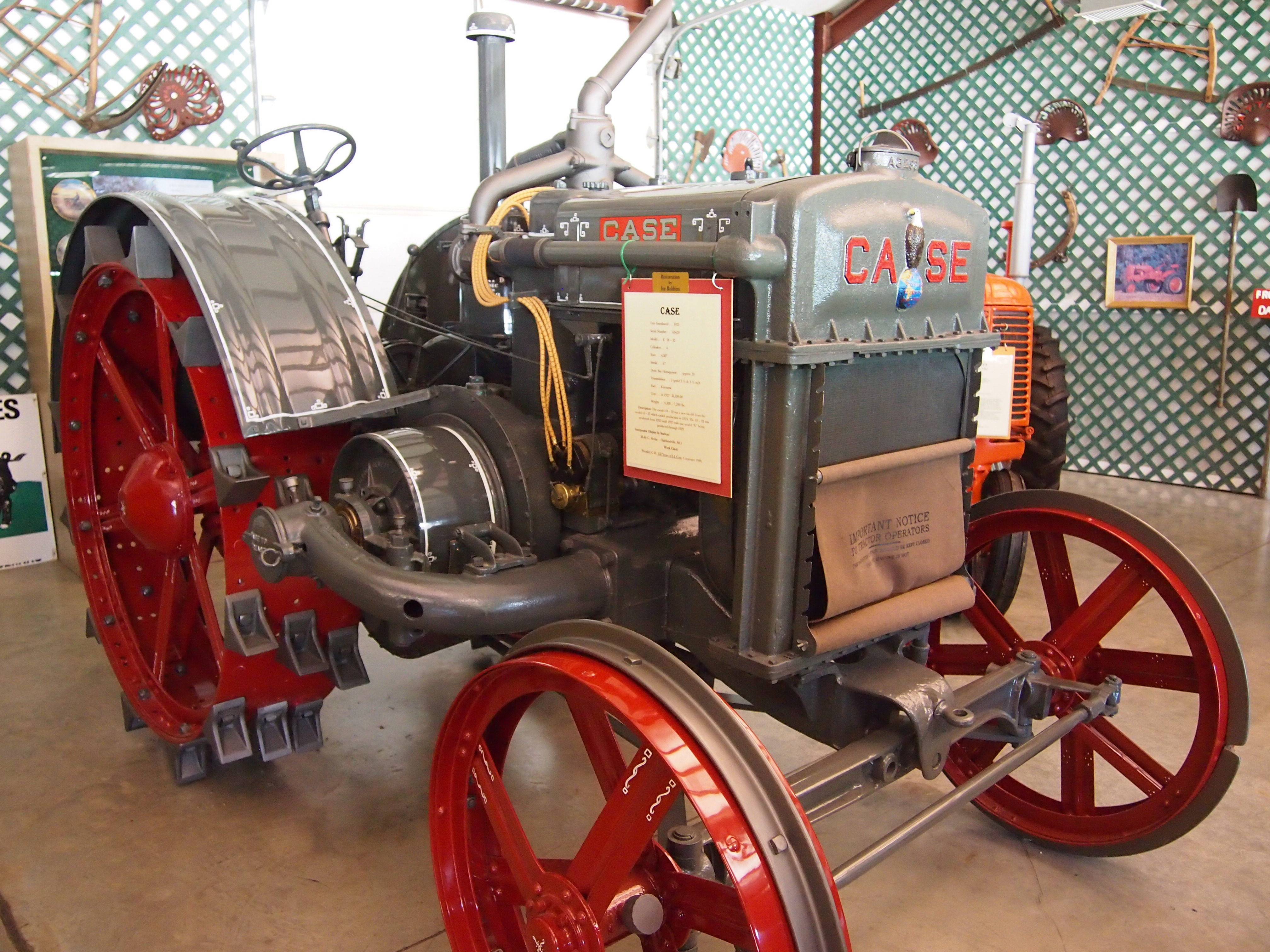
There’s also a Rumely 6A, vintage 1930, as well as four-cylinder, three-ton Case model K, ca. 1927.

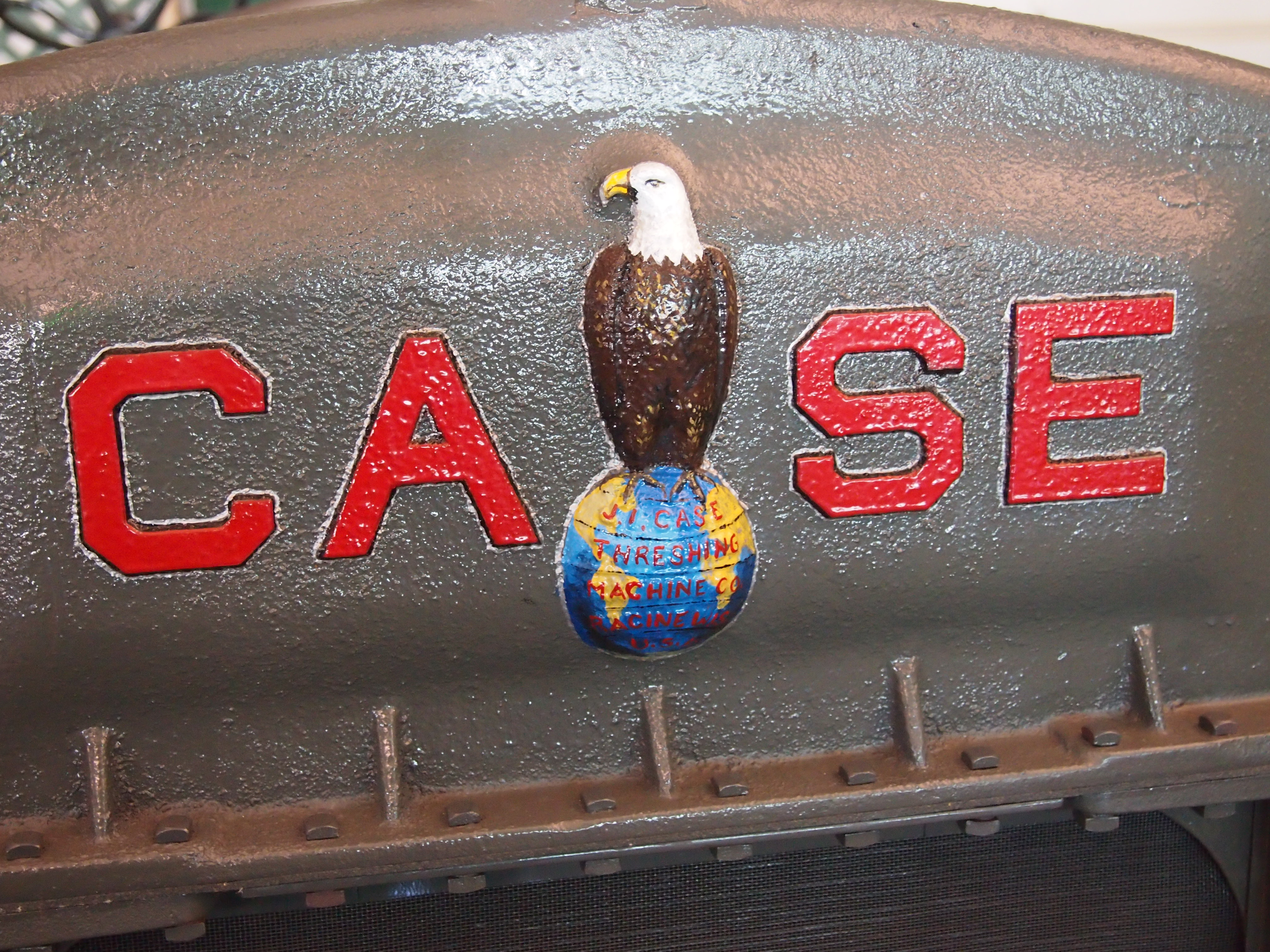
Made by the J.I. Case Threshing Machine Co., which was eventually M&A’d out of existence as a separate entity. Now that’s a corporate name. Beats much of what we have now, such as the Three Initial Corp. or the Random-Syllable Co.

Note the eagle. That was J.I. Case’s corporate symbol, but it isn’t just any eagle. It’s Old Abe.

Old Abe – a living eagle – was the mascot of the 8th Wisconsin Volunteer Infantry Regiment from 1861 to ’64. Quite a story. Bonanzaville, an open-air museum in West Fargo, ND, that we visited in ’06, has a striking Case Eagle on display.

SubTropolis

Early April 1999.

Just returned from Kansas City, which has its interests, but I was too occupied to see much of it, except for a “tour” given by an office developer. He knew the market well, and as you’d imagine, liked to talk.

We visited SubTropolis at one point, which is an underground warehouse and distribution complex, created from a former limestone mine, which was dug straight into the side of a KC hill. The former mine space now houses all kinds of goods, plus some thousands of people who work there. One of their big tenants is the post office, which stores millions of stamps there.

Postscript 2013: I toured a fair amount of commercial real estate in 1999, so this description sounds blase, but actually I was taken with SubTropolis, as I often am with places I’ve never seen before.

More recently, Steve Nadis wrote in The Atlantic: “With 5 million square feet of leased warehouse, light-industry, and office space, and a network of more than two miles of rail lines and six miles of roads, SubTropolis is the world’s largest underground business complex… [and not the only one in KC]. More than 10 percent of the industrial space in greater Kansas City is located ‘down under,’ covering about 25 million square feet—an area bigger than the downtown business district. Mining limestone for use in roadway construction and agriculture continues, with additional acreage carved out each year.”

Branson Leftovers

Back again on Sunday, as the long Thanksgiving weekend peters out. We will be home for the occasion, since just the thought of going anywhere is tiring.

Branson is full of shows, but Joseph beat everything else I saw for sheer spectacle. Joseph is a South & Sight Theatres production, whose specialty is elaborate stagings of Bible stories, but “elaborate” hardly does it justice. The theater’s enormous, seating about 2,000, with a large stage that accommodates massive sets, large troupes of actors (including live animals, such as goats and camels), and impressive lighting and effects. The sets alone for Joseph—fittingly evoking ancient Egypt much of the time—would be worth seeing all by themselves, but fortunately not all of the effort went into sets and effects. The script tells the story of Joseph well, both in song and dialogue.

Christopher James, emcee on the Branson Belle showboat, told the trip’s best joke. I forget the exact wording, but it was a line about knowing better than to shine a bright light on stage, since too many of the audience would respond by getting up and heading toward it.

Indeed, at some of the shows I was a youngster compared to most of the audience. Such shows were heavily spiked with ’40s and especially ’50s nostalgia. But the showmen of Branson are preparing for the future. At one point, we had to wait for a few minutes outside a theater as the audience emerged from a John Denver tribute show. That is, a show spiked with ’70s nostalgia. The audience looked much younger than at most of the other shows—roughly my age.

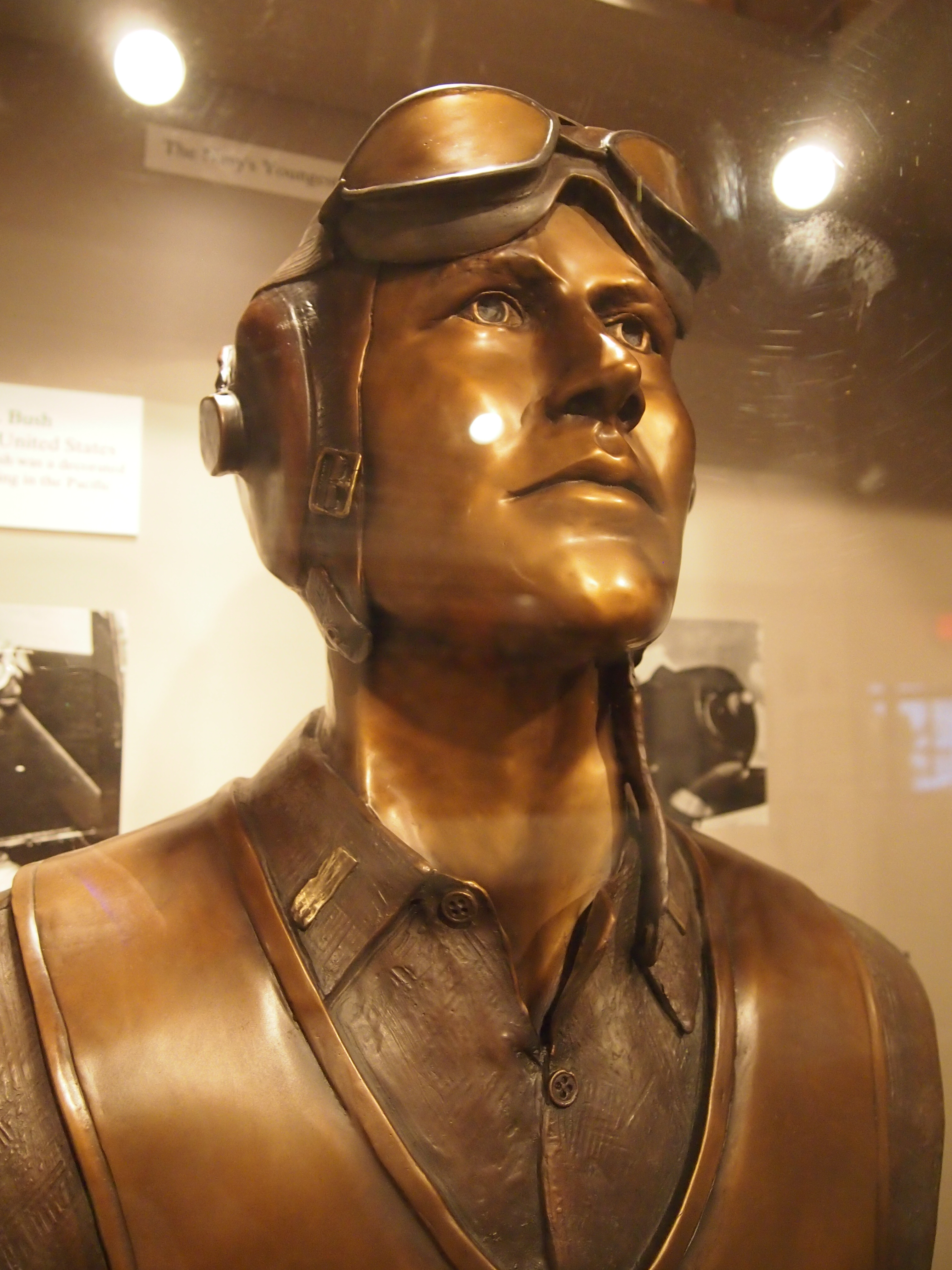
No presidents were from Branson or are buried nearby, unless you count Harry Truman up in Independence, Mo. But I did see one presidential item: a bronze of the elder George Bush, as a young naval aviator, at the Veterans Memorial Museum.

We also visited the College of the Ozarks, which is a few miles from Branson. It’s a private Christian school whose students pay no tuition, but rather work for the school 15 hours a week. The fruits of all that work are many: among other things, we saw the greenhouses that grow orchids, a crafts building, the small hotel that the school runs, and the school’s restaurant, where we had Sunday brunch, done as a large buffet. The food was really good. Much of it is raised by students on the college’s farm.

Speaking of food, I had breakfast at a number of other places during my visit, and none of them—not even at the College of the Ozarks—offered grits. I was puzzled. I thought Branson would be south of the Grits Line, but maybe I’m wrong about that. Biscuits and gravy were widely served, but not grits. Odd.

Veterans Memorial Museum, Branson

On Sunday, November 4, I had the Veterans Memorial Museum in Branson practically to myself, though I knew that only a week later, on Veterans Day, the place would be full. Or for that matter, more crowded during much of “Branson’s Veterans Homecoming Week,” which was from November 5 to 11 this year. The 18,000-square-foot museum opened in 2000 on Missouri 76, one of the town’s main streets, and is essentially the work of a Nebraska sculptor and “museum entrepreneur” named Fred Hoppe. Glowing information about him is at the museum’s web site; a less flattering story is at the Branson Tri-Lake News.

Be that as it may, the Veterans Memorial Museum is a fine little museum, traditional in design and subject matter. That is, most of the displays are static, relying mainly on artifacts, with a fair amount of expository text. The place runs counter to the line of modern museum thinking – which might be accurate, for all I know – that exhibits should be interactive two-and-a-half ring circuses to keep museumgoers happy. But I’m OK with static, text-heavy displays, especially if I’m by myself and have some leisure to look and read.

The subject and layout reminded me a little of the Imperial War Museum in London, as well as the Musée du Débarquement in Normandy, at least as those places appeared in the early 1990s, though both are larger and much more comprehensive about their subjects. The Veterans Memorial Museum is composed of ten rooms covering U.S. wars of the 20th century, beginning with a small room containing a large model of the U.S.S. Missouri, a newsreel about the Japanese surrender aboard that vessel on continuous loop, and a few other artifacts. After that, the exhibits began with World War I and proceeded chronologically. Because of my own inclinations, I spent more time with World War I than in any other room.

There was a lot to see just in that room: photos, paintings, uniforms, weapons and other gear, objets d’ art, and more, and not just representing the U.S. or even the Allies, though they were the main focus. I’m pretty sure I’d never seen an actual Blue Max before, nor a WWI German artillery helmet. Artillery helmets of that time, it seems, didn’t have the famed spike on top, but a ball-shaped peak. The room also sported a nice collection of trench art, especially decorated shell casings, including some remarkably elaborate carvings. One way to pass the tedium of trench life, I suppose.

Among the photographs was, I thought, a particularly poignant one. It depicted graves, a common enough sight, but with a caption explaining that they belonged to men of the 324th Infantry, all of whom “died in the last three hours of the war.”

One long wall of the World War I room looks, at first, blank. Then you notice that it’s covered, floor to ceiling, with sepia-tinted doughboys’ faces, each about the size of a dime. The faces are repetitive, since the effect is created by putting together long strips seemingly copied from the same panoramic regimental photo. No matter. The point of the wall is to impress you with a vast number of faces, and it does. One face, a sign says, stands for every two Americans who died in the Great War, which was about 117,000 men all together.  A wall of doomed youth, looking out at you from behind glass and nearly a 100 years.

The other rooms include a sizable number of interesting artifacts, both American and from other nations, including in what I can only call the Axis Room. (As the History Channel knows, Nazis are always interesting.) Besides Nazi and imperial Japanese paraphernalia, one can also find an Enigma encryption machine in that room, the likes of which I’ve seen at the Museum of Science and Industry and (I think) the Science Museum in London. I should have taken a moment to mock the machine: Ha! We decoded your ass! But I didn’t think of it.

The centerpiece of the museum is in a World War II room – there’s more than one room devoted to that war – that includes 50 bronze life-sized soldiers charging in two lines. A work of sculptor Fred Hoppe, “Each figure in the WWII centerpiece is modeled after an actual combat soldier, one from each of the fifty states,” notes the museum web site. “Leading the charge up the beach is Fred’s father, the late Fred Hoppe Sr.”

The room is long and narrow, as you’d expect, and the names of each American serviceman to die in the war, about 416,800 in all, are written all along its walls. An effective reminder of the war’s cost to the United States, certainly, but I have to say the doughboy faces on the WWI wall were more moving, even though that was only pictorial representation, and not a detailed accounting of individuals.

Janice Martin, Aerial Violinist

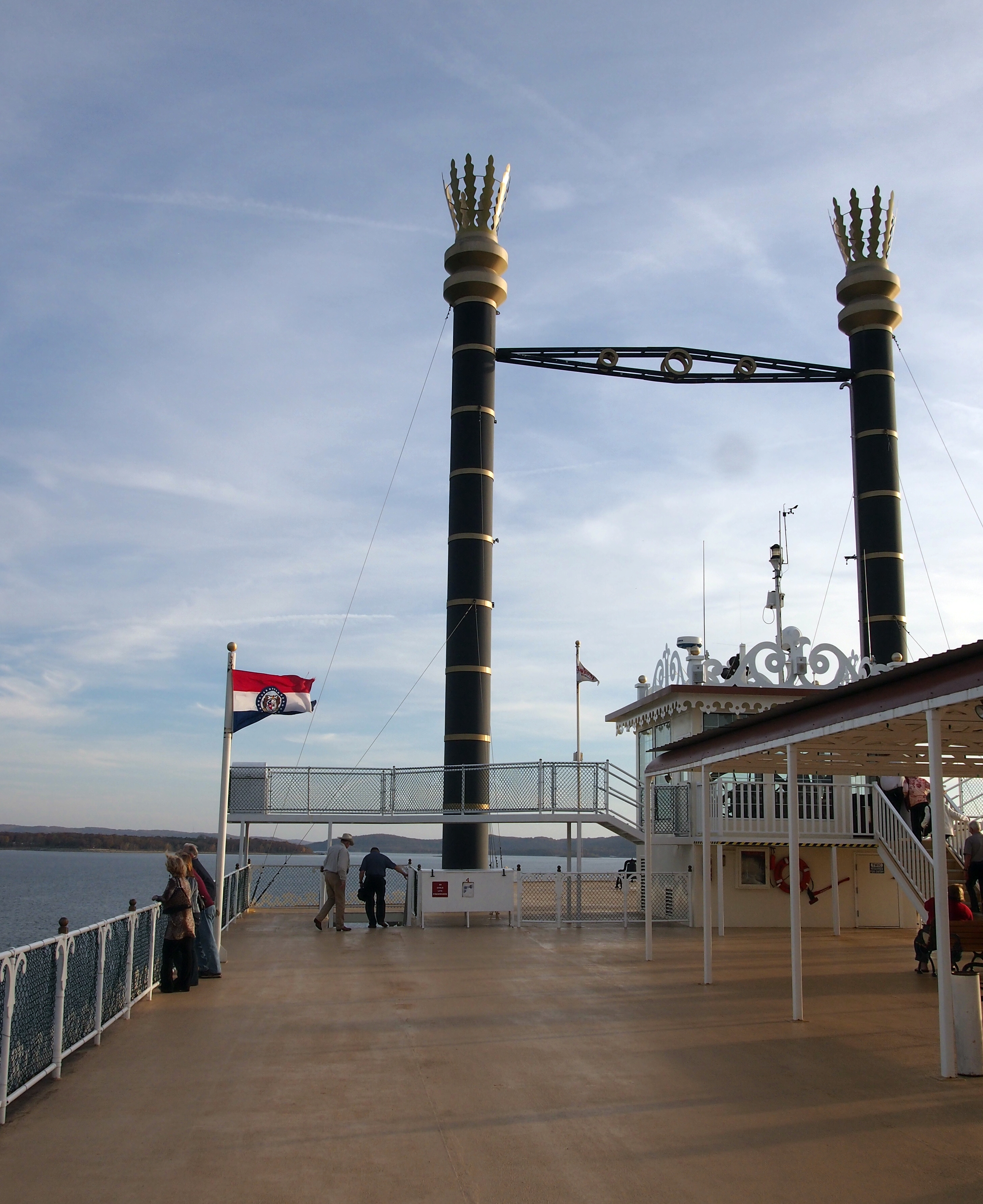
A favorite fact about the showboat Branson Belle, which plies the waters of Table Rock Lake, Missouri: when the ship was launched in 1995, she slid into the water on a ramp greased with 4,000 pounds of bananas. The yellow fruit was a eco-friendly alternative to standard lubricants, and perhaps even cheaper, though I’m not up on the economics of boat launching.

Branson Belle is the property of Herschend Family Entertainment Corp., the company that also owns Silver Dollar City and a lot of other properties.– including Dollywood, but that’s part of another tourist-magnet area. The showboat’s a paddle-wheeler – two twin wheels, 24 feet in diameter each, and it’s a smooth ride, because while sitting in the theater I didn’t notice the ship getting underway. Later I wandered around taking pictures, making it as far as the topmost deck.

The 4 pm show included dinner plus entertainment: magician-comedian emcee Christopher James, who told the best jokes among the various shows I saw, a number of musicians, and “the world’s only aerial violinist,” Janice Martin. That alone was worth getting on the showboat for.

Janice Martin also happens to be a fine singer and pianist, which was part of the act, but I think everyone was waiting to see just what an aerial violinist would do. Climb up a couple of silk lines and do the kind of act you might see in a circus, to begin with. But strapped over one of her shoulders somehow was a special violin built for the purpose, which she played skillfully while dangling from the silks in one way or another. Flat-out amazing.

How did the remarkable combination come about? From the little she said, she’s been a musician always, including training at the Julliard. As for the aerialist skills, she said she first learned rope climbing during her stint in the U.S. Army as a musician. At what point did a light bulb go off? – hey, I can do both of these at the same time. Couldn’t say, but it did, and I hope the Branson Belle is making it well worth her while.