Anticipating Arctic Air

Cold rain well into the night yesterday, enough to wake the sump pump. The good thing was, it didn’t ice everything over today.

Still, we’re on the cusp of a chill. Cold enough by Christmas Eve to snap off bits of Santa’s beard, looks like.

But that’s nothing to the jolly immortal elf. Has he ever got some stories about the Little Ice Age.

In the course of my day today, I was reading about the Lehigh Valley distribution market, which is one of the nation’s largest in square feet (and throughput, I assume). Distribution, as in the system of warehouses that concentrate and store goods until they’re shipped to stores or otherwise delivered to customers. You know, the agglomerations of mostly characterless but highly efficient and valuable buildings that most people drive by without a passing thought. But they’re buying in stores and elsewhere, keeping the whole distribution system in motion.

Then it occurred to me that otherwise I didn’t know jack about the Lehigh Valley. So a little reading followed. The area’s industrial history is deep.

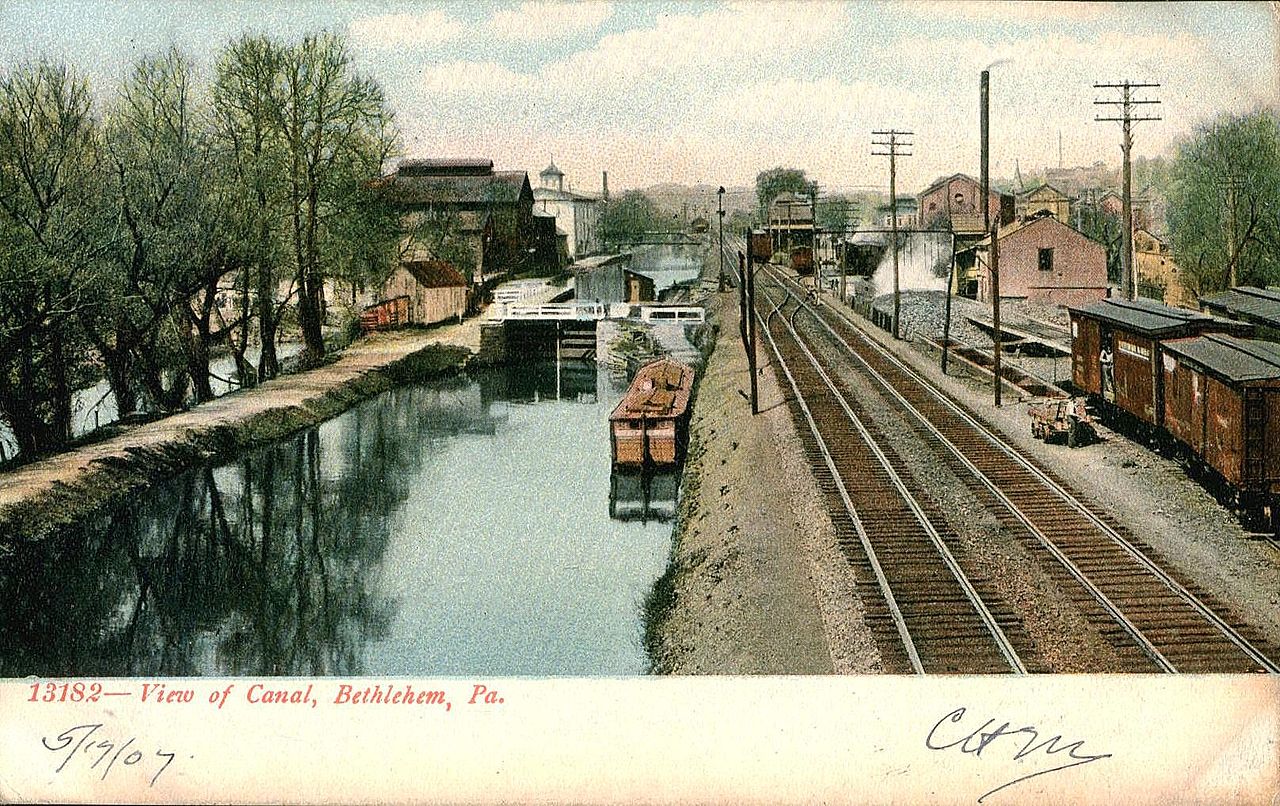
How is it I didn’t know anything about the Lehigh Canal?

Now I do. Glad I got out of bed today.

Another reason I’m glad I made the commute downstairs to my office was my discovery early this evening of Allison Young singing “When I’m With You (Christmas Every Day).”

“I’m hearing some delightful strength and control that wasn’t there in years past,” says one of the YouTube comments. I’ll second that, but add that she was delightful enough in years past (and not too many years past).

Art Institute Spaces, Small and Large

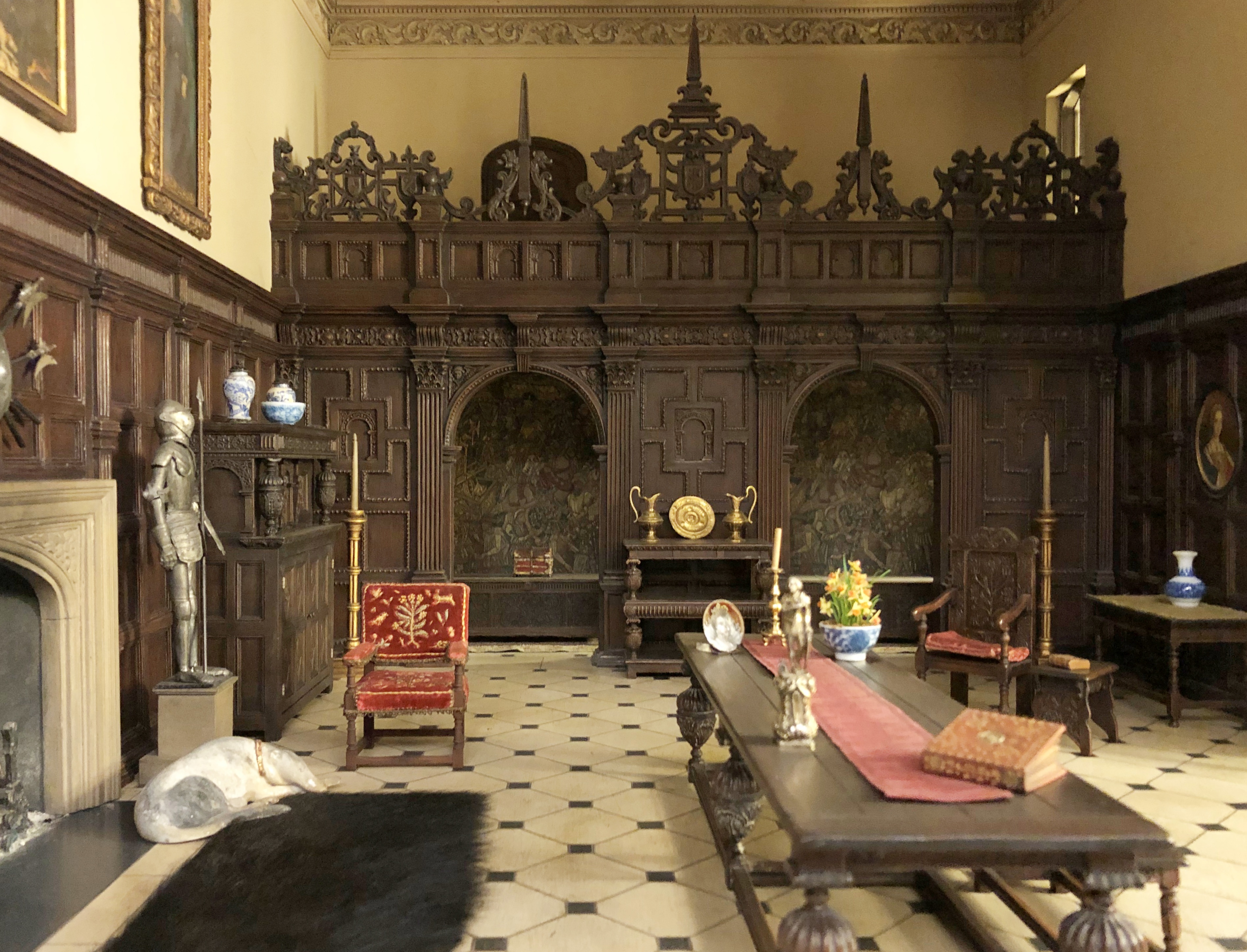
I’d like to say I visited this room recently — looks interesting, doesn’t it? — but I only looked into the room.Thorne Rooms

An English great room of the late Tudor period, 1550-1603, according to a nearby sign. I couldn’t get in because one inch within this room equals one foot in an actual room of that kind, so at best I could get a hand in.

The Art Institute doesn’t want anyone to do that, and for good reason, since random hands would completely wreck any of the Thorne Miniature Rooms. So they are behind glass in walled-in spaces, and not at eye level for someone as tall as I am.

Still, I leaned over to look in. The fascination is there. Not just for me, but for the many other people looking at the rooms on Saturday. Each room evokes a different place or time, heavily but not exclusively American or European settings.

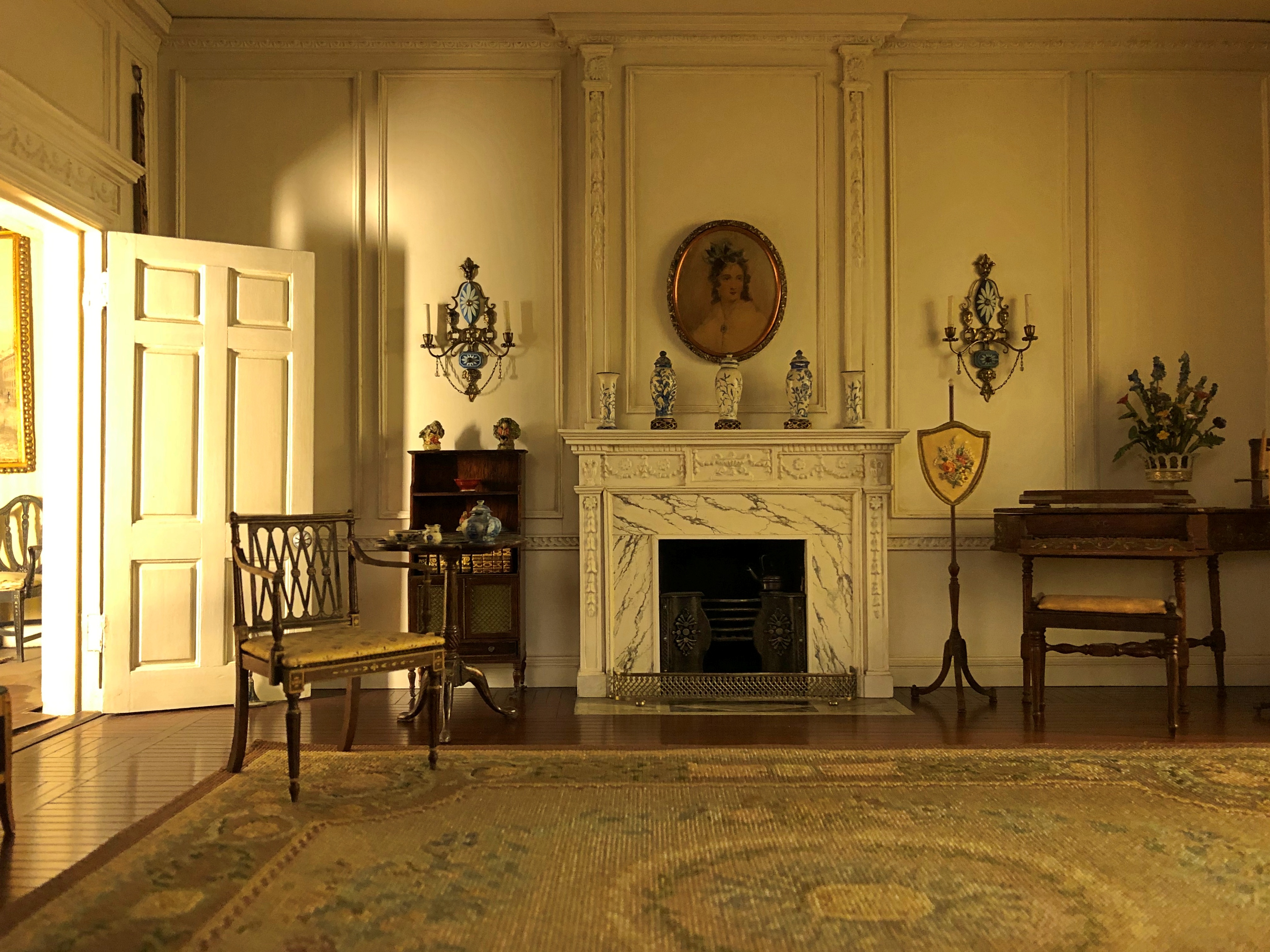
English drawing room, ca. 1800.Thorne Rooms

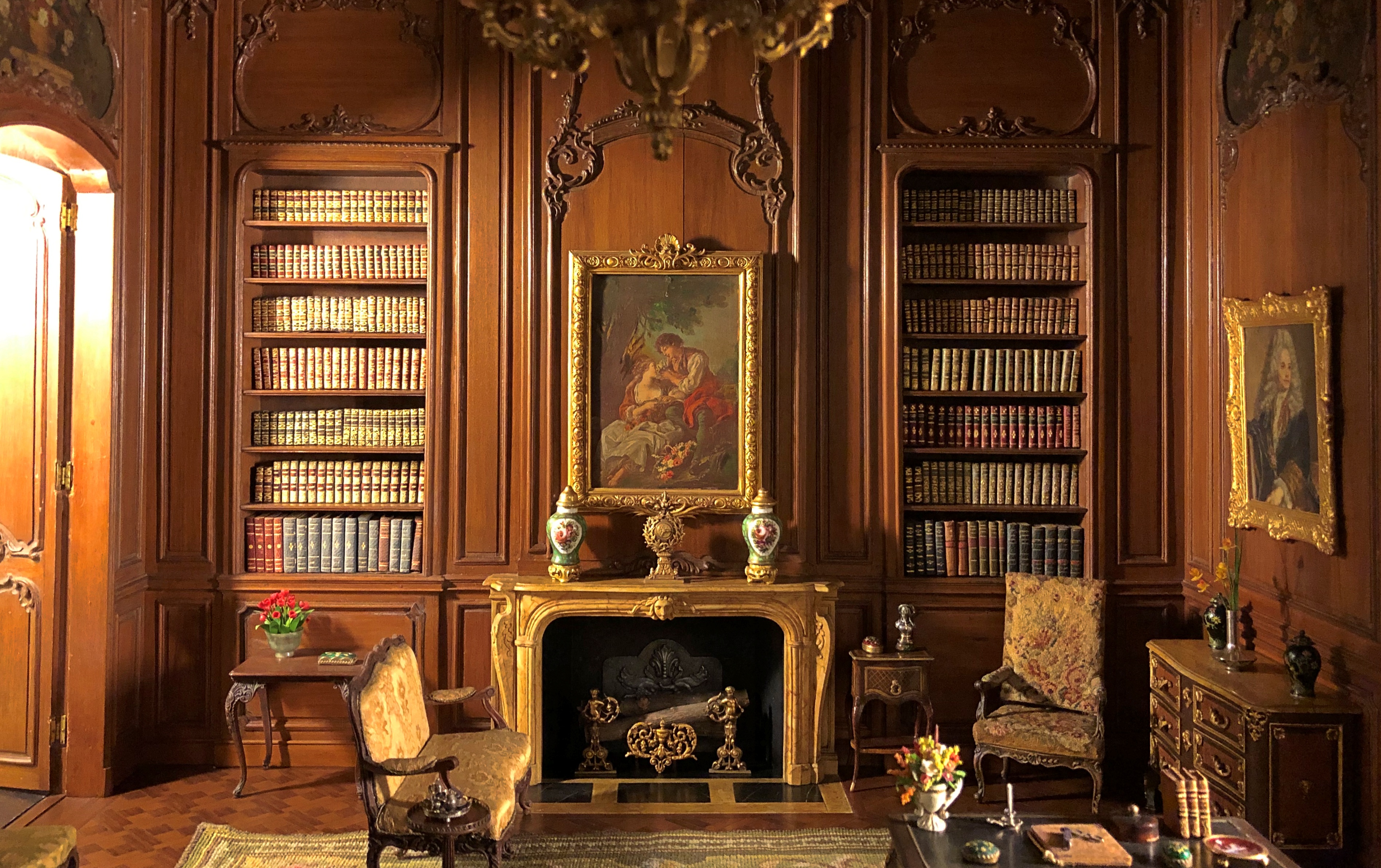
French library, ca. 1720.Thorne Rooms

Across the Atlantic. Pennsylvania drawing room, 1830s.Thorne Rooms

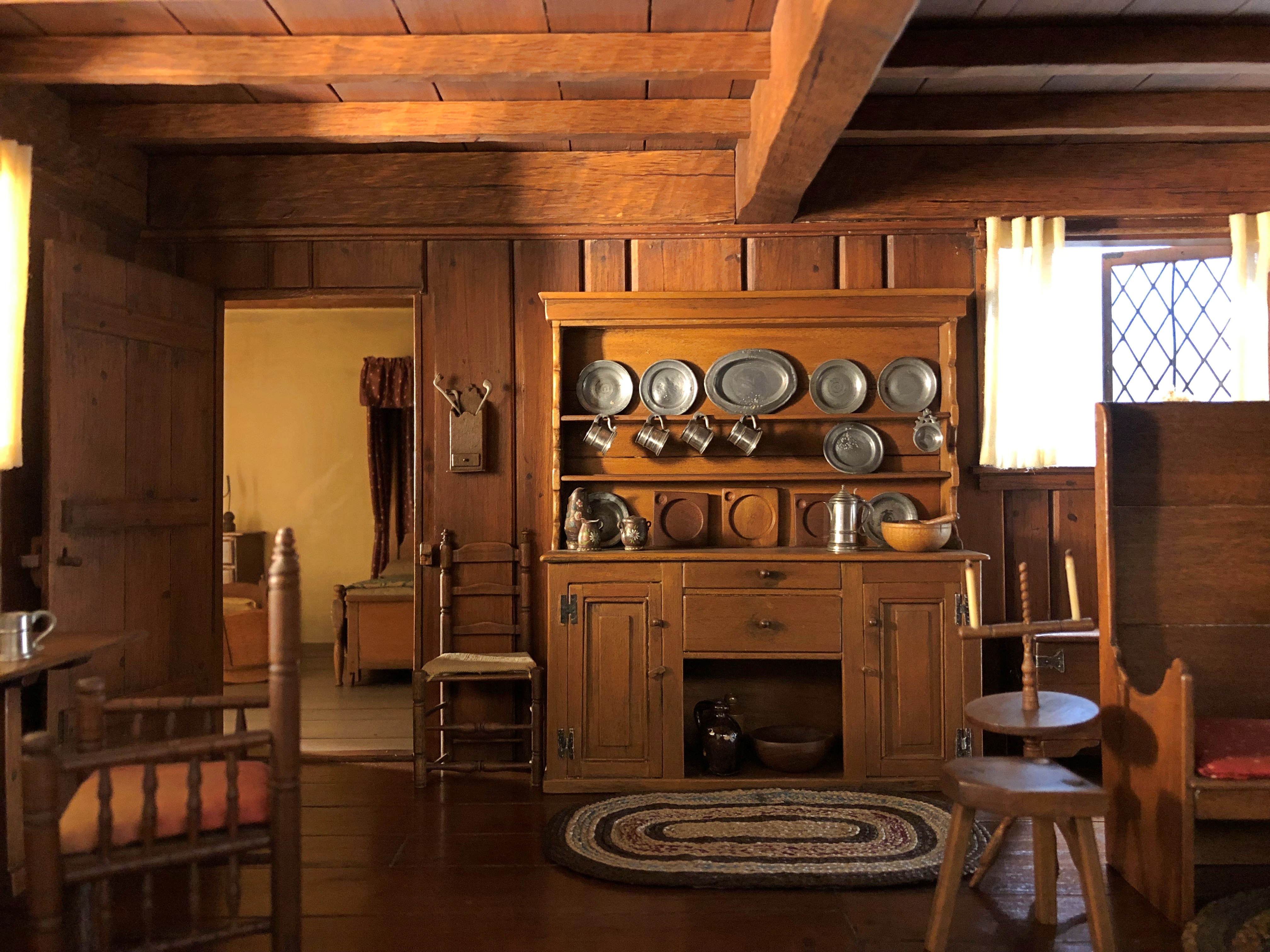
Massachusetts living room, 1675-1700.Thorne Rooms

The fascination isn’t just with the astonishing intricacy of the work, which it certainly has, but also the artful lighting. Artful as the light-play on a Kubrick set. I know those are electric lights in the background, but it looks like the rooms are lighted the way they would have been during those periods. With sunlight, that is.

“Narcissa Niblack Thorne, the creator of the Thorne Rooms, herself had a vivid imagination,” says the Art Institute. “In the 1930s, she assembled a group of skilled artisans in Chicago to create a series of intricate rooms on the minute scale of 1:12.

“With these interiors, she wanted to present a visual history of interior design that was both accurate and inspiring. The result is two parts fantasy, one part history — each room a shoe box–sized stage set awaiting viewers’ characters and plots.” (More microwave oven–sized, I’d say.)

Thorne (d. 1966) had the wherewithal to hire artisans during the Depression by being married to James Ward Thorne, an heir to the Montgomery Ward department store fortune, back when department stores generated fortunes. Bet the artisans were glad to have the work.

It wasn’t my first visit to the Thorne Rooms, but I believe I appreciate it a little more each time. I know I feel that way about the Chicago Stock Exchange Trading Room, which I also visited on Saturday.

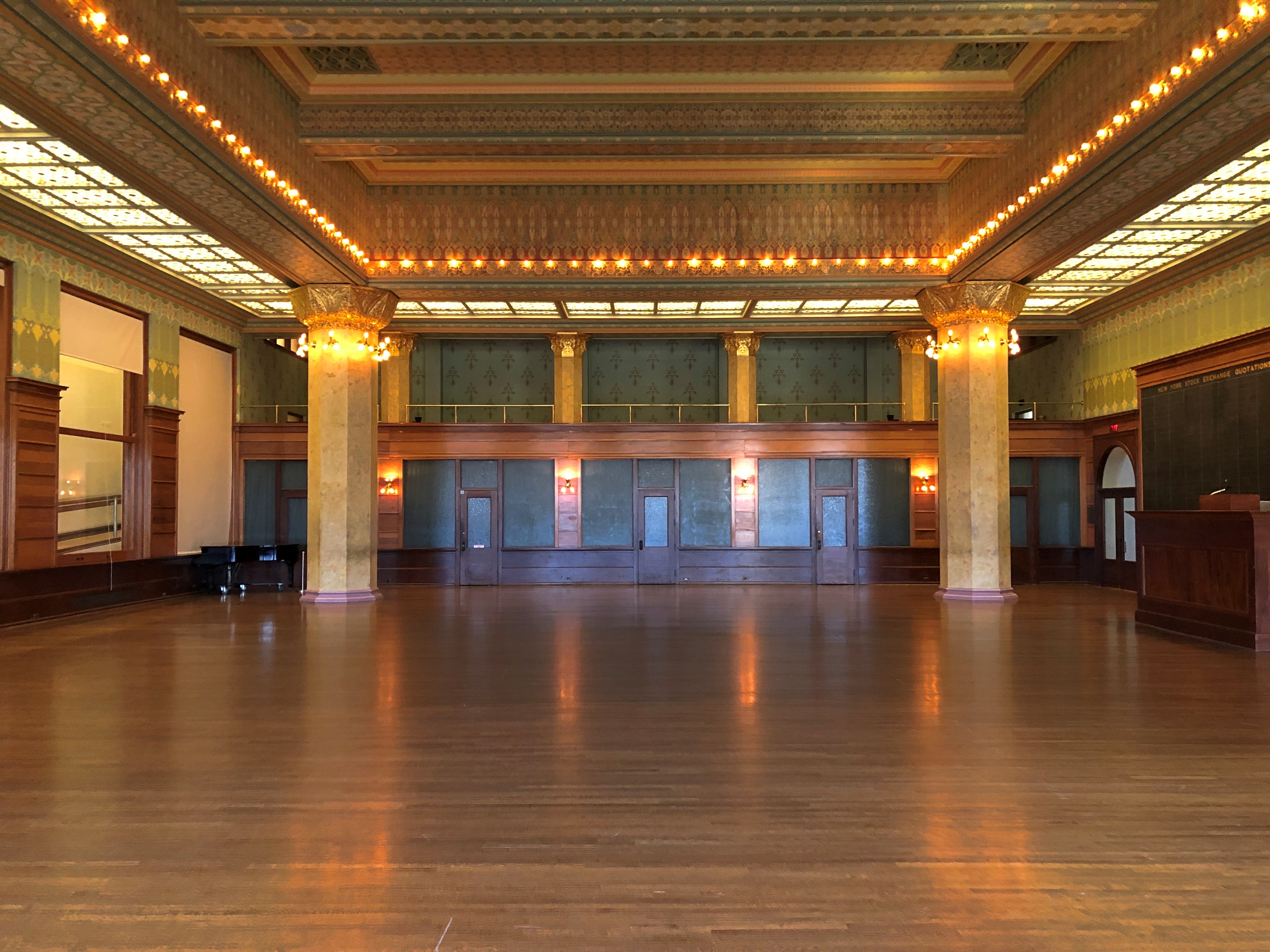
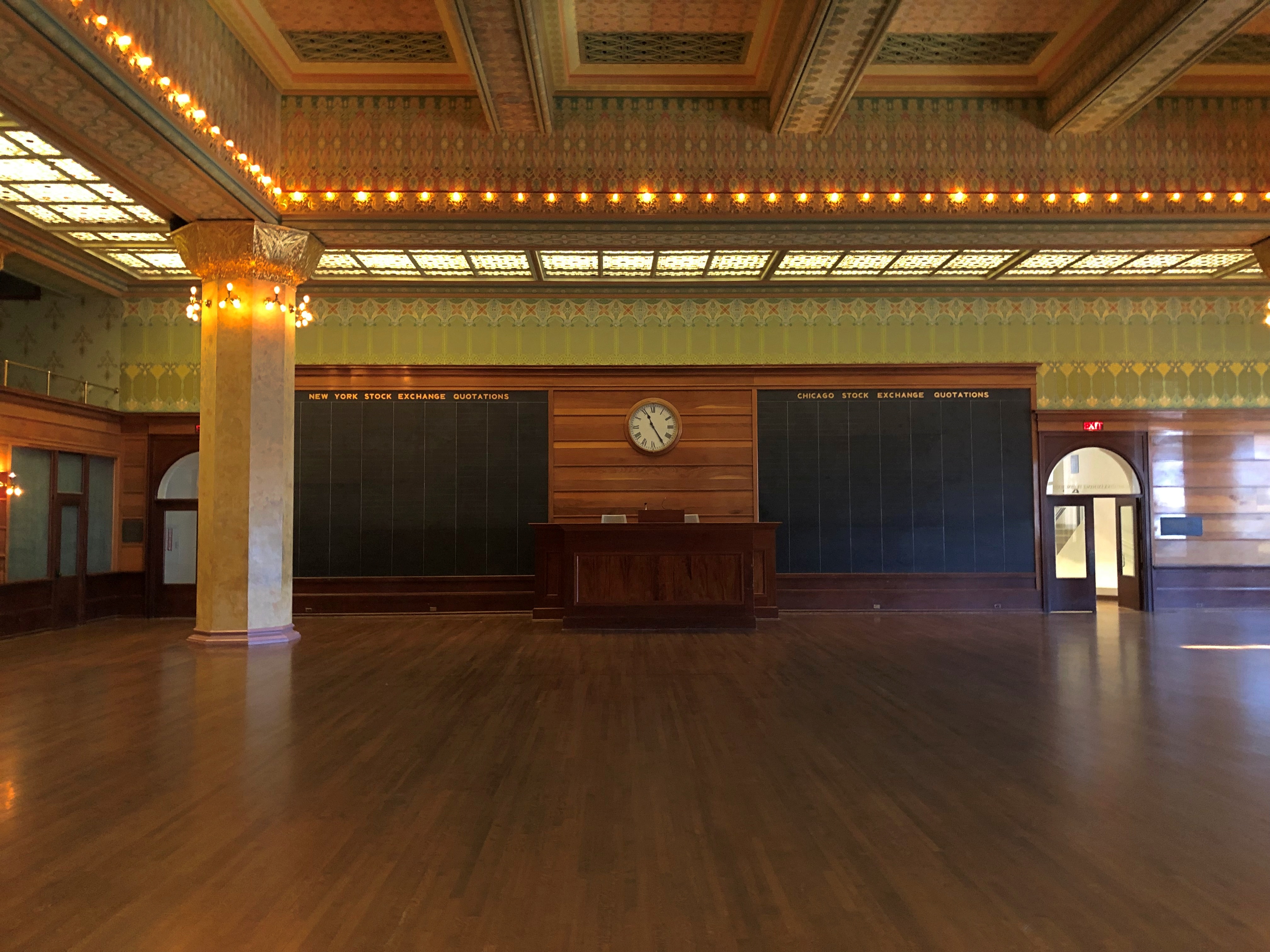
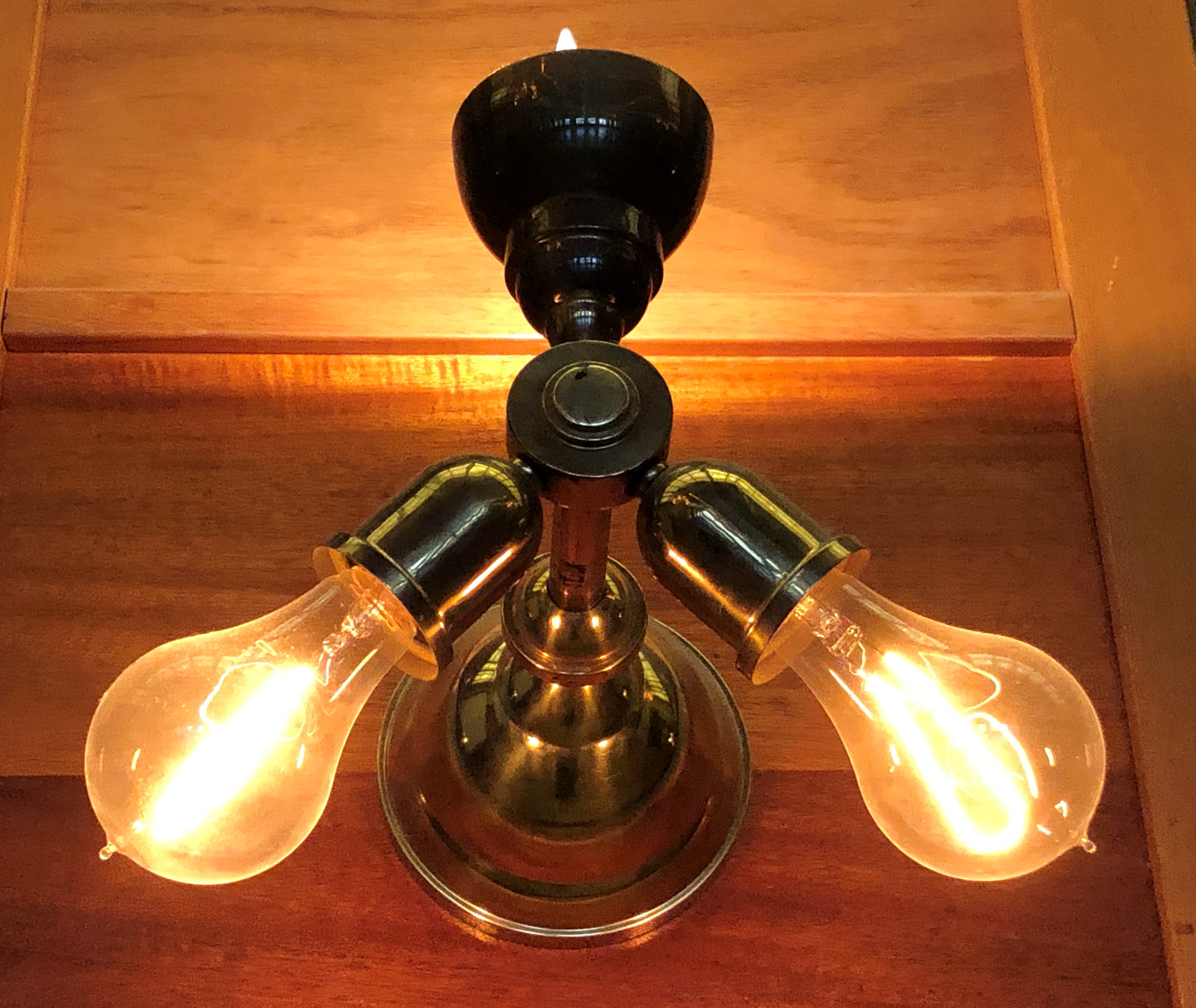
The Thorne Rooms are an exercise in constrained space. The Trading Room is one of expansive space. So much so that my basic lens really isn’t up to capturing the whole. Still, I try.Chicago Stock Exchange Trading Room, 2022 Chicago Stock Exchange Trading Room, 2022

No one else was in the room with me. It is a little out of the way, in museum wayfinding terms, and it is the artwork, rather than being mere protective walls and climate control, so maybe people pass it by.

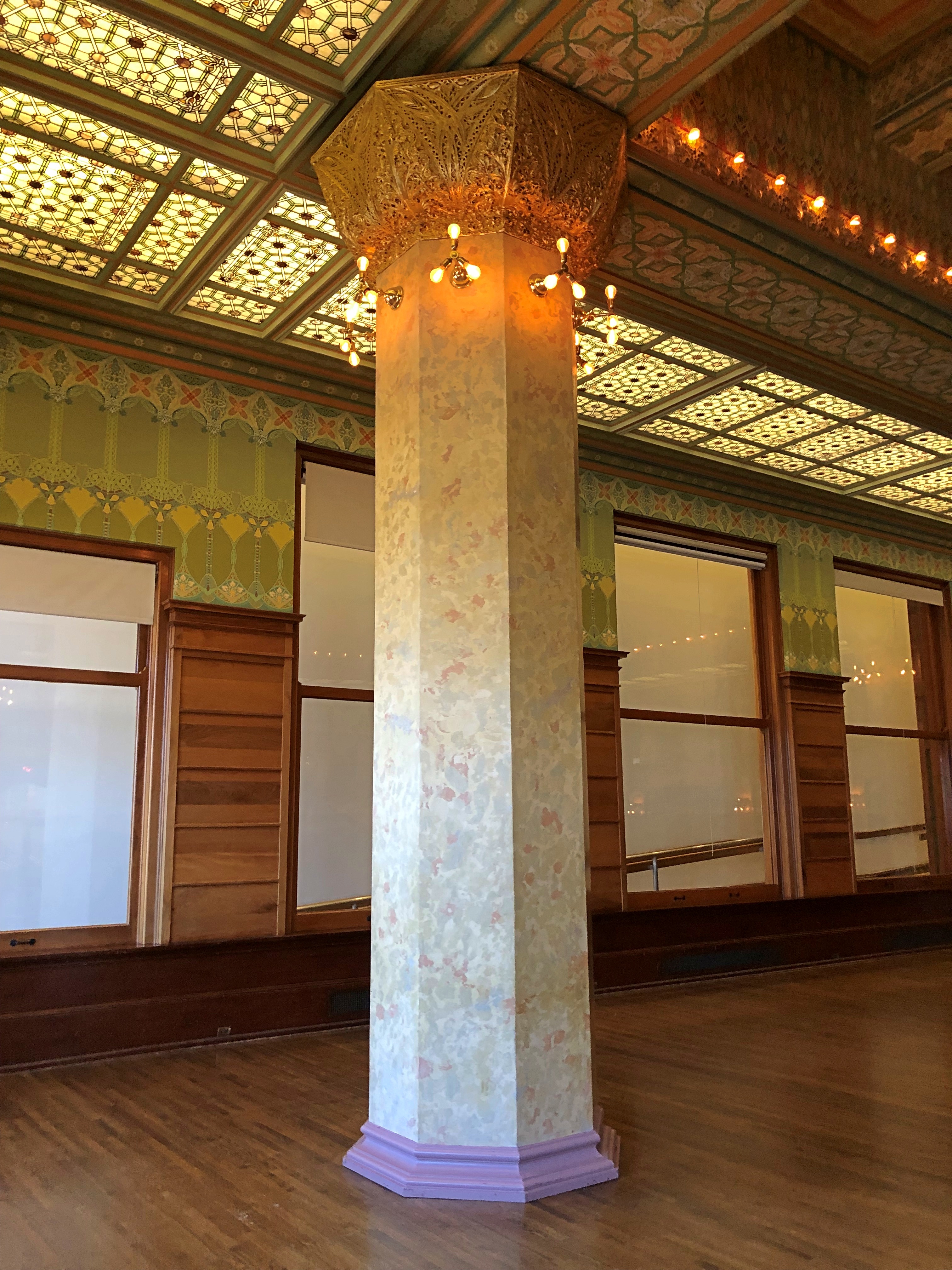
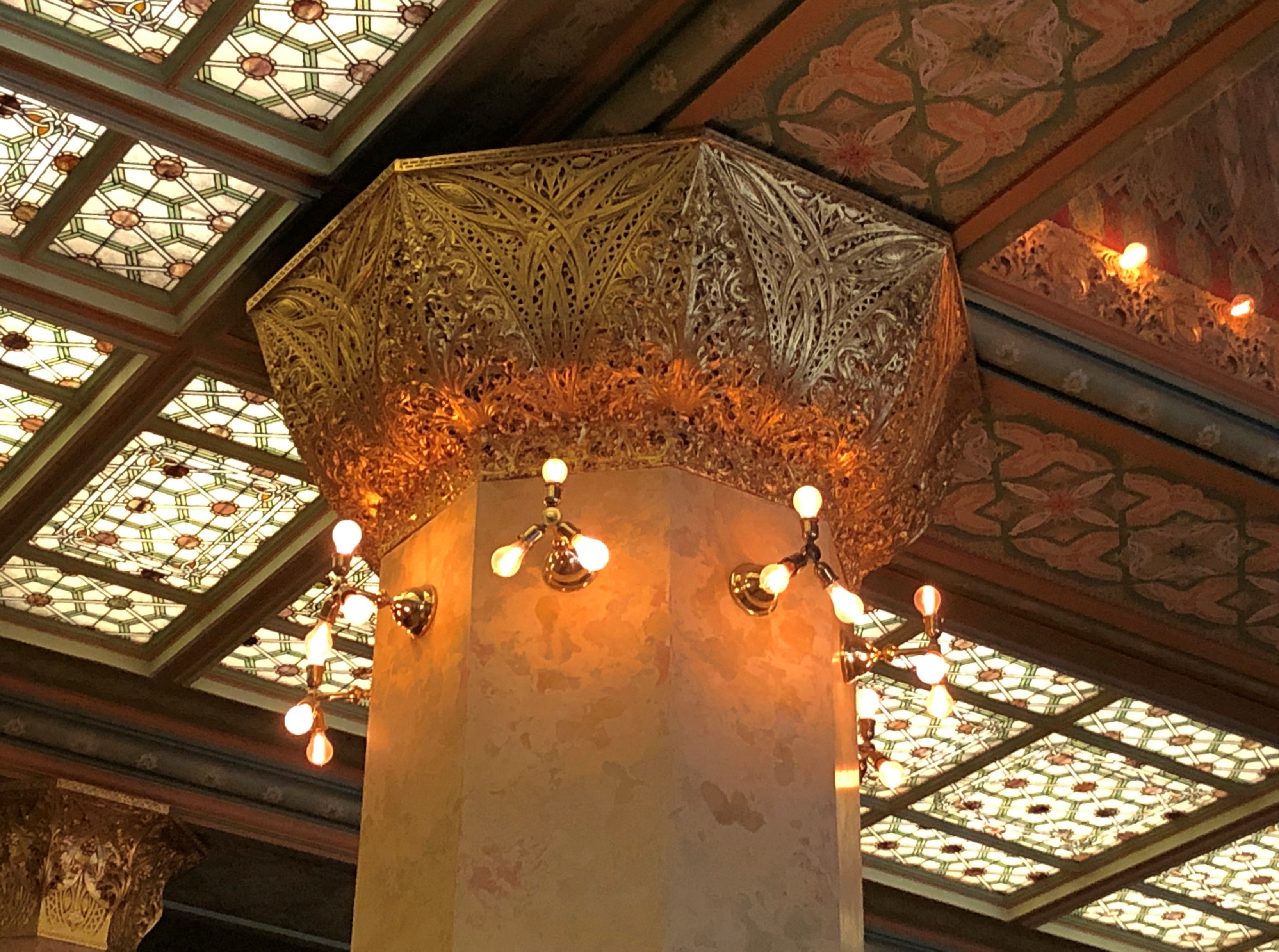
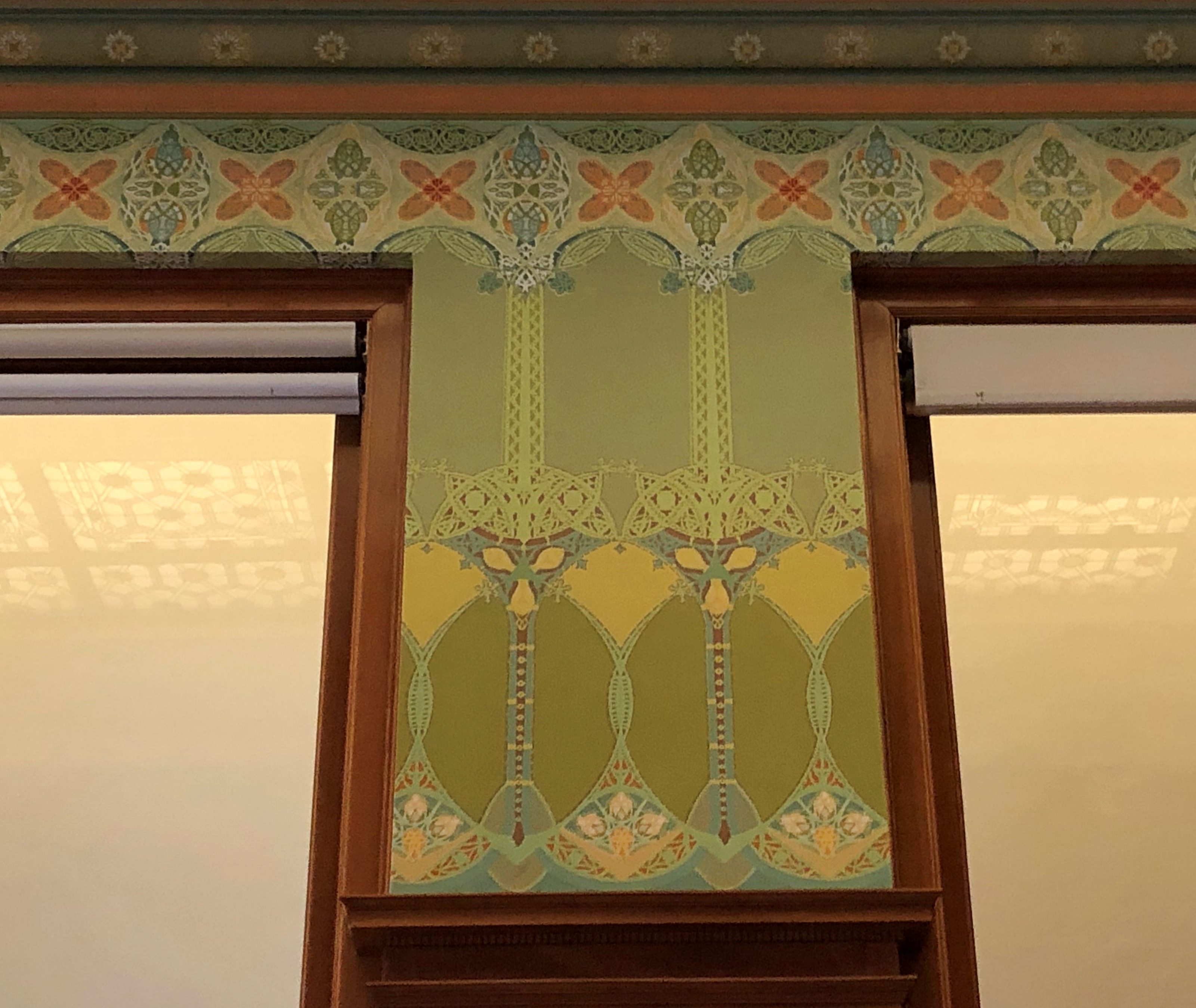
Not me. I spent a while looking at details.Chicago Stock Exchange Trading Room, 2022 Chicago Stock Exchange Trading Room, 2022 Chicago Stock Exchange Trading Room, 2022

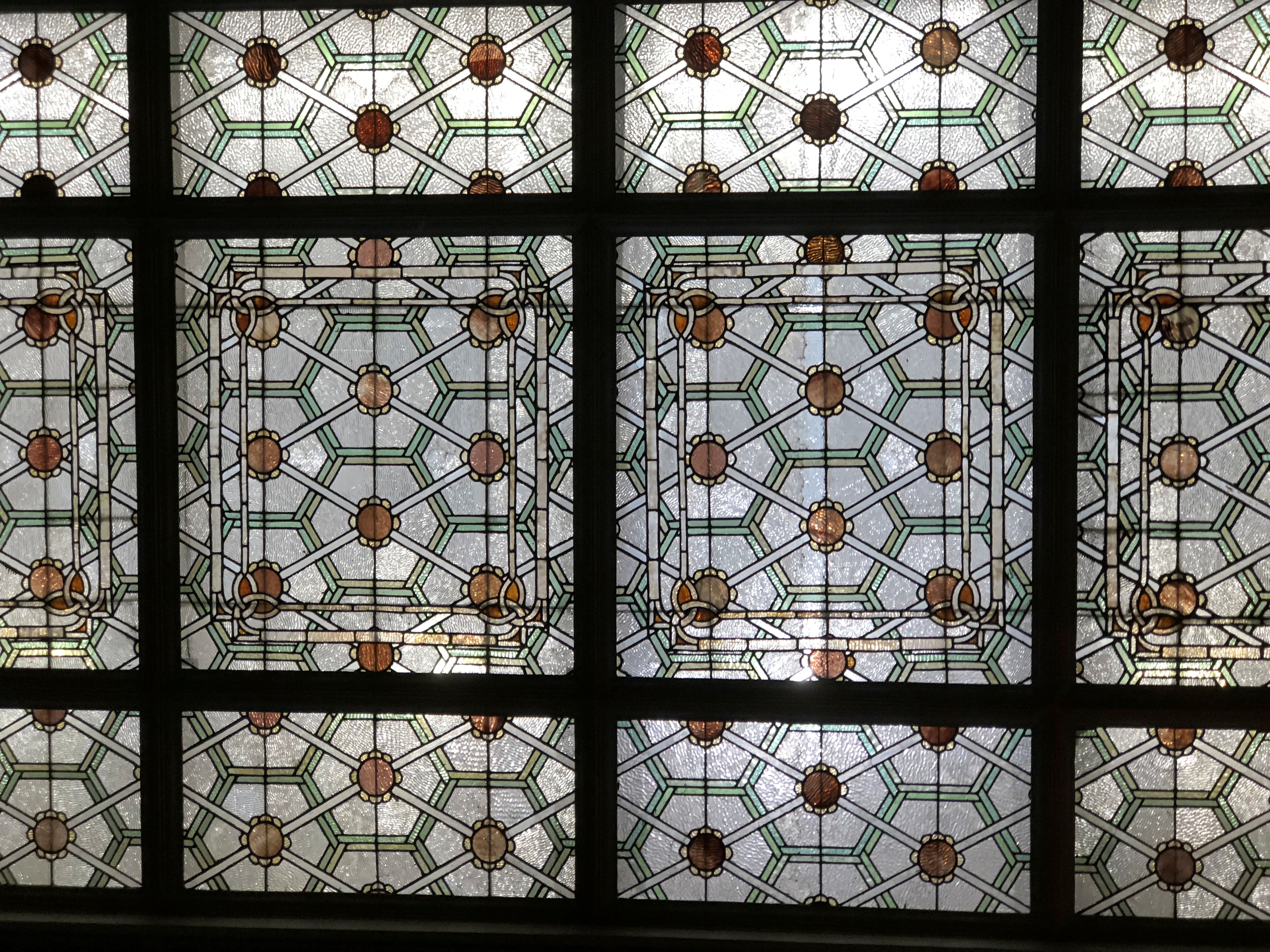
Overhead.
Chicago Stock Exchange Trading Room, 2022

Such a grand room. Victorian ideas at work, striving to add uplift to a space devoted to grubby commerce. I’d say they succeeded.Chicago Stock Exchange Trading Room, 2022

“Designed by Chicago architects Louis Sullivan and his partner, Dankmar Adler, the original Chicago Stock Exchange was completed in 1894,” the museum notes on a page that also extols the room as a place where as many as 300 people can meet.

“When it was demolished in 1972, sections of the Trading Room, including Sullivan’s elaborate stenciled decorations, molded plaster capitals, and art glass, were preserved and used in the 1976–77 reconstruction of the room here at the Art Institute.”

I attended an event there myself for some forgotten reason about 20 years ago. Suits and ties (a while ago, as I said), dresses, and drinks in hand, the room hosted such a crowd with ease.  If I had 300 people to entertain, I’d certainly consider renting the place.

Verschiedene Artikel (Donnerstag)

Still above freezing most of the time, and no snow or ice. My kind of winter. But rain is slated for the weekend, devolving into snow. Maybe. That might interfere with getting a Christmas tree.

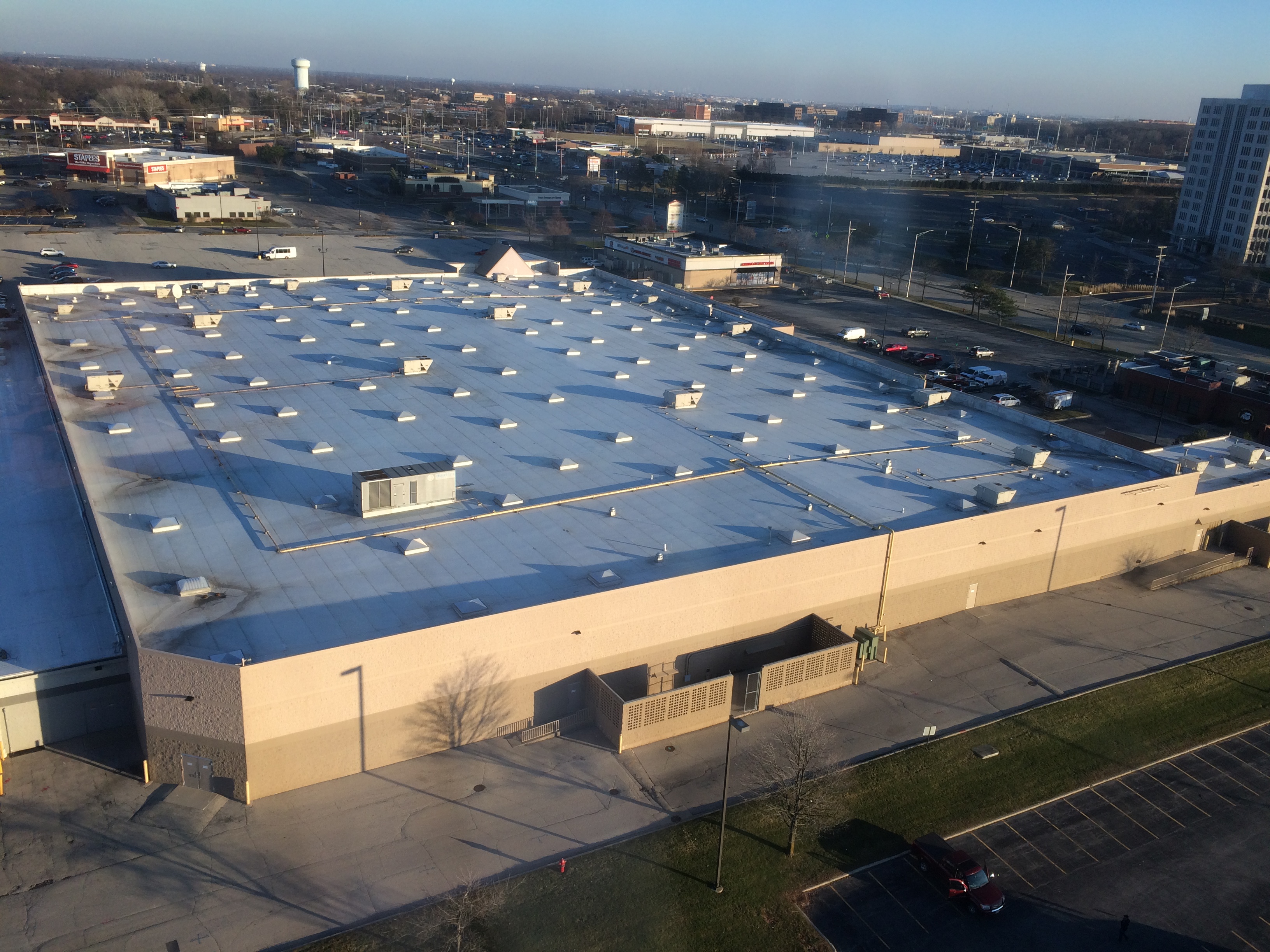
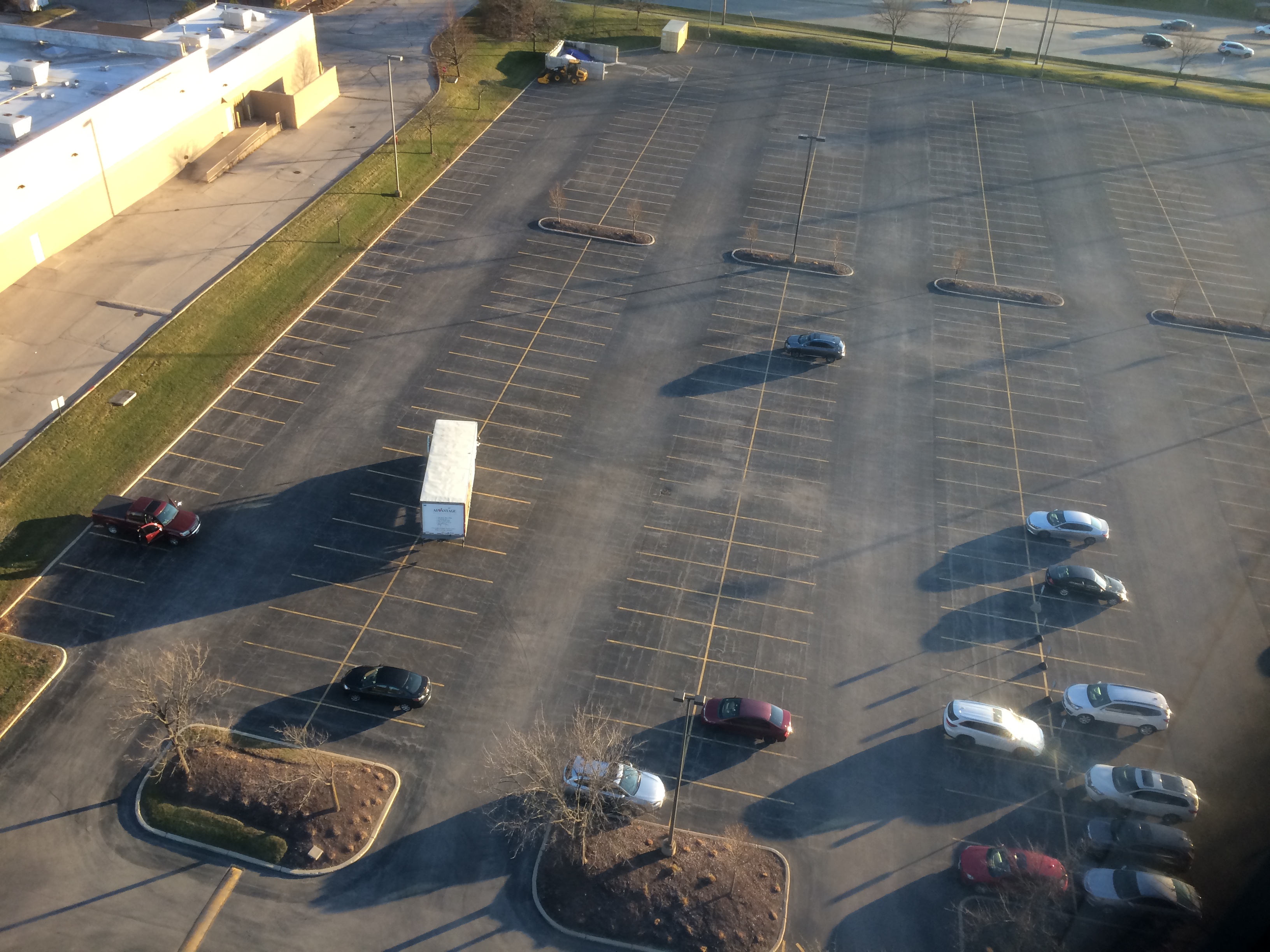
Not long ago I visited a high floor of an office building here in the northwest suburbs, something I don’t do to much these days. The view included the roof of a major retail location.Not very green, that roof. Besides whatever sustainability might be achieved, a roof that includes plants is more interesting to look at. Such as can be seen here and here. I don’t get to visit green roofs that often — ones such as the Chicago City Hall are inaccessible — but I did see one in suburban Toronto during my green press tour in that metro area. Didn’t take any pics.

Just behind the retailer is the office building’s nigh-empty parking lot.

Parking takes up a lot of space, no doubt about it. This study only focuses on a few cities, however, not the endless suburbs.

I set the background of my laptop to change every minute, and to keep things interesting, and I change the collection of images the computer uses every few days, if I remember to. Yesterday I directed the computer to use the images in the file July 5, 2019, which was our first day in Pittsburgh last year.

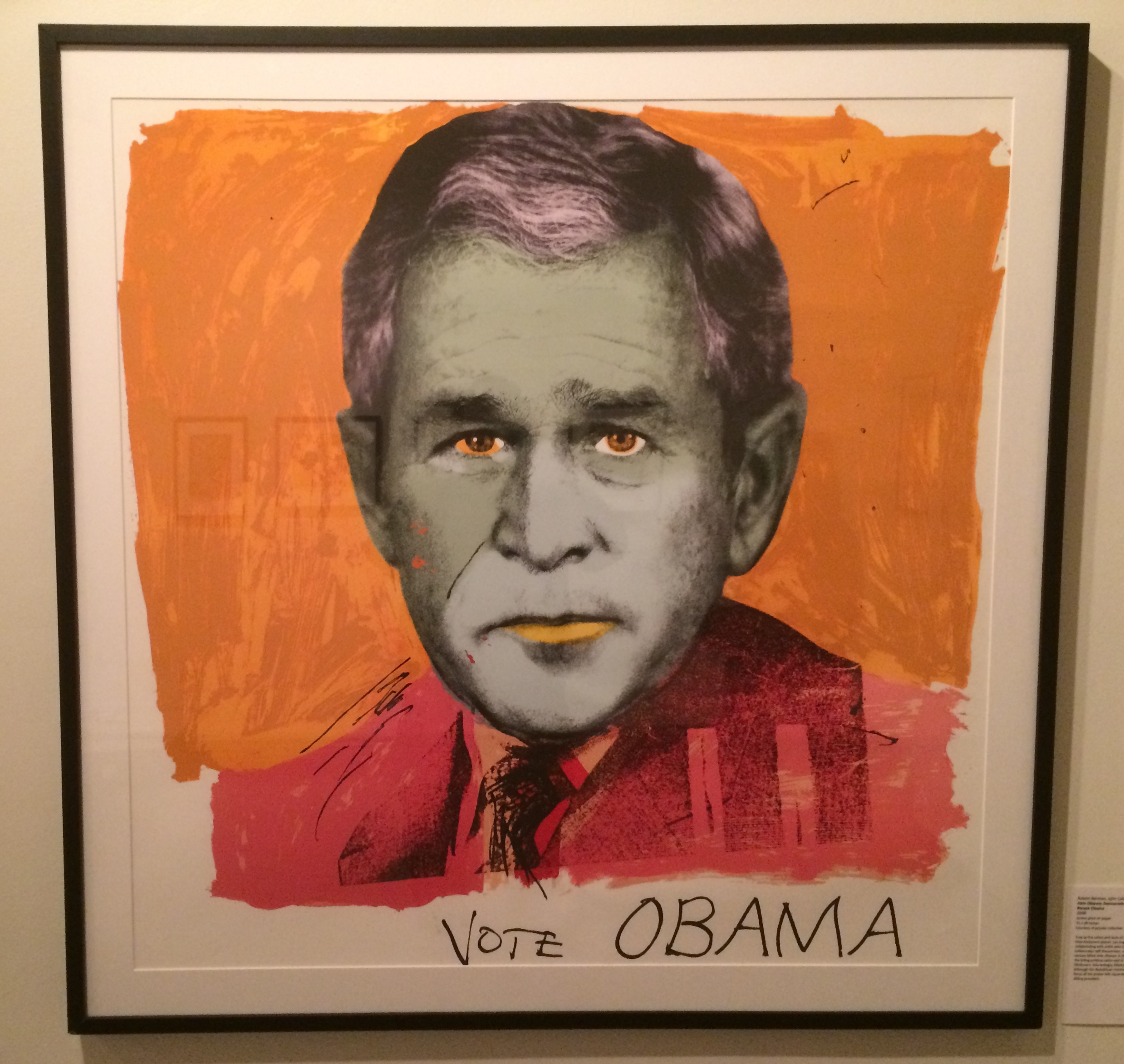
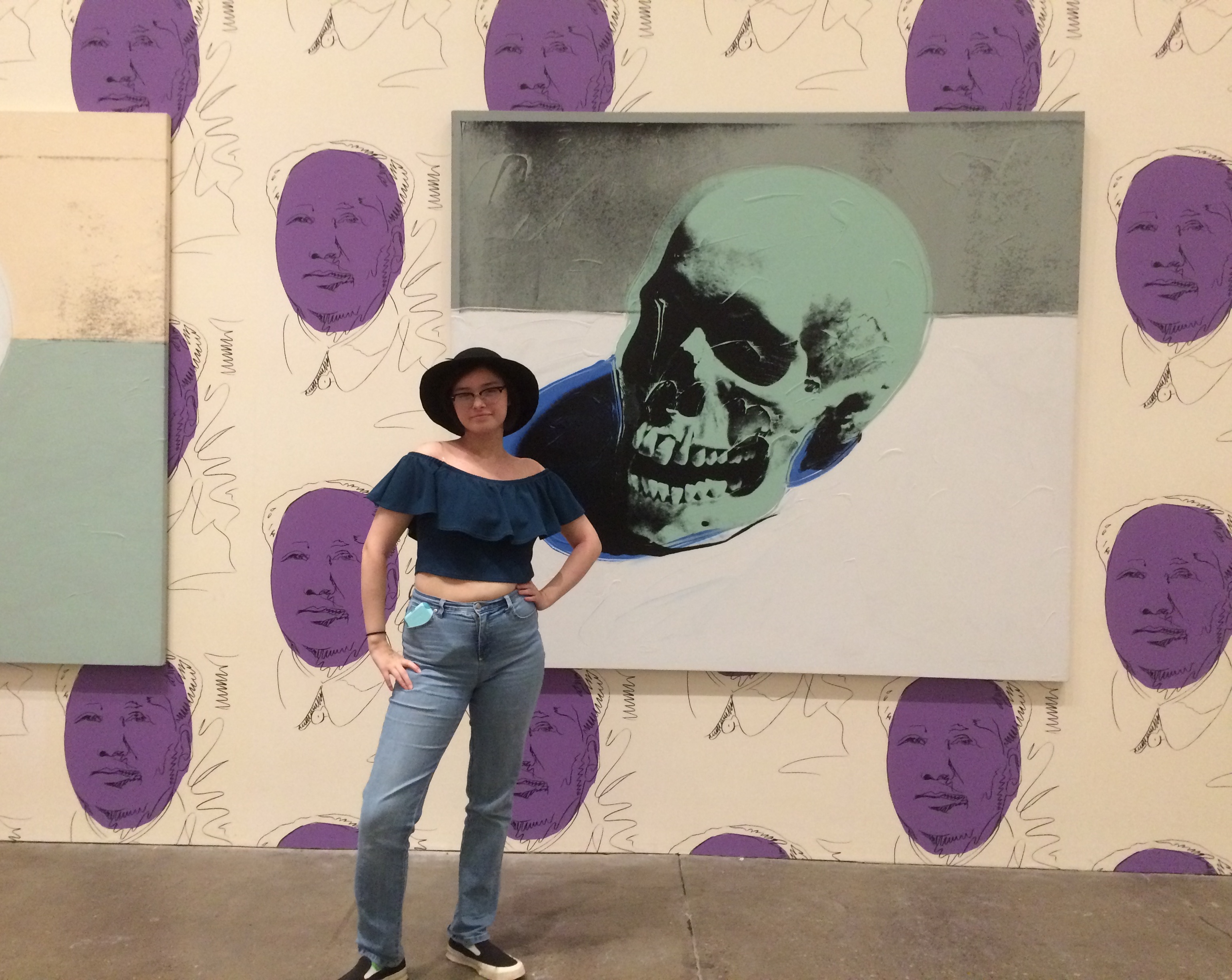
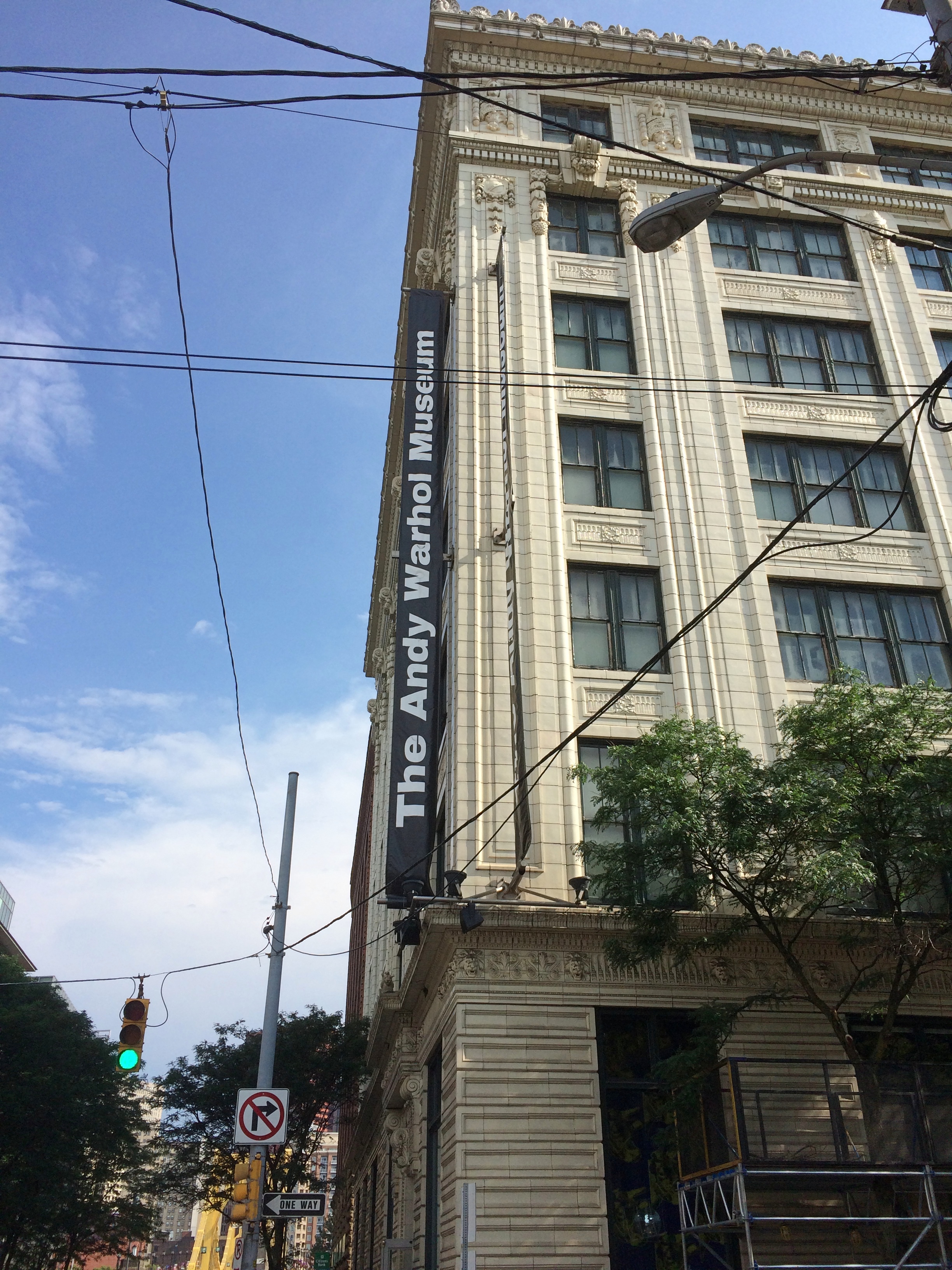
This popped up as part of the cycle. I’d forgotten I’d taken it.
That was in the Andy Warhol Museum.

Ann and I are still watching Star Trek roughly once a week. I’d say she’s seen about half of the original series. The most recent ones were the “Immunity Syndrome” and “A Private Little War,” both of which hold up reasonably well, though in strict storytelling terms, “Immunity” is better, since the concept is simple and the execution fairly taut. It’s the crew of the Enterprise vs. a whopping big space amoeba.

Best of all, it doesn’t turn out that the whopping big space amoeba is actually a sophisticated intelligence that the heroes eventually learn to communicate with and peacefully coexist with, a la Roddenberry.

That can be an OK track for a story — such as in “Devil in the Dark” — but for sheer space pulp drama, what you want is a mindless menace that needs to be destroyed by the last act. Star Trek did an even better job of that in “The Doomsday Machine,” in which the Enterprise fights a massive bugle corn snack that shoots death rays.

At first I thought “A Private Little War” was the (stupid) episode with the Yangs and the Cohms, in which Capt. Kirk recites the Pledge of Allegiance, among other looniness. No, that’s “The Omega Glory,” which we haven’t gotten to.

“War” is a jerry-built metaphor for the Vietnam War, involving as it does war among alien rustics, a Klingon plot to arm the natives, Kirk’s “balance of power” response, etc. Also, there was a raven-haired femme fatale with a bare midriff that got the attention of the 13-year-old I once was, and a creature that looked like a man in an albino gorilla suit, because that’s what it surely was. Spock bled green from a gunshot wound and Nurse Chappell got to slap him around. Why didn’t we ever see more of Dr. M’Benga? (Seems he was in another episode briefly.) Here’s why: actors cost money, as much as showrunners might wish otherwise.

One more item for today. Not long ago we got takeout at Asian Noodle House, a wonderful storefront that seems to be surviving on the takeout trade. We go there every other month or so. Fortune cookies come with each order, one per entre. Each wrapped in its own little plastic bag.

Today we got three little bags. One of them had two cookies tightly packed within. Is that like getting a double yolk? Does it mean extra good fortune or extra bad chi? Maybe one cookie is ying, the other yang.

Twelve Pictures ’19

I always take many more pictures than I post in any given year. Here are some from this year to close out the decade. Back to posting around January 5, 2020. That year sounds so far in the future, at least for those of us who vaguely remember Sealab 2020 — and yet here it is.

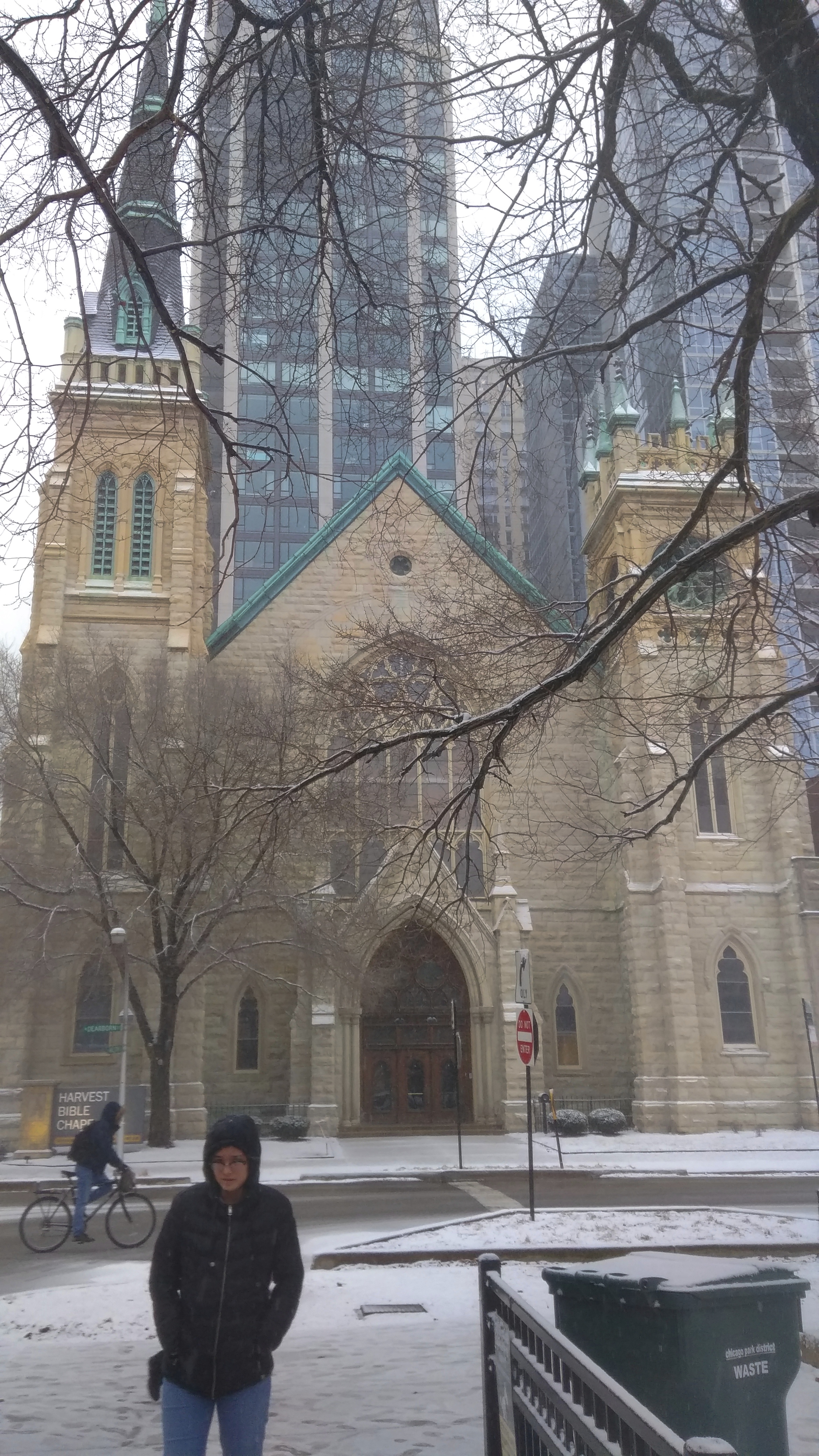
Near North Side Chicago, January 2019

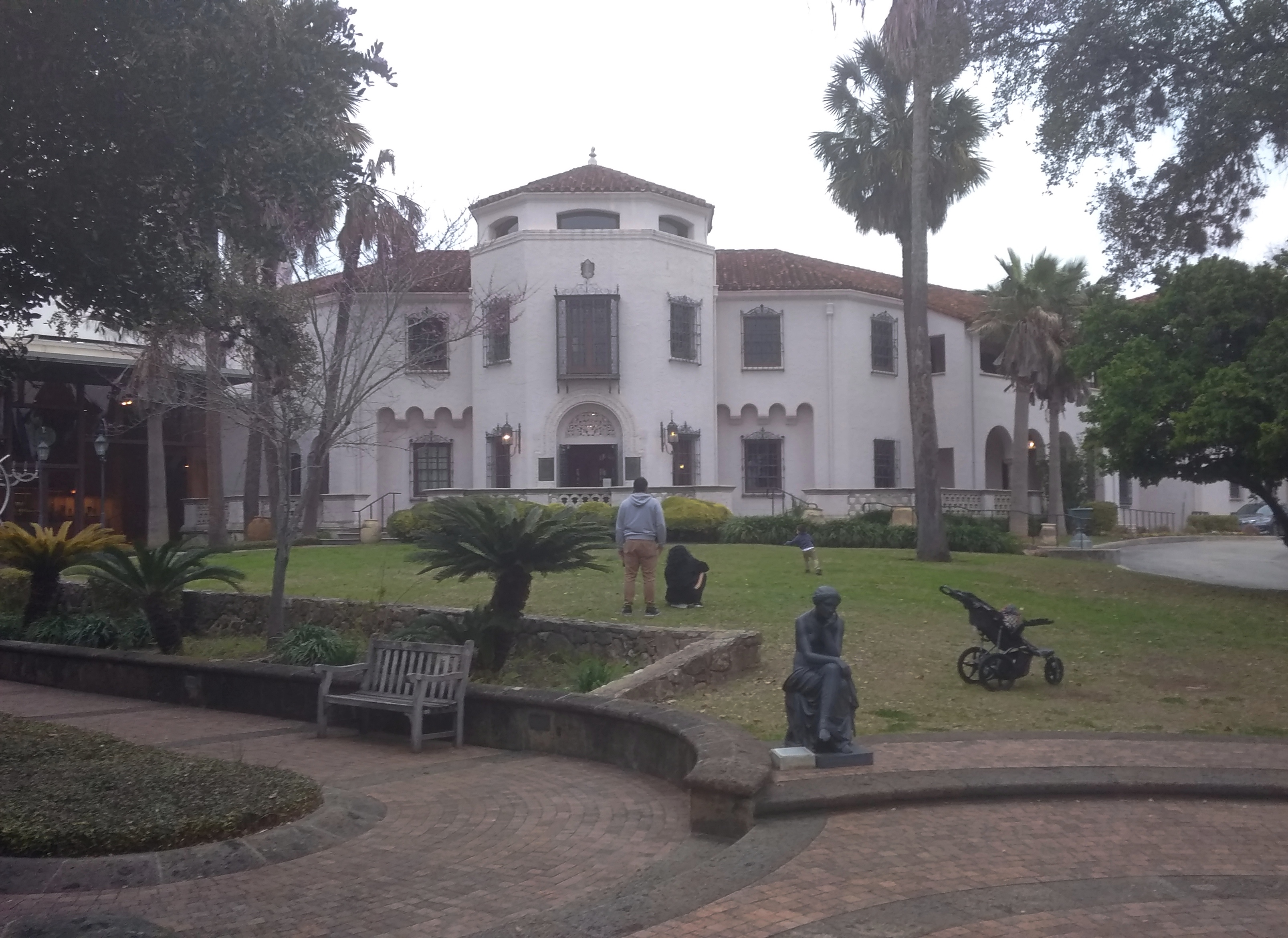
San Antonio, February 2019

Downtown Chicago, March 2019

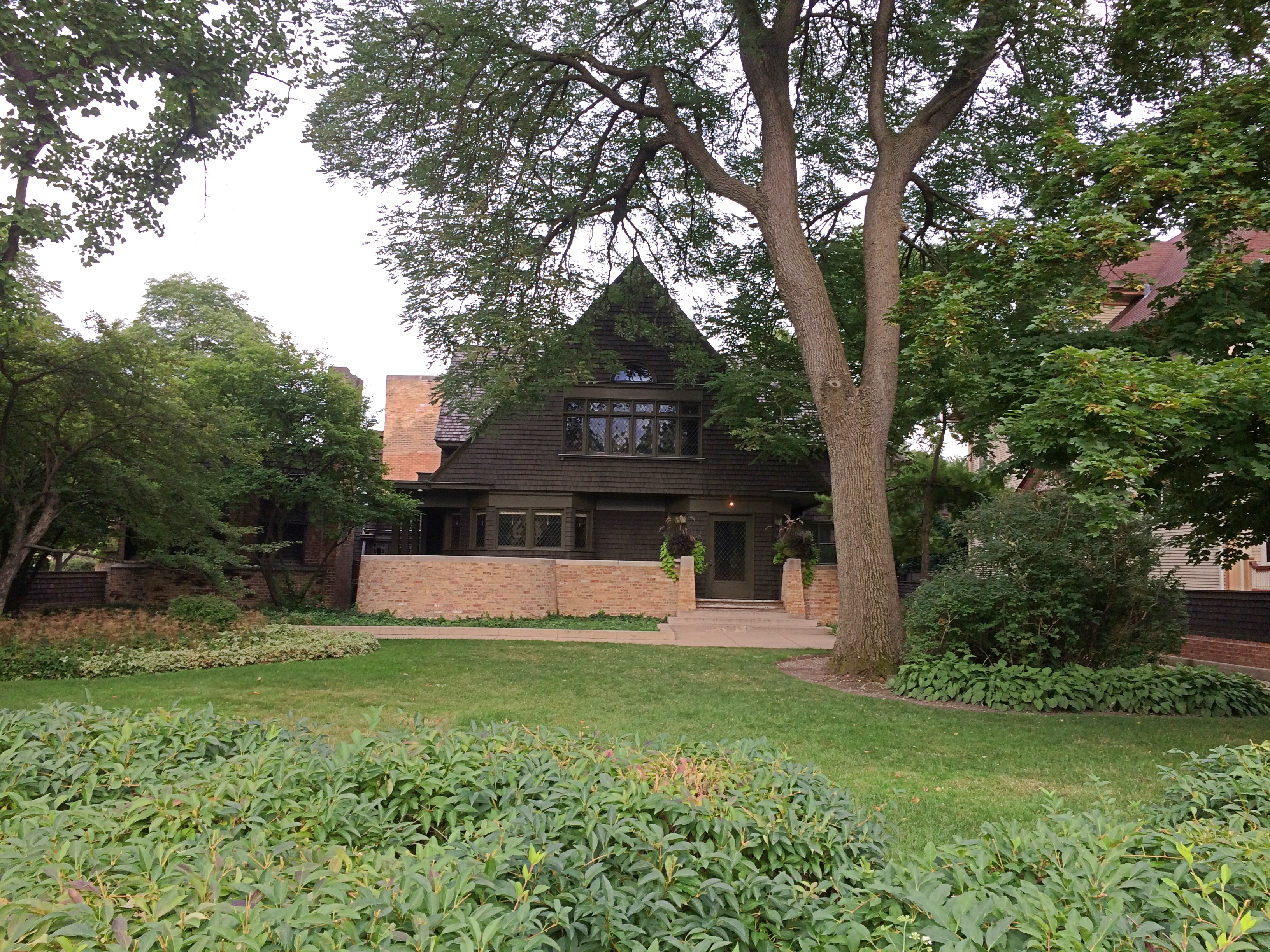
Elmhurst, Illinois, April 2019

New Orleans, May 2019

Arcola, Illinois, June 2019

Pittsburgh, July 2019

Oak Park, Illinois, August 2019

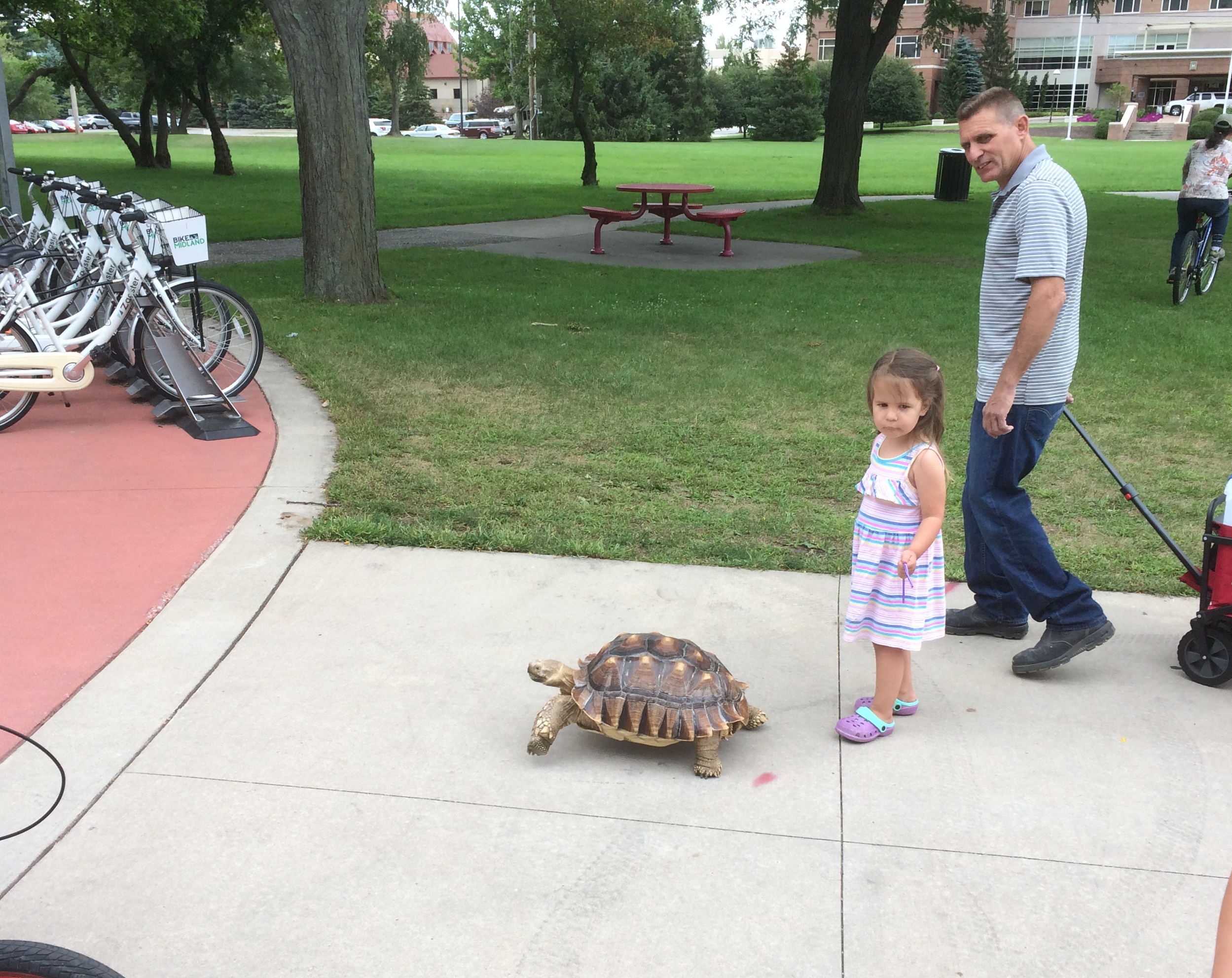
Midland, Michigan, September 2019

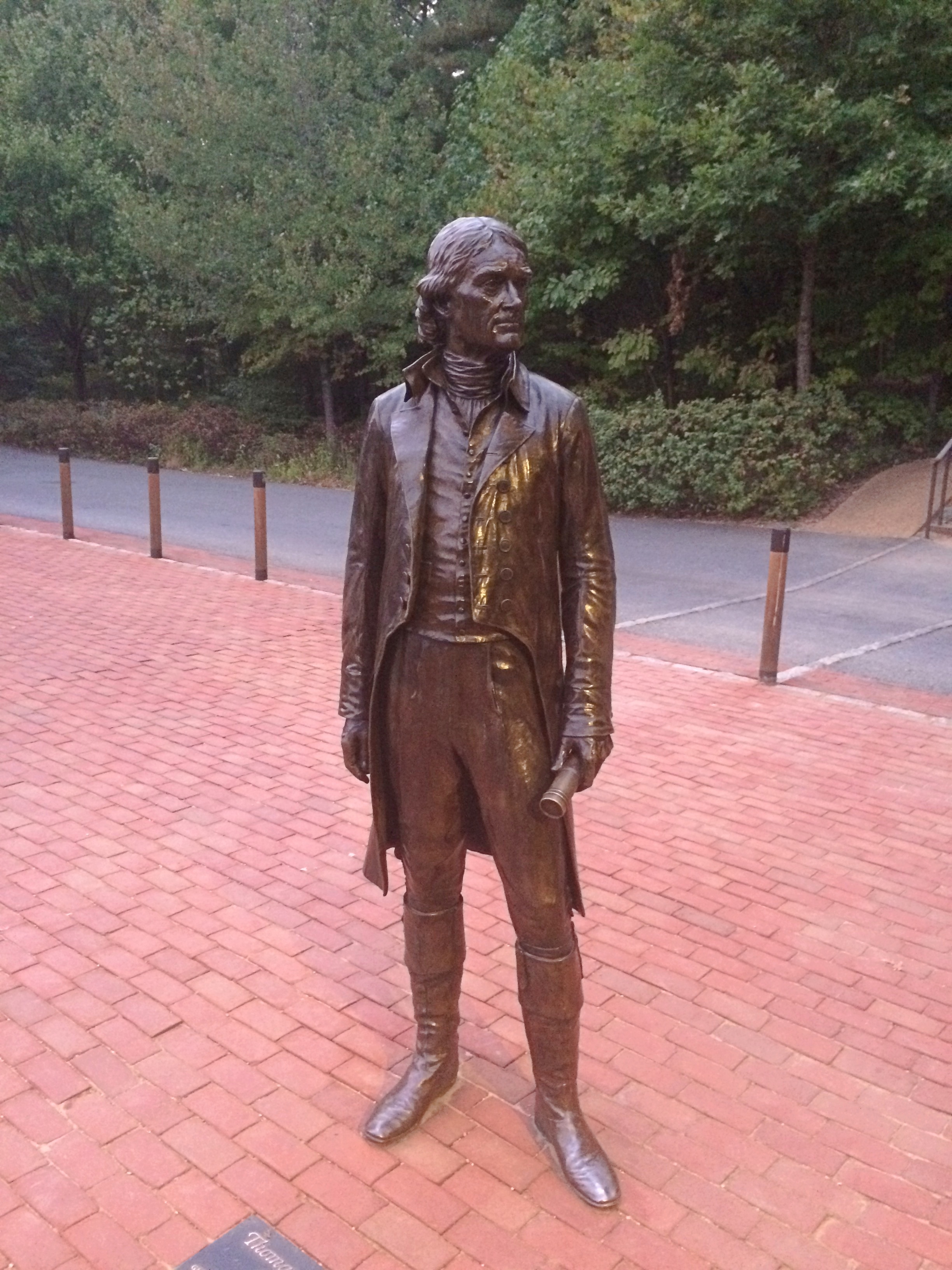
Charlottesville, Virginia, October 2019

Schaumburg, Illinois, November 2019

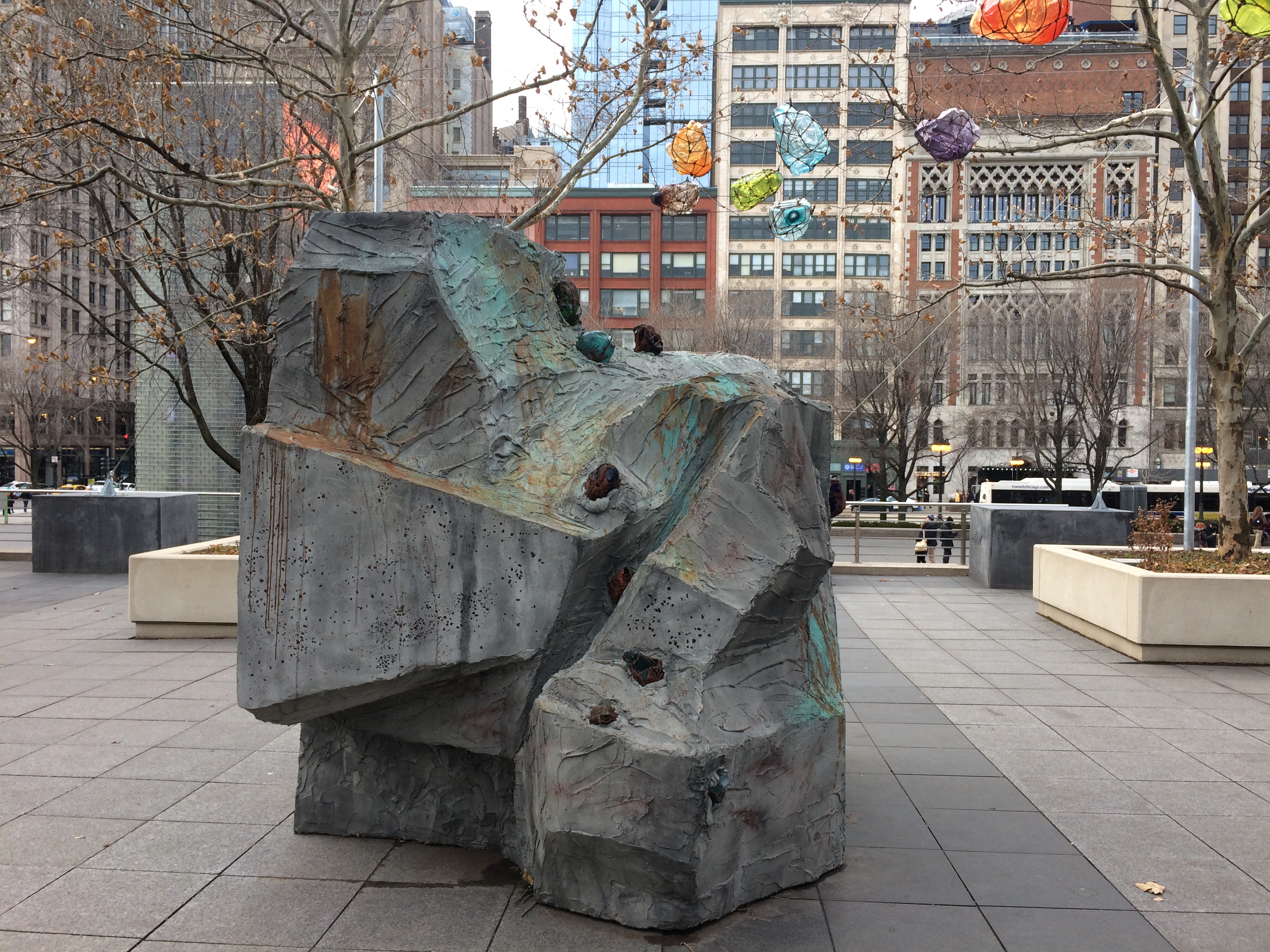
Millennium Park, Chicago, December 2019Good Christmas and New Year to all.

More Bits of Pittsburgh & West Virginia Too

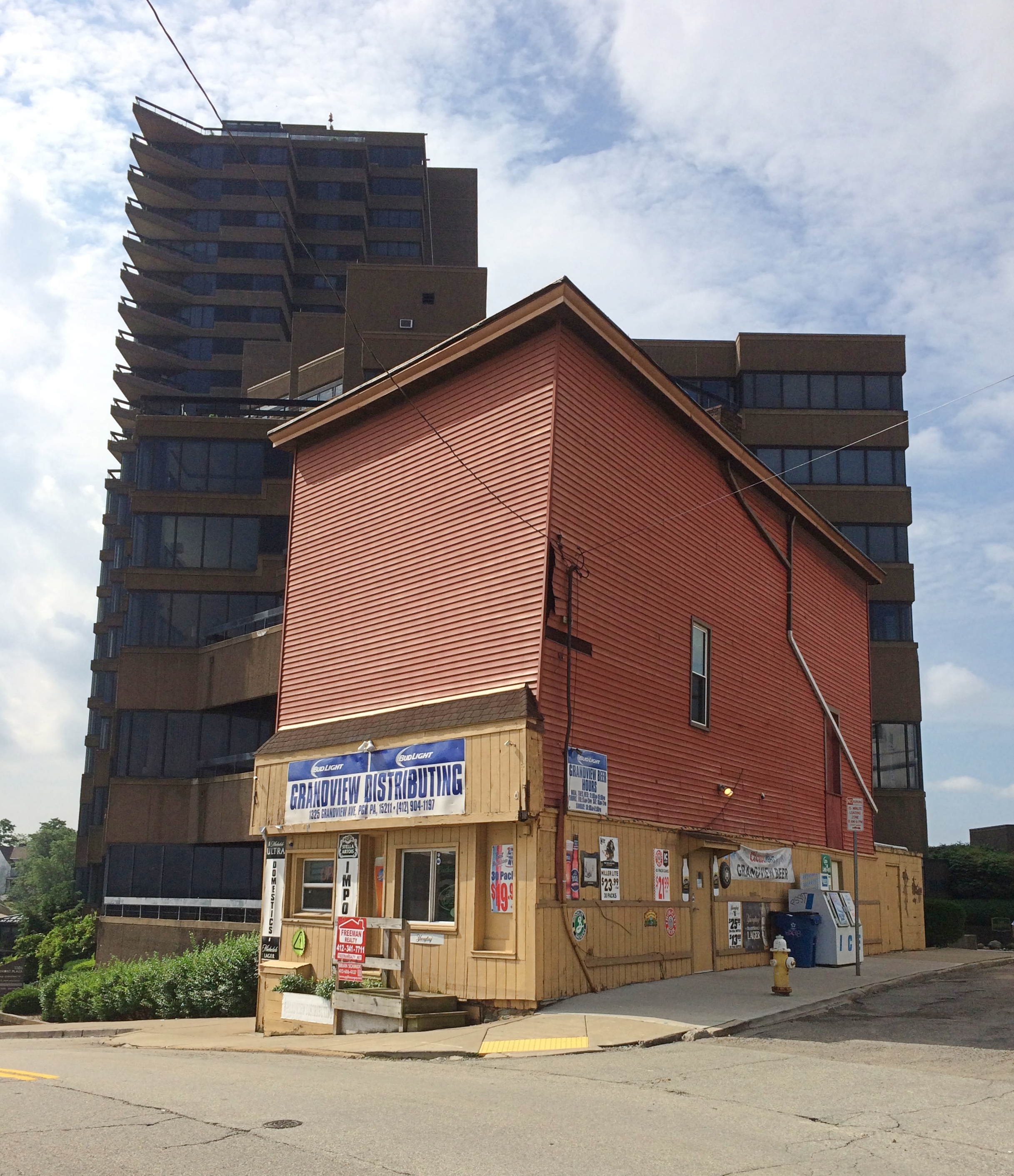
The street that follows the edge of Mt. Washington in Pittsburgh is the aptly named Grandview Ave., featuring some truly grand views overlooking downtown and the three rivers. There are some multifamily properties and office buildings on the road that take advantage of the vista. But not that many. Am I missing something about the Pittsburgh market? Why, for instance, is this building in such a prime spot?

Maybe the lot’s too narrow for an apartment tower — like the one behind it — but what about a large house? I’d imagine that would command a handsome price.

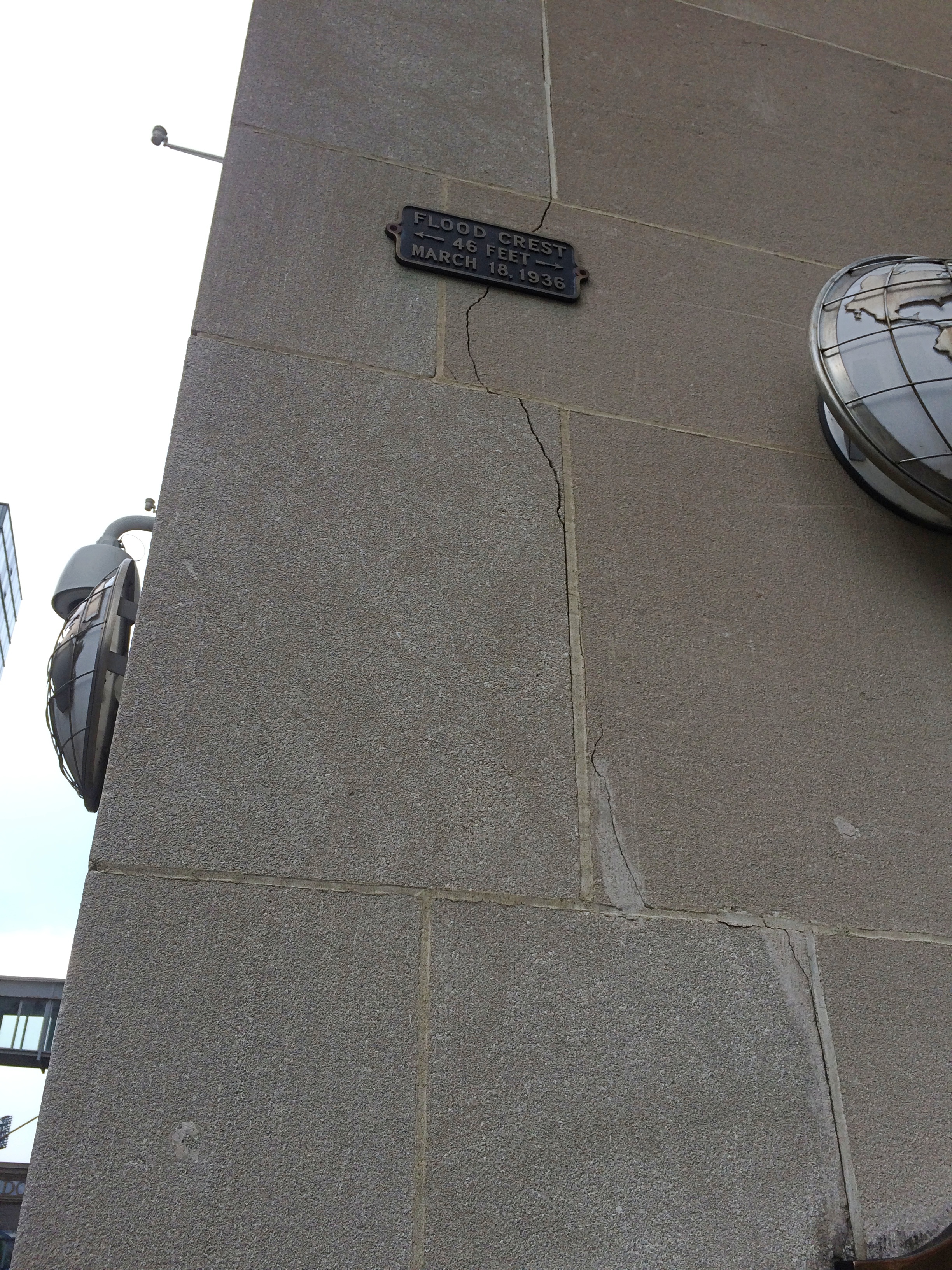
The March 1936 flood in Pittsburgh was a bad one. How do I know this, beyond it being in the historical record? In downtown Pittsburgh, I encountered this wall. Note the plaque way up there.

“Nearly two inches of rain fell on March 16, which added to the 63 inches of snow that came throughout the winter,” the Heinz History Center says. “Warm temperatures melted the snow, swelling creek beds along the upper Allegheny and Monongahela Rivers.

“On St. Patrick’s Day, the rising rivers reached the North Side and washed into the streets of Downtown, wiping out historic businesses within hours. River levels reached a peak of 46 feet at the Point, more than 20 feet over flood stage, leaving more than half of Downtown businesses under water.”

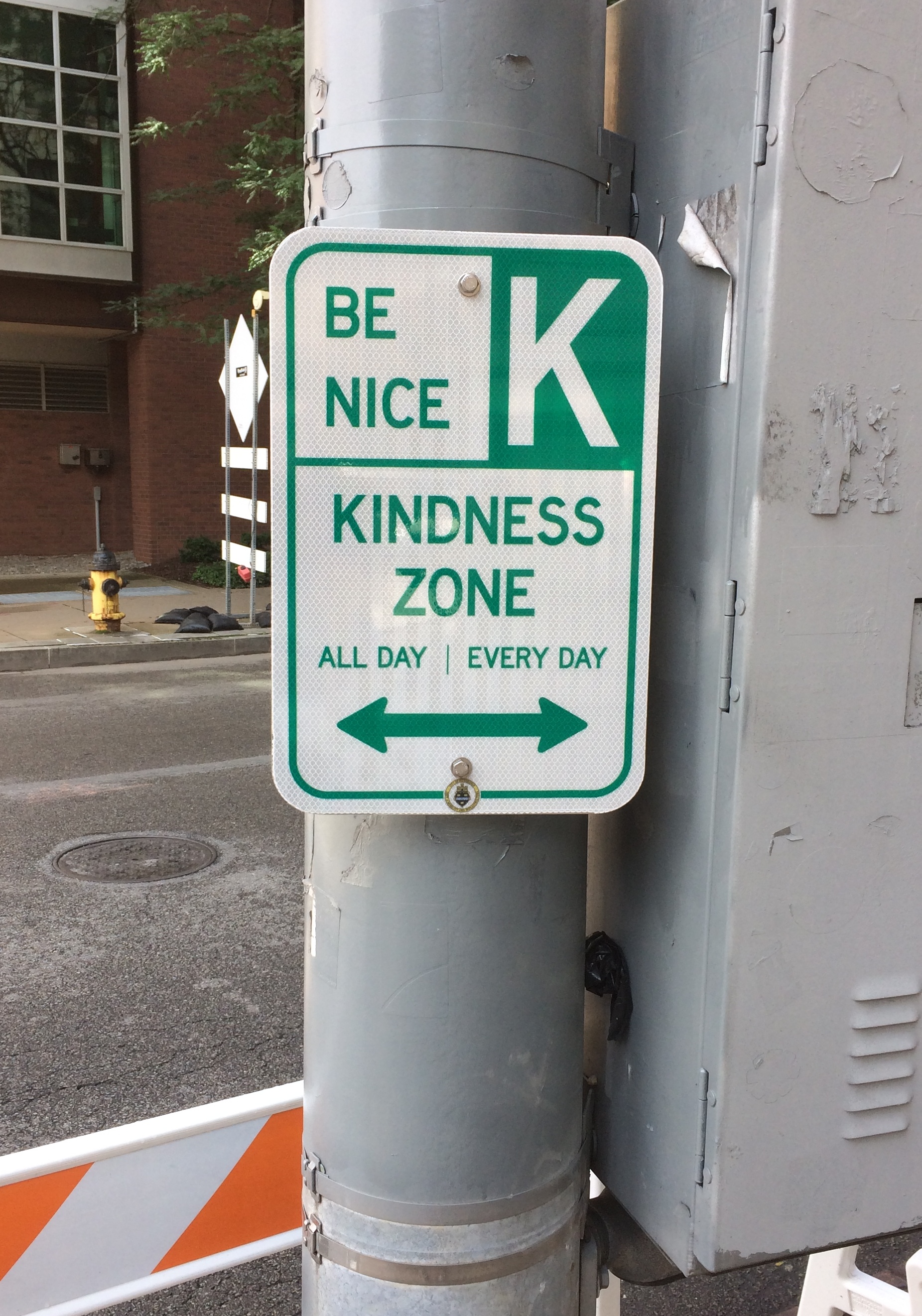
In front of the Andy Warhol Museum is this street sign.
Not sure whether the museum had anything to do with that, but it’s a nice sentiment anyway.

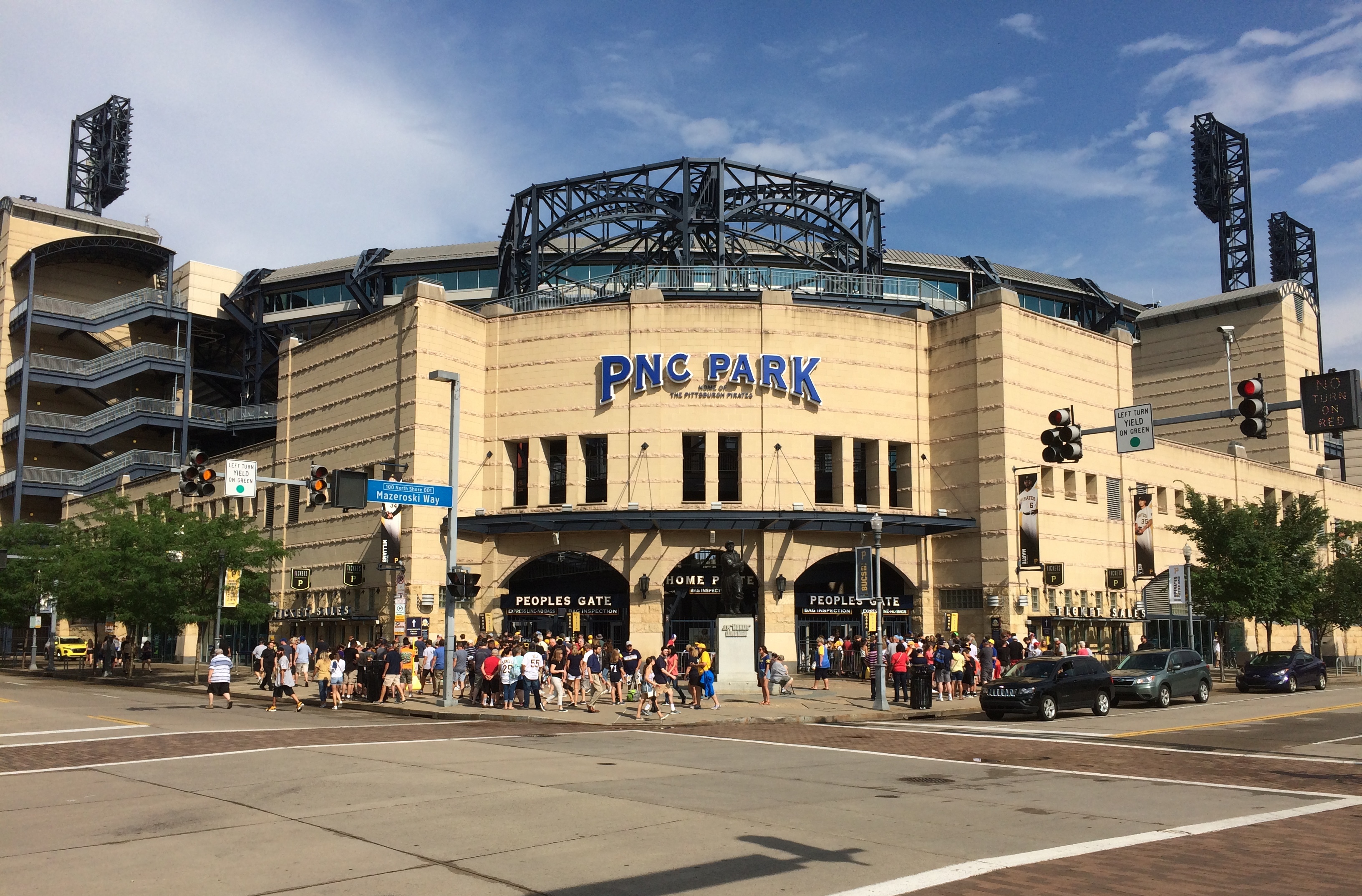
PNC Park was on the way to the Warhol. July 5 was a game day.
The Pirates played the Brewers that day, losing 7-6 in 10 innings. But that was still in the future when we wandered by. If you look closely, you can see a statue of J.P. “Honus” Wagner, beloved Pirate of yore, just in front of the main entrance.

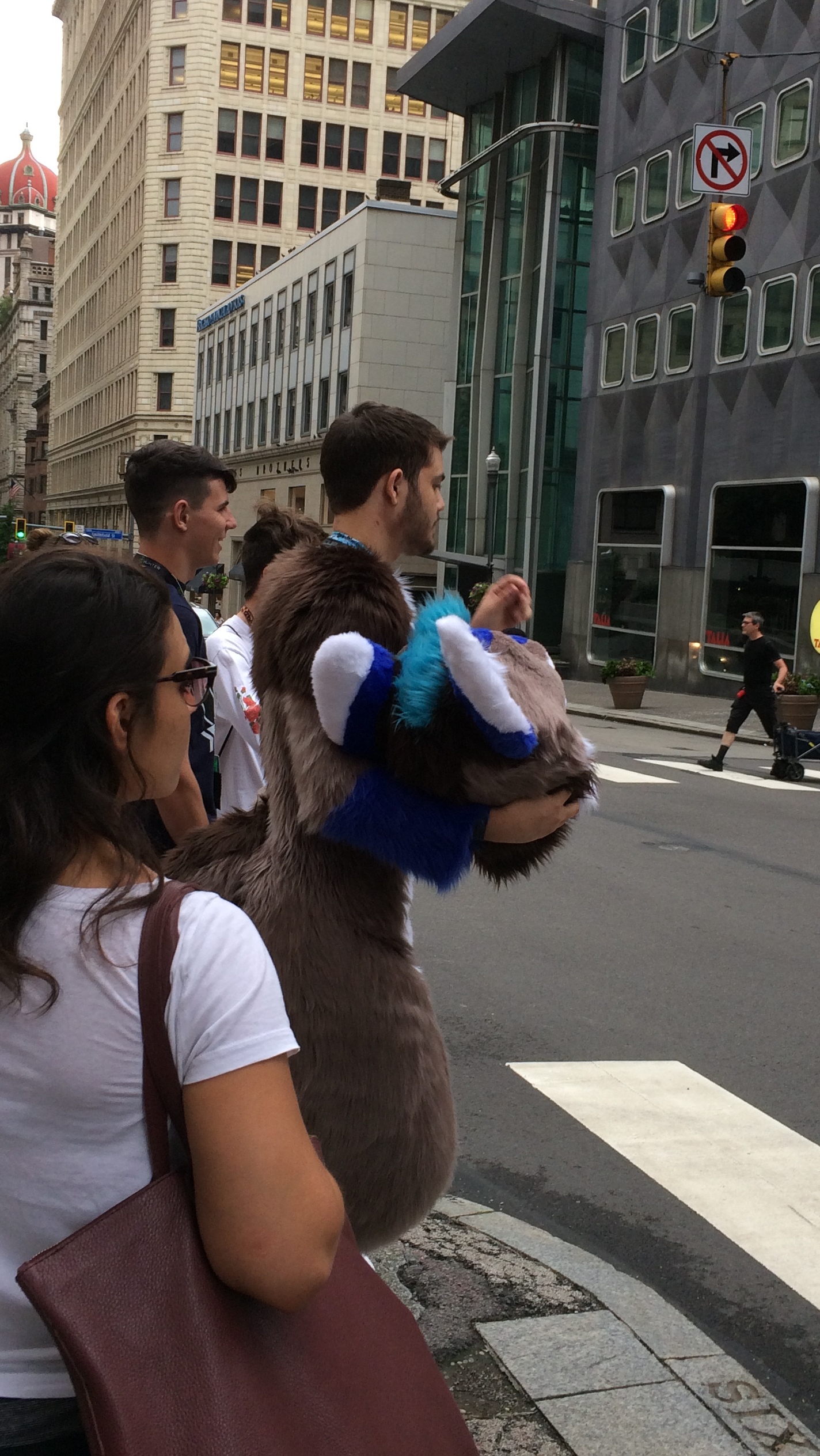
On Independence Day weekend, Pittsburgh is always host to Anthrocon, a national convention I’d never heard of before we took our Pittsburgh walking tour. Anthrocon attendees were out and about that day, and they were easy to pick out.

Here’s an attendee waiting to cross the street.
He had his headpiece off at that moment, but others walked by in full costume, defying the heat. Just what is Anthrocon?

The organization’s web site says: “Anthrocon began as Albany Anthrocon in 1997, and since then has grown into one of the largest anthropomorphics conventions in the world with a membership in 2018 of over 8,400 attendees… All of the finer aspects of anthropomorphic, or more commonly, ‘Furry’ fandom, are celebrated here.”

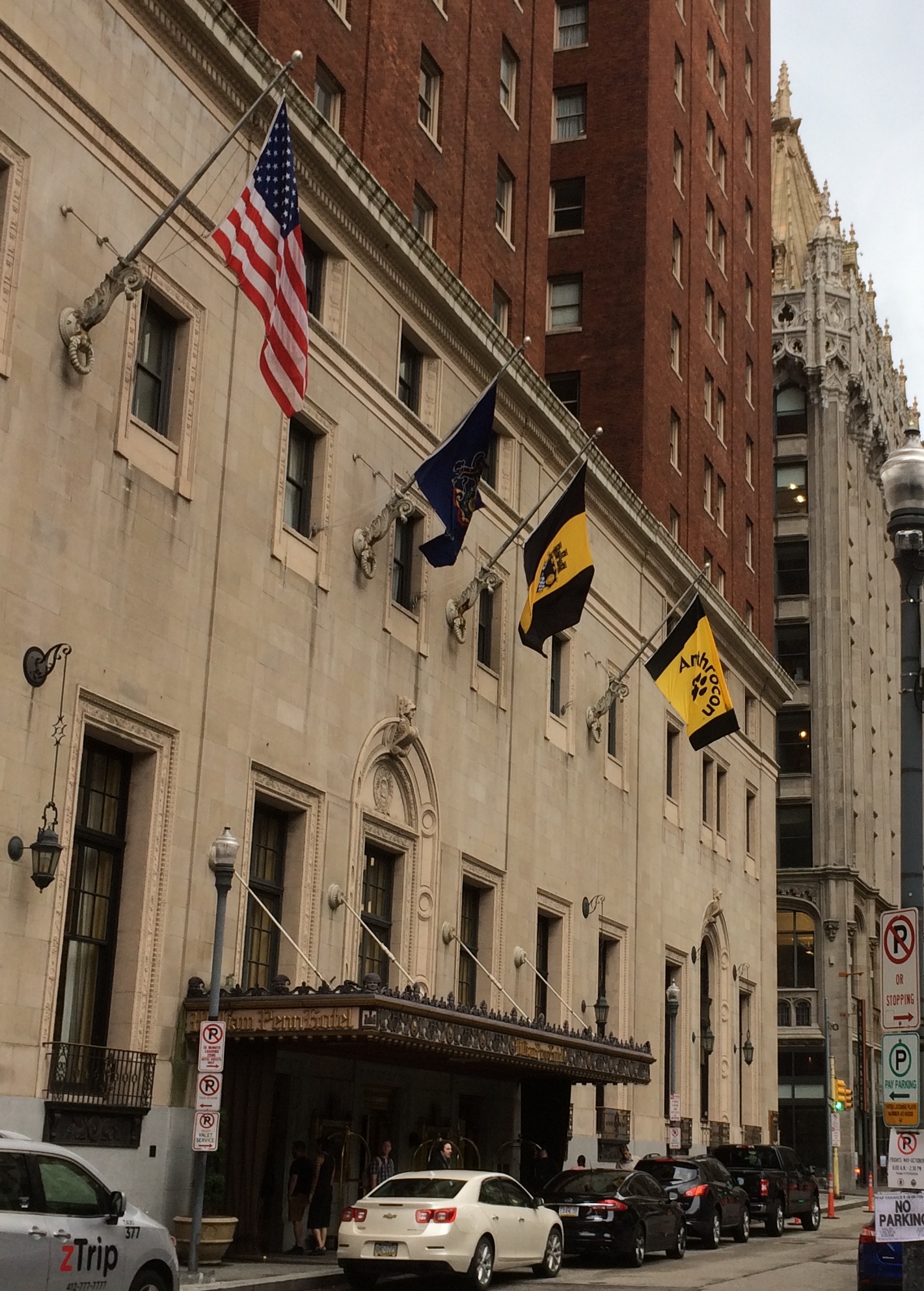
For local hotels, including the storied Omni William Penn Hotel, a convention’s a convention.
That other black-and-gold flag, by the way, is the Pittsburgh city flag.

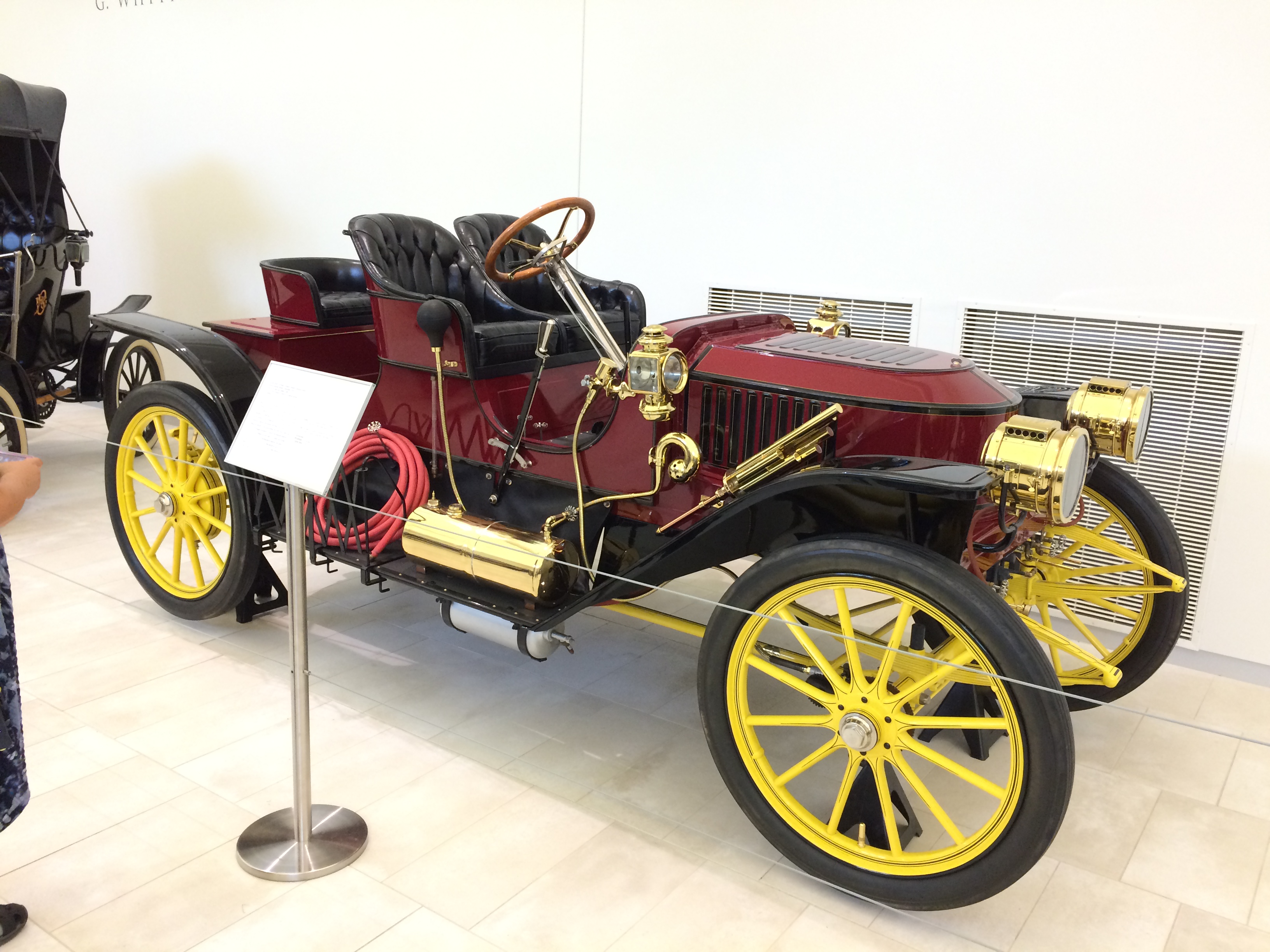
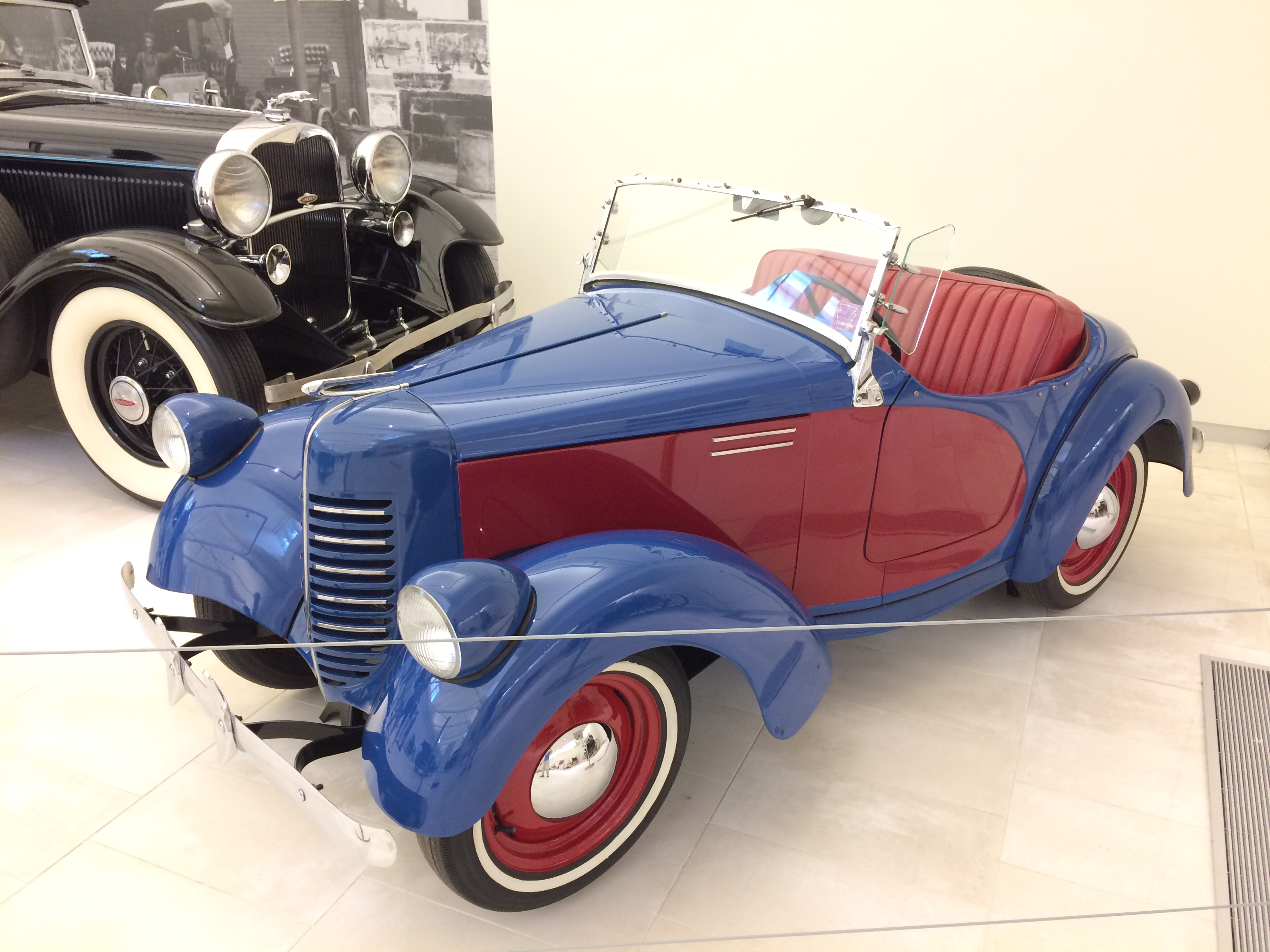
The Frick Pittsburgh includes an exhibit of antique carriages and auto-mobiles. Cool little collection. Including the likes of a 1909 Stanley Steamer Model R Roadster.
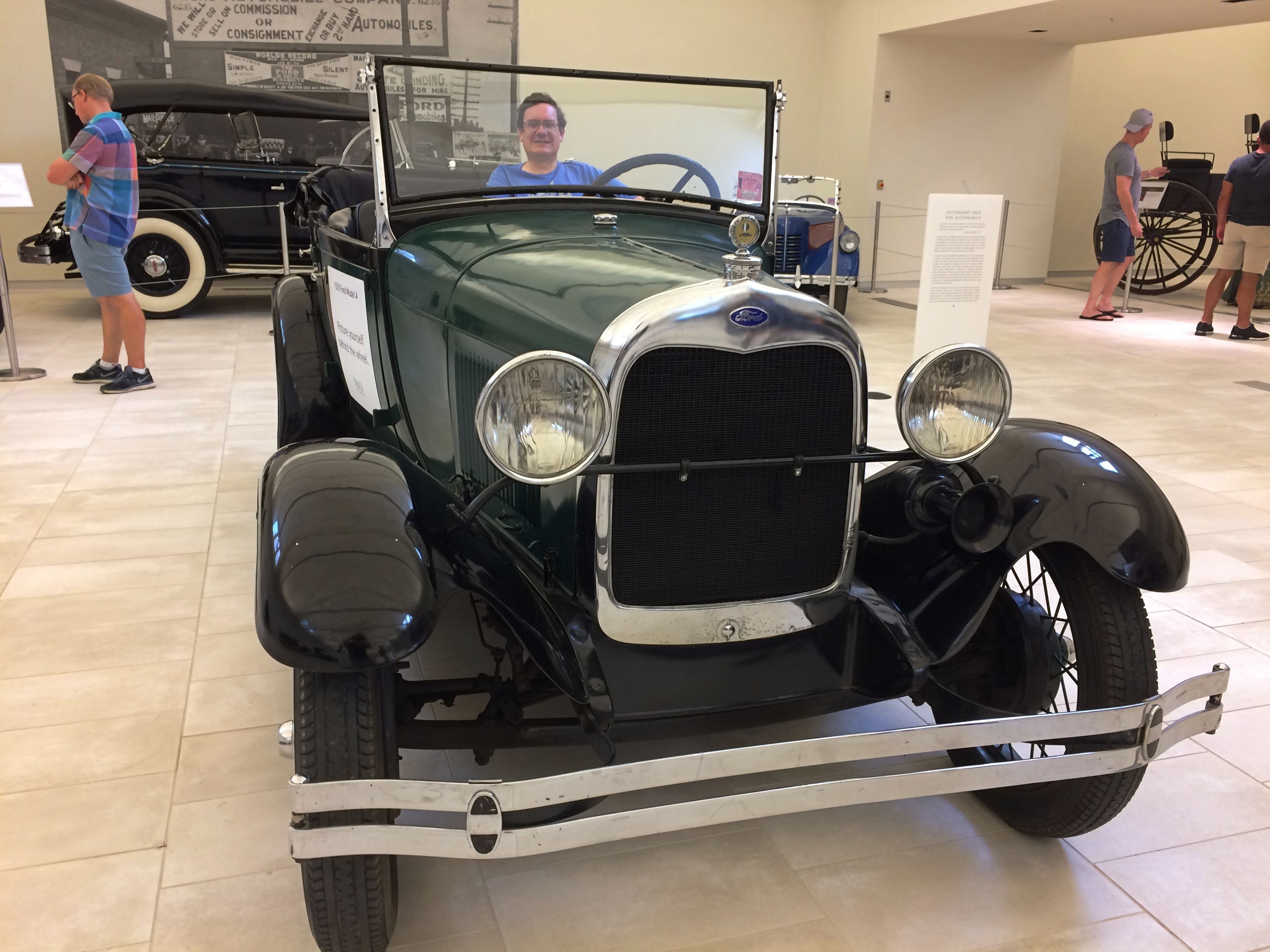
And a 1929 Ford Model A, open to sit in. At some point, my mother’s father had a Model A. She told me about riding short distances — in their driveway — on its running board. I told that to Ann, not just to tell her about her grandmother, but also so she might know what a running board is. Seems like a good detail to know about the world.
I’m sitting in the back of the Model A because I’m too fat for the driver’s seat. Americans generally were more svelte 90 years ago.

A 1940 Bantam Roadster. I doubt that I’d fit in there either.
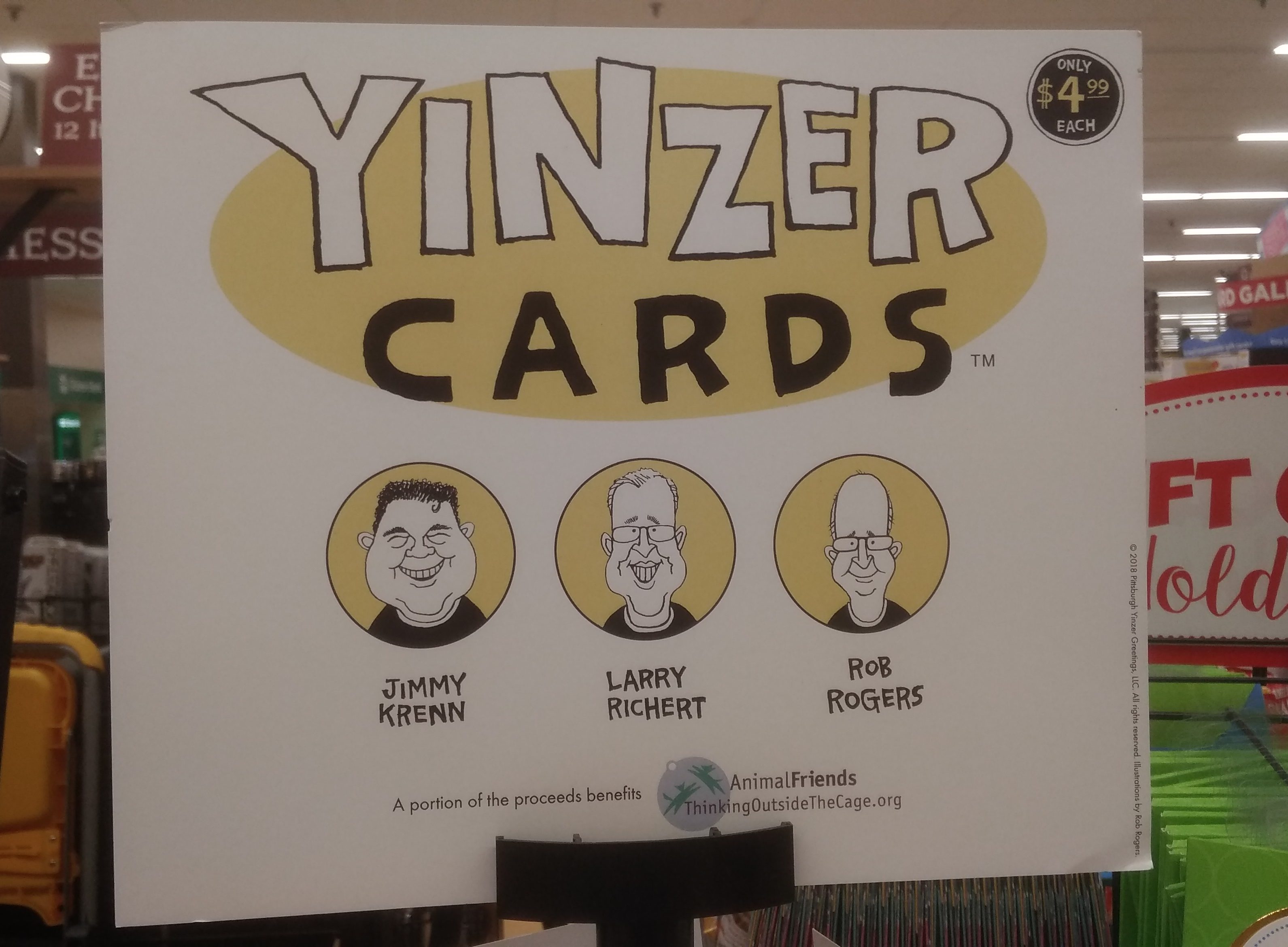
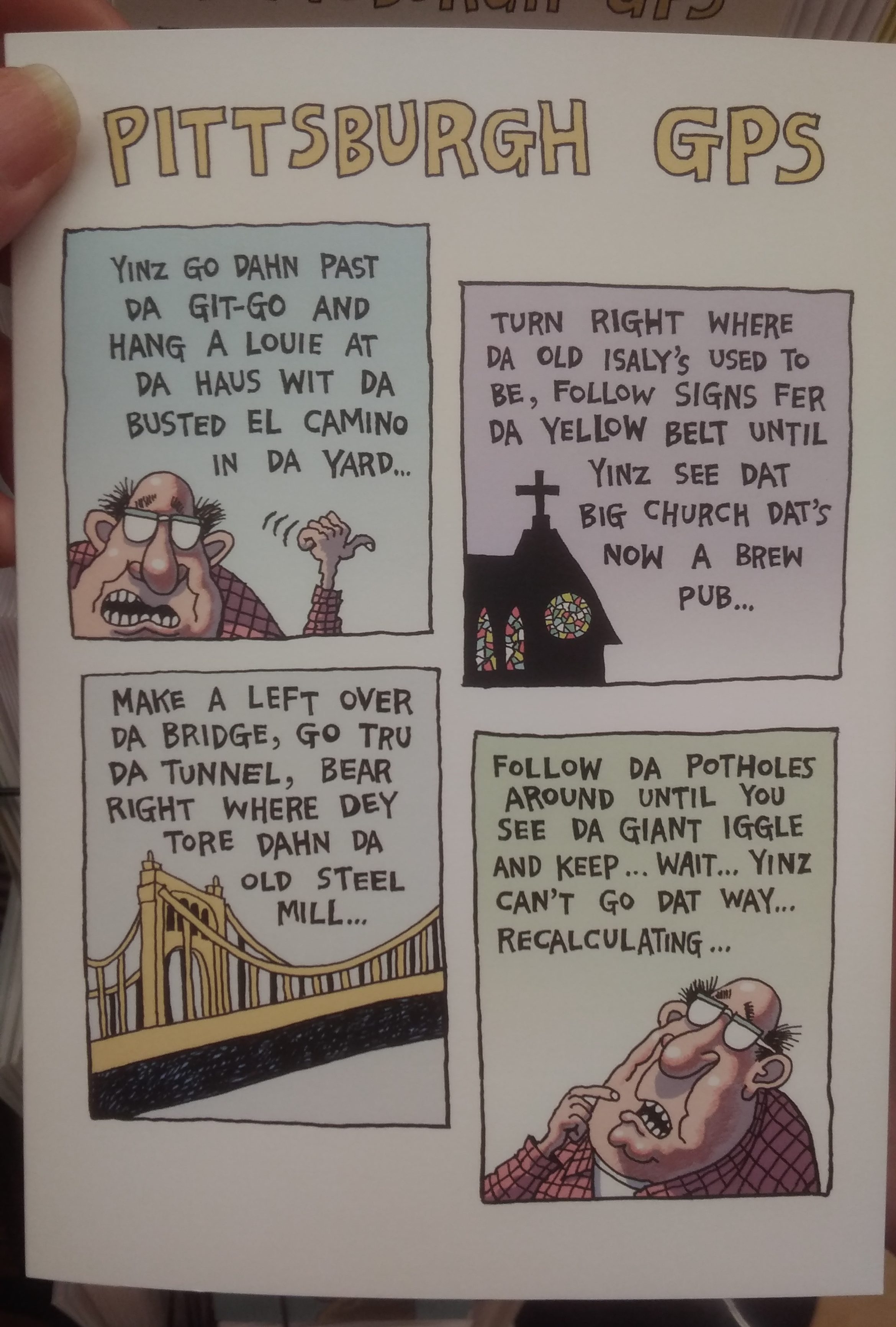
In a suburban Pittsburgh grocery store — the local brand, Giant Eagle, because you should visit grocery stores wherever you go — I saw local greeting cards.

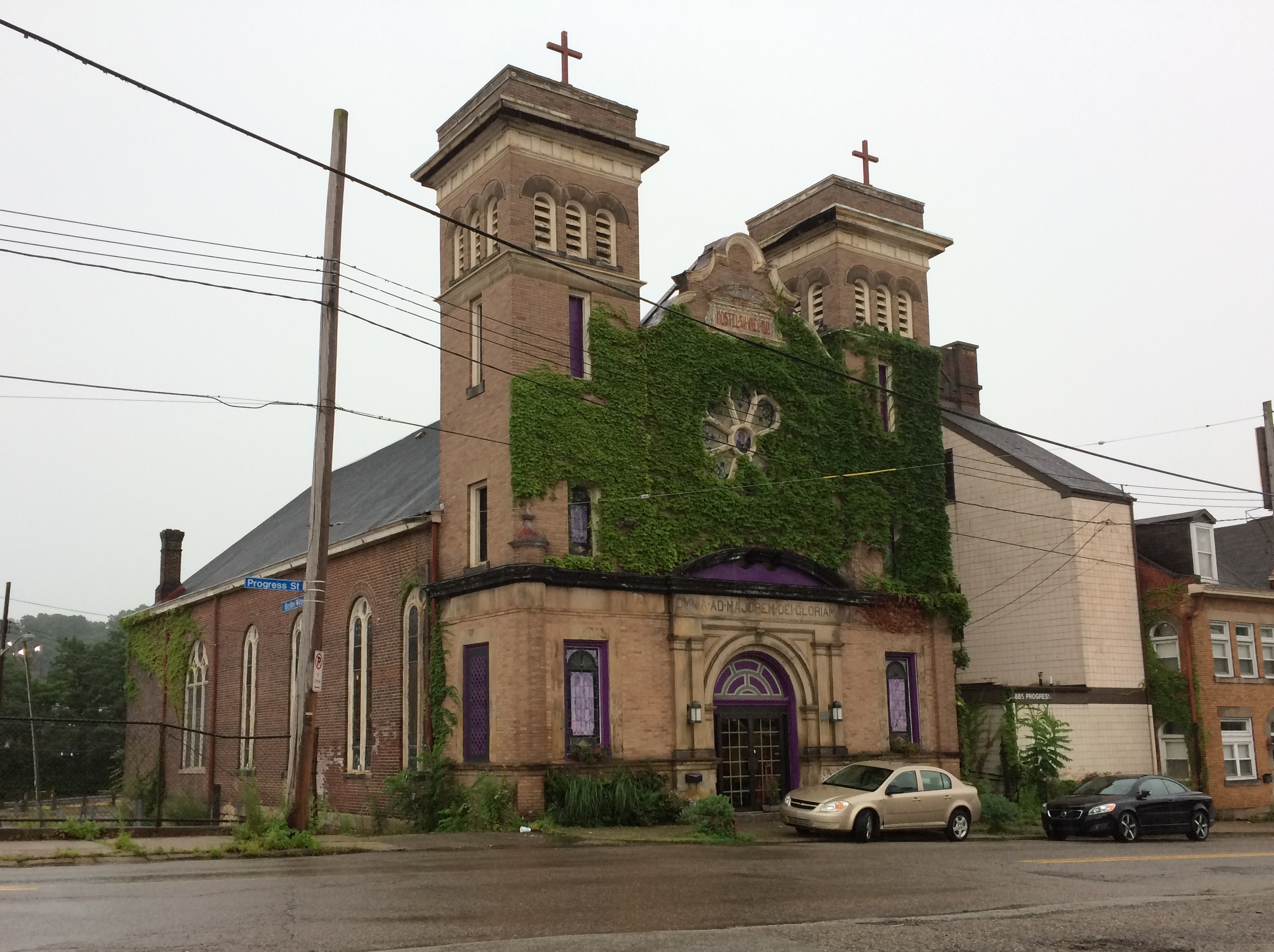
On the way to Randyland, I stopped at a parking lot on the North Side to consult my map, and noticed an intriguing former church.
Until 2015, it housed the New Bohemian, an arts venue. The last time it housed a religious organization was 30 years ago. From the looks of it, nothing is going on there now.

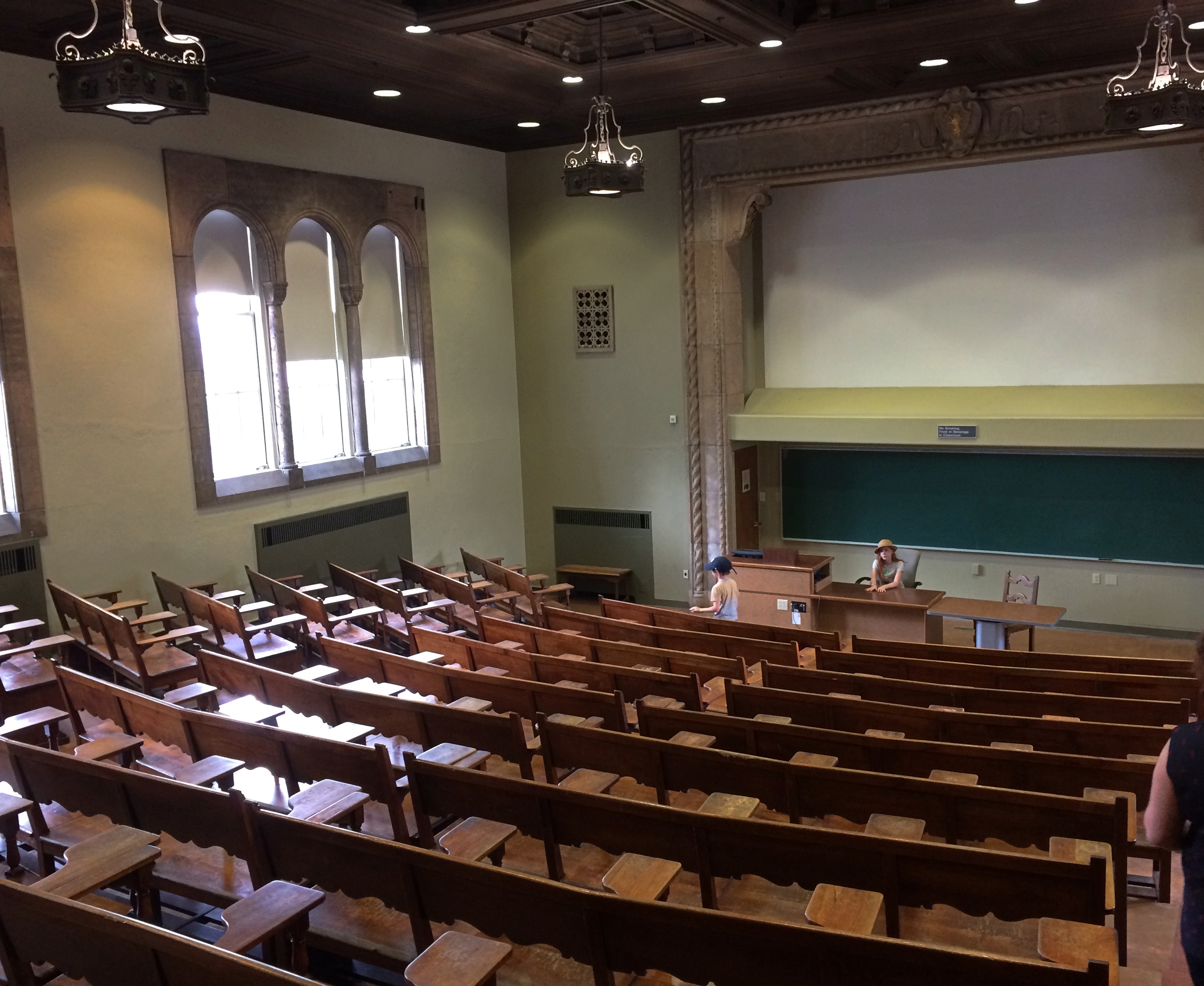
At the Cathedral of Learning of the University of Pittsburgh, the International Rooms weren’t the only interesting features. At one point we entered a classic early 20th-century academic auditorium.
The kind of place where Indiana Jones might teach Archaeology & Derring-Do 101. Even he had to teach freshmen sometimes.

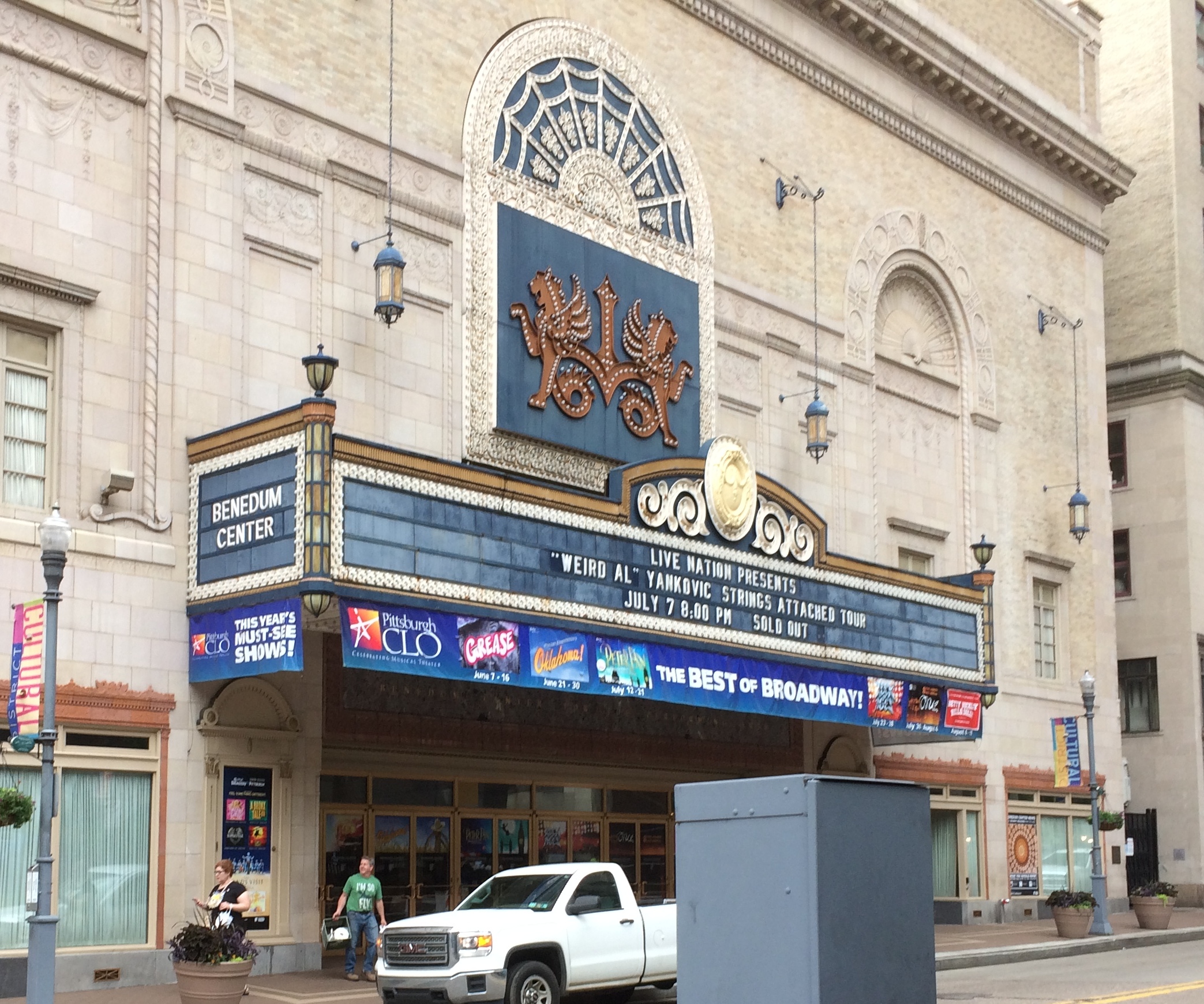
Missed Weird Al, who played Pittsburgh’s Benedum Center the evening we left town. Sold out anyway.
I think I’d pay money to see him, once anyway. But probably not as much as the tickets are priced now, in these gouging days for top acts. The time to see Weird Al would have been ca. 1981. I’m pretty sure “Another One Rides the Bus” was the first song of his I ever heard.

We returned home on July 7 via Columbus, Ohio, and Indianapolis — only a little longer than the all-tollway route we used to get to Pittsburgh from metro Chicago. The main consideration: I was especially annoyed by the Pennsylvania Turnpike, which charged $7.90 to go 11 miles. To compare, the entire Indiana Toll Road, about 136 miles, cost $8.70. Is the Pennsylvania Turnpike paved with gold? If only. I’ll never drive that road again.

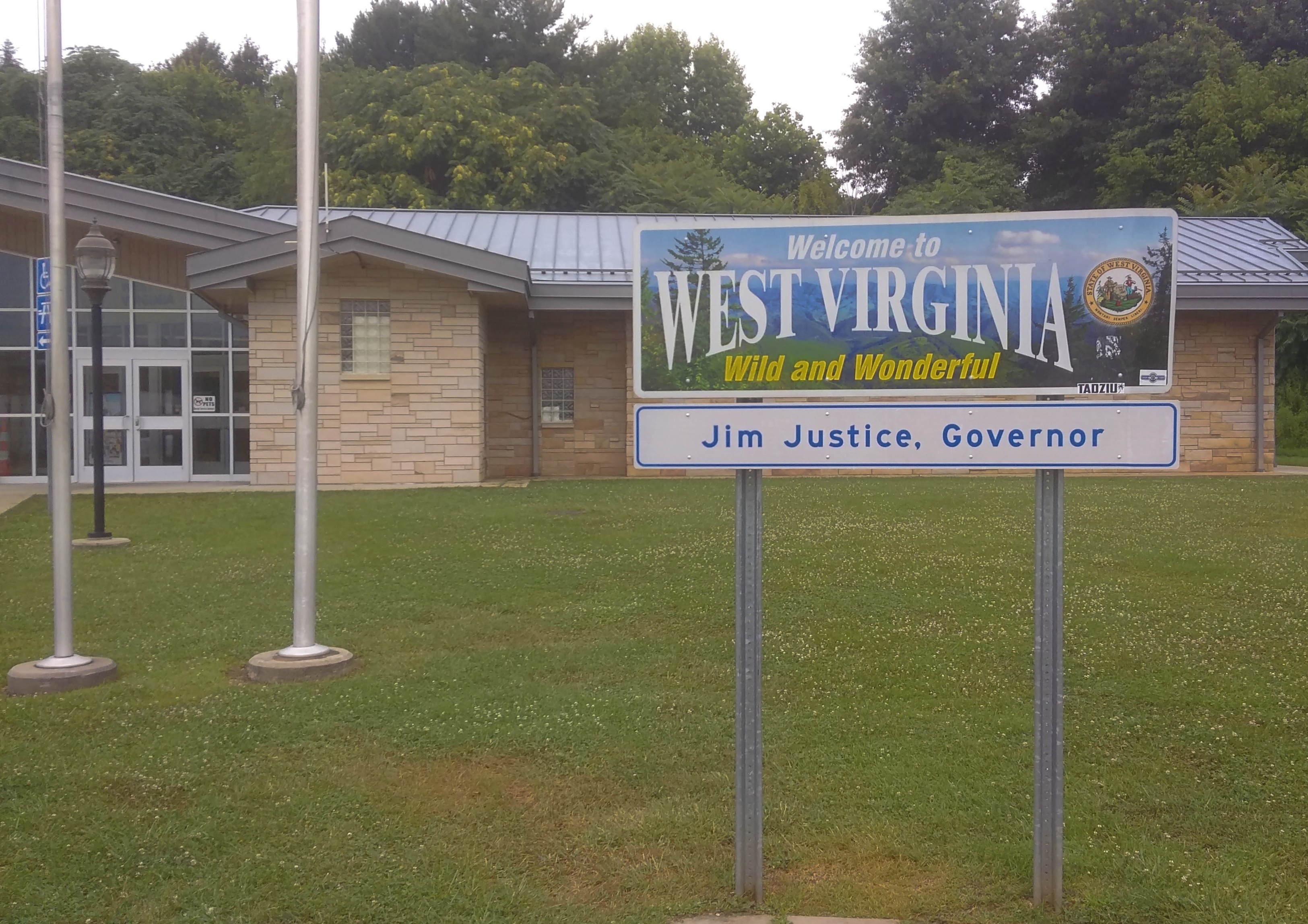
I-70 west from Washington, Pa., takes you across the northern panhandle of West Virginia, a route of about 15 miles. We stopped and I put my feet on W. Va. soil for only the second time.

In 1988, I spent Labor Day weekend tooling around parts of Virginia — Shenandoah NP, Staunton, Monticello, etc. A meandering drive along back roads back to greater D.C. took me briefly into West Virginia. No one else was on the road, so I stopped and relieved myself. That was my total experience in W. Va. until 2019. What did we do at the West Virginia Welcome Center near Wheeling? Relieve ourselves.

Randyland

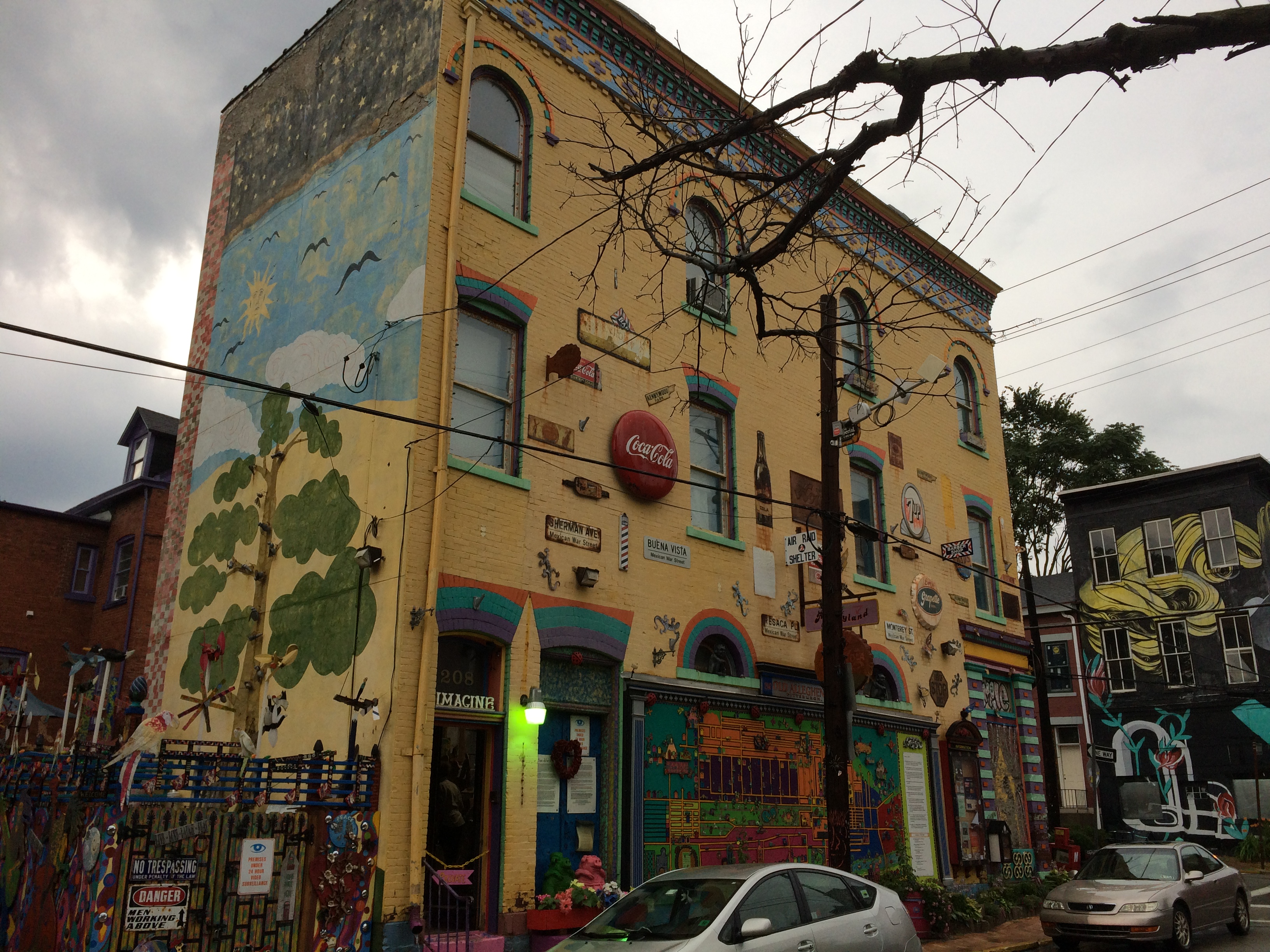
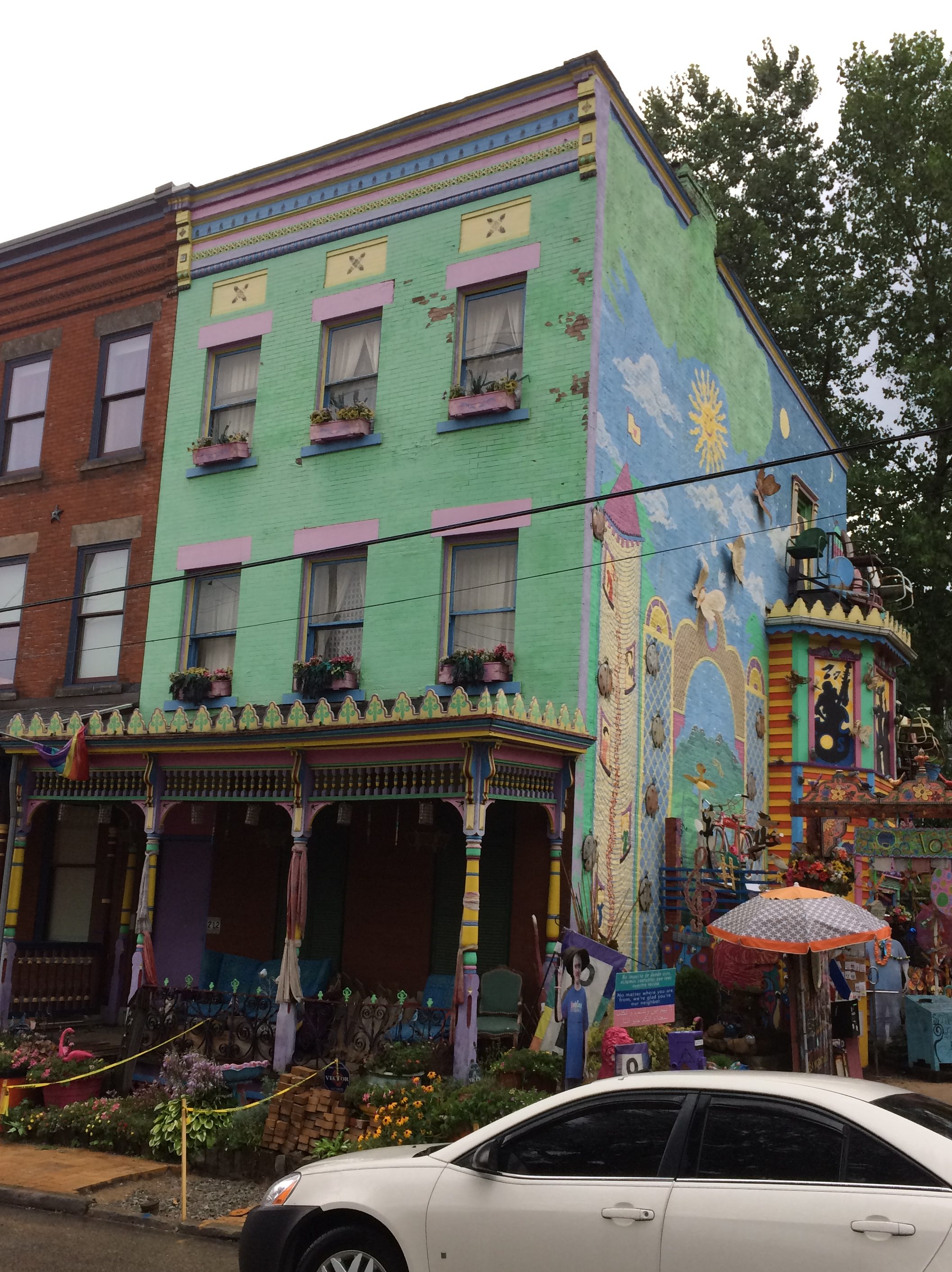
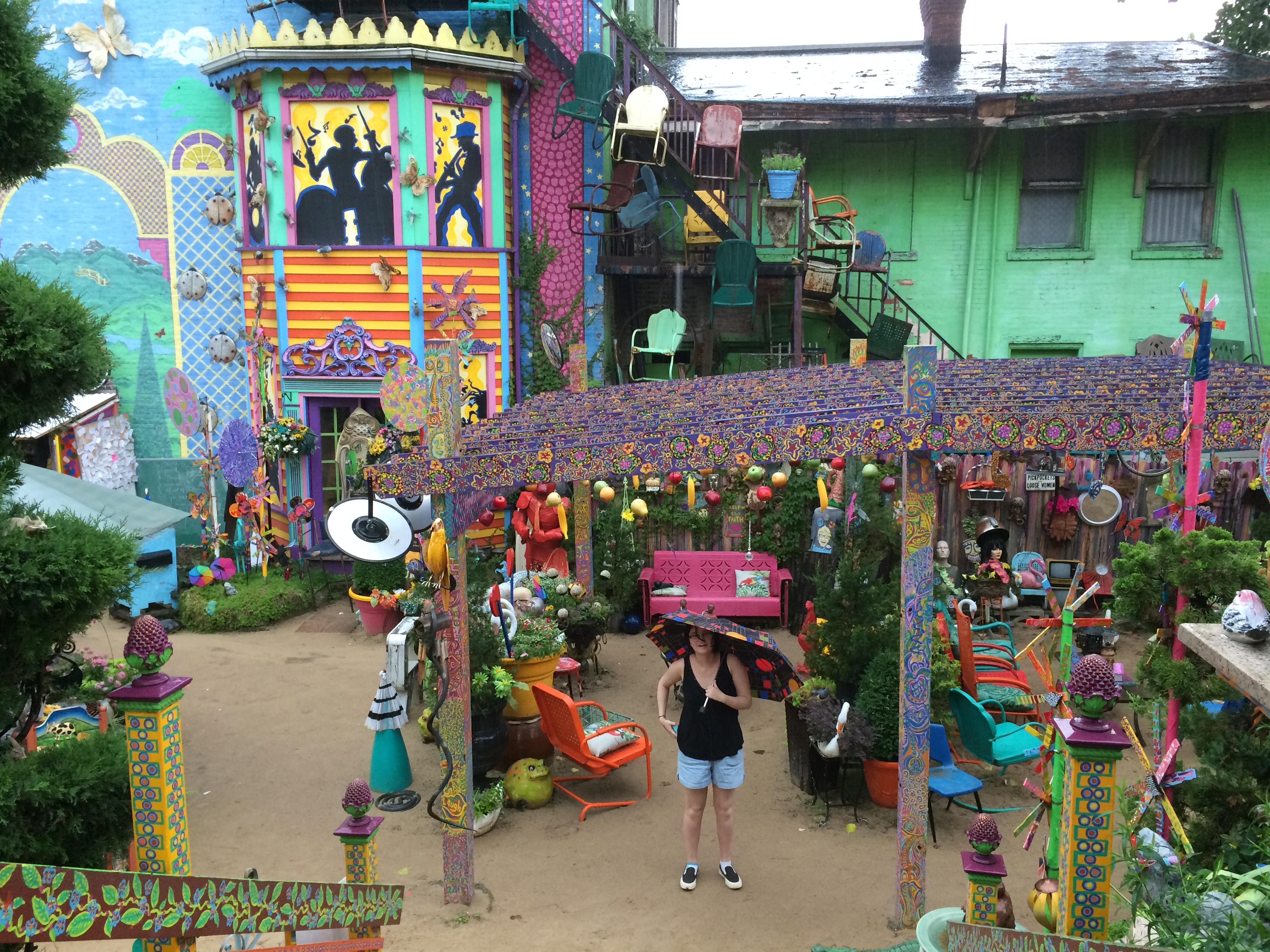
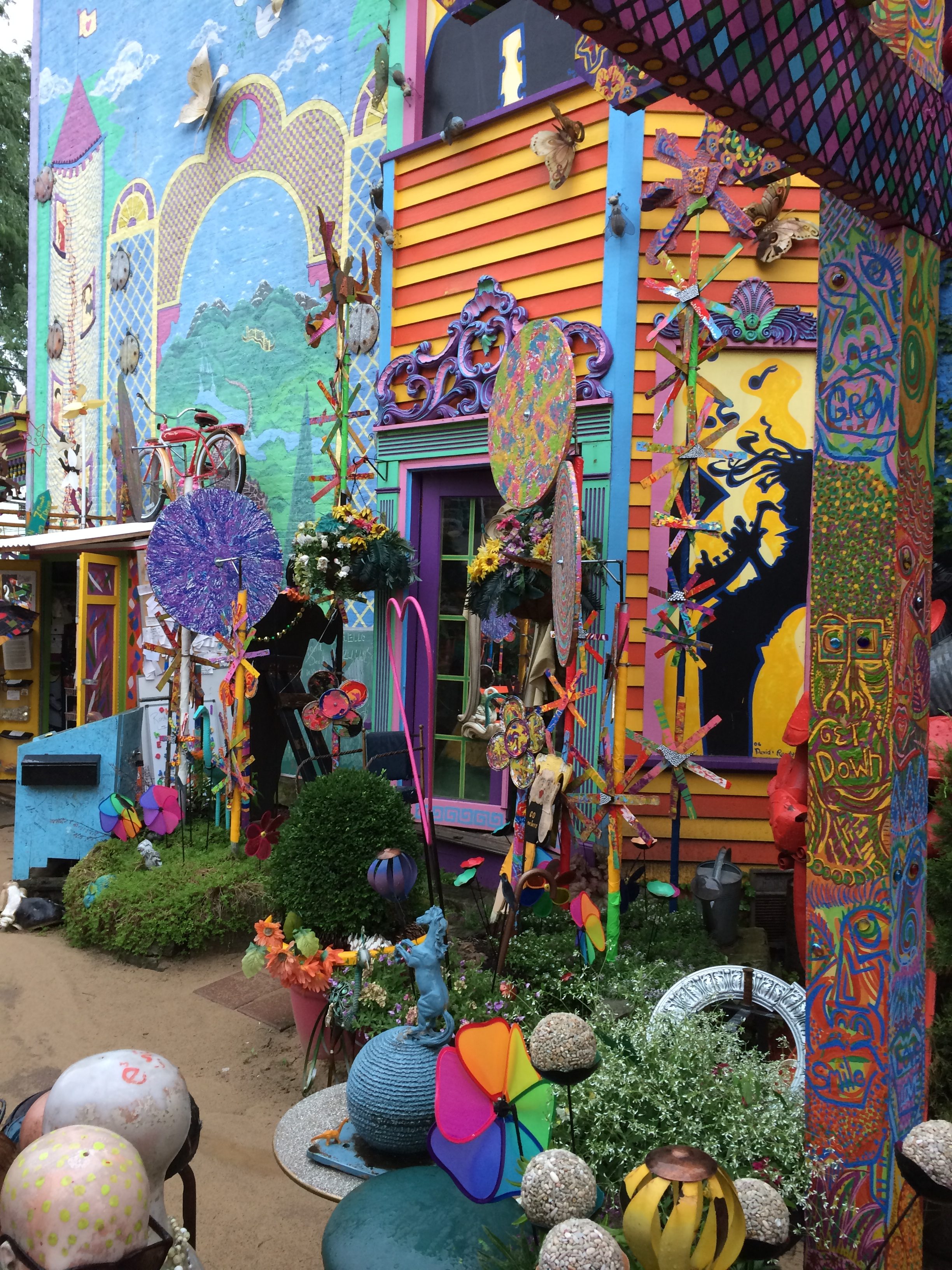
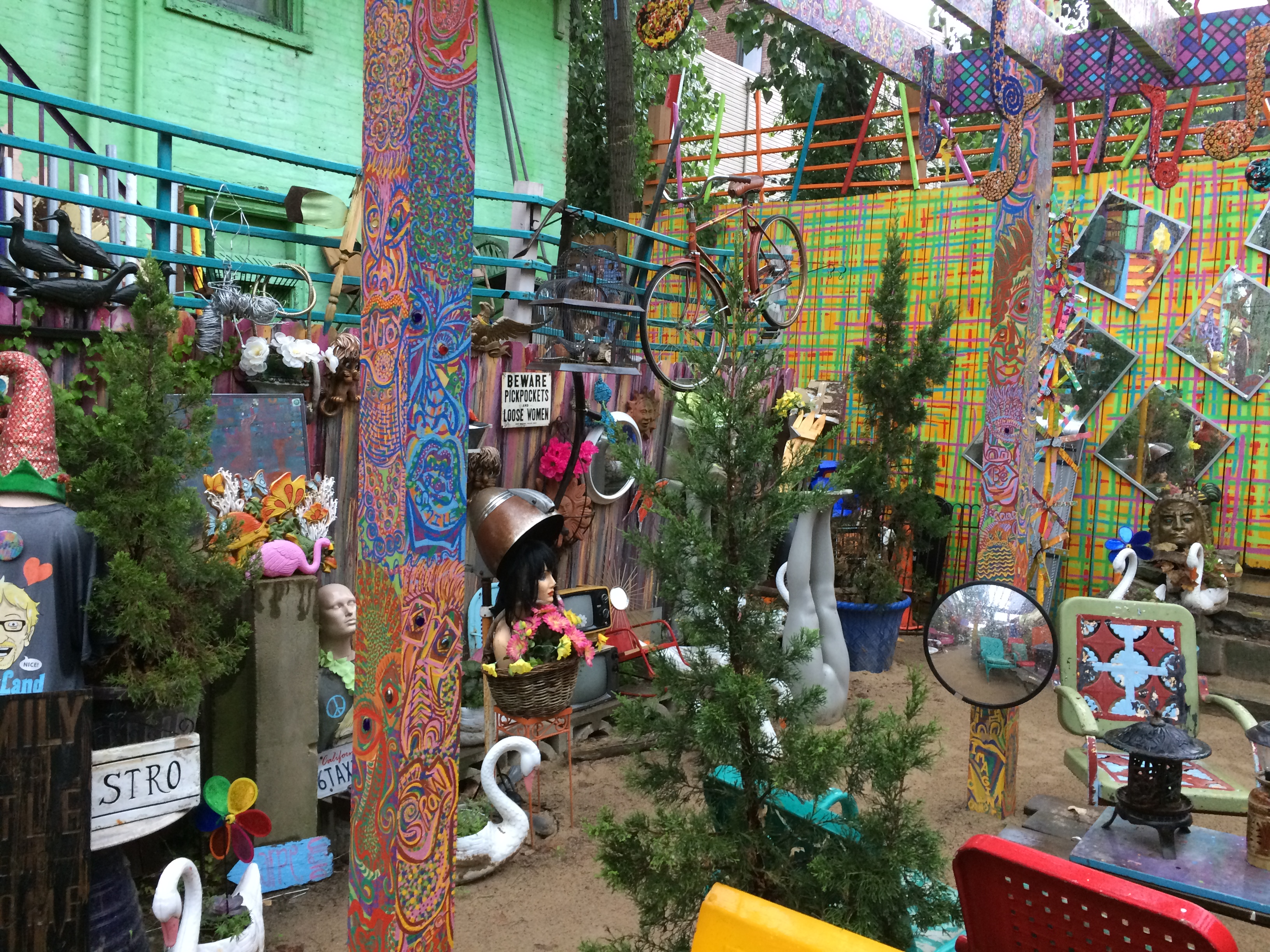
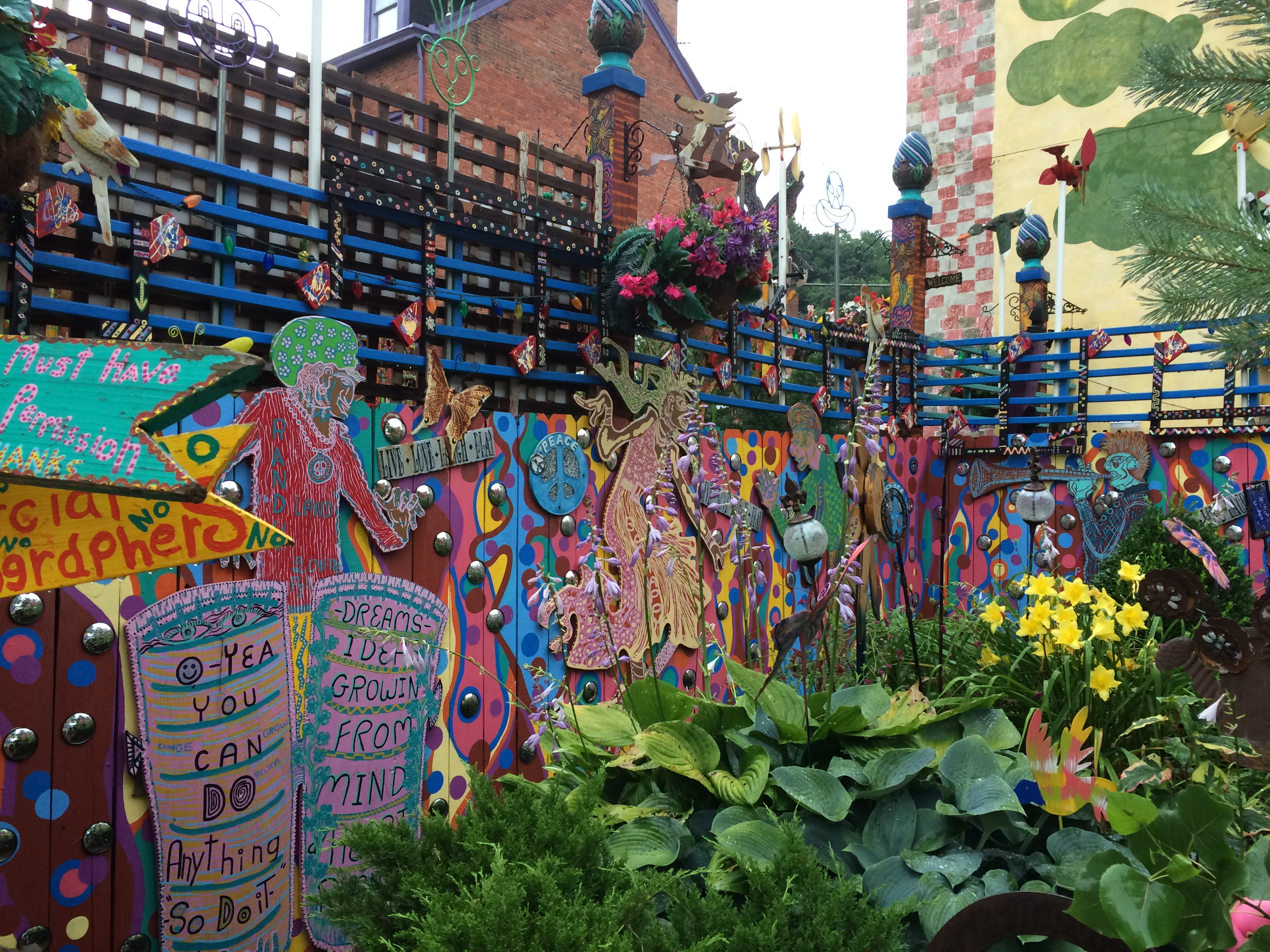
After a heavy downpour cooled down the hot afternoon on July 6 — Pittsburgh seemed awfully tropical this time of the year — we made our way to Randyland. When I was poking around before the trip for Sights To See, I discovered Randyland. Yep, that looks like a sight to see, was my instant conclusion.

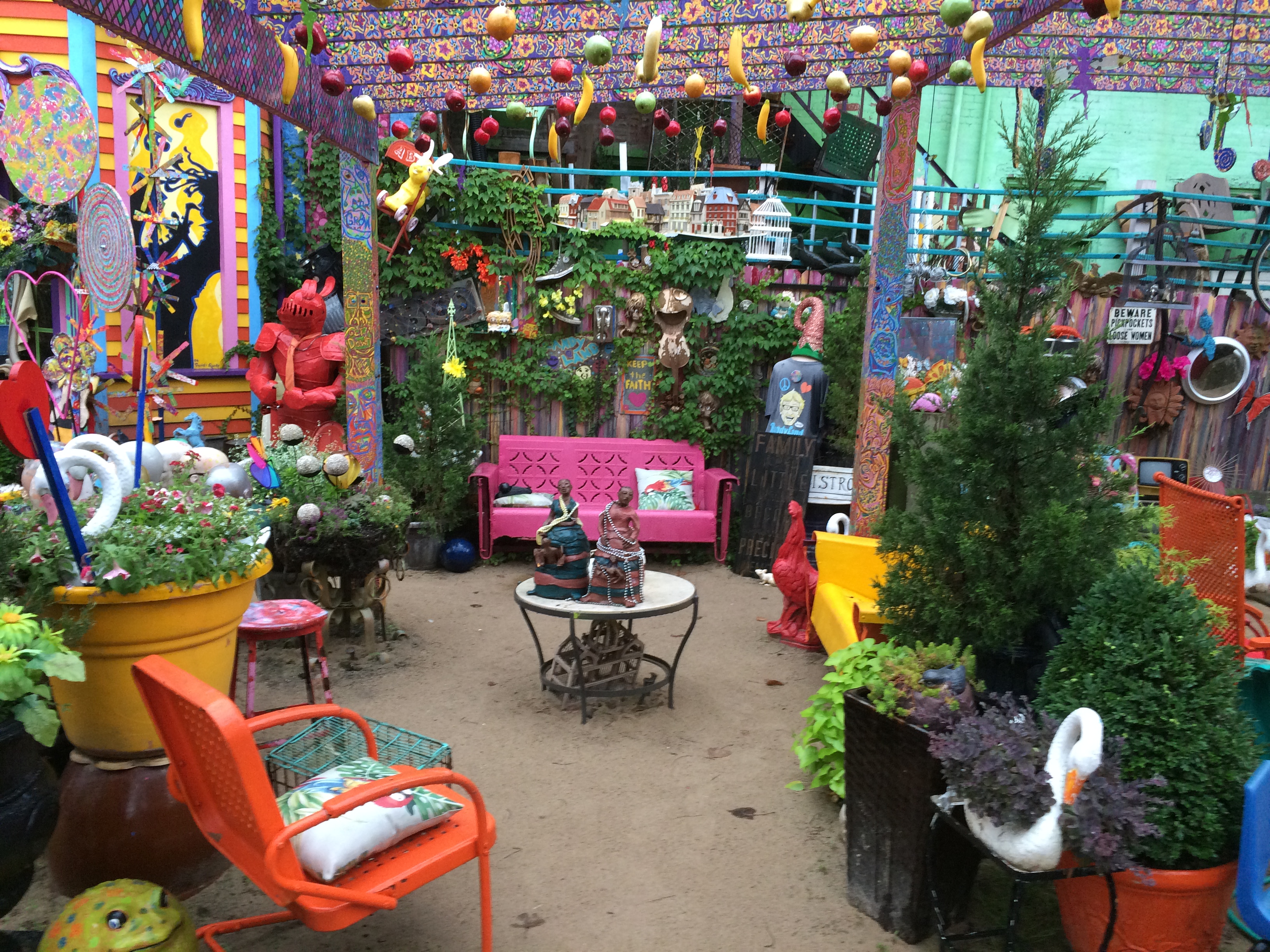
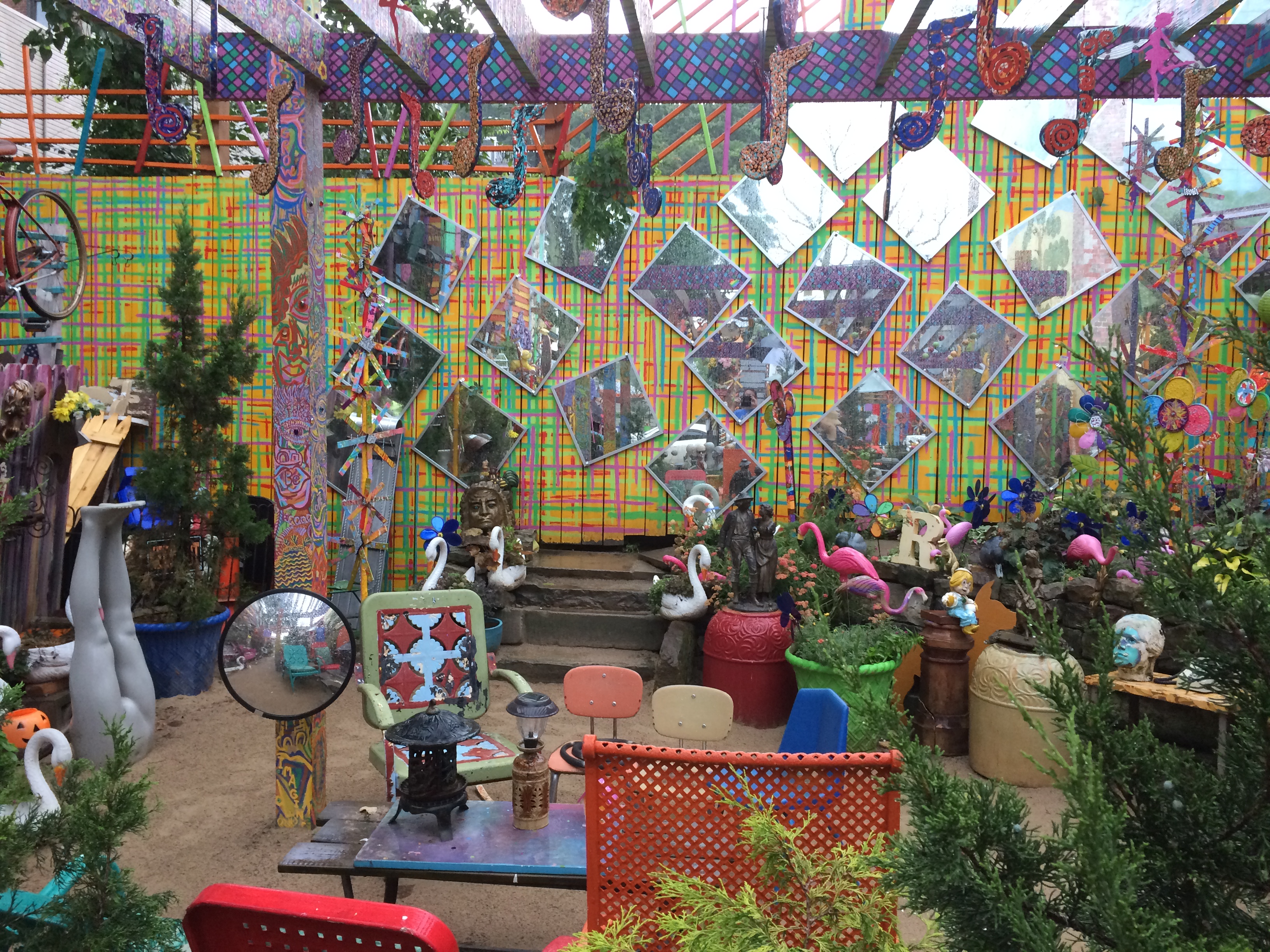
“Randyland is the labor of love of Pittsburgh artist Randy Gilson, a local artist and neighborhood renovator,” Atlas Obscura says. “Over the years Gilson has almost singlehandedly turned a blighted neighborhood corner in Pittsburgh’s Mexican War Streets into one of the most colorful spectacles in the city.”

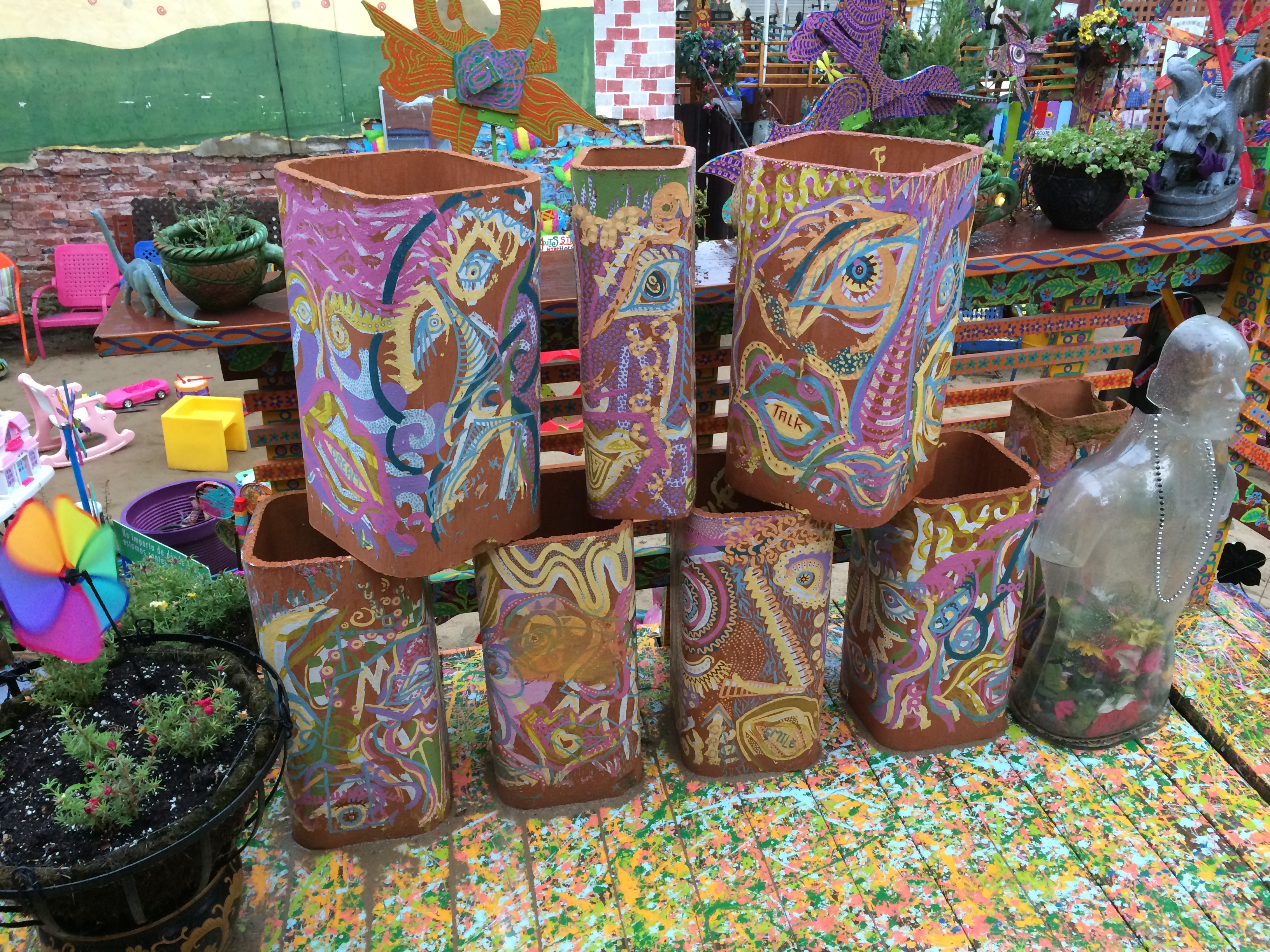
The exact boundaries of Randyland are a little vague. But I know that it includes this colorful building at the corner of Jacksonia and Arch streets.

Maybe this colorful building on Jacksonia.
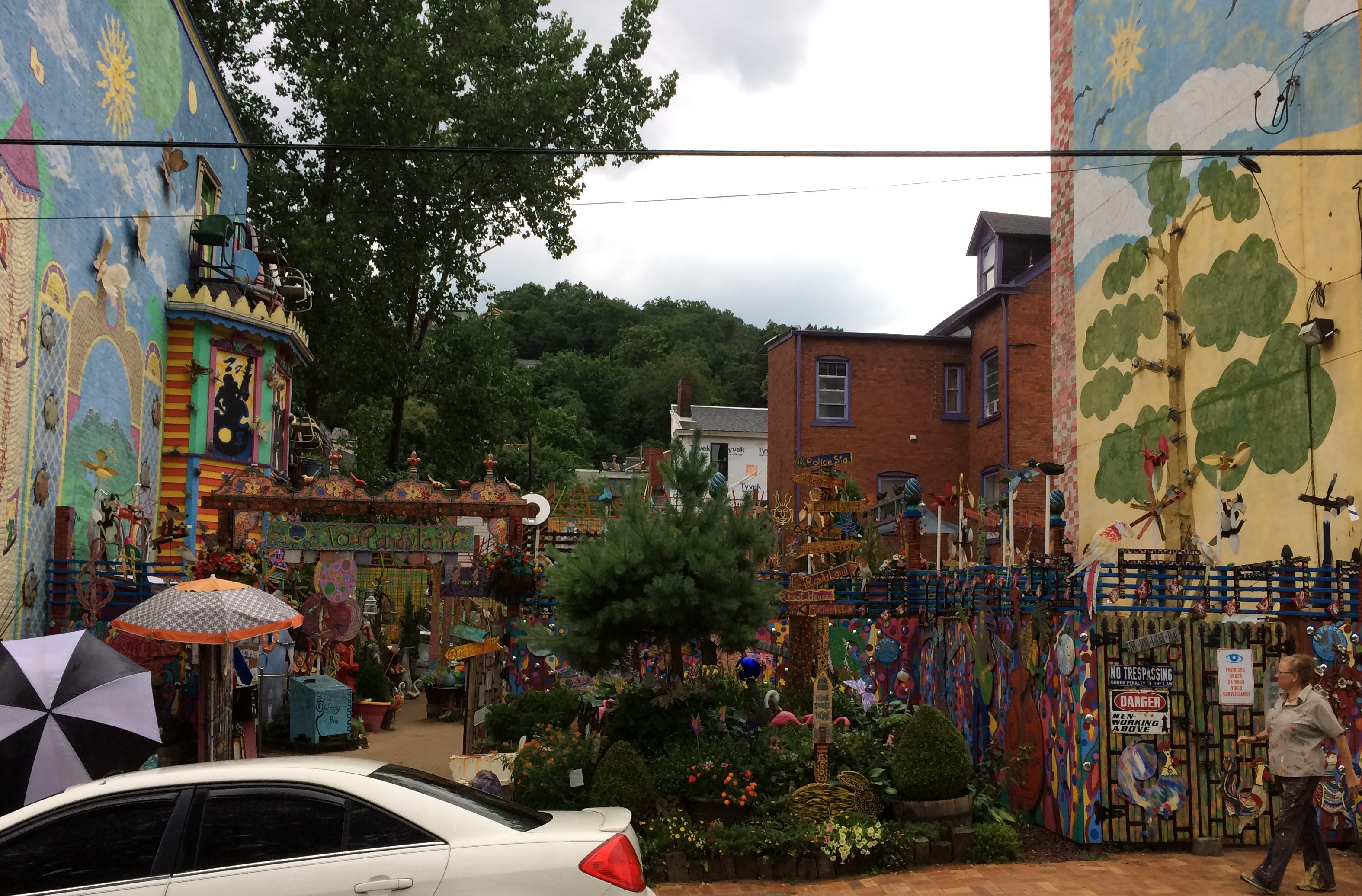
And the space in between those buildings. Most definitely that space.
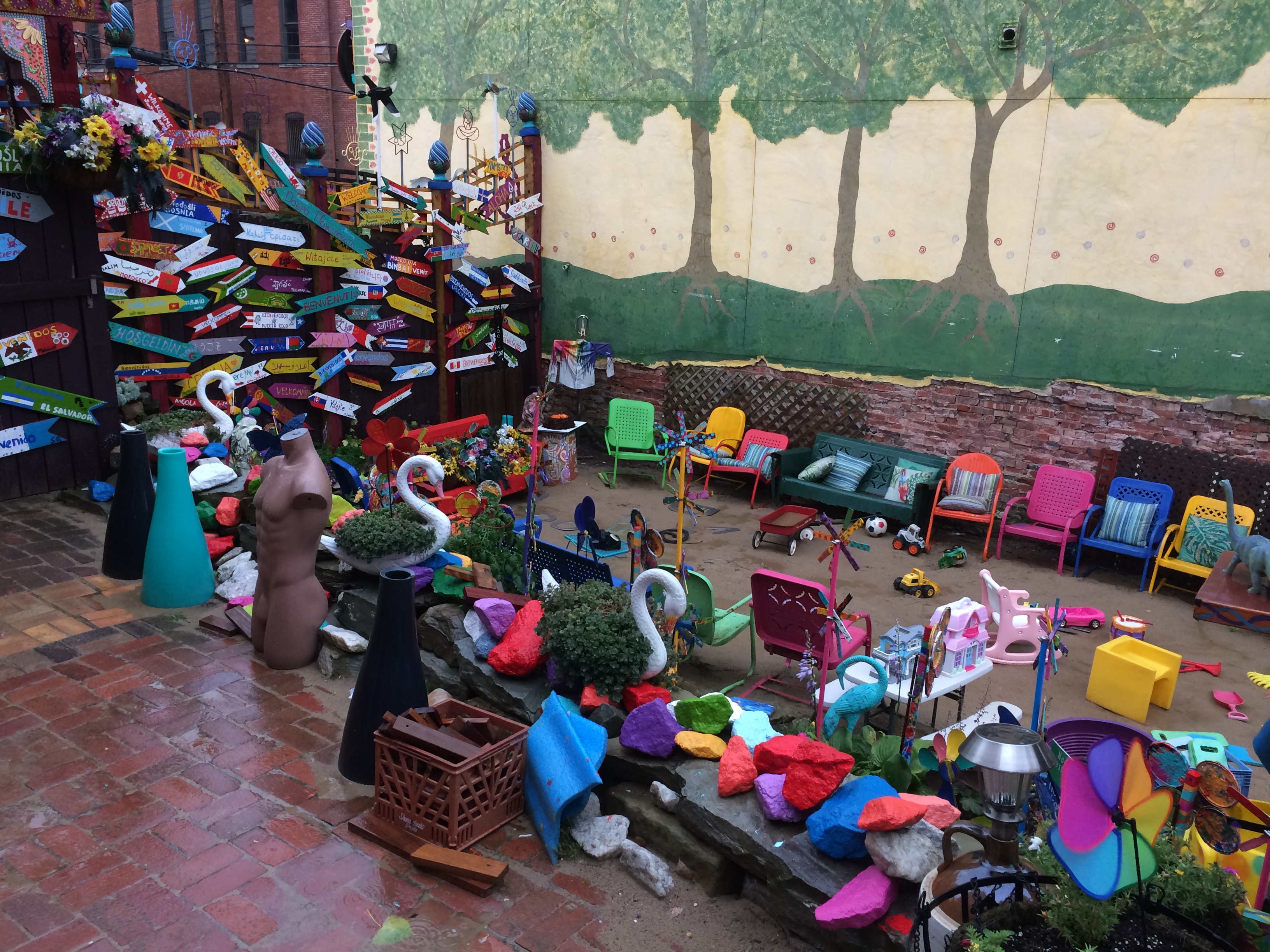
Drizzle was still coming down when we reached Randyland, but that didn’t stop us from entering the space — a sign welcomes all — for a look-see. There’s something colorful everywhere you look.

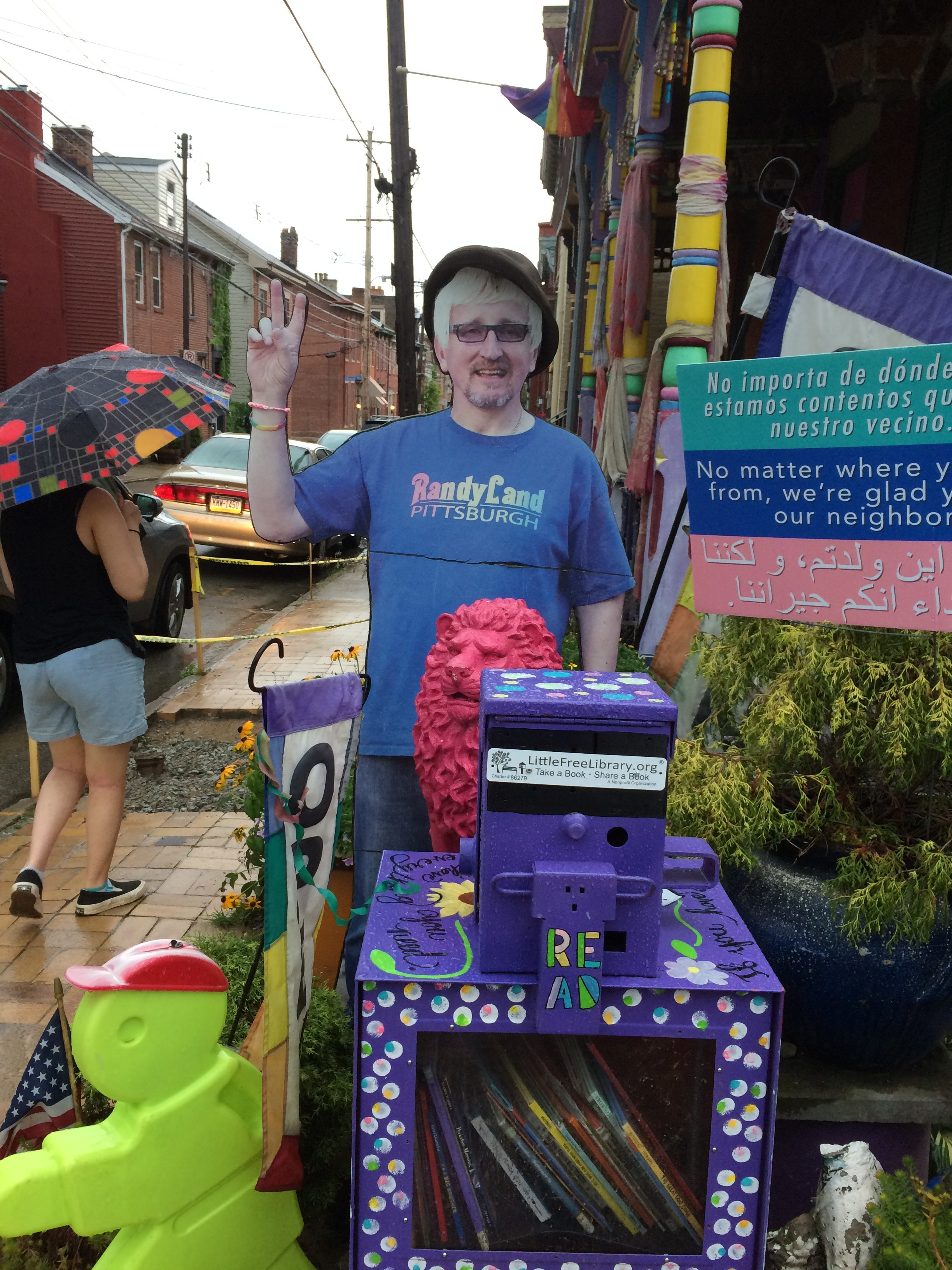
Randy greeted us and we spent a few minutes talking. Though this video might be scripted, it gives you a pretty good idea about how Randy behaved: he was effusive. He seemed genuinely glad to see us, the nth group to wander into his colorful compound. He asked our names and where we were from. He told us it was important to be ourselves and be happy.

In case the isn’t there, Randy greets you anyway in life-sized cutout form.

Later, he went next door, which he said was his studio, but we did see him again before we left, since we bought a couple of t-shirts and a button from him. They were reasonably priced, especially when compared with the merch at the Andy Warhol Museum gift shop. Besides, Warhol is dead, as opposed to effusive and very much alive Randy Gilson. It’s good to support living artists when you can.

Rivers of Steel: Carrie Blast Furnaces National Historic Landmark

It seems to be a misnomer, “Rivers of Steel,” at least as it applies to the Carrie Blast Furnaces National Historic Landmark, yet that’s part of the official name. The Carrie Blast Furnaces produced pig iron, not steel. The facility, which is just outside Pittsburgh, then sent the iron across the Monongahela River to the vast steel works in Homestead, Pa., site of the 1892 battle between strikers and company goons (professional goons: Pinkertons).

So I’d call it Rivers of Iron. Or maybe Rivers of Molten Iron, which sounds more badass. But never mind, that’s just me picking the sort of nits that allow me to be a half-way decent editor.

We arrived at the Carrie Blast Furnaces in time for the 11 a.m. tour on July 6. The day was blazing hot. Fitting for visiting a place whose heat must have been hellish year-round when it was in operation.

The furnaces were originally built in 1881 and acquired by Andrew Carnegie in 1898, becoming part of U.S. Steel a few years later. They closed in 1978. These days, Allegheny County owns the site and a nonprofit manages it, including tours.

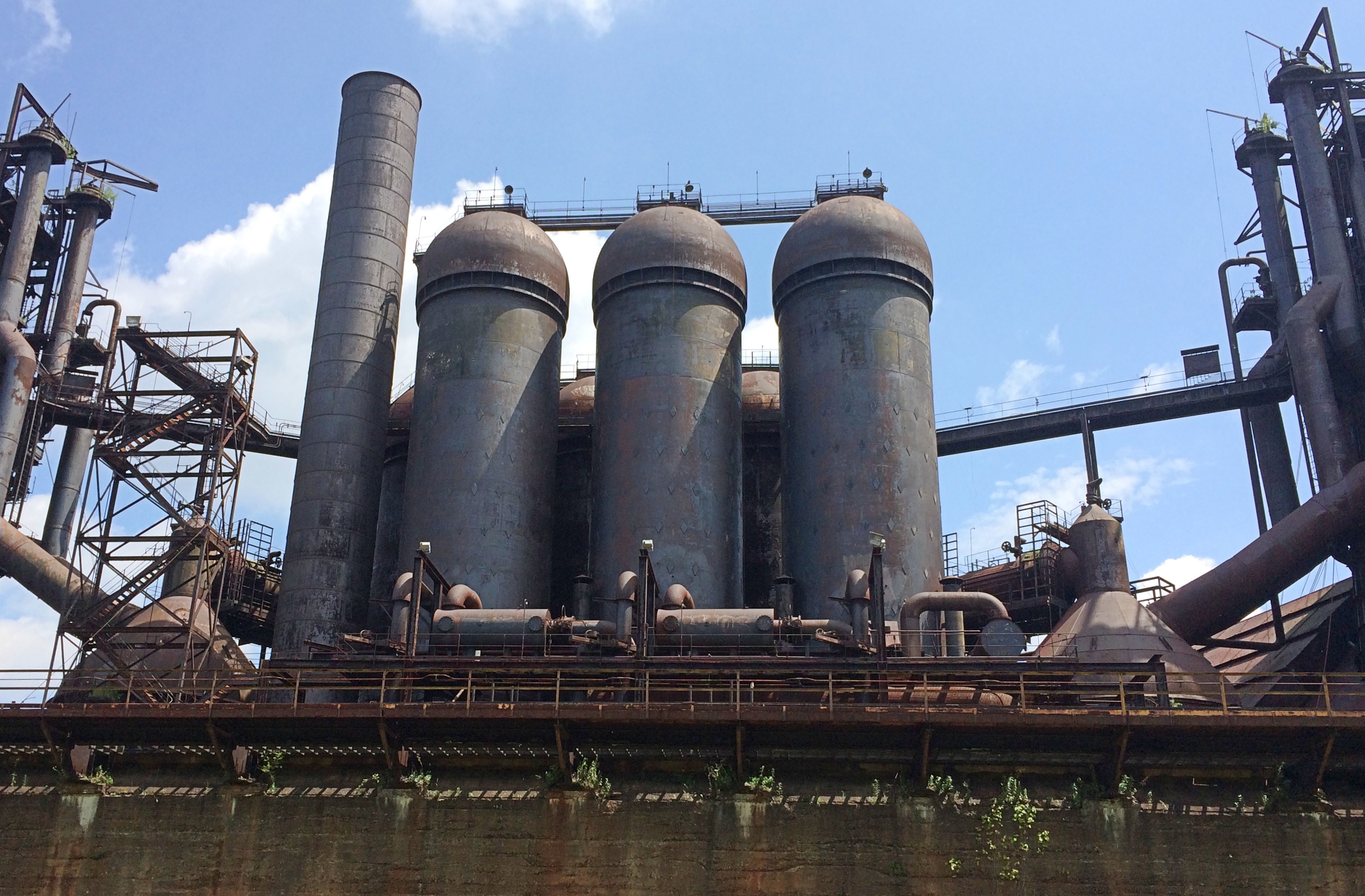
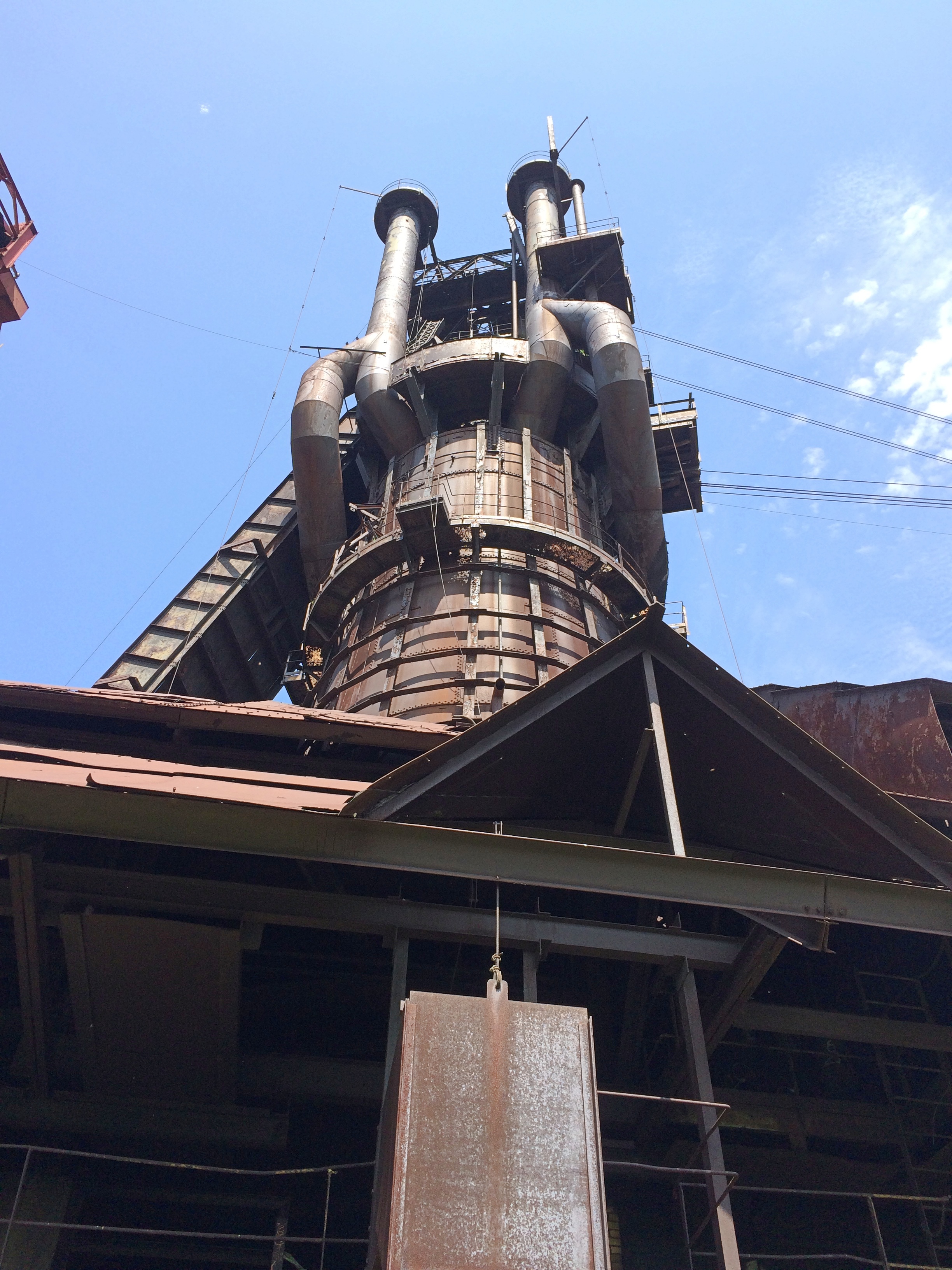
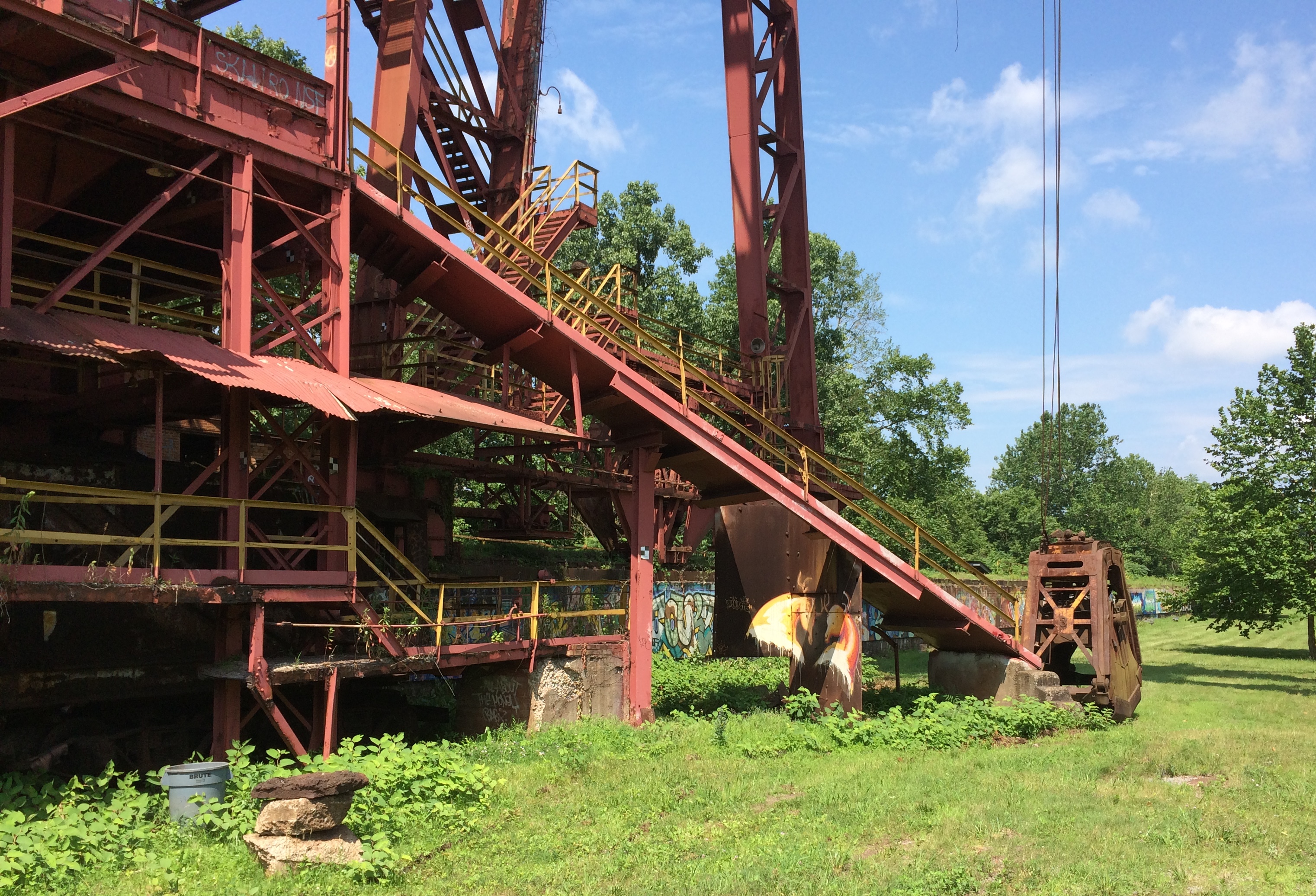
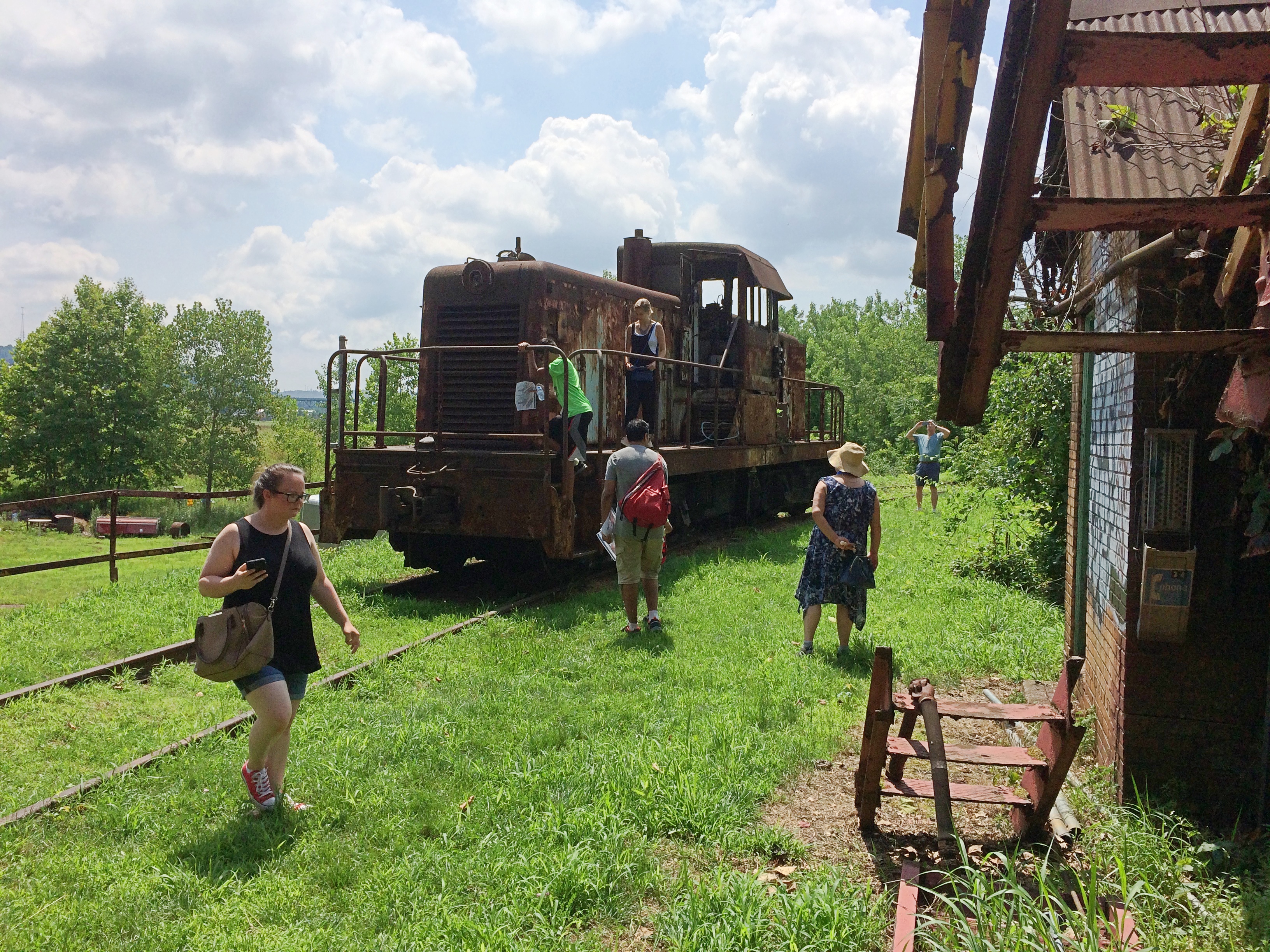
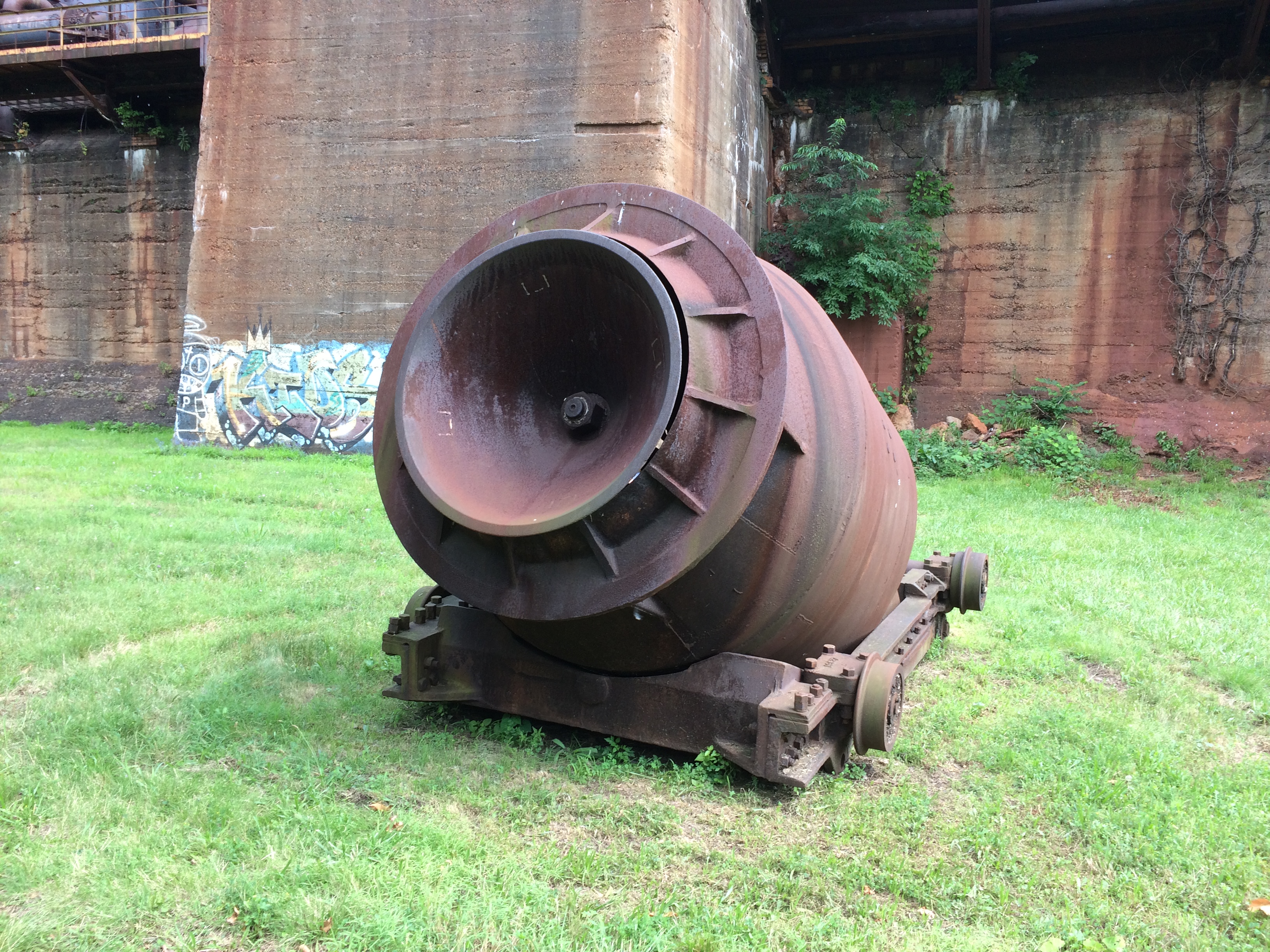
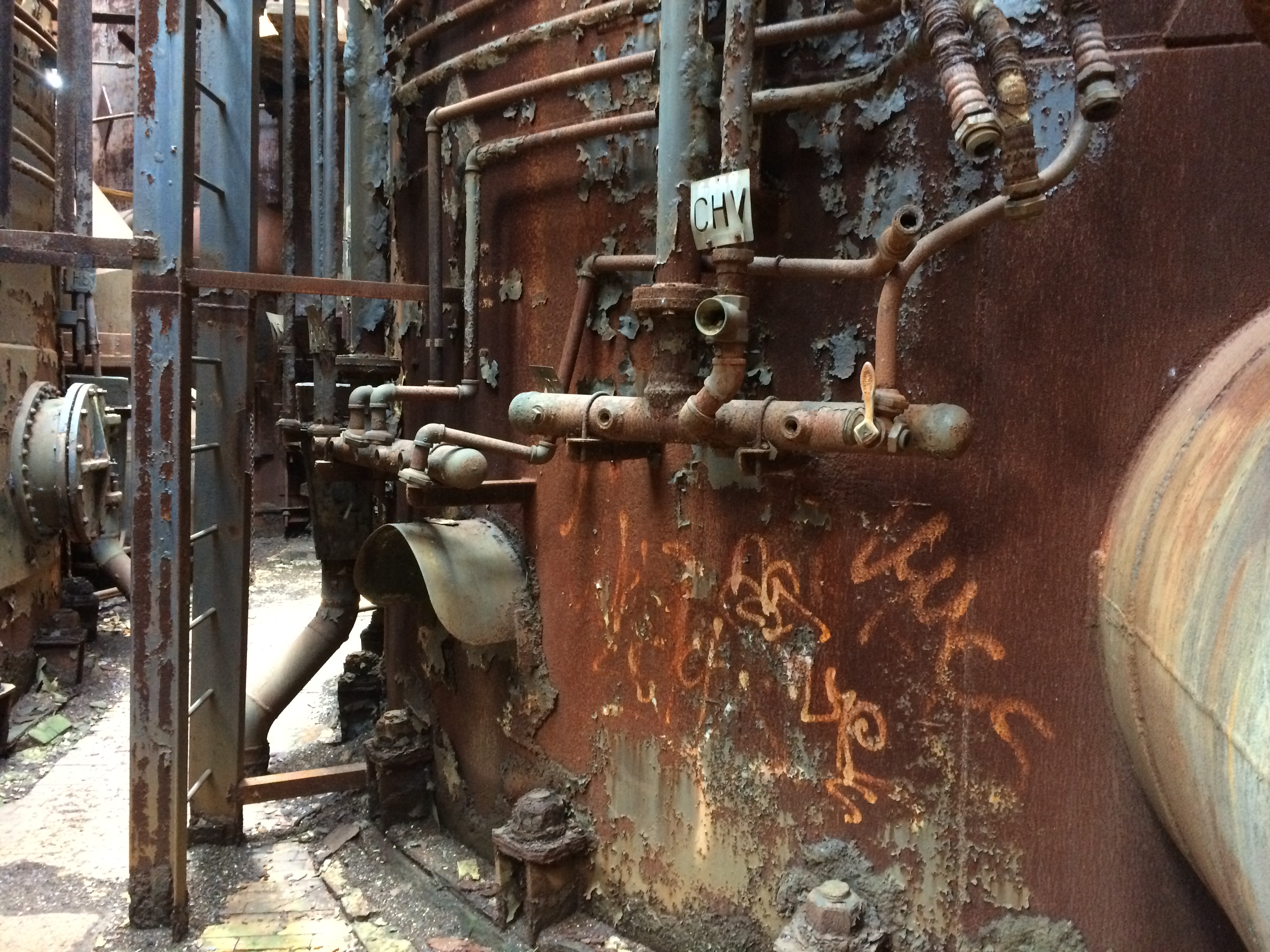
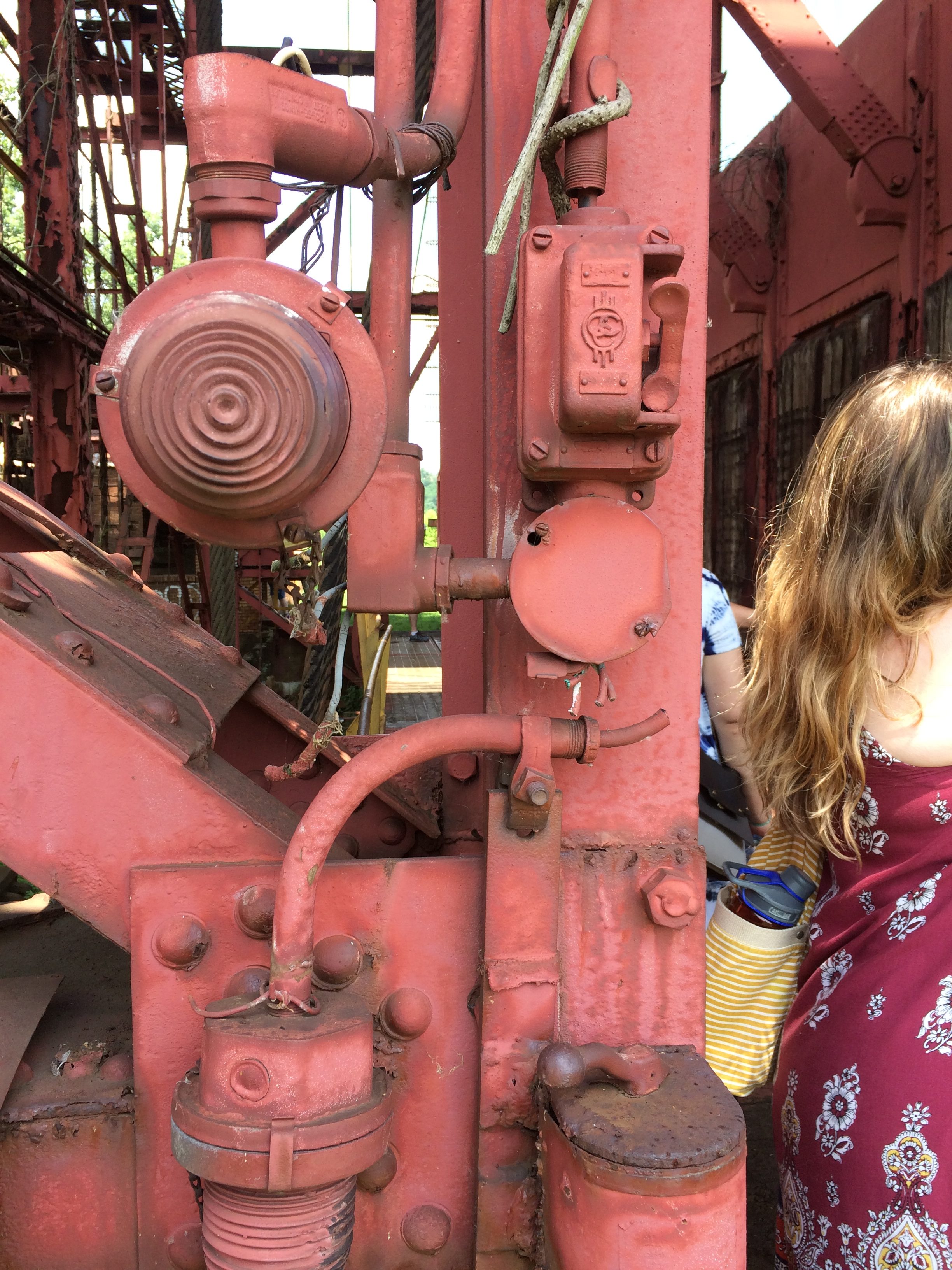
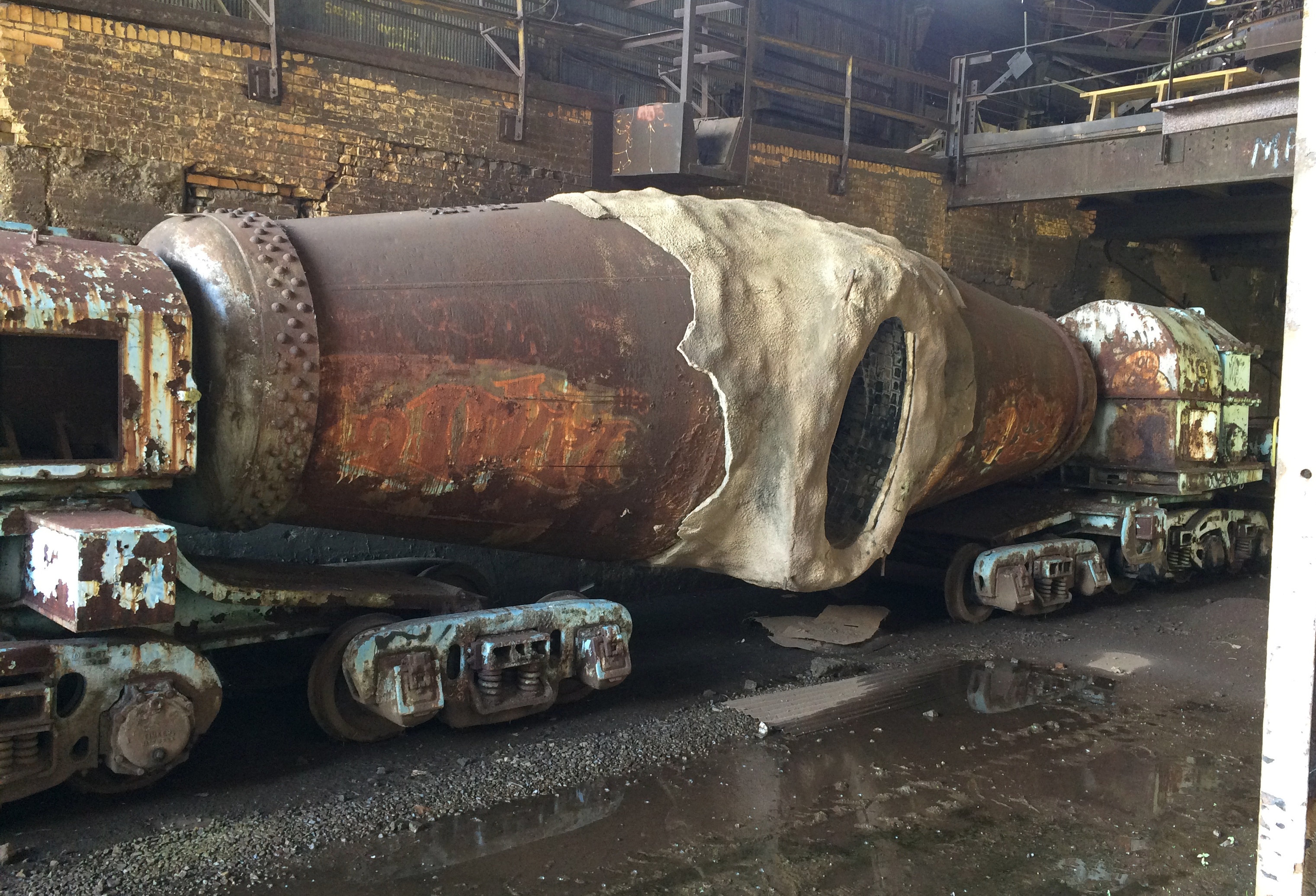
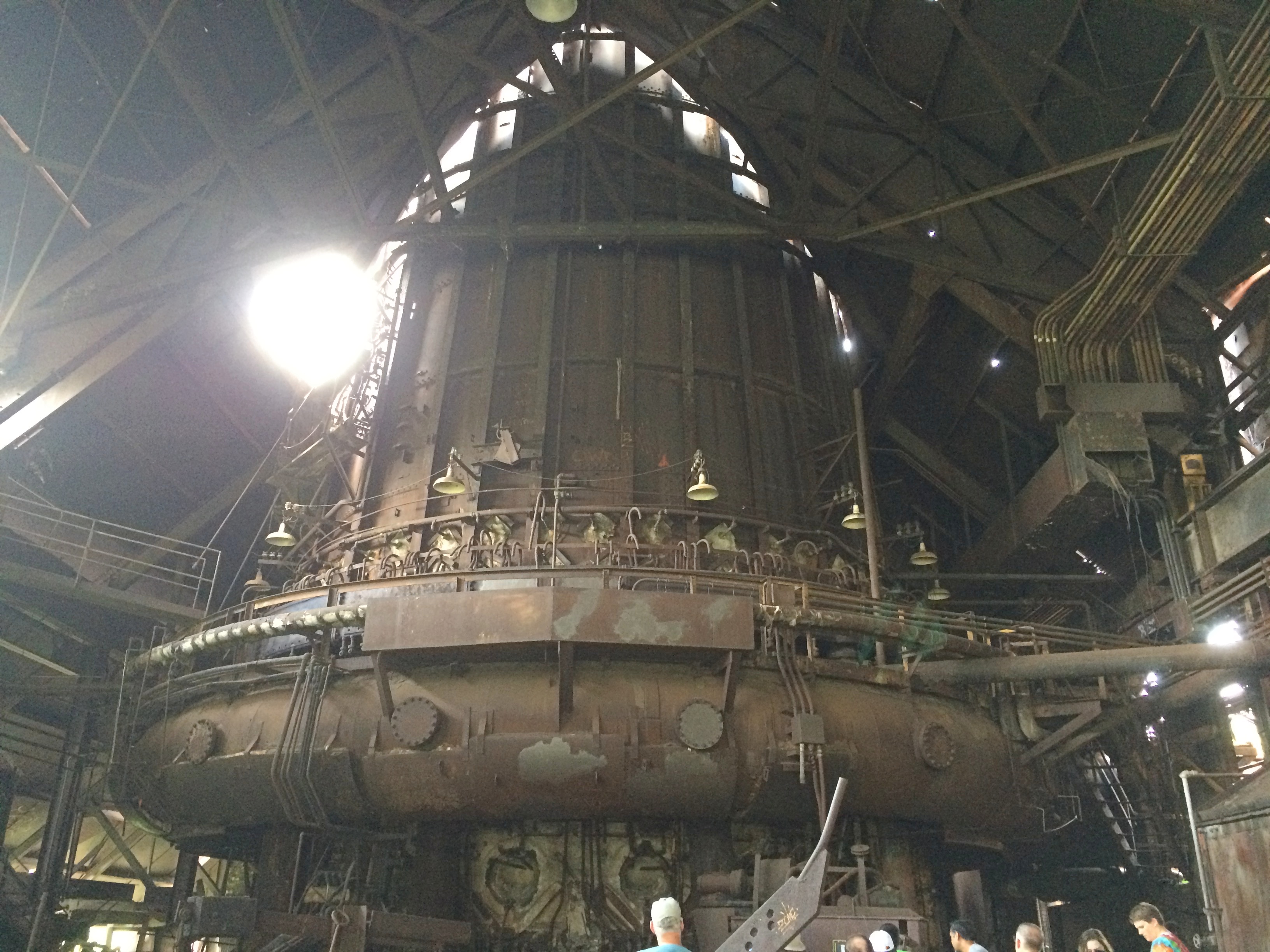
The abandoned pig iron foundry — actually two surviving furnaces along the river, #6 and #7, with the rest razed — is a hulking empire of rust and dust and bricks and voids. Enormous pipes rise into the sky. Twisted metal goes this way and that. Our guide’s constant reminder on pebble paths peppered with debris: watch your step. We watched our step, but when standing still, peered as much as possible into Pittsburgh’s, and America’s, industrial past.

Some soaring elements.

Closer to the ground.

Rusty fixtures.

The king of the complex: one of the blast furnaces.

I listened to the explanations of what certain things were, and how the process moved along, but I don’t have a knack for metallurgy, so most of it didn’t stick. I did get the message about how dangerous and hard the work was, especially in the early days.

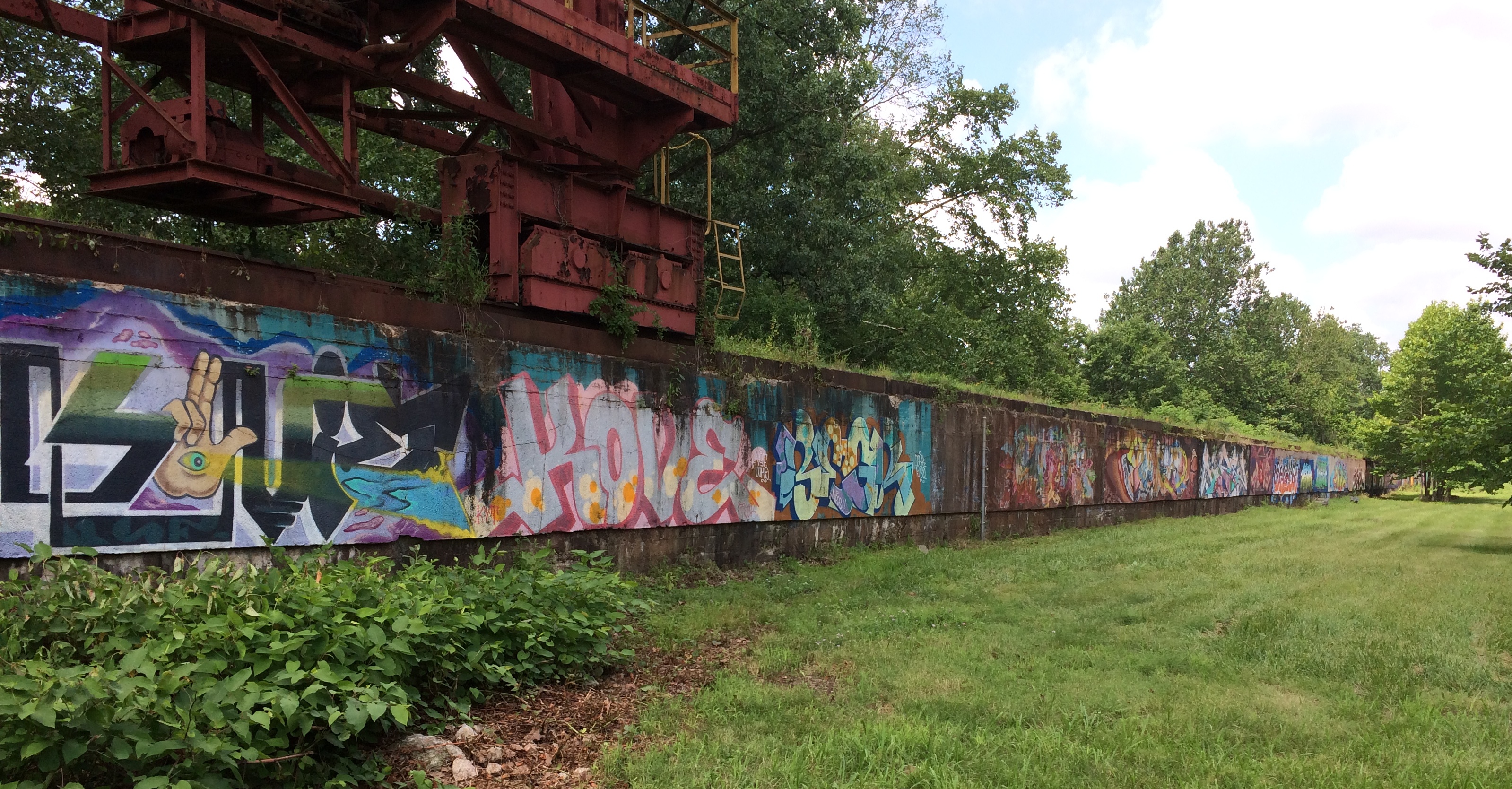
The site is also a nexus for graffiti and outsider art. The largest piece of outsider art was created some decades after the foundry was abandoned.

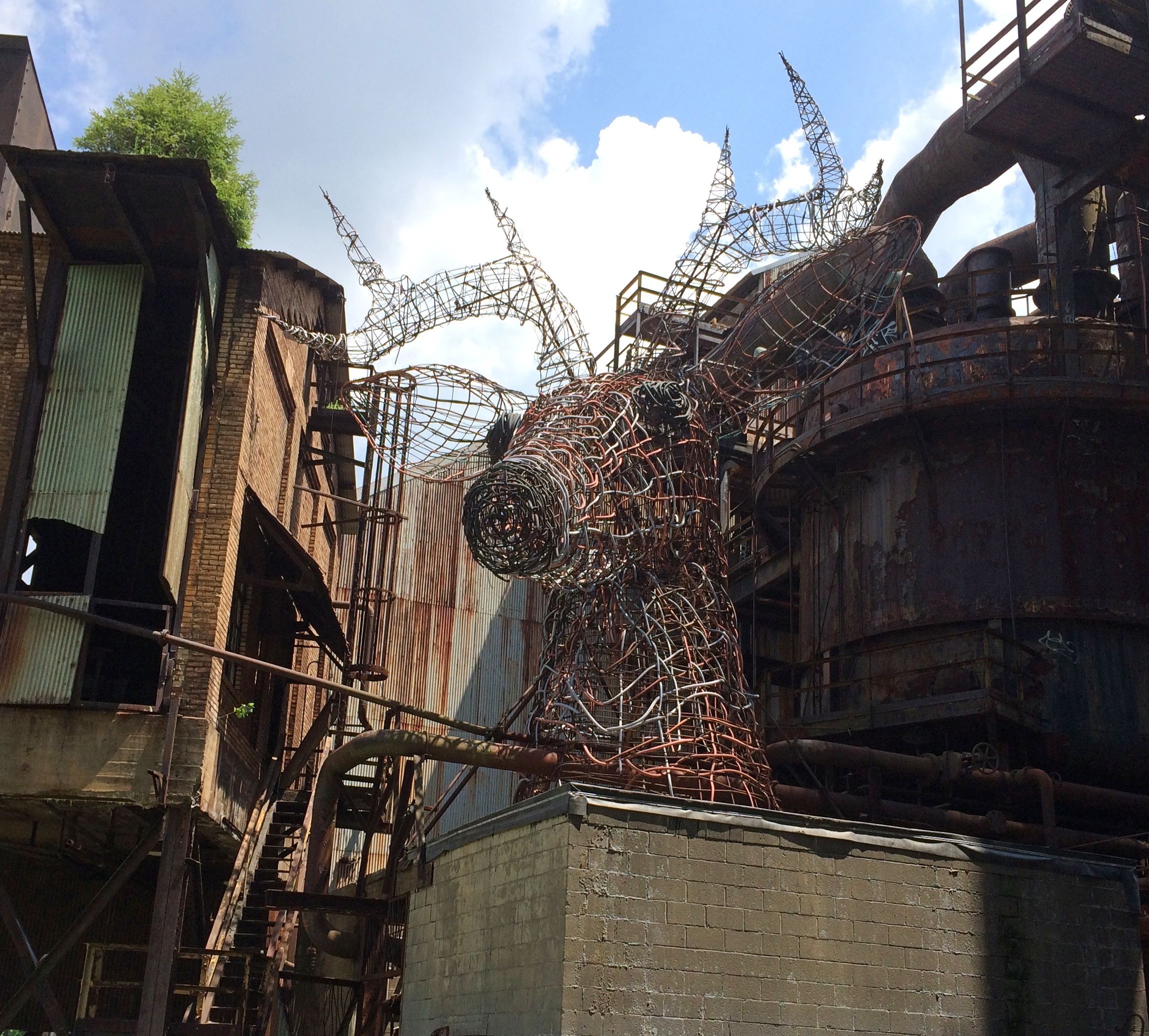
“In 1997, when the furnaces were in the hands of the privately owned Park Corp., a group of local artists entered the site, illegally, with the intention of constructing something from the materials that stayed when industry left: steel tubing, copper ties and wire from electrical conduit,” the Pittsburgh Post-Gazette says.

“Every Sunday for a year, the crew crawled through a hole in the fence, carrying their lunches and a few tools… The artists, whose seven head shots are posted on the exterior of the pump house, fastened the deer’s head on the ground and then lifted it atop the neck using a boat winch.”

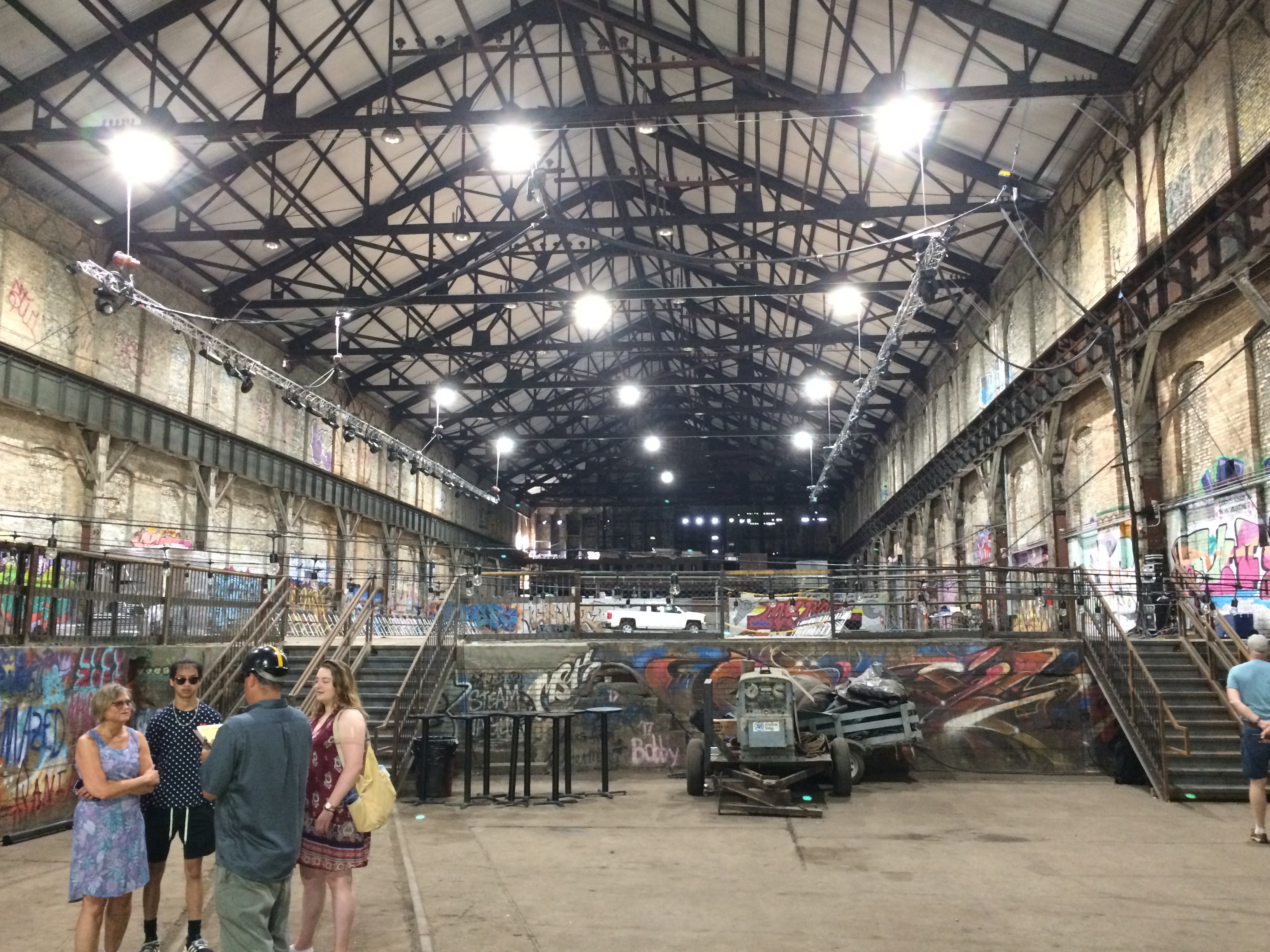
Graffitists also roamed the site in its abandoned days. Inside a large shed (where the tour began), the walls are covered with it.

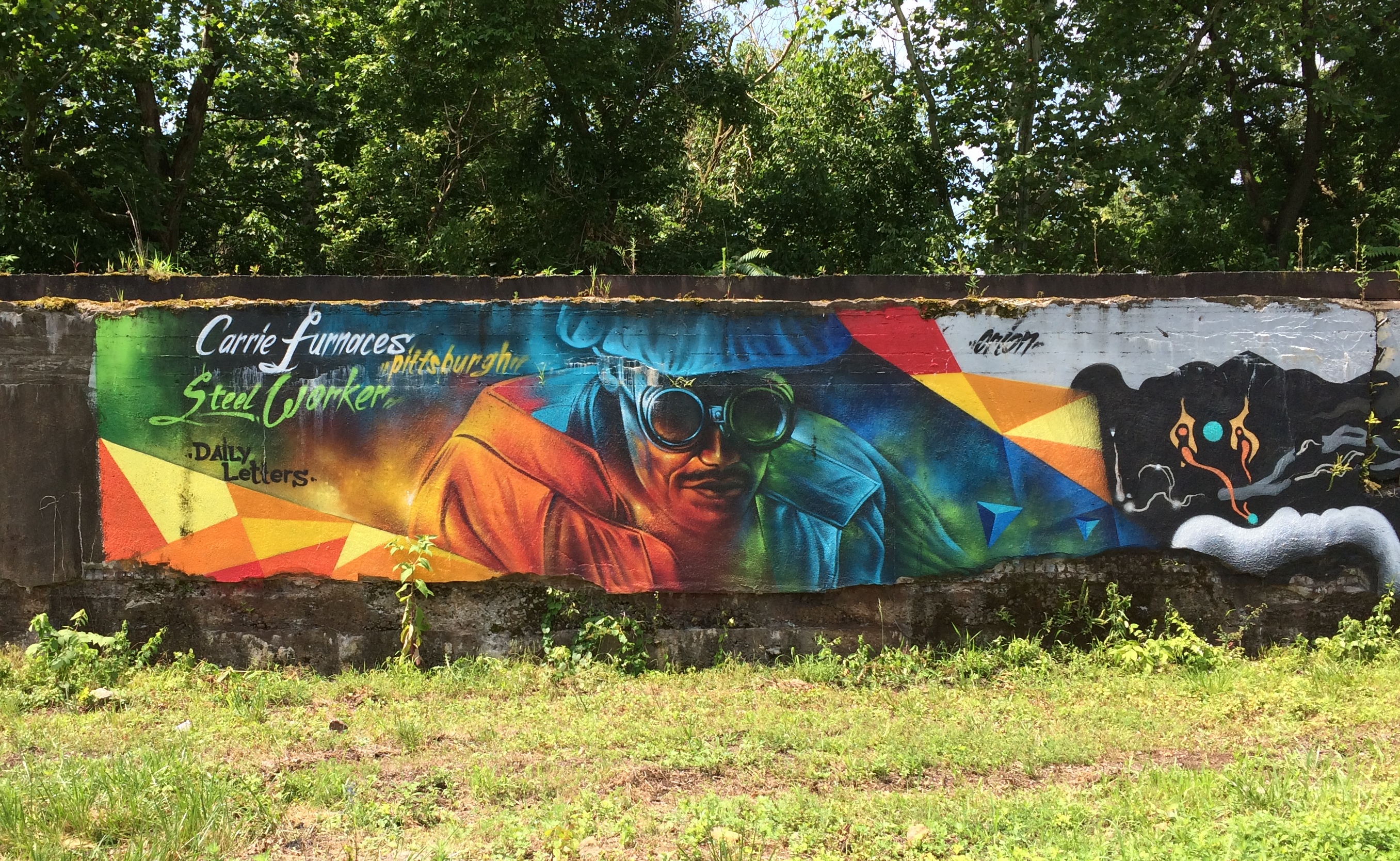
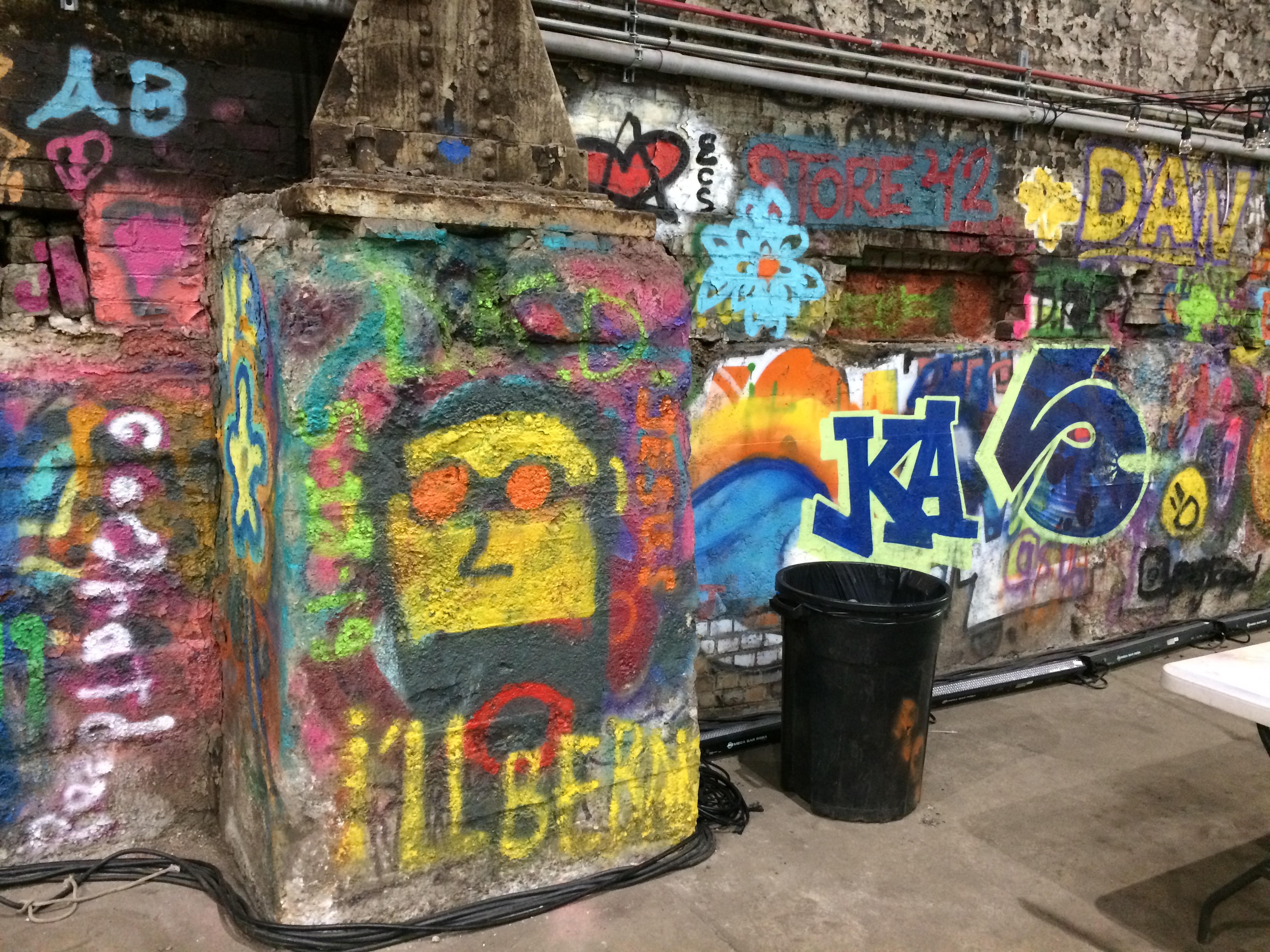
Elsewhere in the complex is a wall on which graffiti is now officially allowed.

“On this wall, it’s art,” the guide said. “Everywhere else, it’s vandalism.”

The Andy Warhol Museum

The earliest memories I have of Andy Warhol are probably him being mocked by comedians, which I must have internalized somewhat. I didn’t give him much thought in my youth, and if I did, he was the weirdo who painted soup cans and oddly colored portraits of movie stars. Later I regarded his work is stuck in ’60s, as dated as go-go dancing or Hair.

More recently his work has grown on me. Maybe in part because he didn’t stick in the ’60s. That was his heyday, certainly, but half a century later, and more than 30 years after the artist’s death, Warhol is still packing ’em in at the Andy Warhol Museum in Pittsburgh, which originally opened in 1994.

But I’ve come to appreciate him for more than enduring popularity. I’m no authority of any kind on his art, but I understand a little about its context now, and see that he was doing new and intriguing things, or sometimes just odd or strange things. Taking his considerable talent as an illustrator in all sorts of curious directions. Making things that are still interesting to look at and think about, which is one of my crude baselines for judging an artist.

Though footsore from a day of tourism, we joined the crowd at the museum on the evening of July 5. The extra Friday hours and half-price admission helped attract us, but we probably would have gone anyway. Pittsburgh has a number of worthwhile fine arts museums, as do a lot of other places. Nowhere else has a museum devoted to Andy Warhol.
Andy Warhol Museum exteriorRichard Gluckman, who is known for his museum work, redesigned the building to be a museum. Originally built in 1911 as a multistory warehouse, the structure now sports seven floors of galleries and exhibition space, with the permanent Warhol exhibits taking up the top four floors.

Warhol’s early and student work, as well as his time as a commercial artist in the 1950s, takes up the seventh floor. On the sixth floor are ’60s works; the fifth floor features ’70s works; and the fourth floor exhibits works from the ’80s.

In some ways, his early works are the most interesting, simply because they are less familiar. On display on the seventh floor, for instance, are ink drawings of women and produce trucks (1946), “Seven Shoes” (third image down), which Warhol did for a shoe brand in the 1950s, and the risque “Female in Corset and Stockings,” which probably wasn’t for a client.

Equally interesting are items about Warhol’s childhood and youth. Such as a large, blown-up photo of his high school graduation picture. The face is him, and yet not any Warhol you’re used to seeing. Turns out Andrew Warhola of Pittsburgh had a childhood and an adolescence, as opposed to the comedian-fodder artist who appeared fully formed in New York with frizzy white hair, painting Brillo boxes.

Also interesting to learn about Warhol: he was the son of Lemko immigrants and he remained a practicing Ruthenian Catholic all his life.

The sixth floor displays the most familiar Warhol output: soup cans and other consumer product-inspired items, celebrity portraits in assorted hues, and clips from his early movies, all 1960s vintage. Most of these are so well known — so absorbed into the tapestry of 21st-century American culture — that I don’t feel the need to link to any images. Even so, I look at the soup cans now and think, interesting idea for 1962. Also, who eats Pepper Pot?

Google Image “soup can” and one of the things high in the results offers a silk screen of “Tomato Soup” for sale. For $500. Not even a limited edition. Presumably the Warhol Foundation is getting a cut. Warhol was an astute businessman as well as an artist, and I think that would make him smile.

All that said, I’m not paying that much for an open-edition silk screen of “Tomato Soup,” however interesting the original concept might have been.

The ’70s and ’80s galleries sported such interesting, or amusing, items such as the “Vote McGovern” (1972) and “Space Fruit: Lemons” (1978). An entire gallery wall featured “Mao Wallpaper,” which he created in 1974 but which the museum reprinted a few years ago, probably to put on the wall. Anyway, it’s there, along with “Skulls” on the same wall (individually, not in a group of six). I like to think that’s a comment on the millions Mao murdered, but I’m not sure the museum would say that.

One gallery display of late-life Warhol output was a complete surprise: computer-generated art. Specifically, Amiga generated.

According to the museum: “In the summer of 1985, Warhol was given his first Amiga 1000 home computer by Commodore International and enthusiastically signed on with the company as a brand ambassador.

“For their launch, Commodore planned a theatrical performance, which featured Warhol onstage at Lincoln Center with rock ’n’ roll icon and lead singer of Blondie, Debbie Harry. In front of a live audience, Warhol used the new computer software ProPaint to create a portrait of Harry. He later made a series of digital drawings including a Campbell’s soup can, Botticelli’s ‘The Birth of Venus,’ and flowers.”

These images are on display in the gallery, though for most of the past decades, they  languished on obsolete Amiga floppy disks. “In 2014, we collaborated with Carnegie Mellon University and Carnegie Museum of Art to extract the saved files from Amiga floppy disks held in our archives collection,” the museum notes.

That was something I knew nothing about, since I wasn’t paying attention to Warhol or the Amiga in 1985, though I knew a fellow in my office who still had one of the machines in the mid-90s that he said was still working.

Warhol died in 1987. The Amiga display made me wonder what he would have done on the Internet, had he lived only a few years longer. Probably odd and maybe interesting.

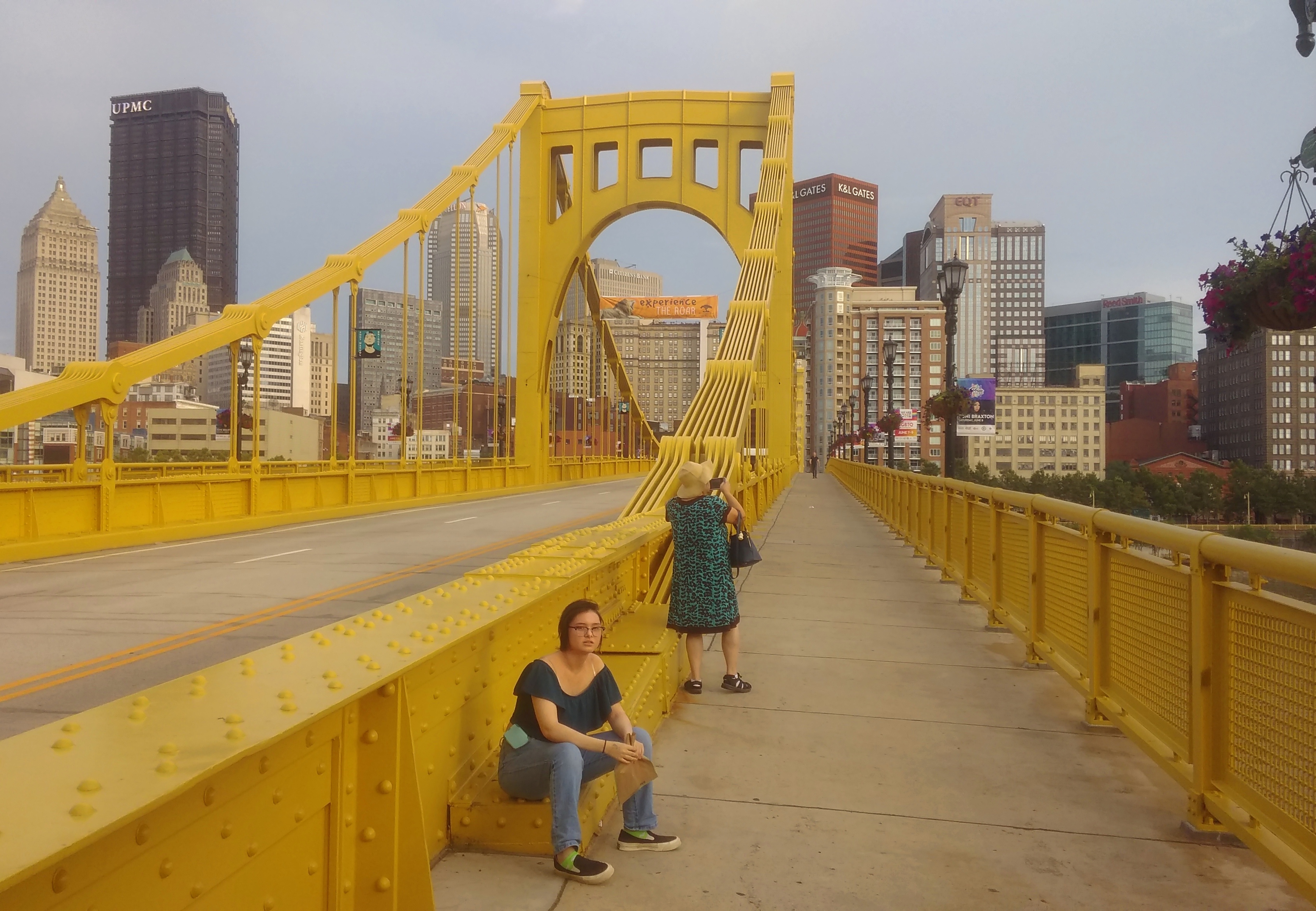
After we left the museum, we walked across what used to be the Seventh Street Bridge, which is mere feet away. In 2005, it was renamed the Andy Warhol Bridge. Dating from the ’20s, it’s a self-anchored suspension bridge that has held up better than the original Silver Bridge, which was of a similar design.

Andy Warhol Bridge 2019

I don’t know how Pittsburghers feel about that name; maybe hardcore Yinzers didn’t take to it. But it’s a fine name for a bridge — goes somehow with the neighboring bridges, named for Roberto Clemente (Sixth St.) and Rachel Carson (Ninth St.) — and I was happy to walk across it.

Point State Park & Pittsburgh Walkabout

RIP, Patricia Deany, mother of our dear old friend Kevin Deany, and a kind and gracious lady. She passed last week at age 90.

At the confluence of the Allegheny and Monongahela rivers is Point State Park, a 36-acre triangular patch of land that may well be featured in every bit of tourist literature ever published about Pittsburgh since the park’s creation nearly 50 years ago.

But that’s no excuse not walk over to the park from downtown Pittsburgh and make a circuit around the fountain at the tip of the park, which is what we did after lunch at the Oyster House on July 5.
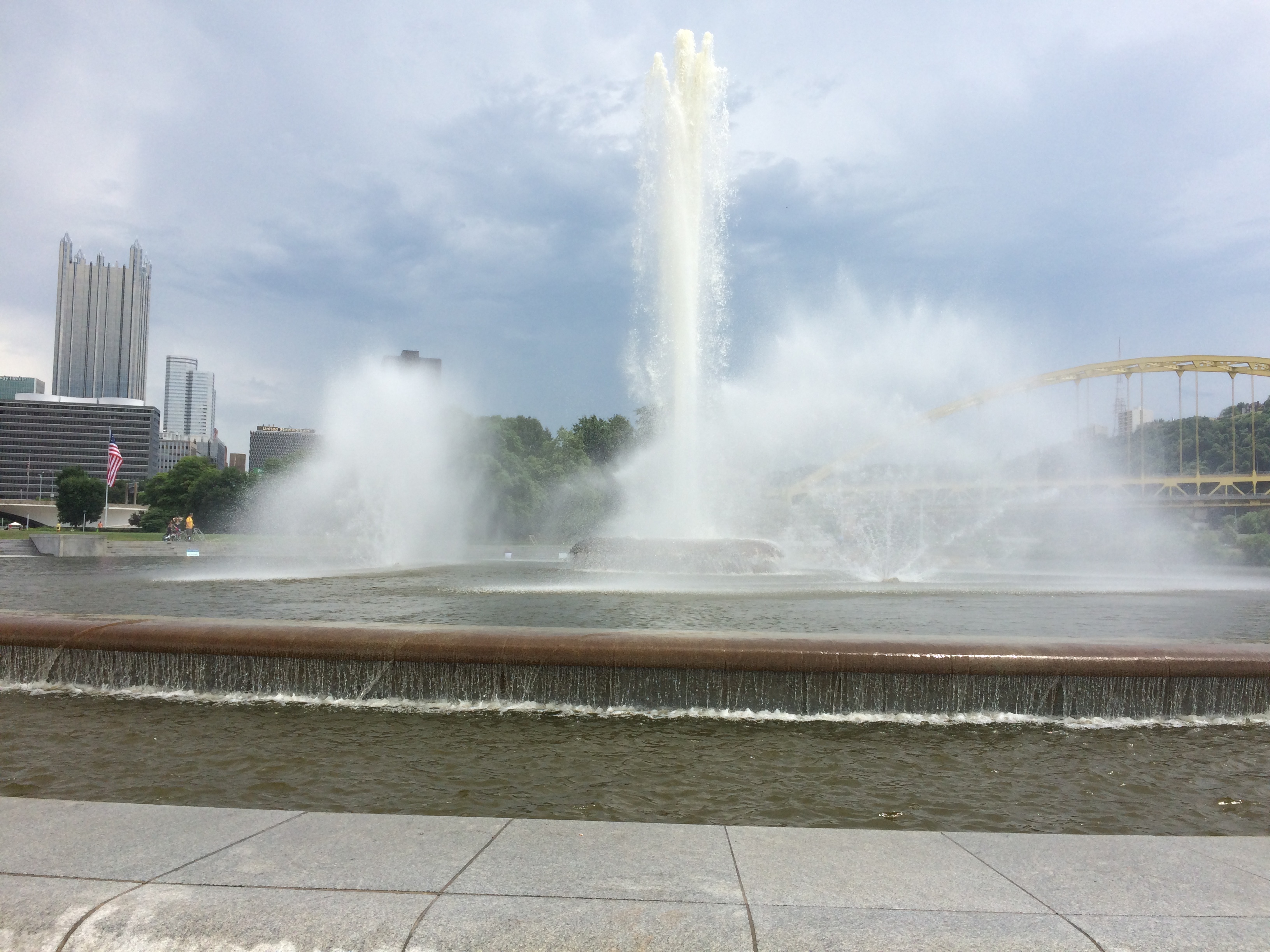
Point State Park, PittsburghThat image makes it look like no one else was there, which wasn’t true at all.
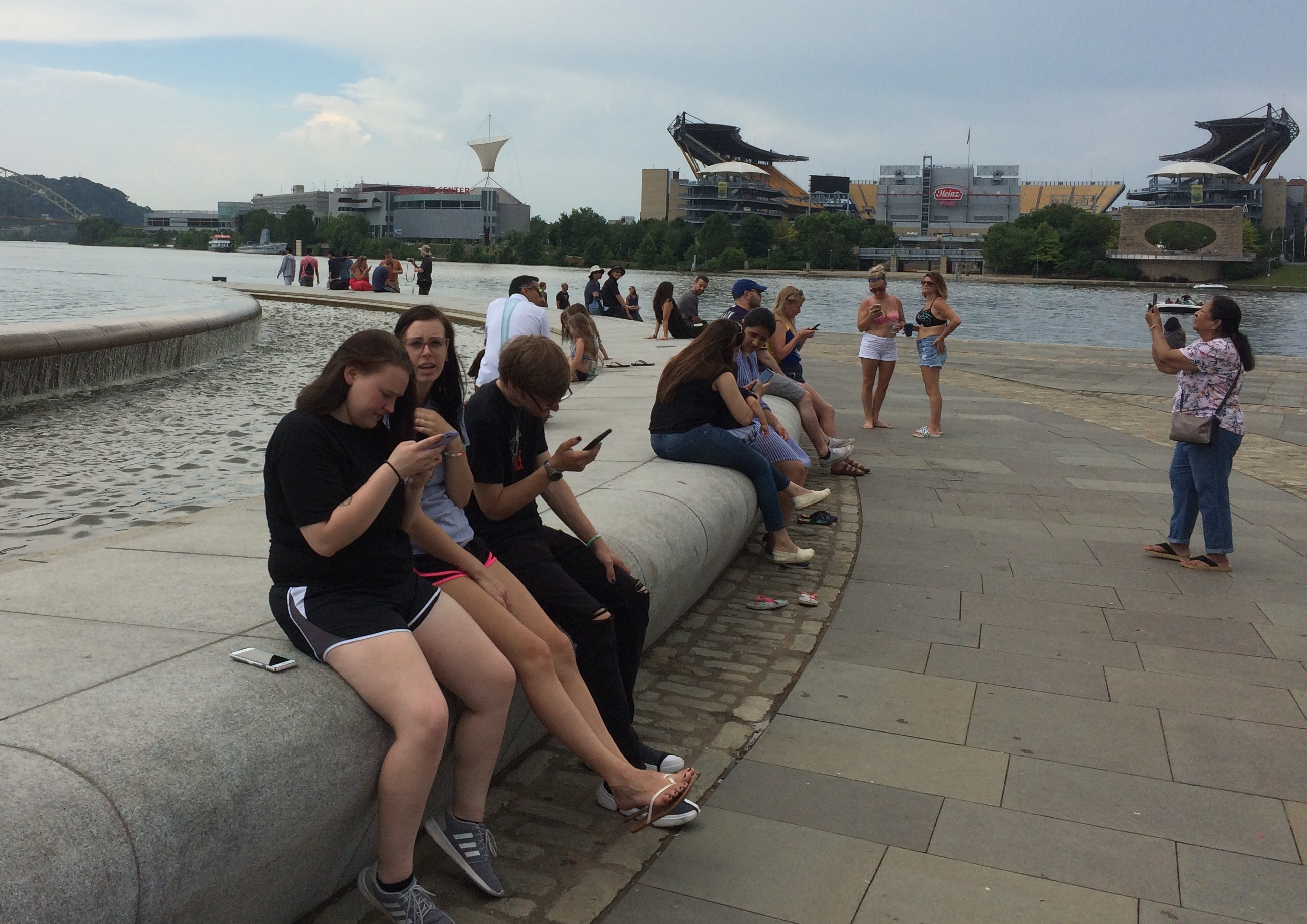
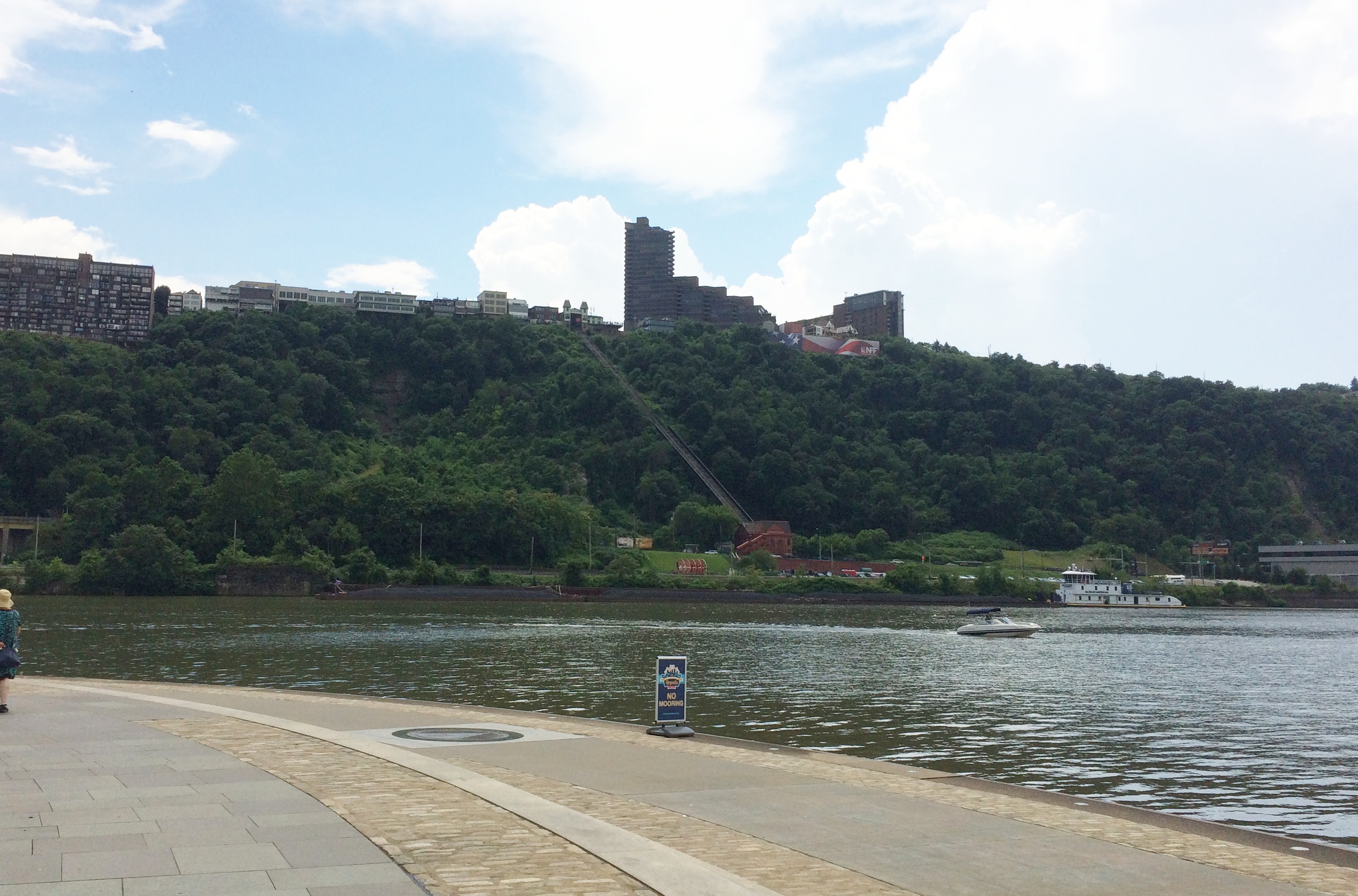
Point State Park, PittsburghThe park offers views of various other parts of Pittsburgh, such as Mt. Washington and the Duquesne Incline.
Point State Park, Pittsburgh

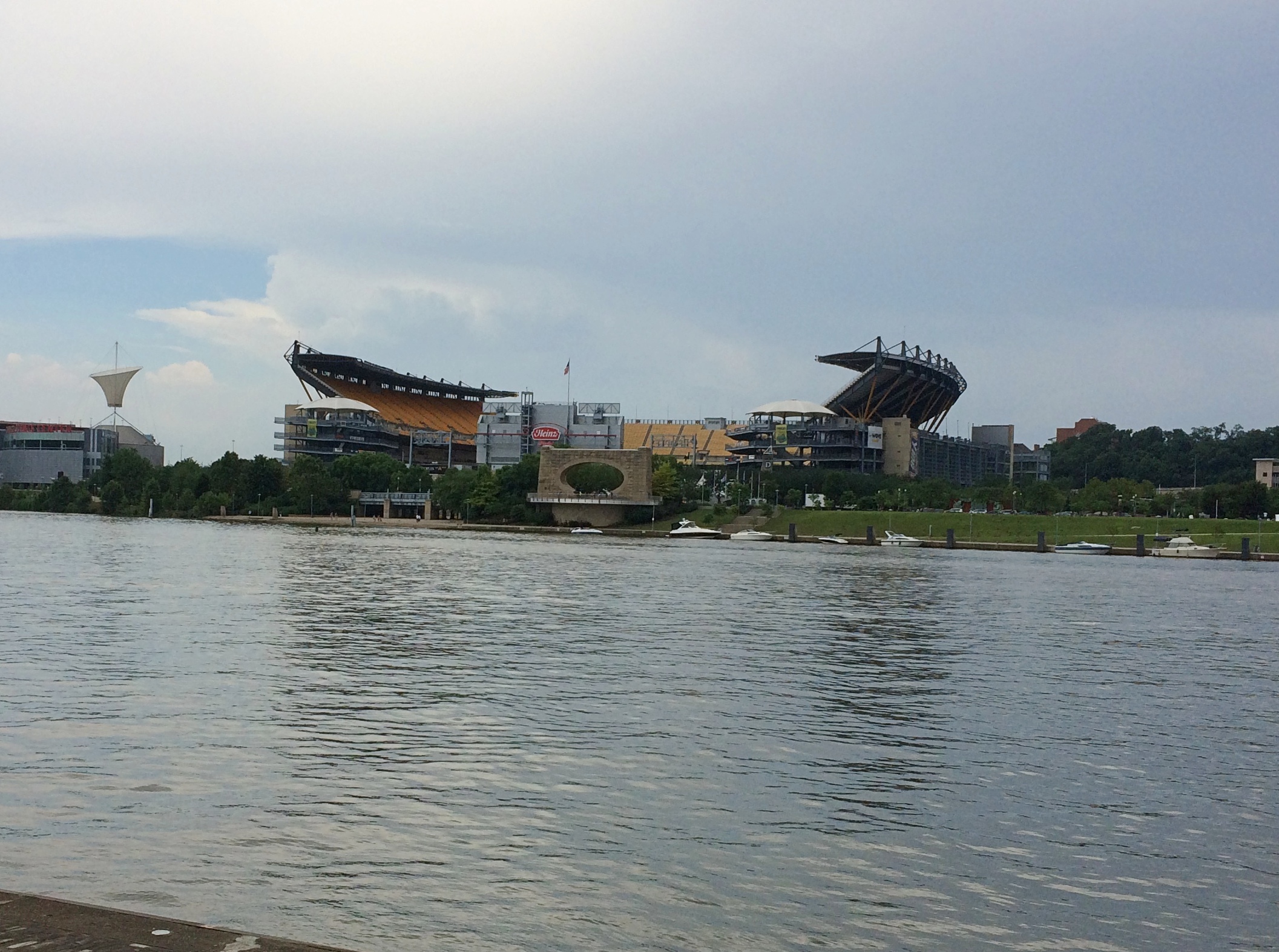
Or Heinz Field, home of the Steelers. There ought to be a giant ketchup bottle in there somewhere.
Away from the fountain, there’s a view of the Fort Pitt Bridge, which carries I-376 across the Monongahela. It replaced the Point Bridge, which was destroyed, along with the Manchester Bridge, to make way for the park.
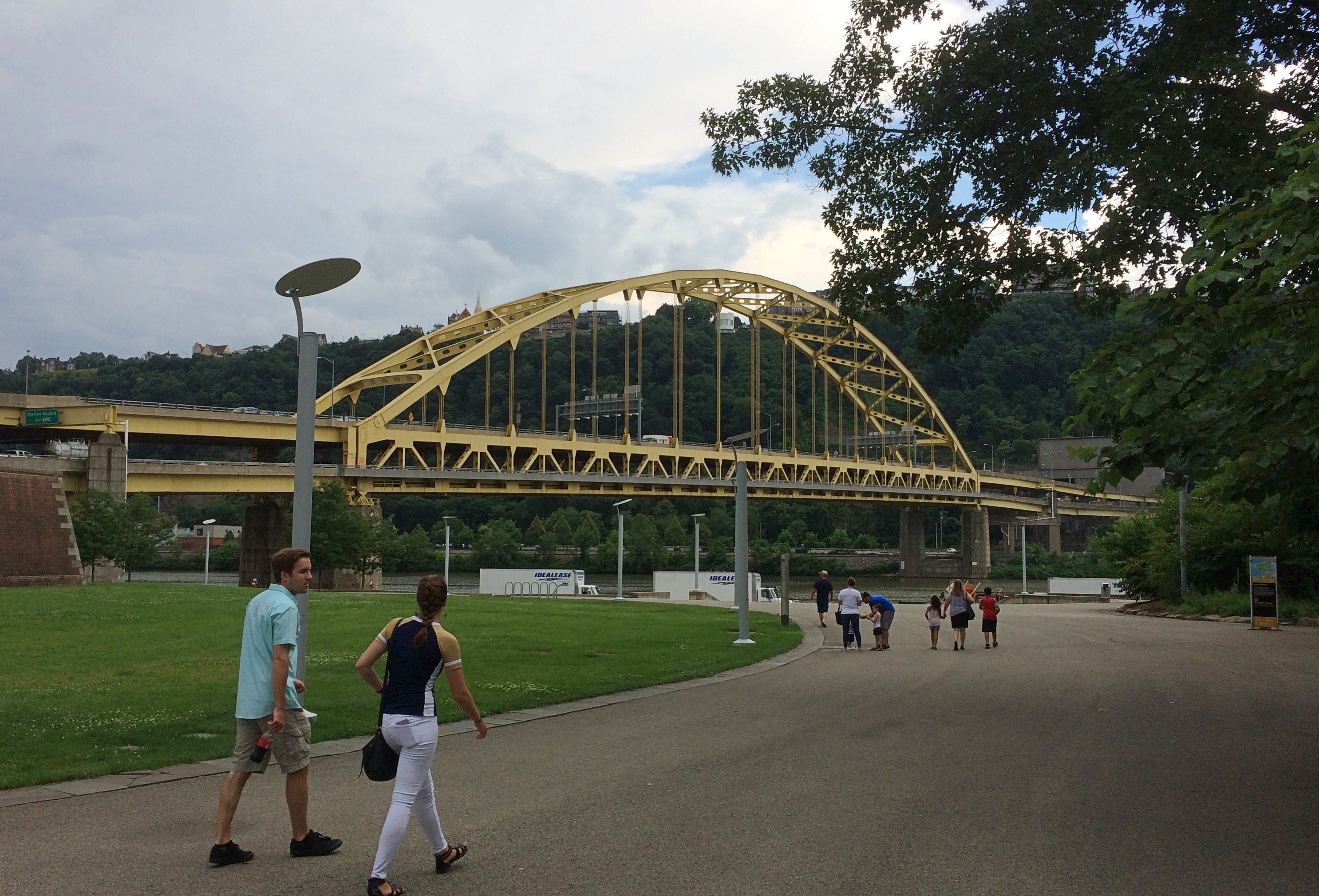
Besides being a pleasant green space with views, the park makes various nods to the early history of Pittsburgh. An irregular path of sidewalk follows the outline of Fort Duquesne, the French outpost. Elsewhere other sidewalks mark the outline of the somewhat larger Fort Pitt, the succeeding British outpost, also in the classic star (Bastion) shape.
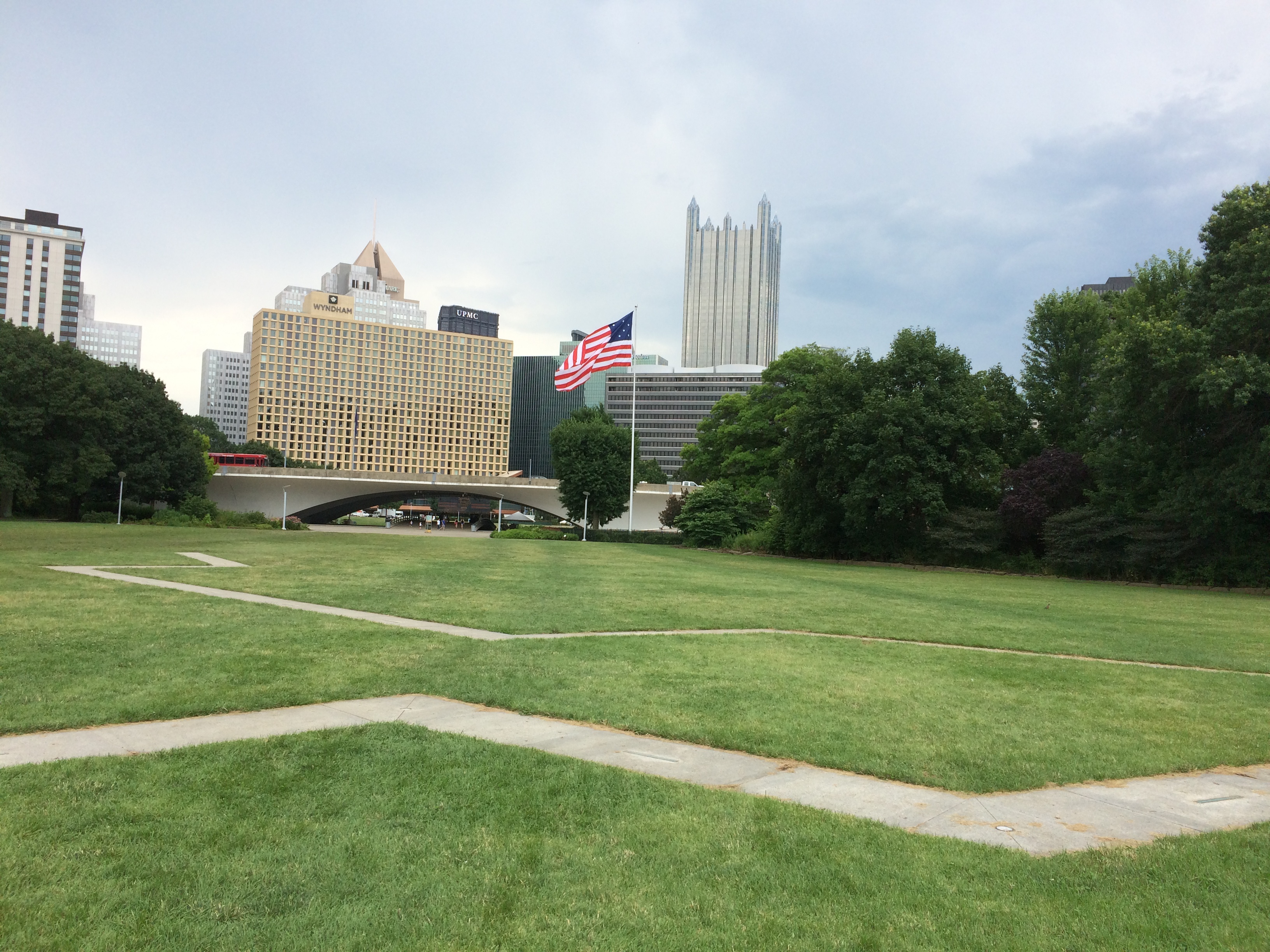
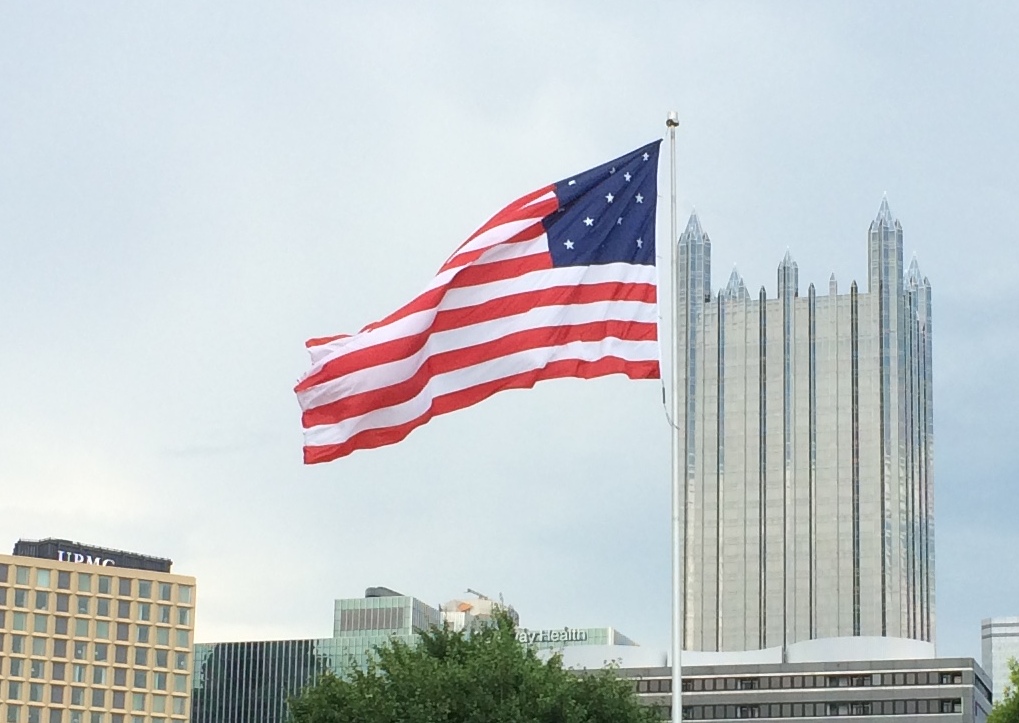
The U.S. flag is a little unusual. Not in having 13 stars, but in that they aren’t the circular arrangement you usually see. Then again, no one specified how the stars in the canton should be arrayed in those days (and maybe we should go back to that).
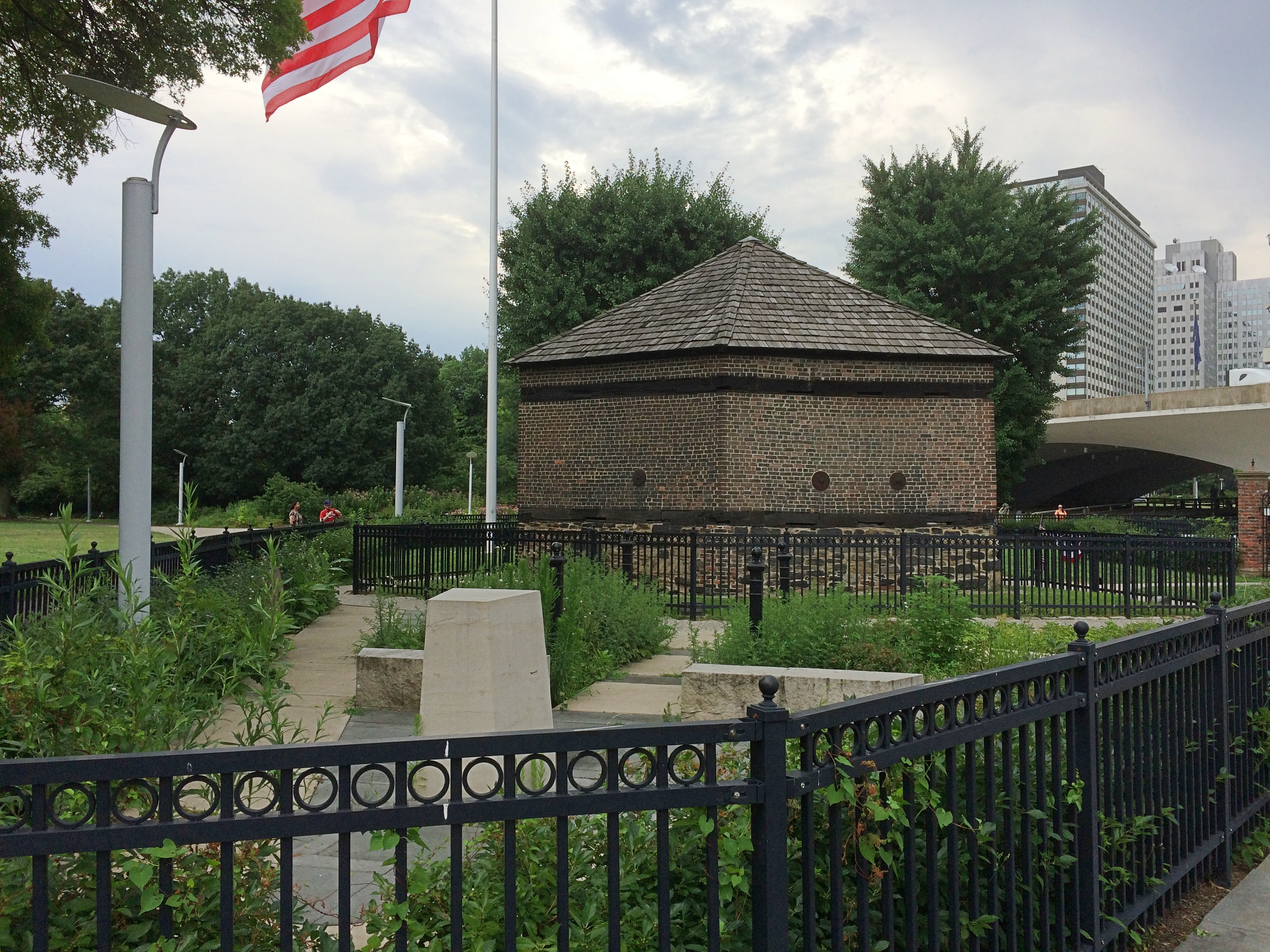
Point State Park, PittsburghOn one edge of the park is the Fort Pitt Block House, Point State Park’s only surviving structure from colonial times, built in 1764 as a redoubt of Fort Pitt. It has endured since then in its original spot, for many years as a residence, more recently as a relic.
Our walking tour of downtown Pittsburgh started at the Block House, led by an energetic young woman, native to Pittsburgh and eager to talk about various places and buildings, though less about design and more about history.

Naturally, the names of Pittsburgh robberbarons Andrew Carnegie and Henry Clay Frick came up a lot, including the story about a dying Carnegie writing a letter to the estranged Frick asking for a meeting, presumably in the spirit of reconciliation.

Les Standiford tells the story, via NPR. A man named Bridge, who delivered the letter, was Carnegie’s assistant.

“Frick’s ire was, after all, legendary. He’d gone toe-to-toe with strikers, assassins, and even Carnegie himself, and had rarely met a grudge he could not hold. Long before Frick had constructed the mansion that would dwarf Carnegie’s ‘Highlands’ up the street, he had gone out of his way to purchase a tract of land in downtown Pittsburgh, then built a skyscraper tall enough to cast Carnegie’s own office building next door in perpetual shadow.

” ‘Yes, you can tell Carnegie I’ll meet him,’ Frick said finally, wadding the letter and tossing it back at Bridge. ‘Tell him I’ll see him in Hell, where we both are going.’ ”

Whatever else you can say about the steely-eyed bastard Frick, at least he had no illusions about his benevolence, as Carnegie seemed to have had. Our guide also mentioned the taller Frick building next to Carnegie’s, and in fact pointed them out. They are both now overshadowed by more recent Pittsburgh buildings, of course.

At one point, we passed by a building associated with both Carnegie and Frick, along with a lot of other Gilded Age and later tycoons: the Duquesne Club on Sixth Ave.
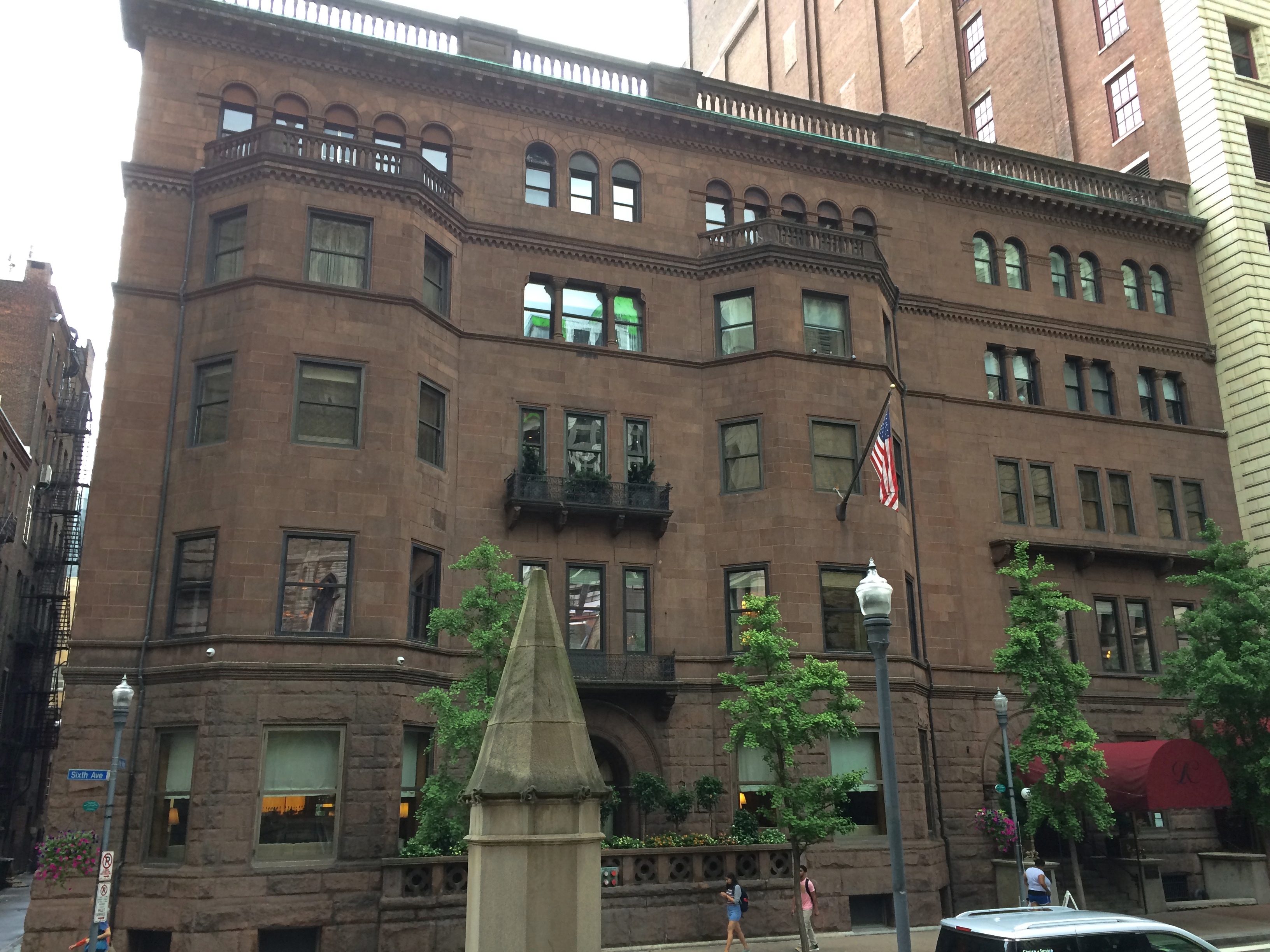
Duquesne Club Founded in 1873 and still a social club for the wealthy, its current home, a Romanesque structure designed by Longfellow, Alden & Harlow, opened in 1890. Just in time for Carnegie and Frick to discuss, possibly over brandy and cigars, the busting of the Amalgamated Association of Iron and Steel Workers.

Speaking of labor history, not far away from the club, I noticed this historic marker.
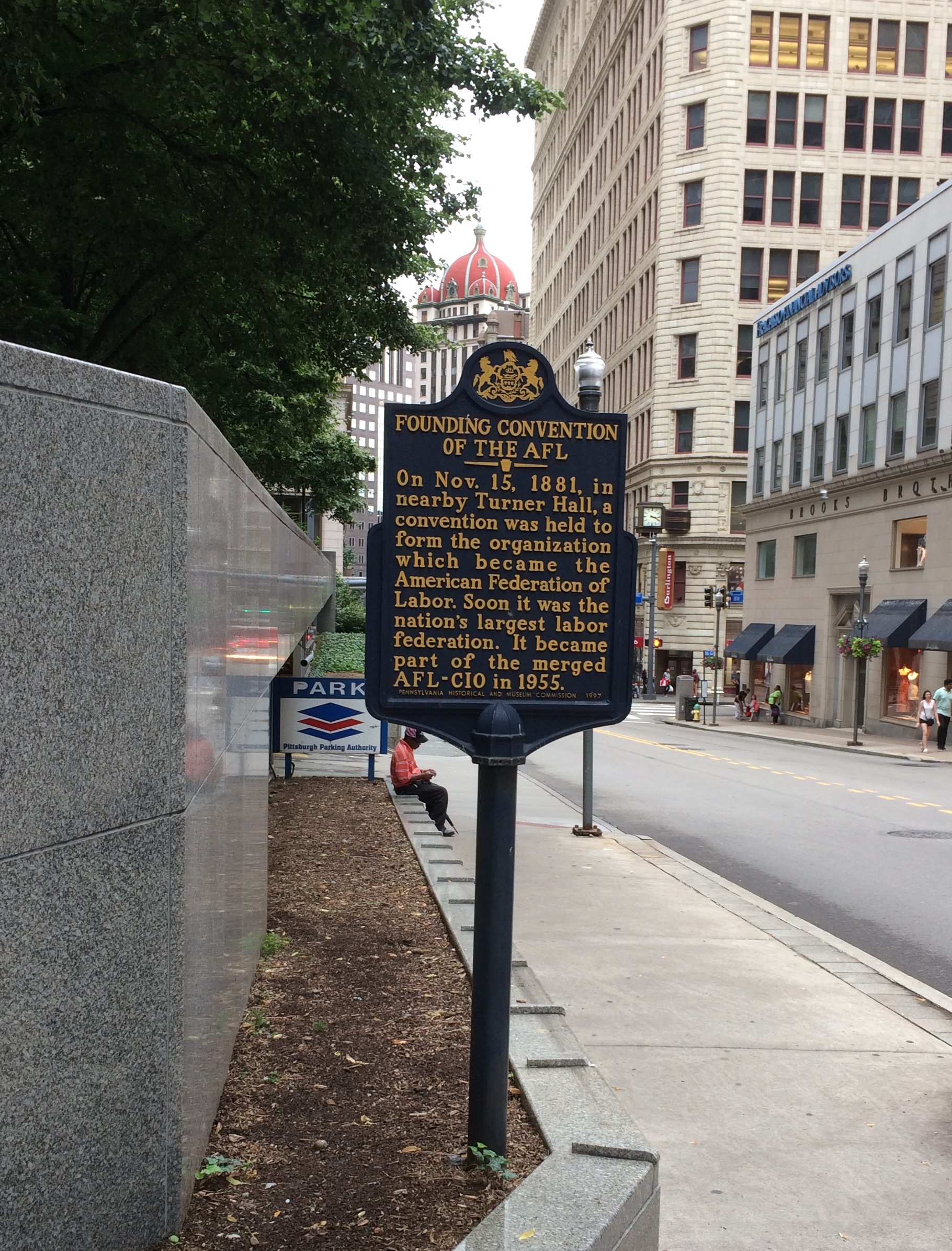
AFL Marker, Pittsburgh - Turner HallThe founding convention of the AFL was in a Turner Hall. Our guide didn’t mention that, and I asked her about the Turner Hall. She hadn’t heard it. To be fair, I’d never heard of Turner Halls until recently either. To be extra fair, I’m not guiding walking tours of a major American city, so I consider that a small lapse on her part.

The Turner Hall in Pittsburgh, unlike that in Milwaukee, is no more. The site is now called Mellon Square, a 1950s park-like creation paid for by the Mellons to go with the development of Alcoa’s new headquarters building at that time.

Alcoa isn’t there any more, and the building is now known as the Regional Enterprise Tower, but it still has its distinctive aluminum skin. The New York modernists Harrison & Abramovitz designed it.
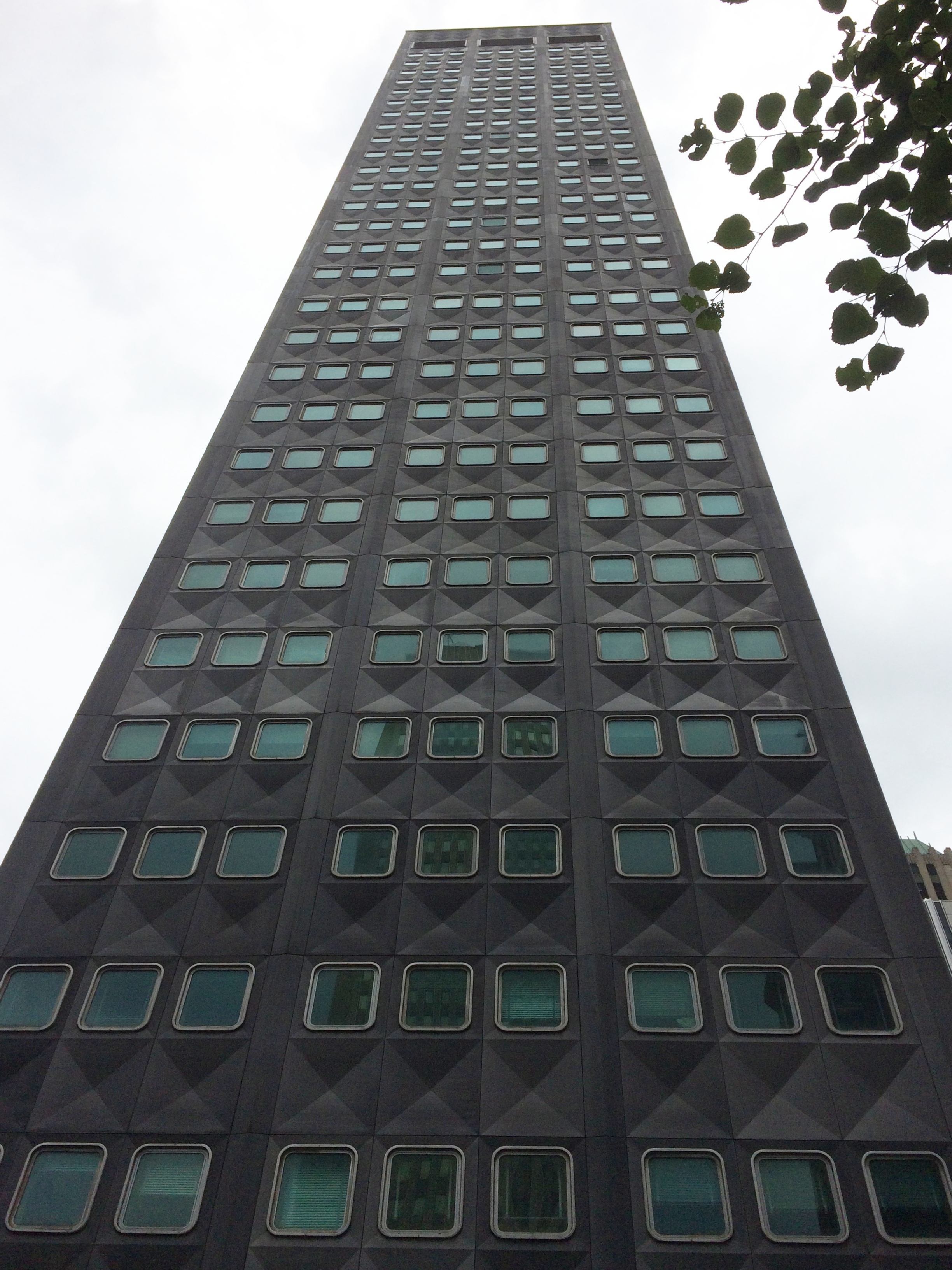
Alcoa Building Pittsburgh

I’ve read that a Beaux-Arts palace of a theater, the Nixon, was destroyed to make way for Alcoa, causing some consternation even in the tear-it-down midcentury.

Another historic marker that I noticed (that also wasn’t on the tour).
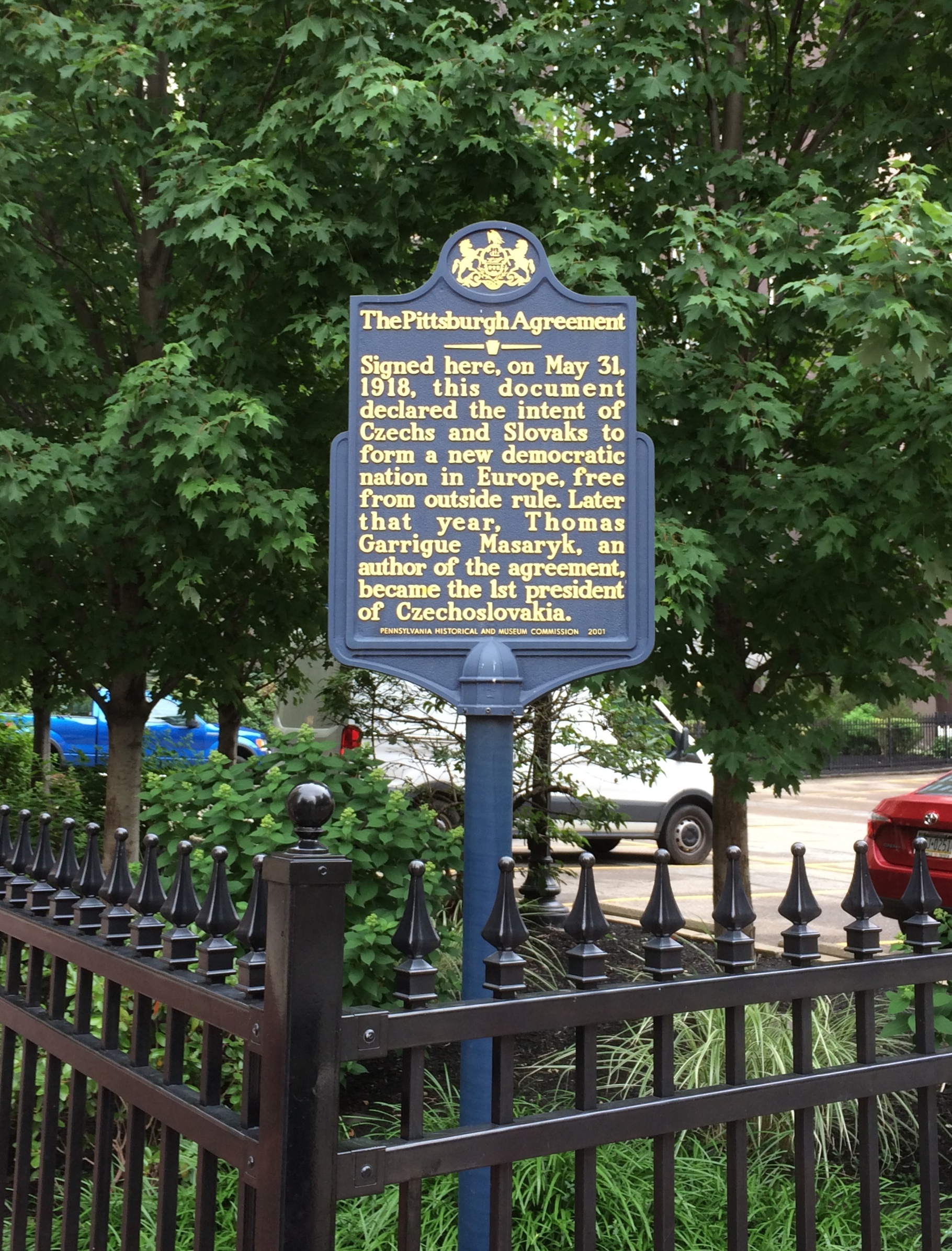
Pittsburgh Agreement MarketWhy Pittsburgh? I wondered. I looked it up later. NPR again: “Slovak culture is everywhere in the Steel City. It’s home to the Honorary Slovak Consulate, a handful of social clubs, cultural centers and annual holiday festivals dedicated to maintaining and celebrating Slovak traditions.

“ ‘Allegheny County has the highest percentage of all of the counties in the United States, not just Pennsylvania, of people who claim Slovak heritage,’ said Martin Votruba, head of Slavic studies at the University of Pittsburgh.

“Slovaks and Czechs formed a group called the Czecho-Slovak National Council of America. Because there were so many Slovak immigrants living in Pittsburgh, Votruba said it seemed like the perfect location to have a big meeting on Memorial Day in 1918.”

Along the way, we looked at a work of public art in Pittsburgh, a 25-foot bronze fountain centerpiece at Agnes R. Katz Plaza by Louise Bourgeois, completed in 1999. The eye-like smaller bronzes are actually benches, though it’s hard to tell from this angle.
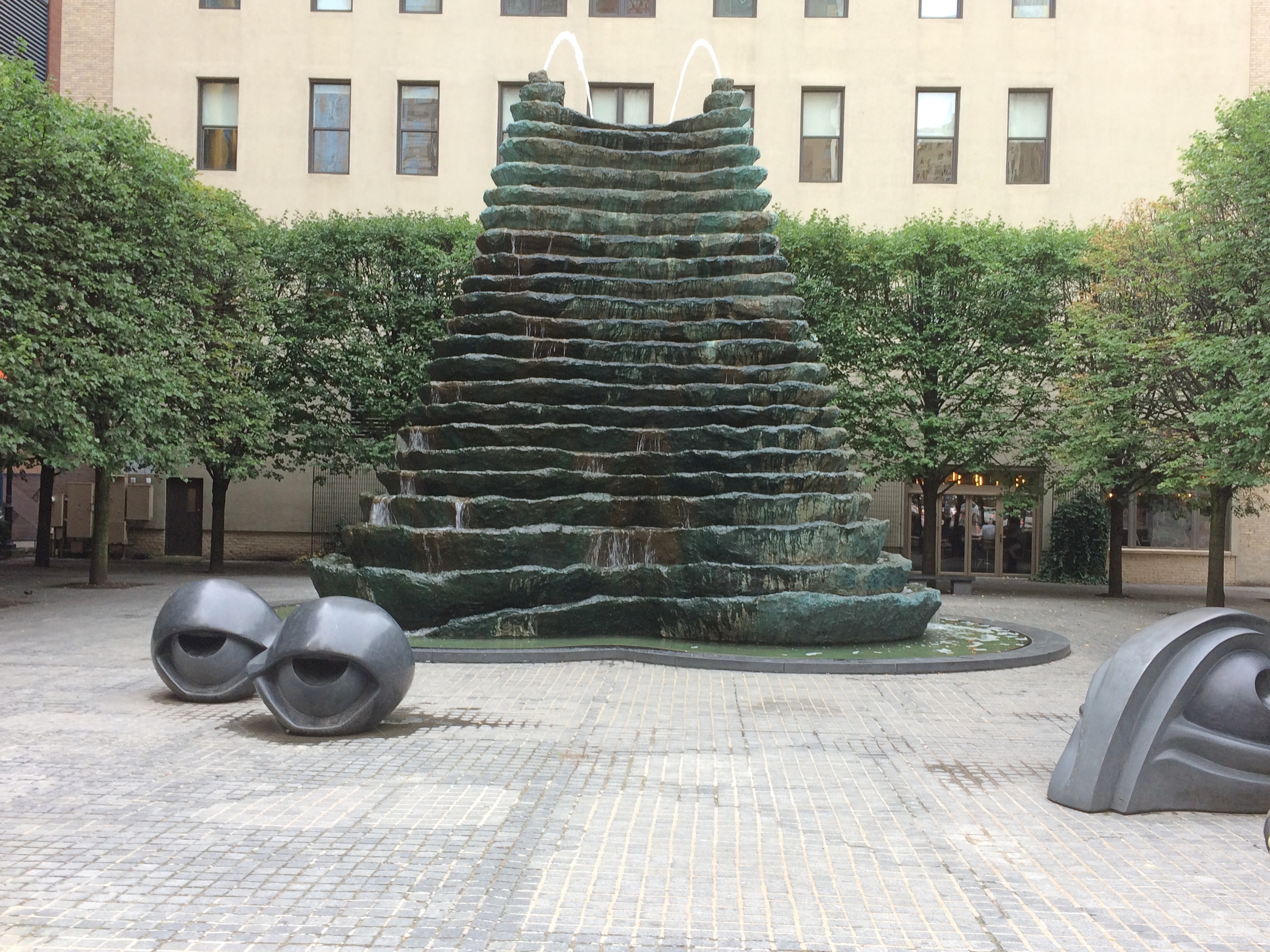
Agnes R. Katz Plaza by Louise Bourgeois,By the time we got to the U.S. Steel Tower, the tallest building in Pittsburgh, a light rain was falling. It would continue at varying strength through the rest of the walk.
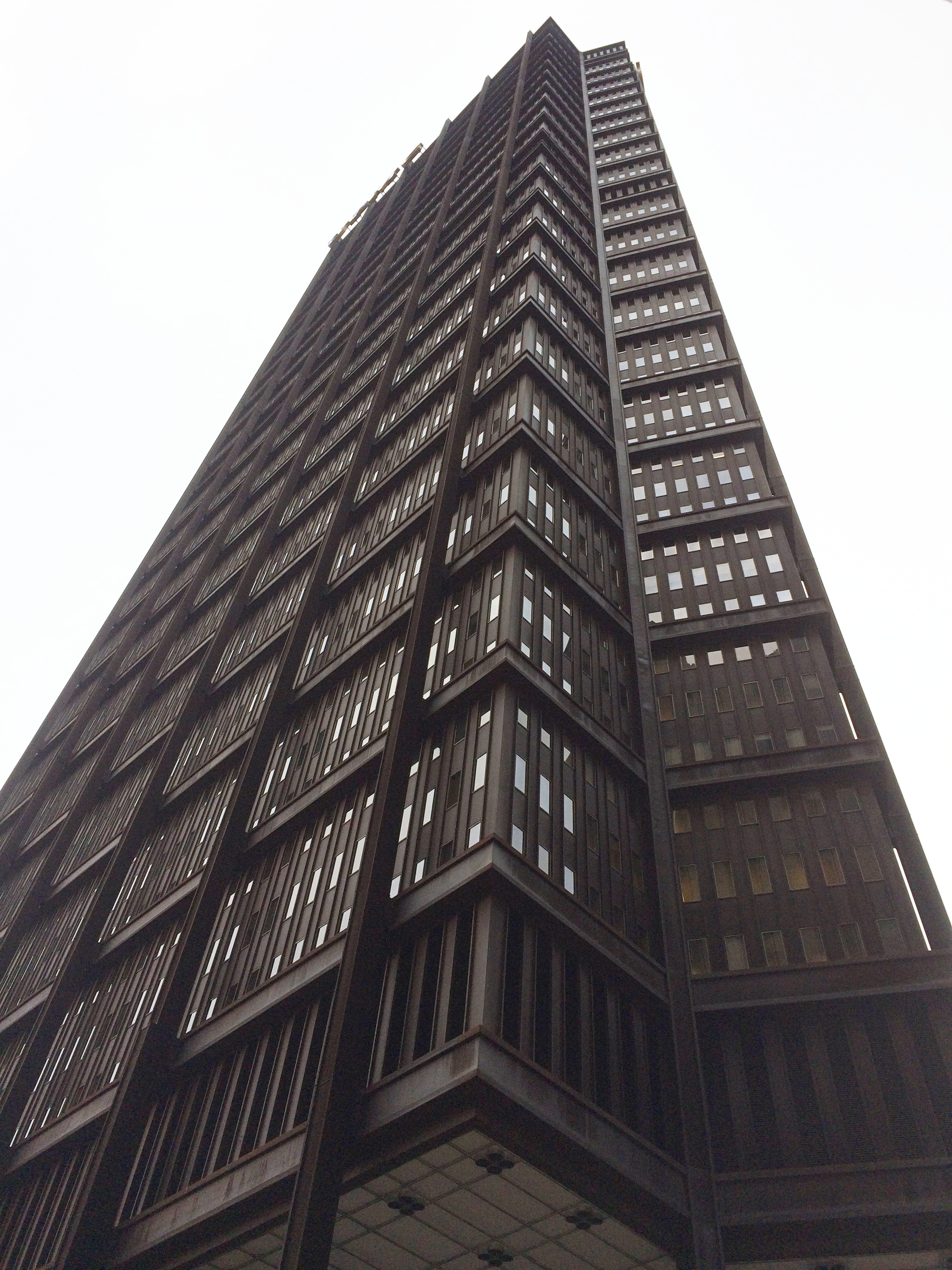
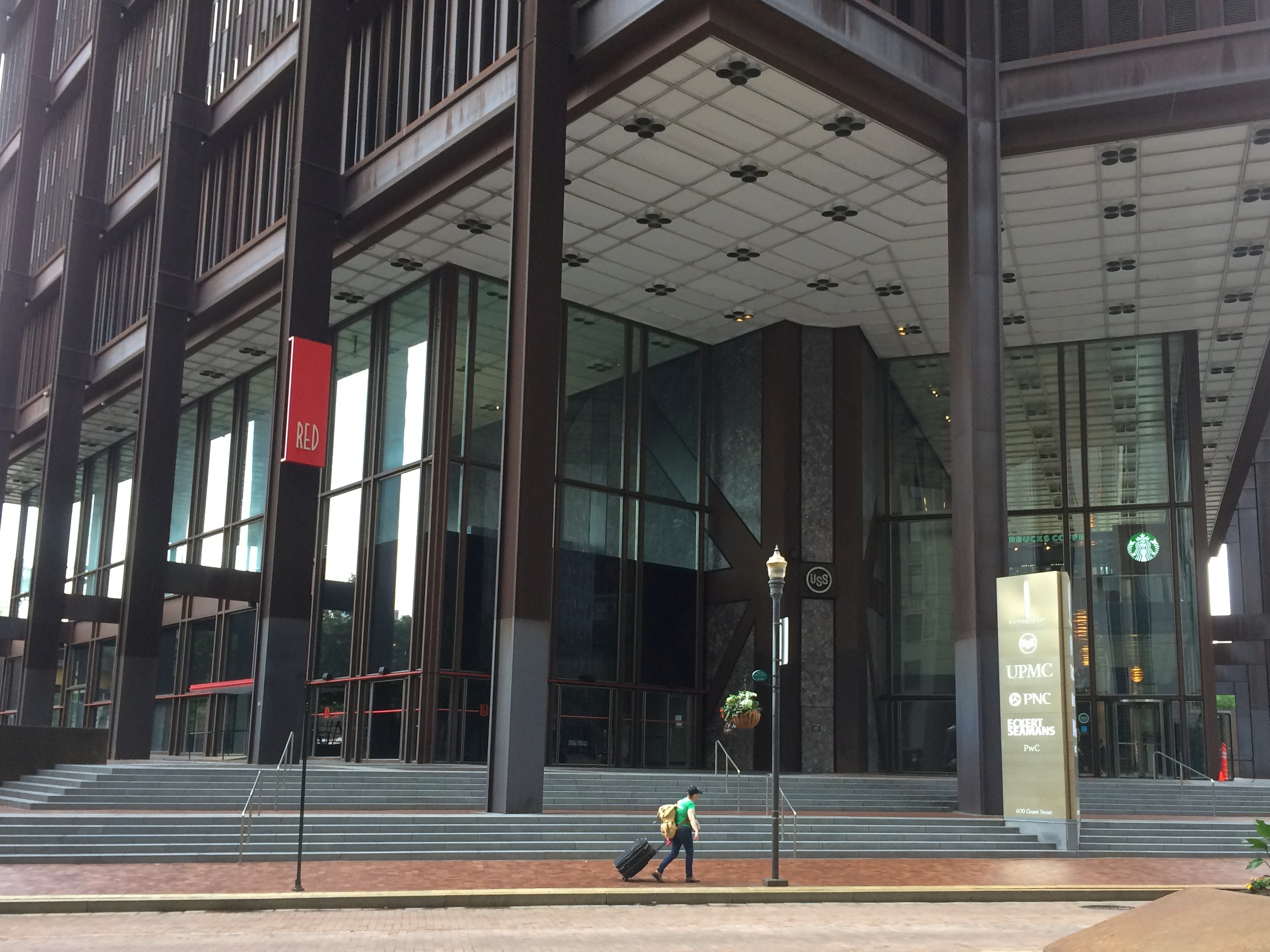
US Steel Tower, Pittsburgh

US Steel Tower, PittsburghNo aluminium for this behemoth, rather steel and lots of it. This too is a Harrison & Abramovitz design. The company made steel for its own building, a newish product at the time, corten or weathering steel, which ends up with a dark brown oxidation over the metal to protect the structure from the elements and obviate the need for paint. (The steel still has many surprising uses.) According to our guide, however, until recently the building skin had an unfortunate habit of spitting granules of this rust onto the sidewalks and people below.

Aluminium, steel and then glass. Fitting for the HQ of PPG, also a stop of the tour. Founded in 1883 as Pittsburgh Plate Glass, these days PPG is a supplier of paints, coatings, optical products and specialty materials.

The complex is actually six buildings, all opening in the early 1980s as part of the effort to revive downtown Pittsburgh. By that time, Johnson/Burgee were the go-to NY architects, so they designed the PPG. Rain prevented me from making a good image, but the tallest of the buildings towers over a plaza that features an ice rink in colder weather. It looks like this on a sunny day.

Toward the end of the tour, we made a stop at a place on Smithfield St. that has no marker of any kind and in fact isn’t distinctive in any way, except for one thing: it was the site of an early nickelodeon, thought to be the first theater anywhere devoted exclusively to movies, as opposed to a live theater with a few machines tucked away to separate patrons from their coins.

“The first exclusive moving pictures theater in Pittsburg and the world was opened in 1905 by Harry Davis and John P. Harris in the Howard Block, west side of Smithfield street, between Diamond and Fifth avenue,” one E. W. Lightner wrote in 1919.

Diamond St. is no longer called that. Oddly enough, the change to Forbes St. was made as late as 1958. I’d imagine that would have been hard to do.

Lightner continues: “Curious to say, the second exclusive picture theater of the world was opened in Warsaw, capital of Poland, by a Pittsburg Polander, who saw the Davis-Harris adventure and recognized the possibilities of presenting so wonderful and profitable a development in his native country.”

“The original and only ‘Nickelodeon’ was opened at 8 o’clock of the morning and the reels were kept continuously revolving until midnight. A human queue was continuously awaiting the ending of a performance and the emptying of chairs. Inside an attendant would announce, ‘show ended,’ and spectators would be hustled gently to the street and new spectators welcomed, seated as quickly as possible, and the picture would again respond to the magic reel.”

As you can see, it was pretty much a nothing site when Google Images came by.

Still looks that way in July 2019. There ought to be a marker there at least, or maybe even a hipster bar with a nickelodeon theme.

The Cathedral of Learning & Its Nationality Rooms

Pittsburgh has some of the most convoluted street patterns I’ve ever driven through. It’s as if a few grids were thrown at random among the hilly terrain, sort of meeting each other in places, with additional streets — some large, some alley-like — crossing the grids at all angles, plus oddball five- and six-way intersections punctuating things. You know, like Boston, only with more hills.

But also more street signs. And fewer lunatics behind the wheel. At least that was my impression, admittedly based on a small sample, as I figured out how to get from place to place. So driving in Pittsburgh wasn’t actually that bad, certainly better than Boston, despite its initial challenges.

Our car has GPS with spoken instructions. I decided to try it on the first morning in town. Pittsburgh managed to flummox the system early in the game. That is, it was unable to give me directions that I could use in a timely manner. Maybe I misunderstood. Doesn’t matter — I found the system annoying, so I quit using it. I went back to consulting maps.

Still, the system’s misdirection, or my misunderstanding, at one point led us through the Liberty Tunnel. Earlier we’d gone through the Fort Pitt Tunnel. Pittsburgh might have some great bridges — more about which later — but it also has some really cool tunnels to drive through.

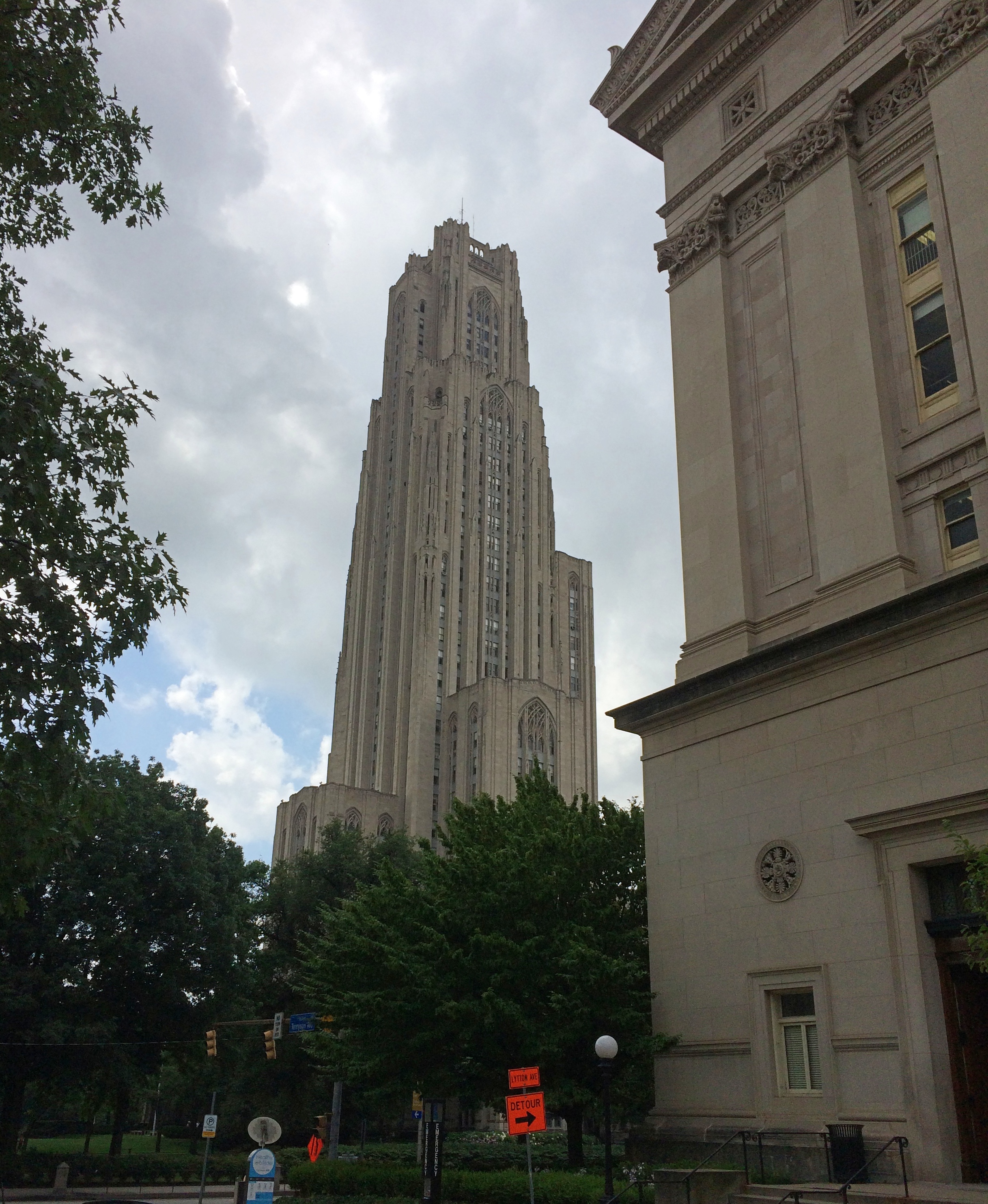
Our second major destination on the first day was the University of Pittsburgh, which is in the city’s Oakland neighborhood. Besides the Heinz Memorial Chapel, we also wanted to go there to see the Cathedral of Learning, which is a 42-story building. Despite the uncertainties of navigating through the Pittsburgh streets — the GPS voice was silenced by then — I knew I was in the right place when I saw a tall neo-Gothic building rising above everything else around it.

Not that Oakland is lacking for other large structures, just nothing else that tall. In fact the district impressed me as practically a city of its own, with its university buildings, healthcare facilities, sizable apartment buildings, a rich array of retail, some green space and a lot of people out and about. We probably could have spent an entire satisfying day in Oakland.
Even a few blocks away, the Cathedral of Learning makes an impression.

Charles Klauder, the same architect who designed the Heinz Memorial Chapel, did the considerably taller Cathedral as well. Both are Indiana limestone edifices.
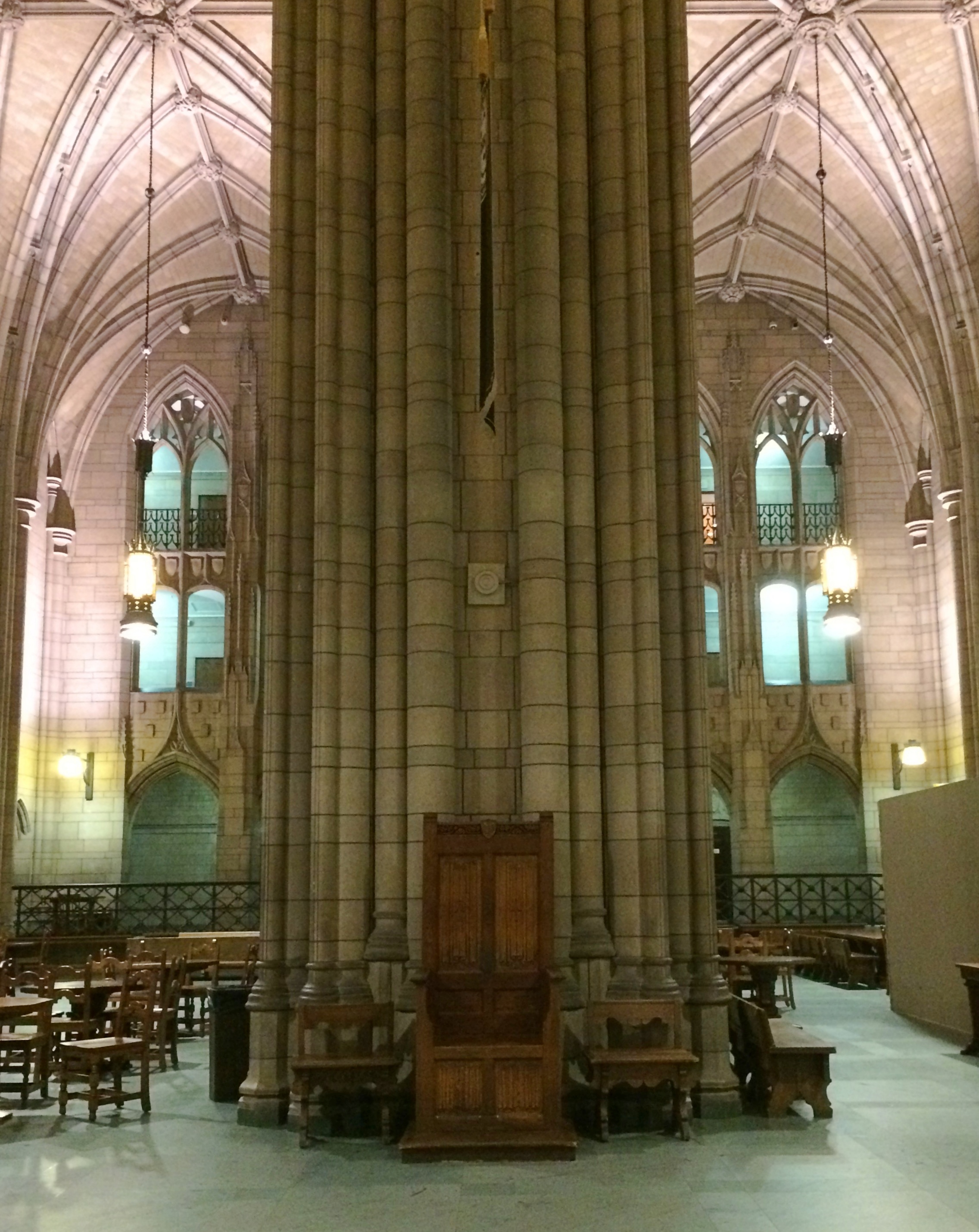
Inside are classrooms and administrative offices, but that hardly describes the place. The soaring, four-story lobby could, if anyone wanted to do it, be decked out as a neo-Gothic church.
Something like the Heinz Memorial Chapel. Since the two structures were built at about the same time and designed by the same architect, that’s not much of a surprise.
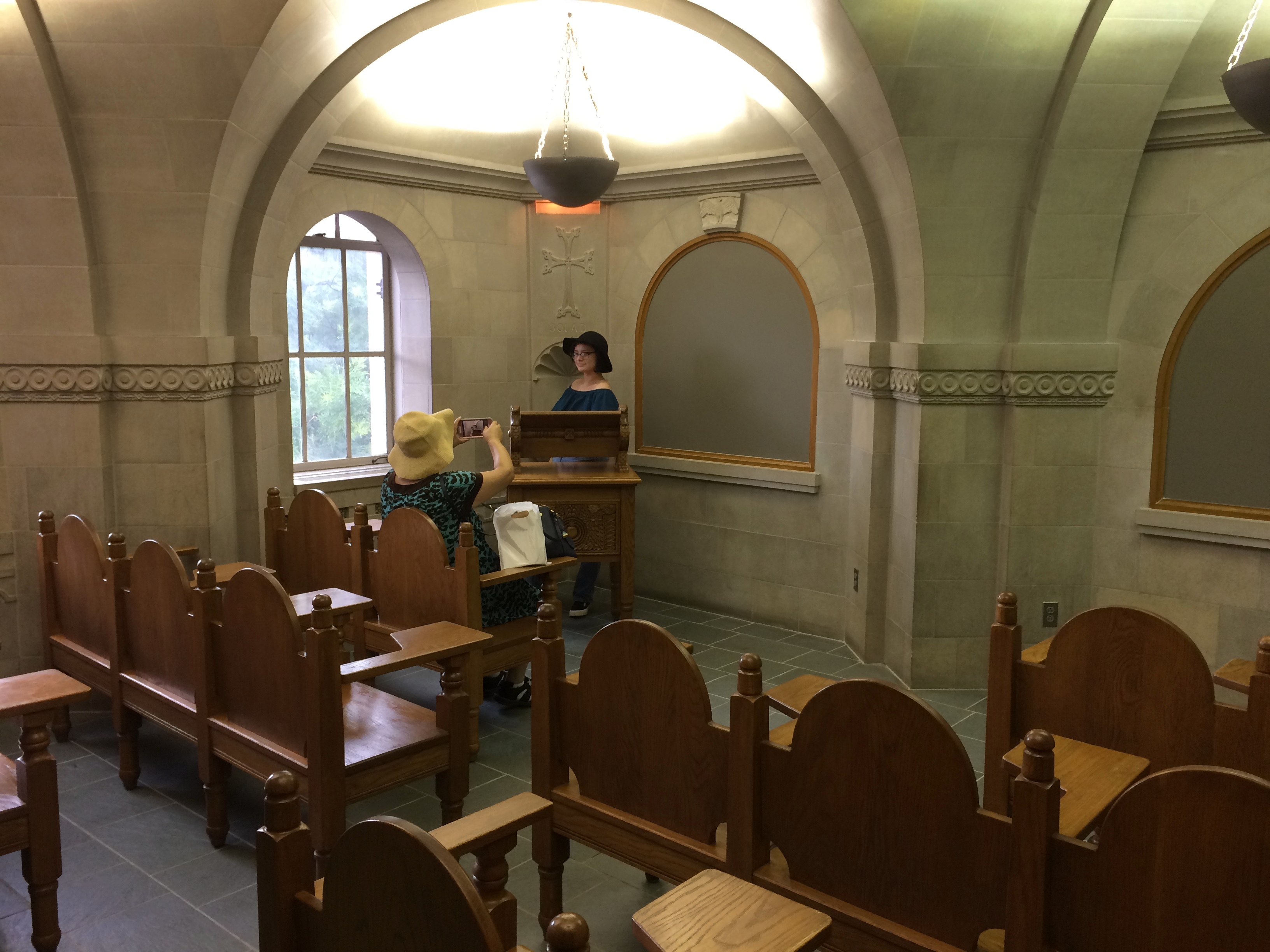
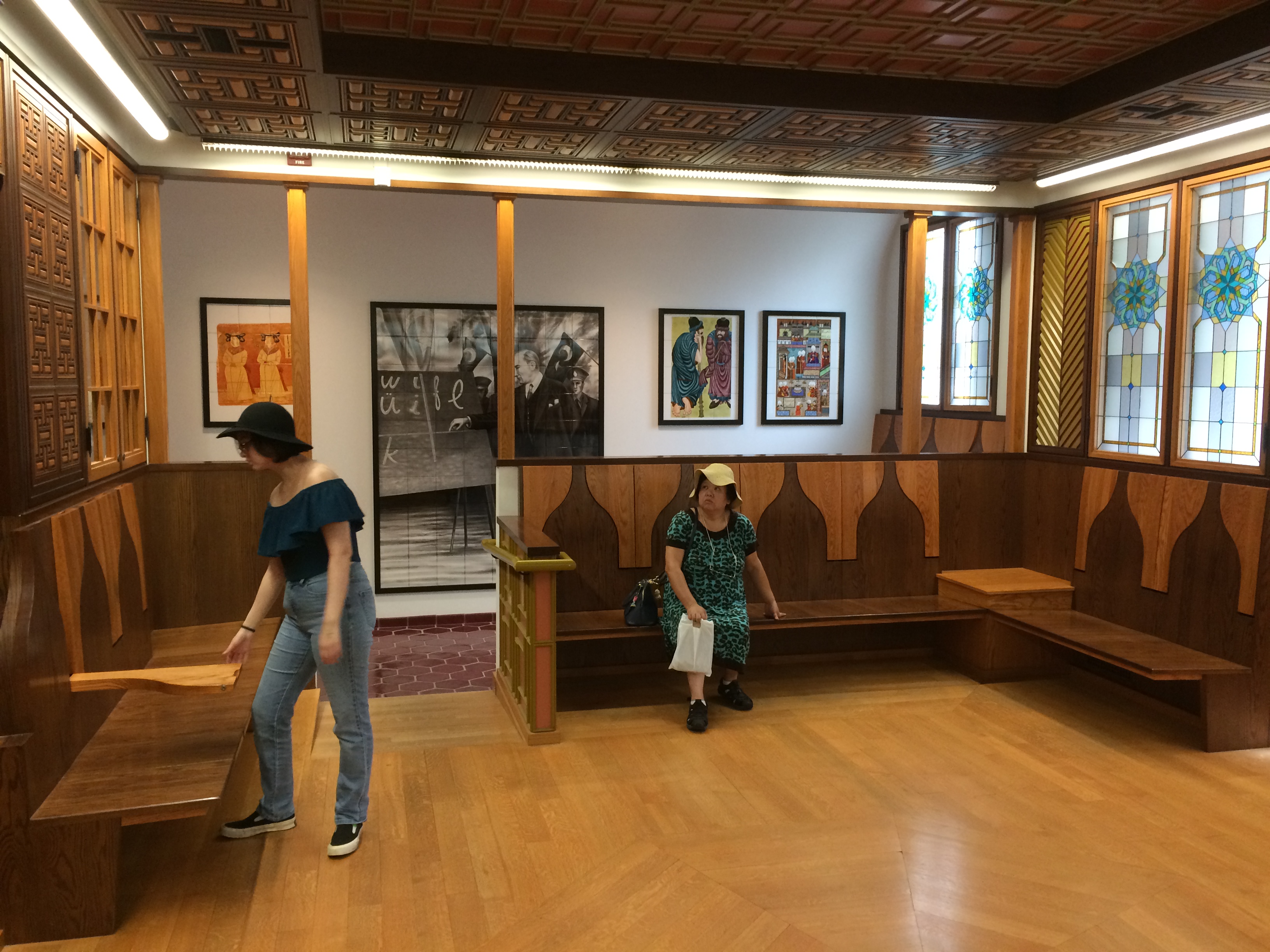
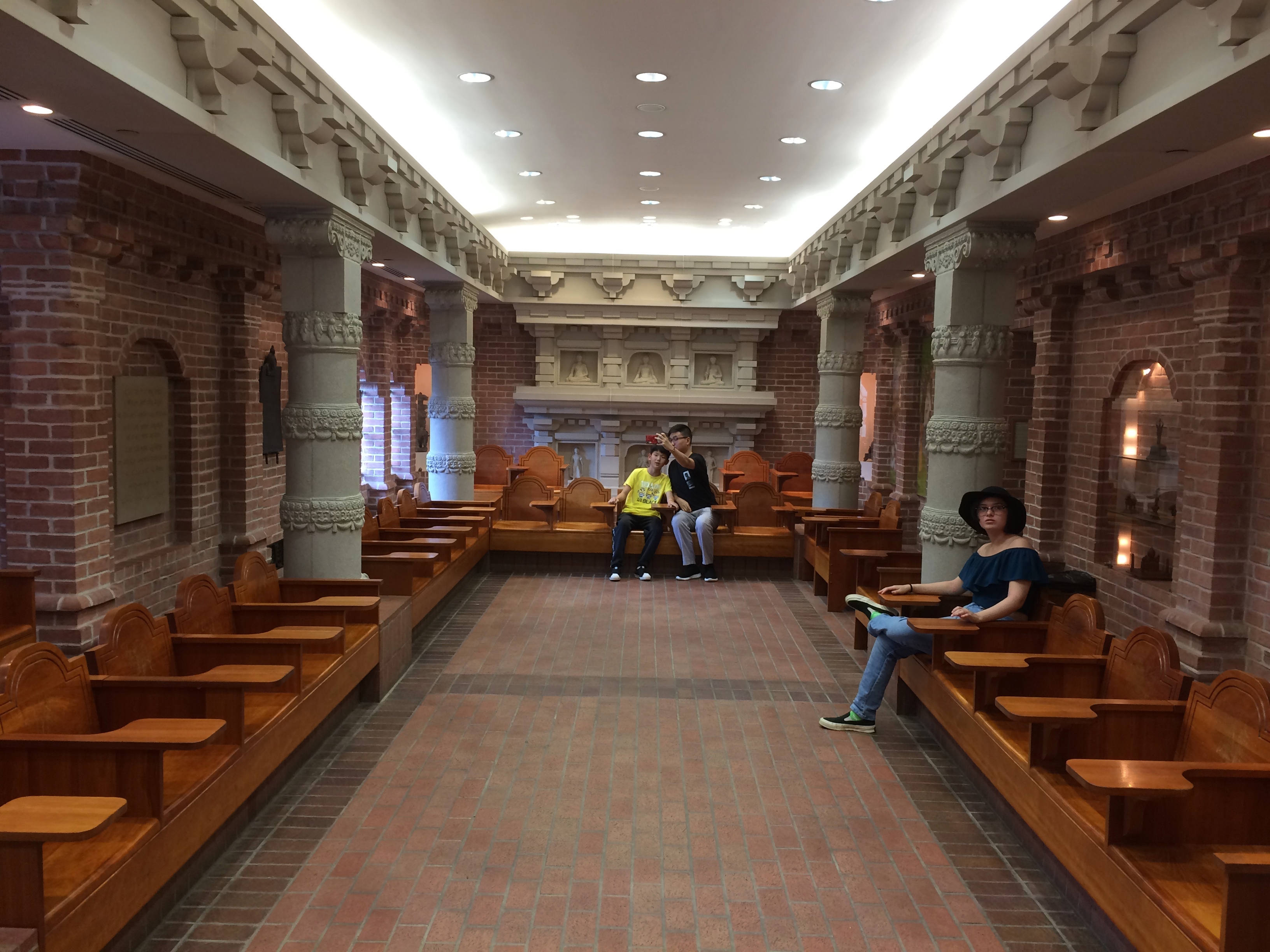
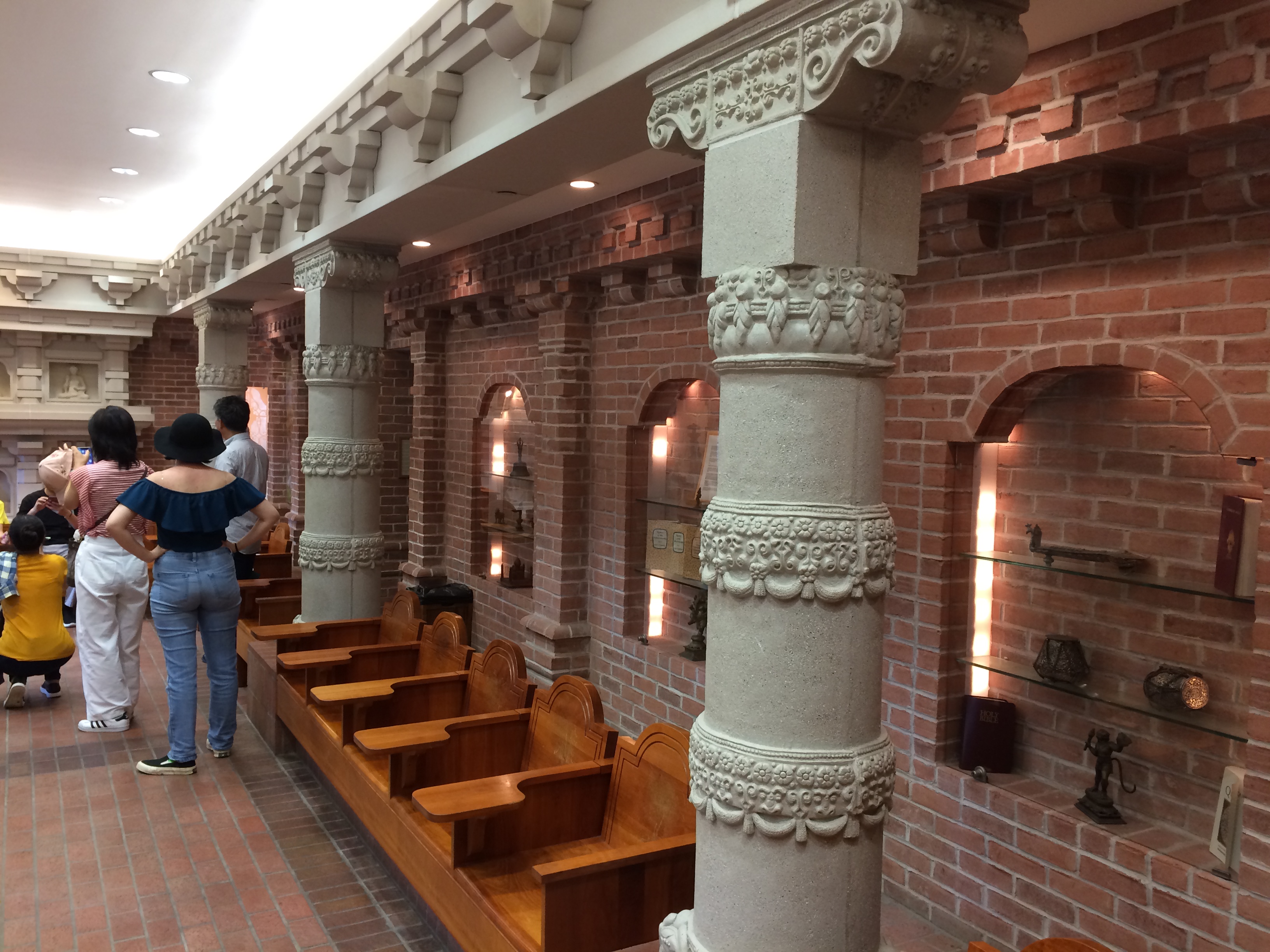
What really makes the Cathedral of Learning distinctive are its 31 Nationality Rooms, most of which are working classrooms, but each designed to reflect a nationality that had an influence on Pittsburgh’s history.

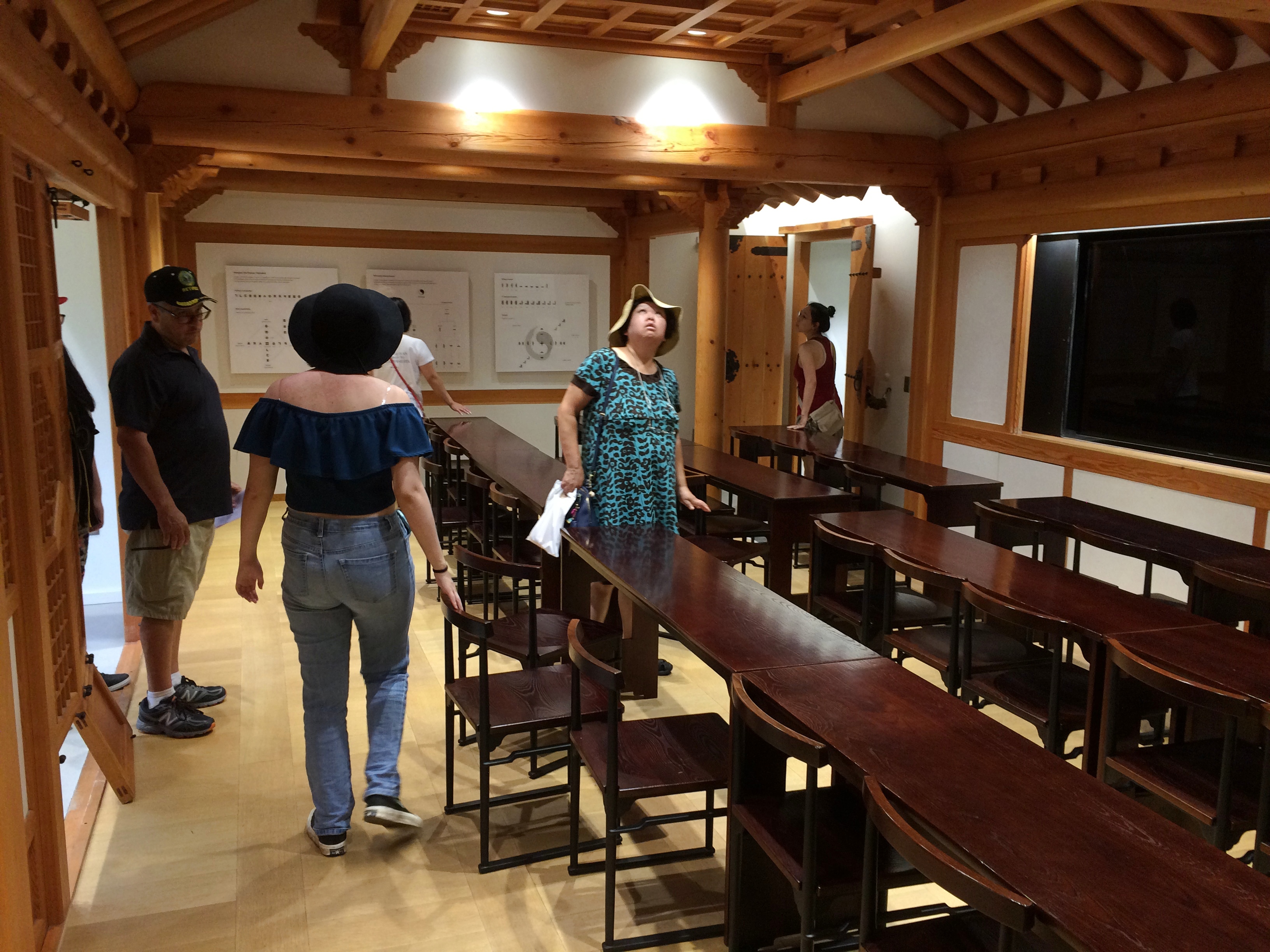
They’re on the first and third floors. We spent time on the third floor looking at such examples as the Korean Room, based on the 14th-century Myeong-nyundang (Hall of Enlightenment), the main building at the Sungkyunkwan in Seoul.
It was completed only in 2015 by Korean carpenters who built it in that country, took it apart and shipped it to the university, where it was reassembled.

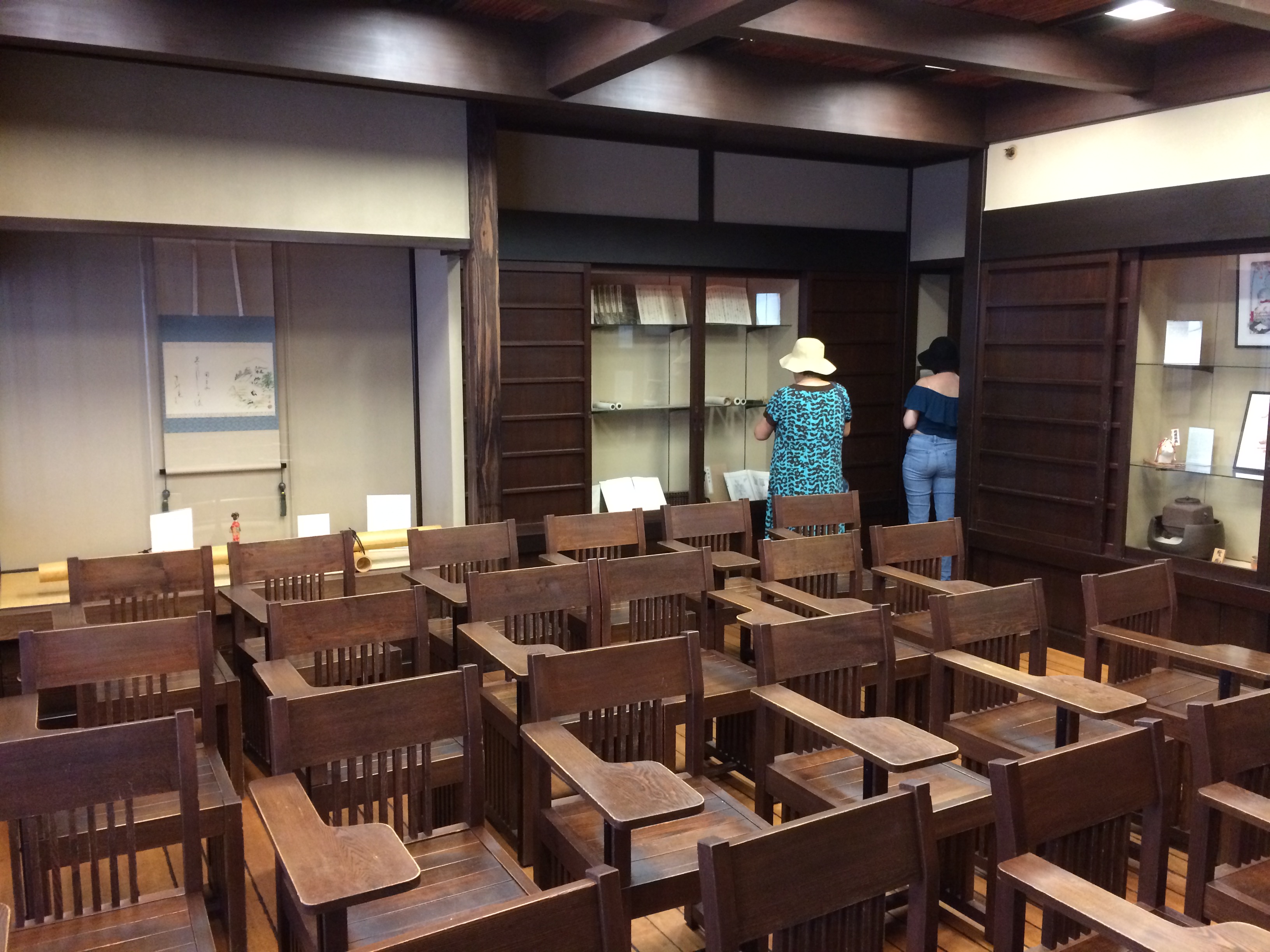
The Japanese Room.
Built in 1999 to evoke residence of an important village leader in a farm village in the mid-18th century in the Kinki district.

The Armenian Room, dating from 1988. Most impressive.
Inspired by the 10th- to 12th-century Sanahin Monastery in Aremenia, which I’d never heard of, so I looked it up.

Also impressive, and probably-not-by-accident on the other side of the building from the Armenian Room, is the Turkish Room, completed in 2012.
In the style of a main room of a 14th-century Turkish house, but also sporting a picture of Ataturk near the entrance (he’s teaching the Turkish nation the Latin alphabet).

My favorite, I think: the Indian Room, completed in 2000. This is the view from the lectern.
A closeup of the columns, decorated with rosettes, swags, and fruit.
The style is a 4th- to 9th-century courtyard from Nalanda University, a Buddhist monastic university. I had to look that up as well.

There might be a lectern, but I can imagine that professors might not spend much time behind it, but rather pace up and down the rose brick floor to more closely converse with the students, who are facing each other.