Just before the screening of 2001: A Space Odyssey at the Music Box Theatre in Chicago at noon on Saturday, one of the theater’s managers spent a few minutes telling us what to expect. Not in terms of content — it was a safe assumption that most (but not all) of the audience had seen the movie sometime in the last 50 years — but that there would be a few minutes of introductory music to a dark screen, and an intermission.
She also mentioned that the Music Box was one of a relatively small number of movie theaters nationwide equipped to screen the new 70 mm print of 2001. Interesting that a neighborhood jewel box of a theater from the 1920s has the latest movie screening tech.
I’d read about the new print. It was made recently from the original negatives, the goal of which wasn’t to clean up the images or digitally goose the movie, but to re-create as closely as possible what an audience would have seen in 1968. When I read about that, I knew I wanted to see it, even though I’ve seen the movie n times over the years.
For one thing, it had been a long time since I’d seen 2001 in a movie theater. I know I did at some point in the early ’70s, when I was old enough to be dropped off at a movie theater, the Broadway Theater in Alamo Heights, but not old enough to drive there myself. I saw it again at some mall theater during high school, after which I read Arthur C. Clarke’s book. In college, I saw it a few more times, at the Vanderbilt student cinema, and I think at an early multiplex in San Antonio during an early ’80s summertime revival.
Since then, I’ve seen it on VHS, DVD and on demand, but not in a theater. I was miffed that TCM didn’t pick it for its big screen series this year for the 50th anniversary, while choosing to show entertaining but lesser moves like Big and Grease. But maybe that’s because the 70 mm version was in the offing elsewhere (including Cannes, where it was first shown not long ago).
More than wanting to see 2001 in a theater, I was intrigued by the idea that it would look like it did 50 years ago. I wasn’t old enough to see it then. I’ll never have the experience of seeing it when it was just a strange new movie — no one ever will again — before it worked its way into the common culture, inspiring volumes of interpretation and giving us an unshakable image of a killer sentient computer with an unctuous voice. Still, this would be as close as I’d get to an original showing.
Ann went with me. Yuriko did not want to go and Lilly had a conflict. The Music Box wasn’t full for the showing, but there was a fair crowd, and not everyone was my age or older. The 70 mm “unrestored” print didn’t disappoint. It also showed, if there was ever any doubt, that 2001‘s special effects were special indeed, from the closest foreground to the furthest background.
Odd how those model spaceships, on actual celluloid, look more real than any GCI spaceships I’ve seen in a digital medium. That observation might be conditioning left over from my youth, or valid for most people, or meaningless all together. I don’t care. That’s what I see.
I noticed a few imperfections in the print: a scratch or two, minor pops of light, that kind of thing. That took me back. Do I remember right that probably as late as the 1980s, movies displayed those kinds of visual ticks?
Speaking of visuals, one new thing that occurred to me during this viewing, and there’s always something new each time, was the visual debt that some of the backgrounds owed to Chesley Bonestell and Luděk Pešek. For instance, a long shot showing the vertical landing of the ship that took Dr. Floyd to the Moon, with unrelated astronauts in spacesuits in the foreground, instantly brought Bonestell to mind — this time. You’d think I’d have noticed that before.
The soundtrack was loud. Except when it wasn’t. At first I thought that was a function of the more advanced sound systems of our time compared with 1968, and so not quite like an original audience would have experienced it. Now I’m not so sure.
“The team also went back to the original six-track soundtrack and faithfully transferred it to the new prints,” the Variety article notes. “ ‘The film is mixed in a very extreme way,’ [director Christopher] Nolan says with awe. ‘There are incredible sonic peaks that are beyond anything anyone would do today.’ ”
Sonic peaks from the get-go, I’d say, as the heavens align to the “Also sprach Zarathustra” fanfare. But for me the most startling sonic peak comes when HAL decides to murder the hibernating astronauts. The cut is from the quiet of the spaceship while Bowman is out retrieving Poole’s body to a sudden, full-screen, flashing COMPUTER MALFUNCTION accompanied by a loud beeping. Louder, I believe, than in other versions of the film. I heard at least one audience member gasp when the scene started.
As well she should have. In my earliest viewings of the movie, that scene disturbed me the most. Sure, you can say HAL went just a little funny in the head because of contradictory programming. Or maybe he was just an evil bastard willing to murder people in their sleep. You know, like some people are. I’m hardly alone in noting that HAL was pretty much the most human member of the crew, for better and definitely worse.
Then again, the sound wasn’t always loud, or even quite intelligible. The more-or-less idle chitchat on the space station at the very beginning of the spoken dialog was a little hard to hear. Everything is intentional in a Kubrick movie, so I suppose that fits with the movie’s well-known lack of exposition.
That was one of the few things I told Ann before the movie. I didn’t want to over-prepare her, but I did say that obtrusive exposition wasn’t one of the movie’s characteristics. Had there been voice-over narration — the original script apparently called for that — I believe that would count as obtrusive, and the movie wouldn’t be regarded as highly. I never did quite like the brief narration at the beginning of Dr. Strangelove, though I can see why it’s there.
Here’s something I never noticed in the soundtrack. Again, during the idle chitchat at the beginning, there’s a background PA voice announcing the following. Twice.
A blue lady’s cashmere sweater has been found in the restaurant. It can be claimed at the manager’s desk.
How did I never hear that before? It popped out at me this time. Maybe that’s a function of the new print. Or maybe it’s just one of those things tucked inside a densely layered work of art that isn’t noticeable early on.
Later, the PA says: Will Mr. Travers please contact the met office.
Whatever that is. Interesting detail, those PA announcements. As if to show that by the end of the 20th century, space travel will have some of the ordinariness of air travel in 1968. Many of the space station details — the customs screening, the restaurant, the phone call — point to that.
Guess that counts as 1968 optimism about the future of space travel. It’s easy to deride that in hindsight, but it wouldn’t have been completely unreasonable at the time. We were well on the way to the Moon, for one thing.
After that would come large space stations, Moon bases, voyages to Mars and rocket engines and spaceships large enough to mount an expedition to Jupiter in 18 months. The idea that extensive space travel would be part of the near future had jumped out of speculative fiction into the realm of serious expectation. Turned out no one wanted to pay for those things, but that was still in the future.
The movie is not, on the other hand, optimistic about future of politics, as you’d expect from Kubrick. That’s another thing that occurred to me for the first time. It’s only hinted at, but the hints are pretty clear. Mainly, the movie assumes that political bureaucracies will be the same prevaricating, susicious entities they’ve long been.
Dr. Floyd is either an important official of the U.S. government, or in a quasi-governmental body, but in any case the lid is slammed down on the discovery of the monolith on the Moon. He offers the official, and secret, reason.
Floyd: I accept the need for absolute secrecy in this and I hope you will too. Now, I’m sure you’re all aware of the extremely grave potential for cultural shock and social disorientation contained in this present situation if the facts were prematurely and suddenly made public without adequate preparation and conditioning. Anyway, this is the view of the council.
Eighteen months later, the monolith is still a secret, even from the astronauts going to investigate where the radio beam pointed. Talk about paranoid secrecy. It’s almost Soviet in its reach.
Floyd expresses the idea, which isn’t unusual in science fiction, that the discovery of extraterrestrials would somehow cause “cultural shock and social disorientation.” Not just science fiction. I seem to remember discussion along those lines — a “fundamental change” in our thinking or some such, if not shock or disorientation — as far back as when the Vikings were digging unsuccessfully for microbes on Mars.
I’m skeptical that any such thing would happen. Say we discovered an alien artifact tomorrow. Something indisputable, except that there would be a group of fools that disputes it anyway. But let’s say most people accepted it for good reasons.
Then what? Assuming the artifact isn’t attacking us or producing pathogens, nothing too dramatic. The reaction would be, how about that. Someone is out there. How interesting. Maybe over the course of decades or centuries, the discovery would change the way we think, but for most people in the here and now, it would be a curiosity. Our lives would go on. Besides, we’ve already been conditioning ourselves, in books and movies and TV and more, to the possibility of aliens for years.
Overall, I’d say 2001 is optimistic, assuming a certain common interpretation of the movie. After much travail — it is an odyssey, after all — mankind does reach for the next level of development, just as the ape-men did.
One more thing I thought about for the first time this time around: Why no redundancy for HAL? The astronauts talk about shutting down HAL and resuming the mission using Earth-based computers, which would certainly be a clunky way to go about it at that distance. And mission control mentions “twin” 9000 series computers at its disposal. So why weren’t at least two HAL-class computers built into the Discovery? In case, you know, one fails in some way, such as trying to go all HAL on the crew.
A nit to pick. After it was over, Ann seemed impressed, and had some questions and observations. She did sleep through some of the movie, though. Especially those long scenes outside the spacecraft.
She may or may not grow to like 2001 as much as I do. It’s an acquired taste, and not for everyone. But I’m glad she went.
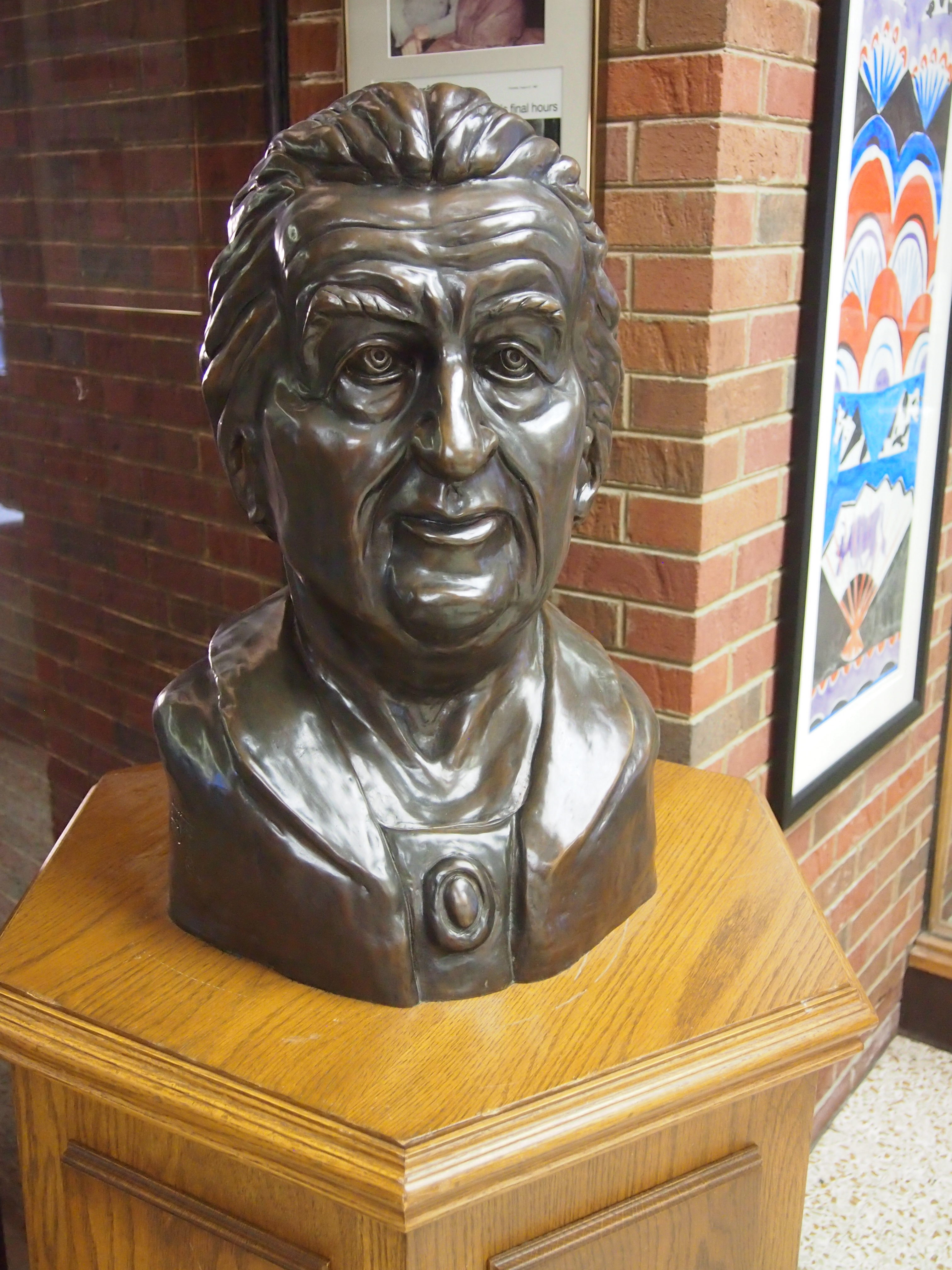 Behind the bust is a mounted Milwaukee Sentinel article, dated August 27, 1987, about the sculptor, Maurice Ferstadt, whom I’ll give credit for not trying to idealize the prime minister’s face. On the morning of February 19 of that year, Ferstadt — who was 75 –finished the sculpture. That evening, he died of an aneurysm.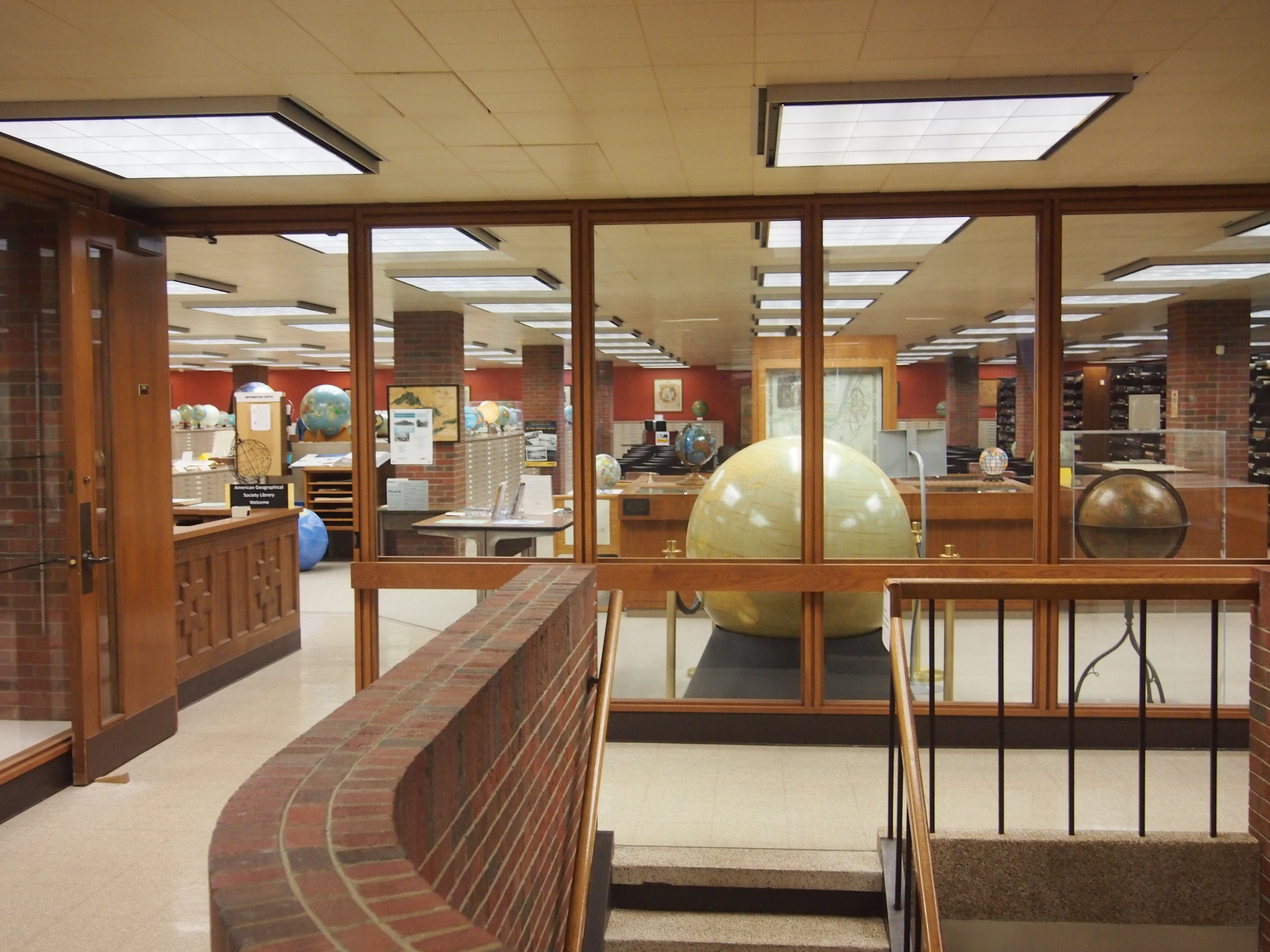
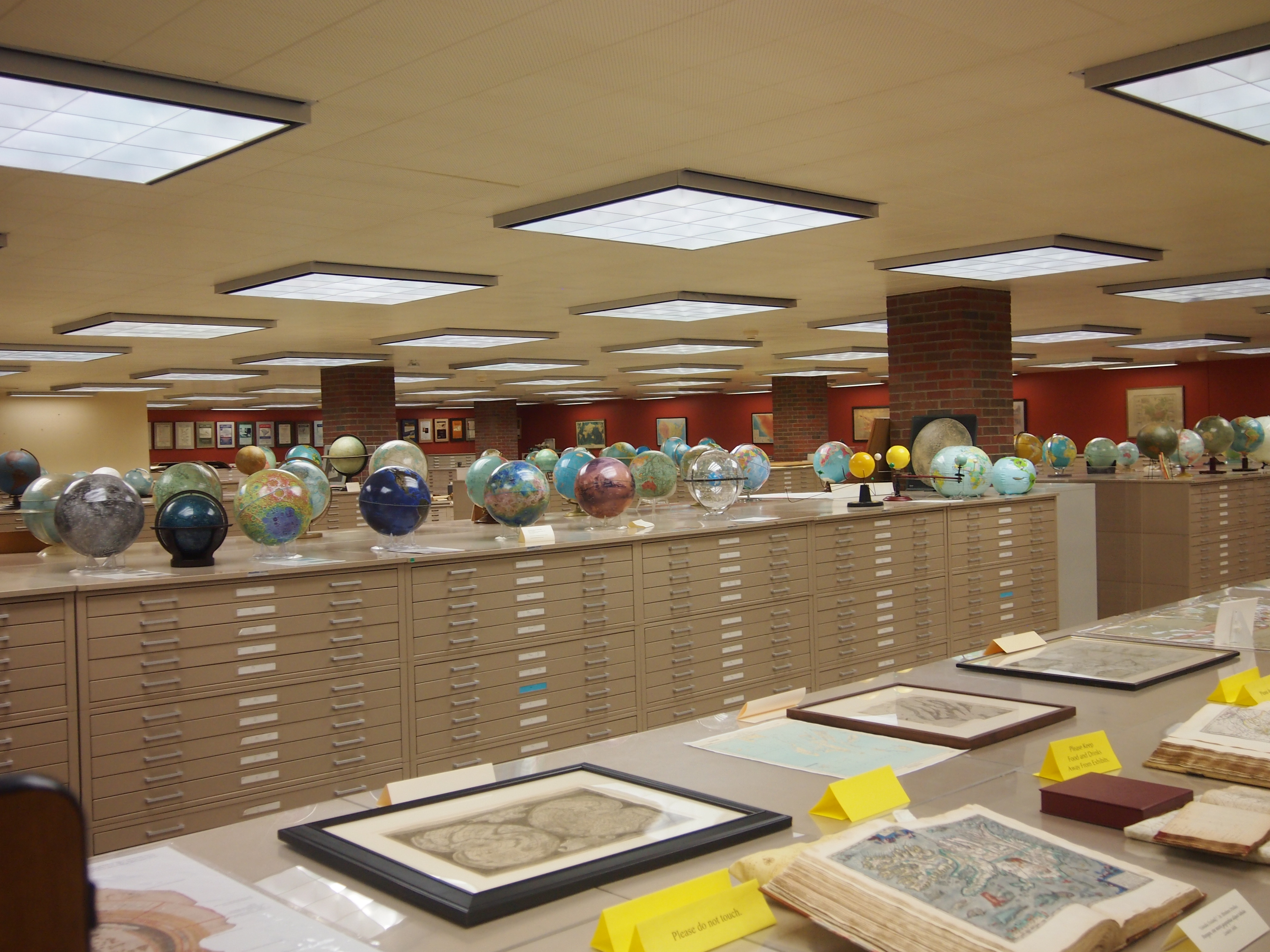
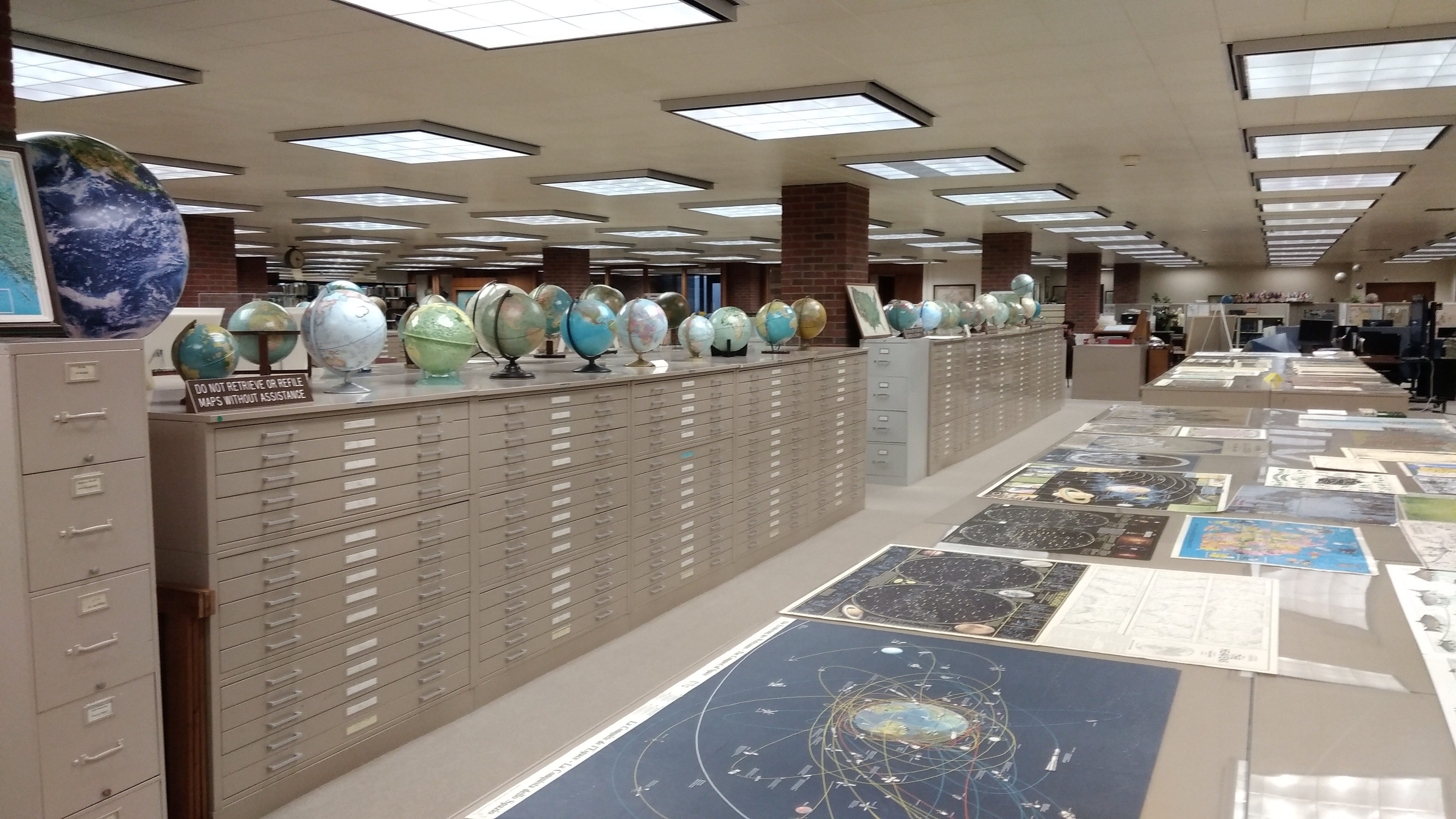
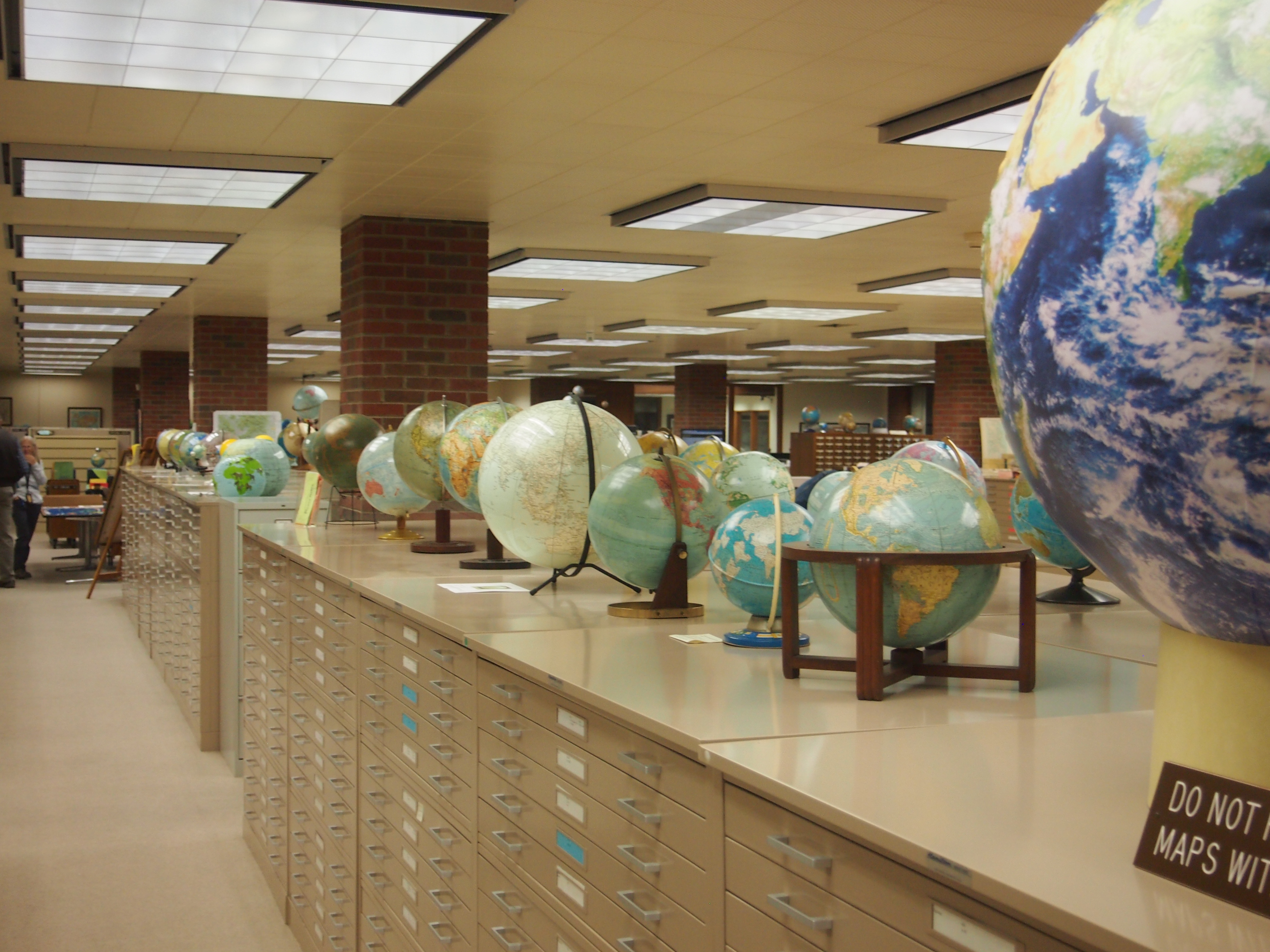 You know, that kid on Christmas morning feeling. The giddiness passed, of course, but I remained vastly impressed by the collection all the same.
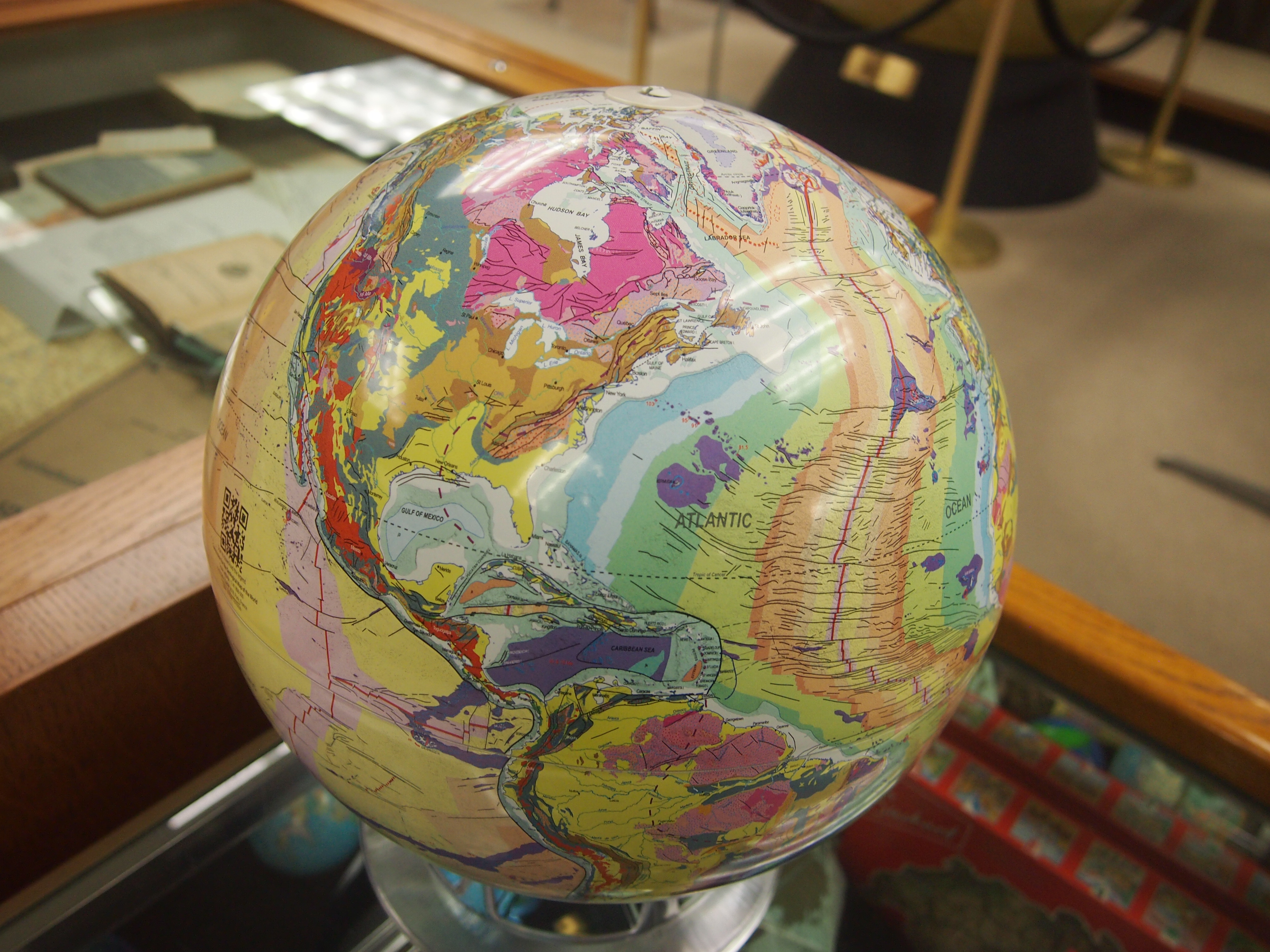 Here’s a relief globe, made in Italy ca. 1950.
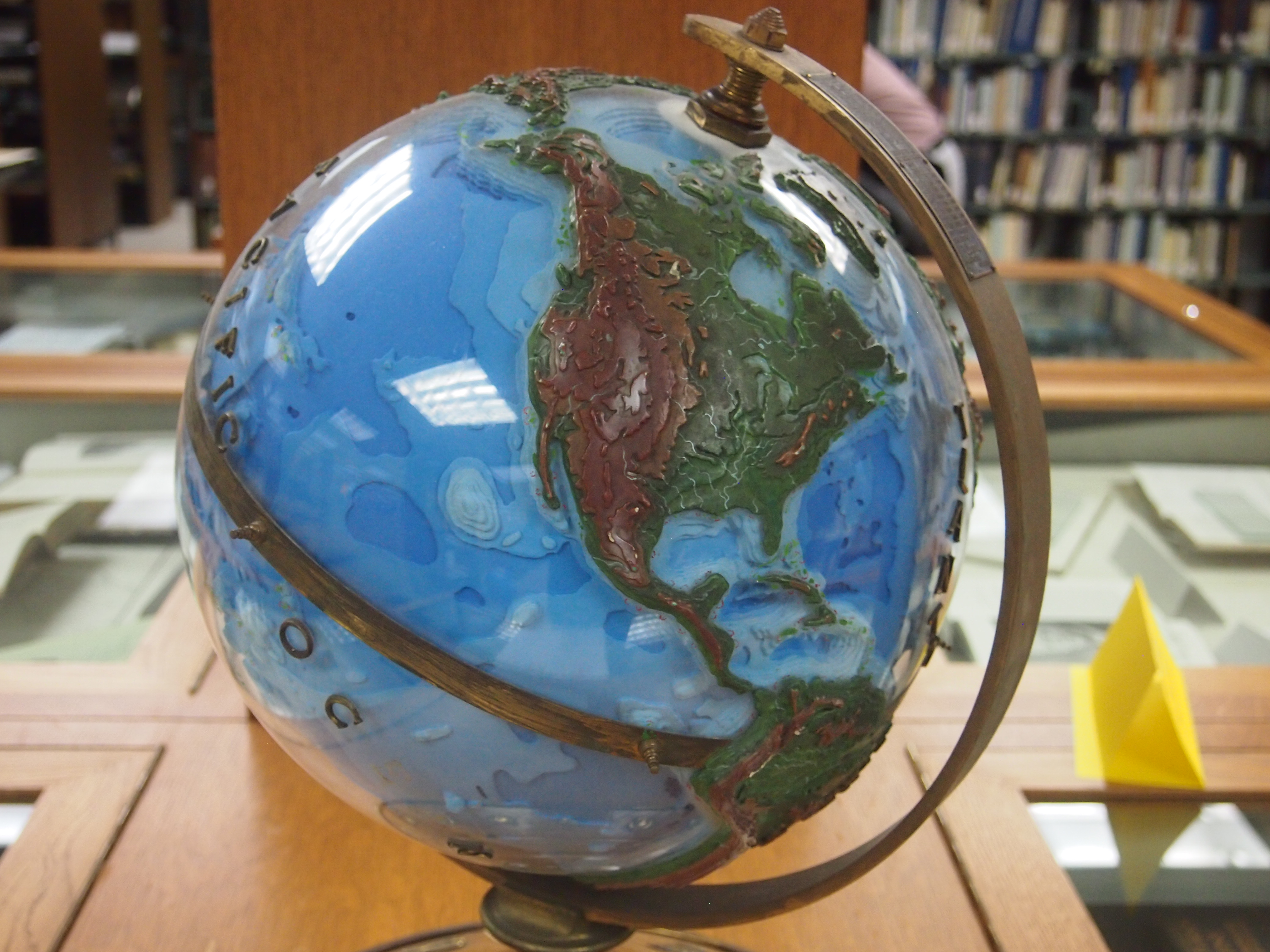 I could have looked at and taken pictures of globes all day. Here’s one more. The granddaddy of all the globes in the collection.
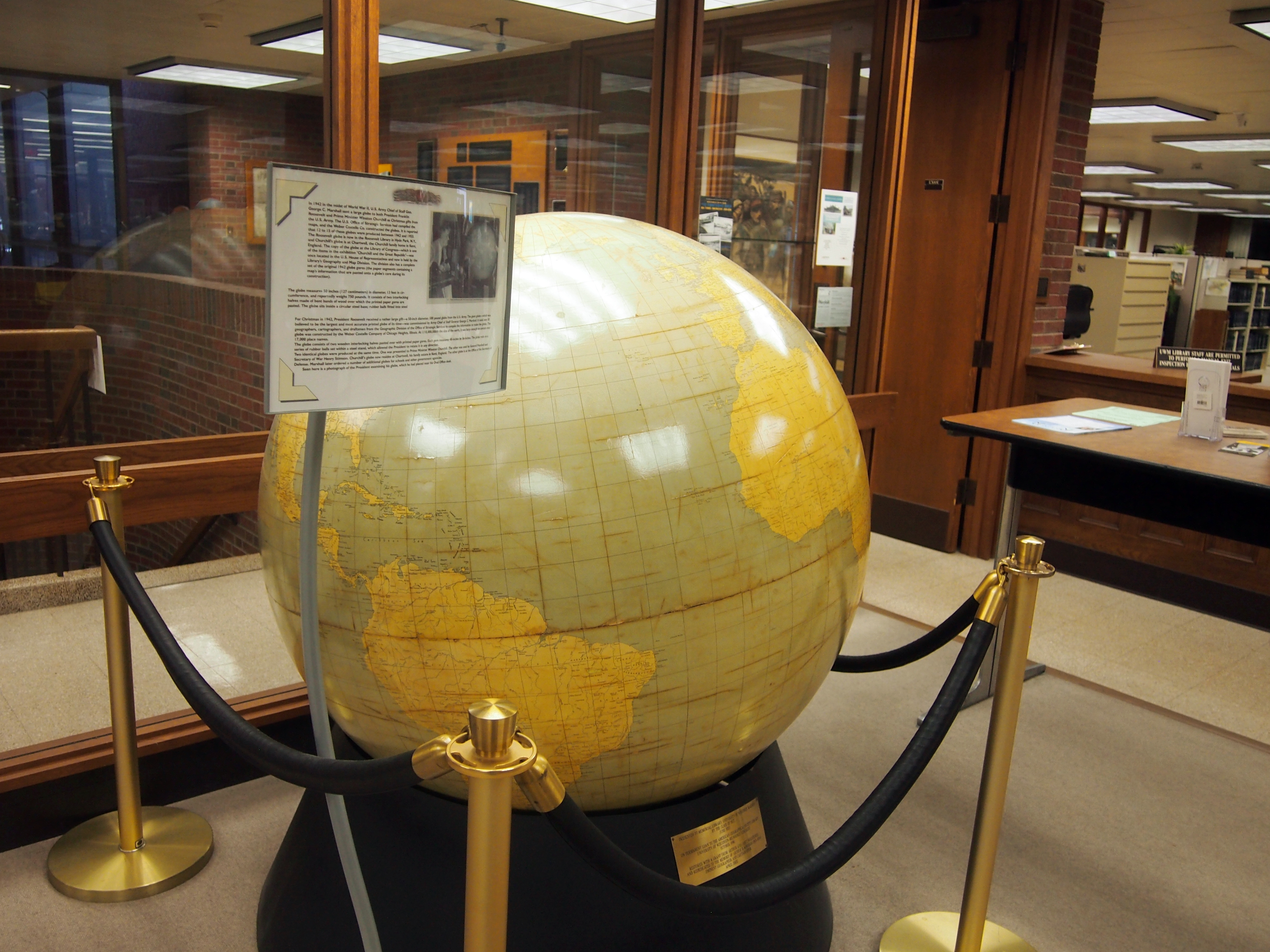 The Library of Congress says, “In 1942 in the midst of World War II, U.S. Army Chief of Staff Gen. George C. Marshall sent a large globe to both President Franklin Roosevelt and Prime Minister Winston Churchill as Christmas gifts from the U.S. Army. The U.S. Office of Strategic Services had compiled the maps, and the Weber Costello Co. constructed the globes. It is reported that 12 to 15 of these globes were produced between 1942 and 1955.
 As I mentioned, there were maps on display from among the library’s vast collection, laying flat on tables for a convenient look.
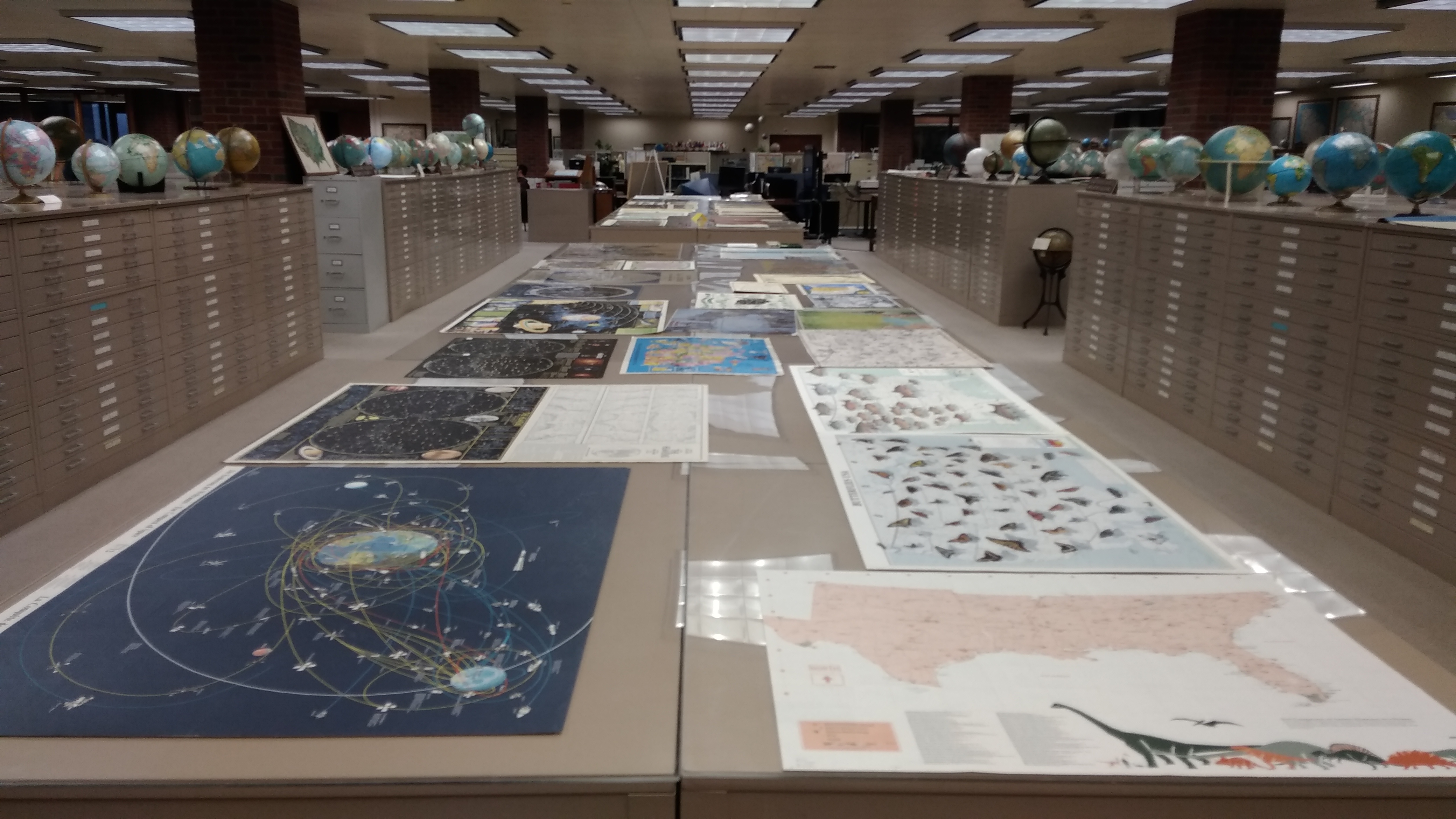 There were all kinds of maps, such as one of the rayon acetate (silk-like) escape maps that helped Allied POWs escape during WWII, highway maps, non-English maps, space maps, hobbyist maps, historical trend maps, and comedy maps, such as the MAD Pictorial Map of the United States from 1981, with artwork by the inimitable Sergio Aragonés (who’s still alive).
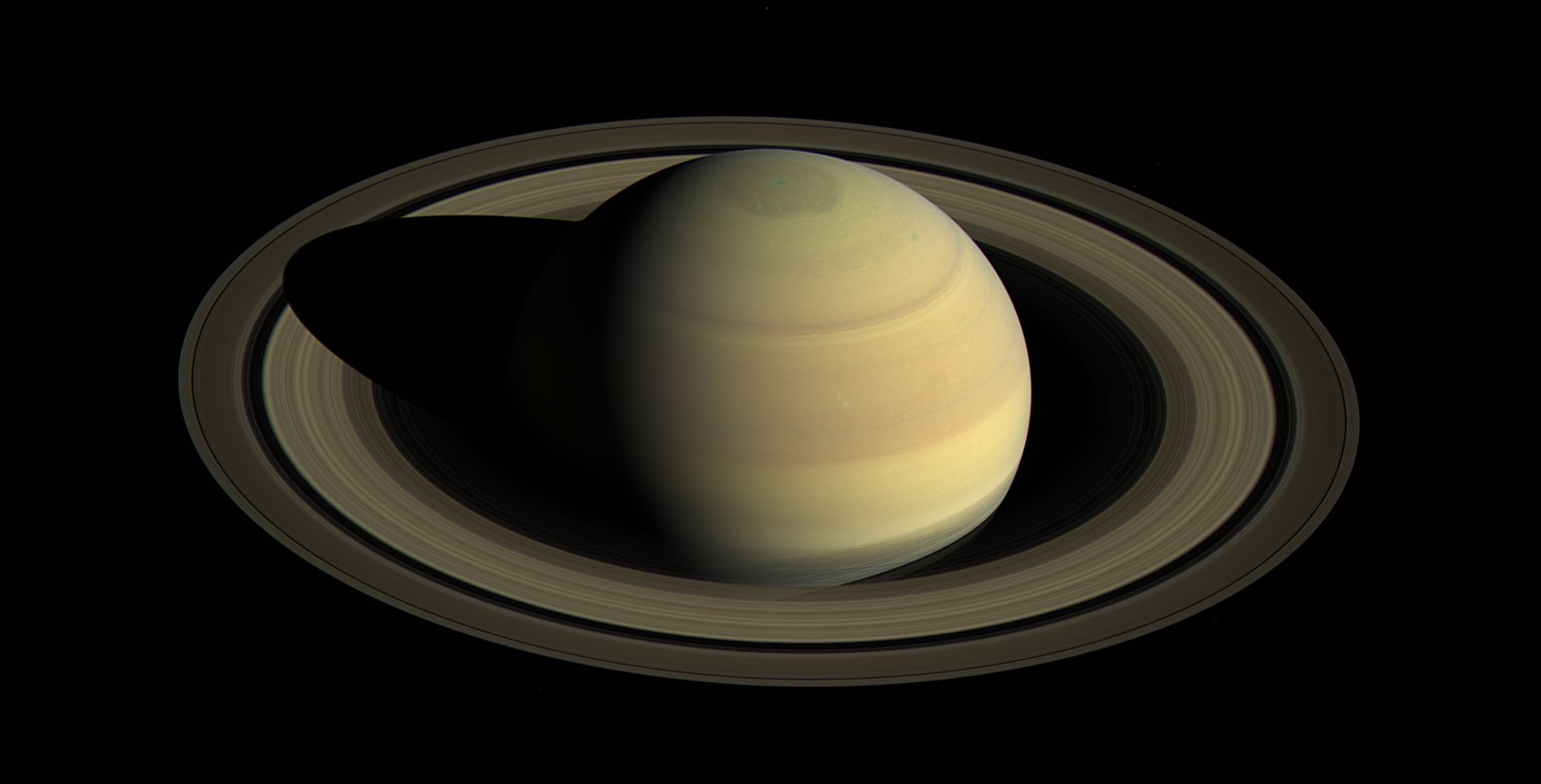
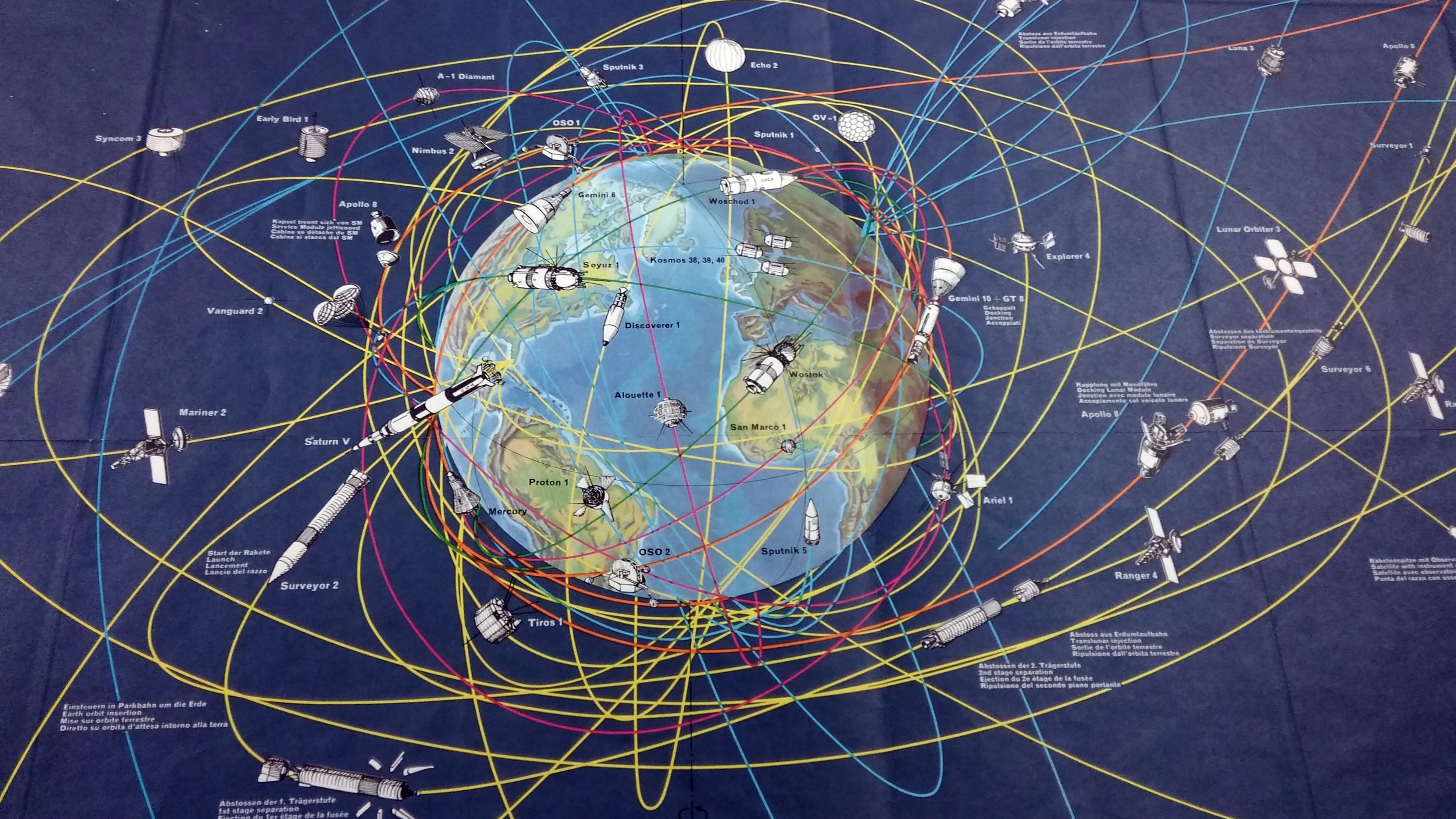 Not shown in my detail are the Moon, or Venus and Mars, though spacecraft had voyaged there by ’68. There had been no exploration of the outer planets or Mercury yet, so those weren’t depicted at all. What a remarkable lot of information the artist, whose name I don’t have, was able to pack into the image.