Today was warm, cloudy and windy, until the clouds let go a lot of water, and then another -y adjective came into play, rainy. Tomorrow will be rainy, windy and chilly, and it won’t get warm again till after Easter, I hear.
Got an email pitch the other day, one of very many. There was a fair amount of verbiage to it, but the heart of the matter was this line: Are you interested in speaking to XY, a holistic health expert, about the sharp rise in the use of anti-anxiety drugs and why taking hemp extract is better for your health?
The short answer is, no. A longer answer would also be no. And I feel not a jot of anxiety about my decision.
And another pitch, at about the same time:
We think this is an excellent story for Earth Day that your audiences will love. The nationally acclaimed eco-feminist artist XX is celebrated as the real-life Marvelous Mrs. Maisel of the art world.
Is she now? Got into art one drunken night when she was on the outs with her husband? I know that show has won some Emmys, and I’m enjoying episodes of the recently dropped fourth season (once a week), but it’s still interesting that the publicist believed it would be a widely enough known reference to make such a statement, silly as it is.
Sluggish progress toward spring here. But some progress. Plants in a nearby park.
The croci in my own yard have been very slow this year — no blooms even now. I don’t keep an exact track every year, but that seems a couple of weeks late. Some years, I remember seeing their very first green sprouts at the end of February. And of course, croci don’t mind a little snow.
On a bench in the same park. What is that thing?
A Soofa sign. The company web site says it makes electronics for advertising or as part of “smart city” communications. This doesn’t look like that, and it also looks inactive. Since I’d never noticed it before, it could be that it isn’t operational yet.
Or is it? According to a park district web site I couldn’t access fully — but could see a bit of, from my Google search — you can charge devices there. Solar-powered, and the top does resemble a solar panel. Wonder how much juice it has these many cloudy days.
The latest snack food to enter the house: Calbee brand Takoyaki Ball-flavored corn snacks. Though Calbee is Japanese, not a product of Japan, but rather Thailand, where ingredients and labor are no doubt cheaper.
No octopus, which is the main ingredient of actual takoyaki, is listed among the ingredients. Still, it’s flavored to taste like takoyaki, which it does, though the simulation isn’t quite spot-on. A little too sweet, Yuriko said, and I agree. Sweetened for North American tastes? Just how many North Americans are going to buy takoyaki-flavored snacks? But not bad.
Calbee, incidentally, began as a candy company in postwar Japan (1949) and acquired its name in the mid-50s, a portmanteau of “Calcium” and “Vitamin B1.” Soon the company found its way into crispy snack foods, especially wheat crackers. I suppose that was something of a novelty in Japan at the time, compared with rice crackers, which go way back. Calbee’s early confections caught on, and so the food technologists there have been working hard to make new varieties of snacks since then.
I see that the fifth season of Better Call Saul has appeared on Netflix. That’s good. I’ll watch it. Once a week or so, that is. That’s how new TV should be, according to Leviticus, I think, though it doesn’t apply to shows that might have been watched every day after school.
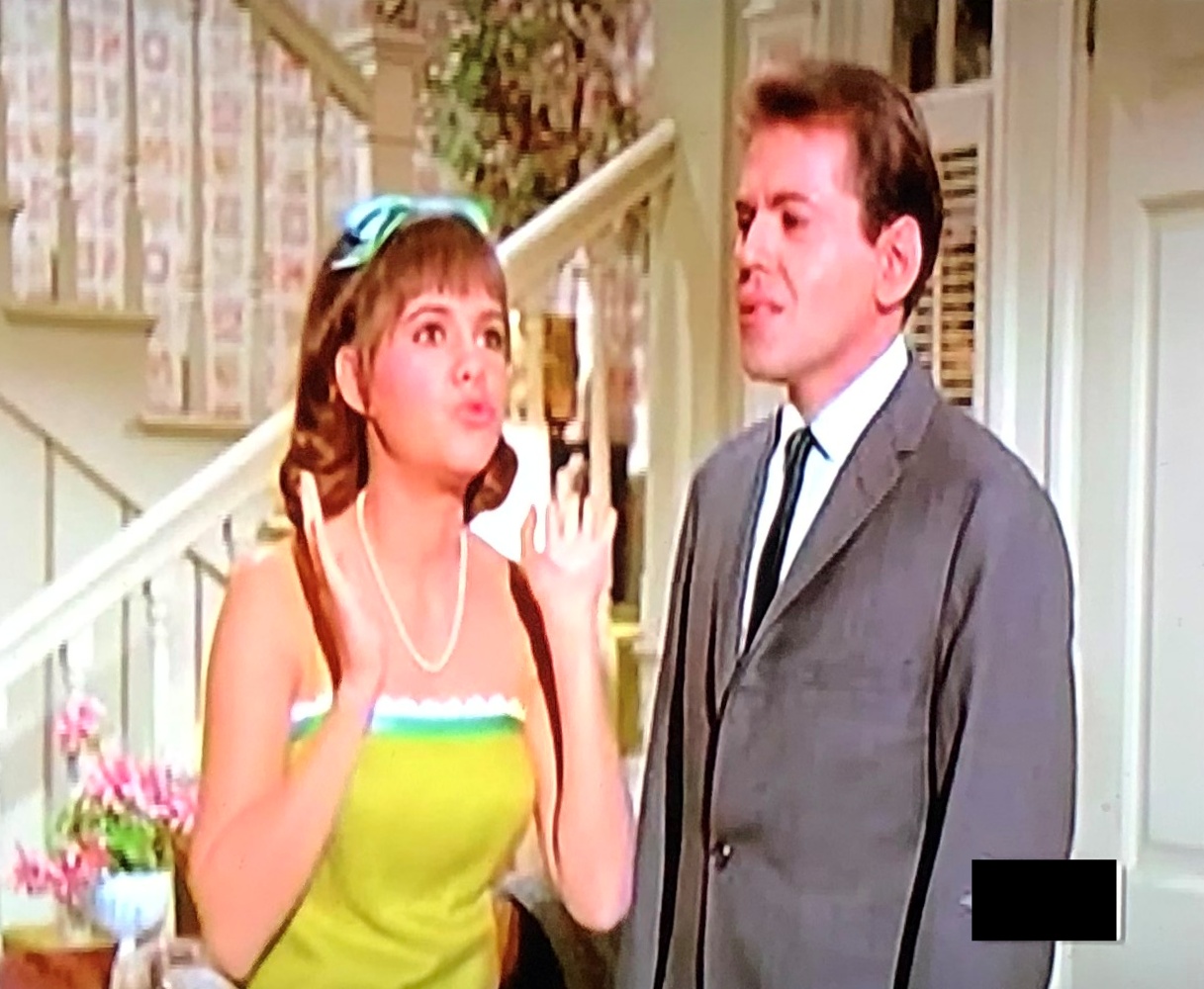
The other day I watched an episode of mid-60s sitcom I had heard of, but never had seen before. It was playing on a nostalgia channel I have access to. A show that only lasted a season, which makes it unusual as a rerun (and why no Camp Runamuck, which was on precisely the same season?).
I decided to watch the whole thing because in the first minute or so, Chekov showed up. That’s what came to mind instantly when I saw him. It took me a few minutes to remember the actor’s name. About two years before he started on Star Trek; just a young-ish character actor at the time (29).
In that episode, he played a Swedish character. His dialect wasn’t so different than the faux Russian he would later do, though you could tell he was trying to add a bit of Swedish to the sound. I’m not an expert on Swedish, but I suspect that the sound wasn’t particularly authentic. But why would it have to be?
As for the show itself, it wasn’t that bad. Or that good. Mildly amusing, occasionally, and decidedly dated. Being only a little older than the show itself, I completely understand how that happens.
Text from a recent fortune cookie: What does the future hodl?
I can overlook the typo. We’ve all done those. But is it right for fortune cookies to ask questions, rather than offer fortune-cookie wisdom?
Besides, the answer to that particular question is simple enough: death. Sooner or later, probably one at a time for all of us humans, but possibly all going together when we go, every Hottentot and every Eskimo, though I suppose that should be revised to Khoikhoi and Inuit and Yupik.
I heard about Dwayne Hickman this morning, and my reaction was, he was still alive? The Many Loves of Dobie Gillis had its charms, and the episodes that I’ve seen tended to be funny. As for Bob Saget, my reaction was, sorry to hear about a 65-year-old passing suddenly, but the episodes I’ve seen of Full House were not funny. What happened to sitcoms in the ’80s anyway?
The other day, I hauled out my envelope of cheap banknotes for a look, as I sometimes do. We might be on the way to excising banknotes from our lives in this country — a great mistake, if so — but I take some comfort in thinking that they will linger quite a while longer in parts of the world not so hep on digital infrastructure.
A nice-looking note, if a little orange.
Cambodia, 2002. 50 riel. Still valid currency, with this note worth about 1.25 U.S. cents these days.
Here’s info from wiki to make the hairs stand up on the back of your neck: “There have been two distinct riel, the first issued between 1953 and May 1975. Between 1975 and 1980, the country had no monetary system.”
On the note’s obverse is Banteay Srei, a 10th-century Cambodian temple and relic of the Khmer Empire. The reverse has a dam on it, likely supposed to be a symbol of modern progress.
Looking into the history of the temple, I came across an oddity.
“It was 1923 when [Andre] Malraux, then 22, arrived in Cambodia with his wife Clara,” journalist Poppy McPherson writes in a publication called The Diplomat. “Newly broke Parisian intellectuals, they had a scheme to steal statues from the Angkor temples to sell in the West. It failed, and they were both arrested in December of that year. The legal wrangle that ensued, ending in a one-year suspended sentence for Malraux and nothing for his wife, meant he spent more than a year stuck in Phnom Penh and, later, Saigon.”
Back to posting around Halloween. Speaking of which, this two-story skeleton can be found about a mile from my house. I’m not planning to get one for my yard.
Also, I’m not planning to watch or care about The Squid Game. Or is it The Octopus Meet? Hard to keep track of all the fashionable shows.
As if on cue, we had a cooler afternoon and evening to start September. Not much cooler, but noticeable. Warmth will be back soon, but the air is slowly leaking out of that balloon as the days grow shorter. Back to posting around September 7.
There’s a nice bloom of goldenrod out by the back fence.
I realize that it isn’t causing our intermittent runny noses, which have been worse this year than last, but not as bad as the worst ever. That would be 1987, the first late summer/early fall I spent in northern Illinois, maybe without much experience with the pollen in question. Ragweed causes that unpleasantness, I understand.
“About Hay Fever,” says American Meadows. “In short, it’s an old wives’ tale. Goldenrod does not cause hay fever. It simply got that bum rap since it blooms at the same time as the real culprit — ragweed.”
Today I started reading When In Rome by Robert J. Hutchinson (1998), subtitled “A Journal of Life in Vatican City,” which is part travel book, part memoir, part popular history, and all very readable and amusing.
Something I found out today: Lyle Waggoner (d. 2020) founded a successful company that provides trailers to movie and TV studios, Star Waggons. After The Carol Burnett Show and Wonder Woman, that’s what he turned his attention to. One of his sons runs it even now, though it has been acquired by a REIT.
One more thing I found out today, early this morning: even at my age, dreams about missing class, or being unprepared for a test, do not disappear completely. Also, the sense of relief is still there when you wake up — ah, I haven’t had to go to a class in nearly 40 years, much less be prepared for one.
A pleasant string of warm days came to an end today with cool drizzle most of the time. But at least the snowy mess of February is just an unpleasant memory.
Back again around April 18. Call it a spring break. Who knows, I might have encountered a new thing or two by that time. Never know when you’ll see something interesting.
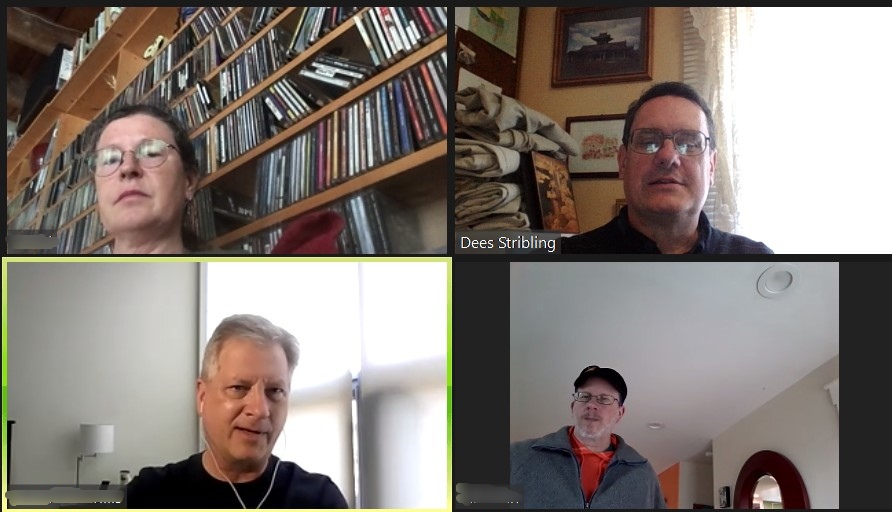
A recent Zoom. Two participants in Illinois, one in Tennessee, one in Washington state. All VU alumni.
If I were a Zoom stockholder, that is in San Jose-based Zoom Video Communications Inc., I might sell. I’m astonished by the number of people who hate Zoom, the platform, and will probably dump it as soon as they can. I know not to ask about half of my old friends on social Zooms anymore, because they will refuse. Politely, because they are old friends.
I don’t quite get it. Burning out on work Zooms is one thing. But the occasional social Zoom among old friends? On a couple of occasions, they’ve run three or four hours, to great delight of everyone. Sure, if we were obliged to meet electronically even with old friends three or so times a week, that would get old. But more occasionally among people with whom you share a past? Nothing better.
I made a point of watching the new short biographic series Hemingway this week as it was broadcast on PBS. I can’t remember the last time watched TV on a broadcast schedule. Mad Men?
It’s high-quality work on the part of Ken Burns and Lynn Novick, illustrating what a biography should illustrate, the life and times. I knew a fair amount of the material already, though did find out more — another mark of a good bio on a well-known subject — such as the relentlessness with which he suffered major, and mostly untreated concussions. The head injury from the second plane crash in Africa was the only serious one I knew about. Turns out it was one of a string.
That’ll do no good to a man who’s already an alcoholic from a family with a history of mental illness, and who probably had a touch of shell shock thrown into the mix, to use the straightforward Great War terminology. It’s a wonder he didn’t put himself on the wrong end of his shotgun before he finally did.
Another Presidents Day come and gone. The aftermath of the Presidents Day Storm of 2021 still lingers, especially down South. (I’d forgotten about the Presidents Day Storm of 2003, probably because it was NE and Mid-Atlantic.)
Around here we merely had more snow pile on top of our increasingly large drifts. About 6 inches in my neck of the suburbs, but other metro Chicago places got two or even three times as much. In any case, it’s accumulating. In some parts of my yard, the snow looks at three feet deep.
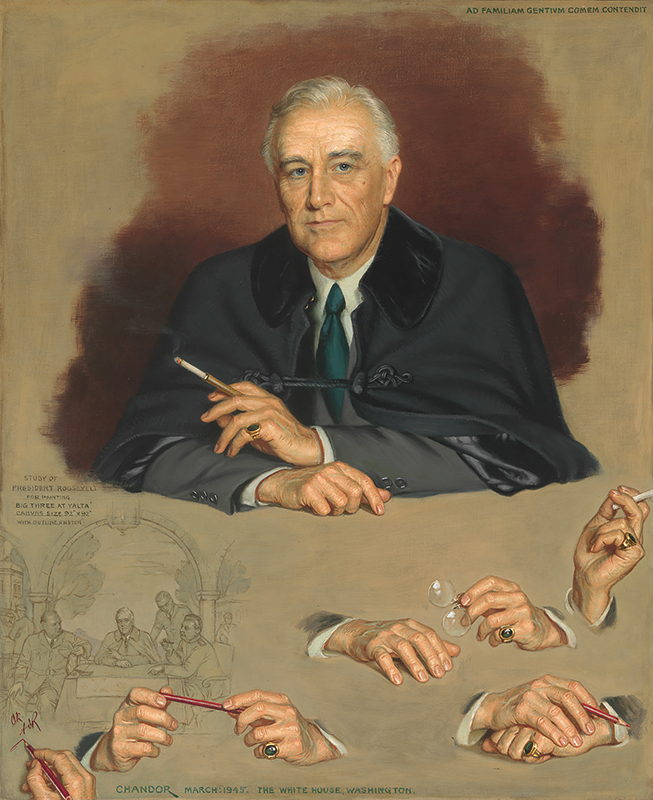
Indoors, I marked the day by taping a new postcard to the wall. It depicts FDR.
“During the autumn of 1944, Roosevelt received a letter from artist Douglas Chandor, proposing that a painting be created of Roosevelt, Winston Churchill, and Joseph Stalin, to document the allied efforts at the Yalta Conference in Russia,” the Smithsonian says about the painting.
“Chandor arranged a sitting for Roosevelt in early April, less than a month before the president’s passing. This portrait is a study for the larger painting, The Big Three at Yalta — a sketch of which appears at the lower left. Chandor also painted a life portrait of Churchill, which is owned by the National Portrait Gallery, but Stalin would not sit for his portrait. Thus, The Big Three at Yalta was never painted.
“Chandor believed that hands revealed as much of a person’s spirit as his or her face would, and therefore experimented with multiple configurations and gestures, scattered across the bottom of the canvas. Roosevelt, however, was dismayed by the attention Chandor paid to his hands, dismissing them as ‘unremarkable’ and likening them to ‘those of a farmer.’ ”
Interesting hands, but also an idealized face. I’ve seen photographs of President Roosevelt from around that time, and there was more than a hint of death in his face. The ravages of untreated hypertension, perhaps.
Speaking of presidents, one of our most recent Star Trek episodes was the one in which Abraham Lincoln gets a spear in the back. As Capt. Kirk said, it was a little hard to watch. So was the episode, though it wasn’t quite as bad as I remembered. Just mostly. I don’t feel like looking up the title. If you know it, you know it.
One interesting detail, though. Faux-Lincoln comes to the Enterprise bridge and, among other things, has a short interaction with Uhura. He uses a certain word and apologizes, afraid that he has offended her. To which, Uhura says:
“See, in our century, we’ve learned not to fear words.”
Of all the many optimistic things Star Trek ever expressed about the future, that has to be the most optimistic of all.
Still above freezing most of the time, and no snow or ice. My kind of winter. But rain is slated for the weekend, devolving into snow. Maybe. That might interfere with getting a Christmas tree.
Not long ago I visited a high floor of an office building here in the northwest suburbs, something I don’t do to much these days. The view included the roof of a major retail location.Not very green, that roof. Besides whatever sustainability might be achieved, a roof that includes plants is more interesting to look at. Such as can be seen here and here. I don’t get to visit green roofs that often — ones such as the Chicago City Hall are inaccessible — but I did see one in suburban Toronto during my green press tour in that metro area. Didn’t take any pics.
Just behind the retailer is the office building’s nigh-empty parking lot.
Parking takes up a lot of space, no doubt about it. This study only focuses on a few cities, however, not the endless suburbs.
I set the background of my laptop to change every minute, and to keep things interesting, and I change the collection of images the computer uses every few days, if I remember to. Yesterday I directed the computer to use the images in the file July 5, 2019, which was our first day in Pittsburgh last year.
This popped up as part of the cycle. I’d forgotten I’d taken it. That was in the Andy Warhol Museum.
Ann and I are still watching Star Trek roughly once a week. I’d say she’s seen about half of the original series. The most recent ones were the “Immunity Syndrome” and “A Private Little War,” both of which hold up reasonably well, though in strict storytelling terms, “Immunity” is better, since the concept is simple and the execution fairly taut. It’s the crew of the Enterprise vs. a whopping big space amoeba.
Best of all, it doesn’t turn out that the whopping big space amoeba is actually a sophisticated intelligence that the heroes eventually learn to communicate with and peacefully coexist with, a la Roddenberry.
That can be an OK track for a story — such as in “Devil in the Dark” — but for sheer space pulp drama, what you want is a mindless menace that needs to be destroyed by the last act. Star Trek did an even better job of that in “The Doomsday Machine,” in which the Enterprise fights a massive bugle corn snack that shoots death rays.
At first I thought “A Private Little War” was the (stupid) episode with the Yangs and the Cohms, in which Capt. Kirk recites the Pledge of Allegiance, among other looniness. No, that’s “The Omega Glory,” which we haven’t gotten to.
“War” is a jerry-built metaphor for the Vietnam War, involving as it does war among alien rustics, a Klingon plot to arm the natives, Kirk’s “balance of power” response, etc. Also, there was a raven-haired femme fatale with a bare midriff that got the attention of the 13-year-old I once was, and a creature that looked like a man in an albino gorilla suit, because that’s what it surely was. Spock bled green from a gunshot wound and Nurse Chappell got to slap him around. Why didn’t we ever see more of Dr. M’Benga? (Seems he was in another episode briefly.) Here’s why: actors cost money, as much as showrunners might wish otherwise.
One more item for today. Not long ago we got takeout at Asian Noodle House, a wonderful storefront that seems to be surviving on the takeout trade. We go there every other month or so. Fortune cookies come with each order, one per entre. Each wrapped in its own little plastic bag.
Today we got three little bags. One of them had two cookies tightly packed within. Is that like getting a double yolk? Does it mean extra good fortune or extra bad chi? Maybe one cookie is ying, the other yang.
After a cold second half of October, temps have trended warmer in early November. So much so that I had lunch on our deck today, and expect to tomorrow as well. It can’t last. But it’s nice to sit out there and forget about the national hubbub — which I can’t do during my working hours, as paying attention to it as part of my job.
Here’s an article about the House of Tomorrow at Indiana Dunes NP, which we saw last month. A good short read, except for one thing: no date on it, which is a pet peeve of mine. It’s obviously not that old, since it refers to the recent designation of the national park, but you shouldn’t have to rely on internal evidence to date an article.
When I posted about Pounds Hollow Recreation Area a while ago, I forgot to include the short falling leaves video. Here it is.
We’re past peak here in northern Illinois, but some of the trees are still ablaze, and some still wilted yellow-green. Sitting out on the deck was pleasant enough today, except when a leaf-blower kicked to life noisily not far away. Will future generations ponder that leaf blowers were ever a thing? Hope so. As far as leaves go, let ’em stay where they fall on your lawn. They’re nutrition for next year’s grass.
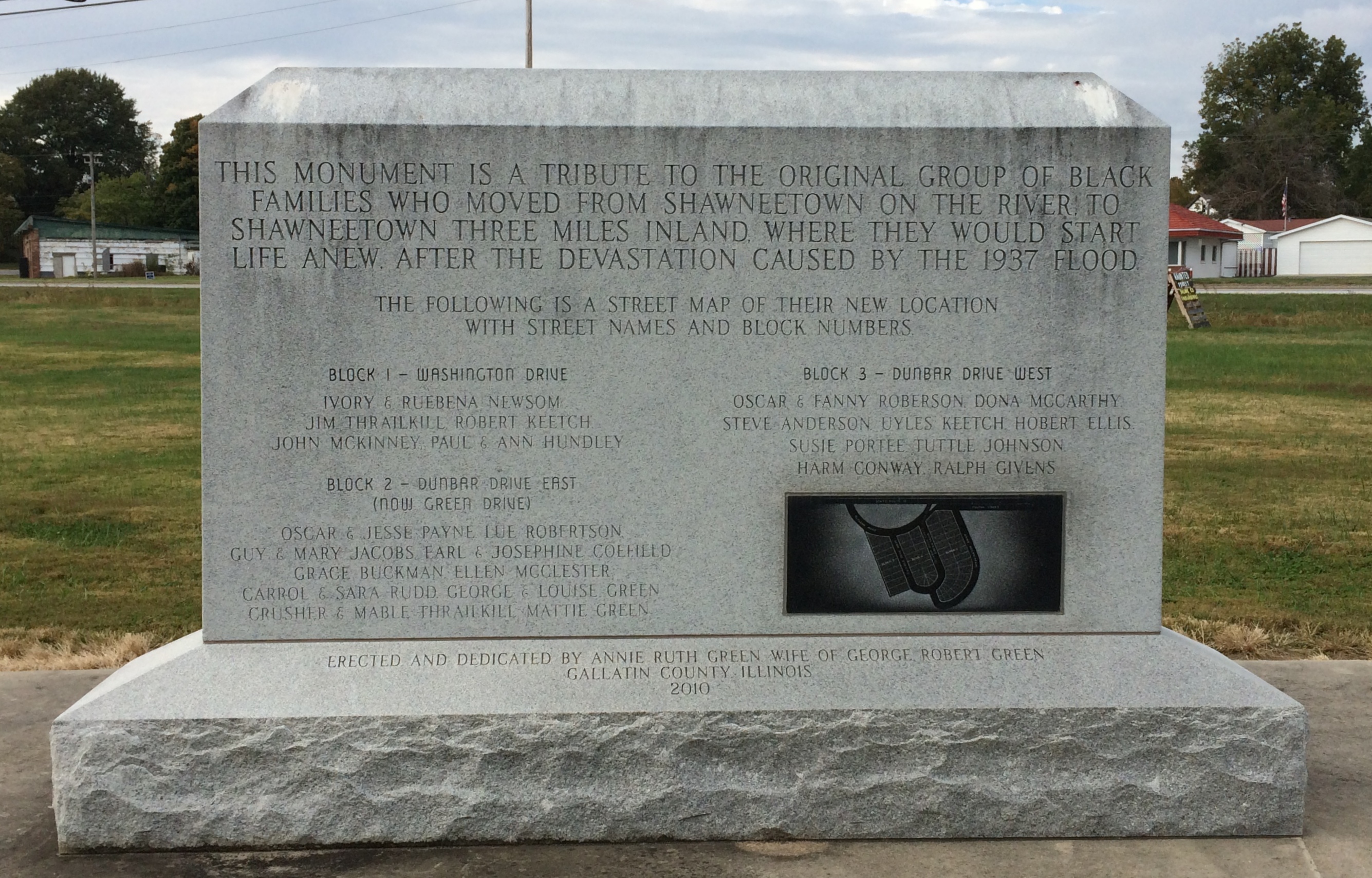
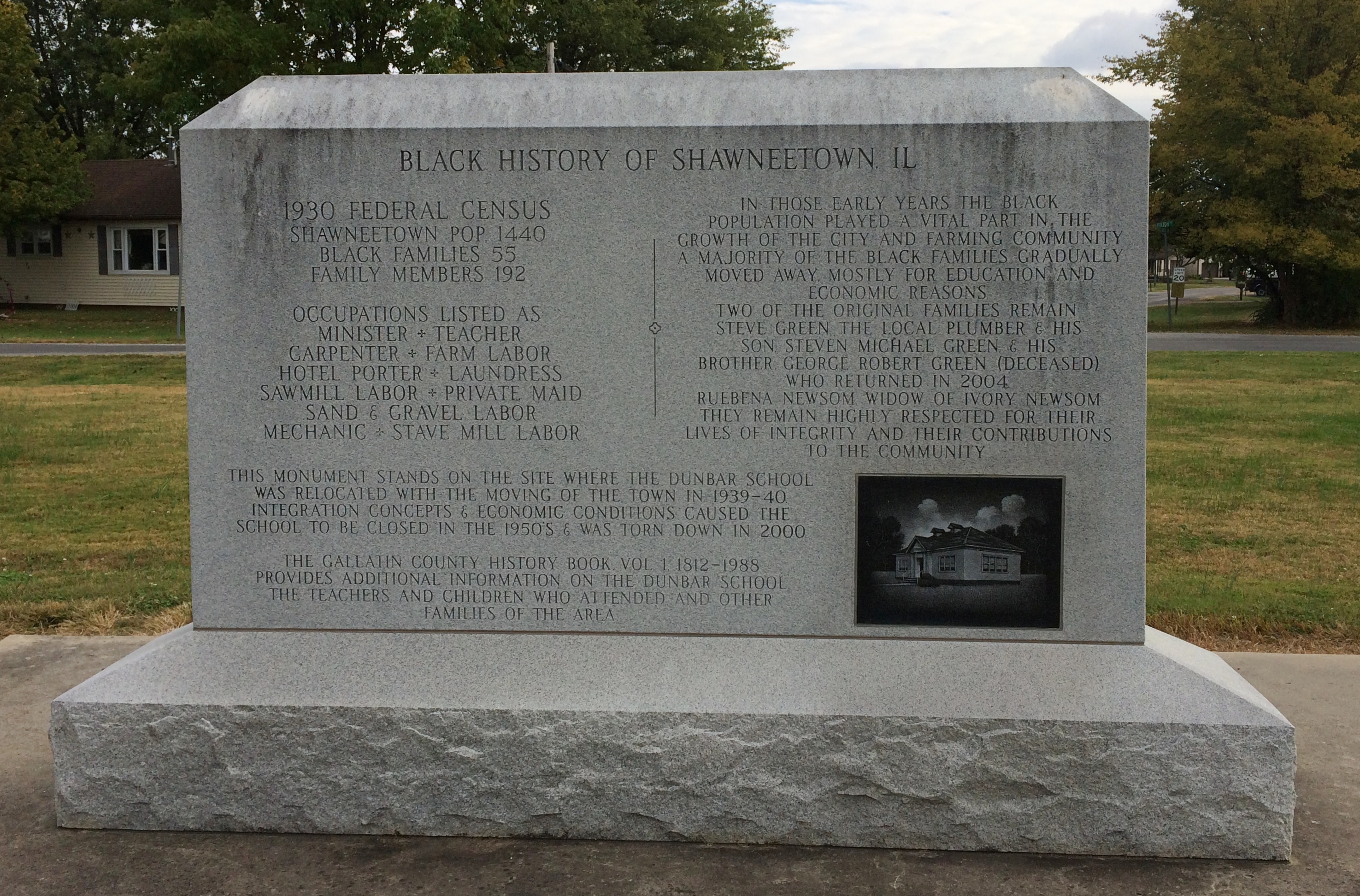
In Shawneetown, Illinois, the new town that is, you can see a memorial erected about 10 years ago. The wave of such memorials, I believe, will continue into the 21st century. It’s a tribute to the original group of black families who moved from Shawneetown on the river to Shawneetown three miles inland, where they would start life anew, after the devastation caused by the 1937 flood.
It includes a map of the nearby neighborhood and all the names of the black residents who lived there. The other side has a more general black history of Shawneetown, noting that a segregation-era school stood on the site of the memorial, presumably for the black neighborhood’s children, but it doesn’t say that. The school closed in the 1950s.
Near the memorial is a rectangular gazebo. Without corners. Or is it really a gazebo? When Ann and I saw the abandoned Texaco station in Old Shawneetown, I asked her if she’d ever heard the Texaco jingle. I hadn’t thought about it in years, but the point of jungles is to bury themselves deep, so it’s coded in my synapses somewhere.
Most Americans my age would know what I meant, but considering that Men Who Wear Texaco Stars are long gone, I didn’t expect her to know. She didn’t.
Later, I showed it to her on YouTube, where it’s a standalone video (and also the grist for truly stupid local TV news).
That made me a little curious myself. When did that jingle first air? As it turns out, 1962, as a snappier tune compared with, for example, what the singing Men With Texaco Stars did for Milton Berle 10 years earlier. The jingle was also incorporated into later Texaco songs, such as this one sung by Ethel Merman.
As jingles go, “You Can Trust Your Car” is memorable indeed. The story of the copywriter (and composer) who came up with it, one Roy Eaton, is even more remarkable. Aside from being a talented concert pianist, he was the first black creative at a major ad agency, joining Young & Rubicam in 1955 and later working for many years at Benton & Bowles, before founding his own company. He’s still alive at 90.
So memorable that it was the basis for an anachronism in a 1977 episode of M*A*S*H (see the trivia section at the bottom of the page).
The Ricki Lee Jones song “Last Chance Texaco” (1979) includes an example of a reference — to the jingle — that was perfectly understandable when the work was new, and perfectly mystifying to later generations.
Your last chance To trust the man with the star You’ve found the last chance Texaco