Finally it’s warm(ish) and more-or-less dry outside. Time for some action shots.
 Lilly has a pink tennis ball. The dog wants it.
 That hound has some strong hind legs, that’s for sure.
 At last, the tennis ball is hers, and she runs off with it.

Finally it’s warm(ish) and more-or-less dry outside. Time for some action shots.
Lilly has a pink tennis ball. The dog wants it.
That hound has some strong hind legs, that’s for sure.
At last, the tennis ball is hers, and she runs off with it.
Tinkertoys, Lincoln Logs, and Legos – the big three among building toys, as far as my younger self was concerned. I thought about that recently when Ann latched on to the two tubes of Tinkertoys that we have around the house. At some point long after I quit using them, the tubes migrated from my mother’s house to mine, maybe in anticipation that one of my children would use them. Until the other day, no.
The tubes interest me now more than the toys themselves.
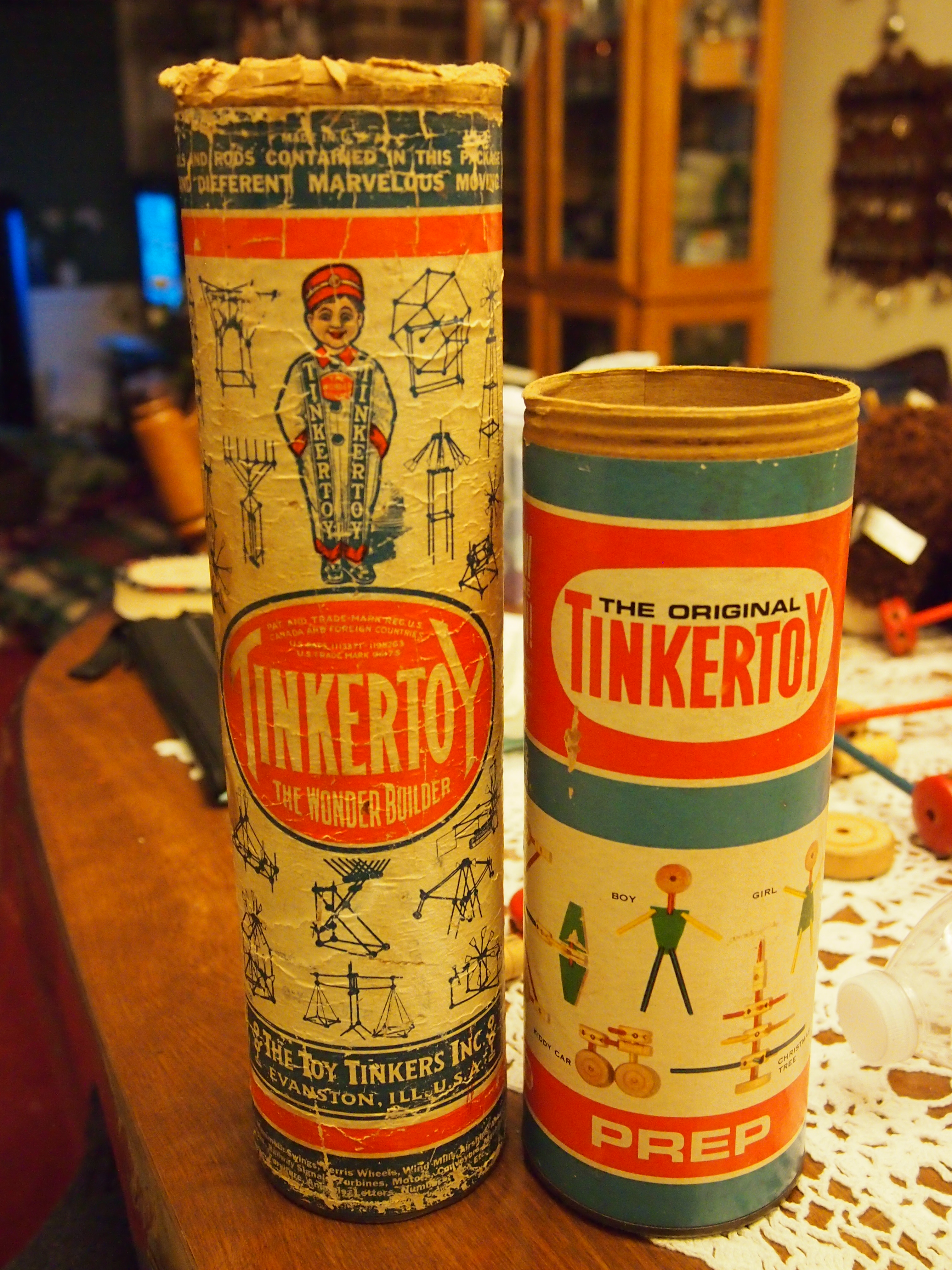 I think my grandparents bought that taller tube for my aunt in the late ’30s – it has her name on it (I saw her last month; maybe I should offer to return them, since isn’t 80 the beginning of second childhood?). In any case, it says Tinkertoy, the Wonder Builder, a product of The Toy Tinkers Inc., Evanston, Ill. I didn’t know Tinkertoys were from Evanston originally.
The design of the longer tube clearly carries a 1929 copyright, but the image, especially of the boy, harkens back somewhat further. Maybe the artist was middle-aged and recalling his boyhood.
My mother probably bought the shorter tube for me ca. 1970, though it’s possible my grandmother got it for me. Note that it doesn’t promise constructions as intricate as the earlier tube. It still has a retail price sticker on it: Winn’s, 77 cents. Winn’s was a dime store near our home in San Antonio that was there until the age of dime stores was over.
Surprisingly little is available on line about Tinkertoy history, at least on casual inspection – there are suspiciously many hits with verbage the same as other sites. Did the inventors of Tinkertoys really hire midgets to play with sets in department store windows in the early days of selling the toys? That’s a repeated story, and I’d like to think it’s true.
Ann had taken a sudden, and previously unexpressed interest in tinkertoys.

It’s a Tinkertoy Tower of Babel. I don’t ever remember building such a thing.
Lilly told me the other day that she was going to take the EXPLORE test at school. I pretended to hear “explorer” test.
“It’s about time,” I said. “I can help you get ready. Here’s a question: how many men did Shackleton lose on the ill-fated voyage of the Endurance?”
“It’s not that kind of test,” she said.
“None. That’s really amazing, if you know anything about it.”
“I don’t know anything about it.”
“That’s why there need to be tests about explorers. Here’s another one. How many men did John Franklin lose looking for the Northwest Passage?”
“I don’t know who that is either.”
“The answer is all of them. They all died, including Franklin. That’s something you should learn in school.”
The pedestrian truth is that EXPLORE is some kind of ACT prep test. Without a single question about any great explorers, I bet.
It rained from about midnight to 6 a.m. on Thursday, one of the heaviest I’ve seen here in the northwest suburbs, but not the heaviest. Just my impression. I don’t feel like looking up the rainfall totals measured at O’Hare for then and now.
Thursday’s rain also compares to the time we went camping in Wisconsin, in summer of ’07, and during our last night in the tent it rained and rained and rained (which I called “two-fisted, he-man rain”). As for the tent, guaranteed to keep you dry indeed.
On Friday morning, skies were gray, but at least it wasn’t raining any more. On Saturday morning, the morning greeted us with a light dusting of snow. It melted after a short time, but even this far north, that’s a little unusual.
Much mud is still around. The dog is very fond of it.
Saw Argo on DVD recently. It deserved its praise for suspenseful plotting and all-around storytelling. Lilly and her mother watched it with me – Ann isn’t really old enough to be interested – and toward the end, Lilly said, “I can’t stand this anymore! What’s going to happen?”
I didn’t tell her. That would have spoiled a cracking good yarn. Part fictionalized? Who cares, if the results are good.
I faintly remembered the extraction of six embassy workers from Iran in 1980 as a momentary good-news pause during the early hostage crisis, and vaguely remembered the much-later revelation that a bogus movie production had been involved. I didn’t believe for a moment that Revolutionary Guards chased a departing Swissair flight down the runway in Tehran, or any of the other last-minute excitements depicted in the movie. Not that such things were impossible, but they seemed too cinematic to be real, and of course they were.
I enjoyed reading about some the real details of the operation afterwards. I especially liked the reason for the timing of the escape, which was on an early-morning flight. Revolutionary Guards, it was reasoned, don’t like to get up early either, zeal or no zeal.
“This was another reason for choosing the 7:30 a.m. Swissair flight,” wrote CIA agent Tony Mendez, who led the escape on the ground at considerable personal risk. “If we arrived at the airport at 5 a.m., the chances were the airport would be less chaotic. Also, the officials manning the controls might still be sleepy, and most of the Revolutionary Guards would still be in their beds. This was the case that Monday morning, 28 January 1980.”
Rain, rain, rain. Seems like the drought that gripped northern Illinois is over. And it seems like we’re getting the rain we didn’t get last year, plus this year’s, and maybe a down payment on next year’s. But I suppose that’s anthropomorphism, or at least using financial terminology for the weather.
 Speaking of anthropomorphism, I think that when our new hound watches us prepare food, as she does every day, she must be thinking those humans are crazy. Why aren’t they eating their food right now?
Another dog picture. I’ll probably publish a number of them before the novelty wears off. I tried to get her to look at the camera, but she was too busy spying our back yard tree for squirrels. None were to be seen. That time.
I hadn’t heard that Jonathan Winters had died until this evening. I hadn’t known he was still alive, but then again his most recent roles seemed to involve voicing Grandpa Smurf, something I would never have known without reading his obit. When I was young, though, he seemed to pop up on TV a lot without warning.
But that’s understandable. A gig is a gig. As funnymen of my parents’ generation go, he aged a lot better than most.
The MIT Center for Real Estate is a big deal in real estate education. It educates real estate pros and generates some interesting real estate data. Also, MIT is also not known to be short on its endowment. So how is it that the latest thing on center’s web site, under the “News and Events” section, is dated November 30, 2011? How it is that the newsletters produced by the center stop around the same time? Did the person who was maintaining it leave, and the organization couldn’t be bothered with it afterwards? I can see that for a small organization on a shoestring — in which case the site shouldn’t promise “news” — but MIT?
More than 30 years ago, I spent a few days camped out in a dorm room at MIT. I noticed a few things while there, such as that everyone on the hall went to the common room to watch an afternoon showing of Star Trek, and everyone knew the lines. (The original series; because this was 1982, the only series. Patrick Stewart was still just a Shakespearean actor who’d played Sejanus for the BBC.)
I discovered that there’s a major collection of samurai armor and art in Dallas, of all places. At the newly opened Ann & Gabriel Barbier-Mueller Museum: The Samurai Collection. I mentioned that to Ed, who’s familiar with the Barbier-Mueller Museum in Switzerland, and he said, ” If it came out of the Barbier, odds are, it’s better than anything you saw in Japan.”
Another thing to see. But at least it’s easier to go to Dallas than, say, Geneva.
I got to know Boylston St. fairly well in 1995. I didn’t walk there every day, but often enough. Part of the street features rows of small, upper-end shops and these days, an Apple Store, though I don’t think it was there then. And I think I remember walking by the Boston Public Library and noticing that the marathon finish line is painted permanently in the street.
We didn’t watch the marathon on Patriots’ Day that year, which is the Massachusetts (and Maine) state holiday to commemorate Lexington & Concord. Rather, we watched a parade on Mass. Ave. in Arlington. Two days later, while at work downtown, I heard about the mayhem in Oklahoma City on the radio. This time of year seems to inspire losers with bombs.
I hear about today’s mayhem on the radio as I drove along today, between errands, in the company of Ann. The only memorable one of these errands was to the pet store we visited last week, to return a brush the dog didn’t like, and buy a tag that could be engraved with contact information in case she runs off. I’d imagined that we’d buy it, and then send it somewhere for engraving.
That was me, thinking old-fashioned thoughts. The store had a laser-based machine that only does one thing: engrave animal tags you’ve just bought, no extra charge. Simple to use, fascinating to watch.
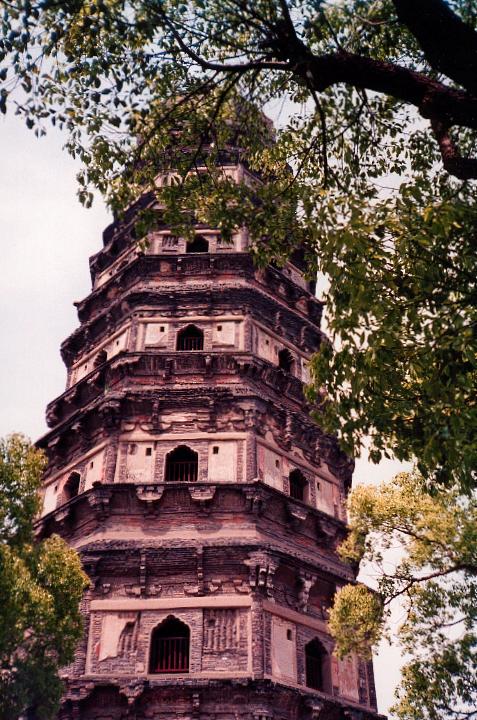 We visited Tiger Hill in Suzhou in April 1994. I took no notes about it, only a few pictures (to the right is the pagoda on the hill). But through the magic of the Internet — very low-grade magic, these days — I can pull up a description that’s a good stab at English by someone who’s first language is something else (some brand of Chinese, no doubt), but ultimately awkward.
The writer’s also probably fond enough of Tiger Hill to write about it in Wiki for the English-speaking world see read about it.
All text is sic: “According to the Historical Records, the Wu King Helu was buried on the hill, called then ‘the Hill Emerging from the Sea’. The legend goes that three days after his burial a white tiger appeared squatting on the hill. Hence the name. It has an elevation of over 30 m. and covers about 49.41ac. Tiger Hill boasts impressive rocks, deep dales, 3 matchless scenes, 9 suitable occasions for enjoyment, 18 scenic spots, and changing scenery at all times. No wonder it has been an awe-inspiring sight in the area south of the Lower Yangtze.
“The Yunyan Temple Pagoda and the Sword Pool are well-known features of the hill. With a history going back more than 1,000 years, the simple, archaic and imposing Yunyan Temple Pagoda, also known as the Second Leaning Tower on earth, stands aloft at the top of the hill, serving as a symbol of ancient Suzhou for years.
“The Tomb of the Wu King Helu under the Sword Pool has remained an unsolved mystery for two and a half millennia. The story goes that the great Jin master Wang Xizhi traded his calligraphy for lovable geese from the Taoist Abbot. And the windy vale and cloudy spring make the visitor reluctant to leave.”