America’s Best Train, Toy & Hobby Shop

As expected, today was frigid, near zero to begin with, and not much warmer as the day ground on. As the Monday holiday for the birthday of Martin Luther King Jr., it’s the sort of day on which school is closed and the mail doesn’t come, but otherwise there was work to be done.

There aren’t many stores like America’s Best Train, Toy & Hobby Shop in Itasca, Illinois, any more. It’s an independent hobby shop, largely but not completely devoted to model trains, with its merchandise stacked floor-almost-to-ceiling along a number of narrow aisles. Tight enough to put off the claustrophobic, no matter how much they like model trains or train toys. The store has new and used model train cars, track, and accessories of all kinds and in various scales, a room devoted to Thomas the Tank Engine toys, Playmobil, Chuggington Station — I’d never heard of that — Lego sets, plastic model kits, and a lot more.

The store has a Maplewood Drive address, but it’s visible from Irving Park Road. I’d driven by it countless times over the years, occasionally thinking, I should take a look. But I never did until Saturday. Lilly, Ann, and I had gone to a music store in Itasca to get some sheet music that Lilly needed, but the store didn’t have it. That was annoying, so I decided to make the best of it by visiting America’s Best Train, Toy & Hobby Shop, which happened to be across the street.

I like model trains — I had an HO scale model at one time, a fairly simple layout — but I was more taken with the shop’s stacks and stacks of plastic model kits. I built some of those as a lad, mostly airplanes, but also a Saturn V. (We also had a kit for the Mayflower than was entirely beyond my talents.) I didn’t spend a lot of time looking at America’s Best Train, Toy & Hobby Shop’s model kits, but my impression is that most were airplanes of one kind or another. I didn’t see an Apollo or Gemini or Mercury or even a Space Shuttle.

There were a few fictional spaceships, such as an original series Enterprise. No surprise there. A original series or remake Galactica would have been cool, but I didn’t see those. I did see an Eagle. As in the Space: 1999 spaceships. The kit looked like it dated from the 1970s and had never been opened, and the price was high. Can there be a collectors’ market for unbuilt models? That would be strange if so.

I asked the fellow behind the counter, who probably knows everything about model trains, whether the shop had any railroad postcards. He looked puzzled. For a moment, I might as well have said, “It’s crackers to slip a rozzer the dropsy in snide.” Guess no one had ever asked about that. Thinking on it, he then directed me to one of the aisles and said there might be some cards somewhere around there. One box tucked away on the aisle had a collection of unmarked black-and-white photos of trains — mid-20th century from the looks of them — and several more boxes contained old model RR hobbyist magazines.

But no postcards that I could find. I can’t fault the store for that; it’s too tangential. Even so, it was popular subject for postcards.
Pit of Winter, and No Place to Toboggan

According to online sources, the temperature outside as I post is zero degrees Fahrenheit, with small negative numbers expected in the near future. Tomorrow will see highs in the positive single digits. So here we are, in the pit of winter.

Twenty-eight Januaries ago I was tramping around at one of the Du Page County Forest Preserves, maybe Blackwell Forest Preserve in Warrenville. I used drive out from the city periodically to visit a friend in Warrenville, usually on a Saturday. During the warm months, I’d help him tend his large garden, receiving a share of the produce.

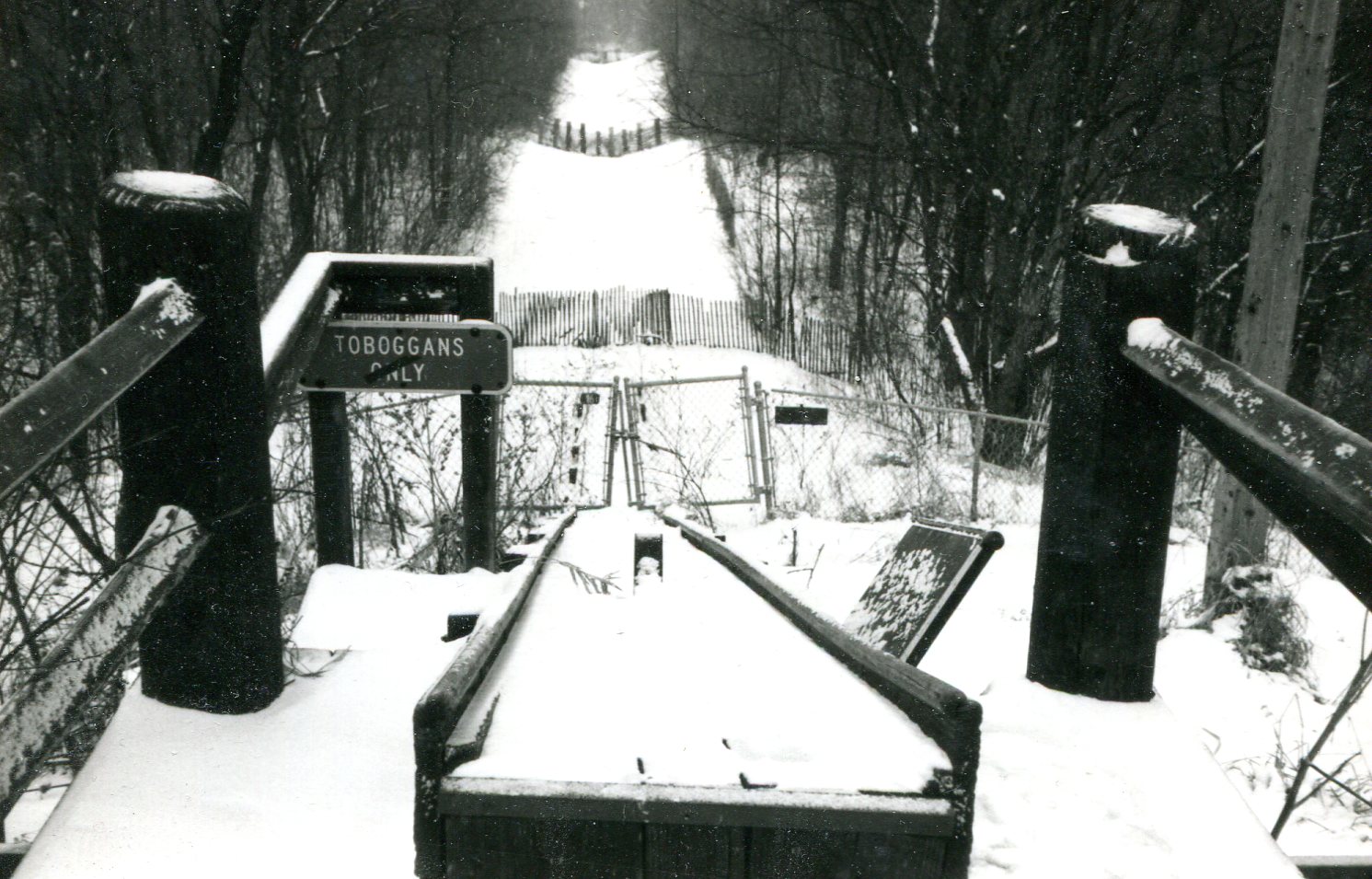
In the winter, I forget what we did, besides watch videos and — on January 23, 1988 — visit a snow-covered forest preserve as the snow fell. I had my camera, and it was during a period when I was taking black-and-white pictures. We happened across a closed toboggan run.

Du Page County Jan 1988I can’t pin it down now, or rather don’t want to spend much time at it, but I’m fairly certain that the local forest preserves closed their handful of toboggan runs sometime not long before I took the picture. Probably it was the expense, or the liability, or both.

Alabama Weekend ’87

Winter has asserted itself after a namby-pamby early phase. It reached about 40 degrees F on Saturday. Now, according to weather data available instantly online — another small marvel of the age — it’s about 3 degrees F. Tomorrow will be likewise gelid.

In early 1987, I was offered a job in Chicago, which I took. The second weekend of the year, I took a final road trip from Nashville, to see a friend in Alabama.

January 9, 1987

After lunch at Mary’s barbecue [still in business] and wrapping up bits of work during the afternoon, Mike and I left town in my car. It was cold and rainy all the way into Alabama. Ate dinner in Huntsville, some surprisingly good Mexican food [I didn’t note the name]. Stopped along the way a number of times for Mike to smoke his cigarettes. We met Dan at 11:30 pm at the Huddle House off I-20 in Anniston, and from there followed him to his place.

Dan and Susan have rented a modern log cabin in rural Alabama way the hell from anything (this weekend, Susan was away, so it was just the three of us). Two stories, a basement, a pond and a cat. Very pleasant. Before going to sleep, we drank beer and watched some ’30s and ’40s cartoons on tape.

Two kids knocked on the door — 16 or 17 from the looks of them — claiming they’d run their car into a ditch and wanting to use the phone. After some deliberation, we decided that they had run their car into a ditch during a drunken episode. It took them a good while to decide who to call. Then they asked for some of our beer and were angry when we refused, but did nothing more than leave. I’d hate to go through life as stupid as those two.

January 10

We ate and played games and watched movies on video. Actually only one movie all the way through, Rambo (Rambo: First Blood Part II), which of course we’d all heard of, but none of us had seen. We also watched parts of The Battleship Potemkin and Pee-Wee’s Big Adventure. [For variety, I guess.] Games: Trivial Pursuit, darts, and Risk. Dan won Risk, but it was a close one. At one point I lorded over the Americas and had footholds in Europe and Asia, but a weak point was exploited and my forces crumpled like an aluminum can.

January 11

Sunday we left at a reasonable hour (11) and drove to Atlanta. We met Layne and her co-worker Shelly, a transplant from Pennsylvania with big eyes, at the Sheraton Northlake. Had lunch at Athens Pizza, which I’d been to on a previous visit. The first place I’d ever had feta cheese pizza. A fine lunch. [I’m glad to learn that Athens Pizza is still around.] But we didn’t stay much longer, driving back to Nashville in the afternoon.

Church, Funicular, Incinerator

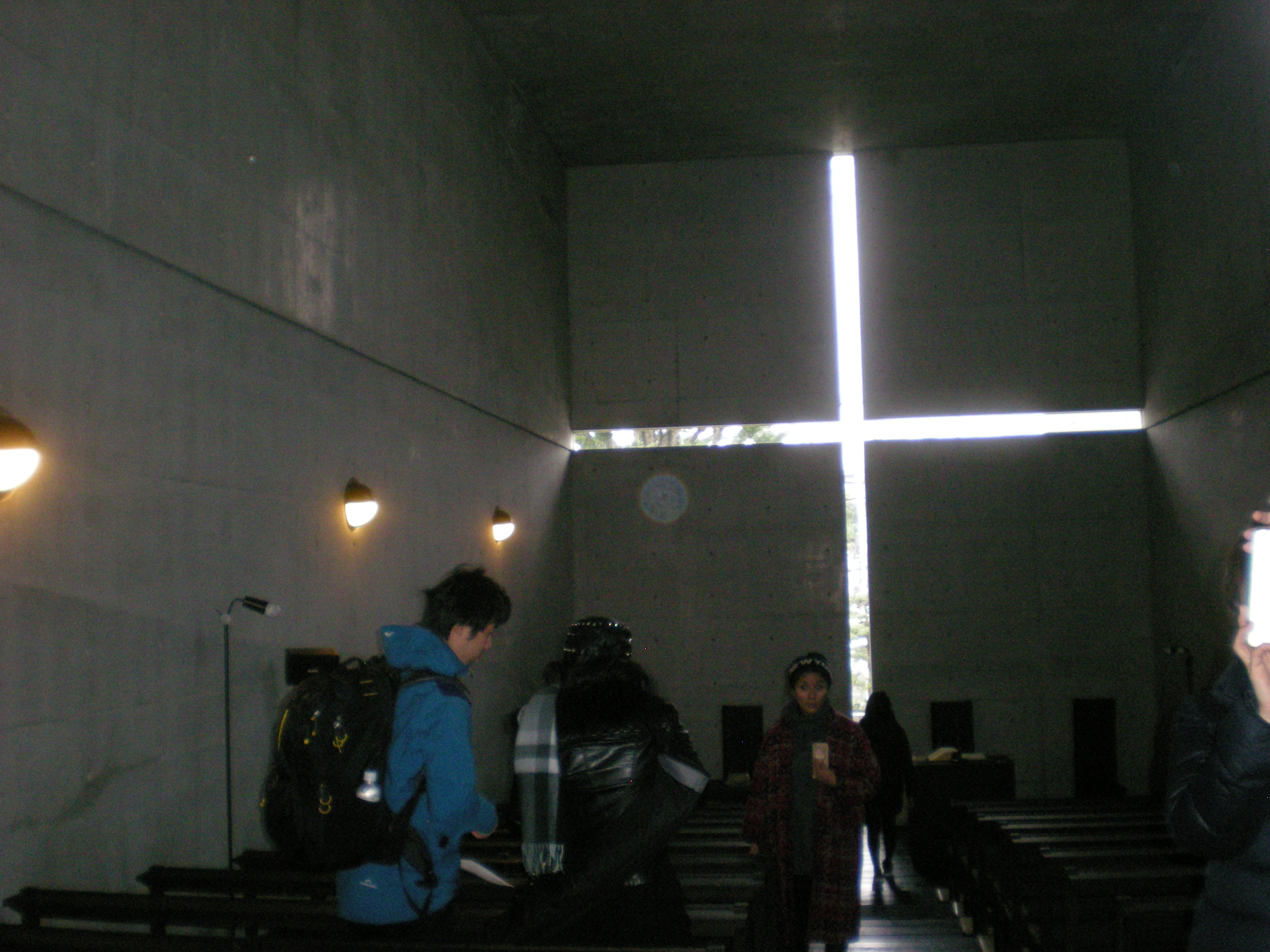
Yuriko’s been back from Japan since Saturday. Among other places she visited there was the Church of the Light, which has stood in Ibaraki in Osaka Prefecture since 1989.
Church of the LightThat’s the interior, which receives light from a cross of a gap in its thick concrete walls. Architectural autodidact Tadao Ando designed the church. Most of his work until around 2000 was in Japan, but lately he’s been doing international commissions, such as the Modern Art Museum of Fort Worth (2002).

Yuriko reports that it’s a remarkable space, considering that it’s essentially a concrete cube. Or a set of cubes; it’s a little hard to tell, even after reading about the structure. More about it — including a lot of pictures — is at Mooponto, “the only web magazine devoted to japanese minimalist architecture.”

I had a brief selfish reaction to hearing about the church. Why didn’t I visit it when I lived (relatively) nearby? I thought about that a while, and maybe I remember hearing about it, but also that the parishioners discouraged casual visitors. They still do, but you can make a reservation to visit.

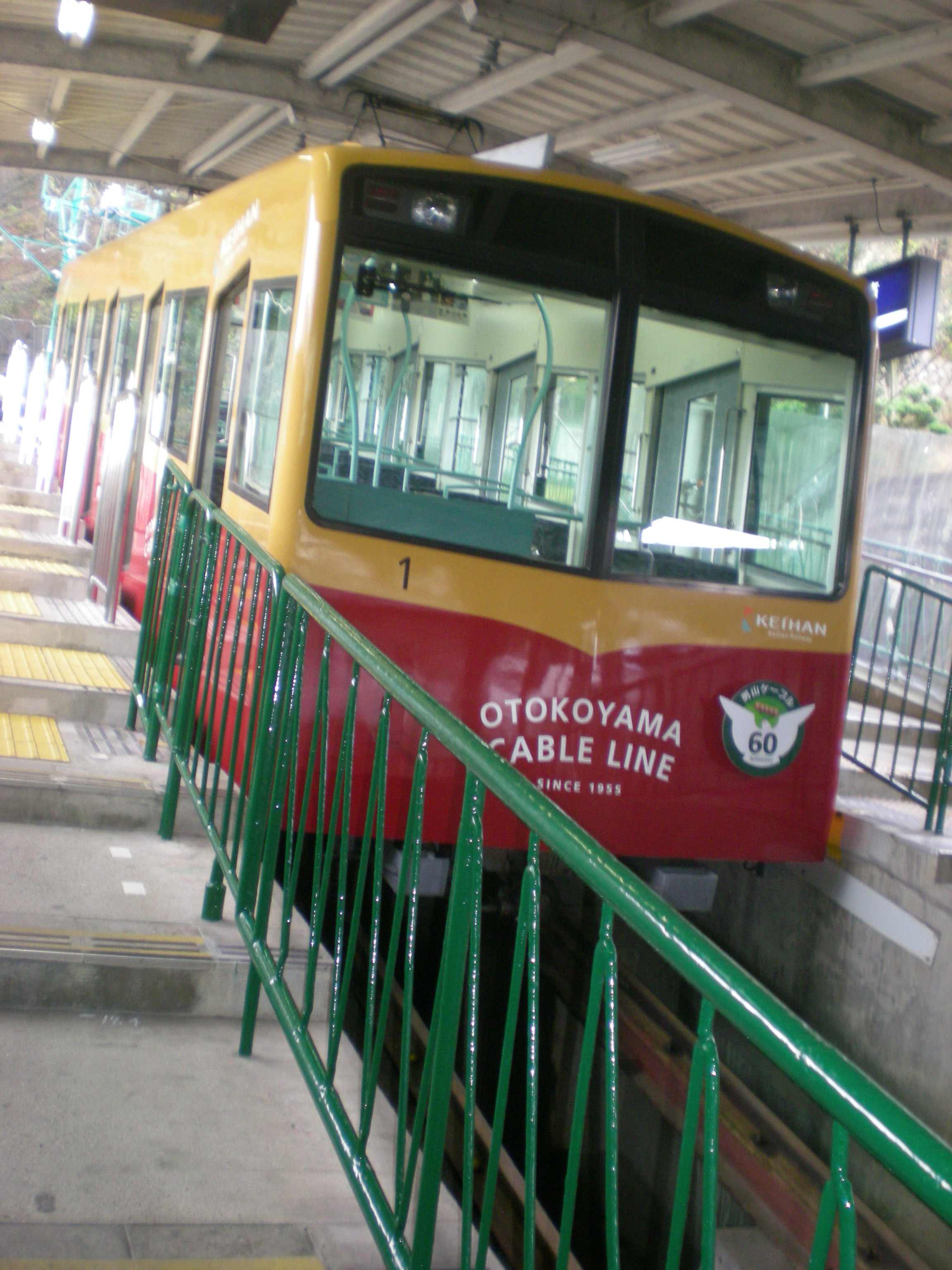
Here’s another thing I’ll do if I ever visit the Osaka area again: ride the Otokoyama Cable Line funicular. Because one thing we all should do in this life is ride funiculars.
Otokoyama funicularAlso called the Cable Line of the Keihan Electric Railway, it takes visitors up to Iwashimizu Shrine in Yawata, Kyoto. Yuriko went ahead of New Year’s. Somehow or other I’ve never heard of the line or the shrine. A shrine of some sort has been on the site since the Heian period (9th century) and the funicular’s been around since 1926, so I’ve got no excuse.

Another place in the Kansai that I want to see someday is the Maishima Incineration Plant in Osaka. I missed it when I lived there because it didn’t exist until the late 1990s. A few years ago I saw a photo of it and thought, what in the world? That’s in Osaka? Yep. Some photos and a bit about the place and the Austrian architect who designed it are here.

The Greeks: From Agamemnon to Alexander the Great

I’m not sure if it counts as a megashow, but the touring exhibit called The Greeks: From Agamemnon to Alexander the Great now at the Field Museum seems like a fairly big deal among museum shows. For one thing, it’s sizable enough, featuring a large assortment of sculpture, tools, vessels, jewelry, weapons, helmets, and more.

“Presented in chronological order, the exhibition begins with the Neolithic Period, around 6000 BC, and continues until the death of Alexander the Great in 323 BC, marking the end of the Classical period,” the Field Museum says. “Highlights of the exhibition include artifacts from the tombs of the first rulers of Mycenae… a burial that depicts the ritual of burial and sacrifice in a funeral pyre described by Homer in the Iliad, a replicated Illyrian warrior helmet that visitors may try on, grave goods from the tomb of Philip II, and inscribed pieces of pottery (ostraka) that were used to ostracize even the most powerful leaders of Classical Greek society.”

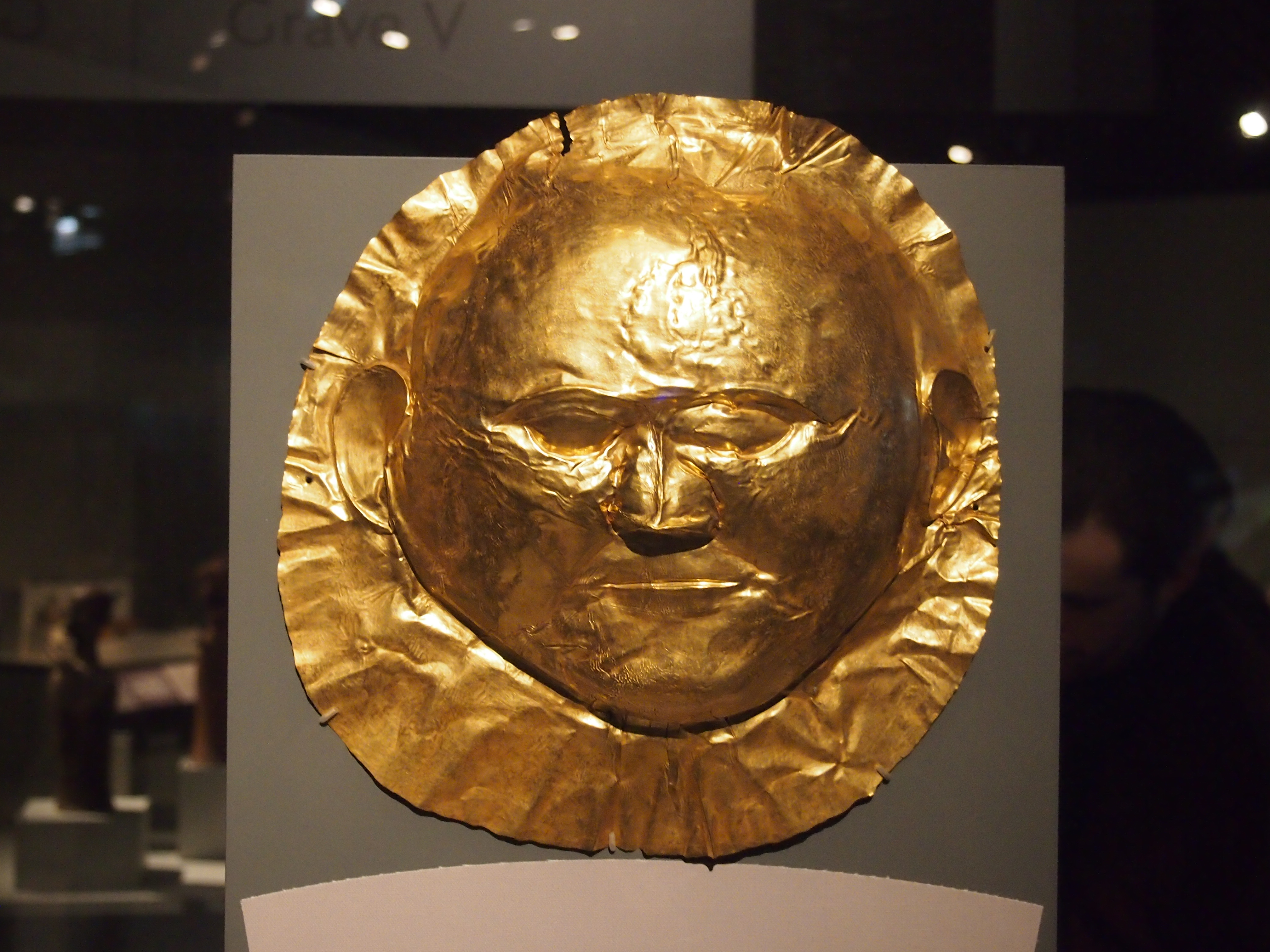
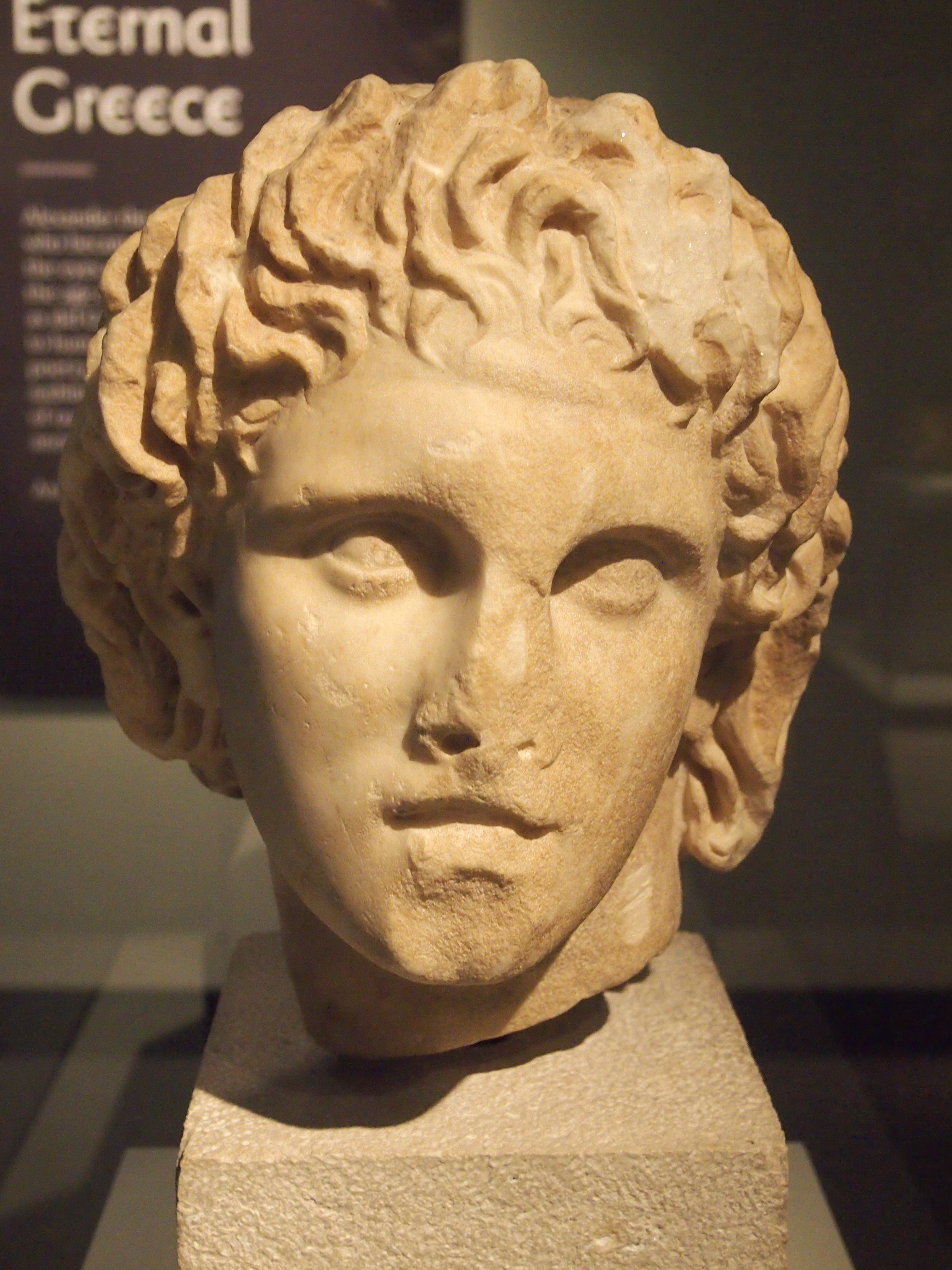
But the show’s main distinction is that its artifacts come from no fewer than 20 Greek museums, and some of them haven’t ever been exhibited outside of Greece. Such as this fellow.
Not AgamemnonBecause my misspent youth didn’t include a visit to Greece, I’d never seen this object in person, though I’ve seen the image reproduced enough to be familiar with it. At once I thought Agamemnon. I wasn’t the first person to think of that, of course.

“Displayed here for the first time outside of Greece, this is the gold mask that Schliemann first associated with Agamemnon,” the sign near the artifact said. “It was placed over the face of a person who died in his or her thirties. Although the deceased was certainly not Agamemnon — assuming that Agamemnon ever existed — he or she could have been one of his ancestors and was undoubtedly a powerful Mycenaean ruler. Mycenae, Circle A, Grave V, second half of the 16th century BCE. National Archaeological Museum, Athens.”

Google “mask of Agememnon” or the like, and you’re get this image, not the mask above. That’s because Schliemann later dug up another mask — the one Google pulls up — that he more famously associated with Agamemnon. The second mask wasn’t part of the exhibition, but there was an artful 19th-century replica of it on display.

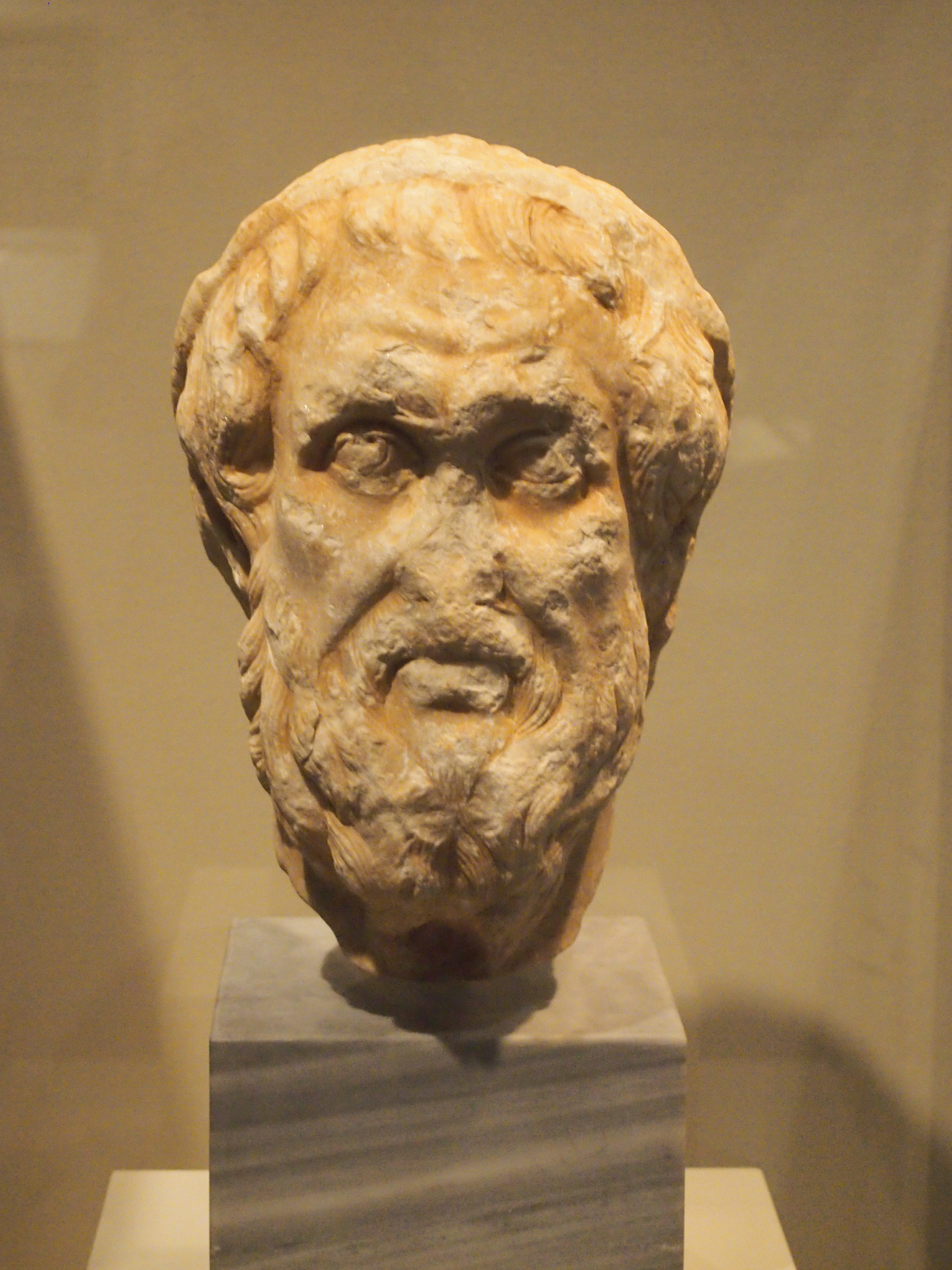
Other familiar faces populated the exhibit. That is, sculptures I’d seen reproduced in books or elsewhere. Such as Homer (a Roman copy of a Greek work, exact time of creation unknown).

D'oh!Then there’s this unnamed lad with an Archaic smile. In fact, he seems pretty happy, considering that part of his penis is missing.

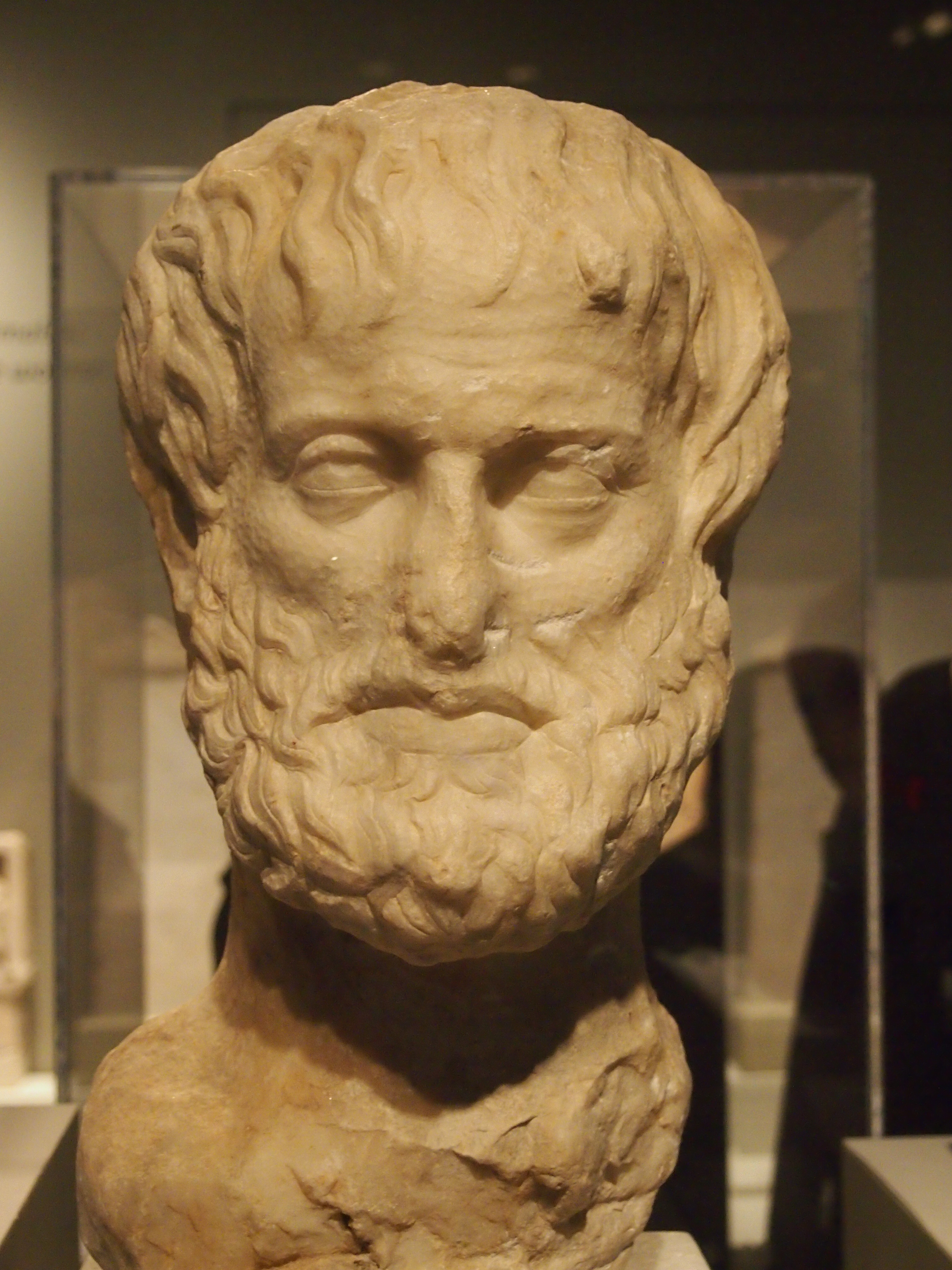
Smile, damn you, smileHere’s Aristotle (another Roman copy). I’m pretty sure this very image was depicted on a collection of his works that I have somewhere.

AristotleAnd Alexander.

Looks like Jim MorrisonThe bust is a Greek original, created in Pella. Am I the only one who thinks Jim Morrison resembles this Alexander? Anyway, the busts of Homer and Aristotle are from the National Archaeological Museum, while the famed face of Alexander is usually found at the Archaeological Museum of Pella (open only since 2009).

The exhibit will be in Chicago until April, and then go to the National Geographic Society Museum in DC for its last stop. Previously, it traveled to Ottawa and Montreal. The Greeks pointedly decided not to send the trove to anywhere in the UK, such as the British Museum or even the Victoria and Alberta. Still some bad feelings over the Elgin Marbles, it seems.

New Year’s Eve at the Field Museum

On the last day of 2015, Ann and I went to the Field Museum. It had been a while since I’d been there (maybe this long ago), though she told me she’d visited with a school group in the not-too-distant past. It was a cold, gray day, just the time for an indoor diversion.

Note to the CTA: how is it that a bus (No. 130) directly from Union Station and Northwestern Station to the Museum Campus — home of the Field Museum, but also the Shedd Aquarium and the Adler Planetarium — runs only in the summer? Isn’t that backwards? Summer’s the time to cover all or part of the distance on foot. In winter it’s good to have transit. Never mind, we walked to State Street and caught the No. 146, arriving at the museum not long after noon.

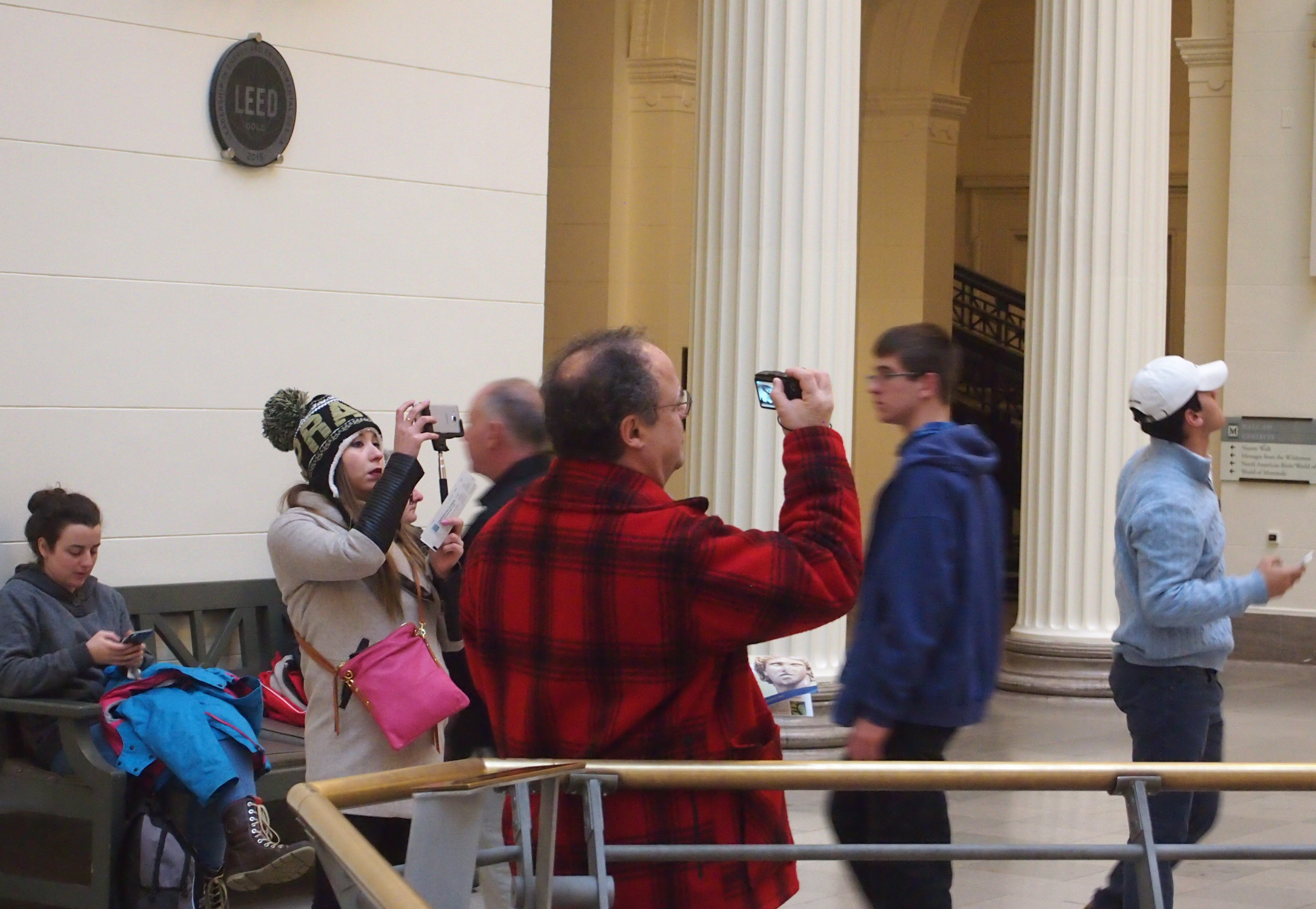
Field Museum Dec 31, 2015We saw some of time-honored exhibits at the Field, such as Sue the T. Rex. People sure are fond of taking its picture.
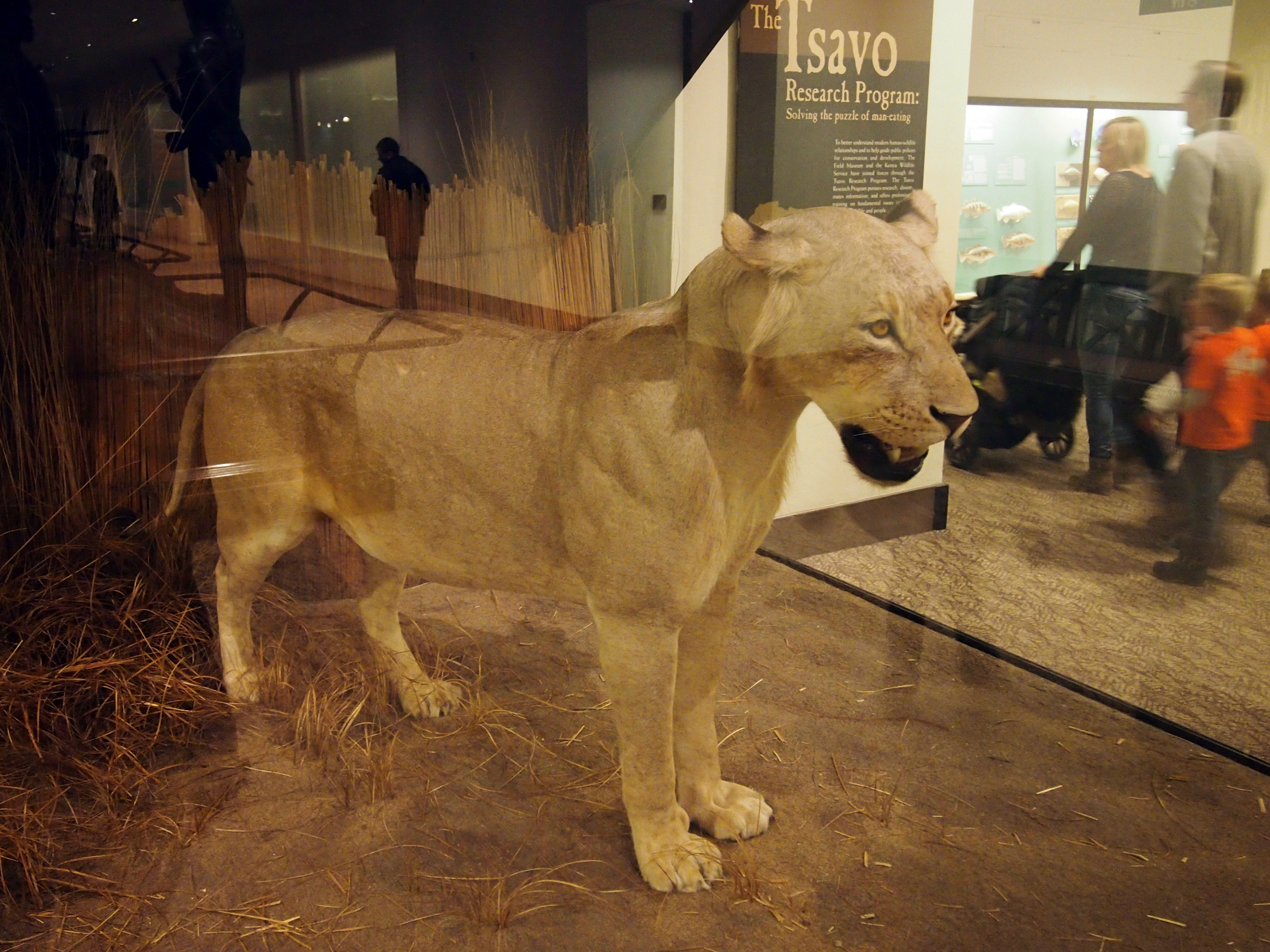
Field MuseumNot very many people were down in the basement looking at the Man-Eater of Mfuwe, but there it was, behind glass.
Field Museum“This cat terrorized Zambia’s Luangwa River Valley — near Msoro Monty’s [a 1920s man-eater] old stamping grounds — in 1991,” notes the Smithsonian. “After killing at least six people, the lion strutted through the center of a village, reportedly carrying a laundry bag that had belonged to one of his victims. A California man on safari, after waiting in a hunting blind for 20 nights, later shot and killed him.” Unlike Cecil the Lion, there was no international outrage over that.

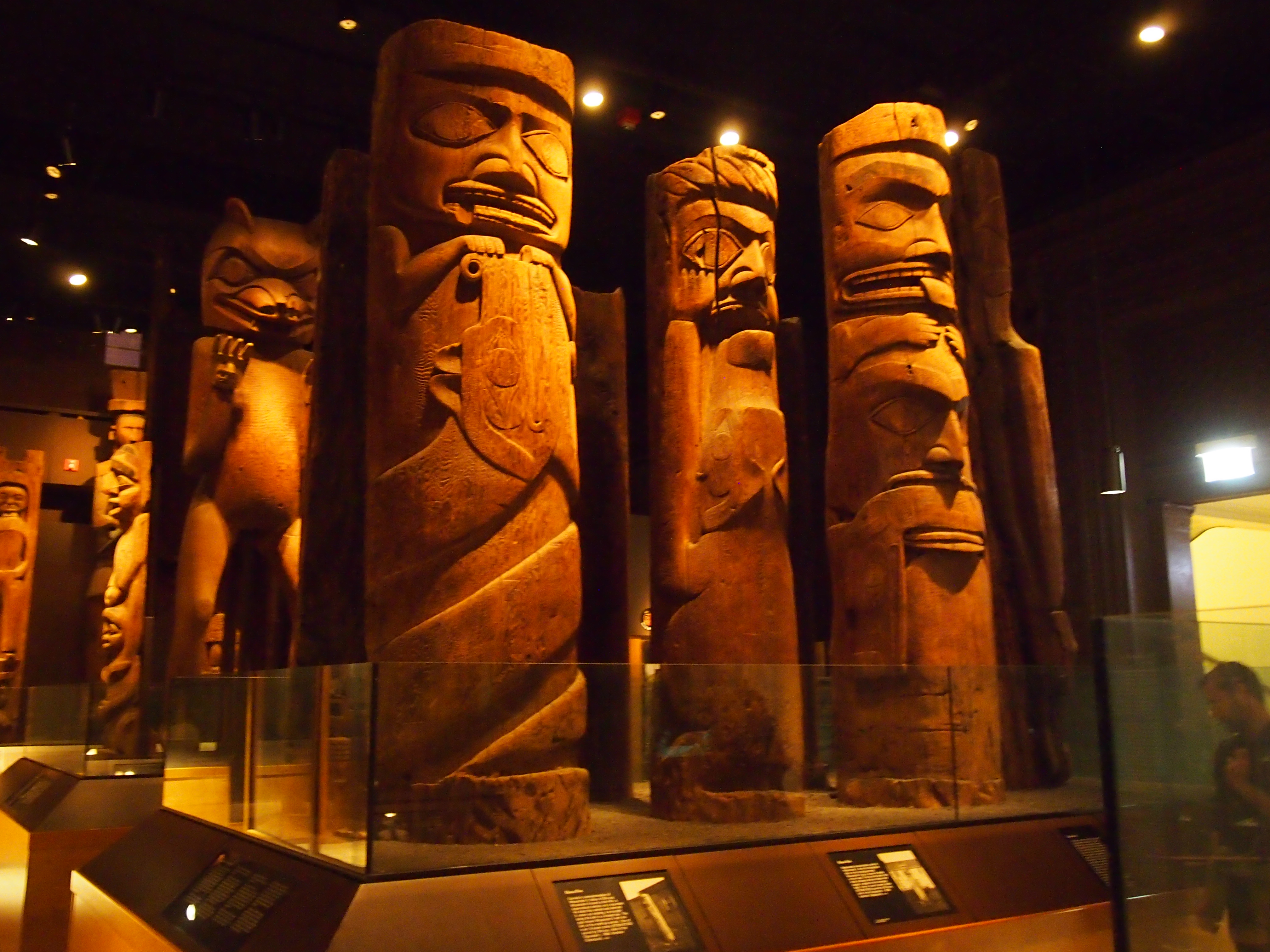
The Field Museum also has a nice collection of Pacific Northwest house posts.
Field MuseumNot quite the selection that the University of British Columbia Museum of Anthropology in Vancouver has, but impressive. We were among the few in the hall looking at them.

I was also glad to see that the Field is preparing to exhibit pieces of the Chelyabinsk meteorite. According to a sign, the Field has “one of the largest collections of the Chelyabinsk meteorite in the Western Hemisphere.” (I wonder what the Church of the Chelyabinsk Meteorite thinks of that, if there really is such a group.)

None of that is why I wanted to visit the Field. Instead it was a rare occasion when I was willing to pay extra to see a special show. Namely, “The Greeks: Agamemnon to Alexander the Great.” It was worth it. More on that shortly.

Back to the Music Box

In December 2003, I posted the following recollection of December 1996: “It’s been a good week leading up to Christmas. On Sunday the 22nd Yuriko and I went to the Music Box Theatre for the double feature sing-along. Between the movies, a Santa Claus — lean and not very old — came out to lead the audience in singing Christmas songs, some standard and some spoofs. The Music Box has an organ for occasions like this, and the organist was in fine form.

“The place was packed, and it was a spirited crowd, jingling the bells they brought and singing along with the bouncing ball (I wonder who thought that up originally?). They also hissed with gusto at Mr. Potter, the villain in you-know-what sentimental holiday movie, which was the other half of the bill with White Christmas.”

For some years I’ve been thinking about returning for the Christmas sing-along at the Music Box. This was the year. On Saturday I went with Lilly and Ann, who each brought a friend. I’m pretty sure 1996 wasn’t the last time I’d been to the Music Box, which is on Southport Ave. on the North Side of Chicago, since I went periodically when I lived in the city and occasionally after that, but I don’t remember my last visit. It’s been some years. I’m glad to report that it looks exactly like it used to, down to the small framed movie poster in the men’s room: the face of Clara Bow, advertising Love Among the Millionaires (1930).

That was probably a picture the Music Box showed in its first year, since it opened as a neighborhood movie palace in the summer of 1929. “The plaster ornamentation of the side walls, round towers, faux-marble loggia and ogee-arched organ chambers are, by Hollywood standards, reminiscent of the walls surrounding an Italian courtyard. Overall the effect is to make the patron feel that they are watching a film in an open air palazzo,” the theater’s web site fancifully asserts.

“The Music Box Theatre opened on August 22, 1929, a time when the movie palaces in downtown Chicago each had seating capacities of around 3,000 people. The Music Box, which sat 800, was considered an elaborate little brother to those theatres. Theatre Architecture magazine noted in 1929 that the theatre ‘represents the smaller, though charming and well equipped, sound picture theatre which is rapidly taking the place of the “deluxe” palace.’

“The building was designed by Louis A. Simon, a local architect who was better known for his Depression-era WPA Post Offices and homes for the nouveau riche. The building was erected by the Southport Avenue Businessmen’s Association and operated by Lasker and Sons, who operated several smaller neighborhood houses in Chicago.”

Naturally the Music Box fell on hard times in the 1960s and ’70s, but in 1983, “management reopened the theater with a format of double feature revival and repertory films. Eventually, foreign films were reinstated, and independent and cult films were added to the roster. The Music Box Theatre now presents a yearly average of 300 films.”

Including It’s a Wonderful Life and White Christmas every December. I only wanted to stay for the former this year. As in ’96, the crowd was festive. An organist played and a faux Claus led the singing, which included lyrics on the screen but no bouncing ball, and no parody songs this time. Still, it was a jolly time.

I can’t say how many times I’ve seen It’s a Wonderful Life all the way through. Maybe four. I didn’t see it when it was ubiquitous on TV in the ’80s because that’s when I had no TV. I probably saw it first in Japan on VHS. That’s no way to see it. You want to be part of an audience that hisses at Potter, rings bells at Clarence, and cheers when George Bailey Does The Right Thing, such as finally getting together with Mary or turning down Potter’s offer of $20,000 a year — which would have the buying power of more than $243,000 now.

(And the money Uncle Billy lost is the equivalent of more than $97,000. Man, that’s carelessness.)

When Bedford Falls reveled itself to be Pottersville, it occurred to me: Wouldn’t have Bedford Falls been a more interesting place with a few of the venues on tap in Pottersville? At least a place to hear some hoppin’ jazz, as Nick’s offered?

Since I didn’t have to pay attention to the arc of the story like my daughters and their friends did (imagine seeing it for the first time), I was able to notice details I’d never noticed before. One thing that struck me is how visually rich the sets are. The building and loan, the Bailey house, and even Potter’s office all look like someone actually uses them day-to-day, sporting the kind of pictures and objects and knickknacks that people accumulate when they’ve been somewhere a long time.

So it’s time to acknowledge the set designer of It’s a Wonderful Life, one Emile Kuri (1907-2000), who also did work on Mary Poppins and Rope, and over the course of his career won two Oscars. I don’t think he gets the attention he deserves when that movie is discussed.

Another detail that jumped out at me — and I guess it would count as a function of costuming — involved Mr. Gower the druggist as an alternate universe ex-con and rummy. When he stumbled into Nick’s to panhandle a drink, his thin coat is slightly open, revealing newspapers inside, added for warmth. I’m certain it would have made no difference to the story or even the scene whether that paper was there. It was just a good touch of a thoughtful costume designer.

One Edward Stevenson (1906-1968) did the costumes for the movie. He also worked on such films as Gunga Din, Citizen Kane, The Magnificent Ambersons, Sinbad the Sailor, and Cheaper by the Dozen, among many others, including some that just credit him for the gowns. He too won an Oscar.

Christmas at Glover Garden, 1993

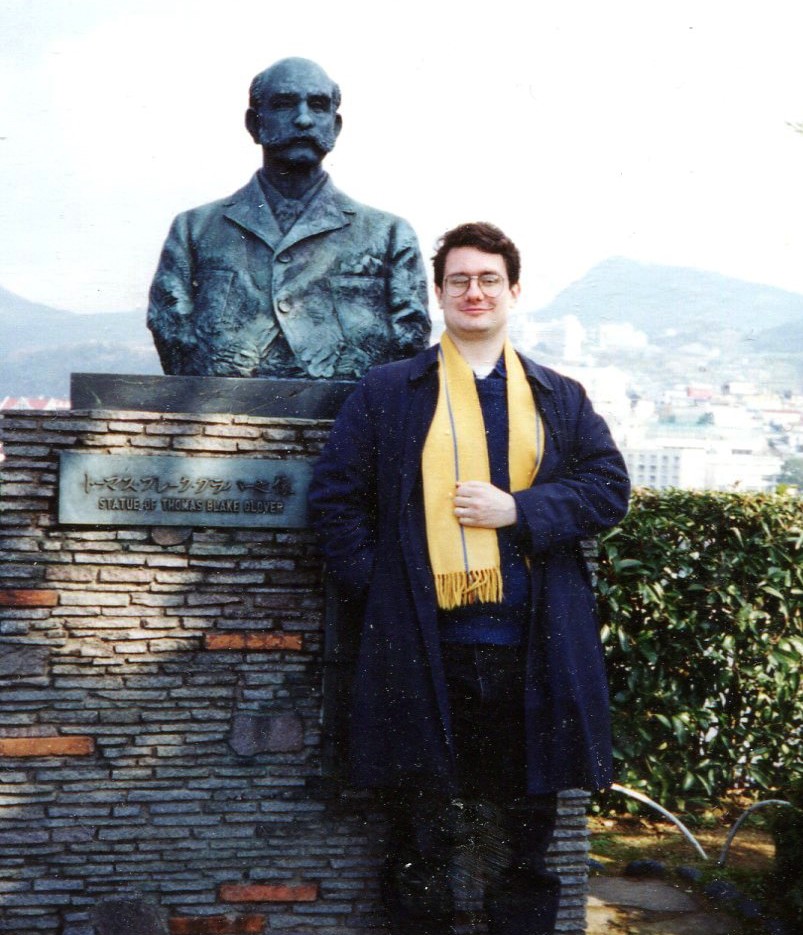
Among the places we went on Christmas Day 1993 was Glover Garden in Nagasaki. Among the things you can find at Glover Garden — which is best known for the Glover House, though I don’t seem to have any images of it — is a bust of Thomas Blake Glover (1838-1911). Naturally I had to pose beside it.

Glover Park 1993Glover was a Scotsman of considerable talent and ambition who went East. The Japan Times noted on the centenary of his death, in something of a rambling article: “When he arrived in Nagasaki in 1859, aged 21, Glover was at first allotted accommodation in the city’s concessions area, called Dejima, where he would soon build up a mini-empire of real estate. In 1861, he founded Glover Trading Co. (Guraba-Shokei) to deal illegally… in ships and weapons with the rebellious Satsuma and Chosu clans in Kyushu and the Tosa from Shikoku, who were all bridling in those tumultuous times against the policies of the so-called bakufu government of the shogunate.”

That is, he was one of the foreign merchants that helped overthrow the Tokugawa shogunate. As you’d expect, after the Meiji Restoration, he profited mightily as a businessman in the new Japan as he helped the new rulers — his old allies — industrialize the nation.

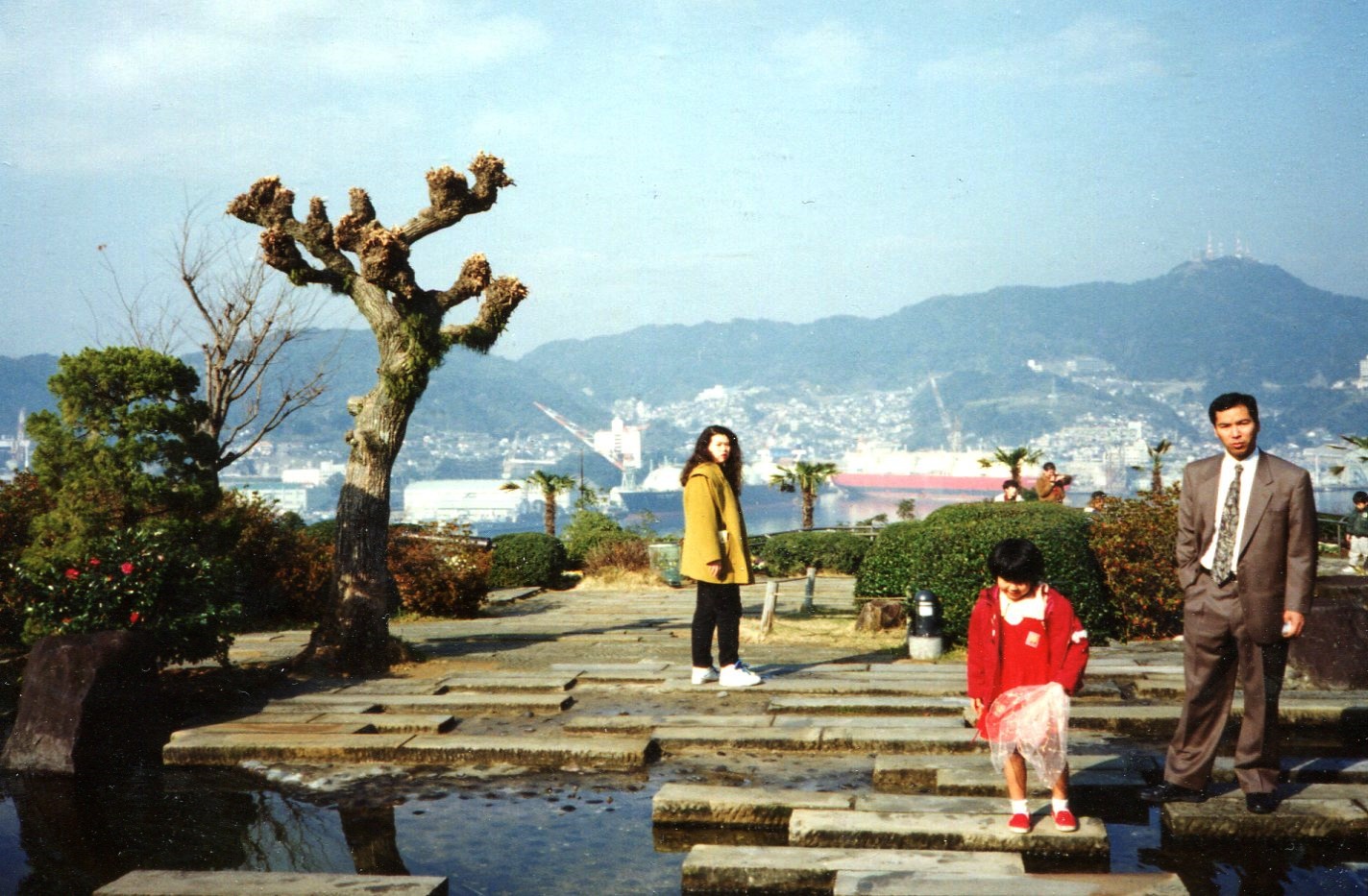
The garden overlooks Nagasaki Harbor. This view shows how hilly the surrounding terrain is. I don’t have any idea who the man or the child are.
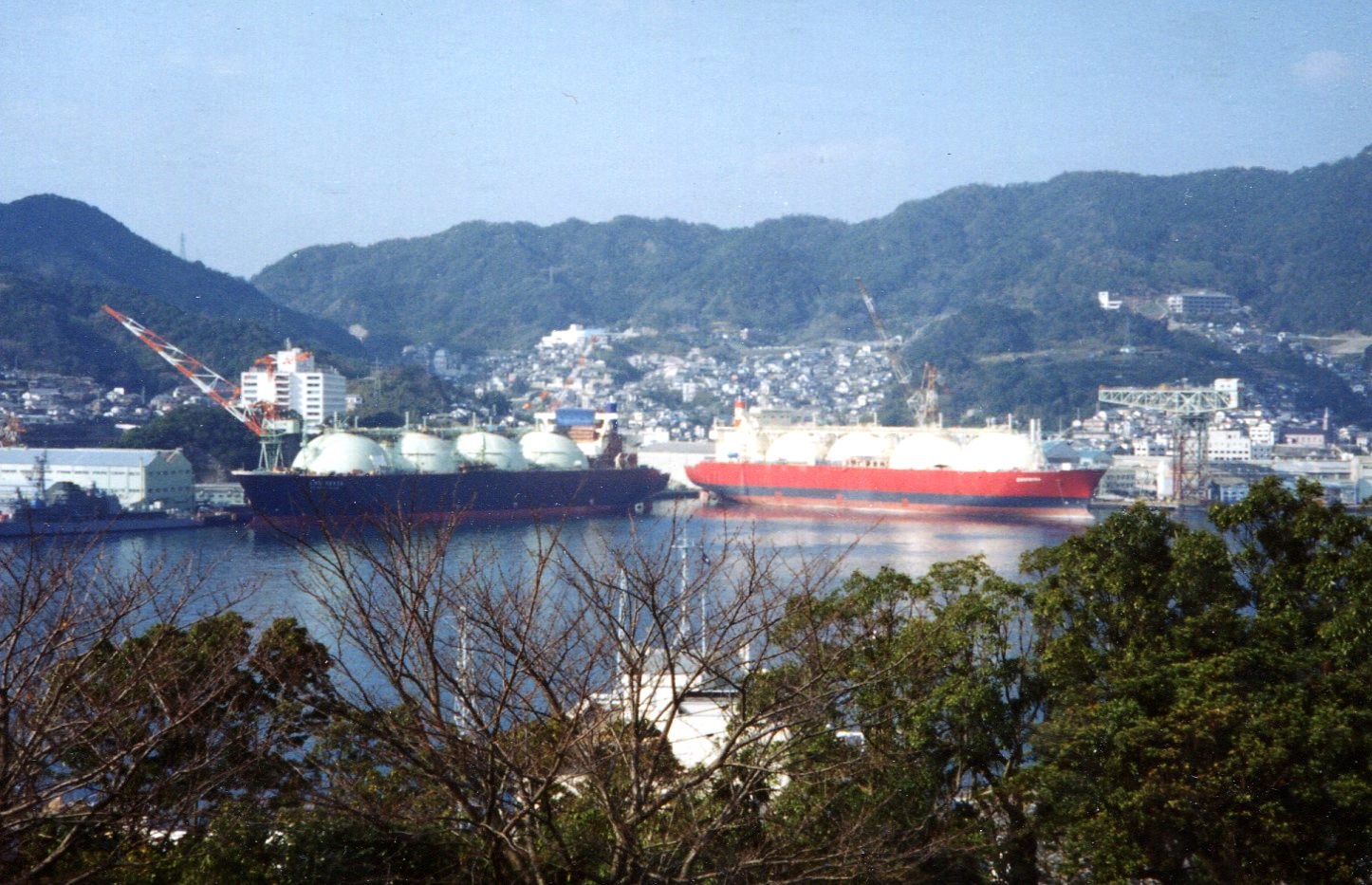
Glover Park 1993A closer view of Nagasaki Harbor.
Glover Park 1993Looks like a couple of liquefied natural gas tankers were in port at the time. Not something that Glover would have ever seen from that view, but he probably would have appreciated it.

Thursday Bits

A lot of rain on Sunday and then more on Monday, creating a week of puddles and mud as temps never quite made it down to freezing during the day. My kind of winter. No risk of slipping on ice, though I did nearly slip on a patch of mud in the yard the other day.

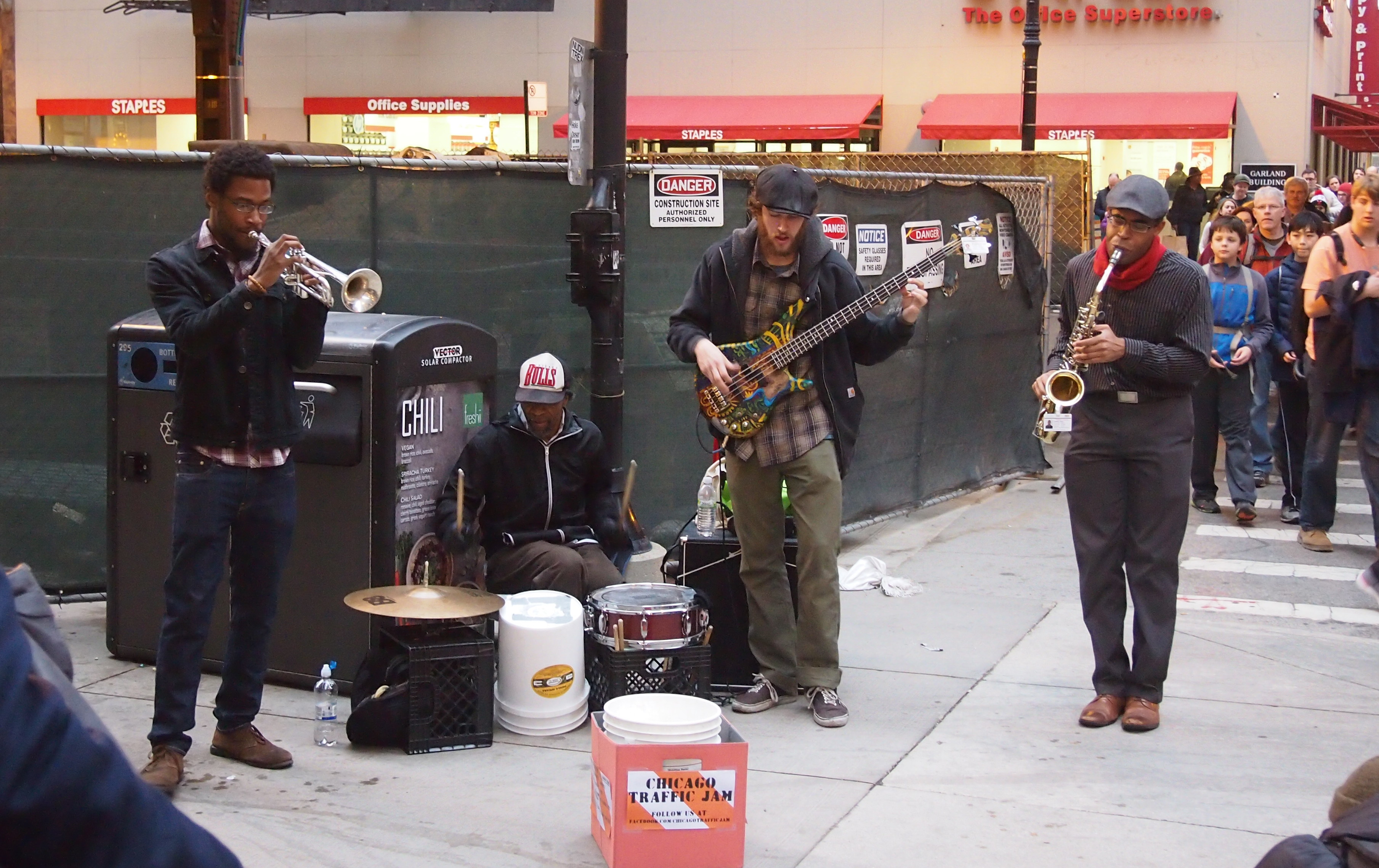
One more picture from Saturday: a street band at the corner of Washington and Wabash who call themselves Chicago Traffic Jam.

Chicago Traffic Jam Dec 12, 2015Jam is right. When we saw them, they were jamming, doing a bang-up job on a ’70s instrumental that I recognized, but couldn’t remember the name of. I pitched a dollar coin in their bucket.

I saw a trailer for Gods of Egypt on YouTube not long ago. From the looks of it, the title’s not quite right. CGI Egypt might be better. Could be one of those movies in which “tell a good story” is about fourth or fifth on the list on the director’s list of things to do, while “make it look badass” is first. Without more information, there’s little chance I’ll spend money to find out. Just another benefit of not being 15 anymore.

Then again, I don’t remember rushing off to any fool movie when I was 15. But the industry was different then.

I missed the obituary of Gene Patton earlier this year, but here it is. RIP, Gene Gene the Dancing Machine. Looks like you had a fun 15 minutes of fame.

Buildings in the Clouds

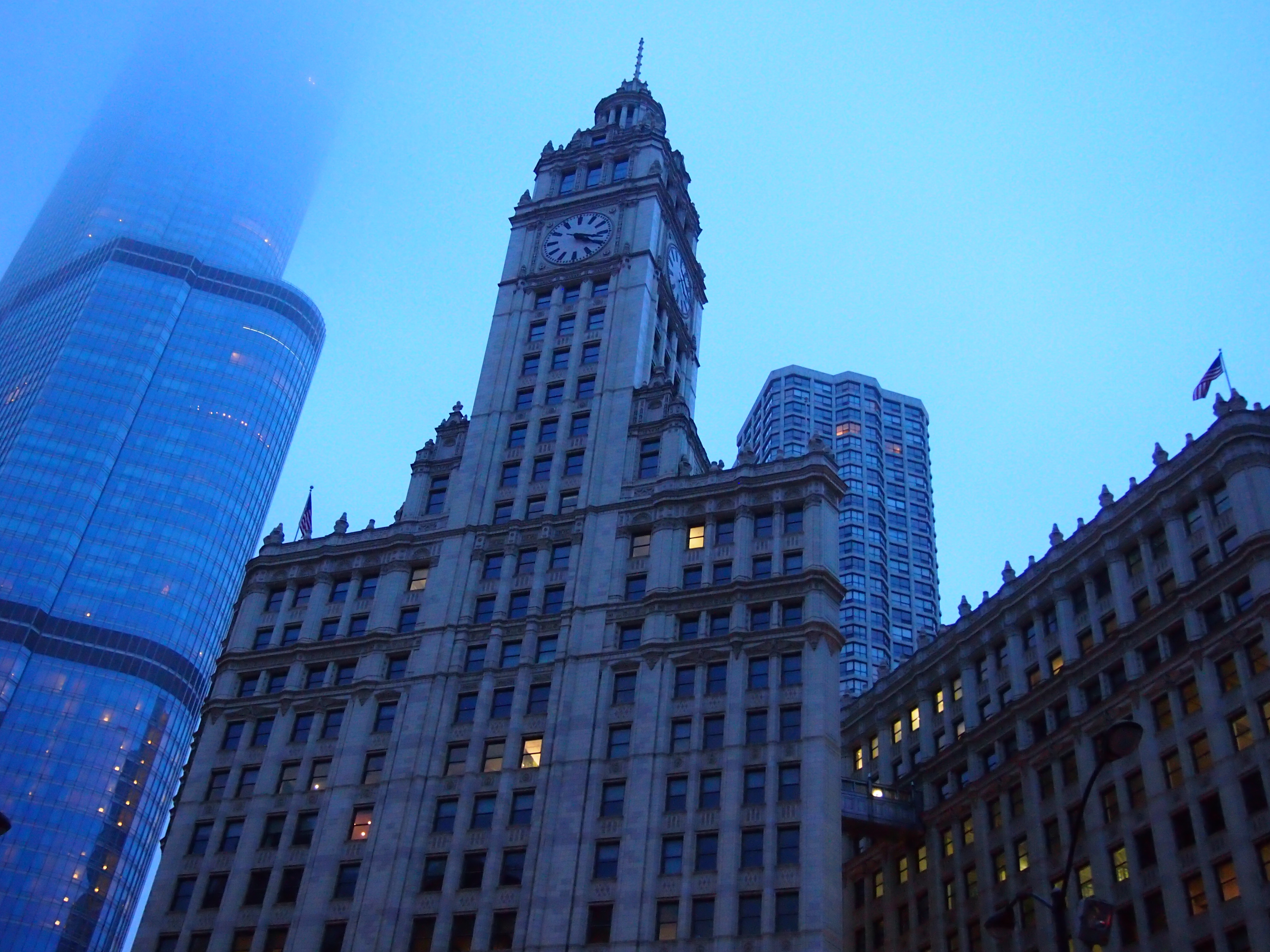
Ann wanted to borrow my camera during part of our walkabout on Saturday, so I lent it to her. She took some good images. Such as the Wrigley Building on Michigan Ave., just as the light faded for the day.
Wrigley Building Dec 12, 2015I’ve read that giant grasshoppers crawled on the building in The Beginning of the End (1957). “You can’t drop an atom bomb on Chicago,” protests a young Peter Graves. That does seem like burning down the house to get rid of the termites, but never mind.

Note the soaring structure beside the Wrigley Building, right up into the clouds. That’s the You-Know-Who Tower, with the name of the property mogul running for president — in classy 20-foot stainless steel letters — slapped on the side facing the Chicago River last year.

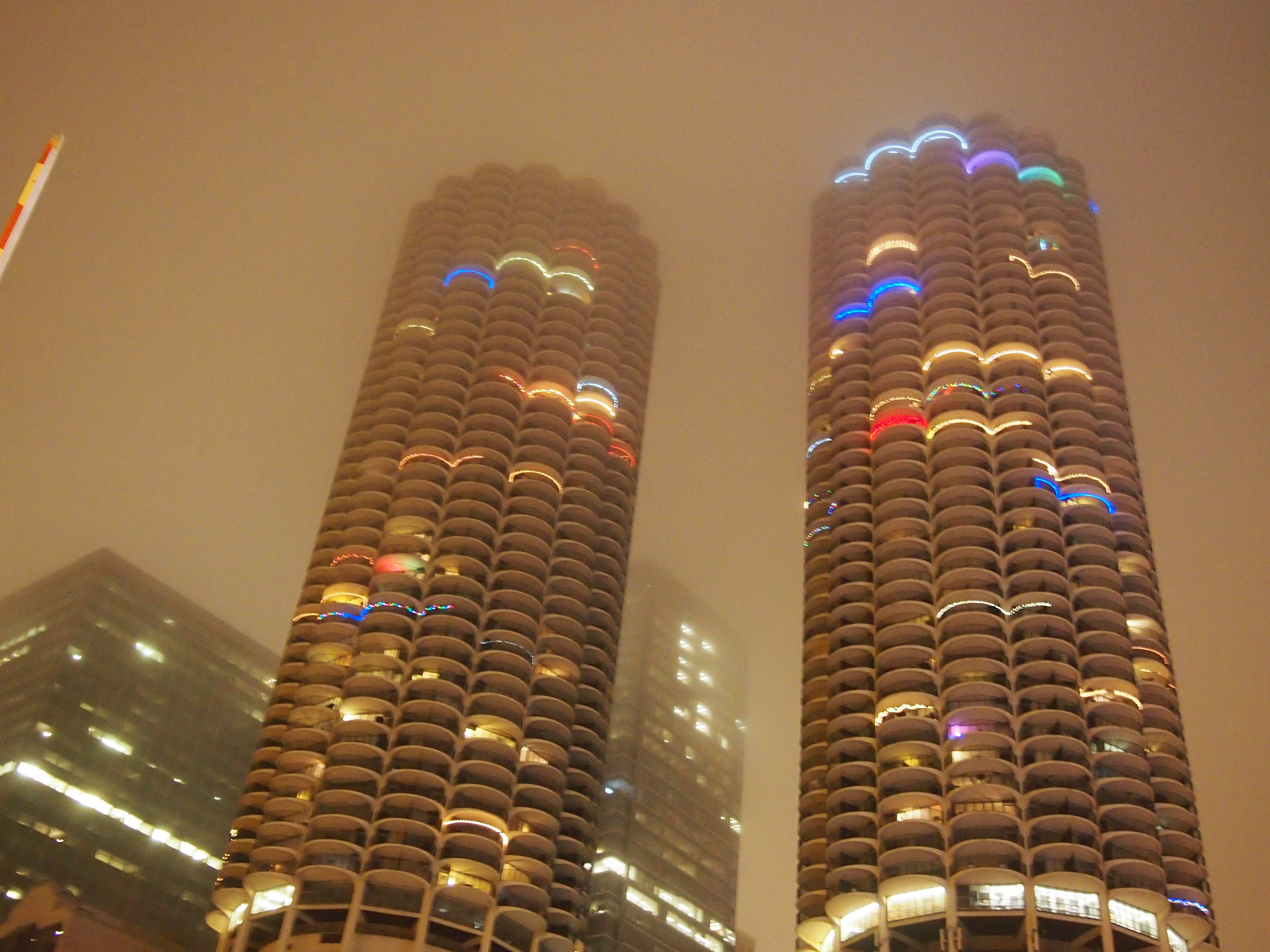
Also reaching into the clouds, as seen from State St.: Marina Towers.

Marina Towers, Dec 12, 2015They too have been in movies, notably The Hunter (1980), which was Steve McQueen’s last picture. I haven’t seen the whole thing, but in the age of YouTube, it’s easy to see just the part in which a car plunges from the towers — which have parking decks on their lower levels — into the Chicago River. The scene was so good that a similar one was created for an insurance commercial, though I have to add that if you’re running from the cops, I doubt that any policy’s going to cover the damage.