Century of Progress, Missent to Kansas City

Had my slip and fall over the weekend. That happens about once per winter. Light snow was falling on Sunday, just enough to cover up a patch of ice waiting for me on a sidewalk. You know how it is. By the time you realize you’re falling, you’re on the ground.

Ann was next to me and helped me to my feet again. I knew I had children for a reason. This time, no bone damage or even bruises or any pain. Sometimes you get lucky.

The risk isn’t over. Until 9 a.m. Tuesday, the NWS says: “Total snow accumulations of 1 to 4 inches expected with highest amounts in the north. Ice accumulations of up to one quarter of an inch possible across portions of Lee, DeKalb, Kane, and DuPage Counties…

“Strong westerly winds are expected to develop Tuesday afternoon and continue Tuesday night. These strong winds may result in blowing snow and may also increase the threat of power outages…”

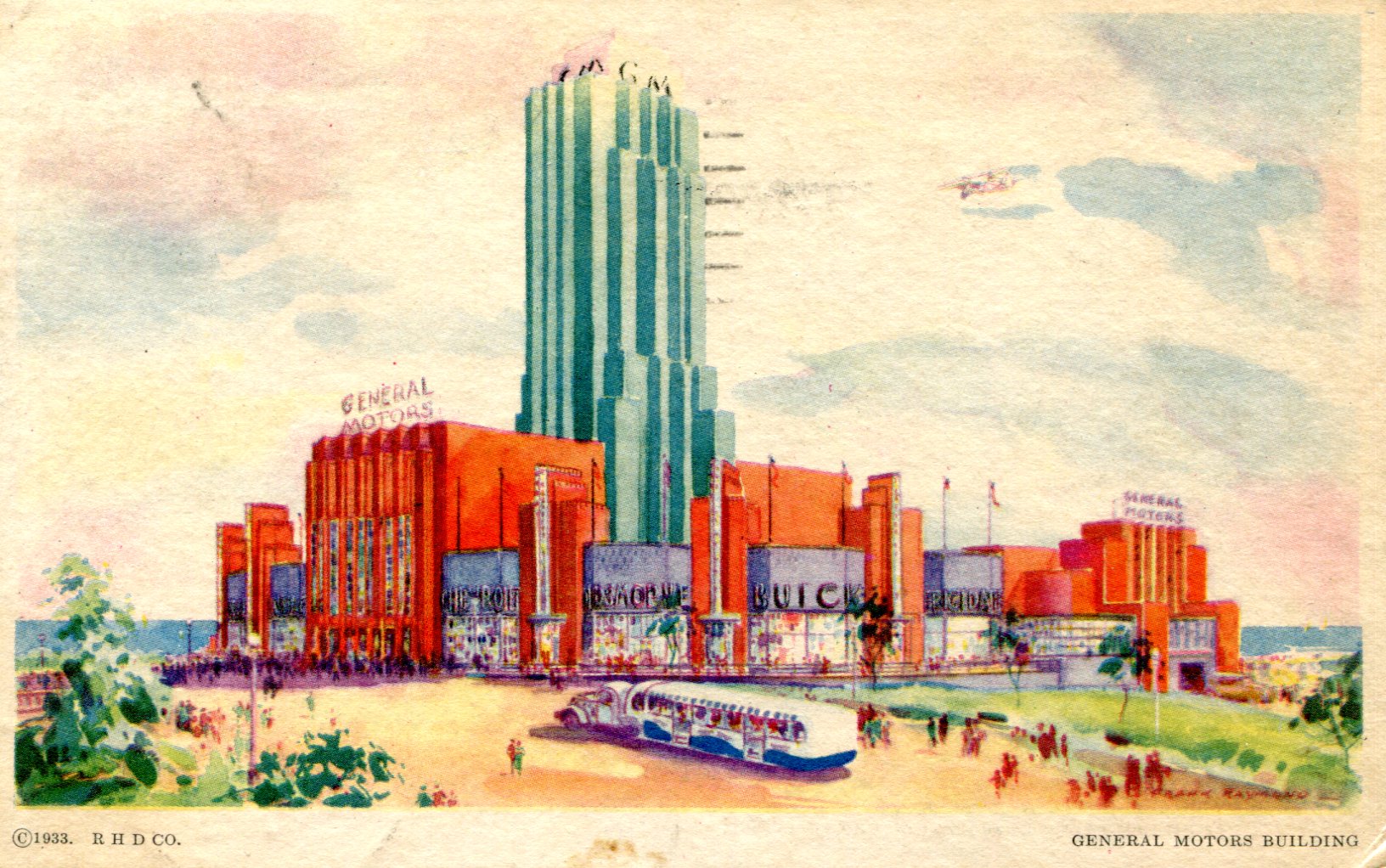
Oh, boy. Days like this, time to dwell on the past. Someone else’s past. At some point during the last few years, I acquired this postcard for a modest sum.
It’s a genuine penny postcard, depicting the General Motors Building at the 1933 world’s fair in Chicago. The Century of Progress Exposition, to use its formal name.

A product of the Reuben H. Donnelley Co., whom I assume was tasked to make cards for the fair. Not, as it turns out, the same entity as R.R. Donnelley Publishing, but a separate company founded by Richard Robert Donnelley’s son, Reuben H. Donnelley. Guess he didn’t want to work for the old man.

The card was mailed from the fair, postmarked 9 p.m. July 17, 1933, a Monday, and sent to a Mrs. A.G. Drew of St. Joseph, Mo. Interestingly, there’s another postmark that says “Missent to Kansas City, July 18, 1933.” Hope the delay wasn’t too long for Mrs. Drew.

When I lived in Osaka, one day I got a beaten up envelope in the mail that had been about three weeks in transit from the United States, or two weeks longer than usual. Stamped on the bottom (in English) was “Missent to Manila.”

Image Adjustments

Not long ago I downloaded a new version of PhotoScape, the program that I use to adjust images. I’d used an earlier version for years, mostly to do simple things, such as crop, adjust sizes and lighten or darken an image.

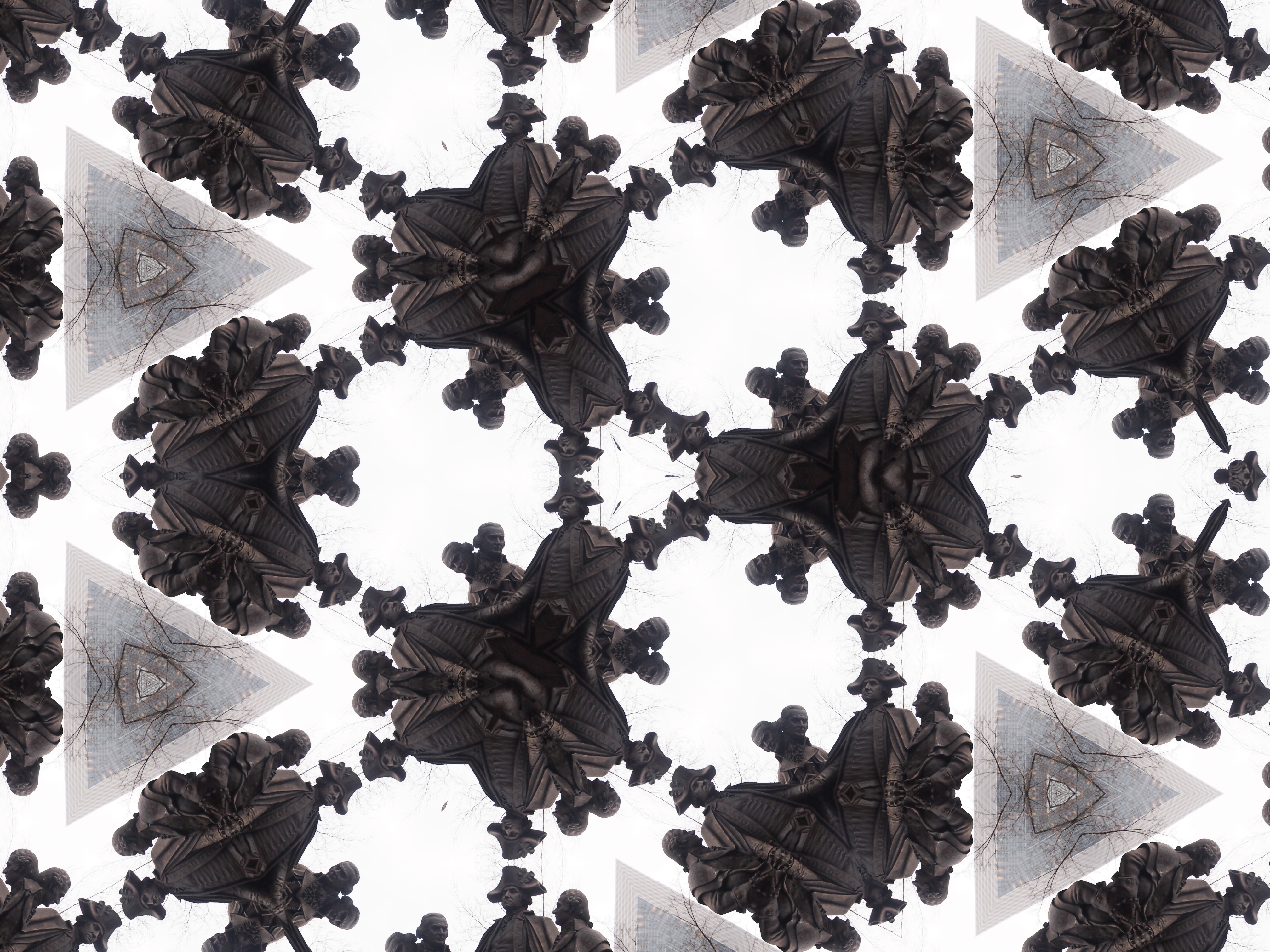
The new version, even the non-premium one, has a lot more bells and whistles. Curious, I decided the other day to play around with some of the added functions. I picked an image from my files for that purpose.

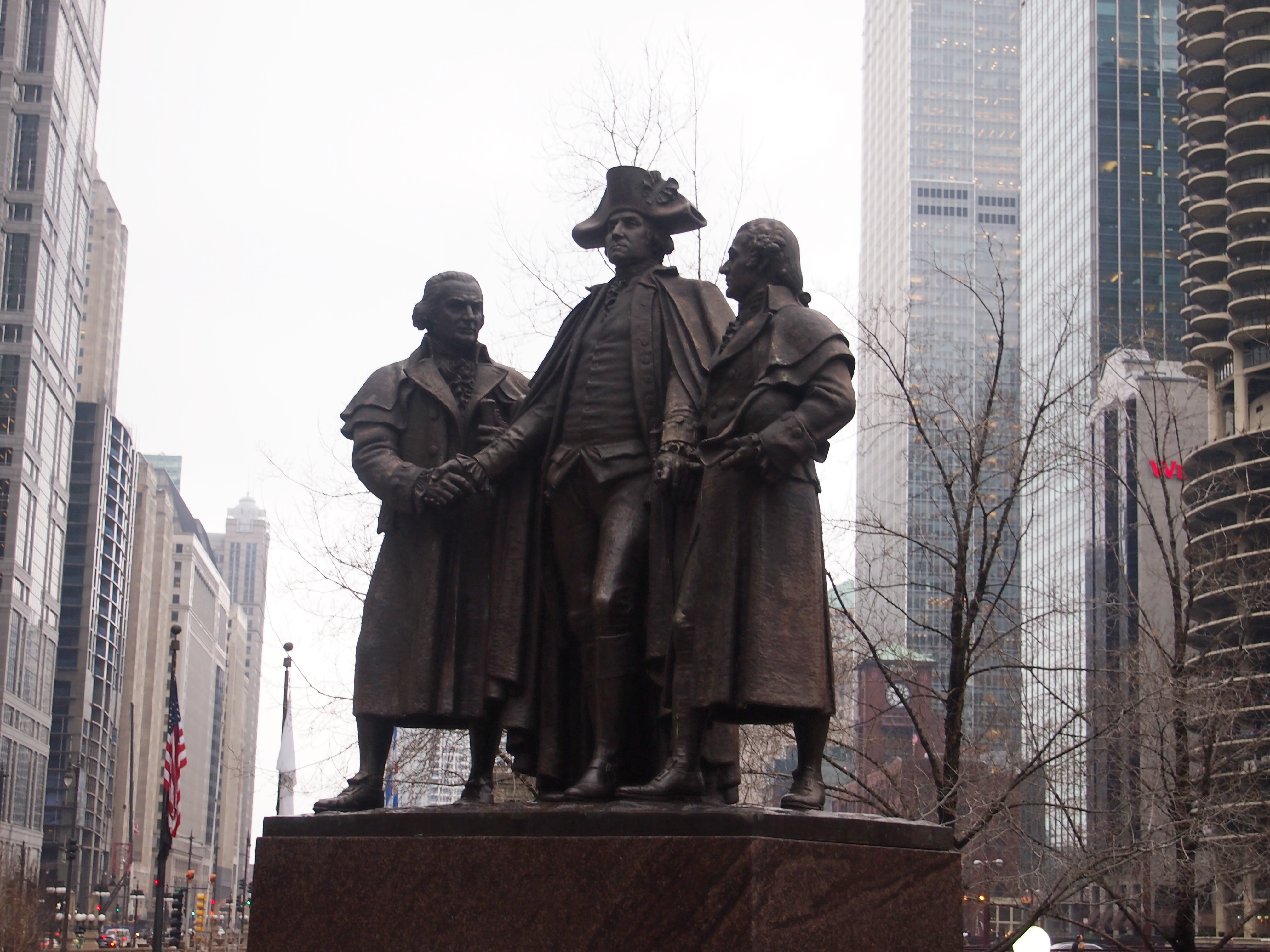
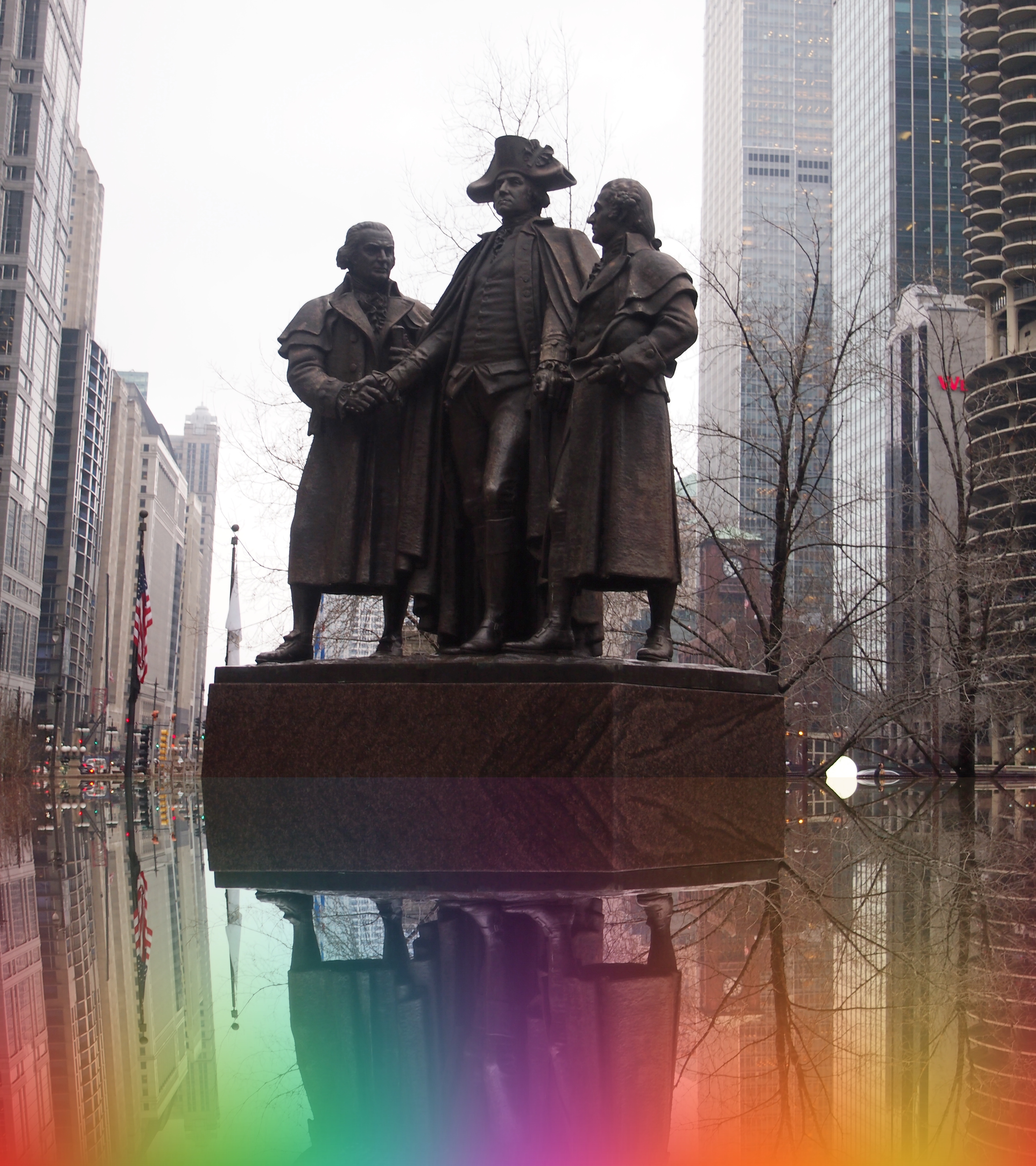
In case the scene isn’t familiar, that’s the Heald Square Monument on E. Wacker Dr. in downtown Chicago, dating from the late 1930s. Prominently placed yet seemingly little noticed. It’s a bronze by the renowned Lorado Taft depicting George Washington and the two main financiers of the American Revolution, Robert Morris and Haym Salomon.

It’s also the kind of thing I take pictures of. I took this one on January 29, 2013. The light wasn’t especially good and in fact I brightened up the above image somewhat. Still a little drab. It was a drab day, I think.

So add a little color. Add a mirror image to the bottom.

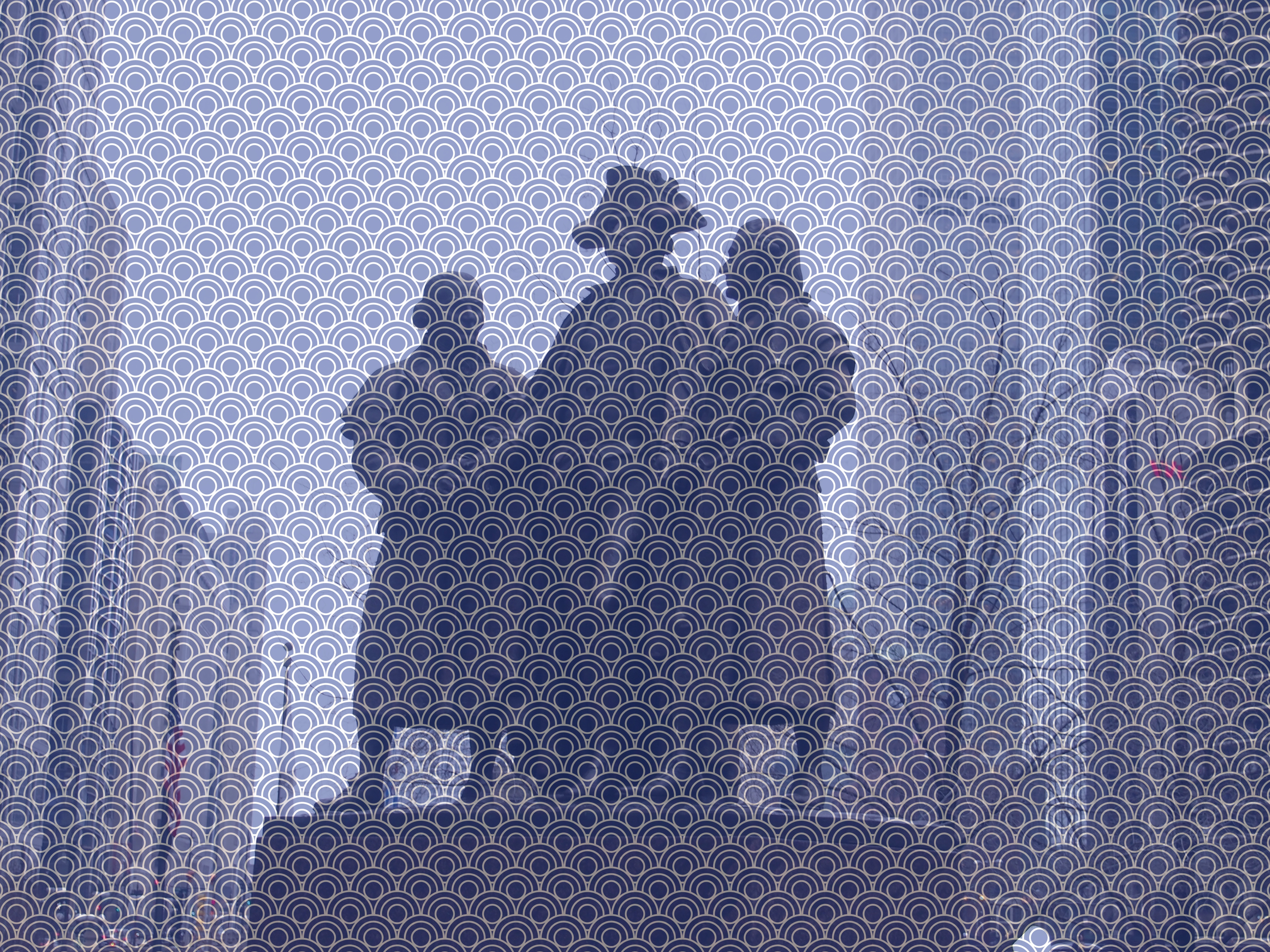
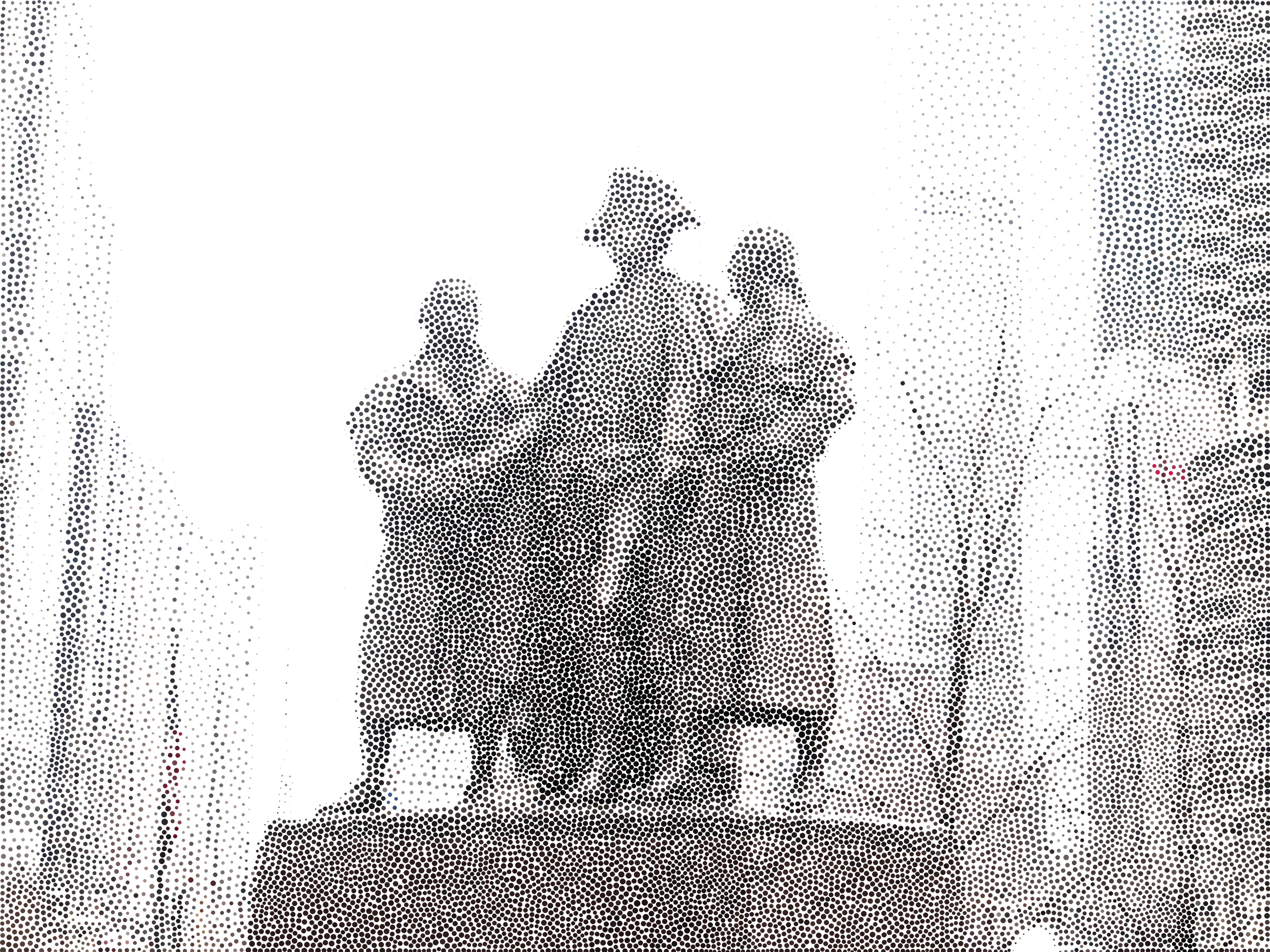
Or do other effects the names of which I forget.
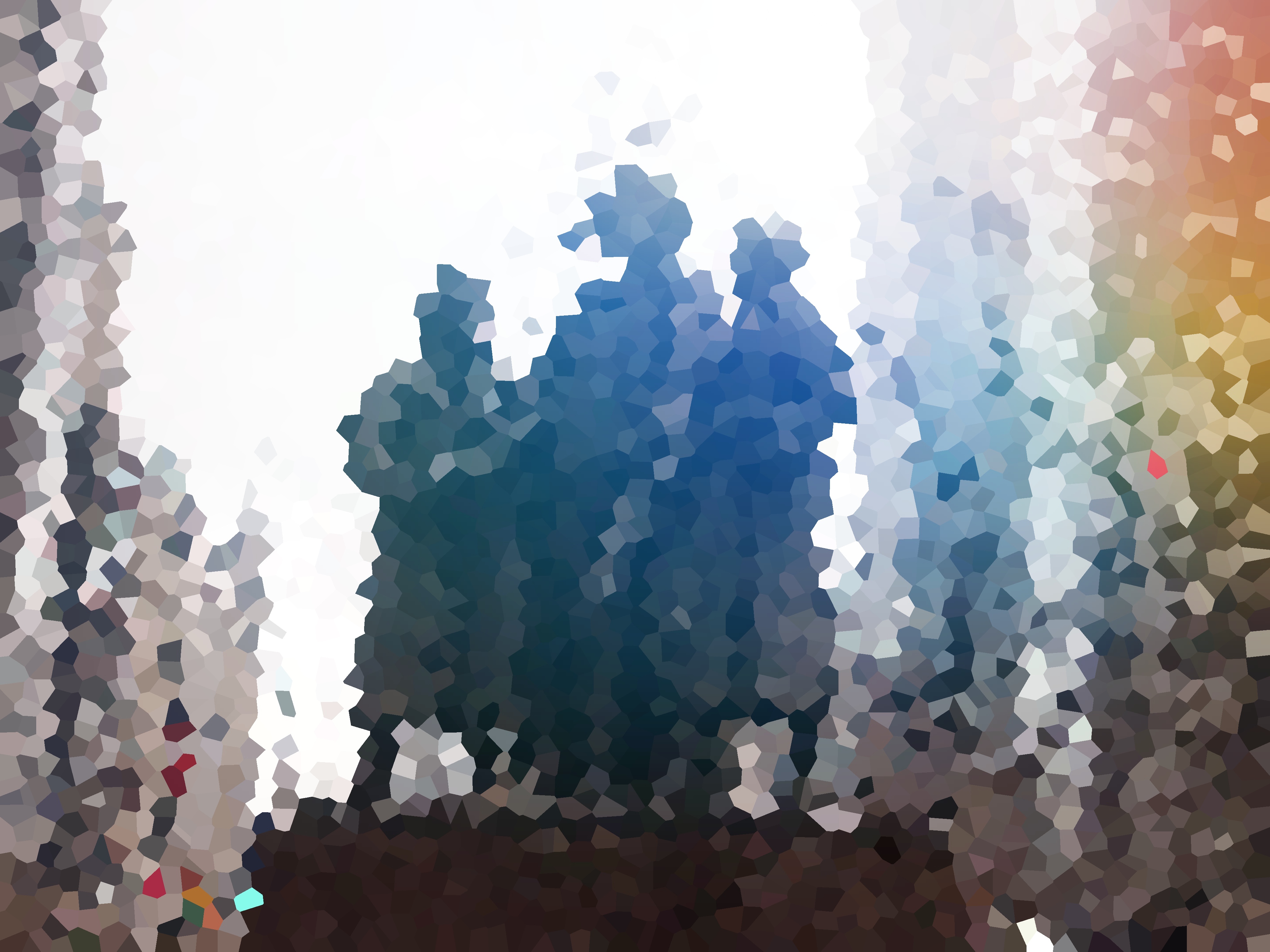
Or finally, my own favorite, kaleidoscope.
That’s only a small sample, not including the functions you have to pay extra for. Interesting.

Titus Andronicus

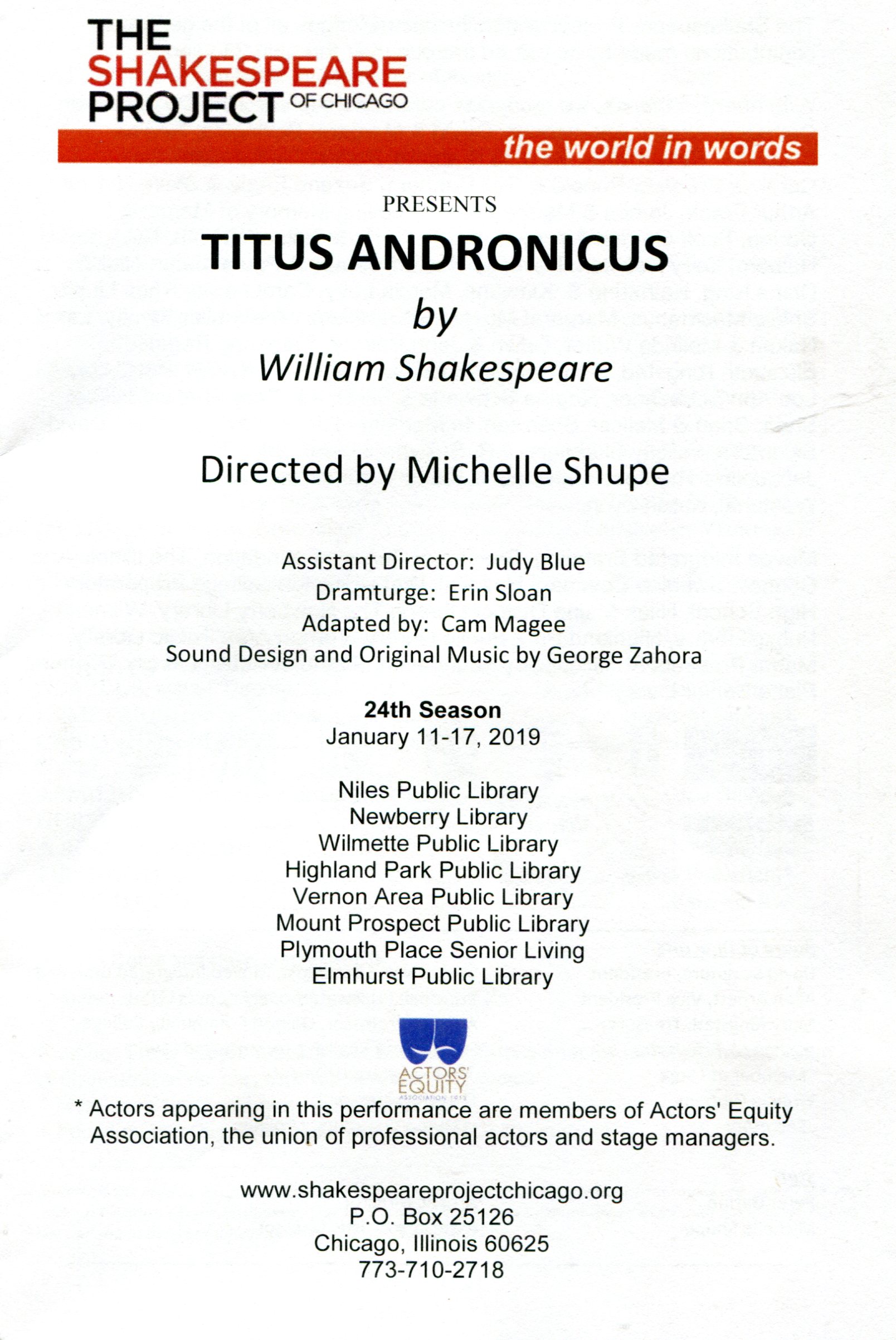
The event we’d gotten up early for on Saturday was a reading of Titus Andronicus at the Newberry Library, done for a few hundred people seated in one of the library’s large rooms. A reading because the actors had scripts with them and there were no sets or much in the way of costumes. But they were good actors and they interacted with each other as if it were a full stage show. So we enjoyed it as much as a standard staging.

Titus Andronicus is an early Shakespeare work, early 1590s, and apparently popular in its time. Later it fell from fashion and has certainly been overshadowed by other Shakespeare plays. After the early 17th century, it wasn’t performed much at all again until the 20th century.

It counts as a revenge play. I can see why. One character is wronged and that sets off a cycle of revenge and more revenge. When Titus Andronicus’ characters seek revenge, things get pretty stabby. The play’s got it all: hate, betrayal, rape, a lot of murder, mutilation, decapitation, even a touch of cannibalism.

I can’t say that the play’s exactly back in fashion, but 21st-century audiences have no shortage of the old ultraviolence in our entertainment, so Titus Andronicus fits right in. Quentin Tarantino ought to do a movie version.

Bughouse Square & the Newberry Library in the Snow

You have to like a place nicknamed Bughouse Square. The city of Chicago has just such a place on the Near North Side. I quote at length from the Encyclopedia of Chicago.

“Bughouse Square (from ‘bughouse,’ slang for mental health facility) is the popular name of Chicago’s Washington Square Park, where orators (‘soapboxers’) held forth on warm-weather evenings from the 1910s through the mid-1960s.

“Located across Walton Street from the Newberry Library, Bughouse Square was the most celebrated outdoor free-speech center in the nation and a popular Chicago tourist attraction.

“In its heyday during the 1920s and 1930s, poets, religionists, and cranks addressed the crowds, but the mainstays were soapboxers from the revolutionary left, especially from the Industrial Workers of the World (IWW), Proletarian Party, Revolutionary Workers’ League, and more ephemeral groups.

“Many speakers became legendary, including anarchist Lucy Parsons, ‘clap doctor’ Ben Reitman, labor-wars veteran John Loughman, socialist Frank Midney, feminist-Marxist Martha Biegler, Frederick Wilkesbarr (‘The Sirfessor’), Herbert Shaw (the ‘Cosmic Kid’), the Sheridan twins (Jack and Jimmy), and one-armed ‘Cholly’ Wendorf.”

The Speakers’ Corner of Chicago, it was. But by the 1980s, when I first saw Bughouse Square, whose formal name is Washington Square Park, the place had quieted down. A number of homeless people were always in residence, however temporarily. Considering the way gentrification goes, those ragged souls might be regularly chased away now, a circumstance that would surely disturb the shade of Ben Reitman.

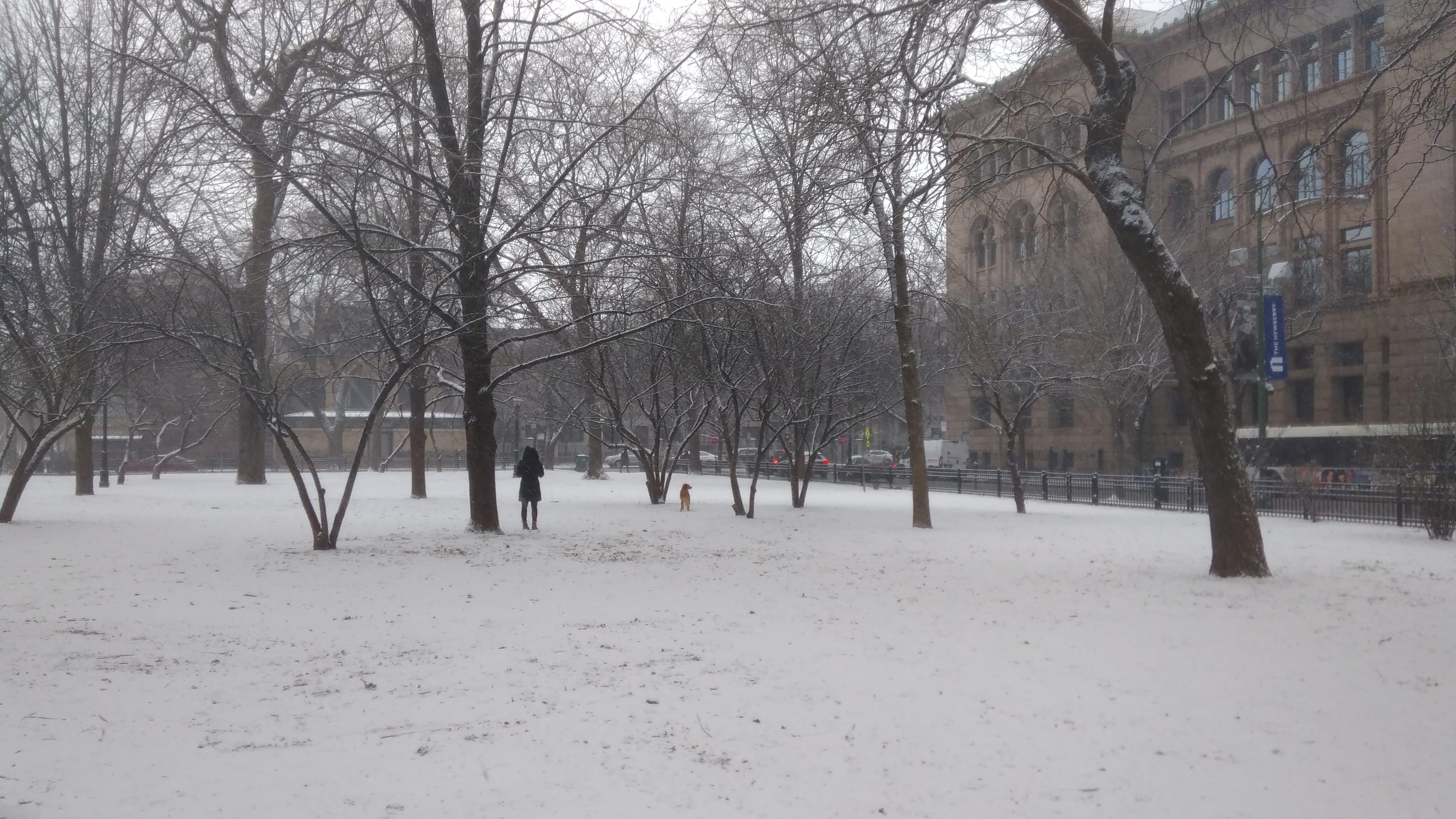
On Saturday morning, snow fell on Bughouse Square and most of the other people we saw there were walking dogs.
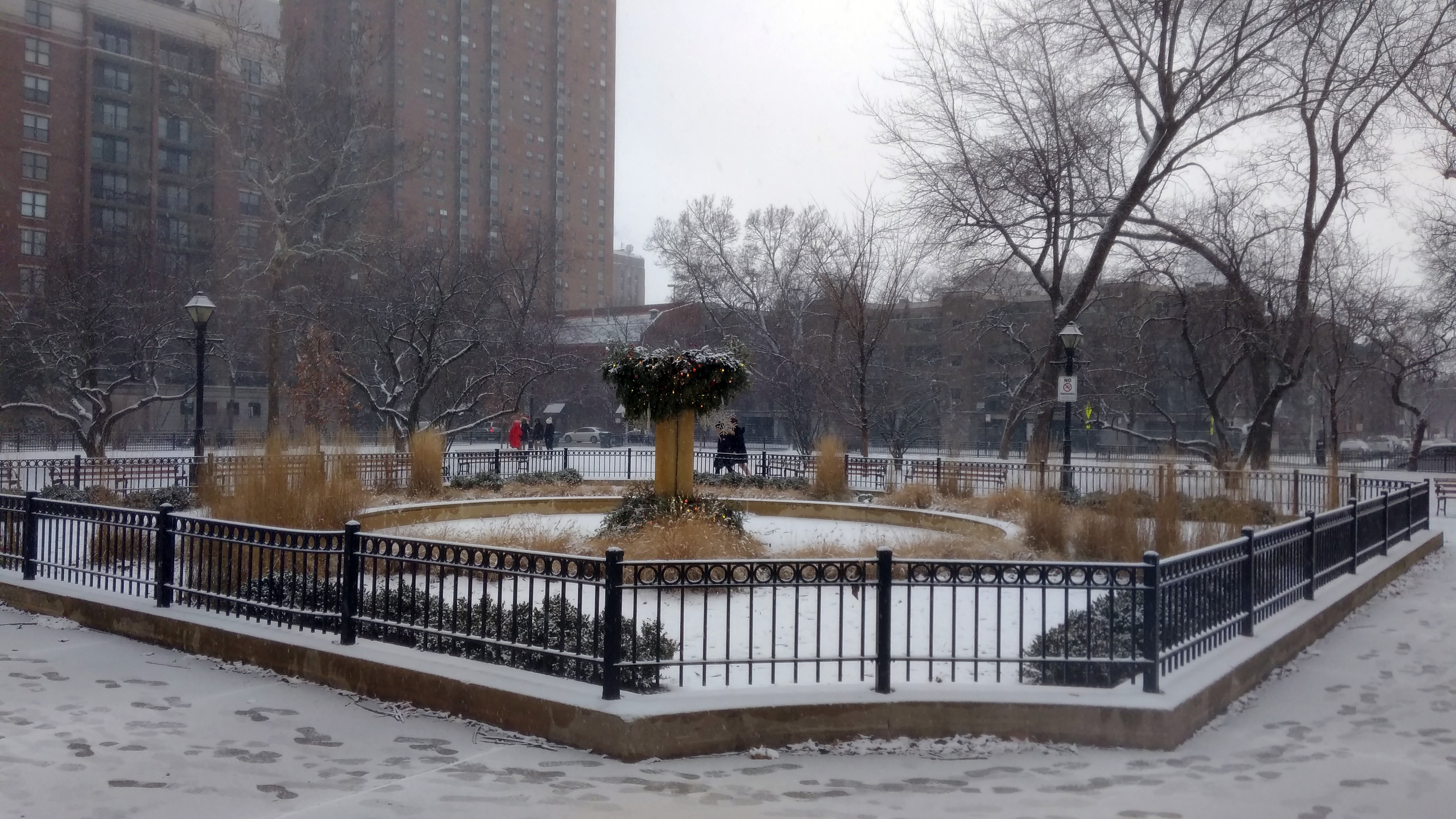
At the center of the square is a modest fountain, a recreation of an early 20th-century fountain on the site.

That morning fairly early, against our usual habit, Ann and I had gotten up and made our way to the city for an event across the street from the square at the Newberry Library.

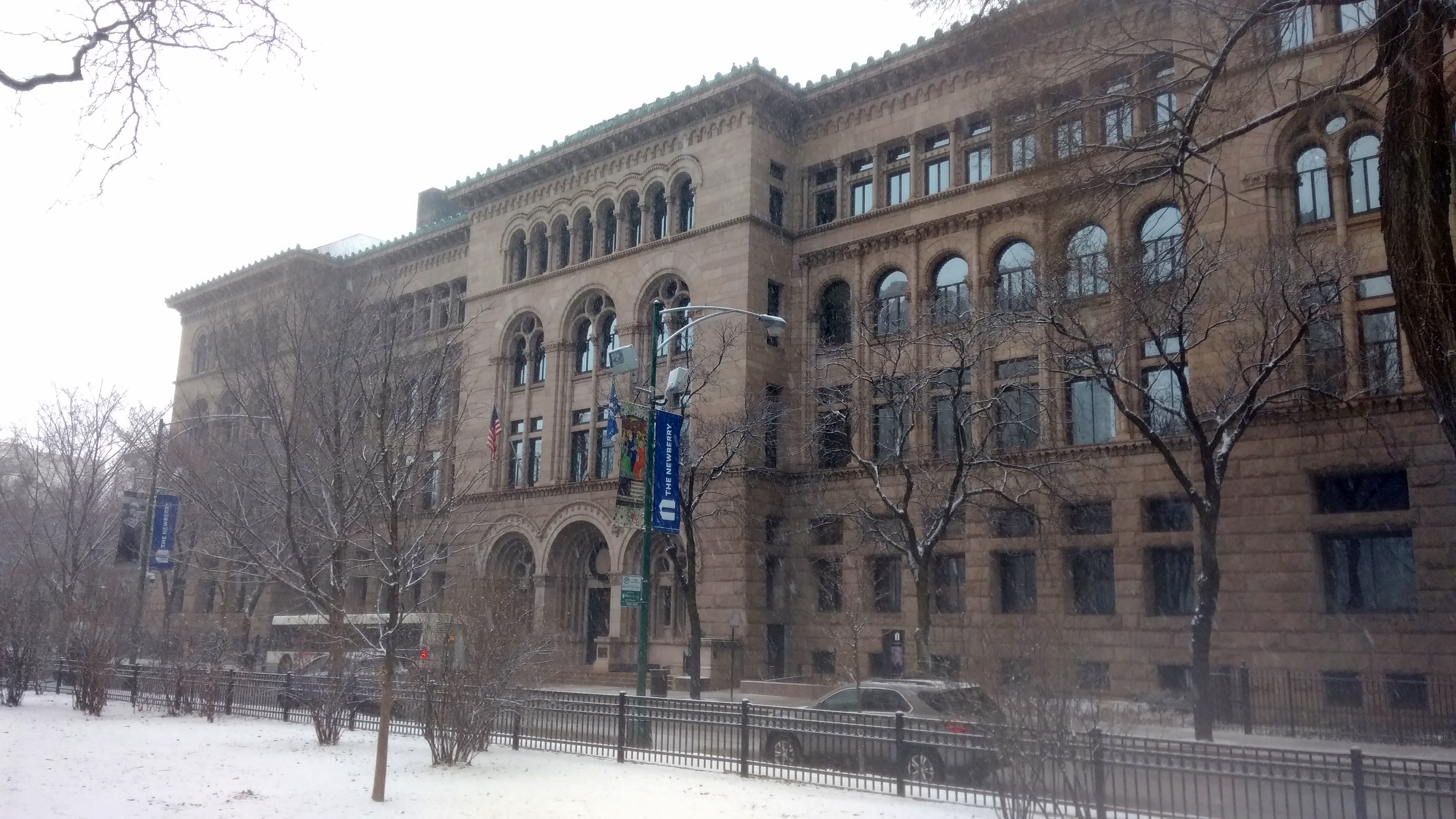
As always, the library’s an impressive pile of stones.

First Thursday Debris of 2019

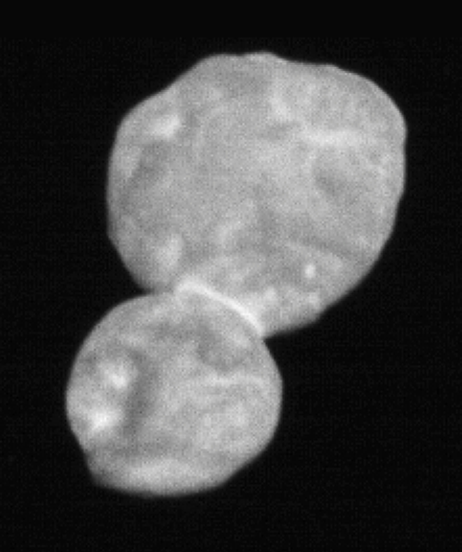
I was glad to hear about the successful flyby of Ultima Thule at the beginning of the year. And to see the public domain photos. Who wouldn’t be?
Not long ago I also read that actual interstellar probes — or what this article terms “precursor” interstellar probes — are under serious consideration by the people who plan robotic space probes.

Space.com: “The APL study — which focuses on a mission that could launch before 2030 and reach 1,000 AU in 50 years — is based on the next extension of what we know we can do, propulsion physicist Marc Millis, founder of the Tau Zero Foundation, said.

” ‘It is a reasonable candidate for the next deep-space mission,’ Millis told Space.com. ‘It is not, however, a true interstellar mission. It is better referred to as an “interstellar precursor” mission.’ ”

After that I had to look up the Tau Zero Foundation. An organization promoting interstellar space flight. There’s a long-term goal we can all get behind.

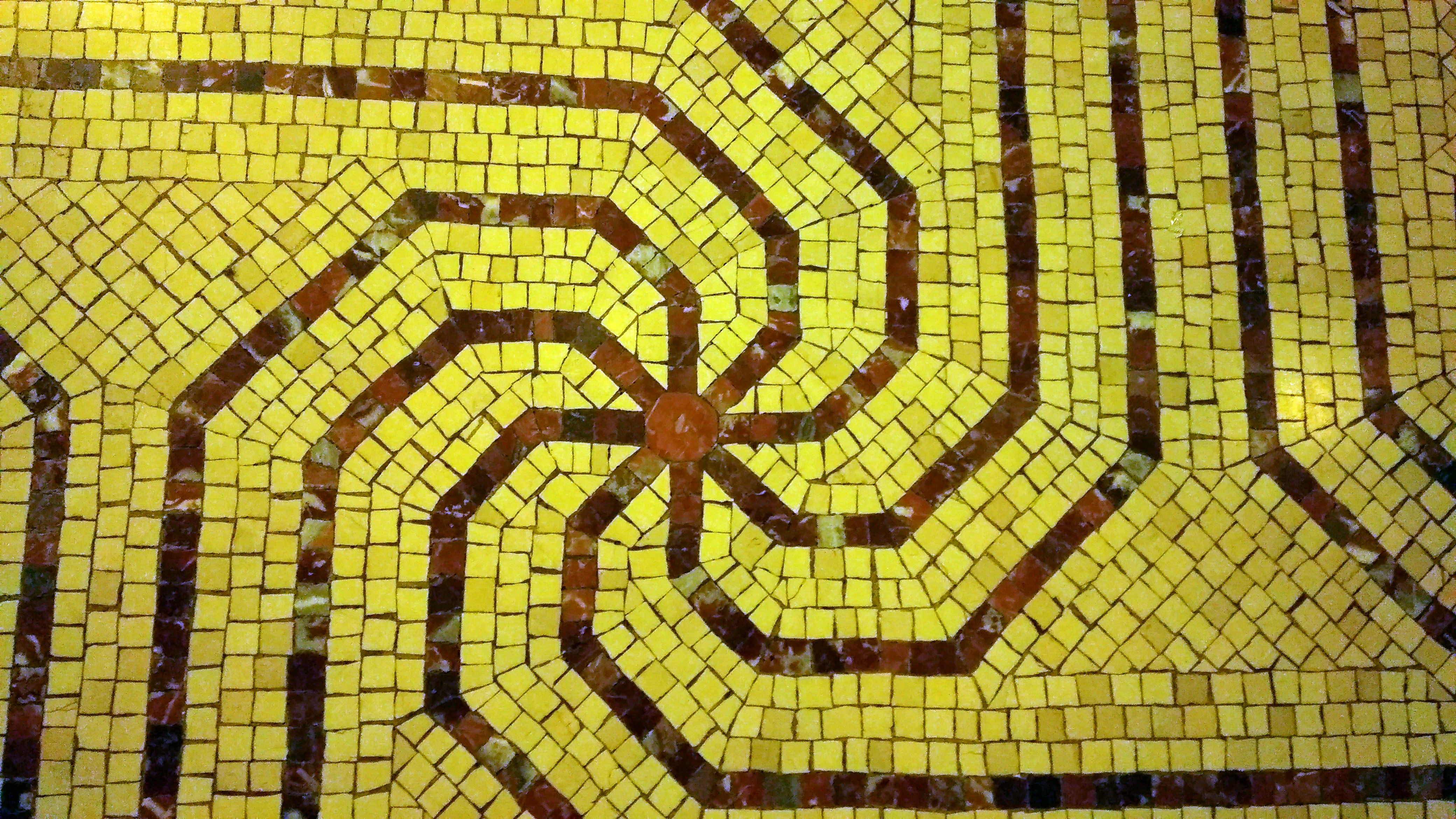
A shot of floor tiles at the Chicago Cultural Center.

Some variation of that pattern can be a symbol for the interstellar ambitions of humanity.

I haven’t given much thought to Brussels sprouts over the years, since I’m not especially fond of them. So I looked down in surprise recently at a grocery store at Brussels sprouts still on the stalk.
There’s something a little otherworldly about the stalks when still in the ground.

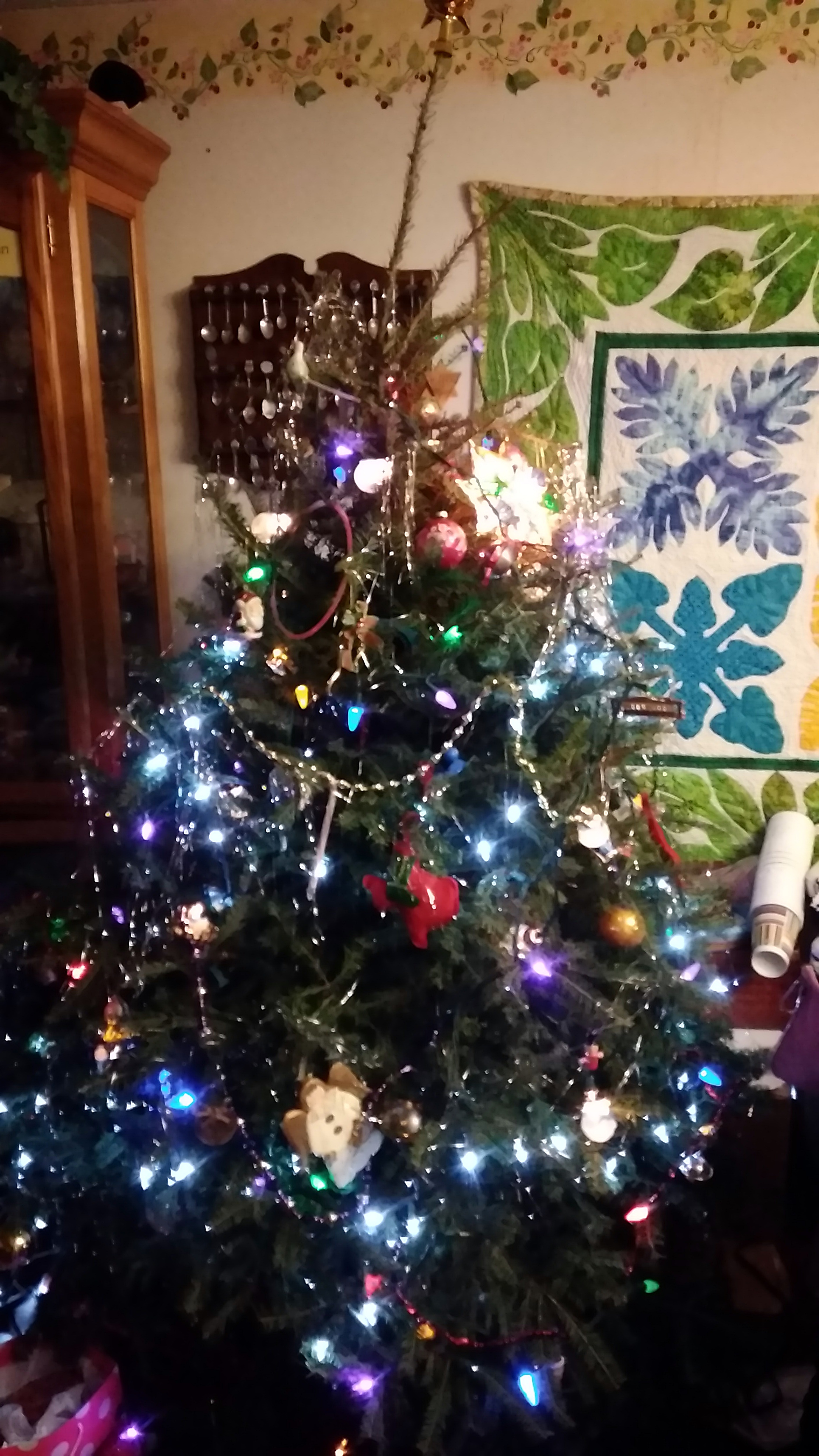
Not the best of images, but I thought I’d take some before the 2018-19 tree gets the heave-ho.
Its last lighting might be tomorrow.

The Pritzker Military Museum

One of the things I wanted to do between Christmas and New Year was visit one of Chicago’s lesser-known museums, ideally one I hadn’t gotten around to. So I went to the Pritzker Military Museum & Library, which is on second and third floors of 104 S. Michigan Ave., overlooking Millennium Park.
Pritzker, as in the Chicago family of billionaires, the architecture prize, and the incoming governor of Illinois. In particular, the museum is a project of retired Col. Jennifer (formerly James) Pritzker of the Illinois Army National Guard, who was also in the U.S. Army for a good many years.

All of the display space — a few rooms on the two floors — is currently given over to the Great War. Fittingly. On display are photos, posters and items carried by WWI soldiers.
There are also a few less conventional items to see.

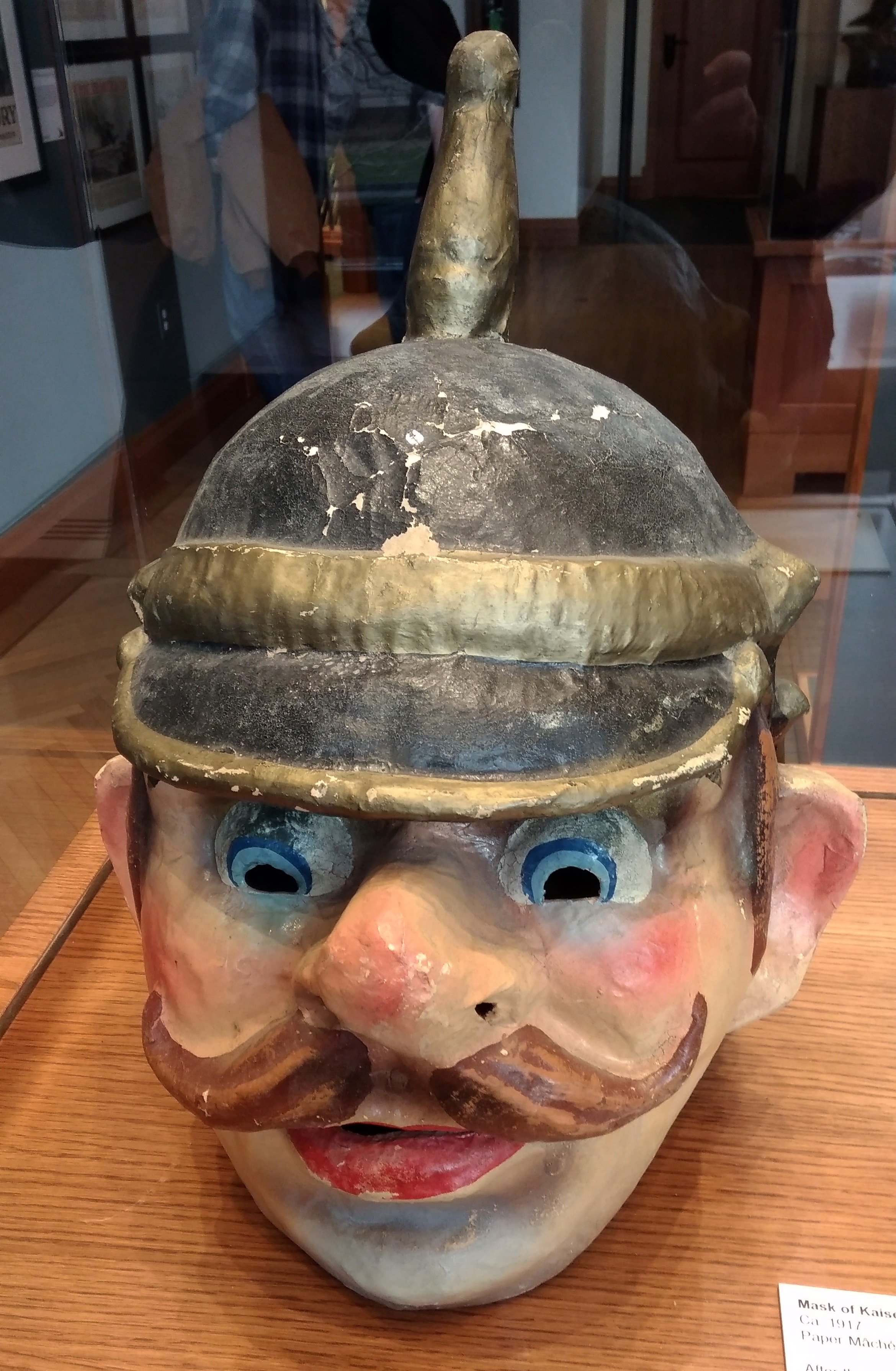
Nothing says Great War like a papier-mâché Kaiser head. According to the sign, “A mask like this one… might have been worn on a float or during a play as a way to mock the German monarch.”

No doubt. What I wonder is how the thing survived 100 years. When the initial fun of Kaiser-mocking died down, did its creator tuck it away in some attic, only to be forgotten for decades? I can imagine some grandson or granddaughter cleaning out that attic in, say, the 1970s, and saying, “What is this? Let’s get rid of it.” But that didn’t happen. Somehow the Kaiser head made its way to the Pritzker, founded only in 2003.

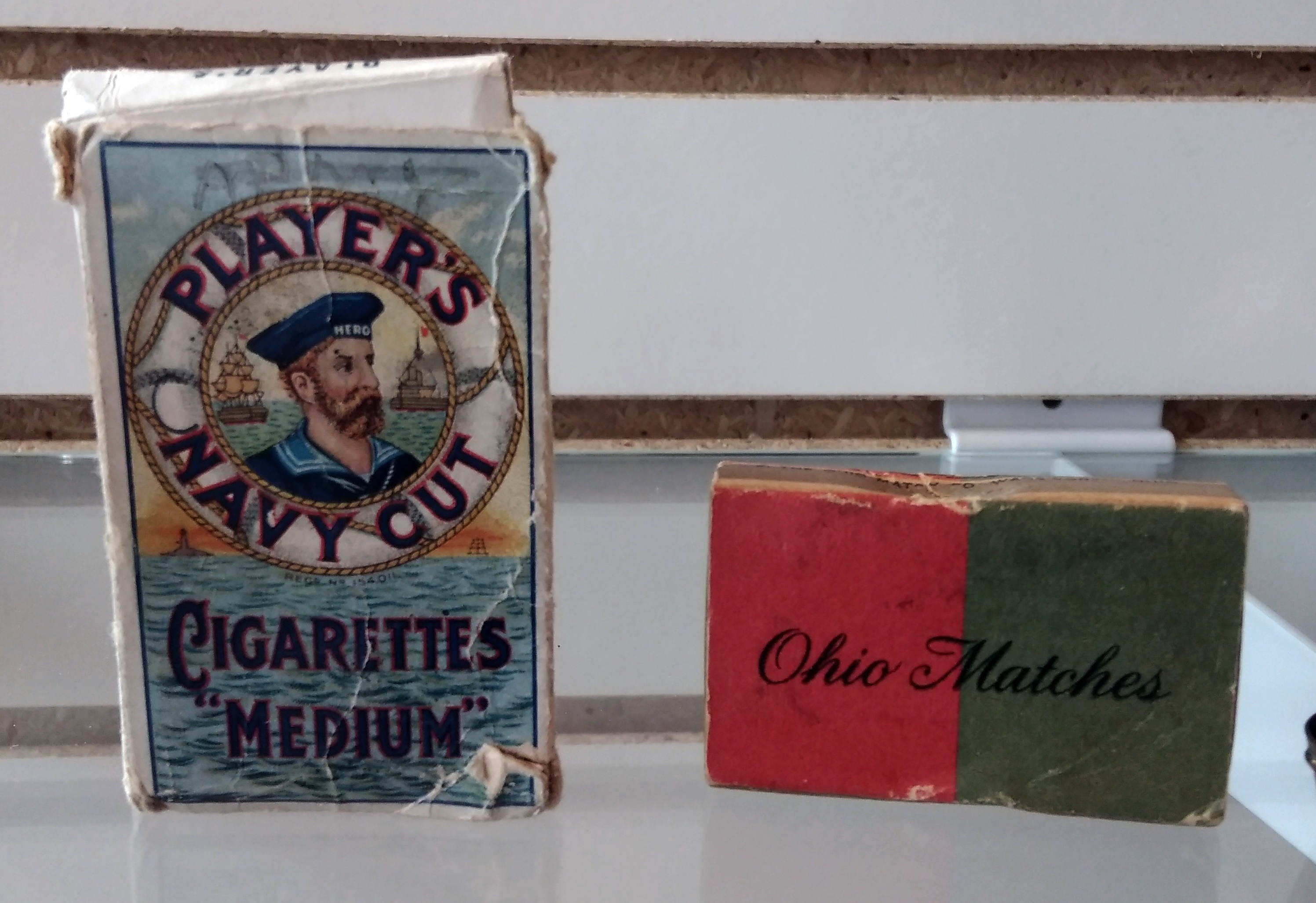
What could be more important to Great War soldiers and sailors than their cigs?

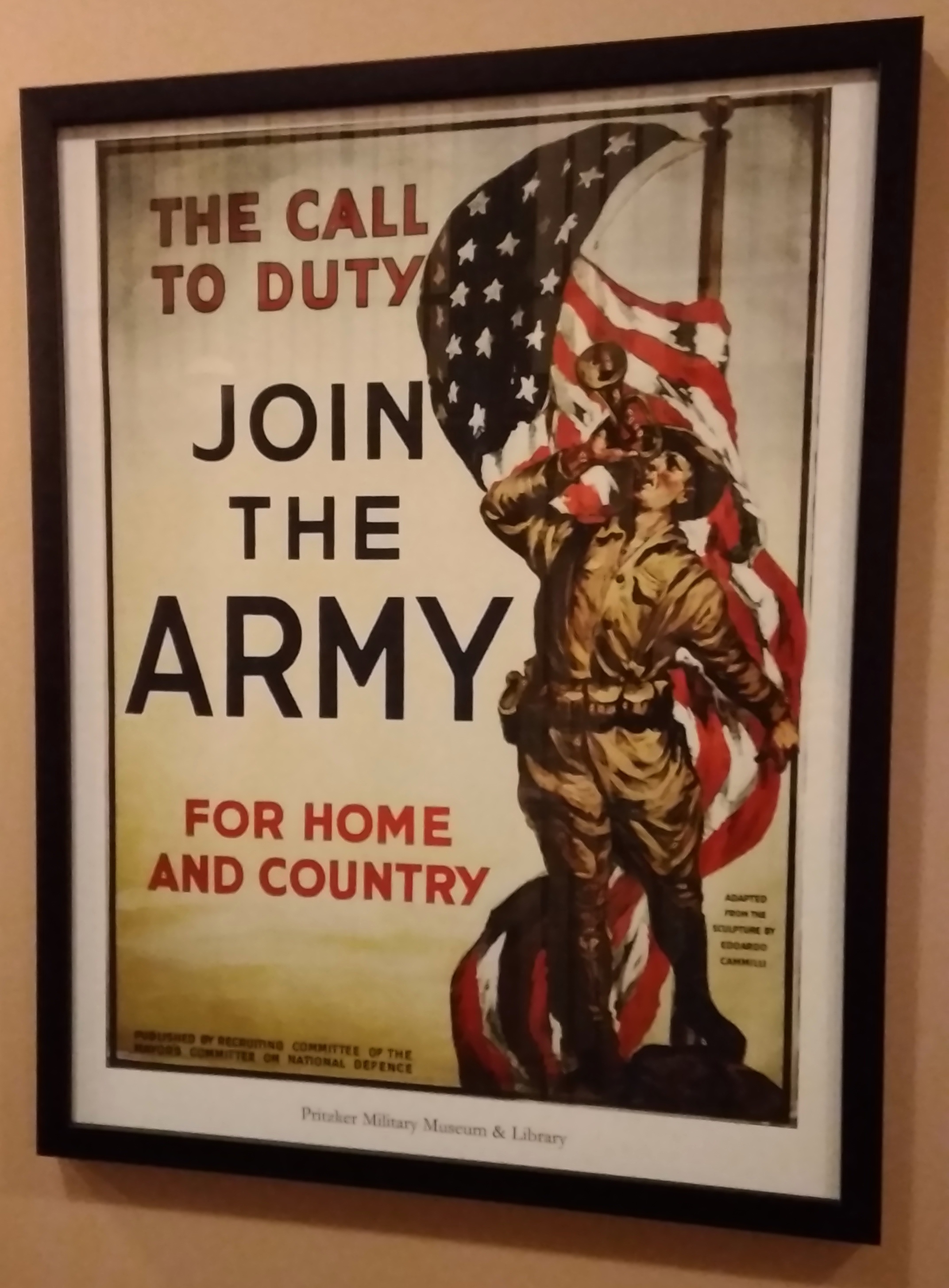
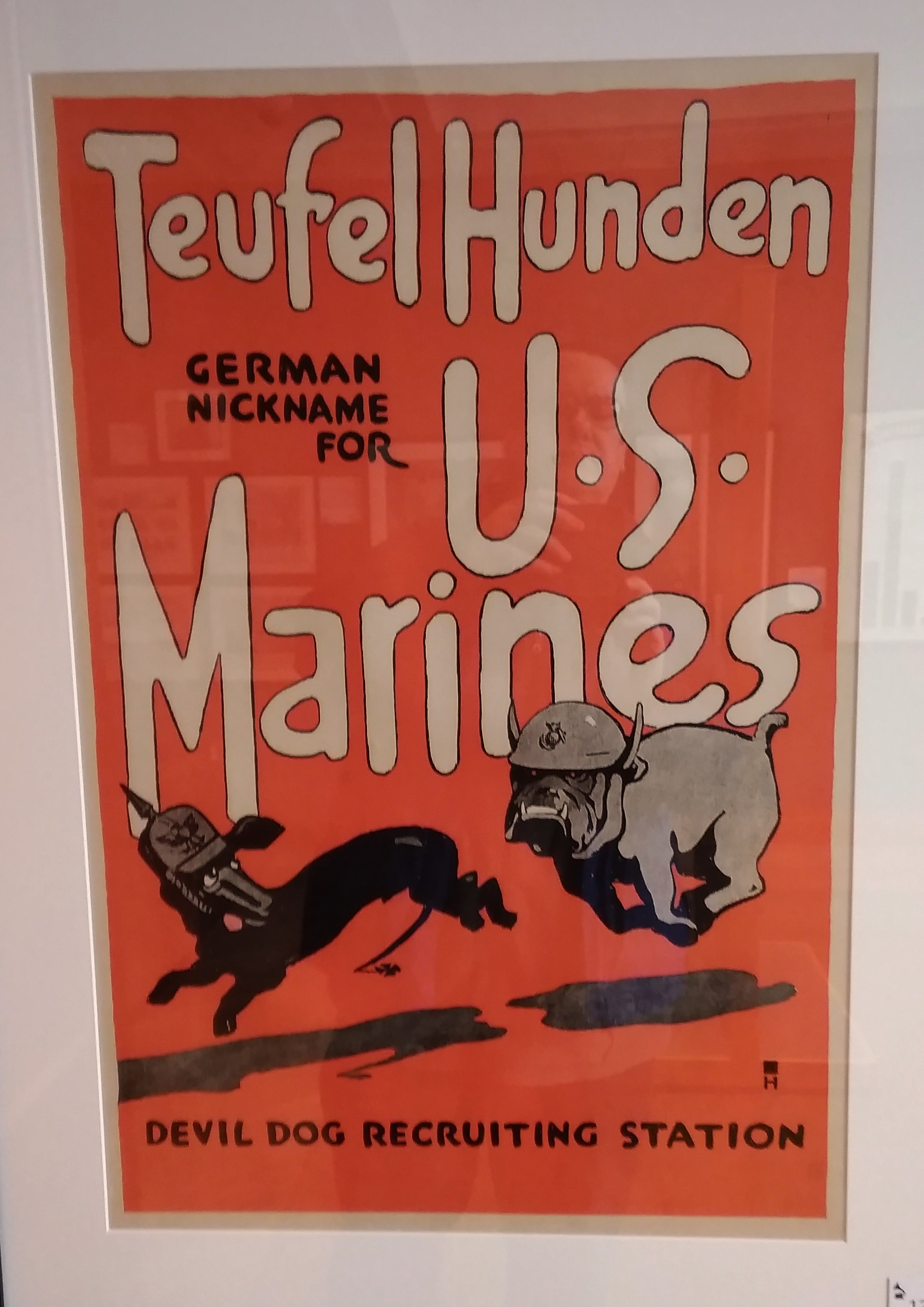
I was especially taken with the collection of posters. Some as conventional as can be.
Some more whimsical.

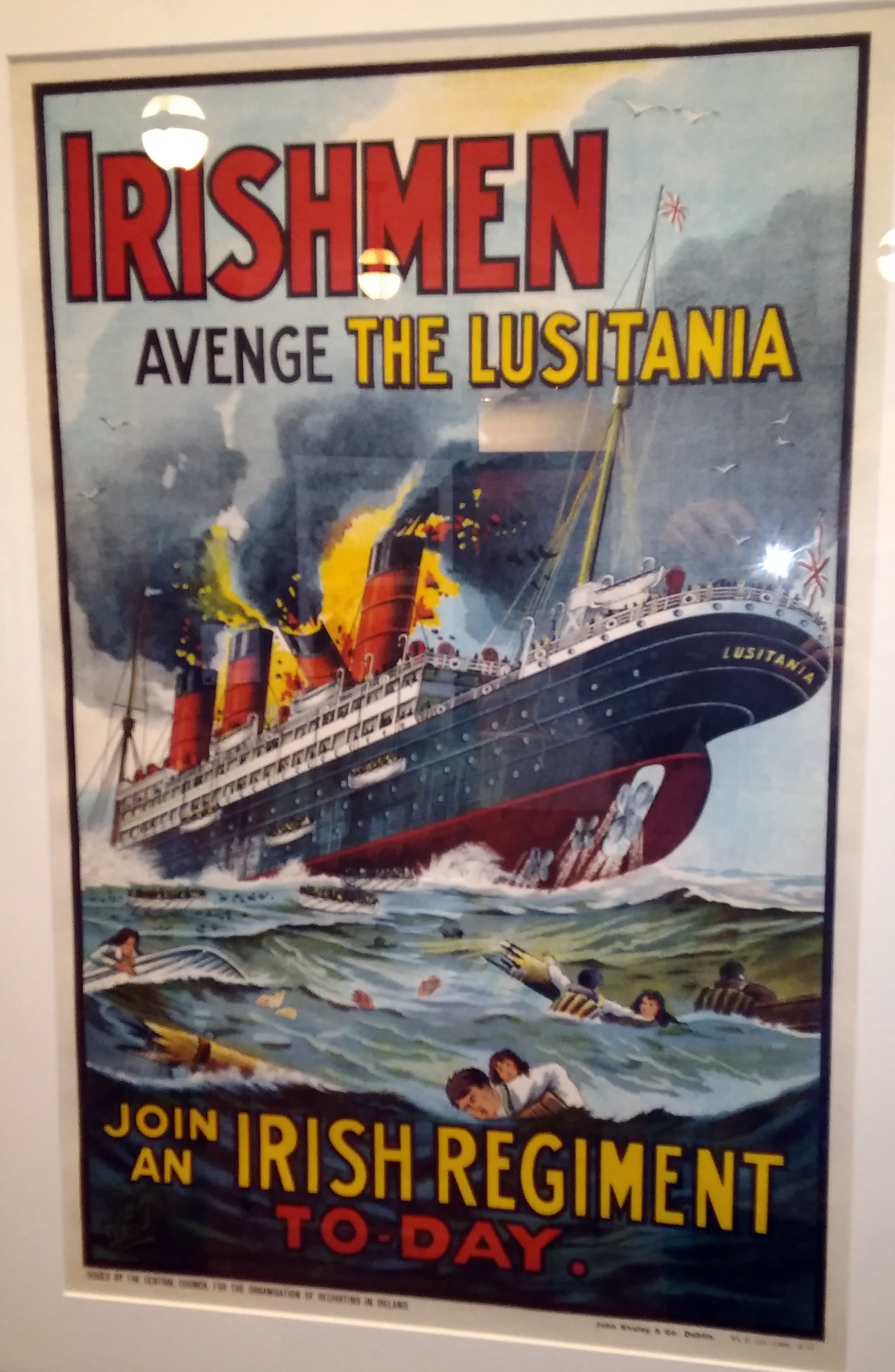
One appealing to ethnic pride and righteous outrage at the same time.
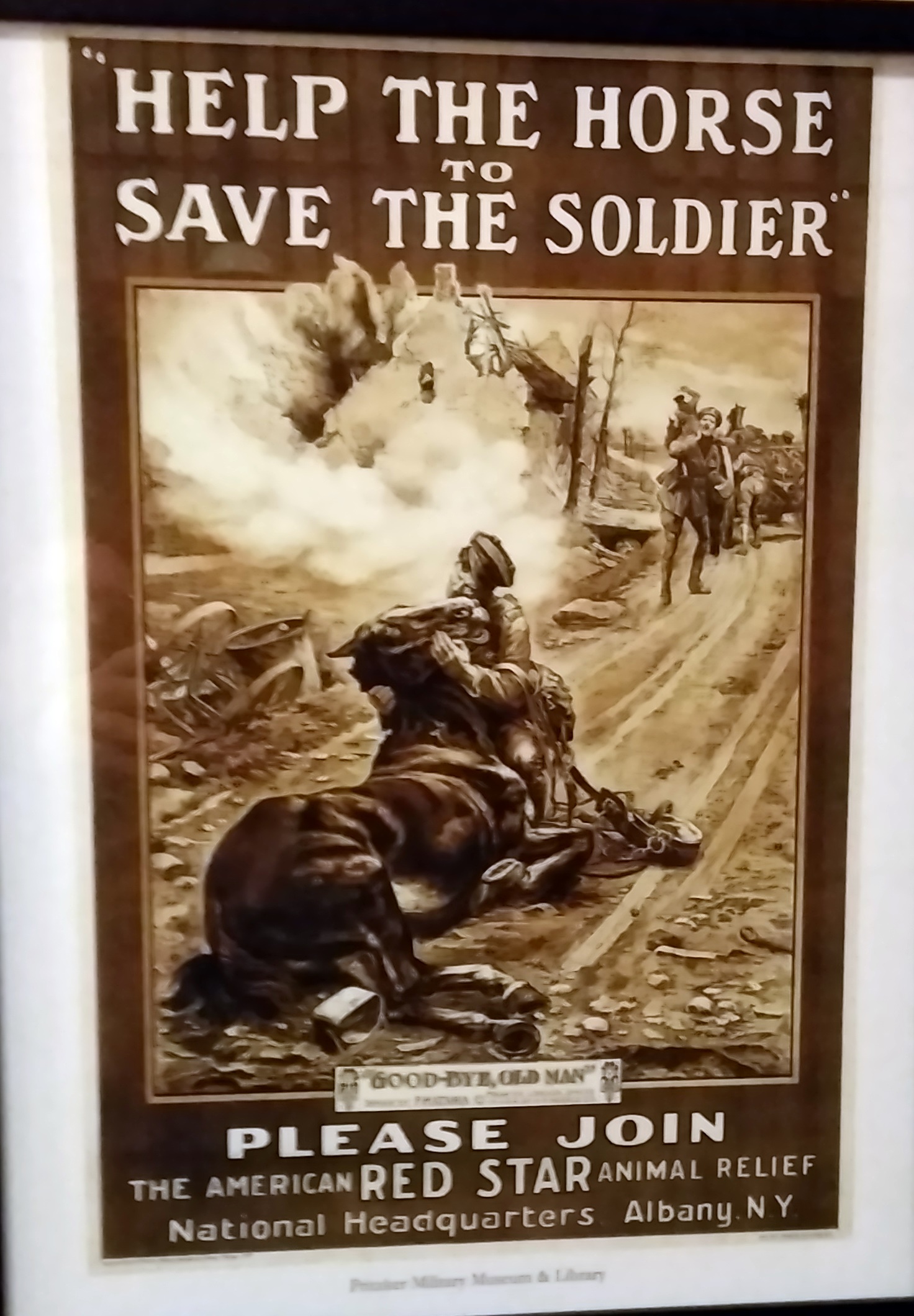
This was for an organization essentially lost to time, though in fact the American Red Star Animal Relief Program is still around, now called Animal Emergency Services.
“[In WWI] the U.S. armed services used 243,135 horses and mules during the war to transport supply wagons, ambulances, traveling kitchens, water carts, food, engineer equipment, light artillery, and tons of shells. Horses were used in direct combat as well,” American Humane says.

“American Humane sent medical supplies, bandages, and ambulances to the front lines to care for the injured horses — an estimated 68,000 per month.

“Since that time, American Humane has helped the animal victims of natural and manmade disasters, such as floods, chemical spills, hurricanes, volcanic eruptions, and victims of animal cruelty throughout the country.”

Cable House & “Victory”

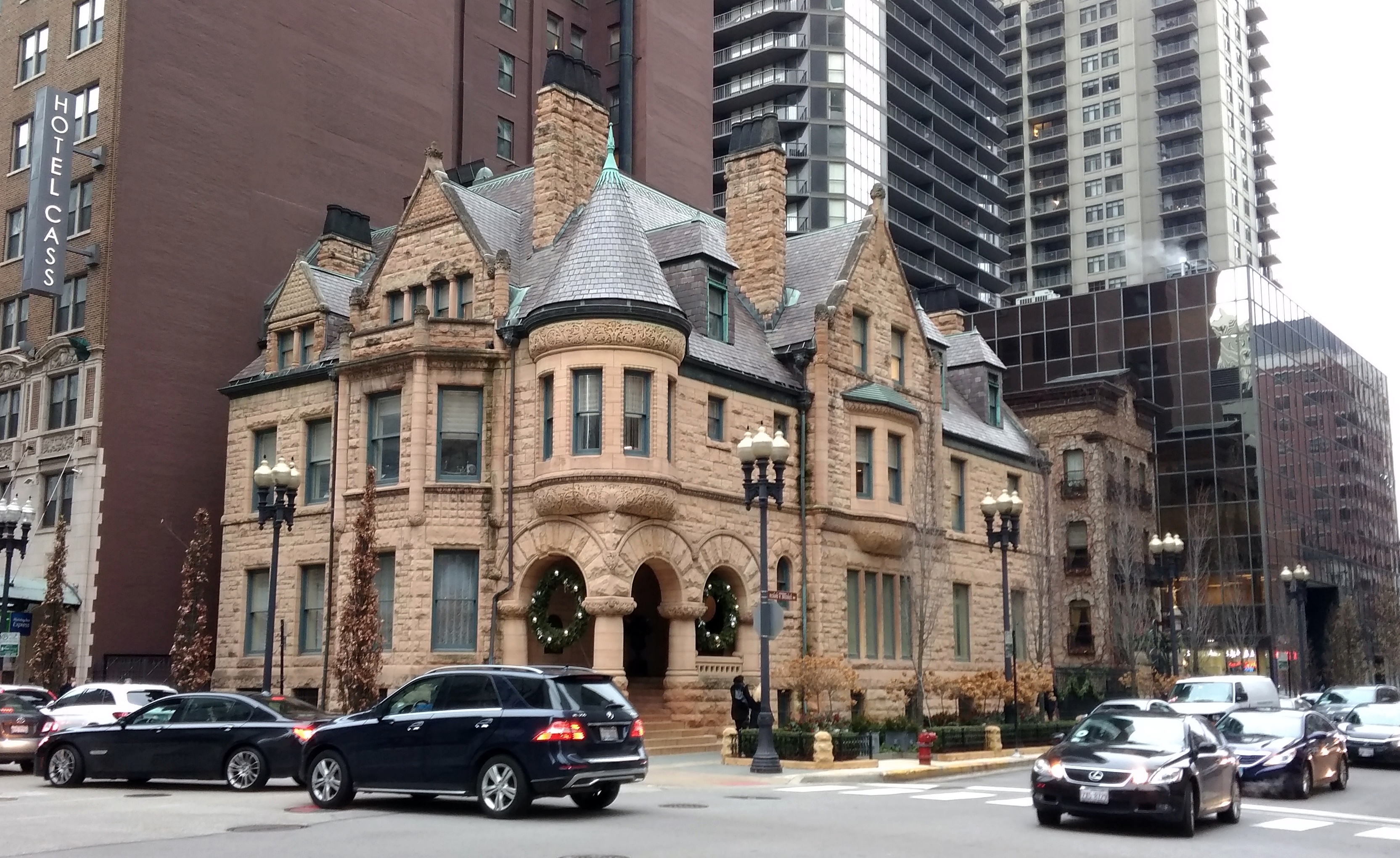
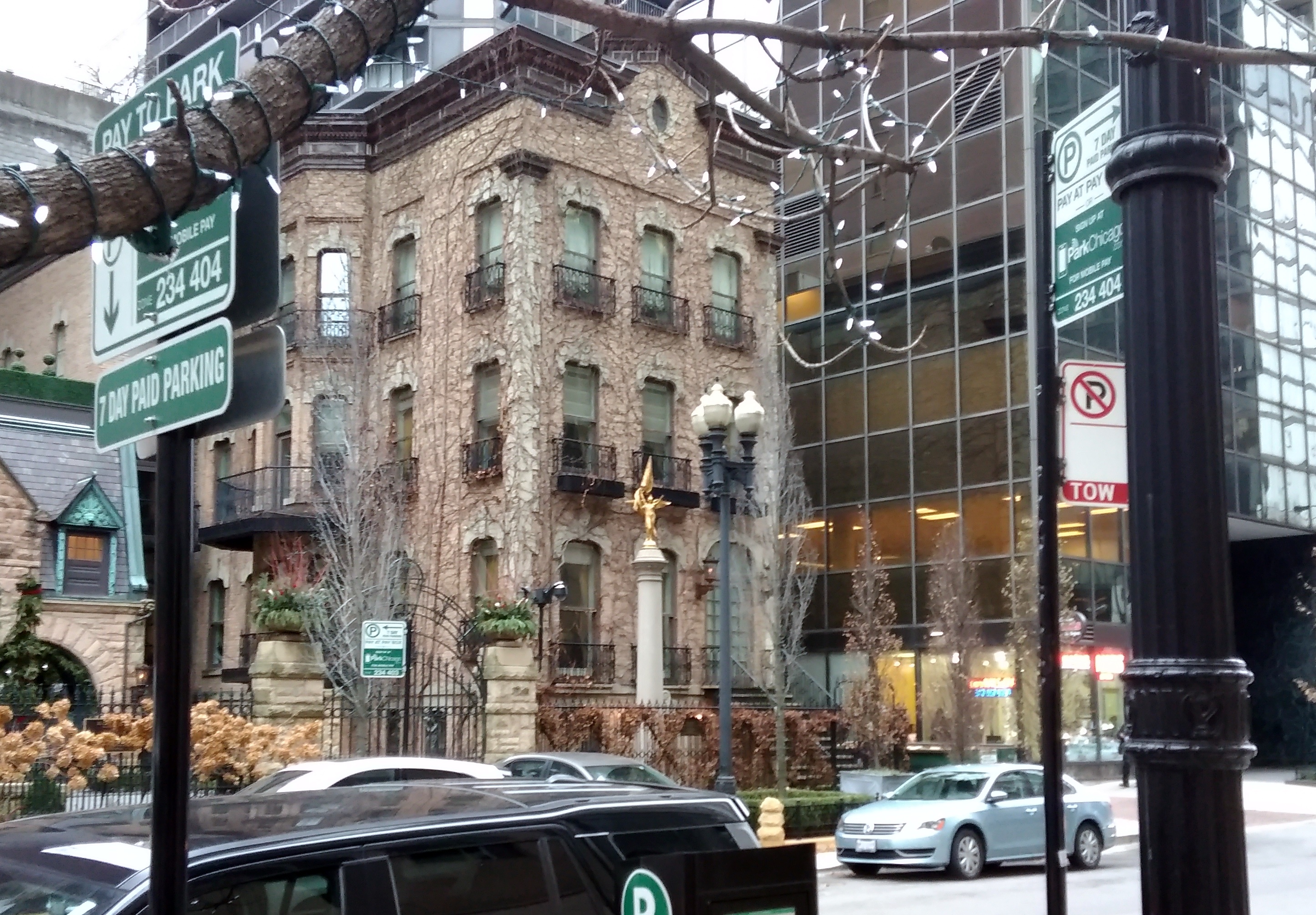
Catercorner from the Dreihaus Museum on the Near North Side of Chicago is the headquarters of Dreihaus Capital Management, which is in the Cable House, an 1886-vintage Richardsonian Romanesque mansion.
In the late 19th century, it was probably the biggest thing on the block. Now tall structures look down on it.

“Its distinct peach-pink façade is Kasota stone, a sedimentary rock from the upper Midwest,” the Dreihaus Museum web site says. “That soft, radiant hue, along with steep gables and abundant ornamentation, are distinct contrasts to the sterner gray of the Samuel M. Nickerson Mansion on the opposite corner.”

“Ransom Reed Cable (1834-1909) commissioned the mansion from the firm Cobb & Frost in 1885. Cable… served as president of the Chicago, Rock Island & Pacific Railway for 15 years.”

Cable went the way of all flesh and then, for much of the 20th century, undertakers John Carroll Sons occupied the house. Now modern office space, the interior isn’t in a 19th-century style any more, according to the museum.

Dreihaus Private Equity is in the Cable House’s former carriage house and (I assume) the small office building next to that.

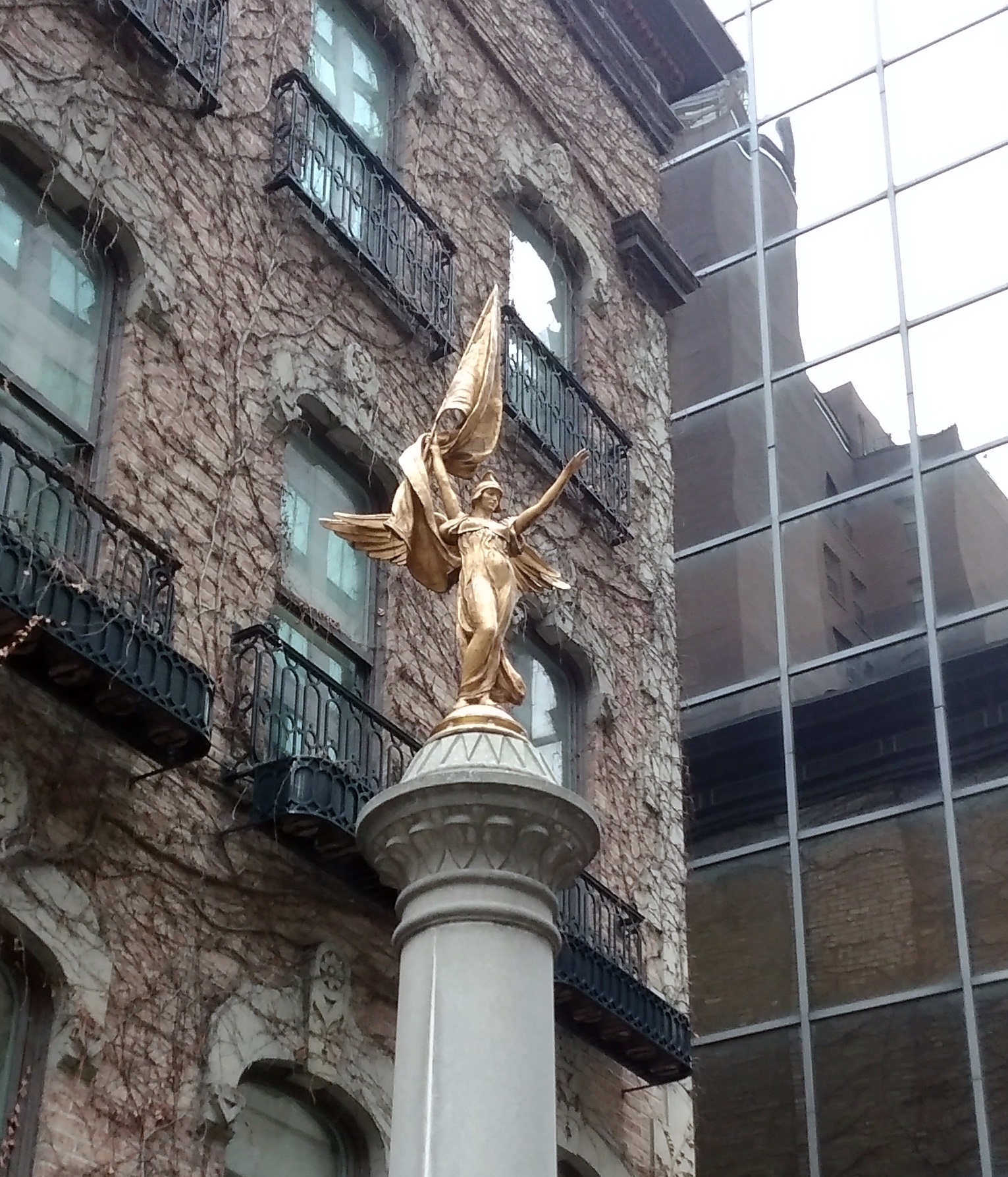
Standing on a column in front of the office building is a sculpture I don’t think I’ve ever noticed before: “Victory” by Daniel Chester French.
Some closeups are here. According to a nearby plaque, it was cast by the D.C. French Roman Bronze Works, NY, in the 1920s from a working model for the First Division Memorial in President’s Park in Washington, DC.

I don’t remember seeing the DC memorial. Maybe I did. But I’ve definitely run across Daniel Chester French before, besides the Lincoln of the Lincoln Memorial: a statue that evokes the 1893 Columbian Exposition here in Chicago and some allegories in Lower Manhattan, among others.

The John B. Murphy Memorial Auditorium

Between the holidays one day, when it was cold but not too cold, I found myself on Chicago’s Near North Side, just west of Michigan Ave. At the corner of N. Wabash Ave. and E. Erie St. is the Driehaus Museum, otherwise known as the Nickerson House at 40 E. Erie St., the Gilded Age palace we visited a year and a half ago.

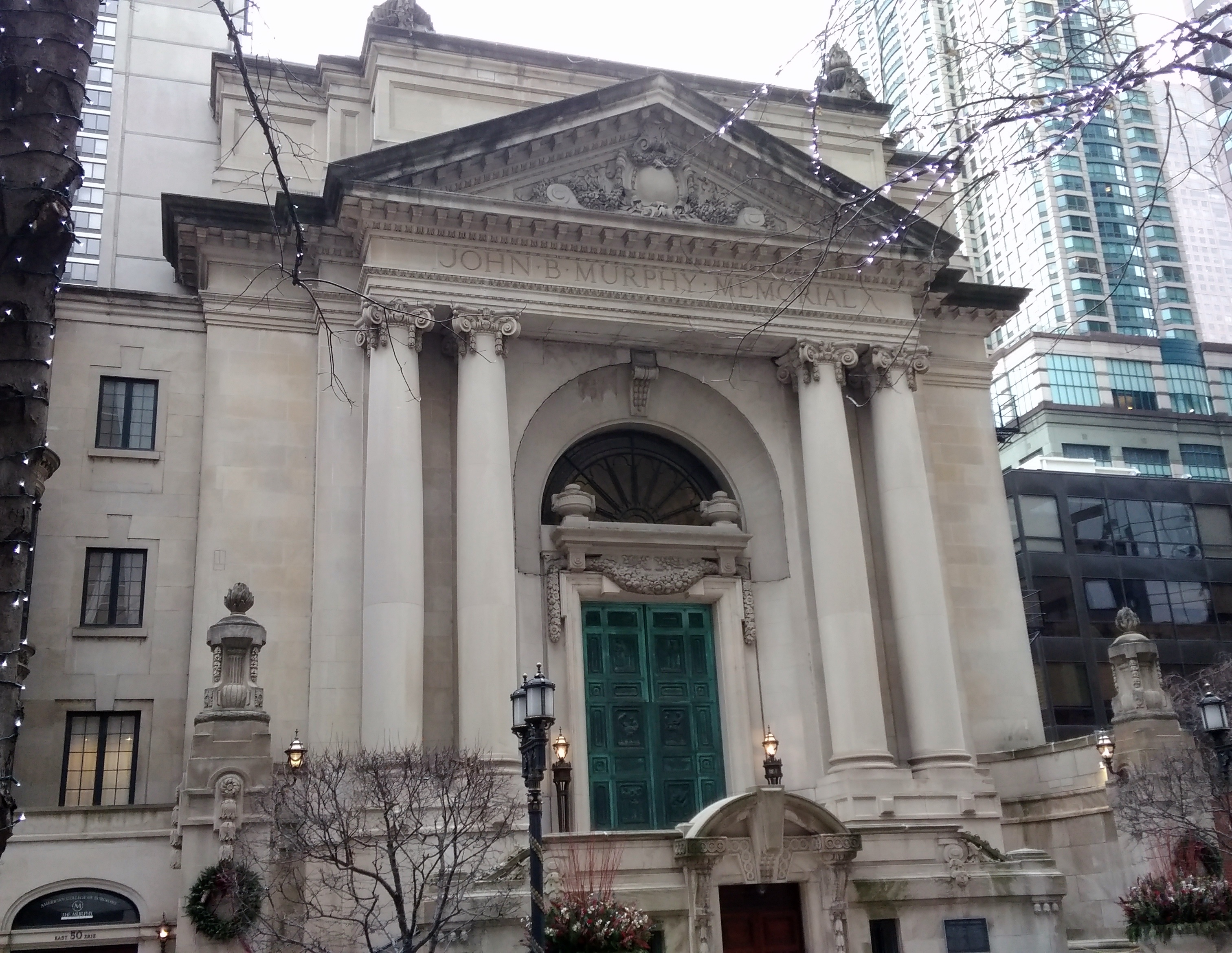
I didn’t stop for that this time, but headed east from there and immediately saw this structure, which is the Driehaus Museum’s next door neighbor.

I stood thinking for a while. Who was John B. Murphy and why did he rate such an imposing memorial? Why can’t I ever remember seeing this building before? I must have. I must have seen it, but maybe I didn’t see it. A strange lapse.

This is the age of computers in our pockets, so I stood on the sidewalk across the street and looked up John B. Murphy.

Dr. Murphy he was, a prominent Chicago surgeon of the late 19th/early 20th centuries (1857-1916). Among other things, he “was a pioneer in recognizing the symptoms for appendicitis, and he strongly urged immediate removal of the appendix when this symptomatic pattern appeared,” Britannica.com tells me.

Someone had to think of that. Dr. Murphy also clearly had friends with means. The web site of the Murphy Chicago — as the space is now known — says that “ground was broken on the John B. Murphy Memorial Auditorium in 1923, and construction was completed in 1926.

“The Auditorium was built to serve as a tangible memorial to the great Dr. John B. Murphy. Shortly following Dr. Murphy’s death, his friends sought to honor him by forming the John B. Murphy Memorial Association.

“The architects for this gorgeous building were Marshall and Fox. The architectural design of the Auditorium is in the French Renaissance style and is reminiscent of the Chapelle de Notre-Dame de Consolation – the Commemorative Monument to the Bazar de la Charite Fire, located in Paris.”

The American College of Surgeons owned the property from day one and still does. The organization formerly hosted ACS meetings there and used it for surgery education, but in the 21st century, it’s a rentable event space. Weddings are a specialty, apparently.

Christmas &c

Only a few days after Christmas, I started seeing Christmas trees chucked out by the curb, as I do every year. And as I do every year, I think that’s too soon. Done right, the run up to the holidays should begin around December 21 and not peter out until after January 6. Our tree’s still up. So are the outdoor lights.

We opened our presents on the 21st this year. The next day, Yuriko and Lilly were off to Japan, returning on the 3rd.

For Ann and I, the holidays were mostly quiet and relaxing. Food, reading, electronic entertainment, as usual. One day Ann even persuaded me to watch Elf with her, which I’d never seen, but which she’s seen a number of times with her sister. It was a lot better than I thought it was going to be.

The weather even cooperated for the most part. Some recent days have been cold, a handful warmish for this time of the year, but no polar vortex events have struck. Some rain, making back yard mud for the dog to investigate. A little snow, but it all melted after a few days.

Made it into the city a few times, including on Boxing Day. Wandered around looking at downtown decorations. The holiday windows at the former Marshall Field’s were again uninspired (unlike a few years ago), but I’m glad to report that Union Station’s Grand Hall was done up well this year.

At the Chicago Cultural Center, we spent some time at an exhibit about South Side nightclubs of the Jazz Age, and a little later. Included was a telephone you could dial to listen to songs of the period.

It’s important somehow, I don’t know why, that she appreciate the operation of a rotary dial.

The Last Days of the Heartland Cafe

At the intersection of W. Lunt Ave. and N. Glenwood Ave., tucked in a corner of Chicago’s far north Rogers Park neighborhood, is the Heartland Cafe. A neighborhood institution.
Word is that the Heartland is closing on December 31. That was a surprise, since it’s been around a long time — opening during the last year of the Ford administration.

I first went there in 1987 with a friend of mine, Becky, who liked the Heartland because of its vegan options. She was a vegan and told me that suitable items on Chicago restaurant menus were hard to find. After that introduction, I went periodically in the ’80s and ’90s, not because of vegan or even non-meat offerings — widely available now — but because the place makes good food at reasonable prices.

When I learned of its closing, I knew I wanted to go one more time. So we went on Sunday. The drive to Rogers Park from Humboldt Park, where Yuriko takes her cake class, is a slog. Driving through the city is usually a slog. But I’m glad we went.

For lunch I had a very non-vegan Reuben sandwich, a good choice. Yuriko had a breakfast burrito, also good.

Google Maps, which has incorrect information sometimes, is wrong about the Heartland. Its thumbnail description for the place is “vegetarian eatery with a hippie vibe.” Meat is all over the regular menu, so no. And a hippie vibe? What does that even mean? Besides, hippies were passe even by 1976.

As restaurants go, the Heartland has more of a diner vibe. Simplicity.

The Hope poster shows more than mere political sympathies, though it does do that. Rather, the Heartland is one of the places that Barack Obama appeared during his run for the U.S. Senate in those seeming long-ago days of 2004.

Murals adorn the Glenwood embankment across from the restaurant.

They weren’t there the last time I went to the Heartland, whenever that was (ca. 2000 would be a good guess). They’re part of a Rogers Park-specific initiative, Mile of Murals, and were painted in 2010 by a variety of artists.

Among many other things, the Heartland makes an appearance on the wall.

Guess the image will be there longer than the restaurant itself.