Valentain Day Special

Time for a late winter break. Back to posting around February 24, much closer to the winter-springish domain of March-April, which is always worth looking forward to.

Saw this today on a package of sushi.
I won’t mock the grocery store for its spelling. I wasn’t a particularly good speller in my younger days. I have vague memories of teachers getting on my case about it. Later I got better, but never flawless, down to the present. Even now there are words I can never quite remember.

I have a hunch that my spelling deficiencies helped me become a more competent writer. I’d want to write a certain word, but couldn’t remember how it was spelled. So I’d think of another way to say what I wanted to say. If that isn’t an important writing skill, I’ll be a monkey’s uncle.

Does anyone say that anymore? I queried Ann about the phrase. She’d never heard it. Come to think of it, I can’t remember the last time I heard anyone use it. I think my 8th grade math teacher used to say it occasionally, but that was 45 years ago.

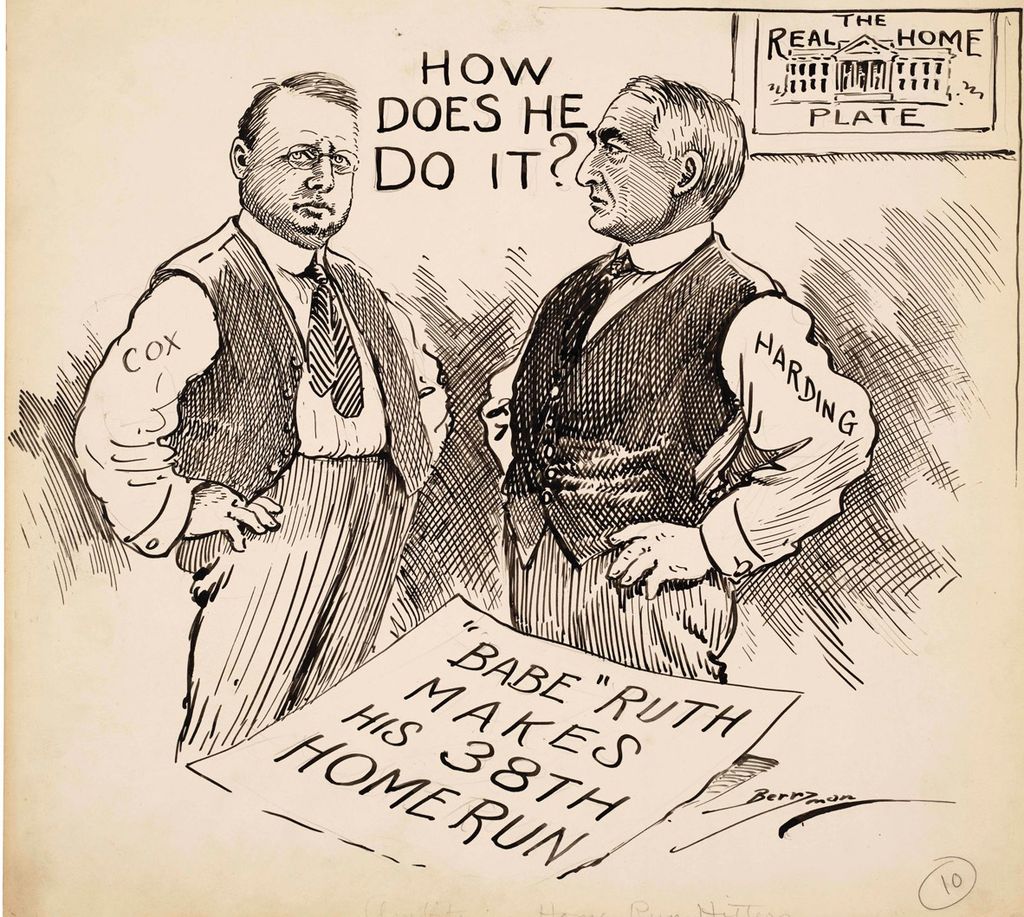
This is in the public domain and I want to use it.

How often do we hear about James M. Cox anymore? Seldom to never. All it takes is 99 years. If anything, he’s noted as the running mate of FDR, even though Cox was top man on the ticket.

Let’s hear it for the public domain. Expanding again as it should.

Here’s a remarkable bit of animation, by a young Iranian named Majid Adin.

I’ll never hear “Rocket Man” quite the same again. But I also associate it with a fellow I knew in high school who attached a small rocket launcher on top of his station wagon and rigged it so he could shoot off small rockets while the car was moving.

The launcher was horizontal, so the rockets went backward from his car. I didn’t just hear about that, either. I saw him do it once on a highway, from another car not far away.

Glad to see that Merle Hazard is still recording. Still amusing, too.

Channeling Tom Lehrer some, I’d say, though Lehrer didn’t do much country and western, unless you count “The Wild West is Where I Want to Be.” I want to hear Hazard’s song about Weimar Republic hyperinflation too.

I’m sorry I missed this Joan Jett video when it was new 30 years ago. But definitely better late than never.

It’s a cover, of course, but who cares. I only learned about a year ago that AC/DC borrowed the title from Beany and Cecil, a cartoon from before my time and which never showed up in reruns that I knew of.

Finally, a comic in which a character makes up something on the spot: about bread mines in this case. I like that.

Geezer Mail

Got a paper catalog in the mail today, one that comes periodically despite the fact that I’ve never ordered anything from it, not once in however many years I’ve been on the mailing list. The merchant must be waiting patiently, hopefully, like a dog under the dinner table waiting for some food to fall its way.

It offers DVDs. I look at it and always see a few movies I’ve never heard of and probably won’t ever see. Not that I dismiss old movies, or black-and-white movies, or subtitled movies out of hand, though I hear that some people do. Rather, there isn’t enough time to see everything, or even everything worth seeing.

Besides, my attitude toward DVDs is rent, not buy.

Speaking of the passage of time, when I opened the catalog this card fell out.

Catalogs are increasingly geezer mail, and if you need any evidence of that, look no further.

Thursday Bunkum

Our latest snow was less convenient than previous ones this winter, falling in mid-week. I spent a fair chunk of Wednesday shoveling more snow around, this time wetter masses than the last snowfall. Now an arctic blast is blasting its way toward northern Illinois. Subzero temps ahead.

Ah, fun. We’ve been down this road before, of course.

I just found out today that the Emperor of Japan is going to abdicate on April 30. That was news in December, but I missed it. I chanced across the information in a copy of the bilingual Chicago Shimpo, a paper Yuriko picks up for free periodically at the Mitsuwa grocery store.

The Imperial Household Agency, known for its mossback ways, is on board with that?  Yet abdication from the Chrysanthemum Throne isn’t unknown. The most recent abdication was of Kōkaku, who quit in 1817. Pretty recent, considering the longevity of the Yamato Dynasty.

In even earlier times, back when the emperor was more of a political football than in recent centuries, one emperor was sometimes forced out to make way for another.

Now that I’ve finished reading Stalin — which I read after John Wayne: The Life and Legend by Scott Eyman (2014), an excellent book — I’ve decided to read some more biographies. A biography bender. Next I want to pick one from around the house, one that I haven’t read.

My choices, at least those I’ve found so far, include works on Francis Bacon, Benedict Arnold and Babe Ruth.

Something called Indywire asserted recently that: Coen Brothers Shock With ‘Buster Scruggs’ Oscar Nomination

I’m not shocked. I’ve seen five of the six stories in the The Ballad of Buster Scuggs so far and they’re really good, especially “Meal Ticket” and “The Gal Who Got Rattled.” Not that being good necessarily gets a movie nominations, but it helps.

All the stories get the Coen Brothers treatment, so you know that something bad is going to happen to at least one of the characters. In the “The Gal Who Got Rattled,” the feeling was particularly poignant, because as the story moved along, both the man and woman evolved into remarkably sympathetic characters. Then one of the dangers of the 19th century smites them.

Parts of the movie were based on sources much closer to the 19th century than our own, such as “The Girl Who Got Rattled” by Stewart Edward White and Jack London’s “All Gold Cañon,” while other parts evoke cowboy pictures of yore.

That only goes to show that there’s a vast and largely untapped galaxy of source material for movies — books, short stories, historic events, myths, graphic novels and on and on. Do moviemakers show any interest in mining these riches? Mostly not, seems like, and if they do, commercial pressures disabuse them of the notion. The Coens are exceptions. I’m glad they’re able to make the movies they want to.

Joe the Georgian in Story and Song

Sometimes you pick up a book that’s been on the shelf unread for many years and you think, time to read it. So it was around the beginning of the year with a copy of Stalin, subtitled “The History of a Dictator,” by H. Montgomery Hyde (1907-89).

It’s a paperback, originally published in 1971 and which no doubt my brother Jay bought. The copy’s pages are yellow and a little brittle with the passage of so much time, and the front cover is partly torn — and repaired with tape — but the book withstood my reading it. Not bad for a paperback not meant to last long.

Of course there are newer biographies of Stalin, such as the work of Stephen Kotkin, whose three-volume bio had its second volume published in 2017. Those sound really good. Later books have the advantage of at least partly open former Soviet or other Communist archives, including things unimaginable in 1971, but even so I wanted to read Hyde’s book. For one thing, it’s on my shelf.

More than that, I was curious how Hyde approached the subject without access to those archives. With a fair number of workarounds, it turned out, and perhaps leaning a little too much on Khrushchev, who has to count as an unreliable narrator. On whole, though, I’d say Hyde did a good job with the material he had to work with.

Sometimes, Hyde pointed out, history and the fate of millions (very possibly) turn on a small event: “If the final stroke of apoplexy had been delayed for a few months or weeks, or even days, Lenin might have succeeded, even without Trotsky’s help, in ousting Stalin from his place of power, such was the immense following Lenin could command in the Party and country. But it was not to be.” (p. 203)

The book isn’t the only Stalin-related diversion for me lately. As in the last year or so. While in New York last March, I went to the Brooklyn Academy of Music’s Rose Cinemas, where I paid New York prices to see The Death of Stalin, then a first-run movie.

It was worth full price. As dark as comedy gets, Death managed to be a funny movie about one of history’s most unfunny subjects, Stalinism. Loosely based on actual events and hardly solid history, but that didn’t matter because of the rule of funny.

Another reason to like the movie: it irritated humorless, authoritarian bureaucrats. According to the imdb: “The movie was banned in Russia on January 23, 2018, two days before it was due to be released… One member of the Culture Ministry’s advisory board was quoted as saying, ‘The film desecrates our historical symbols — the Soviet hymn, orders and medals, and Marshal Zhukov is portrayed as an idiot,’ and added that the film’s release in advance of the 75th anniversary of the end of the Battle of Stalingrad (February 2nd), would be ‘an affront to Russia’s World War II veterans.’ ”

Whatever, Ivan. I will point out that Zhukov wasn’t played as an idiot, but as canny and flamboyant. Canny the real Zhukov surely was, but flamboyant I doubt. Again, the rule of funny. The movie Zhukov was a hoot.

One more Stalin-oriented bit of entertainment: “Joe the Georgian,” an Al Stewart song (1995). Back when I saw him at the Woodstock Theatre in 2008, he sang it, and did his usual patter beforehand. I don’t remember the exact words, but he said that his agent or his label or someone encouraged him to write a dance song. Dance songs sell.

“So I wrote a dance song,” he said. “The trouble was, it was about Joseph Stalin.” Enormous laughter from the audience.

In the song, an unnamed Old Bolshevik, newly arrived in Hell, ponders how he got there.

We all set off together
On this sorry ship of state
When the captain took the fever
We were hijacked by the mate
And he steered us through the shadows
Upon an angry tide
And cast us one by one over the side

His consolation is that when Stalin arrives in Hell, as he surely will, the Old Bolsheviks will torment him with heated pitchforks for “the next few million years” while they “dance, dance, dance.”

Titus Andronicus

The event we’d gotten up early for on Saturday was a reading of Titus Andronicus at the Newberry Library, done for a few hundred people seated in one of the library’s large rooms. A reading because the actors had scripts with them and there were no sets or much in the way of costumes. But they were good actors and they interacted with each other as if it were a full stage show. So we enjoyed it as much as a standard staging.

Titus Andronicus is an early Shakespeare work, early 1590s, and apparently popular in its time. Later it fell from fashion and has certainly been overshadowed by other Shakespeare plays. After the early 17th century, it wasn’t performed much at all again until the 20th century.

It counts as a revenge play. I can see why. One character is wronged and that sets off a cycle of revenge and more revenge. When Titus Andronicus’ characters seek revenge, things get pretty stabby. The play’s got it all: hate, betrayal, rape, a lot of murder, mutilation, decapitation, even a touch of cannibalism.

I can’t say that the play’s exactly back in fashion, but 21st-century audiences have no shortage of the old ultraviolence in our entertainment, so Titus Andronicus fits right in. Quentin Tarantino ought to do a movie version.

Christmas &c

Only a few days after Christmas, I started seeing Christmas trees chucked out by the curb, as I do every year. And as I do every year, I think that’s too soon. Done right, the run up to the holidays should begin around December 21 and not peter out until after January 6. Our tree’s still up. So are the outdoor lights.

We opened our presents on the 21st this year. The next day, Yuriko and Lilly were off to Japan, returning on the 3rd.

For Ann and I, the holidays were mostly quiet and relaxing. Food, reading, electronic entertainment, as usual. One day Ann even persuaded me to watch Elf with her, which I’d never seen, but which she’s seen a number of times with her sister. It was a lot better than I thought it was going to be.

The weather even cooperated for the most part. Some recent days have been cold, a handful warmish for this time of the year, but no polar vortex events have struck. Some rain, making back yard mud for the dog to investigate. A little snow, but it all melted after a few days.

Made it into the city a few times, including on Boxing Day. Wandered around looking at downtown decorations. The holiday windows at the former Marshall Field’s were again uninspired (unlike a few years ago), but I’m glad to report that Union Station’s Grand Hall was done up well this year.

At the Chicago Cultural Center, we spent some time at an exhibit about South Side nightclubs of the Jazz Age, and a little later. Included was a telephone you could dial to listen to songs of the period.

It’s important somehow, I don’t know why, that she appreciate the operation of a rotary dial.

Thursday Detritus

The rains have cleared away, leaving cold air in their wake. This pattern will keep repeating in the coming months, getting successively colder until snow replaces rain and mere cold air is a polar vortex or some such. Bah. At least the trees are coloring up nicely.

An open question for YouTube: how, in the age of digital spying on consumers — so I hear — can YouTube offer me such wildly off-the-mark ads? Lately I’ve been getting a lot of anti-vapping ads, for instance. Aimed at teenagers. Not, I have to add, ahead of much content that that demographic might watch on YouTube. The chances of me taking up vapping are pretty close to zero, YouTube.

Some time ago I picked up a copy of The Shipping News by Annie Proulx (1993) for $1 at Half Price Books. Now I’m reading it. It’s a good read and there are some good lines in it. Here’s one that helps introduce a character:

For the devil had long ago taken a shine to Tert Card, filled him like a cream horn with itch and irritation.

One of the author’s idiosyncrasies is constructions like that, with “filled” instead of “filling.” But you get used to it, and it works. That’s a wonderful sentence that pretty much sets the tone for Tert Card. We’ve all met people like that.

From a press release over the transom the other day, a subject I have no professional interest in. I’m more interested in how the thing was written. I suspect the writer is a fairly fluent but nevertheless non-native speaker of English (all sic):

Businessmen hailing from UAE have an interest in making some investments in Armenia. The trade turnover in between the two countries has risen 10-folks from twenty-five million to about 250 million USD in the last five years as told by Zaki Nusseibeh, the Minister of the State after the sidelines of the ministerial conference of 17th Francophonie summit…

After Ruddigore on Saturday, Ann wanted ice cream. At about 10 in the evening in Evanston, Andy’s Frozen Custard seemed the only place still open serving something close to ice cream. She agreed that was close enough, so we went.
That image doesn’t have many people in it, but not long after we got there, the place was packed. Seems that selling frozen custard late on Saturday evenings near a major university is a pretty good business.

I’d never been to Andy’s before. Turns out there are about 60 of them, mostly scattered around the central U.S., though as far north as metro Chicago and as far south as central Florida. Andy’s makes a good frozen treat. Too good, in fact. I should have gotten a small triple chocolate instead of a medium.

Who did the score for Doctor Zhivago? I found myself wondering that yesterday. Maybe that’s something I should know, but I looked it up: Maurice Jarre.

That came to mind because I’d turned on the TV and DZ was playing. In fact, the very scene in which Yuri and Lara reunited. The Lara’s theme leitmotif was part of the action. I watched about 15 minutes of it.

“What’s this movie about?” Ann asked. I had to think. It’s been how long since I’ve seen it? In the summer of ’81 at the Texas Union Theatre, or in Japan in the early ’90s, when I saw so many movies on VHS? Either way, over 25 years ago.

“Well, let’s see. Doctor Zhivago, that’s him there, Omar Sharif. He’s a doctor of course, and he has a wife. He likes her well enough, but he really loves this other woman, who’s on screen now. I don’t remember who played her. Anyway, there’s a love triangle and they all get caught up in the Russian Revolution and are often in danger. Bolsheviks show up. Zhivago’s also a poet and sensitive fellow. He spends a lot of time looking off in the distance. And there’s a lot of scenery. Wide shots of the steppes of Russia. It’s an epic of a movie. Did I mention that it’s over three hours long? It’s an epic of epic proportions.”

Despite my flip description, I remember liking the movie whenever I saw it. Odd how details of most movies you see or books you read or music you hear or places you go tend to evaporate over the years, leaving a residue like the one I told to Ann.

Never have read Pasternak, so I don’t even have a residue of the book. Maybe I should, but life is short and Russian novels are long. The most recent one I read, a few years ago, was August 1914. Pretty soon into it, I gave up trying to keep track of all of the many characters.

Maurice Jarre, I learned, is the father of Jean-Michel Jarre, known to me for Oxygène. Back when people had record collections, there was always one kid on each floor of each dorm at your college who had unusual records, things no one else had ever heard of. I can’t remember the lad’s name, but he was on my hall freshman year, and that was one of the records he had.

Ruddigore

On Saturday, Ann and I went to see Ruddigore by the same troupe that did The Pirates of Penzance last year, the Savoyaires, who do their shows at a junior high auditorium in Evanston. Musical direction by Timothy Semanik, stage direction by Kingsley Day.

Except for the hard seats, it was a good time. I understand that the work was originally the followup to The Mikado, which must have been a hard act to follow, but Ruddigore was topsy-turvy fun anyway, as Gilbert & Sullivan tends to be. Probably it helps that we have no reason, more than a century later, to compare one work too closely to another that happened to come just before it.

Ann said it was enjoyable too, partly because the story wasn’t quite as convoluted as the other productions she’s seen. Not that the story’s ever the main thing, but as she said, it was nice to be able to keep track of the characters.

All of the main cast acquitted themselves well. I was particularly fond of the energy that Jonathan Joseph Larson, a large man with a large beard, brought to the sailor Richard Dauntless, and Lane Halverson’s amusing performance of the relatively small part of Old Adam, Robin Oakapple’s faithful servant. He has his moment when he’s tasked to abduct a maiden.

There were some laughs. Maybe not as many as in Patience, especially when the Duke of Dunstable emerged in pink tights, but even chuckles are impressive in a work that’s more than 130 years old. Some clever lines I chuckled at:

RICH. And I make bold to ax your honour’s advice. Does your honour know what it is to have a heart?
SIR D. My honour knows what it is to have a complete apparatus for conducting the circulation of the blood through the veins and arteries of the human body.

ROB. My good sir, if I can’t disinherit my own unborn son, whose unborn son can I disinherit?
SIR ROD. Humph! These arguments sound very well, but I can’t help thinking that, if they were reduced to syllogistic form, they wouldn’t hold water.

MAR. Listen – I’ve come to pinch her!
ROSE. Mercy, whom?
MAR. You mean “who.”
ROSE. Nay! It is the accusative after the verb.

Of course, no joke about grammar is as funny as this.

Mass Entertainment

Here’s a list I spent some time with recently: Wiki’s List of highest-grossing media franchises. Being Wiki, there’s no telling how accurate it is, but I will note that there are an enormous number of notes and references. So I’ll take it as accurate enough.

The list is interesting for a number of reasons, but mainly for information on the high-grossing franchises I’ve never heard of, which are quite a few.

Most of them are Japanese: anime, manga, even franchises whose most profitable expression is pachinko machines. As far as I could tell from my years in Japan, pachinko parlors were insanely bright, intensely noisy places to throw away money. But I was just a barbarian outsider. Apparently the machines are branded, and the branding is big business.

Take Fist of the North Star which, originating way back in 1983, would have been around when I was in Japan. I’d never heard of it until today. Though starting as manga, the franchise has enjoyed nearly $16.8 billion in pachinko machine sales, plus a few billion more in manga and other games.

Pachinko, incidentally, comes up 13 times on the list. Most of those are Japanese franchises, but not all. There have been $2.85 billion in Disney Aladdin pachinko (and arcade) machines sold. Spider-Man pachinko machines are popular to the tune of $308 million in sales, and Tomb Raider has sold $300 million.

I was curious how many of the franchises I’ve supported, either for myself or my children, so I counted: more than I would have thought, about 50. That includes mostly through ticket sales, as well as small-screen viewing (at least occasionally), but also the quarters I spent on Pac-Man and Space Invaders, and things my daughters watched that I never would, such as Sailor Moon and Dora the Explorer.

Mass-market entertainment’s pervasive. Even when your tastes tend to run to less successful shows.

The Milwaukee Theatre

On October 14, 1912, former President Theodore Roosevelt took a bullet in the chest at the Gilpatrick Hotel in Milwaukee, but went on to deliver his presidential campaign speech at the Milwaukee Auditorium across the street soon afterward.

“Friends, I shall ask you to be as quiet as possible,” TR said. “I don’t know whether you fully understand that I have just been shot; but it takes more than that to kill a Bull Moose. But fortunately I had my manuscript, so you see I was going to make a long speech, and there is a bullet — there is where the bullet went through — and it probably saved me from it going into my heart.”

In later years, especially during an early 21st-century renovation, the Milwaukee Auditorium evolved into the Milwaukee Theatre, which is officially the Miller High Life Theatre these days, because beer money bought the naming rights recently.
Never mind that. What I want to know is, where is the plaque commemorating TR’s speech?

Maybe there is one, but I didn’t see it. Or why didn’t our tour guide through the theater on Saturday mention this remarkable event? I knew the story of the attempted assassination, but didn’t connect it with the Milwaukee Theatre until today.

In any case, the theater looks like a first-rate venue, seating more than 4,000. The view from the stage.

Here’s the view from the stage when space aliens started kidnapping people standing there, via tractor beams (and how do those work, anyway?).

Or maybe I jiggled the camera during a relatively long exposure.

We toured other parts of the venue as well, including the elegant side halls Kilbourn and Plankinton — named for long-ago donors — with the former decorated by murals depicting Milwaukee history. We also saw the green room.

Where Miller High Life Theatre-themed cupcakes were offered for our refreshment. I have to say that’s something I’d never seen before.
You’d think a light shade of green would be the thing for the green room walls, for tradition’s sake, but no. Then again, I’ve read it isn’t clear that most green rooms ever were really green. Just another phrase origin lost to time.

Next to the theater is the UW–Milwaukee Panther Arena, which seats as many as 12,700. That too was open for the Doors Open Milwaukee event.

These days the arena is home to the Milwaukee Panthers men’s basketball team of the NCAA, as well as the Brewcity Bruisers, a roller derby league based in Milwaukee. For the record, the Bruisers are a member of the Women’s Flat Track Derby Association.