Two Bridges of Madison County

While in Winterset and environs, I took the opportunity to see two of the wooden covered bridges of The Bridges of Madison County fame. The movie, at least, seems to be relegated to a chick flick ghetto. Wrongly, I think. The story was at least as much about the visiting photographer – the man – as it was about the farm wife.

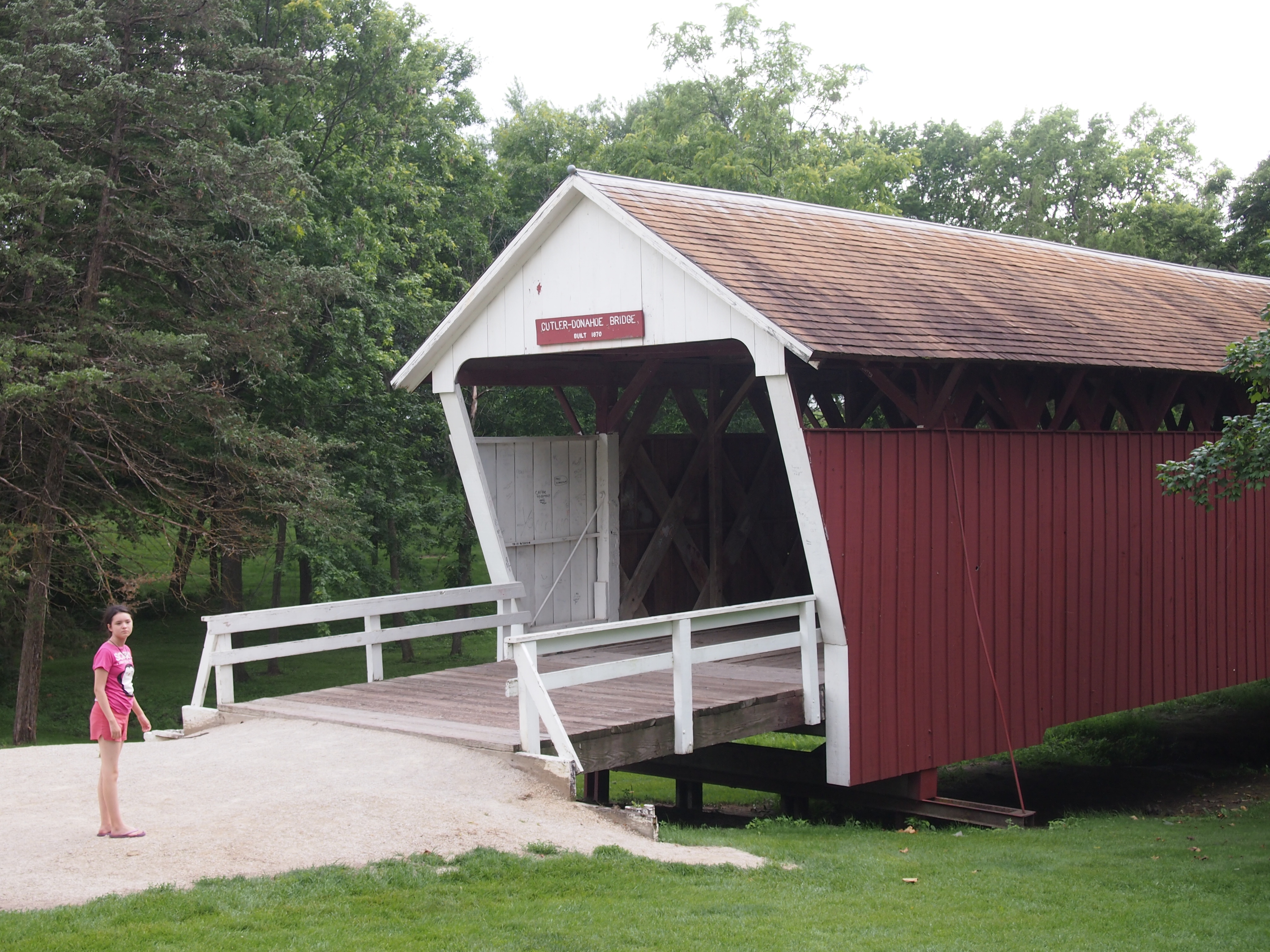
Movie or not, I liked the bridges. At least the two I saw.  It’s remarkable that such artful wooden construction has survived for more than a century, but they have. Ann was less impressed. When we visited the first structure, the Cutler-Donahoe Bridge, she said something like, “What’s so special about this bridge?” You have to be older to appreciate older things, maybe. (Though I’ve liked old things since I can remember. I’m peculiar that way.)

Cutler-Donahoe Bridge, July 2014

The Cutler-Donahoe Bridge dates from 1870, built by one Eli Cox. In 1970, it was moved to Winterset City Park, where we saw it. Length, 79 feet. Weight – and you’d think it would be lighter – 40 tons. Nice work, Eli.

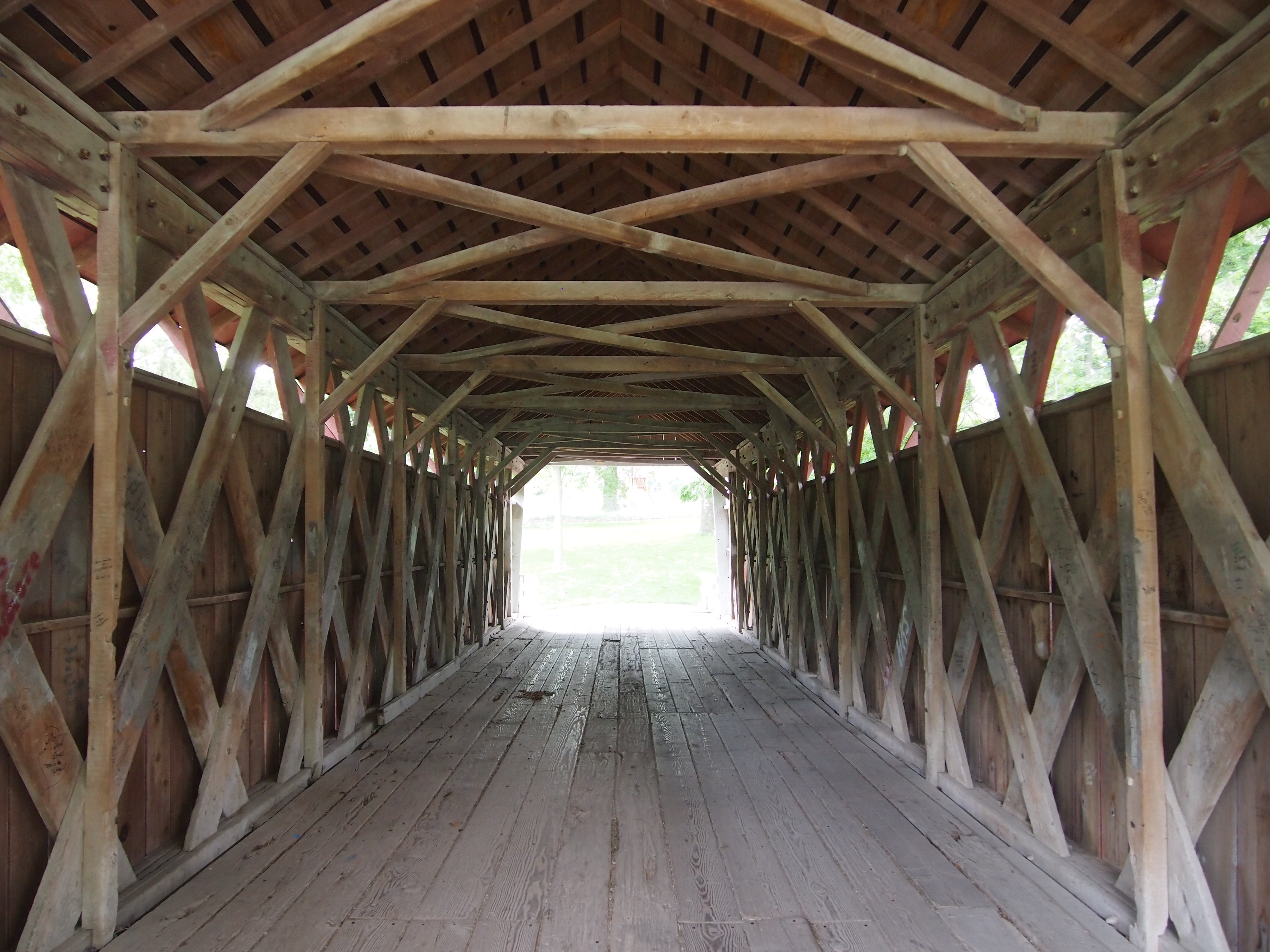
Cutler-Donahoe Bridge interior

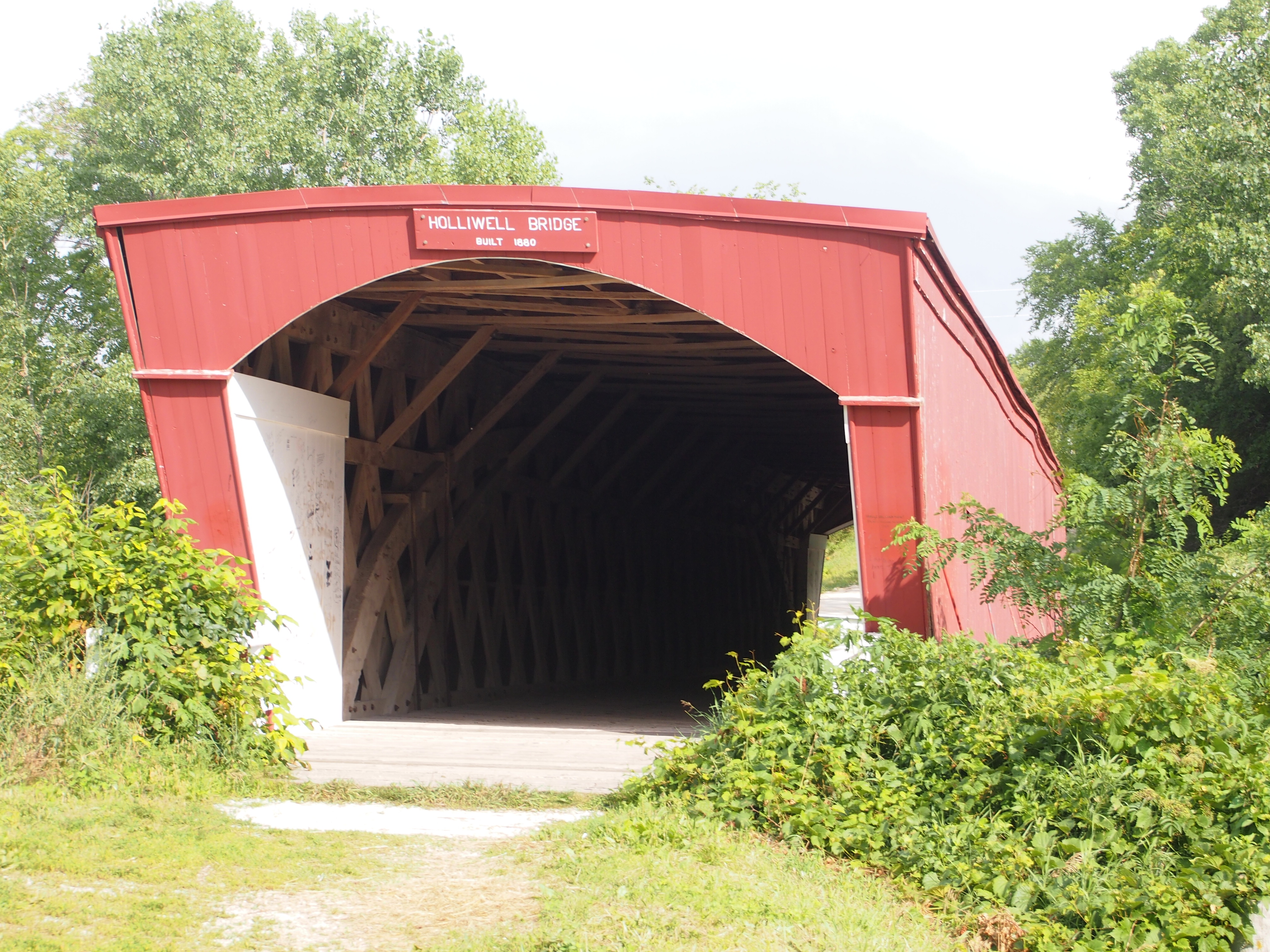
Not far from town is the Holliwell Bridge, in situ over the Middle River.

Holliwell Bridge, July 2014Ann stayed in the car for this one. The structure’s a little newer than Cutler-Donahoe, built by Benton Jones in 1880 and renovated in 1995 (on the occasion of filming the movie, I guess, but my sources don’t say so explicitly).

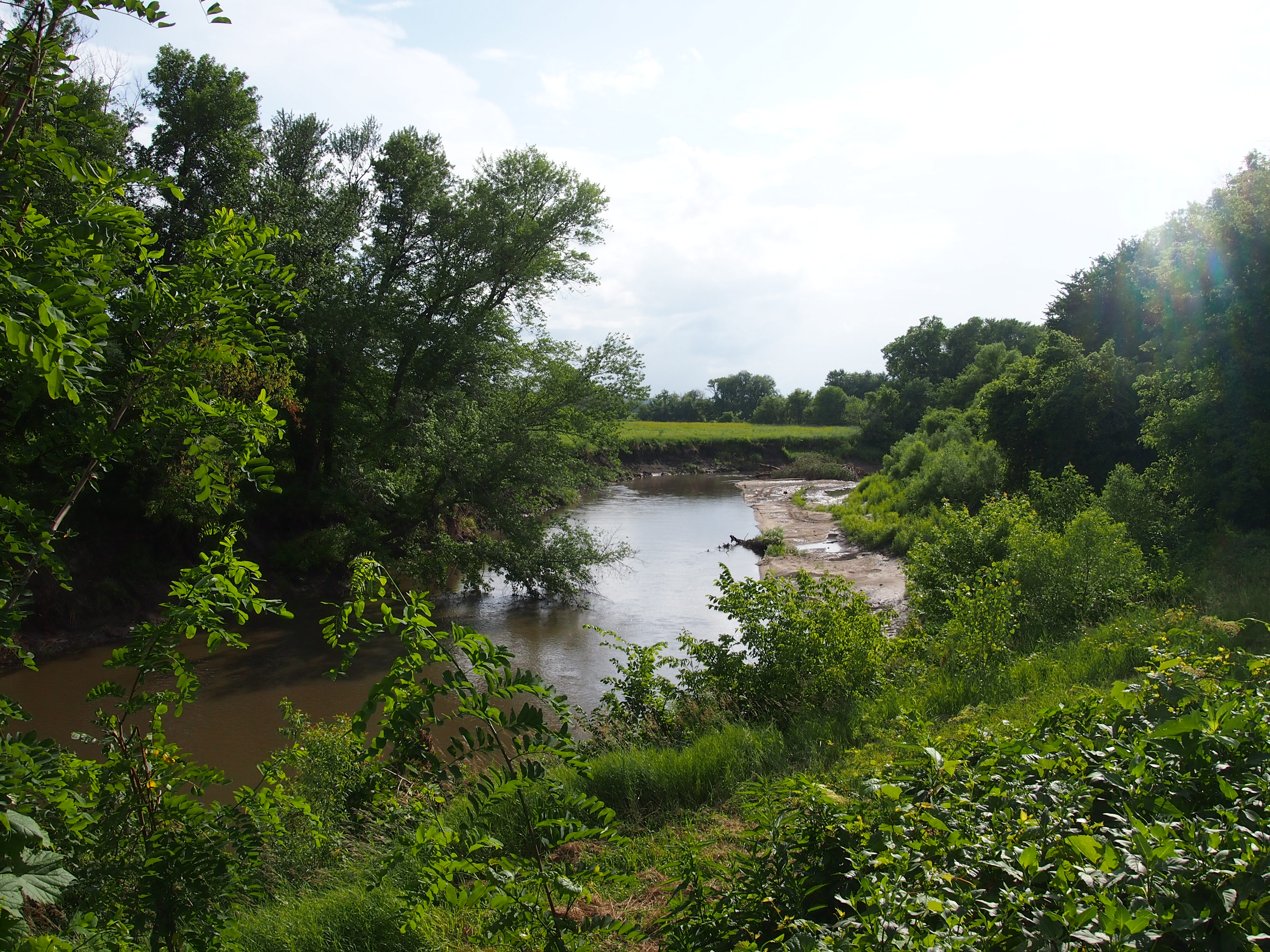
Middle River, Iowa, July 2014This is the view from the north end of the bridge, looking out on the Middle River, a tributary of the Des Moines River that runs through the county. Iowa’s nice and lush this year.

The Duke in Winterset

The thing to do when heading out of Des Moines in a southerly direction is to detour into rural Madison County, southwest of the capital, whose county seat is Winterset. If you have time. I decided we had time, since how could I pass up a look at a bronze of Winterset’s favorite son, Marion Robert Morrison?

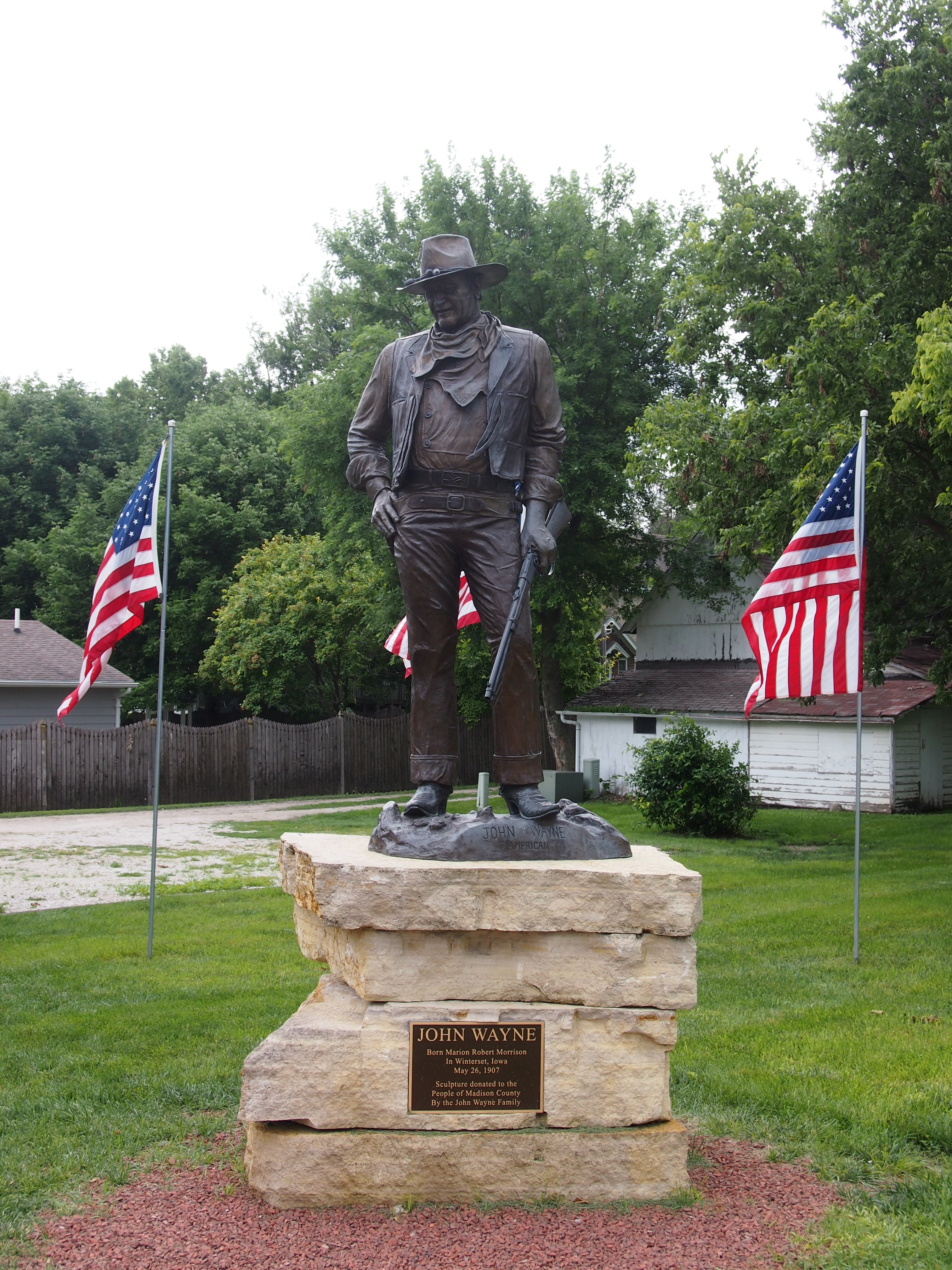
John Wayne, Winterset, Iowa 2014JOHN WAYNE

Born Marion Robert Morrison

In Winterset, Iowa

May 26, 1907

Sculpture donated to the

People of Madison County

By the John Wayne Family

The statue of John Wayne is a short block from his birthplace house, now a museum that (like the capitol) happened to be closed when we arrived. No matter. A good look at the bronze was enough for now, and we weren’t the only ones doing so. A few other families pulled up for a look-see while we were there. Wayne’s fame has some staying power.

Next to the statue is a Chevy van, detailed to honor Wayne. According to the birth site museum web site, “Several years ago, an anonymous person from Arizona donated a full-size 1980 Chevy van that has been extensively customized for the true John Wayne fan….

“This one-of-a-kind vehicle is covered with $50,000 of artwork from John Wayne movies—even the windows are etched to continue the design! The interior boasts hardwood floors, carpeted walls, a wet bar, TV and VCR (this was 1980, remember?), a souped-up sound system, and saloon-style swinging doors that lead to the queen-sized bedroom [sic] in the back.”

I didn’t realize it when we were there, but the statue usually resides at a corner of Washington St. and John Wayne Dr. – one of the main drags through town – but has been moved a block away, so it won’t be damaged during construction of the John Wayne Birthplace Museum. Work started in 2013 on the new museum, which is slated for completion for the 2015 John Wayne Birthday Celebration (and it’s convenient that baby Marion was born pretty close to Memorial Day). Last year my old friend Kevin, quite the fan of the Duke, went to the birthday fest. He said he had a large time.

One more thing: there are other John Wayne bronzes out in the wider world. You have to go to California to see these two.

Summer Interlude

Summertime and the living is — not so different from the rest of the year, considering that we have climate control in the house, have to meet the same deadlines as the rest of the year, and so on.

Time for summer break anyway. Back to posting around July 27. Till then, a handful of summer tunes. Been fond of “Summer Wind,” sung by Sinatra, only since the late ’80s, when I acquired a tape of Strangers in the Night. Music by Heinz Meier and lyrics by Johnny Mercer.

I’ve known “Summer Breeze,” by Seals & Crofts, probably since it was released, or at least fairly new. It evokes a moment in summer, in particular a summer evening, without mentioning beaches or puppy love or such.

Not quite sure what’s going on in “Suddenly Last Summer,” by the Motels, but it’s to do with a particular summer. Some summers, after all, are more memorable than others, especially when you’re young.

Also, some recommended reading. I just started Arabian Sands by Wilfred Thesiger. I’m already hooked, and I haven’t even gotten to his crossings of the Empty Quarter. He’s only been dead about 10 years. The Telegraph’s obit is here, and the Guardian’s is here.

Entertainment Oddities, Some Involving Actors Named West

As it happened, on July 4 one of the channels was running a Batman marathon, and by Batman, I mean the one starring Adam West. Accept no substitutes. I watched two episodes, which is about enough at any one time, a pair originally broadcast one night after the other in 1966. Catwoman was the villain. At one point, after capturing the Dynamic Duo, she separates the two using a vacuum tube, saying: “It’s time to separate Damon and Pythias.”

Did I hear that right? A casual Classical allusion on mid-60s TV? Yes, indeed. Hadrian and Antinous would have been funnier, but even more obscure.

At a grocery store parking lot not long ago, I saw an ordinary sedan, one car among many, except for one thing: “NCC-1701” was detailed on either side. I couldn’t help mocking the owner in abstentia on the way into the store (Lilly was with me). “To boldly go shopping,” “Hope he doesn’t use his phasers in the parking lot,” etc.

She Done Him Wrong (1933) is an odd movie, at least to modern eyes. I tried to imagine what it would have been like to see the movie new, when it wouldn’t (presumably) have been so odd, but it was hard. Still, the movie must have had its attractions in its time, since it made Paramount a bucket of money in the pit of the Depression.

Mae West is one of those people now mainly known by reputation, and that includes my impressions of her. I’d never seen one of her movies until last week, when I watched this one. She’s famous for her one-liners, and justly so. And of course for her sex appeal. I think it helps to have been born around 100 years ago to fully appreciate it.

Another thing I wondered about was the setting. The movie was set in the 1890s, which the intro refers to by its common sobriquet, the Gay Nineties, a ’20s invention. I wonder just what kind of nostalgia people of the 1930s felt for the 1890s. It’s possible to be nostalgic about anything, so I guess that applies to a decade marked by its own depression and bitter labor disputes.

The Field & the Basilica

As of June 21, 2014, there was no new development that I could see at the Field of Dreams movie site, which is near Dyersville, Iowa, about 20 miles west of Dubuque. Apparently there’s been a hubbub – or maybe a brouhaha (not sure which is greater dustup) – about plans for further development at the site.

I won’t dwell on that. Enough to say that the new owners of the property, who have a mortgage to feed, want it to be more than a baseball field amid the corn, while some residents of greater Dyersville and others very vocally do not want that to happen. More about the fracas here.

This is the kind of tourist that I am: although I’ve never actually seen Field of Dreams, I wanted to see the accidental tourist attraction created in haste in the summer of 1988 to serve as one of the main sets for the film. Why? Because it’s there. Or more exactly, because I was going to be near there anyway.

Besides, Yuriko had seen the film. As we drove in the vicinity of the Field, her eyes widened a bit. “This is what it looked like in the movie,” she said. She saw it a long time ago, and couldn’t really remember the story. I’d never seen it, but knew that the movie involved ghost baseball players, including Shoeless Joe Jackson. (Maybe Shoeless Joe got a raw deal from Baseball in his lifetime, but in terms of posthumous fame, he’s one of the better-remembered ball players of the early 1900s.)

The site is appealingly simple. You drive down a small road to get to it, park nearby, and walk a short distance over to the baseball field. It looks pretty much like any other non-pro baseball field, except in a wet late June, the backfield is bordered by lush rows of corn.

Field of Dreams, June 2014The immaculate white house stands nearby, along with a red barn. I understand that the movie producers added the white picket fence around the house to make it look more like our collective notion of rural Iowa (and they had to paint some of the surrounding vegetation green in that drought summer of ’88). Odd, it didn’t even occur to me to go see if the house was accessible. It looks like someone’s house, which it was until recently, so approaching too close would have seemed like trespassing.

A fair number of people were visiting on that Saturday in June. No one was playing a game, exactly, but people were tossing and hitting balls, including a man taking swings at a ball pitched by a kid who probably was his son.

Field of Dreams, June 2014Naturally, there’s a gift stand. It’s a modest operation, not generating enough revenue to feed a large mortgage, I bet. In any case I bought a few postcards and a souvenir spoon for Yuriko.

Field of Dreams, June 2014The Field of Dreams isn’t the only thing to take a look at in Dyersville. The town is home to the National Farm Toy Museum, and while in theory that might have been interesting to visit, we bypassed it to take a look at the Basilica of St. Francis Xavier, an enormous and very ornate Gothic church right in town.

The interior was restored in 2000 and ’01, so it must have some of the brilliance of the original 1880s design. How many small-town basilicas are there in this country? Not many, I think.

Thursday Debris

It’s been a brilliant run of late spring, early summer days here. Rain, but not too much. Heat, but not too much. A few mosquitoes, but not many. Last week at the Klehm we did run into some large clouds of gnats, however, especially on the narrow trails.

Klehm Arbortetum May 2014

See the gnats? Maybe not. The camera’s not that good. But they’re there.

I just finished reading Neither Here Nor There, an entertaining Bill Bryson book. Mostly he dispenses with background detail about the places he visits, and focuses on his own experiences in getting from A to B and seeing what he sees in A and B. Even better, his enthusiasm for going out to see things shines through. Not many writers can pull that off without being a bore, but he does. A small example, describing Rome:

“You turn any street corner in Rome and it looks as if you’ve just missed a parking competition for blind people. Cars are pointed in every direction, half on the pavements and half off, facing in, facing sideways, blocking garages and side streets and phone boxes, fitted into spaces so tight that the only possible way out would be through the sun roof. Romans park their cars the way I would park if I had just spilled a beaker of hydrochloric acid on my lap.”

Since the travels he describes were in Europe in 1990, as well as flashbacks to the 1970s, he’s also detailing an increasingly obsolete style of travel, but one that I well remember myself, at least that of the last two decades of the 20th century. That is, pre-Internet, pre-smartphone, pre-debit card, pre-Ryanair travels. It won’t be long before — if it hasn’t already happened — smartphones or glasses tell tourists absolutely everything about getting to and being at a place. That’ll drain the life right out of the experience.

I wondered today whether the half-season finale Mad Men, broadcast Sunday, used all the lyrics of “The Best Things in Life Are Free.” I wasn’t very familiar with the earliest recorded version, so I looked it up.

As many songs were in the 1920s, much of it is instrumental. So yes indeed, the show used all of the lyrics. The 2010s recalling the 1960s recalling the 1920s. A remarkable scene.

That Cold Blood Moon

It was too cold this morning to drag myself outside and document the snow clinging to the April grass and trees. Why bother anyway? It looked more-or-less like this.

Actually a little less snow coated the ground this time than seven years ago, at least as recorded by my pictures. There wasn’t quite as much sticking to the branches, and none on the street. In any case, except for shadowy spots, all the snow vanished in the afternoon sun, pale and weak as it was.

Missed the early morning Blood Moon, as some headline writers seem to be calling the latest lunar eclipse. They’re nice to see, but not worth getting up at 3 in the morning, especially when it was snowing when you went to bed a few hours earlier. It’s a hard enough sell when it’s merely cold outside, as it also was this morning.

I didn’t miss the season opener of Mad Men, which apparently got low ratings. As a casual viewer of TV, the last thing I care about is ratings, especially for a show that’s going to end on a schedule anyway. It was a decent episode, neither the best nor the worst of the series, and as usual seemed to inspire a lot of commentary, so I won’t really add to that total, even in my small way.

Writing about television in general seems to inspire a body of ridiculous, or at least pointless, writing. Not long ago I saw a headline something like this: “Breaking Bad and The Walking Dead Occupy the Same Universe.” The only reasonable reaction to that is, who cares?

Winter Strikes Back: Sorry!

Here on our small patch of North American earth, we have a few hardy flowers, some buds, and a little green in the grass, along with a few bugs. Saturday proved to be as warm as advertised (70s F.), cloudy sometimes, sunny at other times. Yuriko and I took a pleasant walk at the Spring Valley Nature Preserve.

On Sunday, the warm air held the promise of rain all day, but it held off long enough to allow me to replace a dodgy hinge on our wooden gate and do other things around the back yard, such as pick up the wintertime debris that collects here and there. Lilly and I sat around on the deck for a while, and I could feel the air cooling down. In the span of about half an hour, we lost 10 degrees.

Today, cold and snow. So cold that it stuck, as of the early evening.

On Saturday evening, Ann wanted to play a board game. She plays more video games than any other kind of game, so I thought it was a good idea to oblige her. We don’t have that many games, though, and decided that Monopoly and Risk would involve more time than we wanted to commit. So we played Sorry! Lilly and a friend of hers played, too. Not the most engaging board game in the world, but it has its moments.

BoardGameGeek (“gaming unplugged since 2000”) mentions a Sorry! alternate that sounds interesting: “Sorry! can be made more of a strategic game (and more appealing to adults) by dealing five cards to each player at the start of the game and allowing the player to choose which card he/she will play each turn. In this version, at the end of each turn, a new card is drawn from the deck to replace the card that was played, so that each player is always working from five cards.”

Someday I need to teach Ann and Lilly the rudiments of Risk. Maybe they’ll never play it, but maybe they will. Once or twice a year in the late ’70s and early ’80s, I played Risk with some of my high school friends, and I have fond memories of the games. Eventually, we got to know each other’s strategic thinking pretty well, such as the fact that one of us (and he knows who he is) inevitably took the offense. That is, attack! Outnumbered? Attack! Surrounded? Attack! Just do it! Sometimes it worked out for him, usually not.

Centuries Come, Centuries Go

Last week I took note of some of the monumental items at the Oriental Institute Museum, but of course the museum is home to a lot more artifacts, and most of them were more modest in size. But no less interesting for it. Such as some dice from Roman Egypt.

OLYMPUS DIGITAL CAMERACool. Especially since anyone alive now, two millennia after they were made, could look at them and know exactly what they’re for, even if the games of chance aren’t quite the same. Even cooler is that dice were ancient even then, so much so that their origin is obscure.

Also on display were some knucklebones, an alternative to dice that are probably just as old, if not older (and the ancestor of modern playing jacks?). According the museum, “knucklebones of sheep or oxen were used to determine the number of moves on game boards. The four sides of each bone are distinctive, and each was assigned a specific number. They were normally thrown in pairs, allowing for ten possible combinations.”

The museum also sported plenty of figurines.

Eygptian figurines 1Still charming after all these centuries. Thought to come from a tomb of a courtier named Nykauinpu at Giza, made of limestone and dating from the Old Kingdom, Dynasty 5 of the 25th century BC. So by the time of Julius Caesar, this statue was already older than anything from the time of Julius Caesar is now. Even on a human scale (not to mention geological or cosmological), time’s mind-boggling.

On a sign describing another man-and-woman set of Egyptian figurines, I noted these lines, referring to the way the woman was dressed (emphasis added): “This style of dress was popular for the entire 3,000 years of pharaonic history.” I’ll say one thing about the ancient Egyptians — they found something they liked and stuck with it.

Flashback Within a Flashback

In March 1987, I’d just moved to Chicago; a year earlier, I still lived in Nashville, but made a number of forays north for recreation.

March 17, 1987

Today I saw the green, green Chicago River and watched the downtown St. Patrick’s Day parade on Dearborn St., which was crowded and mildly boisterous. I’m glad I’m fairly tall. Visibility must be poor along crowded parade routes for shorter people – at least those interested in who’s parading by.

It was a lively parade. Not so many Shriners in little cars, as I saw in Nashville. But a lot of high school marching bands and politicos. Pretty sure I saw Fast Eddie Vrdolyak go by. [Best known as the anti-Harold Washington faction leader in the Chicago City Council, but by 1987 near the end of his political career; just a few years ago, he went to prison for a short spell.]

About a year ago, Nancy & Wendy & Kim & Susie & I all went to Chicago on $25 Southwest Air tickets – an introductory price the airline was offering on its brand-new Nashville to Chicago route. It was as spontaneous a trip as these long weekends get. Stayed with Rich while the others stayed elsewhere, but we’d meet periodically to do things.

Saw Rap Master Ronnie at the Theatre Building, ate Romanian food at Little Bucharest, where the portions are enormous. Rich introduced us to Erin W. over a Swedish breakfast that was actually dinner at Ann Sather, and we got into a long discussion over whether the equinox was the first day of spring or not. I took the opposing view, pointing out that it was nearly freezing outside.

The larger group gathered Saturday night and we went to Neo and danced [remarkably, still there]. Later, we tried to get into Medusa, but couldn’t [it seems to survive as a nightclub in Elgin, but at this time it was in the city]. Nate nearly got into a fight with the bouncer, but fortunately didn’t. Good thing we didn’t get in, anyway, because it was nearly 3 a.m. and for my own part I wanted to sleep. As we drove away from Medusa, Kim claimed that she was still up for something else, going somewhere else, but in mid-sentence fell asleep. Luckily as a back-seat passenger, not the driver.