Nori

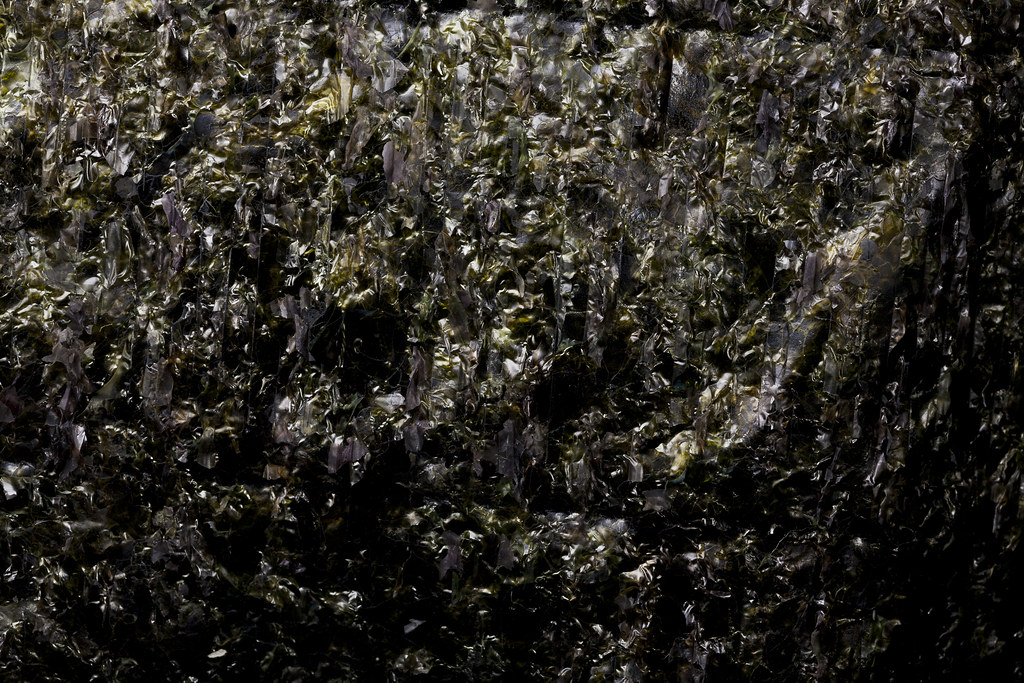
Usually I do my own scanning, but in this case, I figured — what’s the point? A fellow named John Lodder posted this image on Flickr under a Creative Commons 2.0 license, meaning I need to give him credit and link to the original site — which I just did. It’s a close-up of nori.We always have nori around the house. It’s used for wrapping edibles, especially to make homemade sushi, which we do fairly often. Not as artful as prepared sushi, but a lot cheaper and just about as good. More finely shredded nori is a garnish.
Nori is seaweed pressed into sheets. That much I’ve long known. I decided to look into it a little further, and discovered something I never knew, which always makes my day: the story of the reinvention of nori and, indirectly, sushi.

Seaweed has been harvested and processed into nori in Japan for centuries, but right after WWII, the industry was in dire straits.

“Despite becoming a staple food of the Japanese, the basic biology of edible seaweed species remained almost completely unknown until [the late 1940s], when pioneering British scientist Kathleen Drew-Baker saved the country’s nori farming industry,” Gastropod says.

“In 1948, a series of typhoons combined with increased pollution in coastal waters had led to a complete collapse in Japanese nori production. And because almost nothing was known about its life cycle, no one could figure out how to grow new plants from scratch to repopulate the depleted seaweed beds. The country’s nori industry ground to a halt, and many farmers lost their livelihoods.

“Meanwhile, back in Manchester, Dr. Drew-Baker was studying laver, the Welsh equivalent to nori. In 1949, she published a paper in Nature outlining her discovery that a tiny algae known as Conchocelis was actually a baby nori or laver, rather than an entirely separate species, as had previously been thought.

“After reading her research, Japanese scientists quickly developed methods to artificially seed these tiny spores onto strings, and they rebuilt the entire nori industry along the lines under which it still operates today. Although she’s almost unknown in the UK, Dr. Drew-Baker is known as the ‘Mother of the Sea’ in Japan, and a special ‘Drew’ festival is still held in her honor in Osaka every April 14.”

I’m not so sure about that last line. I might have missed such a festival when I lived there — Osaka’s a large place — but other sources, such as a longer University of Manchester article about about Dr. Drew-Baker and nori, tell me the festival is in Uto, Kumamoto.

There’s a memorial to her in Uto, seemingly at a place called Konose Sumiyoshi shrine, which could be confused with Sumiyoshi Taisha (Grand Shrine) in Osaka — within walking distance of where I used to live.

One more thing about nori, at least around here. Our dog likes it. Loves it. One of her favorite things to eat. That has some practical uses, too: any pills the vet prescribes go down a lot easier when wrapped in wet nori.

Bonito Flakes

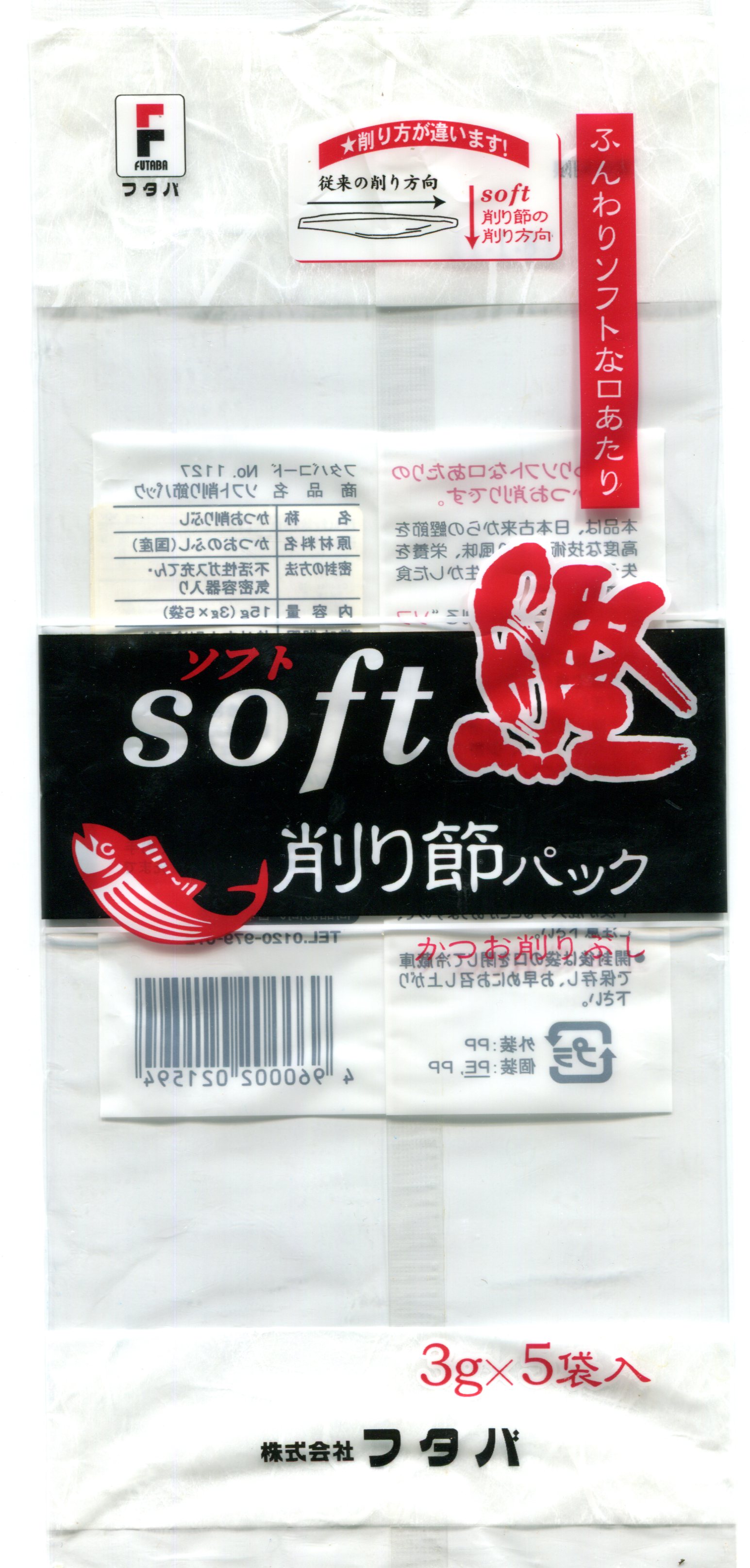
A staple of Japanese cooking, bonito flakes look a little like pencil shavings, but are more delicate. We always have them around the kitchen, in packages large and small. The empty package I scanned is Futaba brand bonito flakes.
“Bonito is a kind of tuna, and Katsuobushi is dried, smoked bonito,” Japanese Cooking 101 says. “Katsuobushi is often used as flakes shaved from a piece of dried fish…
“Katsuobushi has a smokey savory taste that is a great accent for many Japanese dishes. Because dried bonito is packed with lot of umami (savory taste), it is perfect for making dashi (fish broth) with which is a crucial component for Japanese cooking. Katsuobushi also can be used as is, sprinkling on simple vegetables to give a deeper flavor instantly.”

I knew it first from okonomiyaki, an Osaka and Hiroshima specialty sometimes called a Japanese pancake, a term that describes the shape of the food, but misleads about everything else important: taste and texture. Okonomiyaki includes flour, eggs, shredded cabbage, and a choice of protein, and topped with a variety of condiments — especially a brown sauce we call okonomi sauce, and bonito flakes.

Bonito is also good eating as a regular fish dish. Especially in Shikoku, and even more especially in Kochi prefecture in the southern reaches of the island. I encountered it at Cape Ashizuri in ’93.

“The minshuku [was] our accommodation for the night, and completely fogged in. The evening meal made up for it by being excellent, especially the bonito sashimi,” I wrote about the visit.

Kashiwa Mochi

We don’t always acknowledge Japanese holidays, but sometimes we do. This year for Children’s Day, formerly known as Boys’ Day, we ate kashiwa mochi, which is a thing to do on Children’s Day. The holiday is better known in this country for its carp streamers, but we don’t happen to have any of those. (Oddly enough, my mother had three that used to hang in the garage. I don’t know what became of them.)

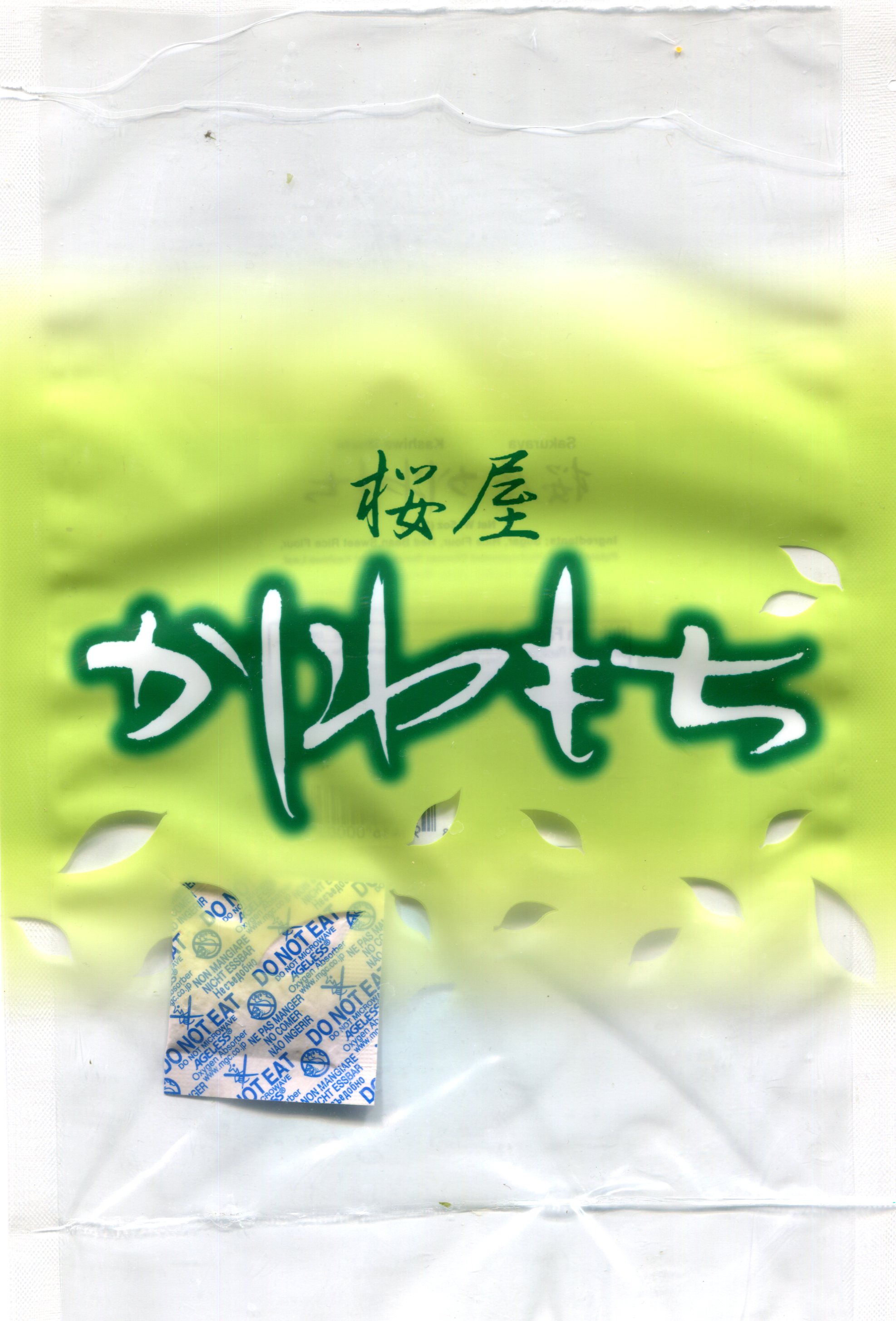
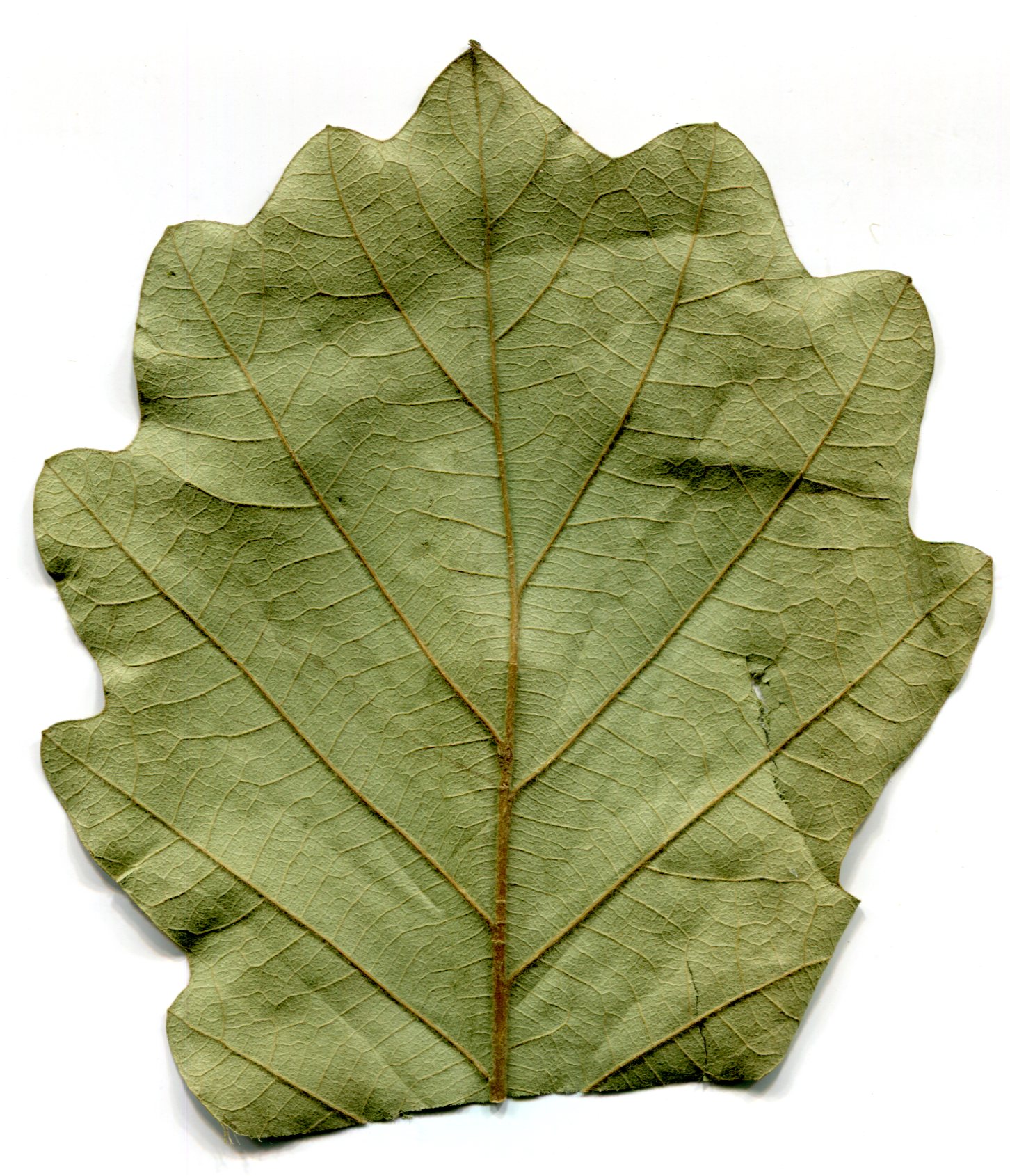
Kashiwa mochi are rice cakes filled with red bean jam and wrapped in oak leaves. The ones we ate came in the package to the right. The small kanji characters say Sakuraya, the brand name, while the larger hiragana characters say kashiwa mochi.

You’d think it’s a product of Japan, but no. It’s domestic, possibly made by a bakery called Sakuraya in Gardena, Calif., and distributed by the Japanese Confection Inc. of College Point, NY. The package, and the Internet, isn’t clear on those points.

The red bean jam is mildly sweet, as red bean jam usually is, but the mochi rice cakes weren’t as sticky as I’m used to eating around the New Year.

Though not that sweet, curiously enough the first ingredient listed for the confection is sugar, followed by rice flour, red bean, sweet rice flour and potato starch.

As befitting its sugar content, it’s almost all carbohydrate, with no fat of any kind and only a touch of protein. No sodium, either.

Toward the end of ingredient list is “salted kashiwa leaf,” that is, the oak leaf. Not edible, but nice to look at. It also wraps the mochi, giving you something to hold it with.

Jidori Chicken

Jidori chicken apparently isn’t new, but I miss things. In 2004, the Wall Street Journal said: “Jidori is exactly the same thing as free-range chicken — but it sounds more impressive in Japanese. ‘Free range is a word that if you put on the menu, it’s out of style,’ Johan Svensson, chef of Riingo in New York.

Today I spotted “jidori” on a package that Yuriko acquired at the northwest suburbs’ main Japanese grocery store. Helpfully, it also said “free range,” as well as offering the kanji for the term: 地鶏. Literally, “ground or earth chicken.”

Nice to learn. Even better, the package contained chicken hearts. That conjured up an image of carefree, happy chicken hearts lolling around the lone prairie.

Been a long time since I’d had any chicken hearts. Usually, or at least in my limited experience, a few are packed along with gizzards, which we don’t eat all that often because they tend to be overly chewy. Hearts, on the other hand, are only a little chewy, and with a good sauce, good to eat.

Adios, Gabuttø Burger

Update: Gabuttø Burger is closed. At least the one in Rolling Meadows is, which used to be the only location. Maybe I should have mentioned that before, since we found that out one day in November (I think) when we dropped by for its fine sort-of-Japanese burgers and found it locked.

So the Yelpers are right. The place wasn’t a victim of the pandemic, though at times I wonder which of our favorite non-chain restaurants will not emerge from their current retail comas. On the other hand, a restaurant is always a high-wire act. No matter how good a joint is, it can still be the victim of regular retail churn.

Gone from Rolling Meadows, but Gabuttø Burger was planning to re-open in Elgin. Not as convenient for us, but we still would have gone occasionally. Unfortunately, word was it was supposed to open in March. I suspect that didn’t go too well.

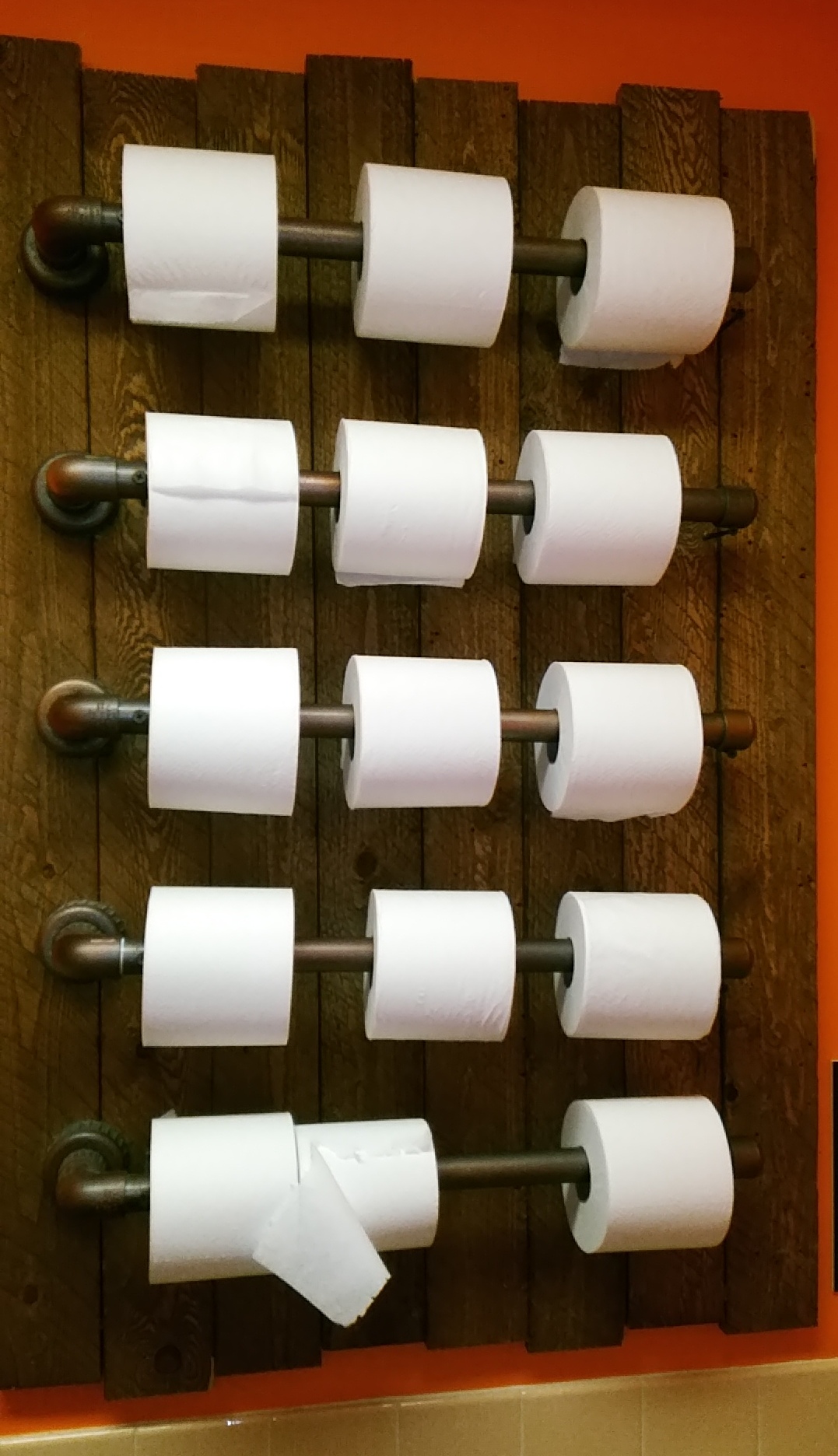
I never did take a picture of one of its burgers. One time, however, I did take a picture at the Rolling Meadows Gabuttø Burger — of something arrayed like I’d never seen before.
More valuable than the restaurant or I realized at the time. I hope the proprietors remembered to take the supply of paper with them when they left.

Speaking of retail in peril, what about the fate of Buc-ee’s? If there ever was a place that encouraged the opposite of social distancing — that would be social cramming? — it would be Buc-ee’s, with its mass crowds in its massive stores.
Then again, such is the pull of Buc-ee’s that maybe it’s been deemed an essential operation in Texas.

British Air ’88

In early April 1988, I visited London for a week, which included laughs in the basement of a pub and time at the British Museum and the Imperial War Museum and a lot more. A good trip.

To make the trip a reality, some time earlier I called a travel agent. The agent who also booked tickets for my company, whose office (I think) was somewhere on Michigan Ave. For me, the ticket buyer, her services cost nothing. Hard to imagine now. I’d call her even for ordinary domestic tickets. The last time was to book passage to Japan in 1990.

I told her where and when I wanted to go, fully expecting to pass through New York to get to London. That’s what you did to get across the Atlantic. Get to New York first, as surely as Lindbergh did.

I reconstruct the conversation:

Agent: We have a flight leaving at x, arriving at Heathrow at y.
Me: Leaving New York?
Agent: No, it’s direct from Chicago.
Me (a touch astonished): Really?
Agent: Oh, yes. So is the return.

A pleasant surprise. I bought a package: RT air tickets, a week’s accommodation at a middling hotel — but very well located near Paddington Station — and a week’s pass on the Underground. Good value.

British Air was the carrier. That too was a first for me. In fact, still the only time I’ve flown that airline. Flew across on a charter in ’83 and on the upstart Virgin in ’94.

A souvenir of the flight. A menu.
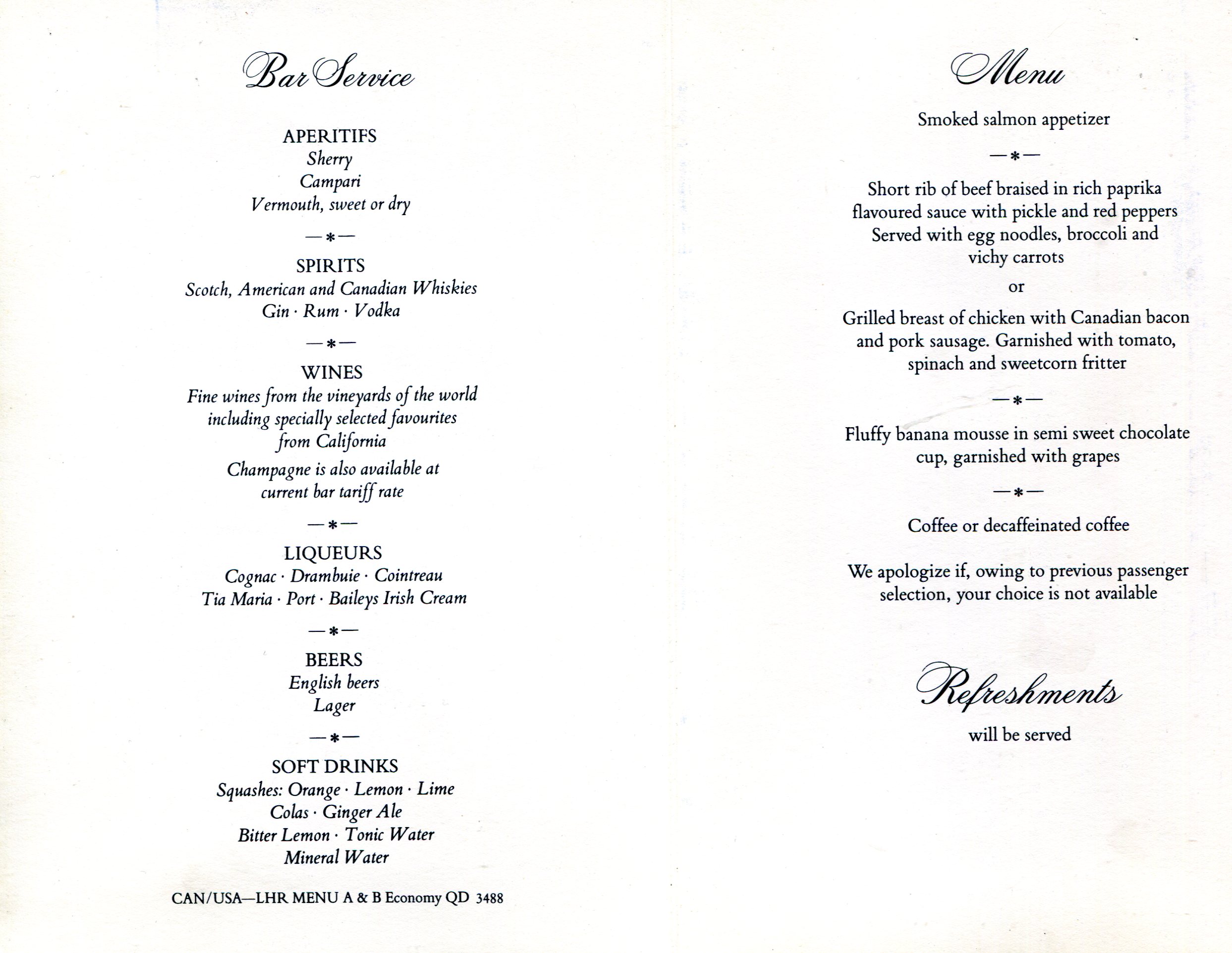
BA menu 1988British Air menu 1988I don’t remember what I had, and I’m not going to bellyache about how much better flying was then compared with more recent times. On the whole, that might be true, but I suspect the differences are exaggerated. Jumbo jets have always been pressurized cattle cars. You put up with it, enjoy the view if you can, and get where you’re going in hours. Worth a little discomfort. Now that air travel is mostly gone, maybe it will better appreciated when it comes back.

Mm, Suburban Chinese Food

The other day I picked up our second pandemic-era takeout food selection, the first being doughnuts: two lunch specials and a serving of chicken wings from a storefront Chinese restaurant. More than enough for three people.

It’s a place we know well. I’ve had better Chinese food, and more authentic Chinese food, in as much as that means anything, but I’m fond of the storefront anyway. (I guess by definition the food I ate in China was more authentic, even if it wasn’t always very good.)

The storefront isn’t expensive, or far away, and it’s consistently good if not great. Everything you need in Chinese food here in suburban North America. We order it about once a month.

The place is mostly takeout and delivery — with only two tables — so I expect it won’t suffer too much from the current crisis. It operates at least one Smart car (soon to be a memory) with the restaurant’s name and colors painted on the side, but I never get delivery. Always takeout. The only difference this time was that I couldn’t go in. I called them from in front of the shop and one of the employees brought out my order, which I’d already paid for over the phone.

Order by phone. Online sites are not to be trusted for that function.

We got what we ordered, enjoyed the meal, and still have leftovers. The order also provided something I’ve never seen before. With each lunch special comes a fortune cookie, a suburban Chinese restaurant touch if there ever was one. The fortunes within show, let’s say, a certain unimaginative consistency.

But this time I noticed that the fortune was printed on slick paper and featured an advertisement on one side. Never in my years of fortune-cookie opening have I seen that. The ad was for tax preparation software.

This article might be behind a paywall, but the readable lead tells me all I need to know: fortune cookie advertising is the work of one company so far. I’m not thrilled about ads invading that obscure space, but I will note that the company has produced something new under the sun, however minor. No mean feat.

My fortune: Chasing your passion will make you happier. Sure it will. Do I even need to list examples of evil passions? Still, it’s a good example of fortune-cookie wisdom.

Mm, Wild Pecan Rice

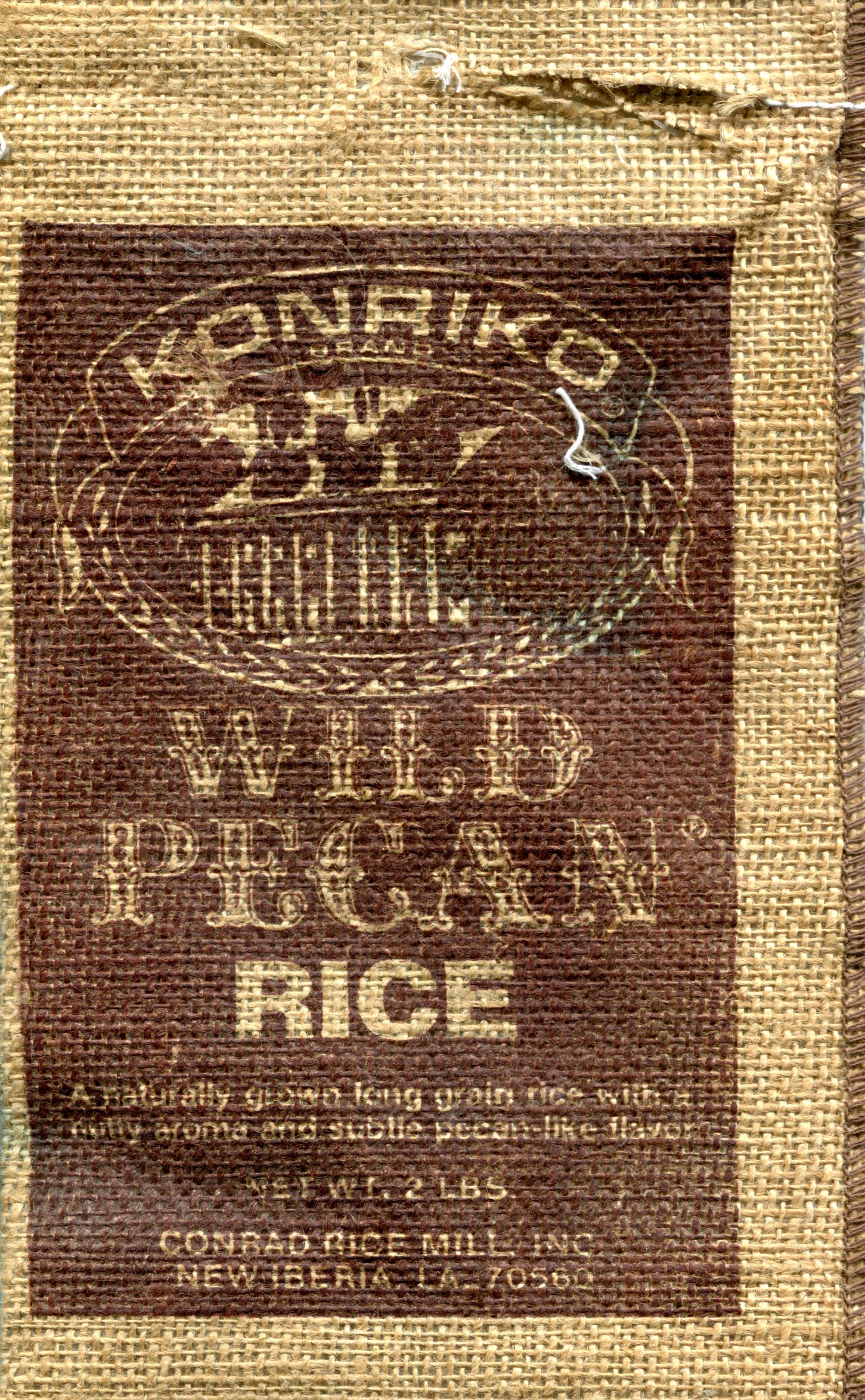
Hanging on the wall near our kitchen is an empty burlap bag that once contained 2 lbs. of Konriko Wild Pecan Rice.

I bought the rice during my visit to New Iberia, Louisiana, in the summer of 2009, when I stopped at the Conrad Rice Mill, a local tourist attraction but also a functioning rice mill. I’m glad to say that even now the mill is still in business, producing rice and other products. When I was there, the mill’s centennial was coming up in a few years; now it’s well past.

The rice included no pecans. The bag, and the Conrad Rice Mill web site, are careful to note that. The bag promises a “nutty aroma and a subtle pecan-like flavor.”

The rice is long gone, and we probably enjoyed it, but what I really like is the bag. That’s my kind of souvenir. Other examples kicking around the house include the small can that used to contain some reindeer pate, acquired on the Finnish ferry between Helsinki and Tallinn, and the front panels from some small cereal boxes acquired in Mexico.

Mm, Grits

There are two kinds of grits in the house. As far as I know, people aren’t hording grits these days, but I haven’t shopped for them since before the pandemic, so who knows.

To the left, the brand I’ve eaten for years. The standard. The go-to. Often the only brand at the grocery store. Easy to make, best eaten after only a few minutes for cooling. Some add butter. I usually add honey, but not always.

To the right, a brand recently acquired. The texture is slightly different, but not enough to put me off of it. Takes longer to make. Naturally, the verbiage on the package tries to make a virtue of that necessity: “You’ll have to hesitate before you eat quick grits again,” it says. Naah.

The standard grits package tube lists the following as ingredients: degerminated white corn grits, plus iron and various vitamins, which are added in the processing. The new grits bag merely lists white corn. Made me wonder if the hull and germ have been removed, which seems essential to grits.

Note this handy definition at Culinary Lore:

Hominy: An endosperm product made from corn, made up of starch, with the hull and germ removed.

Grits: Ground hominy (usually coarse).

I checked the nutrition facts on the new grits package, and indeed it seems that whatever vitamins might have been present in the hull or germ aren’t there, so I assume they aren’t there either.

Anyway, grits and I go way back. As long as I can remember, because my mother made them and I assume her mother did too, though I don’t have any specific memory of grandma’s grits. I learned to make them myself early on.

I also learned that somehow, most restaurants that offer grits serve an inferior version to what you make at home. How is that? Occasionally, though, I find superb grits away from home. For instance, years ago in Mexico Beach, Florida, I had wonderful cheese grits — at a place probably destroyed by Hurricane Michael a year and a half ago.

When I moved to Chicago in the late ’80s, I was glad to find grits in the grocery stores, despite being well north of the Grits Line. I shouldn’t have been surprised, considering how many Southerners, black and white, have migrated to the region over the decades.

Grits aren’t available in Japan. At least they weren’t 30 years ago. We gaijin ordered it by the case from North America, which we then split up. (PopTarts were ordered the same way.) I remember serving them at my apartment in Japan to a Scotsman who also lived in Japan. He liked it well enough.

“Porridge, is it?” he said. I wasn’t sure how to answer. Can porridge be made from corn? Maize, that is. Seems yes, or maybe, since porridge can be any grain, though I think it’s usually associated with oats and not de-germed corn. Porridge isn’t part of my dialect anyway. Growing up I never heard anything outside of children’s stories called porridge, such as what the Three Bears prepared for themselves and Goldilocks pirated.

Yuriko had no notion of grits growing up and still doesn’t care for them. Lilly took to them in a big way, but Ann did not. Different children, different tastes.

Mm, Doughnuts

Been a while since we’ve gone out to eat, of course, but we haven’t been that keen on takeout lately either. On Sunday morning, I decided to drive to the nearest doughnut shop, an independent, and bring home a dozen. Here they are, a selection of creme-filled delights, since that’s what we prefer.

The siren call of doughnuts is pretty strong, but we only buy them every two or three months. Call this latest box our quarterly ration, then, comfort food for uncomfortable times.

For the first time ever, I bought doughnuts using the drive-through. Not just the first at this shop, the first time anywhere. Not bad, just not my typical method. Given my druthers, and until now I’ve always been given my druthers in the matter of doughnuts, I go into the shop to buy a selection. The rows of cheap pastry, from the alluringly plump creme-filled offerings to the scrawny cake doughnuts, wait behind the counter, available not for self-serve, but upon request of another human being.

Ritual selection, it is. Eye the doughnuts, determine what the shop has that you and your party might want — it’s always good to know the tastes of your immediate family in these matters — order two or three or four of this or that, until your dozen is complete. Does anyone ever say to the clerk, just give me a dozen of your choice? Do such devil-may-care people exist? It’s a large world, so they must. But I’ll never be that person.

I’ve been ordering doughnuts for 50 years, that’s why. In our early years in San Antonio, we would sometimes stop at a doughnut shop on the way home from church on Sunday. By ca. 1970, maybe even a little earlier, I’d be tasked as an eight- or nine-year-old to go get the dozen doughnuts.

It was a Dunkin Donuts. I mention that not as an ad — that brand hasn’t been a preferred choice of mine for many years — but to note that it must have been a new franchise in those days, since the brand exploded out of New England only in the 1960s. I never associated it with New England, at least not then. It was merely a likable doughnut shop. It did not, as it does now, distance itself from its pastry origins.

That shop, on Broadway near the Witte Museum, is long gone. A meat shop is in the building now.

A meat shop associated with the restaurant next door, Smoke Shack, which hasn’t been there long, though some kind of restaurant has been next to the former Dunkin’ Donuts since I can remember.

If you look closely at Meat Market, you can see its doughnut past — the glass wall showing most of the store interior, where people sat to drink their coffee, and the part of the building on the right behind brick, which is where the doughnuts were made.