Cal-Tex ’21

My recent visit to Texas was old-fashioned in at least one way. Not in how I got there, namely a series of two airplanes, one to Houston and then another for the short hop to Austin.

Nor in how I got around: driven by a friend or driving a car rented for a few days, along with some long walks after the sun was low or down, since even for central Texas, the late October days this year proved quite warm. Nor even in my eating and drinking habits. I’m glad to report that the restaurants and (I assume) bars of central Texas seem fully open and attracting paying customers.

Rather, I took an old-fashioned approach in taking pictures and sharing them with others. I took almost none. I participated in no social media, including — what’s it called now, Meta? (derisive snort). The trip was a time to visit old friends in person in Austin, meet a new family member in person in that town as well, and visit family in person in San Antonio. There’s no substitute for in person.

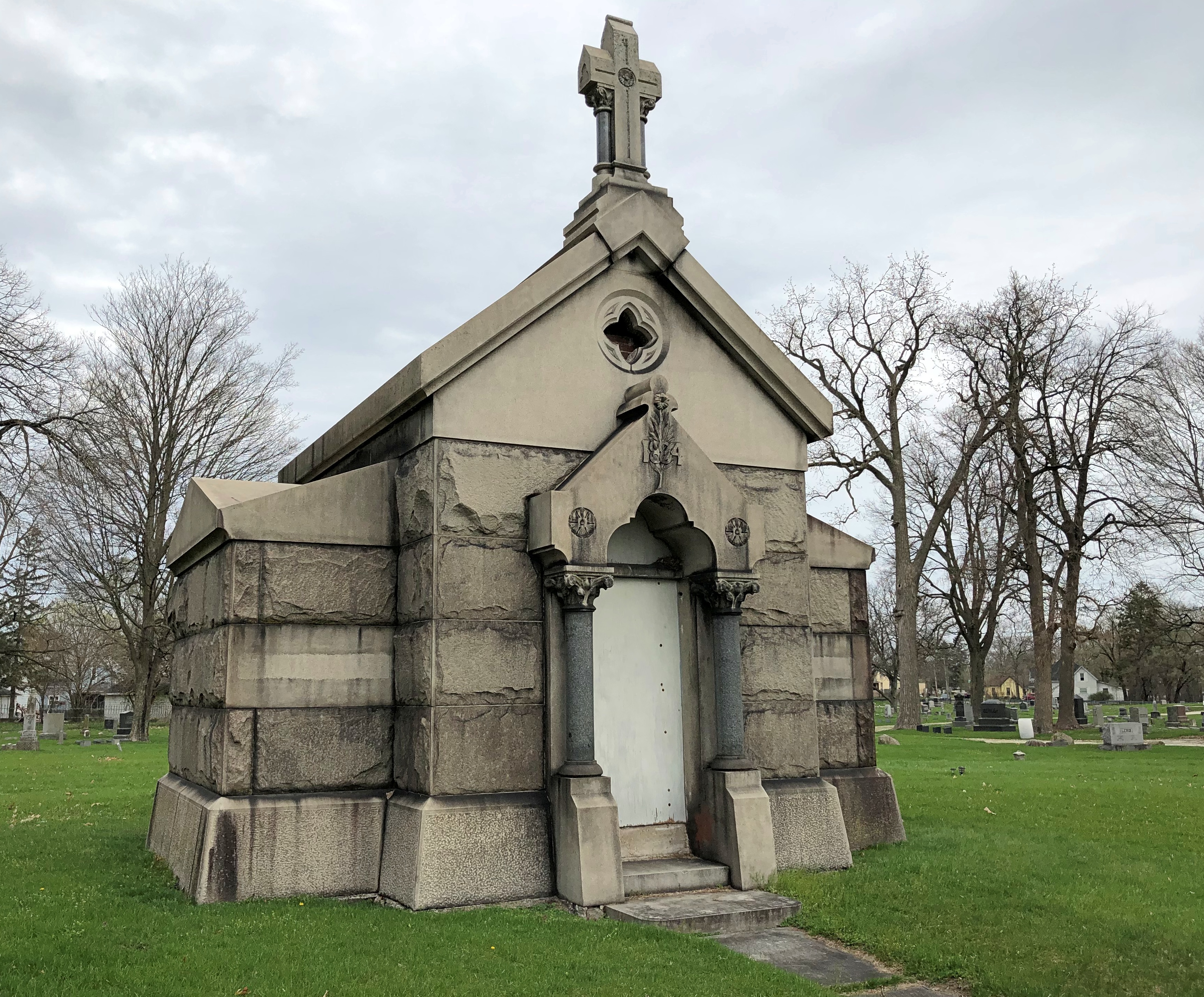
Still, last Monday Jay and I happened to be passing through Seguin, Texas, and happened to see a sign pointing the way to the grave of Juan Seguin. I wasn’t about to pass that up. Or not take pictures. To post here, which barely counts as any kind of media, social or otherwise.grave of juan seguin grave of juan seguin
The grave itself. He was reinterred on the spot in 1976, some 86 years after his death.
grave of juan seguin

My tourist activities picked up quite a bit during the three days I spent in the Bay Area, as a kind of appendix to the trip to Texas. Originally I planned to spend a day each in Oakland, Sacramento and San Francisco, but when the time came to catch a bus to spend the day in Sacramento, I decided I was too tired for it, and spent that morning doing nothing. Such is advancing age. So the trip ended up being about a day in Oakland and a day and a half in San Francisco, staying at a hotel in downtown Oakland.

Why there? It’s been more than 30 years since my last visit to San Francisco (and even longer since my first), and while I passed through Oakland in 1990, I’d never really seen that city. It isn’t the most charming city North America has to offer, and always exists in the shadow of San Francisco, but Oakland has its interests. These are two sights I happened upon in that city.Oakland California
Oakland California

Ah, California.

The Good Reuben James

An anniversary worth noting, because it so seldom is: the sinking of the USS Reuben James, now 80 years past to the day.

Still famed in story and especially song, if you’re willing to listen. Illustrated in our time by an unusually thoughtful video. The Weavers did a good version of the song as well.

Open House: Catholic Churches

During Open House Chicago on Saturday, we wanted to see a place called Boxville — “a 17-[shipping] container open-air marketplace full of art, music, food and a variety of entrepreneurial businesses,” the Open House web site says.

But it looked entirely too crowded as we drove by — people waiting for a tour, or a regular shopping crowd? — and there wasn’t anywhere to park close by. Since Boxville is at the E. 51st Street station on the CTA Green Line, that might be the best way to reach it some other day.

So we went on to Corpus Christi Catholic Church, which is at the corner of Martin Luther King Jr. Dr. and E. 49th St., not too far away. Except that as a functioning Catholic church, Corpus Christi has seen its last mass, which was on June 27.Corpus Christi Church

“Corpus Christi… along with St. Ambrose, St. Anselm, St. Elizabeth and Holy Angels churches, will merge July 1 into one new ‘Our Lady of Africa’ parish, under the Archdiocese of Chicago’s ‘Renew My Church’ initiative, ongoing since 2018,” the Chicago Sun-Times reported in June.

“Under Renew My Church, struggling churches and schools are being closed or consolidated, to cut costs for aging infrastructure, as well as to address a priest shortage.

“And while many parishes continue to struggle with challenges from the changing demographics of Catholic mass and school attendance, the sense of loss from closings and consolidations remains the same.”

Thus the future of the building is uncertain. One of the docents told me she hoped another religious organization would buy the property, but it would be an expensive proposition. Still, someone should consider making a deal with the Archdiocese. It’s a resplendent church, especially inside.Corpus Christi Catholic Church Chicago Corpus Christi Catholic Church Chicago Corpus Christi Catholic Church Chicago

But maintenance is clearly an issue.Corpus Christi Catholic Church Chicago

“This Renaissance Revival building by Joseph W. McCarthy has twin spires and a deeply-coffered ceiling,” says Open House. “Brightly colored stained glass windows, designed in Germany by F.X. Zettler, depict the original church members processing with Pope Pius X…

“During the Great Migration of the 1930s, the church went from serving a predominantly Irish-American community to serving an African-American community.”

Fine detail is evident, including small mosaics.Corpus Christi Catholic Church Chicago Corpus Christi Catholic Church Chicago

A few blocks south of the Midway Plaisance, in a block that’s clearly gentrifying, is the Shrine of Christ the King. This is how the exterior looked on Saturday.Shrine of Christ the King, Chicago Shrine of Christ the King, Chicago

This is a Street View from July 2017, a year and some months after a fire gutted the church.

“More than 150 firefighters were called the 90-year-old church, located in the 6400 block of South Woodlawn Avenue…” WLS reported in October 2015. “Chicago Fire Department detectives said spontaneous combustion from rags used to stain the floor of the choir pew is the mostly likely culprit.

“The Shrine of Christ the King was originally a Catholic church, known first as St. Clara and then as St. Gelasius. As the size of the parish diminished, the building faced demolition. However, the building was given historic status and taken over by a religious order in 2006.”

Namely, the Institute of Christ the King Sovereign Priest, which has been around only since 1990 and whose U.S. national headquarters is in Chicago. The building is considerably older, the final work of ecclesiastical architect Henry J. Schlacks, completed in 1927 (and suffering a previous fire in 1976).

The interior is still completely unfinished. All you could do is look in from the entrance, and hear about its pending restoration from volunteers. I’m all for that, so I put a small donation in the box on the table at the door.

On Sunday, while Yuriko was busy creating a most delicious marble cake —marble cake

— I headed to the North Side to take a look at St. Vincent de Paul Church.St. Vincent de Paul Church Chicago St. Vincent de Paul Church Chicago St. Vincent de Paul Church Chicago

“St. Vincent de Paul serves a parish founded in 1875 by the Vincentian order,” Open House says. “The present-day church was completed in 1897, considered to represent architect James Egan’s finest work… The church is constructed of Indiana limestone blending Romanesque architecture like rounded doorways and arcades with French Gothic details such as the large, soaring windows.”St. Vincent de Paul Church Chicago St. Vincent de Paul Church Chicago St. Vincent de Paul Church Chicago

Wonderful to see, but when I left I also took note of a more everyday wonder. Food. Across the street from the church is a joint called Jam ‘n Honey. People were sitting at tables out on the sidewalk, eating what looked like delicious breakfasts. I’ll have to keep that in mind for future reference.

Open House: Protestant Churches

During Open House Chicago on Saturday, we dropped by a number of open churches, as usual. Chicago has many. Our first religious site was the United Church of Hyde Park, a Romanesque Revival structure designed by Gregory A. Vigeant, dating from 1889.United Church of Hyde Park United Church of Hyde Park

“United Church of Hyde Park is a tri-denominational faith community (United Church of Christ, Presbyterian Church USA, and United Methodist Church),” the church web site says. A Protestant parfait, I guess.United Church of Hyde Park United Church of Hyde Park

They’re barely visible, but the names of the Apostles are inscribed around the dome.
United Church of Hyde Park

There are 12 places for names, and while I can’t read them, I assume they include Matthias rather than Judas. I’d hope so, anyway.

Elsewhere in Hyde Park is Augustana Lutheran Church.Augustana Lutheran Church

It’s a mid-60s modernist design by Edward Dart, who is better known for Water Tower Place on Michigan Ave., though he did a lot of churches as well.Augustana Lutheran Church Augustana Lutheran Church Augustana Lutheran Church

“A church more than any other building should reflect today’s culture, feeling, and the renaissance of our own era,” Dart said. That meant midcentury brick and concrete, and for all that not a bad design.

The Augustana grounds also include a spot of green space behind a brick wall near the street. Part of the space is given over to a columbarium.
Augustana Lutheran Church

Interestingly, the plaques on the wall (to the right in the above picture) don’t mark niches. Rather, they name people whose ashes have been scattered in the churchyard.
Augustana Lutheran Church

I suppose that’s Paul, though the only thing that tells me so is text on the wall nearby, from his Epistle to the Romans.
Augustana Lutheran Church

One more neighborhood Protestant church: Hyde Park Union Church, a 1906 design by James Gamble Rogers.Hyde Park Union Church
Hyde Park Union Church

A bit dark inside, but I understand the acoustics are really good.
Hyde Park Union Church

Plus some impressive Tiffany windows, such as one depicting Joshua and Moses.
Hyde Park Union Church

As the name indicates, the current church was formed by a merger between congregations. In this case, American Baptist Churches-USA and United Church of Christ.

During the course of the day, we passed by a few other churches that I’d have peeked inside, had they been open. Such as a Baptist church in Bronzeville, which is otherwise home to a number of fine churches.Liberty Baptist Church, Chicago

And a Unitarian church of considerable heft, back in Hyde Park.First Unitarian Church of Chicago

I can’t remember visiting a Unitarian church before, though I probably have. Still, I was definitely curious to know how this one is decorated inside. Like this, turns out.

ISU Quad Walkabout

Heavy rain for a while today and cooler temps, but not till afternoon, so there was time for one more lunch on my deck.

Ann invited us to visit her over the weekend, which we did, heading down to Normal on Saturday morning and returning Sunday afternoon, spending the night in a motel near I-55. Daytime temps were nearly as warm as when I dropped her off at ISU in August.

Toward the end of the day on Saturday, it had cooled enough for a short walk — including the dog, whom we brought — around the prettier parts of campus. Mostly that meant the ISU Quad. What’s a university without a quad or two?

As mentioned yesterday, most of the foliage is still green. An eastern approach to the Quad.ISU Quad

ISU Quad

“The Hand of Friendship,” which honors Robert G. Bone.ISU Quad

Bone (1906-1991) was the ninth president of Illinois State Normal University, which was renamed Illinois State University during his tenure. Though only president for 11 years (1956-67), he oversaw a lot of construction, including the tower where Ann lives. Later, the school’s student center was named after him.

The Quad also counts as the heart of the arboretum that spans the campus — the Fell Arboretum, to cite its formal name, honoring one Jesse Fell.

Fell (1808-87) was the sort of businessman that America spawned in the 19th-century — lawyer, real estate speculator, newspaper publisher and sawmill owner. Specific to Illinois, he was a friend of Lincoln’s. He founded towns in central Illinois and helped organize counties there as well, and is considered a founder of ISU.

As for the arboretum, apparently Fell not only profited from cutting down trees, but was a fanatic when it come to planting them, so ISU named it in his honor.

Elsewhere, we saw a plaque on a rock honoring the horticulturist who designed the original landscape for the campus, William Saunders (1822-1900), who also happened to be a founder of the National Grange of the Order of Patrons of Husbandry, an organization I had only scant knowledge of before. That is to say, little that I remember, though I’m sure heard about the Granger movement in a U.S. history class. Always good to learn or re-learn something.

In the middle of the Quad is a lush garden.ISU Quad

ISU Quad

ISU Quad

The centerpiece is the Old Main Bell, dating from 1880.
ISU Quad Old Main Bell

Old Main was the campus’ first building, which stood from 1857 to 1958. A memorial honors the building not far from its bell. Unusually, it depicts all four elevations of the building.
ISU Quad Old Main
ISU Quad Old Main

We wandered on. This is Cook Hall.

“One of Illinois State’s most interesting buildings and the oldest one still standing on the Quad, Cook Hall was originally built to be a gymnasium,” ISU tells me. “It was completed in 1897 and was named after John Williston Cook, the University’s 4th President (1890-1899). He earned his diploma in 1865 from Illinois State Normal University and in 1876 he became a Professor of Mathematics.

“The building has also been known as the ‘Old Castle’ or ‘The Gymnasium.’ The governor at the time, John Altgeld, had a great liking for medieval castles and insisted all new state construction during his term in office resemble castles. You’ll find a Cook Hall look-alike at many other state schools; they are called ‘Altgeld’s Folly.’ ”

Really? I had to look into that more, and found this Wiki item about Altgeld Castles. It does indeed seem that a raft of crenellated, or quasi-crenellated buildings at Illinois state schools dates from the 1890s. I remember seeing Altgeld Hall at UIUC, but didn’t know it was part of a pattern. An eccentric pattern. That’s two things I learned (or relearned) today; makes for a good Monday.

The Former Hokkaido Government Office Building

We spent time in Sapporo during our late September/early October 1993 visit to Hokkaido, and one of the more charming structures to be found there is the Former Hokkaido Government Office Building. A handsome pile of 2.5 million or so bricks.Old Hokkaido Government Building

I understand the local nickname is Akarenga, or Red Bricks. That seems fitting.

The building dates from early Meiji period, when settling Hokkaido was seen as a priority, and for a time housed the offices of the Hokkaido Development Commission, and later the government of the prefecture. It burned down twice in the earliest years and was always rebuilt (but I don’t think it fell into a swamp).

“Completed in 1888, the American neo-baroque style brick style brick building was designed by engineers of the Hokkaido Government and was constructed with many local building materials…” says the prefectural government.

“In 1968, it was restored to its original state in commemoration of the centennial of Hokkaido… and it was designated as a National Important Cultural Property in 1969.”

These days (as in 1993), it houses a small museum and the prefecture’s archives. I know we went in, but I don’t remember what was on display. Note the flag on the pole on the pamphlet I picked up at the building, but not in the picture I took.

I might not have seen the flag of Hokkaido there, but I do like it.

Forest Home Cemetery & Arboretum, Milwaukee

A touch of fall in southern Wisconsin.Forest Home Cemetery & Arboretum

A touch more every day, for sure, but this is how the foliage appeared on Saturday at Forest Home Cemetery & Arboretum, Milwaukee, which is mostly still green.

The cemetery’s chapel was part of Open Doors Milwaukee over the weekend. It is a handsome structure, completed in 1892.Forest Home Cemetery & Arboretum

“With an exterior of gracefully aged reddish-brown Lake Superior sandstone, the interior features stately buttresses, fine leaded-glass windows and spacious conservatories containing lush tropical foliage,” the cemetery web site notes, a little heavy on the adjectives. “Many of the tropical plants are decades-old and provide a comforting ambiance that truly sets the Chapel apart from others built before, or since.”Forest Home Cemetery & Arboretum

The conservatory elements are on either side of the main nave-like room. I put it that way because, according to a docent on site, no denomination has ever consecrated the space.Forest Home Cemetery & Arboretum

Forest Home Cemetery & Arboretum

As for the cemetery proper, some 118,000 people reside there.Forest Home Cemetery & Arboretum, Milwaukee

Forest Home Cemetery & Arboretum, Milwaukee

The nonprofit that runs the cemetery publishes a wonderful, 20-page full-color guidebook and was giving them away for Open Doors Milwaukee. Maybe they’re always given away, but anyway I got one and used it liberally during my visit.

“Forest Home Cemetery was established in 1850 by St. Paul’s Episcopal Church as a cemetery for the city,” the guide says. “As Milwaukee expanded, the cemetery became the final resting place for 26 mayors, more than 1,000 Civil War veterans and countless prominent people who left their marks on Milwaukee’s history… the property was one of the first landscaped sites in Milwaukee offering a natural respite. Designed by Increase A. Lapham, known as Wisconsin’s first naturalist, it is considered one of the finest examples of a rural garden cemetery in the Upper Midwest.”

Increase Lapham. Makes me smile. Name your babies Increase, hipsters. You could do a lot worse, considering the distinction of this particular Increase.

“A self-educated engineer and naturalist, Increase Lapham [1811-1875] was Wisconsin’s first scientist and one of its foremost citizens,” the Wisconsin Historical Society notes. “He wrote the first book published in Wisconsin, made the first accurate maps of the state, investigated Wisconsin’s effigy mounds, native trees and grasses, climatic patterns and geology, and helped found many of the schools, colleges and other cultural institutions that still enrich the state today.”

More important than the text, the guidebook includes a detailed map and a color-coded key to the notable burials at Forest Home.

Yellow: Beer Barons; Pink: [Other] Industrialists & Business Magnates; Brown: Pioneers, Inventors & Publishers; Orange: Mayors & Founders; Aqua: Notable Women; Red: Black Leaders & Abolitionists; Purple: Entertainers, Artists & Art Collectors; Deep Blue: Military Heroes; Green: Tragic and Distinctive Burials, such as the memorial to the victims of the 1883 Newhall House Hotel Fire, which General and Mrs. Tom Thumb survived, the grave of John “Babbacombe” Lee, and five victims of the 1903 Iroquois Theatre Fire in Chicago.

All together, the guide lists 65 notable burials. Far too many to see during our hour jaunt through the property, but I managed to find a few, which as always is enough. I was especially interested in finding beer barons. A whole category for beer barons; that’s Milwaukee for you.

Valentin Blatz (1826-94).Forest Home Cemetery & Arboretum, Milwaukee

Frederick Pabst (1836-1901).Forest Home Cemetery & Arboretum, Milwaukee

The cenotaph of Joseph Schlitz (1831-75).
Forest Home Cemetery & Arboretum, Milwaukee

If I knew it, I’d forgotten that Schlitz died in the sinking of the SS Schiller off the Isles of Scilly on May 7, 1875. The ship is carved on the cenotaph.Forest Home Cemetery & Arboretum, Milwaukee

Those three were among the largest memorials in the cemetery, but hardly the only striking ones.Forest Home Cemetery & Arboretum, Milwaukee

Forest Home Cemetery & Arboretum, Milwaukee

I chanced across the stone memorializing company founder A.O. Smith.
Forest Home Cemetery & Arboretum, Milwaukee

As an industrial concern, A.O. Smith has experienced an interesting trajectory. Over the years, it has made bicycle parts, steel vehicle frames, bomb casings and other munitions for the World Wars, brewery tanks, water heaters, air conditioning components, boilers and more. It’s still headquartered in Milwaukee.

We noticed that the statue on top of the memorial of one Emil Schneider had toppled to the ground at some point recently.Forest Home Cemetery & Arboretum, Milwaukee

The head and hands are missing. Go figure.
Forest Home Cemetery & Arboretum, Milwaukee

Toward the end of our walk, we noticed George Marshall Clark (1837-61), whose spanking new stone was dedicated only a few weeks ago, on the 160th anniversary of his lynching.Forest Home Cemetery & Arboretum, Milwaukee

As I said, there was only time to see a small fraction of the notable burials. Among the others listed, I’d heard of a few that we didn’t see, such sausage king Fred Usinger, Gen. Billy Mitchell and insurance executive Edmund Fitzgerald, who lent his name to the ore carrier that famously sunk in Lake Superior in 1975.

Many more stones memorialize interesting people I’d never heard of, including Increase Lapham, see above. The world is full of such. That’s one reason to visit cemeteries, or at least those with useful guidebooks.

A selection, including slightly edited text provided by the guide:

Harrison C. Hobart (1815-1902). Union Gen. Hobart was captured at Chickamauga. Along with two other officers, he devised a plan to dig an escape tunnel, working in secret for months until 109 prisoners crawled to freedom.

Christopher L. Sholes (1819-90). Inventor of the QWERTY keyboard typewriter.

Georgia Green Stebbins (1846-1921). Stebbins was the keeper of the North Point Lighthouse for 33 years. Her father, Daniel Green, initially held the job, but was in ill health, so Stebbins unofficially performed his duties for seven years before being appointed to the position.

Xay Dang Xiong (1943-2018). Xiong was a Hmong veteran from Laos who risked his life in secrecy working with the CIA during the Vietnam War. He spent 16 years in the Royal Lao Army fighting in numerous battles while commanding 4,500 troops… Col. Xiong received a full military burial.

Carl Zeidler (1908-42). Elected mayor of Milwaukee in 1940, Zeidler requested a leave from his duties in 1942 to fight in WWII. He died six months later when his ship, the USS LaSalle, was torpedoed and everyone on board perished. Because his remains were never recovered, he was memorialized with a cenotaph. (His brother Frank Zeidler (1912-2006), three-term socialist mayor of the city, is also in the cemetery.)

An FLW Block, Though Built by Mr. Richards

Once upon a time, Frank Lloyd Wright took a stab at designing affordable housing. He didn’t get far for various reasons (including, maybe, his temperament), but relics of the effort occupy the north side of the 2700 block of W. Burnham St. in Milwaukee to this day. We arrived to take a look around noon on Saturday.

I bought some postcards from the nonprofit that now owns most of the block. One line on one of the cards says: “Burnham Block is the only location in the world where six Wright-designed homes sit side by side.”

I’d say that’s reaching for a distinction, but in any case the block was worth seeing. FLW is usually worth a look, even in the case of an obscure warehouse building in otherwise obscure Wisconsin town.

The houses on the block have that FLW look, all right.Burnham Block, Milwaukee

Burnham Block, Milwaukee

At one point the owner of the house on the left, which is in the middle of the block, had the temerity to put siding on the house, which horrifies the Wright purists, who have been acquiring the houses one by one in recent years, but haven’t gotten that one yet. When they finally do, it will be restored to its 1910s look, once funds are raised (always a consideration with FLW works).

The six are American System-Built Homes. To quote from the last time we saw one, which was in 2015: “Between 1915 and 1917, Wright designed a series of standardized ‘system-built’ homes, known today as the American System-Built Homes, an early example of prefabricated housing. The ‘system’ involved cutting the lumber and other materials in a mill or factory, and then brought to the site for assembly; thus saving material waste and a substantial fraction of the wages paid to skilled tradesmen.”

Arthur L. RichardsMuch more detail on the Burnham houses is at web site of the organization that owns most of them.

On Saturday, only one of the houses was open for a tour (the B-1 model, roughly 800 square feet), taking about a dozen people at a time, so we had to wait 20 minutes or so each to get in. While we waited, a docent talked about the houses, and FLW, and the houses’ developer, whom he quarreled with — Arthur Richards, pictured in an early 20th-century ad — the cost-savings measures, the history of the properties after Wright gave up on the American System but before the world acknowledged them as products of The Genius, which was decades later, and more.

This is the B-1, with people waiting on the porch to get in.
Burnham Block, Milwaukee

The inside is impressive in a number of ways, but mainly in its efficient use of the small space, and its inexpensive wood buffed up to look elegant. Two pictures in the slide show here that illustrate that. Nice place to visit, I thought, but not enough room for essential clutter.

Two Churches in Bay View, Milwaukee

Just at first glace on Saturday morning, the Bay View neighborhood in Milwaukee seemed alive with small businesses and pedestrians along S. Kinnickinnic Ave. (long ago, an Indian trace). I was glad to see it.

The place has a long history, founded separately from Milwaukee. “Captain Eber Brock Ward of Michigan opened his third rolling mill, the Milwaukee Iron Co., in Bay View in 1868,” the Bay View Historical Society says.

“Within a year the village of Bay View sprung up as a company town around the steel mill. Cottages erected for mill workers became the center of the village. Many of these cottages are still occupied today and are a part of the diverse architecture of the Bay View neighborhood.

“With village incorporation in 1879, its rapid growth and demands for city services were so great that a vote was taken and the village was annexed to the city of Milwaukee in 1887.”

Rising at a bend on Kinnickinnic is St. Lucas Evangelical Lutheran Church.St. Lucas Evangelical Lutheran Church Milwaukee

Originally, Evangelische Lutherische St. Lucas Kirche zu Bay View, since it is yet another Midwestern church founded by German immigrants, with the building completed in 1888.

Built using good old Cream City brick, a local specialty.St. Lucas Evangelical Lutheran Church Milwaukee

“The church commissioned architect Herman P. Schnetzky (1849-1916) to design its new place of worship,” Architecture of Faith says. “Schnetzky was born in the town of Wriezen in the Kingdom of Prussia… He came to Milwaukee as a young man and worked in the office of H.C. Koch and Company from 1874 or a bit earlier, [establishing] his own office in 1887.

“Schnetzky’s design for St. Lucas Lutheran is quite similar to his design for St. Martini Lutheran, built just a year prior to St. Lucas on Cesar Chavez Drive and Orchard Street on the South Side. He went on to design at least five other churches in Milwaukee by 1896, under his own name and in partnership with Eugene Liebert.”St. Lucas Evangelical Lutheran Church Milwaukee

St. Lucas Evangelical Lutheran Church Milwaukee

A few blocks northwest of St. Lucas is St. Augustine of Hippo Catholic Church, finished in 1908. More Cream City brick.St. Augustine of Hippo Catholic Church

St. Augustine of Hippo Catholic Church

It too was developed for a German-speaking congregation, with a design by Brust & Philipp, a very busy firm 100 years ago.St. Augustine of Hippo Catholic Church
St. Augustine of Hippo Catholic Church

A volunteer told me that the platform extending out from the apse (a term he didn’t use) was added after the Catholic church “changed a bunch of things” in the 1960s (not using the term Vatican II). I guess he was used to talking to people who had no notion of that bit of ecclesiastical history. Anyway, the platform was thought better to facilitate priestly interaction with the congregation, now that they faced each other.

He didn’t know who had made the stained glass windows, except that they were original to the church and not added later. They’re wonderful.St. Augustine of Hippo Catholic Church

The Stations of the Cross on the wall, on the other hand, were salvaged from another Milwaukee church that closed some years ago, though they look like they belong in their current place.

Emerging from the church, I noticed a couple of men on a porch across the street from St. Augustine.

Just a couple of regular Milwaukee guys getting ready for their Saturday doings?

Doors Open Milwaukee ’21

Warmish weekend, good for walking around. We did that in Milwaukee yesterday, because the Doors Open Milwaukee event has returned after last year’s cancellation. We drove up in mid-morning and returned not too long after dark, as we did in 2019 and 2018 and 2017. One difference this year was that a few — not all — places required a mask.

Doors Open Milwaukee 2021

Another wrinkle this time is that we took the dog. Leaving her at home alone for more than a few hours is just asking for a mess to clean up upon return. So that meant for most of the places we went, we took turns, as one of us stayed with the dog, either in the car or walking her around.

First we went to the Bay View neighborhood south of downtown, a place that got its start as a 19th-century company town. In our time it seems pretty lively. There we sought out St. Lucas Evangelical Lutheran Church and St. Augustine of Hippo Catholic Church, both late 19th-century/early 20th-century edifices themselves, distinctly built of cream brick.

In the Burnham Park neighborhood of Milwaukee, southwest of downtown, you can find the Burnham Block. In fact, an organization called Frank Lloyd Wright’s Burnham Block, which is part of Wisconsin’s Frank Lloyd Wright Trail, very much wants you to come see the six small houses on that block, designed by The Genius.

Who are we to resist the call of FLW? We went there next. So did a fair number of people late that morning, more than at any other place we saw yesterday. This was part of the line to get in.Burnham Block, Milwaukee

Taking turns looking at FLW’s work took up a fair amount of time. Afterward we repaired to a park for a drive-through-obtained lunch. Then we went to Forest Home Cemetery. Usually, I can’t persuade Yuriko to visit cemeteries, but the Doors Open feature was its chapel, which she was willing to visit.

Then, to my complete surprise, she wanted to walk the dog through the cemetery as I stopped here and there among its many stones and funerary art. Forest Home is an historic rural cemetery movement cemetery, as fine an example as I’ve seen anywhere.

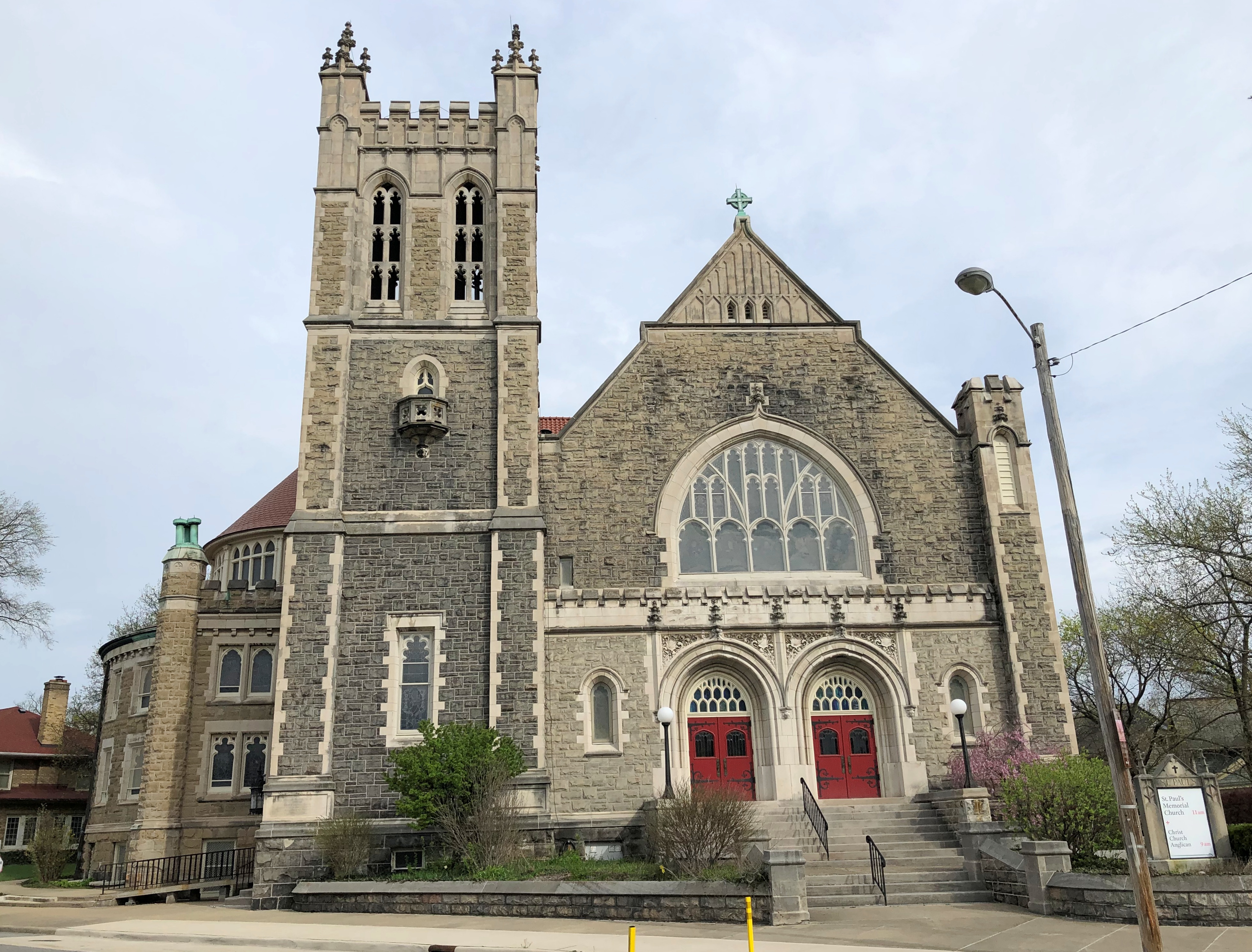
We had time enough after the cemetery for two more churches in East Town — or maybe the Lower East Side, hard to tell — St. Paul’s Episcopal Church and St. Rita’s Catholic Church.

By the time we’d finished those, it was 5 pm and Doors Open was done for the day. But I didn’t quite want to head home. I wanted to find a place to see the Milwaukee skyline, something I’d never done in all the years I’ve been coming to that city.

It didn’t take long.

That’s the view from Veterans Park on Lake Michigan, and it illustrates one of the advantages of the Milwaukee MSA (pop. 1.57 million) compared with the Chicago MSA (pop. 9.6 million).

The logistics of getting to that view of Milwaukee were exactly this: drive to Veterans Park, park on the road for free, and walk about two minutes. To reach a similar vantage to see the vastly larger Chicago skyline, I shouldn’t have to point out, is much more complicated, and free doesn’t enter into it.

Veterans Park in Milwaukee also has some nice amenities, such as a place called Kites.Kite shop, Milwaukee

Kite shop, Milwaukee

At Kites, you can buy kites, as well as snacks. We got some nachos.Kite shop, Milwaukee

People were out flying kites. The wind was up but it wasn’t too cold, so it was a good afternoon for it. If we’d gotten there earlier, we might have as well.Kite flying, Milwaukee

We walked the dog again, this time a little ways along the lake.
Lake Michigan, Milwaukee

It was a good afternoon for that, too.