Wednesday Debris

Warm days and cicadas at dusk. Back to posting around August 1.

I saw this in my back yard yesterday.

Imagine my surprise. A lawn circle! The suburban version of crop circles. (In the UK, they’re called garden circles.) Clear evidence that space aliens visited.
Spotted in a northwest suburban parking lot the other day.
Color Me Green
I ought to look that up, but I don’t want to.

Dear streaming service that I subscribe to: When you send me an email with links in it, the links should not take me to this.

This statue was just east of the commuter rail station in New Buffalo.
"Gakémadzëwen," which is Potawatomi for "Enduring Spirit,"

“Gakémadzëwen,” which is Potawatomi for “Enduring Spirit,” by Fritz Olsen, dedicated only in 2018. The plaque says it was erected by the city of New Buffalo “in recognition of the generous contributions to the city by the Pokagon Band of Potawatomi.”

“The 1833 Treaty of Chicago established the conditions for the removal of the Potawatomi from the Great Lakes area,” says the band’s web site. “When Michigan became a state in 1837, more pressure was put on the Potawatomi to move west. The hazardous trip killed one out of every ten people of the approximately 500 Potawatomi involved.

“As news of the terrible trip spread, some bands, consisting of small groups of families, fled to northern Michigan and Canada. Some also tried to hide in the forests and swamps of southwestern Michigan. The U.S. government sent soldiers to round up the Potawatomi they could find and move them at gunpoint to reservations in the west. This forced removal is now called the Potawatomi Trail of Death, similar to the more familiar Cherokee Trail of Tears.

“However, a small group of Neshnabék, with Leopold Pokagon as one of their leaders, earned the right to remain in their homeland, in part because they had demonstrated a strong attachment to Catholicism. It is the descendants of this small group who constitute the Pokagon Band of Potawatomi Indians.”

Even so, it wasn’t until 1994 that Congress reaffirmed the federally recognized status of the Pokagon Band of Potawatomi. The band now owns some Michigan casinos, including Four Winds New Buffalo, which features 3,000 slot machines, 70 table games, four restaurants, bars, retail venues, and a 415-room hotel.

Got a boring email from Amazon the other day. It said:

Unfortunately, we weren’t able to cancel the items you requested and these items will soon be shipped. We apologize for the inconvenience.

You can track your package at any time. If you no longer want these items, you may refuse delivery or return them after they arrive. You can visit Your Orders to start a return.

There’s no style to that. How about:

Unfortunately, we weren’t able to cancel the items you requested and these items will soon be shipped. No force in the universe can stop an Amazon order once it is past the FailSafe Point.®

Not even the mighty Jeff Bezos can stay your package from its appointed delivery, even from his perch in space. You may refuse delivery or return them after they arrive. You can visit Your Orders to start a return.

Also from Amazon: One of our updates involves how disputes are resolved between you and Amazon. Previously, our Conditions of Use set out an arbitration process for those disputes. Our updated Conditions of Use provides for dispute resolution by the courts.

Well, well, well. The Wall Street Journal reported in June: “Companies have spent more than a decade forcing employees and customers to resolve disputes outside the traditional court system, using secretive arbitration proceedings that typically don’t allow plaintiffs to team up and extract big-money payments akin to a class action.

“With no announcement, the company recently changed its terms of service to allow customers to file lawsuits… The retail giant made the change after plaintiffs’ lawyers flooded Amazon with more than 75,000 individual arbitration demands on behalf of Echo users.”

This is the flag of Greater London. The officially approved flag of that political entity, I’ve read. It looks like it was drawn by a ten-year-old.

One more thing: National Geographic now asserts there is a “Southern Ocean,” hugging Antarctica below 60 degrees South. That’s a term that I know Australians have long used — I heard it from Australians in the ’90s, and saw the term on a sign at Cape Leeuwin — though I believe they mean the “waters south of us.”

Speaking of ten-year-olds, I understand that part of Nat’l Geo’s mission is educational, but a headline asking whether I can name all the oceans, as if I were that age?

Paestum 1983

One more card, depicting Paestum, which I visited on July 20, 1983. The postcard dates from the early 1990s, sent to me by an Australian I knew. I’d recommended he visit the place, and he did.Paestum

“Paestum, also known by its original Greek name as Poseidonia, was a Greek colony founded on the west coast of Italy, some 80 km south of modern-day Naples,” says World History Encyclopedia.

“Prospering as a trade centre it was conquered first by the Lucanians and then, with the new Latin name of Paestum, the city became an important Roman colony in the 3rd century BCE. Today it is one of the most visited archaeological sites in the world due to its three excellently preserved large Greek temples.

“Paestum is most famous today for its three magnificent temples which are amongst the best surviving examples of ancient Greek architecture anywhere,” the encyclopedia continues. I’ll vouch for that. They were impressive indeed, and I also delighted in walking along such a well preserved Roman road.

A bonus thing to think about in that text: Lucanians, an Italic people who spoke Oscan. The Roman juggernaut eventually absorbed them, lock, stock and barrel, and I’d say they and their language are even more obscure than the Etruscans.

On the whole, it seems to be a well-written article, but I’m not sure about Paestum being a “most visited archaeological site.” It might not be entirely authoritative, but Travel & Leisure published a list in 2012 regarding the most-visited ancient ruins. Paestum doesn’t make the cut; the closest places are Pompeii and Herculaneum.

My own experience was that Steve and I had the place to ourselves on that summer afternoon — the same summer when we encountered a well-populated Pompeii. Of course, those recollections are decades old, but I suspect even now people don’t show up at Paestum in any great numbers, but rather go to Pompeii as always.

Clichéd the term might be, the beaten path is a very real phenomenon in mass travel, with its own discontents. The odd thing is that you don’t have to go very far or think that hard to find marvels away from the path.

Trotsky Postcard (Maybe)
Come on, fraudsters. You’ve got to try harder. These things need to be in perfect English.

Then again, maybe not. I have impossibly high standards when it comes to phishing.

Below is a more recent postcard, though maybe not actually a postcard, but a postcard-sized image of exiled Trotsky. There’s nothing printed on the other side. Maybe the revolutionary considered postcards to be bourgeois frivolity.

I don’t actually know that, just a hunch. Could be I need to read The Permanent Revolution and Results and Prospects more closely to ascertain his take on postal items. Somehow, I don’t think that would be worth the effort.

In any case, I picked it up at the gift shop of the Museo Casa de Leon Trotsky in Mexico City in late 2017, which I wrote soon after was “heavy on socialist books and portraits of Trotsky for sale and light on tourist gimcracks.”

Further Considerations About Sock Monkeys (And Long Grove Community Church & Cemetery)

Rockford, Illinois, is generally credited with creating the modern sock monkey, and more recently fiberglass sock monkeys were put on display there. There are even sock monkeys at the Midway Village Museum in Rockford.

So how is it Long Grove is getting a sock monkey museum? I’ve only done cursory research, the kind the subject deserves, and I haven’t found a connection. I like to think the Long Grove museum will be run by a breakaway sock monkey faction, rivals of the sock monkey orthodoxy in Rockford, but that’s just me amusing myself.

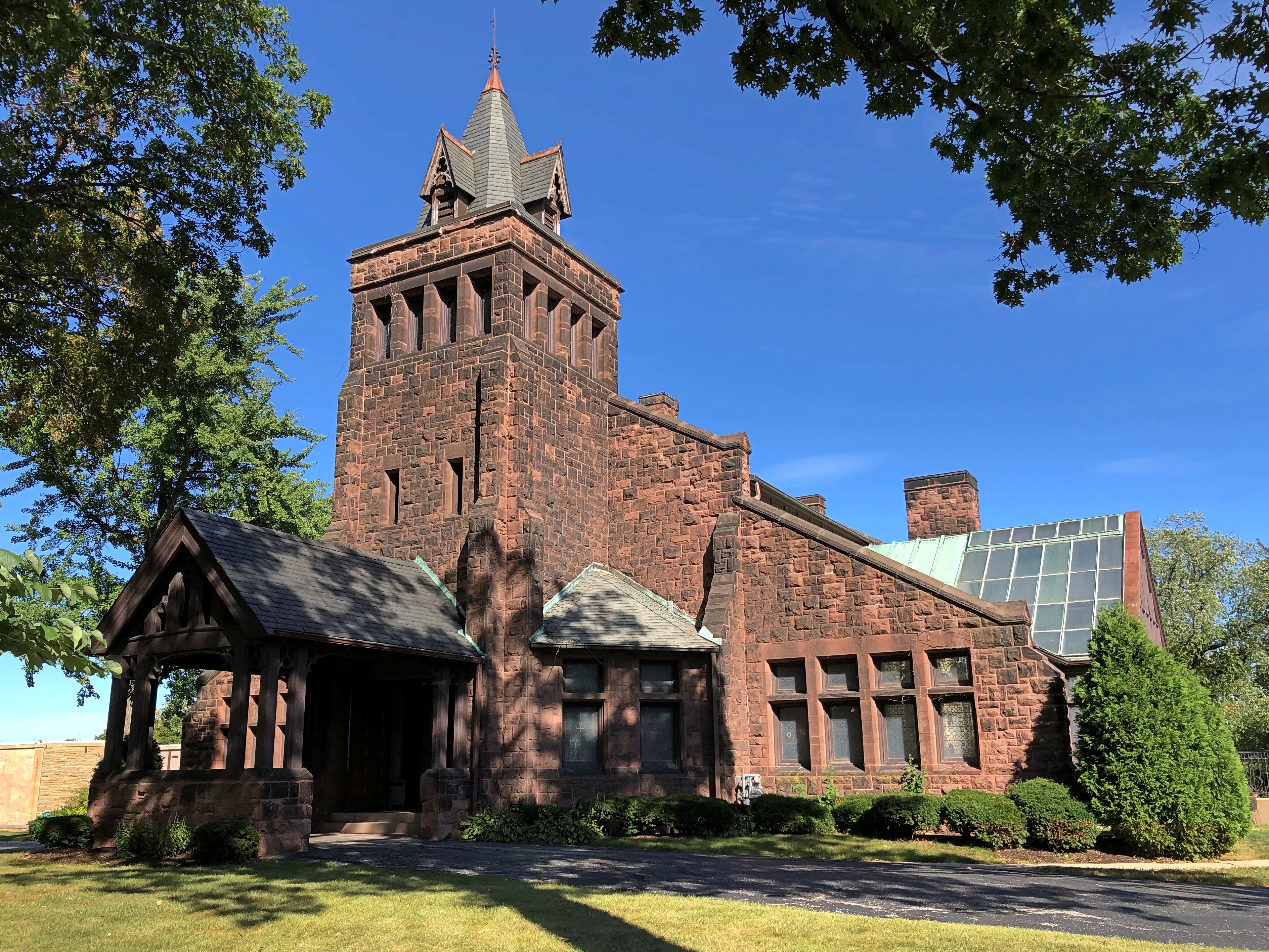
A short distance from Long Grove’s historic downtown is Long Grove Community Church, which is historic in its own right, built by Evangelical German immigrants in the 1840s.Long Grove Community Church

Long Grove Community Church
“With a new century, came many changes,” the church’s web site says, referring to the 20th century. “The church widened her circle of ministry to include local people who were not German-speaking. Two denominational mergers took the church away from her Evangelical roots.

“By 1950, the church had grown so small that the denomination recommended the doors be closed. But God gave the people a vision. Instead of closing their doors, they built Sunday School rooms for children. As people migrated from the city to the suburbs, the area grew and so did the church. By the late 1960s, we had transitioned from a small rural church into a suburban church.”

The Long Grove Cemetery is next to the church.

Long Grove Community Church

Long Grove Illinois Cemetery

Long Grove Illinois Cemetery

There isn’t much information on line about this cemetery, despite its clear historic aspects.Long Grove Illinois Cemetery

But I don’t need a web site to tell me it’s another of the many cemeteries in the Chicago area with immigrant German stones, many dating from the 19th century.

Vietnam 1994, But the Postcard Picture is Much Older

Tremendous rain on Saturday morning. By later in the day, most everything was dry, including my deck. The storm had left behind humidity but also enough wind to lessen that sticky feeling. The rest of the day was cloudy and about 75 F. A fine time to sit outside and do something close to nothing, and otherwise be a bit too leisurely.

From the postcard files: one I sent from Vietnam, dated June 29, 1994. I must have gotten a collection of cards somewhere, maybe a postcard vendor in the street — they were usually older children — and sent all of them. This one says it’s No. 8.

Vietnam Postcard Vietnam Postcard

The card says it depicts the central market in Rạch Giá, a city southwest of Saigon, by a photographer named Nadal. It has the look of earlier in the 20th century, and it seems that one Fernand Nadal was active with a camera in this part of the world ca. 1930.

We went that direction to visit the Mekong Delta, but didn’t make it down to Rạch Giá. I sent the card anyway, contrary to my usual practice, probably because I didn’t have that many cards. You couldn’t count on running into postcard-wallahs just anywhere, even in Vietnam.

Woodward Avenue, Detroit

Clouds mostly obscured the June full moon tonight. Last night was clear, and I watched the might-as-well-be-full moon traverse — appear to traverse — the top branches of a neighbor’s tree off to the southeast just after sunset. I knew it already, but I’m always mildly amazed that you can see the movement — apparent movement — of the moon if you stare at it for a while.

Here are a few things you can see on Woodward Avenue in Detroit, also known as Michigan 1, which goes from downtown to Pontiac, Michigan.

Woodward Avenue Detroit

Woodward Avenue Detroit
I Googled the signature under the wings later. The artist who created the wings, one Kelsey Montague, only in her 30s, has painted a lot of murals around the world. Yuriko specifically wanted to stop and have her picture taken with it. I expect that happens pretty often.

Early Saturday afternoon, we walked along Woodward, at least lower Woodward from Campus Martius Park nearly to another urban green space, Grand Circus Park. This part of Detroit was alive with pedestrians, though not thronging.

Woodward Avenue Detroit

Even more conspicuous were the party bikes.

That one was tooling along Madison St., headed toward Woodward, but there were plenty of the vehicles on Woodward itself, their occupants sharing their merriment with the world. After the first one or two, I thought, not those again, but strangely enough by the time I’d encountered a half dozen or more, I enjoyed their spirited arrival.

You’d think that would be the other way around, but I felt that they were out having a noisy good time, with the noise arriving and departing in short order, so I didn’t begrudge them their noisy good time.

I look up the term party bike as well. Such a vehicle is also known, according to Wiki, as a beercycle, fietscafé, bierfiets, pedal crawler, pedal pub, beer bike, bar bike, pedal bar or bierbike. Europeans invented them.

As I said, Woodward was alive on a Saturday morning, as was much of central Detroit, whatever other problems the city has. Not every North American city of Detroit’s size can say that. Lower Woodward also sports some fine old buildings, recently renovated. Such as the amusingly named Shinola Hotel.
Woodward Avenue Detroit

I think it’s funny, anyway. The 129-room boutique property, only open since early 2019, offers rooms at north of $300/night sometimes.

“[The] hotel is part of a multimillion-dollar development project by Shinola, founded by Tom Kartsotis of Fossil watches, and Dan Gilbert’s real estate venture, Bedrock, which has acquired and developed more than 100 properties in the city since 2011,” says the New York Times. “The project, which took two years to complete, also includes an alley behind the hotel with shops and two restaurants: The Brakeman, an American beer hall with an outdoor area, and Penny Red’s, a fried chicken spot.”

The alley.
Woodward Avenue Detroit

Further north on Woodward.

Woodward Avenue Detroit

Woodward Avenue Detroit

The David Whitney Building on Woodward. Outside —
David Whitney Building
— and inside.
David Whitney Building

It’s a Daniel Burnham design, completed in 1915 and named for a already-dead local lumber, shipping and real estate baron and owned for decades by his family. “When the Whitney family sold the building in 1966, more than three hundred doctors and dentists had offices here…” an historic site plaque on the building says. “It reopened in 2014, rehabilitated for use as a hotel and apartments.”

The plaque omits the fact that the building was vacant by the 2000s. Doctors and dentists are famously reluctant to move their offices — they’re sticky tenants — such that so many leaving a building speaks volumes about the decline of Detroit. Even the Garland Building, an equivalent building in downtown Chicago, has managed to keep many of its healthcare tenants down to the present.

I’d count Woodward as one of the great thoroughfares of the nation, with theaters and museums and retail lining its way far beyond where we walked, and a remarkable history beginning as an Indian trail long ago. Its 2010s revival was no doubt interrupted by the pandemic, but now the revival is being revived. Good for Detroit. Still, I don’t have any illusions that much of the city, beyond the lively corridor along Woodward, remains the impoverished shell of the place it once was.

Downtown Detroit Walkabout

Near the intersection of Woodward and Jefferson avenues in downtown Detroit, you can see quite a few things, such as this fellow.The Spirit of Detroit

The formal name of the 16-foot bronze, installed on this site in 1958, is “The Spirit of Detroit” by Marshall M. Fredericks. A nearby plaque provides verbiage.
The Spirit of Detroit
All very optimistic, I’d say. No one knew that the spirit of Detroit would take a considerable beating during the rest of the 20th century.

“One of the most prolific sculptors of the twentieth century, Marshall M. Fredericks is known in America and abroad for his monumental figurative sculpture, public memorials and fountains, portraits, and animal figures,” says the Marshall M. Fredericks Sculpture Museum in Saginaw. “His sculptures can be found in more than 150 public and corporate locations.”

Behind the sculpture are the seals of Detroit and Wayne County, Michigan, in stone. Behind that is a brutalist wall of the Coleman A. Young Municipal Center, which is Detroit’s city hall.The Spirit of Detroit
From the same vantage, other Detroit buildings of note are visible, such as the Guardian Building.
Guardian Building, Detroit
And One Woodward Avenue, formerly the Michigan Consolidated Gas Company Building, a 1962 design by Minoru Yamasaki — one of whose buildings we saw in Buffalo not long ago.

One Woodward Avenue

Across the street from the “Spirit of Detroit” is another work of considerable size, based on human anatomy: “The Fist.” We didn’t cross the busy street for a closer look, unfortunately.

The Fist Detroit

“Aimed menacingly toward Canada, the giant bronze boxing arm of Joseph Louis Barrow (aka Joe Louis) hangs from a pyramid of poles in the middle of what was once Detroit’s busiest downtown intersection,” says Roadside America. “The 24-foot-long arm — as long as the pyramid is tall — weighs four tons, and gives off the vibe of a medieval siege battering ram.

“Louis was the heavyweight boxing champion of the world (1937-1949) and a big hero in Detroit, where he’d moved when he was 12 and trained at the city’s Brewster Recreation Center…”

Sports Illustrated magazine gave “The Fist” to the the Detroit Institute of Arts in 1986. The museum apparently didn’t think much of it as a work of art, so arranged to put it on display in its current location.

These works were part of the first stop, after Campus Martius Park, on a Preservation Detroit walking tour led by an affable young man who told us this was his first tour since the fall of 2019, since none were held last year. Only four people had signed up for the tour we were on, including us. We walked around for a little more than two hours and even so there were a number of buildings and other sights that the tour didn’t have time for.

For instance, just down the street from “The Spirit of Detroit” and “The Fist’ is the Mariners’ Church, which I saw up close during my 2004 visit.
Maritime Sailors Cathedral

“Last fall, as I drove briefly through downtown Detroit, I noticed a little church building on Jefferson, a main road,” I wrote in ’04. “I had just enough time to note its name: The Mariners’ Church. Flick-flick-flick went the synapses of dim memory, lighting up again. That’s the church in the song?

“Sure enough. Last month, while I was on foot in downtown Detroit, I wasn’t about to miss seeing it.”

I didn’t know until I checked after this visit, but the Mariners’ Church is part of the schismatic Anglican Church in North America. Our guide didn’t point out the church, but I recognized it right away.

Rather, he spent time discussing the 5.5-million-square-foot Renaissance Center, which certainly makes a mark on the Detroit skyline, even if it took decades to evolve into a part of downtown, rather than an isolated corporate enclave that sucked tenants out of some of Detroit’s more venerable buildings.

Renaissance Center

Renaissance Center

One of these days, I’d like to go in and look around. There are even free tours of the place.

Renaissance Center is ’70s international glass. Not far away is a surviving example of Beaux-Arts, the Old Wayne County Building, with a pink granite base, 247-foot tower and bronze sculptures riding high.
Old Wayne County Building

The 1902-vintage building is empty these days, owned by a nonprofit. The county moved out about a decade ago. It was a Gilded Age project, all right, since besides the style there was the matter of cost overruns and corruption.

“The building was fraught with controversy from the beginning…” says Historic Detroit. “Wayne County was blasted for overpaying for the land by about $50,000, about $1.27 million today. The land deal ‘aroused grave suspicion,’ the Detroit News wrote in September 1897. Then some 96,000 pounds of steel and iron went missing. There were allegations that the county’s auditors were not auditing or keeping financial tabs on the project. None of the steelwork was done in Detroit, when hometown labor was to be used. Copies of the plans and specifications were not made public. The contractor, M.J. Griffin, was accused of double-charging the county and using four-cut granite instead of the six-cut that the county paid for. There was a grand jury investigation, and a supervisor accused of soliciting bribes was prosecuted, though not convicted.”

Ah, well. The people of turn-of-the-century Detroit might have been cheated but, like New York City Hall, they got a fine building for an elevated price.

“One of the building’s most prominent features is the pair of large sculptures flanking its center tower and portico,” Historic Detroit continues. “The copper sculptures are known as quadrigae, a Roman chariot drawn by four horses. The pieces were done by New York sculptor J. Massey Rhind, who intended the quadrigae to symbolize progress. They feature a woman standing in a chariot led by four horses with two smaller figures on either side.”

Old Wayne County Building

This handsome building, at Brush St. and E. Fort St., used to be a tobacco products factory, the guide said.

Former Tobacco Building, Detroit

Turns out Detroit was once a major producer of tobacco products, mainly in the 19th century, when that meant cigars, chewing tobacco and (I assume) snuff, though that might have been considered old-timey even then.

I had no idea. Apparently Ontario used to be an important producer of tobacco, which found its way to Detroit for rolling in such buildings as this. More about the industry is in the excellent Detroit-centric blog, from which I borrowed the above illustration, which is surely public domain.

Just goes to show you: if you’re paying attention when you’re out seeing things, you’ll gain all kinds of useless knowledge, and occasional useful nuggets, such as how to navigate a Michigan left.

The tour continued. I earned my toe blister that day. This is another Albert Kahn building: the 1915-vintage Detroit Athletic Club.

Athletic Club, Detroit
“The Palazzo Borghese in Rome provided Kahn with a model for much of the Detroit Athletic Club, but the idea of using the large impressive windows for the impressive fourth floor dining room — called the Grill Room — came from the Palazzo Farnese,” notes Wiki.

Footnote: In the club’s early decades, no Jewish members were allowed. The club was willing to make an exception for Kahn, who was Jewish, but he declined.

The tour circled back toward the vicinity of Campus Martius Park and took in a few more of Detroit’s magnificent structures, such as those along Capitol Square. The Farwell, whose cornices have been restored.

Farwell Building
There hangs another tale of Detroit history and, some would argue, the baneful impact of government overreach. Or, to depoliticize the lesson, an example of the unintended consequences of good intentions.

“Back in 1958, a chunk of stone fell off a cornice of an older building at 1448 Woodward, killing an 80-year-old woman on the street below,” the Detroit Free Press reported. “The City of Detroit responded with a new ordinance requiring the inspection of all cornices, the ornate stone crowns that top off most classically inspired buildings.

“Budget-minded downtown building owners stripped away cornices on their buildings, often leaving a denuded top scarred with patches of mismatched brick. Dozens of buildings were defaced, and a good portion of Detroit’s architectural heritage was lost.”

More recently, Detroit cornices have been restored. Reminds me a bit of the unintended consequences of the British window tax.

The David Stott Building.
David Stott Bldg

The mighty Penobscot Building. the tallest building in Detroit from its completion in 1928 to the development of the Renaissance Center in 1977.

Penobscot Building Detroit

Penobscot Building Detroit

Penobscot Building Detroit

Last on the tour: the Guardian Building.

The outside is colorfully interesting, but nothing compared to the lobby and other interior spaces. I’d say it was worth coming all the way to Detroit, and walking for a couple of hours, just to see that.

Campus Martius Park, Detroit

Just how long ago was it? One of those nagging questions. In this case, I was wondering when the last time I’d been to downtown Detroit. I couldn’t remember until I looked it up.

Right. Seventeen years. This time we arrived on Saturday morning. After visiting St. Joseph Shrine, we repaired to Campus Martius Park, which counts as a green spot in the heart of downtown Detroit, and which was still being developed the last time I was in the area.

Campus Martius Park, Detroit
When I went looking for information about the history of the park, I was amused that the Downtown Detroit Partnership hadn’t gotten around to writing anything. And yet the dummy Latin evokes the origin of the original Campus Martius, which even dummy students of Latin (as I was) know was the gathering place in the early Roman Republic for legions before they went out to kick barbarian butt, and later was home of the Pantheon.

The Michigan Territory borrowed the name not directly from Rome, it seems, but a place in Ohio. In the 19th century, citizens gathered at the Detroit Campus Martius in war and peace, but the spot was neglected in the 20th century, becoming mostly just a place through which cars passed.

In the 21st century, Campus Martius was reinvented as a park to help bring new life to downtown. It’s a fine bit of urban planning. Why do I think that? Because it features not only things to do and look at, but chairs with actual backs on which it’s actually fairly comfortable to sit during the warm months. How many cities don’t understand how important that is, perhaps worried that the homeless might find someplace to sit? Many.

The park also includes a cafe, a small stage, a bit of green space, a fountain, a sandy “beach” in summer and an ice rink in winter, a view of impressive buildings, and an embedded zero milestone, which is called the Point of Origin.

Campus Martius Park, Detroit
As I understand it, all of the Detroit area’s mile roads, such as the famed 8 Mile Road, measure from this point.

The Michigan Soldiers and Sailors Monument is also part of Campus Martius Park, which seems reasonable.
Campus Martius Park, Detroit

“The Soldiers and Sailors Monument is among Detroit’s oldest pieces of public art and was one of the first monuments to honor Civil War veterans in the United States,” Historic Detroit says. “It was announced by Gov. Austin Blair in 1865 that money would be collected to erect a tribute to Michigan’s soldiers killed in battle. Detroit, being the largest city, won the right to the monument.

“The cornerstone for the monument was laid July 4, 1867, but not in Campus Martius, where the monument stands today… a special committee of the [city] council resolved in September 1871 that the best place for the monument was the open square in front of City Hall.

“The bronze and granite sculpture was formally unveiled on April 9, 1872, though some of its statues were not added until July 18, 1881… The Classical Revival monument stands more than 60 feet tall and was sculpted by Randolph Rogers, an Ann Arbor native who studied at the Academy of St. Mark in Florence, Italy, under Lorenzo Bartolini.”

In 2003, the monument was moved about 150 feet to the south as part of the creation of Campus Martius Park. According to carving in the plinth, a time capsule was entombed there as well in 2004, to be opened on July 23, 2104.

The First National Building, just southeast of the park. An Albert Kahn design completed in 1930.Campus Martius Park, Detroit

An array of buildings.

Campus Martius Park, Detroit

In the foreground, the Qube, previously known as the Chase Tower, another Albert Kahn work, but from a later year: 1959. Behind it to the left is the magnificent Guardian Building, more about which later, and the Penobscot Building, another 1920s masterpiece.

One of the more sizable buildings towering over the park is the 985,000-square-foot One Campus Martius, a 2003 development of Bedrock Detroit, the real estate arm of billionaire Dan Gilbert’s empire. Michigander Gilbert has developed, and probably more importantly, redeveloped a lot of properties in Detroit.

One Campus Martius

Poised at the entrance of One Campus Martius is “Waiting,” a mildly unnerving 17-foot bronze by Brooklyn-based artist Brian Donnelly, also known as Kaws.One Campus Martius

“ ‘Waiting’ is another high-profile acquisition by real estate magnate Gilbert and his wife, who purchased the statue for their growing Detroit Art Collection — a wide-ranging portfolio of immersive installations and public art that span Bedrock’s real estate portfolio downtown,” notes the Detroit Free Press.

Campus Martius Park was just the beginning for us that morning. We’d come for a 10 o’clock walking tour of downtown Detroit lead by Preservation Detroit, and that’s where it started; more about that soon.

The Edsel & Eleanor Ford House

Major thunderstorm last night, especially around 10:30, when I had a mind to take out the trash. Soon my phone started making a racket. It was sounding a tornado warning. That and the lightning and the heavy rain persuaded me to postpone my outdoors task until around midnight, when the storm had blown over. Naperville, a good ways to the south, had the worst of it.

Last Friday afternoon in greater Detroit, we made our way to Grosse Pointe Shores to see the Edsel & Eleanor Ford House, a 20,000-square-foot mansion on the shore of Lake St. Clair completed in 1928. The Fords hired Albert Kahn, who seems to have done everything in metro Detroit, to design the place.Ford House, Michigan

Ford House, Michigan

Ford House, Michigan

The Fords had liked the cottages they’d seen in England, especially in the Cotswolds, including such features as stone roofs, vine-covered walls and lead-paned windows. Not only did the Ford House design reflect English inspiration, the Fords had paneling, fixtures and other bits and pieces of Old England brought over for installation in the new mansion, back when that sort of thing was possible.

All in all, a handsome set of rooms to wander through. Such as barrel-vaulted Gallery, the largest room in the house. Sizable events were (and are) held here.Ford House, Michigan
“The Gallery… is paneled with sixteenth-century oak linenfold relief carved wood paneling,” notes Wiki. “Its hooded chimneypiece is from Wollaston Hall in Worcestershire, England; the timber-framed house had been demolished in 1925 and its dismantled elements and fittings were in the process of being dispersed… [the] barrel-vaulted ceiling for the Gallery was modeled on one at Boughton Malherbe, Kent, England.”

A handsome living room. Too handsome ever to be a living space, I think, and no doubt clutter wasn’t allowed, or at least the staff made sure it disappeared.
Ford House, Michigan

This looks more livable: an upstairs art deco bedroom, one of the more modern rooms designed by Walter Dorwin Teague. You can imagine leaving newspapers and magazines and books lying around in a room like this, with a globe or two sitting around as well. Not visible in my picture are the number of radios the Fords had built into various pieces of furniture.

Ford House, Michigan
An attached complementary bathroom.

Ford House, Michigan

In Edsel Ford’s private office, I noticed a flag behind glass.
Ford House, Michigan

Adm. Byrd had taken the flag with him on his flight over the South Pole, and gave it to Ford — who had supported Byrd’s expedition, besides being the president of the company that built his airplane, a Ford trimotor — along with a handwritten letter. In another part of house is a flag Byrd took with him on his North Pole expedition.

One more item inside the house: a copy of a portrait of Edsel Ford by Diego Rivera. The artist wasn’t so much of a red that he wouldn’t take money from a leading captain of industry.Ford House, Michigan

Outside, as you’d expect, the house has an expansive view of the lake.Ford House, Michigan Ford House, Michigan Ford House, Michigan

Plus swarms of mayflies, some of which decided to land on my shirt. They didn’t bite or do anything but appear in large numbers in my vicinity.

Ford House, Michigan

We asked a Ford House worker about them, learning that they’re known locally as fishflies. This is their high season, when they are most likely to swarm.

Our Lady of Victory Basilica and National Shrine, Lackawanna

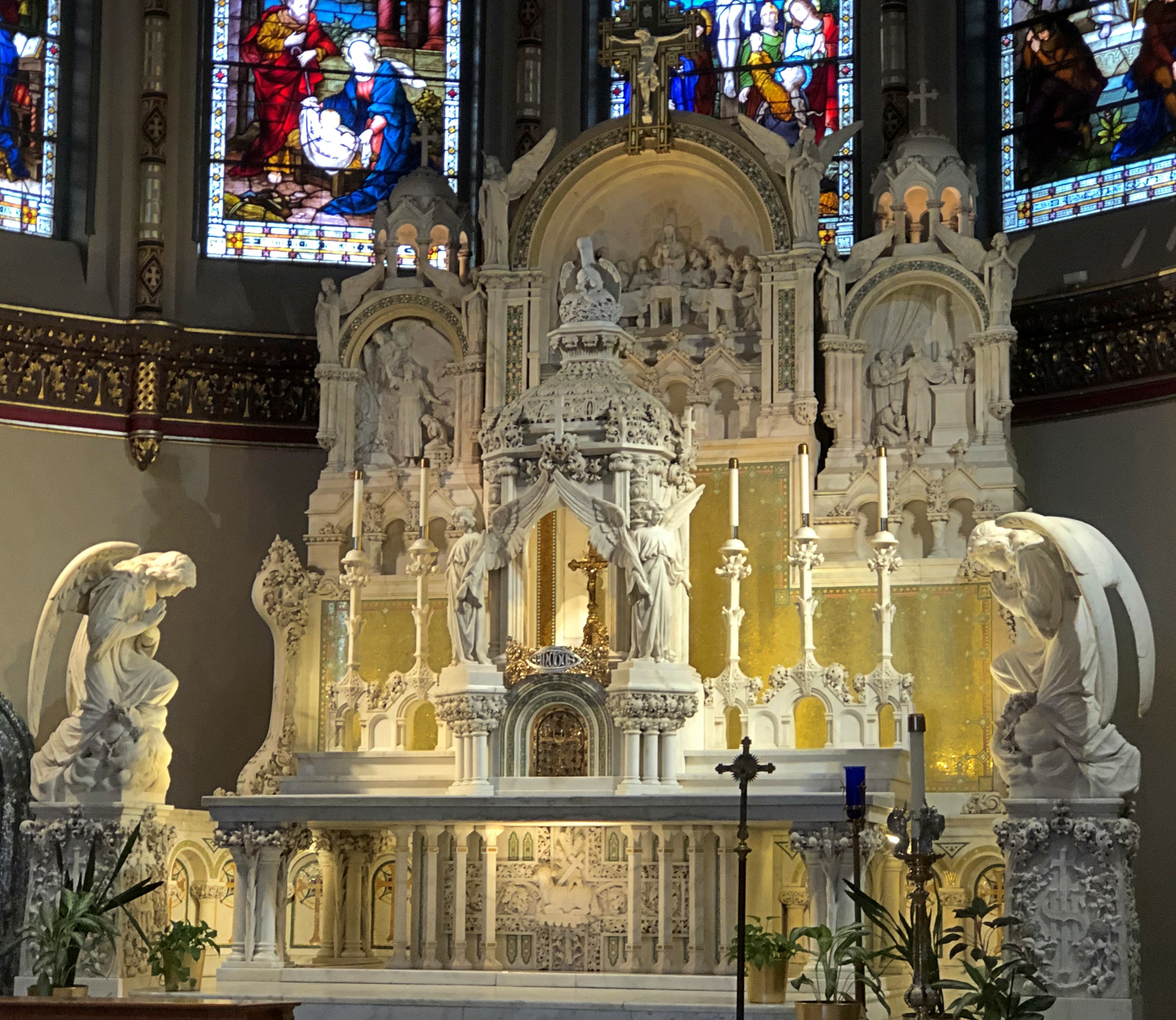
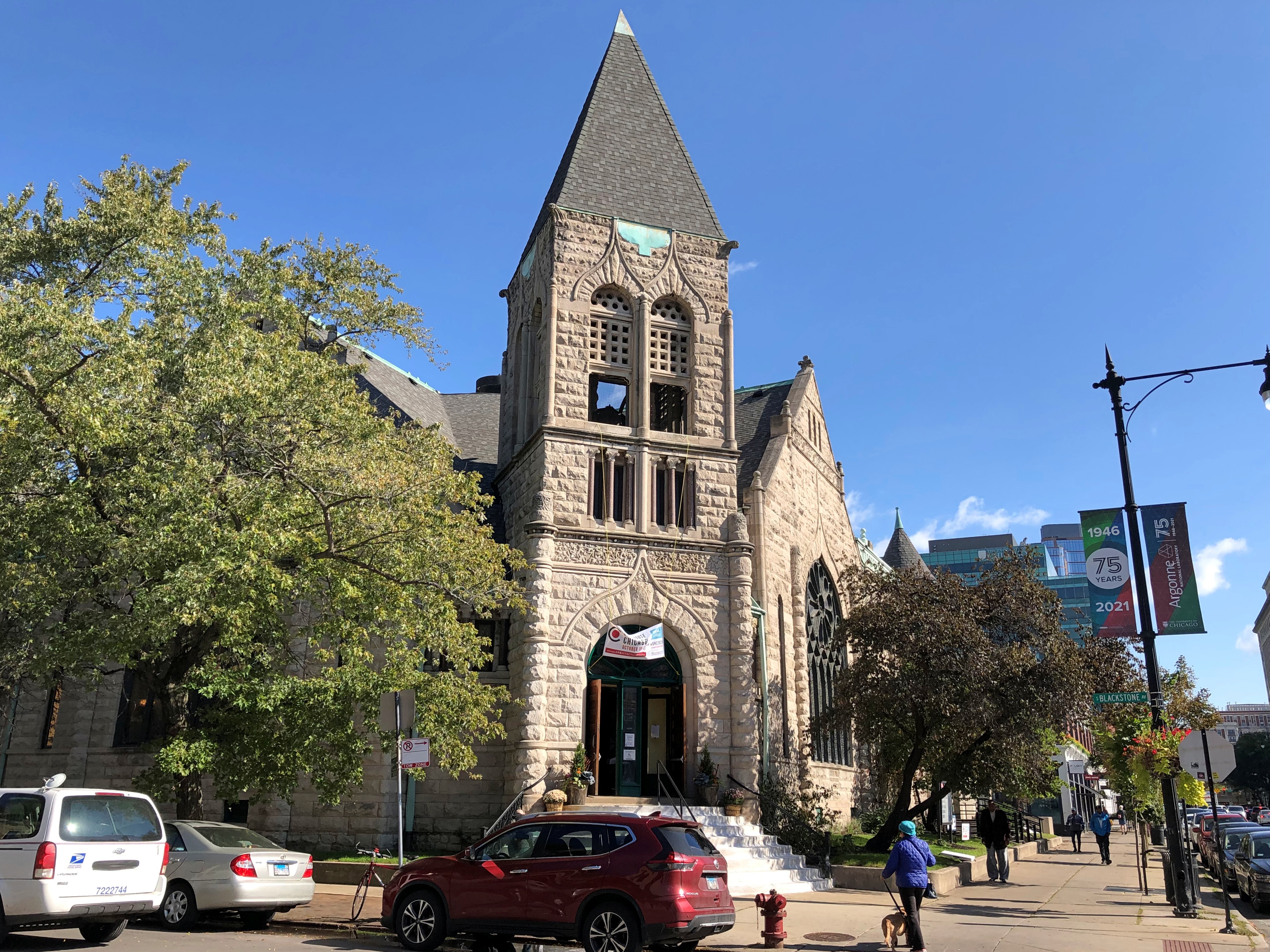
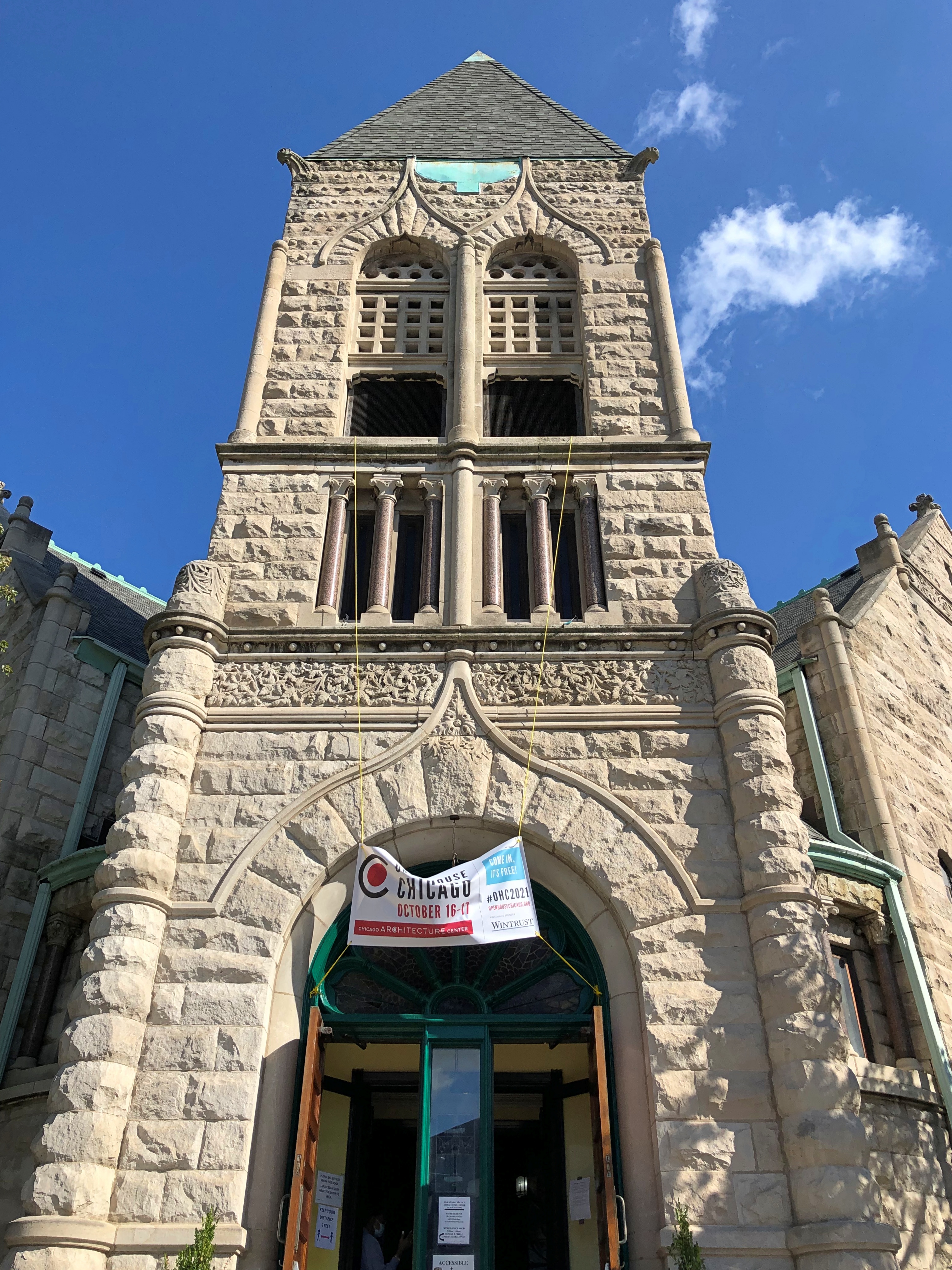
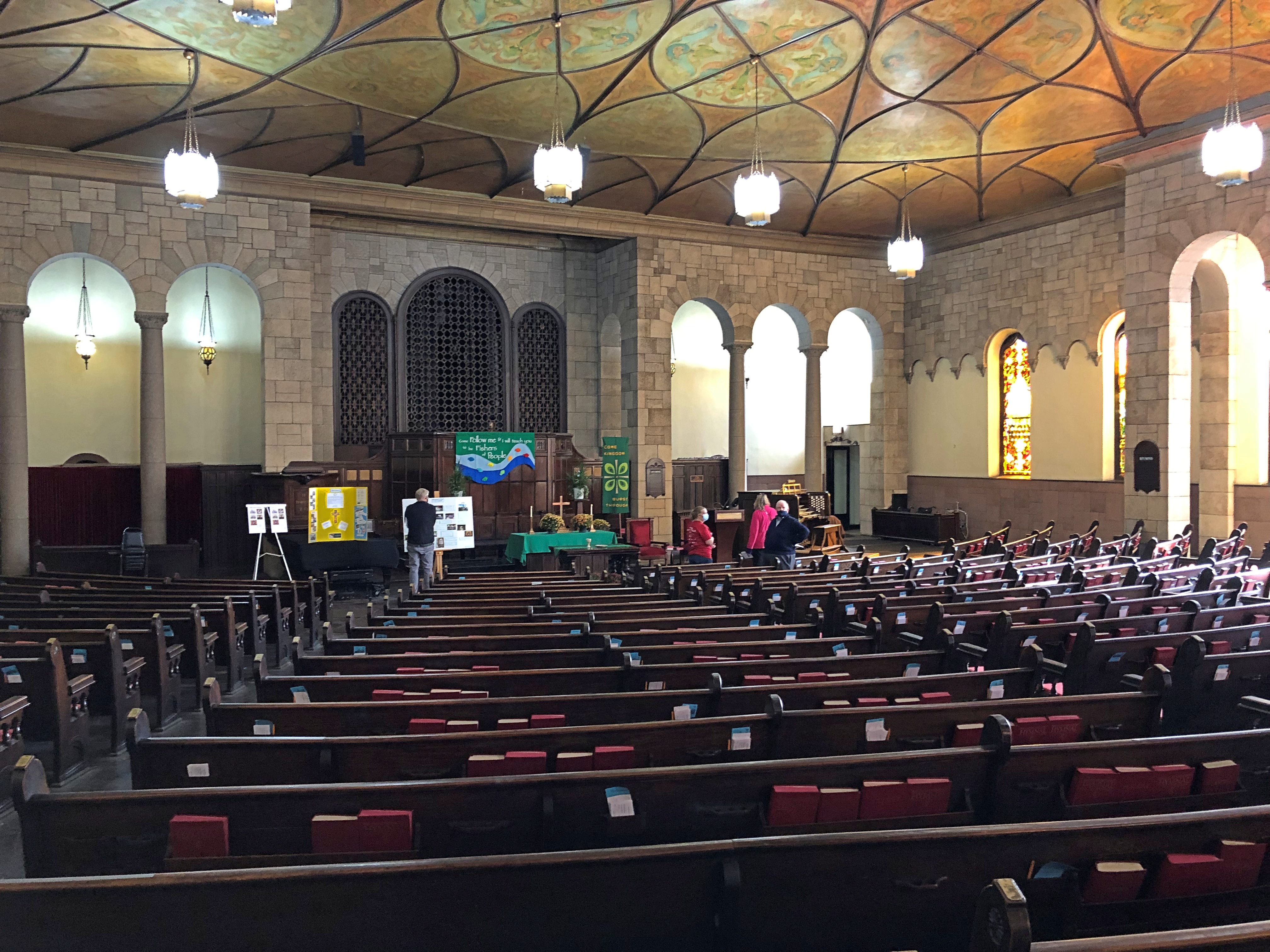
The last place we visited over Memorial Day weekend in greater Buffalo was Our Lady of Victory Basilica and National Shrine, which is in south suburban Lackawanna, New York. We drove south from Lockport just after noon, had lunch in Buffalo at the Lake Effect Diner, and continued south on surface streets to Lackawanna, mainly U.S. 62, which is Bailey Ave. and then South Park Ave.

That course takes you through areas well-to-do and ragged, residential and industrial. Greater Buffalo might be like a smaller version of greater Chicago, but on our drive through the heart of the MSA, we found an essential difference: it’s much easier to get around Buffalo.

Maybe the holiday weekend had something to do with that, but I suspect the difference between 1.1 million people living on the edge of a Great Lake and 9.4 million people living on the edge of another Great Lake was the determining factor. Driving through metro Chicago is often like driving through glue. Buffalo proved much more pleasant as a driving experience.

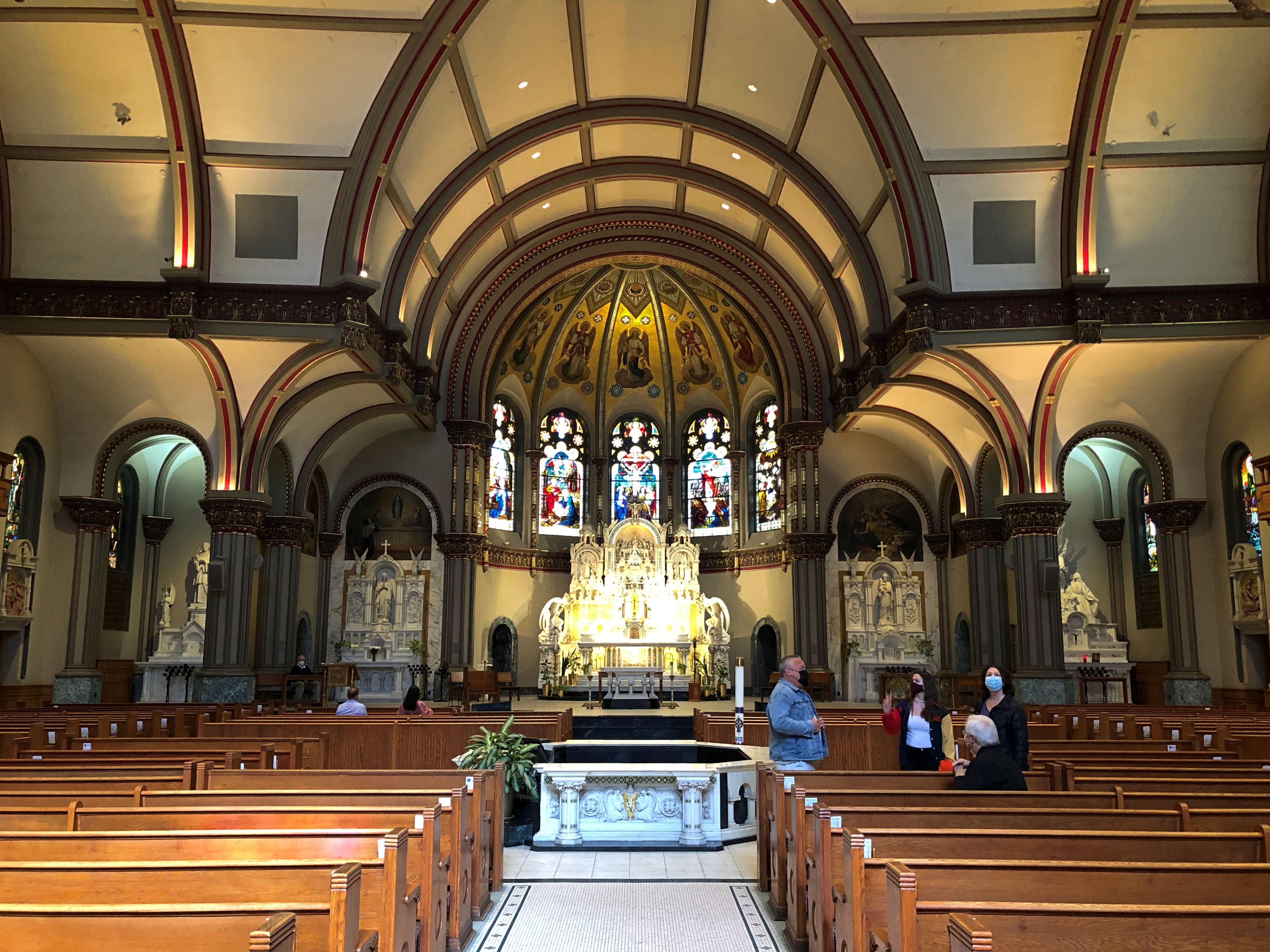
The basilica stands at South Park Ave. and Ridge Road in Lackawanna. Our Lady of Victory Basilica

 Our Lady of Victory Basilica

Our Lady of Victory Basilica

Our Lady of Victory Basilica

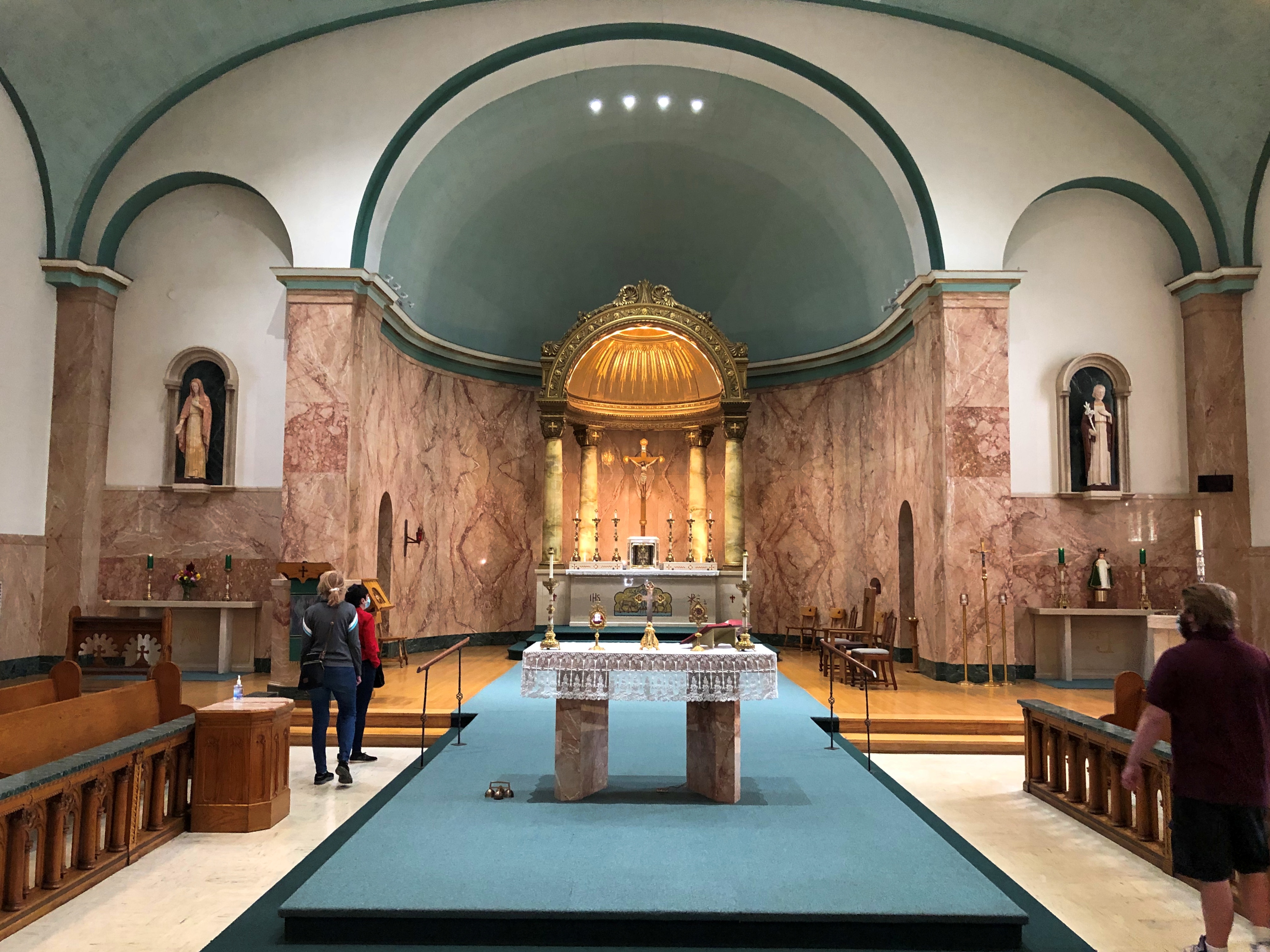
The church was open. I believe only two other people were there when we visited.Our Lady of Victory Basilica

Our Lady of Victory Basilica

Our Lady of Victory Basilica
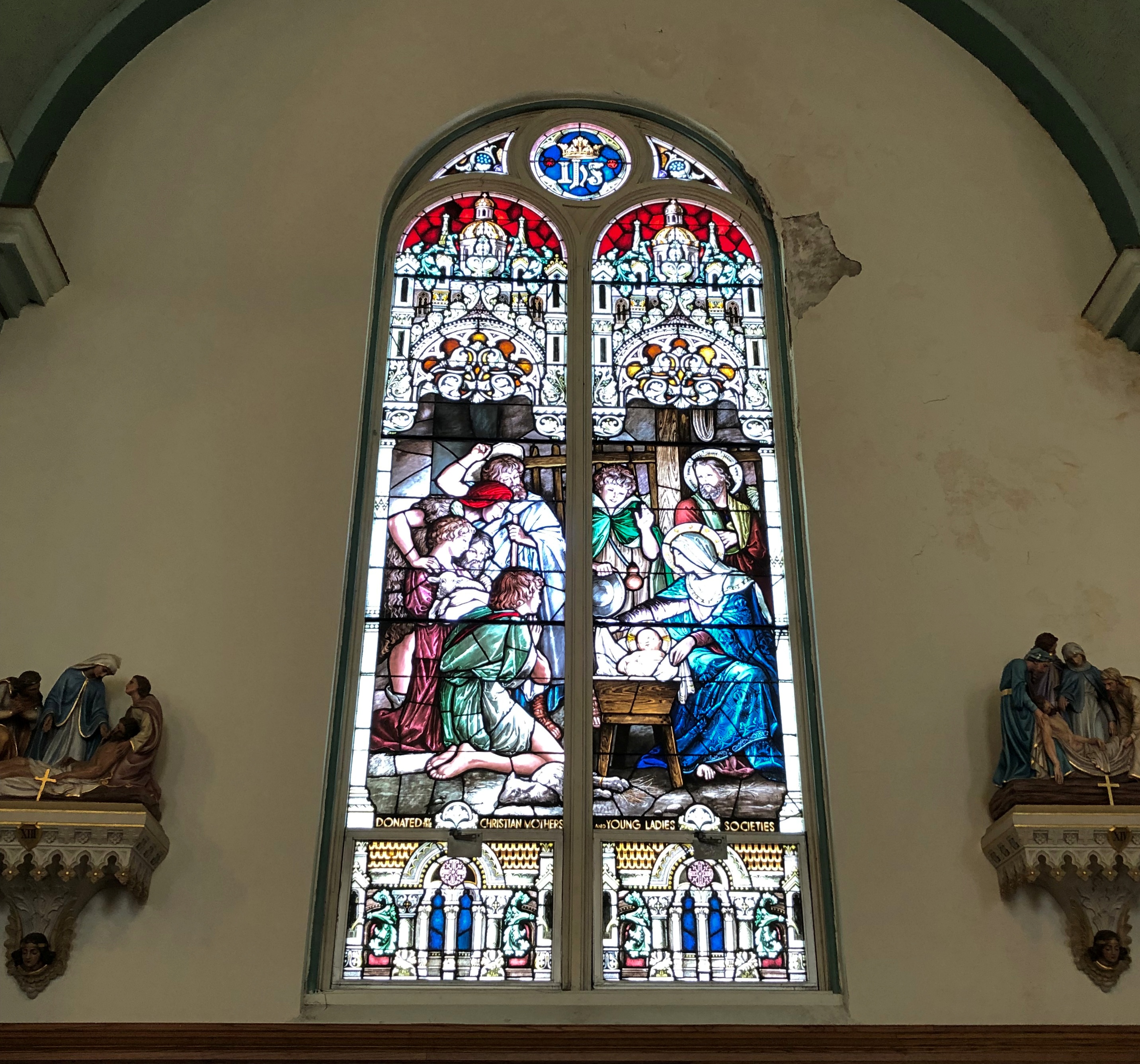
“The artists who painted the murals, sculpted the statues and painstakingly produced the basilica’s 134 stained-glass windows were also members of an international team,” the Buffalo News reported, as reposted here.

“– Architect Emile Ulrich, a graduate of the Academy of Paris, was in Cleveland when the call came from Baker.
— Italian born Gonippo Raggi masterminded the artwork. His oil paintings can be seen throughout the shrine. When he died at age 84 in 1959, Raggi was the subject of a New York Times obituary that credited his work in more than 100 churches on three continents.
— Buffalonian Marion Rzeznik of Poland assisted Raggi. Rzeznik studied sculpture in Krakow, Vienna and New York City.
— Otto Andrle, a Buffalo-native, crafted the stained-glass windows.”

All that talent was brought together in the 1920s to build the basilica by the Venerable Nelson Henry Baker (1842-1936), an exceptionally talented and energetic priest. One of his talents, useful almost anywhere with a money economy, was fundraising. Besides the basilica, which started construction when Baker was 79, over the course of his vocation he founded a hospital, high school, elementary school, an infant home, a home for unwed mothers and a boys’ orphanage.

A bronze Baker is across the street from the basilica.
Our Lady of Victory Basilica Father Baker

Not far away is Mary.
Our Lady of Victory Basilica Virgin MaryBaker declined credit for his many legacies, it seems, with his quote on the matter on the pedestal.