Our Second Decatur This Year

On Saturday, I wondered how many U.S. cities and towns are named for Stephen Decatur. Later I looked it up: Counting Decatur City, Iowa, and a ghost town in Missouri of that name, 17 — not counting counties, of which there are six among the several states.

Now mostly forgotten except by the Navy and naval history enthusiasts, he had his moment. He even took a lethal bullet in a duel, though Commodore Decatur isn’t known as well as Alexander Hamilton for that distinction. Lin-Manuel Miranda needs to get on the stick and write Decatur: A Musical of Kicking Barbary Pirate Asses.

Decatur’s moment also happened to be when towns and counties were being named in the United States. Decatur, Illinois, has the largest population of any of them, edging out Decatur, Alabama by some thousands of souls, even though the Prairie State Decatur has been shrinking in recent decades.

We spent most of Saturday afternoon in Decatur, Illinois, our second visit to a city of that name this year. Though the more northern Decatur isn’t quite the industrial town it used to be, a number of large manufacturers are still in evidence, such as Mueller Co., more about which later. Downtown Decatur seemed in fair shape as well. Good enough for a walkabout late in the afternoon, when the heat was ebbing away.

Decatur’s signature structure is the Transfer House.
Transfer House Decatur Illinois“The Transfer House was erected in 1895, replacing a smaller shelter dating from 1892,” writes H. George Friedman Jr., whose page features many pictures. “The City Electric Railway paid $500 toward the $2,700 building fund subscribed by local merchants and property owners, and agreed to furnish and maintain the building. As its name implies, it was used as a central transfer point for all the streetcar lines (and later the bus lines) in the city.”

Designed by W.W. Boyington, of all people. That only seems odd to me because we visited another one of his works just last week, the Old Joliet Prison. So there’s nothing really odd about it. The man got a lot of commissions.

Remarkably, the Transfer House was originally located at Main and Main streets — that always sought-after address, at least among commercial real estate investors. Decatur still has a north-south Main and an east-west Main, and their meeting looks like an ordinary intersection, though there is a statue of young A. Lincoln nearby.

In 1962, the city moved the Transfer House to its current location in Central Park, near a fountain.
The park also features a memorial to the Macon County’s Civil War soldiers.
On the back of the base, a plaque says:

Grand Army of the Republic
Organized in this city
April 6, 1866
Erected by Dorcas Society,
and Other
Patriotic Citizens

Not erected until 1904. Maybe funds were in short supply for years, but then the people of Decatur realized their veterans didn’t have much longer.

Near Central Park are a number of buildings, including this one sporting one of Decatur’s murals, featuring Mike Elroy, a recent mayor.
Driving into town we saw a more interesting mural featuring Bob Marley on the side of a record store building, but we didn’t stop for it.

A former Universalist church building, originally erected in 1854.
The handsome Merchant Street, formerly a hive of scum and villainy.

Further from the park was the equally handsome Library Block, home these days to a brewpub and other businesses.
The Decatur Masonic Temple, looking a lot like a WPA post office.
The First United Methodist Church of Decatur.
As with many city churches, it would have been nice to get inside for a look, but no go.

At first, I thought this might be the entrance to an eccentric dentist’s office, an oral equivalent of the eyes of Doctor T. J. Eckleburg.

But no: it’s the entrance to the Sol Bistro restaurant.

The Danish Cemetery, Lemont

En route back from Joliet on Sunday, there was one more sight to see, just off I-355 in southeast suburban Lemont: The Danish Cemetery. It’s a small patch of land, sparsely populated by the dead — or at least their stones — and it hasn’t seen a burial in more than 50 years.
Danish Cemetery, Lemont

As far as I know, ghost stories aren’t told about this place, especially compared with boneyards that are more remote. The only story I know about the Danish Cemetery involves this memorial off to one edge of the grounds.

Danish Cemetery, Lemont

UNKNOWN SOLDIER
Served the U.S. in time of need
Found dead July 1, 1919
Buried by Legion Post 243

“The body of the unknown soldier was taken out of the Sag Canal at Sag Bridge on July 9 [sic], 1919,” Patch says. “He was found by bargemen working on the Chicago Sanitary and Ship Canal… the funeral home believed the body had been in the water for about 10 days. The remains were brought to Lemont, and they tried to identify the body. Besides the uniform, there were no identifying papers on the body.

“The Lemont Historical Society said no one came forward in Lemont to identify the body and the Lemont American Legion buried him with full honors in the Danish Cemetery.”

The Old Joliet Prison, Interrupted

Though it’s interesting, we didn’t go to Joliet on Sunday just to see the Joliet Area Historical Museum. The drive’s a bit far for that. About a year ago, I read that the museum had started offering tours of the former Joliet Correctional Center, which closed in 2002. I knew I wanted to do that, and so Ann and I went.

These days the site is called the Old Joliet Prison — a much better name. As you look at the massive stone walls and guard towers and the barb-wire residuum, no weasel word like “correctional” will do. It was a prison.

The tour groups meet in front of the former prison’s administrative building. Convict labor built the prison in the 1850s, with a design by W.W. Boyington, who also designed the Chicago Water Tower.
It’s also the site of the 1915 murder of Odette Allen, wife of the prison’s warden, a story that the guide told us almost at once. Blunt force to her head, body set on fire in her room, a young black inmate fingered for the crime but not executed because there was too much doubt about his guilt, though he spent the rest of his life in the prison. Later I read about the incident, as relayed here.

One curious detail to the story (I thought): “That afternoon, [Warden Edmund] Allen bought his wife a $3,000 diamond ring. He was going to present it to her that evening at dinner.”

That’s an insanely expensive ring, about $76,000 in current money. Allen was independently wealthy? Maybe running a large state prison had its graft opportunities in the early 20th century. This is Illinois we’re talking about, after all. But enough to buy that kind of rock for his wife?

Anyway, the former administrative building hasn’t been stabilized yet, so we had to enter the grounds through one of the prison’s sally ports.
Old Joliet Prison 2019Almost immediately after our entrance, heavy rain started to fall. The tour leader took us into some of the few structures open to visitors, in hopes that the rain would slack off.

So we got to see some solitary confinement cells, with the only light from windows and cell phones.
Along with the former prison hospital and its abandoned equipment.
The prison has been closed for 17 years. In the early years of its abandonment, the place was pretty much no man’s land, prone to looting, arson and vandalism. Graffiti relics of those days are still visible.
The rain kept coming.

Soon thunder and lightning started. Since much of the tour is outdoors — most of the buildings are still unsafe — that meant the tour had to be cancelled. In a few moments of lighter rain, we all left the way we had come. I got a few pictures of the wet grounds as we exited.

We can re-schedule at no extra charge at a later time. I figure that might be October, when it certainly won’t be hot, and the risk of thunderstorms is a little less.

The Joliet Area Historical Museum

RIP, Debbie DeWolf. One Monday morning in 1988, when I was working at the Law Bulletin Publishing Co. in Chicago, the company receptionist — whose name I forget — reportedly called the company long distance from Kansas or Nebraska or the like and said she wasn’t coming to work that day. Or ever again.

Shortly thereafter, a young woman named Debbie DeWolf took her place. She was one of the more effervescent people I’d ever met and she ultimately make a career at the LBPC well beyond answering phones. I hadn’t spoken with her for many years before her death, but it was sad news.

On Sunday, Ann and I spent some time in Joliet. We noticed that the Blues Brothers pop up in odd places around town, such as on the wall of an auto parts business and at the main entrance to the Joliet Area Historical Museum.

The Joliet Area Historical Museum

That’s pretty remarkable traction for not only fictional characters, but for characters created more than 40 years ago. Then again, Jake’s nickname was “Joliet,” and he was seen being released from the Joliet Correctional Center when The Blue Brothers opened (and come to think of it, he was back in the jug at the end of the movie), so I guess Joliet can claim him.

Better than the city being associated forever with the prison. The museum doesn’t particularly downplay the long history of the prison, but it isn’t exactly celebrated either. In any case, it will probably be a few more decades before “prison” stops being the first answer in a word association game with “Joliet.”

It’s a longstanding tie. In 1972, Chicago songwriter Steve Goodman recorded a song called “The Lincoln Park Pirates,” about an aggressive Chicago-based towing service that regularly ransomed cars. It included the following lines:

All my drivers are friendly and courteous
Their good manners you always will get
‘Cause they all are recent graduates
Of the charm school in Joliet

The Joliet Area Historical Museum is a well-organized example of a mid-sized local history museum, with thematically grouped artifacts and reading material. In its main exhibition hall, the centerpiece re-creates a section of the Illinois and Michigan Canal, which passed through Joliet. The view from the first floor.
The Joliet Area Historical MuseumThe view from the second floor, with stained glass from a demolished local church in the background.
The Joliet Area Historical MuseumAnother transportation-related artifact: a Lincoln Highway signpost.
The Joliet Area Historical MuseumAs it happens, the Lincoln Highway still runs through Joliet, half a block south of the museum, as U.S. 30. There’s also a sign in downtown Joliet marking the intersection of the Lincoln Highway and a branch of the former U.S. 66.

The museum does acknowledge the prison. In fact, there’s an entire gallery devoted to artwork made from material and debris and found objects from the former pen, or paintings inspired by it.

Even here, there’s no getting away from Jake Blues.
The Joliet Area Historical Museum“Fight Girl,” “Caught” and “Jake” by Dante DiBartolo. Interestingly, the images are painted on metal shelving scavenged from the prison.

Part of the former prison burned in 2013 — arson — and some of the burned items were later used for art as well. Such as a scorched TV set for “Ren-ais-sance Man” by Terry M. Eastham.
Joliet Area Historical MuseumI didn’t see a title for this one.
Joliet Area Historical MuseumRemarkably, the work is by a 7th grader named Sophia Benedick. The words on the work are, “It’s Never Too Late to Mend.”

There is also a room in the museum devoted to John Houbolt. He was the NASA aerospace engineer who pushed successfully for lunar orbit rendezvous for Apollo, a concept that made the landing possible by 1969. I’d read about him before (and seen him depicted in the superb miniseries From the Earth to the Moon), but missed the detail that he went to high school in Joliet.

Besides the museum, we spent a short time in downtown Joliet. One of these days, I want to attend a show at the Rialto Square Theatre. Supposed to be pretty nice on the inside. The outside’s not too bad either.
Rialto Square Theater JolietOn the grounds of the Joliet Public Library downtown is Louis Joliet himself.
Louis Joliet statue Joliet Public LibraryUnlike Jebediah Springfield, he didn’t purportedly found the town or anything. Joliet just passed this way.

Woodstock Walkabout

At noon on Saturday, the sun was high and mighty and toasting northern Illinois well into the 90s F. Later in the afternoon, an unexpected storm blew through. Unexpected because I hadn’t looked at any weather reports. By late afternoon, the storm was over and temps were in the pleasant 70s.

A good time to take a short walk in Woodstock, Illinois, which might be one of the state’s most pleasant towns. A good place to start was Woodstock Square. At the very center of the square is a GAR memorial to Union soldiers and sailors from Woodstock, which was founded in 1852.
What’s a town square without a gazebo?
Woodstock Square IllinoisStrolling south from Woodstock Square, I passed by the Blue Lotus Buddhist Temple. I noticed it on a previous visit to Woodstock.

Blue Lotus Temple Woodstock Illinois

I don’t believe these statues were there the last time. It’s been seven or so years, after all. Plenty of time to add a few depictions of Buddha.
Blue Lotus Temple Woodstock IllinoisBlue Lotus Temple Woodstock IllinoisThe temple isn’t the only religious site in the vicinity. Cater-cornered across the street is Woodstock’s First Church of Christ, Scientist. Not far away are the First United Methodist Church and the Unity Spiritual Center of Woodstock.

I’d come to Woodstock to see Greg Brown at the handsome Woodstock Opera House. He’s a vastly underappreciated singer-songwriter-story teller from Iowa.

It was dark after the show, but I didn’t want to hurry away from Woodstock. Besides, I’d read that there was a new(ish) mural just north of Woodstock Square. So it is, in an alley — which the town calls a “pedway” — off Main Street next to Classic Cinemas Woodstock Theatre.

The mural honors the likes of Groundhog Day, filmed locally and remembered elsewhere in town.

Woodstock Illinois Movie and Stage Mural

Orson Welles, who spent part of his youth in Woodstock.

Woodstock Illinois Movie and Stage MuralThe town also remembers Chester Gould, though the Dick Tracy Museum in Woodstock closed a number of years ago.
Woodstock Illinois Movie and Stage MuralThe alley features two statues as well. One is a wood carving of Woodstock Willie, presumably the town’s answer to Punxsutawney Phil, created by carver Michael Bihlmaier.
Woodstock WillieOddly enough, also near the mural is a small bronze of Welles by a local artist, Bobby Joe Scribner.
Woodstock Orson Welles statueAccording to the information sign near the work, it’s the only statue of Welles on public display in the United States. Interesting that it depicts an older Welles. His Paul Masson period, you might say.

More Bits of Pittsburgh & West Virginia Too

The street that follows the edge of Mt. Washington in Pittsburgh is the aptly named Grandview Ave., featuring some truly grand views overlooking downtown and the three rivers. There are some multifamily properties and office buildings on the road that take advantage of the vista. But not that many. Am I missing something about the Pittsburgh market? Why, for instance, is this building in such a prime spot?

Maybe the lot’s too narrow for an apartment tower — like the one behind it — but what about a large house? I’d imagine that would command a handsome price.

The March 1936 flood in Pittsburgh was a bad one. How do I know this, beyond it being in the historical record? In downtown Pittsburgh, I encountered this wall. Note the plaque way up there.

“Nearly two inches of rain fell on March 16, which added to the 63 inches of snow that came throughout the winter,” the Heinz History Center says. “Warm temperatures melted the snow, swelling creek beds along the upper Allegheny and Monongahela Rivers.

“On St. Patrick’s Day, the rising rivers reached the North Side and washed into the streets of Downtown, wiping out historic businesses within hours. River levels reached a peak of 46 feet at the Point, more than 20 feet over flood stage, leaving more than half of Downtown businesses under water.”

In front of the Andy Warhol Museum is this street sign.
Not sure whether the museum had anything to do with that, but it’s a nice sentiment anyway.

PNC Park was on the way to the Warhol. July 5 was a game day.
The Pirates played the Brewers that day, losing 7-6 in 10 innings. But that was still in the future when we wandered by. If you look closely, you can see a statue of J.P. “Honus” Wagner, beloved Pirate of yore, just in front of the main entrance.

On Independence Day weekend, Pittsburgh is always host to Anthrocon, a national convention I’d never heard of before we took our Pittsburgh walking tour. Anthrocon attendees were out and about that day, and they were easy to pick out.

Here’s an attendee waiting to cross the street.
He had his headpiece off at that moment, but others walked by in full costume, defying the heat. Just what is Anthrocon?

The organization’s web site says: “Anthrocon began as Albany Anthrocon in 1997, and since then has grown into one of the largest anthropomorphics conventions in the world with a membership in 2018 of over 8,400 attendees… All of the finer aspects of anthropomorphic, or more commonly, ‘Furry’ fandom, are celebrated here.”

For local hotels, including the storied Omni William Penn Hotel, a convention’s a convention.
That other black-and-gold flag, by the way, is the Pittsburgh city flag.

The Frick Pittsburgh includes an exhibit of antique carriages and auto-mobiles. Cool little collection. Including the likes of a 1909 Stanley Steamer Model R Roadster.
And a 1929 Ford Model A, open to sit in. At some point, my mother’s father had a Model A. She told me about riding short distances — in their driveway — on its running board. I told that to Ann, not just to tell her about her grandmother, but also so she might know what a running board is. Seems like a good detail to know about the world.
I’m sitting in the back of the Model A because I’m too fat for the driver’s seat. Americans generally were more svelte 90 years ago.

A 1940 Bantam Roadster. I doubt that I’d fit in there either.
In a suburban Pittsburgh grocery store — the local brand, Giant Eagle, because you should visit grocery stores wherever you go — I saw local greeting cards.

On the way to Randyland, I stopped at a parking lot on the North Side to consult my map, and noticed an intriguing former church.
Until 2015, it housed the New Bohemian, an arts venue. The last time it housed a religious organization was 30 years ago. From the looks of it, nothing is going on there now.

At the Cathedral of Learning of the University of Pittsburgh, the International Rooms weren’t the only interesting features. At one point we entered a classic early 20th-century academic auditorium.
The kind of place where Indiana Jones might teach Archaeology & Derring-Do 101. Even he had to teach freshmen sometimes.

Missed Weird Al, who played Pittsburgh’s Benedum Center the evening we left town. Sold out anyway.
I think I’d pay money to see him, once anyway. But probably not as much as the tickets are priced now, in these gouging days for top acts. The time to see Weird Al would have been ca. 1981. I’m pretty sure “Another One Rides the Bus” was the first song of his I ever heard.

We returned home on July 7 via Columbus, Ohio, and Indianapolis — only a little longer than the all-tollway route we used to get to Pittsburgh from metro Chicago. The main consideration: I was especially annoyed by the Pennsylvania Turnpike, which charged $7.90 to go 11 miles. To compare, the entire Indiana Toll Road, about 136 miles, cost $8.70. Is the Pennsylvania Turnpike paved with gold? If only. I’ll never drive that road again.

I-70 west from Washington, Pa., takes you across the northern panhandle of West Virginia, a route of about 15 miles. We stopped and I put my feet on W. Va. soil for only the second time.

In 1988, I spent Labor Day weekend tooling around parts of Virginia — Shenandoah NP, Staunton, Monticello, etc. A meandering drive along back roads back to greater D.C. took me briefly into West Virginia. No one else was on the road, so I stopped and relieved myself. That was my total experience in W. Va. until 2019. What did we do at the West Virginia Welcome Center near Wheeling? Relieve ourselves.

Rivers of Steel: Carrie Blast Furnaces National Historic Landmark

It seems to be a misnomer, “Rivers of Steel,” at least as it applies to the Carrie Blast Furnaces National Historic Landmark, yet that’s part of the official name. The Carrie Blast Furnaces produced pig iron, not steel. The facility, which is just outside Pittsburgh, then sent the iron across the Monongahela River to the vast steel works in Homestead, Pa., site of the 1892 battle between strikers and company goons (professional goons: Pinkertons).

So I’d call it Rivers of Iron. Or maybe Rivers of Molten Iron, which sounds more badass. But never mind, that’s just me picking the sort of nits that allow me to be a half-way decent editor.

We arrived at the Carrie Blast Furnaces in time for the 11 a.m. tour on July 6. The day was blazing hot. Fitting for visiting a place whose heat must have been hellish year-round when it was in operation.

The furnaces were originally built in 1881 and acquired by Andrew Carnegie in 1898, becoming part of U.S. Steel a few years later. They closed in 1978. These days, Allegheny County owns the site and a nonprofit manages it, including tours.

The abandoned pig iron foundry — actually two surviving furnaces along the river, #6 and #7, with the rest razed — is a hulking empire of rust and dust and bricks and voids. Enormous pipes rise into the sky. Twisted metal goes this way and that. Our guide’s constant reminder on pebble paths peppered with debris: watch your step. We watched our step, but when standing still, peered as much as possible into Pittsburgh’s, and America’s, industrial past.

Some soaring elements.

Closer to the ground.

Rusty fixtures.

The king of the complex: one of the blast furnaces.

I listened to the explanations of what certain things were, and how the process moved along, but I don’t have a knack for metallurgy, so most of it didn’t stick. I did get the message about how dangerous and hard the work was, especially in the early days.

The site is also a nexus for graffiti and outsider art. The largest piece of outsider art was created some decades after the foundry was abandoned.

“In 1997, when the furnaces were in the hands of the privately owned Park Corp., a group of local artists entered the site, illegally, with the intention of constructing something from the materials that stayed when industry left: steel tubing, copper ties and wire from electrical conduit,” the Pittsburgh Post-Gazette says.

“Every Sunday for a year, the crew crawled through a hole in the fence, carrying their lunches and a few tools… The artists, whose seven head shots are posted on the exterior of the pump house, fastened the deer’s head on the ground and then lifted it atop the neck using a boat winch.”

Graffitists also roamed the site in its abandoned days. Inside a large shed (where the tour began), the walls are covered with it.

Elsewhere in the complex is a wall on which graffiti is now officially allowed.

“On this wall, it’s art,” the guide said. “Everywhere else, it’s vandalism.”

The Andy Warhol Museum

The earliest memories I have of Andy Warhol are probably him being mocked by comedians, which I must have internalized somewhat. I didn’t give him much thought in my youth, and if I did, he was the weirdo who painted soup cans and oddly colored portraits of movie stars. Later I regarded his work is stuck in ’60s, as dated as go-go dancing or Hair.

More recently his work has grown on me. Maybe in part because he didn’t stick in the ’60s. That was his heyday, certainly, but half a century later, and more than 30 years after the artist’s death, Warhol is still packing ’em in at the Andy Warhol Museum in Pittsburgh, which originally opened in 1994.

But I’ve come to appreciate him for more than enduring popularity. I’m no authority of any kind on his art, but I understand a little about its context now, and see that he was doing new and intriguing things, or sometimes just odd or strange things. Taking his considerable talent as an illustrator in all sorts of curious directions. Making things that are still interesting to look at and think about, which is one of my crude baselines for judging an artist.

Though footsore from a day of tourism, we joined the crowd at the museum on the evening of July 5. The extra Friday hours and half-price admission helped attract us, but we probably would have gone anyway. Pittsburgh has a number of worthwhile fine arts museums, as do a lot of other places. Nowhere else has a museum devoted to Andy Warhol.
Andy Warhol Museum exteriorRichard Gluckman, who is known for his museum work, redesigned the building to be a museum. Originally built in 1911 as a multistory warehouse, the structure now sports seven floors of galleries and exhibition space, with the permanent Warhol exhibits taking up the top four floors.

Warhol’s early and student work, as well as his time as a commercial artist in the 1950s, takes up the seventh floor. On the sixth floor are ’60s works; the fifth floor features ’70s works; and the fourth floor exhibits works from the ’80s.

In some ways, his early works are the most interesting, simply because they are less familiar. On display on the seventh floor, for instance, are ink drawings of women and produce trucks (1946), “Seven Shoes” (third image down), which Warhol did for a shoe brand in the 1950s, and the risque “Female in Corset and Stockings,” which probably wasn’t for a client.

Equally interesting are items about Warhol’s childhood and youth. Such as a large, blown-up photo of his high school graduation picture. The face is him, and yet not any Warhol you’re used to seeing. Turns out Andrew Warhola of Pittsburgh had a childhood and an adolescence, as opposed to the comedian-fodder artist who appeared fully formed in New York with frizzy white hair, painting Brillo boxes.

Also interesting to learn about Warhol: he was the son of Lemko immigrants and he remained a practicing Ruthenian Catholic all his life.

The sixth floor displays the most familiar Warhol output: soup cans and other consumer product-inspired items, celebrity portraits in assorted hues, and clips from his early movies, all 1960s vintage. Most of these are so well known — so absorbed into the tapestry of 21st-century American culture — that I don’t feel the need to link to any images. Even so, I look at the soup cans now and think, interesting idea for 1962. Also, who eats Pepper Pot?

Google Image “soup can” and one of the things high in the results offers a silk screen of “Tomato Soup” for sale. For $500. Not even a limited edition. Presumably the Warhol Foundation is getting a cut. Warhol was an astute businessman as well as an artist, and I think that would make him smile.

All that said, I’m not paying that much for an open-edition silk screen of “Tomato Soup,” however interesting the original concept might have been.

The ’70s and ’80s galleries sported such interesting, or amusing, items such as the “Vote McGovern” (1972) and “Space Fruit: Lemons” (1978). An entire gallery wall featured “Mao Wallpaper,” which he created in 1974 but which the museum reprinted a few years ago, probably to put on the wall. Anyway, it’s there, along with “Skulls” on the same wall (individually, not in a group of six). I like to think that’s a comment on the millions Mao murdered, but I’m not sure the museum would say that.

One gallery display of late-life Warhol output was a complete surprise: computer-generated art. Specifically, Amiga generated.

According to the museum: “In the summer of 1985, Warhol was given his first Amiga 1000 home computer by Commodore International and enthusiastically signed on with the company as a brand ambassador.

“For their launch, Commodore planned a theatrical performance, which featured Warhol onstage at Lincoln Center with rock ’n’ roll icon and lead singer of Blondie, Debbie Harry. In front of a live audience, Warhol used the new computer software ProPaint to create a portrait of Harry. He later made a series of digital drawings including a Campbell’s soup can, Botticelli’s ‘The Birth of Venus,’ and flowers.”

These images are on display in the gallery, though for most of the past decades, they  languished on obsolete Amiga floppy disks. “In 2014, we collaborated with Carnegie Mellon University and Carnegie Museum of Art to extract the saved files from Amiga floppy disks held in our archives collection,” the museum notes.

That was something I knew nothing about, since I wasn’t paying attention to Warhol or the Amiga in 1985, though I knew a fellow in my office who still had one of the machines in the mid-90s that he said was still working.

Warhol died in 1987. The Amiga display made me wonder what he would have done on the Internet, had he lived only a few years longer. Probably odd and maybe interesting.

After we left the museum, we walked across what used to be the Seventh Street Bridge, which is mere feet away. In 2005, it was renamed the Andy Warhol Bridge. Dating from the ’20s, it’s a self-anchored suspension bridge that has held up better than the original Silver Bridge, which was of a similar design.

Andy Warhol Bridge 2019

I don’t know how Pittsburghers feel about that name; maybe hardcore Yinzers didn’t take to it. But it’s a fine name for a bridge — goes somehow with the neighboring bridges, named for Roberto Clemente (Sixth St.) and Rachel Carson (Ninth St.) — and I was happy to walk across it.

Point State Park & Pittsburgh Walkabout

RIP, Patricia Deany, mother of our dear old friend Kevin Deany, and a kind and gracious lady. She passed last week at age 90.

At the confluence of the Allegheny and Monongahela rivers is Point State Park, a 36-acre triangular patch of land that may well be featured in every bit of tourist literature ever published about Pittsburgh since the park’s creation nearly 50 years ago.

But that’s no excuse not walk over to the park from downtown Pittsburgh and make a circuit around the fountain at the tip of the park, which is what we did after lunch at the Oyster House on July 5.
Point State Park, PittsburghThat image makes it look like no one else was there, which wasn’t true at all.
Point State Park, PittsburghThe park offers views of various other parts of Pittsburgh, such as Mt. Washington and the Duquesne Incline.

Point State Park, Pittsburgh

Or Heinz Field, home of the Steelers. There ought to be a giant ketchup bottle in there somewhere.

Away from the fountain, there’s a view of the Fort Pitt Bridge, which carries I-376 across the Monongahela. It replaced the Point Bridge, which was destroyed, along with the Manchester Bridge, to make way for the park.

Besides being a pleasant green space with views, the park makes various nods to the early history of Pittsburgh. An irregular path of sidewalk follows the outline of Fort Duquesne, the French outpost. Elsewhere other sidewalks mark the outline of the somewhat larger Fort Pitt, the succeeding British outpost, also in the classic star (Bastion) shape.

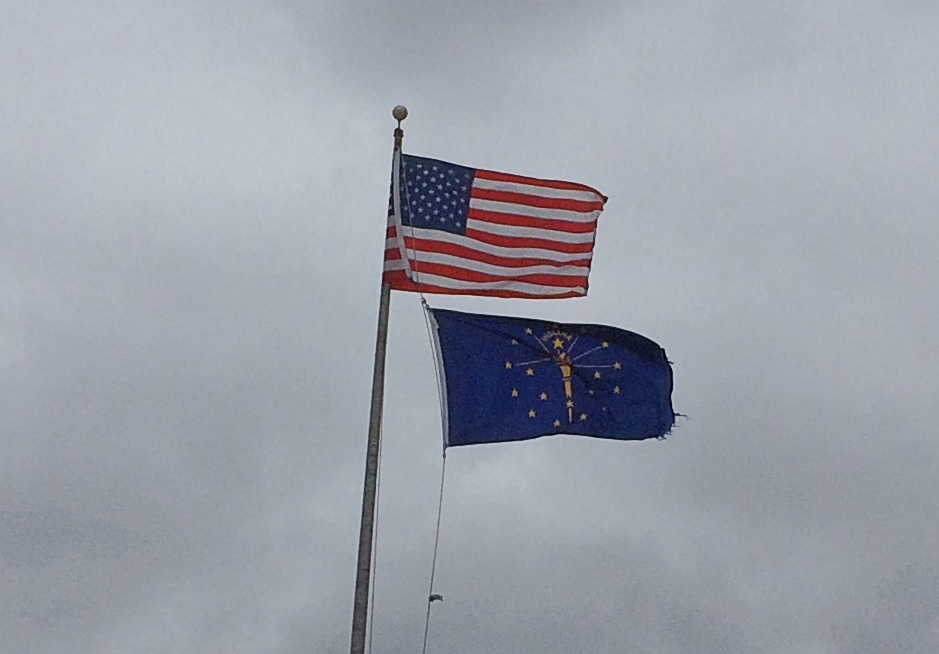
The U.S. flag is a little unusual. Not in having 13 stars, but in that they aren’t the circular arrangement you usually see. Then again, no one specified how the stars in the canton should be arrayed in those days (and maybe we should go back to that).

Point State Park, PittsburghOn one edge of the park is the Fort Pitt Block House, Point State Park’s only surviving structure from colonial times, built in 1764 as a redoubt of Fort Pitt. It has endured since then in its original spot, for many years as a residence, more recently as a relic.

Our walking tour of downtown Pittsburgh started at the Block House, led by an energetic young woman, native to Pittsburgh and eager to talk about various places and buildings, though less about design and more about history.

Naturally, the names of Pittsburgh robberbarons Andrew Carnegie and Henry Clay Frick came up a lot, including the story about a dying Carnegie writing a letter to the estranged Frick asking for a meeting, presumably in the spirit of reconciliation.

Les Standiford tells the story, via NPR. A man named Bridge, who delivered the letter, was Carnegie’s assistant.

“Frick’s ire was, after all, legendary. He’d gone toe-to-toe with strikers, assassins, and even Carnegie himself, and had rarely met a grudge he could not hold. Long before Frick had constructed the mansion that would dwarf Carnegie’s ‘Highlands’ up the street, he had gone out of his way to purchase a tract of land in downtown Pittsburgh, then built a skyscraper tall enough to cast Carnegie’s own office building next door in perpetual shadow.

” ‘Yes, you can tell Carnegie I’ll meet him,’ Frick said finally, wadding the letter and tossing it back at Bridge. ‘Tell him I’ll see him in Hell, where we both are going.’ ”

Whatever else you can say about the steely-eyed bastard Frick, at least he had no illusions about his benevolence, as Carnegie seemed to have had. Our guide also mentioned the taller Frick building next to Carnegie’s, and in fact pointed them out. They are both now overshadowed by more recent Pittsburgh buildings, of course.

At one point, we passed by a building associated with both Carnegie and Frick, along with a lot of other Gilded Age and later tycoons: the Duquesne Club on Sixth Ave.
Duquesne Club Founded in 1873 and still a social club for the wealthy, its current home, a Romanesque structure designed by Longfellow, Alden & Harlow, opened in 1890. Just in time for Carnegie and Frick to discuss, possibly over brandy and cigars, the busting of the Amalgamated Association of Iron and Steel Workers.

Speaking of labor history, not far away from the club, I noticed this historic marker.
AFL Marker, Pittsburgh - Turner HallThe founding convention of the AFL was in a Turner Hall. Our guide didn’t mention that, and I asked her about the Turner Hall. She hadn’t heard it. To be fair, I’d never heard of Turner Halls until recently either. To be extra fair, I’m not guiding walking tours of a major American city, so I consider that a small lapse on her part.

The Turner Hall in Pittsburgh, unlike that in Milwaukee, is no more. The site is now called Mellon Square, a 1950s park-like creation paid for by the Mellons to go with the development of Alcoa’s new headquarters building at that time.

Alcoa isn’t there any more, and the building is now known as the Regional Enterprise Tower, but it still has its distinctive aluminum skin. The New York modernists Harrison & Abramovitz designed it.

Alcoa Building Pittsburgh

I’ve read that a Beaux-Arts palace of a theater, the Nixon, was destroyed to make way for Alcoa, causing some consternation even in the tear-it-down midcentury.

Another historic marker that I noticed (that also wasn’t on the tour).
Pittsburgh Agreement MarketWhy Pittsburgh? I wondered. I looked it up later. NPR again: “Slovak culture is everywhere in the Steel City. It’s home to the Honorary Slovak Consulate, a handful of social clubs, cultural centers and annual holiday festivals dedicated to maintaining and celebrating Slovak traditions.

“ ‘Allegheny County has the highest percentage of all of the counties in the United States, not just Pennsylvania, of people who claim Slovak heritage,’ said Martin Votruba, head of Slavic studies at the University of Pittsburgh.

“Slovaks and Czechs formed a group called the Czecho-Slovak National Council of America. Because there were so many Slovak immigrants living in Pittsburgh, Votruba said it seemed like the perfect location to have a big meeting on Memorial Day in 1918.”

Along the way, we looked at a work of public art in Pittsburgh, a 25-foot bronze fountain centerpiece at Agnes R. Katz Plaza by Louise Bourgeois, completed in 1999. The eye-like smaller bronzes are actually benches, though it’s hard to tell from this angle.

Agnes R. Katz Plaza by Louise Bourgeois,By the time we got to the U.S. Steel Tower, the tallest building in Pittsburgh, a light rain was falling. It would continue at varying strength through the rest of the walk.

US Steel Tower, Pittsburgh

US Steel Tower, PittsburghNo aluminium for this behemoth, rather steel and lots of it. This too is a Harrison & Abramovitz design. The company made steel for its own building, a newish product at the time, corten or weathering steel, which ends up with a dark brown oxidation over the metal to protect the structure from the elements and obviate the need for paint. (The steel still has many surprising uses.) According to our guide, however, until recently the building skin had an unfortunate habit of spitting granules of this rust onto the sidewalks and people below.

Aluminium, steel and then glass. Fitting for the HQ of PPG, also a stop of the tour. Founded in 1883 as Pittsburgh Plate Glass, these days PPG is a supplier of paints, coatings, optical products and specialty materials.

The complex is actually six buildings, all opening in the early 1980s as part of the effort to revive downtown Pittsburgh. By that time, Johnson/Burgee were the go-to NY architects, so they designed the PPG. Rain prevented me from making a good image, but the tallest of the buildings towers over a plaza that features an ice rink in colder weather. It looks like this on a sunny day.

Toward the end of the tour, we made a stop at a place on Smithfield St. that has no marker of any kind and in fact isn’t distinctive in any way, except for one thing: it was the site of an early nickelodeon, thought to be the first theater anywhere devoted exclusively to movies, as opposed to a live theater with a few machines tucked away to separate patrons from their coins.

“The first exclusive moving pictures theater in Pittsburg and the world was opened in 1905 by Harry Davis and John P. Harris in the Howard Block, west side of Smithfield street, between Diamond and Fifth avenue,” one E. W. Lightner wrote in 1919.

Diamond St. is no longer called that. Oddly enough, the change to Forbes St. was made as late as 1958. I’d imagine that would have been hard to do.

Lightner continues: “Curious to say, the second exclusive picture theater of the world was opened in Warsaw, capital of Poland, by a Pittsburg Polander, who saw the Davis-Harris adventure and recognized the possibilities of presenting so wonderful and profitable a development in his native country.”

“The original and only ‘Nickelodeon’ was opened at 8 o’clock of the morning and the reels were kept continuously revolving until midnight. A human queue was continuously awaiting the ending of a performance and the emptying of chairs. Inside an attendant would announce, ‘show ended,’ and spectators would be hustled gently to the street and new spectators welcomed, seated as quickly as possible, and the picture would again respond to the magic reel.”

As you can see, it was pretty much a nothing site when Google Images came by.

Still looks that way in July 2019. There ought to be a marker there at least, or maybe even a hipster bar with a nickelodeon theme.

The Heinz Memorial Chapel

Chapel has a cozy connotation: little chapel in the woods, wayside chapel, goin’ to the chapel and we’re gonna get married, etc. That doesn’t mean you can’t find some sizable edifices that are chapels all the same, such as the Rockefeller Memorial Chapel at the University of Chicago, or the Heinz Memorial Chapel at the University of Pittsburgh.

Late on Friday morning we arrived on campus to see the sizable chapel, funded by condiment money in the 1930s.
More specifically, the will of ketchup baron Henry Heinz (d. 1919) vaguely provided for the development of a building for religious training and social events at the university. His children and the university administration ultimately decided on a soaring neo-Gothic structure, designed by Philadelphia architect Charles Klauder, who was known for his university work. Apparently the chapel was nondenominational from the get-go.

Looking toward the sanctuary.
Toward the back of the nave. The organ has 4,272 pipes, and when we were in the chapel, an organist was filling the space with soft practice notes.
Both transepts feature dual banks of some astonishingly tall stained glass windows: 73 feet tall, designed by Charles J. Connick’s Boston studio.
I found a pamphlet that tells me that the four tall windows each have a theme: Temperance, Truth, Tolerance and Courage. Some of the characters depicted in those windows are religious figures, as you’d expect, such as the Virgin Mary, Moses, King David, St. Francis, St. George and Joan of Arc.

Others are less expected, such as Sir Isaac Newton. With Edmund Halley down in the corner, helping prove Newton’s laws of motion.
Or President Lincoln.
Or Dorethea Dix.
That’s just a small sample. “The windows, which highlight an equal number of women and men, contain sacred and secular figures from history, literature, and science,” the chapel web site says. There are 391 figures in all.