Stonewall National Monument

Last Saturday, which was my last full day in New York City, I made a brief late afternoon foray into Greenwich Village. Been awhile since I’d been there, but I have a special fondness for the Village. Not because of the Beats or bohemians or the like, which are certainly interesting, but because I stayed in an apartment there for a couple of weeks in August 1983.

The place I stayed back then had a Sheridan Square address, so I wandered over that way, which isn’t far from the excellent Washington Square Park, though it was a little chilly on Saturday to fully appreciate it. Pretty soon I came across a place I’d heard and read about, but hadn’t fixed in my mind as being where it is: Stonewall National Monument, on Christopher St.

As national monuments go, Stonewall is small, about 7.7 acres. It’s also new, designated only in June 2016, near the anniversary of the Stonewall Riots.

NYC Parks has a short history of the place: “Located at 51-53 Christopher Street, Stonewall Inn was formerly two adjacent two-story stable houses erected in 1843 and 1846. After numerous alterations, the two buildings were joined into a restaurant by the 1930s. By the 1950s the place was known as Stonewall Inn Restaurant.

“In 1966, it closed for renovations, and reopened in the following year as a private club known as Stonewall Inn – a bar and dance hall which, like numerous local establishments, catered to the homosexual community of Greenwich Village.

“In the early hours of June 28, 1969, police raided the Stonewall Inn and a melee ensued in which 13 people were arrested. Word of the raid and the resistance to it soon spread, and the next day hundreds gathered to protest the crackdown and advocate the legalization of gay bars.

“Further protests erupted in early July, and on July 27, a group of activists organized the first gay and lesbian march, from Washington Square to Stonewall. The events of that summer and their aftermath are often credited as the flashpoint for the gay rights movement in the United States.”

In 1983, I had no notion the Stonewall Inn was there. I’d heard the story of the riots a few years before, but I don’t remember anything to mark the site when I was there, and by then the building was being used for something else anyway.

Christopher Park, which is across the street from Stonewall Inn, was being renovated at that time. “The restoration of Christopher Park was initiated in 1983 by the Friends of Christopher Park, a community volunteer group organized in the late 1970s to maintain and beautify the park,” NYC Parks says.

“Under the direction of landscape architect Philip Winslow, over $130,000 was spent in order to restore the site to its 19th-century splendor. The renovated park, including a new gate, benches, lampposts, walkways, and numerous trees and shrubs, was officially reopened in 1986.”

This time around, I spent a few minutes resting at Christopher Park, even though it was distinctly cool by that time in the afternoon. (In New York, one walks a lot, or should.) There are three memorials in the small park. One is “Gay Liberation” by George Segal, unveiled in 1992.

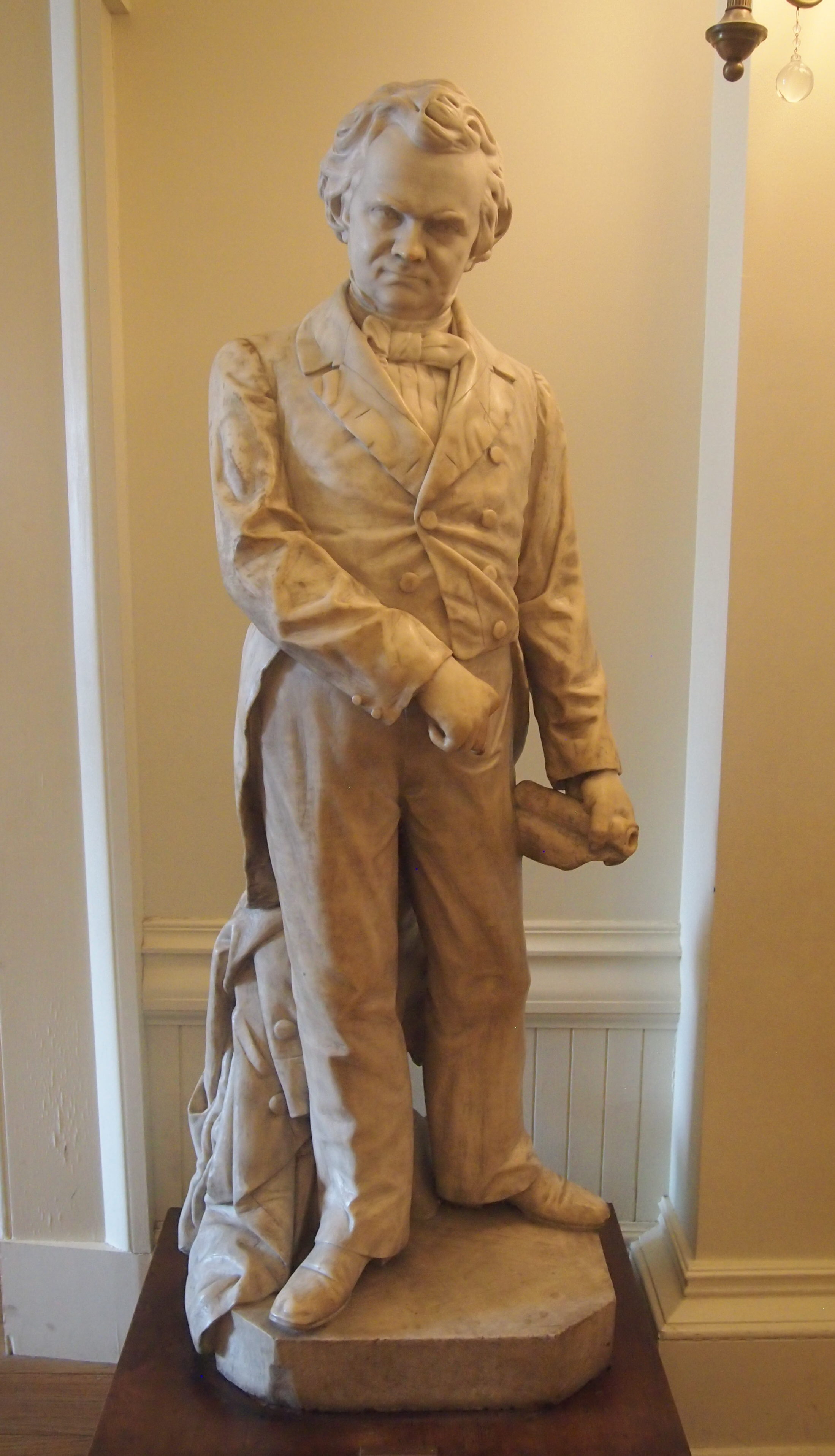
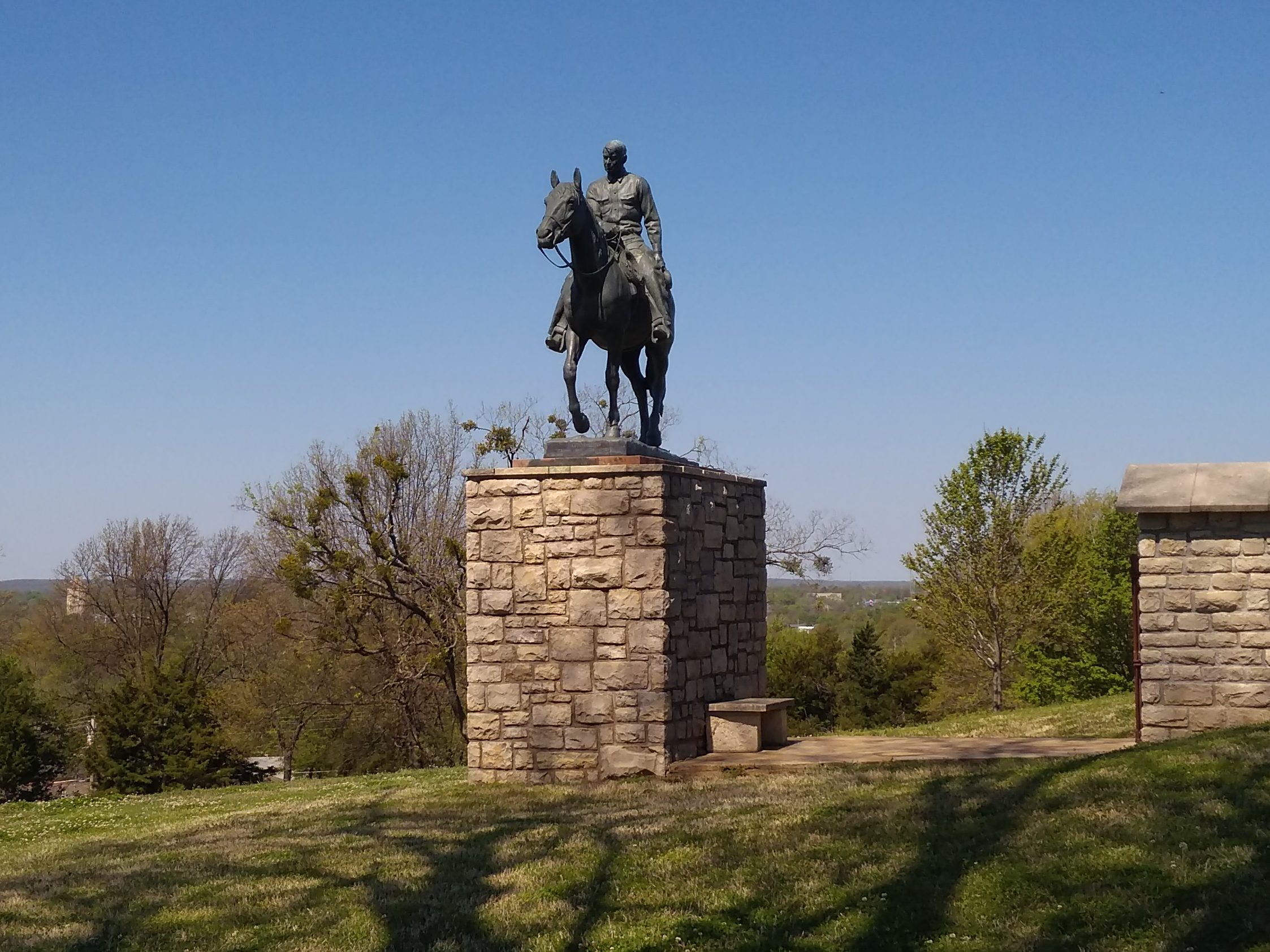
A more traditional statue, erected in the 1930s, also stands in the park: Phillip Sheridan, by Joseph P. Pollia.

Finally, according to NYC Parks, there’s a flagpole in the park honoring the 1861 Fire Zouaves. Damn, how did I miss that? What the ’61 Fire Zouaves need is a statue on the site, or somewhere in New York. A bright, colorful statue.

Trinity Church Wall Street, Alexander & Eliza Hamilton, and Norges Bank Investment Management

On Broadway in Lower Manhattan, near the intersection with the storied Wall Street, stands the church and graveyard of Trinity Church Wall Street. Looking at the property means you’re peering deep into the history of New York and the early days of the Republic — and into a modern-day real estate story involving Norwegians.

First, the church building.

The current church is the third one on the site, completed in 1846, so it isn’t the building that George Washington and especially Alexander Hamilton would have known. The second building was completed in 1790 to replace the original, which burned down in the Fire of 1776.

Richard Upjohn designed the current Gothic Revival structure as one of the first in a very long list of churches that he did. For a good many years, it was the tallest building in New York, or in the United States for that matter, which is a little hard to imagine in its current setting among taller buildings.

Being Holy Week, the church was fairly busy, though no service was going on when I visited.
Busy inside, but the real crowd was outside, in the graveyard.
A school group happened to be wandering through when I arrived. They might have come for the history of the entire place, but who had they really come to see?

Alexander Hamilton, of course.
I have to admit that I either didn’t know, or had forgotten, that he is buried at Trinity. In a way, that was a good thing, since it was a nice surprise.

Note the enormous number of pennies and other coins at the base of his stone. Seemed like even more than I saw at Benjamin Franklin’s grave, who had the benefit of being associated with “a penny saved is a penny earned.”

Eliza Hamilton, who outlived Alexander by more than 50 years and is buried next to him, collected her share of pennies, too.
That’s what you get for being the subject of a very popular musical in our time. Even I’ve heard some of the songs. Ann plays them in the car. They’re interesting. I’m all for musicals about major historical figures, but I’m not going to pay hundreds of dollars for a ticket.

The Hamiltons weren’t the only famed permanent residents of the graveyard. There’s steamboat popularizer Robert Fulton, who has a memorial fittingly erected by the American Society of Mechanical Engineers.

Here’s Capt. James “Don’t Give Up the Ship” Lawrence, hero of the War of 1812. His memorial’s looking a little green these days.
Nice detail on one side.

There are also plenty of memorials for regular 18th- and 19th-century folks. I’m glad to say they were getting some attention.

There are stones the likes of which aren’t made any more.

Or on which time has taken its toll.
About those Norwegians. Trinity Church Wall Street, which is part of the Episcopal Diocese of New York, is known for is being one of the wealthiest parishes in the nation. In 1705, Queen Anne granted the church 215 acres on the island of Manhattan. It still holds 14 of those acres, which these days are home to millions of square feet of commercial property. That kind of acreage would make anyone very rich indeed.

Recently —  in 2015 — the church monetized 11 of its office buildings by striking a deal with Norges Bank Investment Management, which oversees Norway’s sovereign wealth fund (a lot of North Sea oil money, I reckon). It’s no secret. I quote from the press release the church published:

“Norges Bank Investment Management will acquire its 44 percent share in a 75-year ownership interest for 1.56 billion dollars, valuing the properties at 3.55 billion dollars. The assets will be unencumbered by debt at closing.”

Unencumbered by debt. The sweetest words you can write about real estate.

“The properties are about 94 percent leased and total over 4.9 million square feet. They are all located in the Hudson Square neighborhood of Midtown South in Manhattan… The buildings were originally built in the early 1900s to house printing presses, but have been redeveloped by Trinity Church to attract a mix of creative office tenants.”

“Nuclear Energy”

If you visit the Smart Museum of Art at the University of Chicago, you can also easily visit “Nuclear Energy,” which is on a small plaza only about a half a block to the south, on Ellis Ave. (but not part of the museum’s collection). I’d seen it before — I couldn’t say exactly when — but Yuriko and Ann hadn’t. So we took a look.

“Nuclear Energy” is a Henry Moore bronze on the site of the first manmade self-sustaining nuclear chain reaction, the 75th anniversary of which just passed last December 2.

As for the sculpture, it was dedicated exactly 25 years after Chicago-Pile-1 was built and tested on the site, so its 50th anniversary was on December 2 too. Looks good for being out in the Chicago weather for so long, but I suppose it’s maintained.
Abstract, as Henry Moores tend to be, but of course you think of a mushroom cloud. Moore denied that, offering up (I’ve read) some art-speak about a cathedral, but I’m not persuaded. A mushroom cloud is perfectly fitting.

Still in Old Assenisipia

I was looking in a seldom-looked at file of images the other day and found a scan I’d made of a page from a collection of Thomas Jefferson’s writings. I’d forgotten I’d made ir. Here it is.

Nearly 15 years ago, I wrote: “Some years ago, I read a curious little document by Thomas Jefferson, who in 1784 made a report to Congress — the Congress under the Articles of Confederation — about how to create states from the Northwest Territory and what to call them.

“Jefferson suggested 10 states for the area that now contains six (Illinois, Indiana, Kentucky, Michigan, Ohio and Wisconsin). It was an exercise in hyper-rationality and hyperliteracy, though if his suggestions had been used, they would be normal and even venerated names — such is the power of custom.

“Hyper-rational because, instead of paying attention to natural features, Jefferson cut the district into rectangles measuring two degrees of latitude north-to-south and roughly four degrees of longitude east-to-west (‘roughly’ because the irregular Mississippi River forms the western boundary of the territory).

“Besides the Mississippi, geographic form did intrude in what we call lower Michigan — even Jefferson wasn’t going to ignore lakes Michigan and Huron in drawing lines — as well as a few other places on his map, but he was doing his best to apply Longitude and Latitude to the new states’ boundaries. It was as if Colorado- and Wyoming-shaped states were to be created in the Midwest.”

Naturally, other sites discuss this odd collection of non-realized states, such as (of course) Strange Maps.

Presidential Real Estate

“Presidents Day” weekend has rolled around again. Late last week I managed to make professional use of my slight knowledge of the presidency — or more exactly, the various U.S. presidents — to write an article about a selection of their houses. The final title: “The Fabulous Real Estate (And A Few Modest Digs) Of Past Presidents.”

It was a fun article to write. I didn’t want to make it overly long, so of course most of the presidents were left out. But I did have a nice selection from different eras: Madison, Jackson, Van Buren, Wm. Henry Harrison, Lincoln, Benjamin Harrison, Theodore Roosevelt, Hoover and Lyndon Johnson.

My sources included my own visits in some cases, online information, and two books that I own. One is the bare-bones Presidents, subtitled “Birthplaces, Homes, and Burial Sites,” by Rachel M. Kochman. I can’t quite remember where I got it, but it’s the kind of book that sells in national park or national monument or national historic site bookstores. Acquired sometime in the late 1990s probably, since it’s the 1996 edition, with the most recent president covered being Bill Clinton.

Bare bones because while extensively illustrated, all the photos and drawings are black and white. That’s no problem, really, but it’s set in an ugly sans serif. That makes what should be a browsing book less pleasant to browse. Still, the book includes a lot of information on presidential sites.

I also have a coffee table book called Homes of the Presidents by Bill Harris, 1997, so it too ends with Clinton. A remainder table find. The text is a little uneven, but not bad. The pictures are the thing, of course, and they are well selected.

Manhunt: The 12-Day Chase for Lincoln’s Killer

On Friday morning, I noticed that I could have watched the opening ceremony to the Winter Olympics via live streaming if I’d gotten up at 5 a.m. Ha, ha. I was busy about then enjoying a dream about something or other. Then I forgot to watch any of the replay on regular TV, maybe because NBC’s treatment is always tiresome.

Considering that today is Lincoln’s birthday, it’s fitting that I picked up a book about him — partly about him — on Saturday at a resale shop, and started reading it as soon as I got home. But I wasn’t thinking about that coincidence when I bought the book. It didn’t occur to me until this morning.

The book is Manhunt, subtitled “The 12-Day Chase for Lincoln’s Killer,” by James L. Swanson (2006). I liked it from the beginning, namely “A Note to the Reader,” on page viii.

“This story is true. All the characters are real and were alive during the great manhunt of April 1865. Their words are authentic. Indeed, all text appearing within quotation marks comes from original sources: letters, manuscripts, affidavits, trial transcripts, newspapers, government reports, pamphlets, books, memoirs, and other documents. What happened in Washington, DC, in the spring of 1865, and in the swamps and rivers, and the forests and fields, of Maryland and Virginia during the next twelve days, is far too incredible to have ever been made up.”

In a case like this, I’d guess a surfeit of information and sources would be the writer’s challenge, rather than missing puzzle pieces. Among 19th-century crimes, Lincoln’s murder might well be the best documented.

So far Swanson seems up to the challenge. Even though I know a fair amount of the story, and have read other books about the assassination (e.g., The Day Lincoln Was Shot by James Bishop), Manhunt is a page-turner. I spent a fair amount of Saturday night and Sunday morning turning those pages.

Though the book hews close to the facts, that doesn’t keep Swanson from occasional interesting counterfactual musings. Such as a paragraph about what might have happened had Booth’s shot missed — his derringer had only one shot, after all.

“Had Booth missed, Lincoln could have risen from his chair to confront the assassin. At that moment, the president, cornered, with not only his own life in danger but also Mary’s, would almost certainly have fought back. If he did, Booth would have found himself outmatched, facing not kindly Father Abraham, but the aroused fury of the Mississippi River flatboatman who fought off a gang of murderous river pirates in the dead of night, the champion wrestler who, years before, humbled the Clary’s Grove boys in New Salem in a still legendary match, or even the fifty-six-year-old president who could still pick up a long, splitting-axe by his fingertips, raise it, extend his arm out parallel with the ground, and suspend the axe in midair. Lincoln could have choked the life out of the five-foot-eight-inch, 150-pound thespian, or wrestled him over the side of the box, launching Booth on a crippling dive to the stage almost twelve feet below.”

Also intriguing are the walk-on characters. Walk-on from the point of view of the main story, since no one is a walk-on in his or her own life. Such as “John Peanut,” the man — or teen — who worked as a menial at Ford’s Theatre and who held John Wilkes Booth’s horse in the alley behind the theater while the actor went off to become an assassin. Booth had asked Ford’s Theatre carpenter Ned Spangler to do so, but he fobbed the job off on “John Peanut,” who might have been named John or Joseph Burroughs or Burrows.

A little more information about this person is here, for what it’s worth. A Lincoln assassination buff named Roger Norton says, “I believe the best Lincoln assassination researchers in the world tried to find out what became of him, but nobody could succeed. The trail ends with his appearance at the trial. Mike Kauffman has suggested that his name was actually Borrows (sp?). Nobody knows his exact age in 1865 as far as I know, but ‘teens’ is a logical assumption.”

So there’s plenty in Manhunt to keep me interested. It’s become an express train blowing by the other books I’m reading at the moment: Trotsky: Fate of a Revolutionary, The Crossing (Cormac McCarthy) and a collection of Orwell’s essays, which is a re-read after a few decades.

1 Jiao, 1980

From the NWS at 3 p.m. today, for northeastern Illinois: WINTER STORM WARNING REMAINS IN EFFECT FROM 6 PM THIS EVENING TO 9 PM CST FRIDAY…

“Heavy snow expected. Travel will be very difficult to impossible at times, including during the morning commute on Friday. Total snow accumulations of 8 to 14 inches, with localized higher amounts are expected.”

Well, that ought to be fun. Snow had already started as of 6 p.m. Thursday. Fortunately, all of us can stay home tomorrow.

One more small banknote for now. Small in value, about 1.6 cents, and small physically, 4½ by 2 inches. The 1 jiao of the People’s Republic of China. The PRC. I miss it being called red China, just a little.

1 jiao is 0.1 yuan. So you could say that this is a Chinese dime. The gentlemen depicted on the note are stalwart examples of Gaoshan and Manchu men, presumably looking boldly toward the socialist future. Manchu, I’d heard of. Manchu Dynasty and all that. Gaoshan, on the other hand, I had to look up. Seems that’s a term for Taiwanese aborigines.

Dated 1980, but in fact part of the fourth series of the renminbi (as opposed to FECs), which were issued from 1987 to 1997. So I might have picked this up in China. I know I have a few 1 jiao aluminum coins from our visit. Or the note might have been among the bunch o’ cheapies I got more recently.

25 Centavos, Nicaragua, 1991

This slip of a note, all of 41116 inches by 2116 inches, came with dozens of others that I bought for a few dollars a few years ago. It’s one of a series of small denomination notes issued by Banco Central de Nicaragua in the early 1990s that didn’t have much value for very long.

The country’s base currency is the cordoba, named for the fellow pictured on the note, Francisco Hernández de Córdoba (d. 1526), who is regarded as the founder of Nicaragua, in that he founded Granada and León in that country. He’s not to be confused with another Francisco Hernández de Córdoba (d. 1517), who had the misfortune to lead an expedition in the Yucatan inevitably described as “ill-fated.”

Actually, the Nicaraguan Córdoba had his own ill fate, running afoul of another Spaniard, Pedrarias Davila, founder of Panama City and by most accounts a ruthless bastard even by conquistador standards. Davila had Córdoba put to death by decapitation, just as he did to Balboa (who has a currency named after him, too).

The note was printed by Harrison & Sons Limited, a major British engraver of stamps and banknotes founded in 1750 and lasting until it was bought by competitor De La Rue in 1997. “Harrison & Sons Limited” is visible right there on the bottom of the reverse.

The cap in the triangle, incidentally, is a Liberty Cap, a.k.a. a Phrygian Cap. A symbol of freedom, either a freedman’s or more generally everyone’s. I didn’t know this until I looked it up, but Liberty Caps are commonly used Latin American coats of arms, by Argentina, Bolivia, Colombia, Cuba, El Salvador, Haiti, Nicaragua and Paraguay.

Why have we in the United States forgotten about the Phrygian Cap? Why did the silliest of the Tea Party supporters wear tricornes and not Liberty Caps? Most anyone in the early Republic would have known what it meant. Remarkably, Walking Liberty wore a Phrygian Cap on the U.S. half dollar until 1947, though I suspect by then few noticed.

Back to Francisco Hernández de Córdoba. His skull-less bones were discovered in 2000. The Miami Herald reported that year: “Nearly 500 years after he was decapitated by a ruthless boss, and 400 years since his grave was lost in the aftermath of a volcanic eruption, the remains of Hernandez de Cordoba have been discovered. Nicaraguan archaeologists made the find earlier this month in the dusty ruins of a church here on the banks of Lake Managua, 30 miles northwest of the capital…

“When Davila sensed that his chief lieutenant in Panama, Vasco Nuñez de Balboa, was growing in popularity, he had him decapitated. He did the same with Hernandez de Cordoba in 1526. The head of Nicaragua’s founder was stuck on a pole in the town plaza, a reminder to others of the costs of incurring Davila’s wrath, while his body was buried at the foot of the altar in Leon Viejo’s only church.”

10 Sen Note, 1964

Something I thought about the other day, when looking for more detail about my Indonesian 10 sen note, dated 1964: Why aren’t there prizes in cereal boxes any more?

This article at a site called Extra Crispy offers a plausible answer: kids wouldn’t respond to them any more. Entertainment for children has become more sophisticated, you might say. A more cynical take would be that if it isn’t an electronic three-ring circus, kids will be bored.

I wondered that because I read an entry posted by “Man” at a blog called Coined for Money that discusses the 10 sen note. Man asserts (all sic): “Taking a quick break from U.S. notes to talk about my oldest foreign note. I got this from a Cheerios box back in the 1980s when they had a special in box promotion.Cheerios has been doing this for year in the 1950s they had replica confederate money and the most famous is the Sacagewea coins from the 2000s.”

Interesting. I’ve confirmed that General Mills did give away Confederate money reproductions in Cheerios boxes in 1954 — one of those details that shows that some things do change — and Lincoln cents and a few hundred Sacagaweas in 2000.

But I didn’t acquire my note in the 1980s. I don’t remember when I got it, but it was at least as long ago as 1970. It’s one of the first, maybe the first, of the foreign banknotes in my possession. I found it fascinating as a kid. I still find it interesting: a relic, however minor, of Year of Living Dangerously Indonesia. (Book and movie both recommended.)

Could be that Cheerios boxes offered cheap foreign notes as premiums in the late 1960s. That’s plausible, since even then, 10 sen notes were worthless.

To cite Wiki on the 1960s Indonesian rupiah (which even now is technically divided into 100 sen): “The hyperinflation of the early 1960s resulted in the pronouncement of the ‘new rupiah’ supposedly worth 1,000 of the old rupiah.

“The withdrawal of the old money meant the issue of an entirely new set of banknotes, by Presidential decree of 13 December 1965. The decree authorised Bank Indonesia to issue fractional notes for the first time (although the 1 and 2½ rupiah notes were still issued by the government itself), in denominations of 1, 5, 10, 25, and 50 sen showing ‘Volunteers’, dated 1964.

“Due to the fact that the rupiah was only devalued about 10, rather than 1000 times, they were worthless on issue, and many millions of notes never entered circulation.”

Perhaps someone at General Mills’ ad agency got wind of the fact that countless thousands of 10 sen notes could be had for very little real money, and included them in the promotion. And for all I know, the company had so many that it could do it again in the ’80s.

​2½ Guilder Note, 1949

I haven’t found figures on how many 2½ guilder banknotes dated 1949 that De Nederlandsche Bank produced, but it must have been a lot. I know that because, at least as of Sunday, one was for sale on eBay for $1.30, plus 50 cents shipping. A valuable collector’s item, it’s not. Suits me.

The one for sale looks roughly in the same slightly worn condition as the one I have, which is on permanent loan from my mother. It’s a smallish note, 4½ inches by 2⅜ inches. My parents picked it up during their time in Europe in the mid-1950s.

The one to have, at least according to valuations on eBay, is the 1939 Dutch East Indies 25 guilders with Javanese dancers. Someone wants $400 for one of those.

I like the fact that its denomination is ​2½ guilders, not a quantity you see often, though for a long time the United States issued ​2½ dollar gold coins, the Quarter Eagle. Twee en een halvee gulden is also fun to say, though I probably don’t sound Dutch when I do.

If I’ve done my research correctly, a guilder was worth about a U.S. quarter in the mid-50s, valuing this note at 62 cents or so. Not as trifling a sum then as now  — its purchasing power was probably over $5 in current money — but not that much either.

Also of note on the obverse: Uitgegeven krachtens k.b. van 4 Februari 1943 en van 18 Mei 1945. My stab at a translation: issued by virtue of royal decree, February 4, 1943 and May 18, 1945. The Dutch government was in exile in the UK on that first date, including the famously strong-willed Queen Wilhelmina. I know that, anticipating an Allied victory, new Dutch currency was produced starting in 1943. Made in the United States as it happens, as the designs more than hints at.

The 1949 reserve has a Spirographic sort of design.

Queen Juliana appears on the 1949 note, new to the job since her mother abdicated the year before. Juliana was still on some of the coins in circulation when I visited the Netherlands in 1983, though she had abdicated three years earlier in favor of Beatrix, who stayed on as queen until 2014, past the time when guilders ceased to be money. I wonder if the Dutch miss their guilders.