Springfield ’18: Another Look at the Rubber Lincolns

The weekend before last, we popped down to Springfield for a short visit. As in the capital of Illinois, not any of the many others, or the cartoon town. Ann had expressed an interest, mostly in passing, that she’d like to see the Abraham Lincoln Presidential Museum again. So, like a parent does sometimes, I took that passing whim and ran with it.

The last time we were there was 2010, so I could see Ann’s point. She was only seven years old then and wanted an updated perspective. I also wanted to visit again, just to see if it was any different.

The short answer: not much. Is that part of the museum’s current problems?

Maintaining attendance as the years go by means offering new things from time to time, and I got the distinct impression that most everything was the same as eight years ago — including the short films shown in the museum’s two main auditoriums. I know it costs money to make new films, but that can’t be done in eight years?

Then again, maybe the museum isn’t interested in repeat visitors. School groups come, tourists come. For most people, once is probably it. Or maybe again many years later as a child who visited returns with a child of his or her own. The museum isn’t quite old enough for that yet, but I suppose it will happen.

Actually, I noticed a few small changes. Take a look at the picture of the “rubber” Lincoln family near the museum’s entrance that I took in 2010, with my own family posing.

Now look at this one from 2018, with Ann on the right and a friend of hers on the left.

There are some small differences in the Lincoln family — a different but similar dress for Mary, for instance, and for all I know the life-sized figures might be different ones from the ones standing there eight years ago. But the main difference is behind the Lincolns.

Eight years ago, a life-sized John Wilkes Booth lurked in the background. Now he’s gone. The figure you can see in the back to the left is George McClellan, standing inside the fence with U.S. Grant, who isn’t visible in my picture. (Also obscured, and off the right, are Harriett Tubman and Frederick Douglass.)

Is Booth out for a touchup? Or did the museum get tired of people complaining about his presence? He did murder Lincoln, after all. His figure in such a prominent place is a little like putting a print of the famed photo of Lee Harvey Oswald and his rifle on the wall at the Kennedy Museum.

Never mind all that, I enjoyed the museum the second time around enough to make it worth the trip, though I think it will be my last. I’m sure Ann got her revised impression of the place.

I paid close attention to the rubber figures, which aren’t rubber, of course. As I wrote in 2010, “Though derided as ‘rubber’ Lincolns, they’re actually sculpted foam coated with fiberglass, and then painted, clothed and fitted with a mix of real and synthetic hair.”

The figures are a distinguishing feature of the museum, and on the whole, add to the experience. Here’s the thinkin’, book readin’ young Abe.

The store-keeping Lincoln as a young man in Salem, Illinois. It didn’t work out for him.

Abraham courting Mary. That worked out for him.

The Lincoln-Herndon law office. Perhaps the best tableau in the museum. Clutter is an essential aspect of people’s lives that historical museums often miss. Lincoln had better things to do than tidy his office or discipline his sons. Namely, read.

Can’t very well have a Lincoln museum without Mr. Douglas debating Mr. Lincoln.

Mary Lincoln dressed for her husband’s inauguration.

There is another Mary Lincoln figure, dressed in black, sitting alone in a dim room with the sound of rain in the background. She is depicted grieving for their son Tad, who died in 1862. It’s the saddest tableau in the museum, even more than the Ford’s Theatre depiction.

The first reading of the Emancipation Proclamation to the cabinet. (“By the way, gentlemen, one more thing…”) Clearly inspired by the famed Carpenter painting, if not so formally posed.

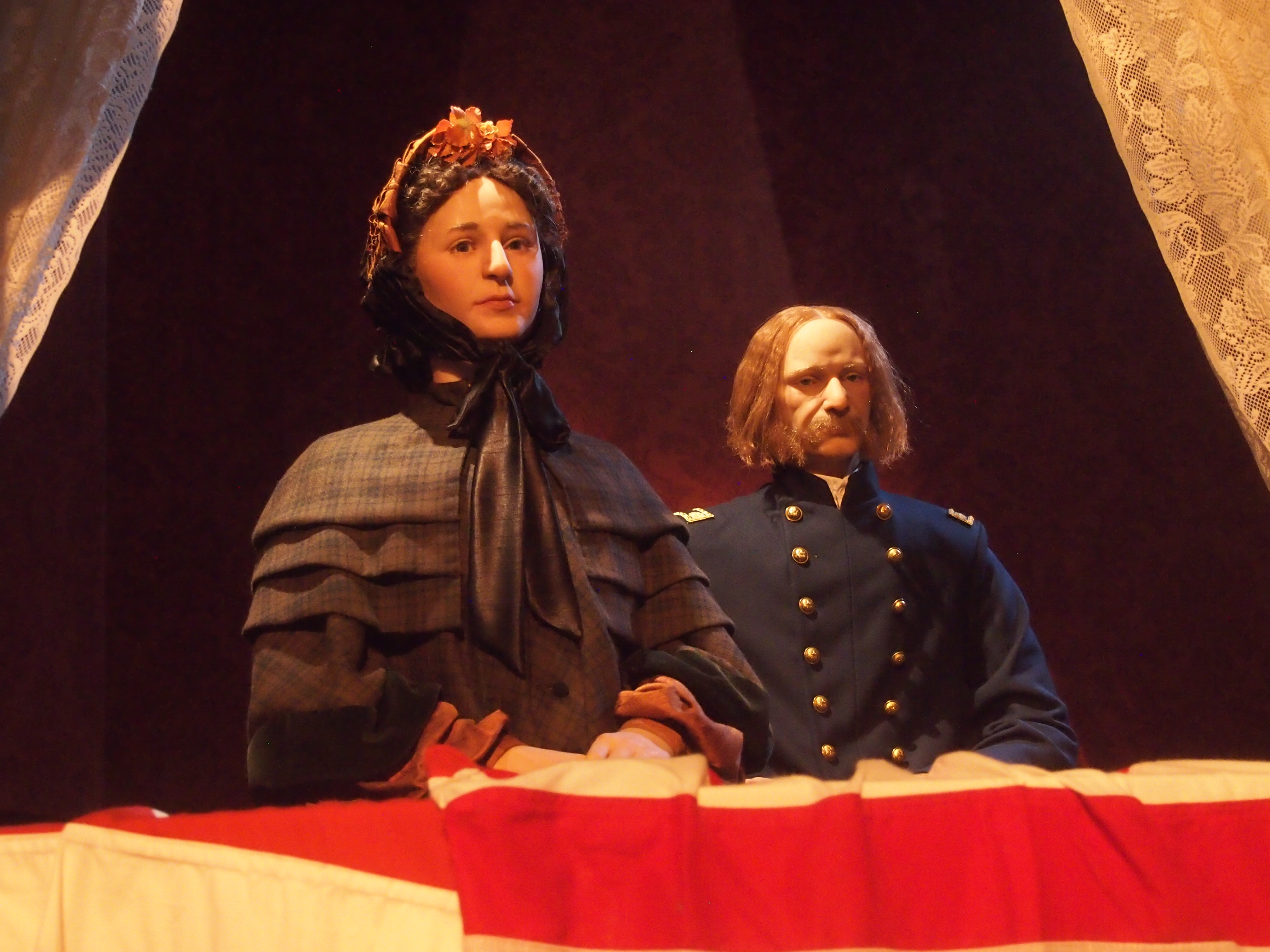
And, of course, the Lincolns at Ford’s Theatre.

Booth is depicted entering the door behind them, so maybe that’s the only place to find the rubber assassin in the museum these days.

The Swamp

The following is the kind of color I want from history books, not the kind of experience I want for myself:

April 12: Did nothing but send off express to Fort Deynaud at 4 a.m. and mourn my existence the rest of the day. Mosquitoes perfectly awful.
April 13: No peace from mosquitoes… Stayed up all night… Mosquitoes awful. 1,000,000,000 of them.
April 18: Mosquitoes worse than ever. They make life a burden.
April 19: I am perfectly exhausted by the heat and eaten up by the mosquitoes… They are perfectly intolerable.

The time: 1856. The place: Florida, during the Third Seminole War. Pre-DEET Florida. The writer: Alexander Webb, with the U.S. Army at the time. He survived the mosquitoes (not everyone did), was later a hero at Gettysburg and died in 1911.

The diary extract is quoted in The Swamp by Michael Grunwald (2006). Subtitled “The Everglades, Florida and the Politics of Paradise,” it’s a history of human interaction with the Everglades, and an interesting book with a large cast: Calusa Indians, Ponce de Leon, Andrew Jackson, the Seminoles, James Gadsden, Osceola, competing Florida Reconstruction governors Gleason and Reed, land speculator Hamilton Disston, John James Audubon, Napoleon Bonaparte Broward and Henry Flagler. That’s just up to the 20th century, when the only organization up to the task of draining much of the Everglades came to the fore: the U.S. Army Corps of Engineers.

Of course, draining or otherwise modifying the Everglades is now universally regarded as a mistake, and a remediation as slow as the Everglades is under way.

Early on, Grunwald pointed out that large parts of the ecosystem are actually marshes, with only some counting as swamp, but never mind. The Swamp it is.

Then it occurred to me that “drain the swamp” is an ossified metaphor. No one in the developed world advocates draining real swamps any more. We want more wetlands. As usual, language is a laggard. But that’s not always a bad thing.

Sightseeing at the Jetties Cafe 60-Odd Years Ago

Here’s a postcard I acquired at a Missouri antique mall not long ago. To judge by the automobiles in the image, early to mid-1950s.

The image doesn’t seem odd, not at first, but the caption on the other side tells a different story:

“Aliens who have entered the United States illegally are being returned to Mexico on this ship passing the Jetties Cafe on Padre Island, Port Isabel, Tex. Usually a smaller boat follows the ship to pick up aliens who prefer to ‘jump ship’ before it clears the channel.”

As postcard subjects go, that’s one of the odder ones I’ve seen. A casual scene of mass deportation. Maybe it was a strange card even 60+ years ago. Or maybe it counted as topical, referring to a not-well-remembered action by the Eisenhower administration.

The publisher was Frank Whaley Post Cards of McAllen, Texas, and this card is numbered FW-457. A casual look reveals that he seemed to specialize in South Texas. Apparently he was successful enough to own a couple of postcard vans.

Cahokia Mounds State Historic Site

When leaving Illinois via I-55 in mid-April, I considered stopping for a look at Cahokia Mounds State Historic Site, which is still in Illinois, but within sight of St. Louis. We stopped there in 2000, I think, when we spent time in St. Louis and Hannibal, Mo.

But we didn’t get far into the place that time — barely beyond the visitors center and museum. Mostly Cahokia is an outdoor attraction. Back in 2000, it was November, and the weather was crummy. We also had a three-year-old in tow.

So I’ve been meaning to stop again for a while. But in mid-April this year, the weather was as crummy as any November day, so I drove on. I figured I might catch it on the return about two weeks later, when the weather might be better.

So it was. On April 29 I stopped at Cahokia to wander around the grounds and try to imagine the long-gone inhabitants of a city so prominent in pre-Columbian North America that it’s now a World Heritage Site.

There isn’t much visible to go on. Fields, trees and non-natural mounds. Most of the importance of the site is invisible.

UNESCO says that Cahokia “was occupied primarily during the Mississippian period (800–1400), when it covered nearly 1,600 ha and included some 120 mounds. It is a striking example of a complex chiefdom society, with many satellite mound centres and numerous outlying hamlets and villages. This agricultural society may have had a population of 10–20,000 at its peak between 1050 and 1150.”

A road cuts through the site, and on the other side of the road from many of the mounds and the visitors center is the centerpiece of Cahokia: Monks Mound.
At this distance, it’s hard to tell, but those are stairs with people climbing them. Monks Mound, at about 100 feet high, and 955 feet by 755 feet at the base, is the largest Pre-Columbian earthwork in the Americas, and the largest pyramid north of Mexico. Clearly the Mississippian-culture Indians were determined to build the thing, since they’re presumed to have built it over some centuries using baskets to move soil and clay.

The least I could do was climb to the top. The view’s a good one. Note St. Louis off in the distance, including just-visible the Gateway Arch (which is more clearly visible with your eyes).

The opposite direction, into the flatness of Illinois.

The top of the mound itself is fairly flat, though I understand the archaeologists have discovered a number of subtle gradations up there, and found evidence of a large building toward the back of the mound. That’s assumed to be a chiefly or priestly residence, which would be consistent with most human behavior in most places, but the Cahokians aren’t around to tell us.

Another mystery: why did they leave? Cahokia was abandoned long before Europeans came this way, or even European diseases, so it wasn’t that. Climate change? Their own plague? Other Native Americans driving them away? I believe archaeologists’ answers to the question boil down to, Dunno. Go figure.

Three West Texas Cemeteries

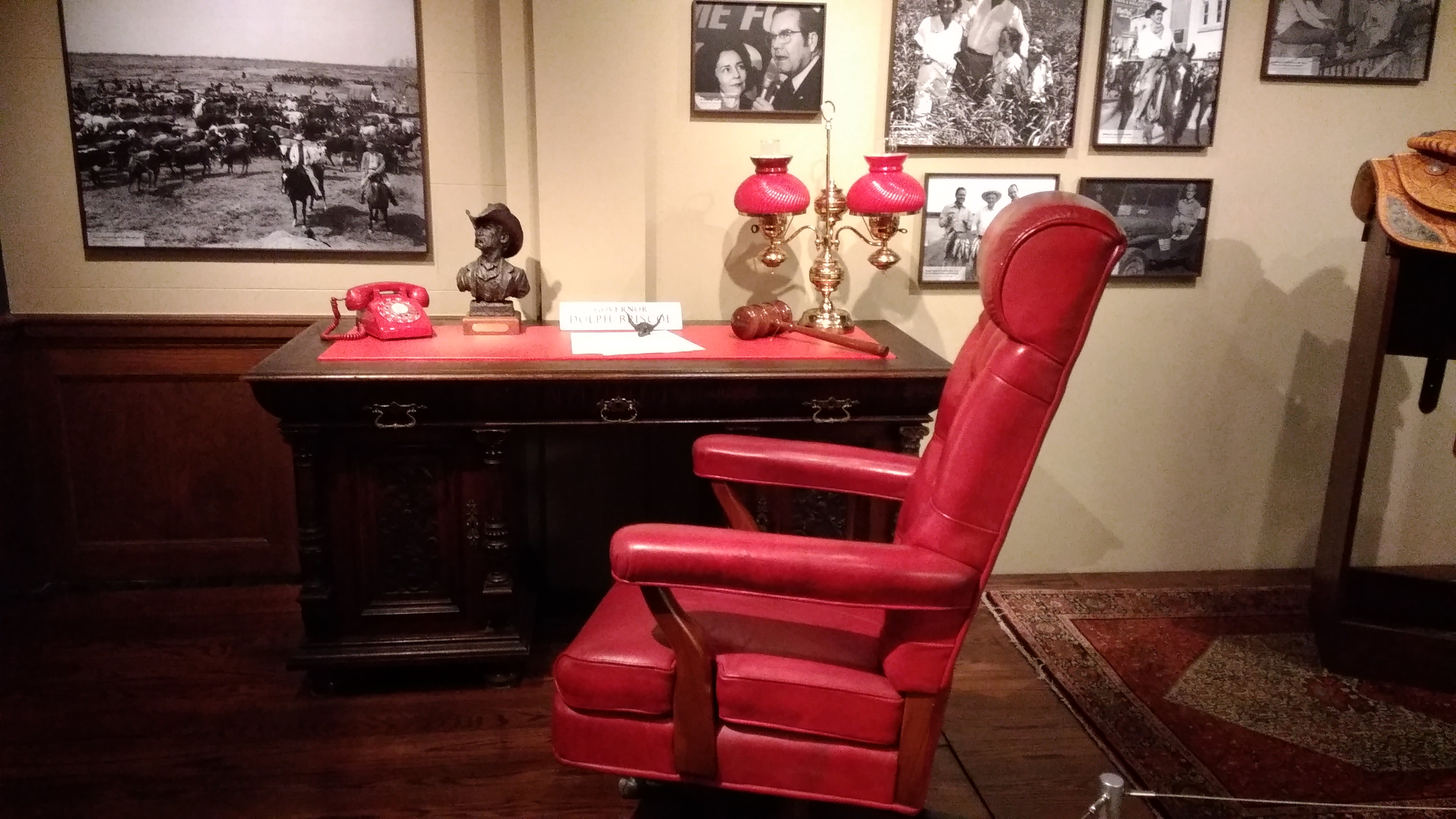
Heading out from San Antonio on U.S. 90, I considered a stop in Uvalde, Texas, to see the Briscoe-Garner Museum. Briscoe, as in Dolph Briscoe, 41st governor of Texas (in the 1970s, so I remember him), whose family owned 560,000 acres of Texas land not long after his death in 2010. That’s about 875 square miles, or about two-thirds the size of Rhode Island, and not a lot smaller than the Grand Duchy of Luxembourg.

Garner, as in Cactus Jack Garner, 39th Speaker of the U.S. House of Representatives and 32nd Vice President of the United States, who famously said the vice presidency wasn’t “worth a bucket of warm piss.” Especially when you end up at odds with your president. So far he’s the longest-lived vice president or president in United States history, and, as some anonymous writer at Wiki points out, had the distinction of living during the presidencies of both Johnsons: Andrew and Lyndon.

Enough there for a pretty good museum, I’d say. But as I stopped at a rest area along U.S. 90, I did a little more checking and found that the museum is closed on Mondays.

So I decided to drop by Uvalde Cemetery and find Garner’s grave. It’s a large burial ground, marked by some trees and greenery, but not overly garden-like.

Still, I figured I could find Garner. There would probably be flag poles near him. So there were.

Here’s the grave of John Nance Garner and his wife Marietta Rheiner Garner. Imagine that, he was a fully grown man at the turn of the 20th century, and yet lived to see men travel into space.

How many vice presidential graves have I seen? That is, the resting places of men who were never also president? Only one other that I can think of. I got a look from some distance at the stone of John C. Calhoun in Charleston. I need to seek more of them out.

In Fort Davis, Texas, after visiting the National Historic Site of that name, I dropped by the Jeff Davis County Library to check my email, and found it to be a fine adaptive reuse of a late 19th-, early 20-century building complex that had once been a general store, post office, an early telephone exchange and other things.

Just off Texas 118 in Fort Davis is a sign that says Pioneer Cemetery. I had to take a look at that. A narrow path, completely surrounded by the kind of diamond wire-mesh fence that you might see in any suburb, led to the cemetery gate. That was the only entrance that I saw, and otherwise the cemetery grounds were surrounded by fenced-off private houses. That felt a little odd at first, but soon I got used to it.

Like the region, the cemetery is sparsely settled.

But there are a few headstones and fenced-off plots.
One old soldier that I could see, Joseph Granger, CSA.

According to the plaque at the entrance, the cemetery was active from the 1870s to 1914, which also says that immigrants named Dutchover are buried here, along with a madwoman and a couple of horse thieves. Sounds like a motley mix of pioneers, all right. Here are some Dutchovers.

Marfa, Texas, famed among the glitterati these days, still looks a lot like a small West Texas town, though with galleries, tony hotels and Manhattan-priced shops thrown in the mix. Unfortunately, after visiting the McDonald Observatory and Fort Davis, I didn’t have the time or energy to visit the sizable Chinati Foundation in Marfa, which I’m sure is a worthwhile destination.

I did look around at some other spots. The Presidio County Courthouse is handsome, for one thing.

The Hotel Paisano is decidedly handsome, too.
Before I left Marfa, I stopped at Cementerio de la Merced, a desert cemetery with a mix of wooden markers and more formal stones. Bet not many of the glitterati pause there to pay their respects.

The names on the graves are largely, but not completely, Hispanic in origin. Not far away, but separated by a fence, was a graveyard mostly of formal stones, and Anglo names.

Marfa Public Radio had this to say: “One cemetery is known as the Anglo cemetery. The other two — Cementerio de la Merced and the Marfa Catholic cemetery — are Hispanic…

” ‘Well, it was not legally segregated, but it was segregated by custom,’ says historian Lonn Taylor, a former curator at the Smithsonian Institution in Washington DC…

“In this part of Texas, Hispanics hold many key political offices. Yet a visible reminder of historic inequality are the cemeteries, where in death, people remain divided.”

Two Entertainers Who Died in Unfortunate Air Crashes

I asked Ann about both Buddy Holly and Will Rogers not long ago. She was unfamiliar with them. That only goes to show a generational difference. As far as I’m concerned, both are visible threads in the American cultural fabric, people I always remember hearing about. But the tapestry is very large and changing, so every generation sees different threads.

While driving from Marathon, Texas, to Amarillo, I passed through Lubbock, a city I’d had scant experience with before. Maybe none, I’m not sure. So I took a short look around. If I’d had more time, I might have strolled around the campus of Texas Tech or visited the American Wind Power Museum or the Prairie Dog Town at Mackenzie Park.

But I only wanted to spend a few hours in town, so I made my way to the Buddy Holly Center.

The center, which is at 1801 Crickets Ave., and a block from Buddy Holly Ave., is a performing and visual arts venue that also includes a small museum dedicated to the rock ‘n’ roll pioneer from Lubbock whose surname was actually spelled Holley. The museum takes up two rooms. Really one and a half, since one room is more about other famous musicians and entertainers visiting the center, such as Sir Paul McCartney, who played a concert there in 2014 (and who, last I heard, owns the rights to Holly’s songs).

Still, I will say that the main exhibit room, which is guitar-shaped, was packed with items and full of things to read. Buddy Holly might have died at 22, and only worked for a few years as an up-and-coming professional musician, but he was busy. He wrote songs, made records, toured constantly, appeared a few times on TV, and somehow found time to get married. Clearly he’d found something he was good at — this new music genre — and went after it with great energy, creating a remarkable output in a short time.

On display are photographs, letters, post cards, tour itineraries, including one for the Winter Dance Party, recording equipment, a microphone, business cards, contracts, performing outfits, furniture, Buddy’s childhood record collection (all 45s), and his Fender Stratocaster, which is the last one he ever played. There’s a lengthy timeline posted on the wall detailing Holly’s life and career, and other one about the evolution of rock ‘n’ roll.

Also on display, oddly enough, are the horn-rimmed glasses he was wearing when he died. Apparently they were in an evidence locker in Cerro Gordo County, Iowa, until 1980. The 750-pound giant glasses outside the center were fashioned in 2002 by a local artist, Steve Teeters, who died a few years ago.

No photography allowed in the museum. The clerk who sold me my ticket, and signs in the display room, were clear on that point. Something about copyright. No doubt the RIAA would release flying monkeys to snatch the camera away from anyone foolish enough to take pictures, and bill him $10,000 per image besides.

You can, however, take all the exterior shots you want, including across the street at an eight-and-a-half foot bronze of Buddy and his Fender Stratocaster, created in 1980 by San Angelo-born sculptor Grant Speed, well before the Buddy Holly Center opened in 1999.  The statue was moved from elsewhere in Lubbock only a few years ago, and now fronts a wall with various plaques honoring 30 years of inductees on the West Texas Walk of Fame.

I recognized only a handful of names on the wall besides Holly, such as Waylon Jennings, Mac Davis, Tanya Tucker, Roy Orbison (who lived in Wink when he was young) and Dan Blocker, whose alma mater, Sul Ross State University, I drove by in Alpine.

The Buddy Holly Center is an adaptive reuse. Long ago, the building was a handsome depot for the Fort Worth and Denver South Plains Railway Co., dating from the 1920s.
En route from Amarillo to Lebanon, Missouri, I made a stopover in Claremont, Oklahoma, not far from Tulsa, to visit the Will Rogers Memorial Museum. Strictly speaking, I’d been there before sometime as a child. But I had no memory of it.

Will Rogers, on the other hand, I’ve always seem to have known about. That’s remarkable for an entertainer who wasn’t actually of my parents’ time — my mother wasn’t quite 10 when he died — but rather of my grandparents’ time. I knew enough about him to go see James Whitmore do his fine impression of Rogers live, including a rope trick or two, on one of the Vanderbilt stages in the summer of 1984 .

Here’s the view of the museum from the back. John Duncan Forsyth designed the original 15,000-square-foot limestone building, though there was an addition in the 1980s.

Will Rogers has a good many more exhibits than Buddy Holly, as you’d expect, considering that Rogers’ career in entertainment lasted quite a bit longer, beginning with wild west shows when that was still a thing, and moving on to all the media available in the first decades of the 20th century: vaudeville, movies, radio, and newspapers. No doubt if Rogers had lived on into the 1950s — he was only 55 when he died — we’d remember an early TV program called The Will Rogers Show.

Before I went to the museum, I had only the vaguest notion of Rogers’ early life in the Oklahoma Territory. I imagined that his origins were quite modest. Probably he was happy to have people think that, but in fact his father, Clem Rogers, was quite prosperous. The museum hints that Clem considered his son something of a ne’er-do-well, slumming as a cowboy and lassoist.

The last laugh was on Clem, who died before his son got into movies or on the radio. Ultimately, Will Rogers built himself a 31-room ranch house in California, which (per Wiki) “includes 11 baths and seven fireplaces, is surrounded by a stable, corrals, riding ring, roping arena, golf course, polo field — and riding and hiking trails that give visitors views of the ranch and the surrounding countryside — 186 acres.”

When the nation loves you, you can afford such digs. Here’s what President Roosevelt said over the radio in 1938 to dedicate the memorial in Claremore: “This afternoon we pay grateful homage to the memory of a man who helped the nation to smile. And after all, I doubt if there is among us a more useful citizen than the one who holds the secret of banishing gloom, of making tears give way to laughter, of supplanting desolation and despair with hope and courage. For hope and courage always go with a light heart.

“There was something infectious about his humor. His appeal went straight to the heart of the nation. Above all things, in a time grown too solemn and somber he brought his countrymen back to a sense of proportion.”

Rogers, his wife, three of his children and one of his grandchildren are interred on the grounds.

Naturally, there’s an equestrian statue of Rogers on the grounds.

It’s now near the tomb. To judge from the ca. 1970 picture I posted a few years ago, the statue has been moved from wherever it was then. The view from the back of the museum:

I didn’t take too many pictures inside the museum, but I make an image of a painting I liked.
It’s by an artist named John Hammer, who lives in Claremore. (More about him here.) I knew his style at once, since about a year ago I saw an edition of Travel Buddy — a coupon book you get at rest stops — that had a painting of his on the cover, a portrait of another Okie of renown, Woody Guthrie.

I picked it up because it was so different that anything you might see on a publication like that. I kept it because I really liked it.

Fort Davis National Historic Site

The town of Fort Davis, which I later learned is unincorporated despite being the county seat of Jeff Davis County, Texas, has an example of an historic site worth seeing, though probably not worth going to see: Fort Davis National Historic Site. I was there a week ago, after visiting McDonald Observatory.

The place was a military post from 1854 to 1862 — Confederate the last of those years — and again from 1867 to 1891 as part of the string of forts in the region to protect emigrants, mail coaches, and freight wagons.

Fort Davis National Historic Site had about 60,900 visitors last year, putting it at 278th out of 377 Park Service units. About an hour wandering around the grounds was enough to see the standing buildings, ruins, a handful of exhibits, and the sizable parade ground.

Without this sign, there’s little to tell you that the old San Antonio-El Paso Road passed this way.
The odd thing to me is that when Fort Davis was re-established after the Civil War, the U.S. Army kept the name. Sure, Jefferson Davis had been Secretary of War in the 1850s. But from the point of view of the United States government, he had done some questionable things since then. Maybe it’s just an example of bureaucratic inertia.

The Trans-Pecos & Llano Estacado

Back on April 14, I headed for Texas by car. I spent most of following two weeks in that state, arriving home today. Along the way, I drove 3,691 miles and change.

The main event was the wedding of my nephew Dees and his betrothed Eden on April 21 at Hummingbird House, a gorgeous outdoor wedding venue just south of Austin in the full flush of a Texas spring. An actual warm and green spring, unlike the cold and still brown spring I left in Illinois.

Rain had been predicted for the day, as it often is this time of the year, and there was an indoor pavilion just for that circumstance, but the Texas spring accommodated the bride and groom and wedding party and all the guests by not raining. If fact, the sun came out just before the ceremony, which was picturesque as could be.

I was remiss in taking pictures of Dees and Eden or anyone else, except for a few shots of my family.They’d flown to Austin the day before the wedding, in time for the rehearsal dinner, which was a pizza party in Dees and Eden’s back yard. The logistics of my family getting to Austin were a little involved, but everything worked out.

As for me, I’d spent most of the week before the wedding with my brother Jay in Dallas, arriving in Austin the Thursday before the wedding. The morning after the wedding, a week ago now, Yuriko, Lilly and Ann and I drove to San Antonio, where we all visited my mother and brother Jim. They flew back home that evening, leaving me to drive back to Illinois.

I wanted to return a different way than I’d came, especially since I had the week off from work (the week before the wedding was a work week). So I didn’t pick the most direct route home.

Namely, I drove west from San Antonio to Marathon, Texas, a town of a few hundred people in West Texas whose main distinction is its proximity to Big Bend National Park, which I visited last Tuesday. There are many impressive things to see there, but I was most astonished by the cliffs on the Rio Grande that form Santa Elena Canyon.

The next day I went to the Trans-Pecos towns of Alpine, Marfa and especially Fort Davis. Not far from Fort Davis is the McDonald Observatory, which I’ve had a mind to visit for years. It was cloudy and misty and a little cold when I got there, but that doesn’t matter when you’re looking at impressive telescopes. In Fort Davis itself, I visited the Fort Davis National Historic Site.

The next day, I drove north, through Midland-Odessa and Lubbock and finally to Amarillo, a shift in scenery from the desert of the Trans-Pecos to the high plains of the Llano Estacado. Along the way I made a few stops: the Presidential Archives and Leadership Library in Midland and the Buddy Holly Center in Lubbock.

While in Amarillo, a city I had not seen since a brief visit in 1979, I took the opportunity on Friday to see Palo Duro Canyon State Park, which is about 30 minutes outside of town. It’s a great unknown among natural areas in Texas and, for that matter, the United States.

I had enough time that day after visiting Palo Duro — the days are getting longer — to drop by and see the Cadillac Ranch, famed oddball tourist attraction, which is on the western outskirts of town.

This weekend was a long drive home: Amarillo to Lebanon, Missouri, on Saturday (I’d stopped in Lebanon the first day out, on the way to Dallas), and Lebanon to home in metro Chicago today. Tiring, but I did squeeze in two more sites. In Claremore, Okla., on Saturday, I saw the Will Rogers Museum. Not bad for an entertainer who’s been dead more than 80 years.

Today I stopped just outside St. Louis and took a walk around the Cahokia Mounds State Historic Site. Not bad for a culture that’s been gone for about 800 years.

Back to the Bronx

Early in the afternoon of Easter Saturday, I boarded a 4 train at Atlantic Ave.-Barclays Ctr. in Brooklyn and rode it all the way to the Woodlawn station in the Bronx, which is the end of the line and nearly as far as you can go in New York City in that direction. It was a local train. As far as I could tell, there were no expresses to be had on that line that day, though I might have been wrong.

It was a long ride: the better part of two hours. But it was a ride I wanted to take, watching a shifting array of passengers get on and off, and when the train got to the Bronx, watching the borough go by, since the train is elevated up that way.

Some time ago, I wrote about my passage through the South Bronx in 1983: “Before long I was on the #5 IRT, which after leaving Manhattan becomes an elevated train and gave me a full look at the wasteland that is the south Bronx. Blocks of rundown buildings are one thing, but what’s astonishing is how few buildings stand on many blocks, and how much rubble there is. I’ve never seen the aftermath of a city shelled by an enemy, but I’d think it would look like this place.”

That impression of the South Bronx never quite left me. Of course things were different this time, because of the passage of 35 years, and the fact that the 4 takes a very different course than the 5 (which, note, I called the IRT 5 in those days). The 4 train took me past block after block of large apartment buildings, as you’d expect in much of New York, as well as by Yankee Stadium. A casual look at the route of the 5 on Google shows that much redevelopment has been done in that part of the borough, which I’ve also read about.

My goal for the day wasn’t riding the train, but walking through Woodlawn Cemetery. After I first visited Green-Wood Cemetery, I became intrigued with the prospect of seeing Woodlawn, which is an equivalent historic, park-like cemetery in the Bronx, founded in 1863 and so part of the rural cemetery movement. More than 300,000 people are interred there. When Saturday turned out to be clear and almost warm, that tipped my decision toward taking the trip up to Woodlawn.

The cemetery’s web site says: “Our 400-acre cemetery has become an outdoor museum to more than 100,000 visitors who tour our grounds each year. Our celebrated lot owners comprise artists and writers, business moguls, civic leaders, entertainers, jazz musicians, suffragists, and more, including Herman Melville, Joseph Pulitzer, Fiorello LaGuardia, Celia Cruz, Duke Ellington, Irving Berlin, and Elizabeth Cady Stanton, just to name a few.

“The cemetery’s collection of monuments — including over 1300 mausoleums — were designed by American architects, landscape designers, and sculptors. The work of McKim, Mead & White, Carrere & Hastings, Beatrix Farrand, Louis Comfort Tiffany, and Daniel Chester French graces Woodlawn’s grounds.”

I entered at the Jerome Ave. entrance and walked across the cemetery, generally heading northeast along the main road toward the main entrance. The cemetery isn’t kidding about its many mausoleums. A lot of really large ones seem to be concentrated close to the Jerome Ave. entrance. The result of lots of wealthy people imagining they would be remembered when, of course, they are not.

Still, they’re wonderful to look at. Here’s the stately mausoleum of Julius Manger, early 20th century hotel mogul.

A Greek temple of a mausoleum for Francis Patrick Garvan, lawyer and long-time president of the Chemical Foundation.

The resting place of George Ehret, early 20th century beer baron. I was hoping it was the food faddist Arnold Ehret, but no.

Here’s more Egyptian revival. Always makes my day to run across an example of it.
Woolworth? That Woolworth? Yes, indeed. F.W. Woolworth, the king of the dime store, who died in 1919.

Among these major mausoleums, Woolworth was the only one I’d heard of before looking them up. I wasn’t out to look for famous graves, though I knew Woodlawn has plenty. I had no guide or map. I was just walking to see what I could see.

Mausoleums weren’t the entire scope of the cemetery. I saw many more modest markers, or not so modest, some very elegant.

This one was unusual: Jerome Byron Wheeler (1842-1918). Seems like he wanted to be remembered as a man of refined literary tastes. Or at least as a lover of books.

Wiki, at least, claims his mother was a second cousin of Ralph Waldo Emerson. That didn’t pay for the stone and the relief, however: Wheeler owned mines in Colorado.

One more grave of a noted person: Joseph Pulitzer and other family members, which I found by chance.

Near the main entrance, I saw this wood carving.
Glad to see that the cemetery didn’t simply rip the stump out. Like all the best rural cemeteries, Woodlawn is an arboretum too. This is a kind of memorial to the tree.

Return to Green-Wood

About three and a half years ago, I took a brisk walk through Green-Wood Cemetery in Brooklyn, a hilly, wooded place featuring a vast array of headstones and funerary art. The very model of a Victorian rural cemetery, you might say, except that the city has grown around it. Also, it’s still an active cemetery in the 21st century.

I wanted to go back, especially since I spent the latter part of my recent trip to New York staying with my nephew Robert and his girlfriend Meredith at their apartment in Brooklyn, which happens to be two subway stops away from the main entrance of Green-Wood. Even better, I discovered that a tour — the Twilight Tour — ran from 6 to 8 p.m. on Friday, March 30, after my work obligations were over.

So I bought a ticket online, and showed up at the main gate not long before 6. The gate itself is a striking bit of Victorian Gothic Revival. Outside the entrance:
None other than Richard Upjohn, the same architect who did Trinity Church Wall Street, designed the gate. Looks like it, too. Inside the entrance:
A resurrection-themed detail on the gate, one of four by John M. Moffitt.
Gray clouds hung over the cemetery and there was occasional drizzle. But I was dressed for it, so that didn’t interfere with the pleasure of walking through Green-Wood again, into parts I didn’t go to last time, so vast is the cemetery.

Even the bare trees and brown-green grass had their charms.

The tour wound up hills and down and around. I didn’t even bother trying to keep track of where we were. I just followed and listened to the guide, who knew a lot and pointed out things you might otherwise miss.

For instance, there aren’t that many Confederates in the cemetery, but there are a few. Such as Col. George Henry Sweet.
We soon came to the highest point in the cemetery, and in fact in Brooklyn, called Battle Hill for its part in a bloody episode in the Battle of Long Island (a.k.a. the Battle of Brooklyn) in the Revolution.

About 100 years ago, that event was memorialized on the hill by a sculpture called “Altar to Liberty: Minerva” by Frederick Ruckstull, which faces toward New York Harbor.

On a clear day, you can see the Statue of Liberty from Minerva’s perch, but we didn’t have a clear day. I understand that that particular the sightline is protected by law, like views of the capitol in Austin.

Also on Battle Hill is a sizable monument to New Yorkers who fought for the Union.

Not far away is the Van Ness-Parsons Egyptian Revival tomb. Pianist, teacher, organist and composer Albert Ross Parsons is interred there, among others.

Clearly they wanted everyone to know that the tomb doesn’t evoke pagan Egypt, but rather Christian Egypt.

Soon we came to the grave of Leonard Bernstein.
Then the more elaborate memorial to Elias Howe, improver of the sewing machine and archenemy of Issac Singer.
As promised, the tour started to become a twilight tour after sunset. The last large tomb I had light enough to shoot was a doozy, though: Charlotte Canda.
I didn’t know the story of Charlotte Canda. The guide informed us. Charlotte, daughter of a wealthy New Yorker, died on her 17th birthday in a carriage accident in 1845. Her tomb is based on unused sketches she made herself a few months earlier, for an aunt of hers who had predeceased Miss Canda.
Restoration efforts have been underway in recent years. According to the guide, back when Green-Wood was treated as a city park, Miss Canda’s tomb was an especially popular place to visit and picnic. The pathos of her story appealed to Victorians, I guess.

We carried on in the near-dark, often using smartphone flashlights, and saw the remarkable gravestone of Cortland Hempstead, chief engineer of the steamship Lexington, which burned and sank in Long Island Sound in January 1840. Of the 143 souls aboard, only four are known to have survived. Hempstead wasn’t one of them.

As seen here, the stone includes a relief based on a Nathaniel Currier lithograph originally published in the New York Sun: “Awful Conflagration of the Steam Boat ‘Lexington’ in Long Island Sound on Monday Eveg Jany 13th 1840, by Which Melancholy Occurrence Over 100 Persons Perished.”

We also saw Green-Wood’s catacombs, which are usually closed to the public. They aren’t remotely as extensive as the catacombs of Rome or Paris, but they were interesting: a long concrete tunnel dug into a hill with some dozens of chambers off to the sides, and people interred in the walls of the chambers. The place was dank and smelled like a cave. According to the guide, the catacombs were a more economic alternative than burial in a plot for a while in the 19th century, but they never really caught on, probably because water always made its way in.

After leaving the catacombs, we passed by the single grave at Green-Wood that I wanted to see more than any other: Boss Tweed. Not for the aesthetics of the marker — it’s large but fairly ordinary — but for making the passing acquaintance of such an infamous scoundrel, when he’s no longer in a position to pick one’s pocket.