Voyageurs National Park

What is it about national parks? The term is a charm, good juju, kotodama, perhaps to misuse all those expressions, that draws people to a place. People like me.

Had Voyageurs National Park, which is way up in northern Minnesota, merely been Voyageurs State Park — with the same lake-based natural sites and the same history stretching back to paleo-Indians — I doubt that I’d have made the effort to visit this time. I even picked it over a national monument about the same distance from Duluth, the similarly themed Grand Portage NM at the state’s northeast tip.
Recently I checked a list of U.S. national parks and discovered that Gateway Arch National Park in St. Louis was established earlier this year. I hadn’t heard that. The new designation was evidently something Congress could agree on, so now there are 60 national parks.

Including Gateway, because I’ve been there a few times, that’s a round 20 national parks I’ve visited, also including Voyageurs NP, which we went to on July 30.

Among the 60 U.S. national parks, Voyageurs NP is one of the least visited, in the bottom 15, with 237,250 recreational visitors in 2017. That’s many more than the likes of Gates of the Arctic (the least visited at just over 11,000 visitors last year) or the least-visited non-Alaska park, Isle Royale, at over 28,000. But not very many compared with the swarms at Great Smoky Mountains or the Grand Canyon or Zion, the top three 2017 tourist magnets among national parks.

The park is relatively new as well, something I hadn’t bothered to learn beforehand. Richard Nixon’s signature is on the 1971 bill creating Voyageurs NP, which was formally established in 1975.

Voyageurs NP is one of those parks designated for its natural beauty, but also its human history, with the name honoring the tough and probably randy Frenchmen who passed this way once upon a time, hauling pelts on journeys from the wilds of Canada toward the markets of Europe.

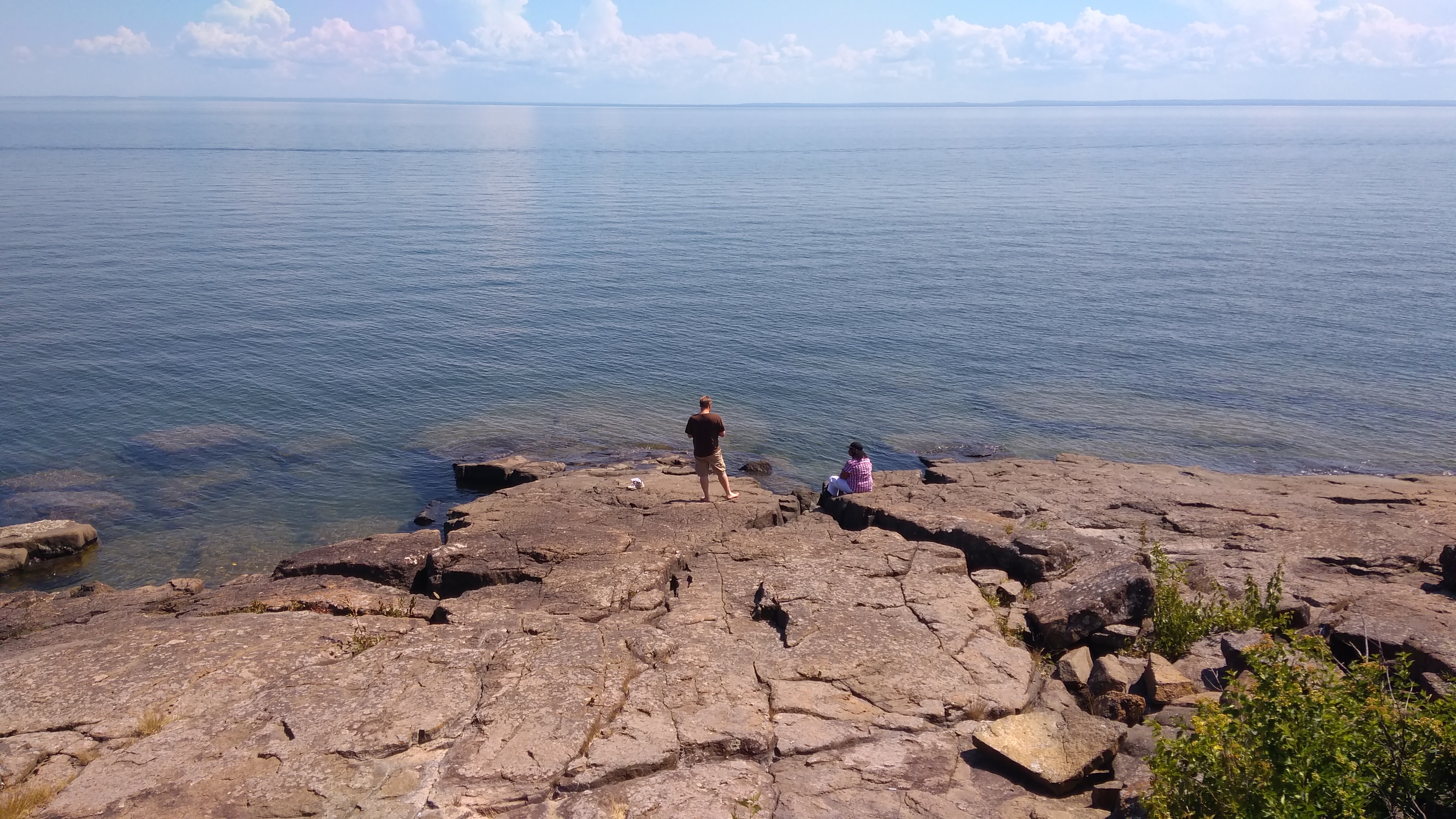
The park is a world of wooded islands and peninsulas but mostly lakes, including the sizable Rainy and Kabetogama lakes. So I figured only reasonable that the thing to do was take a boat tour.

The park itself offers a number of options, including one that’s six hours long, which didn’t interest me greatly, and one in small boats you paddle to evoke the transits of those hearty voyageurs of old, though I bet modern participants smell better than authentic voyageurs. That didn’t really pique my interest either.

So we took a two-and-a-half hour jaunt out on Rainy Lake, at the park’s western edge, accessed by driving a few miles east of the border town of International Falls, Minn. We boarded the good tourist ship Voyageur and off we went.
Along the way, our guide — Ranger Adam — pointed out various aspects of natural and human history in the land we cruised by, such as a number of eagles and eagle nests perched on tall trees, evidence of beavers at work, the sparse ruins of an 1890s settlement called Rainy Lake City, and a former fishing camp that petered out in the 1950s.

We stopped at one small island: Little American Island, which was added to the park only in 1989. Gold mining had occurred there briefly nearly 100 years earlier. These days, short footpaths take visitors to the few relics of the gold mining days.
Ranger Adam went with us to explain things and point stuff out, such as the hole in the ground left over from the gold mine and a few rusty mining machine parts.

“The Little American Mine operated from 1893 to 1898,” says Forgotten Minnesota. “The average value of the gold extracted during that time was $30 per ton, which represented a profit of around $12 per ton.

“The Little American is the only gold mine in Minnesota known to have produced a profit. The impact of the mine was felt primarily in Rainy Lake City. After the mine closed, Rainy Lake City slowly disappeared and was considered a ghost town by 1901.

“Although the mine was productive, a large vein of rich gold was never found to kick off a gold rush to rival those in California. Oddly enough, the influence of the Little American Mine on the mining industry occurred in Canada, where the large veins of gold were finally found.

“Remnants of the mine can still be found under years of overgrown brush and pine trees. Two major excavations from the Little American Mine are still visible on the island: a vertical, cribbed shaft and an entrance to a horizontal shaft. Both are filled with debris and water.”

Little American Island aside, the tour was mostly a relaxing few hours on the water. Though it was fairly warm — maybe 85 F and partly cloudy — as we chugged along the breeze kept things fairly comfortable.

One oddity: out on the lake, I felt my phone buzz in my pocket. I didn’t really want to have anything to do with it while on the lake, but I was surprised there was service at all. I glanced at the phone and the screen said, Welcome to Canada! Then it offered details about how I needed pay extra to call from within Canada.

I’m pretty sure we hadn’t crossed into Canadian waters, since a NPS tour is probably going to be precise about that kind of thing. But we were close. The nearest cell tower must have been on private land in Canada, so the phone, dense device that it is, figured we were there.

The Aerial Lift Bridge

There’s a large sand bar between St. Louis Bay and Lake Superior that runs a long way southeast from downtown Duluth, and east of the city of Superior, Wis. Only seven miles southeast from Duluth does the bay finally meet Lake Superior via a natural channel.

Once Duluth was a going concern, its city fathers decided that that arrangement would never do, since it slowed shipping down, the only thing that made Duluth a going concern in the first place. So the city dug the Duluth Ship Canal through the spit in the early 1870s, opening up St. Louis Bay to Lake Superior, conveniently at the city’s waterfront.

Eventually, a bridge across the canal was deemed necessary too. So what we now call the Aerial Lift Bridge opened for traffic in 1905. It’s an impressive work of steel from a distance.
As well as from closer up.

Even more, standing underneath one of its tall towers. Definitely a grand relic of the Machine Age.

The lower level of the bridge is a roadway. When ships need to pass under the bridge, the lower level is raised about 135 feet, after traffic has cleared off, of course. We stood below and watched the process. This is the lower level before rising.

This is the lower level in its raised position.

When the Aerial Lift Bridge was built, it was an oddity known as a transporter bridge. Instead of raising the road, passengers and vehicles crossed in what were essentially large gondolas. That was impractical in the long run, so by 1930 the bridge had been converted into its current form.

There’s some tourist infrastructure in the shadow of the bridge. Warehouses and other old buildings have been redeveloped in recent years into a retail-restaurant-attraction district known as Canal Park, which is north of the bridge and adjacent to downtown Duluth. Reminded me some of Navy Pier in Chicago, though Canal Park is shorter and not as crowded.

We took a walk out to one of the lighthouses at the end of the canal, the Duluth North Pier Lighthouse.

At water’s edge near the canal, we watched a remarkably skilled stone-skipper, a kid of maybe 12. He was skipping stones across the water six or seven or eight or more times that I could count, one stone after another after another. Here he is, in black, looking for more stones.

The kid had the wrist action for it. If there’s such a thing as pro stone-skipping — and for all I know, there is, since we live in a world where people are pro video gamers — I bet he could go pro.

The Briscoe Western Art Museum

On Tuesdays, the Briscoe Western Art Museum in downtown San Antonio — in full, the Dolph and Janey Briscoe Western Art Museum — offers free admission from 4 to 9 p.m., so after wrapping up my work that day last week, I decided to visit within that window of discount opportunity. It’s still a fairly new museum, open only since 2013, so I’d never been.

The building, which is on W. Market St., is not new. It was the main city library from 1930 to 1968, so I don’t remember it as that, though my mother and grandparents would have known it.

The lobby is striking. This image was taken before the installation of a reception desk toward the back, and a large bronze, John Coleman’s “Visions of Change.” A lot of restoration apparently went into bringing the interior roughly back to its library-era look.

For some decades after the library moved, the building housed the Hertzberg Circus Collection, an enormous array of circus artifacts that the library used to own. That I remember. Vaguely. I know I went once as a kid. Around the beginning of the 21st century, the Witte Museum acquired the collection and plans were laid for the current museum.

Something like the Eiteljorg Museum in Indianapolis, the Briscoe focuses on art from both the Indian and non-Indian populations of the West, but it also has a lot of artifacts. In nine galleries on three levels, that includes paintings, sculptures, guns and other weapons, such as a fancy sword owned by Santa Anna, saddles — Pancho Villa’s and Roy Rogers’ — jewelry, Mexican santos and retablos, a chuck wagon, a replica stage coach, and a collection of spurs that takes up an entire wall.

There are some Texas touches, such as a windmill in motion. Other Western states have them, but windmills have a special place in the history of Texas.

There’s a de facto shrine to Dolf and Janey Briscoe in the form of Dolf’s desk and some other items. As you’d expect, the Briscoes donated art and ponied up money to make the museum possible.
Good old Dolf. I think of him as a mellow governor, as befitting his ’70s time in office. I’m sure that’s nonsense, though: you don’t get to be a successful politico, much less governor of a large state, by being mellow. Not even if you start out as one of the richest men in the state. Rich in a traditional Texas way, too: a vast ranching operation. None of this microchip or cyber-fortune wealth for Dolf (well, maybe he branched into all that before he died in 2010).

My own favorite item in the museum: a large diorama behind glass walls depicting the storming of the Alamo. Carelessly, I didn’t check to see who created it, though it might be the work of one Tom Feeley. The museum’s web site is unhelpful in telling me. But whoever it was did a first-rate job.

The diorama includes all of the walls standing at the time of the siege, plus the buildings, and thousands of two- or so inch figures — armed Mexicans and Texians, horses, cannons — all done with incredible attention to detail. It captures the moment when the defenders, surrounded on all four sides by masses of Mexican soldiers, are about to be overwhelmed; but they’re still fighting.

Headphones are attached to a low wall below the glass, and you can listen to short items about various participants in the battle — the big three of Travis, Crockett and Bowie, of course, but also Susanna Dickinson, Joe (Travis’ slave), Gen. Cos and Santa Anna.

Near the diorama is a life-sized bronze of Travis, “Col. Travis — The Line” by James Muir, who specializes in heroic and allegorical work. That is, it depicts Travis drawing his famed line in the sand. A se non è vero, è ben trovato sort of story if there ever was one.

The artists in the museum’s temporary exhibit were a little unexpected: Andy Warhol and Billy Schenck. The Warhol part of the exhibit is very late Warhol (he died the next year): his 1986 Cowboys & Indians series. The artist gave his colorful and instantly recognizable treatment to the likes of John Wayne, Annie Oakley, George Custer, Geronimo and TR, among others.

Warhol might have been at risk, in earlier decades, of being a hopelessly dated artist, one whose reputation is forever stuck in the 1960s. Somehow he seems to have avoided that.

I’m less familar with Billy Schenck, who, unlike Warhol, is still alive and working. He’s “Warhol of the West,” according to the museum, and there are some similarities, especially in his generous displays of color. On the whole, he’s a match for Warhol. His work on exhibit at the Briscoe includes a number of the pieces in the slideshow at his web site.

South Texas, Summer ’18: The King William District in July

Just back from eight days in San Antonio. Most of the time I visited with family or worked, since my kind of work is mobile. Also, temps in the high 90s and sometimes over 100 degrees F. discouraged me from too much wandering around during the day.

Even so, last Sunday toward the late afternoon I drove down to the King William District, which is leafy this time of year and so not quite unbearably hot, and took a few short walks.

“The district encompasses land that was once irrigated farm land belonging to the Mission San Antonio de Valero, commonly known as the Alamo,” the City of San Antonio says. “When the mission was secularized in 1793, the lands were divided among the resident Indian families from the mission or sold at public auction. In the 1860s the area was subdivided into lots and laid out with the present streets.

“In the mid-nineteenth century… a great many Germans, who had immigrated to Texas in the 1840s, began to settle in this area… The area developed into an idyllic neighborhood of large, impressive houses designed in the Greek Revival, Victorian, and Italianate styles.

“The main street into the neighborhood was given the name King William in honor of King Wilhelm I, King of Prussia in the 1870s. During World War I, when America was at war with Germany, the name was changed to Pershing Avenue. A few years after the war ended the King William name was restored.”

These days there’s a Pershing Ave. in San Antonio, but it’s further north, fittingly not far from Fort Sam Houston. By the mid-20th century, the King William District was run down. By the late 20th century, restoration was under way.

One of my short walks took me along King William St., which is an important street in the district, but hardly the only one. The array of houses made me think of the East End Historic District in Galveston. In King William, there are large and historic houses such as the Villa Finale.
The Steves Homested. One of these days, I’ll take the tour.Edward Steves was a successful businessman in lumber in San Antonio in the 19th century, and Steves & Sons, which makes doors, is still around. I went to high school with a girl who was descended from Steves on her mother’s side.

There are plenty of other large and not-so-large houses on the street, most of which are worth a look.
That last one is the Alfred Giles House. One the architect of that name designed for himself. He’s thought to have done the Steves Homestead, and he certainly designed a lot of buildings in Texas, including some county courthouses (such for Goliad County and Presidio County) and even some in Monterrey, Mexico.

The Hegeler Carus Mansion

Back to posting on July 8. A good Independence Day to all.

Before we went to Streator to see the Walldog murals, we visited LaSalle, Illinois. Like Streator, LaSalle is in LaSalle County, though it isn’t the county seat either — Ottawa is. Unlike Streator, LaSalle is on an Interstate. On two of them, in fact, at the junction of I-80 and I-39.

Those roads were still far in the future when a German, Edward C. Hegeler, came to LaSalle in the late 1850s. Before long he and his partner Frederick William Matthiessen, another German, were American zinc barons whose fortunes were made during the Civil War.

Why LaSalle? It was near coal deposits and the Illinois & Michigan Canal, besides a rail connection to Chicago. Smelting zinc required a lot of coal in those days. Zinc was to be had in southern Wisconsin. Cheaper to bring the zinc to Illinois than the coal to Wisconsin, I suppose.

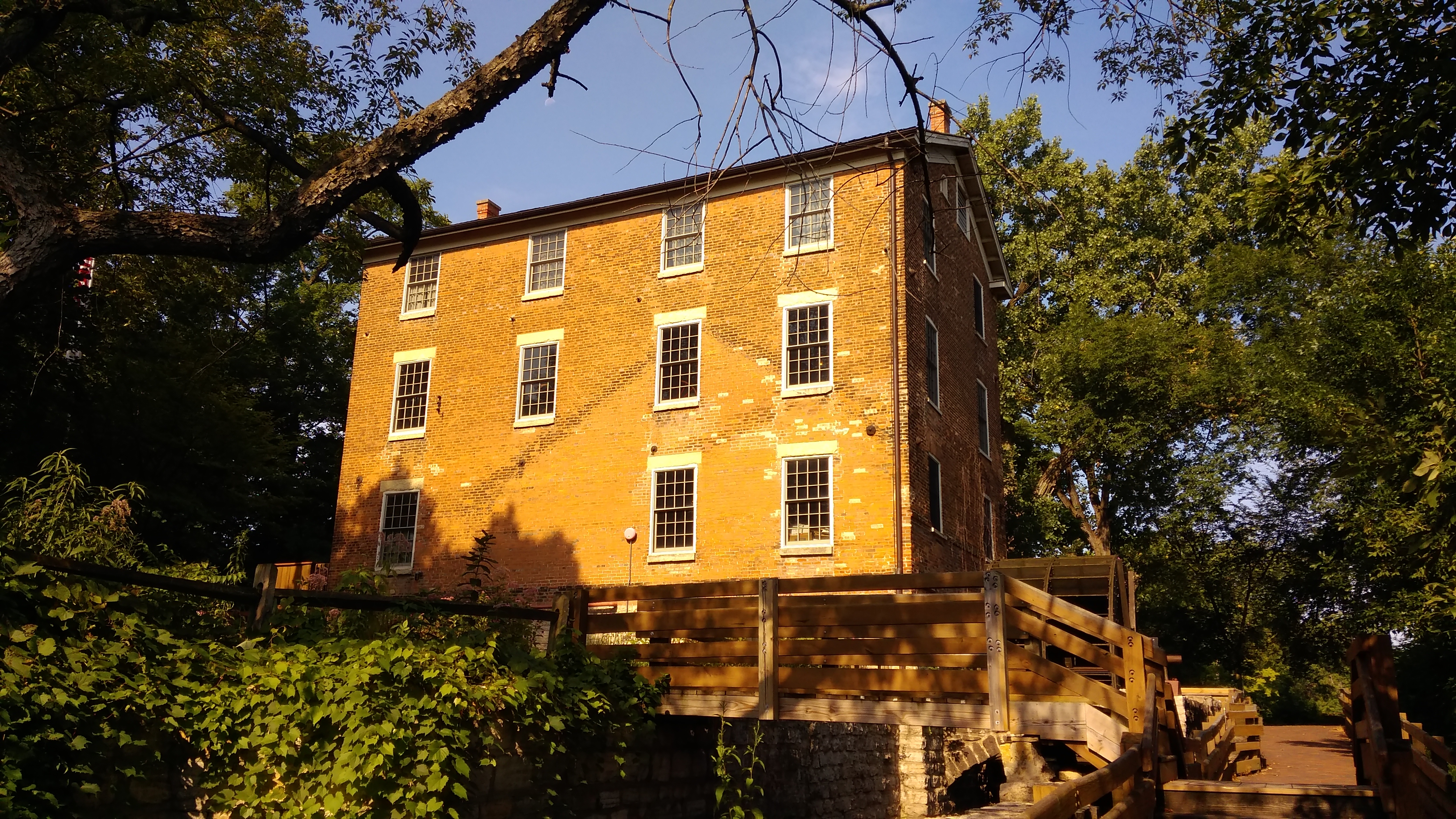
As propertied men of the Gilded Age often did, Hegeler had a mansion built for himself and his large brood. In our time, it’s the Hegeler Carus Mansion, completed in 1876 in that Second Empire style we associate with eerie residences because of the drawings of Charles Addams.
William W. Boyington designed the house. He’s better known for the Chicago Water Tower, but he also did the Joliet State Pen and the current Illinois State Capitol.

The Carus in the name is after Hegeler’s son-in-law, Paul Carus, who wasn’t a zinc baron. He was a scholar, eventually running Open Court Publishing Co., which was founded by old man Hegeler, who clearly didn’t have a one-track zinc-oriented mind. Open Court published — publishes, it’s still around — titles in philosophy, science, and religion.

We took the 3 p.m. tour of the Hegeler Carus Mansion on Saturday, partly as something to do during the hotest part of a hot day. The house doesn’t have central AC, but thick walls and wall units and fans made it tolerable inside.

A third-generation member of the Hegeler-Carus clan lived in the house until 2004, when he died aged more than 100. Now a foundation owns the place, and it’s doing the slow work of restoring the mansion. A few rooms are finished, complete with high Victorian furniture and wall and floor decor — there are some elaborately styled floors in this house — and many, many books.

“The elaborate interior decoration of the Hegeler Carus mansion is the work of August Fiedler, a talented German-American who excelled in interior design and furniture making,” says The Story of a House. “Although he designed many interiors in Chicago and elsewhere, most have been lost, leaving the Hegeler Carus as the largest and most intact surviving example of his work.”

Most of the rooms aren’t finished yet. Still, the flavor of the place is distinct. A historic property doesn’t have to be a House Beautiful specimen to be enjoyable.

Murals & Milestones in Streator

Early in June, when we were visiting Arcola, Illinois, I noticed that the town sported more murals than it did during our 2007 visit. In fact, I didn’t remember any from that time. That’s because in 2012, Walldogs came to town and painted the murals.

I found that out by looking at Arcola’s web site, which mentioned the Walldogs, and then I looked them up. “The Walldogs are a group of highly skilled sign painters and mural artists from all over the globe…” the group’s web site says.

“Once a year, hundreds of Walldogs gather in one lucky town or city to paint multiple murals and old-fashioned wall advertisements. This meet – or festival – is usually held during the span of 4 or 5 days ending on a Sunday.”

More about the group was published recently by The Times, the area’s local paper.

While reading about the group, I noticed that the next Walldogs event was going to be in Streator, Illinois at the end of June. I knew right away that I wanted to go to Streator during the event, and that is what we did on Saturday. Since it was nearly 100 degrees F. during the early afternoon, we timed the visit so we didn’t get there until around 5:30 in the afternoon, when things had cooled off to around 90 or so, and it was easier to find shade.

Streator was glad to get the Walldogs, at least to judge by signs like this, placed in the window of a resale shop.

This is a mural to commemorate the event itself. It notes that this year is the 150th anniversary of Streator, the 200th anniversary of Illinois entering the Union, and 25 years of Walldogs events.
We’d been to Streator once before, but only for a short visit in 2005 that absolutely no one but me remembered.

I wrote in a previous BTST: “Illinois 18 took us exclusively through flatlands, once the Illinois River valley was behind us, and on to Streator. Streator’s one of those towns that the Interstate system has completely bypassed. It didn’t seem any worse for it, though, with all the usual features of rural Illinois county seats [sic]: a small downtown, a district of fine-trim houses, a trailer park or two, parks, schools, a police station, firehouse, and library with a historic marker out front dedicated to the discoverer of Pluto.”

I stopped to read the sign, but didn’t even get out of the car. That was all I did in Streator. This time around, I knew that Clyde Tombaugh was going to get his own prominent Walldog mural in Streator, and sure enough, that was one of the first of the spanking-new murals we saw when we got to town.

So new, in fact, that the artists were still working on it.
Just before we left, however, the mural was visible for all to see.

It did me good to know that Streator hasn’t forgotten its favorite astronomical son, a lad from the Midwest who discovered a whole planet. I bet Pluto isn’t anything but a planet to the good people of Streator. Me either.

Murals tend to be stylized, and so Tombaugh’s a stylized astronomer, looking through an eyepiece. Even in the 1920s and ’30s, I don’t think professional astronomers did that very much. After all, Tombaugh discovered Pluto by the tedious task of comparing photographic plates by eye, something that computers certainly do now.

Nearby were other walls with other brand-new murals, such as WWII Canteen.

They too are stylized, but supposedly there’s a story behind the couple on the wall. I didn’t get the details

Here’s Edward Plumb, a film composer who worked for Disney back when Walt himself was in charge, and who happened to be a grandson of the cofounder of Streator, Col. Ralph Plumb.

I noticed that Plumb’s mural is on the side of the boarded up Majestic Theater. No doubt once upon a time, you could hear his scores there as Disney movies played at the Majestic.

On this wall in the afternoon sun are Col. Plumb and Worthy Streator, town founders, along with the miners who came to dig coal in Streator’s early days, and a canary.

Some of the murals were being painted on aluminum panels fixed to temporary wooden scaffolding. The panels, I was told by a fellow who may or may not have been with the event, would be attached to walls later. Walls maybe not otherwise suitable for taking paint directly.

One honored native son was Clarence Mulford, creator of Hopalong Cassidy.

I’d say that Hopalong Cassidy is pretty much the definition of a forgotten figure from fiction. Even when I was growing up, he was little more than a vague Western character with an odd name.

Another forgotten name, though not from fiction: Calbraith Rodgers.
Rodgers had his moment in the public eye in 1911, when he flew the Vin Fiz Flyer, a Wright Brothers machine, coast-to-coast over the course of about three months. Vin Fiz was a soft drink, in case anyone thinks product sponsorship is a new thing.

According to Wiki: “The support team rode on a three-car train called the Vin Fiz Special, and included Charlie Taylor, the Wright brothers’ bicycle shop and aircraft mechanic, who built their first and later engines and knew every detail of Wright airplane construction; Rodgers’ wife Mabel; his mother; reporters; and employees of Armour and Vin Fiz.”

There’s a movie comedy in that story. Or there was, back in the 1960s, when the likes of The Great Race and Those Magnificent Men in Their Flying Machines were made.

Rodgers might have reached further heights of aviation fame, but he died in a crash soon after his transcontinental flight. In fact, according to the International Bird Strike Committee, he was the first person to die because his airplane struck a bird: “The first fatal bird strike accident was in 1912 at Long Beach in California, when a gull (Larus sp.) lodged in the flying controls of a Wright Flyer, killing Cal Rodgers.”

A mural honoring Engine No. 34 of the obscure Streator & Clinton RR.

Here are the Howe brothers, Orion and Lyston.
They were drummer boys from Streator with the 55th Regiment Illinois Volunteer Infantry. Lyston has the distinction of being the youngest known drummer boy in the war, and Orion received the Medal of Honor for his conduct at Vicksburg.

The lads have a memorial in the park, not far from where their mural was painted.
The citation for Orion says: “A drummer boy, 14 years of age, and severely wounded and exposed to a heavy fire from the enemy, he persistently remained upon the field of battle until he had reported to Gen. W. T. Sherman the necessity of supplying cartridges for the use of troops under command of Colonel Malmborg.”

A Day in Malacca

July 5, 1992.

Up fairly early and went to Bukit China, which sports a massive hillside cemetery populated by Malaysian Chinese. The graves have peculiar, horseshoe-shaped walls surrounding small areas dug out of the side of the hill; the gravestones themselves are in the dugout. Some look new, others neglected.

A long walk then took me to (1) the Dutch Cemetery, which contained mostly British graves and (2) the Dutch Church, which is Anglican — and there was a service going on in Cantonese, I think. I sat in a while.

Had lunch at Kim Swee Huat, not bad fried noodles, sweet and sour pork, and a great fruit lasi. On the way to lunch I saw a Chinese funeral procession pass by on the street.

[Wish I’d added a little more detail about that, but I did take a picture in which the procession is barely visible.]
[As well as some pictures of the streets of Malacca. Including an example of baking fusion of some kind.]
From lunch I went back up to Bukit St. Paul (St. Paul Hill). [Bukit St. Paul features the ruins of St. Paul’s Church, among other things. A church structure of one kind or another has been on the site since shortly after the Portuguese conquest of Malacca more than 500 years ago.]

Afterwards I visited the Muzium Budaya, the Cultural Museum. The wooden building is a marvel of its kind, and the displays interesting.

[Again with an abbreviated description. Per Wiki, “the building is a modern reconstruction of the palace of the Melaka Sultanate. It showcases the history of the region.]

Afterwards, I went back to my room to cool down, though stopping at a bookstore I discovered along the way, where I bought The Roman Games by Roland Auguet.

Around sunset, I sought out dinner, and had a remarkable one at Sri Lakshmi Vilas [even more remarkable, it may still be open], a south Indian daun pisang. That means banana leaves, the “plates” on which the food is served.

I had mutton and fish and rice and veggies on a banana leaf that I ate with my fingers, which is the way to do it. Not the best Indian food I’ve ever had, but pretty good, and certainly the most interesting presentation. Even better, it cost M$5.30, or a little more than $2.

After eating, I took a walk through old Malacca. The Kampong Kling Mosque wasn’t open to me, but light and noise were pouring from the open windows of one of the side structures, which I figured might be an attached school. Some rambunctious kids were inside.

Nearby, I saw the Sri Poyatha Moorthi temple and the Cheng Hoon Teng temple. At Cheng Hoon Teng, a large ceremony of some kind was going on, with a lot of chanting. I watched for a while. No one paid the slightest bit of attention to me.

Last Thursday in June Olla Podrida

A few days ago, when it was cloudy and cool, I happened to be at the Schaumburg Town Center. The place has an underappreciated garden. Underappreciated by me, anyway.Since then, genuine summer has returned in the form of warmer temps. High 90s are forecast for the weekend. It’s been a rainy summer so far, though.

One detail I forgot to mention about the Lincoln Museum. Ann said she was most amused by learning that in his youth, the president was a talented ax-thrower. I was amused too. They took entertainment where they could get it in the 19th century.

One more picture from the Lincoln Museum. Don’t recognize them? On Jeopardy, the clue would be “Maj. Henry Rathbone and Clara Harris.”

The question: Which couple was in the presidential box with the Lincolns at Ford’s Theatre?

Their story is as sad as that of the Lincolns, or even worse. Rathbone later married Harris, but his mental health deteriorated in the following years, and he eventually murdered her. He died in 1911 in an insane asylum.

Saw this not long ago in Chicago, on Irving Park Blvd.
A bust of Jose P. Rizal, ophthalmologist and martyred Philippine nationalist. How many ophthalmologists get to be national heroes as well? I can’t think of any others.

The Lincoln Tomb State Historic Site

We couldn’t very well leave Springfield Saturday before last without visiting Lincoln’s Tomb in Oak Ridge Cemetery, or in full the Lincoln Tomb State Historic Site. It’s one of those places that I’ve visited every decade or so since the 1980s. The last time was in 2010.

We arrived just after the interior closed, at 5 p.m., so we only took a look at the exterior. And only for a little while, since even at that hour, temps were still about 90 degrees F.

The tomb looked precisely the same as all the other times. Timeless, it is, at least in our lifetimes.

Larkin Mead designed the tomb. Ringing the obelisk are bronze groups he did: the Infantry Group, 1874–76; the Naval Group, 1874–77; the Artillery Group, 1882; and the Cavalry Group, 1883. I made point of making a circuit around the tomb to look at them, but since the stairs up to their level were roped off, I didn’t get that close.

We did get close to the Gutzon Borglum’s head of Lincoln.
This time, Ann could reach it herself. I seem to recall lifting her up to touch the nose back in ’10.

The Old Illinois State Capitol, Springfield

Before we revisited the Lincoln Museum in Springfield, we revisited the Old State Capitol. At least I revisited it. I’m not sure whether I’d ever taken Ann, or whether her friend had ever been there at any point. Never mind, it was worth a look.
In the background from that vantage is the larger dome of the modern capitol, on which construction started in 1868. Didn’t visit there this time around.

More formally, the old capitol is the Old State Capitol State Historic Site, a Greek Revival structure that served as the state house from 1839 to 1876, so it was the one Lincoln would have hung around. In fact, as a state legislator, Lincoln was among the legislators who facilitated the movement of the capital from Vandalia, which is further south.

“In the Legislature at Vandalia in the session of 1836-7, Sangamon county was represented by two senators and seven members of the lower house,” says ‘The Story of the Sangamon County Court House,’ a 1901 monograph by H.D. Giger. “They were a singular body of men, all tall and angular and their combined height was exactly 54 feet, they are famous in Illinois history as the ‘Long Nine.’

“The capitol of the State at this time was at Vandalia, having been removed there from Kaskaskia, and as the tide of emigration was moving northward it was conceded that the capitol must be nearer the center of population; although Vandalia and Southern Illinois fought hard against it.

“From the beginning of the session the Long Nine set to work log rolling. They asked for no public improvements; they wanted no railroads, canals, no plank roads, but would help out any member that did want them for his district, if he would vote to remove the capital to Springfield.

“There were many applicants, and on the first ballot Springfield had but 35 out of 121 votes… Poor old Peoria, as usual, brought up the rear and Springfield captured the prize on the fourth ballot.”

Abraham Lincoln Online picks up the story: “The capitol building, designed by architect John Rague, was the third to appear on the square, replacing two previous courthouses.” (Rague also did the old Iowa capitol.)

“The [state] outgrew the building during Lincoln’s presidency, and work on a new statehouse began soon after his death. The present building was dismantled in 1966 and rebuilt, which allowed the inclusion of an underground public parking lot and space for offices. The original stone exterior was stored and rebuilt, but the interior was completely reconstructed.”

It’s a well-done reconstruction.

The exhibits include a statue of the Little Giant.
While we were there, a group of historic re-enactors in 19th-century costumes happened to be in the recreated House chamber.
They gave a lively 20-minute or so performance, recalling the lives of black Illinois citizens of the Civil War era.