The Last Gasp of the Federal Works Agency

Not something you see everyday: a plaque marking a project by the Federal Works Agency. But there it was last weekend for me to see, at the Chicago subway station of the CTA Blue Line (O’Hare-Forest Park).

Federal Works Agency plaque, Chicago StationThe Federal Works Agency only lasted until 1949, but it’s a safe assumption that the subway construction project started under its aegis in the late ’40s, so it was thought fitting to use the name even in 1950. The agency had been created as a part of a major federal government reorganization in 1939, authorized by Congress and overseen by the executive branch.

To quote President Roosevelt, in his message to Congress on the Reorganization Act of 1939: “[The FWA will include] the Bureau of Public Roads, now in the Department of Agriculture; the Public Buildings Branch of the Procurement Division, now in the Treasury Department, and the Branch of Buildings Management of the National Park Service… now in the Department of the Interior; the United States Housing Authority, now in the Department of the Interior; the Federal Emergency Administration of Public Works; and the Works Progress Administration, except the functions of the National Youth Administration.”

Various additions and subtractions were made to that list until 1949, when the FWA’s remaining functions were parceled out to other agencies, as well as the newly created General Services Administration. As federal bureaucracies go, the FWA had a fruit-fly lifespan.

With a 10-year run, there couldn’t be that many FWA plaques. Certainly not as many as the GSA — nearly 70 years now — or even the WPA or the CCC, which also had short runs, but were really busy in their heydays. So maybe in the hobby of plaque-spotting the FWA is a nice find.

If there is such a hobby. Surely someone looks for plaques in a more enthusiastic or systematic way than I do. And is Blue Plaque-spotting a thing in the UK, or does this Spectator article merely refer to casually walking by them?

The Driehaus Museum

A fine Solstice. Clear and not particularly hot, followed by a short cool night.

The least plutocrats can do for posterity is build lavish, highly aesthetic houses that, decades or even centuries later, are restored and open to the public in one way or another. I suspect modern magnates, business tycoons, and captains of industry are mostly failing in this regard.

Late 19th-century and early 20th-century plutocrats, on the other hand, did not shrink from their duty along these lines. They might have imagined they were celebrating their worldly success in a highly visible way, and maybe they were, but sic transit gloria mundi. Beyond their own time and concerns, they were leaving something for later hoi polloi to ogle.

I will give Richard Dreihaus his due, however. I’m not sure he counts as a plutocrat, but he is a wealthy fund manager of our time. He might not have built a lavish house — or maybe it’s still private — but in any case, he managed to restore the Samuel M. Nickerson House at 40 E. Erie St. on the Near North Side of Chicago to its Gilded Age glory.

Now it stands, stocked with fine art and objets d’art, for the hoi polloi to see (for a fee). Hoi polloi such as Yuriko and I on Sunday afternoon, when we visited the Richard H. Driehaus Museum, which occupies the Nickerson House.

Richard H. Driehaus Museum

Chicago magazine in 2007 on the philanthropist: “Driehaus, the founder of Driehaus Capital Management… is no ordinary preservationist. He is a man who can afford to indulge his passions — for art, for parties, but mainly for restoring historic architecture — on a boundless scale, as anyone who has visited his many residences and offices around the world can attest.

“In the past two decades, Driehaus has emerged as one of Chicago’s most prominent advocates for historic preservation. He has also taken a leading role in encouraging the city and public institutions and groups to adopt a more design-centered approach to civic projects.”

Driehaus bought the building at 40 E. Erie St. in the early 2000s, when it was being used as an art gallery, and spent a good deal restoring it, including cleaning the exterior, which I’ve read was black from a century-plus of pollution. Considering its location on Erie, I’m sure that I walked and rode by the building any number of times in the 1980s and ’90s — and took exactly no note of it.

Since 2011, it’s been open to the public as the Driehaus Museum. I still took no note of it until last year, when I was walking by and saw its sign. Museum? This is a museum? Since when? Even in the Internet age, it’s hard to keep track of things.

Samuel M. Nickerson was a successful banker in early Chicago who tasked Edward J. Burling of the firm of Burling and Whitehouse to build him a mansion, which was completed in 1883. Burling had a long career in Chicago, with many of his buildings destroyed by the Fire.

The Nickerson House rooms feature 17 types of marble, along with onyx, alabaster, carved and inlaid wood, glazed and patterned tiles, mosaics, and Lincrusta, which was brand-new to the United States at the time. During Nickerson’s time, the place was replete with his and his wife Mathilda’s artwork, later donated to the Art Institute. Driehaus not only restored the house to its Gilded Age look, after years as office space and other uses, but made it into museum space for his collection of art from the period.

The museum says: “When the Driehaus Collection was formed during the early 1970s, acquisitions focused primarily on Art Nouveau posters by Alphonse Mucha and his contemporaries. From that essential core, the collection has grown to include master works of design by such Belle Epoque luminaries as Louis Majorelle, the Herter Brothers, Édouard Colonna, John La Farge, Emile Gallé, and Josef Hoffmann. In addition to these important holdings, the Driehaus Collection is one of the country’s leading private collections of works by preeminent American decorative designer Louis Comfort Tiffany.”

The lighting was good for looking, less so for non-flash photography. I got a few half-decent images, mostly of some of the artwork or room details, but not the rooms.

Richard H. Driehaus MuseumRichard H. Driehaus MuseumRichard H. Driehaus MuseumThat statue is in the Gallery Room. Always good to have a reminder of the Psyche and Eros story around. I especially liked the fireplace behind it.

Richard H. Driehaus MuseumThe fireplace was put in by the second owner of the house, paper baron Lucius Fisher. He also had the distinction of commissioning Daniel Burnham to do the excellent Fisher Building, which still stands in the South Loop.

The fire surround, dating from 1901, was by Giannini & Hilgart, done in lacquered cherry and iridescent glass. Remarkably, traces of that operation remain on line. The studio also did the striking glass dome in the same room as the fireplace. Looks like Tiffany, but no.

Whatever else you can say about the Gilded Age, its aesthetics were first-rate, if you had the scratch for that kind of thing. A better look at the interior is this WTTW production, but even so it’s a pale substitute for being there.

Wicker Park, The Neighborhood & Wicker Park, The Park

Juneteenth has come around again. We need more holidays in the summer, and that would be a good one, celebrating human freedom.

We went to the city on Sunday, giving me an opportunity to wander around Wicker Park on a warm but not too hot day. I visited both places of that name. Wicker Park’s both a fashionable area — which it was not 30 years ago, when I first lived in Chicago — and the name of a smallish triangular park within the neighborhood.

The intersection of North, Damen and Milwaukee is part of the neighborhood, but I didn’t hang around there much this time. Instead, I walked along some of the side streets. Much of the residential North Side of Chicago looks like this in June.
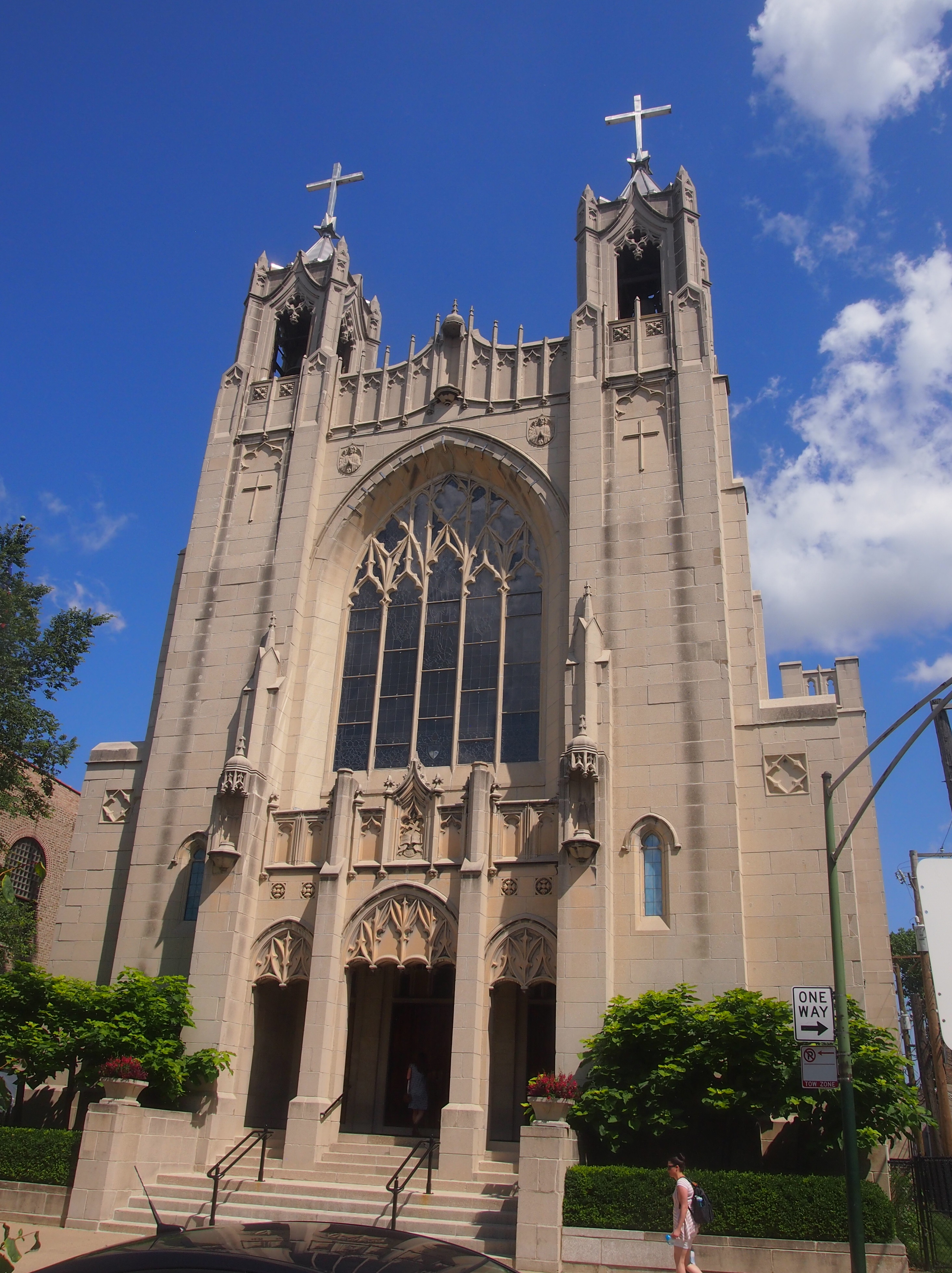
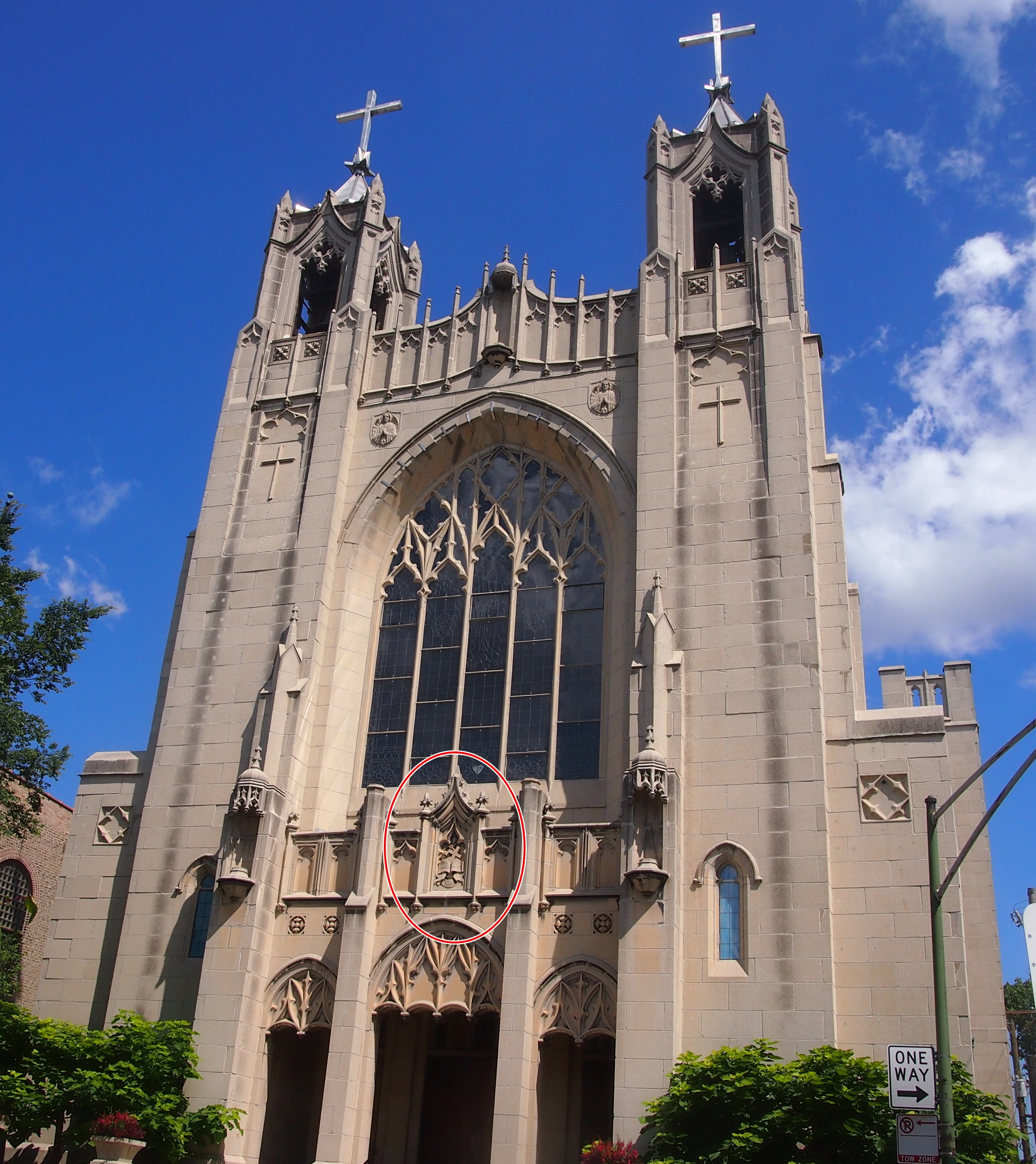
Wicker Park June 2017The handsome Wicker Park Lutheran Church is at 1502 N. Hoyne Ave.
Wicker Park Lutheran ChurchIt was already closed by the time I got there, but the interior looks like this.

The building dates from 1906, though the congregation goes back to 1879. “It boasts a basilica design, with double colonnades and an apse, a style used in ancient Rome for courts of law or places of public assembly,” notes the church web site. “The two towers are based on those of Abbey of Sainte-Trinité (the Holy Trinity), also known as Abbaye aux Dames, in Caen, France, which was built in the 11th century.”

A few blocks to the east is Wicker Park, the park. It isn’t one of Chicago’s great parks, but it is pleasant on a warm summer Sunday, well stocked with people and their dogs enjoying the warm summer Sunday. The park has some trees, a lush garden sporting flowers and bushes, a field house, a modest water fountain, and some open lawn.

There’s also a statue of Charles Gustavus Wicker (1820-1889), complete with stovepipe hat, heavy coat and broom. It’s been in the park since 2006.
Charles G. Wicker Statue, ChicagoCharles G. Wicker Statue, ChicagoThere’s a plaque at the feet of Wicker that asserts that he was an important figure in the development of this part of Chicago. In fact, it’s a lot like a press release in bronze, this plaque. A sample: “The broom symbolizes his initiative and readiness to take personal responsibility. He, and people like him, established Chicago, where all who truly do their best will continue to make this unique community a place of opportunity with justice, freedom, and equality for everyone.”

About Charles and his brother Joel Wicker, the Chicago Park District says: “In 1870, when businessmen and developers Charles G. and Joel H. Wicker began constructing drainage ditches and laying out streets in their subdivision, they donated a four-acre parcel of land to the city to be used as a public park.

“Fencing the triangular site to keep cows out, the city created an artificial lake in the center of the park, surrounding it with lawn and trees. As the Wickers had hoped, the area developed into a fashionable middle- and upper-class neighborhood.”

Further discussion of Wicker and his brother is at the Chicagoist. A few years ago, the statue fell down — was knocked down — tumbled down somehow, and there’s a story about that as well. The statue was restored, of course. Oddly enough, the sculptor who created the statue of Wicker, and pushed for it to be in the park, was a great-granddaughter of his, one Nancy Wicker, who died just last year at over 90.

In one corner of the park, a troupe called Theatre-Hikes was doing a low-budget version of A Midsummer Night’s Dream. No sets, just costumes. I sat down for a few minutes to watch. I’m no expert on the play — in fact, this is the only live performance I’ve seen of any of it — but I was able (later) to pin down that I’d arrived during Act 3, Scene 1.

Here’s Bottom.

Theatre-Hikes, Wicker Park

Titania and Bottom. Both actors were good, and able to ham it up when the play called for it, to the amusement of all.

Theatre-Hikes, Wicker Park 2017

Titania:
Be kind and courteous to this gentleman.
Hop in his walks and gambol in his eyes.
Feed him with apricoks and dewberries,
With purple grapes, green figs, and mulberries.
The honey bags steal from the humble-bees,
And for night tapers crop their waxen thighs
And light them at the fiery glowworms’ eyes
To have my love to bed and to arise.

Flag Day, Such As It Is

It occurred to me today, before I went out on some errands and for no particular reason, that it was Flag Day. So I decided to take note driving along whether there seemed to be more American flags than usual flying in my slice of the northwestern suburbs. The answer: not that I could tell.

Adam Goodheart, writing in 2011 in the former NYT blog Disunion, wrote about the origin of the day, which falls on the anniversary of the adoption of the flag by the Second Continental Congress: “It was destined, eventually, to become the runty stepchild among American national holidays. One hundred and fifty years after its original creation, no one ever hosts a Flag Day cookout or sends a Flag Day greeting card. Nobody gets to take a long weekend from the office. Even the most customer-hungry car dealers don’t advertise Flag Day sales.

“…exactly 150 years ago after it was first celebrated [in Hartford, Conn.], almost no one seems to have noticed the anniversary. Google searches for ‘sesquicentennial of Flag Day’ and similar phrases yield exactly zero hits.”

The day might not have endured as much more than text on calendars, but reverence for the flag has very much endured. I didn’t see no U.S. flags during my drive today, just flags where they usually are, which is a lot of places.

“Before 1861, the American flag had served mostly as a military ensign or a convenient marking of American territory, flown from forts, embassies and ships, and displayed on special occasions like the Fourth of July,” wrote Goodheart. “But after the Southern states began to secede — and the Union garrison at Fort Sumter took its stand as a lone bastion of resistance — the Stars and Stripes began to fly, as it still does today, from houses, from storefronts, from churches; above village greens and college quadrangles.”

(And at Ft. Sumter to this day.)

Ft Sumter 2017“The adulation of the national banner hardly diminished during the years that followed… As for Flag Day, it seems to have remained a largely local observance during the Civil War and Reconstruction years, despite occasional efforts in Congress… to have it declared a national holiday. Official federal recognition came only in 1916.

“The holiday’s popularity seems to have crested in the period of the two world wars and the early cold war. Then, for the 1960s generation, it became more or less the epitome of square: a vaguely embarrassing grade-school memory to be filed alongside duck-and-cover drills and mandatory prayers.

“Flag Day never regained much of its former cachet in the decades that followed. And yet, holiday or no holiday, this June 14 — as on all other days of the year — the American flag remains as ubiquitous and as venerated as the most pious citizen of Hartford could have wished in 1861.”

Bellefontaine Cemetery and Arboretum, St. Louis

You might call Bellefontaine Cemetery and Arboretum in St. Louis a Mount Auburn-class cemetery, since it dates from the 19th century as a solid example of the rural cemetery movement. Mount Auburn in Boston is the first of the class, dating from 1831. Others are Green-Wood in Brooklyn, Laurel Hill in Philadelphia and Woodland in Dayton, all of which are now surrounded by their respective cities, as Bellefontaine is.

It is a good class. More people ought to visit these places. But as usual, when we were at Bellefontaine on May 26, the only other living souls around were groundskeepers.

The good people of St. Louis got around to founding Bellefontaine in 1849, well outside the existing city, spurred in part by a severe cholera epidemic that year. The further away those bodies were, the better, since the dead helped create the miasma that vexed the living with the likes of cholera. Sure, that wasn’t true, but it must have made intuitive sense in the days before germ theory, and it gave us a roundly beautiful public space.

Bellefontaine Cemetery and Arboretum

Bellefontaine Cemetery and ArboretumBellefontaine Cemetery and ArboretumBellefontaine Cemetery and ArboretumBellefontaine’s web site has a well-written short history of the place, including its founding, the splashy dedication event in 1850, the work of long-time grounds superintendent Almerin Hotchkiss (1816-1903; he still resides at Bellefontaine), and a paragraph about post-Victorian cemetery aesthetics, something I didn’t realize.

“Nearly 50 years after its founding, Bellefontaine was inspired to modernize. Spring Grove Cemetery in Cincinnati and the burgeoning landscape-lawn cemetery design movement ushered in a new aesthetic that replaced ornate and elaborate Victorian fences and hedges with open, cross-lawn views.

“Bellefontaine followed suit by removing hedges, fences, elaborate plantings, and stone copings. Open, cross-lawn views became the more common aesthetic of the cemetery, bringing Bellefontaine in line with modern ideas about cemetery design. The changes also made Bellefontaine appear more open and park-like, creating a more integrated landscape composition than the earlier delineation of individual lots with distinctly defined spaces.”

The cemetery sports a fair amount of funerary art, such as the Hilts memorial, whose angel has spent many years out in the elements.
Bellefontaine Cemetery and ArboretumThis memorial says it remembers the “nobelest, dearest, gentlest and most unselfish of women, Ottilie Stephan, wife of Henry Hiemenz Jr.” (1858-1897). Well, let’s hope so.
Bellefontaine Cemetery and ArboretumBellefontaine is also known for its mausoleums. Such as one for Ellis Wainwright and family.
Bellefontaine Cemetery and Arboretum, Ellis Wainwright“In 1891, St. Louis millionaire and brewer Ellis Wainwright commissioned architect Louis Sullivan to design a tomb for his wife who had died suddenly of peritonitis,” the cemetery tells us. “Sullivan had recently completed the Wainwright Building in St. Louis, which is considered to be the beginning of modern skyscraper design. The mausoleum is a domed cube with simple carved decorations in Sullivan’s signature stylized plant patterns. The mausoleum’s double doors are bronze grills framed by delicate stone carvings. Sullivan’s draftsman for the project was Frank Lloyd Wright.”

The Tate mausoleum is a little different.
Bellefontaine Cemetery and Arboretum, Tate tomb“This Egyptian Revival mausoleum, designed by Eames and Young, was built in 1907 by Frank N. Tate, who at the time controlled most of the theater property in St. Louis. He also owned theaters in Chicago and Buffalo, New York…. The mausoleum has an entry flanked by columns with palm capitals. An Egyptian winged disc is flanked by serpents above the entry, and a pair of granite sphinxes guard the front.”

The Old Gasconade River Bridge

On I-44 in south central Missouri, there’s a point at which you cross the Gasconade River, which rises in the Ozarks and ultimately flows to the Missouri River. It hardly seems like a bridge, so effortless is the crossing.

Transportation disaster enthusiasts, or maybe just train wreck buffs, know the Gasconade River as the site of the Gasconade Bridge Train Disaster of 1855. A train from St. Louis bound for Jefferson City broke the railroad bridge it was traveling across, precipitating the engine and some of the cars into the river, killing 31 and seriously injuring many others at a time when the state of medical science meant that you were pretty much on your own when it came to recovery.

The accident was nowhere near where I-44 crosses the river, but rather near the town of Gasconade in Gasconade County, between St. Louis and Jeff City. Hope there’s some kind of memorial to the event around there, but I can’t find any evidence of one.

A few years ago, Ramona Lehman, co-owner of the Munger Moss Motel, told me about the old bridge across the Gasconade, just south of the modern I-44 bridge, which is only about 10 miles from the motel. She even sells postcards depicting the bridge at the motel front desk, proceeds of which go toward preserving the bridge. I’ve bought a few over the years.

The old bridge dates from the 1920s, and carried U.S. 66 traffic across the river for many years. After that highway became nostalgia fodder, the bridge continued to carry local traffic for many more years.

In late 2014, the Missouri Department of Transportation closed the old bridge as unsafe. What with the new bridge and all, the department had probably opted for deferred maintenance on the old one for a long time. Get off the Interstate west of the old bridge, and take the access road — Historic 66, that is — and pretty soon you’ll find yourself at the inaccessible bridge, as we did late on the morning of May 26.

The Gasconade River Bridge, Route 66The Gasconade River Bridge, Route 66Not especially impressive from that vantage. The best way to look at the old bridge was from underneath. A patch of land near the river and under the bridge was surprisingly accessible.

The Gasconade River Bridge, Route 66

The Gasconade River Bridge, Route 66I was motivated to see the structure as more than a passing blur out of the corner of my eye. The next time I come this way, it might be gone. The good people who live near it want the bridge preserved, but it isn’t clear that’s going to happen. As usual, it comes down to money.

MoDOT recently issued a press release that included the following: “The majority of public comments stemming from a Dec. 14, 2016, public meeting held in Lebanon supported constructing a new bridge near I-44 and leaving the current facility, located on historic Route 66, intact. However, MoDOT has indicated all along that liability issues and limited funds would require the department to remove the bridge unless an outside entity stepped forward to take ownership of and maintain the bridge.

“The current bridge will remain in place as the agency works through the requirements of Section 106 of the National Historic Preservation Act. The act requires federal agencies and the recipients of federal funds, such as MoDOT, to consider the effects of projects on properties eligible for listing on the National Register of Historic Places, such as the Gasconade River Bridge.”

Thus the fate of the bridge is uncertain. That meant seeing the bridge was a carpe diem situation, so I did.

The USS Batfish

A park in Muskogee, Okla., might seem an odd place to find a submarine, but that’s where the USS Batfish makes its home as a museum ship.

USS Batfish

Note the walkway leading to the top of the vessel. That’s the access point for visitors, as Lilly and I were on the afternoon of May 13.
USS BatfishNote also the water around the hull of the Batfish. I suspect that was because of a rainy spring, not a permanent feature. Soon we stood on top of the Batfish. I’d never stood on a submarine before. The fencing was clearly added for the safety of tourists. I’ll bet that during active service, either you maintained your footing or you didn’t.
USS BatfishI walked onto the sub thinking that was it, a look at the outside. Then we noted that both hatches, one forward, the other aft, were open. You can go inside.

The interior is well maintained, well lighted, and pretty much like crawling around in a cave made of steel. On display were such features as glowing torpedo tubes.
USS Batfish - torpedo tubesTo make your way through the vessel, you pass through a series of hatches like this. I assume they’re watertight. Submarines clearly aren’t meant for fat men.
USS BatfishI didn’t feel claustrophobic, exactly, just boxed in. It’s difficult to imagine the fortitude necessary to spend months at a time in such a steel box, with sudden drowning all too real a possibility.

Plenty of narrow corridors.
USS BatfishAnd limited comforts.
USS BatfishUSS BatfishI understand that the food was generally better on subs than the ordinary run of ships, as one way to compensate for other discomforts. I hope that was true.

A forest of pipes.
USS BatfishAnd controls. Many, many controls and dials.
USS BatfishUSS BatfishUSS BatfishAs a warship, the Batfish had a good run, completing seven war patrols from late 1943 to the end of the war. She clearly took the cinematic Patton at his word, making some other poor dumb bastards die for their country. Most notably by sinking three Japanese subs in a 76-hour period in February 1945.

After the war, the vessel hung on until 1969, when it was struck from the Naval Vessel Registry. Apparently Oklahoma submarine vets, aided by state politicos, managed to obtain it for display from the Navy in the early ’70s, though the task of getting to its current site in Muskogee, near the Arkansas River, was a long and tedious process, as described here.

There’s also a small museum in a building near the submarine, and not far from the sub, a poignant display with plaques honoring each U.S. submarine, WWII and other eras, that didn’t return. On eternal patrol, as the submariners put it.

Into the Silence

When I went to Half Price Books the other day, I knew I’d come away with something. Even more because I had a gift card, though I don’t remember where or when I got it. The code on the back was scratched off, so I couldn’t tell whether it had any value by checking online. I figured the clerk could tell me, and so she did: $15.

More than enough to buy Into the Silence by Wade Davis (2011), subtitled “The Great War, Mallory, and the Conquest of Everest.” That subtitle alone was almost enough to sell me on it. Not that I have a particular interesting in books about mountaineering, though I’ve read a few. But I do have an interest in the Great War and about journeys or expeditions to remote places, during which the participants die or not.

In this case, of course, Mallory and Irvine did not come back from Everest in 1924. Mallory managed to survive the war — which many of his friends did not — but Everest got him. I remember reading about the discovery of Mallory’s body in 1999. Irvine has yet to turn up, and no one knows whether they made the summit or not.

Also the fact that Wade Davis wrote the book was a recommendation, though I haven’t read any other books of his, even the one about Voodoo. Not yet. Anyway, he’s an insanely accomplished fellow, so I suspect I’m in for a good read.

Hotel Boom

The Chicago Architecture Foundation calls one of its new tours Hotel Boom. “Learn how and why a former athletic club, bank, chemical company, motor club and more were transformed into first-class hotels,” the description promises. I was game. So we (all of us, including Ann) took the tour on Easter Saturday, a warm, pleasant spring day in Chicago.

I suspected that I’d been in many of the properties, and I was right. But some of them weren’t even hotels the last time I visited, and it’s always good to hear about a property from a knowledgeable docent, which CAF docents tend to be. In order, we visited the Silversmith Hotel, Virgin Hotel, Hampton Inn (formerly the Chicago Motor Club Building; I got an international drivers license there), London House, Hard Rock Chicago, and the Chicago Athletic Association Hotel.

Mostly we got a look at the exteriors, and then at the lobbies, though at one property we didn’t enter the lobby, and at another we saw the rooftop.

My friend Geof Huth stays at the Silversmith Hotel, 10 S. Wabash Ave., when he’s in town. The exterior is an historic arts-and-crafts facade dating from the 1890s, done by one of Daniel Burnham’s men. I assume that silversmiths were once tenants, since that part of Wabash was Jewelers Row (and still is). When I met Geof there in previous years, the lobby interior — which is not a protected historic feature — looked like this, with brown predominating. Not any more. Now black and off-white is the thing in the Silversmith’s public areas.

Next up was the Virgin Hotel. Virgin as in one of Sir Richard Branson’s properties, and in fact the first hotel with that flag, opened only in 2015. This was a surprise. I used to work across the street, more-or-less, and I remembered the Old Dearborn Bank Building at 203 N. Wabash Ave. being an interesting but aged art deco building.

The exterior has been spiffed up, the better to appreciate some of the details.

Virgin Hotel Chicago 2017Virgin Hotel Chicago 2017We had to skip the interior. One of these days I might take a look.

There’s a Hampton Inn in what used to be the Chicago Motor Club Building at 68 E. Wacker Pl., originally developed in 1928 and converted into a hotel only a few years ago.
Chicago Automobile Club Building 2017Blair Kaiman writes: “All of Art Deco’s defining characteristics are compressed into this fabulous, 15-story package just west of Michigan Avenue: A trim silhouette with strong vertical lines; stylish geometric decoration; and a superb integration of art and architecture, especially in the lobby where a freshly restored mural map of the continental United States reigns with regal understatement.”

Chicago Auto Club Building US Map MuralIt’s a splendid mural. Done by an Illinois artist named John Warner Norton (1876-1934), who favored this kind of large work. More about him here, by a writer who doesn’t understand paragraphs.

I like this detail, too. It’s over the hotel’s main entrance.
 The Hard Rock Hotel Chicago at 230 N. Michigan Ave. is a Hard Rock. With that, you get musical embellishments, such as guitars on the wall and an express checkout station that’s fashioned out of a 45 record player.

The hotel is the Carbide and Carbon Building, yet another fine deco building, finished in 1929, just before the Depression ground building to a halt, deco or otherwise. Burnham Bros. did the original building (Daniel Burnham was long dead by then); Lucien Lagrange Architects did the conversion into a hotel, finished in 2003.

You might even call it noir deco, since carbon black is the motif.
Carbine and Carbon Building 2017Further south, fitting very nicely in the Historic Michigan Boulevard District, is the Chicago Athletic Association Hotel at 12 S. Michigan.
Chicago Athletic Association Hotel 2017The building, a Henry Ives Cobb design, goes all the way back to 1893, so it was spanking new at the time of the World’s Fair. No art deco for him. He was of a previous generation. He also did the Newberry Library, which I’ve always liked, and the fine Yerkes Observatory.

The redevelopment of a posh men’s club into a posh hotel by Hartshorne Plunkard Architecture was finished only in 2015. “Many of the building’s elaborate architectural details were preserved, as the ornate millwork and tiled floors throughout the interior and the stained glass and cast-iron exterior relief have all been restored,” says Curbed Chicago. “However, one of the greatest highlights of the new hotel is its rooftop restaurant’s deck space that offers sweeping views of Michigan Avenue and Millennium.”

On a pleasantly warm Saturday, the line to get to the elevator to the rooftop was long indeed. Some other time, maybe.

We did see the large bar on the first floor. It features a lot of games and a sports theme on the walls. Sports of an earlier time: leather football helmets, baggy golf knickers, and medicine balls.

The space also included a bocce ball court. People were playing it. I’d never seen anyone play bocce ball.
Chicago Athletic Association Hotel 2017 bocce ball courtGuess I don’t hang around enough Millennial bars. Or any bars, come to think of it.

Two Churches & One Temple in Old Town

Towering over N. Cleveland and W. Eugenie Sts. in the Old Town neighborhood of Chicago is St. Michael’s, a Romanesque Catholic church dating from just before the Great Chicago Fire. Not good timing, since the building was thus in the path of the conflagration.

“As the fire moved past Holy Name Cathedral, religious from nearby institutions rushed to St. Michael’s for respite, but they knew that the fire was just a few hours away,” the church tells us at its web site. “Priests, brothers, and nuns, helped by parishioners, packed parish treasures onto an oxcart and fled. Soon, flames tore into all the parish buildings, leveling all of them. Only the walls of the church remained standing.”

By 1873, the church had been rebuilt, though various modifications have occurred since then.

St. Michael's, Old Town, Chicago St. Michael's, Old Town, ChicagoLook closely up there and you see the Archangel Michael, sword drawn, ready to do battle with Old Scratch and his minions.
St. Michael's, Old Town, ChicagoThe interior looks like this: Bavarian Baroque, according to the AIA Guide to Chicago.

The archangel is also depicted outside on the plaza, facing the church. His sword is at his side, after vanquishing Old Scratch (at least, I assume that’s Satan underfoot). Good thing none of the nearby telephone wires were damaged in the struggle.
St. Michael's, Old Town, ChicagoThe plaza itself is a pedestrian zone that cuts the flow of cars on that section of Eugenie St. That’s unusual. I can’t think of another church in Chicago that has one. It helps make that part of Old Town distinct.

A few blocks to the north, at Wisconsin and Orleans, is the less distinct — at least as a building — Church of the Three Crosses, which is affiliated with both the United Church of Christ and the United Methodist Church.
Church of the Tree Crosses, Old Town, ChicagoAround back, however, is a sign of the times.
Church of the Three Crosses, Old Town, ChicagoRoughly between St. Michael’s and the Church of the Three Crosses, on W. Menomonee, is the Midwest Buddhist Temple, a temple of the Jodo Shinshu school of Buddhism.

Midwest Buddhist Temple“Jodo Shinshu, also referred to as Shin Buddhism, was founded in Japan by Shinran Shonin (1173-1262),” explains the temple’s web site. “It was Shinran Shonin who made Buddhist teachings accessible to people of all walks of life — in contrast to the traditional, primarily monastic practice of Buddhism.

“Between 1900 and 1940, many Jodo Shinshu temples were founded along the West Coast of the United States. But it wasn’t until 1944 that the Midwest Buddhist Temple was founded in Chicago by Rev. Gyodo Kono — its beginning linked to the ‘resettlement’ of many Japanese-Americans who moved to the Midwest to start new lives as World War II came to a close.”

At the edge of the property is a small but lovely garden, designed by Hoichi Kurisu of Portland, Ore., who also did the Anderson Gardens in Rockford.

Midwest Buddhist TempleMidwest Buddhist Temple“The boulders, set into place by a 30-ton crane, were especially important in representing the topographical features of Shinran Shonin’s walk from Mt. Hiei to the people in the Japanese villages as he spread the teachings of Shin Buddhism.”

Luckily, these days there are funiculars connecting Mt. Hiei with the rest of Japan.