The Greeks: From Agamemnon to Alexander the Great

I’m not sure if it counts as a megashow, but the touring exhibit called The Greeks: From Agamemnon to Alexander the Great now at the Field Museum seems like a fairly big deal among museum shows. For one thing, it’s sizable enough, featuring a large assortment of sculpture, tools, vessels, jewelry, weapons, helmets, and more.

“Presented in chronological order, the exhibition begins with the Neolithic Period, around 6000 BC, and continues until the death of Alexander the Great in 323 BC, marking the end of the Classical period,” the Field Museum says. “Highlights of the exhibition include artifacts from the tombs of the first rulers of Mycenae… a burial that depicts the ritual of burial and sacrifice in a funeral pyre described by Homer in the Iliad, a replicated Illyrian warrior helmet that visitors may try on, grave goods from the tomb of Philip II, and inscribed pieces of pottery (ostraka) that were used to ostracize even the most powerful leaders of Classical Greek society.”

But the show’s main distinction is that its artifacts come from no fewer than 20 Greek museums, and some of them haven’t ever been exhibited outside of Greece. Such as this fellow.
Not AgamemnonBecause my misspent youth didn’t include a visit to Greece, I’d never seen this object in person, though I’ve seen the image reproduced enough to be familiar with it. At once I thought Agamemnon. I wasn’t the first person to think of that, of course.

“Displayed here for the first time outside of Greece, this is the gold mask that Schliemann first associated with Agamemnon,” the sign near the artifact said. “It was placed over the face of a person who died in his or her thirties. Although the deceased was certainly not Agamemnon — assuming that Agamemnon ever existed — he or she could have been one of his ancestors and was undoubtedly a powerful Mycenaean ruler. Mycenae, Circle A, Grave V, second half of the 16th century BCE. National Archaeological Museum, Athens.”

Google “mask of Agememnon” or the like, and you’re get this image, not the mask above. That’s because Schliemann later dug up another mask — the one Google pulls up — that he more famously associated with Agamemnon. The second mask wasn’t part of the exhibition, but there was an artful 19th-century replica of it on display.

Other familiar faces populated the exhibit. That is, sculptures I’d seen reproduced in books or elsewhere. Such as Homer (a Roman copy of a Greek work, exact time of creation unknown).

D'oh!Then there’s this unnamed lad with an Archaic smile. In fact, he seems pretty happy, considering that part of his penis is missing.

Smile, damn you, smileHere’s Aristotle (another Roman copy). I’m pretty sure this very image was depicted on a collection of his works that I have somewhere.

AristotleAnd Alexander.

Looks like Jim MorrisonThe bust is a Greek original, created in Pella. Am I the only one who thinks Jim Morrison resembles this Alexander? Anyway, the busts of Homer and Aristotle are from the National Archaeological Museum, while the famed face of Alexander is usually found at the Archaeological Museum of Pella (open only since 2009).

The exhibit will be in Chicago until April, and then go to the National Geographic Society Museum in DC for its last stop. Previously, it traveled to Ottawa and Montreal. The Greeks pointedly decided not to send the trove to anywhere in the UK, such as the British Museum or even the Victoria and Alberta. Still some bad feelings over the Elgin Marbles, it seems.

Christmas at Glover Garden, 1993

Among the places we went on Christmas Day 1993 was Glover Garden in Nagasaki. Among the things you can find at Glover Garden — which is best known for the Glover House, though I don’t seem to have any images of it — is a bust of Thomas Blake Glover (1838-1911). Naturally I had to pose beside it.

Glover Park 1993Glover was a Scotsman of considerable talent and ambition who went East. The Japan Times noted on the centenary of his death, in something of a rambling article: “When he arrived in Nagasaki in 1859, aged 21, Glover was at first allotted accommodation in the city’s concessions area, called Dejima, where he would soon build up a mini-empire of real estate. In 1861, he founded Glover Trading Co. (Guraba-Shokei) to deal illegally… in ships and weapons with the rebellious Satsuma and Chosu clans in Kyushu and the Tosa from Shikoku, who were all bridling in those tumultuous times against the policies of the so-called bakufu government of the shogunate.”

That is, he was one of the foreign merchants that helped overthrow the Tokugawa shogunate. As you’d expect, after the Meiji Restoration, he profited mightily as a businessman in the new Japan as he helped the new rulers — his old allies — industrialize the nation.

The garden overlooks Nagasaki Harbor. This view shows how hilly the surrounding terrain is. I don’t have any idea who the man or the child are.
Glover Park 1993A closer view of Nagasaki Harbor.
Glover Park 1993Looks like a couple of liquefied natural gas tankers were in port at the time. Not something that Glover would have ever seen from that view, but he probably would have appreciated it.

Scenes of Naniwa

In July 1991 at Kinokunya Books in Osaka, which had a nice selection of English-language titles, I chanced across a large paperback called Scenes of Naniwa, which seems to be subtitled, “Osaka Time Tunnel.” I’m really glad I forked over the ¥2060 to buy it (about $15 in those days), because I’ve never seen it for sale anywhere else, not even Amazon, though admittedly I only checked the English-language version of that site.

Scenes of NaniwaThe book has 40 short chapters, each well illustrated by black-and-white images, of Meiji- and Taisho- and early Showa-era Osaka, which is to say, the latter decades of the 19th century and the early decades of the 20th. In fact, the photographs are the genesis of the book.

It seems that one Teijiro Ueda (1860-1944), who owned a sizable camera shop in Osaka in the early years of the 20th century, also had a sizable collection of photographs of old Osaka. He apparently took some of them himself, though it isn’t always clear which ones. Some of them he probably collected from other photographers.

In the 1980s, with the assistance of Ueda’s elderly daughter-in-law, who had kept track of his 1,300 or so images in a dozen albums, the Yomiuri Shimbun (a daily paper) published the photos and articles to go with them in a serial format. Later the paper put the articles together in book form. A Belgian named J.V.D. Cammen took it upon himself to translate the book into English, and in 1987, Yomiuri published that too. That’s what I have.

I’m assuming that neither Japanese nor English were Cammen’s first language, and if so, he did a remarkable job. The prose isn’t quite as smooth as it might be, but on the whole it’s high-quality writing in English. Someone unfamiliar with Osaka might find the book a chore to read, but the more you know about that city, the more interesting the descriptions will be. You find yourself thinking, “That used to be there?”

It’s a time tunnel all right. The modern urban landscape of Osaka has mostly obliterated the places and sights that Scenes of Naniwa documents. (Naniwa is an older name for the city, and possibly even a poetic one in later times.) As the text notes, “In our time, with ferro-concrete buildings lining the streets, the appearance of Osaka has become almost the same everywhere, but there are plenty of photographs in the Ueda albums of the city before it received this uniformity.”

For example, the book tells of the Osaka Hotel, which used to be on Nakanoshima, a narrow island in Yoda River, which these days is a good place for strolling in fair weather. The book says that: “The hotel [had] arched windows resembling those of palaces in the West. It [had] turrets like castles in the Middle Ages, with dormer windows in the roofs, which [were] covered with asbestos slates, and the ridgepoles too [were] decorated with fine ironwork… The front part of the hotel [was] three-storied, but at the back [was] a basement with a veranda and even an anchorage for the private use of the hotel.”

The structure dated from 1900, but didn’t last long: it burned down in 1924. On the site now is the fine Museum of Oriental Ceramics, completed in 1982.

Then there’s the Tall Lantern (Taka-doro) in Sumiyoshi. I used to live in Sumiyoshi Ward, and south of my residence, about 20 minutes on foot, was Sumiyoshi Shrine (Sumiyoshi-jinja). Not far from there was the Tall Lantern, though not in its original position, as I learned from the book.

“… the Taka-doro was originally an offering made by fishermen to the Guardian Sea-god of the Sumiyoshi Shire at the end of the Kamakura period, but has become best known now for being the oldest lighthouse ever constructed in Japan… In 1950, the Stone Lantern was destroyed by Typhoon Jane, but it was reconstructed in its original form about 200 m farther east. Restored, it stands on its former foundation, is 21 m high, and has a tiled roof like that of a temple.”

Other chapters cover the Juso Ferry (Juso’s a neighborhood; I was married in a church there); the site of the Japanese Mint and its cherry blossoms; the earlier Osaka Stations, before the current and entirely utilitarian one; the site of the Industrial Expo of 1903; a ceremonial arch (long gone) built to commemorate the victory over Russia in 1905; the evolution of the Dotomburi district, which in the age of electric lights overwhelms the eye, but which used to be a home to many kabuki theaters; the earlier iterations of Namba Station and the Nankai Electric Railway; Shitennoji and environs, the clearest memory I have of which is one of the ponds at Shitennoji temple that was infested with an absurd number of frogs; and much more, such as an account of a fire on July 31, 1909, that burned more than 122 hectares of the city and 11,300 houses. Ueda apparently went to the roof of his camera store and took a picture that morning, which shows an enormous billow of black smoke about two kilometers away.

The book also taught me about the miotsukushi. I pulled this image of one, along with a sailboat, from a Japanese web site. The image is in the book, though cropped a bit differently, and dates from about 1877, which surely puts it in the public domain.
miotsukushi1877Scenes of Naniwa tells us that “the Osaka city symbol, the miotsukushi, originates from the stakes used as water route signals which up to the middle of the Meiji period stood planted in the Kizu and Aji Rivers, both debouching into Osaka Harbor. The depth of the water was difficult to judge because of the abundant bamboo reeds growing in the rivers… the miotsukushi planted along both sides of the rivers were signs showing that within those stakes the water was deep enough to sail through safely.”

Though gone by the end of the 19th century, the miotsukushi were well regarded enough to become the city symbol in 1894, and if you spend enough time in Osaka, you start noticing depictions of them in various places, something like the Chicago municipal device.

Before I left Japan in 1994, I went to a flag shop and, after some discussion, managed to order a miotsukushi flag as a souvenir of my time in the city. (I think they had a hard time believing a gaijin would have ever heard of it.) It was a little bigger than a 3 x 5-inch flag, and I had it until 2003, when it disappeared during the move to my current house.

Gods and Mortals in Classical Mythology

I’ve turned the “reply” function here back on — or at least no logon to WordPress should be required to leave a comment — to see what happens. So far, unwanted replies are coming in. We’ll see whether that becomes a torrent.

Gods and Mortals in Classical MythologyAnother specialized dictionary that’s a prized book on my shelves: the hardback edition of Gods and Mortals in Classical Mythology by the tireless Michael Grant and John Hazel, first published in the UK in 1973. The Dorset Press put out my edition in 1985.

In the front cover I wrote my name, and “New York City, Aug 29, 1986.” I found it on a remainder table at the Barnes & Noble on Fifth Avenue back when that place was a destination, rather than just a large store in a large nationwide chain (and which closed last year anyway). I bought it as an upgrade to a paperback version of the book I acquired ca. 1984 in Nashville.

Acquiring the hardback allowed me to give the paperback to my college friend Rich, who’d expressed an admiration for it during a visit, and wanted it to look up Classical references in the Continental philosophy and the writings of other Germanic thinkers he’s interested in.

Me, I just enjoy reading about Antiquity. Gods and Mortals in Classical Mythology is an exceptional reference for that purpose.

Some excerpts, picked at random, show its richness. Such as wonderful detail about well-known characters:

Traditions vary about the appearance of the Gorgons. One the one hand, they are sometimes described as beautiful, and it was said that Athena gave Perseus the power to kill Medusa because she had boasted of excelling the goddess in beauty. Ancient art, on the other hand, depicts them with hideous round faces, serpentine hair, boar’s tusks, terrible grins, snub noses, beards, lolling tongues, staring eyes, brazen hands, a striding gait, and sometimes the hindquarters of a mare.

Or giving more obscure characters a mention:

Halirrhothius: Son of Poseidon and a nymph, Euryte. Near the Acropolis in Athens, he raped Alcippe, a daughter of Ares and Aglaurus, and for this Ares killed him. The god was arraigned by Poseidon at a court which met on the spot. This was the legendary origin of the court named Areopagus (Hill of Ares), which tried cases of homicide at Athens: it acquitted Ares of guilt.

And offering variations on the stories, which shows that that’s the way storytelling usually works. The book has this to say on the death of the hunter Orion, who hunts even now in the winter sky with his faithful Canus Major and Minor following him.

Orion next went to Crete, where he hunted in Artemis’ company, but Eos, goddess of the dawn, fell in love with him and carried him off. The gods, and particularly Artemis, were jealous that a goddess should take a mortal lover, and on the island of Delos… Artemis killed Orion with her arrows.

She is likewise associated with other variant accounts of Orion’s death. According to one of them, he died because he rashly challenged the goddess at discus-throwing; and another story recounted that she shot him for trying to rape Opis. Again he was said, while clearing Chios of wild animals, to have tried to rape Artemis herself, but she brought from the ground an enormous scorpion which stung him to death.

Or else she did this because she was afraid that he would kill all the animals on earth; or, alternatively, she actually contemplated marriage with Orion, whereupon her brother Apollo tricked her into killing him by pointing to an object far out at sea and betting that she could not hit it. She tried and succeeded, but the target she had hit turned out to be Orion’s head, for he was swimming or wading far from shore. In her grief she place her beloved in the sky as a constellation.

USS Arizona 1979

It won’t be too many years before the living memory of the attack on Pearl Harbor is as gone as the assassination of Franz Ferdinand or the shelling of Fort Sumter or the Shot Heard Round the World. Does it matter whether such events make it into a collective awareness beyond actual memory? I think it does.

PearlHarbor79According to the Park Service, about 2 million people visit each year, so it’s unlikely that the awareness will fade too soon. This image dates to July 1979, which I took on the approach to the memorial. That was almost closer in time to the attack than to the present (not quite: 38 years vs. 36 years), which itself is a sobering thought.

Inside are a list of the Arizona’s dead. The inscription also says: To the Memory of the Gallant Men Here Entombed and their shipmates who gave their lives in action on 7 December 1941, on the U.S.S. Arizona.

Greater Tuna at Ford’s Theatre

Will Reagan-era Washington DC ever evoke the kind of nostalgia New York of various decades does, or London of the ’60s, or the once-removed nostalgia for Paris or Berlin of the ’20s? The Americans doesn’t really trade on nostalgia for the time, even though it’s set then. Who knows?

All I know is that I visited DC a number of times during the mid-1980s. During a late ’86 visit, I went to Ford’s Theatre for a performance of Greater Tuna.

FordsTheatreI don’t remember a lot about Greater Tuna, except that it was a somewhat dark, two-man farce about a fictional small town in Texas. According to Samuel French, which licenses the play, Greater Tuna was originally produced in 1981 in Austin by its authors, Jaston Williams, Joe Sears and Ed Howard. The play’s stars, Williams and Sears, played all 20 characters, and Howard directed.

Greater Tuna was first presented Off Broadway at Circle in the Square in New York City on October 21, 1982. It ran for over a year Off Broadway, and “went on to tour major theatres all over America and spots overseas for the next 30 some years, and became one of the most produced plays in American theatre history,” notes Samuel French.

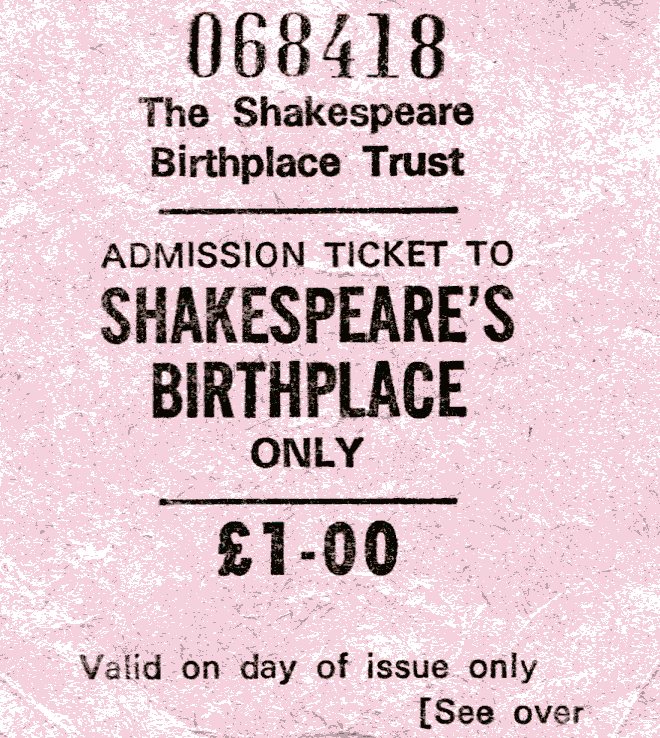
I think Joe Sears and Jaston Williams were still the two men doing all the parts in 1986, but I wouldn’t swear to it. All I have left is a ticket stub and a recollection of it being entertaining.

Ford’s Theatre, of course, has a doleful history of its own. The president’s box is still draped with flags, though it’s actually a 1960s reconstruction of the original, as is the entire theater space, with more changes made in a 2008 renovation. During the most recent renovation, the Washington Post ran an article containing a brief history of the place:

“Ford’s Theatre was a Baptist church until it was taken over in 1861 by entrepreneur John T. Ford. The venue was destroyed by fire the night of Dec. 30, 1862, but was rebuilt and reopened in 1863.

“After the assassination… when Ford sought to reopen for business, there was a public outcry. The government bought the theater from Ford and used it over the years as a museum and as an office and storage building.

“On the morning of June 9, 1893, the building was packed with 500 government clerks, occupying several floors of jury-rigged office space, when the interior collapsed, according to a Washington Post account the next day. Scores were killed and injured, and the theater’s already altered interior was destroyed.

The government rebuilt it again — and again used the building for storage. In the 1950s, the government decided to restore the building as a historic site and theater venue, and Ford’s reopened in 1968.”

It just occurred to me that I’ve visited three of the four sites of presidential assassinations: Ford’s Theatre, the National Gallery of Art’s West Building (built on the site of Baltimore & Potomac Railroad station where President Garfield was shot, though unmarked), and the Texas School Book Depository building. Guess that means I need to visit Buffalo.

1 Afghani

A cold front blew in last night, bringing not only colder air, but also air in motion. I woke up at least once during the small hours to hear the vigorous rush of wind outside. Reminds me of the last graph of Chapter 11 of The Sun Also Rises (not for the first time, but no smoking for me): “After supper we went upstairs and smoked and read in bed to keep warm. Once in the night I woke and heard the wind blowing. It felt good to be warm and in bed.”

This collection of Zone Rouge images would have been fitting yesterday, but I only found it today.

One more Asian banknote for now: an Afghan afghani, formerly issued by Da Afghanistan Bank, but replaced in recent years with a coin. I can’t help but smile at that institution’s name. Who issues the money in Afghanistan? “Da Afghanistan Bank, mon.”

AfghaniREVAfghaniOBVThese days, 1 afghani = 0.0151515 U.S. dollars. The obverse features the seal of Da Afghanistan Bank, which includes the design from the famed gold 20-stater of Eucratides, everyone’s favorite Greco-Bactrian king, or usurper, take your pick. Unless you’re fonder of, say, Menander, “who conquered more tribes than Alexander the Great.”

On the reverse is the Blue Mosque-Shrine of Ali in Mazar-i-Sharif, Afghanistan, which dates from the 15th century. Archnet tells us that “the shrine was restored extensively in the mid-twentieth century and draws Shi’a pilgrims throughout the year, and especially during the celebration of New Year (Neuroz).”

Guy Fawkes & Martians &c

One more warm day. Then no more. Unless the forecasts about next week are right. What kind of November is this?

It’s Guy Fawkes Day again, and not a burning effigy in sight. It’s really something we should import. Lately I’ve been reading What If? 2, a collection of counterfactual history essays that I picked up used for 50 cents, but “What If Guy Fawkes Had Succeeded?” isn’t one of the subjects. Naturally that question’s been taken up elsewhere.

All of us went to see The Martian on Sunday. All in all, a well done bit of hard SF. Titanium hard, though considering the story, the focus on the technology of space travel and survival in a hostile environment isn’t misplaced. The movie also managed to present its exposition — and there was a lot of it — in a way that didn’t goo up the narrative, which is no small trick.

One thing (which the author of the book has acknowledged): the Martian atmosphere is so thin that a raging storm of the sort that got the hero in his jam would be impossible. The planet does have dust storms, of course, but not hurricanes of dust. Never mind.

There’s no overt indication of when the story takes place, so I figured it was either 20 years or so from now — very optimistic indeed, considering the sluggish pace U.S. manned space exploration these days — or in a present-day world in which a program to send people to Mars got started in earnest in the 1990s (it was, after all, something the elder Bush proposed). The flags on the spaceships and shoulder patches, I noticed, had 50 stars. A nice detail would have been to use the 51- or 52-star designs.

I suspect the only way U.S. astronauts are getting to Mars in a few decades is if the Chinese decide to attempt it.

From a web site I’d never heard of before but happened across recently, purporting to cover real estate news (all sic): “According to Investor Daily, TIAA-CREF’s Phil McAndrews has recently stated that the United States economy is under fairly good state that tantamounts to the continuing optimistic forecasts for the commercial property segment.”

That’s a sample from an item laid out like a real article, but clearly not written by a native speaker of English. The item, in fact, is a little hard to read, and larded with advertising links and other annoyances. And then it crashed my browser with an irritating “Unresponsive Script” message. I’m not overly worried about competition from such Mickey Mouse efforts as this.

Does anyone use “Mickey Mouse,” as in amateurish, any more? I had a teacher in junior high, our band director Mr. Fields, who was fond of the term. Now it sounds like it belongs to an earlier generation — Mr. Fields’ generation, or about the same age as Mickey himself. Maybe in more recent years, Disney minions have made trouble for anyone who uses Mickey like that. I’d better watch out.

The Waxahachie City Cemetery

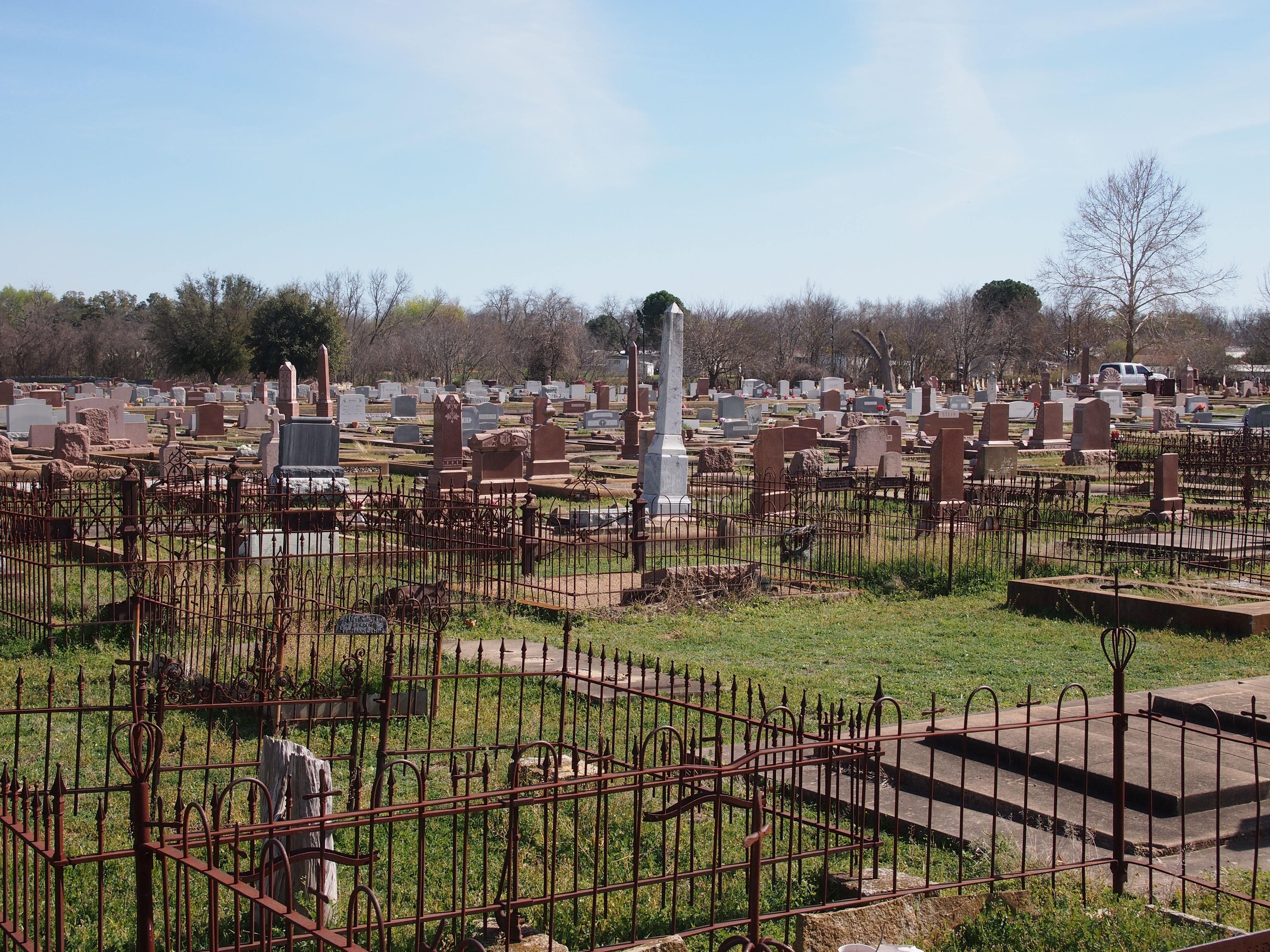
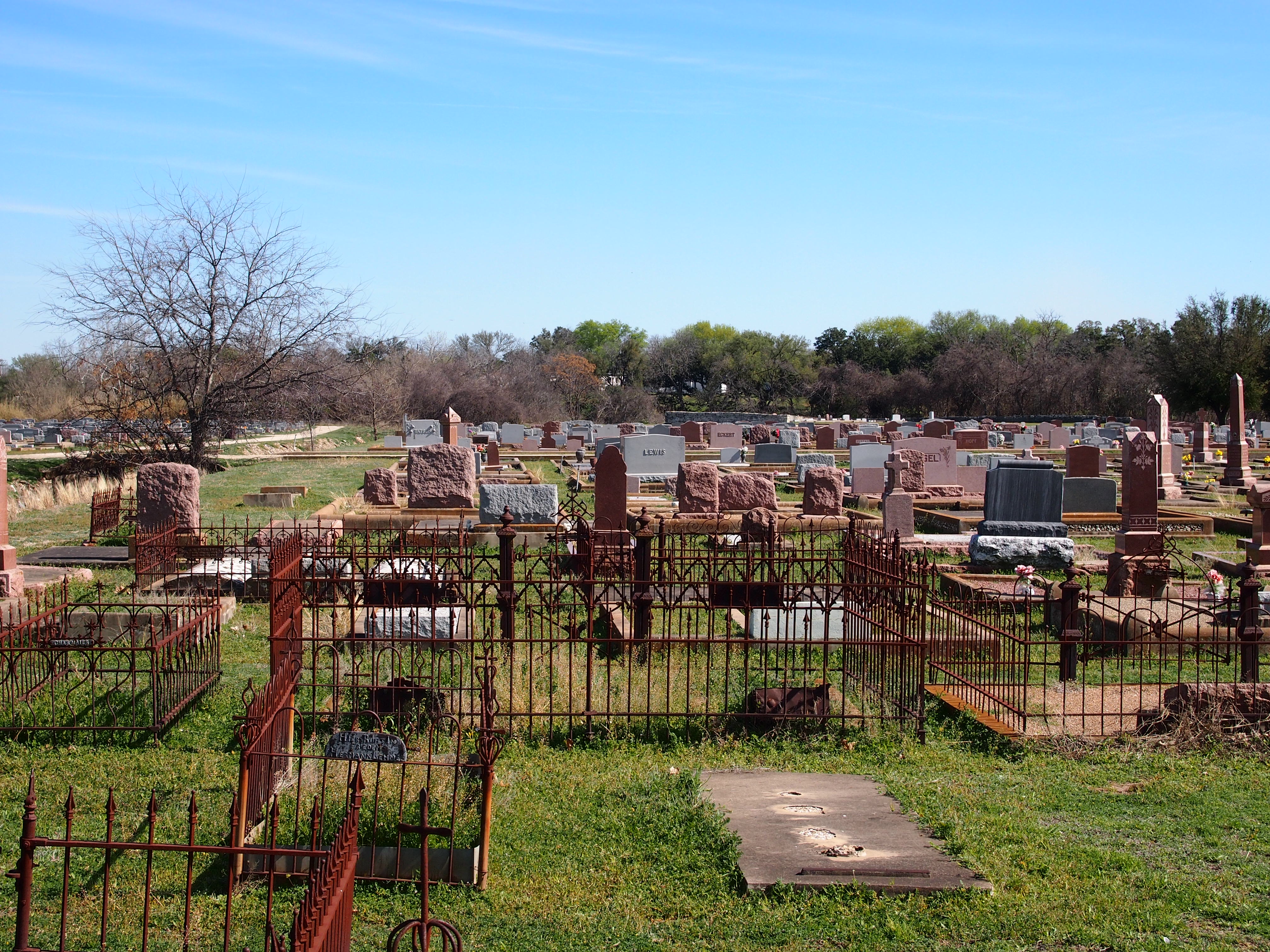
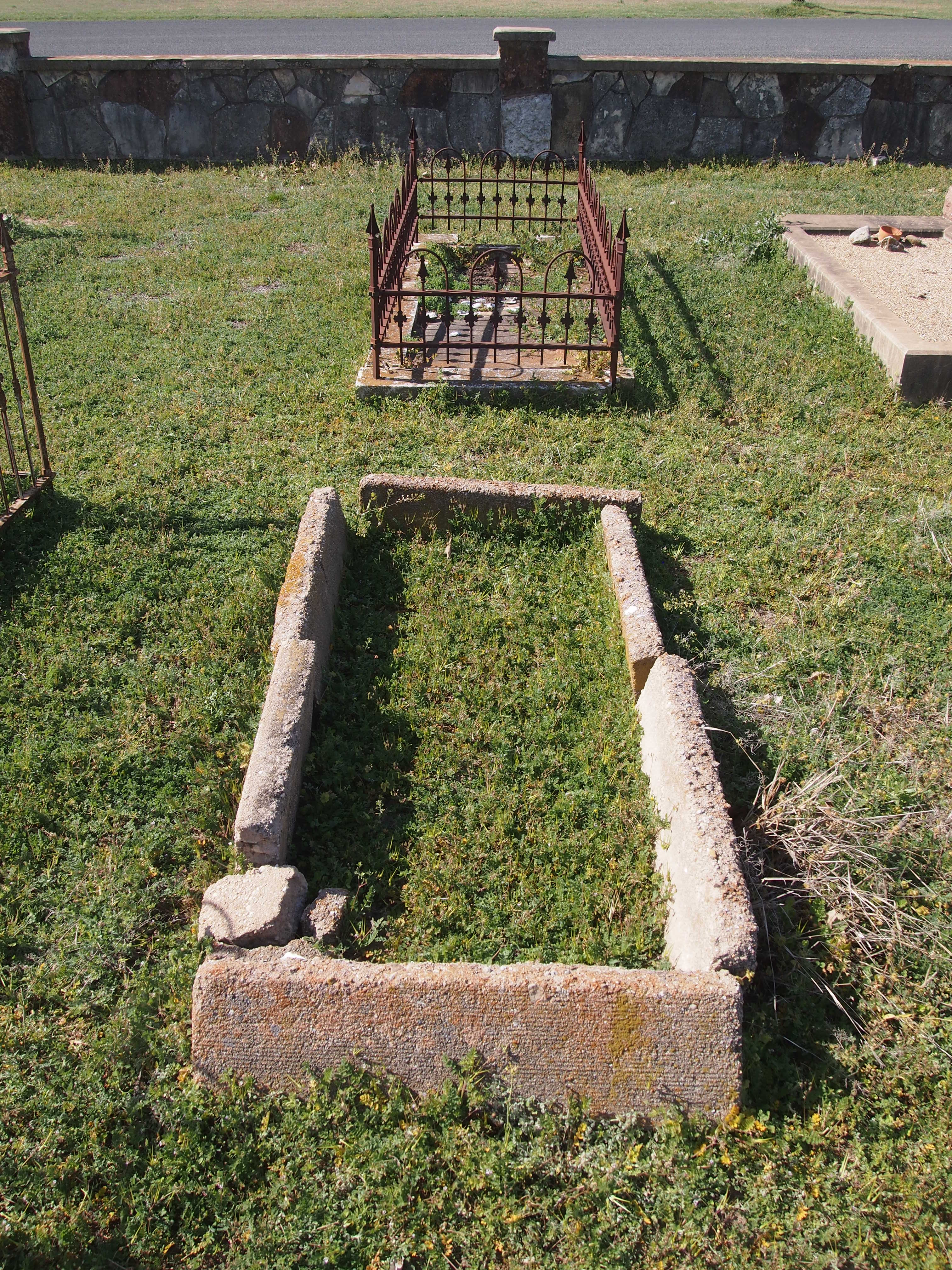
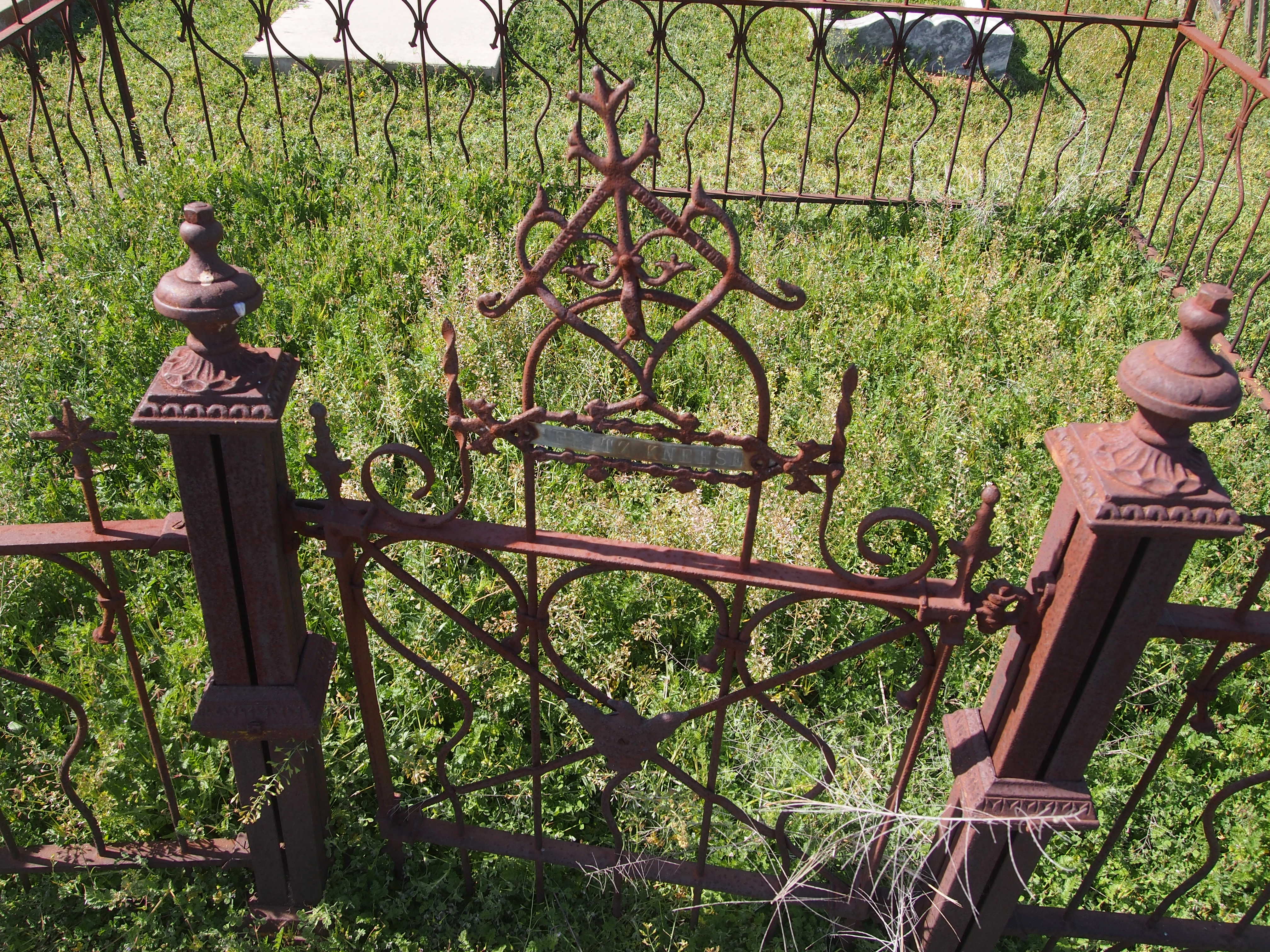
Jay and I passed through Waxahachie in Ellis County, Texas, on October 22, and besides visiting the handsome Nicholas P. Sims Library for a little while, we also spent a few minutes at the Waxahachie City Cemetery a short distance away.

According to a Texas Historical Commission marker on site, “the first burial here occurred on Jan. 1, 1852, after the death of pioneer merchant Silas Killough (b. 1805), one of the founders of this community. The original 4.16 acre tract was given in 1858 to trustees of the Methodist church by Emory W. Rogers (d. 1874), who was Waxahachie’s first settler (1846) and donor of land for the townsite. About 1900, the cemetery was transferred from church to municipal jurisdiction. By gifts and purchases of additional land, the site has grown to 65 acres and contains about 10,000 graves.”
WaxahachieIt had been dry in this part of Texas since a wet early summer, so the cemetery was rich in earth tones in October ahead of the massive rains that fell over the next few days.

Et In Waxahachie EgoNot the most ornate cemetery or the shadiest one, but a nice small-town Texas boneyard, something like the one I saw in Flatonia, Texas a half-dozen years ago, and not as tumbledown as the old San Antonio cemeteries I saw earlier this year.