Patience

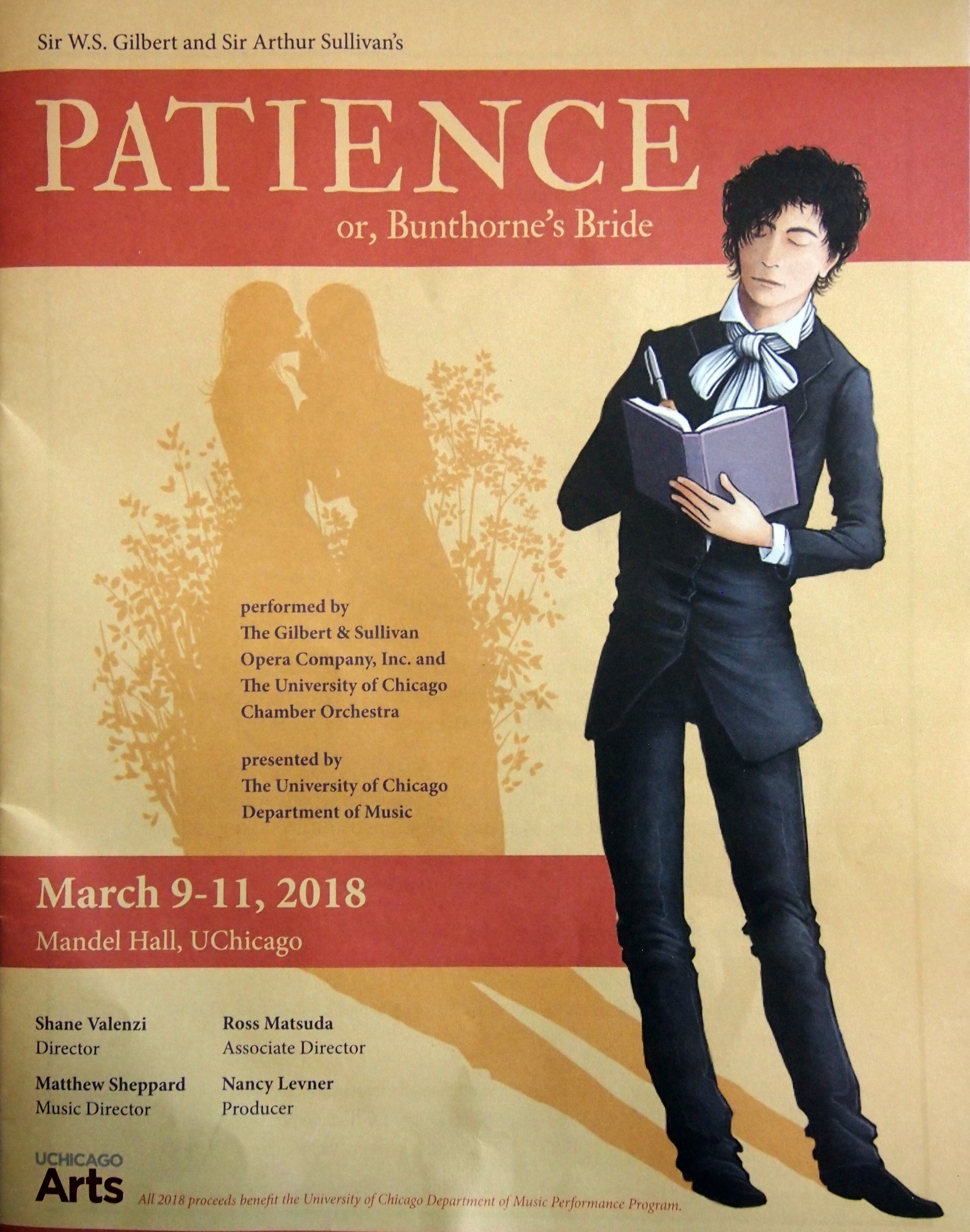
The Gilbert & Sullivan Opera Company’s performance of Patience drew a sizable crowd to Mandell Hall at the University of Chicago on Sunday (including us), as did previous Gilbert & Sullivan productions that we saw, Yeomen of the Guard and Iolanthe.

For good reason. The company, directed by Shane Valenzi, did a fine job of it, their talent augmented by the skillful University of Chicago Chamber Orchestra, a 40-member ensemble.

Remarkable how something funny almost 140 years ago can still be funny. Not only that, spot-on satirical. Then again, while the aesthetic poetry movement might be a thing of the increasingly distant past, fads — and more particularly, the fickle adulation of male sex symbols — are still immediately recognizable.

All of the leads, including Jeffrey Luksik as Bunthorne and Olivia Doig as Patience, brought considerable talent to their parts, but I was especially amused by Brandon Sokol’s take on Grosvenor. As the program notes put it, “Grosvenor is Fabio, a pure sex symbol without anything resembling artistic sensibilities,” and Sokol played it up delightfully.

Also amusing was Grosvenor’s transformation into “appearance and costume absolutely commonplace.” He came out with his golden hair shortened and wearing sports apparel, namely a Cubs cap and a Bears t-shirt. That was part of the costuming of the entire production, overseen by costume designer Rachel Sypniewski. The costumes were decidedly not Victorian, but that design decision worked.

“We’ve attempted to draw that comparison [between Victorian and modern faddishness] more or less overtly,” the program says, “modernizing the dress of the women and the poets to reflect a Poe-ish aesthetic evocative of the vampire-esque gothic movement that evolved from aestheticism and [which] enjoyed a revival during the popularity of the Twilight saga… The men [Dragoons] are Canadian Mounties who, despite their fearsome competence and justifiable pride, and nonetheless often the subject of light ridicule in American popular culture.”

(Such as Dudley Do-Right. Something I didn’t know about the Mounties, per Wiki: “Although the RCMP is a civilian police force, in 1921, following the service of many of its members during the First World War, King George V awarded the force the status of a regiment of dragoons, entitling it to display the battle honours it had been awarded.”)

Three of the Dragoons, usually dressed as Mounties, got the biggest laugh of the night when they tried to be aesthetics, dressed in tights. Actually, the very biggest laugh came when one of their members, the Duke of Dunstable, played by an enormous, hairy actor named Dennis Kulap, came out in pink tights.

One more thing about Patience, which I discovered just today: Oscar Brand and Joni Mitchell singing “Prithee Pretty Maiden.”

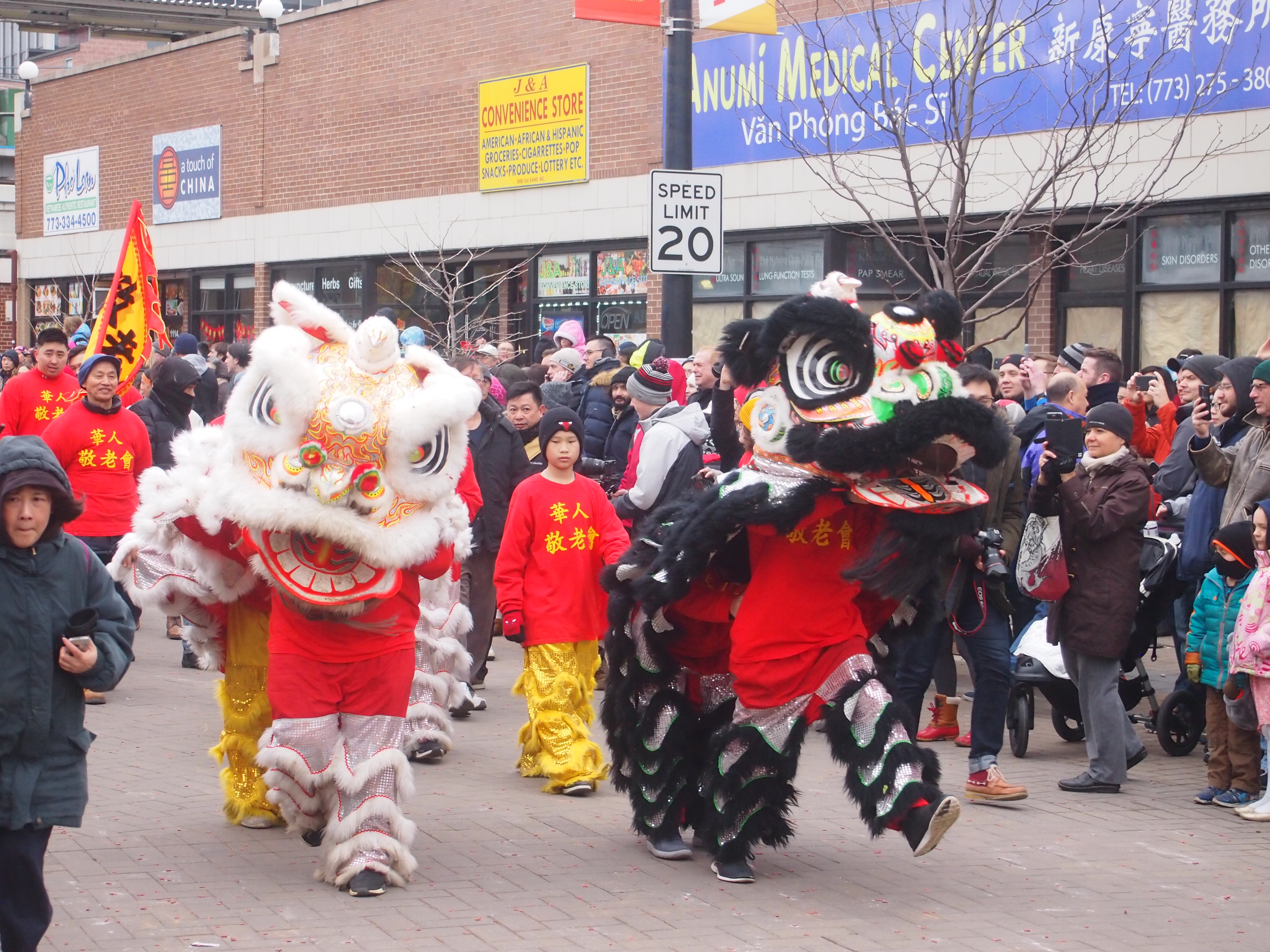
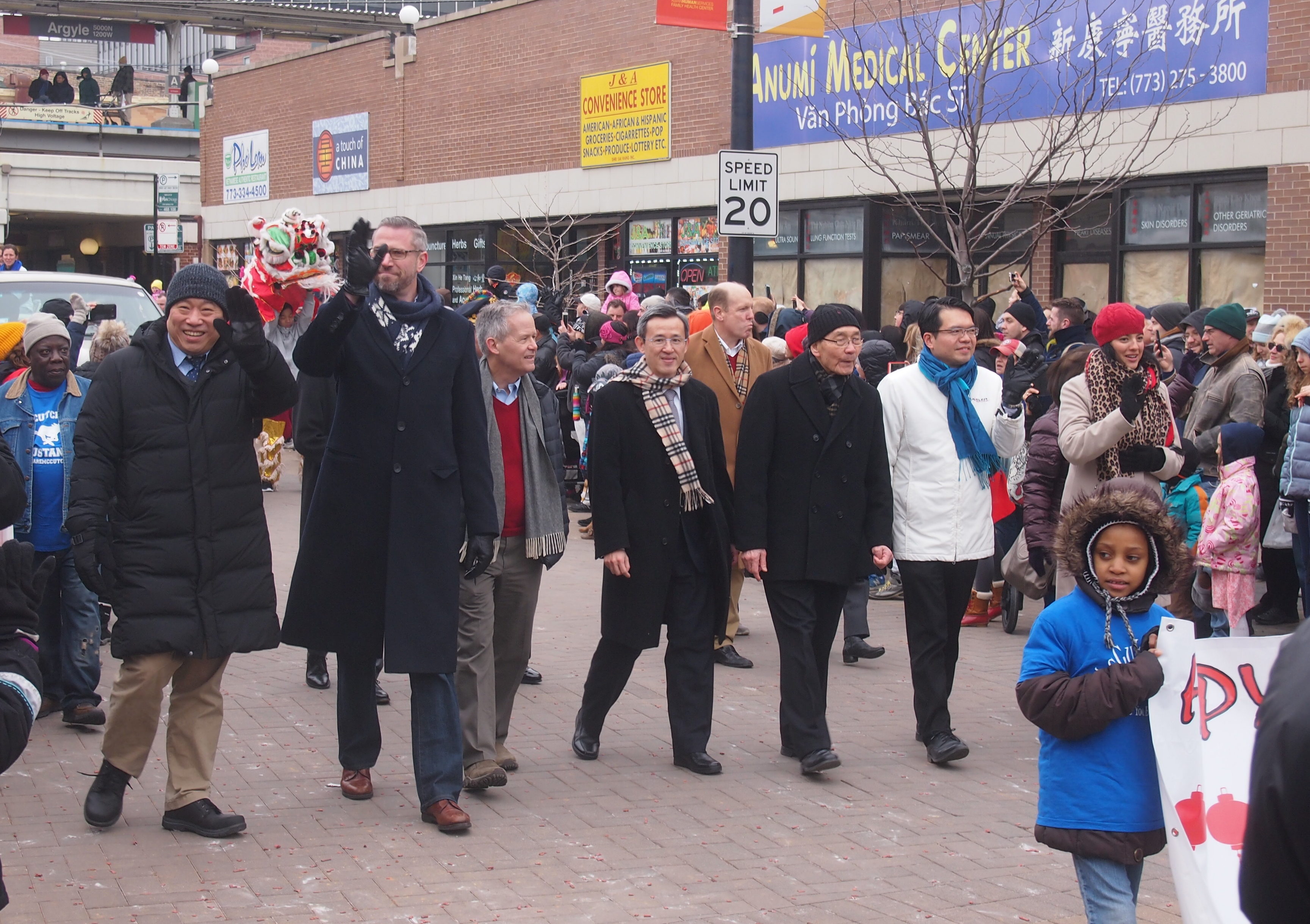
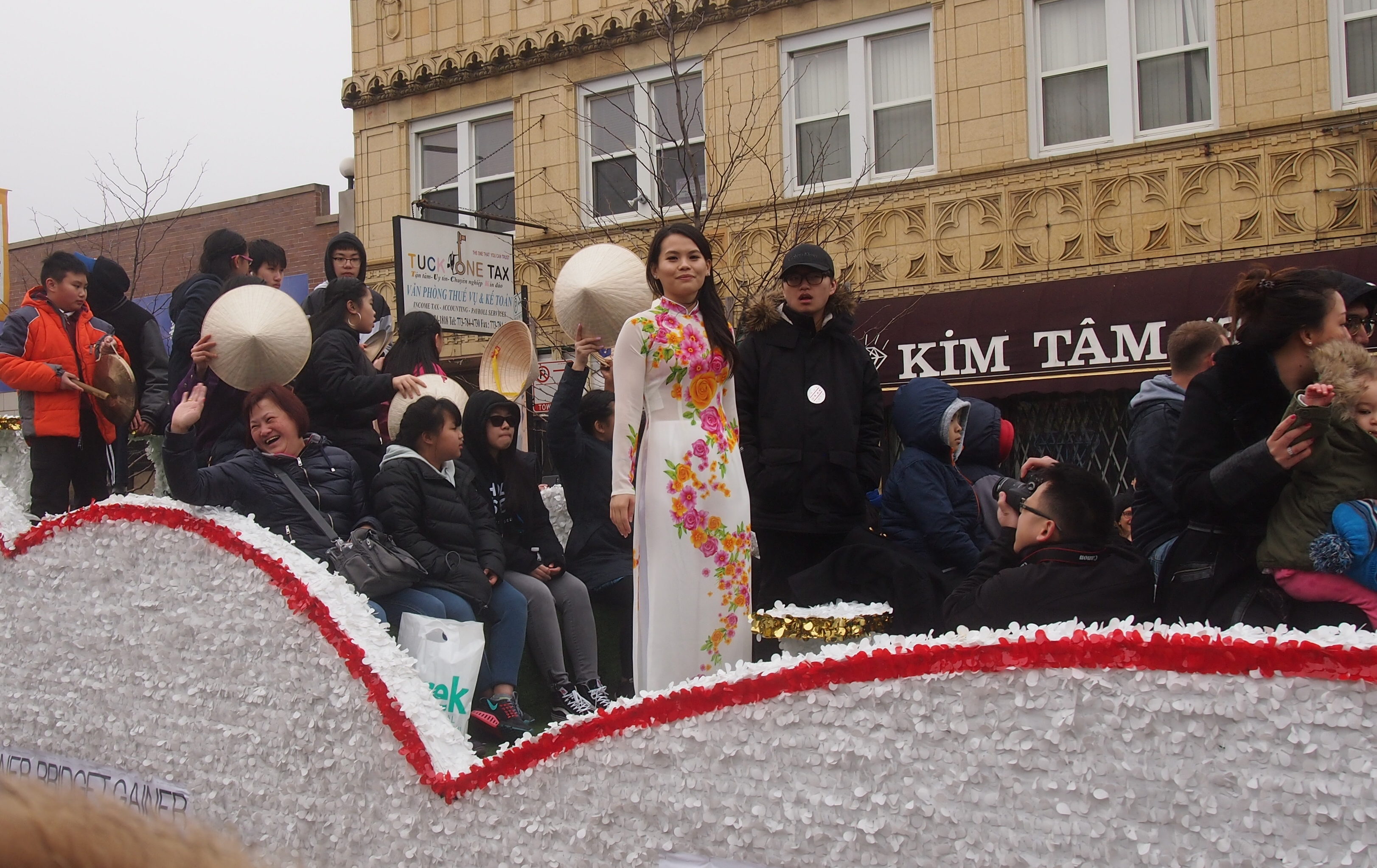
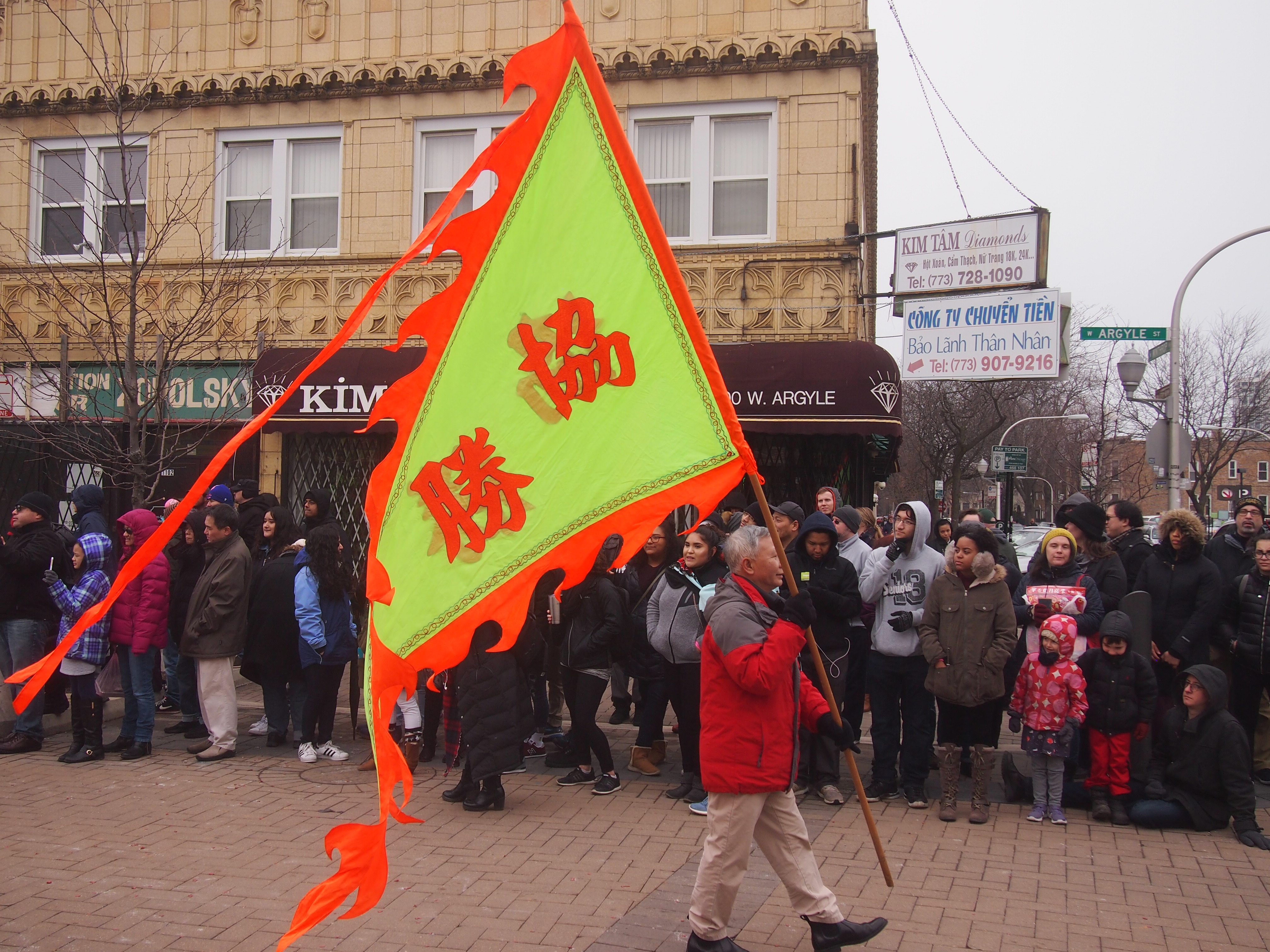
The 2018 Argyle Street Lunar New Year Parade

Last year, we went to see the Chicago Chinatown New Year Parade. It was a colorful event. Banners, dragons, bands, etc. The weather was good enough this year — above freezing, no rain — to go again, but instead we opted for the Argyle Street Lunar New Year Parade on the North Side of Chicago on Saturday. I wondered how it would compare.

The short answer: it was a lot shorter. Fewer of everything. Still, not a bad parade. At 1 pm it started, fittingly, on Argyle Street, just west of the El tracks that run over the street. asia on argyle, as the letters just below the tracks say. I took the picture after the parade, when the street got back to normal.

From there, the parade headed east on Argyle; we stood just east of the El tracks. Argyle is the focus of what used to be known as New Chinatown, but in fact the neighborhood is more Vietnamese than anything else, with plenty of Vietnamese restaurants, grocery stores and shops. I’m a little surprised the event isn’t more specifically Tet.

Dragons started things off.

Followed by politicos. I think.
Various floats.
A few colorful banners.
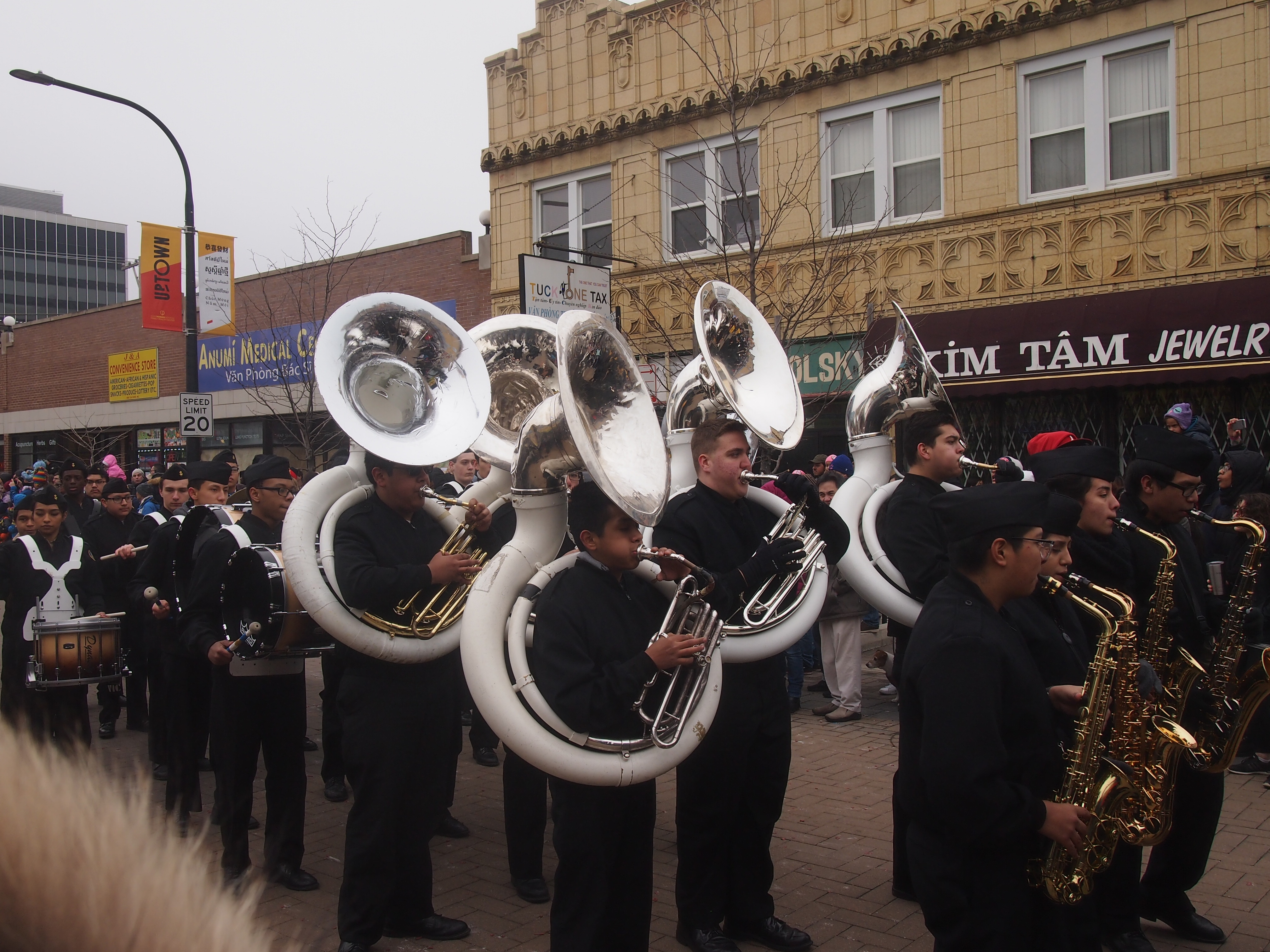
One band, from the Admiral Hyman Rickover Naval Academy High School.
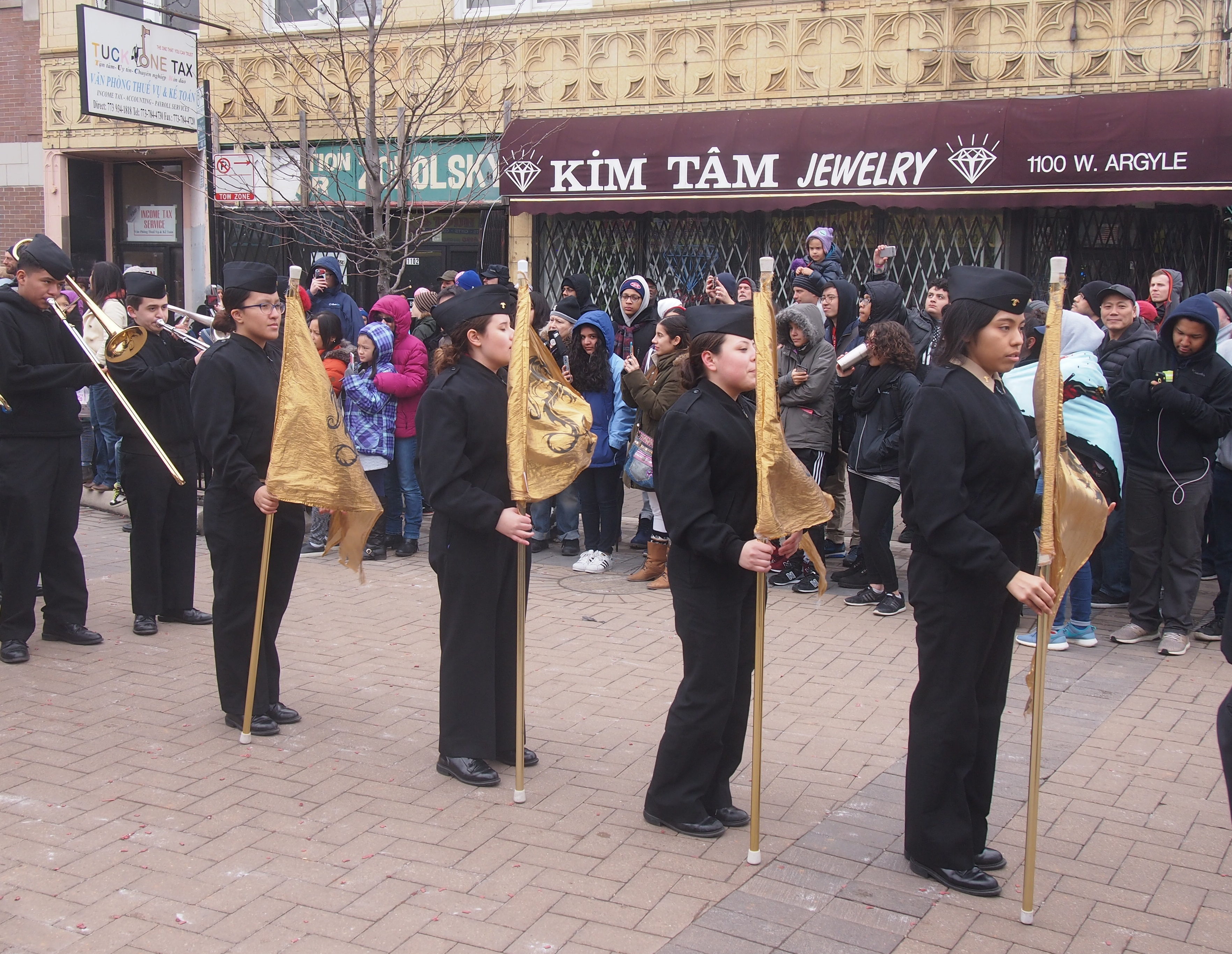
With flag girls.
Some veterans.
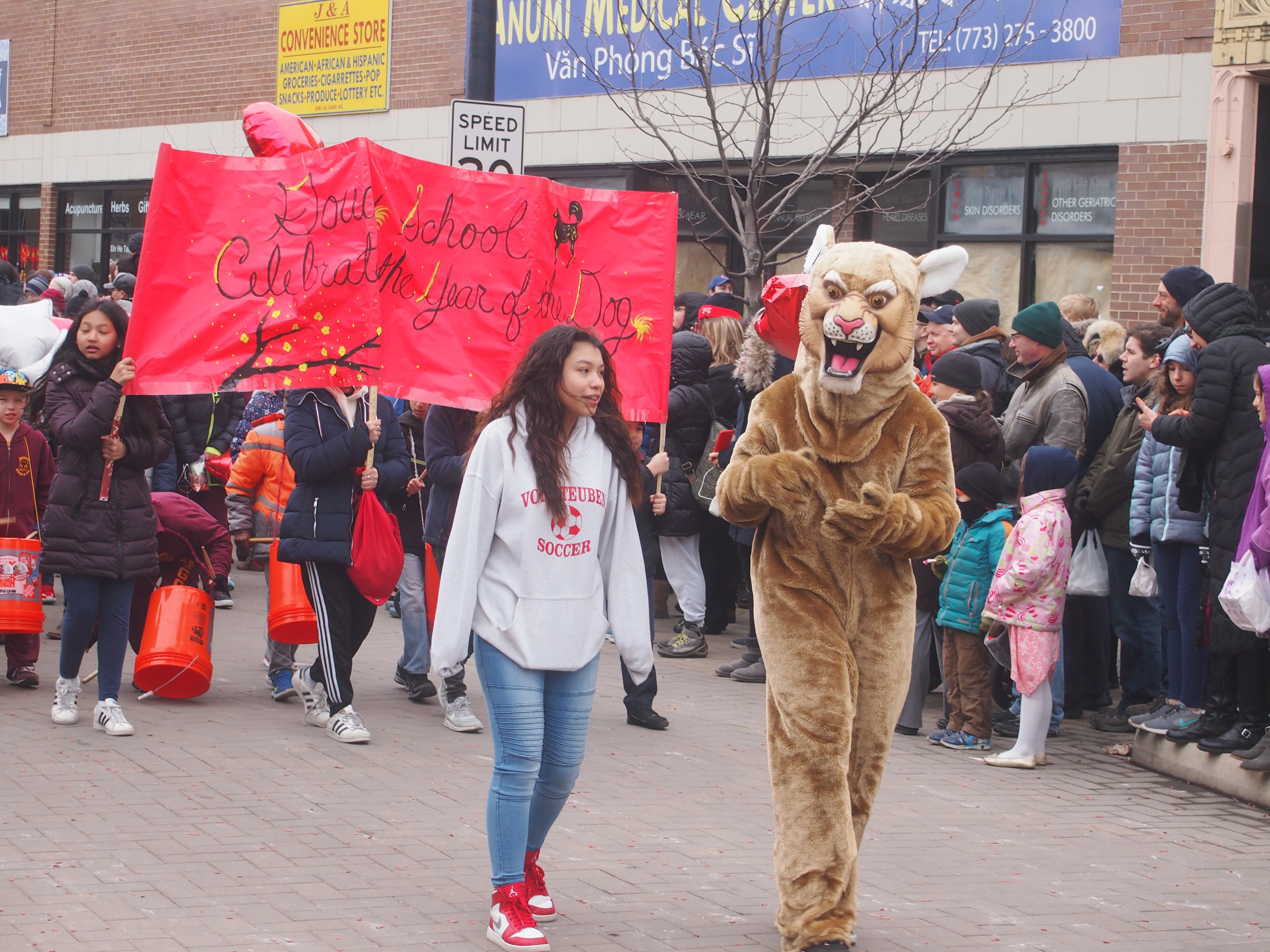
And a costumed character or two.
Guess he’s the school mascot. A cat walking in a Year of the Dog parade.

Big Bad Voodoo Daddy

WGN said this morning: “Periods of rain and thundery downpours are to persist into Tuesday evening, maintaining a flood threat across the entire metro area.” Just what we need.

“Chicago lies on the warm side of a front extending from the southern Plains, to lower Michigan. Unseasonable, moisture-rich Gulf air is being focused along this boundary which separates polar air from unusual warmth, more typical of late April. The ground is frozen and where it has melted, soils are saturated.” Yep.

Regrets, I’ve had a few. Here’s one: I could have seen Cab Calloway live. He was still performing in the 1980s, with more vigor than anyone over 80 can expect to have.
But I didn’t seek him out. I’ve got no excuse.

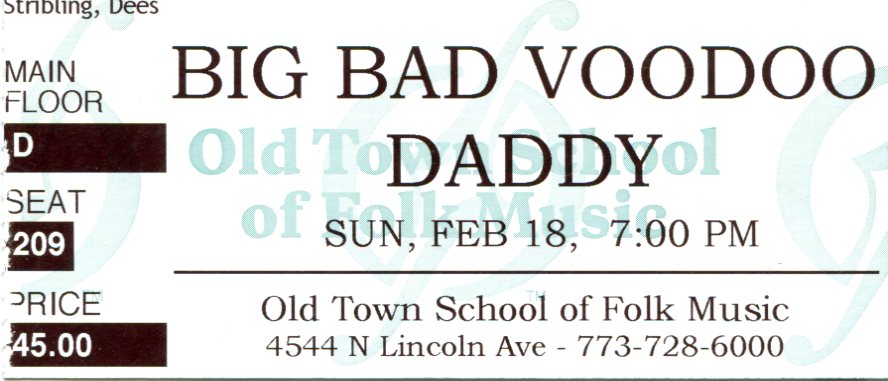
Sometimes, you do the next best thing. I thought of that on Sunday evening when Ann and I went to see Big Bad Voodoo Daddy at the Old Town School of Folk Music in the city. At one point, frontman Scotty Morris and his hoppin’ band did a cover of “Minnie the Moocher.” It wasn’t Cab, it couldn’t be, but it was a gas.

The whole show was a gas: rousing swing revival tunes by enormously talented musicians who’ve been playing together for decades. Loud but not too loud, brassy but leavened by strings, as much of a righteous riff as I’m ever likely to reap. It might be the 21st century, but they’re the cats shall hep ya, even so.

Morris, in his suit and tie and what must be his trademark fedora, sang and alternately picked guitar and banjo, and did a little patter for the audience. Not too much, but he included the fact that the band has been together for 25 years this year.

“Twenty-five years ago, the most famous band in the world was Nirvana,” he said. “I think they had four hit songs that year. So I figured that was the perfect time to start a swing band.”

According to the band’s web site, it “was named Big Bad Voodoo Daddy after Scotty met Texas blues guitar legend Albert Collins at one of the latter’s concerts. ‘He signed my poster “To Scotty, the big bad voodoo daddy.” I thought it was the greatest name I had ever heard on one of the greatest musical nights of my life.’ ”

Morris and eight other men took to the stage and made the music come alive via trumpet, all manor of sax, clarinet, trombone, double bass, keyboard, drums and more, playing and jumping and swinging, while their instruments reflected the variable colored spotlights of the venue. Smoke and the clink of glasses would have added to the ambiance, but we don’t get those in the 21st century (or even earlier: the difference between Preservation Hall in 1981 and 1989 was smoke).

BBVD did an energetic mix of swing standards — “Minnie” with all the call-response Hi-De-Ho you could shake a stick at, but also “Diga Diga Doo,” “Mambo Swing,” “The Jumpin’ Jive,” and “I Wan’na Be like You” — along with tunes of their own. Neo-swing, you might call those, or the commonly used term, electroswing.

Such as “Why Me?”

The video is fun, and I like the recorded version, but it isn’t as much fun as the live version. I suspect it’s their biggest hit, if you can call it that, because they did it during the encore.

Though BBVD has always been a touring band, I think they were also promoting their latest record on this tour, Louie, Louie, Louie. Record indeed, since vinyl copies were for sale in the lobby.

Named, according to Morris, after the three Louies: Armstrong, Jordan and Prima. “We stole a lot from them,” he said. Well, sure. They stole from the best and made it their own.

CDMX

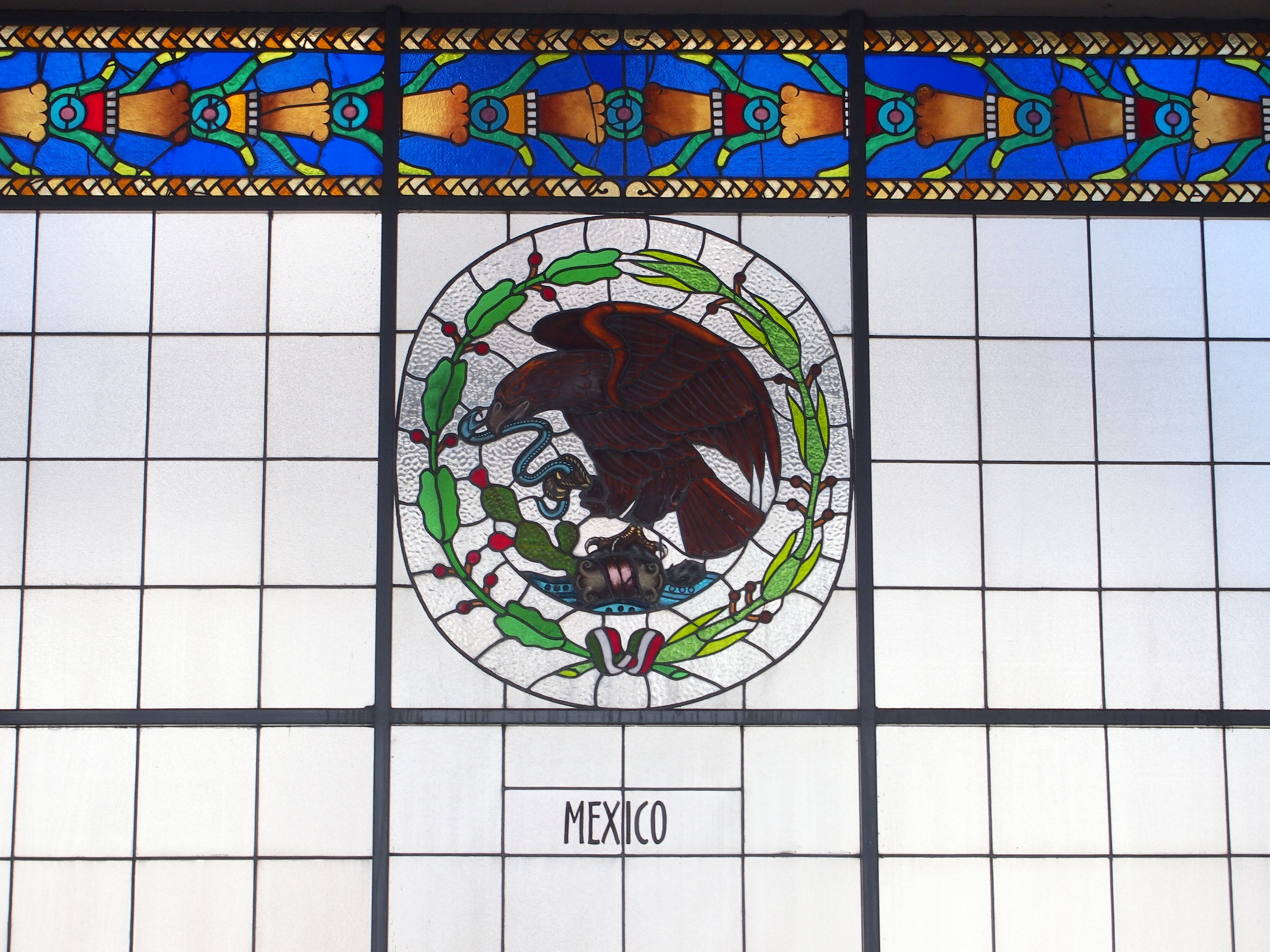
Something I didn’t know until recently: Mexico City, which has more autonomy than it used to, is no longer in the Distrito Federal, which it had been since 1824. Two years ago, the federal government of Mexico signed off on a name change, which the city’s government had wanted, to simply Ciudad de México, abbreviated CDMX.

On Wednesday, December 27, Lilly and I flew to Mexico City, returning on New Year’s Day 2018 — or actually early January 2, since the return flight was late. We stayed at a hotel in the Zona Rosa, just south of Paseo de la Reforma, a major thoroughfare, but also within walking distance of the Roma neighborhood.

We spent our time as dyed-in-the-wool, first-time tourists, seeing impressive places and structures, visiting grand museums, walking along interesting streets, eating a variety of food, taking in as much detail as possible.

Considering that Mexico City is a vast megalopolis — all too apparent from the air as we arrived in the daylight and left at night — we experienced only the slimmest sliver. But an endlessly fascinating sliver.

Adding immeasurably to the trip was the fact that my old friend Tom Jones — known him nearly 45 years — was in Mexico City at the same time. In fact, I’d suggested the trip to him on the phone last summer, when I called him to hear about his experience in seeing the eclipse. He’d been a fair number of other places in Mexico over the years, more than I have, but not Mexico City, so he was open to the suggestion.

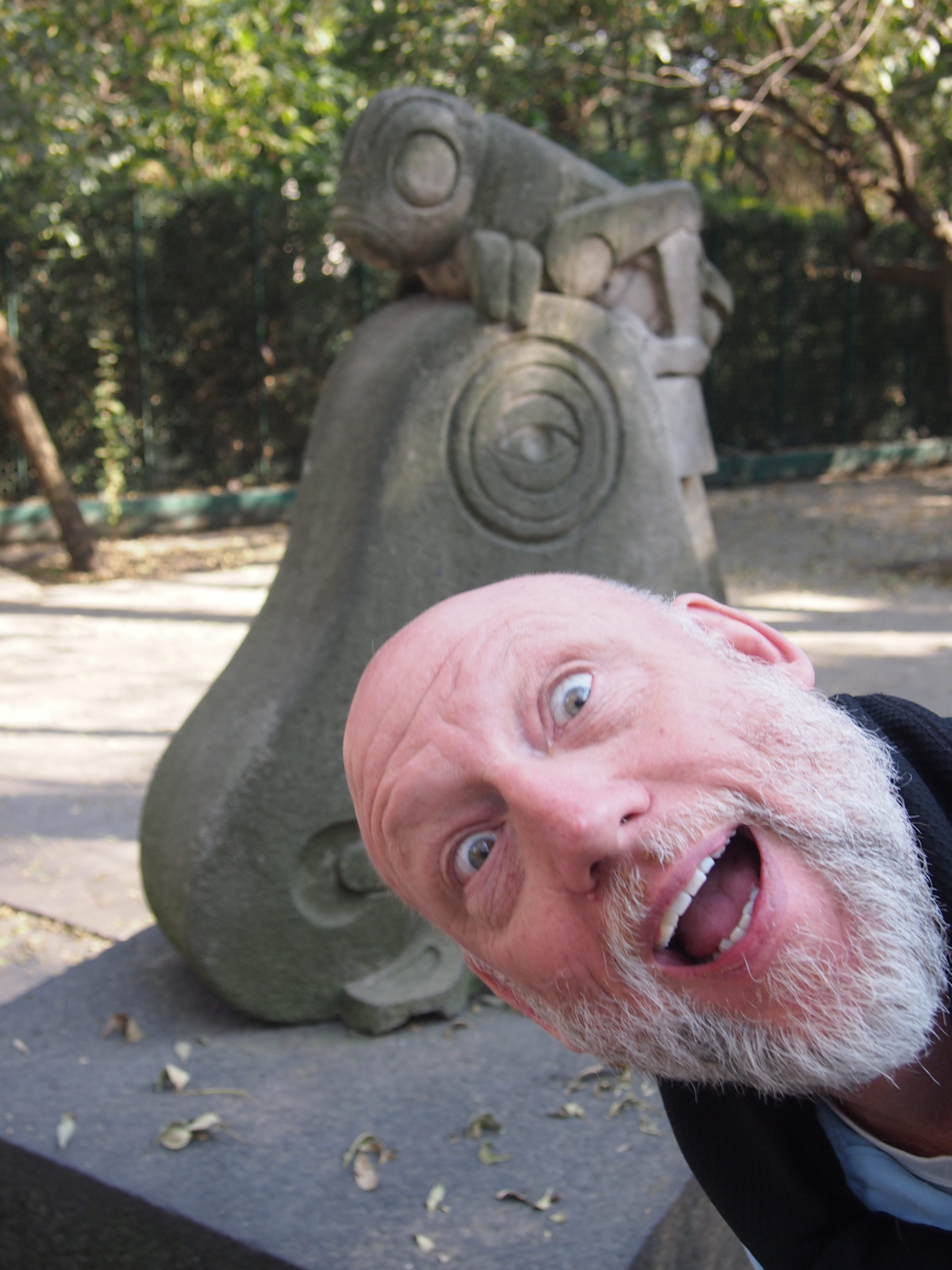
So the three of us went a lot of places together in the city. Tom has an impulse for photobombing.
The first place Lilly and I went, not long after we had arrived, was the enormous Zocalo (formally the Plaza de la Constitution), which was packed with holiday revelers enjoying a temporary ice-skating rink and amusement-park slides. We circumambulated the square, said to be the second largest in the world after Red Square, and spent some time inside the vaulting Catedral Metropolitana, which opens onto one side of the Zocalo.

The second day, with Tom joining us, was for large museums in the even larger Bosque de Chapultepec, the city’s equivalent of Central Park: the Castillo de Chapultepec, a grand palace along European lines and now a history museum; and the Museo Nacional de Antropologia, an epic museum devoted to the many and varied cultures of pre-Columbian Mexico (or more precisely, pre-Cortez).

All that makes for tired feet, so the third day was less intense. Even so, we got a good look at a small part of the charming Coyoacan neighborhood, which includes the Museo Frida Kahlo. The lines were too long to visit Frida, but not to get into the Museo Casa Leon Trotsky a few blocks away.

The next day, December 30, was exhausting, but completely worth all the energy and money we spent, because we got to visit the renowned Teotihuacan, which is to the northeast of the city, in the State of Mexico, and climb its pyramids. From there, we went back into the city to see the Basílica de Nuestra Señora de Guadalupe — the Basilica of Our Lady of Guadalupe — a pilgrimage site I’ve been curious about since I encountered The Shrine of Our Lady of Guadalupe, Des Plaines.

And as if that wasn’t enough for a day, we returned to Castillo de Chapultepec on the evening of the 30th, along with four of Tom’s friends from Austin who were also visiting Mexico City, for an outdoor performance by the astonishingly talented dancers, singers and musicians of the Ballet Folklórico de México.

On the last day of 2017, we slept fairly late, but were out and about after noon, for a visit to the Palacio de Belles Artes, a striking building with art exhibits and some astonishing murals, especially the Diego Riveras. More Rivera murals were in the offing at the Palacio National, the last large site we visited.

We were tired on the evening of the 31st, but not too tired to walk a few blocks from our hotel to the Paseo de la Reforma. One of the city’s two main New Year’s celebrations was being held around the Angel de la Independencia, a famed gold-colored statue atop a tall column in the center of a Paseo de la Reforma traffic circle. The event featured live music by well-known (I was told) Mexican bands, a countdown just like at Times Square, except in Spanish, and then fireworks: a bang-up way, literally and figuratively, to start 2018.

A Christmas Carol, Suburban Chicago Version

Metropolis Performing Arts Centre is an excellent mid-sized theater that would fit in anywhere in the city, but it happens to be in suburban Arlington Heights. We went to see a production of A Christmas Carol there on Saturday.

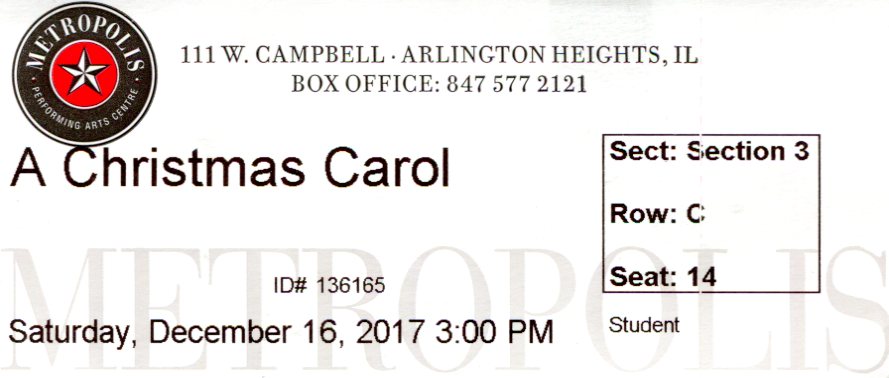
Another nice detail: they produce paper tickets. This was Ann’s.
The soulless ticket cartel might be eager to get rid of paper tickets, but venues ought to be eager to keep them. People keep them, especially if they show was good. They’re cheap long-term bits of marketing.

Ann had never seen A Christmas Carol on stage, and neither had Yuriko. The last time I saw it was also at the Metropolis — almost exactly 10 years ago, when I took Lilly.

This production had everything it needed to have, particularly an actor (Jerry M. Miller) who could handle Scrooge’s dour initial disposition that slowly melts to his inevitable conversion to altruism. A Christmas Carol without that is a limp rag indeed.

Since it’s based on a novella, and not a source play, stage versions are going to differ, as the movies do. There was more singing and dancing in this version than others I’ve seen. Each of the Christmas spirits got a song-and-dance by a troupe, for instance, which was pleasant enough. This version also featured Bob Cratchit as the story’s narrator, which was a little odd.

A couple of important lines were omitted. Lines I think are important, that is. Old Fezziwig, who seemed reasonably prosperous — he had apprentices, after all — but who also knew that life was about more than making money, got none of his lines. He was mentioned in passing by Scrooge, and he got to dance, but that was about it.

“Yo ho, my boys!” said Fezziwig. “No more work to-night. Christmas Eve, Dick. Christmas, Ebenezer. Let’s have the shutters up,” cried old Fezziwig, with a sharp clap of his hands, “before a man can say Jack Robinson.”

When faced with the Spirit of Christmas Yet to Come, Scrooge didn’t ask it a most important question.

“Before I draw nearer to that stone to which you point,” said Scrooge, “answer me one question. Are these the shadows of the things that Will be, or are they shadows of things that May be, only?”

Just quibbles. Now I’ve done my bit to introduce my children to the Dickensian part of Christmas. If you’re going to celebrate the holiday in this post-Victorian world, you should know it.

The Pirates of Penzance

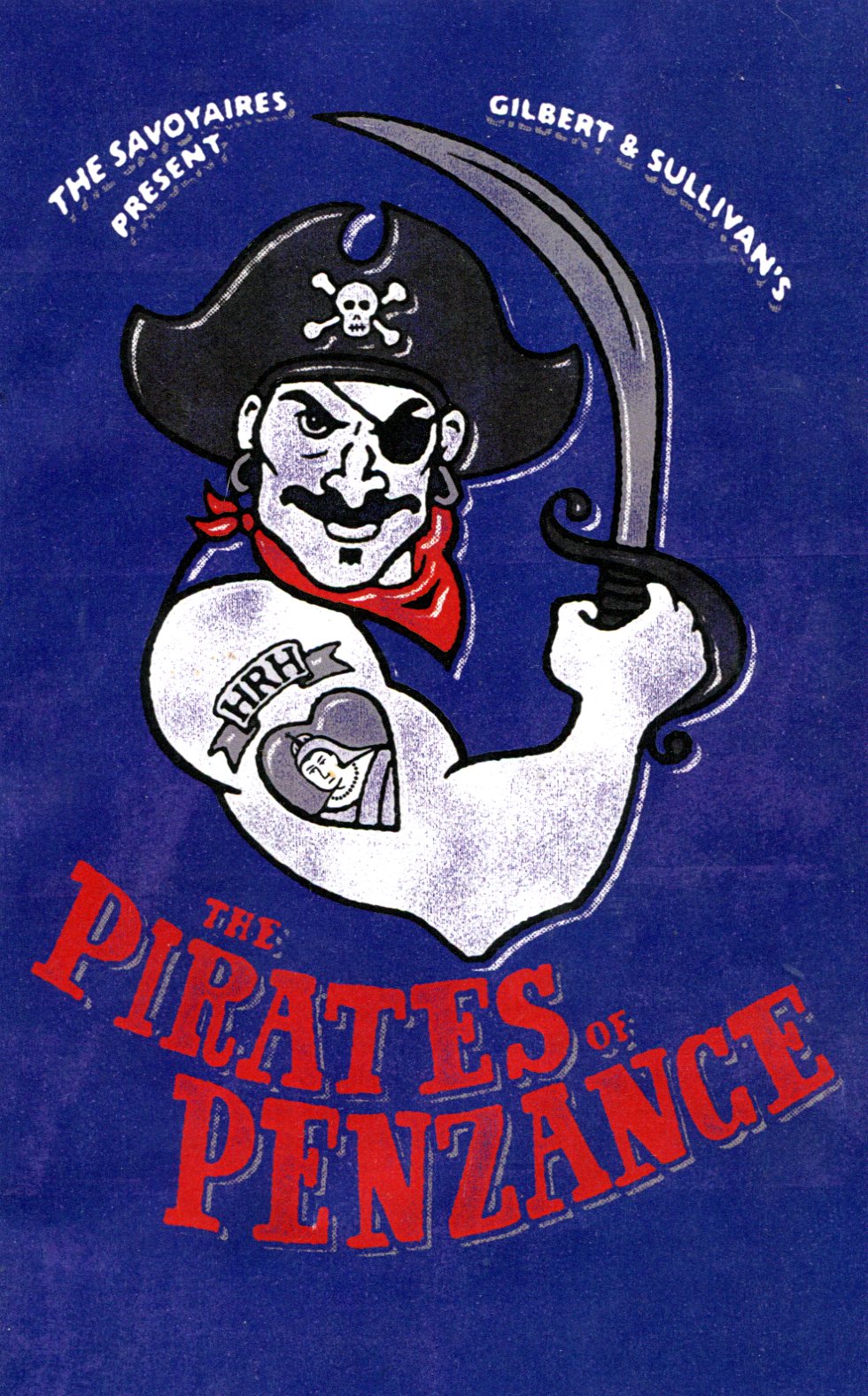
Not long ago Ann and I went to Evanston to see a production of The Pirates of Penzance by a troupe known as the Savoyaires, directed by Amy Uhl (choreography) and Timothy Semanik (music). I’d seen it advertised in the Iolanthe program last spring, and it occurred to me that I’d never seen it on stage. So I wanted to go.

img492I saw the Kevin Kline and Linda Ronstadt movie version sometime in the mid-80s at the Vanderbilt cinema. It was essentially a filming of the 1980 Broadway production. I’m not sure what it was, but I remember the movie being a little off. A little stiff.

Maybe it didn’t offer enough of that jolly good time that you should get from Gilbert & Sullivan. We got that from the Savoyaires, who didn’t need an elaborate venue to pull it off. The show was staged in a sizable but plain junior high school auditorium, complete with an orchestra.

Phillip Dothard played the Pirate King with gusto, and Sahara Glasener-Boles brought the right amount of sauciness to the part of Ruth. Of course what everyone was waiting for was the Major-General to show up and sing his signature song. An actor named Bill Chamberlain did that part.

“How did he learn to do that?” Ann asked later.

“Practice,” I said, though in fact, even if I had the voice, I doubt that I could ever do “I Am the Very Model of a Modern Major-General.”

And while Chamberlain was very good, he didn’t quite get all of the enunciation. Close enough, though. He was definitely part of the jolly good fun.

The program included “A Pirates of Penzance Glossary,” including the likes of Babylonic cuneiform, The Frogs of Aristophanes and Heliogabalus, whom it described as an “infamously depraved Roman emperor.”

“What was he depraved about?” Ann asked.

I couldn’t remember. It had been years since I’d read about him. A vague sense of perversion clings to him, but I wonder if there’s much to it. Ancient historians liked gossip and lurid invention as much as anyone else, and so did not-so-ancient historians.

“To confound the order of the season and climate, to sport with the passions and prejudices of his subjects, and to subvert every law of nature and decency, were in the number of his most delicious amusements,” Gibbon wrote of the boy-emperor.

He also wrote: “It may seem probable, the vices and follies of Elagabalus have been adorned by fancy, and blackened by prejudice.” In other words, dress as a woman a few times and people will make up all kinds of stories about you, especially if you’re emperor.

Ah, well. I will leave it to learned sages to argue over Heliogabalus. Next year’s production by the Savoyaires is Ruddigore, another G&S I’ve never seen staged. I’ll try to go.

A Bit of the Chicago Fringe Festival

The Edinburgh Fringe Festival was pretty much out of the question this year — and it’s probably a logistics hassle of the first order, even of you’re already in the UK — so I went to the Chicago Fringe Festival for a few hours on Sunday afternoon. Though not a trans-Atlantic proposition, it did involve driving into the city, which has its own small hassles.
Fringe1Naturally I left home later than I wanted to, so I caught only two performances, more-or-less picked at random: With the Weight of Her Fate on Her Shoulders and Jeff Fort and Fred Hampton: A Revolutionary Love Story. Per Fringe rules, each ran for an hour or less, with the latter taking nearly the whole 60 minutes, the former not quite so much.

The festival, now in its eighth year, is in the Jefferson Park neighborhood of the Northwest Side. One of the selling points of the festival is that all of the venues were within easy walking distance of each other, and they were. Despite all the years I’ve lived in northern Illinois, it was yet another unfamiliar neighborhood, so I spent some time walking around between the shows as well.

Jefferson Park is a pleasant strolling neighborhood, even in the fairly high heat of late summer, with its residential and commercial thoroughfares (Milwaukee and Lawrence) very much in the Chicago pattern: leafy small streets lined with small apartments, plus blocks of shops along the larger streets. In our time, Jefferson Park is heavily Polish. So Polish, in fact, that the Copernicus Center is there, at 5216 W. Lawrence Ave.

The center includes the Mitchell P. Kobelinski Theater — formerly Gateway Theatre, the first movie palace in Chicago for talkies. That by itself would be worth seeing, but over Labor Day weekend, the center holds its Taste of Polonia festival, which was in full swing Sunday afternoon. So the place was jumping, having attracted more people than the Fringe could ever dream of, and making a lot more noise. As I passed, a band was playing “Come on Eileen,” sounding like the Save Ferris version.

I wasn’t in the mood for a festival, but I did walk by the entrance and took a look at the outside of the building, including the sweeping tower atop the building. That was added in the 1980s and is said to resemble the tower of the Royal Castle in Warsaw, or at least its post-WWII reconstruction.

The Fringe venues were more modest, but I was surprised to learn that three of them were actual theater spaces: the Gift Theatre, Jefferson Park Playhouse and Windy City Music Theatre Blackbox Studio. Jefferson Park, in other words, has a theater scene. Other performances were held in spaces provided by the Congregational Church of Jefferson Park.

With the Weight of Her Fate on Her Shoulders was at Gift Theatre, a 50-seat slice of space with three rows of seats, black walls and a small performance area under a modicum of lights. You can’t get any more basic than that for a theater space, so everything depends on the strength of the writing and the skill of the actors.

Weight wasn’t bad, but not that good. The three young actors certainly had some acting chops. The tight space of the theater fit the setting of a cramped refuge from unseen but definitely heard urban combat going on outside. It also fit what the play seemed to be about: war is hell, it will drive you mad, and then probably kill you. Also, words are weapons. What? One of the characters seemed to talk — verbally harass — another into a violent death. Or was that supposed to be a stray bullet coming into the room?

As earnest as it all was, the short play was something of a muddle. I couldn’t quite bring myself to care whether the characters survived, because I wasn’t quite sure what kind of danger they faced. At times I felt like dozing off, but forced myself to stay awake, like you do during a hard patch of long-distance driving. There’s no risk of causing a traffic accident sitting in a theater, but snoring during a live show would be embarrassing.

I had no such problems with Jeff Fort and Fred Hampton: A Revolutionary Love Story, a fine work of historical fiction, done in the Congregational church’s meeting hall. The thing was engaging. I wanted it to last longer than its hour. The acting was strong, especially the two leads, and while it would have been easy for the playwright — Steven Long — to stray into the tendentious, he avoided that trap, portraying the leads as human beings rather than talking points.

The story was straightforward, depicting meetings between Black Panther leader Fred Hampton, during the year before the authorities murdered him, and Jeff Fort, a major gang leader in Chicago at the time. Hampton spent considerable energy trying to persuade Fort to give up his criminal enterprise and join him in revolution, which he believed would be along Marxist, not racial, lines. Fort was less impressed by the idea of revolution.

As depicted, the two were in a kind of courtship: Hampton doing his best to persuade Fort, who resisted his pleas, along with spells of mutual admiration, quarrels that almost turned violent, and a sense of foreboding. Aptly so, since both men were doomed in their own ways. A short life for Hampton and a long one for Fort. Even now, the real Jeff Fort, aged 70, is at the federal supermax prison in Florence, Colo., where he will surely be until he dies.

After the play, Steven Long came out and asked the audience, about 25 of us in all, to mention it on social media. That’s the first time I’ve ever heard that, but probably not the last. For my part, I’m mentioning it and the festival here.

My attendance at the Fringe this year was as much an exploratory run as anything else, to see whether it might be worth committing more time and energy to in future years. I’d say yes.
Chicago Pride Parade ’17

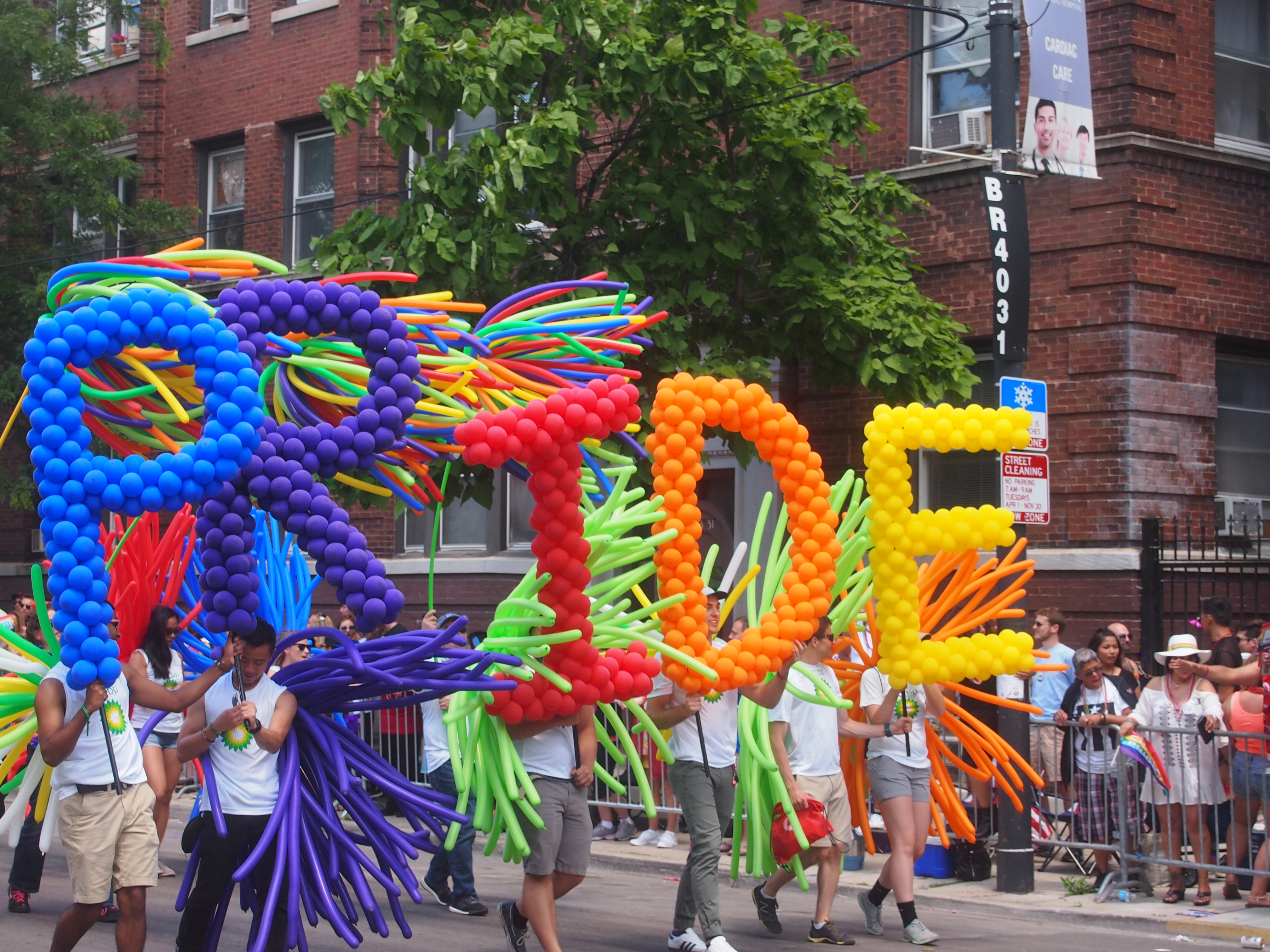
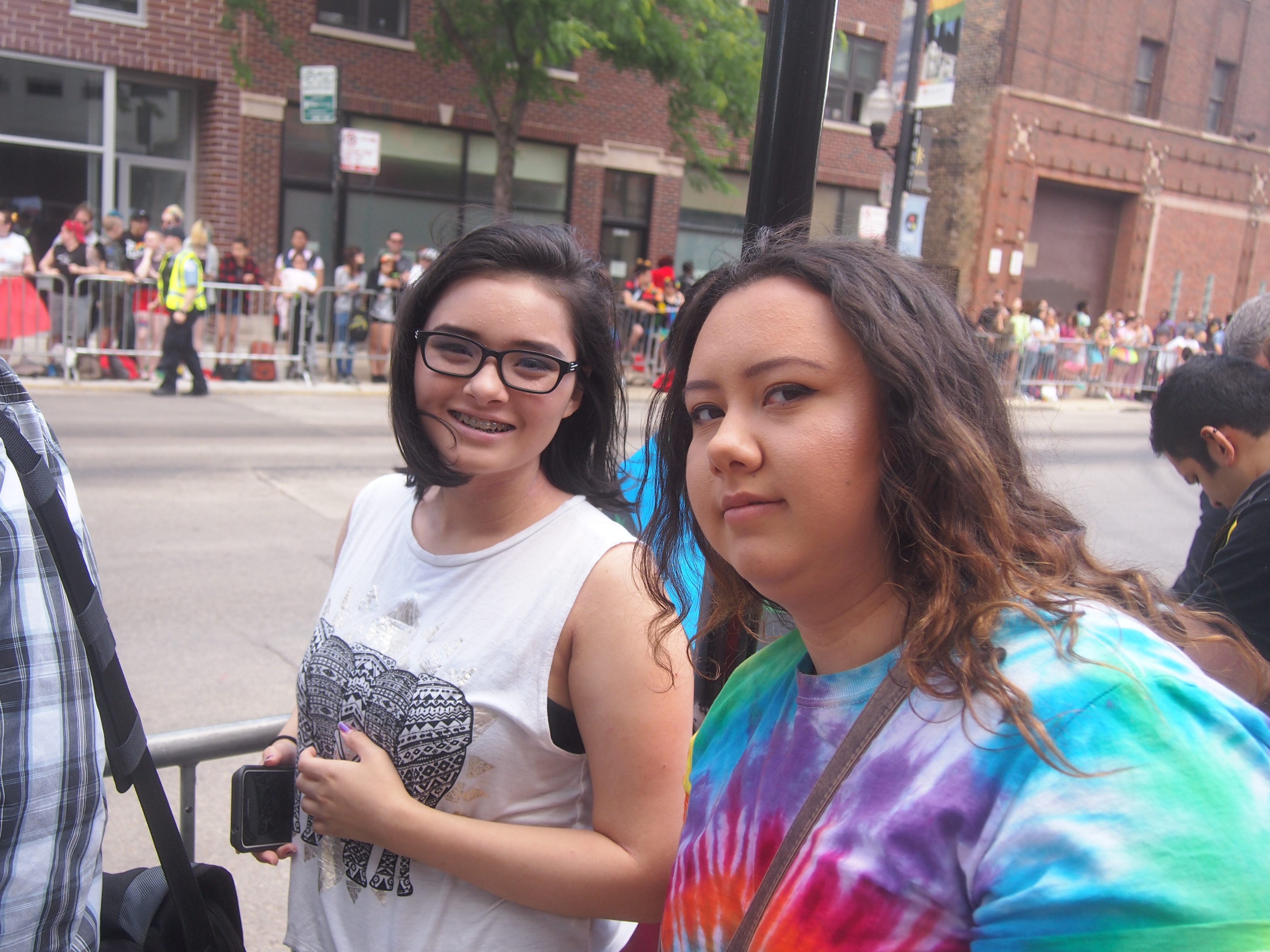
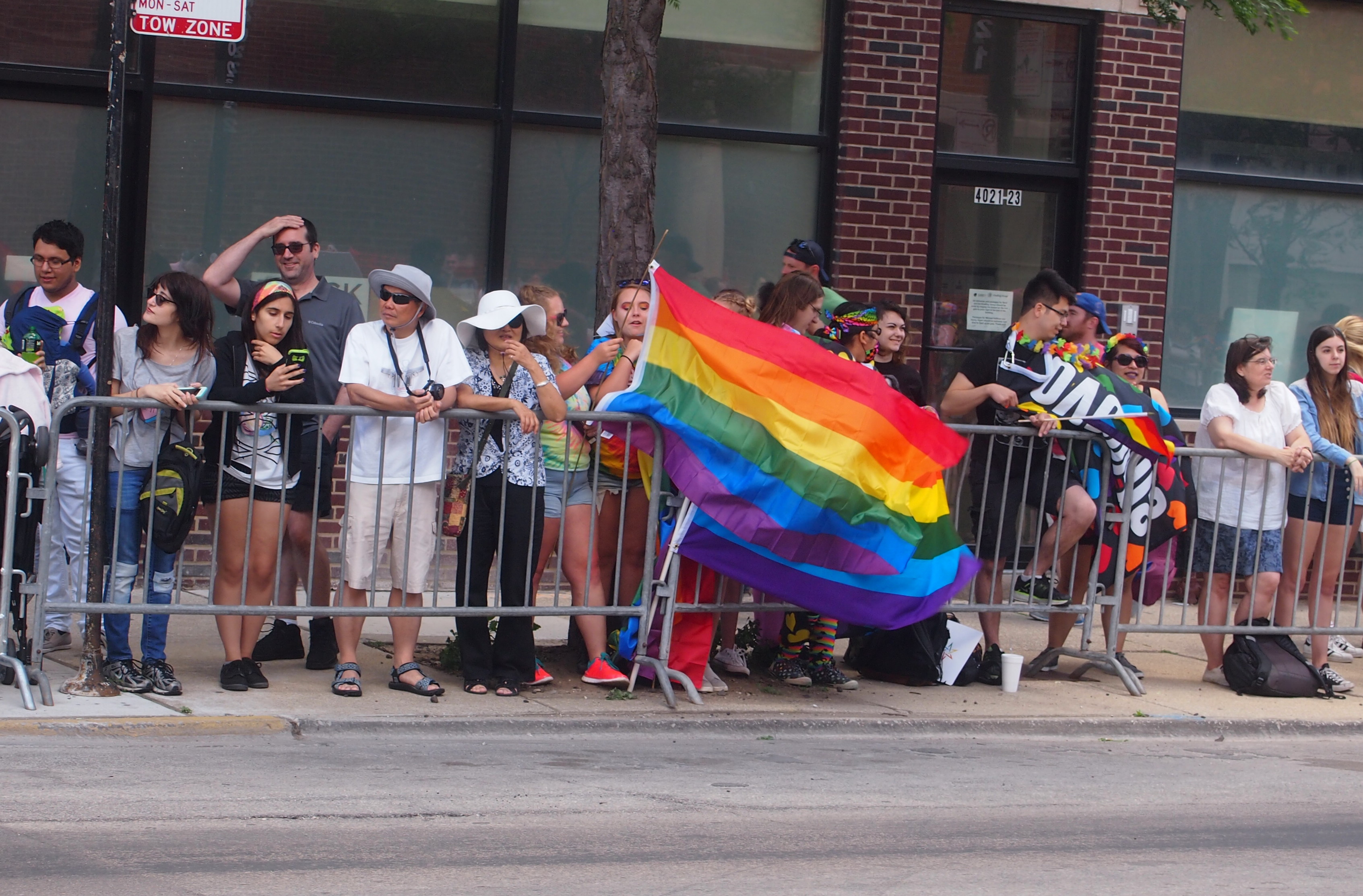
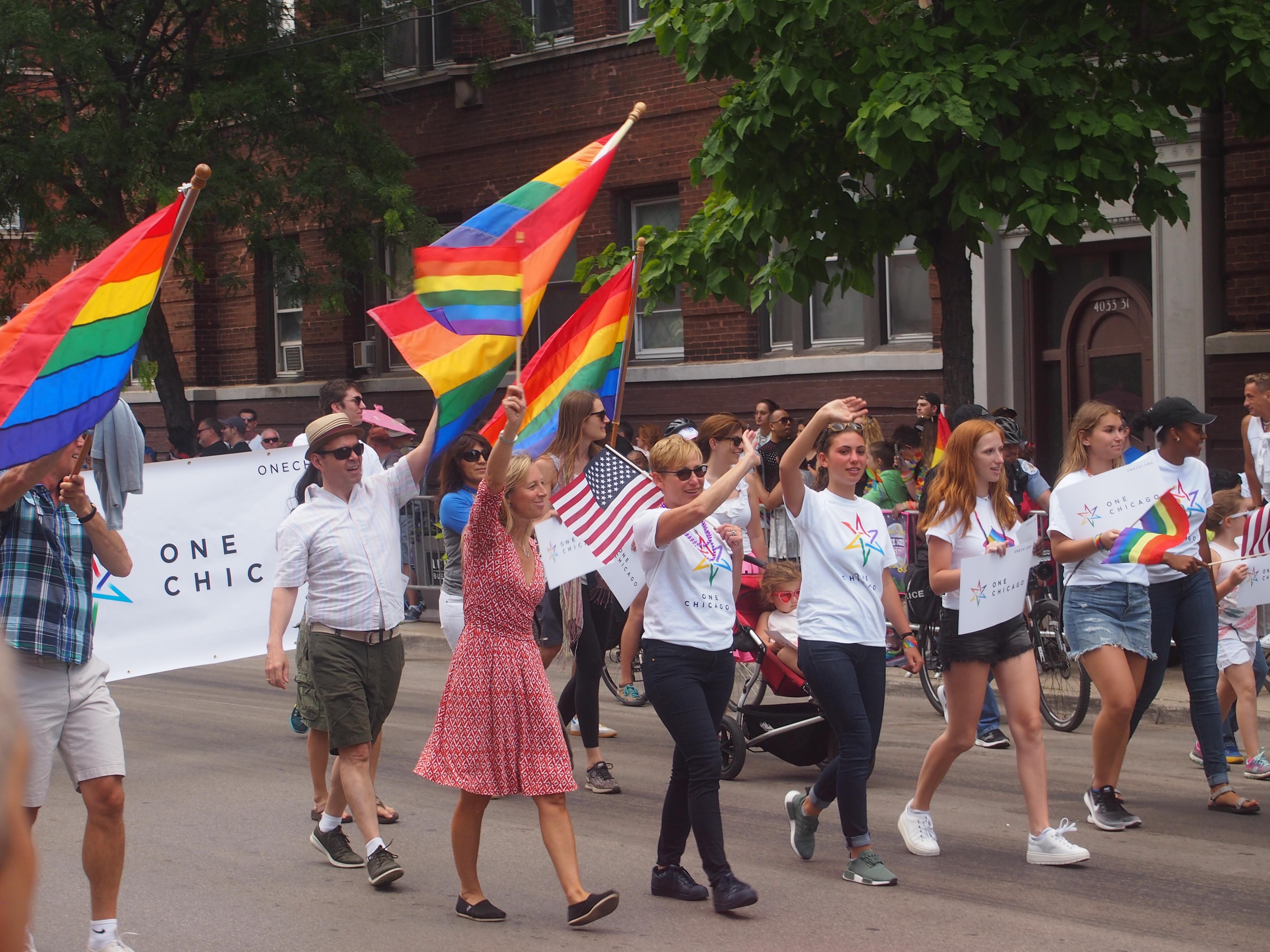
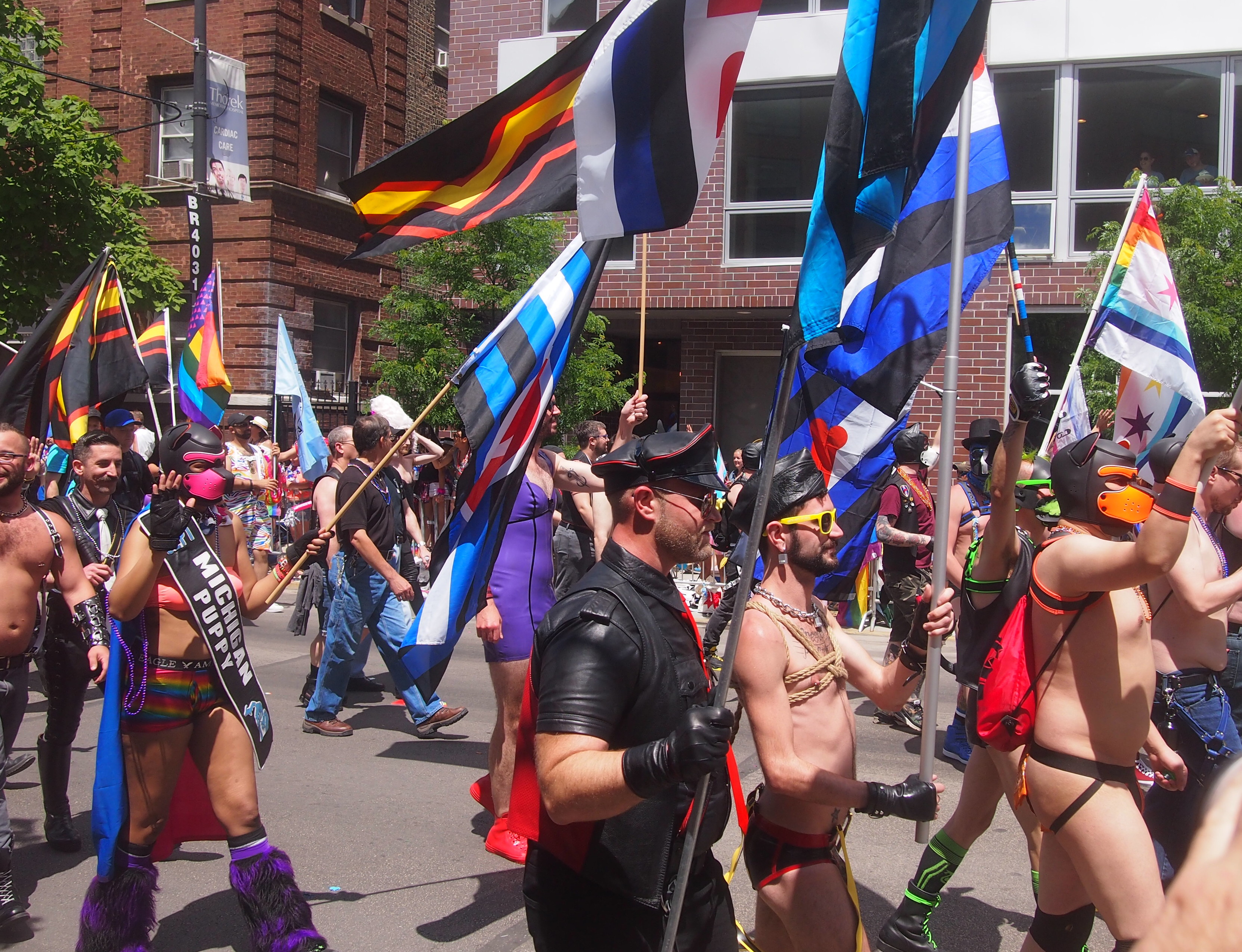
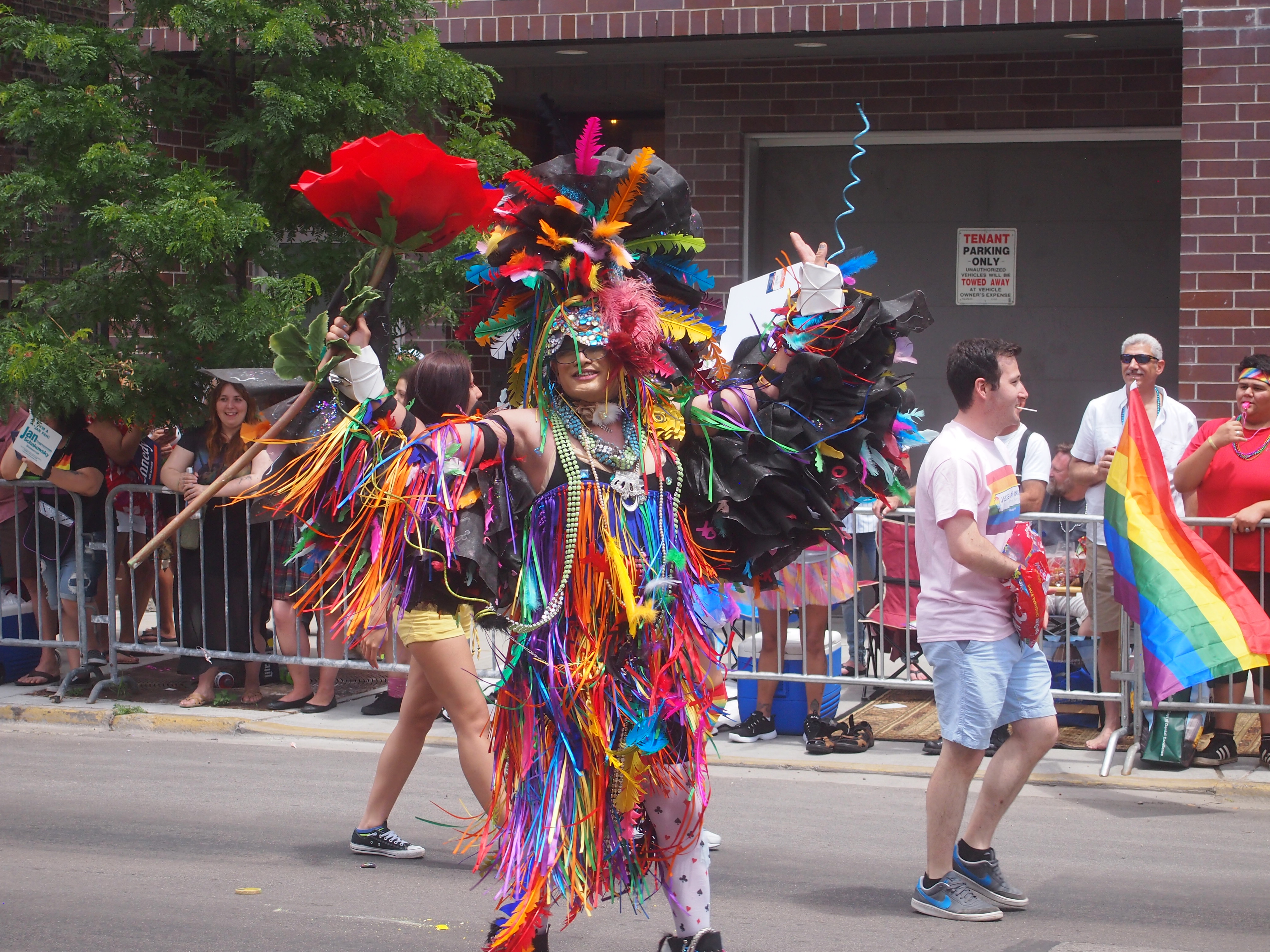
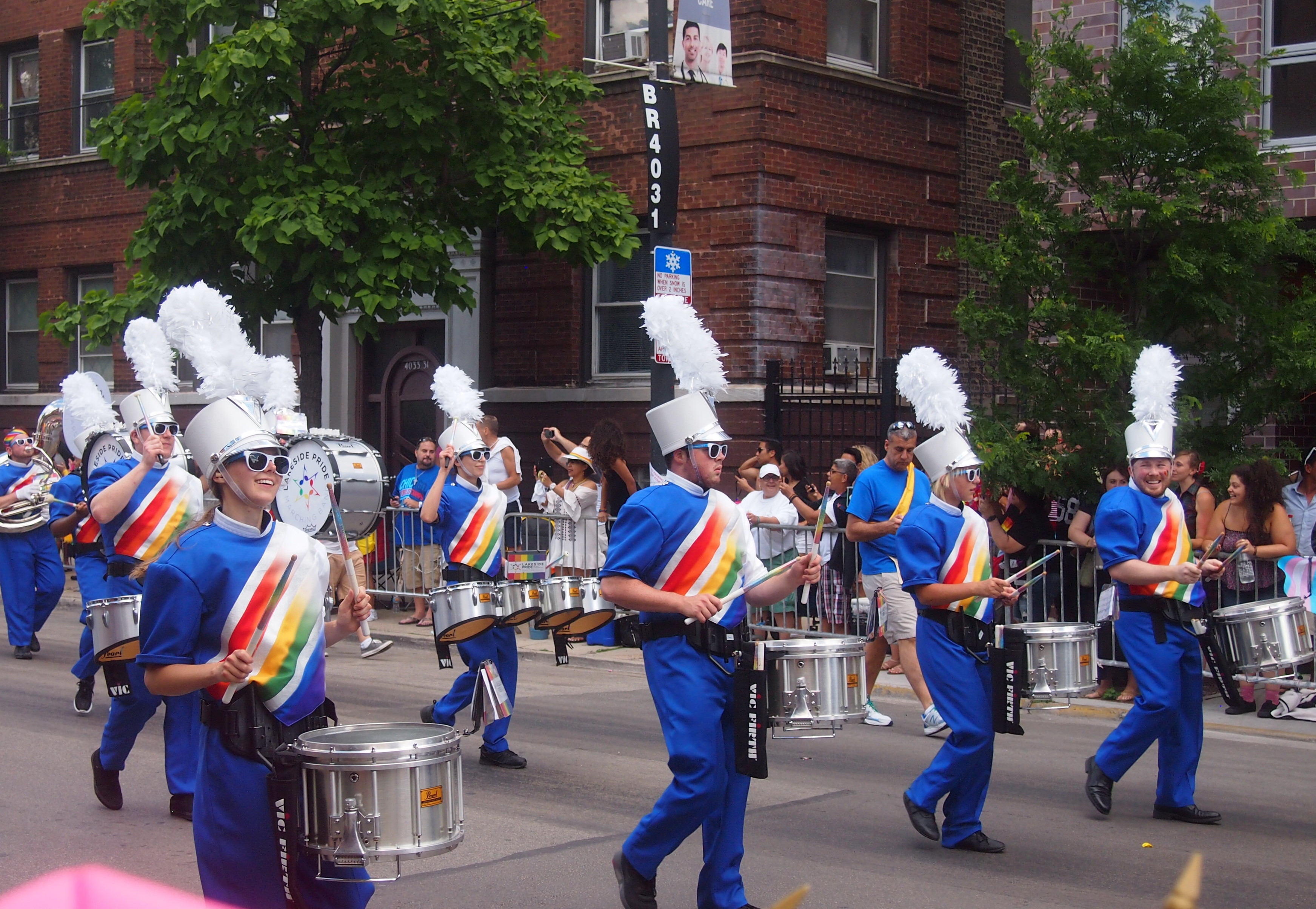
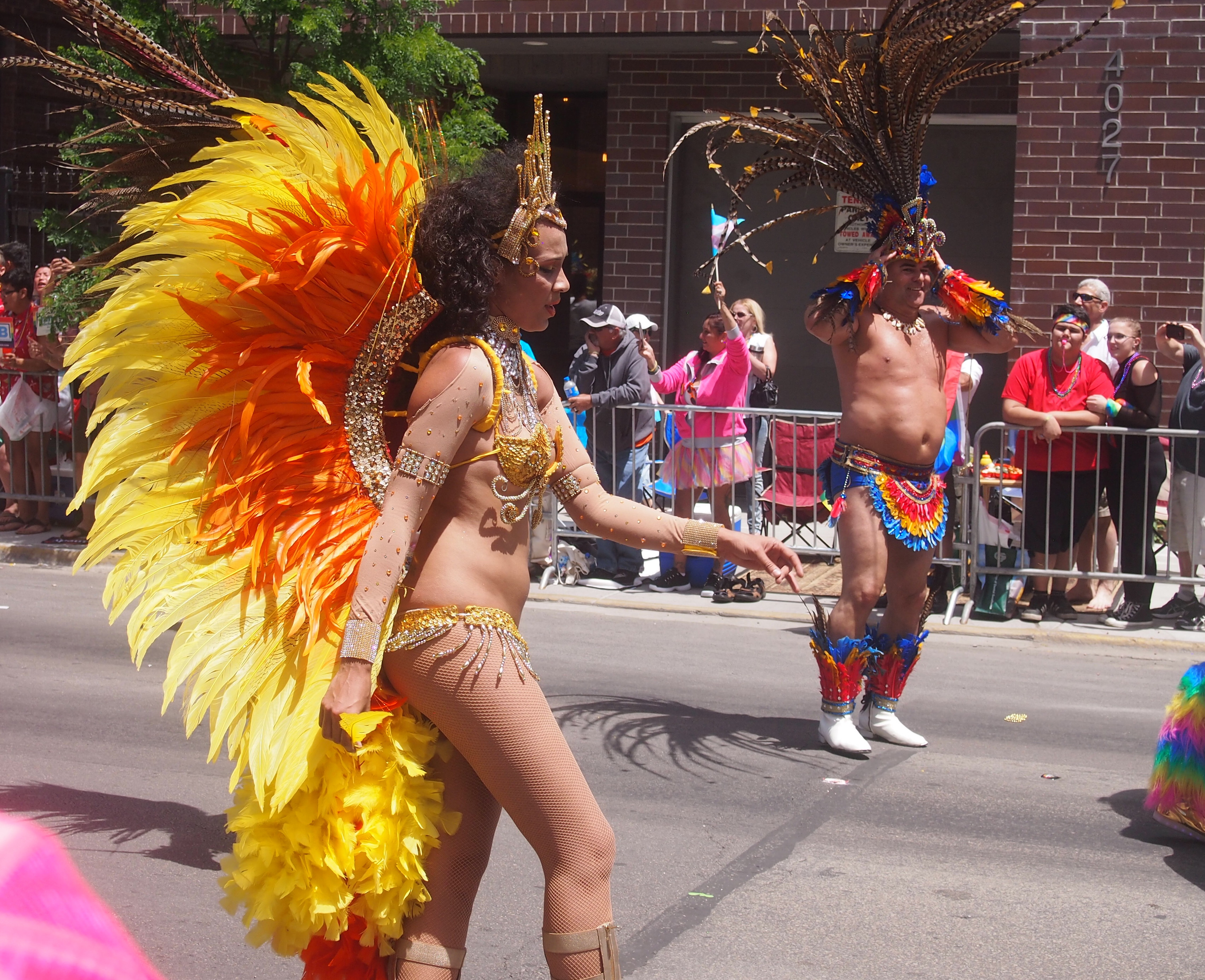
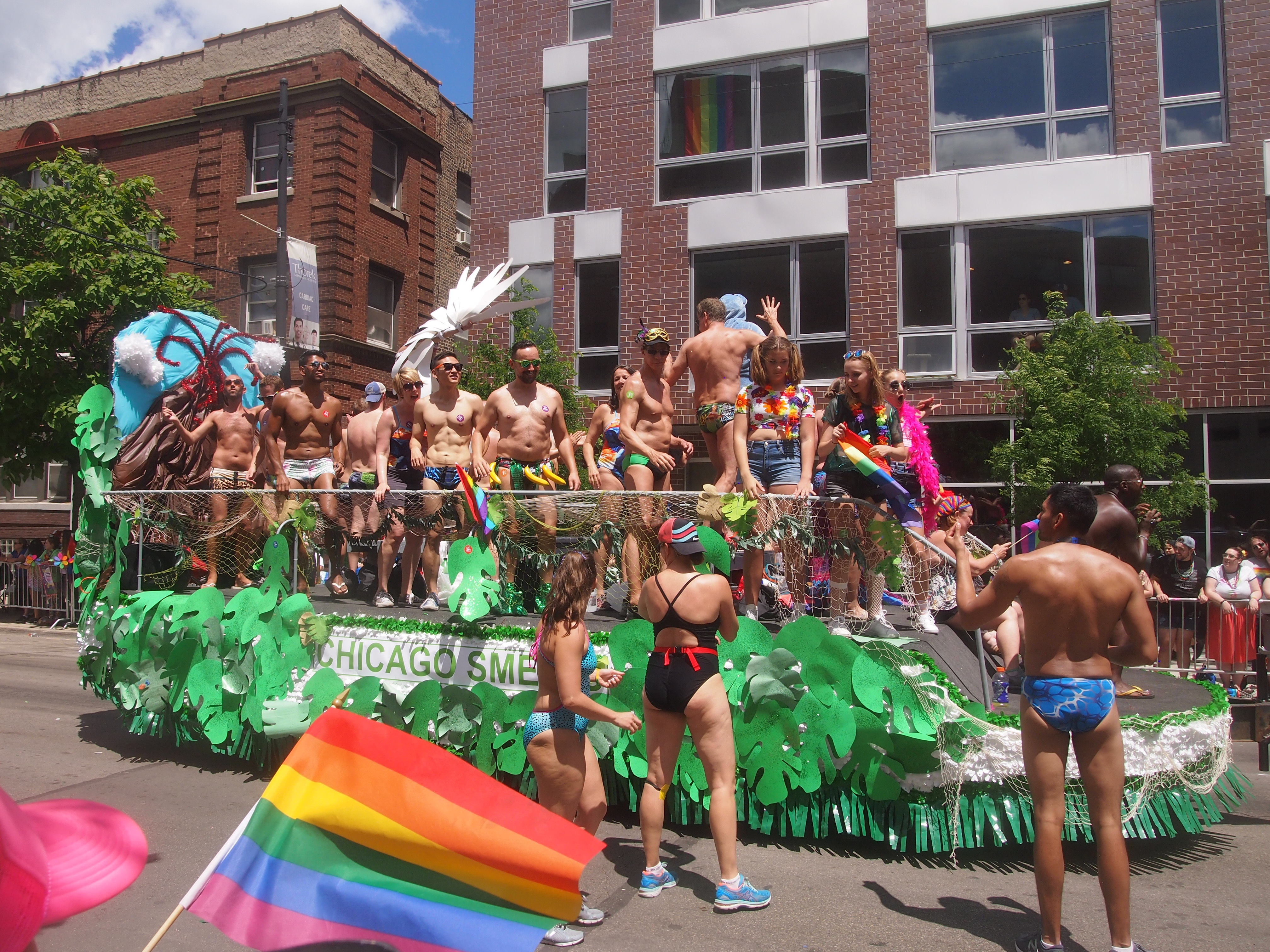
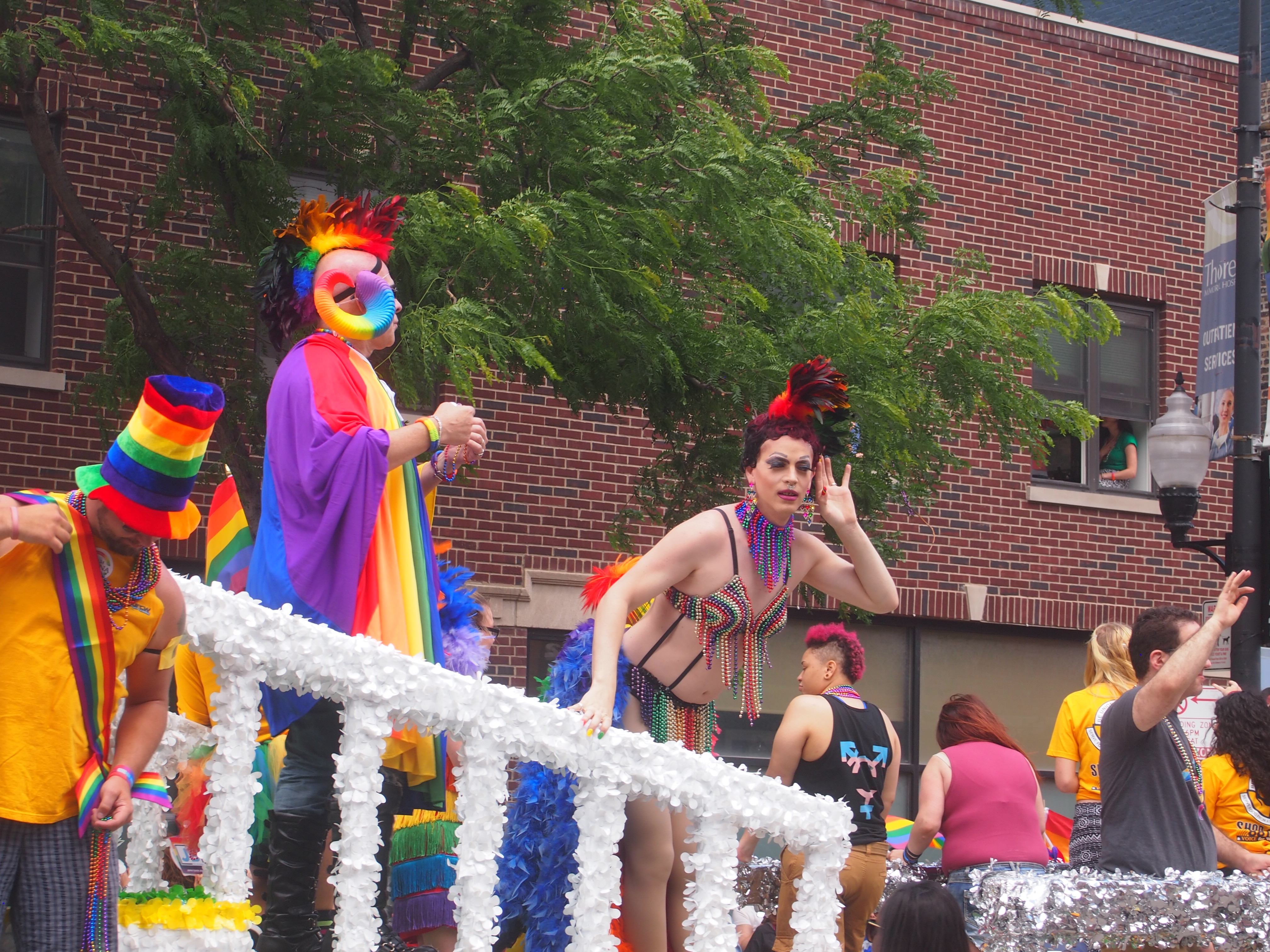
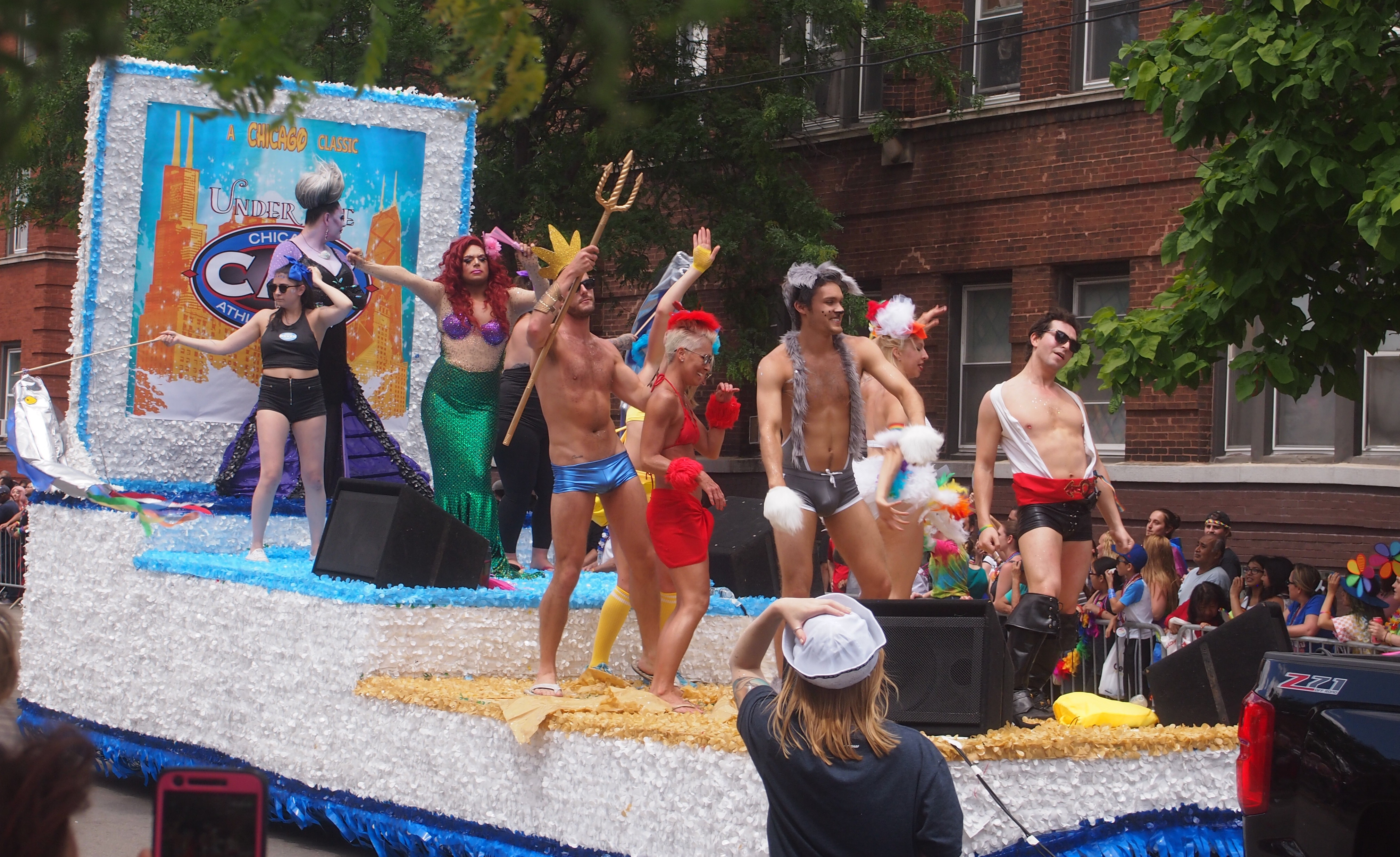
The 47th annual Chicago Pride Parade, which was held yesterday on the North Side, is easily the most colorful parade I’ve ever seen.Chicago Pride Parade 2017And the most exuberant since the Greenwich Village Halloween Parade. The girls and I posted ourselves on the west side of Broadway, a few blocks north of Irving Park Blvd., toward the beginning of the parade route.That area had the advantage of a relatively thin line of spectators, at least compared to what the crowds must have been like further south along North Halsted St., which is in Boystown proper.Chicago Pride Parade 2017 As it was, the girls found a spot next to the street, and I stood behind a street parking collection box, since I was tall enough to see over it without a problem. The weather was made to order for a parade, low 70 degrees F., partly cloudy, some light winds.

We were there for more than two hours, watching — and though overused, the word fits here — the diversity parade by: floats, trucks, buses, motorcycles, riders, dancers, and walkers with private organizations and clubs, public agencies, corporations, churches, synagogues, advocacy groups, and entities without easy definition.

Sound systems provided most of the music, though there were a few bands, with the paraders and parade-watchers not shy about making their own noise. Beads, candy and other trinkets were tossed freely.

All kinds of attire were part of the parade, as well it should have been.Chicago Pride Parade 2017Chicago Pride Parade 2017Chicago Pride Parade 2017Chicago Pride Parade 2017Chicago Parade Parade 2017Chicago Pride Parade 2017

Chicago Pride Parade 2017

Chicago Pride Parade 2017

Chicago Pride Parade 2017

Chicago Pride Parade 2017

Various politicos were on hand, including aldermen, other local officials, state office holders, and a number of candidates for governor. U.S. Sen. Tammy Duckworth rode by.Chicago Pride Parade 2017 - Tammy Duckworth

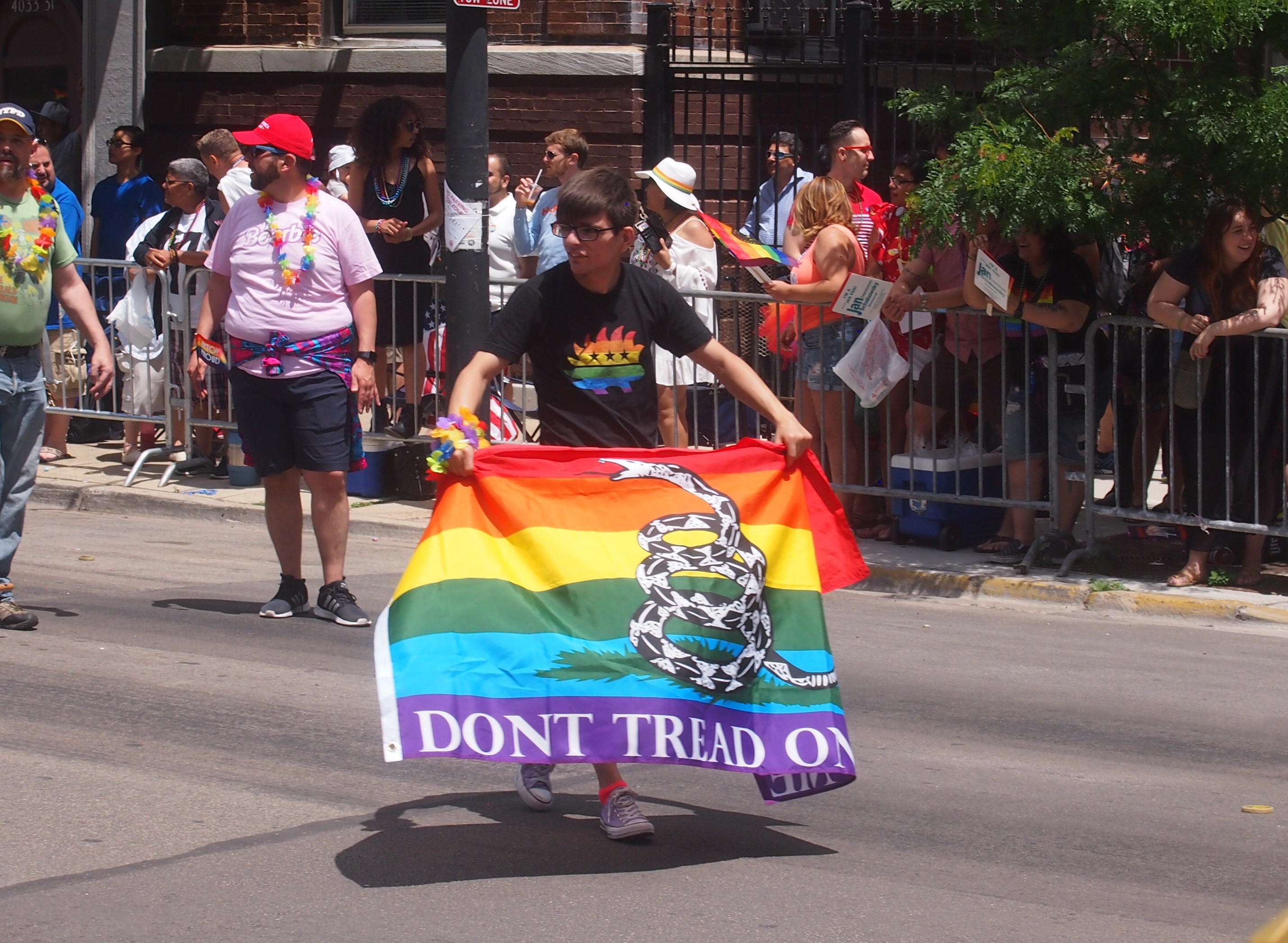
The standard rainbow flag was ubiquitous, but I also saw a few less familiar designs, such as a Libertarian rainbow and a Star of David rainbow.

Chicago Pride Parade 2017There was less political content than I expected, but there was some.
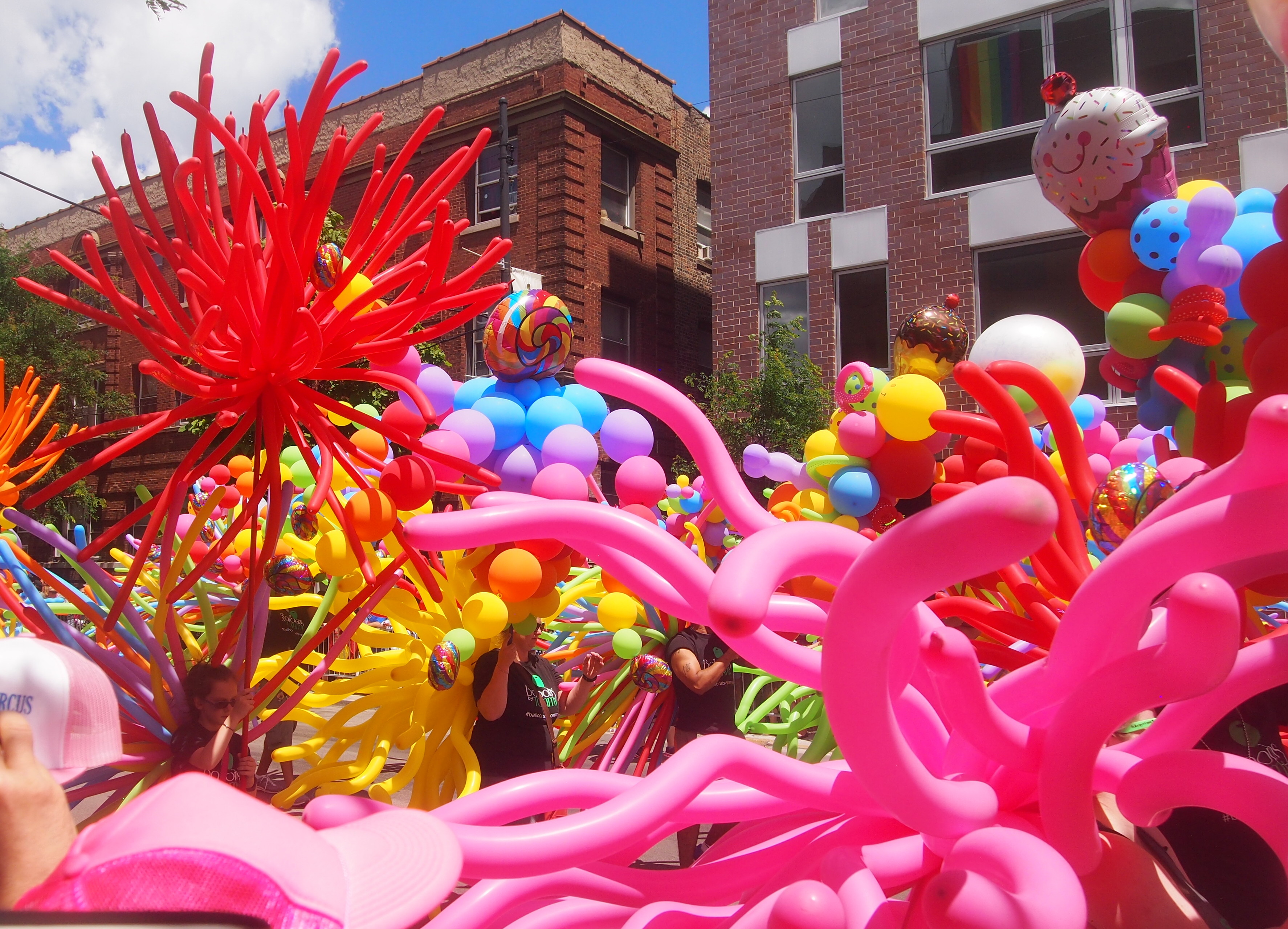
Chicago Pride Parade 2017Mostly the event had the feel of a big party, rather than a protest. With a party comes balloons. A lot of balloons. I’ve never seen such a concentration of balloons, many of them attached in some way to parade-walkers.Chicago Pride Parade 2017

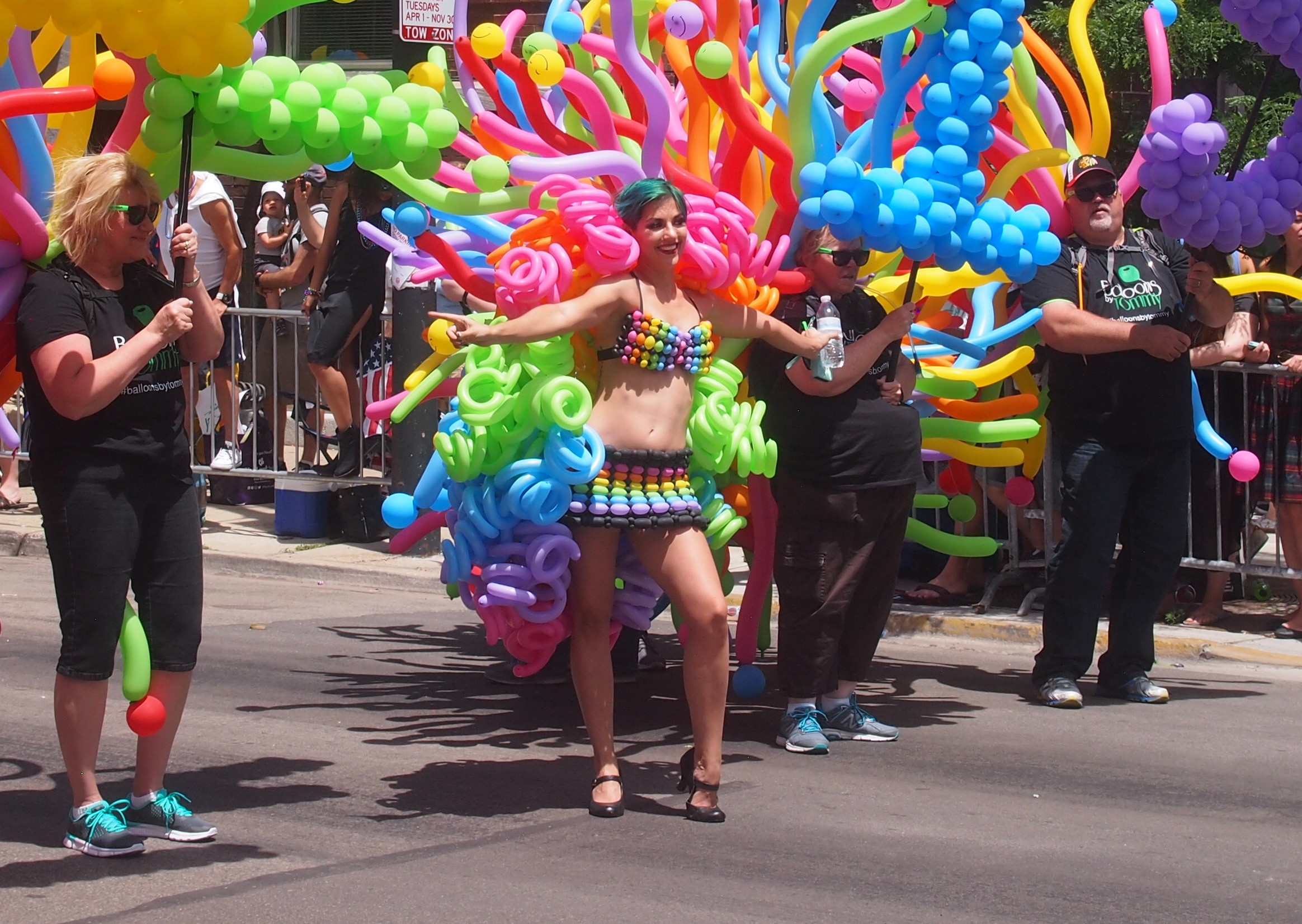
More than mere attachments, there were also examples of balloon-wear.
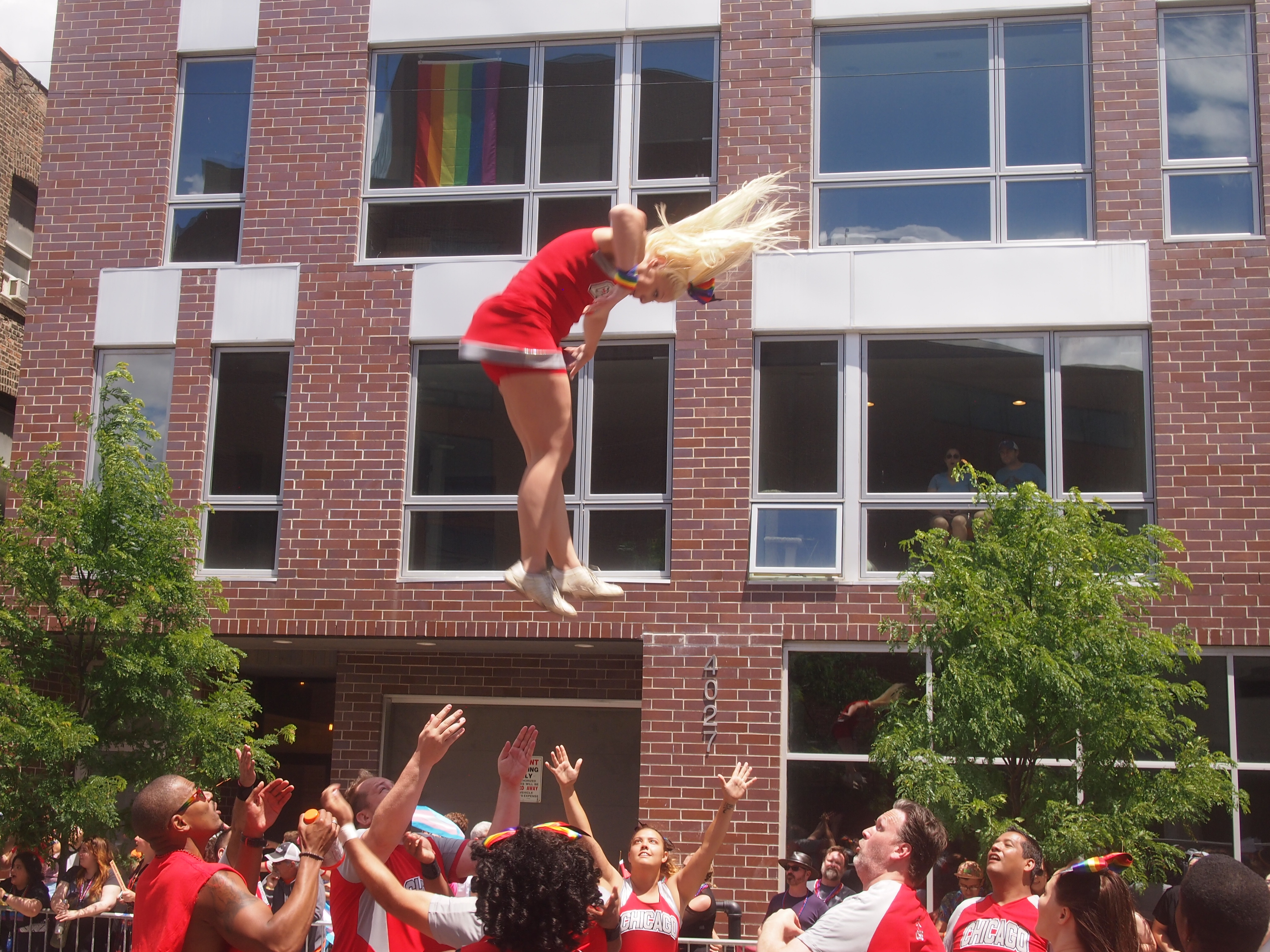
Chicago Pride Parade 2017Some floats blasted confetti, too.Chicago Pride Parade 2017There was an acrobat, tossed into the air suddenly.Chicago Pride Parade 2017Glad they caught her. Him. The acrobat.

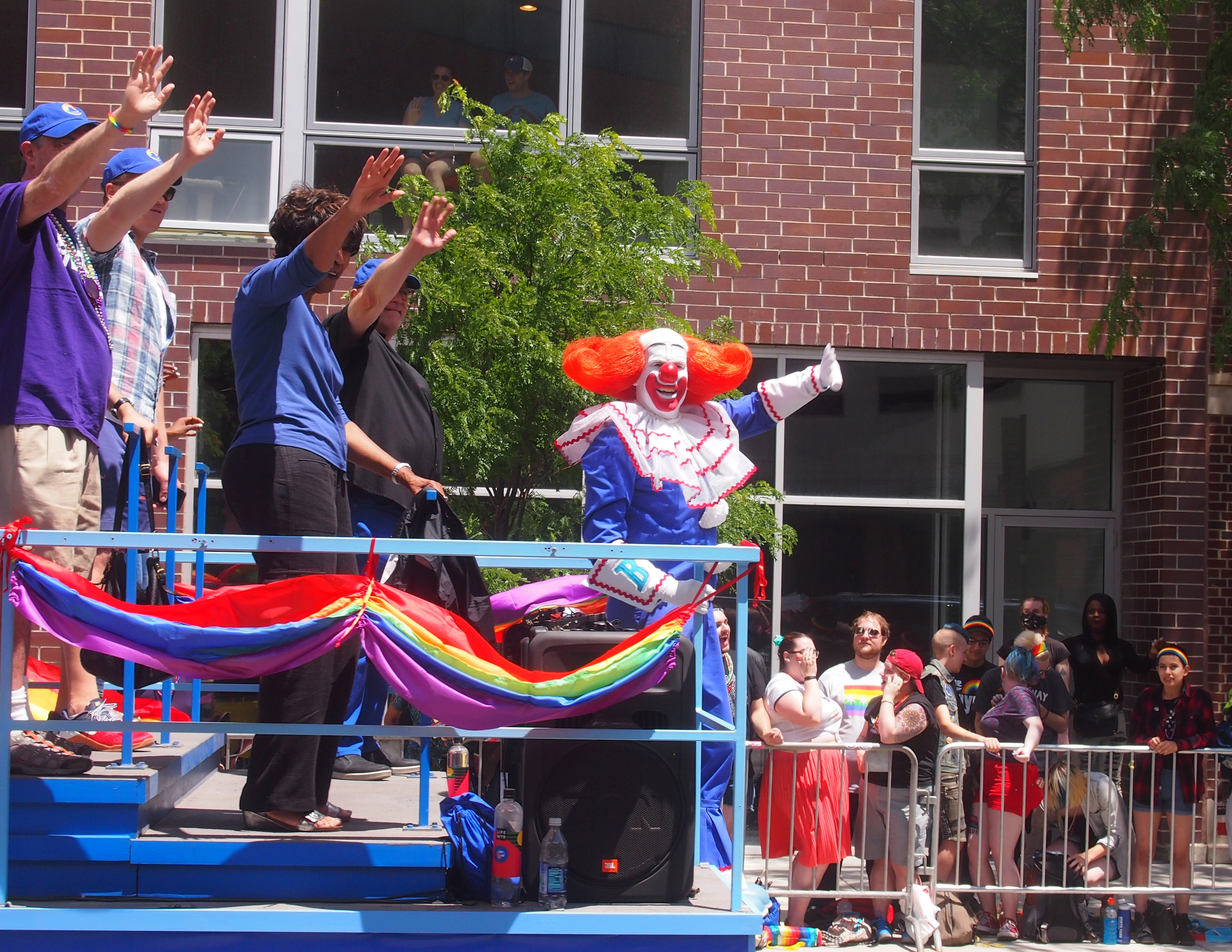
Who was this bozo? Bozo, of course.
Chicago Pride Parade 2017For once not the most colorful attendee of the parade.

Ravinia Circular ’17

We received the 2017 Ravinia Festival circular in the mail recently. Like last year, I decided to check to see whose tickets command the biggest bucks at the storied north suburban outdoor venue. Last year was something of a mystery, but never mind. This year, less so, at least in my opinion, but in any case at a price I’m unwilling to pay.

Who are the top draws? Performers commanding more than $100 for reserved pavilion seats include Willie Nelson, Aretha Franklin, Sammy Hager, Common, Diana Krall, Moody Blues, Sheryl Crow, Joshua Bell, Lang Lang, Tony Bennett, Darius Rucker, Santana, Alanis Morissette, John Mellencamp, Frankie Valli, and Stevie Nicks.

My reaction to the entertainers on the list is hm, interesting; or, they’re still around (alive)?; or who? All first-water performers, no doubt, but no one should charge that much, at least according to the Elvis Test, which I’m sure I’ve mentioned before.

Note the prices on these 1957 Elvis posters. Prices vary, but $3 is toward the upper end. Accounting for inflation over the last 60 years, $3 then = $26.31 in our time. Add another $5 or so because sound systems are so much better now, and another $5 because Ravinia is such a nice place, and needs to be maintained. I’ll even throw in a few more dollars just to round things up. So no ticket for a singer should cost more than $40, because no one is better than Elvis in his prime. A ridiculous idea, maybe, but I like it.

Who gets less than $40 at Ravinia? This year, the CSO for some of its concerts, and a scattering of classical performers. But I will say this for Ravinia: some of the lawn seats for its concerts, which is the place to be anyway unless it’s raining, are reasonable at $10 (though they’re jacked up during A-list concerts).

The top draw this year, according to the accountants, is Stevie Nicks at $200. She’s pushing 70 pretty hard these days, and I hope she’s as mellifluous as she was when I saw Fleetwood Mac on August 17, 1980, at the HemisFair Arena. No doubt her 2017 show would push all the right nostalgia buttons. But I can find ways to do that for a lot less.

Al Stewart at City Winery

Considering his longstanding love of wine, it seemed fitting that Al Stewart appeared at City Winery in Chicago last Thursday. I don’t share his oenophilia — I like the idea of wine more than wine itself — but I can appreciate an enthusiasm like that. Still, it didn’t matter to me exactly where he was playing. Some time ago, I decided to catch his shows whenever they were convenient to where I happened to be, and anywhere in the Chicago area is close enough.

City Winery is a relatively new place, taking its current form on the near West Side of Chicago only in 2012, and as such, it was a pioneering venue in that part of the city. Just before the music started, an announcer said, “City Winery’s not just a kitschy name. We actually make wine here. All those barrels in the back are filled with our wine, aging for your consumption.”

Carefully stowed barrels dominate the back of City Winery’s music room. The place also has a number of other rooms, including a large restaurant space forming the front of the building. All together, it’s a handsome interior space, characterized by brick walls and barrels and bottles, and the acoustics are good.

I’ve seen Stewart with a band, with sidemen, and by himself. This time, he had a band backing him, the young but talented Empty Pockets. They did a set before Stewart came out, including a fine version of “Fever.” The band’s relative youth caused Stewart to marvel at one point that he was being backed by musicians who weren’t born when the music they were playing came out, but who had the jam down pat anyway. That wouldn’t be quite so remarkable in a classical or jazz context, but I suppose it still is in popular music.

Though not a member of Empty Pockets, sax man (and flautist) Marc Macisso joined Stewart and the band for the concert too. He blew his sax like a man possessed, and did a fine job on the flute as well. On a number of Al Stewart songs, the sax is a defining sound, so it was good Macisso was on hand. He reminded me of the saxophonist who killed it with Stewart during his 1989 Park West concert, who might have been Phil Kenzie (who played on the record Stewart was promoting at the time), though I’m not sure.

The set list for the City Winery concert was different than any other of his that I’ve seen. After a handful of songs — “Sirens of Titan,” “Antarctica,” “Time Passages” — Stewart and the band played all of the songs from the album Year of the Cat in order.

The bonus was Stewart’s usual entertaining patter between the songs. “This brings me to Year of the Cat,” he said by way of introducing the songs. “It was a shock for me. I was an English folk singer playing in coffee bars, and all of the sudden people bought this thing, and I wasn’t sure why. I did begin on a very commercial note by writing a song about an English seafarer from 1591, Richard Grenville. This is a subject that most disco artists at the time were embracing.”

Stewart was being coy. If ever he did a polished commercial record, it was Year of the Cat (except maybe Last Days of the Century, which wasn’t as good). Alan Parsons produced Year, after all. The first song, “Lord Grenville,” does indeed mention Richard Grenville. He of “Out-gunned, out-fought, and out-numbered fifty-three to one.” I believe listening to the song in 1976 was the first time I’d ever heard of him.

About the next song — “On the Border,” a favorite of mine since I acquired the record 40 years ago — he said, “I thought we’d continue with mass popular appeal by doing a song about the Basque separatist movement, the crisis in Rhodesia and the fall of the British Empire, and amazingly this one actually made the top 40. I have no idea how that was possible. I can only assume the disk jockeys didn’t listen to the lyrics.”
For a long time I thought the song was about the Spanish Civil War, but I’ll defer to the songwriter. But it doesn’t really have to be about anything so specific.

Regarding “If It Doesn’t Come Naturally, Leave It” — my least favorite cut on the record — he said, “It has far too many words. If I’d known when I was 30 that I’d be singing it when I was 70, I’d have written half as many words.”

Stewart said that his favorite song on the album is “Flying Sorcery,” which was not top 40, but a fine tune all the same. “It concerns two lovers. I turned them into airplanes. They take off from the same airport but they get caught up in a fog bank and land at separate airports. Obviously that means they’re breaking up.”

I never quite took that from the song, but no matter. It has some wonderful lyrics, including, “You were taking off in Tiger Moths/Your wings against the brush-strokes of the day.” The brush-strokes of the day. What a way to describe the sky. It occurs to me that he’s done other songs with aeronautic images (not on Year), such as “The Immelman Turn” and “Fields of France.” (“When Lindy Comes to Town” talks about flight, too, but it’s a particular historic event.)

He mentioned some alternate lyrics to the song “Year of the Cat,” though not in as much detail as recorded on this Songfacts page, based on a 2015 performance. I think everyone was pretty glad that the final lyrics came out the way they did, including Stewart.

On the whole, Al Stewart was in fine fettle on Thursday. His voice is still clear and his guitar playing is impressively energetic for a man of 71. He also seems to enjoy himself thoroughly on stage, which must be why he still tours. Hope he’s got more years yet.