Heavy Rain, Then Sudden Fireworks

After posting yesterday, we had more fierce rain, until it finally petered out around 9 pm. At about 9:50, I started hearing pop-pop-pop-BOOM-pop-crackle-bang-pop-pop. As in, fireworks. Private fireworks, not a large public display, as people shoot off on the Fourth of July or New Year’s, neither of which was yesterday. Is that really fireworks, I wondered, or some kind of bizarre thunder? What’s going here?

Soon I figured out that the Blackhawks must have won the Stanley Cup. Pull up Google News and sure enough, they had. Then I heard some yelling in the street by some happy knuckleheads, something that almost never happens in the suburbs. I don’t remember that happening the last time Hawks won, or the time before, but maybe I wasn’t paying attention.

I do remember fireworks and — possibly — distant gunshots when the Bulls won one of their championships in 1997. I figured it was a good time to stay home, which we did. Anyway, it’s been a long time since I got news via fireworks. Odd how things come to one’s attention sometimes.

Or not. I didn’t hear until yesterday that Ronnie Gilbert had died. Time to look at the Weavers’ 1951 videos, made for Snader Telescriptions. Been a while since I’d seen them, and before the age of YouTube, I never had.

Oddly enough, I found out that Blaze Starr — a different sort of entertainer — had died almost as soon as the news was out, by a mention in an email, of all things. That was a case of, she was still alive? (But I knew Ronnie Gilbert was; now there’s only one original Weaver left.)

Maybe I need to pay more attention to this constantly updated Roll of Death, which could also be called the Death Never Takes a Holiday List. If I had, I’d have known about not only Ronnie Gilbert, but also Tiffany Two.

Thursday Squibs

Sometimes at the bank I get a roll of dollar coins, which totals 25 all together. These days, most of them are presidential dollars, though some Sacagaweas and Susies are usually mixed in. Since the presidents after Garfield have relatively low mintage — Garfield had a total of 74.2 million from both mints, while Arthur had only about 10 million — it’s rare to see one of the later presidents. This week, a TR coin turned up (one of 9.2 million minted) in a roll. In worn condition. Odd.

“What’s syncopation?” Lilly asked recently. Being in band, I thought she’d know that. Maybe not. I learned about it in high school, but when she asked I realized I’d forgotten how to describe it. Just what YouTube is for: this is a lucid explanation, and he even makes Philip Glass a little more interesting.

In line at a grocery store the other day, a man behind me was carrying on a vigorous conversation on his phone. Nothing unusual about that anymore, unlike the day in 1989 when I saw a woman pull a brick of a phone from her purse at the McDonald’s that used to be on the Mag Mile and start talking into it. Overhearing one side of a call these days might even be annoying, depending on the conversation.

I couldn’t pin down his language. It didn’t quite sound like Russian, but it was some kind of Slavic tongue. Maybe Ukrainian. Anyway, he had a good voice, so I listened. There wasn’t much else to do in line anyway. Then I started to notice: talktalktalktalk OK talktalktalk OK talktalktalktalktalktalktalk OK talktalktalktalktalktalk OK.

I know OK is practically universal. (Or do the French resist?) That wasn’t a surprise. Still, I marveled that a bit of 1830s American slang, whose origin even now isn’t quite certain, has traveled so far. So naturally did he use the word, it might as well have been native from his point of view.

New fact for the day (a couple of weeks ago for me, when I learned it): Neil Diamond wrote “Red, Red Wine.” A strange notion at first, but then again he’s written other songs with an alcohol motif. Then I learned that that’s his actual birth name: Neil Diamond, son of Akeeba and Rose Diamond of Brooklyn. It always sounded like a stage name to me.

In Branson in 2012 I met a fellow whose act was a Neil Diamond impersonation (tribute, as they say). He had the enormous mane and the good looks of young Neil Diamond, but I didn’t get to hear whether he had similarly impressive pipes. I’d hope so.

The last episode of Mad Men is on Sunday. A lot of shows now have last episodes, so it isn’t quite like the novelty of watching the end of The Fugitive (which I don’t remember) or even, come to think of it, The Mary Tyler Moore Show (which I do). Here’s an interesting essay about final shows, though maybe covering something that doesn’t really deserve an essay, namely the last episode of Hogan’s Heroes.

Still, I’ll be watching Mad Men. If only to see whether Roger Sterling gets one more funny line or scene.

Summer Interlude

Summertime and the living is — not so different from the rest of the year, considering that we have climate control in the house, have to meet the same deadlines as the rest of the year, and so on.

Time for summer break anyway. Back to posting around July 27. Till then, a handful of summer tunes. Been fond of “Summer Wind,” sung by Sinatra, only since the late ’80s, when I acquired a tape of Strangers in the Night. Music by Heinz Meier and lyrics by Johnny Mercer.

I’ve known “Summer Breeze,” by Seals & Crofts, probably since it was released, or at least fairly new. It evokes a moment in summer, in particular a summer evening, without mentioning beaches or puppy love or such.

Not quite sure what’s going on in “Suddenly Last Summer,” by the Motels, but it’s to do with a particular summer. Some summers, after all, are more memorable than others, especially when you’re young.

Also, some recommended reading. I just started Arabian Sands by Wilfred Thesiger. I’m already hooked, and I haven’t even gotten to his crossings of the Empty Quarter. He’s only been dead about 10 years. The Telegraph’s obit is here, and the Guardian’s is here.

Anna Maria Alberghetti in a Wintry Mix, Honey

Another day above freezing. That’s a good thing, except for the current forecast. The following is direct from the National Weather Service, which is worthy of respect for its accuracy, but also the fact that it doesn’t fix cute names to winter storms. The NWS put out this “Special Statement” for my part of the country early this evening.

RAIN AND EVEN SOME THUNDERSTORMS WILL DEVELOP ACROSS NORTHERN ILLINOIS LATER TONIGHT. HOWEVER… TEMPERATURES ACROSS FAR NORTHERN ILLINOIS… MAINLY ALONG AND NORTH OF INTERSTATE 88… [we’re north of I-88 by a few miles] MAY REMAIN COLD ENOUGH TONIGHT FOR THIS PRECIPITATION TO BEGIN AS A WINTRY MIX OF SNOW… SLEET OR FREEZING RAIN BEFORE MUCH WARMER TEMPERATURES ARRIVE THURSDAY MORNING.

DUE TO THE FACT THAT THE PRECIPITATION COULD FALL AT A HEAVY RATE LATE TONIGHT…THIS COULD RESULT IN SOME SNOW OR ICE ACCUMULATIONS ACROSS PORTIONS OF THE AREA BY DAYBREAK THURSDAY… POSSIBLY IMPACTING THE MORNING COMMUTE.

CURRENTLY IT APPEARS THAT A COUPLE INCHES INCHES OF SNOW MAY ACCUMULATE BEFORE THE WINTRY MIX CHANGES TO ALL RAIN EARLY THURSDAY MORNING.

Odd forecast. Deuced odd, it is.

Speaking of odd, it took me nearly 40 years to get the following knock-knock joke, as told by Ted Baxter during the Sept. 13, 1975, episode of The Mary Tyler Moore Show, “Edie Gets Married.”

Not that I’ve been puzzling over it for 40 years. I’d forgotten all about it until today, walking around in the fairly pleasant afternoon air, when I thought, What did that joke about Anna Maria Alberghetti mean? Memory works in mysterious ways.

Just as unlikely, I remembered to look it up when I got home, connecting the joke to “Darktown Strutters’ Ball,” which I’d heard before – but (much) more recently than 1975. It was clearly a joke for grownups back then, back when sitcom writers actually wrote jokes for grownups.

A lot of singers have done the song. Fats Domino’s version is here.

Send More Chuck Berry

Time for another winter break. The better to admire the snow drifts and icy sidewalks and salty roads and bare trees. Back to posting around February 2 — when I’ll still be able to see those things out my window and under my feet.

I didn’t know until recently that Blind Willie Johnson’s “Dark Was the Night, Cold Was the Ground,” a fitting song for the pit of winter, was included on the Voyager Golden Record. But so it was. Dark is space, cold is the void.

This handy JPL web site tells us that Voyager I, for its part, is now 19+ billion km from the Earth, or more than 126 AU, with a round-trip light time from the Sun of more than 35 hours (so that would be about 17.5 light hours out — not even a light day). The thing’s been flying for over 36 years. Lesson: space is really big.

I did remember that “Johnny B. Goode” went with the Voyagers. Probably because of a SNL skit that mentioned it.

Kreeg Antwoord: You see, it all started on August 20th, 1977, when NASA put up a recording of the sounds of Earth on Voyager I. A two-hour long tape included natural sounds of animals, a French poem by Gaugliere, a passage from the Koran in Arabic, messages from President Carter, United Nations Secretary Kurt Waldheim, music — everything from classical to Chuck Berry.

Maxine Universe: Uh — and you’re saying that the — another civilization has found the tape?

Cocuwa: Yes. They’ve sent us a message that actually proves it. It may be just four simple words, but it is the FIRST positive proof that other intelligent beings inhabit the universe.

Maxine Universe: Uh — what are the four words, Cocuwa?

Cocuwa: The four words that came to us from outer space — the FOUR words that will appear on the cover of Time magazine next week — are [he holds up the magazine: Send More Chuck Berry].

The Greenstone Church

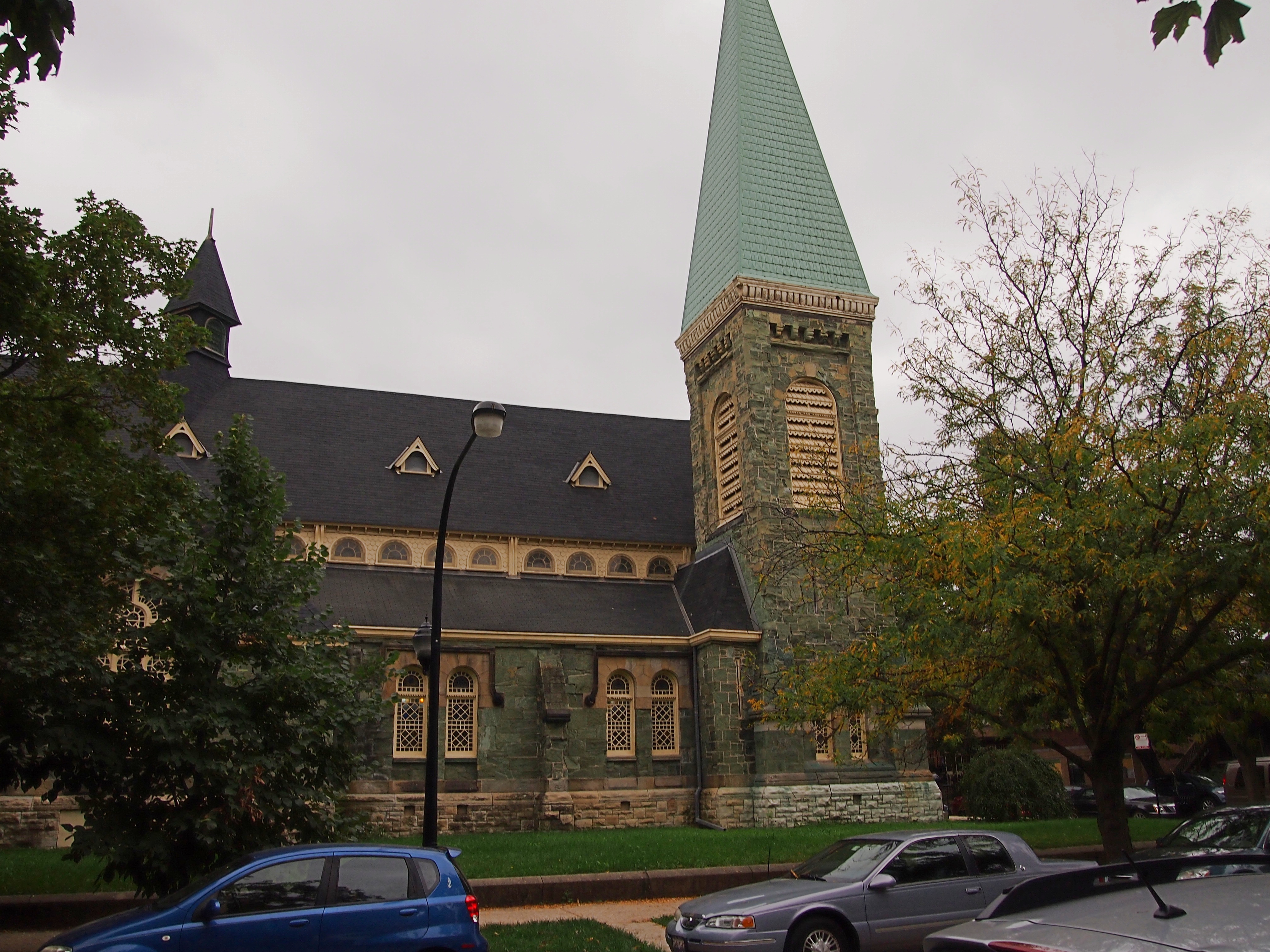
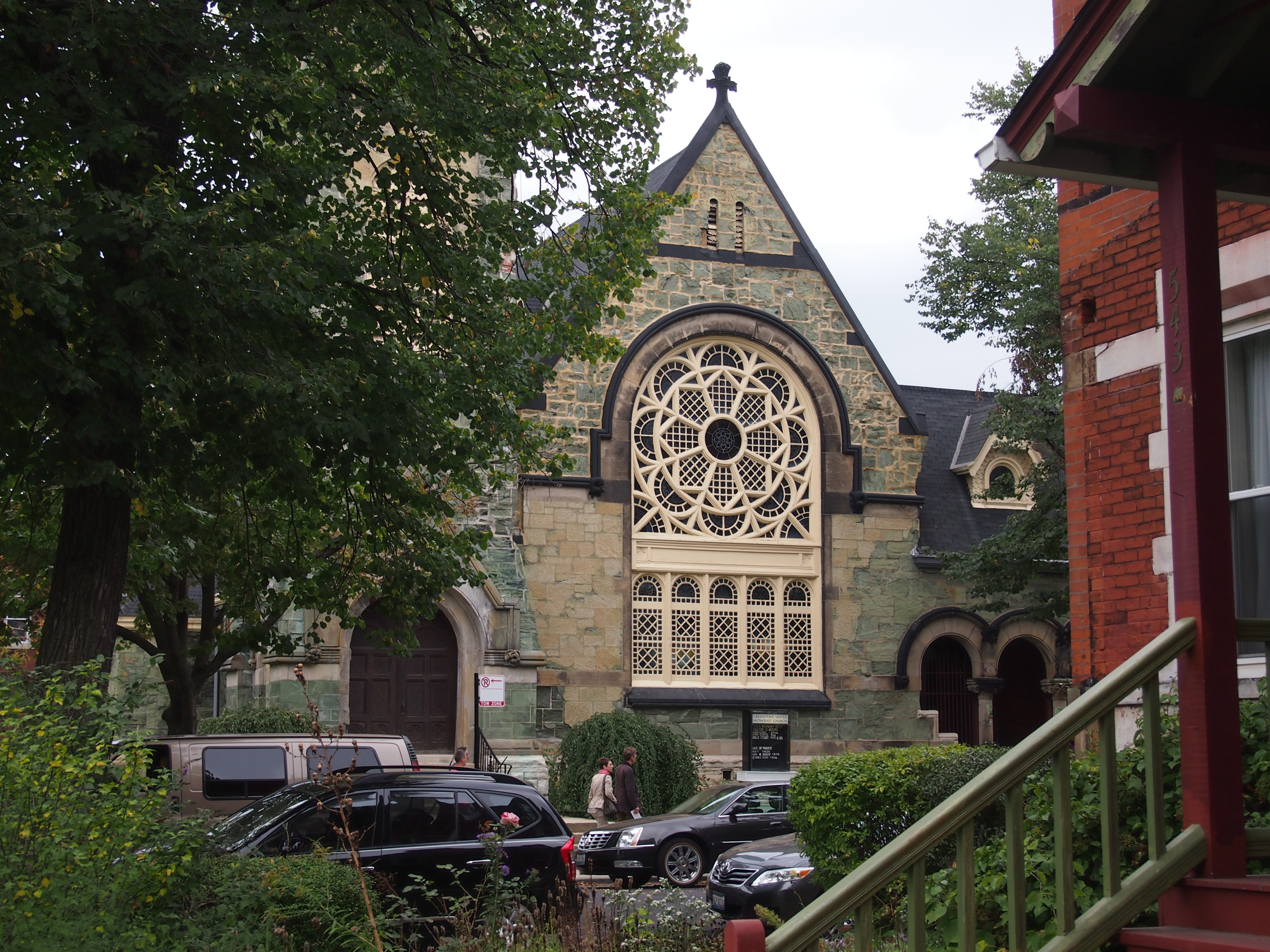
The Greenstone United Methodist Church is at the corner of 112th St. and St. Lawrence Ave. and it’s green.

Yuriko suggested it was covered with moss, but closer inspection reveals that much of the rock itself is green. Apparently it’s made of serpentine quarried in Pennsylvania. I wasn’t familiar with serpentine, so I looked into it. The 1911 Encyclopaedia Britannica says that it’s “a mineral which, in a massive and impure form, occurs on a large scale as a rock, and being commonly of variegated colour, is often cut and polished, like marble, for use as a decorative stone… Although popularly called a ‘marble,’ serpentine is essentially different from any kind of limestone, in that it is a magnesium silicate, associated however, with more or less ferrous silicate.”

Why aren’t more things built of it? Could be the expense. But it does make for a sturdy structure. Greenstone has been standing since 1882, designed by Solon Beman, who did all of Pullman. He did a number of other things – including a large number of Christian Science churches, interestingly enough – but he’s best known for Pullman.

Back in the days of Mr. Pullman, the structure was built as a Unitarian Church “for all to unite in a union body and get a broad-minded evangelical clergyman,” according to the Pullman Foundation. That dog didn’t hunt, with each denomination going its own way in rented space elsewhere. It also didn’t help that rent was high at Greenstone. In 1907, a decade after Pullman and his company ceased to own the property, Methodists acquired it.

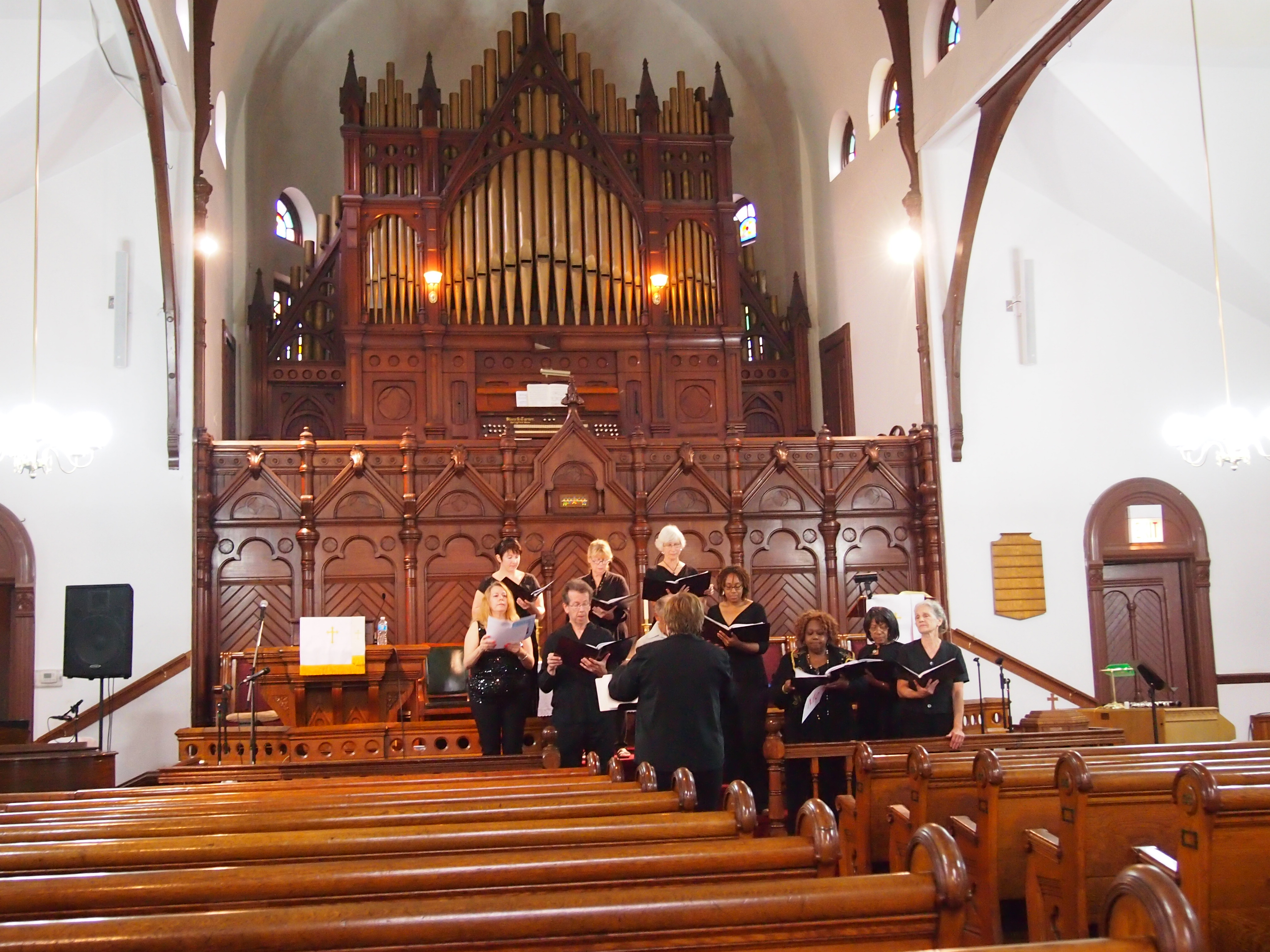
The inside is modestly adorned, with its original cherry wood pews. I’m sorry I didn’t get to hear the organ.

Again from the Pullman Foundation: “The organ was built in 1882 by the distinguished firm of Steere and Turner as their Opus #170. It is one of the few manual tracker organs remaining in the United States… The organ contains 1,260 pipes ranging in size from the large front pipes to others the size of a pencil. It consists of two manuals for the hands, one for the feet, twenty-one stops and twenty-three ranks of pipes, three couplers and a twenty-seven note-pedal board.”

I don’t know a lot about organs, but that sounds fancy. The foundation further says that “its tracker action means that the valves are mechanically linked to the keys and are directly activated by the organist’s hands and feet. Most organs have an electrical system which eliminates this direct link between the keys and pipes. Today’s organists find playing this organ a physically demanding but emotionally satisfying act.” No organ for old men, you could say.

On ira pendre notre linge sur le ligne Siegfried

Another very warm, practically hot day. Sure, you can use the air conditioner in your car on days like today, but when I was driving along around 1 p.m., I kept the windows down and blasted myself with warm air. Pretty soon driving will be complicated by snow and ice, so I want to feel the warmth, even the sweaty heat, right now.

Ah, these warm days of September. Makes you think about the Sitzkrieg, doesn’t it? No? I might not have either, but not long ago I happened across the bilingual “On ira pendre notre linge sur le ligne Siegfried” (“I’m Going to Hang Out the Washing on the Siegfried Line”), a song I wasn’t familiar with. I like finding moment-specific songs — in this case, the Sitzkrieg — that have been lost to time. (Like this one and this one.)

This version was by French band leader Ray Ventura. Irish songwriter Jimmy Kennedy wrote it. His 1984 NYT obituary noted that “Mr. Kennedy’s songwriting career spanned 50 years. His familiar songs included ‘The Hokey-Cokey’ (which was popular as the Hokey-Pokey dance in the United States) ‘Teddy Bear’s Picnic’ and ‘I’m Going to Hang Out the Washing on the Siegfried Line.’ ”

Odd to think that someone actually wrote “The Hokey-Pokey” and “Teddy Bear’s Picnic,” (Bears’?) though of course someone did. Someone named Jimmy. Songs like that just seem to emerge from the woodwork.

The Leland & The Aurora

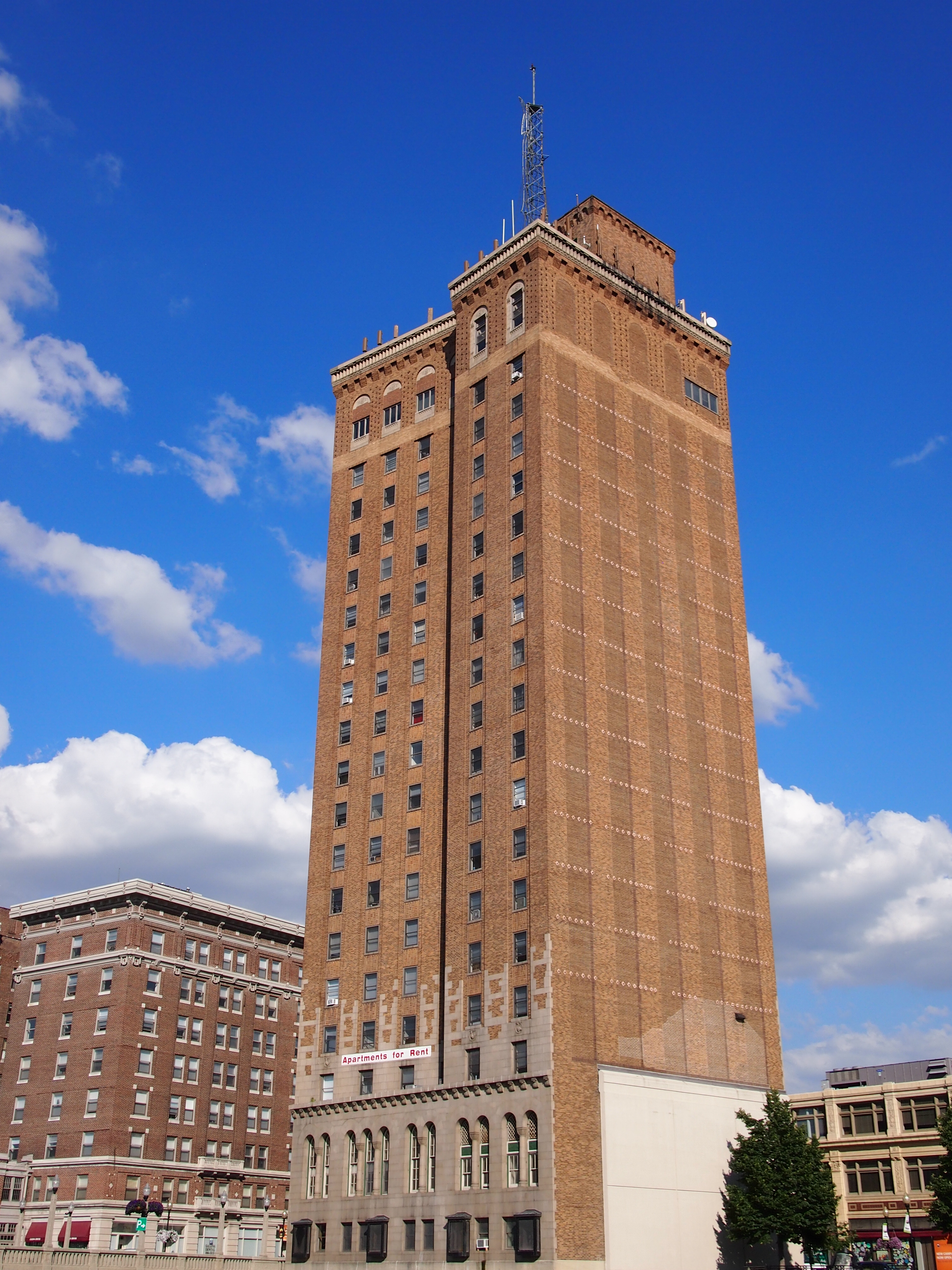
This fine building stands at 7 S. Stolp Ave. on Stolp Island in Aurora. The 1920s was clearly an age of  fine buildings, and we’re fortunate to still have so many in Chicago and environs.

Built as the Leland Hotel in 1928, it’s now Fox Island Place Apartments. A helpful plaque on the exterior wall told me that the structure is on the National Register of Historic Places. “Designed by Anker Sveere Graven and Arthur Guy Mayger… it was the tallest building in Illinois outside of Chicago.”

That seems like reaching to find a distinction, but never mind. “In addition to being a first-class hotel, it became an important entertainment center,” the plaque continued. “In the 1930s it was the recording studio for some of the most influential blues musicians of the golden age of blues recording. This plaque honors this historic building, and these artists.”

And it lists some of them. I will too, just as the plaque does. With some links. As the plaque cannot. Not yet, anyway.

John Lee “Sonny Boy” Williamson – Harmonica Legend

Big Bill Broonzy – Guitar/Singer

Hudson “Tampa Red” Whittaker – The Guitar Wizard

Yank Rachell – Mandolin

“Robert Night Hawk” Robert Lee McCoy – Guitar

Bill “Jazz” Gillam – Harmonica

Big Joe Williams – Guitar

Washboard Sam – Washboard

Lester Melrose – Producer

Across the street from the former Leland is the former Aurora Hotel, now the North Island Apartments. It dates from 1917 and is also a nice bit of work.

Not, as far as I can tell, where bluesmen hung out. A simpler plaque on the building says that one H. Ziegler Dietz was the original architect; hope his commissions didn’t dry up because of the war. The redevelopment architect in 1998 was Carl R. Klimek & Associates.

Summer of ’78

So few are the images I have of high school friends that this might be the only one I haven’t posted at some point. It’s provided to me courtesy of Catherine, who’s in the picture.

From left: me, Ellen, Donna, Tom T., Melanie, Kirk, Nancy, Tom J. and Catherine.

It might have been taken by Catherine and Melanie’s father (R.I.P., Mr. F.). I can’t pinpoint the day, but it was in August before senior year started (senior year for all but two in the shot). Mid-August, because I’d been in Austin early in the month and then on a bus epic of a trip to Stevens Point, Wisconsin, and back from the 5th to the 10th.

It might have been August 14, 1978. I marked on the calendar I kept at the time that I’d gone to Ellen’s – with a fair number of other people – to listen to The War of the Worlds concept album, which was brand new. In full, it was called Jeff Wayne’s Musical Version of The War of the Worlds. I remember all of us sitting in her living room, listening to the whole thing as if it were a live performance. I doubt that very many people even remember that record any more, though I’ve read it was more popular in the UK than the US. Who owned it among my friends, and who suggested we listen to it, I couldn’t say.

This picture was taken at Catherine’s home, not Ellen’s, so either it was another day, or we migrated from one place to the other – entirely possible. I’m glad to report that, as far as I know, everyone in the picture is still alive, except almost assuredly the cat. Among us, we have 15 children, though I might be miscounting that.

Speaking of items from the past, but not quite so long ago, it’s been 10 years to the day since we moved into our house.

Up in the Air, Junior Birdmen

Today I know more about “Up in the Air, Junior Birdmen,” than I ever have before. I read the Wiki page, of course, but that isn’t very meaty. A page on a site devoted to aviator Walter Lees is better, including bits of primary source material, or at least reprinting some.

Yesterday I wrote a short item about a trio of volunteers who helped build bicycle-powered pedal planes for an aviation museum. Non-flying planes, that is, the kind that kids tool around in for amusement and edification. I needed a headline. That request went to my synaptic warehouse, that sprawling place with an idiosyncratic and often infuriating filing system, overflowing with jumbles of memories, images, and logical reconstructions — or is it big ideas, images, and distorted facts? — and out popped “Up in the Air, Junior Birdmen.”

Perfect. I’m rarely so good at headline writing. But where did that come from? I wasn’t in the Junior Birdmen demographic, considering it was aimed at boys of the 1930s.

Later it occurred to me. I might have heard about it earlier, but I definitely remember Tom Lehrer mentioning it as a gag on one of his records, before he sang “It Makes a Fellow Proud to be a Soldier.” The early 1960s audience clearly understood the reference, because it got a laugh.

“Some of you may recall the publicity a few years ago about the Army’s search for an official Army song to be the counterpart of the Navy’s ‘Anchors Away’ and the Air Force’s ‘Up in the Air, Junior Birdmen’ songs. I was in basic training at the time…”

So today I did a small amount of checking on line about the Junior Birdmen phenomenon. Added a bit of information to the otherwise incredibly minor Junior Birdmen file somewhere in my synaptic warehouse. And no visit to the Internet for useless information is complete without a stop at YouTube, in this case to hear the song itself – which I don’t think I’d ever heard before.

Well, I can’t say completely useless information. I got a headline for a paid piece of writing out of it – one that the editors kept.