A Few New Orleans Statues, With Some Opinions

As of May 2019, Gen. Andrew Jackson still rides his steed at Jackson Square in New Orleans, the dramatic centerpiece of a handsome public space.
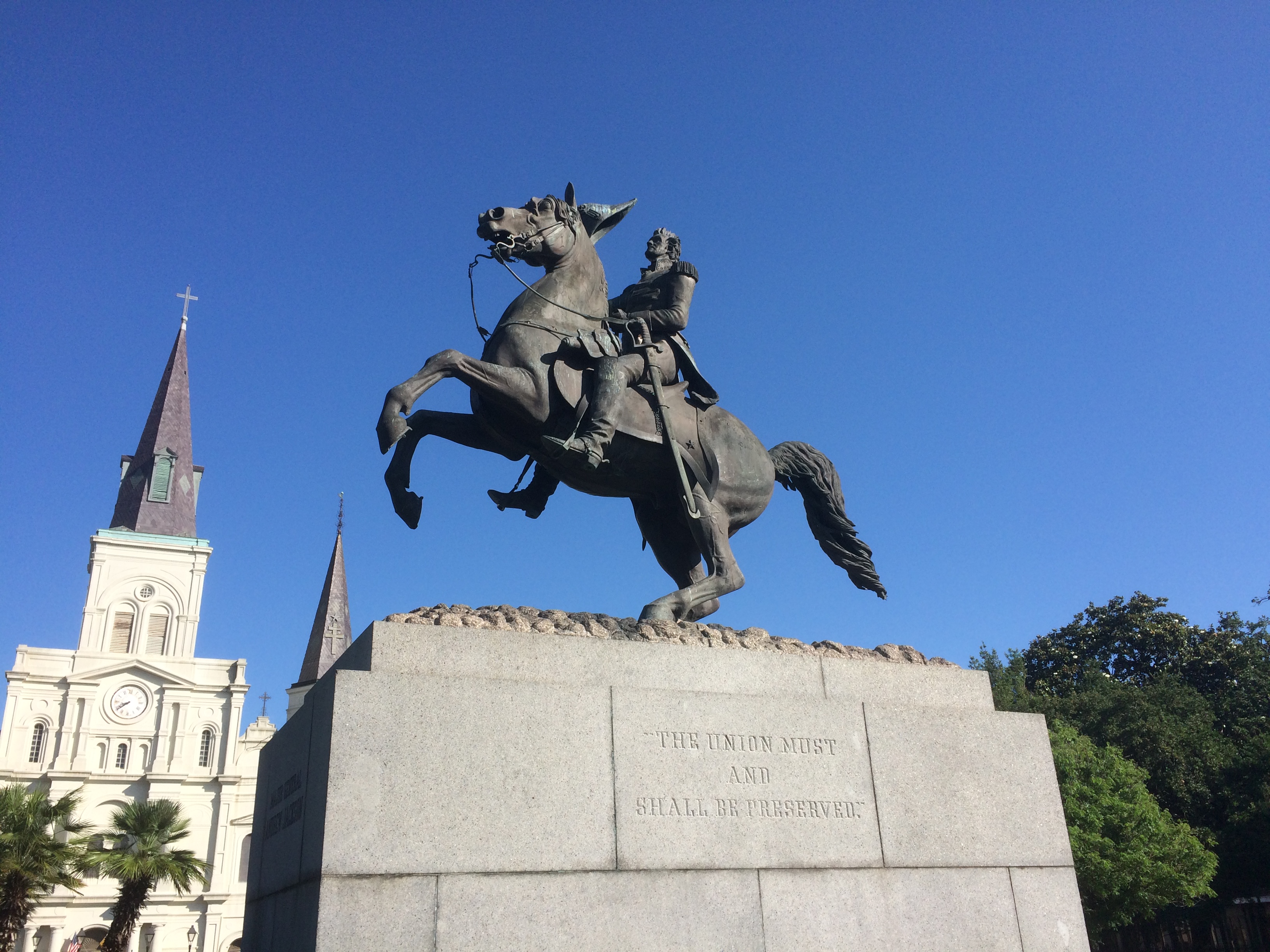
The equestrian bronze, by notable 19th-century sculptor Clark Mills, has been there since 1856, when the Battle of New Orleans was still in living memory, at least among the old timers. I understand the monument is a target of removalists, so there might come a day when Jackson Square loses its man on horseback and becomes Something Else Square.

That’s New Orleans’ decision. Yet I’m not persuaded Jackson should go, for all his retroactively understood flaws. It’s one thing to remove monuments to those who actively sought disunion because they feared to lose their human property. Jackson and his men defeated an invading army on American soil near New Orleans. As president, he had no use for disunion, either. Just ask John C. Calhoun.

During our last day in New Orleans, Lilly and I visited the National WW II Museum, and to do so we got off the St. Charles streetcar at Lee Circle (as Google Maps calls it). Looking back at the circle, we saw an empty pedestal.

That’s odd, I said to Lilly. But I must have known at some time — I’d ridden on the St. Charles line decades earlier — that a statue of Robert E. Lee used to stand atop the pedestal. I’d forgotten. I don’t ever remember taking a close look at the Lee statue, since I haven’t always watched for monuments as much as I do now.

Just yesterday, it occurred to me to look up Lee Circle, and was reminded that removal activists were able to persuade New Orleans to take down Lee and three other monuments in 2017. Sic transit gloria mundi, Gen. Lee.

Of course, there are many ideas about a new statue to put on Lee’s former spot. Among this selection, the one I like best on prima facie examination is the relatively unknown J. Lawton Collins, a New Orleans native and important commander during WWII. He’s also appropriate because the museum devoted to that war is mere blocks away. Or if a strictly military option is out, Andrew Higgins, of Higgins boat fame, seems reasonable.

Here’s another statue that has gained the ire of removalists: Chief Justice of the United States Edward Douglass White Jr., who had a long and varied career but sided with the majority on the notorious Plessy v. Ferguson decision. (Most sources double that s in his middle name, but the statue does not.)
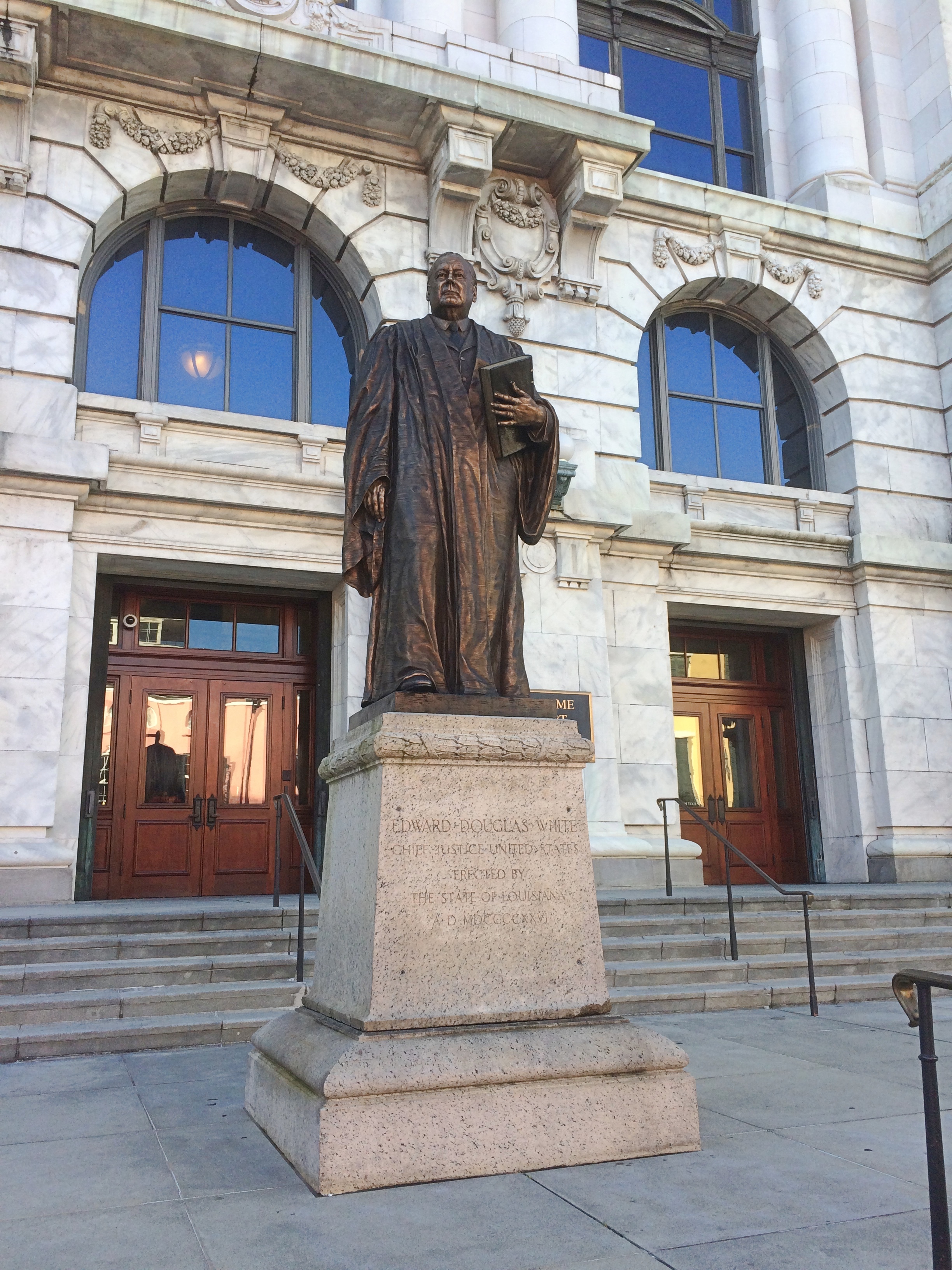
The chief justice stands on Royal St. in front of the major edifice housing the Louisiana Supreme Court, a building whose reputation has varied across the decades. We just happened to walk by.

Later I wondered, what’s the state supreme court doing in New Orleans and not Baton Rouge? Guess as far as the court is concerned, Baton Rouge is a johnny-come-lately capital, having that title only since 1846.

Chief Justice White would be a harder nut to crack for the removalists than Lee, simply because among the generally ahistoric American people, whipping up righteous outrage about someone as obscure as White would be a tall order. But it might happen.

In Louis Armstrong Park, where we had a pleasant stroll despite the increasing heat, there are plenty of statues that will probably last a good long time. Satchmo himself certainly deserves to.
Elizabeth Catlett did the bronze, which was dedicated in 1980.

Other metal jazzmen grace the park, such as a marching brass band by sculptor and New Orleans native Sheleen Jones-Adenle, erected in 2010.
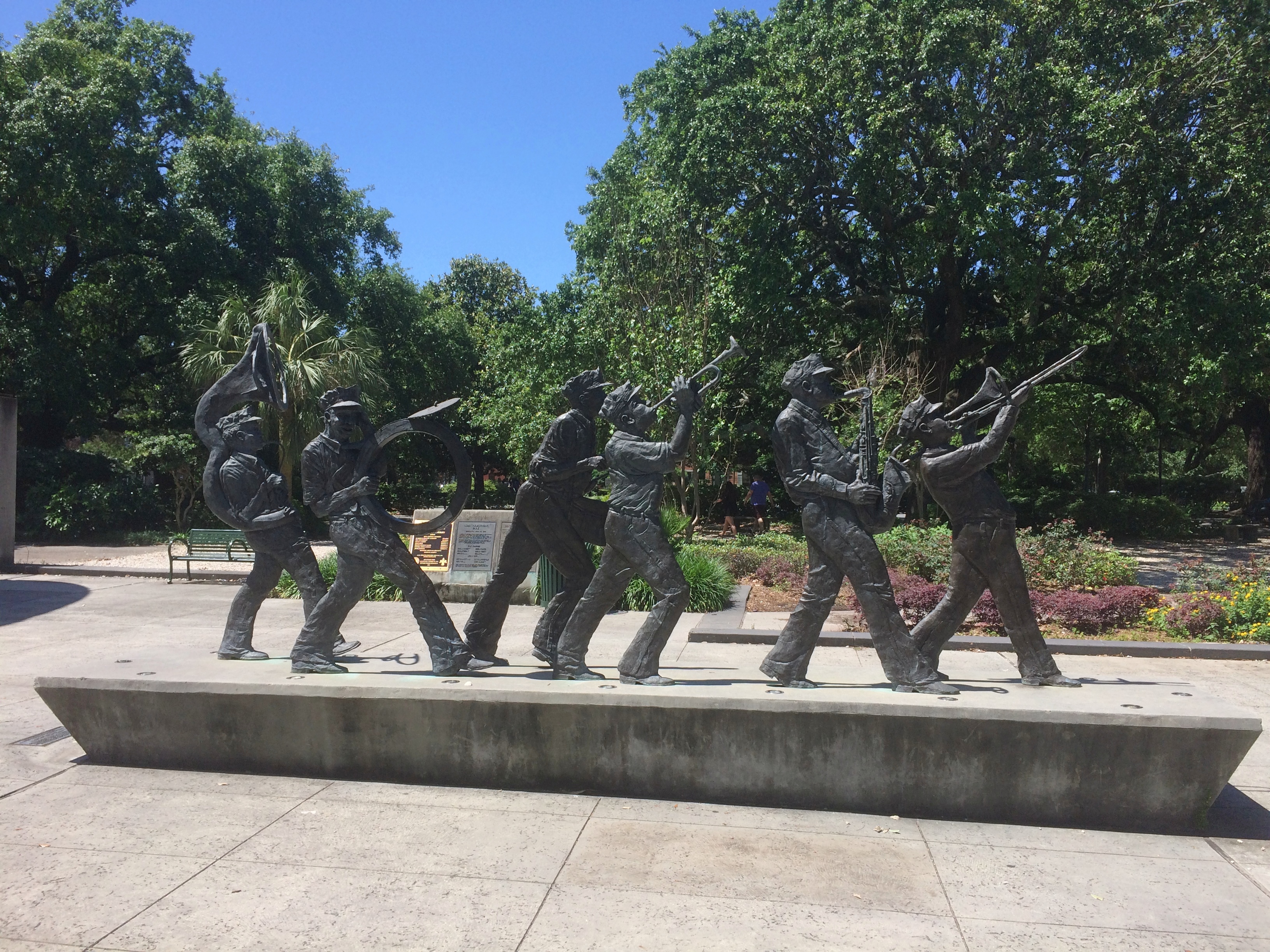
Here’s a tripartite statue of foundational jazzman Charles ‘Buddy’ Bolden created by sculptor Kimberly Dummons, also from 2010. Such triple figures aren’t common, but not unknown.

In Congo Square, there’s a vivid sculptural relief by Nigerian-born artist Adéwálé Adénlé fittingly called “Congo Square,” another of the 2010 class of works in the park.

That hardly covers everything in Louis Armstrong Park. Whoever Mike is, he made good images of these and other sculptures there.

Next to the French Market, at St. Philip and Decatur Sts., is Maid of Orleans, a gift from France to New Orleans and erected in 1972.
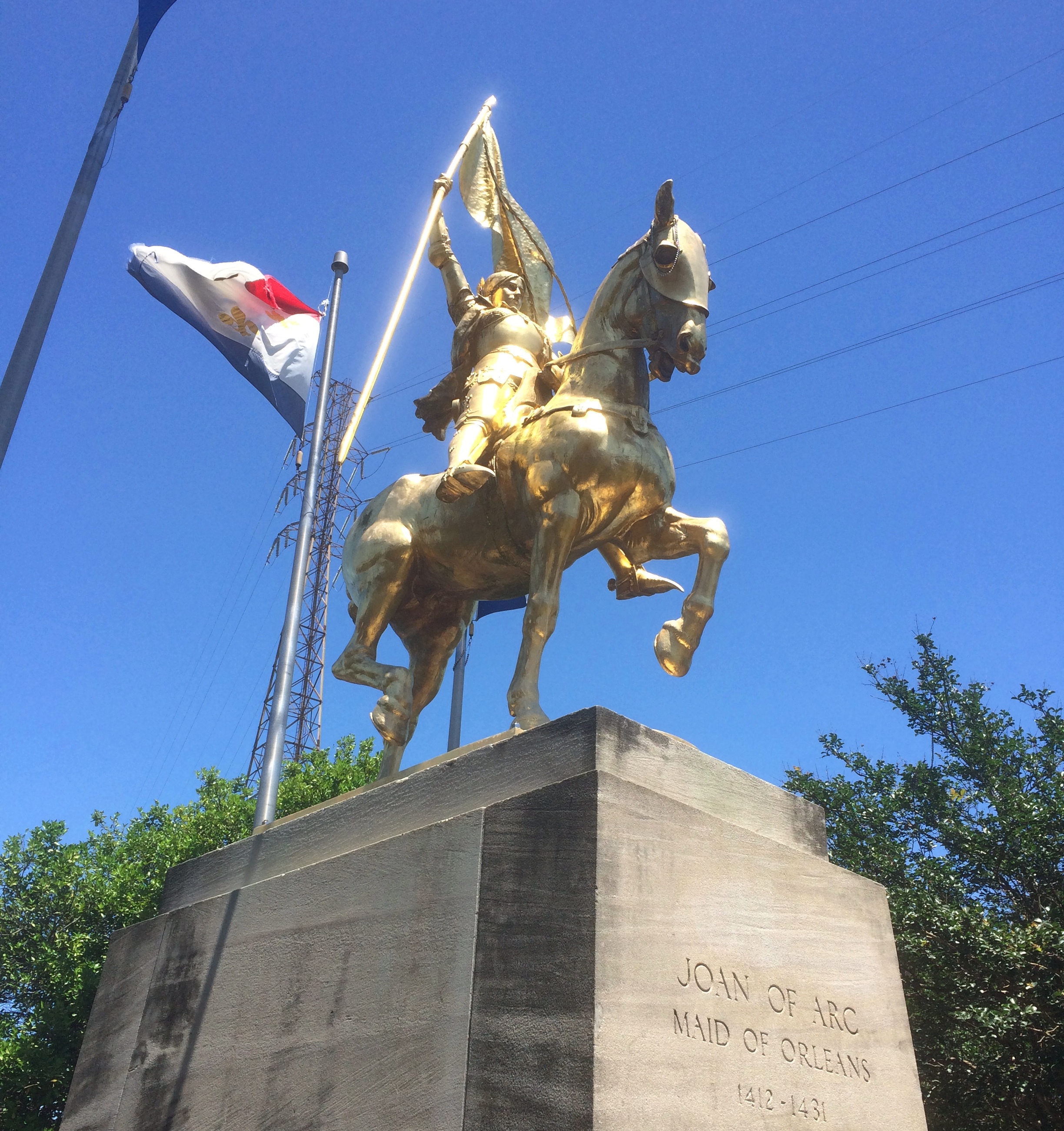
A replica of the 1880 Emmanuel Frémiet equestrian statue of Joan of Arc in Place des Pyramids in Paris, the Maid used to be at the foot of Canal St., but when a casino was developed there, she moved to her present location in the Quarter.

One more: A seated statue of Francis Xavier Seelos.
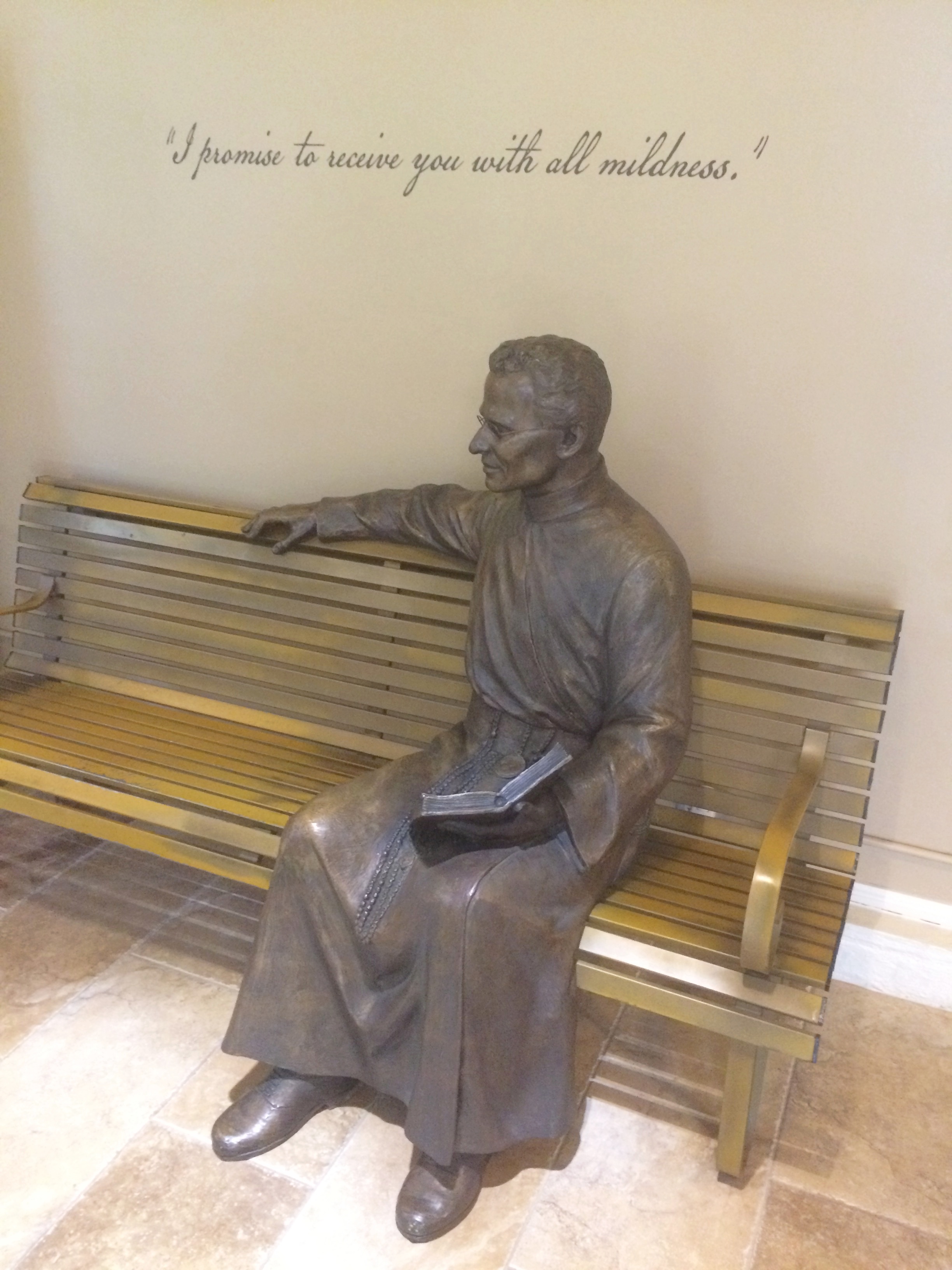
Francis Xavier Seelos statueHow we came see that statue, during our walkabout in the Garden District, is slightly convoluted. But that’s never stopped me from pursuing a destination.

While relaxing at the Chateau Hotel during the second evening, I queued up “Pearl of the Quarter,” a dulcet song about a New Orleans long gone and which never quite was. One of its lines: “I met my baby by the shrine of the martyr.”

A flight of Steely Dan fancy, I’m sure, but if you Google around using that term and “New Orleans,” pretty soon you come across the National Shrine of Blessed Francis Xavier Seelos at St. Mary’s Assumption Church in New Orleans. Which just happened to be not too far from where we were going to go the next day.

So we visited the shrine and its reliquary, which are separated from the nave of the church by a wall and a door — locked. We didn’t get to see the interior of the church as a result, which I understand is well worth seeing.

The seated statue is in the hallway outside the shrine itself, which includes a number of exhibits about Fr. Seelos, a Redemptorist from Bavaria, along with many relics and a more conventional standing statue of him at the end of the hall.

Fr. Seelos, for his part, was beatified by the church in 2000. He came to New Orleans as a missionary in the 1866.

“As pastor of the Church of St. Mary of the Assumption, he was… joyously available to his faithful and singularly concerned for the poorest and the most abandoned,” Seelos.org says.

“In God’s plan, however, his ministry in New Orleans was destined to be brief. In the month of September, exhausted from visiting and caring for the victims of yellow fever, he contracted the dreaded disease. After several weeks of patiently enduring his illness, he passed on to eternal life on October 4, 1867.”
Notre-Dame

First heard about the Notre-Dame fire on the car radio late yesterday afternoon. Wish I could report some kind of transcendent experience at the cathedral during our visit years ago, but no. Other people’s accounts along those lines are being posted with great speed.

We were duly impressed by the stained glass, the flying buttresses and the overall sweeping majesty of the exterior. But sad to say, what I remember most was that the cathedral interior was dark.

I understand the reason. Lighting is expensive. So the cathedral wasn’t much illuminated on an ordinary day in November 1994 for the ordinary tourists who were visiting. The thing to do would have been to attend a service, but we thoughtlessly did not.

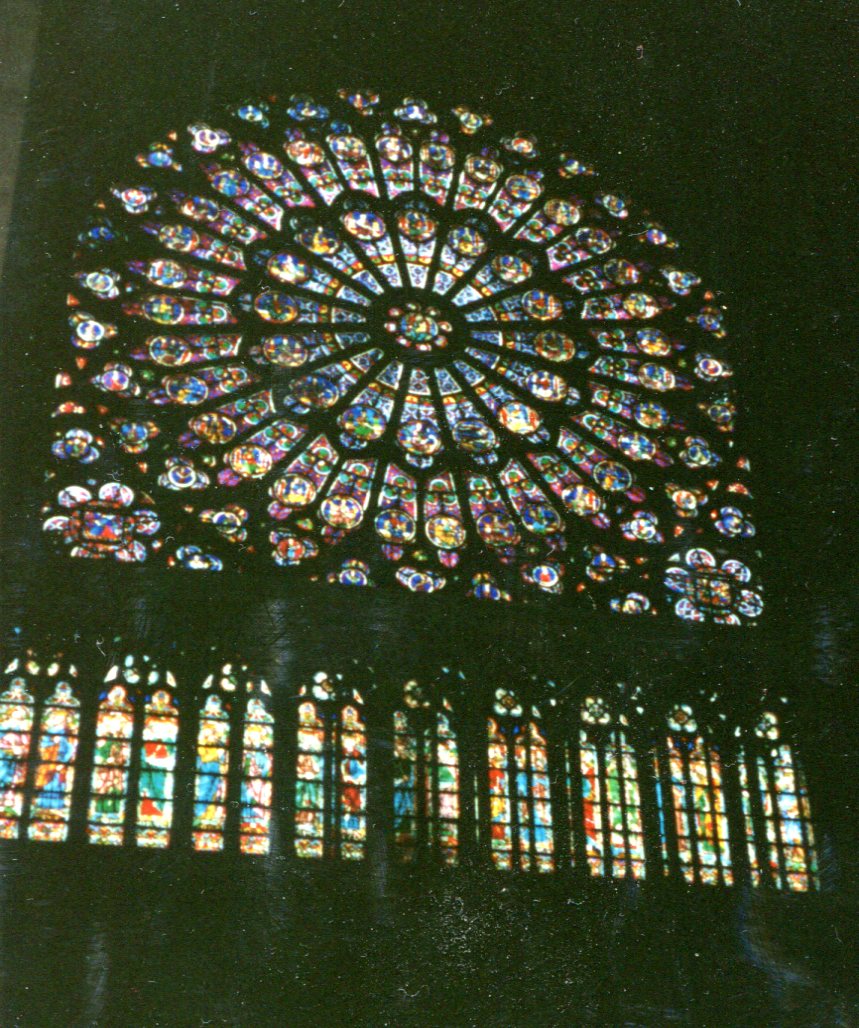
Among all the pictures I took in 1994, I have exactly one of Notre-Dame. Of course it was one of the Rose Windows. I didn’t want to use film anywhere too dark. Not that I had the equipment to take a very good image anyway.

Maybe we were lucky to be able to see it at all. Whether you credit Dietrich von Choltitz with not burning down Paris in 1944, or think that’s nonsense, the Germans could have certainly done a lot of damage before liberation, including dynamiting something so quintessentially French as Notre-Dame du Paris. Such an act would have been in character, after all.

I’ve read today that, at least, the flying buttresses did indeed buttress the walls, though the roof was lost, including wood lattices made from trees cut down between 1160 and 1170. The Rose Windows seem to be intact.

Naturally, the building will be restored. I wonder whether there will be arguments about rebuilding the completely lost spire. Considering the long history of the cathedral, it counts as a late addition.

Thursday Whatnots

News I missed, and I miss a fair amount, which I figure is actually healthy: “For the second time in history, a human-made object has reached the space between the stars,” a NASA press release from December says.

“NASA’s Voyager 2 probe now has exited the heliosphere — the protective bubble of particles and magnetic fields created by the Sun…

“Its twin, Voyager 1, crossed this boundary in 2012, but Voyager 2 carries a working instrument that will provide first-of-its-kind observations of the nature of this gateway into interstellar space.”

Voyager 2 is now slightly more than 11 billion miles (18 billion kilometers) from Earth. Or 16.5 light hours. That’s still in the Solar System, though. “It will take about 300 years for Voyager 2 to reach the inner edge of the Oort Cloud and possibly 30,000 years to fly beyond it,” NASA says.

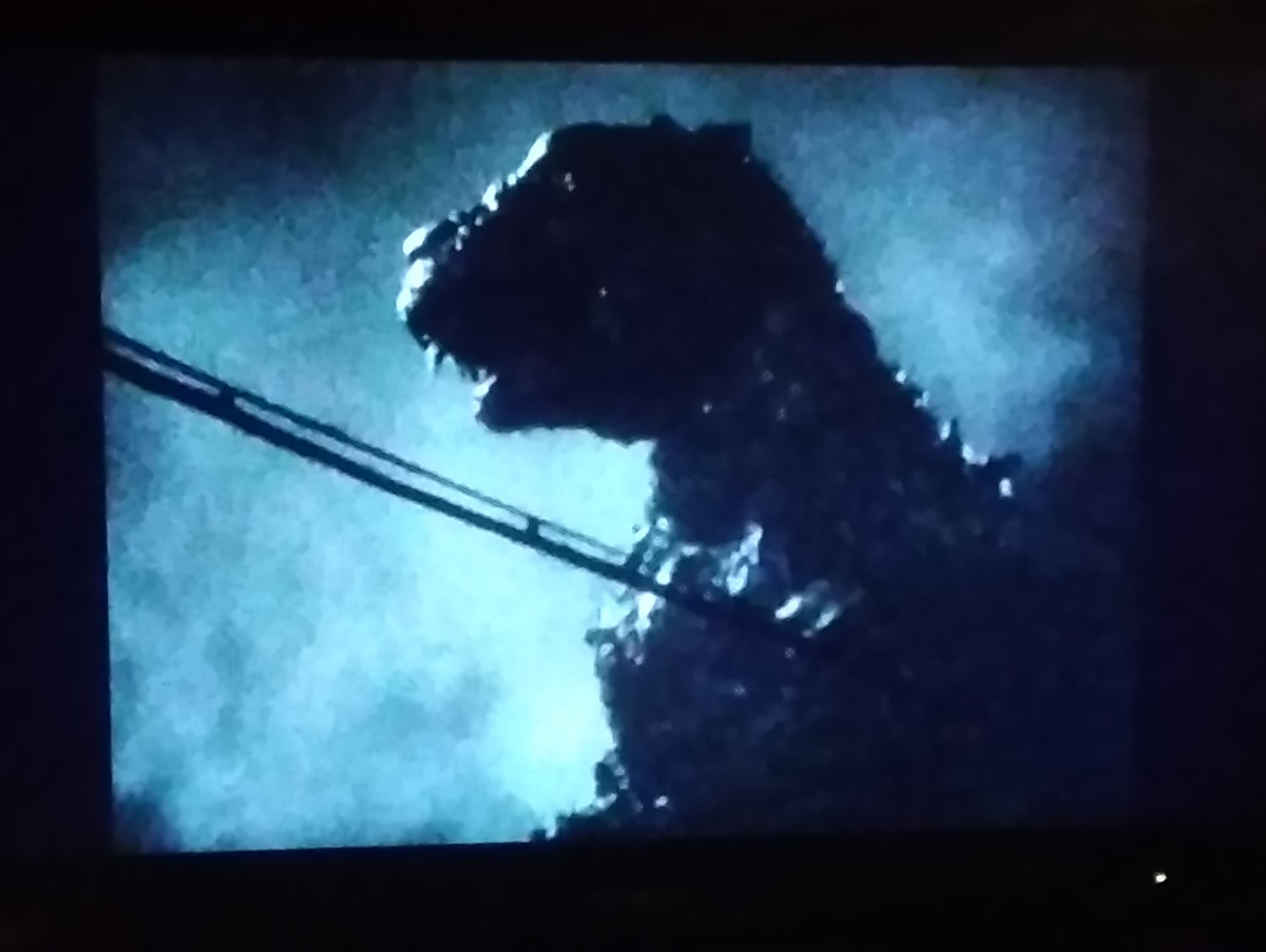
Not long ago, the original Godzilla — Gojira, to be pedantic — appeared on TV, in Japanese with subtitles. Not that the famed atomic beast needs any subtitles. I had my camera handy.
I didn’t watch it all, but that’s one way to approach televised movies. Not long ago, I watched the first 15 minutes or so of The Sting, a fine movie I’ve seen a few times all the way through. But other tasks were at hand, so I quit after Luther is murdered.

Later, I had the presence of mind to turn the TV back on and watch the last 10 minutes or so, when the sting is put on gangster Doyle Lonnegan. It’s a satisfying ending, but it got me to thinking.

A con with that many people would surely generate rumors. Just as surely, the rumors would make their way to the murderous Lonnegan, who wouldn’t rest until Henry Gondorff and Johnny Hooker were dead. But that’s overthinking things.

Here’s another example of a dim algorithm. Just about every time I use YouTube, I see anti-teen smoking PSAs. Or maybe they’re blanketing the medium, regardless of audience. Still, if I didn’t take up smoking 45 years ago, I’m not going to now.

That brings to mind the first time I remember seeing one of my contemporaries with a cigarette. That was about 45 years ago at a place called the Mule Stall.

The Mule Stall was a student space on the campus of my high school with a few rooms, chairs, a pool table and I don’t remember what else. It was tucked away about as far as you could get from the rest of the school, opening up to the street behind the school.

High schoolers used it, but junior high kids from the district had gatherings there occasionally as well. The event I remember might have been the wrap party for one of the plays I was in. Besides not acquiring a taste for smoking back then, I also discovered the theater wasn’t for me, except as an audience member. But ca. 1974, as a junior high school student, I did a few plays.

There we were, hanging out at the Mule Stall, when we noticed a girl named Debbie, who was in our class, pass by with a cigarette between her fingers. I didn’t know her that well, and I don’t remember much about her now, though she had curly hair, glasses and the sort of development adolescent boys pay attention to. At that moment, I guess she was on her way out to smoke the thing, though we didn’t see that.

I don’t know anything about her later life. She attended high school with us for a while, but either moved away or dropped out before the Class of ’79 graduated. I wonder if even now, she holds her cigs in yellow-stained fingers and spends part of the night coughing.

As for the Mule Stall, we had occasional high school band parties there later. One in particular involved almost everyone lining up to dance to the “Cotton-Eyed Joe.” That was fun. As Wiki accurately says, the dance was very much alive in Texas in the 1970s.

In fact, the Wiki entry has a description of the style of dance we did. Someone who did the dance seems to have written it, because this is exactly right.

“This dance was adapted into a simplified version as a nonpartner waist-hold, spoke line routine. Heel and toe polka steps were replaced with a cross-lift followed by a kick with two-steps. The lift and kick are sometimes accompanied by shouts of ‘whoops, whoops,’ or the barnyard term ‘bull s–t.’… The practice continues to this day.”

We used the barnyard term. An administration with no sense of history apparently razed the Mule Stall in the 1990s. Now the site is parking.

Minor Election Day

Local elections today. In as much as any of them got any wider attention, the runoff for mayor of Chicago did. Out here in the suburbs, the elections were for village presidents (mayors), school boards, library boards and the like. The only contest of even mild interest in my particular suburb will determine who will succeed the current mayor, who’s been in office since Hector was a pup.

I’ve received a number of campaign postcards recently, but this election didn’t rise to the level of robo-calls. I don’t think I got any in the run up to the vote today.

I almost forgot to vote. But I remembered about an hour and a half before the polls closed, and walked to my polling place. There were the scattering of signs at the parking lot entrance.

Low voter turnout is almost guaranteed in an election like this, but it occurred to me that that means the votes of those who do turn out thus count for more. In a statewide election, you’re one of tens or hundreds of thousands, or even more; in a local election, you might be one of hundreds.

Thursday Sundries

I’m glad to report that Jimmy Carter has become the oldest person ever to be President of the United States, at 94 years, 172 days, topping George H.W. Bush. For many years, life expectancy was such that no one bested John Adams, who died at 90 in 1826. Finally Ronald Reagan lived longer than Adams in 2001. Since then, so have the elder Bush, Ford and Carter.

I’m not glad to report that we’ve been getting a raft of calls from an “800 Service” lately, asking me to contact “Apple Support Advisor” for unspecified but ominous reasons. Ah, spring is coming, and that must be the season for phishing.

Turns out it isn’t even a new scam, but this one didn’t say anything about iCloud.

Email subject line recently from a news outlet that has my address: “Meet R. Kelly’s lawyer.”

I don’t think so. Some years ago, I introduced my daughters to the concept of the List of Things I Don’t Care About. A lot celebrities are on the list. More are added all the time, mostly without me being conscious of it. R. Kelly’s been there a long time, but since his recent legal problems, he’s on the list with a bullet.

Here’s something I’d never heard of until the Internet offered it to me completely by chance, despite the fact that it happened in Texas, near a place that I drive by often when I visit that state: the Crash at Crush.

“On September 15, 1896, more than 40,000 people flocked to this spot to witness one of the most spectacular publicity stunts of the nineteenth century — a planned train wreck,” the Texas State Historical Association tells us.

“The man behind this unusual event was William George Crush, passenger agent for the Missouri, Kansas and Texas Railroad… As the arena for his spectacle, Crush selected a shallow valley just north of Waco, conveniently located close to Katy’s Waco-Dallas track.

“In early September 500 workmen laid four miles of track for the collision run and constructed a grandstand for ‘honored guests,’ three speaker’s stands, two telegraph offices, a stand for reporters, and a bandstand. A restaurant was set up in a borrowed Ringling Brothers circus tent, and a huge carnival midway with dozens of medicine shows, game booths, and lemonade and soft-drink stands was built.

“At 5:00 P.M. engines No. 999 and 1001 squared off at opposite ends of the four-mile track. Crush appeared riding a white horse and trotted to the center of the track. He raised his white hat and after a pause whipped it sharply down. A great cheer went up from the crowd as they pressed forward for a better view.

“The locomotives jumped forward, and with whistles shrieking roared toward each other. Then, in a thunderous, grinding crash, the trains collided. The two locomotives rose up at their meeting and erupted in steam and smoke.

“Almost simultaneously, both boilers exploded, filling the air with pieces of flying metal. Spectators turned and ran in blind panic. Two young men and a woman were killed. At least six other people were injured seriously by the flying debris.”

Say what you want about the 19th century, they knew how to stage a spectacle. A dangerous spectacle, but it must have been quite a sight.

The article doesn’t say, but I assume the conductors had some way of keeping the throttles open after they themselves left the engines before they gathered too much speed.

Another thing I didn’t know (there are so many): Scott Joplin named one of his pieces, “Great Crush Collision March,” after the event. Guess it counts as one of the lesser-known railroad wreck songs, unlike the more famous “The Wreck of the Old 97.”

The Building Blocks of Publicity

I get a lot of press releases. Most are about commercial real estate in one way or another, which at least has the potential to be useful. But there’s also a regular flow from various weird planets orbiting remote journalistic suns. Remote to me, that is.

For instance, recently I got a press release that starts (sic): “TM” premiered a third action-packed season at its brand new home on “DRIVE,” a dedicated auto enthusiast programming block on A+E Networks’ FYI® (Primetime) and HISTORY® (Weekend Mornings).

Each week, former celebrity stuntman and head “TM” leads his talented team in crafting one-of-a-kind custom automotive builds. From hot rods and classics to muscle cars, trucks and motorcycles, “TM” gives car lovers across America a front-row seat to the incredible building process behind these powerful and unique machines.

Good to know that HISTORY® isn’t shirking when it comes to “dedicated auto enthusiast programming.”

I got this why? Because I write about hot rods and classics and muscle cars. Not.
Just another dim-witted algorithm guessing at what I might want to see, probably.

Another one: X is the co-creator of XYZ Foods, along with her husband Y. The idea for the company grew from issues dealing with health complications that lead to their infant son, Z, needing a feeding tube. Z’s parents originally followed doctors’ and nutritionists’ advice to give Z commercial formula for his feeding tube.

But when Julie discovered that the main ingredient found in the food for Z’s feeding tube was corn syrup, she quickly started experimenting with pureeing and blending whole foods to feed Z.

Well, of course, dread corn syrup. At least they don’t seem to be blaming their problems on vaccines.

One more: Shocked and appalled. That’s the reaction most people are having following “Operation Varsity Blues,” exposing bribery scandals involving colleges such as Yale, Stanford, and Georgetown. According to leadership expert Kyle M.K., there are five ways these schools can effectively handle the crisis — and three things that will cause more damage.

I myself am shocked, shocked to hear that a few wealthy people tried to bribe their children into the Louis Vuittons, Guccis and Versaces of academia. One of those “seemed like a good idea at the time” for the status-besotted. But again, why I am getting this?

This Gelid Day

I got up this morning and before long pulled up the Weather Underground page for my suburb. At about 9 a.m. the temperature was minus 23 F. “Feels like minus 43,” the site helpfully added, since there was some wind.

At O’Hare, the low was one degree colder, it seems. “This morning’s minimum of 24 below zero was the coldest in Chicago in the 36 years since the morning of January 20, 1985, when Chicago’s all-time record low of minus 27 was recorded,” WGN reports. Even in Nashville, I remember that things were pretty cold around that time in ’85.

Not to worry, we had a high of minus 15 F. to look forward to today. That happened around 1 in the afternoon, but as of about 7 p.m. we were back to 17 below. Remarkably, the weather savants say that the local air will be above freezing by the weekend. Hope so.

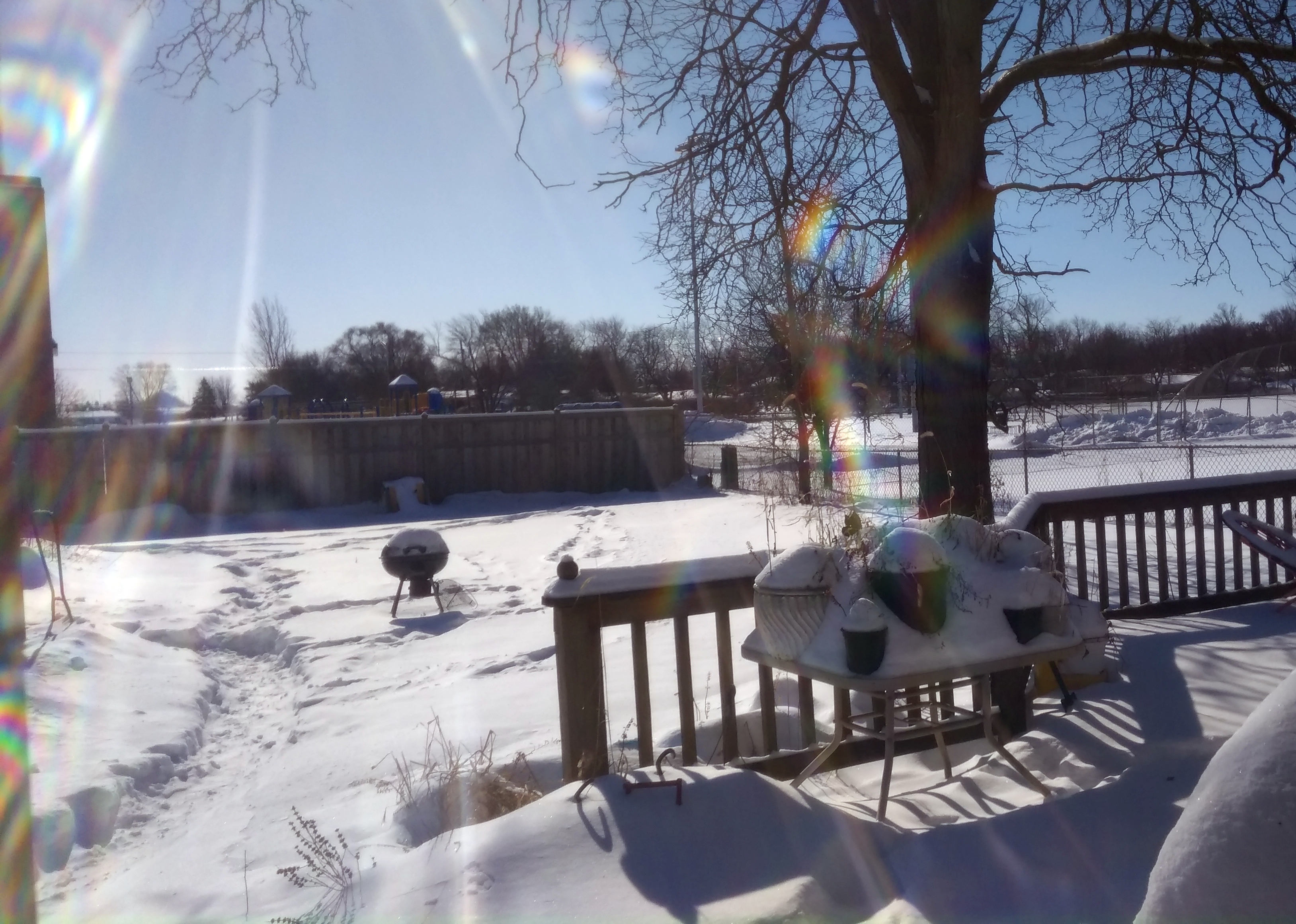
Early in the afternoon, the dog wanted to go out to do what dogs do outside. So I let her out. During the minute or so she spent in the frozen landscape, I couldn’t resist the urge to document the scene — as quickly as possible through a door that was open for a few seconds.
No adjustment of the image necessary. Looks like the camera also caught light dispersing through ice crystals in the gelid air.

At temps like this, it’s easy to anthropomorphize the cold. It feels like the cold is pressing on all the doors and windows, trying to put its icy fingers through the cracks, eager to invade the house and equalize the temperature outside and inside. As if central heating is an affront to its idea of the way things should be.

My work desk faces an outside window. Even wearing socks, I could feel the temps under the desk to be lower than usual today. Behind one of our kitchen cabinets is an exterior wall. The air was noticeably cooler in the cabinet today. Last night, I heard the house pop and creak a little as the outside temps dipped below zero. That is unnerving.

Some years ago, an occasional BTST reader said, you sure write about the weather a lot. The implication was, I think, why are you wasting your time with trivia like that?

I’ve thought about that question occasionally since then. Odd what some people consider trivial. Like the weather. Which is the state of the atmosphere in which we live 24 hours a day, seven days a week, except for a handful of astronauts for a little while. You’d think it would be worth some attention.

Actually, in this iteration of BTST at least, weather is a main category in only about 10 percent of the postings: 132 of a total of 1,342. Seems like a healthy amount of attention to me.

Of that category, only 18 postings (like today) are tagged “dangerous weather,” all of which I’ve experienced myself. Winter storms, hurricanes, very heavy rains, high heat, usw. (Well, I’ve never been near a hurricane, but I did hear a typhoon rush by outside in Osaka.) “Unpleasant weather” gets 43 tags while “pleasant weather” gets 23, so I guess I’m not one to accentuate the positive when it comes to atmospheric conditions.

Ignore the weather at your peril. The unnamed protagonist in Jack London’s “To Build a Fire” didn’t give it much thought, and look where it got him: frozen to death.

“Fifty degrees below zero meant eighty-odd degrees of frost. Such fact impressed him as being cold and uncomfortable, and that was all. It did not lead him to meditate upon his frailty as a creature of temperature, and upon man’s frailty in general, able only to live within certain narrow limits of heat and cold; and from there on it did not lead him to the conjectural field of immortality and man’s place in the universe.”

Thursday Bunkum

Our latest snow was less convenient than previous ones this winter, falling in mid-week. I spent a fair chunk of Wednesday shoveling more snow around, this time wetter masses than the last snowfall. Now an arctic blast is blasting its way toward northern Illinois. Subzero temps ahead.

Ah, fun. We’ve been down this road before, of course.

I just found out today that the Emperor of Japan is going to abdicate on April 30. That was news in December, but I missed it. I chanced across the information in a copy of the bilingual Chicago Shimpo, a paper Yuriko picks up for free periodically at the Mitsuwa grocery store.

The Imperial Household Agency, known for its mossback ways, is on board with that?  Yet abdication from the Chrysanthemum Throne isn’t unknown. The most recent abdication was of Kōkaku, who quit in 1817. Pretty recent, considering the longevity of the Yamato Dynasty.

In even earlier times, back when the emperor was more of a political football than in recent centuries, one emperor was sometimes forced out to make way for another.

Now that I’ve finished reading Stalin — which I read after John Wayne: The Life and Legend by Scott Eyman (2014), an excellent book — I’ve decided to read some more biographies. A biography bender. Next I want to pick one from around the house, one that I haven’t read.

My choices, at least those I’ve found so far, include works on Francis Bacon, Benedict Arnold and Babe Ruth.

Something called Indywire asserted recently that: Coen Brothers Shock With ‘Buster Scruggs’ Oscar Nomination

I’m not shocked. I’ve seen five of the six stories in the The Ballad of Buster Scuggs so far and they’re really good, especially “Meal Ticket” and “The Gal Who Got Rattled.” Not that being good necessarily gets a movie nominations, but it helps.

All the stories get the Coen Brothers treatment, so you know that something bad is going to happen to at least one of the characters. In the “The Gal Who Got Rattled,” the feeling was particularly poignant, because as the story moved along, both the man and woman evolved into remarkably sympathetic characters. Then one of the dangers of the 19th century smites them.

Parts of the movie were based on sources much closer to the 19th century than our own, such as “The Girl Who Got Rattled” by Stewart Edward White and Jack London’s “All Gold Cañon,” while other parts evoke cowboy pictures of yore.

That only goes to show that there’s a vast and largely untapped galaxy of source material for movies — books, short stories, historic events, myths, graphic novels and on and on. Do moviemakers show any interest in mining these riches? Mostly not, seems like, and if they do, commercial pressures disabuse them of the notion. The Coens are exceptions. I’m glad they’re able to make the movies they want to.

First Thursday Debris of 2019

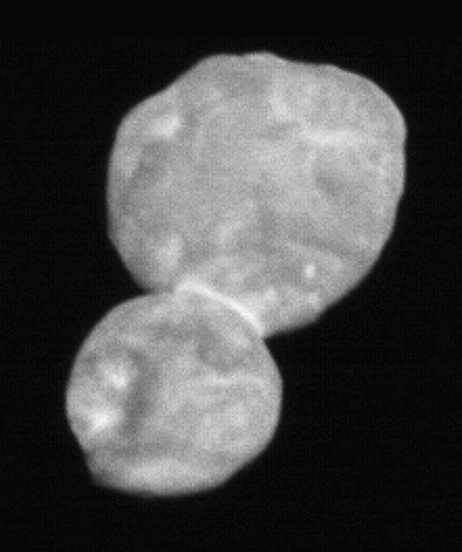
I was glad to hear about the successful flyby of Ultima Thule at the beginning of the year. And to see the public domain photos. Who wouldn’t be?
Not long ago I also read that actual interstellar probes — or what this article terms “precursor” interstellar probes — are under serious consideration by the people who plan robotic space probes.

Space.com: “The APL study — which focuses on a mission that could launch before 2030 and reach 1,000 AU in 50 years — is based on the next extension of what we know we can do, propulsion physicist Marc Millis, founder of the Tau Zero Foundation, said.

” ‘It is a reasonable candidate for the next deep-space mission,’ Millis told Space.com. ‘It is not, however, a true interstellar mission. It is better referred to as an “interstellar precursor” mission.’ ”

After that I had to look up the Tau Zero Foundation. An organization promoting interstellar space flight. There’s a long-term goal we can all get behind.

A shot of floor tiles at the Chicago Cultural Center.

Some variation of that pattern can be a symbol for the interstellar ambitions of humanity.

I haven’t given much thought to Brussels sprouts over the years, since I’m not especially fond of them. So I looked down in surprise recently at a grocery store at Brussels sprouts still on the stalk.
There’s something a little otherworldly about the stalks when still in the ground.

Not the best of images, but I thought I’d take some before the 2018-19 tree gets the heave-ho.
Its last lighting might be tomorrow.

RIP, George Bush

Somewhere, I have a souvenir photo I obtained at a breakfast event held by a prominent real estate brokerage in March 2001. If I knew where that item was, I’d scan it for posting, but no such luck (the event is mentioned in passing here).

That brokerage was later absorbed by another company and is now only a memory. The featured speaker at the event that morning is likewise only a memory now: George H.W. Bush. RIP, Mr. President.

Saw a fair number of flags at half staff in his honor today.

I checked to be sure, and it’s so: the late President Bush was, and remains, the only U.S. president to have four names. Until the mid-19th century, most of them didn’t even have three. Naming fashions change.

Been a while since there was a presidential death. Now there are only four living former presidents. With the elder Bush’s death, the fourth period of five living former presidents ended (Jan. 20, 2017-Nov. 30, 2018). That has only happened three other times: March 4, 1861-Jan 18, 1862; Jan. 20, 1993-April 22, 1994; and Jan. 20, 2001-June 5, 2004.

That three of the four periods are in living memory illustrates the longer lifespans of our time. Speaking of longevity, Jimmy Carter now has to make it to early March 2019 to become the oldest person to have served as U.S. president, taking that distinction from the elder Bush.