The Ordinary Now, Retail Edition

About two weeks ago, we visited a nearby regional mall. One thing I noticed was an enormous construction site where one of the anchor tenants used to be, a department store I can’t ever remember visiting. Later I read that the site will soon be a home to a store with no connection to the rest of the mall — none casual visitors can use, anyway. It’s a brand that will probably do well there.

Inside the mall, we witnessed the last gasp of another anchor.

Last 2 Days! We had to wander through. Still for sale: large rugs, some washing machines and refrigerators, store fixtures. I actually remember buying something at this location: a lawn mower a few years ago. A Craftsman. It’s held up pretty well.

A few days ago as I looked out my office window, I noticed a delivery truck. That isn’t at all unusual, not even this particular kind of truck, but I wanted to take a picture anyway. A small urge to document the ordinary now, since it won’t last.

The deliveryman was fast, though. By the time I got my camera (phone, that is), activated the camera function, unlocked the front door, stepped outside, pointed and pushed the button, he was on his way, so the image is of an e-commerce delivery truck in motion. Maybe that’s fitting: go-go-go.

UVA, Part 1: Rugby Road

We arrived behind the Rotunda of the University of Virginia at about 4 pm on October 13. Under cloudy skies, but the day was warm and good for walking around the picturesque campus. Even parking had been relatively painless, and at no cost, on a street a few blocks away.

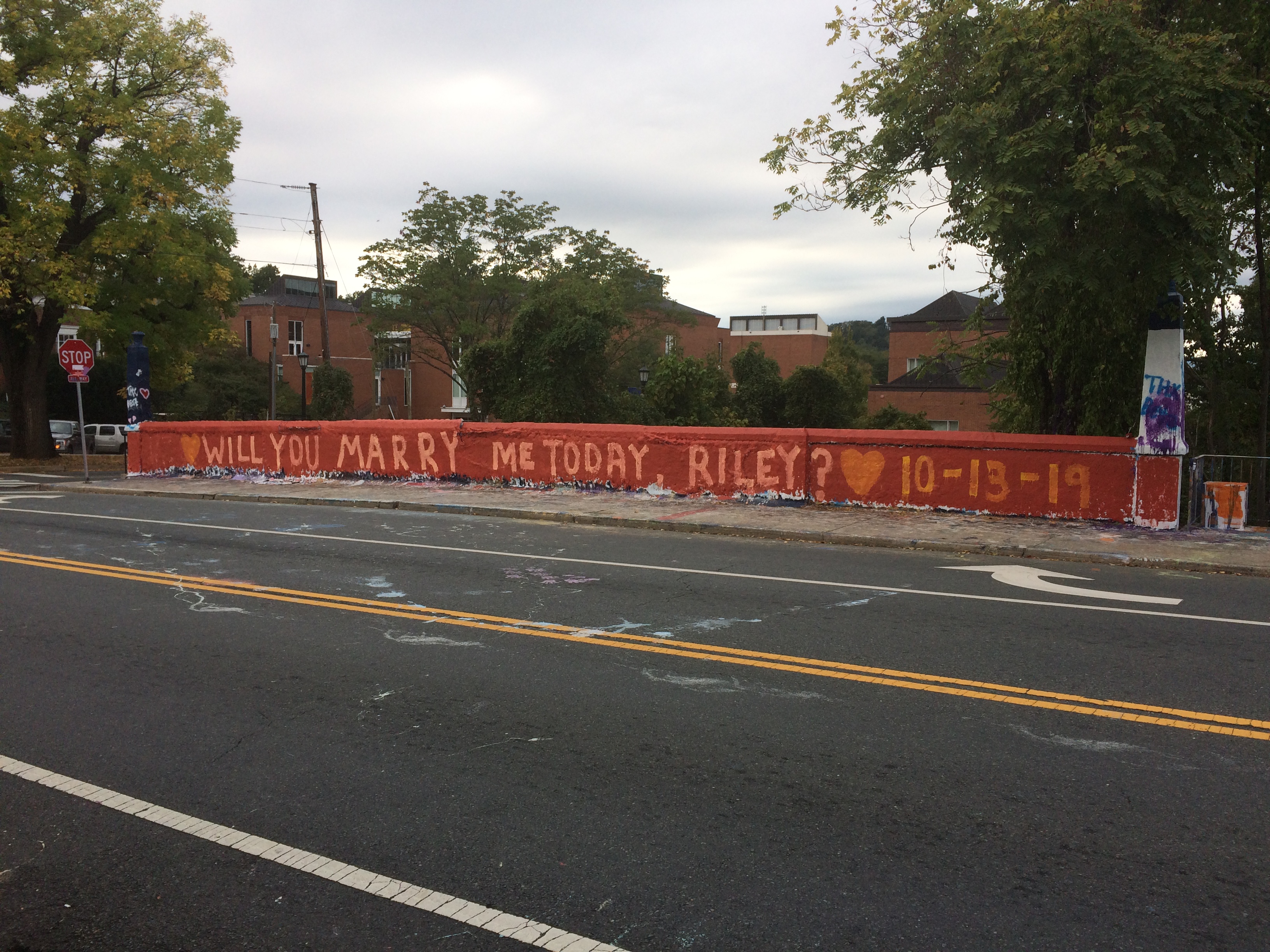
We walked down Rugby Road to get to the Rotunda. At one point, we crossed a bridge over railroad tracks. A specific message had been painted on the inside of one of the safety walls.
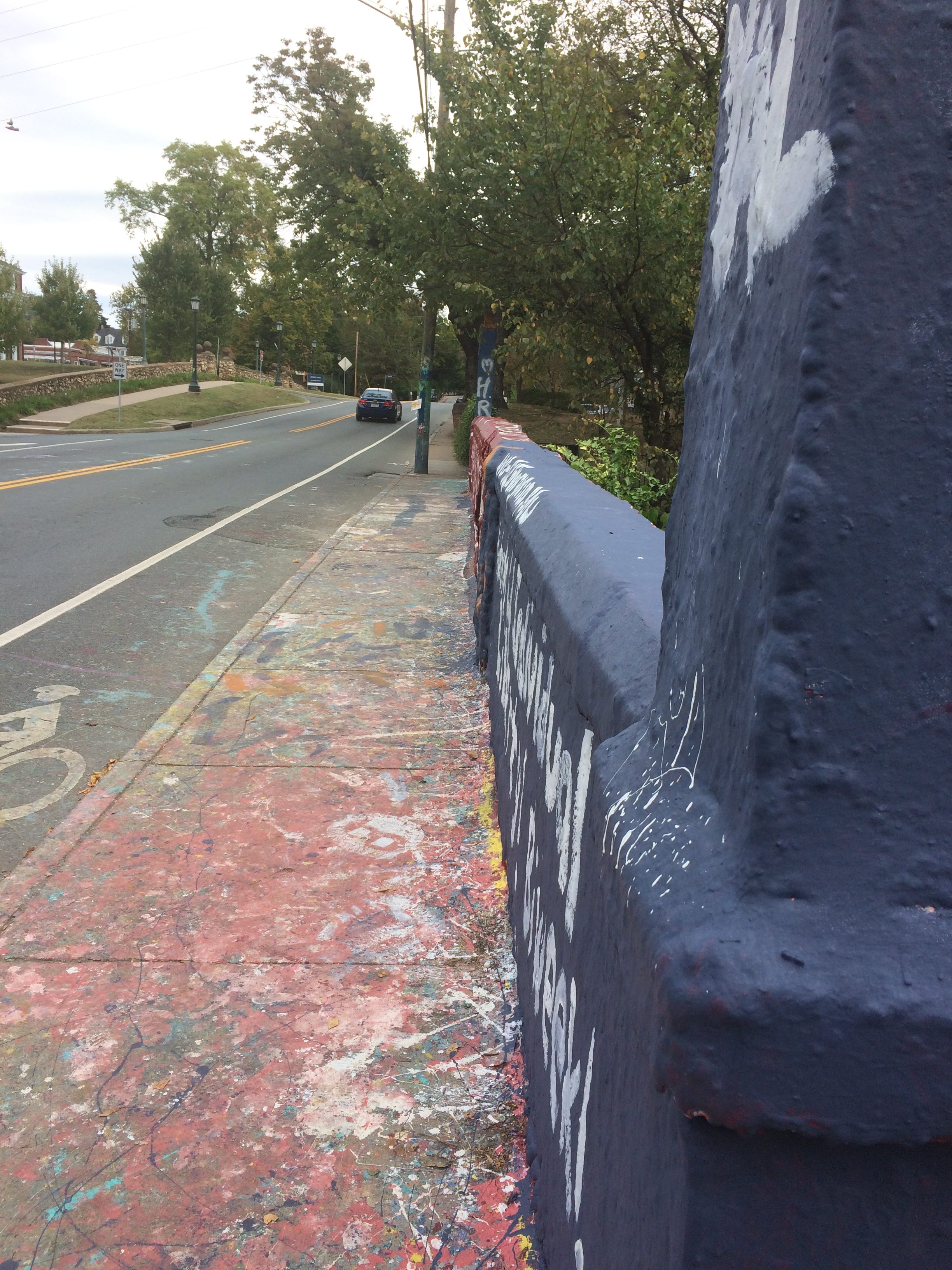
Rugby Road Beta Bridge CharlottesvilleThere was evidence of repeated painting.
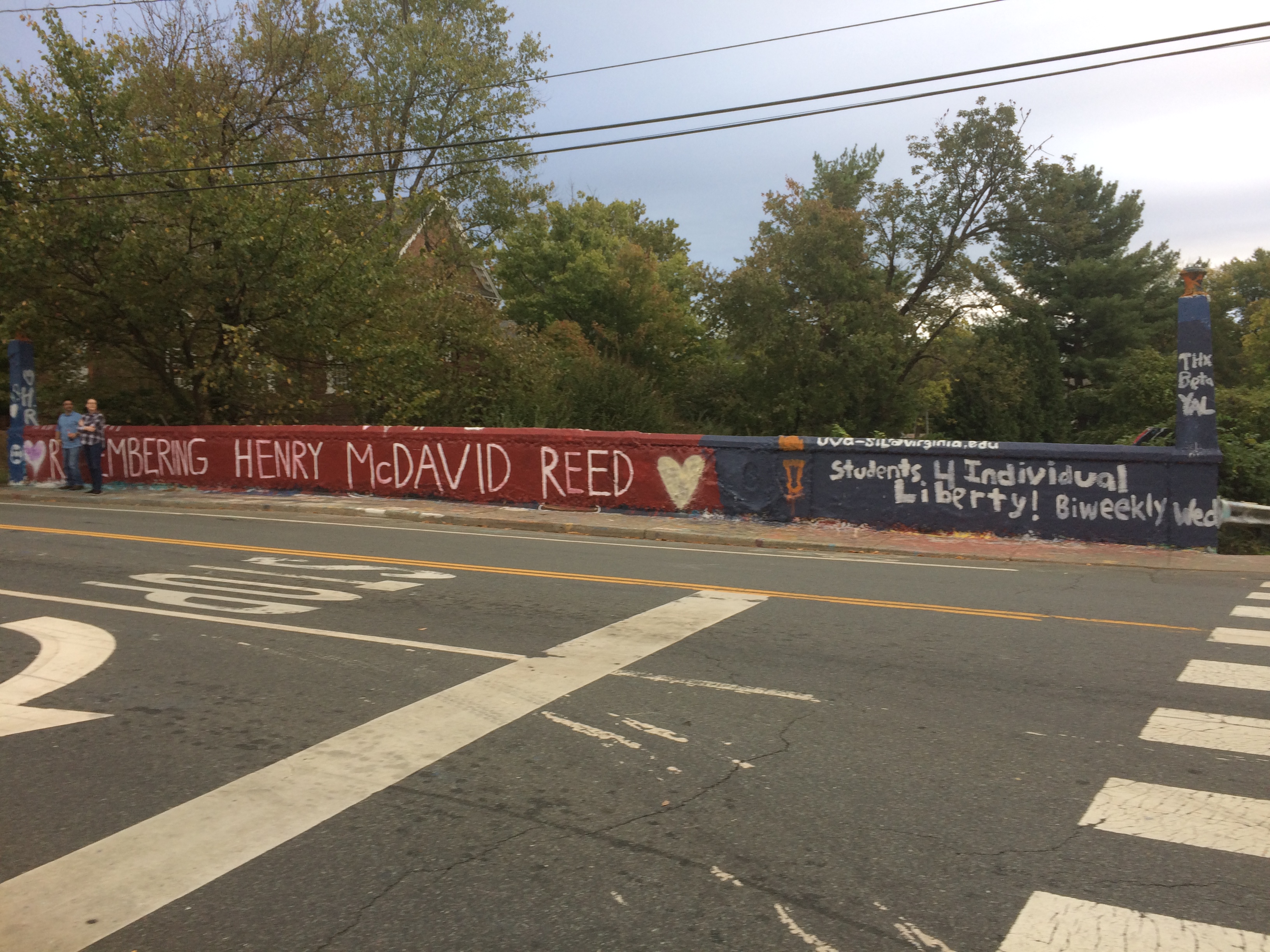
Rugby Road Beta Bridge CharlottesvilleLater, as we walked back to the car, I got a good look at the other side of the bridge.
Rugby Road Beta Bridge CharlottesvilleLocal tradition. I figured it had to be. Didn’t take long to find an article about the bridge — Beta Bridge — in UVA Today.

“For instance, one of the most notable landmarks on Grounds, Beta Bridge, has been at the center of its own tradition since just the latter half of the 20th century.

“Often brightly colored with hand-lettered messages spanning its length, the bridge carrying Rugby Road over the C&O Railroad tracks over the years has become the place for paintbrush-wielding students to express themselves.”

I don’t know whether Riley accepted or declined the proposal, or even if it was serious, but I was able to look up the unfortunate fate of Henry McDavid Reed. He was a UVA student who died of brain cancer in August.

That’s not all I found out about Rugby Road, which has a number of frat houses on it, and passes by the university’s art museum and architecture school, among other things. It’s also the title of a UVA drinking song, mostly sung to the tune of Charles Ives’ “Son of a Gambolier.”

Its first verse no doubt includes some of the cleaner lyrics:

From Rugby Road to Vinegar Hill, we’re gonna get drunk tonight.
The faculty’s afraid of us, they know we’re in the right,
So fill your cups, your loving cups, as full as full can be.
And as long as love and liquor last, we’ll drink to the U. of V.

The version on YouTube also has a verse that I suspect is left out these days.

All you girls from Mary Washington and RMWC,
Never let a Virginia man an inch above your knee.
He’ll take you to his fraternity house and fill you full of beer,
And soon you’ll be the mother of a bastard Cavalier!

RMWC would be Randolph-Macon Woman’s College in Lynchburg, which is now simply Randolph College. Mary Washington is the University of Mary Washington in Fredericksburg, Virginia.

If I’d thought about collegiate drinking songs when I was in college, I probably would have considered them hopelessly old fashioned — and that was 40 years ago. Maybe I didn’t hang out with the right crowd. Or the wrong crowd, take your pick.

Paper Purge

Not long ago, I decided to purge some paper around the house. Specifically, user manuals for machines that are long gone. You’d think that those would have been tossed along with the items themselves, but that’s not how clutter works, unless you’re Marie What’s-Her-Name.

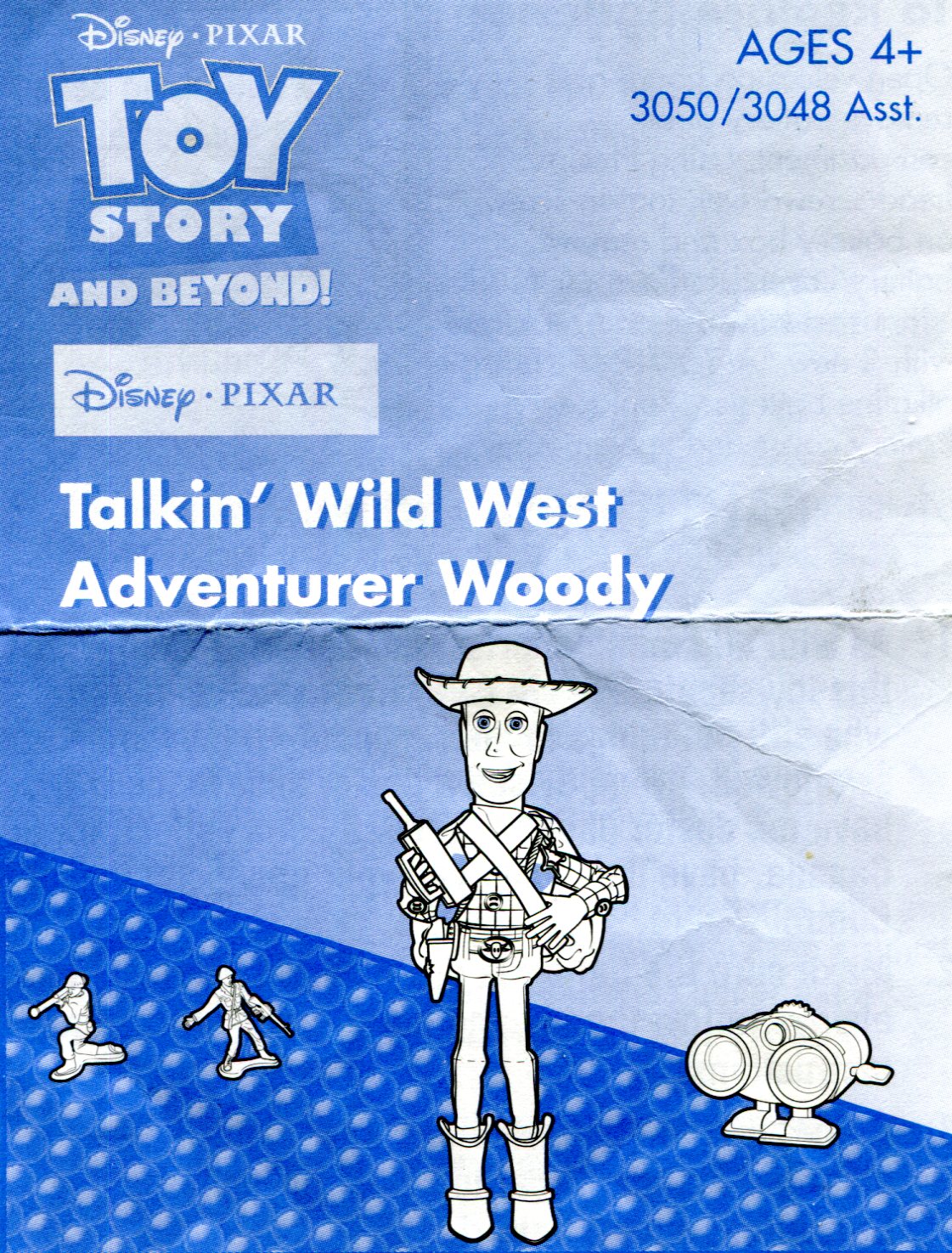
Papers like this.

In the same vein, I had setup instructions for iMacs, a reel mower that now has vines on it, landline phones long junked, defunct cameras, a previous dishwasher, clothes washer, clothes dryer, and oven, and a few odds and ends I don’t even remember owning.

From a bilingual food processor manual, I learned the amusing fact that the French for food processor is robot culinaire.

Also: Woody warnings. We took the actual toy to Boot Hill long ago — well, metaphorical boot hill — after the dog did him bodily harm. Somehow, the pamphlet of written warnings was left behind.

Warnings because the only instructions involve replacing the batteries that power Woody’s voice box. The rest of the text lists warnings about the batteries: keep them away from small children, don’t swallow them yourself, put them in correctly, including the correct polarity, don’t mix different kinds of batteries, or old and new batteries, and don’t let the damn things leak, but if you do, throw them away — in a locally acceptable manner.

Pedestrian stuff. Not a single warning along the lines of: If you see Woody walking and hear him talking, you are not having a psychotic episode. Woody is a sentient creature with a secret life.

Hush, Here Comes A Whiz Bang

Been a while since I visited Archive.org, which I remember from the early days of the Internet. Or at least my early days on the Internet, back in 199-something. According to the site, the archive now holds 330 billion web pages, 20 million books and other texts, 4.5 million audio recordings, 4 million videos, 3 million images and 200,000 software programs.

Maybe not the Library of Babel, or even the Library of Alexandria — or the existing Library of Congress, with its 168 million items — but impressive all the same. A fine place to wander around. When I did so the other day, I came across digitized versions of Captain Billy’s Whiz Bang, the juvenile humor mag whose heyday was nearly 100 years ago.

I downloaded a cover. It’s public domain now. The explosion of pedigreed bunk belongs to all humanity.

Naturally I spent some time reading some of the jokes. They were anachronistically mentioned by Prof. Harold Hill, after all: “Is there a nicotine stain on his index finger? A dime novel hidden in the corncrib? Is he starting to memorize jokes from Captain Billy’s Whiz Bang?”

This is what I have to say about it: juvenile humor has a short shelf life. Also worth noting: 25 cents wasn’t exactly cheap in the 1920s for a kid. A quarter in 1922 had the purchasing power of about $3.80 now.

Speaking of juvenile humor, I ran across this article the other day. Interesting that the writer, or maybe the editor, expects readers to get the visual reference to Alfred E. Neuman. So, apparently, do the editors of Der Spiegel, at least their English-speaking audience.

Incident in the Suburbs

My primitive camera really wasn’t up to the task, but I took pictures anyway. The thing to do here in the 21st century. This image was taken at about 7 pm this evening, September 23, in the twilight not long after the equinox sun had set.

A chaos of lights. Tail lights, street lights, fire truck lights, police car lights and ambulance lights. There had been a traffic accident at a major intersection here in the northwest suburbs. One we travel through often. Fortunately for us, we had no part in the incident — weren’t even inconvenienced by it, since we turned into a strip-center parking lot adjacent to the intersection, without having to pass through the intersection.

We’d come to have dinner at a fast-casual restaurant near the strip center that we rarely go to, but which we were inspired to visit this evening. I left the restaurant for a moment and walked to the sidewalk on one of the major streets near the intersection, to see what all the hubbub was about.

A rare chance to rubberneck (figuratively, anyway) without being in a car or annoying the drivers behind you. Not that I could really tell what the hubbub was about, other than one metal device on wheels had hit another one in the recent past, and first responders were responding.

A Motley Thursday Assortment

Congratulations to Geof Huth, who will be a grandfather come 2020. The latest of my contemporaries to do so, but hardly the last, I bet. Who are my contemporaries? People who could have gone to high school with me. An idiosyncratic definition, but I’m sticking with it.

News items pop up on my phone — misnamed, isn’t it? — my communications-information-time sucker gizmo, the work of bots and algorithms that are as mysterious as the Sibylline Books. Usually, it offers nothing I want to read, since the ways of bots and algorithms may be mysterious, but they’re still pretty dimwitted.

Sometimes, though, the offering is just downright bizarre. Recently the phone told me that one Susan Kristofferson had died. Given the name, I thought she was some relation of the singer of that name. I was just curious enough to check (on my laptop), and no — nothing to do with the singer. Nothing to do with me, either. Neither friend nor relative nor even nodding acquaintance.

So why did the phone tell me about her? Only the bots and algorithms know, and they aren’t telling.

Looks like Tom’s Diner in Denver, whose 1973 atmosphere I enjoyed in 2017, will soon be no more. Too bad to see a good diner go, Googie or not.

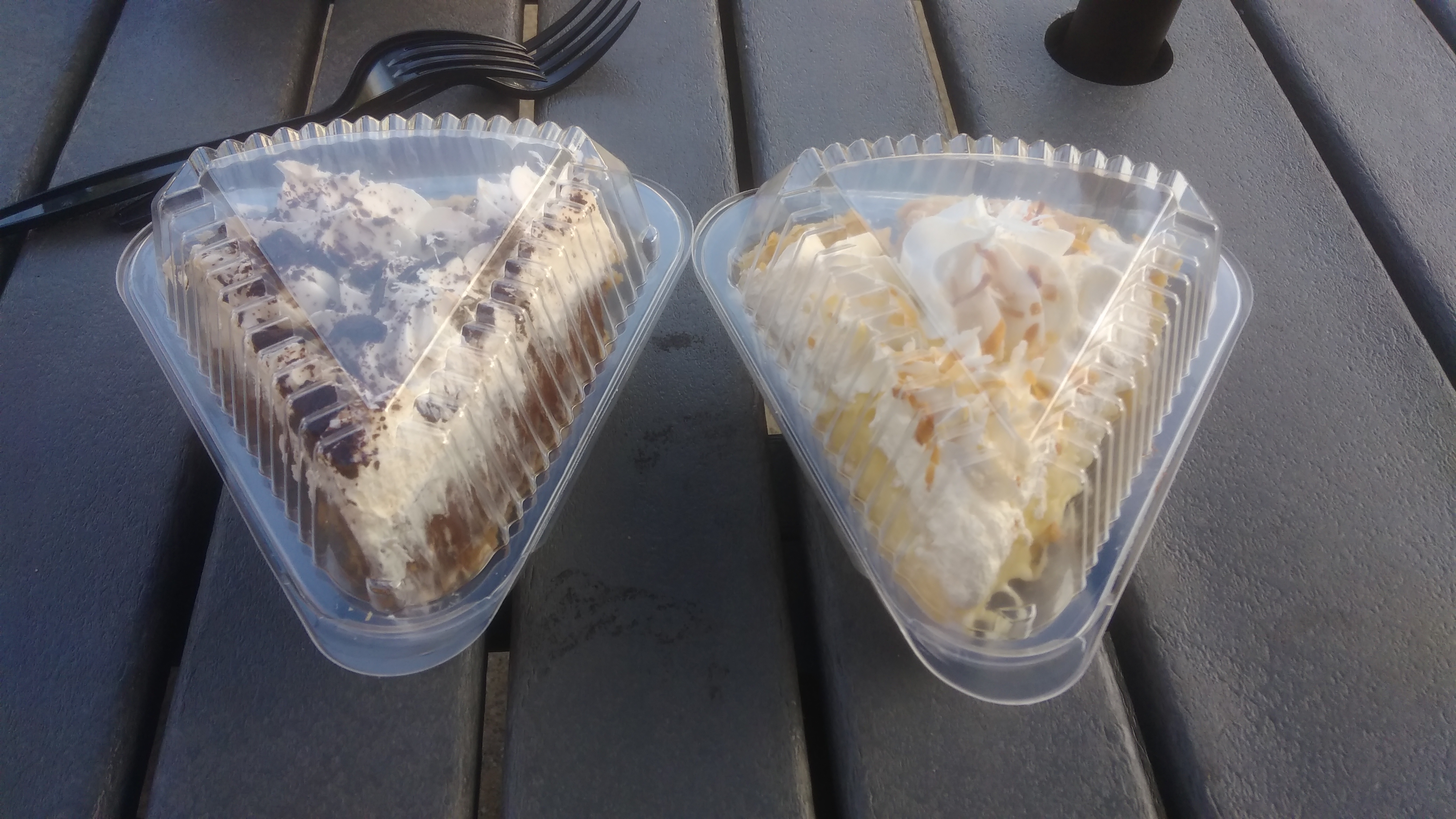
Late last year, I groused about a Chicago joint that serves $8 slices of pie, a price that compares unfavorably even to Manhattan. In Lansing, Michigan, recently, I paid about $8 for creme pie — but for that price we got two slices that we shared.

Tasty pie. Served by the Grand Traverse Pie Co., with 15 locations, all of which are in Michigan, except for an oddball in Terra Heute, Indiana. Sure, it’s cheaper to operate in a small city, but that alone can’t account for the difference between $4 and $8 slices.

Until recently, I hadn’t heard “Step Right Up” by Tom Waits in years. You might call it advert-scat. It’s funny.

I first heard it in college, because my friend Dan had some Tom Waits records, most memorably Small Change. Listening to it now, it occurs to me that some of the phrases have mostly passed from common use in the advertising world, such as please allow 30 days for delivery or the heartbreak of psoriasis or no salesman will visit your home.

So in 100 years, will the song mostly be 20th-century gibberish? Maybe. Still, with a light beat, steady bass and driving sax, I’d listen to Tom Waits sing gibberish.

See All the Hip New Joints!

If I didn’t know better, and I don’t, I’d think that Lonely Planet is straying away from its backpacker roots into travel articles infused with that wan emotion felt by wan people, fear of missing out.

Take this article about the Scott’s Addition neighborhood of Richmond, Virginia. Not long ago, I wrote about an apartment development in the area, and in the course of my research discovered that the district is hip, up-and-coming, the haunt of millennials who have more adventuresome tastes than all previous generations, etc. That wasn’t something I’d known. On the whole, that’s probably good: economic and real estate development for the area, new businesses, people walking around, maybe even a few older buildings saved.

Still, the tone of the article is offputting. Here’s how it starts: “Passionate entrepreneurs have muscled onto the scene: hot art-themed hotels are wowing guests, bold chefs are shaking up the culinary landscape and brewers offer sours and saisons in brand-new tasting rooms.”

A sentence that could be published in precisely any travel guide about anywhere thought to be hip. There’s nothing distinctive about it. Remember in Masada, when one of the other Romans was committing a particularly heinous act, Peter O’Toole’s character stopped him while yelling, This is not Rome! My urge here is to declare, This is not Lonely Planet!

Lonely Planet cares not for art-themed hotels or bold chefs or brand-new tasting rooms. Lonely Planet might take a look in the hotel lobby, but then it finds a cheap lunch and eats it on a bench as life on the streets goes by, which Lonely Planet watches with delight. Lonely Planet smiles at the thought of bold chefs who create must-have creations. How do we know that they are must have? Everybody says so. Guaranteed to be expensive too, and Lonely Planets cares not for that.

That’s not my only beef with this particular article. It’s called “36 hours in Scott’s Addition, Richmond’s new hotspot.” It should be called, “36 hours in Scott’s Addition, Richmond’s new hotspot, while well and truly drunk.”

The following is an outline of the article’s suggestions: First, go to a distillery and drink. Then drink cider made from apples so rare only one secret tree in Serendip grows them. Then have dinner, with “craft beer and adult milkshakes” at a “postmodern diner.”

See some art, because art is good, then resume drinking — Chinese food with craft beer. Then more beer. And some more after that, at very arty places. Or maybe saisons or farmhouse ales. Then stagger to another brewery. Don’t forget to eat after that, because the food’s special around here, but also finish things off with more beer!

It’s definitely the tone that bothers me. No doubt all of the recommended places are quite good, if that’s what you want. Some of my old friends have epicurean and gourmand tendencies, after all. The tone of the article, on the other hand, is Hit! All! The! Special! Places! or your trip will be crap, your time wasted and your soul unnourished.

Une Impitoyable Savate Japonaise

Ah, marketing blarney. The other day I noticed a big plastic bottle of body wash on a shelf. Let’s leave aside for the moment the fundamental question of how that’s different from soap, other than a higher price per oz., and look at the text on the back of the bottle. Hogwash for body wash.

I won’t give the brand any free advertising, however microscopic. Enough to say that it’s a well-known and longstanding brand of personal care products, owned by a conglomerate. Almost everyone my age with access to American TV in the latter years of the 20th century, and probably a good many people older and younger, could whistle its jingle, so catchy and ubiquitous it was.

Also know that the brand has long been aimed at men, encouraging them to be manly men who do manly things, and in no way ironically. Still seems to, as you will see.

Anyway, the body wash bottle has text in English and French, since I suppose Canadians buy it too. As follows:

Doesn’t leave you feeling dry or rob you of your dignity.

Hm.

Like wearing an armor of man-scent.

Armor’s an interesting choice. More manly than residue, I guess. But the last line was my favorite. It made me laugh. Out loud. Chuckle, that is.

Drop-kicks dirt, then slams odor with a folding chair.

French isn’t my language, but the French text seems to hew pretty close to the English, until that last line:

Lutte contre la salete et les odeurs et le envoice au tapis pour le compte grace a une impitoyable savate japonaise.

I won’t vouch for its accuracy, but I did find one online translation for the last part of that sentence that seems plausible: “Sends [odor] to the mat with a devastating Japanese roundkick.”

Maybe that’s what the French call a roundhouse kick, for reasons best known to them. Maybe not. I’m amused all the same.

Bugs Burger Night

Thirty-six years ago I worked for a few months at an upscale restaurant in Nashville. If I remember right, it wasn’t open on Mondays, and one Sunday when I hadn’t been there long, word came down that we had to get the place ready for Bugs Burger Night, which would happen after the restaurant closed that evening.

Before long I understood that meant exterminators were coming to give the restaurant a top-to-bottom treatment, and we had to put away the food and dishes and so on. It was a pretty big deal, this Bugs Burger Night, and the phrase was curious enough to pique my interest. The treatment of course was a regular thing, every few months, so I assumed that “bugs burger” was just restaurant-specific slang passing along from more experienced employees to the likes of me. Fun in the way slang can be. Maybe the exterminators were feeding the bugs a burger of death.

It even inspired me to dream up a title that was never attached to any story: The Long Bugs Burger Night of the Soul. Or The Dark Bugs Burger Night of the Soul.

That oddity was duly tucked away in the part-organized, part-chaotic filing cabinets of my memory. Files that have a way of popping into conscious thought without warning, which I suppose is a function of the chaotic side. That’s all a long way of saying that “Bugs Burger Night” popped into my head the other day. Then I did what we do in modern times: Googled it.

Bugs Burger was part of a brand name. That shouldn’t have surprised me, but it did. Pest Management Professional told me about Alvin “Bugs” Burger (d. 2015), founder of Bugs Burger Bug Killers, a Miami-based national exterminator. So professionals from BBBK were coming to the restaurant that night. Though Alvin “Bugs” is gone, the name lives on.

Small pleasures aren’t just the likes of enjoying a favorite old food or a spying a colorful cloud formation or a reading a postcard from an old friend. They can also be intangible, like a small thought from your remote past reappearing for a reinvention in the present.