The Last Gasp of the Federal Works Agency

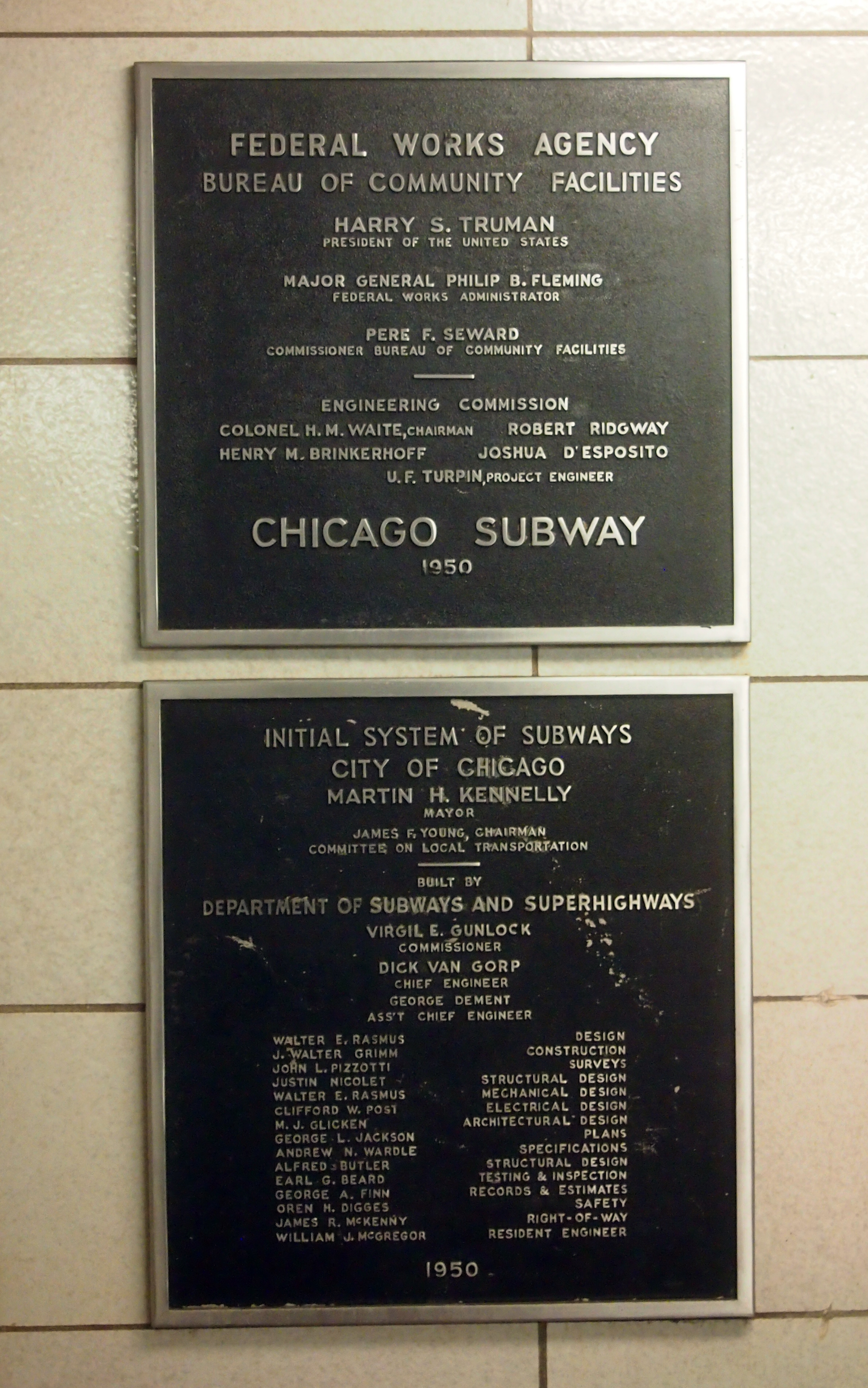
Not something you see everyday: a plaque marking a project by the Federal Works Agency. But there it was last weekend for me to see, at the Chicago subway station of the CTA Blue Line (O’Hare-Forest Park).

Federal Works Agency plaque, Chicago StationThe Federal Works Agency only lasted until 1949, but it’s a safe assumption that the subway construction project started under its aegis in the late ’40s, so it was thought fitting to use the name even in 1950. The agency had been created as a part of a major federal government reorganization in 1939, authorized by Congress and overseen by the executive branch.

To quote President Roosevelt, in his message to Congress on the Reorganization Act of 1939: “[The FWA will include] the Bureau of Public Roads, now in the Department of Agriculture; the Public Buildings Branch of the Procurement Division, now in the Treasury Department, and the Branch of Buildings Management of the National Park Service… now in the Department of the Interior; the United States Housing Authority, now in the Department of the Interior; the Federal Emergency Administration of Public Works; and the Works Progress Administration, except the functions of the National Youth Administration.”

Various additions and subtractions were made to that list until 1949, when the FWA’s remaining functions were parceled out to other agencies, as well as the newly created General Services Administration. As federal bureaucracies go, the FWA had a fruit-fly lifespan.

With a 10-year run, there couldn’t be that many FWA plaques. Certainly not as many as the GSA — nearly 70 years now — or even the WPA or the CCC, which also had short runs, but were really busy in their heydays. So maybe in the hobby of plaque-spotting the FWA is a nice find.

If there is such a hobby. Surely someone looks for plaques in a more enthusiastic or systematic way than I do. And is Blue Plaque-spotting a thing in the UK, or does this Spectator article merely refer to casually walking by them?

Billy Beer Now Counts as an Antique?

First things first. Remember the Alamo.

Not long ago we visited an antique mall in another northwest suburb that we go to occasionally, though this was the first time in a few years. On the whole it’s a likable place stuffed to the gills with debris from across the decades. I like looking around, just to remind myself how much stuff there is in the manmade world. The establishment frowns on photographing its wares, so I have no images.

The mall’s postcards, unfortunately, tend to be $1 or more each. It has to be a special card for me to pay that much. Got enough of them anyway. Several drawers full of old photographs of random strangers were also available, at a lower cost per item. Many were easily taken 100 years ago. That only goes to prove that for most people, any images older than their grandparents might as well be cave paintings.

The most amusing find: a six pack of Billy Beer, apparently unopened. I don’t ever remember actually seeing any, only hearing about it, as everyone did in 1977. A short history of the risible brand, posted in 2010, is at Mental Floss, whose key line is: “That’s about the best summary of Billy Beer that we can find; it was so noxious that not even Billy Carter would drink it.”

As for later: “Billy Beer perfectly fit the mold for a worthless collectible. It was made in giant quantities. Hordes of people had speculatively saved some. It had no intrinsic value.”

I think the price on the cans was $30. Who knows, maybe Billy Beer’s time as a collectible will come someday, as those giant quantities waste away across the decades. But I’m not going to buy any in hopes of finding out.

Thursday Residuum

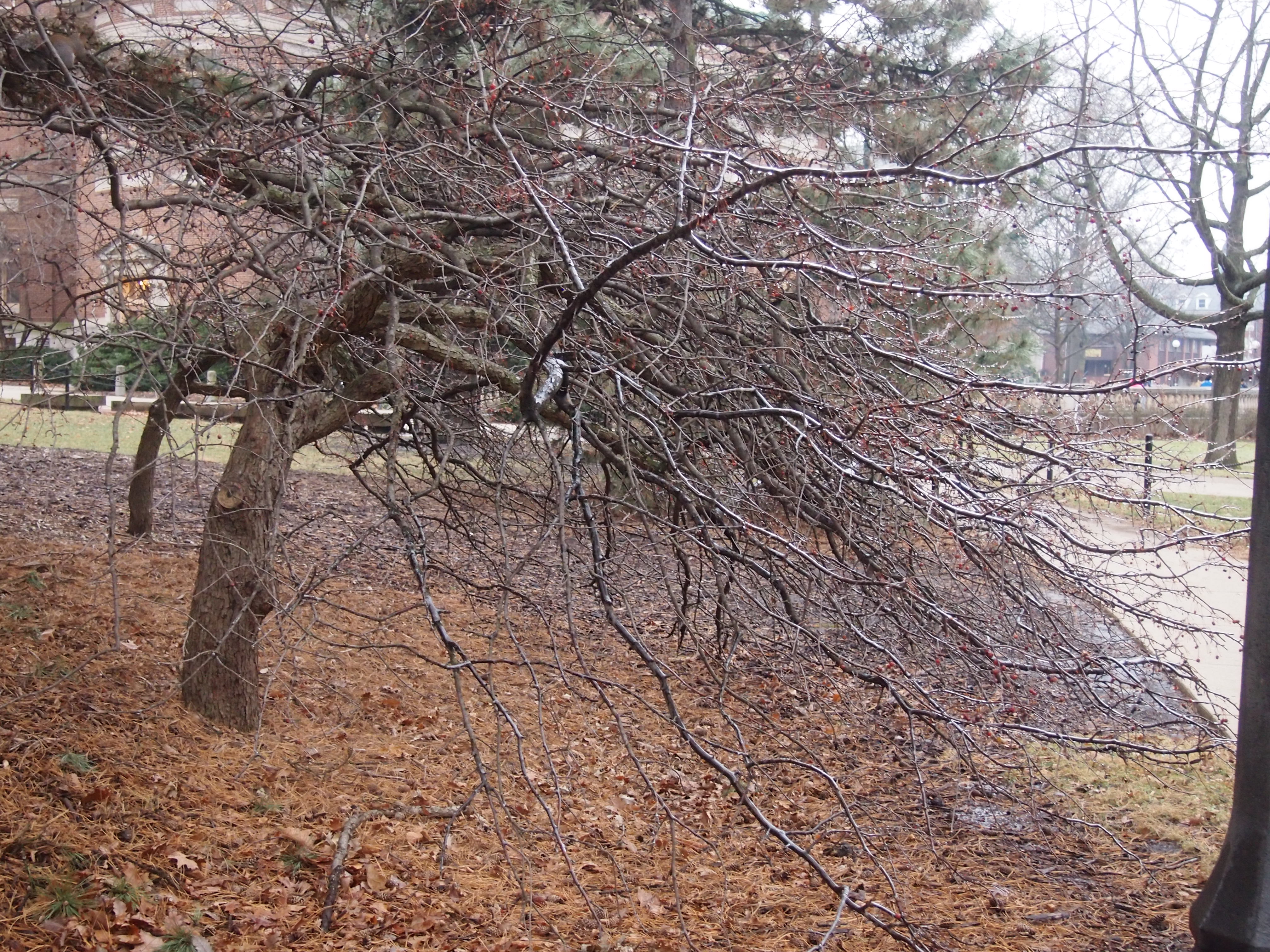
Remarkably rainy January so far. Even when it hasn’t been raining these past weeks or so, the skies have looked pregnant with rain. So it’s been a wet January, not an icy one. That was the case at UIUC, as the last of clinging frozen matter thawed, as it might in a normal northern March.

UIUC January 15, 2017

Blame it on climate change? I’d be tempted, but weather isn’t climate. Besides, there’s a blizzard lurking out there in the near future, or at least heavy snow. Winter will not be denied.

A few days ago, I approached a four-way stop to make a left turn. Directly across the intersection another car arrived to make a left turn. To my left, a third car arrived to make a right turn. We all got there at about the same moment. We all made our respective turns concurrently. Can’t remember when that happened before. Had a fourth car to my right wanted to make a right turn, it would have been truly remarkable, but we had to settle for a three-way synch.

At a World Market last week, I saw bottles of Tito’s Handmade Vodka for sale. I couldn’t ever remember actually seeing any before, as opposed to hearing about it, though I don’t go to a lot of liquor stores.

Last month, I heard Tito himself on the radio, pitching his creation. He didn’t quite sound like his high school self, no one would, but it was him all right. I was pretty sure I hadn’t ever heard advertising for Tito’s beyond sponsorships on public radio (the ad I heard was on a commercial station). Maybe Tito’s needed to up his ad budget in the face of competition.

I’m most of my way through the book River of Doubt, about the Roosevelt-Rondon expedition into the deep Brazilian rainforest. Reading it, you think, how did anyone survive that trip? They faced untreatable diseases, looming starvation, dangerous animals, venomous bugs, an extremely hazardous river, a murderer among their crew, and the potential for Indians to attack at any time and wipe them all out. At one point, a very sick Theodore Roosevelt seriously contemplated overdosing on morphine. Not too end his pain, but to avoid being an impediment to the rest of the expedition. His son Kermit wouldn’t allow it.

Amazing how close TR’s bio came to ending with, “Led expedition down the River of Doubt in Brazil, 1914. Never seen again.”

Divers Content on a Freezing Cold Thursday

Inspired by yesterday’s natterings, I stopped at the library and checked out River of Doubt (2006) by Candice Millard. Subtitled “Theodore Roosevelt’s Darkest Journey,” it’s about TR’s expedition into darkest Amazonia in 1913-14. As the book makes clear from the get-go, the journey nearly killed him. Even he-man action presidents have their limits, after all.

I didn’t know until today that Andrew Sachs died not long ago. There are many clips available of him in fine form as Manuel, such as this one or this one or this one.

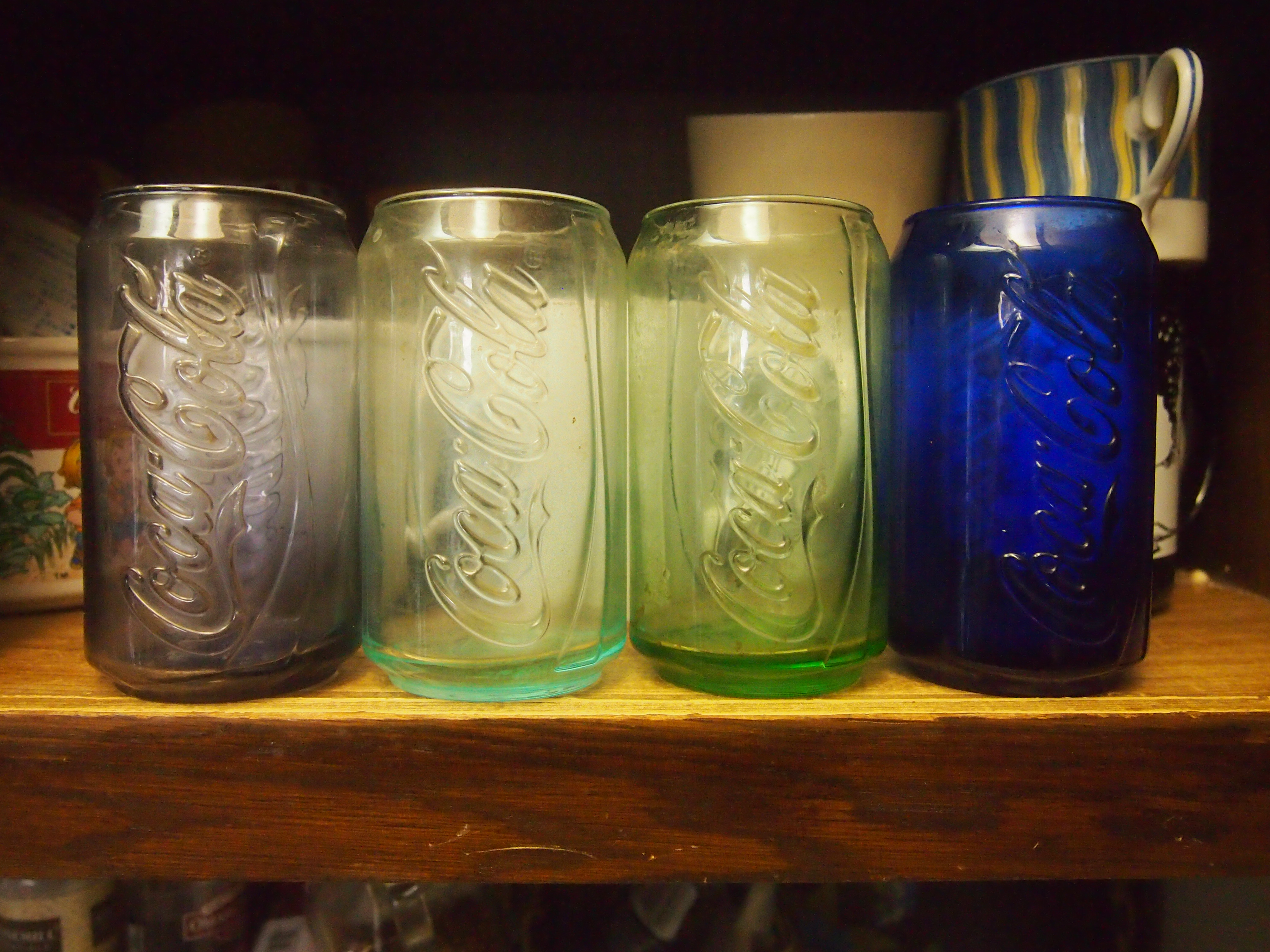
I’ve had these glasses for a few years now. Bought them at a garage sale for (I think) a quarter each.

Coke Cans Make of Glass

They were clearly some kind of promotional item from Coca-cola but also McDonald’s, because three of them have McDonald’s arches on the bottom. The interesting thing to me is that they’re precisely the same size and shape as a 12 oz. soft drink can.

While writing about a hotel today, I encountered something in the hotel biz known as a “spiritual menu.” The concept isn’t exactly new, but I’d never heard of it. The following is from the Christian Post in 2008.

“A hotel in Nashville will be the first known in the nation to remove the standard Holy Bible from its rooms and replace it with a ‘spiritual menu’ that includes other religious books… Hotel Preston, a boutique owned by Oregon-based Provenance Hotels, will require guests to call room service to order their religious book of choice…

“The religious book list includes the Book of Mormon, the Qur’an, the Torah, the Tao Te Ching, The Four Noble Truths of Buddhism, Bhagavad Gita (a Hindu text), books on Scientology, as well as the King James and New American Bible versions.” @#$%&! Scientology?

Hm. The Gideons can’t be too happy about being replaced. And the following lyric just doesn’t have the same ring: Rocky Raccoon/Checked into his room/Only to find a spiritual menu.

Presidential Trivia for the Day, 1/11/17

There’s a monograph to be written about U.S. presidents and South America. That’s the kind of thing that comes to mind sometimes for me, but it wasn’t an entirely random thought that popped into my head. (Though I get enough of those, too.)

My friend Kevin sent me an email today about a trivia contest he’d participated in recently. I don’t think he’d mind me reproducing our exchange here. The subject line was: Final Trivia Question Last Night – U.S. Presidents

Kevin: Without looking up the answer, would you have known the answer to this?

“When Eisenhower was in office, Alaska and Hawaii were admitted into the union. Before him, who was the last president to be in office when a new state was admitted into the union?”

Me: That’s an easy one: Wm. Howard Taft, president in 1912 when NM and AZ became states.

Kevin: Where were you last night when we needed you?

I had the states right in my mind and the time frame, but we put Teddy Roosevelt down. Off by one president.

Me: A harder question would be which state entered the union when TR was president? Oklahoma, 1907. 

Here’s another one: which president signed statehood bills for six states?

Kevin: Ya got me. Hayes or Garfield?

If you still lived in Westmont, you could be on our team.

We were doomed anyway. One of the categories was Alice in Wonderland. We got one right out of eight.

We generally do pretty good with the first round, which is a grab bag round. A little bit of everything. Six out of eight with that category.

They also have another grab bag round, but each answer started with the letter “R.” Seven out of eight for that category.

Me: Benjamin Harrison. The story about the Dakotas is that he closed his eyes when he signed their bills — they’d been approved by Congress at the same time — so that no one would know which was first. Others BH states were Montana, Idaho, Washington and Wyoming. No president ever signed so many statehood bills.

Hayes didn’t get any. But he was the father of a department in Paraguay, which is named after him.

Now that’s trivia. Unless you’re from Paraguay.

Kevin: Very interesting. I hope that comes up as a trivia question sometime.

I keep hoping they’ll ask who was president between Grover Cleveland’s two non-consecutive terms? Benjamin Harrrison! That one I know.

I might know more presidential facts than most, but I don’t expect anyone else to know that kind thing. Each to his own trivia. Sports fans would be well to remember that. Then again, sometimes “trivia” is really “facts every educated person should know.”

Can’t remember when I first heard about the Presidente Hayes Department, but it was quite a while ago. Guess the Paraguayans, being from a country that didn’t catch any breaks in the 19th century, were glad to get something from the international arbitration that Hayes oversaw.

Back to the U.S. presidents and South America monograph. There’s certainly enough material. There’s Hayes and Paraguay, of course. There’s also Teddy Roosevelt’s expedition to the Amazon basin (the Roosevelt-Rondon Scientific Expedition of 1913-14) to explore the River of Doubt, known these days as the Rio Roosevelt. And one more that I can think of: the time when Vice President Nixon’s car was attacked and nearly overturned in Caracas in 1958. Sure, he wasn’t president yet, but he would be later, so it counts.

Captain Canuck & President Polk for Christmas

My last Christmas present came via UPS today. Lilly ordered it not long ago, some time after I assured her that a little while after Christmas is close enough. It’s an attitude that makes the holidays less stressful; more people should consider it.

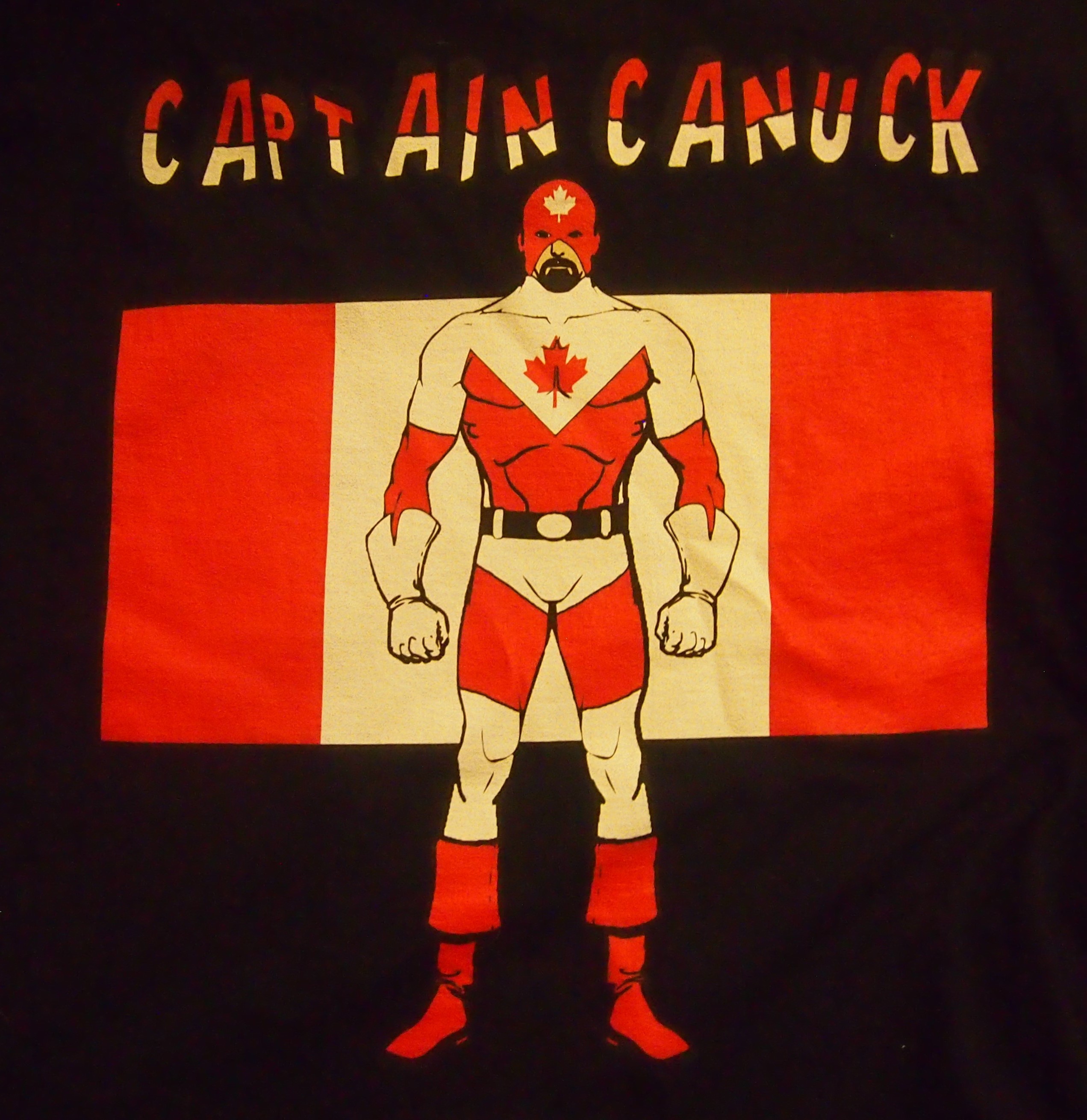
I’d suggested the item almost off-handedly. In our time, such whims are easily gratified online. It’s alarmingly easy. Here’s a closeup.

Captain Canuck!

It’s a Captain Canuck t-shirt, 100 percent cotton, made in Nicaragua. Accept no less.

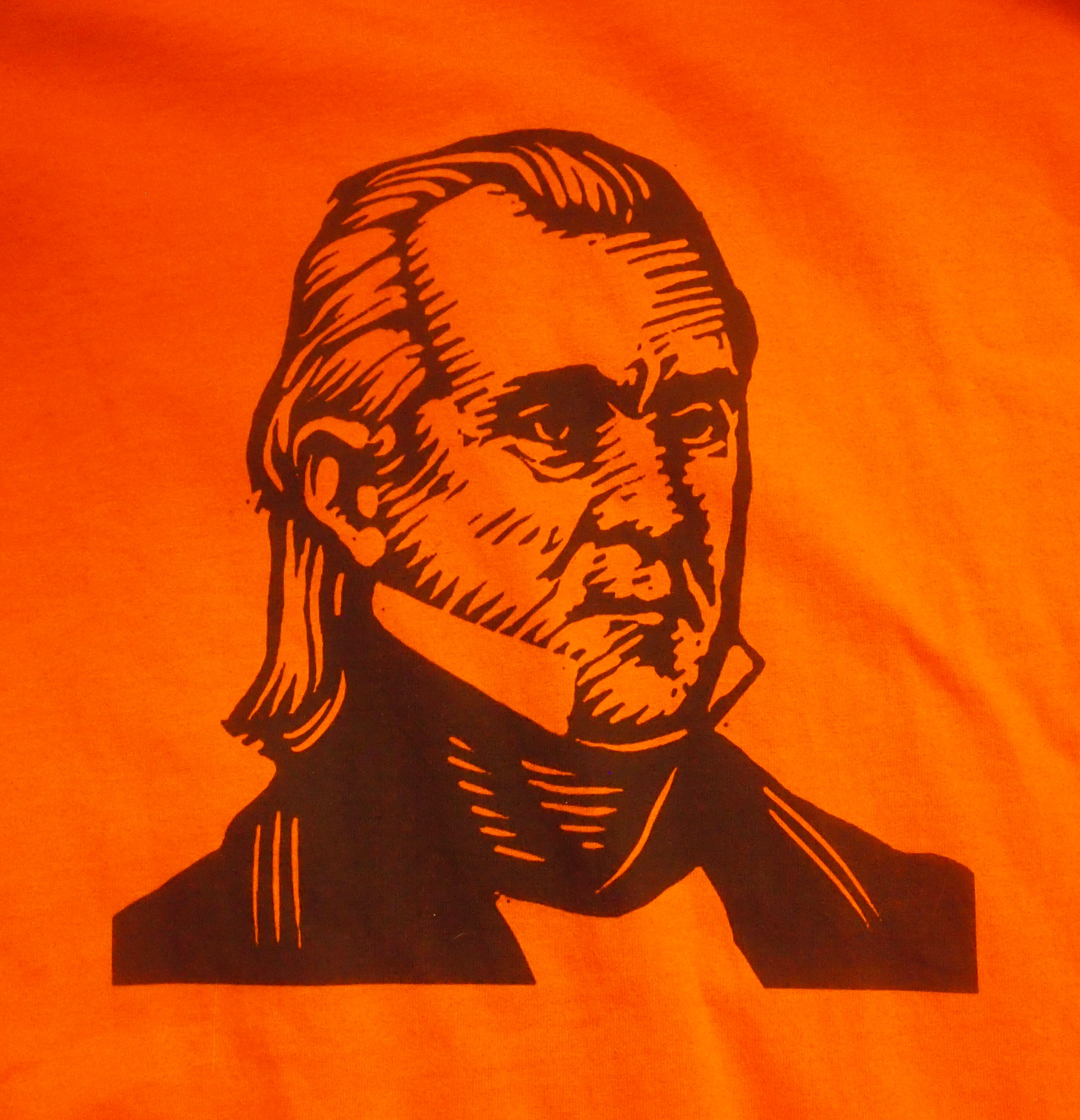
Also for Christmas this year, but some time earlier, Jay got me a t-shirt with another larger-than-life figure, though from the annals of U.S. history.

James K. Polk, Napoleon of the Stump

None other than James K. Polk, Napoleon of the Stump. Also all cotton, but made in Haiti. On the back it says POLK 11.

Otherwise, Today Was Fairly Normal

Not much to add to the volumes written about the election, and which will be, ad nauseam. Biggest surprise since 1948, maybe bigger than that. Trouble is, Trump is no Truman. No one knows what he’ll be in office. So it’s an awful gamble.

Best not to dwell on it too much at this juncture. Instead, hum something cheerful.

Presidential facts to mull over. Assuming President Obama finishes his term, and it’s a safe assumption, it will mark only the second time that three presidents in a row have held office for eight years each. The first time was long ago: Jefferson-Madison-Monroe. Four times in a row has never happened.

Also assuming Obama survives his term — and all of the other ex-presidents do, too — then there will be five living former presidents for a time after Jan. 20, 2017 (Carter, Bush, Clinton, Bush, Obama). That’s only happened three times: March 4, 1861-Jan 18, 1862; Jan. 20, 1993-April 22, 1994; and Jan. 20, 2001-June 5, 2004.

Donald Trump will be the first president from New York City since TR, though of course FDR was from New York state and so were a number of others. In fact, with the upcoming addition, that will make six presidents from New York state, same as Ohio, “Mother of Presidents.”

Three More Philly Sites

One of the things to do while you wait to enter Independence Hall is take a look at the museum of the American Philosophical Society, which stands very near the hall itself.
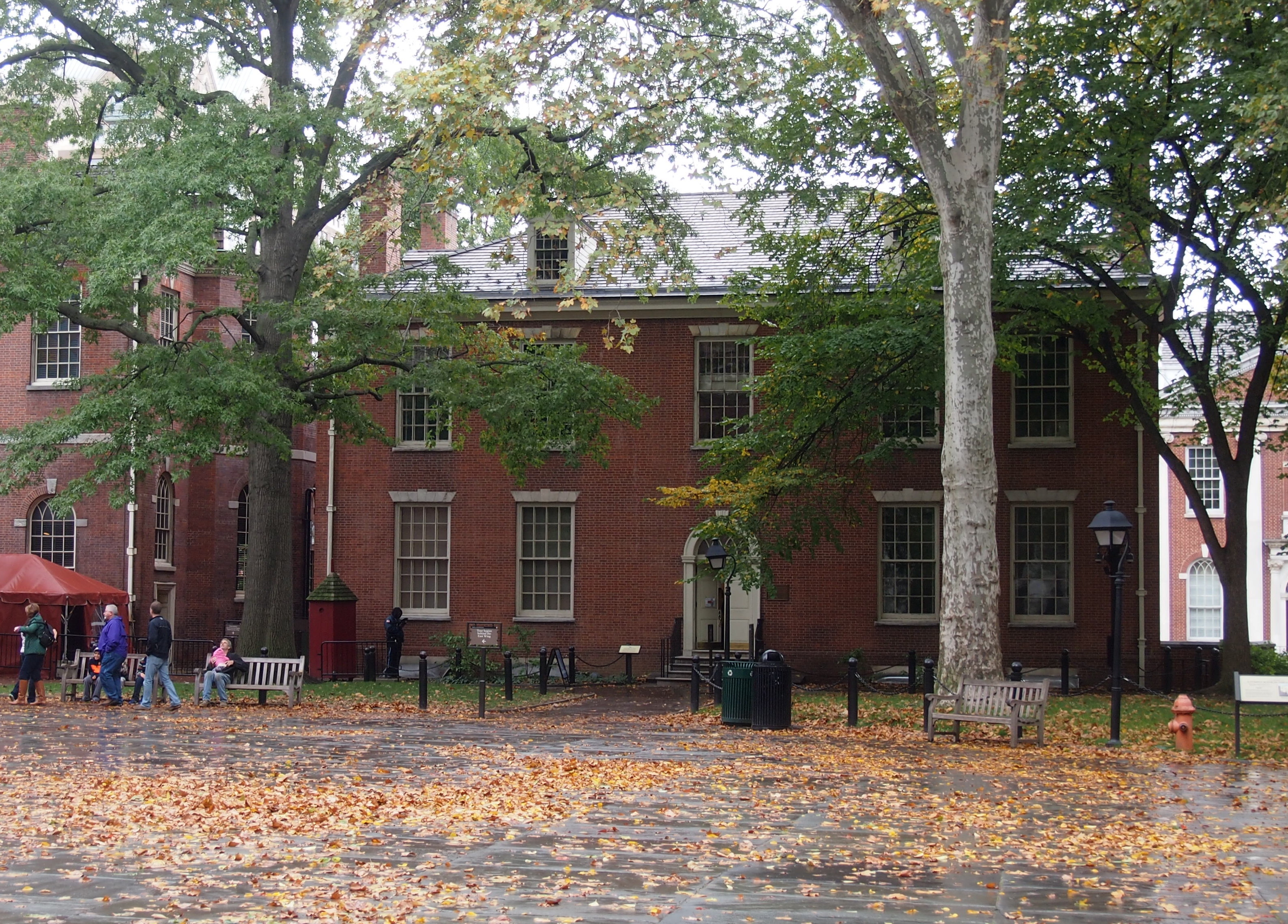
American Philosophical SocietyI wasn’t aware that the APS is still an ongoing thing, but that’s just me being ignorant again. It’s a learned society, originally inspired by the old concept of leisure. “The first drudgery of settling new colonies is now pretty well over,” wrote Benjamin Franklin in 1743, “and there are many in every province in circumstances that set them at ease, and afford leisure to cultivate the finer arts, and improve the common stock of knowledge.”

The main current exhibit at the APS museum is Gathering Voices, which “tells the story of Jefferson’s effort to collect Native American languages and its legacy at the Society,” says the museum. “Jefferson had an abiding interest in Native American culture and language, while, at the same time, supporting national policies that ultimately threatened the survival of Indigenous peoples. As president of the APS from 1797 to 1814, Jefferson charged the Society with collecting vocabularies and artifacts from Native American nations. Over the next two hundred years, the APS would become a major repository for linguistic, ethnographic, and anthropological research on Native American cultures.”

It was an interesting display, including some documents in Jefferson’s hand. The collection isn’t as large as it might have been, however. The museum also tells this little-known story: “When Thomas Jefferson left Washington after two terms as President of the United States, he packed 50 Native American vocabulary lists in a trunk and sent them on a river barge back to Monticello along with the rest of his possessions. Somewhere along the journey, a thief stole the heavy trunk, thinking it was full of treasure. Upon discovering it was only filled with papers, he tossed the seemingly worthless contents into the James River. The loss of the vocabularies represented the destruction of 30 years of collecting on Jefferson’s part.”

Photocopying. That’s what Jefferson needed, but didn’t have.

In the West Wing of Independence Hall, there’s a small exhibit that doesn’t require waiting or a ticket to enter — another thing you can do while waiting to get into the rest of the hall. The exhibit is called Great Essentials.

On display are original printed copies of the Declaration of Independence, the Articles of Confederation, and the Constitution. All very interesting, but the thing that really got my attention was the Syng inkstand. A fine work of silversmithing, and highly placed in the history of the United States. It may be the only inkstand anywhere that has a proper name, though I wouldn’t swear to it.

“Irish-born Philip Syng was the son of Philip Syng, a silversmith,” notes the Penn University Archives and Records Center. “In 1714 he and his father emigrated to America. In 1726, after a successful apprenticeship in Philadelphia and a trip to England, Philip established himself as a silversmith in Philadelphia. In 1730 he married Elizabeth Warner; together they had at least eighteen children.

“Perhaps on his trip to England, and if not, soon thereafter, Syng met Benjamin Franklin. The two formed a friendship, leading to Syng’s inclusion in the Junto, Franklin’s group of political and intellectual civic leaders… Syng was also elected to various public offices including city assessor, warden of the port, and treasurer of the city and county of Philadelphia.

“Syng was renowned as a silversmith, creating the finest work for Philadelphia’s leading families. His most famous work was the inkstand he made for the Pennsylvania Assembly, which was then used by the signers of the Declaration of Independence and the U.S. Constitution. He provided seals for the Library Company, the Union Fire Company, the Philadelphia Contributionship and for various surveyors and Pennsylvania counties. His shop produced not only silver bowls, tankards, teapots and trays but also gold belt buckles, buttons and teaspoons.”

A block north of Independence Hall is a visitors center of fairly recent vintage, at least compared with the original buildings, and across Market St. from the center — between it and the Liberty Bell — is the President’s House Site.
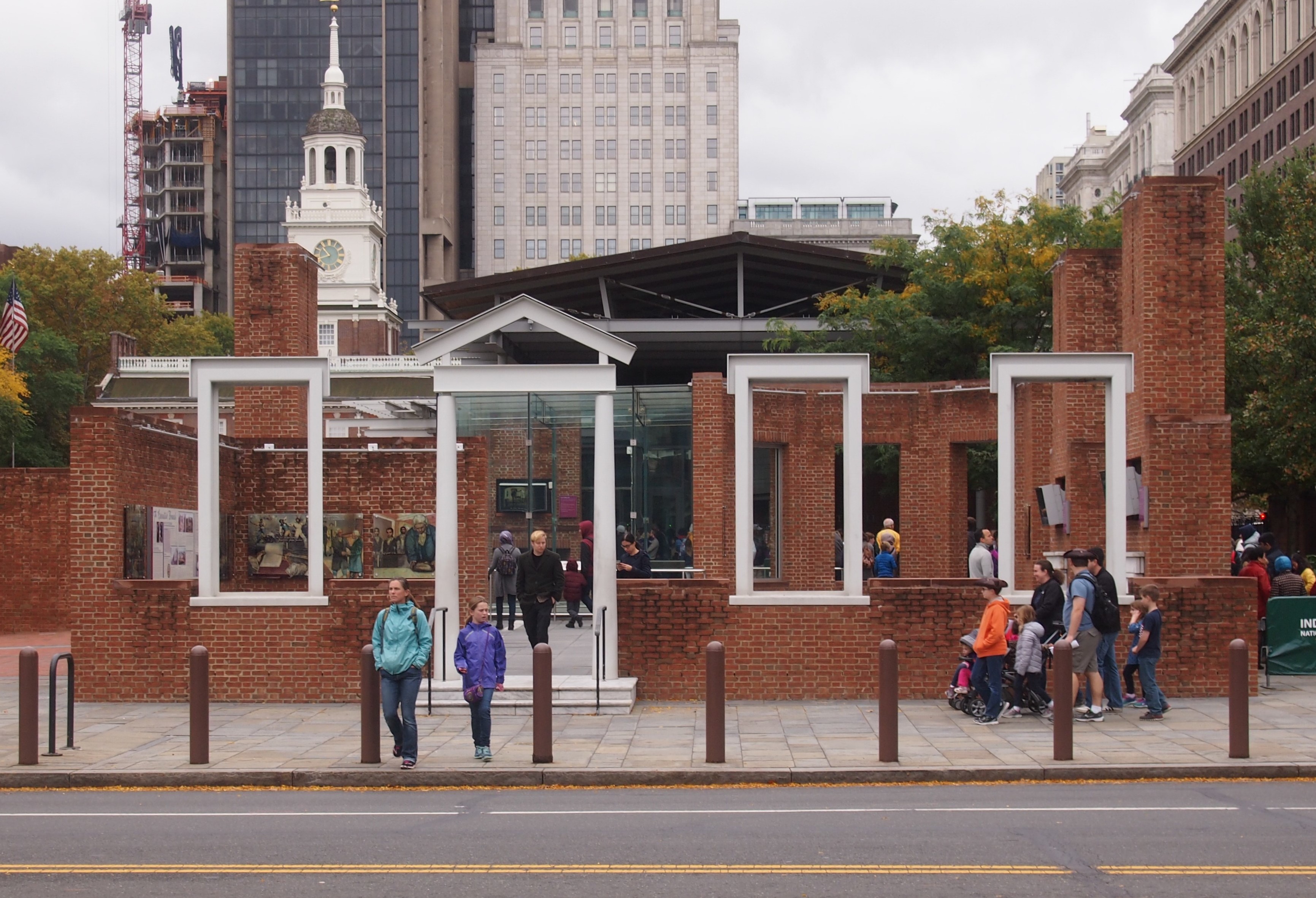
Presidents House Site, Philadelphia

I quote the NPS on the history of the site at some length, because it’s a relatively unknown place, but much happened there. It was originally built in 1767, and was known as the Masters-Penn house (a grandson of William Penn lived there in its early days).

“In September 1777, British forces under General Sir William Howe occupy Philadelphia after the Battles of Brandywine and Germantown. General Howe makes the Masters-Penn house his winter residence and headquarters while Washington and his troops retreat to Valley Forge. In June 1778, the British evacuate Philadelphia and consolidate their forces in New York.

“Colonial forces enter Philadelphia under the command of Major-General Benedict Arnold. Arnold promptly makes the Masters-Penn House his residence and headquarters. In March 1779, Arnold resigns his post and two months later, while still living in the house, he begins his treasonous correspondence with the British.

“In January 1780, the house is severely damaged by fire, and is subsequently purchased and rebuilt by Robert Morris, the famed ‘Financier of the Revolution.’ Morris rebuilds the house to its original plan, enlarges the property, and adds an icehouse and several back buildings.

“In 1790, Robert Morris volunteers his house to serve as President Washington’s residence while Philadelphia temporarily serves as the nation’s capital. Washington occupies the property from November 1790 to March 1797, during which time his household includes nine enslaved Africans brought up from Mount Vernon. He also makes several enlargements and modifications to the house and back buildings, including the addition of a slave quarters between the kitchen and stables.

John Adams succeeds Washington as President and moves into the President’s House in March 1797. Adams leaves Philadelphia in 1800 and moves into the newly completed White House in Washington D.C. on November 1.”

So it’s a house associated with the Penn family, Gen. Howe, Benedict Arnold, Robert Morris, George Washington and John Adams. What happened to it later?

“In 1832, the building is demolished and rebuilt as a series of three narrow stores. Only the east and west walls of the original house are left standing, and are incorporated into the later commercial buildings… In 1935, the later commercial properties are themselves demolished, although remnants of the original east and west walls of the President’s House survive until the early 1950s. In 1951, the entire block is razed.”

What’s standing there now is a monument, completed in 2010 after much agitation, to the slaves who came with George Washington to attend his household while he lived there. (And whom he rotated back and forth to Virginia to avoid having to free them under Pennsylvania law.)

“Dominating the site as a whole is a large glass enclosure — the architects, Kelly/Maiello Architects & Planners, call it a ‘glass vitrine’ — protecting the fruits of a 2007 archaeological excavation. Within, about 10 feet below street level, visitors can see the remains of house foundations, revealing both the world of Washington and Adams (who held no slaves), and the world of indentured servants and Washington’s black chattel.”

For the record, Moll, Christopher Sheels, Hercules, his son Richmond, Oney Judge, her brother Austin, Giles, Paris, and Joe were the slaves who worked for President Washington at the Philadelphia household.

Of Hercules, the president’s chef, Wiki notes that “Stephen Decatur Jr.’s book Private Affairs of George Washington (1933) stated that Hercules escaped to freedom from Philadelphia in March 1797, at the end of Washington’s presidency… In November 2009, Mary V. Thompson, research specialist at Mount Vernon, discovered that Hercules’s escape to freedom was from Mount Vernon, and that it occurred on February 22, 1797 – Washington’s 65th birthday…

“At Martha Washington’s request, the three executors of Washington’s Estate freed her late husband’s slaves on January 1, 1801. It is possible that Hercules did not know he had been manumitted, and legally was no longer a fugitive.

“In a December 15, 1801 letter, Martha Washington indicated that she had learned that Hercules, by then legally free, was living in New York City. Nothing more is known of his whereabouts or life in freedom.”
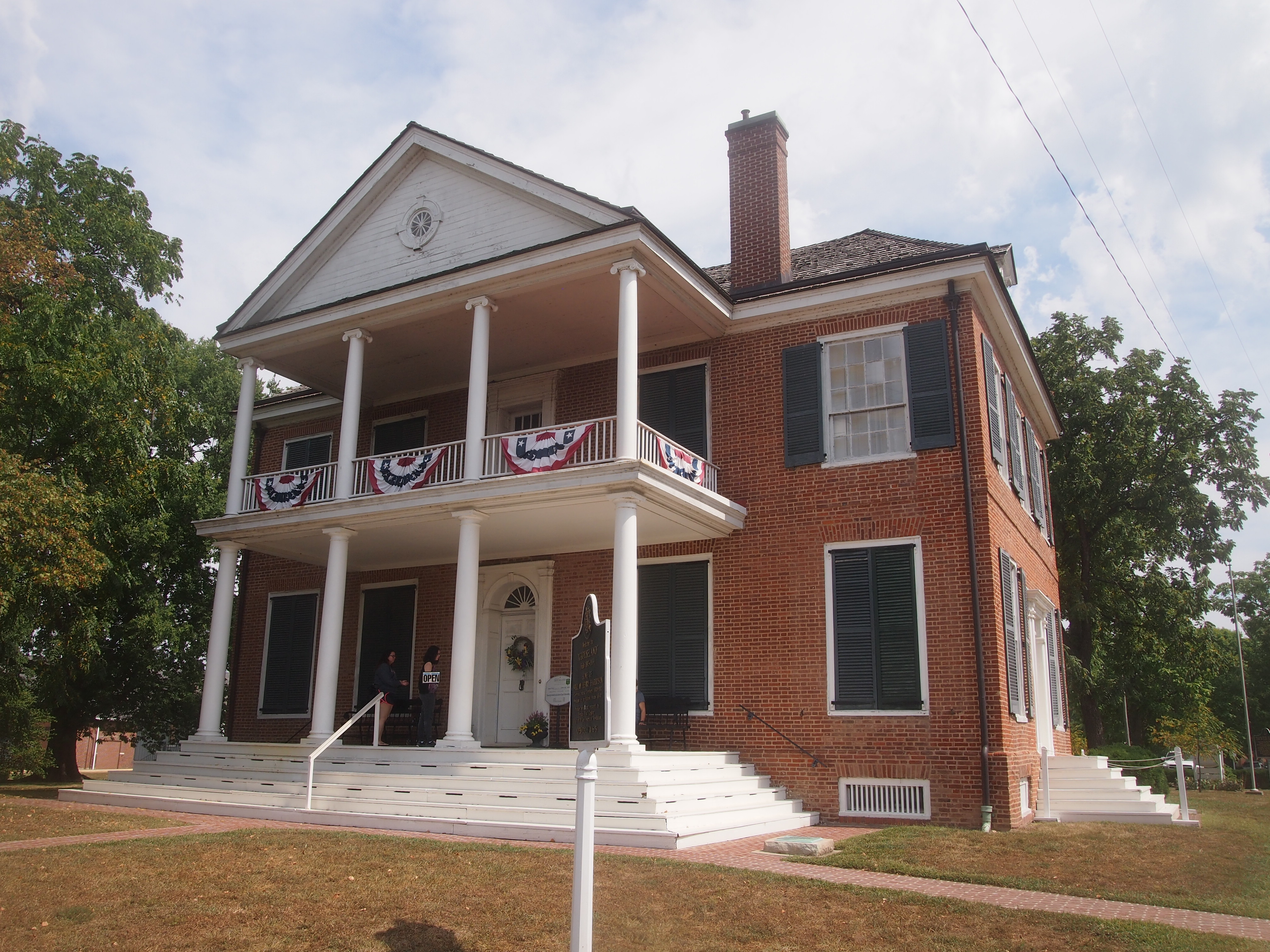
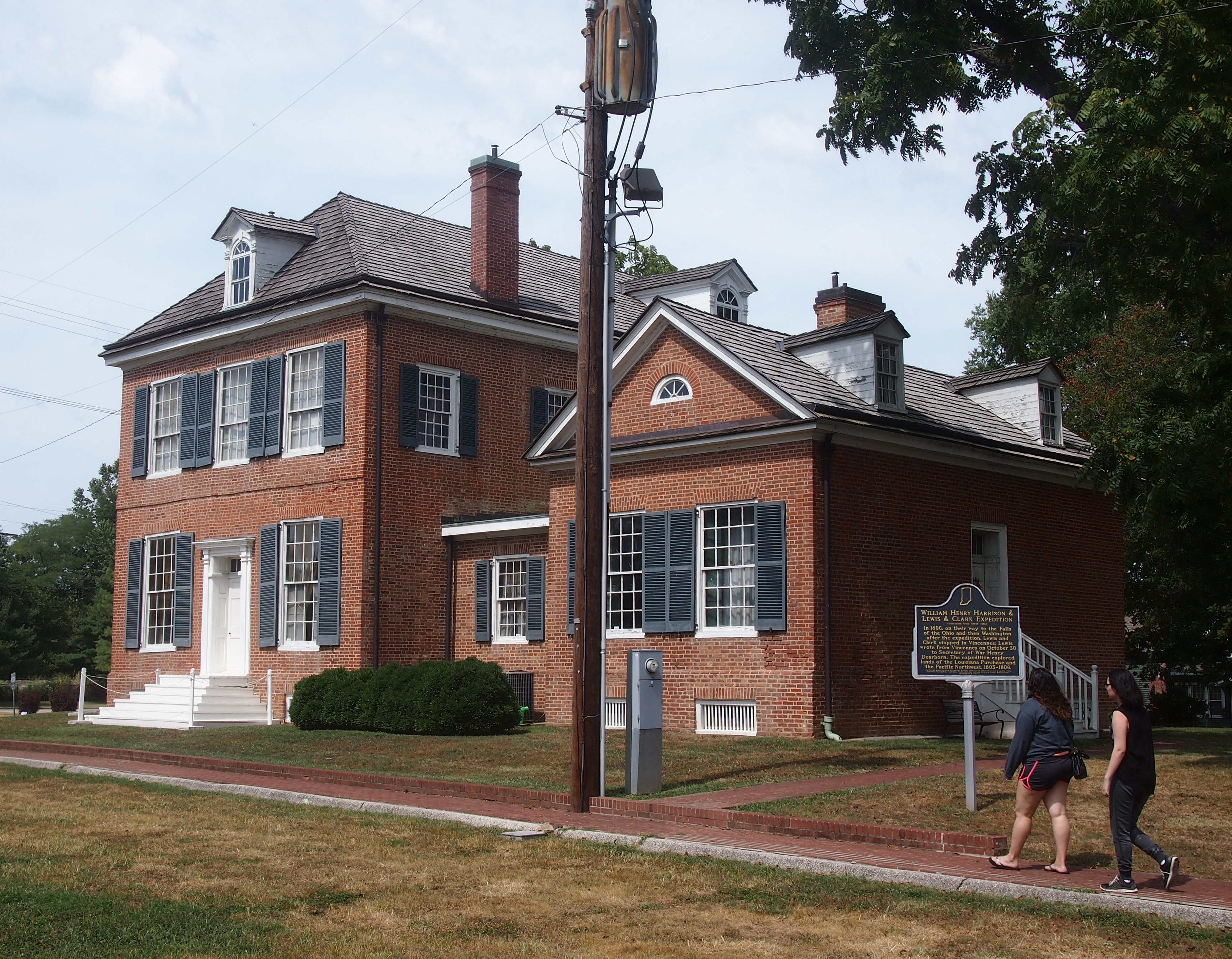
The Frances Willard House Museum & The Levere Memorial Temple

Here’s something I learned last Saturday while making the rounds at Open House Chicago. Learned it in fact at the first place we visited. Namely, the Women’s Christian Temperance Union is still in existence.

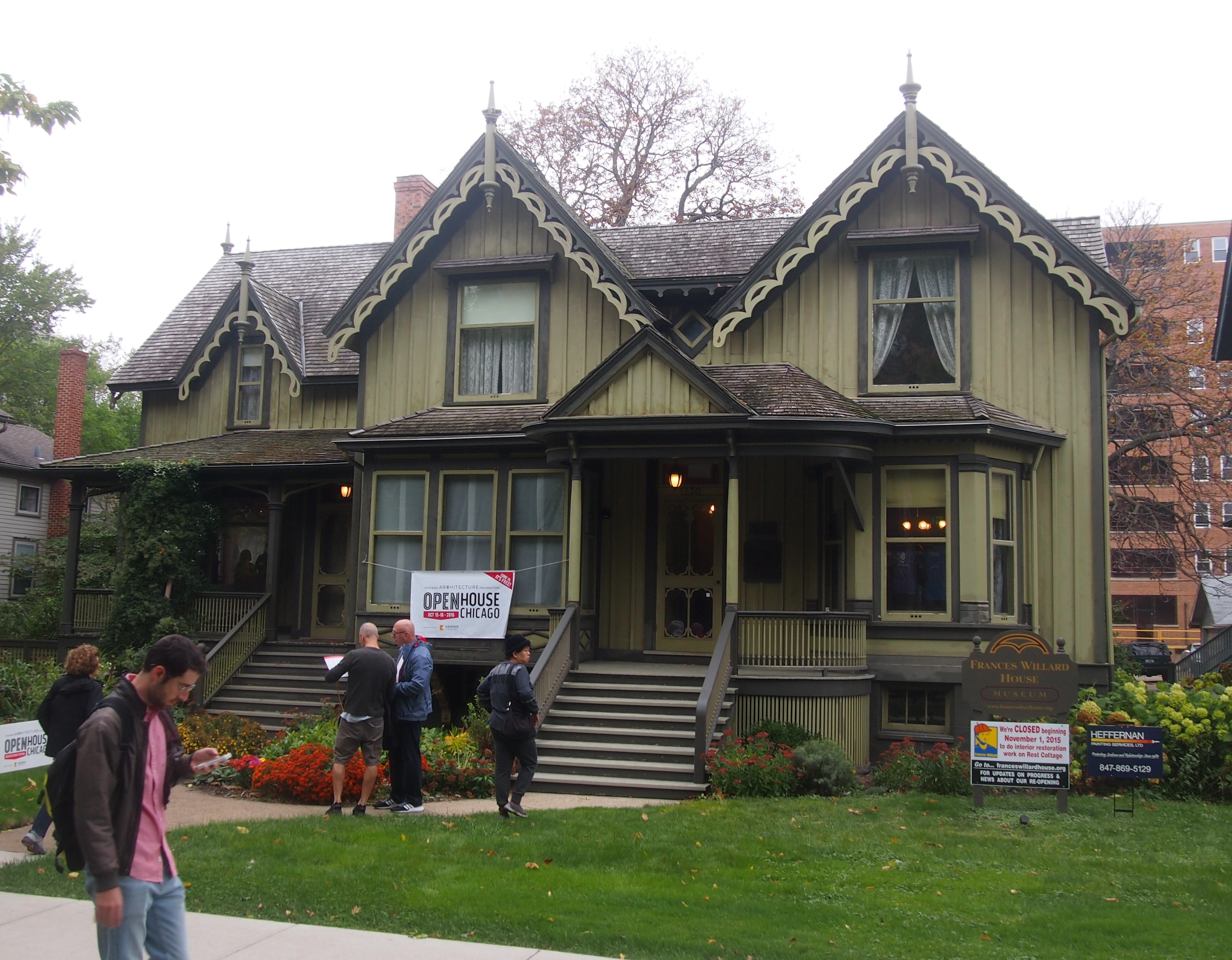
If you’d asked me beforehand, I would have put the WCTU in the same class as the GAR or Godey’s Lady’s Book or Lydia Pinkham’s Vegetable Compound or other things without much purchase beyond the early 20th century. Not only is the WCTU still around, the organization’s HQ is in Evanston, and it owns the Frances Willard House Museum, which is a few blocks south of the Northwestern campus.

Frances Willard House Museum

Frances Willard was one of the founders of the WCTU. As the organization’s web site says, “Willard recognized, developed, and implemented the use of the Woman’s Christian Temperance Union as a political organizing force. Under her leadership, the Union increasingly saw its role as an organization advocating for broad social as well as political change.”

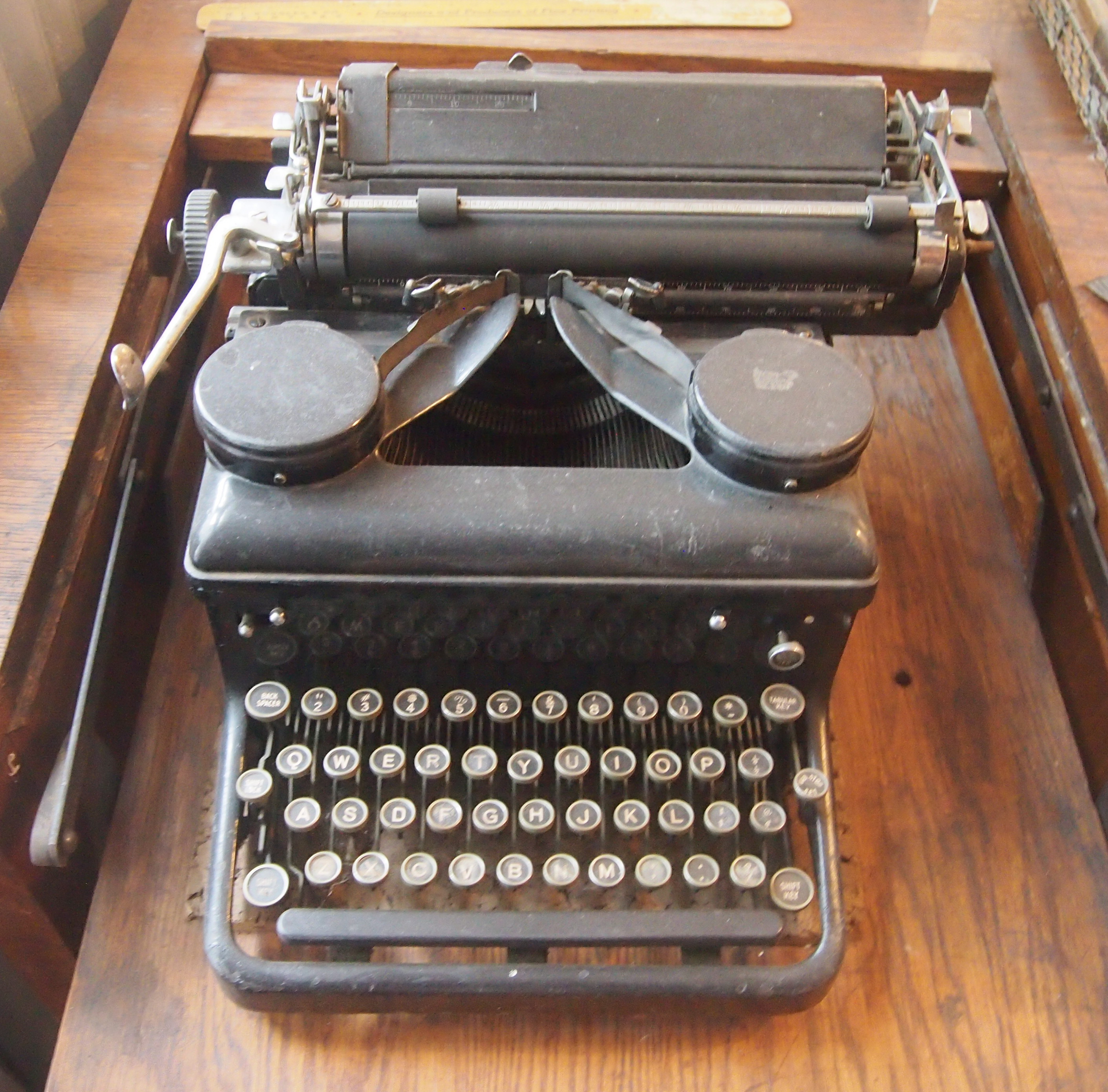
Frances Willard House MuseumThat is, she wasn’t the one who took a hatchet to saloons, but I’m sure she smashed them in other ways. She had a handsome home in Evanston, built in 1865 and made a museum only two years after Willard’s death in 1898. Clearly, the other members of the WCTU held her in high regard. Some artifacts are in place, such as this typewriter.

I like to think Frances Willard banged out some anti-demon rum polemics on it, but I’m not sure it looks old enough to be a late 19th-century machine. Maybe WCTU writers used it later to assure everyone that Prohibition was going swimmingly.

According to the volunteer on hand at the house, the place wasn’t open very much until recently, when it was cleaned and refurbished. Now the museum seems to be actively trying to attract visitors, which must have been the reason it was part of Open House Chicago. All the years I’ve visited Evanston I’d never seen or heard of it. Now I have.

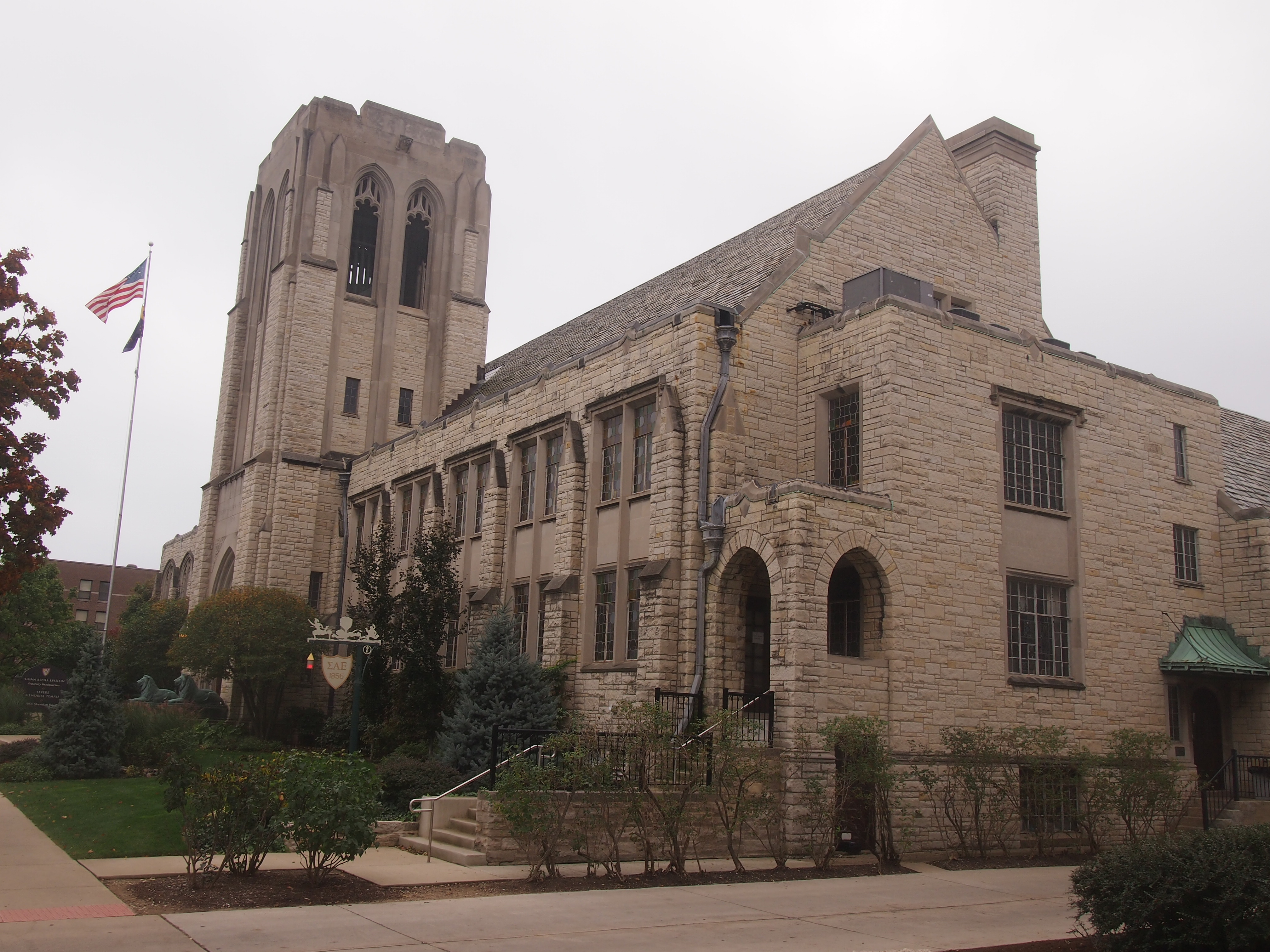
At the other end of the alcohol appreciation spectrum is the national headquarters of Sigma Alpha Epsilon, which is closer to Northwestern — across the street, in fact. It too was part of Open House Chicago.

SAE HQA lot has been written about the SAEs lately, such at Inside Higher Ed, which noted that “there’s nothing quaint about the nicknames SAE has these days — on many campuses people say the initials stand for ‘Sexual Assault Expected’ or ‘Same Assholes Everywhere.’ ” (Then again, if you hold the entire frat responsible for the actions of a few, aren’t you badmouthing the United States of America?)

Whatever else you can say about the SAEs, they’ve got a swell national headquarters building, including a library, museum of frat artifacts, meeting and office space, and elegant chapel, which is called the Levere Memorial Temple. It was designed by Arthur Howell Knox in 1930.

Open House Chicago says of the structure: “This understated Gothic-Revival building sits across from Northwestern’s gate. It was the vision of Billy Levere, a Temperance preacher with a key role in the history of the Sigma Alpha Epsilon fraternity… [temperance again? Maybe there’s a ritual toast to Levere at SAE keggers.]

“It was the first national headquarters building of any fraternity (a use it still serves today). It was also a memorial for the fallen of World War I. A local architect and fraternity member designed the building, including its colorful chapel with a large but uncharacteristic collection of Tiffany windows that narrate the history of America and Sigma Alpha Epsilon.”

The fact that it’s called a “temple” led to some discussion with Yuriko about whether the structure was actually some kind of church — it certainly looks like one, complete with pews, stained glass, religious art, and an altar. No, I offered that whatever the SAEs call it, it’s a chapel. No one meets there regularly for services, after all, and I doubt that it’s been consecrated.

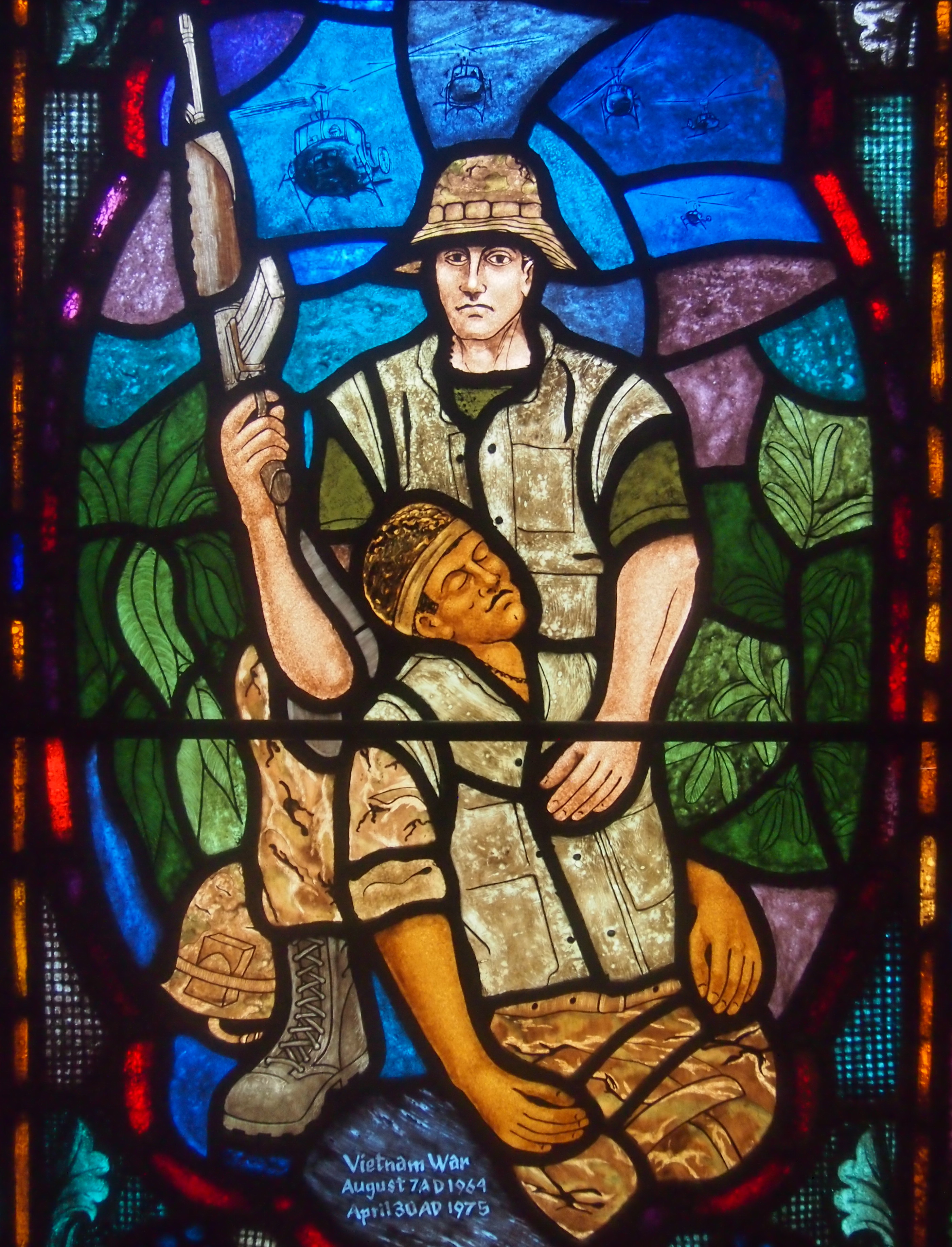
I was interested to see that the stained glass windows on one side started by honoring the soldiers of World War I, but didn’t stop there. In fact, there was a window for Persian Gulf War soldiers.
Levere Memorial TempleAnd Vietnam.
Levere Memorial TempleAnd Korea and WWII, going all the way back to WWI. Behind the altar is stained glass with a Union soldier on the left, a Confederate soldier on the right, and Jesus in between, with Pax Vobiscum on the banner below.

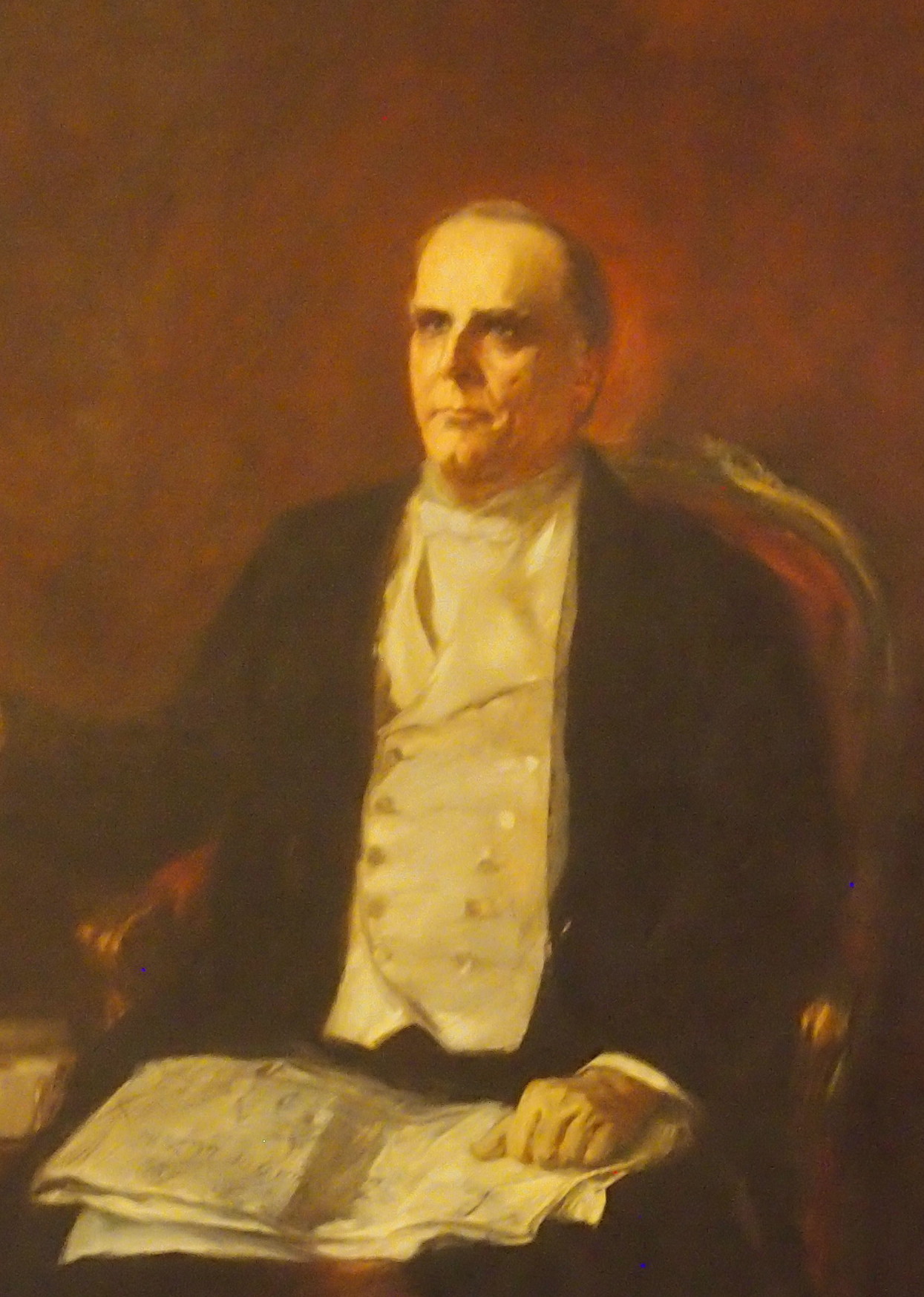
One more thing: hanging on the landing between the first and second floors is a painting of President McKinley.

Levere Memorial TempleHe’s the only U.S. chief executive that the fraternity counts as a member, having joined at Mount Union College during his short time there.

The Pigeons of ’48

Missed the big-hairy-deal debate last night. Nothing either of them could say at this point is going to change my mind. This election has gone on long enough already.

Instead I worked, as I usually do on Monday nights, and late in the evening read for pleasure, as I often do. Currently I’m working my way through 1948 by David Pietrusza (2011), which is about (as the subtitle says), “Harry Truman’s Improbable Victory,” or the story of an election that didn’t go on quite so long, and had its share of surprises. I read Pietrusza’s book about presidential politics in 1920 some time ago, and it was fairly good. So is 1948.

I haven’t been in a hurry to get through 1948, diverting into other books as well, such as a second reading of The Right Stuff (first time was in the early ’90s, and well worth the re-read), and first readings of The Basketball Diaries and Death Comes for the Archbishop. It’s a rare time when I just read one thing all the way through to the exclusion of others. I might even take up News from Tartary soon, since it’s been much too long since I read any Peter Fleming.

1948’s got some interesting detail. Here’s an anecdote about the Democratic National Convention that year that I like: “With the convention running three hours and forty-three minutes behind schedule, [Sam] Rayburn nevertheless undertook one last chore before introducing the exceedingly patient Truman: ‘I want to introduce Mrs. Emma Guffey Miller, Pennsylvania delegate-at-large. She has a surprise for us which I hope the convention will enjoy.’

“The plump, white-frocked, seventy-three-year-old Mrs. Miller, younger sister of former Pennsylvania senator Joseph Guffey, had prepared an elaborate, six-foot-high floral display composed of red and while carnations, in the shape of the Liberty Bell. Imprisoned inside it for several hours were forty-eight caged white pigeons, officially and symbolically designated ‘doves of peace.’ In the horrible heat, a couple had already expired. The band stoked up ‘Hail to the Chief,’ and the surviving birds — crazed by the noise, lights, and the heat — exploded out of the opened ‘Liberty Bell.’

“Pigeons flew into the rafters. They dive-bombed delegates. Men and women shouted, ‘Watch your clothes!’

” ‘Though the press delicately did not mention it,’ noted Clark Clifford (who did), the ‘doves of peace began, not surprisingly, to drop the inevitable product of their hours of imprisonment on any delegate who had the bad luck to be underneath them.’

“Some birds landed on the platform. Rayburn frantically shushed them away. One nearly landed on his glistening, bald head… ‘Get those damned pigeons out of here!’ he screamed over live radio and TV.

” ‘As [Truman] spoke,’ Time reported, ‘pigeons teetered on the balconies, on folds of the draperies, on overhead lights, occasionally launched on a quick flight to a more pigeonly position.’

“Thus, Harry Truman’s choice of a crisp, double-breasted white suit that evening may not have been the wisest choice of the campaign…”

Nevertheless, Truman’s ’48 Democratic Convention acceptance speech famously turned out to be a barnburner: “Senator Barkley and I will win this election and make these Republicans like it — don’t you forget that!”